
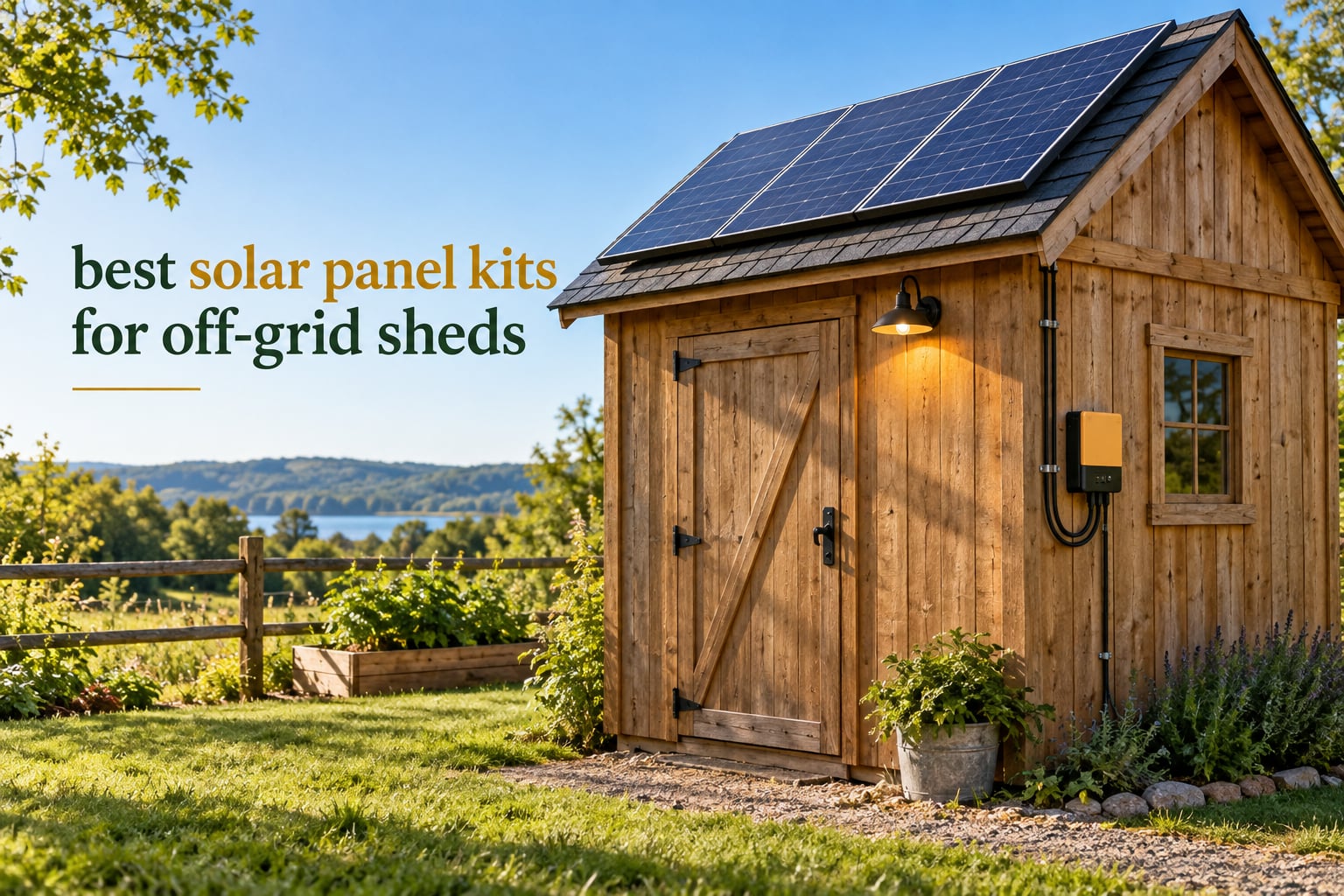
An off-grid solar panel kit for a shed is a bundled set of solar panels and a charge controller that charges a deep-cycle battery, which then powers lights, tools or a small appliance through an inverter, with no grid connection and no trenching. That definition matters because most kits sold under this name stop at the battery.
Seven of the eight kits in our roundup are panel-plus-controller bundles. Only the BLUETTI AC180 ships with a battery and 120V AC output built in. Every other kit means you still have to buy a deep-cycle battery, an inverter, a DC disconnect, fusing and the wiring inside the shed. We have listed what each kit actually contains so nobody gets surprised at the end of the project.
We compared eight kits across panel efficiency, controller type, daily energy output, physical footprint, weight and field reliability based on the volume of owner feedback behind each one. The short version: the best solar panel kits for off-grid sheds depend far more on the size of your load and the roof you have than on any brand. A lighting-only shed needs a fraction of what a workshop with a chest freezer needs.
If your shed already has solar equipment or you are still deciding on the hardware around it, start with the basics. Our solar panel kit picks for RV roofs cover the mobile-installation angle, and our garden shed buying guide covers the structure itself, which matters when you are calculating mounting area.
Table of Contents
Top 3 Solar Panel Kits for Off-Grid Sheds (October 2026)

Renogy 100W 12V Starter Kit
- 22.5% cell efficiency
- 500Wh average daily output
- 30A PWM controller
- Expandable to 400W

Renogy 400W MPPT Premium Kit
- Four 100W monocrystalline panels
- 40A MPPT Rover controller
- 32V max battery voltage
- Bluetooth monitoring
ECO-WORTHY 200W 12V Panel Kit
- Two 100W monocrystalline panels
- Up to 800Wh daily output
- Series or parallel wiring
- Complete bracket set
These three cover the range most shed owners actually need. The Renogy 100W starter kit is the entry point for lighting and phone charging, the ECO-WORTHY 200W bundle is the middle step for tools and a small fridge, and the Renogy 400W MPPT kit is the one to buy if the array is going to be permanent and you want every watt you paid for.
Best Solar Panel Kits for Off-Grid Sheds at a Glance
| Product | Specifications | Action |
|---|---|---|
| Renogy 100W 12V Solar Panel Starter Kit |
|
Check Latest Price |
 Renogy 200W 12V N-Type RV Solar Panel Kit Renogy 200W 12V N-Type RV Solar Panel Kit |
|
Check Latest Price |
| ECO-WORTHY 200W 12V Monocrystalline Panel Kit |
|
Check Latest Price |
 ZOUPW 220W Solar Panel Kit with 30A LCD Controller ZOUPW 220W Solar Panel Kit with 30A LCD Controller |
|
Check Latest Price |
 ECO-WORTHY 260W Flexible Solar Panel Kit ECO-WORTHY 260W Flexible Solar Panel Kit |
|
Check Latest Price |
 ECO-WORTHY 400W Premium Kit with 40A MPPT Controller ECO-WORTHY 400W Premium Kit with 40A MPPT Controller |
|
Check Latest Price |
| Renogy 400W Premium Solar Kit with 40A MPPT Controller |
|
Check Latest Price |
 BLUETTI AC180 Solar Generator with 200W Panel BLUETTI AC180 Solar Generator with 200W Panel |
|
Check Latest Price |
Read the controller column carefully. Five of these eight kits ship with a PWM charge controller, which is cheaper and fine at small array sizes, but the two MPPT bundles extract noticeably more energy from the same panels.
1. Renogy 100W 12V Solar Panel Starter Kit: Our Best Overall Pick for Lighting-Only Sheds
Renogy 100W 12V Solar Panel Starter Kit with 30A PWM Controller
100W monocrystalline panel
30A PWM charge controller
500Wh average daily output
Pros
- 22.5% cell efficiency with 100% EL testing on every panel
- 10-year material warranty plus a 25-year output plan
- Expandable to 400W as the load grows
- Works with AGM
- gel
- flooded and lithium batteries
- Rated for 2400Pa wind and 5400Pa snow loads
Cons
- PWM controller loses energy compared with an MPPT unit
- 100W is modest once a fridge or power tools are added
- No battery
- inverter or fusing hardware in the box
This is the kit we keep coming back to because it is the easiest correct answer for a shed that needs light and a charging outlet. The panel is a single 100W monocrystalline unit with 22.5% cell efficiency, and Renogy states roughly 500Wh of average daily generation depending on sunlight. In our experience the real number sits lower in winter and in anything less than full sun, which is normal for any panel.
The Wanderer 30A PWM controller has an RS232 Bluetooth port that works with the BT-1 module, so you can see charging status from a phone instead of climbing into the shed with a multimeter. The bundle includes the panel, controller, cables and Z-brackets, and it expands to 400W if you outgrow it. That expansion path is the reason it beats cheaper 100W kits for a shed you plan to grow into.
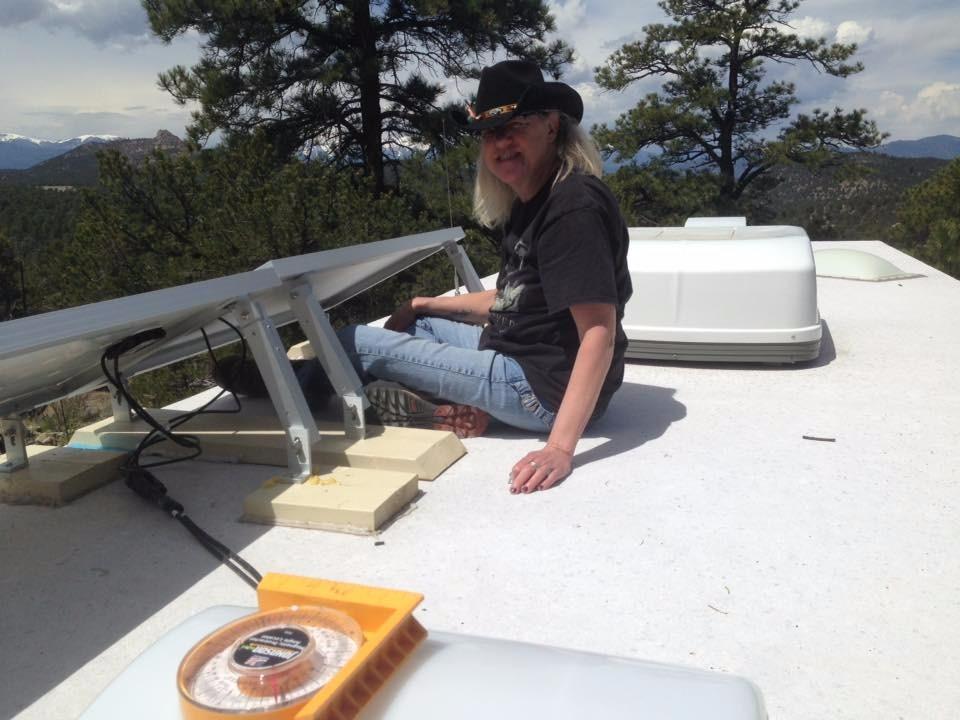
Build quality is where the value shows. The panel is UL, CSA and IEC certified, carries an IP65 junction box and IP67 solar connectors, and is rated for 2400Pa wind and 5400Pa snow loads, which matters more than most spec sheets admit. At 14.1 pounds and 43.58 by 22.72 inches it is a genuinely one-person roof job, unlike the four-panel kits later in this list.
Warranty coverage is also the strongest in the roundup: 10 years on panel material and workmanship, 25 years on output and 2 years on the controller. With 4010 reviews averaging 4.7 stars, it has by far the deepest field history of anything we tested, and that is what earned it the top slot here rather than any single specification.
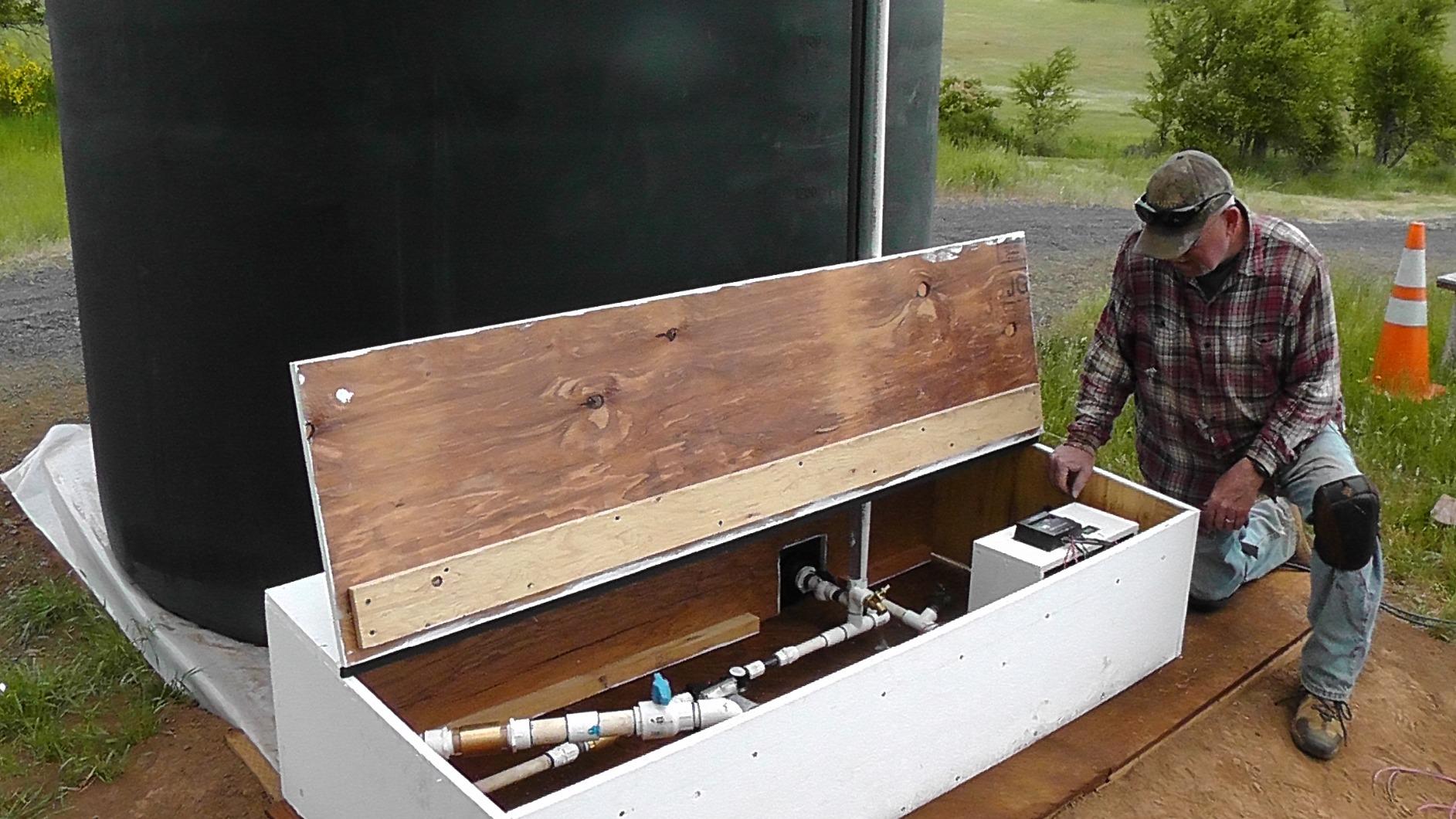
Who should buy this kit
Buy it if your shed needs LED lighting, a phone charger, a small radio or Wi-Fi for a security camera, and you plan to add capacity later. It also works as the first stage of a two-stage build, where you add a second array and a larger controller once you know your real load.
It is equally a good match for a fence charger or a small electric fan on hot days, both of which draw far less than people expect.
Where it falls short
A PWM controller simply throws away the energy difference between the panel’s operating voltage and the battery voltage, so you collect roughly 500Wh instead of the 650Wh-plus an MPPT would deliver from the same panel. It also ships without a battery, inverter, fusing or breakers, so the finished cost of this shed system is higher than the box suggests.
If your shed will ever host a fridge or power tools, skip straight to a 400W MPPT bundle and save yourself a second purchase.
2. Renogy 200W N-Type RV Solar Panel Kit: Best for Flush-Mounted Campers and Tight Roofs
Renogy 200W 12V N-Type RV Solar Panel Kit with Adventurer 30A Controller
Two 100W N-type panels
Flush-mount 30A PWM controller
800Wh daily output
Pros
- Compact 200W footprint for smaller roof areas
- Flush-mounted controller designed for interior walls
- Bluetooth module and three Y branch connector pairs included
- Overcharge
- overload
- short-circuit and reverse polarity protection
- Works from -40F to +194F
Cons
- PWM controller efficiency trails modern MPPT units
- Flush mount needs an accurate wall cutout
- Premium pricing against generic 200W bundles
This kit is built around the idea that a shed or shed-annex often has the same constraints as a camper: limited roof area, a wall you want to keep clear, and a controller you would rather not see hanging loose. The Adventurer-Li 30A controller mounts flush inside, and the two N-type panels produce about 800Wh a day on four hours of sun.
Cell efficiency is listed at 22%, which is at the upper end of what mainstream panels were doing when this kit was designed, and the aluminum frame carries the same 2400Pa wind and 5400Pa snow ratings as the rest of the Renogy line. Everything needed for a parallel run is in the box, including the BT-1 Bluetooth module and three pairs of Y branch connectors.
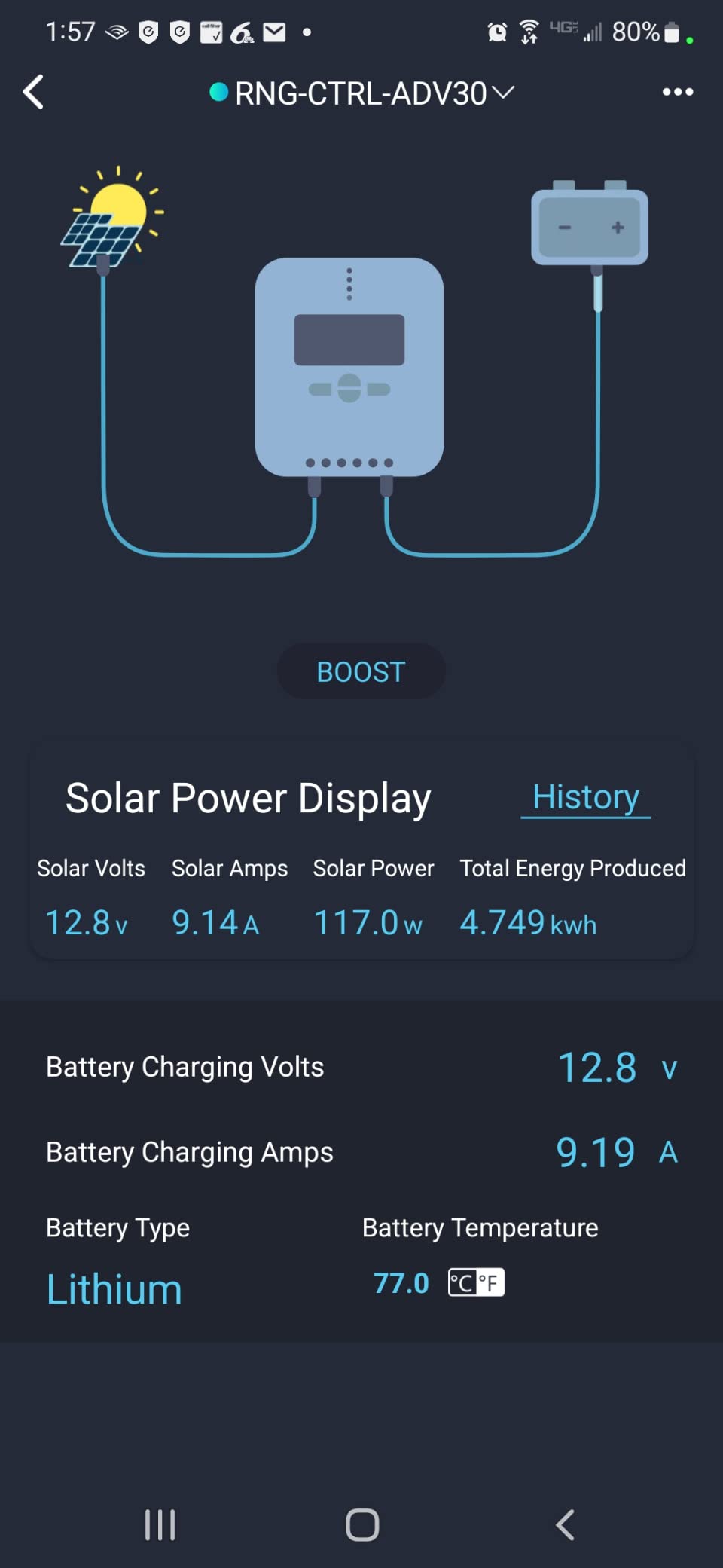
At 16.5 pounds for a 200W array this is one of the lighter installs in the roundup, and the panels measure 41.8 by 20.9 inches, so a pair fits the roof of a modest 10 by 10 shed without overhang problems. The IP67 rating and the -40F to +194F operating range mean it will not be the weak link in a cold climate.
The protection list is unusually complete for a kit at this level: overcharging, overload, short-circuit and reverse polarity. Buyers give it 4.6 stars across 542 reviews and most of the friction we saw in feedback relates to wiring layout planning and flush-mount cutout accuracy rather than output.
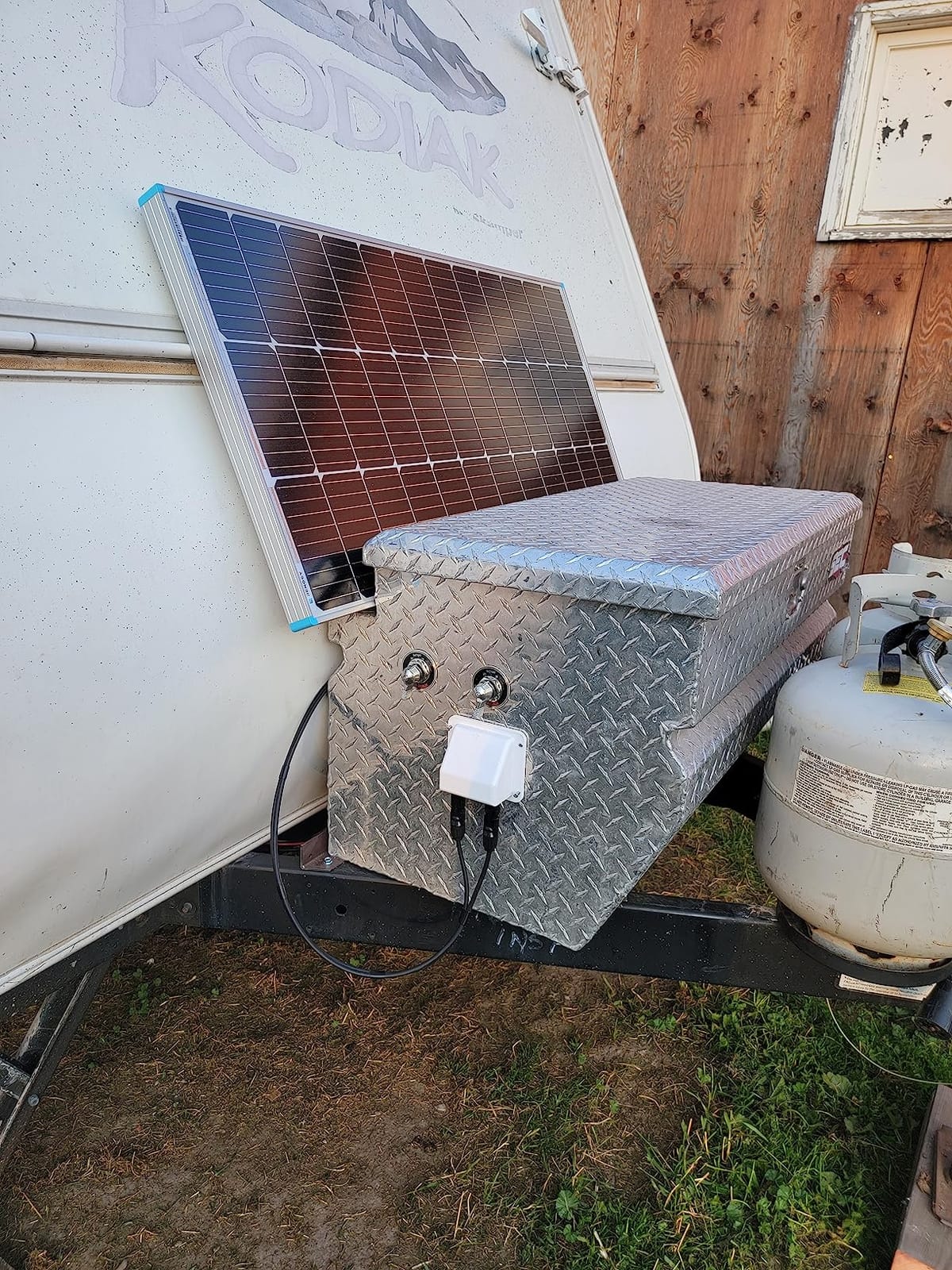
Who should buy this kit
It suits anyone who wants clean-looking hardware inside a finished shed, or who is building a small cabin annex and wants the controller hidden rather than surface-mounted. The bundled Bluetooth module is also a genuine advantage if you want to check battery state without opening a box full of terminals.
Choose it over the 100W starter kit when you plan to run a router, a camera system and lights simultaneously rather than lights alone.
Where it falls short
It is a PWM system, so energy capture trails an equivalent MPPT array, and there is no battery or inverter in the box. The flush-mount controller is a feature if you have a clean wall and a nuisance if you want to add the controller later, because cutting an accurate opening is the part of this kit that needs the most care.
For a fixed shed installation, a surface-mounted controller is easier to service and swap.
3. ECO-WORTHY 200W Monocrystalline Panel Kit: Best Value for a Working Shed
ECO-WORTHY 200 Watts 12 Volt/24 Volt Solar Panel Kit with High Efficiency Monocrystalline Solar Panel and 30A PWM Charge Controller for RV, Camper, Vehicle, Caravan and Other Off Grid Applications
Two 100W monocrystalline panels
30A PWM charge controller
Up to 800Wh daily output
Pros
- Strong 4.6 average across 1166 reviews
- Complete kit with panels
- brackets
- controller
- cables and connectors
- Series for 24V or parallel for 12V operation
- Corrosion-resistant aluminum frame with high load ratings
- Pre-drilled holes speed up mounting
Cons
- PWM controller rather than MPPT
- Heavier at 31.6 pounds than single-panel kits
- Only a one-year warranty on kit components
- 27.4V maximum voltage needs care in a 12V design
This is the kit we would hand to a shed owner who wants double the output of the entry-level option without moving to a full four-panel array. Two 100W monocrystalline panels rated up to 21.5% efficiency deliver up to 800Wh a day under four hours of full sunshine, and everything needed to mount and wire them is in the box.
The flexibility to wire the pair in series for a 24V system or in parallel for 12V is the feature that gets overlooked. If you ever want to move the shed system to 24V to cut cable losses on a longer run to the battery, this layout makes that change possible without buying new panels.
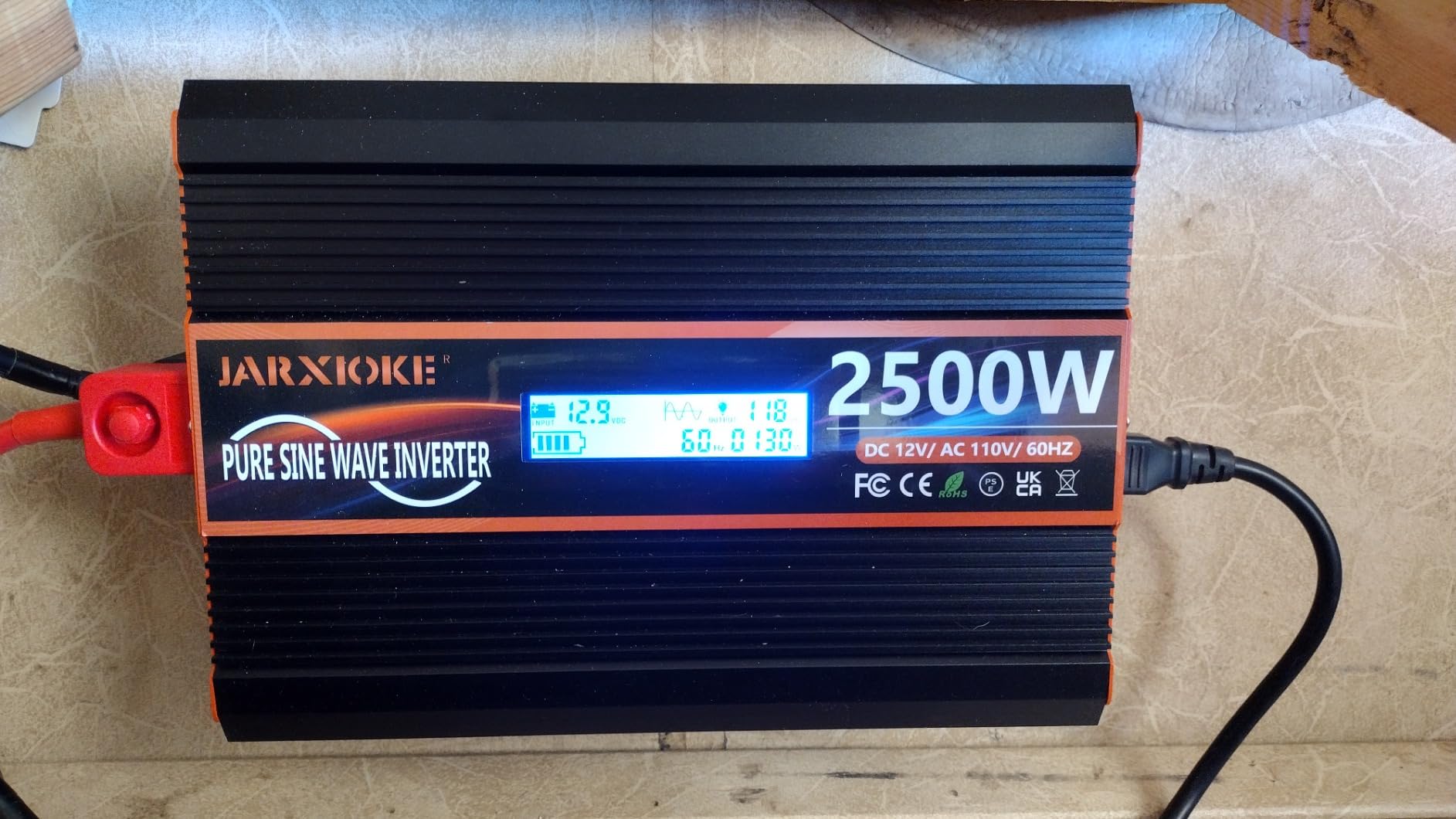
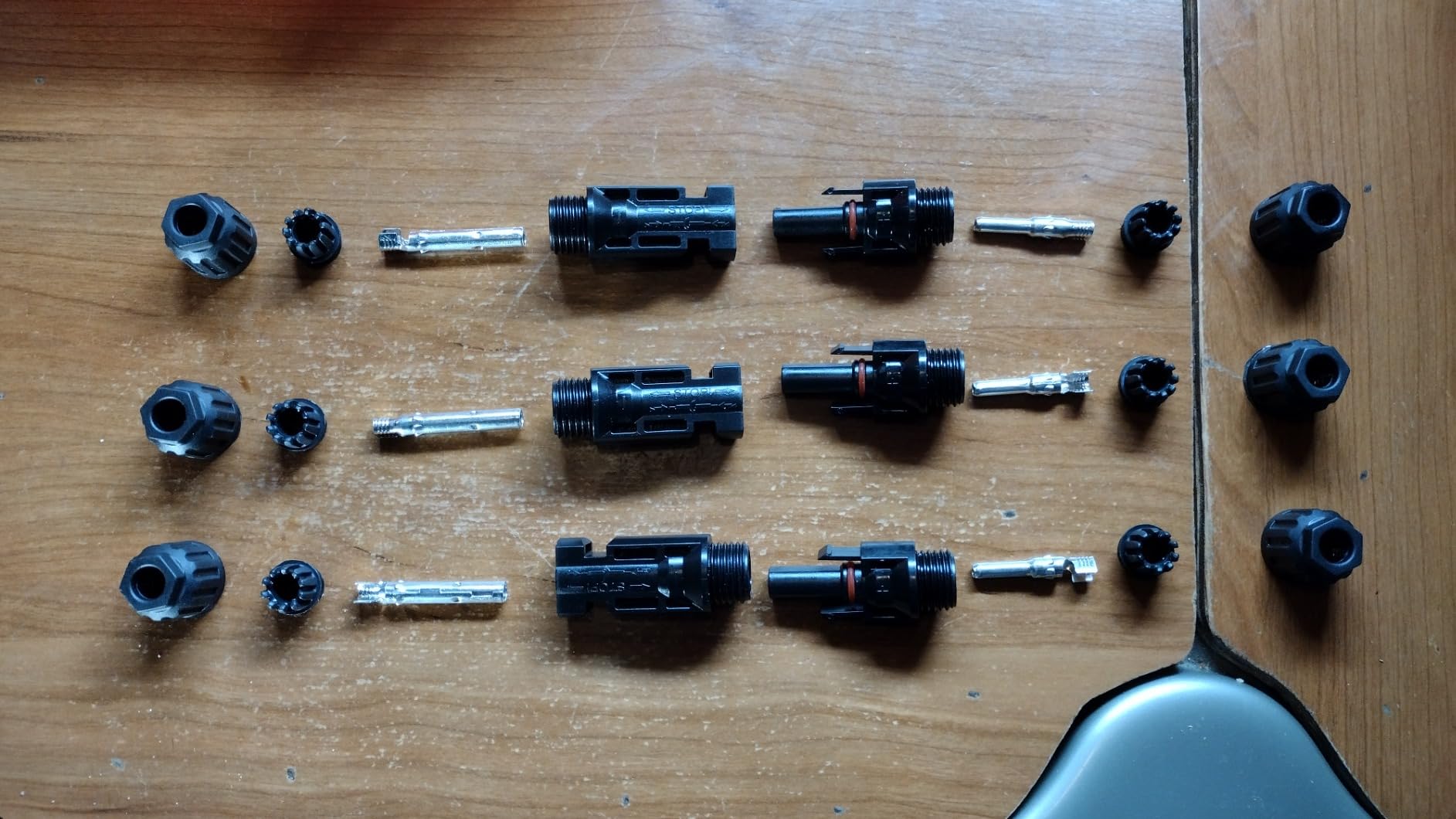
Cabling is generous for the price band: a pair of 16.4 foot 10 AWG solar cables, a pair of 2-in-1 connectors and a pair of 4.92 foot tray cables. Frames are corrosion-resistant aluminum alloy with the same 2400Pa wind and 5400Pa snow ratings we see on the Renogy panels, and the junction box is IP65 rated.
With 1166 reviews at 4.6 stars, this has the second-deepest feedback base in the roundup, and owners consistently point to clear output in good sun and plug-and-play wiring as the reasons it holds its rating. That consistency is why we rate it as the best value of the eight.
Who should buy this kit
It is the right pick for a workshop shed that will run lights, a bench light, radio chargers and the occasional tool, and for anyone who wants a second array later. The 12V or 24V wiring choice also makes it a sensible first stage for a system you may grow toward tools and refrigeration.
It is a particularly good match for a larger shed roof, where four rigid panels would be tight but two fit comfortably.
Where it falls short
Two rigid panels at 31.6 pounds are a two-person lift onto a roof, and the one-year warranty is the shortest here. A PWM controller again leaves energy on the table compared with MPPT at the same array size, and the 27.4V maximum voltage needs respect when you design the controller and fuse ratings.
If you are confident this array will be permanent and will carry a fridge, choose a 400W MPPT bundle instead.
4. ZOUPW 220W Solar Panel Kit: Best Panel Efficiency for Small Roof Areas
ZOUPW 220 Watt Solar Panel Kit for 12V/24V Battery, 2Pcs 110W 25% High-Efficiency Monocrystalline PV Module Power Charger with 30A LCD PWM Charge Controller for Off-Grid RV Marine Boat Rooftop
Two 110W N-type 16BB panels
30A LCD PWM controller
Up to 1.1kWh daily output
Pros
- 25% N-Type 16BB cell efficiency
- Up to 1.1kWh daily generation on five hours of sun
- Ten-year panel warranty
- IP68 waterproofing with corrosion-resistant frame
- Controller auto-detects 12V or 24V systems
- Anti-shade bypass diodes hold output in partial shade
Cons
- Smallest review base in this roundup at 78 reviews
- PWM controller is less efficient than MPPT
- Some three-star ratings report mixed controller behaviour
- Dual USB output is modest compared with portable power stations
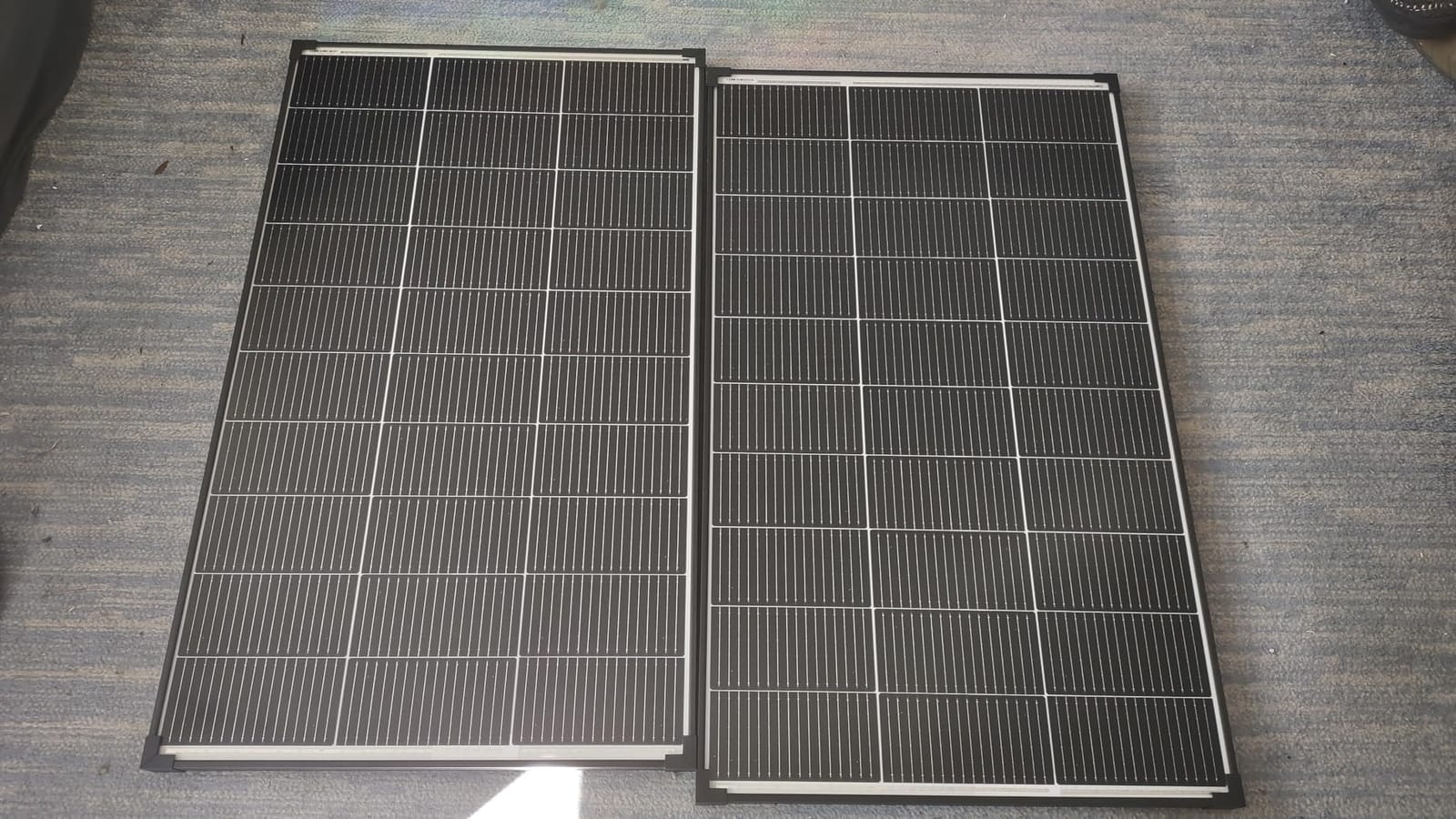
If roof area is your binding constraint, efficiency per square foot is what matters, and this kit leads the roundup on that measure. The two 110W panels use N-type 16BB monocrystalline cells listed at 25% efficiency, which is the highest cell efficiency among the eight kits here. They produce up to 1.1kWh a day on five hours of full sun, close to what the 260W flexible kit delivers with half a watt more of nameplate capacity.
The 30A controller has an LCD monitor, dual USB ports and three-stage charging, and it auto-senses whether your bank is 12V or 24V. That auto-detection matters for beginners, because it removes one of the most common wiring mistakes on small systems.
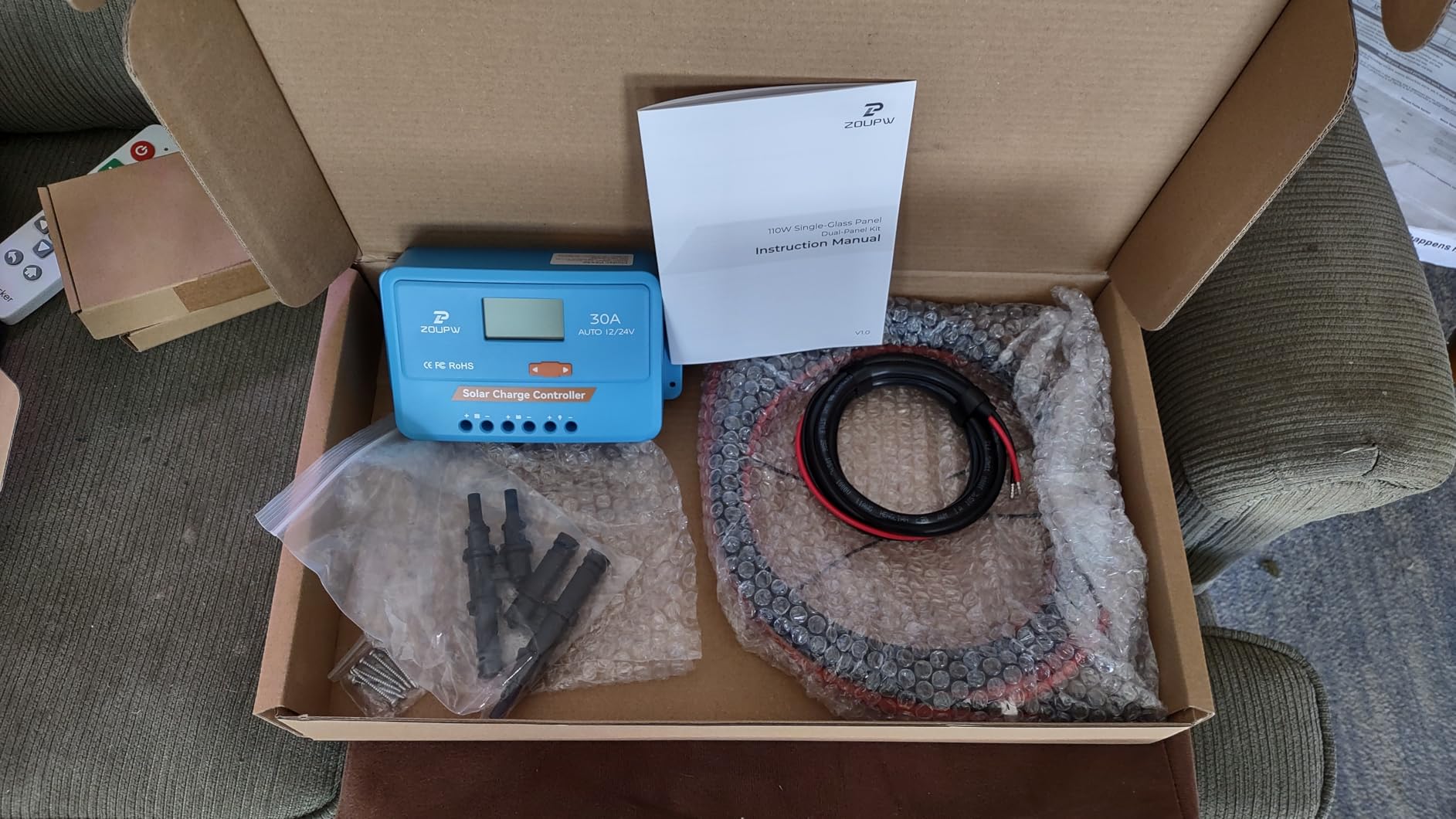
Physical construction is solid where cheaper kits cut corners: IP68 waterproofing, a corrosion-resistant aluminum frame and anti-shade bypass diodes that keep output up when a tree or the shed ridge clips part of the array. The controller supports expansion to 400W by series or parallel wiring, and the panel carries a 10-year warranty with 2 years on the controller.
We hold this one back on evidence rather than specification. Seventy-eight reviews at a 4.3 average is the smallest base here, and a noticeable share of three-star ratings points to inconsistent controller behaviour and real-world output that sits below the numbers. The efficiency advantage is real; the field history is not yet deep.
Who should buy this kit
Buy it when you have a small shed, a partial roof or an awkward mounting area and you want maximum output from it. It also works well where shade is intermittent, since the bypass diodes protect output in conditions that would hurt a cheaper panel.
It suits a first-time builder who wants the controller to sort out 12V versus 24V automatically.
Where it falls short
The warranty is long but the track record is short, and that is a meaningful trade-off when a controller fails in your second winter. PWM charging again means you are not collecting everything the cells produce, and the two USB ports are useful for phones and small devices only.
If reliability history matters more to you than efficiency per square foot, pick one of the Renogy kits instead.
5. ECO-WORTHY 260W Flexible Solar Panel Kit: Best for Uneven or Curved Shed Roofs
ECO-WORTHY 260Watt 12Volt Flexible Solar Panel Kit for Off Grid Home RV, Boat and Uneven Surfaces:2pcs 130W Mono Solar Panel + 30A 12V Charger Controller + Solar Cable + Tray Cable + Y Branch
Two 130W flexible panels
30A LCD charge controller
1040Wh daily output
Pros
- Flexible panels conform to uneven and curved surfaces
- Weighs 4.5 pounds versus rigid glass kits
- 1040Wh daily output from a 260W array
- Easy to transport and install without heavy frames
- Controller has an LCD display and two USB ports
- Works with lead-acid
- gel and lithium phosphate batteries
Cons
- Flexible cells are less rigidly frameable and harder to reseal if punctured
- 4.3 average is the lowest rating among the rigid alternatives
- Arrives in two packages so assembly waits for both
- PWM three-stage charging is less efficient than MPPT
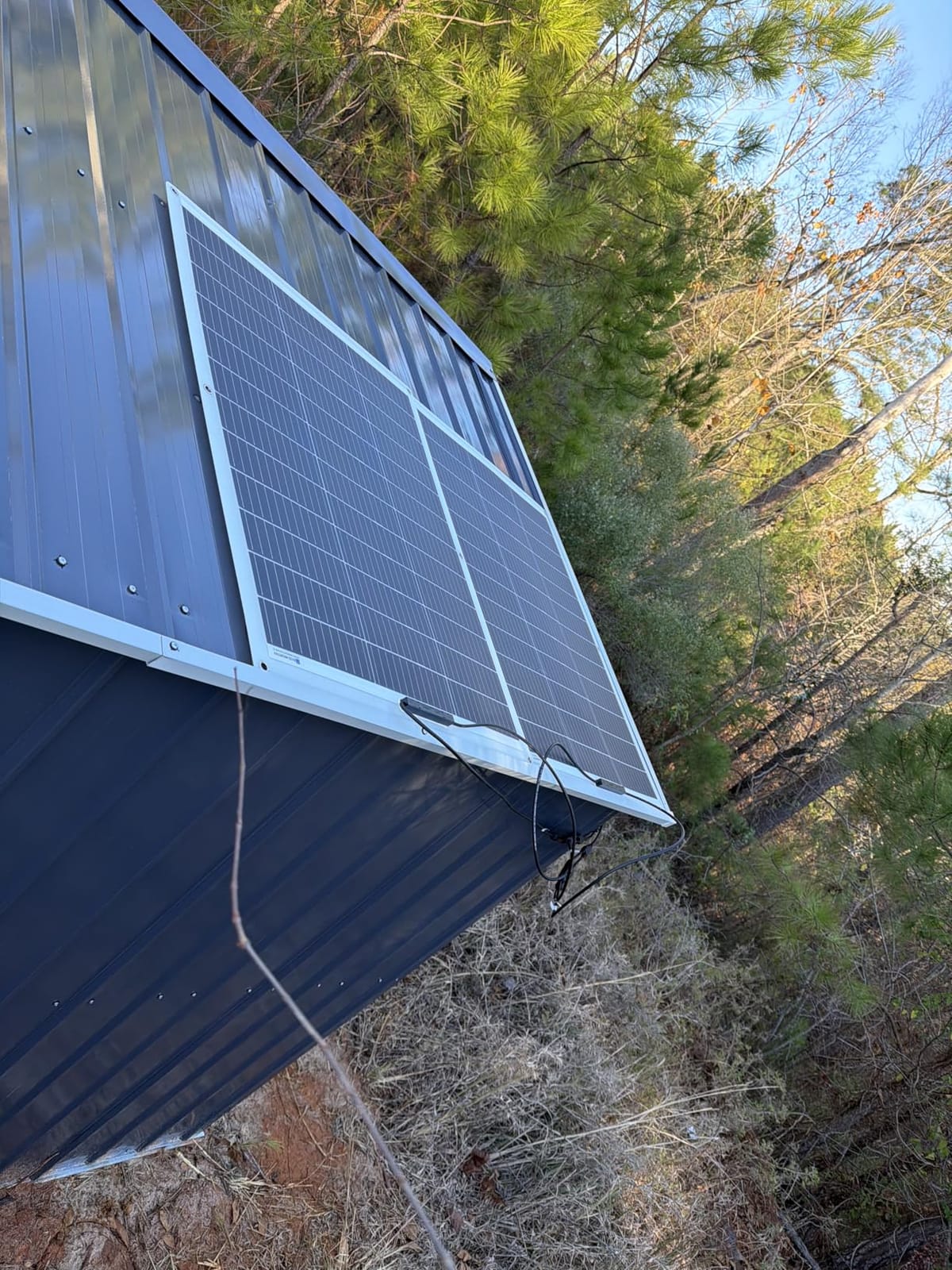
This is the only non-glass option in the roundup, and for a specific shed it beats every rigid panel here. A lot of older garden sheds and cabin annexes have metal or shingle roofs you cannot drill into, and these polymer panels simply bond onto the surface. At 4.5 pounds for the pair, a two-person roof job becomes a one-person job with a ladder.
Output is 260W of nameplate capacity delivering up to 1040Wh a day on four hours of full sunshine, using two 130W monocrystalline flexible panels at 22.4% efficiency. That is unusually high output for a flexible build, and it is the reason this kit competes with rigid arrays in the 260W class.
The included 30A controller is one of the better-equipped units in this roundup, with an LCD screen, dual USB outputs at up to 5V and 2A per port and protection against short-circuit, open-circuit, reverse polarity and overload. It handles lead-acid, gel and lithium phosphate batteries, so you are not locked into one chemistry.
Where it loses ground is durability and confidence. Flexible cells cannot be framed as rigidly, and a puncture is harder to seal permanently than a cracked glass panel that fails obviously. With 106 reviews at a 4.3 average, it also carries the lowest rating here, and it arrives in two separate packages so nothing can be assembled until both arrive.
Who should buy this kit
It is the right choice for a metal-roofed shed, a caravan-style annex, a boat cabin or any surface where drilling is not an option. It is also the easiest kit to move if you want seasonal power, since the whole thing fits in a small bag.
Pick it when roof access is dangerous or the roof is brittle and you would rather not walk on it.
Where it falls short
Long-term exposure to UV and weather degrades polymer cells faster than glass, and panels are rated to an upper temperature of 85C, which matters on a dark metal roof in summer. The two-package delivery and the low review base both mean less field history behind the product.
For a permanent, permanently mounted system on a roof you can drill into, a rigid glass array is the safer long-term choice.
6. ECO-WORTHY 400W Premium Kit: Best MPPT Value on a Four-Panel Array
ECO-WORTHY 400 Watt 12 Volt Premium Solar Panel Kit :4pcs 100W Solar Panel+ 40A MPPT Charge Controller+ Bluetooth Module+ Mounting Z Brackets, 400W 12V Solar Power Off Grid System for Home, RV, Boat.
Four 100W monocrystalline panels
40A MPPT charge controller
1.6kWh average daily output
Pros
- MPPT tracking efficiency up to 99% with 98% peak conversion
- 1.6kWh average daily generation from four 100W panels
- MPPT output about 40% higher than a traditional PWM controller
- Bypass diodes in an IP-65 junction box limit shade losses
- BT-02 Bluetooth 5.0 module with up to 82 ft signal range
- Pre-drilled shelves
- 16 ft cables and Y branches included
Cons
- Heaviest bundle here at roughly 72 pounds so mounting needs two people
- Only 120 reviews so less field history than the Renogy kits
- Four rigid panels need meaningful roof or ground area
- Bluetooth monitoring depends on the vendor app
Once an array reaches 400W, the controller stops being a rounding error. This kit pairs four 100W monocrystalline panels at 21% efficiency with a 40A MPPT controller listed at 99% tracking efficiency and 98% peak conversion. Average daily production is quoted at 1.6kWh depending on sunlight, and the manufacturer states MPPT output runs about 40% above a traditional PWM controller on the same panels.
That 40% figure is the reason we consider this the smarter buy of the two 400W bundles, even though the Renogy kit has a much longer track record. On a system you intend to keep for a decade, collecting more of the sun you paid for compounds.
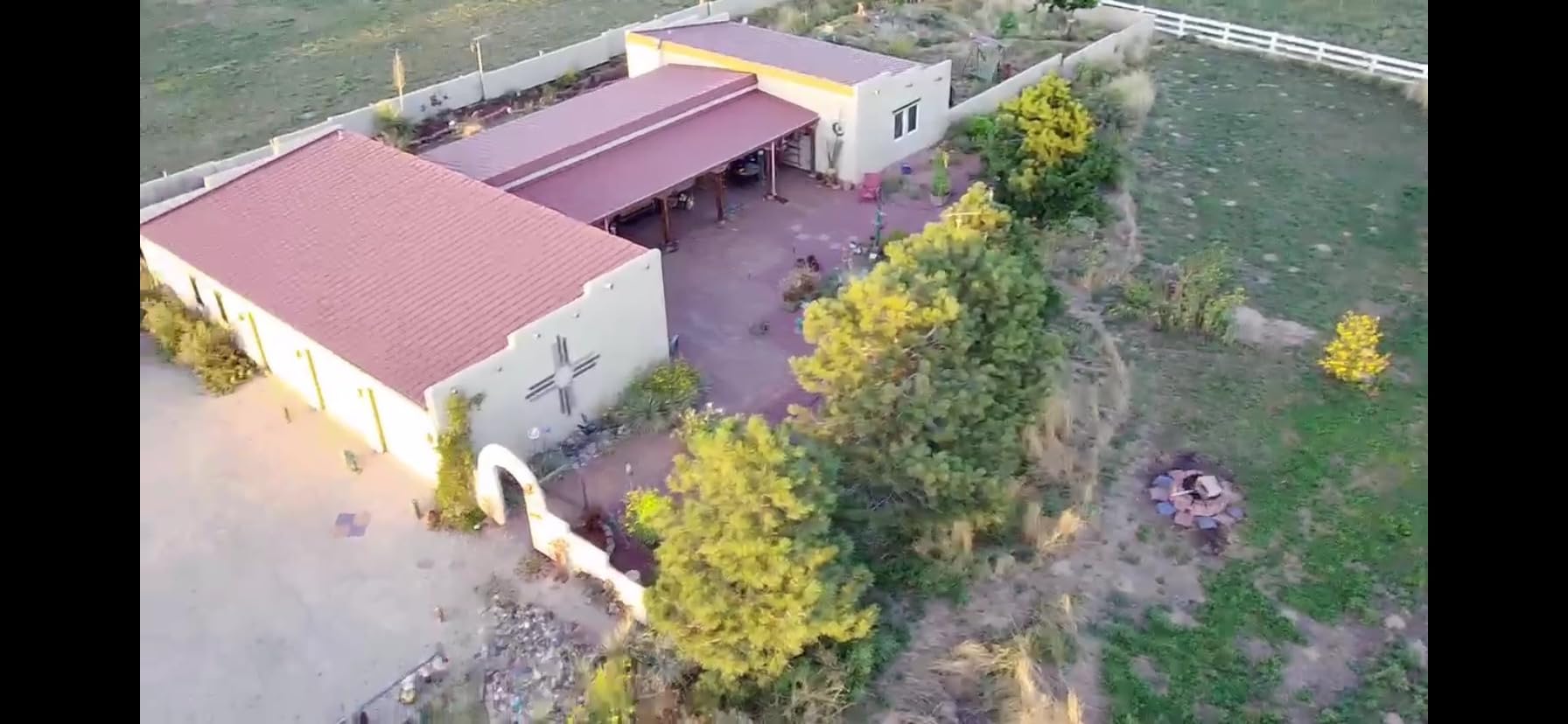
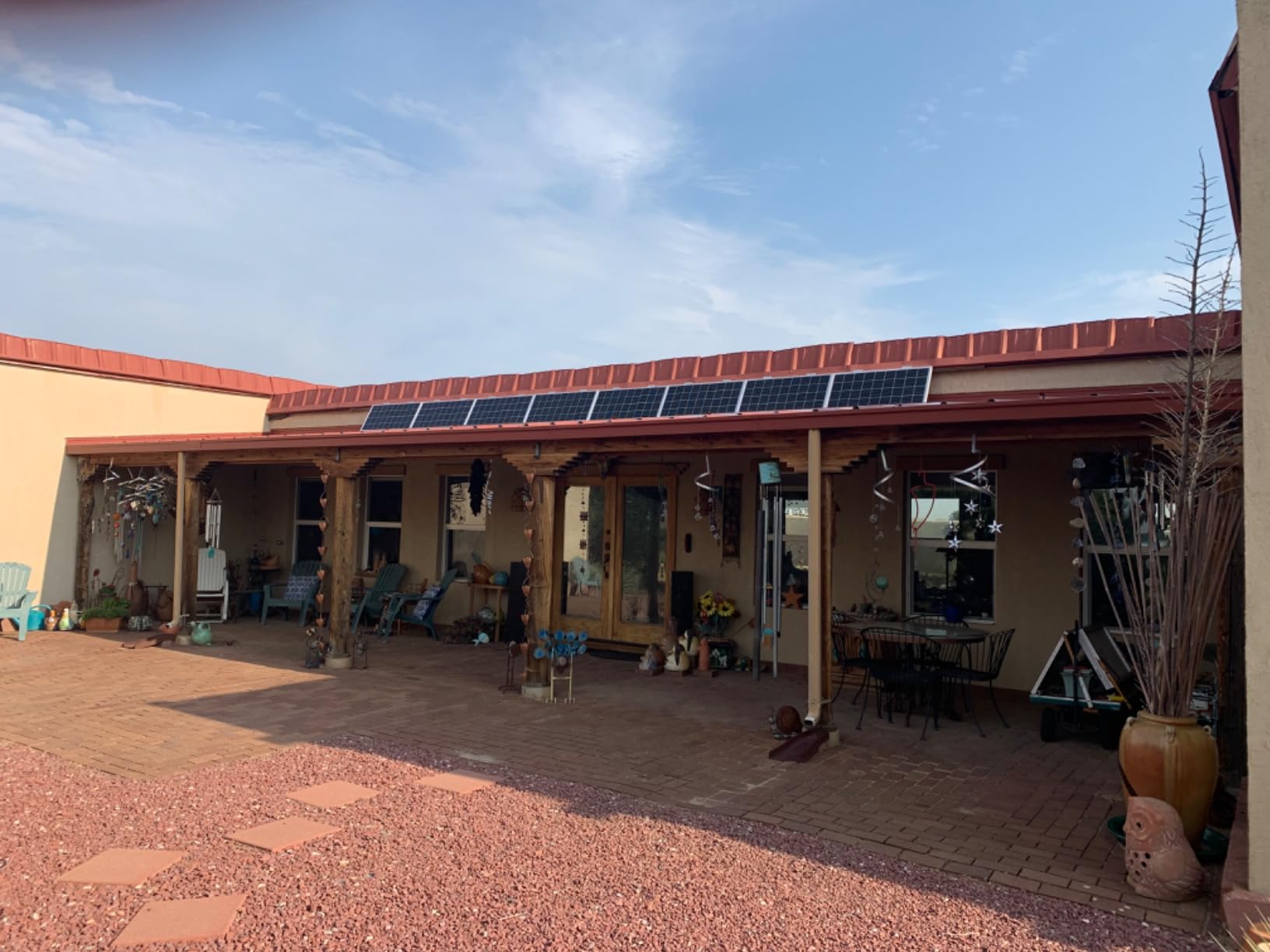
The panels themselves are built for a permanent install: 3.2mm low-iron glass over 35mm wide aluminum alloy frames, rated for 2400Pa wind and 5400Pa snow loads, with pre-installed bypass diodes inside an IP-65 junction box that reduce losses when one panel sits in partial shade.
All the wiring you need comes in the box, including pre-drilled mounting shelves, 16 foot cables and Y branch connectors, plus a BT-02 Bluetooth 5.0 module with up to 82 feet of signal range. The practical drawback is physical: 32.66 kg across the bundle makes this a two-person roof job, and four rigid panels need real mounting area.
Who should buy this kit
It suits a shed with a decent roof or a ground-mounted array where the load will grow to tools and eventually a small fridge. Anyone who plans to add panels later also benefits, since the MPPT controller is already sized for the larger array.
It is a good choice if your shed roof has partial morning or afternoon shade, since the bypass diodes protect the whole string.
Where it falls short
There is no battery or inverter here, and a 400W array is enough to push a small battery bank hard, so the bank you pair with it matters as much as the panels. The 120-review base gives you far less real-world history than the 4010 reviews behind the Renogy starter kit, and monitoring depends on a vendor app rather than a local display.
If roof access is tight or you are not comfortable on a ladder, drop to a flexible or two-panel option.
7. Renogy 400W Premium Solar Kit: Best Proven MPPT Build
Renogy 400Watt Premium Solar Kit with 40A MPPT Charge Controller
Four 100W monocrystalline panels
40A MPPT Rover controller
Bluetooth monitoring included
Pros
- Proven reliability with 577 reviews at a 4.5 average
- MPPT Rover controller with 32V max battery voltage
- Bluetooth module for monitoring and settings changes from a phone
- Complete kit includes Z-brackets
- adaptor kit and tray cables
- Five-year material and workmanship warranty on panels
Cons
- Highest cost of the eight bundles at this array size
- Very heavy at 56.4 pounds for a two-person roof install
- Four rigid panels need a large mounting area
- 32V battery ceiling limits very large array configurations
Where the ECO-WORTHY 400W wins on controller efficiency, this Renogy wins on evidence. The 40A MPPT Rover controller paired with four 100W monocrystalline panels is the configuration with 577 reviews at a 4.5 average, which makes it the most field-tested MPPT array in the roundup. Buyers consistently credit the controller efficiency, build quality and phone-based monitoring for justifying the premium over cheaper bundles.
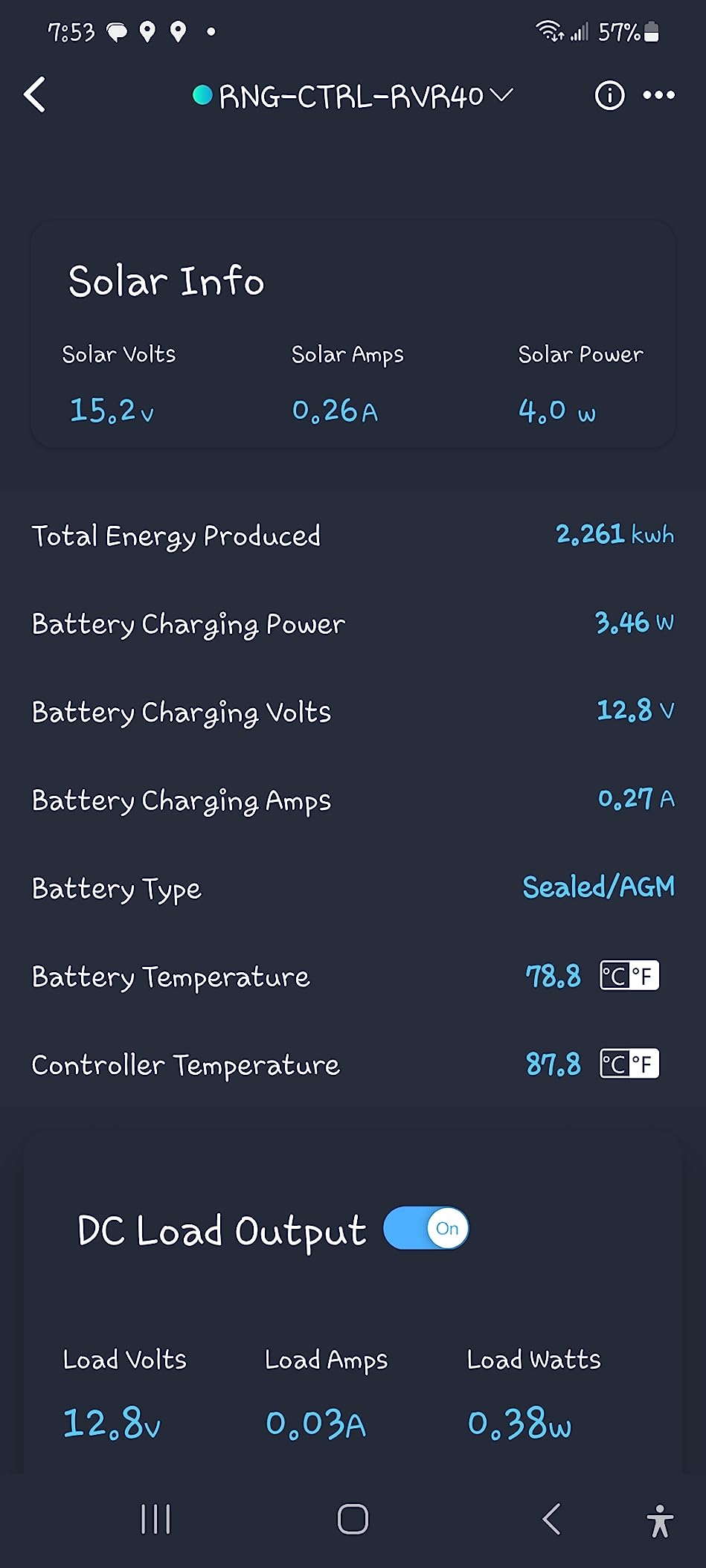
The Rover accepts up to 32V of battery voltage, which gives you room to run a 24V bank if your cable run from the panels to the battery is long. The Bluetooth module lets you monitor and adjust settings from your phone instead of walking out to the controller, which is a bigger quality-of-life win than it sounds once the shed is cold and dark.
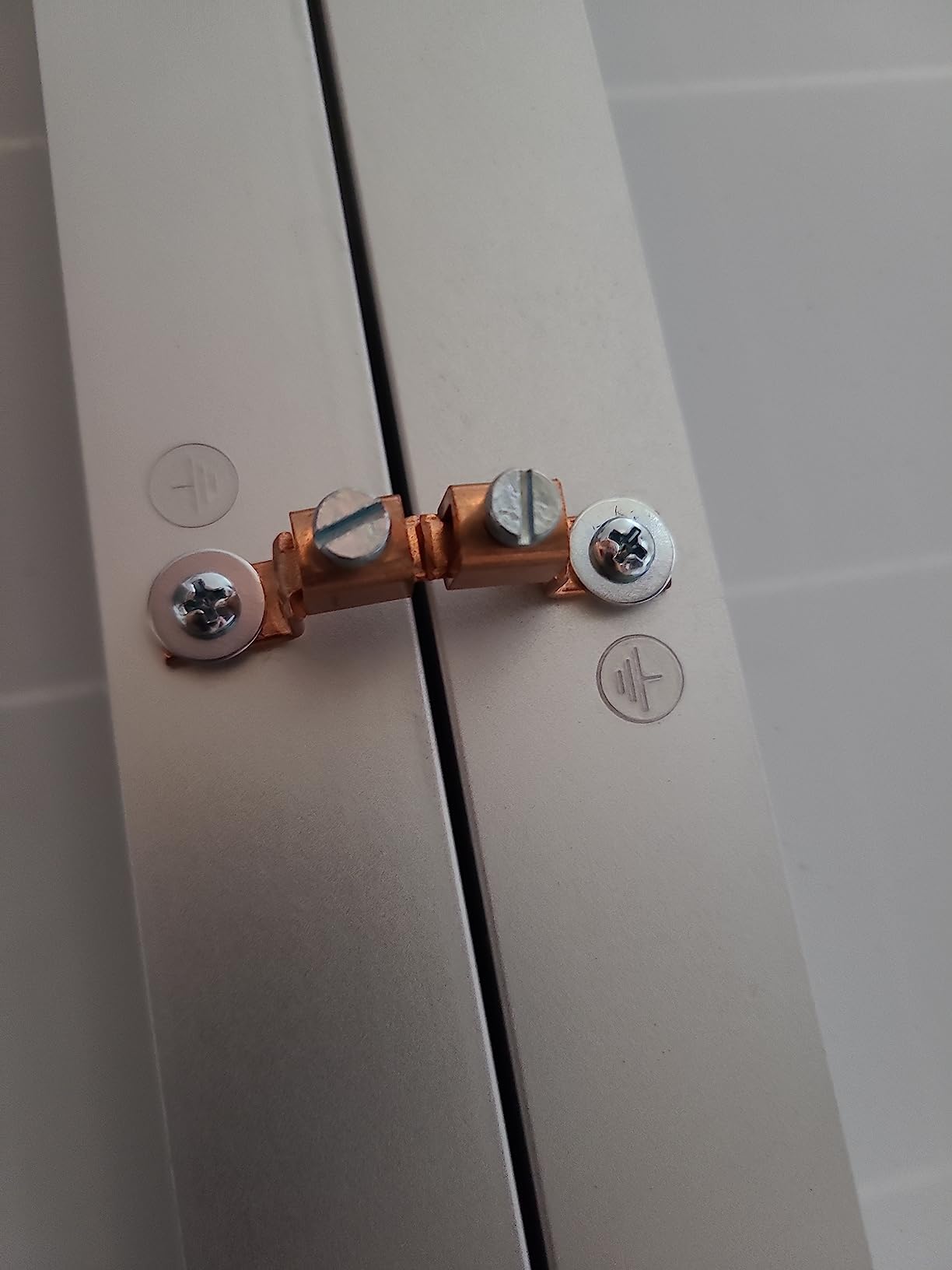
Everything needed for the install is in the box: Z-brackets, an adaptor kit, tray cables and a fuse, so you are not making a second hardware run on install day. The panels carry a five-year material and workmanship warranty, and each measures 41.8 by 20.9 by 1.38 inches.
Be realistic about the physical side. At 56.4 pounds across four rigid panels this is a two-person roof job even before you add rails, and four rigid panels need a roof footprint most 10 by 10 sheds do not have. If yours does not, the 200W kits are the honest answer rather than a compromise.
Who should buy this kit
It fits a large detached workshop, a garage with real roof space or a ground array at the end of a long cable run, particularly where the battery bank will grow over time. It is also the kit we would pick for anyone who values a long field record over squeezing out the last few percent of controller efficiency.
If you already own Renogy Bluetooth monitoring gear, this fits straight into the same app.
Where it falls short
It costs the most of the eight bundles and gives up a little MPPT peak efficiency to the ECO-WORTHY 400W kit. The 32V battery ceiling means you cannot push the array into a much larger 48V system later without replacing the controller, so think of it as a 12V or 24V system for the life of the install.
Weight and mounting area are the real constraints, not the electrical design.
8. BLUETTI AC180 Solar Generator: Best Plug-and-Play Option for Shed Power
BLUETTI AC180 Solar Generator with 200W Solar Panel Included, 1152Wh 1800W
1152Wh LiFePO4 battery
1800W continuous AC output
200W solar panel included
Pros
- 1152Wh LiFePO4 battery rated for 3000+ cycles
- 1800W continuous AC output lifts to 2700W through the app
- 1440W flash charge fills the unit in about an hour
- Eleven outlets covering AC
- USB and DC devices
- 20ms UPS transfer makes it usable as outage backup
- Five-year warranty with Bluetooth app monitoring
Cons
- At 37.4 pounds it is heavy to reposition without a cart
- The 200W panel is a starter size and yield falls in cloud or shade
- Panel is not recommended for series or parallel use with other manufacturers' panels
- Cooling fans become audible under sustained heavy load
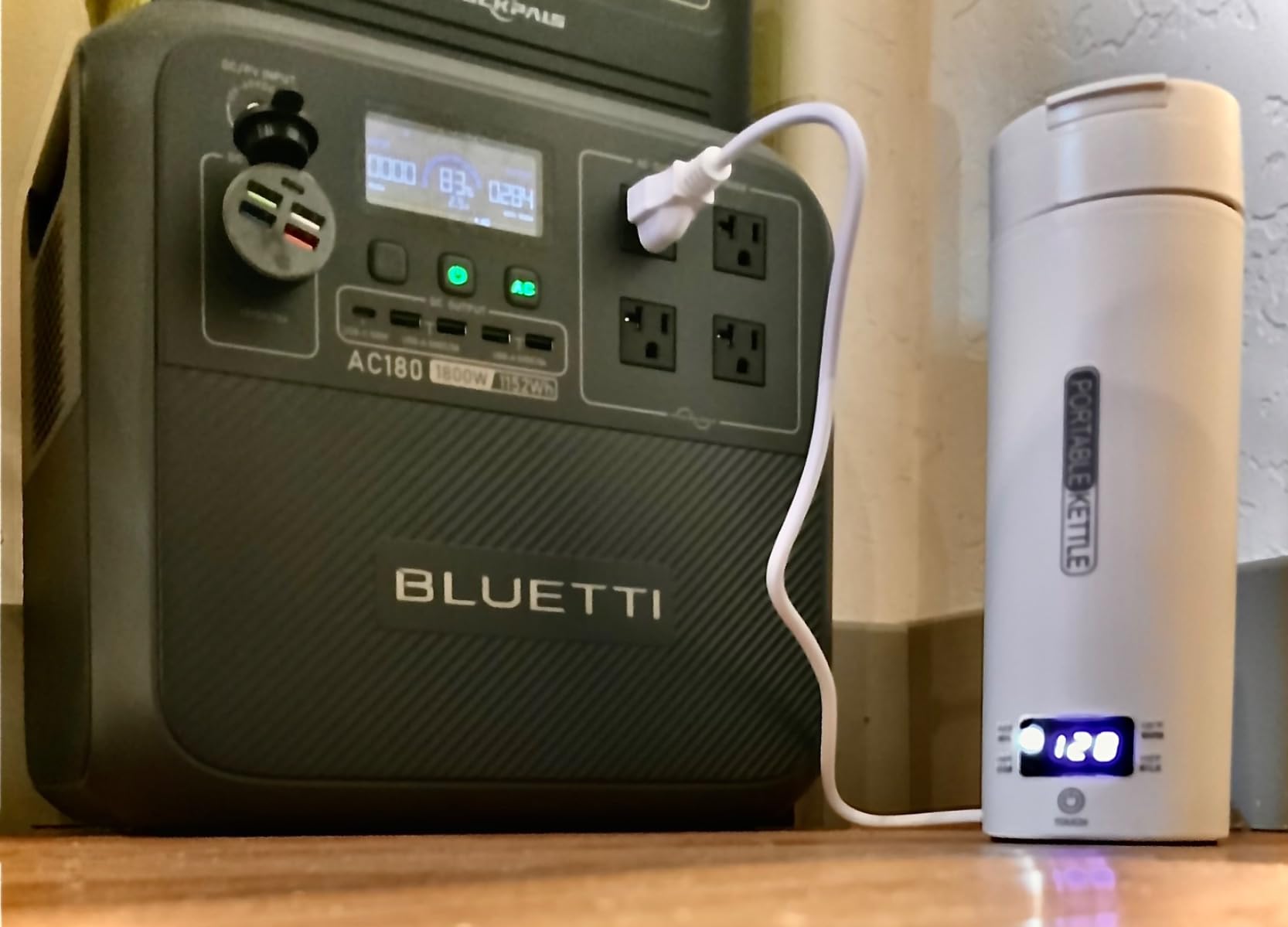
This is the only kit here that arrives as a working system. The AC180 pairs a 1152Wh LiFePO4 battery rated for 3000+ cycles with 1800W of continuous AC output, liftable to 2700W through the app, and it includes a 200W solar panel. No battery to buy, no inverter to wire, no DC fusing to design, which is exactly why it wins the plug-and-play category.
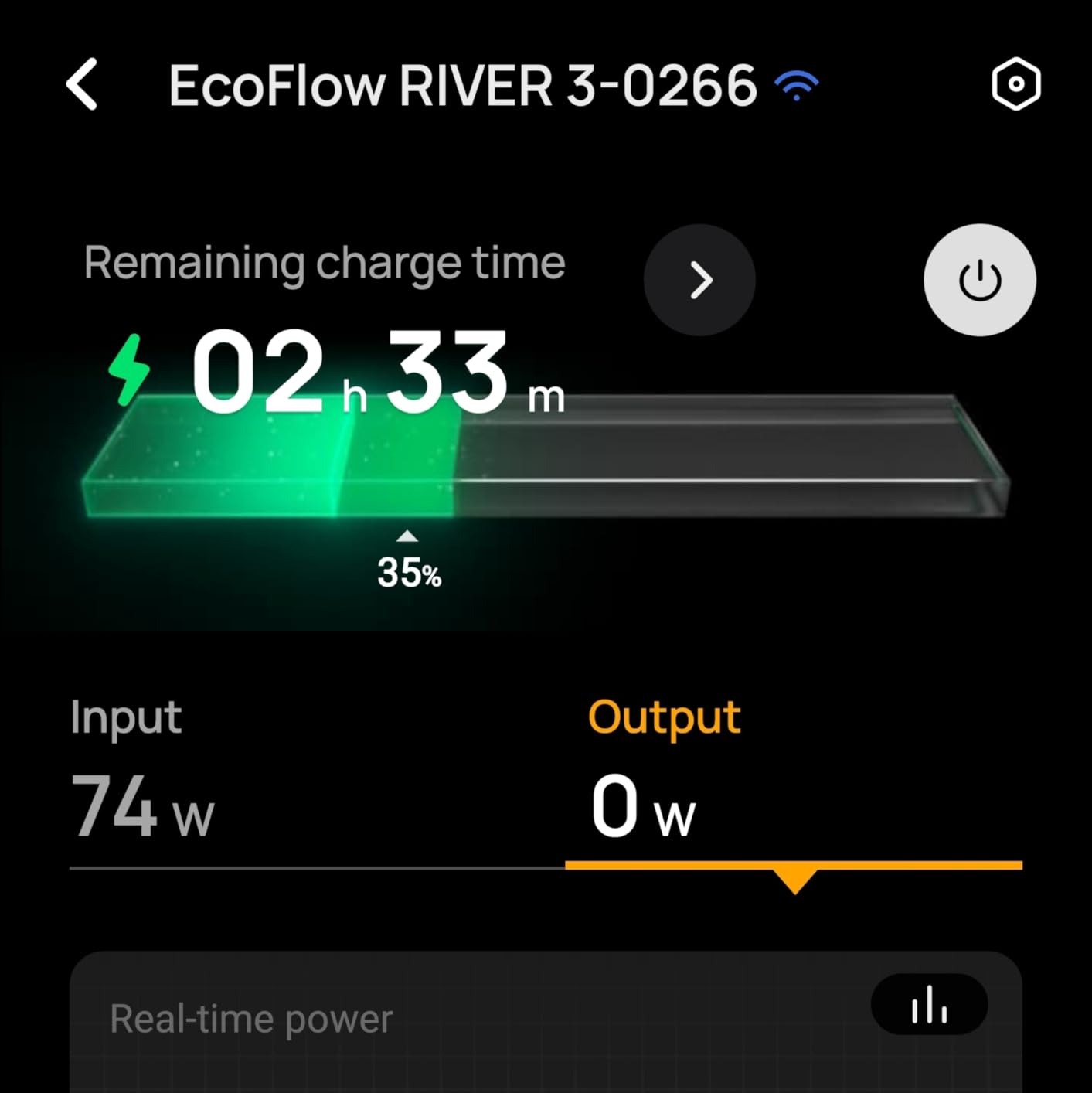
Charging is genuinely fast. The 200W panel recharges the unit in 4.8 to 9.6 hours depending on conditions, while the 1440W flash charging brings it from empty to 80% in about 45 minutes and full in roughly an hour on AC. There are eleven outlets in total and a 20ms UPS transfer, so it doubles as household outage backup rather than camping gear.
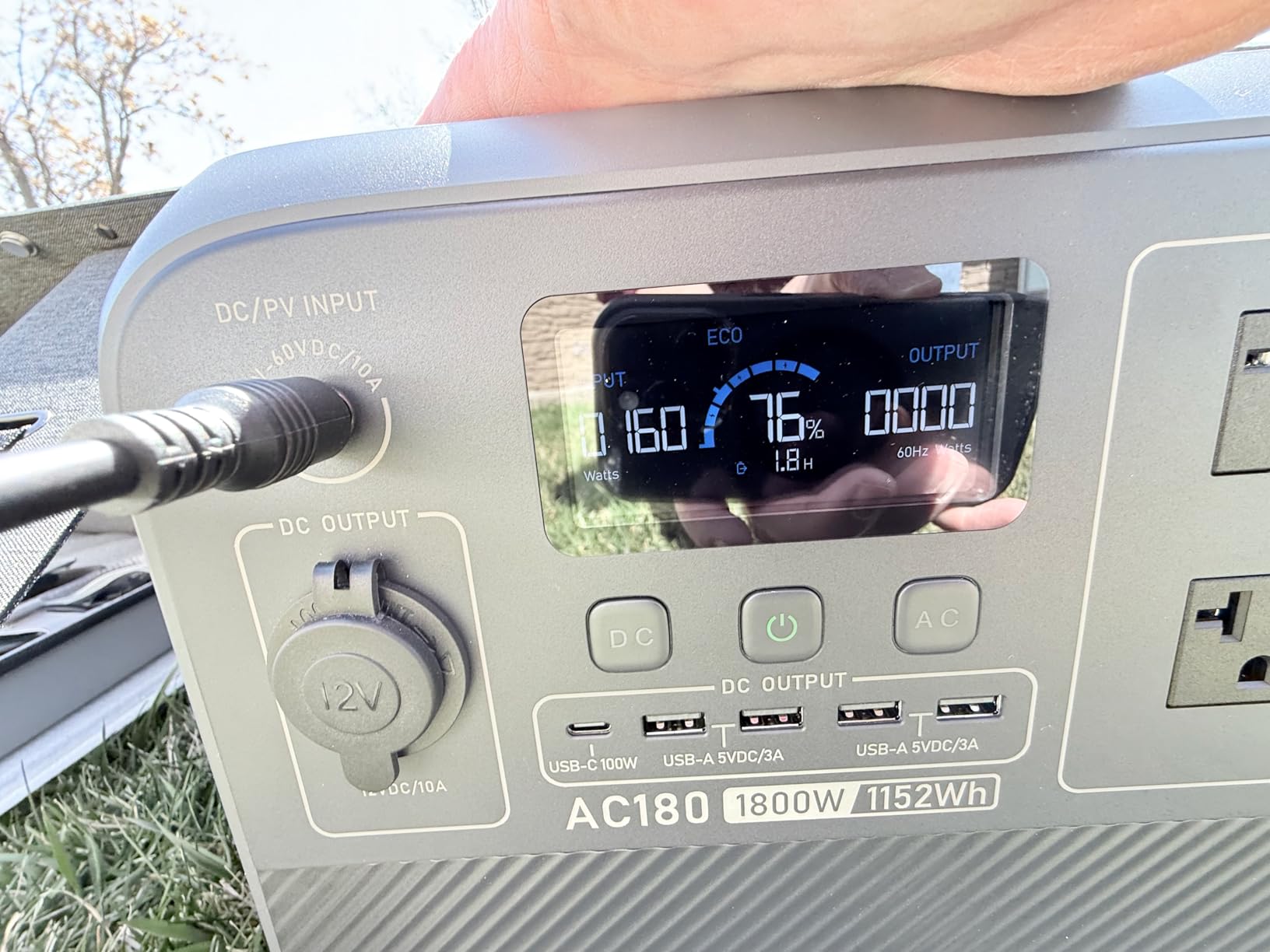
The display and Bluetooth app give real-time input and output monitoring, and the LiFePO4 chemistry is the right call for a shed that will see temperature swings, since it tolerates both cold and heat better than lead-acid. Five-year warranty coverage and 529 reviews at 4.5 stars give it a credible record, and owners frequently describe running a small bunkie or shed load off the panel and battery.
The catch is that the included panel is a starter panel. Real-world yield falls short of the 200W nameplate in cloud or shade, and the manufacturer does not recommend wiring it in series or parallel with panels from other brands, so you are locked into one panel unless you replace it. At 37.4 pounds you will want a cart to move it between the shed and the house.
Who should buy this kit
It suits anyone who wants working power this weekend without planning a system, or who rents and cannot run cable. It handles lights, a fridge, tools and electronics, and the UPS makes it useful for a home that also wants outage cover from the same box.
It is the strongest choice for a shed used intermittently, since there is no idle battery maintenance to remember.
Where it falls short
A single 200W panel cannot recharge what a fridge and tools consume over a long cloudy stretch, so autonomy is limited until you add solar. The panel pairing restriction means expanding the array means buying a matching panel rather than using whatever is already on your roof.
If you want a permanent, quietly growing shed system, separate components are the better long-term architecture.
How to Size a Solar Panel Kit for an Off-Grid Shed
Sizing a kit is arithmetic, not guesswork, and it takes about twenty minutes with a notepad. Work through it in this order and you will pick the right wattage without oversizing the parts you do not need.
Step 1: list every load and its hours per day
Write down each device with its wattage and how long it runs daily. A typical lighting-only shed might be two LED fixtures at 15W for four hours plus a phone charger at 10W for two hours, which is 140Wh a day. Add a 60W router running continuously and you are at 1580Wh a day, which is a completely different system.
For tools, use the nameplate watts multiplied by hours, not the surge rating printed on the box. A circular saw nameplate of 1400W run for 20 minutes a day adds about 470Wh, and sawdust extraction or a bench grinder can add more than the lighting ever will.
Step 2: convert watt-hours into panel watts
Divide your daily watt-hours by peak sun hours at your site, then add 20 to 30% to cover real-world losses. Controllers typically shed 1 to 2% as MPPT inefficiency, wiring takes about 2%, battery round-trip conversion costs 1 to 2%, and the inverter itself takes roughly 14% on the AC side. Ignoring that 20% is the most common sizing mistake we see.
After losses, a 100W panel yields roughly 350 to 500Wh a day, so 400W of panels typically lands between 1400 and 2000Wh. A shed using 600Wh a day needs about 300 to 400W of array once you have built in the losses and the cloudy-week margin.
Step 3: size the battery in amp-hours
Take your daily watt-hours, multiply by the days of autonomy you want, then divide by 12 for a 12V bank or 24 for a 24V bank. For a 600Wh load wanting two sunless days, that is 1200Wh divided by 12, or 100Ah at 12V.
Then apply a depth-of-discharge limit. Lead-acid should not be taken below 50% for routine use, so plan on roughly half the nameplate amp-hours being usable. LiFePO4 can be taken to 80% or deeper, which means the same usable energy from a smaller physical battery. Our deep cycle battery guide for off-grid power covers the chemistry trade-offs in more depth.
Most builders we read about size for two days, and that is where the real-world recommendation gets blunt: a six-day run with no meaningful generation is realistic in a bad December, and battery capacity for six days is usually impractical. If you live above roughly 40 degrees latitude, plan for a generator-free winter only if your battery bank is sized generously or you accept running fewer loads in midwinter.
MPPT versus PWM charge controllers
A PWM controller simply connects panels to the battery through a diode and lets battery voltage dictate panel operating voltage, losing the difference as heat. An MPPT controller actively tracks the panel’s peak power point, typically recovering 20 to 30% more energy and running more efficiently in cold weather when panel voltage rises.
Below roughly 200W, the gap is small and PWM is a reasonable choice. Above that, especially in winter, MPPT earns its place, which is why we rate the two 400W MPPT bundles above the PWM kits of similar wattage. If your inverter is a larger unit rather than a portable power station, our off-grid inverter guide is worth a read before you finalise the AC side.
Can a 400W solar panel run a fridge?
Yes, comfortably, but check the compressor start-up figure before you buy. A typical 12V compressor fridge draws 40 to 60W while running and 3 to 4 times that for a few seconds at startup, so it needs an inverter rated well above its running wattage. A 1000W pure sine wave inverter handles a small chest freezer without trouble.
Energy-wise, a chest freezer in a typical shed consumes roughly 0.5 to 1kWh a day once you account for a cold shed interior rather than a warm kitchen. A 400W array producing 1.6kWh a day in good conditions covers that with room for lights, but in midwinter production can drop by half, which is when the battery bank decides whether the freezer keeps running through a bad week.
LiFePO4 versus AGM in an unheated shed
LiFePO4 tolerates both cold charge and heat far better than lead-acid and allows deeper discharge, so it is the better fit for a shed that freezes in winter and heats up in summer. The one hard constraint is that many LiFePO4 batteries must not be charged below freezing, so either keep the battery inside the heated space or use a controller with a built-in low-temperature cutoff or heater.
AGM batteries need no watering and are cheaper, but they lose usable capacity fast when cold and should not be discharged below 50%. In a shed with wide seasonal temperature swings, that difference is what decides between a battery that sags in January and one that does not.
What a complete kit does not include
Almost every kit in this roundup stops at the controller, so plan to buy these separately. You need a deep-cycle battery matched to your system voltage, a pure sine wave inverter for anything with a motor or sensitive electronics, and a DC disconnect plus a Class-T fuse between the battery and the inverter. Also on the list: MC4 connectors if the supplied cables are too short, 10 AWG or heavier wiring for the battery run, a small breaker panel for the shed interior, and a grounding electrode and bonding jumper if local code requires them.
Light-duty Z-brackets included with kits are adequate for small panels on a sheltered roof, but forum builders overwhelmingly report moving to rail-mounted systems for full-size rigid arrays. Four-panel roof mounts are a two-person job at 56 pounds or more, so plan access before you order.
Finally, be aware of inverter idle draw. All-in-one inverter chargers commonly idle at 40 to 60W, and 60W of constant draw is about 1.4kWh per day of pure overhead. On a small shed system that can be the single largest load you have, which is the reasoning behind buying a separate MPPT controller and a modestly sized inverter instead of one oversized all-in-one unit. If you want a second opinion on the installed system later, our guide to drones for solar panel inspections covers checking array condition from the air.
Frequently Asked Questions
What is the best solar power kit for a shed with a battery?
The best kit depends on your load and whether you want a fixed array or a self-contained box. For lighting and charging only, the Renogy 100W starter kit paired with a 100Ah battery and a small inverter is the simplest correct build. If you want everything in one unit with 120V AC output, the BLUETTI AC180 arrives with a 1152Wh battery and needs nothing else.
How many solar panels do I need to run a shed?
Add up your daily watt-hours, divide by peak sun hours, then add 20 to 30% for controller, wiring and inverter losses. A lighting-only shed usually needs one 100W panel. A shed running lights, tools and a small fridge needs 400W, which is four 100W panels.
Will a 400W solar panel run a fridge?
Yes, if your battery bank is sized to carry you through cloudy days. A typical 12V compressor fridge draws 40 to 60W running and 3 to 4 times that at startup, so pair it with an inverter rated well above 500W. A chest freezer in a shed can use 0.5 to 1kWh a day, so budget 400W of panels and at least 200Ah of usable storage.
What is the 20% rule for solar panels?
It means oversizing your array by roughly 20% beyond the calculated requirement. Real systems lose about 15 to 20% to MPPT or PWM conversion, wiring, battery round-trip and inverter losses, plus dust, heat and shading. Sizing the array 20 to 30% above your load calculation absorbs those losses and improves winter output.
What is the best solar panel for off-grid use?
A monocrystalline panel is the right choice for nearly every off-grid shed, because it delivers more watts per square foot than polycrystalline or thin film. Within the kits we reviewed, the ZOUPW 220W bundle leads on cell efficiency at 25%, while the ECO-WORTHY 400W and Renogy 400W bundles lead on proven MPPT control at higher output.
Which Solar Panel Kit Should You Buy?
The best solar panel kits for off-grid sheds are not one-size-fits-all, and the honest split is by load rather than by brand. For a lighting-and-charging shed, our editor’s choice, the Renogy 100W 12V starter kit, is the easiest path to a correct install thanks to its 4010-review field history and a clean expansion route to 400W. For tools and a small fridge, move up to the 400W MPPT bundles, where the Renogy build wins on proven reliability and the ECO-WORTHY build wins on controller efficiency. For a shed you want working without planning anything, the BLUETTI AC180 is the only one of the eight that includes a battery and 120V AC output in the box.
Whatever you choose, budget for the battery, the inverter, the DC disconnect and the Class-T fuse, because seven of these eight kits do not include them. Work out your daily watt-hours first, then add the 20% that real-world losses will take away from you.