
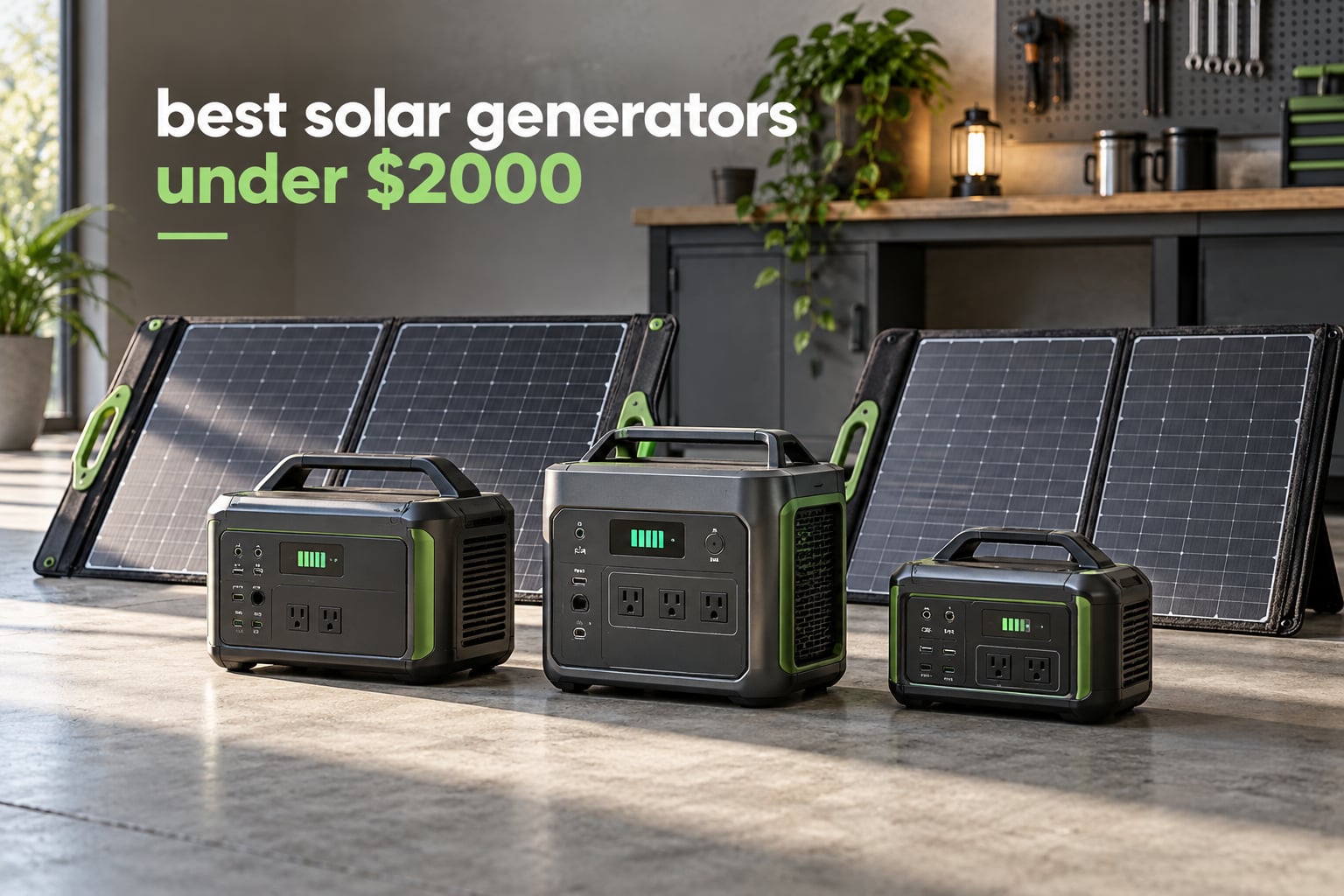
A solar generator is a battery, an inverter and a set of outlets packed into one box. It stores energy from panels, a wall outlet or a car, then pushes 120V household current to a fridge, a router, a CPAP machine or a power tool. No engine, no fuel, no exhaust, nothing that wakes the neighbours at 3am.
Below you will find the ten solar generators under the 2,000-dollar ceiling that we would actually put in a truck, a pantry or a prep shelf, tested against the same criteria. Our top three right now are the Anker SOLIX C1000 Gen 2 for overall balance, the BLUETTI Elite 200 V2 for real home backup, and the EcoFlow Delta 3 Classic for value. Every pick below fits the budget filter, and every pick has a named limitation.
One thing to clear up before we start: most listings that say solar generator ship the battery box only. A panel is a separate purchase in most cases, and the four bundles on this list are the exception, not the rule. We flag which kits include a panel in every section so your real system cost is never a surprise.
If you want the broader picture first, our general solar generator roundup covers the full range without a budget filter, and our home backup guide goes deeper on transfer switches and whole-house wiring.
Table of Contents
Top 3 Picks: Best Solar Generators Under $2000 (October 2026)
These three cover the widest range of buyers inside the budget. One is the best all-rounder, one has the most usable capacity, and one costs the least while still hitting a 4.7 rating across more than a thousand reviews.

At a Glance: Every Pick Compared
Capacity is the headline number, but continuous output and surge decide whether your compressor-starting fridge will actually run. Weight decides whether you can still get it up the stairs when the power is out.
| Product | Specifications | Action |
|---|---|---|
 Anker SOLIX C1000 Gen 2 Anker SOLIX C1000 Gen 2 |
|
Check Latest Price |
| BLUETTI Elite 200 V2 |
|
Check Latest Price |
 BLUETTI AC180 BLUETTI AC180 |
|
Check Latest Price |
 EcoFlow Delta 2 Max EcoFlow Delta 2 Max |
|
Check Latest Price |
 EcoFlow Delta 3 Classic EcoFlow Delta 3 Classic |
|
Check Latest Price |
 Jackery Solar Generator 1000 v2 Jackery Solar Generator 1000 v2 |
|
Check Latest Price |
 Anker SOLIX C2000 Gen 2 Anker SOLIX C2000 Gen 2 |
|
Check Latest Price |
 BLUETTI Elite 100 V2 BLUETTI Elite 100 V2 |
|
Check Latest Price |
 OUPES Mega 1 OUPES Mega 1 |
|
Check Latest Price |
 EcoFlow Delta Pro 3600Wh EcoFlow Delta Pro 3600Wh |
|
Check Latest Price |
How We Picked and What We Looked At
We compared ten power stations on six criteria, and we weighted them the way owners actually complain. Battery chemistry and usable watt-hours came first, then continuous inverter output, then recharge speed from a wall outlet, then whether the unit could grow later.
Every product here uses LiFePO4 cells, so cycle life separates them rather than chemistry. We then checked the real-world figures that show up repeatedly in owner reviews: fridge runtimes, whether pass-through charging works, and how heavy the box feels after a full carry. Port count and app quality broke the remaining ties.
We did not rank on star averages alone. Review volume matters, because a 5.0 rating on twelve reviews tells you almost nothing about warranty claims two years from now. Where units are close, we favour the one with more long-run owner feedback behind it.
1. Anker SOLIX C1000 Gen 2 – Best Overall and Lightest Pick
Anker SOLIX C1000 Gen 2 Portable Power Station
1024Wh LiFePO4
2000W output, 3000W peak
49 minute AC recharge
10ms UPS
Pros
- Fastest wall recharge in the group at 49 minutes
- Compact and light at about 25 lbs
- Ran a CPAP for three nights and a mini fridge for two days
- Silent running with a dependable 10ms UPS
Cons
- Gen 2 has no expansion battery option
- Measurable harmonic distortion on a microwave
This is the unit we keep coming back to. It carries 1024Wh of LiFePO4 rated for 4000 cycles to 80 percent capacity, and it recharges from a normal wall outlet in 49 minutes. That combination means you can grab it off the charger in the morning and put it back at night without planning around it.
The inverter is rated at 2000W with 3000W peak, which is unusual in a box this size. It has nine outlets and a 10ms UPS switchover, so a refrigerator or a CPAP machine barely notices the transfer from grid to battery.
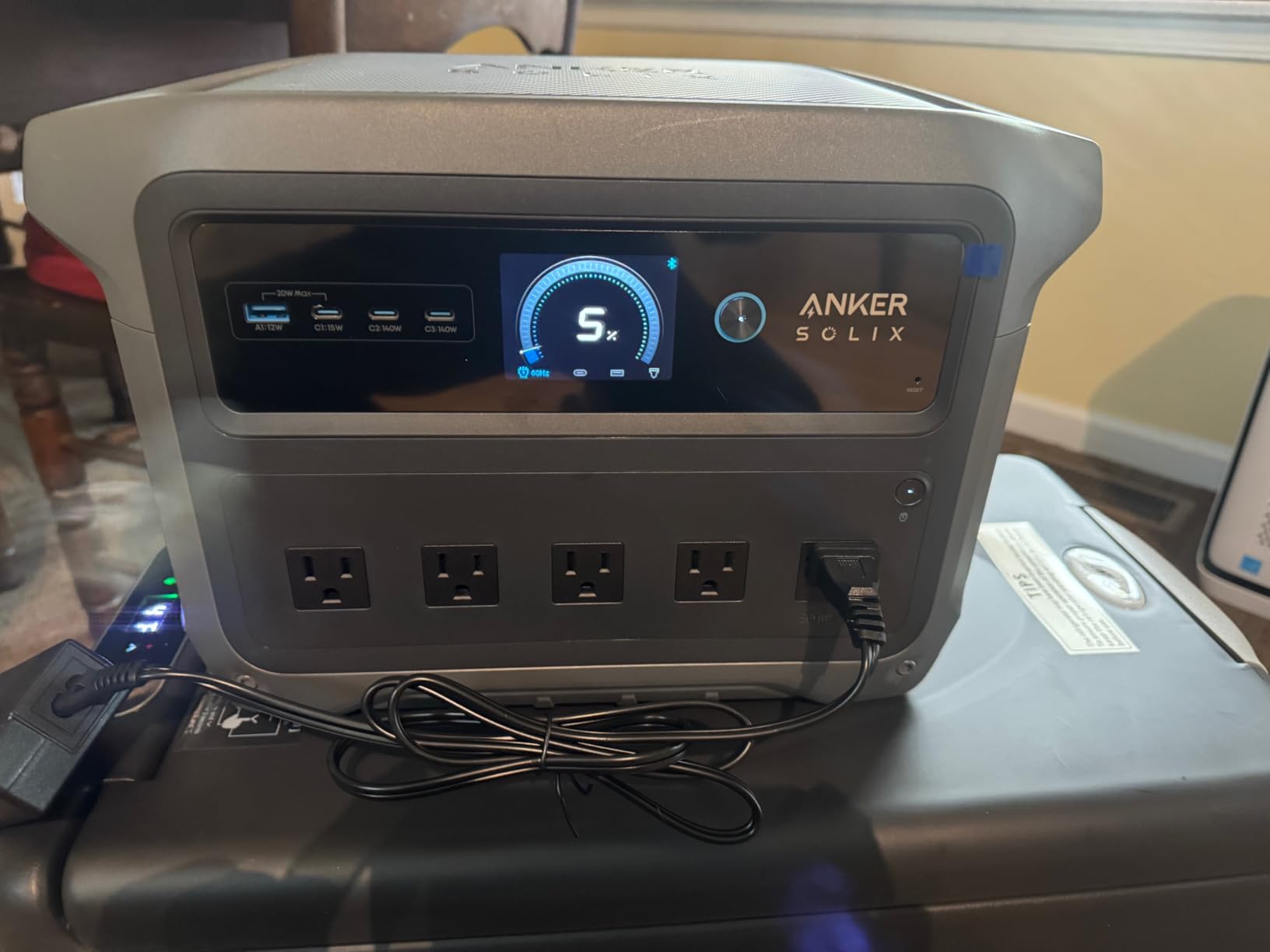
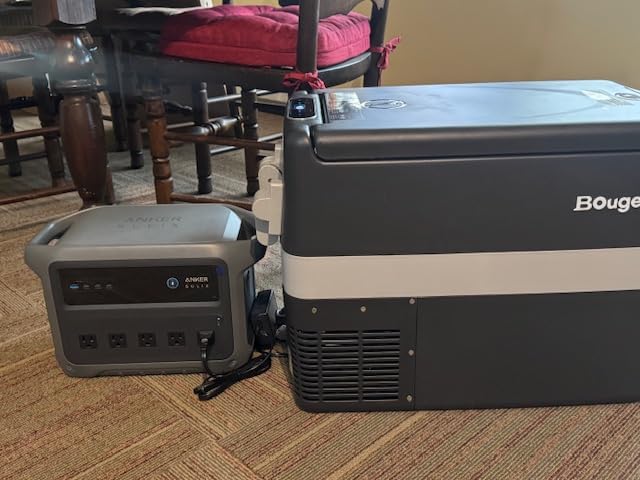
Owners report the highest consistency of any unit in this group, with a 4.7 average across more than 1600 reviews. Multiple people describe running a CPAP machine for three nights, or a mini fridge for two days, before needing a wall plug. The 11.3 kg weight is the real reason it wins: you can carry it to the kitchen, then move it to the bedroom, without recruiting a second person.
Two things work against it. The Gen 2 platform dropped the expansion battery that the previous generation offered, so 1024Wh is all you will ever have. Some reviewers also measured harmonic distortion when powering a microwave, which showed up as a flicker on sensitive electronics.
Who this works for
A household that needs to keep a fridge, a router, some lights and one medical device alive for two or three days. That is roughly 500 to 800Wh of honest draw across a long outage, and this unit covers it with headroom on a single charge.
It also suits anyone moving the unit between rooms, a garage and a truck bed. At 25 lbs with a clean handle, this is the one we would hand to a parent or an older family member to manage during an outage.
Who should skip it
If you need more than a kilovolt-amp-hour or two eventually, skip this. There is no expansion path, so a growing household has to buy a second unit instead of a second battery, and two boxes cost more than one larger box.
Skip it if you plan to run a microwave or sensitive audio equipment off the AC inverter every day. For audio gear, a pure sine wave unit like the OUPES Mega 1 is the safer pairing.
2. BLUETTI Elite 200 V2 – Best for Home Backup With Two Panels Included
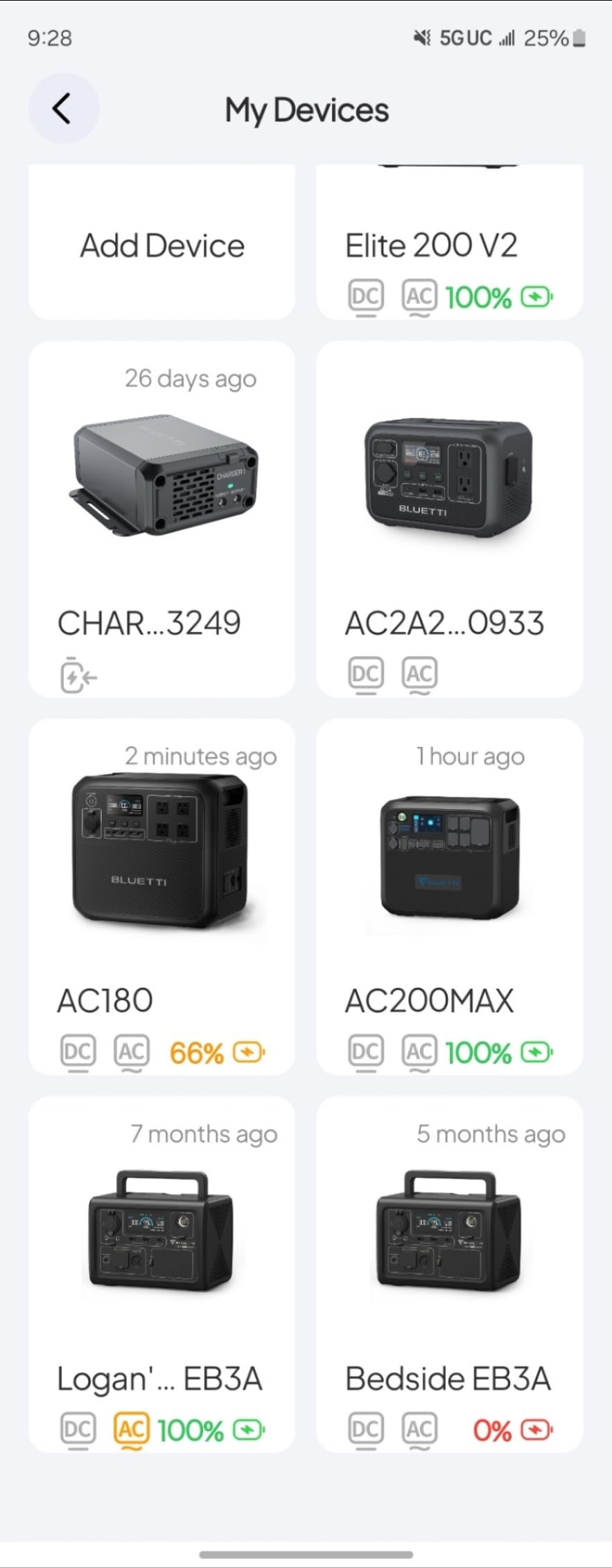
BLUETTI Elite 200 V2 Solar Generator & 2x200W Solar Panel Included 2073.6Wh
2073.6Wh LiFePO4
2600W output, 3900W lifting
Two 200W panels included
10W standby draw
Pros
- Double the capacity of an AC180 in a similar footprint
- 2600W inverter handles an air fryer and microwave together
- Two 200W solar panels ship in the box
- Low 10W standby draw stretches usable runtime
Cons
- 53.4 lbs is the heaviest unit in this roundup
- Solar input ceiling of 60V makes a 1000W array difficult
This is the largest battery you can carry into a home without a trailer, and that is the only pick in this roundup that includes two 200W solar panels in the box. That panel inclusion alone shifts the real system cost, because a comparable pair of panels bought separately is a serious extra line item.
Capacity is 2073.6Wh of LiFePO4 rated at 6000 plus cycles and a claimed 17-year lifespan. The inverter delivers 2600W continuous with 3900W of power lifting, which covers an air fryer and a microwave at the same time rather than one after the other.
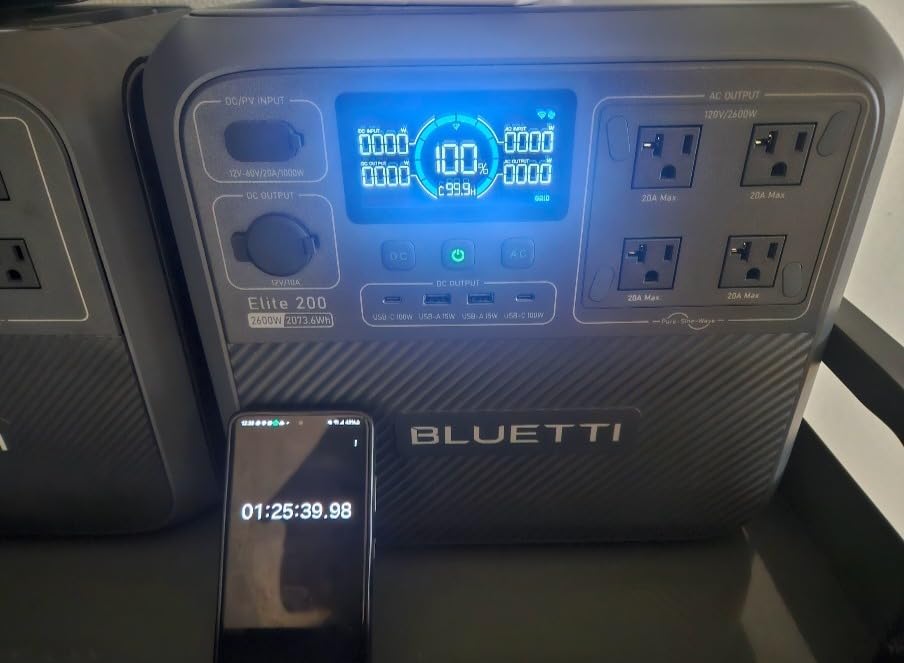
Reviewers single out the inverter efficiency and the standby draw. At 10W idle, this unit consumes roughly a third of what comparable boxes do, and that difference adds up across a 48-hour outage where the unit is mostly waiting rather than running.
Owner reports also give the best real runtime numbers we found for a 2kWh class unit. One reviewer ran a 29 cubic foot refrigerator for more than 24 hours, and another got a full 30 hours on a 50 percent capacity drop. Those are the figures that matter when a storm knocks out power for a day.
Who this works for
A household that wants two full days of a refrigerator, a router, lights and a medical device without planning a recharge schedule. Two people can carry it, but only into the house or a garage, not up a narrow stairwell alone.
It also suits buyers who want solar in the box. Charge both included panels while you drive or sit at home, and you have a genuinely off-grid setup without a second purchase decision.
Who should skip it
Skip it if you plan to move it often or run it from a picnic table to a truck bed on a regular basis. At 53.4 lbs it is a two-person lift or a cart job, and the trolley is not included.
Skip it if you want to stack extra BLUETTI batteries later. This model does not take expansion modules, and the 60V solar input ceiling makes reaching the full 1000W solar input awkward without a specific panel setup.
3. BLUETTI AC180 – Best for Power Tools and Mixed Loads
BLUETTI AC180 Solar Generator with 200W Solar Panel Included, 1152Wh 1800W
1152Wh LiFePO4
1800W output, 2700W lifting
200W panel included
0-80% in 45 minutes
Pros
- 0-80% in about 45 minutes on 1440W single-cable charging
- 1152Wh covers tools
- microwaves and laptops
- Clear display showing live input and output watts
- 10ms UPS keeps essentials running
Cons
- Roughly 35 to 40 lbs is awkward without a cart
- Fan becomes audible under sustained heavy load
The AC180 sits at the sweet spot between the tiny 1kWh boxes and the heavy 2kWh units, and it arrives with a 200W solar panel in the carton. The battery is 1152Wh of LiFePO4 rated at 3000 plus cycles, with an inverter rated 1800W continuous and 2700W through power lifting.
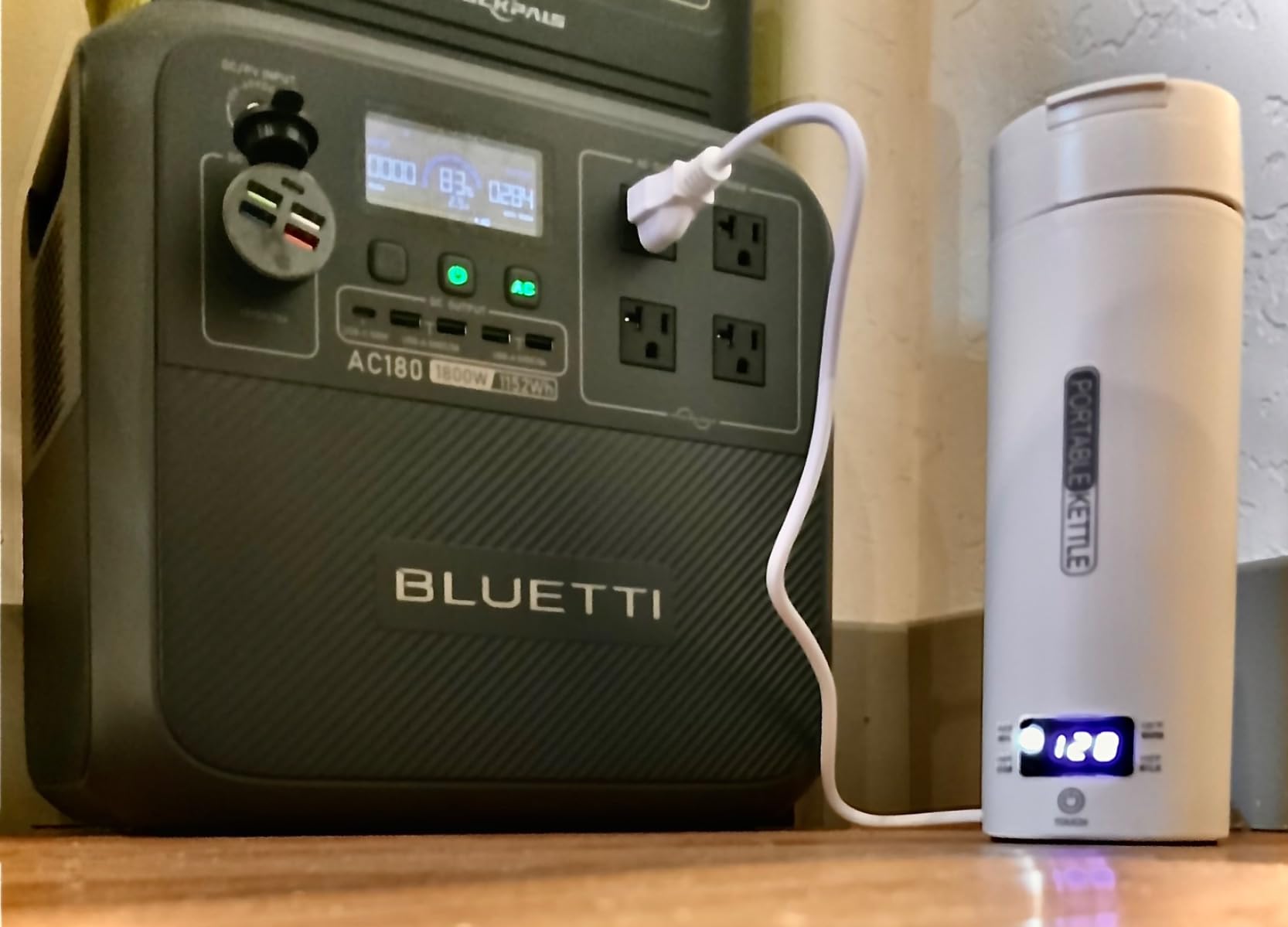
Charging is the standout. A single-cable 1440W input takes the unit from empty to 80 percent in about 45 minutes, which means you can top it up overnight between storms or over lunch on a job site. The 10ms UPS switchover makes it usable as an outage box as well as a tool box.
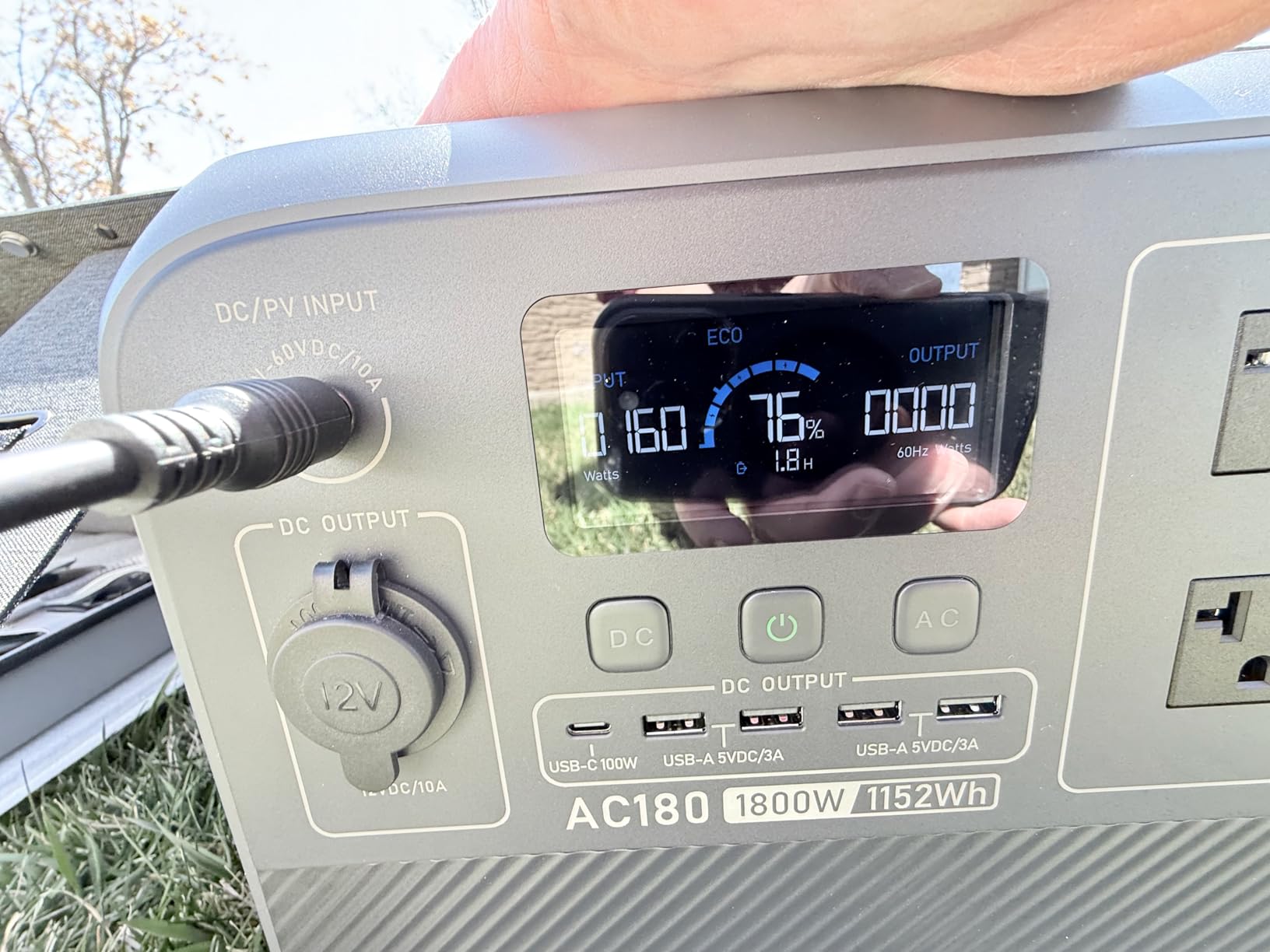
Owners across more than 500 reviews consistently point at the display. Showing live input and output watts is more useful than a four-bar indicator, because you can see whether the panel is actually delivering and whether a tool is pulling more than you expected.
The common theme in reviews is charging speed alongside the LiFePO4 durability. The recurring complaints are weight and the small bundled panel, both of which are fair given that this unit is still under the budget line with the panel included.
Who this works for
A weekend DIYer or contractor who wants to run a circular saw, a recip saw and a shop light, then keep the fridge going on the same charge. The 1800W continuous rating covers most handheld and small bench tools without the power lifting mode.
It also fits a household that wants one box for both uses. Use it for tools in the day, plug it in at night, and the morning recharge is complete before anyone needs it.
Who should skip it
Skip it if you need to move it alone often. At 35 to 40 lbs without the panel, most people will want a cart for anything longer than a single trip.
Skip it if silence matters. Reviewers report the cooling fan becoming audible under heavy sustained load, which is noticeable indoors at night and on a quiet job site.
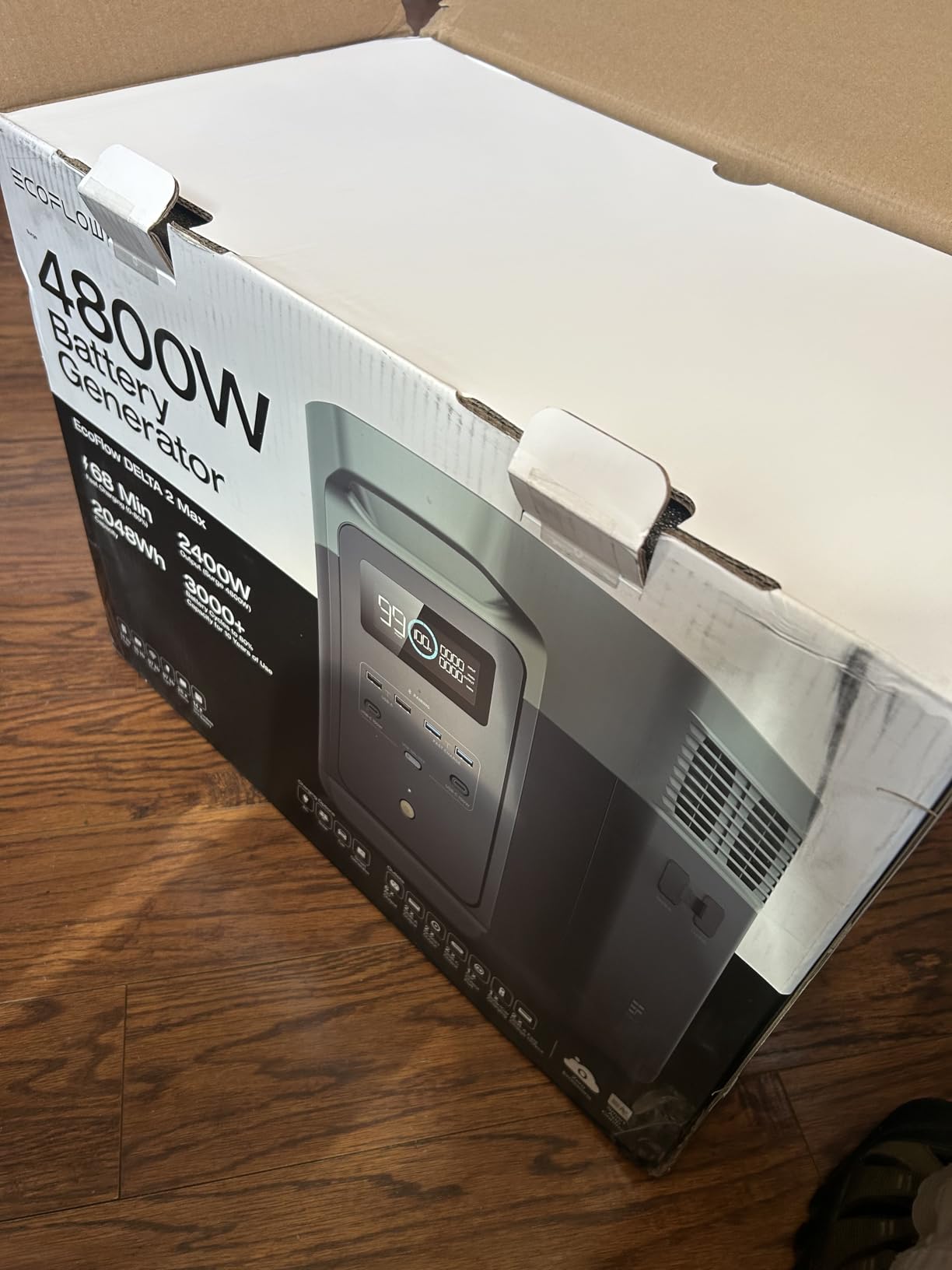
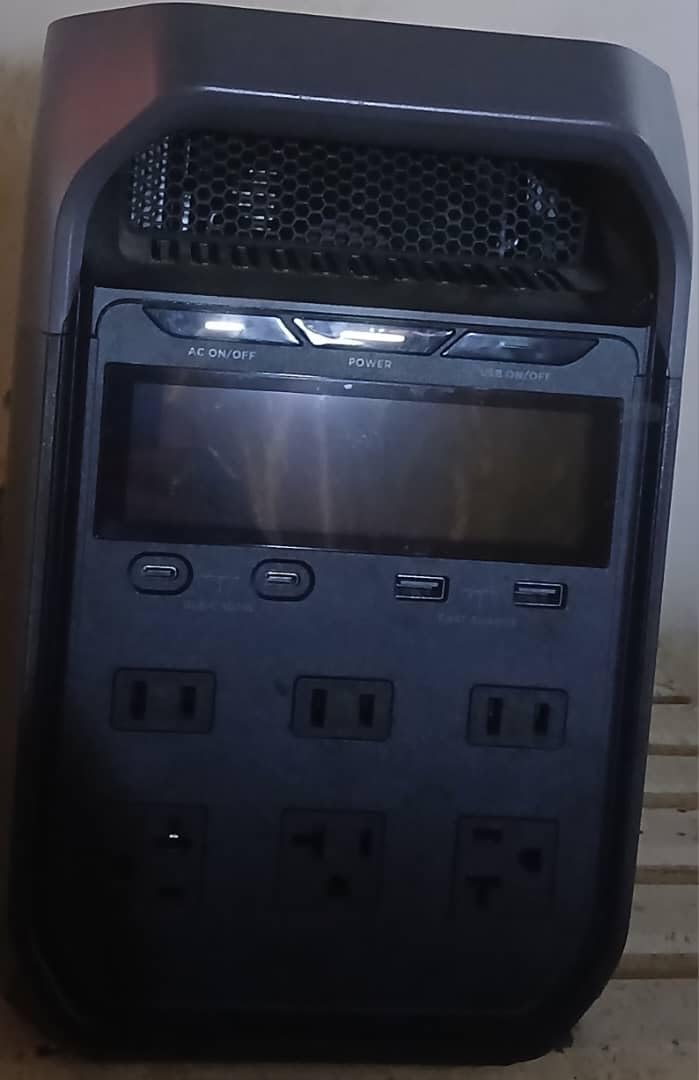
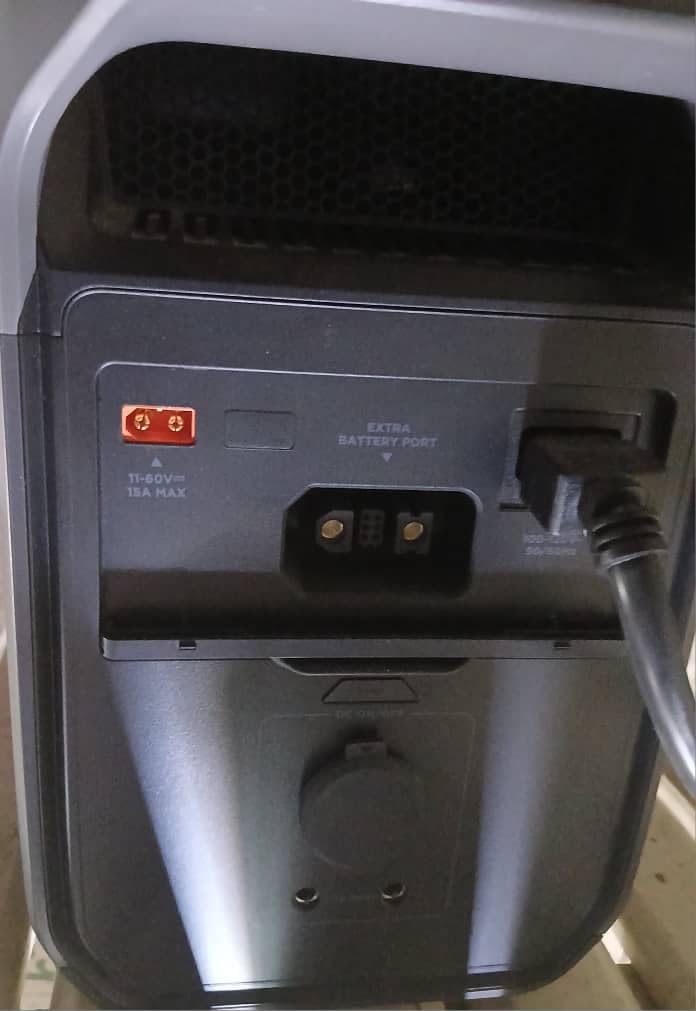
4. EcoFlow Delta 2 Max – Most Expandable Unit on the List
EF ECOFLOW Portable Power Station DELTA 2 Max 2048Wh, 2400W LiFePO4 Battery
2048Wh LFP
2400W output, 3400W X-Boost
Expandable to 6kWh
30 dB quiet mode
Pros
- 0-80% in 43 minutes with solar and AC combined
- Expandable from 2kWh to 6kWh with two extra batteries
- 2400W covers most household appliances
- Quiet at 30 dB for overnight use
Cons
- Solar panel sold separately with the base unit
- Tall 20 inch body and 50.7 lb weight
The Delta 2 Max is the pick for buyers who are not finished growing. It starts at 2048Wh of LFP rated 3000 cycles to 80 percent and expands to 6kWh with up to two extra batteries, which is the largest expansion ceiling of any 2kWh unit we covered.
Its 2400W inverter reaches 3400W with X-Boost, which covers most household appliances with headroom for compressor startup. Owners report 0-80 percent in 43 minutes when solar and wall charging run together, and 80 percent in 1.1 hours on the wall alone.
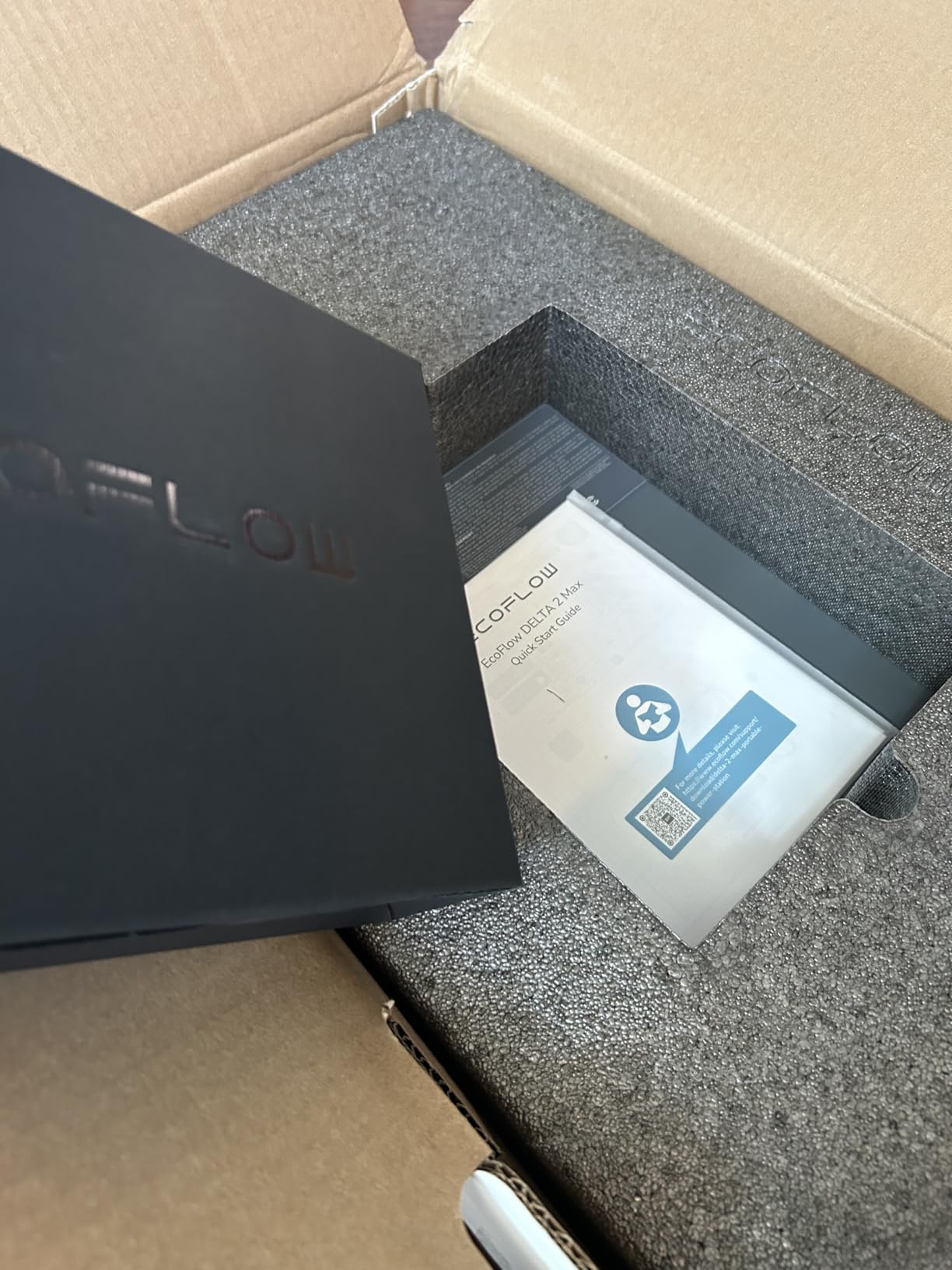
It carries a 4.6 average across more than 1300 reviews, and the quiet operation is cited constantly. At 30 dB it is one of the few power stations in this price band that owners will happily leave running overnight in a bedroom.
The clearest owner advantage is the combination of speed and headroom. If you start with 2048Wh and add one battery later, you are not replacing a whole unit, which is cheaper than buying a second box and stacking two separate ecosystems.
Who this works for
A family that expects its power needs to grow, or one buying for a home that might add a well pump, a second fridge or a home office within a few years. Expansion is the argument here, not raw capacity today.
It also fits anyone who wants a 2kWh unit today and still wants two kWh more in two years without changing platform.
Who should skip it
Skip it if shelf or trunk space is tight. At 20 inches tall it is noticeably taller than the flat competitors, and at 50.7 lbs it is not a one-person carry for a rooftop or an attic install.
Skip it if you want panels in the box. The base configuration ships with a charging cable only, which is the single most common complaint in owner reviews about solar kits like this.
5. EcoFlow Delta 3 Classic – Top Rated Pick in the Entry Tier
EF ECOFLOW Portable Power Station Delta 3 Classic, 1024Wh 1800W AC
1024Wh LiFePO4
1800W output, 3600W surge
0-80% in 45 minutes
Under 10ms UPS
Pros
- Full charge in about an hour from a standard outlet
- Rock-solid Bluetooth link and clean solar input acceptance
- Ran a portable fridge full-time for three weeks of van life
- Twenty-six point seven pounds with dual handles
Cons
- Not compatible with EcoFlow extra batteries
- 12V vehicle charging is slow while parked
If the budget is the binding constraint, this is the box to buy. It pairs 1024Wh of LiFePO4 cells rated for 10 plus years of daily use with an 1800W inverter that surges to 3600W and reaches 2600W with X-Boost. The result is a unit that punches above its size class.
Charging is the second surprise. X-Stream AC charging takes it from zero to 80 percent in 45 minutes, and a full charge on wall power takes roughly an hour. Solar input accepts up to 500W for a full recharge in about 2.5 hours.
The 4.7 rating across roughly 1300 reviews comes with unusually specific owner stories. One reviewer ran a portable fridge full time through three weeks of van life on this unit, which is a stronger endurance signal than any spec sheet.
Build details get mentioned just as often: dual handles, non-skid pads and a tidy port layout. The app supports scheduling, usage monitoring and storm alerts, which means you can start a charge cycle before you leave the house rather than watching a gauge.
Who this works for
A buyer spending the smallest possible amount on a unit with a 4.7 rating and a real warranty behind it. It covers a fridge, a router, lights and a laptop for a day or two without any drama.
It also suits van life and long boondocking trips where weight and volume matter, at 26.7 pounds with a compact footprint. Running a small fridge full time through a multi-week trip is exactly what owners report.
Who should skip it
Skip it if you want to grow the battery later. It does not accept EcoFlow extra batteries, so this is a closed 1024Wh box no matter how long you own it.
Skip it if you plan to top up while parked on 12V. Owners report vehicle charging as slow, and forum users consistently warn against long 12V sessions with the engine off because of starting battery drain.
6. Jackery Solar Generator 1000 v2 – Best Panel Bundle for Beginners
Jackery Solar Generator 1000 v2 and 200W Solar Panel,1070Wh,1500W AC
1070Wh LiFePO4
1500W output, 3000W surge
200W SolarSaga panel included
1 hour emergency charge
Pros
- Ran a full-size side-by-side fridge for nine hours on one charge
- Lightest unit here at 23.8 lbs with a foldable handle
- Pure sine wave output plus 100W USB-C for laptops
- Station and panel held up through heavy rain and mud
Cons
- 200W panel is bulky and tips over in wind
- Fastest charge mode only works after enabling it in the app
The Jackery Solar Generator 1000 v2 is the most approachable bundle on this list. You get the Explorer 1000 v2 unit with 1070Wh of LiFePO4 rated over 4000 cycles, plus a 200W SolarSaga panel in the same box, and a 5-year manufacturer warranty.
Output is 1500W continuous with 3000W surge peak, which is enough for a refrigerator, a router, lights and a laptop without strain. The port layout covers three pure sine wave AC outlets, two USB-C, one USB-A and a DC car port, and there is a 30 dB quiet charging mode.
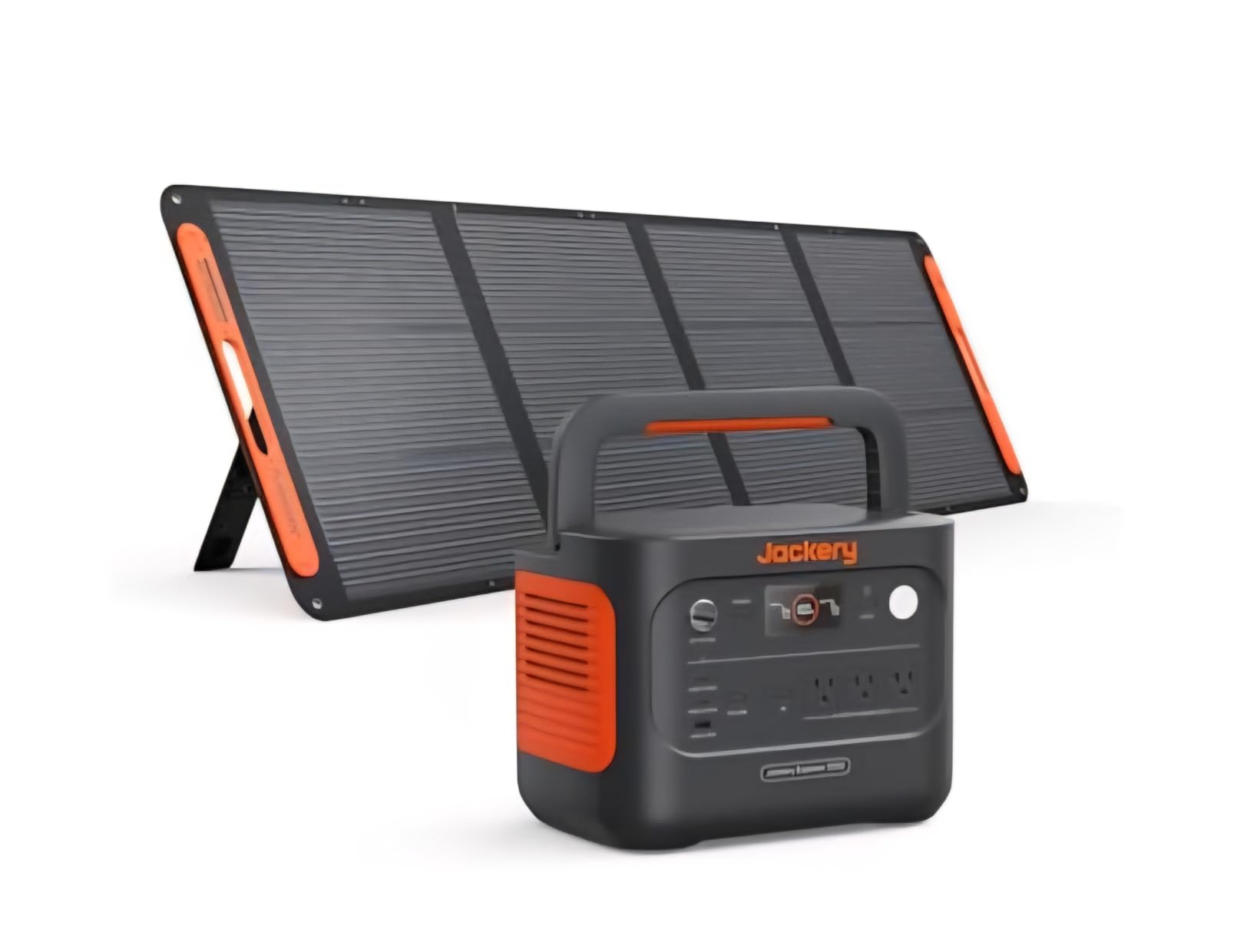
Owners rate it highly for build quality and portability. At 23.8 lbs it is the lightest unit in this roundup, and the foldable carry handle makes it easy to move between a garage and a tailgate. One reviewer logged a full-size side-by-side fridge running for nine hours on a single charge.
Durability gets real-world backing too. Reviewers report the station and panel surviving heavy rain and mud without complaint, and the colour display is clear enough to read in direct sun, which matters more than it sounds.
Who this works for
Someone buying their first solar generator who wants a working solar setup on day one without researching panels. Everything you need to charge from sun or wall is in the carton.
It also fits campers and tailgaters who carry one box instead of two. Laptops and phones get USB-C power delivery, and the AC outlets are pure sine wave, which is the right pairing for sensitive electronics.
Who should skip it
Skip it if you want the fastest charge without extra steps. The advertised one-hour emergency charge only applies after you enable emergency mode in the Jackery app, and the default wall charge takes longer.
Skip it if you plan to deploy the panel in open sun on a windy day. Reviewers describe the 200W panel as bulky and unstable, and the cable between panel and station is short enough to limit placement. Budget for a panel case separately.
7. Anker SOLIX C2000 Gen 2 – Best for RV Life and Boondocking
Anker SOLIX C2000 Gen 2 Portable Power Station, 2,048Wh, 2,400W, Camping
2048Wh LiFePO4
2400W rated, 4000W peak
Expandable to 4kWh
58 minute full recharge
Pros
- Only 41.7 lbs for a 2kWh unit
- 2400W rated and 4000W peak runs window and RV air conditioners
- 58 minute full recharge across six charging methods
- Expandable to 4kWh for multi-day fridge runtime
Cons
- Solar panel not included with the base configuration
- Outlet specification for the base unit reads as a single outlet
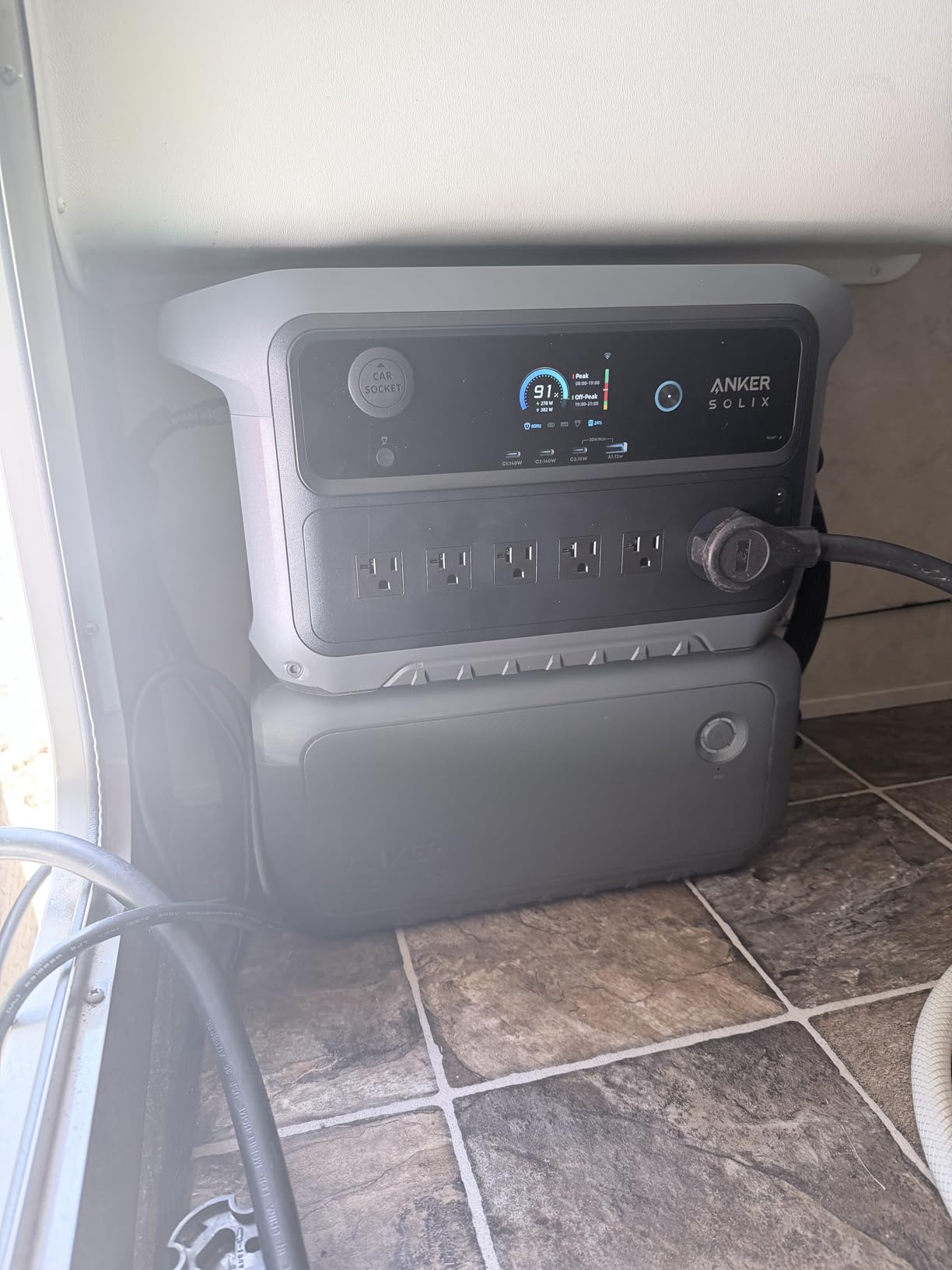
This is the 2kWh unit that RV owners keep recommending to each other, mostly because of the weight. At 41.7 lbs it is roughly 25 percent lighter than comparable 2kWh boxes, and that difference decides whether you can get it into a rear storage bay yourself.
It holds 2048Wh of LiFePO4 and expands to 4kWh with an expansion battery. The inverter is rated 2400W with 4000W peak, which owners say is enough to run window and RV air conditioners rather than only small electronics.
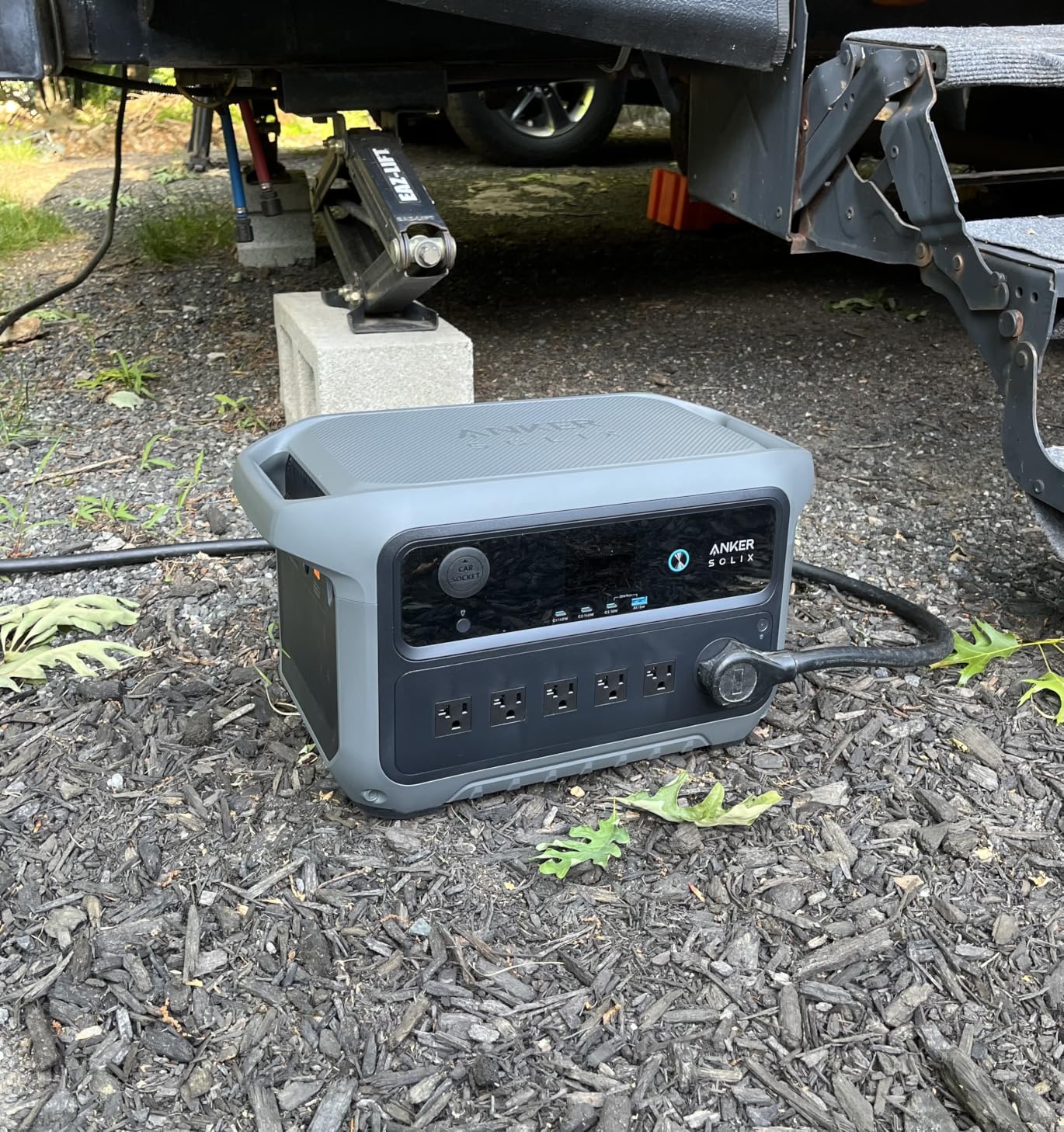
Recharging is the other headline. A full recharge takes 58 minutes with AC and solar, there are six recharging methods in total, and 800W alternator charging fills it in about three hours, which is the useful number for a long drive between campsites.
Idle draw is 9W, and the manufacturer claims a dual-door fridge can run up to 32 hours. Standby losses are what kill capacity during a long boondock, so a low draw figure matters more here than on a unit that only runs during an outage.
Who this works for
An RV or van family who wants to run a fridge, a CPAP, a laptop bank and lights through several days away from an outlet. The 2400W rating opens up air conditioning, which most 2kWh competitors in this band cannot do.
It also suits anyone who drives a lot. Alternator charging at 800W means you can refill while driving and still have usable charge at the next site.
Who should skip it
Skip it if you want solar included. The base configuration ships without a panel, so your system cost is higher than the sticker number suggests unless you already own panels.
Skip it if you need many simultaneous AC devices. The manufacturer outlet specification for the base unit reads as a single outlet, so plan on charging small devices over USB rather than running several mains appliances at once.
8. BLUETTI Elite 100 V2 – Fastest Full Recharge in the 1kWh Class
BLUETTI Solar Generator Elite 100 V2 with 200W Solar Panel Included, 1024Wh
1024Wh LiFePO4, 4000+ cycles
1800W output, 3600W surge
70 minute full charge
1000W solar input
Pros
- 70 minute full recharge and 45 minutes to 80%
- Pass-through charging runs a fridge while topping up
- XT-60 DC input is far more robust than older plugs
- Only 25 lbs with a readable input and output display
Cons
- About 24 hours of runtime with a 12V fridge
- Power Lifting mode adds stress to the battery
The Elite 100 V2 is the one to buy when recharge speed is the priority. It carries 1024Wh of LiFePO4 rated at 4000 plus cycles and reaches a full charge in 70 minutes on the wall, or 45 minutes to 80 percent.
Output is 1800W continuous with 3600W surge and 2700W through power lifting. Solar input accepts up to 1000W, which is the highest ceiling in the 1kWh class here, and a 200W panel is included in the kit.
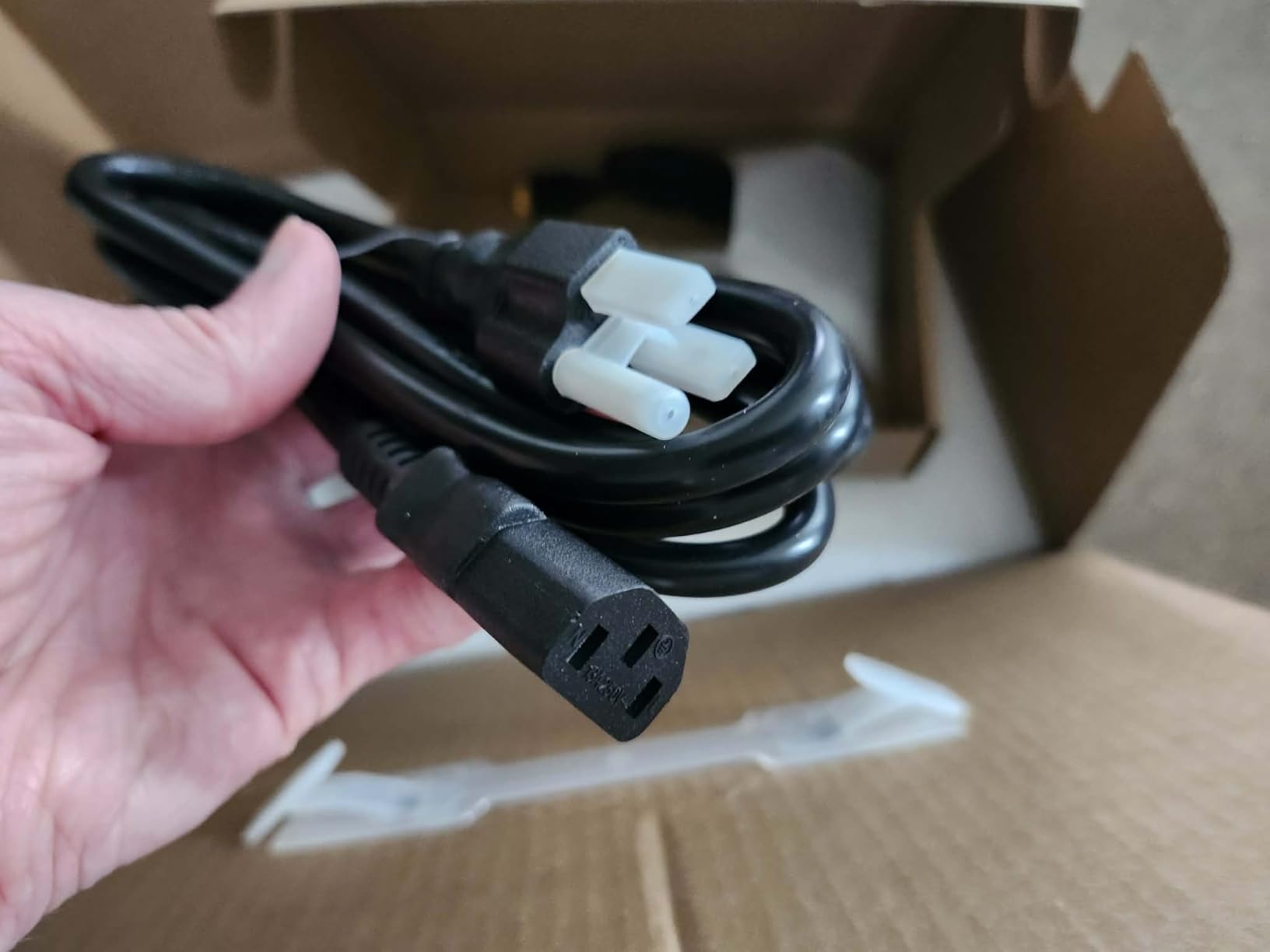
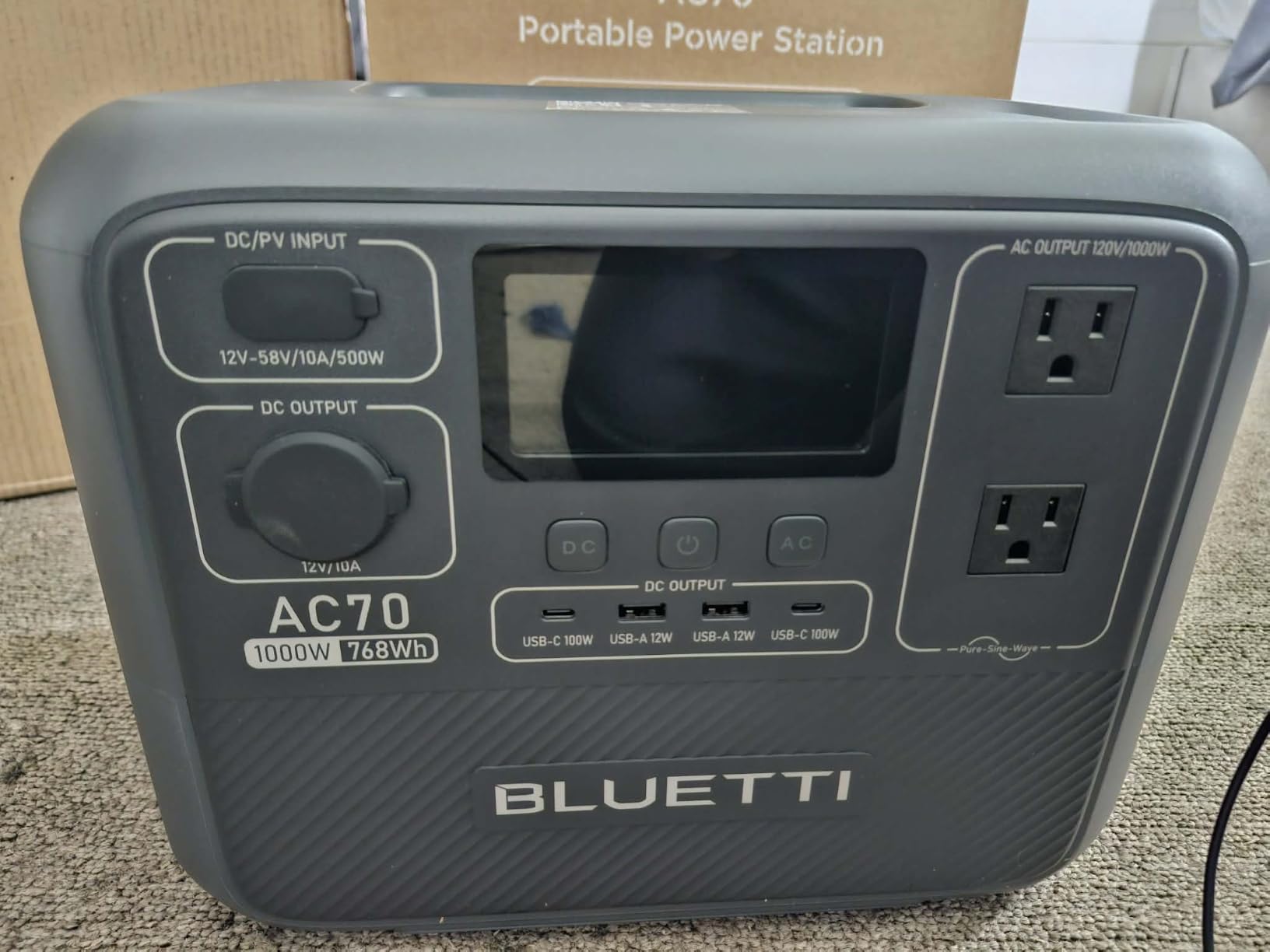
Two features get singled out repeatedly by owners. Pass-through charging lets the unit run a refrigerator while it tops up, which removes the usual either-or choice. The XT-60 DC input connector is also far more robust than the older 7909 style plugs that crack in the field.
Reviewers are candid about the trade-off. Real-world runtime with a 12V fridge is closer to 24 hours per charge rather than the several days the headline watt-hours suggest, and Power Lifting mode puts extra stress on the cells if you lean on it.
Who this works for
A buyer who needs a small unit that is always ready. The 70 minute full cycle means a top-up between breakfast and lunch, and the included 200W panel means you can leave it charging on a roof or a deck without a second purchase.
It also fits anyone running a fridge through pass-through charging, because the unit stays useful while it refills rather than going dark at zero.
Who should skip it
Skip it if you need more than a day of runtime on a single charge. The honest fridge figure is around 24 hours, so longer outages mean planning recharges or buying the 2kWh Elite 200 V2 instead.
Skip it if you plan custom RV or tiny-home wiring. The DC output amperage is modest, which limits how much you can tap directly off the low-voltage side.
9. OUPES Mega 1 – Most Ports and the Cheapest Expansion Path
OUPES Mega 1 Solar Generator with 100W Panel Included, 2000W 1024Wh LiFePO4
1024Wh LiFePO4
2000W pure sine wave, 4500W surge
100W panel included
Expands to 5120Wh
Pros
- Thirteen ports including two 100W USB-C outputs
- Expandable from 1024Wh to 5120Wh with two batteries
- Only 27.8 lbs despite a 2000W output
- 100W panel included in the kit
Cons
- Rating trails the 4.7 leaders in this group
- Bundled 100W panel is small for a solar generator kit
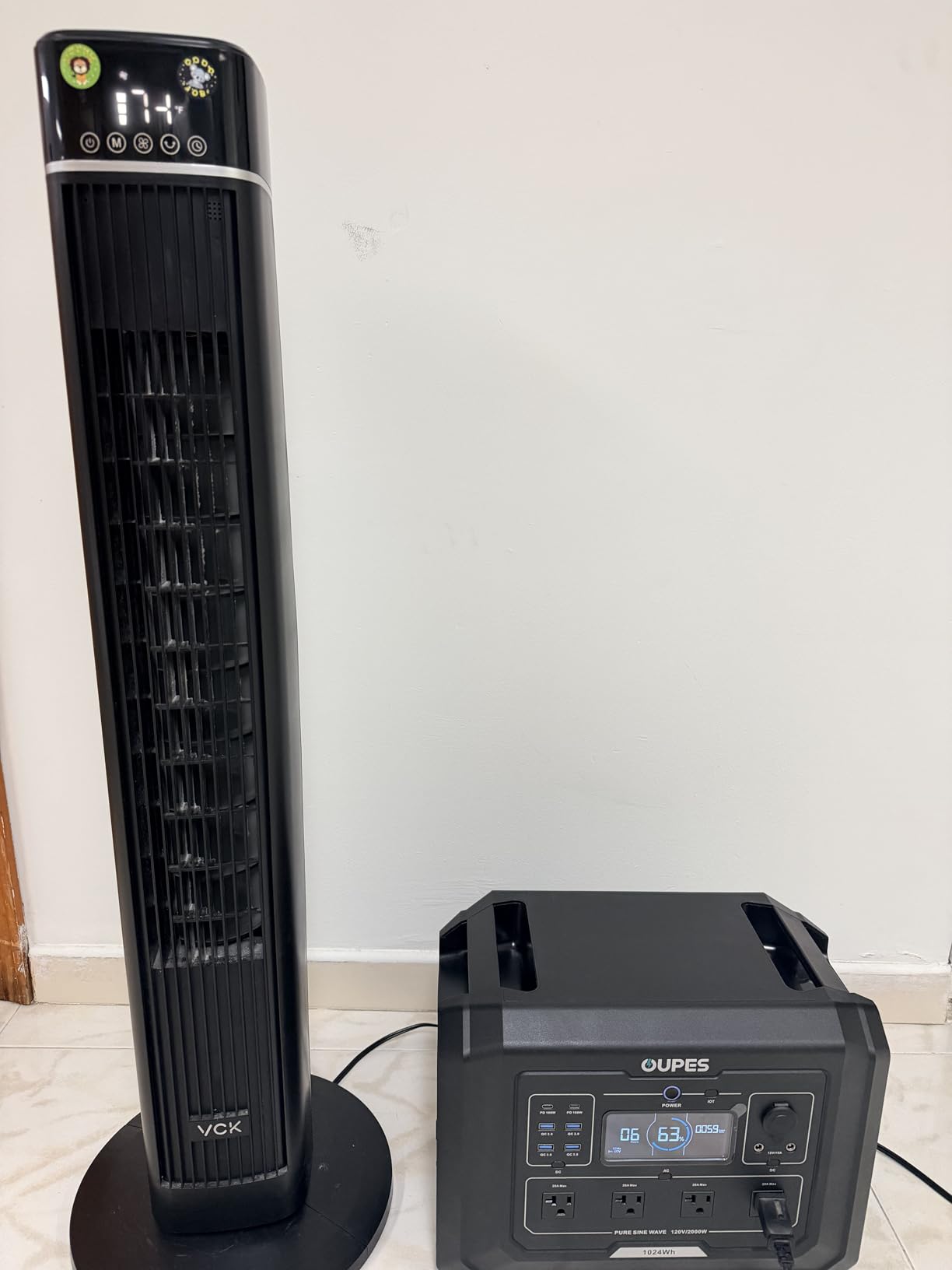
The Mega 1 wins on ports and on expansion maths. It has 13 ports, the most in this roundup, including four AC outlets, two 100W USB-C PD outputs, four USB-A QC3.0 ports, two DC5521 outputs and a car socket. You can charge a whole camp table from one box.
Underneath is 1024Wh of LiFePO4 rated at 3500 plus cycles, expanding to 5120Wh with two extra batteries. The inverter is 2000W pure sine wave with 4500W surge, and it reaches 80 percent in 36 minutes on AC alone.
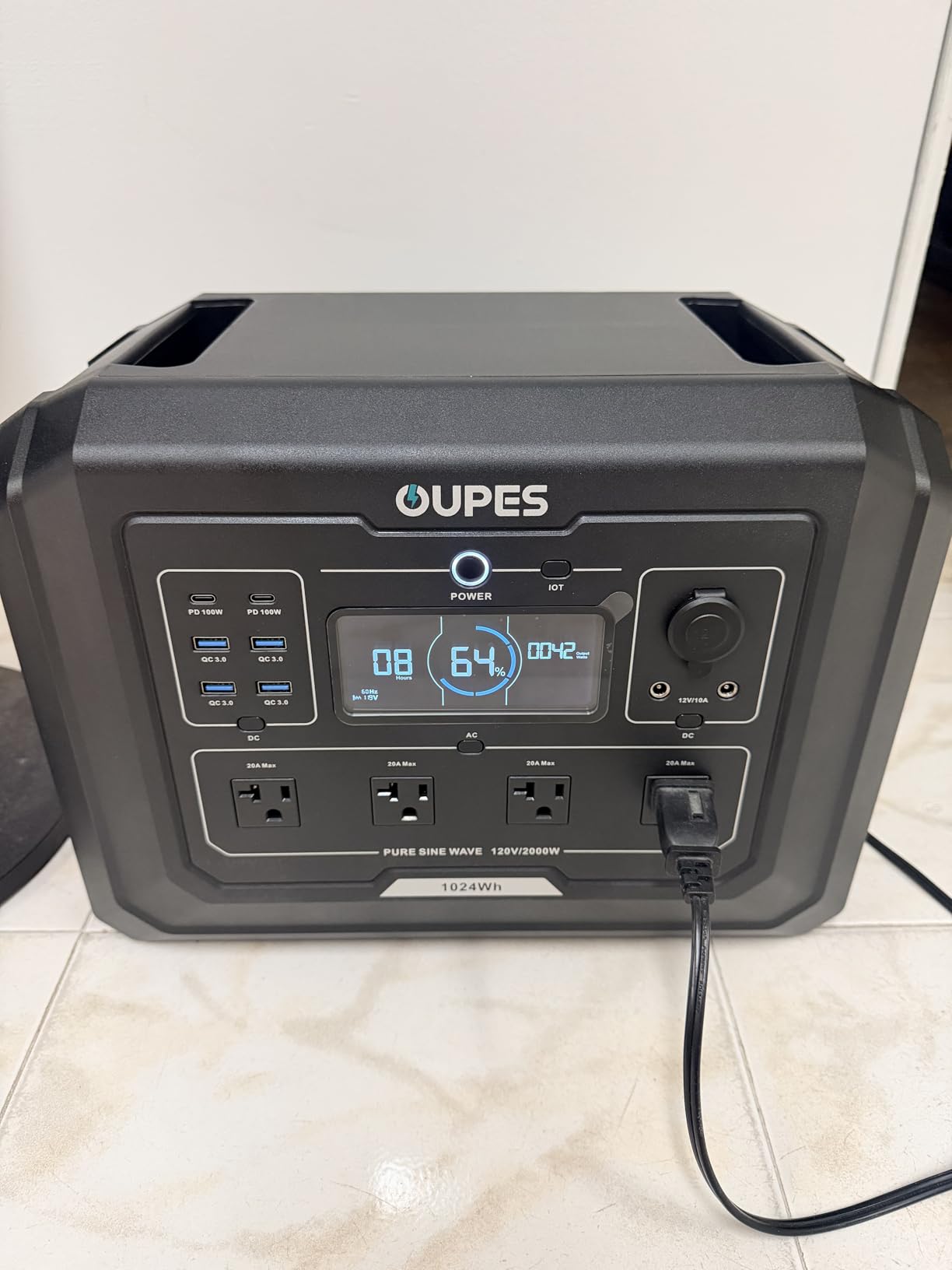
Solar input accepts up to 800W, and with three 240W panels the manufacturer claims 0-80 percent in 1.3 hours. The UPS switchover is under 20ms, enough to protect computers and medical devices, and a 100W panel comes with the unit.
The honest caveat is brand maturity. Owners like the port selection and included panel, but the 4.5 rating across roughly 1480 reviews trails the leaders in this group, and RV forum users generally treat a less proven brand as a research item before committing at this level.
Who this works for
A family or work crew that charges a lot of small devices rather than one big appliance. Thirteen ports means nobody is queueing for an outlet, and the two 100W USB-C outputs handle laptops directly.
It also fits buyers who want room to grow, since 5120Wh is a large ceiling for a 1kWh base and costs less than trading up to a bigger unit later.
Who should skip it
Skip it if warranty support matters more than port count. The five-year warranty is on paper, but the feedback base is younger than the BLUETTI, Anker and EcoFlow entries here.
Skip it if you want a serious solar kit from day one. A 100W bundled panel is a trickle charger relative to the 800W input the unit can accept, so you will be buying real panels shortly after.
10. EcoFlow Delta Pro 3600Wh – Best for Small Business and Heavy Loads
EF ECOFLOW Portable Power Station 3600Wh DELTA Pro, 120V 3600W AC Output
3600Wh LFP
3600W AC, 4500W X-Boost
Expands to 25kWh
15 output ports
Pros
- 3600Wh capacity expandable to 25kWh
- 3600W continuous handles commercial loads
- Full charge in 1.8 hours on 240V input
- Fifteen output ports including five AC and two 100W USB-C
Cons
- 99 lbs needs a trolley to move at all
- Solar input capped at about 15 amps
- Some reports of overload errors and warranty friction
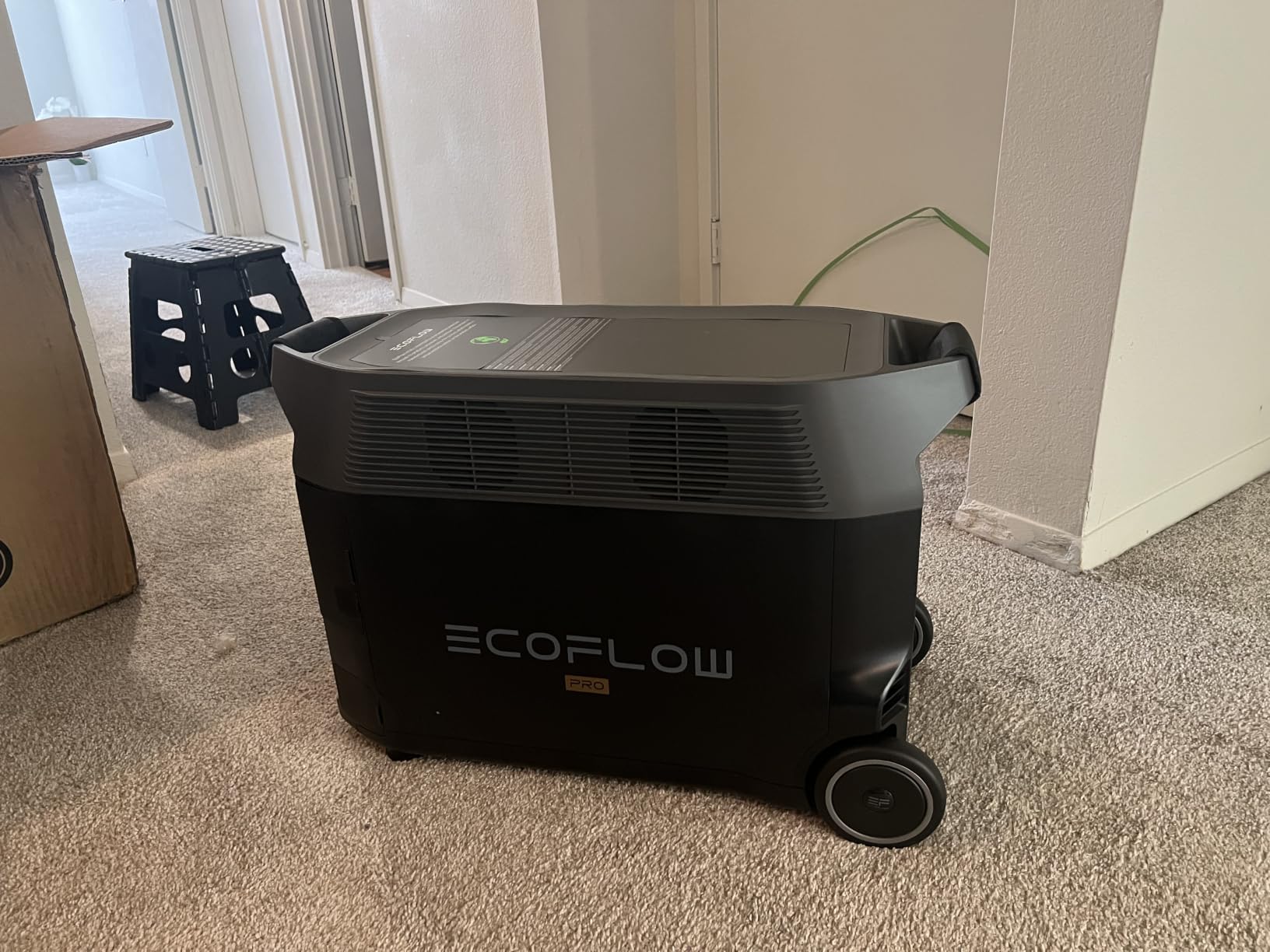
The Delta Pro is the only unit on this list that approaches whole-home or small-business territory. It carries 3600Wh of LFP expandable all the way to 25kWh, and it is the biggest battery you can fit under the 2,000-dollar ceiling without going to a trailer.
The inverter delivers 3600W continuous, up to 4500W with X-Boost and 7200W when two units are paired. Fifteen output methods include five AC outlets, two USB-C at 100W and an Anderson port, which is enough to keep a small shop running.
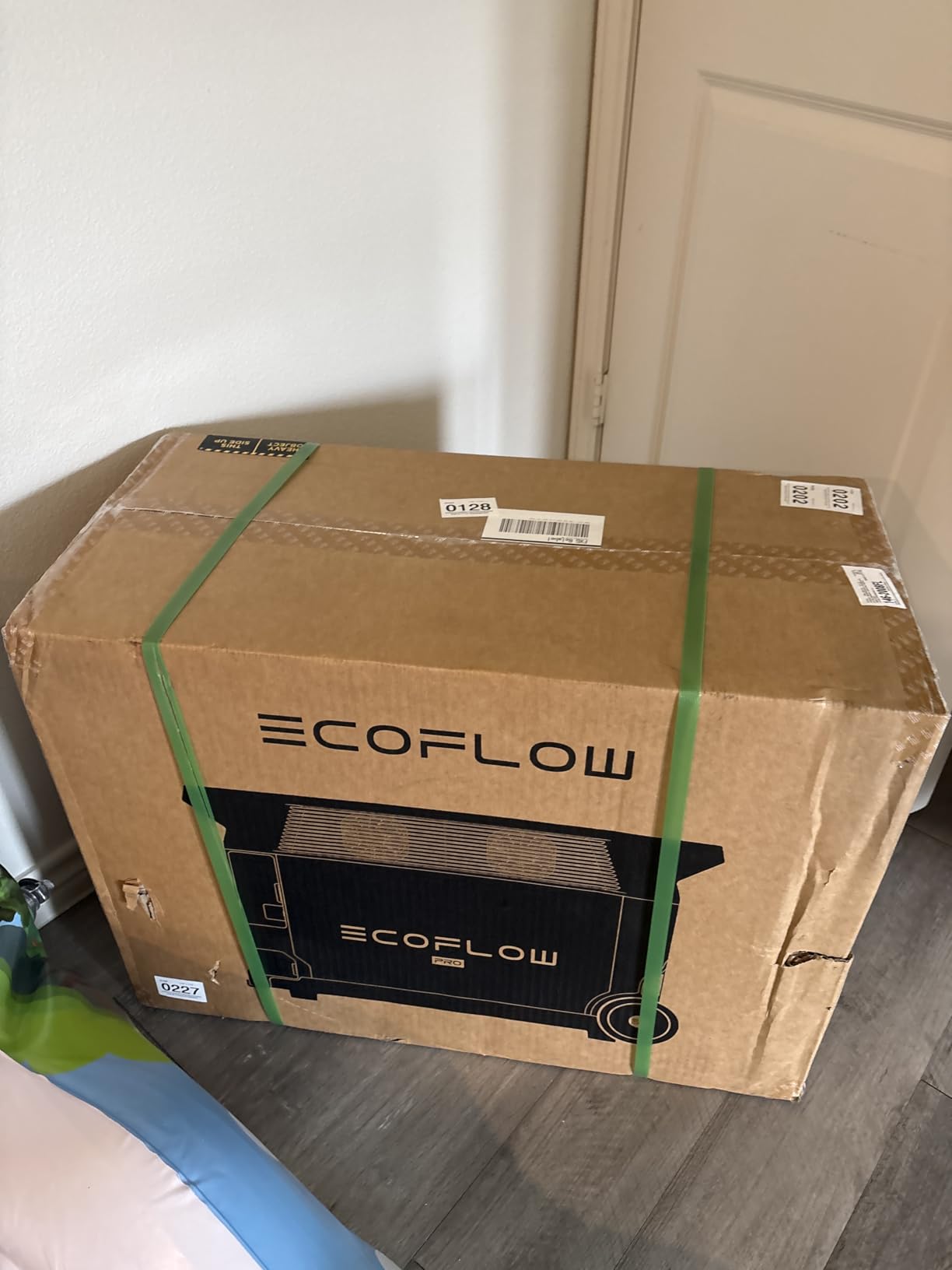
Charging is genuinely fast at this size. A full recharge takes 1.8 hours on 240V at 3000W and 2.7 hours from a 1800W wall outlet, and four 400W panels refill the unit in about 2.8 hours. Owners also mention EV station charging as a fast top-up route.
One reviewer logged roughly 15 hours running a refrigerator, furnace blowers, internet and computers at the same time. Vendor market users report running heat presses with no voltage drop, which is the kind of load no 2kWh unit in this roundup handles.
Who this works for
A home that wants to carry the essentials through a long outage, or a small business that cannot afford to lose refrigeration and computing for a day. The 3600W output covers loads the 2kWh class physically cannot.
It also suits buyers who intend to grow into a larger system. With expansion to 25kWh, this is a starting point rather than a ceiling.
Who should skip it
Skip it if it has to cross a threshold or go up stairs. At 99 lbs the extendable trolley handle is close to essential, and any arrangement without ground-level storage rules it out.
Skip it if you plan a large solar array. Solar input is limited to roughly 15 amps, which caps the array size regardless of how many panels you own. A few buyers also report overload errors and warranty friction worth weighing.
What Your Budget Actually Buys
A budget this size splits into three useful tiers, and they buy genuinely different things. Knowing which tier matches your outage risk saves you from overspending on capacity you will never draw.
The entry tier, roughly 600 to 900 dollars, buys about 1024 to 1152Wh with an 1800 to 2000W inverter. That covers a fridge, a router, lights and a laptop for a day or two, and it is where the Anker SOLIX C1000 Gen 2 and the EcoFlow Delta 3 Classic sit.
The mid tier, roughly 900 to 1300 dollars, buys 2048Wh with a 2400W inverter and, in two cases, real expansion. This is the band most households should target, because it adds a second fridge or a CPAP machine without changing platforms.
The top tier, roughly 1300 to 2000 dollars, buys 2073 to 3600Wh. You are buying hours rather than days of runtime, plus higher inverter output for air conditioners and tools. Our cabin solar generator guide covers the off-grid version of this tier in more depth.
What a 2000W Unit Runs in a 24-Hour Outage
Capacity math is simple: divide watt-hours by the watts your devices actually draw, then apply a safety factor. A compressor-based refrigerator averages far less than its startup rating, so most owners get more hours than the label implies.
A typical 150W refrigerator compressor cycling on and off for roughly a third of the day draws about 1.2kWh over 24 hours. On a 2048Wh unit that leaves room for a router, a few LED lights and a laptop, and on a 3600Wh unit you can add a CPAP machine comfortably.
What a 2000W inverter will not do is run central air, a clothes dryer, a water heater or an electric range. Those loads sit well above anything in this roundup, and owners on RV forums consistently describe them as the reason people buy a second unit rather than a bigger one.
Surge matters more than people expect. A fridge compressor can draw three to four times its running wattage for a second or two, which is why a 1500W inverter with 3000W surge can start something that a nominally similar 1800W unit stalls on.
How to Choose the Best Solar Generators Under 2000
Start with capacity, then work down. Multiply the wattage of everything you need to run by the hours you need it to last, add 30 percent for conversion losses, and use that total as your watt-hour floor. Ignore this step and you will size the wrong box.
Next check continuous output against surge. Continuous output is what sustains a load; surge covers startup. If your largest appliance is a microwave or a power tool, confirm the surge rating clears it, because a compressor or motor can draw several times its nameplate briefly.
Battery chemistry is already decided for you in this price band. Every unit here uses LiFePO4, which is why we compare cycle ratings instead: 3000 cycles for the AC180 and Delta 2 Max, 4000 for the Jackery and the Anker C1000 Gen 2, and 6000 plus for the Elite 200 V2. Higher cycle counts mean more full charges across a decade of ownership.
Solar input is the most-misunderstood spec. Check the wattage ceiling, not the panel in the box. A 200W bundled panel in summer sun adds far less than the rated figure, and owners across RV and van life forums report that wall charging is dramatically faster than panel charging in practice.
Plan the total system cost, not the unit cost. Only four of these ten kits include a panel, and one includes just 100W. If you need meaningful solar, add a 400W to 1000W panel and possibly an expansion battery to the purchase, and check whether your budget still holds.
Ports and portability decide daily usability. Count the AC outlets you actually need at once, check whether there are 100W USB-C ports for laptops, and test the weight honestly against your strongest available arm. The gap between 25 lbs and 53 lbs is the difference between one person and two.
For home use, safety is non-negotiable. Never improvise a backfeed connection, and never feed a home through a modified cord. A listed transfer switch installed by a qualified electrician is the correct method, and a portable power station is meant to run a few essential circuits rather than the whole panel. Indoor use is fine as long as you keep ventilation clear while fast charging.
Leave a small buffer on the state of charge rather than running to zero every cycle. Long-term storage at partial charge, in a moderate temperature, keeps more of the rated capacity available for the years you are not using the unit at all.
If you also want the brand question answered directly, our expandable generator guide compares the expansion paths across the major brands.
Watch-Outs Owners Actually Report
None of these are dealbreakers, and none are hidden by the manufacturers. They are the same complaints that come up repeatedly in owner forums, and knowing them in advance saves an expensive return.
Solar recharge is slower than the spec sheet suggests, especially in heat or thin cloud. Forum consensus across RV, van life and off-grid communities is consistent: wall charging is where the speed lives, and panels are a slow top-up rather than a rescue plan.
Fan noise during fast charging is a recurring indoor annoyance. Several units here run their cooling fans hard when pulling 1000W or more from the wall, and that is audible in a bedroom at night. If your unit lives indoors overnight, check whether it has a silent charging mode.
Charging from a car drains the starting battery. Owners consistently warn to charge only while the engine is running, and 12V charging is slow on most of these units anyway, so treat it as a trickle top-up.
Warranty and service friction is a long-running complaint across the category. If you rely on a unit for medical equipment, buy from a brand with a long published warranty and keep the serial number and purchase record somewhere you will find it in a blackout.
Frequently Asked Questions
What is the best solar generator for the money?
Within the sub-2,000-dollar band, the Anker SOLIX C1000 Gen 2 offers the best balance of 1024Wh capacity, a 2000W inverter, a 25-pound weight and a 49-minute wall recharge, backed by a 4.7 rating across more than 1600 reviews. For more raw capacity the BLUETTI Elite 200 V2 gives you 2073.6Wh and two included solar panels.
What is the best 2000 watt solar generator?
At exactly 2000W continuous, the Anker SOLIX C1000 Gen 2 pairs 1024Wh of LiFePO4 with a 3000W peak rating and a 10ms UPS, making it the strongest 2000W option for essential circuits. If you need more than a kilowatt-hour of storage at that output, the EcoFlow Delta 2 Max delivers 2400W with 2048Wh and expands to 6kWh.
How long will a 2000 watt solar generator run a refrigerator?
A 150W compressor refrigerator averaging roughly a third duty cycle draws about 1.2kWh over 24 hours. On a 2048Wh unit that leaves ample room for a router, lights and a laptop, while a 1024Wh unit typically covers one long night plus part of the next day. Owners report nine hours on a full-size side-by-side fridge with a 1070Wh unit and over 30 hours on a 2073.6Wh unit.
What can you run on a 2000 watt solar generator?
A 2000W inverter handles a refrigerator, router, lights, a laptop, a CPAP machine, a microwave and small power tools without strain. It will not run central air, a clothes dryer, a water heater or an electric range, because those loads exceed anything portable at this price. Check surge ratings before starting compressor-based appliances.
Are solar panels included with solar generators?
Usually not. Only four of the ten power stations in this roundup come with a panel, and one of those includes only 100W, so your real system cost is usually higher than the sticker price. The two 200W panels included with the Elite 200 V2 are the strongest bundle here. Budget for a 400W to 1000W panel if you plan to run on solar alone.
Can I use a solar generator indoors?
Yes, indoor use is fine as long as you keep ventilation clear, especially while fast charging when the cooling fans run hard. Never improvise a backfeed connection into your home wiring. Use a listed transfer switch installed by a qualified electrician if you want to power essential circuits, and keep a portable unit on a small set of appliances rather than the whole panel.
Final Verdict
The best solar generators under $2000 fall into a clear pattern: buy capacity you will actually use, buy LiFePO4 with a long cycle rating, and add the panel cost to your budget before you shop. Our editor’s choice is the Anker SOLIX C1000 Gen 2 for the strongest all-round balance, the BLUETTI Elite 200 V2 for real home backup, the EcoFlow Delta 3 Classic for value, the Anker SOLIX C2000 Gen 2 for RV life, and the EcoFlow Delta Pro 3600Wh for small business loads.
Whichever you choose, buy the panel at the same time and charge it fully before the next storm season.