
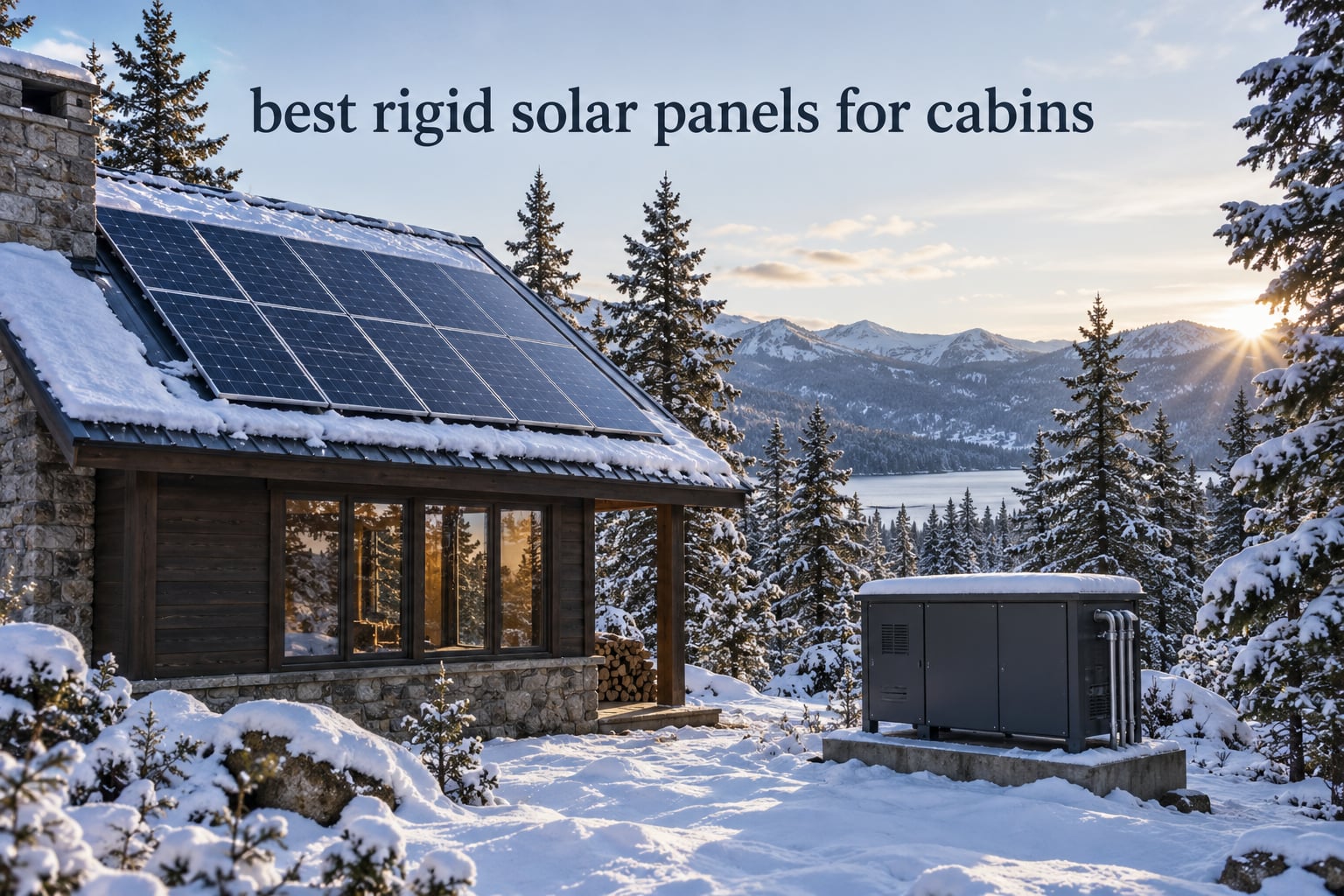
A cabin has no utility to fall back on, so the panel you pick is a reliability decision before it is a shopping decision. The best rigid solar panels for cabins are the framed, glass-capped modules you can bolt to a roof or a ground rack and forget about for a decade. They take snow, hail, wind and critters, they run cooler because air moves behind them, and they come with 25-year performance warranties that a thin flexible sheet cannot offer.
Our team compared ten rigid modules from the entry 100W class up to 400W ground-mount sets, checking cell technology, efficiency, weight, junction box sealing, wind and snow ratings, warranty length and the real-world output buyers report after a season or two of real weather. Six of these ten are N-type panels, and that shift matters more in a cold, low-sun cabin state than any other spec on the datasheet.
If you are still building the rest of the system, our picks for solar generators for cabins and portable solar panels cover the backup and mobile side of the same problem. This guide stays on permanent rigid installs.
Table of Contents
Top 3 Picks: Best Rigid Solar Panels for Cabins in 2026

The Renogy 200W wins the overall slot because it carries the largest verified review base in the group and delivers above its nameplate in real installs. HQST’s twin-panel pack is the value pick, and the ECO-WORTHY four-panel set is the one to buy when the array sits on a rack with open air behind it.
All 10 Rigid Solar Panels for Cabins Compared Side by Side
| Product | Specifications | Action |
|---|---|---|
 Renogy 200W N-Type 16BB Renogy 200W N-Type 16BB |
|
Check Latest Price |
 HQST 400W 2 x 200W N-Type HQST 400W 2 x 200W N-Type |
|
Check Latest Price |
| ECO-WORTHY 400W Four-Panel Set |
|
Check Latest Price |
 RICH SOLAR 200W N-Type 18BB RICH SOLAR 200W N-Type 18BB |
|
Check Latest Price |
 JJN 200W Bifacial N-Type JJN 200W Bifacial N-Type |
|
Check Latest Price |
 Callsun 200W TwinCell Callsun 200W TwinCell |
|
Check Latest Price |
 Traver Force 100W Monocrystalline Traver Force 100W Monocrystalline |
|
Check Latest Price |
 Callsun 200W 2 x 100W N-Type Callsun 200W 2 x 100W N-Type |
|
Check Latest Price |
 DOKIO 200W Monocrystalline DOKIO 200W Monocrystalline |
|
Check Latest Price |
 Renogy ShadowFlux 200W Renogy ShadowFlux 200W |
|
Check Latest Price |
1. Renogy 200W N-Type 16BB – Best Rigid Solar Panel for Cabins Overall
Renogy Solar Panels 200 Watt, N-Type Solar Panel 25% High-Efficiency 16BB
200W N-Type 16BB
25% cell efficiency
IP67, 23.4 lb, 49.7 by 30.1 in
Pros
- Reports of output above the 200W nameplate in full sun
- Compact footprint for a small cabin roof
- 10-year workmanship plus 25-year performance guarantee
- IP67 module holds up to snow and rain
Cons
- Z-brackets must be unbolted to remove the panel
- Series Voc has to be matched to your MPPT window
- A minority of units arrive with a cell strip defect
This is the panel we keep coming back to for cabin duty, and the reason is the review base rather than a single spec. More than seven thousand buyers have rated it, and the pattern in their reports is consistent: measured peaks above the 200W nameplate, including 255W in direct sun and 216W under overcast skies on a multi-panel array.
The build is what separates it from cheaper 200W glass. You get a tempered glass face in an anodized aluminum frame, 16-busbar N-type cells at a quoted 25% efficiency, and an IP67 rating on the module itself. Degradation is specified at 1% or less in year one and 0.4% a year after that, which is the kind of number that matters when you are planning fifteen years ahead on a battery bank.
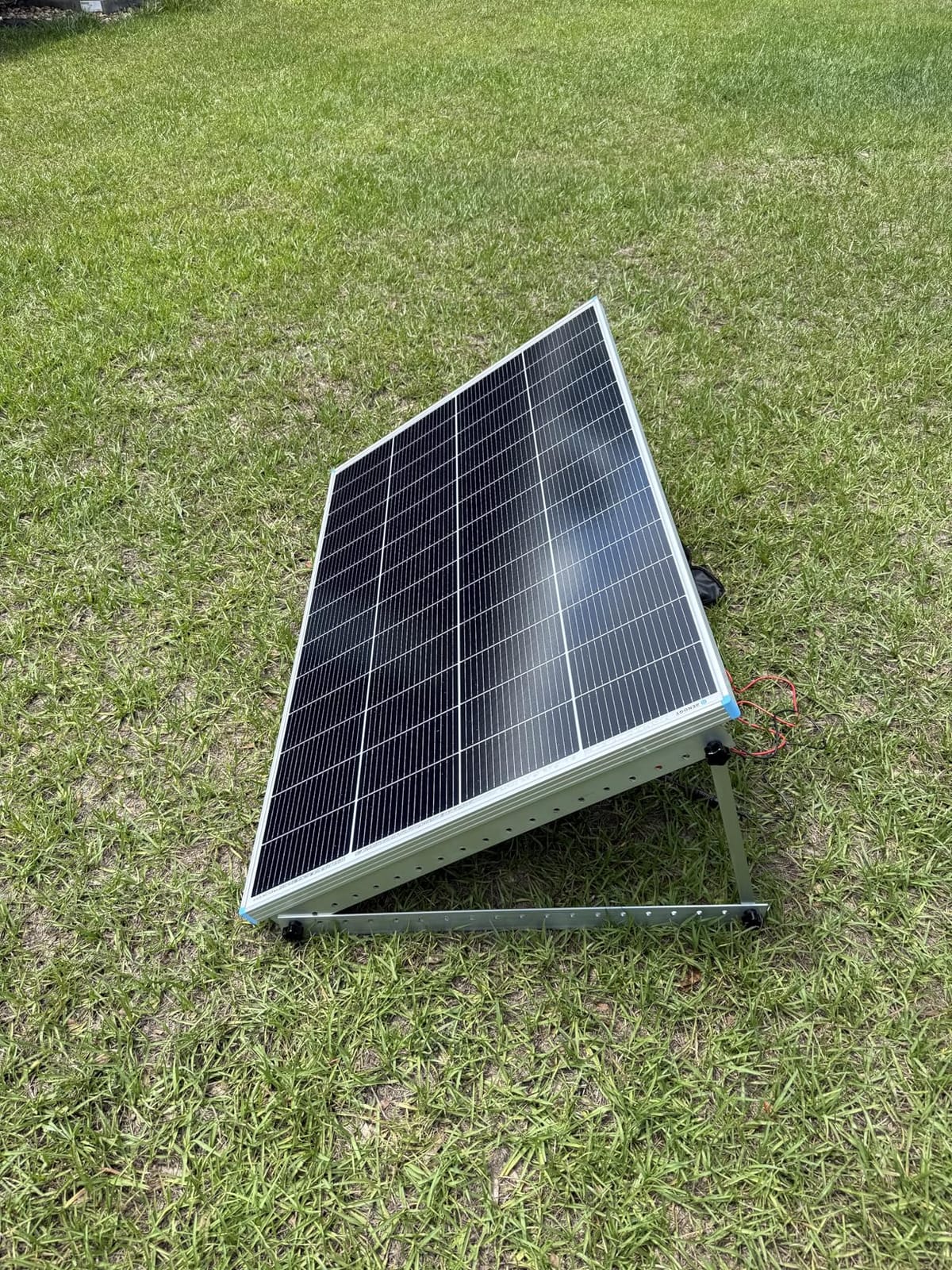
The electrical picture suits a small-to-mid cabin bank. It runs at 24V with a 37.44V maximum, 6.85A of output current, and it is rated for both 12V and 24V battery systems, so it fits a weekend cabin on one 100Ah LiFePO4 bank or pairs into a 24V string for a larger homestead array.
Weighing 23.4 pounds at 49.7 by 30.1 inches, it is a manageable two-person roof lift and light enough for a metal-framed cabin roof with modest structure. At 49.7 inches long it fits most cabin roofs where a 58-inch panel would overhang the edge, and 23 pounds per panel is roughly 46 pounds for a two-panel roof pair, well inside typical residential roof limits once you add a proper mounting plane.
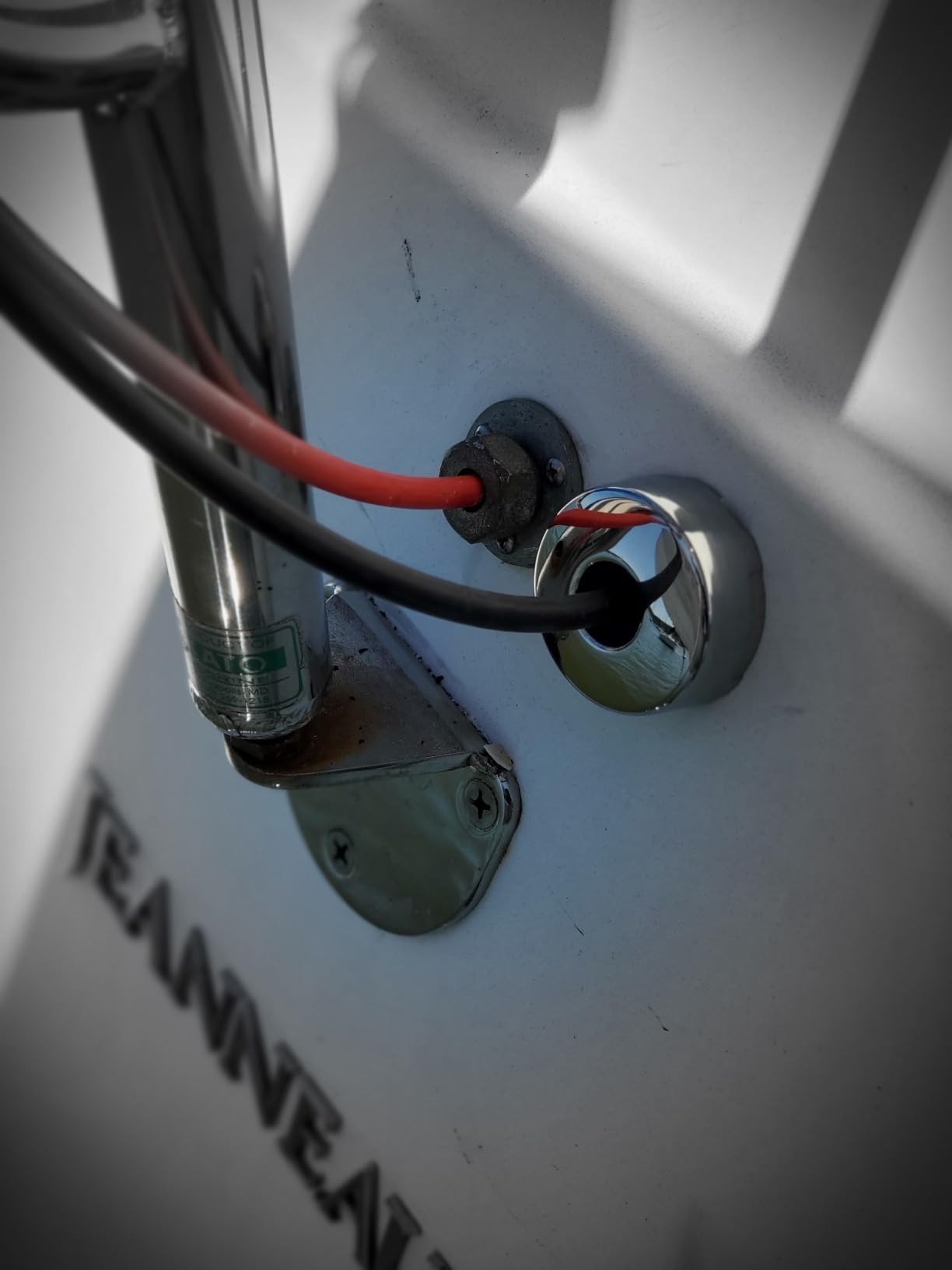
What the 37.44V maximum voltage means for your controller
That voltage is the number to check first, because it drives everything about string design. In series with a second panel, open-circuit voltage rises well past the single-panel figure, and on a cold January morning with a clear sky it climbs further still. Any MPPT controller you pick needs an input ceiling above your cold-corrected string voltage, with margin to spare.
Run the array in parallel instead and the voltage stays put while current adds up, which is why many cabin builders pair two of these in parallel on a single 30A controller rather than stacking them in series.
Where it falls short
The most repeated complaint has nothing to do with electricity. The Z-brackets are designed so the panel cannot be lifted off for cleaning or inspection without removing the brackets themselves, which turns a five-minute roof task into a longer job on a ladder in the cold.
Second, a small number of buyers report a cell or solder strip defect on arrival, so test each panel with a multimeter before you mount it. Third, output under heavy overcast still falls off noticeably from rated power, which is physics rather than a fault, but it is worth planning around if your December load is heating-driven.
2. HQST 400W (2 x 200W) – Best Value Rigid Solar Panels for Cabins
HQST 400W Solar Panel, 2 * 200W, N-Type, 16BB, up to 25.4% Efficiency, IP65
Two 200W N-Type panels
Up to 25.4% efficiency
2400 Pa wind, 5400 Pa snow, 20.2 lb each
Pros
- Strong output per watt on budget hardware
- Light enough at 20.2 lb for a solo roof install
- Bifacial rear face adds real gain on open mounts
- Survives abuse including a dropped step ladder
Cons
- Short factory leads sit at one top corner
- Bifacial gain disappears when mounted flush
- Thin corner padding in the packaging
Two matched 200W panels in one package is the shape most cabin builds actually want, and this is the pair we would reach for first after the Renogy. Each panel is a 46.3 by 30.1 inch N-type module rated to 2400 Pa wind and 5400 Pa snow, which is the snow rating that matters in Maine, Vermont, northern Michigan and the Canadian Rockies.
Buyers consistently report production above the rated 100W per panel figure on budget-class hardware, and the durability reports are unusually good for the price tier. One reviewer reported no damage after a step ladder was dropped on the panels, and another had a panel torn off a temporary mount by wind and still considered it usable.
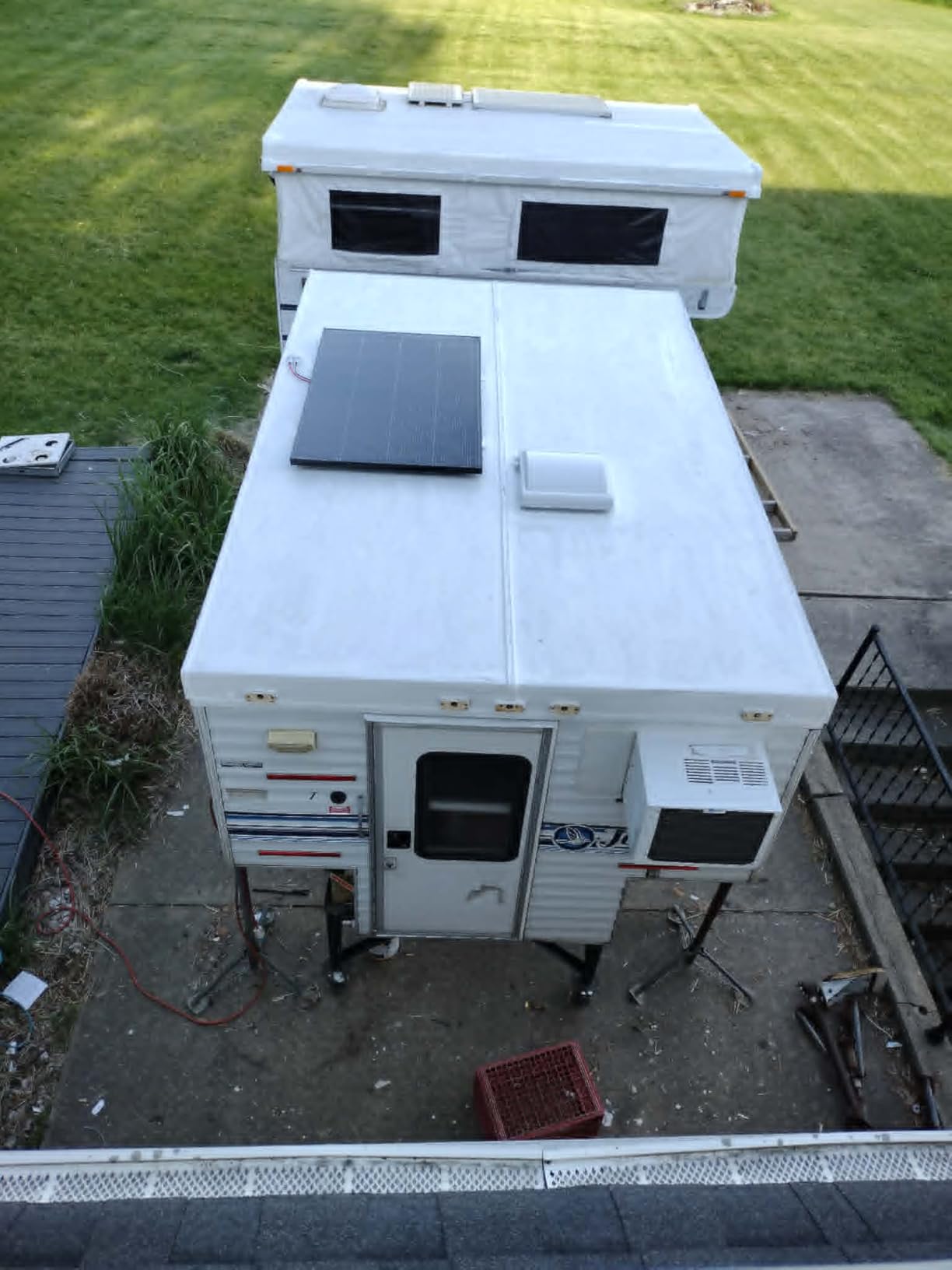
The efficiency claim of up to 25.4% comes from Grade A+ 16-busbar cells that are EL-tested for microcracks before shipping, and the manufacturer rates service life at 30 years with 87.4% output retained. That long-horizon degradation figure is a genuine advantage over panels sold with only a 25-year guarantee at 80%.
Bifacial construction means these collect light on the rear face as well, but only if you mount them with an air gap. On an open rack over pale gravel or snow, that rear-side contribution is real. Bolted flat to a dark shingle roof, it is close to nothing, so plan the mounting height before you buy rather than after.
The open-circuit voltage measures around 22.4V per panel, so two in series land near 45V, which sits comfortably inside the input window of most 30A and 40A MPPT controllers. That makes this pair an easy fit for a 24V cabin bank.
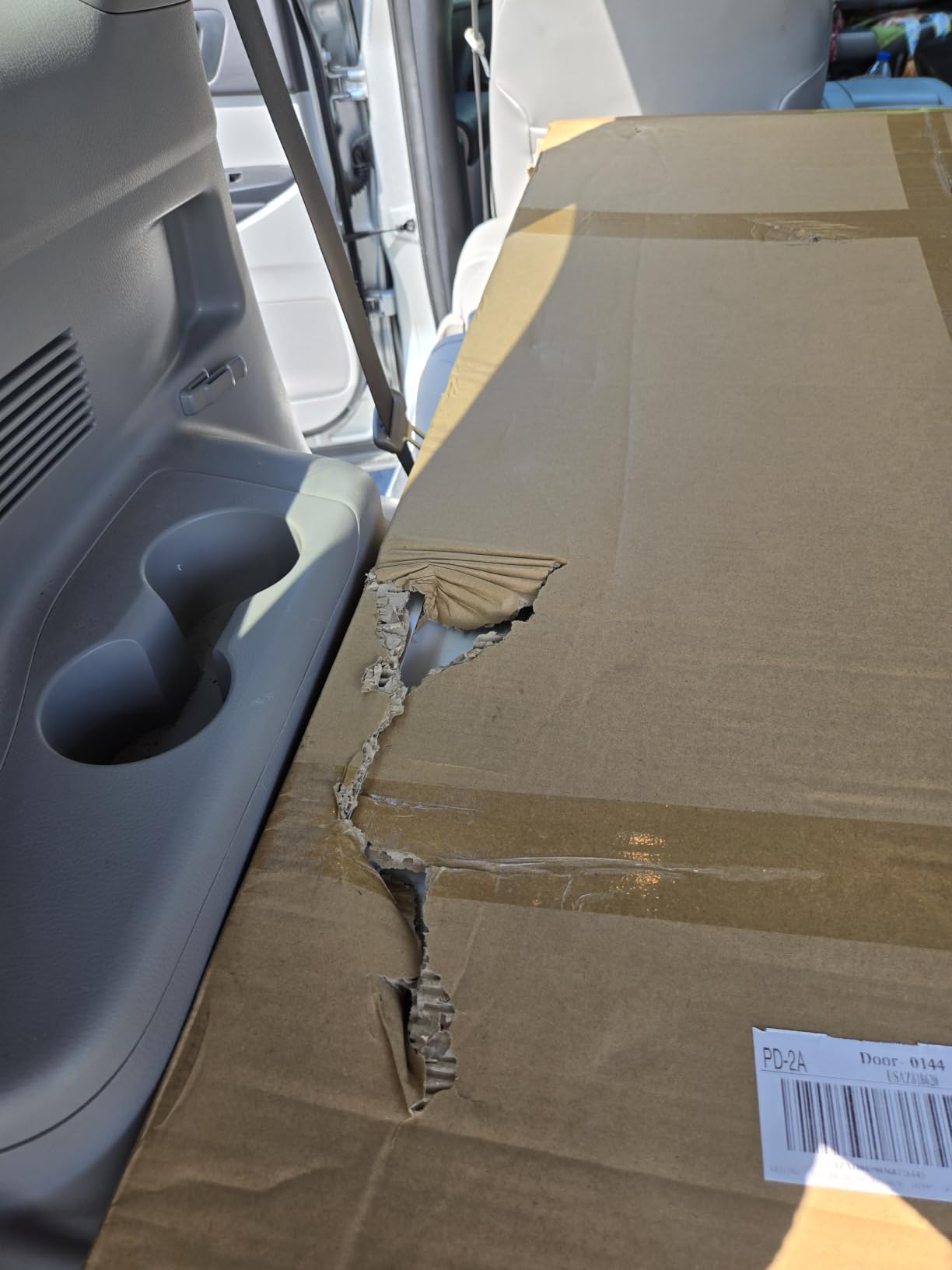
Why the junction box position will decide your layout
The single most repeated practical complaint across these reviews is the junction box and cable placement. The factory leads run only 24 to 27 inches and the box sits at one top corner, which means wiring more than about three panels in series needs extension cables you will have to source separately.
Plan the physical arrangement around that box corner. Put the panels in two parallel strings of two rather than one long series run, keep the extension cable length short, and you will avoid extra parts entirely.
Where it falls short
The compact 46.3 by 30.1 inch footprint is a genuine benefit on a cabin roof but a drawback on a vehicle roof, where a taller panel is often easier to clear of an obstruction. And again, the bifacial advantage only appears with proper standoff mounting.
Outer packaging protection is thin with minimal corner padding, so if you are shipping to a remote cabin site, order extra corner protection for the road leg.
3. ECO-WORTHY 400W Four-Panel Set – Best Rigid Solar Panels for a Ground Mount
ECO-WORTHY 400W Solar Panels N-Type 4pcs 100 Watt 18V Monocrystalline
Four 100W bifacial N-Type panels
Up to 25% efficiency
IP68 box, 23.8 lb for the set
Pros
- Owners report measured set output of 400-449W
- Light for the total output
- IP68 junction box with bypass diodes
- Free replacement on an underperforming panel
Cons
- Panel-to-panel output varies
- so test each one
- Bifacial gain is modest at typical tilt
- Panels are packed in two separate cartons
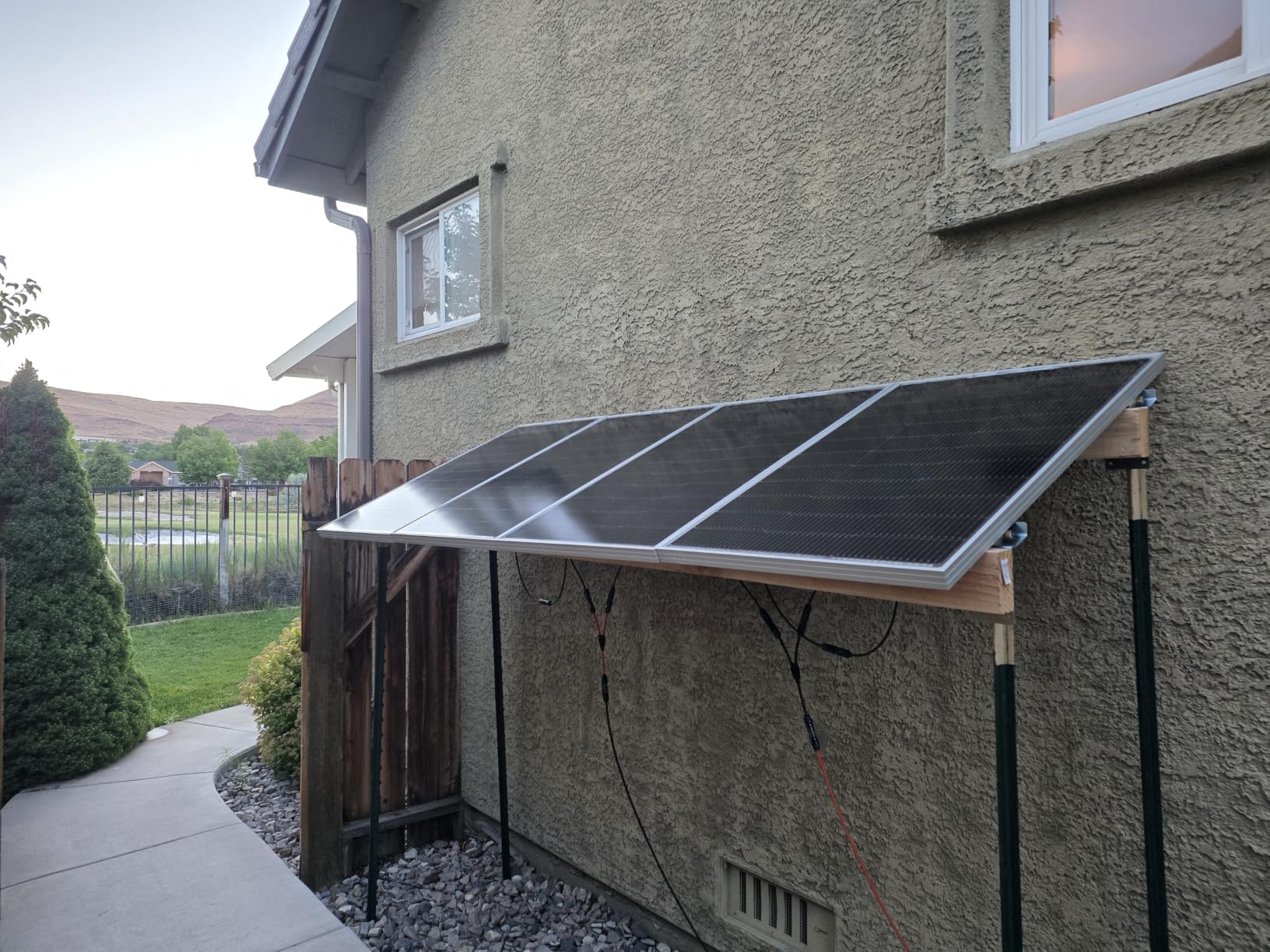
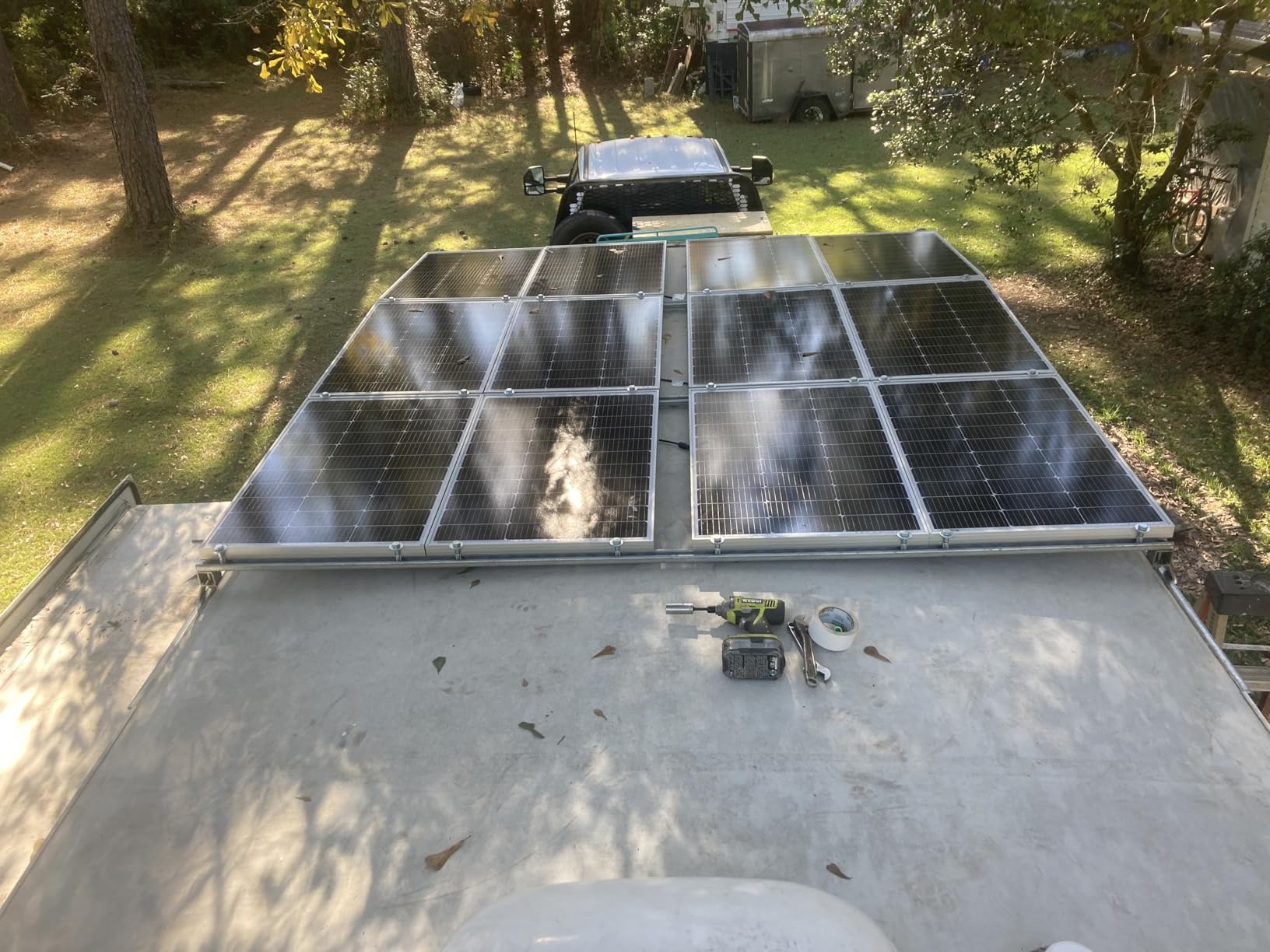
Four small panels beat one big one in almost every cabin scenario that has ground to mount into. Each module measures 35.63 by 23.03 inches, so you get 400W of nameplate capacity from a rack you can build in an afternoon, and the entire set weighs only 23.8 pounds. That weight matters more than efficiency when you are framing a rafter run or a pole mount out in the woods.
Measured output is the story here. Owners report set totals of 400 to 449W and more than 20 amps flowing into a pair of 100Ah batteries. Cell technology is N-type with 16 busbars at up to 25% conversion efficiency, in low-iron glass with an anodized aluminum frame, and each panel carries a 35-inch lead with plug-and-play connectors.
The junction box is IP68 with pre-installed bypass diodes, which is the highest sealing rating in this group and the one specification that forum builders single out when moisture ingress is the worry. The 1.18-inch edge thickness also helps shed heat, which keeps output steadier on a hot July afternoon.
Each panel outputs 21.6V at 4.96A with a 25.2V maximum voltage, so two in series gives you a normal 24V nominal string and four in series gives you a 48V-class string. That flexibility is what makes this set attractive for a full-time homestead rather than a weekend retreat.
The bifacial design harvests rear-side light, though the real-world gain here is modest at a typical winter tilt over ground rather than snow. Treat it as a bonus on a high-tilt summer rack, not as a sizing assumption for December.
Why testing each panel before mounting pays off
The most substantive finding across these reviews is panel-to-panel variance. One buyer found a unit running roughly 20% under the rest of the set, which is exactly the kind of defect that quietly drags an entire string down if it goes unnoticed. The brand resolved it with a free replacement, which is good service, but only if you caught it.
Before you mount anything, clip a DC clamp meter to each panel in full sun and write the numbers on the frame with a marker. Anything more than 10% below its siblings goes back now rather than after you have drilled the roof.
Where it falls short
A 400W nameplate set realistically yields less than 400W on site once you apply a realistic derate, so size your battery bank for what you actually collect in December rather than for the label.
The four-panel set is packed across two cartons, so a complete set is not always delivered together. If you are installing in a single visit, order early enough that a split carton does not leave you short one panel.
4. RICH SOLAR 200W N-Type 18BB – Premium Rigid Solar Panel for Snow-Country Cabins
RICH SOLAR 200 Watt Solar Panel, 12V N-Type 18BB, 25% High-Efficiency
200W N-Type 18BB
10.9A output, 25% efficiency
5400 Pa snow, IP67, 24 lb
Pros
- High 10.9A output speeds battery charging
- Long narrow format rails neatly in rows
- 1.3mm anodized frame for permanent rooftop mounting
- Same product line spans several sizes for future expansion
Cons
- 58.7 inch length needs a long clear roof area
- Heavy for a single-person roof install
- 18V maximum voltage constrains series strings
This is the one we would specify for a cabin that sees real winters. It is UL certified, rated IP67, and carries a 5400 Pa snow load rating alongside 2400 Pa wind resistance. The warranty package is the strongest in the group for a single 200W panel: 25 years of linear power output plus 5 years on materials and workmanship.
The electrical headline is current rather than voltage. At 10.9A output on an 18.4V panel, this is a 12V-class module that pushes charge current into a small battery bank faster than most 200W competitors, which shortens the window you need to reach full charge on a short winter day.
Cell technology is N-type with 18 busbars at up to 25% efficiency. More busbars means more current paths across each cell, which cuts resistive loss and cuts the hot-spot risk that leads to microcracks over a 25-year service life on a cold-climate roof.
Installation is straightforward, with 14 pre-drilled holes that accept Z-brackets, tilt mounts and pole mounts, and 3-foot quick-connect cables for series or parallel expansion. It works with PWM or MPPT controllers and with either grid-tied or off-grid inverters.
The frame is 1.3mm anodized aluminum with high-transmittance tempered glass, and the panel is rated to 185 degrees Fahrenheit. Anodizing rather than paint is the detail to look for in any cabin panel, because paint on steel starts showing corrosion in humid climates within a year.

How to handle the 58.7 inch footprint
This panel is long and narrow, and that is an advantage when you are rail-mounting a row along a long cabin ridge or an RV-length roof. It is a problem when your usable roof section is shorter than the panel, which is common on a small A-frame or a steep-hip roof with a chimney.
Measure the clear run first, then choose between this and a squarer 200W panel. At 58.7 by 26.8 inches and 24 pounds, it also needs two people on the roof rather than one, so budget a helper for the install day.
Where it falls short
The 18V maximum voltage is the constraint to plan around. On a 12V MPPT controller with a narrow input window, series strings are limited, so most cabin builders run this panel in parallel or in a two-panel parallel configuration instead.
The long length can overhang shorter cabin roof sections if you force the layout, and the 24-pound weight is the heaviest single panel we recommend for a do-it-yourself roof lift.
5. JJN 200W Bifacial – Best Budget Rigid Solar Panel for Cabins
JJN Bifacial 200 Watt Solar Panel, 25% High-Efficiency, Monocrystalline
200W bifacial N-Type 16BB
25% efficiency
Black frame, 2400 Pa wind, 23.2 lb
Pros
- Bifacial transparent backsheet adds rear-side generation
- Lowest entry point into a 200W N-Type module
- Black aluminum frame blends into a residential roof
- Light enough at 23.2 lb for manageable roof handling
Cons
- Rear-side gain vanishes when mounted flush
- Sold as PV module only with no brackets
- 28.1V open-circuit voltage needs a controller check
The JJN is the value route into 200W N-type silicon without stepping up a tier in build quality. It uses 16-busbar N-type cells at a stated 25% efficiency in a black corrosion-resistant aluminum frame rated for 2400 Pa wind and 5400 Pa snow, with IP67 connectors and an IP65 junction box.
What distinguishes it is the bifacial transparent backsheet, which collects energy from the rear face instead of blocking it with an opaque backsheet. On a rack with an air gap over pale ground or snow, that rear side adds output that a conventional single-faced panel simply throws away.
Output figures sit at 23.4V working voltage, 28.1V maximum voltage and 9.12A of current. That voltage profile is the one to check against your controller window before you commit, because 28.1V cold-corrected leaves less headroom than a 22V panel does.
Warranty coverage is 10 years on workmanship plus an output warranty above 88.9% at 30 years. That is a strong long-horizon figure, and note that the published output figure is stated for the rear-biased bifacial rating, so treat it as a ceiling rather than a guaranteed front-side number.
Pre-drilled rear mounting holes make the physical install familiar, and at 23.2 pounds it is one of the lighter 200W modules here. The black frame is a practical detail on a residential cabin roof where a bright silver frame reads as an afterthought.
When bifacial gain is worth the mounting effort
Rear-side generation needs two conditions: a gap of several inches behind the panel, and a reflective surface underneath. A steel or pale metal roof, white gravel or a snow field all contribute. Shingles, dark soil and an airtight standoff contribute almost nothing.
If your cabin roof is asphalt and your only mount is a flush Z-bracket, treat the bifacial claim as marketing and size the array as if it were single-sided. If you are building a ground rack on a south slope with light gravel, it is a real gain in the shoulder seasons.
Where it falls short
The listing includes the PV module only, so brackets, wiring and connectors are separate purchases that need to be budgeted before the roof is opened.
The 28.1V open-circuit voltage constrains how many panels you can put in series on a typical 12V-class MPPT controller, and a few panels in series in cold weather can exceed a narrower controller ceiling.
6. Callsun 200W TwinCell – Highest-Efficiency Rigid Solar Panel in the Set
Callsun N-Type 16BB 200W Bifacial Solar Panel, 200 Watt Solar Panel for 12V Battery Systems, 25.6% High Efficiency, Dual-Module Parallel Anti-Shade Design, for RV Van Marine Home Rooftop Off-Grid
200W N-Type TwinCell
25.6% efficiency, bifacial
-0.3%/K coefficient, IP68 box, 23.8 lb
Pros
- TwinCell layout keeps half the panel producing under shade
- Owners report peaks above the 200W nameplate
- Compact 51.3 by 30.3 inch footprint
- -0.3%/K coefficient holds output in heat
Cons
- Occasional damage in transit on a share of orders
- A small number of panels reported well below rating
- Bifacial gain depends on mounting height and reflectance
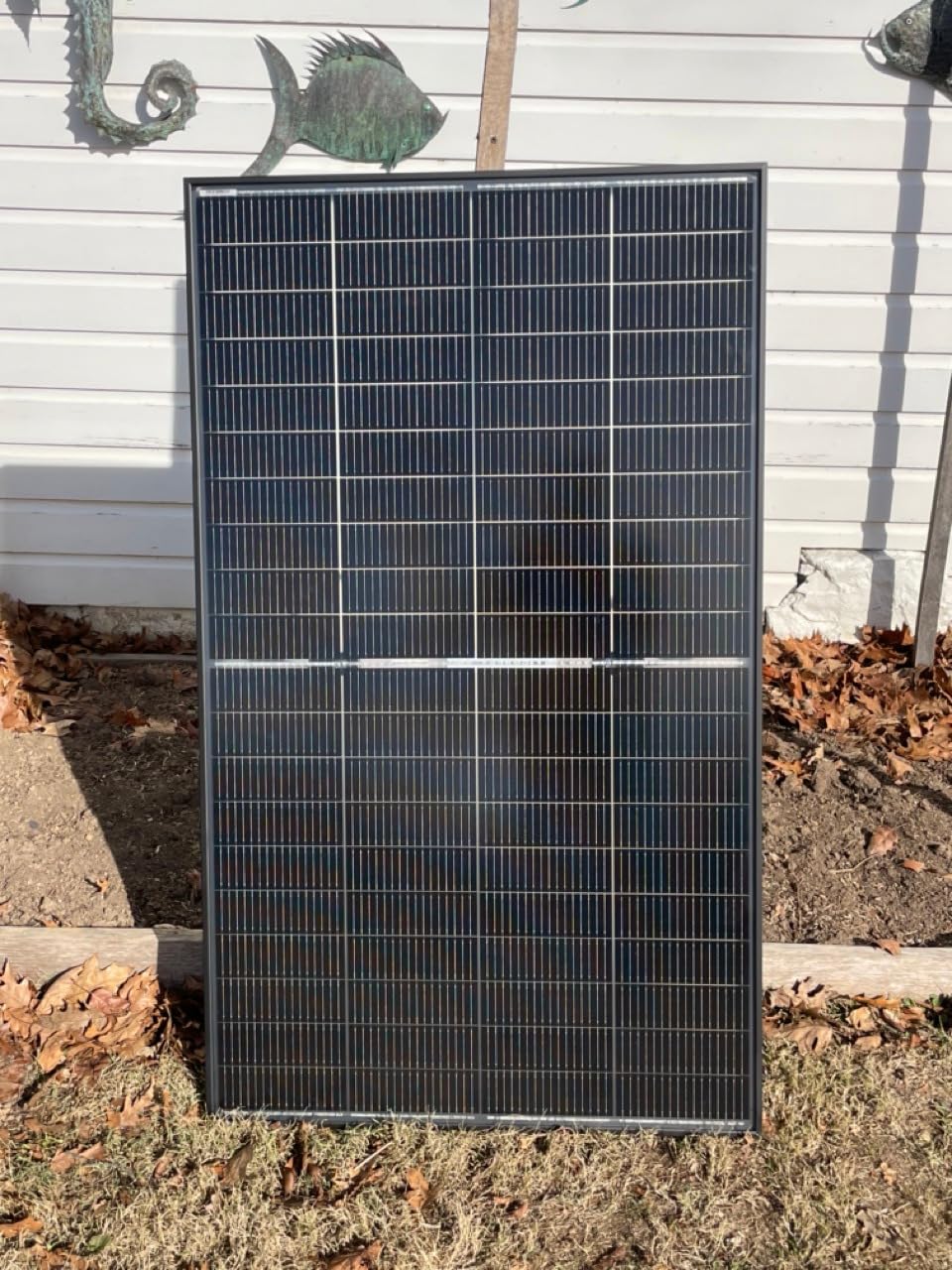
On paper this is the most efficient panel in the group at a stated 25.6% conversion efficiency, and its rating of 4.8 across 115 reviews is the highest average here. The defining feature is the TwinCell dual-module parallel architecture, which splits the panel into two independent halves so one can keep producing when the other is shaded.
That matters more at a cabin than the efficiency number does. A chimney, a stovepipe, a bare branch or the shadow of a snow ridge crossing the array at a low sun angle is exactly the condition that drags a conventional string down, and the manufacturer claims shade tolerance improved by up to 50% with this layout.
The bifacial transparent backsheet claims up to 30% extra output from the rear face. On light metal or concrete roofs, owners running large rooftop arrays report a noticeable additional yield, which is why this panel shows up on cabin builds with a standing-seam metal roof.
Thermal behaviour is the other quiet strength. The -0.3%/K temperature coefficient means output falls slowly as cell temperature rises, and combined with 3.8mm tempered glass and an IP68 junction box it is a panel built for a hot summer noon as much as a cold one.
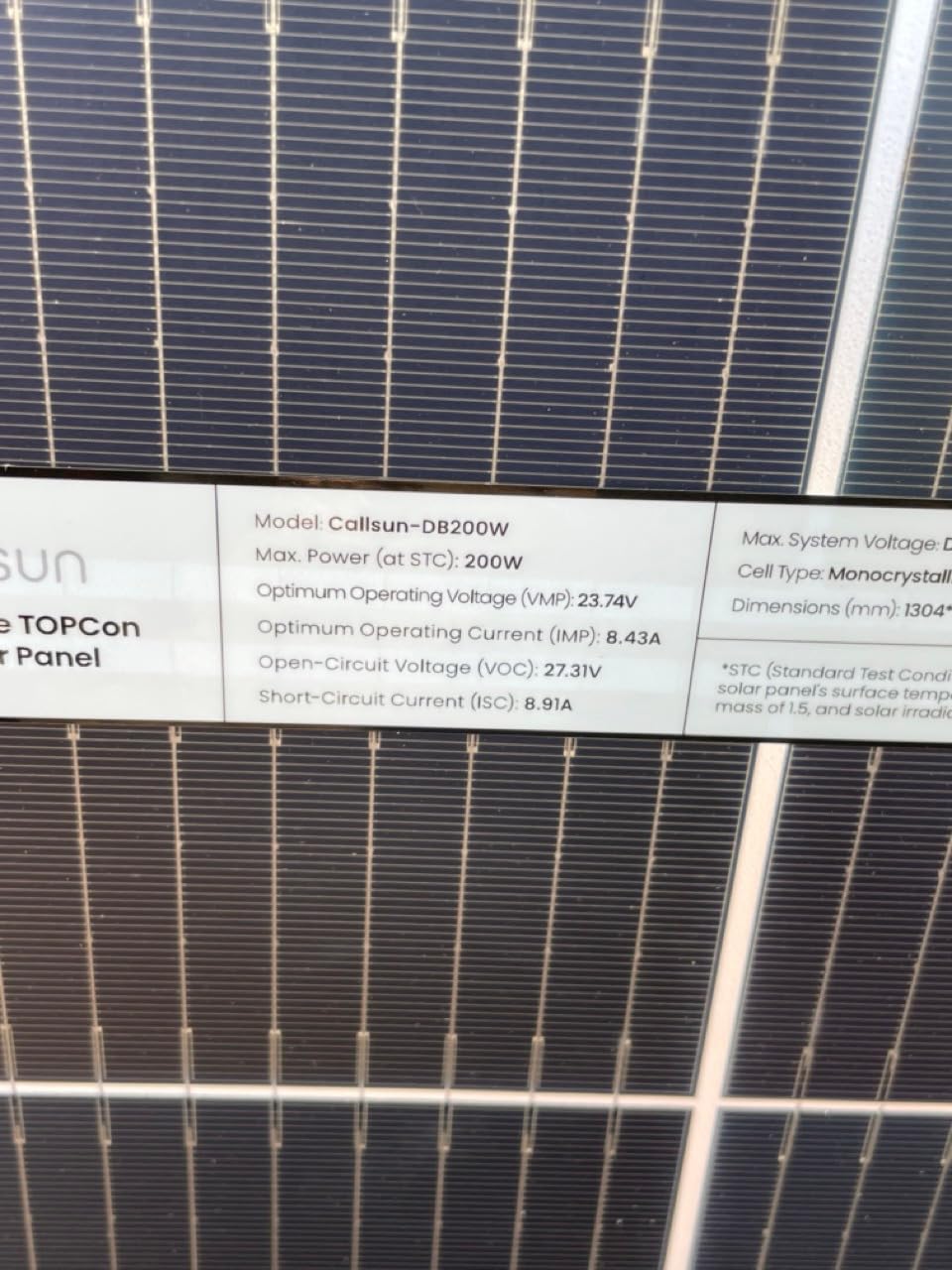
It is listed as optimized for 60V portable systems, with 60 cells, 23.74V working voltage and 8.43A output current. The 25-year performance commitment is stated at 84.5% output, with 10 years of technical support behind it.
What the TwinCell layout means in a real string
Because the two halves run in parallel inside one frame, a partial shadow from a chimney takes out part of the module rather than dragging the whole thing to the current of the weakest cell. In a series string of three panels, that single-panel advantage propagates to the whole string.
The catch is that current, not voltage, is what you get out of it. At 8.43A you need a controller sized in amps rather than one that only looks adequate on paper, and a series string needs the voltage ceiling checked cold.
Where it falls short
Transport damage shows up on a share of orders despite careful packaging, and a small number of units have been reported producing far below the rating. One review documented a faulty panel that the seller replaced only after the return window had closed, so check output on arrival.
It also carries the shortest review base in this roundup at 115 reviews, which means less long-term field history than the panels ranked above it. That is the trade for the best efficiency figure and the best rating average on the page.
7. Traver Force 100W – Best Entry Rigid Solar Panel for Small Cabins
Traver Force Solar Panel 100 Watt 10BB Monocrystalline 12V Solar Panels for Home High Efficiency Solar Module Power Charger for RV Camping Cabin Marine Boat Motorhome Off-Grid Black
100W monocrystalline 10BB
Up to 25% conversion
IP65 box, 13 lb, 38.1 by 22.6 in
Pros
- Lowest cost per watt in this group
- Light 13 lb panel is easy to handle and mount
- Compact footprint fits smaller roof sections
- Available in 1
- 2 and 4 packs for scaling
Cons
- 100W means several panels for meaningful cabin power
- 12V maximum voltage limits series strings
- Only four mounting holes
- 10BB cells trail 16BB on low light
Not every cabin needs a 200W module. A 12-foot hunting cabin running a small fridge, a couple of lights and a phone charger can be built entirely around 100W panels, and this is the cheapest credible rigid route into that build.
The cell specification is 182mm monocrystalline with 10-busbar technology at up to 25% conversion rate, in Grade A+ cells that pass EL testing without cracks. It carries a 5-year product assurance and 80% output retention at 25 years, which is a thinner warranty story than the premium options.
Physical handling is the standout. At 38.1 by 22.6 inches and 13 pounds, one person can carry, position and bolt this to a cabin roof without a second set of hands, and it fits roof sections where a full-size 200W panel will not go.
Environmental sealing is respectable for the tier, with IP68-rated solar connectors and an IP65-rated junction box in an anti-corrosion aluminum alloy frame. Four pre-drilled holes give you fewer attachment options than a premium panel with fourteen, so plan your bracket layout around a four-point mount rather than adapting a rail kit.
The upper temperature rating of 194 degrees Fahrenheit is among the higher figures here, and the listed use cases include cabins, RVs, marine and general off-grid installs, which is the correct audience for a panel this size.
The real constraint is arithmetic. A 100W panel at 12V and 2.75A produces roughly 300 watt-hours on a good summer day and far less in December, so a weekend cabin load of 500 watt-hours per day needs at least two of these and a winter load needs four.
When several small panels beat one big panel
There is a genuine case for the 100W format. Small panels are lighter, cheaper to replace individually, easier to hand-haul up a ladder, and far easier to arrange around a chimney, a vent stack or an irregular roof edge than a single large module.
They are also more forgiving of partial shade, since a shadowed small panel drags down less of the array than a shadowed corner on a large one. You give up some per-panel efficiency, and you pay for more mounts and more wiring runs.
Where it falls short
Twelve-volt maximum voltage limits how many you can place in series, so on a 12V system you are working in parallel with matched strings. And 10-busbar cells trail 16-busbar alternatives on low-light yield, which is precisely the December condition that limits a cabin array.
8. Callsun 200W (2 x 100W) – Lightest Rigid Solar Panels for Tight Cabin Roofs
Callsun N-Type 16BB 200 Watt Solar Panel, 2×100W Solar Panels
Two 100W N-Type 16BB panels
Up to 25% efficiency
11.4 lb each, 2400 Pa wind, 5400 Pa snow
Pros
- Two smaller panels are easier to position single-handed
- Compact 31.1 by 22.7 inch footprint fits small roofs
- Reinforced corner guards and IP68 sealing
- 5400 Pa snow and 2400 Pa wind ratings
Cons
- Lower per-panel wattage means more panels for a target array
- Two panels mean more mounts and parallel runs
- 12V class output constrains 24V string design
- 10% of reviews sit at three stars
When roof space or handling weight is the binding constraint, this split format is the answer. Two 100W N-type 16-busbar panels at 31.1 by 22.7 inches each, roughly 15% smaller than a conventional 100W module, weighing 11.4 pounds apiece.
Each panel carries up to 25% conversion efficiency, a -0.3%/°C temperature coefficient, 3.2mm low-iron tempered glass in a corrosion-resistant aluminum alloy frame, IP68 sealing with reinforced corner guards, and 2400 Pa wind plus 5400 Pa snow load ratings.
The corner guards are worth noting on a cabin. Panels thrown onto a gravel road during installation or nudged by a ladder are the most common way a good glass panel gets cracked before it is ever bolted down, and reinforced corners are cheap insurance.
Warranty terms are 10 years of support with a 25-year guarantee at 84.5% power output. That is a solid long-horizon commitment for a compact module, and the 16-busbar N-type design is credited with better light absorption and fewer hot spots than older 9-busbar or 10-busbar cells.
Because each panel is a 12V-class module, the pair works well in parallel into a 12V bank or as a matched pair on a 24V bank with the right controller topology. Expect to run parallel runs rather than a long series string, which keeps the wiring simpler on a small array.
Choosing between split panels and one large module
The split format wins when your roof is the constraint. Two panels of 31 inches give you far more layout options than one panel of 47 inches, and if one is ever damaged you replace a small panel instead of a large one.
A single large module wins on mounting hardware and wiring connections, because one panel means one set of brackets, one pair of leads and one set of cable runs. On a tiny roof with generous space, the larger panel is simply less work to install.
Where it falls short
The trade is straightforward. Lower per-panel wattage means more panels to reach a target array size, and each extra panel adds mounts, cable runs and connector pairs that all become potential failure points in a wet environment.
The rating spread is also wider than the single-panel Callsun model, with 10% of reviews sitting at three stars, which reflects some mixed satisfaction on output claims.
9. DOKIO 200W – Lowest-Cost 200W Rigid Panel, With Caveats
DOKIO 200W 18V Monocrystalline Solar Panel for 12V Systems, MC4
200W monocrystalline at 18V
Tempered glass, aluminum frame
22.5 lb, 50.8 by 29.5 in
Pros
- Low cost per watt among 200W monocrystalline modules
- Size and weight suit a single-person install
- MC4 leads are clearly labeled for series wiring
- Arrays measured at 560W and 616W
Cons
- Lowest rating in the set with 12% one-star reviews
- Several buyers report output well below nameplate
- Short leads make daisy-chaining awkward
- Output drops sharply whenever anything casts shade
This is the lowest-rated panel in the group at 4.1 across 465 reviews, and we would not put it on the roof of a cabin you rely on through January. It belongs on a shed, a barn or a fence-charger run where the load is modest and the consequence of a weak panel is a dark workshop rather than a frozen cabin.
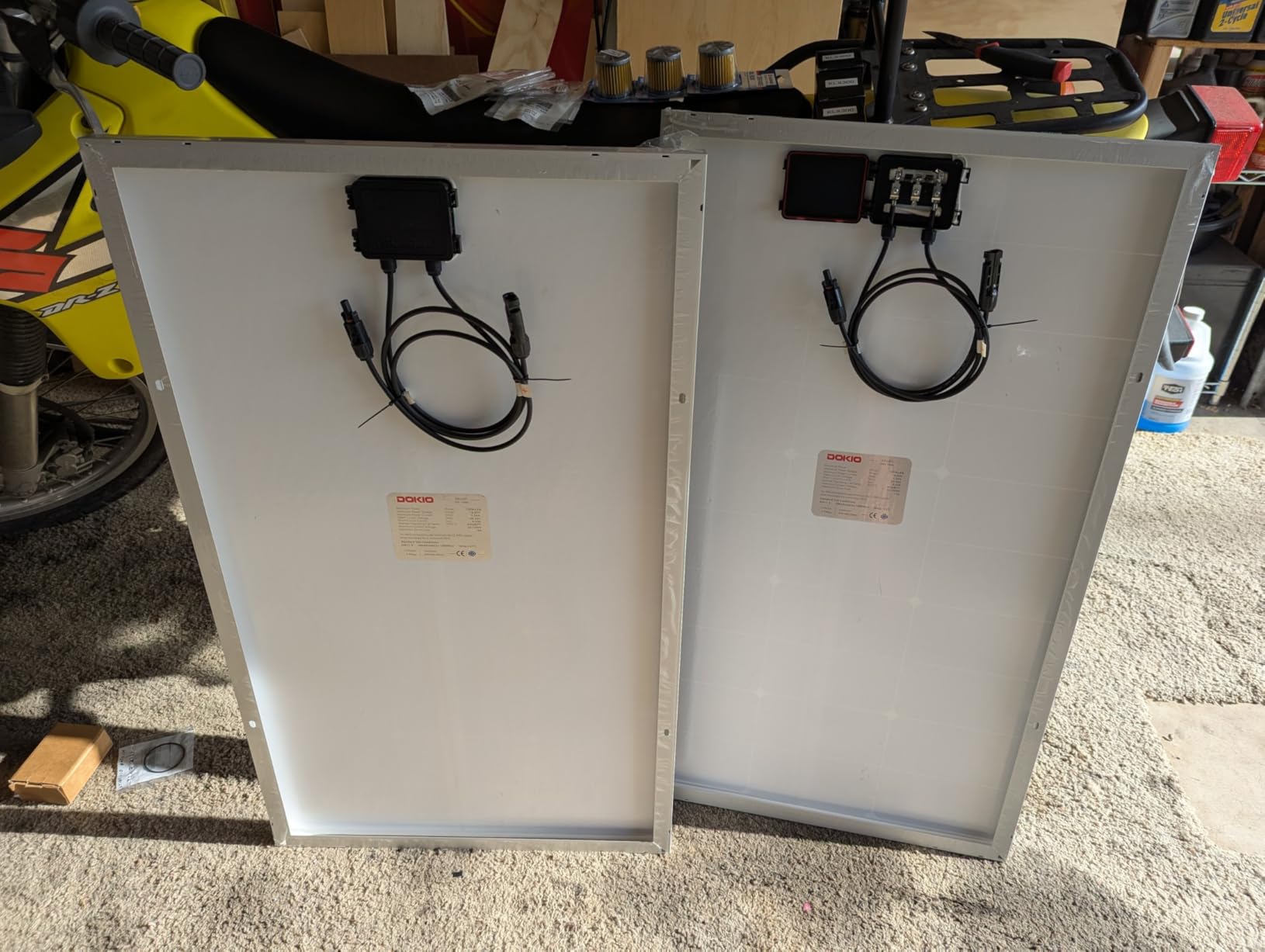
What it does well is straightforward: a 200W monocrystalline module at 18V for 12V systems, with tempered glass, a corrosion-resistant aluminum frame, weather-sealed connectors, pre-drilled holes compatible with standard brackets, and reinforced packaging to survive transit.
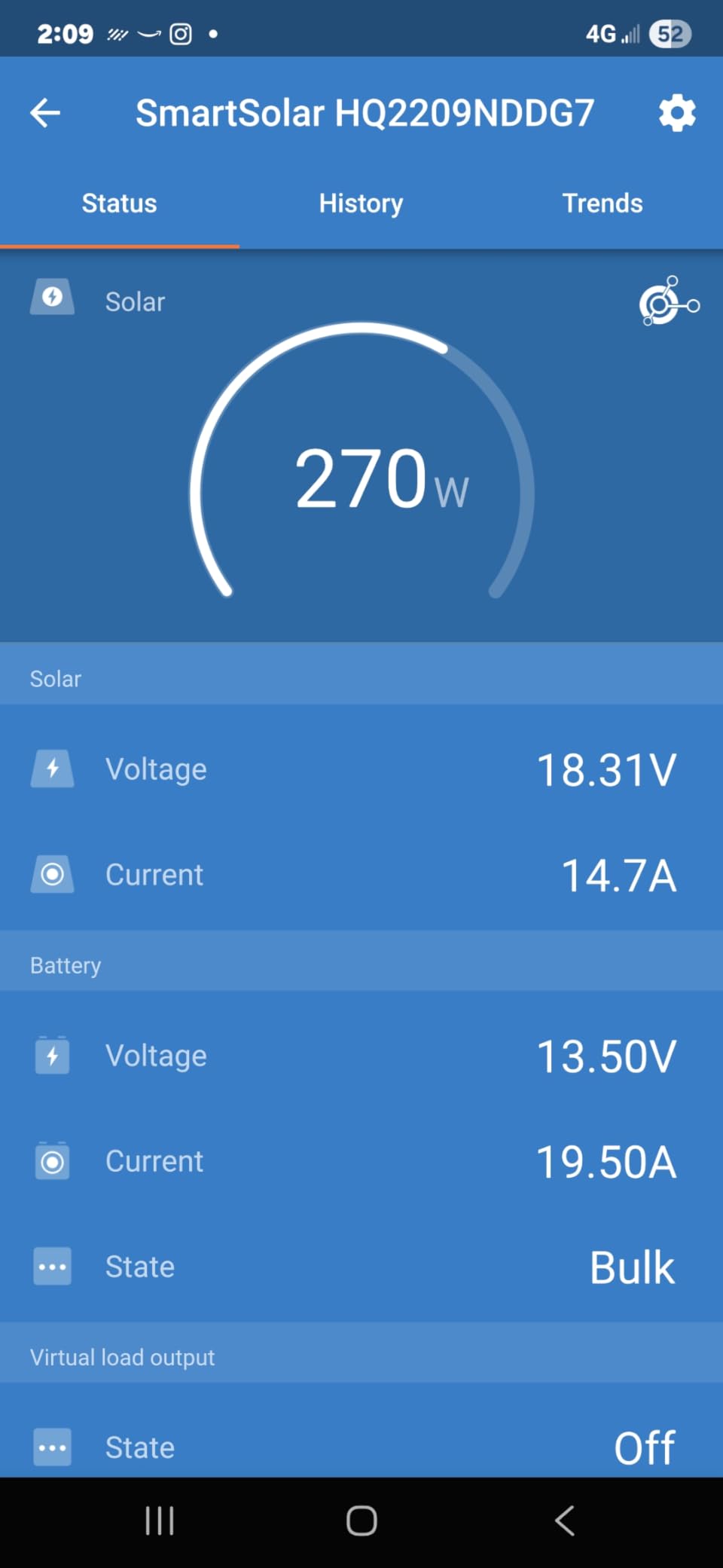
Buyers praise the build quality and connector workmanship more than the output. Multi-panel arrays have been measured at 560W and 616W, so the panel itself clearly works when conditions are right.
The complaint that decides it for us is output variance. A meaningful group of buyers reports panels delivering a fraction of the advertised wattage, and 12% of reviews are one-star, which is far above every other panel here. In a building where a failed array means a dead freezer, that risk profile is not acceptable.
Listing accuracy is a second issue. Reviewers have documented cases where the product page pictured and specified a different panel configuration than the panel that arrived, which makes it harder to trust the datasheet before the panel is in your hands.
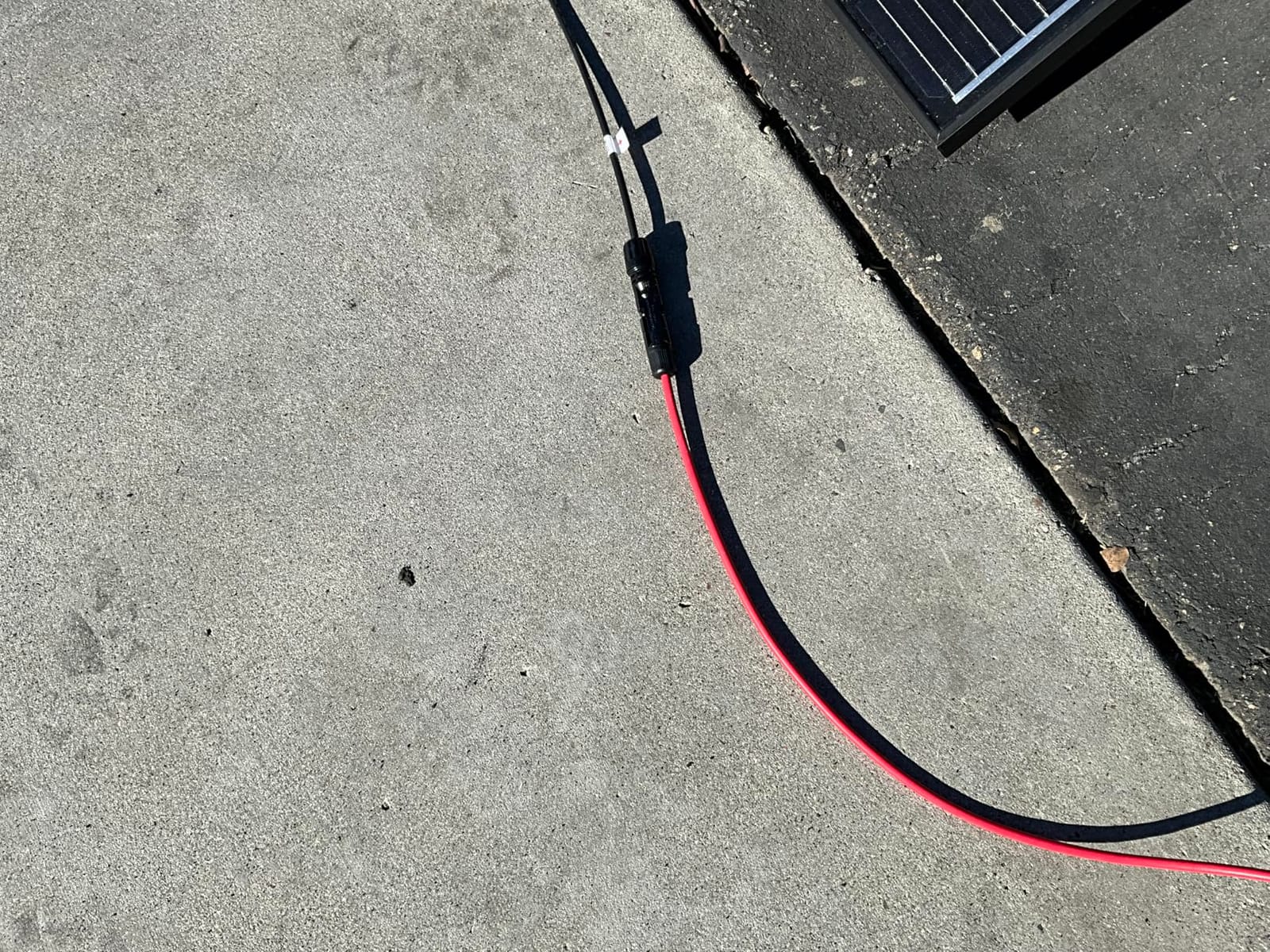
On the positive side, the MC4 connectors are clearly labeled, which makes series wiring straightforward for a first-time builder, and product support is described as knowledgeable and easy to work with.
How to vet a lower-rated panel before it goes up
Whatever panel you buy, measure it before you mount it. Set the panel in full midday sun, attach a DC clamp meter to the output, and compare the reading against the label. A panel running 10% or more under its rating should be returned immediately.
Also check the physical panel against the listing. Confirm the dimensions, the cell count and the connector type match what you ordered, because mismatches between the page and the delivered panel are exactly the kind of problem that surfaces only after you have drilled the mounting holes.
Where it falls short
Output drops sharply whenever anything casts a shadow across the panels, which is a real constraint at a cabin with a chimney, a tree line or a roof that catches late-afternoon shadow. Lead cables are short, which makes daisy-chaining awkward, and the rating gap versus the rest of this list is the core reason it does not place higher.
10. Renogy ShadowFlux 200W – Best Rigid Solar Panel for Cabin Shade
Renogy ShadowFlux Solar Panel 200 Watt, N-Type 25% High-Efficiency
200W ShadowFlux N-Type
25% efficiency, 16BB
IP67 sealed, 23.8 lb, 36.5V maximum
Pros
- Anti-shading cells hold output under partial shade
- 25% efficiency N-Type cells with 16BB busbars
- Compact footprint smaller than equivalent PERC panels
- IP67 encapsulation handles snow
- rain and small hail
- Five-year and 25-year output warranties
Cons
- Highest cost per watt in this group
- Highest share of one-star reviews among 200W options
- 36.5V class voltage needs careful string planning
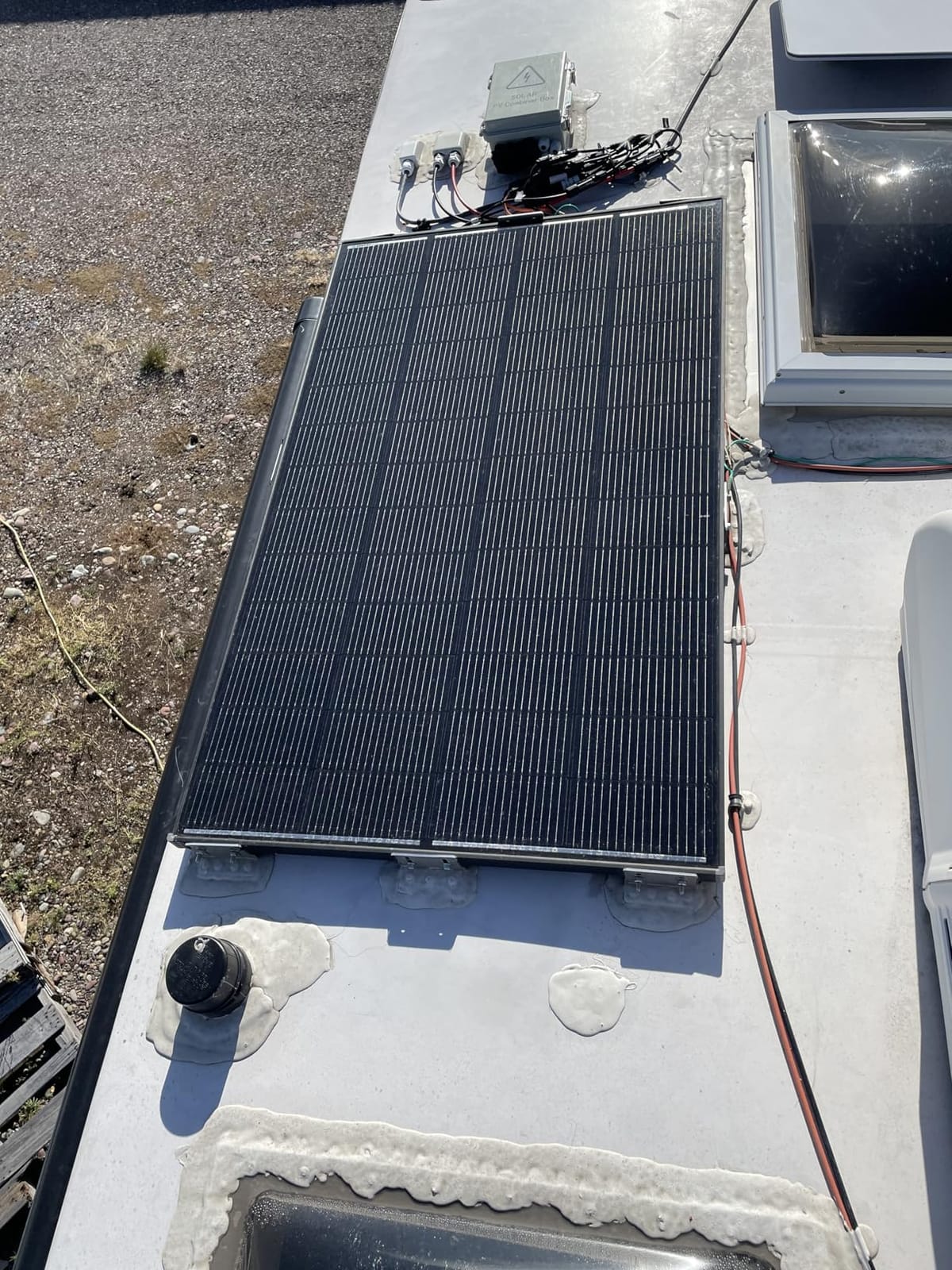
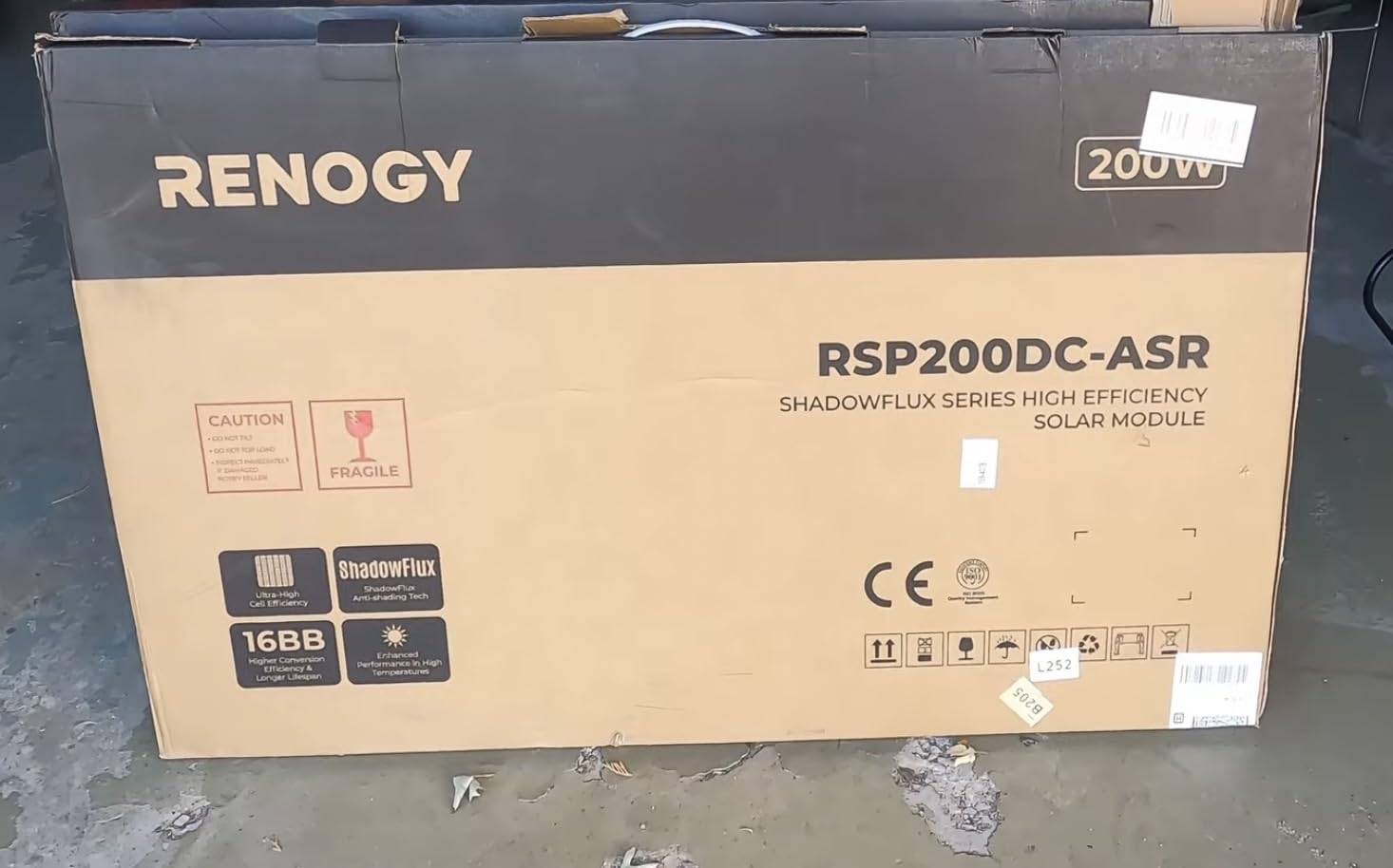
ShadowFlux is the panel to reach for when your cabin site has obstructions. It is built for exactly the conditions that punish a conventional string: trees, adjacent rooflines, buildings, leaves and snow drifting across the glass. Reviewers single out the anti-shading technology as the feature that separates it from a standard 200W module.
Underneath it is a conventional-looking but current-generation build: N-type cells with 16BB busbars at 25% efficiency, in a frame that is 7% smaller and 10% more compact than the equivalent PERC panel. The footprint is 49.69 by 30.08 inches at 23.8 pounds.
Environmental claims cover the cabin reality well, with IP67 sealing and advanced encapsulation for water vapour resistance, and the panel is described as built to endure snow, rain and small hail. The warranty package is among the longest offered here, with a 5-year output warranty plus a 25-year commitment at 80% output.
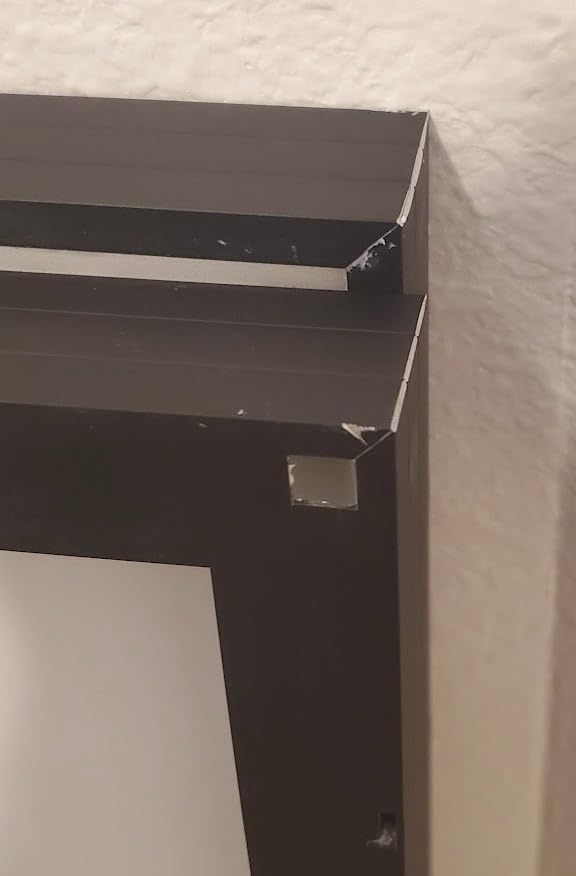
The honest drawback is cost. It sits at the top of the cost per watt range in this group, and 8% of reviews are one-star, the highest negative share among the 200W options here. For a site with clean southern sky, that premium buys you capability you will never use.
For a cabin hemmed in by a tree line on the west and a neighbouring barn to the south, it buys you roughly 20 to 30% of a December afternoon that a conventional panel would have lost to shade, which is a different kind of value calculation entirely.
When the anti-shade benefit actually pays
The benefit depends entirely on the shading pattern and the orientation. A panel that gets a clean edge shadow for an hour before noon loses relatively little with this design. A panel sitting under a dense canopy loses most of its output no matter how the cells are laid out.
The right way to check is simple. Note the sun path across your cabin site in December, the worst month, and see whether the array will ever sit in full sun at midday. If it will not, shade-tolerant cells matter more than raw efficiency.
Where it falls short
The 36.5V maximum voltage is the highest in this roundup and demands the most careful string planning. On a cold clear morning with two of these in series, the corrected open-circuit voltage can exceed the input ceiling of a mid-range MPPT controller, which is the single most common way people destroy a charge controller.
Beyond price and the negative review share, the anti-shade benefit is pattern-dependent, so treat the marketing claim as a genuine benefit in partial shade and as irrelevant in full sun.
How Many Rigid Solar Panels Does Your Cabin Need?
Size the array against your worst month, not your annual average. The formula that works is PV watts = daily watt-hours divided by worst-month peak sun hours multiplied by 0.70. That 0.70 derate accounts for system losses, heat, dust and the gap between nameplate and real-world output, and it is the number most cabin builds get wrong by skipping entirely.
A weekend cabin with a 12V compressor fridge, LED lighting, a phone charger and occasional power tools lands near 500 watt-hours per day. In a northern state with two peak sun hours in December, that is 500 divided by 2 times 0.70, which is roughly 360 watts of PV. In practice you would choose two 200W panels rather than one 400W panel, because you want them in parallel for shade tolerance and serviceability.
A full-time homestead running a well pump, a Starlink terminal, a furnace blower and a refrigerator sits between 2,000 and 3,000 watt-hours per day. At four peak sun hours in a shoulder month, that is 2,000 divided by 4 times 0.70, or about 350 watts, and at two December hours it climbs past 1,400 watts. That gap between shoulder-month and winter sizing is where most cabin arrays fall short, and it is why forum builders size for the worst month.
Add 25 to 30 percent less PV if you own a generator. If a backup generator can carry the heating and well pump load, your array only needs to cover the always-on loads, and a smaller array with a larger battery bank is often the more reliable build.
On the battery side, a weekend cabin generally works with one 100Ah LiFePO4 bank, while a full-time homestead wants 200Ah to 400Ah of storage to carry a winter night and a cloudy morning. If you are still planning that side of the system, our expandable solar generators for off-grid cabins guide covers the storage-and-backup angle in more depth.
Rigid vs Flexible Solar Panels for Cabins
Rigid panels win on a cabin roof for four reasons: efficiency per square foot, physical survival, heat behaviour and service life. Long-term off-grid builders report rigid glass-backed modules delivering two to three times the lifetime energy of flexible ETFE panels, and the mechanism is simple, because a flexible panel mounted without an air gap runs five to ten percentage points warmer and degrades faster.
Flexible panels do have one genuine advantage, and it is a real one: they fit a surface that cannot accept a frame. A curved campervan roof, a rounded skylight dome or a soft RV awning rail will not take a rigid frame. Everywhere else, from a cabin roof to a ground rack, rigid is the correct answer.
On lifespan, rigid panels with 25-year performance warranties and roughly 1 to 1.5% annual degradation hold their output for decades. Flexible panels that yellow, crack and delaminate within three to five years are common enough that the forum consensus is to use them only where nothing else fits.
On weight, a rigid 200W panel sits around 22 to 24 pounds, and mounting requires real structural headroom. If your cabin roof is an older build with limited rafter spacing, that weight is a genuine constraint worth checking with a span table before you drill anything.
If you also need power away from the cabin for a boat, a truck or a work site, solar panels for camping covers the portable side, which is the one job rigid panels should not be doing.
Cold Weather, Snow and Hail: The Checks That Matter Most in Cabin Country
The number that has destroyed more cabin charge controllers than any other is open-circuit voltage rising in the cold. Panel voltage climbs as cell temperature drops, and on a clear January morning with the array sitting near minus 20 degrees, a panel rated at 37V can present well over 45V. Multiply that by the panels in your series string and you will exceed the input ceiling of a mid-range MPPT controller, which is why owners keep reporting controllers that simply died in February.
The fix is arithmetic before installation. Take each panel’s maximum voltage, apply a cold-temperature correction factor for your local record low, and confirm the total sits below your controller’s maximum input voltage with margin. When in doubt, run the array in parallel instead of in series, because parallel strings hold voltage flat while current adds up.
For snow and structural loading, the ratings to look for are 2400 Pa wind and 5400 Pa snow. Five of the ten panels in this roundup publish a 5400 Pa snow load rating, including the RICH SOLAR, Callsun 2x100W, JJN and HQST models. Where a listing omits a snow figure entirely, treat that as unverified rather than adequate.
Hail resistance is harder to compare across datasheets because manufacturers test to different standards. Glass thickness is the practical proxy, and the panels here run from 3.2mm low-iron glass up to 3.8mm tempered glass. On a cabin in a hail belt, thicker tempered glass with a black anodized frame is the sensible preference.
Snow clearing deserves a direct answer: yes, you should clear heavy snow from your panels, because a covered panel produces nothing. Light snow often slides off on its own, and brushing with a soft roof rake from the ground is enough. Never climb onto a snowy roof to do it, and never use anything abrasive or hot on the glass.
How to Choose Rigid Solar Panels for Cabins: 8 Checks Before You Buy
Check the datasheet Voc against your controller first. Maximum open-circuit voltage is the single most consequential number on the sheet, and it must clear your controller’s input ceiling after cold correction for your site’s record low. Do this before you fall in love with an efficiency figure.
Check the junction box rating next. IP65 is called out as a failure point by builders who have seen moisture ingress and hot spots, so IP67 or IP68 is the sensible floor for a permanent cabin install where a moisture-related failure is not something you will see until it is serious.
Check the frame material. An anodized aluminum frame holds up far better than painted steel, and corrosion shows up in humid climates within a year on the painted option. Every panel we recommend here uses an anodized or corrosion-resistant aluminum frame.
Check weight against roof structure. A 200W rigid panel is roughly 22 to 24 pounds, and a two-panel roof pair is close to 46 pounds before mounting hardware. Confirm your rafter spacing and span before committing, or move the array to a ground mount where structure is not a question.
Check that all panels in a string are identical. Forum consensus is unambiguous on this, because mixing brands, ages or even production years drags the whole string toward the weakest panel’s current. Buy the same part number for every panel in a string.
Check whether the exact SKU is still available years later. Owners report that dimensions and model naming shift between production years, which makes expanding an array later harder than it should be. If you plan to add panels, buy the expansion panels now.
Consider ordering one matching spare panel with the initial array. It costs one panel’s worth of capacity now and saves a freight leg, a compatibility headache and a string mismatch later. It is the advice we give most often in off-grid build forums.
Finally, check that expansion SKUs, charge controllers, batteries and monitoring all come from ecosystems that interoperate. A cabin system you cannot expand or troubleshoot without guessing is a worse investment than the panel price difference between two comparable options ever was.
Frequently Asked Questions
Who makes the best rigid solar panels?
Among the ten we compared, Renogy’s 200W N-Type 16BB panel is the strongest all-round pick, with the largest verified review base and reports of output above its nameplate. RICH SOLAR’s 200W N-Type 18BB earns the premium slot for its 5400 Pa snow rating, UL certification and 25-year linear output warranty. Choose on the rating your site needs: snow load for winter cabins, efficiency for tight roofs, output current for small battery banks.
Are rigid solar panels more efficient than flexible solar panels?
Yes, in almost every case. Rigid framed modules hold a wider range of cell technologies and convert 20 to 25.6% of incident light in the panels we tested, while thin flexible sheets typically sit lower and, mounted flush, run five to ten percentage points warmer, which costs further efficiency on hot days.
Are rigid solar panels better than flexible solar panels for a cabin?
For a permanent cabin roof or ground mount, yes. Rigid panels are more efficient per square foot, tolerate hail, snow and high wind, run cooler with an air gap behind them, degrade roughly 1 to 1.5% a year, and carry 25-year performance warranties. Flexible panels only make sense on a curved surface that cannot accept a frame.
What size solar battery do I need to be off-grid at a cabin?
A weekend cabin with a fridge and lighting usually runs well on a single 100Ah LiFePO4 bank. A full-time homestead with a well pump, furnace blower and Starlink terminal generally wants 200Ah to 400Ah so the bank carries a winter night plus a cloudy morning. Add a generator and you can size the bank smaller and put the budget into panels.
Is it better to have more solar panels or a bigger battery?
For a cabin, more panels usually wins, because winter production is the limiting factor rather than overnight storage. If your bank sits near full by noon in December you need more panels. If it sits near full by noon all summer and still drops out on cloudy autumn days, you need more battery capacity instead.
Are you supposed to remove snow from solar panels?
Yes, because a snow-covered panel produces almost nothing, and a week of cover in a northern winter can cost you days of charging. Clear heavy snow with a soft roof rake from the ground. Light snow usually slides off on its own, and you should never climb onto a snowy roof or use anything abrasive or hot on the glass.
How many solar panels do I need for a 24V 200Ah battery?
A 24V 200Ah bank stores about 4.8 kWh nominal. In a region with three to four peak sun hours, two to three 200W rigid panels will keep it charged on a moderate cabin load, and four to six will carry a full-time load through winter. Always check that your controller’s input voltage ceiling clears the cold-corrected series voltage first.
How many rigid solar panels does a weekend cabin need?
A weekend cabin running a fridge, lights and small electronics typically needs 500 watt-hours per day. At two peak sun hours in December with a 0.70 derate, that works out to roughly 360 watts of PV, so two 200W rigid panels in parallel is the usual answer. Add panels rather than oversizing the battery if the bank still sits full at noon.
Final Verdict: The Best Rigid Solar Panels for Cabins
The best rigid solar panels for cabins in 2026 come down to your site and your worst month, not to a single winner. The Renogy 200W N-Type 16BB is the pick we would put on most roofs, the HQST 400W twin pack is the best value, the ECO-WORTHY four-panel set is the best ground-mount array, and the Renogy ShadowFlux earns its place wherever trees or buildings shade the roof.
Whichever you choose, do the cold-weather voltage math before the panels go up, size against December peak sun hours, and order one matching spare panel while you are still on the same purchasing cycle. Those three steps prevent more cabin power failures than any wattage decision ever will.