

Most cabin solar failures are not panel failures. They are charge controller failures, and the fix is almost always decided by three things: how cold the cabin gets in January, how far the nearest technician drives, and how much daylight the array actually sees. Pick the wrong class of controller and the cheapest unit you can find becomes the most expensive one. That is why the best solar charge controllers for cabins are not simply the highest-rated models, but the ones whose published electrical limits match your array, your bank voltage and your climate.
Here is the short version. A good cabin charge controller must publish a maximum PV input voltage high enough for your array’s cold-corrected open-circuit voltage, a rated battery-side charge current that matches your panels, and a battery profile that matches your chemistry, including a low-temperature charge cutoff if you run LiFePO4 in a shed that can freeze. Everything else, the app, the backlit screen, the USB ports, is convenience.
Is MPPT really better than PWM? On a cabin, yes, and the gap widens as conditions get worse. A PWM controller throws away the difference between a panel’s operating voltage and the battery’s charging voltage, so on a cold morning that gap is large; an MPPT controller tracks the array’s maximum power point and keeps most of it. On a 200W panel feeding a 12V bank in winter, that difference is routinely 20 to 30 percent of what the panel produces. On a small 12V summer cabin with one 20V panel and a bank that is never deeply discharged, PWM is good enough and costs far less.
What no competitor roundup organises around is who is actually staying in the cabin. A weekend shed that sees four weekends a year has completely different controller requirements from a full-time home running a refrigerator and a water pump, and a hunting cabin in northern Minnesota has different requirements again from a weekend place in Arizona. We sorted all ten controllers in this guide against those scenarios, because the occupancy pattern, not the amp label, is the single biggest determinant of which one is right.
Before we get into the list, a note on how we built it. This is a research-led roundup: every rating, review count, voltage limit, current rating, warranty length and physical dimension quoted below comes from the manufacturer’s published specification and the aggregated customer review record, not from a marketing amp label. We did not bench-test ten controllers on a snowy roof, and we do not claim to have. Where a number is not published, we say so rather than estimating it. If you want the wider category background, our general solar charge controller guide covers the electrical fundamentals in more depth.
Table of Contents
Top 3 Picks: Best Solar Charge Controllers for Cabins: Ranked by System Fit (October 2026)
These three cover the most common cabin configurations. The Renogy Rover 30A is the one we would put in most cabins, the Wanderer 10A is the value pick for small 12V systems, and the EPEVER Tracer is the highest-rated MPPT in the group.

Renogy Rover 30A MPPT
- Dual-peak MPPT with 99.9% tracking efficiency
- 400W at 12V or 800W at 24V
- Voc 100V ceiling with 6kV surge protection
- Works with gel
- sealed
- flooded and LiFePO4 banks
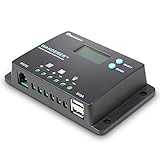
Renogy Wanderer 10A PWM
- PWM four-stage charging for AGM
- gel
- flooded and lithium
- 130W at 12V or 260W at 24V with 50V input ceiling
- Load output with manual
- automatic and timed modes
- Backlit LCD and 2-year warranty

EPEVER Tracer 30A MPPT
- MPPT tracking above 99.5% with 98% DC/DC conversion
- 100V max PV input for 390W at 12V or 780W at 24V
- Supports LiFePO4
- Li(NiCoMn)O2
- AGM
- gel and flooded banks
- RS485 Modbus for MT50
- MT52
- WiFi and BLE adapters
Solar Charge Controllers for Cabins in 2026: Quick Overview
Every controller below is matched to a named cabin scenario. The charge current column is the battery-side rating at the controller’s nominal bank voltage, not a panel-wattage marketing number.
| Product | Specifications | Action |
|---|---|---|
| Renogy Rover 30A MPPT |
|
Check Latest Price |
| Renogy Wanderer 10A PWM |
|
Check Latest Price |
 Depvko 30A PWM Controller Depvko 30A PWM Controller |
|
Check Latest Price |
 Renogy Wanderer Li 30A PWM Renogy Wanderer Li 30A PWM |
|
Check Latest Price |
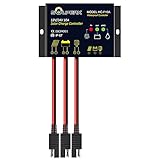 SOLPERK 10A Waterproof PWM SOLPERK 10A Waterproof PWM |
|
Check Latest Price |
 ECO-WORTHY 30A PWM with Bluetooth ECO-WORTHY 30A PWM with Bluetooth |
|
Check Latest Price |
| EPEVER Tracer 30A MPPT |
|
Check Latest Price |
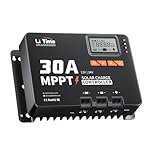 LiTime 30A MPPT with Bluetooth LiTime 30A MPPT with Bluetooth |
|
Check Latest Price |
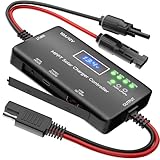 SUNAPEX 10A MPPT SUNAPEX 10A MPPT |
|
Check Latest Price |
 POWLAND 120A MPPT POWLAND 120A MPPT |
|
Check Latest Price |
Two things stand out. Five of the ten here are true MPPT controllers, and only one of those runs above 30A on the battery side, which matters for anyone with an array over roughly 600W. If your cabin is heading toward a 48V bank, read the voltage support line carefully, because nine of these ten never leave 24V.
MPPT vs PWM: Which Architecture Fits Your Cabin
The decision is not about quality. It is about how much voltage your panels run above your battery’s charging voltage, and that gap is what a PWM controller discards. A 12V bank in bulk sits around 14.4V. A typical 200W panel runs its power point somewhere between 30V and 40V on a cold, clear morning. A PWM controller simply cannot deliver that panel at its power point, because it can only output current at battery voltage, so you lose that difference as heat.
An MPPT controller inserts a DC-DC conversion stage that finds the panel’s actual maximum power point and runs it at a voltage the battery can absorb. On a cold-climate cabin, or with panels in series at high voltage, or with any partial shading from trees, that recovered energy is the whole argument. The panel manufacturer writes the efficiency on the sticker, and the controller label tells you the harvest figure to expect. The EPEVER Tracer lists 98 percent maximum DC/DC conversion, and the LiTime lists 98 percent peak conversion. Those are different measurements from a panel’s own rating, but both sit far above what a PWM stage delivers.
There is a documented case on the DIY Solar Forum that makes the argument concrete. A cabin owner with a battery bank far larger than his array was running a PWM controller, and a forum expert called the oversized bank his biggest single problem, because the panels could not supply even a 1/8C charge rate. The controller was pushing roughly 10A where 46A was needed. No change of controller architecture can create energy the array never captured, but the same thread also notes that old PWM controllers silently cost yield, and that replacing the controller is the first move before touching the inverter.
So the practical rule for a cabin: MPPT if you have more than one panel, if your panels run at high voltage in series, if you are in a cold climate, if the array is partially shaded by trees, or if you plan to add panels later. PWM is defensible when you have a single low-Voc panel, a small bank, a mild climate and no expansion planned. For RV and campervan roof arrays, which have their own wiring constraints, we covered that separately in our RV charge controller roundup.
1. Renogy Rover 30A MPPT: The Most Complete Cabin Pick
Renogy Rover 30A 12V/24V Auto DC Input MPPT Solar Charge Controller Parameter Adjustable LCD Display Solar Panel Regulator fit for Gel Sealed Flooded and Lithium Battery, Rover 30A,Black
30A dual-peak MPPT
400W at 12V, 800W at 24V
Voc 100V max
3-year warranty
Pros
- Dual-peak multi-peak tracking at 99.9% with 98% conversion efficiency
- Handles gel
- sealed
- flooded and LiFePO4 banks including lithium recovery
- Temperature compensation from -40F to 149F with 6kV TVS surge protection
- Direct DC load output with timer scheduling
- 4050 reviews with documented manuals and real support
Cons
- Bluetooth monitoring needs the separately sold BT-2 module
- Initial LCD parameter setup takes some configuration
This is the controller we end up recommending most often, and the reason is boring rather than glamorous. It has the largest published review record in the group at 4050 reviews, and that record exists mostly because owners keep it for years on cabins, boats and trucks and keep writing about it. The dual-peak tracking is the technical headline: when a cloud passes or a panel is shaded or partly damaged, the unit re-acquires the maximum power point instead of sitting on a stale one.
Electrically it covers the widest useful range of small-cabin work. Maximum PV input is 400W on a 12V bank and 800W on a 24V bank, with a 100V open-circuit ceiling, which is enough to run a two-panel series string in a cold climate without approaching the limit. Temperature compensation is specified from -40F to 149F, and the TVS 6kV surge protection matters more than it sounds in a cabin with a long unprotected run from the array.
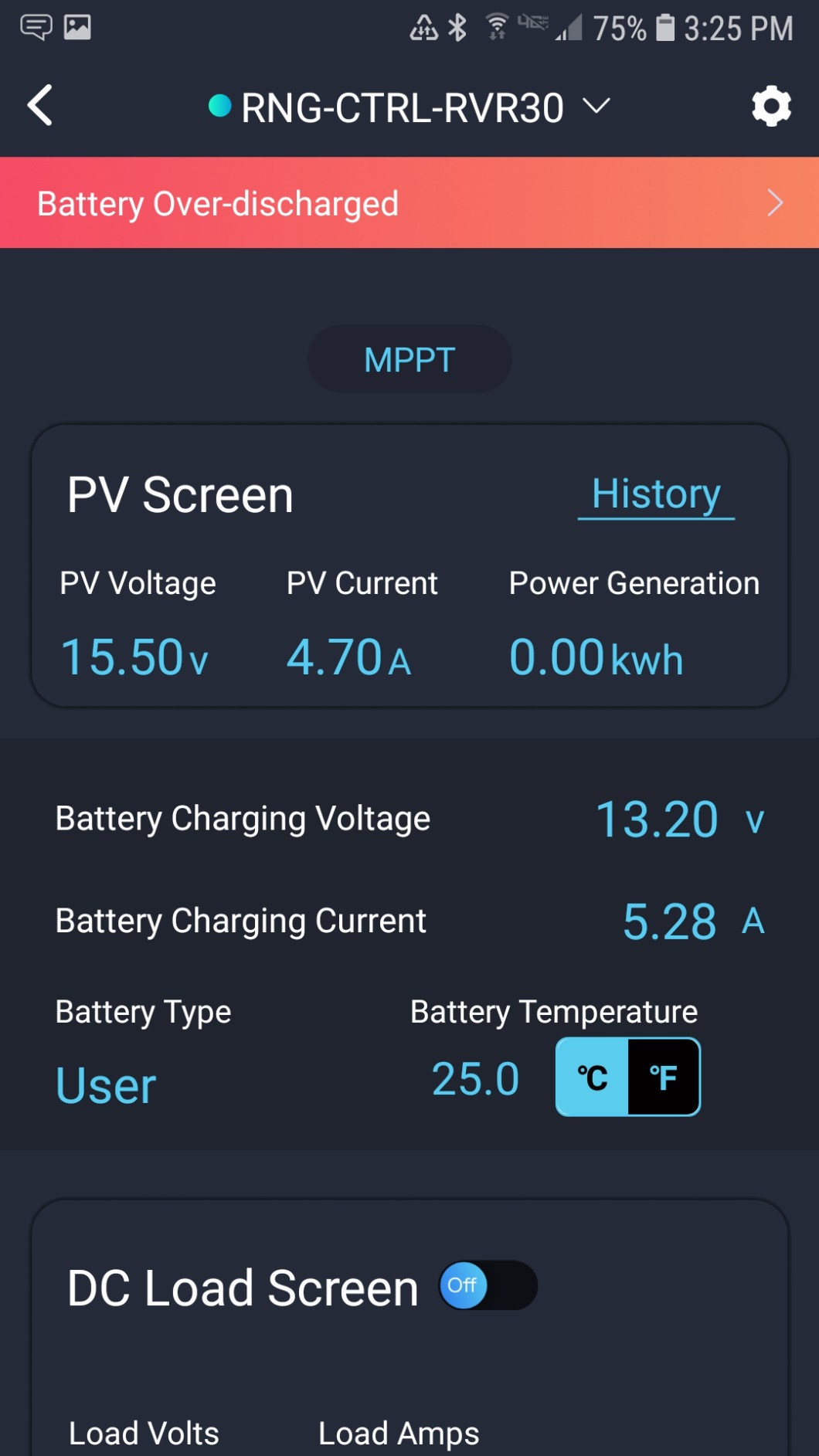
The four-stage program covers bulk, absorption, float and equalisation, with a lithium reactivation mode for deeply discharged banks. That last feature matters for the seasonal cabin, where a bank can sit for months at a low state of charge and then need recovering on the first sunny weekend. Reviewers consistently credit accurate multi-peak harvesting, broad battery compatibility and rugged surge protection as the reasons this one survives a remote install.
On the negative side, the app is an add-on. Monitoring through the DC Home app requires the BT-2 Bluetooth module, sold separately, so budget for it if you want to see charge history from town rather than drive up to read an LCD. Some owners also find the first pass through the parameter menu slow. In a cabin, a second inverter charger such as an all-in-one unit is often the alternative owners discuss, and we have covered those separately in our cabin solar generator guide.
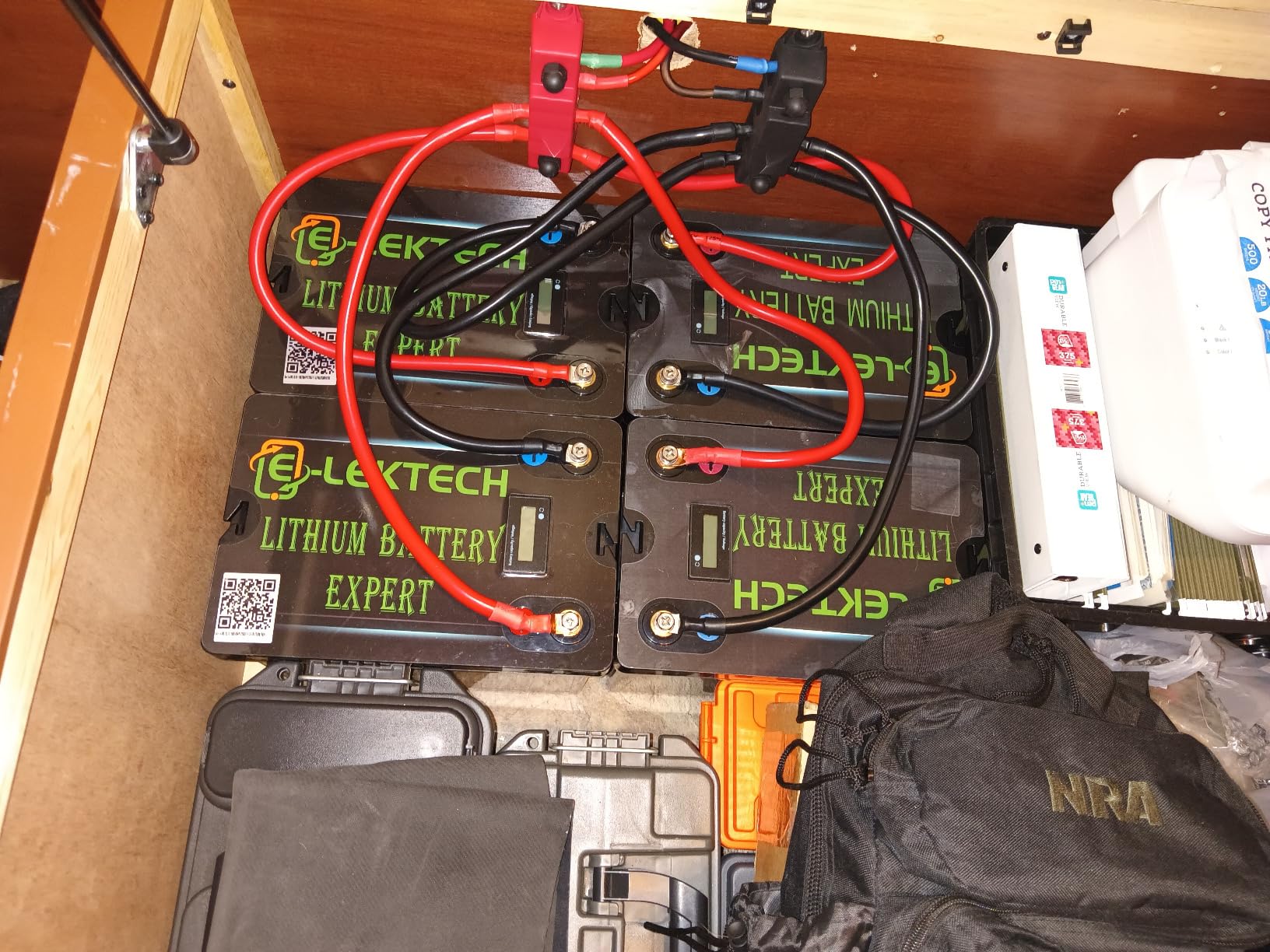
Best for a seasonal cabin with a mixed battery bank
This is the pick for a cabin that runs lead-acid in the summer and gets a lithium retrofit later, because the Rover handles gel, sealed, flooded and LiFePO4 in one unit with auto-selectable charge curves. The 30A battery-side rating also gives you room: a 400W 12V array can push close to its nameplate output on a clear day, which a 10A controller simply cannot pass.
If your cabin runs a 24V bank, the 800W PV limit and the 100V Voc ceiling are exactly what a two-panel series string needs with margin for a cold-corrected voltage spike. That margin is the single most important published number on the datasheet for anyone north of the 40th parallel.
Watch out for the add-on monitoring and the equalisation question
Two real cautions. First, the BT-2 module is a separate purchase, and the app is the only way to get charge history remotely, which is exactly what you want at a cabin nobody is standing next to. Second, the equalisation stage in the program is meaningful for flooded lead-acid and something to disable on lithium, so confirm the setting before you leave.
Warranty is three years on material and workmanship, which is the longest in this group and the closest thing to a service promise you get from a controller at a site two hours from a town with a parts counter. A forum regular put it plainly when advising others to keep a working inverter and only replace the charge controller: at a remote cabin, the warranty length and the availability of a replacement matter as much as the harvest figures.
2. Renogy Wanderer 10A PWM: The Small-Cabin Value Pick
Renogy Wanderer 10A PWM Solar Charge Controller 12/24V for Solar Panels
PWM four-stage, 10A
130W at 12V, 260W at 24V
50V PV ceiling
2-year warranty
Pros
- Genuinely a 10A controller with correct bulk and float voltages
- Backlit LCD showing voltage
- current and load status plus a 5V/2A USB port
- Compact 4.69 by 2.95 by 1.08 inch body for small electrical boxes
- 3226 reviews and clear documentation with real support
Cons
- PWM architecture gives no gain from series-connected panels
- Factory 10.8V load cutoff is deep for flooded lead-acid
This is the controller for a cabin with a single panel and a small bank, and it does that job without pretending to be more. Independent reviewers confirm it is a real 10A unit rather than a marketing figure, and that the bulk and float voltages are set correctly for AGM, gel, flooded and lithium banks. That verification matters, because most of the cheap PWM controllers in this class quietly deliver less than their label.
The physical design is a genuine advantage in a cabin. At 4.69 by 2.95 by 1.08 inches and 4.32 ounces, it fits inside a shallow cabinet or an RV panel where a 30A controller will not, and the backlit LCD lets you read state-of-charge in a dark shed without a flashlight. There is a 5V/2A USB port on the front, which owners use for a phone or a small fan.
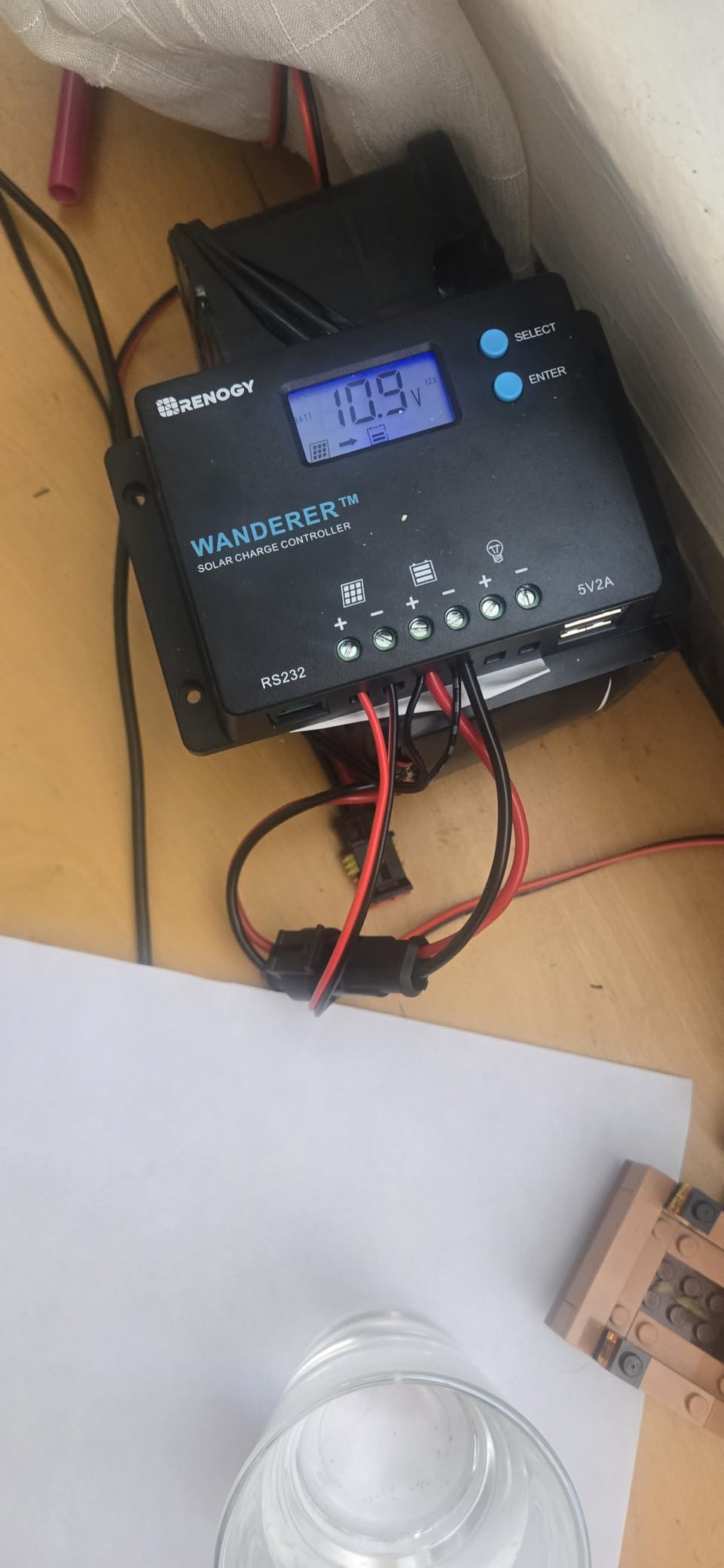
Maximum PV input is 130W at 12V and 260W at 24V, with a 50V ceiling. That number is the whole architecture in one line. Because PWM output is clamped to battery voltage, adding a second panel in series gains you almost nothing, so this unit is a one-panel solution. Self-consumption is under 10mA, which for a weekend cabin that sits idle for weeks is genuinely low parasitic draw.
The load output with manual, automatic and timed modes is the feature owners mention most, because it lets the controller run a small DC circuit, a light or a vent fan directly without involving the inverter. RS232 is present for the BT-1 Bluetooth module if you want status, though the module is an extra cost and the app gives live status rather than stored history.
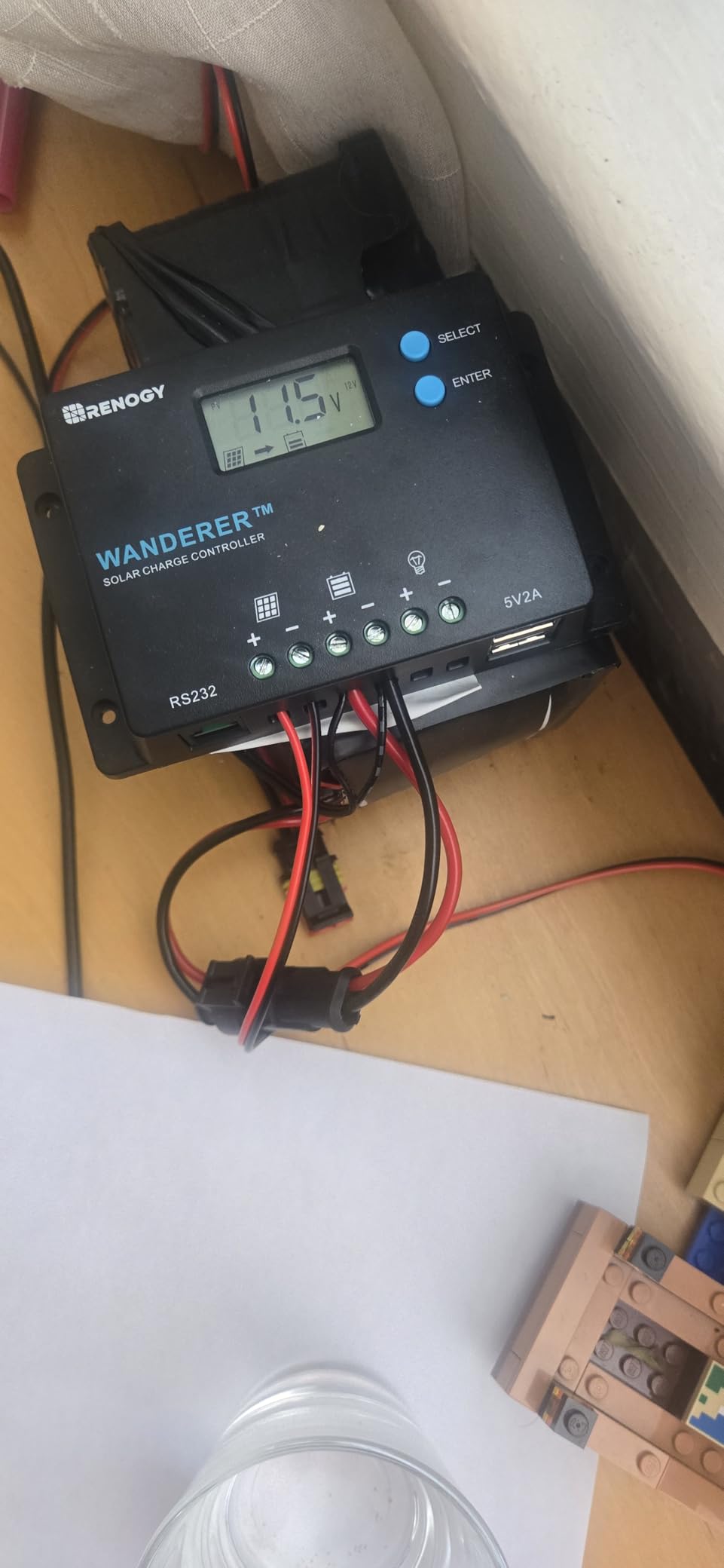
Best for a weekend cabin under 200W of panel
If your array is a single 100W to 200W panel, your bank is under 200Ah, and your climate is mild, this unit captures nearly everything a PWM architecture can capture and costs a fraction of any MPPT. It also runs on 12V or 24V with automatic adaptation, so the same box works if you later move a bank to 24V.
The IP32 rating is fine indoors or inside a closed cabinet but is not weather sealing. For a controller mounted outside or in a damp utility room, the SOLPERK further down this list is the appropriate housing.
Watch out for the fixed load cutoff and sensitive short-circuit detection
Two reviewer complaints recur and both are real. The factory low-voltage load cutoff is fixed at 10.8V, which is too deep a discharge for a flooded lead-acid bank, and short-circuit detection is sensitive enough that inverter inrush can trip it. If you plan to run a night-light circuit off the load output, plan on a battery monitor or a separate cutoff.
Warranty is two years, shorter than the Rover’s three, and Bluetooth is an add-on module. None of that matters if the controller is inside a heated cabin within a short drive of a parts supplier, which is the situation this unit is designed for.
3. Depvko 30A PWM Controller: The Lowest-Cost Small-System Fit
[Upgraded] 30A PWM Solar Charge Controller with Auto Parameter LCD Display
PWM 30A
Automatic 12V/24V
Lead-acid only
Dual 5V USB outputs
Pros
- Lowest cost controller in this group and it charges small cabin house banks effectively
- Dual 5V/2.5A USB outputs run a vent fan or phone without extra wiring
- Settings memorised across power cycles so a shed power blip does not reset parameters
- Readable LCD showing charge state and battery voltage
Cons
- Wire entry slots struggle with 8-10 AWG and the set screws are hard to torque
- Lead-acid only
- with no lithium profile
- Small wire slots and thin plastic construction
At the bottom of the range, this unit does something the others in its class do not: it remembers your settings. The industrial microcontroller stores parameter changes across a power cycle, which on a cabin with flaky generator or shore-power input is worth more than it sounds. Automatic 12V/24V adaptation and battery-voltage recognition mean it configures itself on first power-up in most installations.
The dual 5V/2.5A USB outputs are the feature that generates the most owner satisfaction. Running a USB vent fan or charging a phone directly from the controller is a small thing that makes a shed feel livable, and the review record shows owners using exactly that. The LCD is clear enough to read charge state and battery voltage at a glance.
![[Upgraded] 30A PWM Solar Charge Controller with Auto Parameter LCD Display customer photo 1](https://mydroneauthority.com/wp-content/uploads/2026/10/B08NFSCZ4V_customer_1.jpg)
Protection coverage is broad for the tier: overcurrent, short circuit, open circuit, reverse polarity, low voltage and overcharge, with a dual MOS anti-backflow circuit that generates less heat than a single-diode design. Heat is the enemy of a PWM controller in a closed box, and running cooler translates into a longer service life in a warm shed.
Wiring is the weak point and the reviews are specific about it. The wire entry slots are small enough to struggle with 8-10 AWG conductor, and the terminal screws are small enough to be difficult to torque properly. A loose terminal on a 30A controller in a damp shed is exactly the failure you do not want at a remote site, so budget time and the right screwdriver for installation.
![[Upgraded] 30A PWM Solar Charge Controller with Auto Parameter LCD Display customer photo 2](https://mydroneauthority.com/wp-content/uploads/2026/10/B08NFSCZ4V_customer_2.jpg)
Best for a lead-acid cabin on a tight budget
This is a sensible pick for a first cabin build or a weekend shed with an open, sealed or colloid lead-acid bank, where the whole point is getting a working 30A controller in the box for less than the cost of the wiring. The 30A rating also gives headroom above a single 200W panel, which the 10A class cannot offer.
It must be mounted on a flat, well-ventilated surface, and that is not optional with a PWM unit dissipating real heat. If your only mounting location is a sealed cabinet, this is the wrong pick.
Watch out for the lithium exclusion and the warranty gap
No lithium profile. This controller is specified for lead-acid chemistries only, open, sealed and colloid, and is explicitly not for lithium or NiMH banks. If you are planning a LiFePO4 retrofit within a few years, buying it now means buying it twice, and the lithium exclusion is not fixable with a menu setting.
No warranty length is published for this model, which is a real consideration at a remote site. Reviewers also report occasional units arriving non-functional or draining rather than charging, and the build feels cheap and light in hand. Our general charge controller guide covers what to inspect on arrival before you install anything.
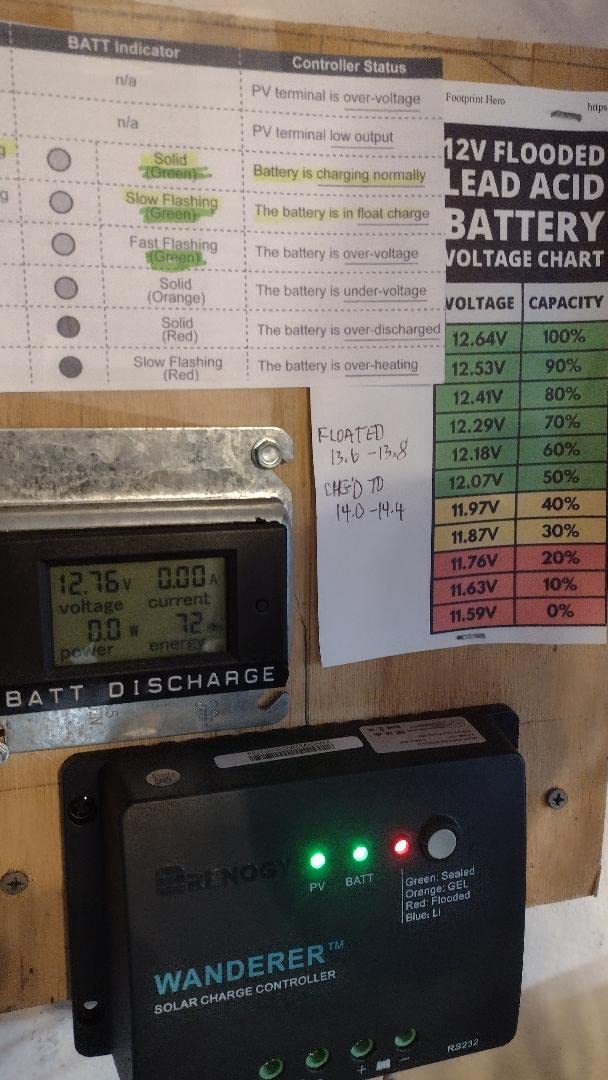
4. Renogy Wanderer Li 30A PWM: The Lithium-Aware 12V Pick
Renogy Wanderer Li 30A PWM Solar Charge Controller 12V for Solar Panels
12V PWM, 30A bulk
25V PV ceiling
IP32 case
1-year warranty
Pros
- Lithium-aware 12V PWM option supporting LiFePO4
- AGM
- gel and flooded with auto charge curves
- Compact 6.5 by 4.3 by 1.8 inch IP32 housing with DIN rail or wall mounting
- 4-stage program with 30A bulk
- 120-minute boost
- float and auto equalisation
- Temperature compensation from -4F to 140F when paired with the BT-1 module
Cons
- LED indicators only
- with no LCD for reading voltage or current
- 25V PV input limit means series panels beyond about 20V Voc add nothing
- Only a 1-year warranty
Same chassis family as the 10A Wanderer, scaled to 30A and retuned for lithium, and that is exactly what makes it interesting. It selects a charge curve automatically for LiFePO4, AGM, gel or flooded, which means a cabin owner who moves from lead-acid to lithium does not have to keep a mental note of which absorption voltage is programmed. For a 12V system under about 300W, that is a genuinely useful combination.
The 30A bulk stage is specified at 80 percent of rated output, followed by a 120-minute boost stage, float maintenance and automatic equalisation. Feedback in the review record centres on rugged, compact construction and clean lithium charging, and the IP32 rated case resists corrosion in a damp location.
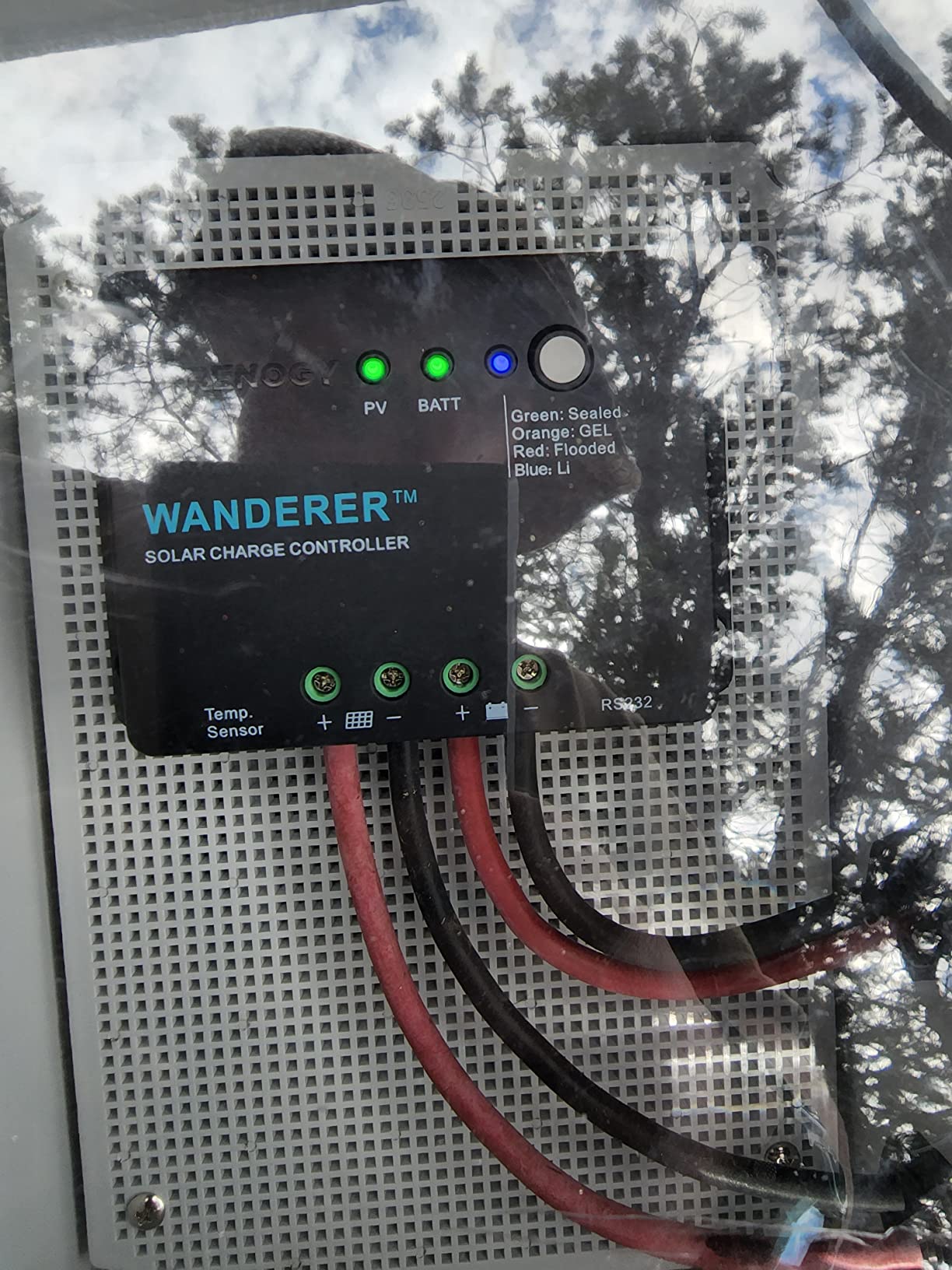
Mounting options are unusually flexible for the class. DIN rail or wall mounting both work, and at 6.5 by 4.3 by 1.8 inches and 4.8 ounces it still fits tight RV panels and marine compartments. Reverse polarity, overcharge, overload and short-circuit protection are all present, and the unit runs on a negative ground arrangement like every other controller here.
Temperature compensation is specified from -4F to 140F, but only when the BT-1 Bluetooth module is attached. Without that module, compensation depends on the internal sensor alone, which is worth knowing before you decide it is a cold-climate cabin controller.
Best for a 12V lithium retrofit on a small array
If you already have a 12V LiFePO4 bank and a one-panel or small-parallel array, this is the cheapest way to get a lithium-aware charge controller with a real protection suite. The 30A rating comfortably passes a 200W panel and gives room to add a second panel in parallel, which is the expansion path that actually works on PWM.
For anyone planning to go bigger than 300W at 12V, step up to a 30A MPPT unit instead. The 25V PV input ceiling means a 36V or 40V Voc panel will not work here, and that is not always printed on the box.
Watch out for the display and the short warranty
There is no LCD, only LED indicators. That means you cannot read battery voltage or charge current without a multimeter, which on a cabin you visit monthly turns every check into a physical task. Reviewers who love the charging behaviour are the same reviewers who mention this.
The 1-year warranty is the shortest of the three Renogy units in this roundup and ties the SUNAPEX for the shortest stated term among the controllers here. At a cabin ninety minutes from a parts counter, a one-year term is a thin margin, and the BT-1 module remains a separate purchase for monitoring.
5. SOLPERK 10A Waterproof PWM: The Exposed-Mount Pick
SOLPERK 10A Solar Charge Controller Waterproof Solar Panel Controller 12V/24V PWM Solar Panel Battery Intelligent Regulator for RV Boat car ,with LED Display
IP67 sealed
10A
150W at 12V, 300W at 24V
SAE plug-and-play
Pros
- IP67 sealing is the best weather resistance in this roundup for damp or exposed locations
- True plug-and-play SAE connectors that remove wiring errors
- Three clear status LEDs confirm charging at a glance without opening anything
- Automatic 12V/24V detection for both bank voltages
Cons
- LED indicators only
- with no numeric voltage or current readout
- 10A ceiling limits it to small panel arrays
Every other controller in this roundup is meant for an interior cabinet. This one is IP67 sealed, which means it can live on the outside of a cabin, inside an unheated and damp utility room, or on a wall where condensation is routine. If your install location is the problem rather than your array, weather sealing is the feature that solves it.
Automatic 12V/24V identification handles 150W of panel at 12V and 300W at 24V with a 10A current ceiling. The three status indicators, green for load output, green for battery and red for panel charging, let you confirm the system is working without opening a cabinet or carrying a meter up a ladder in the rain.
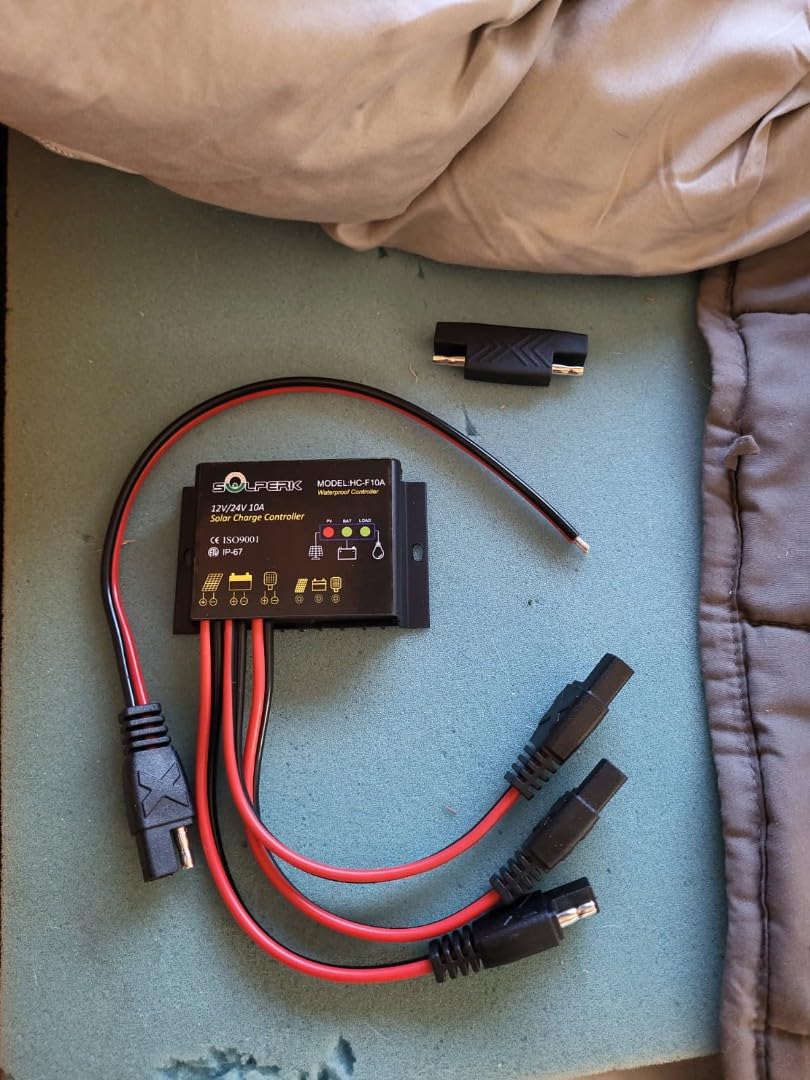
Installation is the other selling point. SAE plug-and-play ports mean the panel and battery connections are physically keyed, so the classic reversed-polarity error at a remote site basically cannot happen. Pre-drilled mounting holes and an included manual mean no bracket fabrication. The enclosure is 1.97 by 3.19 by 0.83 inches, which is genuinely small.
Charging is a 3-stage PWM program for AGM, gel and flooded deep-cycle batteries, with protection covering battery under- and over-voltage, output overload, short circuit and anti-reverse connection for both the battery and the panel. That is the right protection set for a lead-acid cabin, and it is the right place to be cautious about lithium.
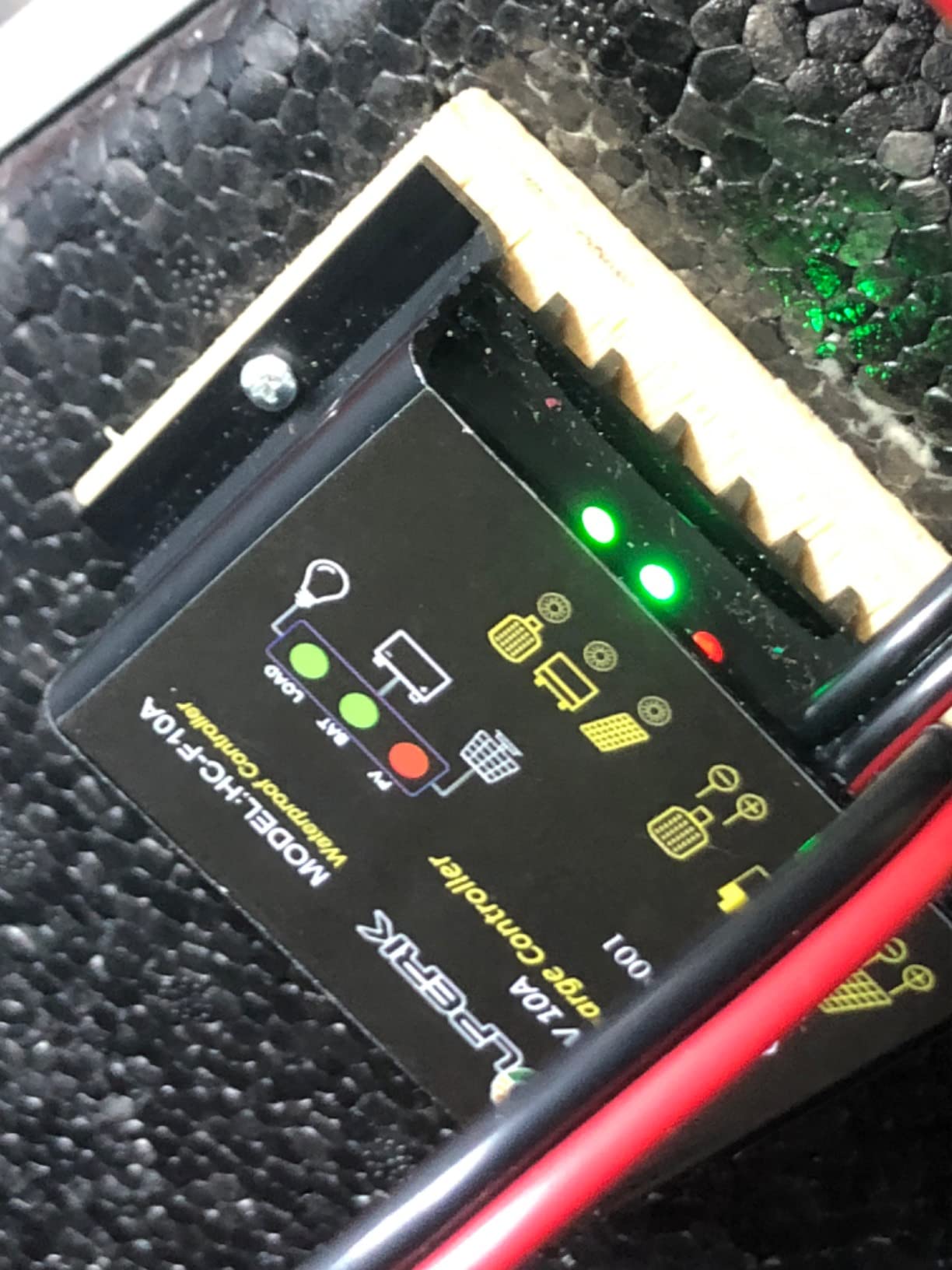
Best for a damp utility room or an outdoor mount
This is the pick for a coastal cabin, a cabin with an unheated shed that sweats in the spring, or any install where you would otherwise spend money building a sealed enclosure for a controller. The IP67 rating on a controller of this size is uncommon, and it removes a failure mode that has nothing to do with electronics.
It suits a single 100W to 150W panel on a 12V lead-acid bank feeding lights, a small pump and a USB port, which is a common layout in the equipment boxes described on cabin forums.
Watch out for the LED-only interface and the failure rate
There is no numeric readout, only three lights, so you cannot check battery voltage without a meter. That is fine for a system that is sized once and left alone, and frustrating for one you are still commissioning.
The more serious point is reliability. This product has the highest share of one-star reviews in the group at 15 percent, which hints at early units failing. With 467 reviews that is a real signal rather than noise, and it is the reason we would not put this controller on a full-time occupied cabin where a failure strands the batteries. Pair it with a battery monitor so you notice a problem before the bank does.
6. ECO-WORTHY 30A PWM with Bluetooth: Monitoring Without a Module
ECO-WORTHY 30A 12/24V PWM Solar Charge Controller with Bluetooth
30A charge, 10A load
Built-in Bluetooth
12V and 24V
LiFePO4 supported
Pros
- Bluetooth is built into the controller rather than sold as a separate module
- 30A charge current with a 10A load output for cabin lighting and small pumps
- Handles lead-acid
- gel and lithium phosphate chemistries
- Measurement accuracy stated within a 1 percent error margin
Cons
- Bluetooth range limited to roughly 98 feet line of sight
- Runs warm and needs a flat
- ventilated mounting surface
- Deep-discharge cutoff at 8V is aggressive for lead-acid banks
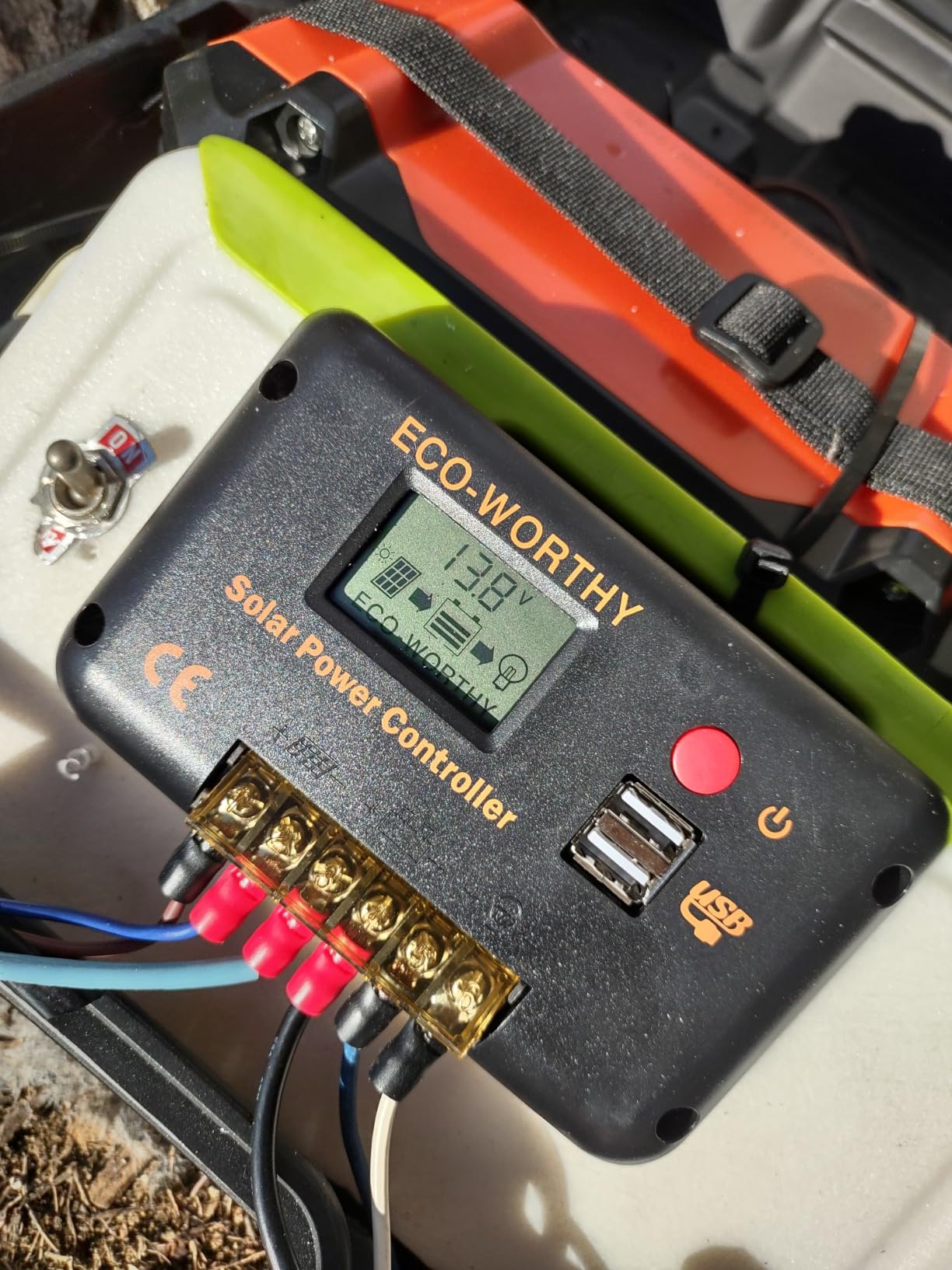
The problem with most controller apps is that the controller does not have a radio. The BT-1 and BT-2 modules exist because the base unit has no Bluetooth at all, so a remote cabin owner pays twice to get visibility. This controller has the radio in the box, which at 30A and with a load output is an unusual combination in this tier.
Range is specified at up to 98 feet in open field. That is enough to stand outside the shed with your phone, and not enough to check the bank from the cabin, so treat it as a commissioning and status tool rather than remote monitoring. If you need monitoring from off-site, the RS485 route on the EPEVER further down is the more extensible answer.
Measurement accuracy is stated within a 1 percent error margin, which is a real spec to have on a controller that reports current and voltage to an app. The chemistry support covers lead-acid, gel and lithium phosphate, and the LCD shows live status while allowing parameter changes without a laptop.
The 30A charge current with a 10A discharge current is a sensible split for a cabin. The load side can run lighting and small pumps directly, and the LCD plus dual 5V/2.5A USB outputs cover phones and small devices. Protection covers short circuit, open circuit, reverse connection and overload.
Best for a small cabin where you want an app without an add-on
If you are building a 12V or 24V system up to about 300W and you want to see charge state from the doorway, this removes both the module cost and the module installation step. It is also one of the few budget controllers that will charge a LiFePO4 bank, which matters for a new build.
Warranty length is not published for this model, which is worth noting against the Renogy units that state three years, two years and one year explicitly. The plastic housing has no weather sealing rating stated, so keep it inside.
Watch out for the 8V cutoff and the heat
Auto shutoff below 8V battery voltage is aggressive for lead-acid banks, and there is no published way to change it. On a lead-acid cabin with deep-cycling weekend use, that cutoff will trigger before you expect it to, and you will come back to a bank that has been taken further down than you intended.
Reviewers also report that the unit runs warm and must be mounted on a flat, ventilated surface, which every PWM controller shares and is a genuine constraint in a closed cabinet. We have covered the alternative approach of sizing the whole system around a larger inverter charger in our expandable cabin power guide.
7. EPEVER Tracer 30A MPPT: The Highest-Rated MPPT
EPEVER MPPT Solar Charge Controller 30A 12V 24V Auto Max PV 100V
30A MPPT
100V max PV
390W at 12V, 780W at 24V
RS485 Modbus
Pros
- Highest average rating in this roundup at 4.5 with only 2 percent one-star reviews
- MPPT tracking above 99.5 percent with 98 percent maximum DC/DC conversion
- Widest chemistry support including 4s and 8s LiFePO4 and 3s
- 6s
- 7s lithium
- Temperature sensor unit included in the box
Cons
- Bulky and heavy at 1.26 kg compared with the PWM alternatives
- Monitoring hardware such as the MT50 display is an extra purchase
This has the best rating in the group at 4.5, and the review distribution behind it is unusually clean with 74 percent five-star and 2 percent one-star. The technical case is strong too: tracking efficiency above 99.5 percent, maximum DC/DC conversion of 98 percent, and a 100V maximum PV input giving 390W on a 12V bank or 780W on a 24V bank.
Chemistry support is wider than anything else here. Gel, AGM, flooded, sealed, LiFePO4 and Li(NiCoMn)O2 are all covered, which means a 4s or 8s LiFePO4 pack and a 3s, 6s or 7s lithium pack can be charged with the correct profile rather than an approximation. Common negative grounding, battery temperature compensation, real-time energy statistics and overheating power derating round out a serious feature list.
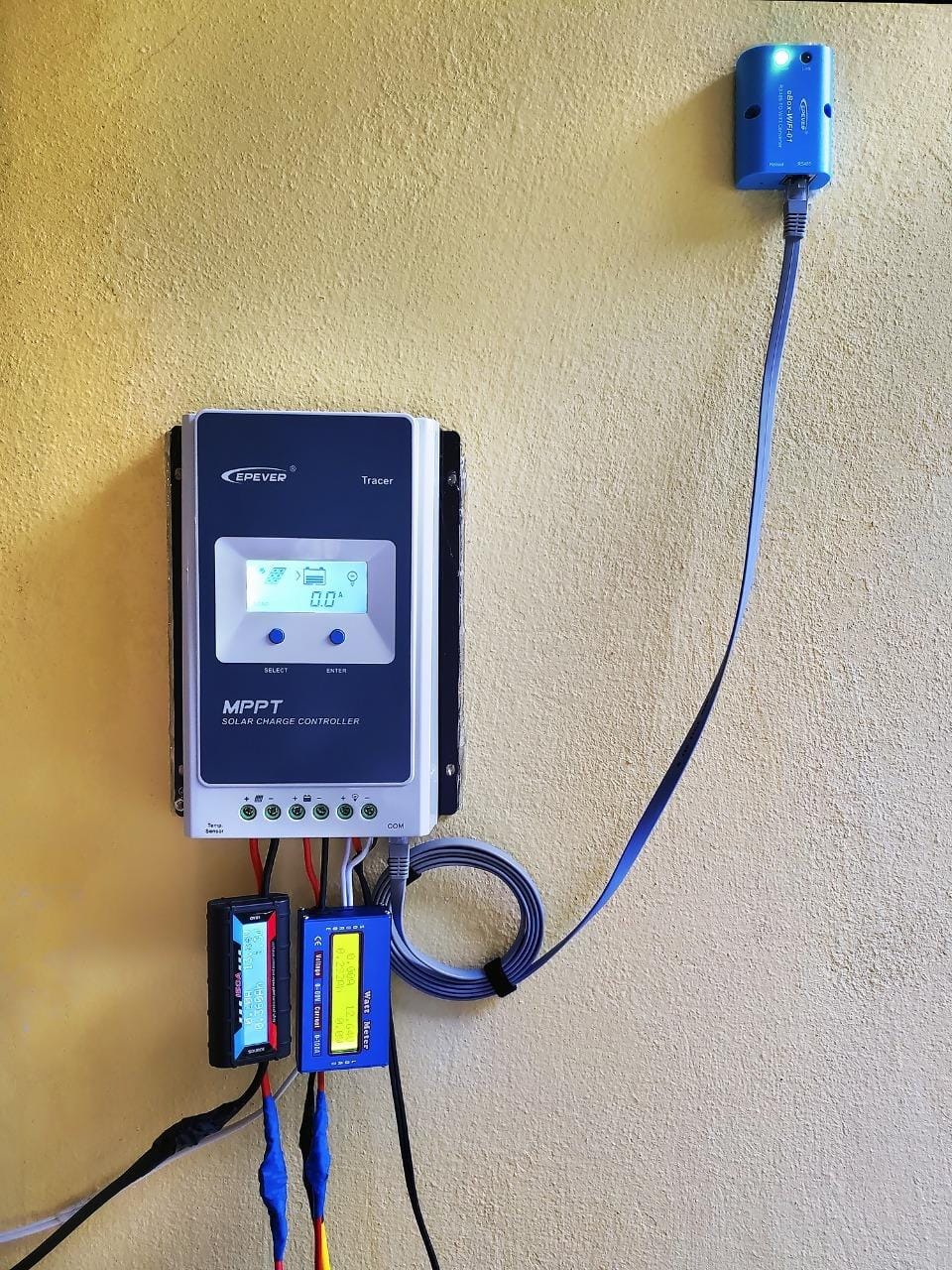
The communication path is what makes this the pick for a cabin you want to monitor properly. RS485 Modbus with optional MT50 or MT52 remote displays, a WiFi adapter, a BLE adapter and the eLOG01 logger means you can build whatever monitoring chain fits the site, including off-site visibility if you add the network hardware. A temperature sensor unit is included, which is not true of most controllers in this roundup.
Size is the trade. At 8.98 by 6.46 by 2.17 inches and 1.26 kg, this needs a real cabinet with airflow, and it is roughly ten times the weight of the 10A Wanderer. On a cabin with a wall-mounted panel space, that is a planning constraint rather than a dealbreaker.
Best for a cabin that will grow, or one you monitor from town
The chemistry breadth makes this the strongest choice for a LiFePO4 retrofit, particularly an 8s pack on a 24V nominal bank, which several controllers in this roundup do not support. The temperature sensor in the box is also the right answer for a cold cabin, because battery temperature compensation is what stops a winter charge from being too aggressive.
If your cabin is 90 minutes from a town with a solar shop, the 2 percent one-star share matters more to you than it would to someone in a city. It is the cleanest reliability record of any controller here, and it is the reason we treat this as the premium tier pick.
Watch out for the size and the monitoring add-ons
Budget for the accessories. The MT50 remote display, the WiFi adapter and the BLE adapter are all separate purchases, and the base unit gives you the LCD and the RS485 port rather than the finished monitoring chain. That is a fair trade if you plan to add monitoring once, and an expensive one if you do not.
With 217 reviews this has a modest evidence base, so the rating is excellent but the long-term track record is unproven relative to the 4050-review Rover, and three controllers here have fewer reviews again. For an occupied cabin in a severe climate, weigh that against the Rover’s higher volume.
8. LiTime 30A MPPT with Bluetooth: The LiFePO4 Retrofit Pick
LiTime 12V/24V 30A MPPT Solar Charge Controller Bluetooth, LCD Display
30A MPPT
450W at 12V, 900W at 24V
Built-in Bluetooth
2-year warranty
Pros
- Built-in Bluetooth with a companion app
- with no separate dongle purchase
- Die-cast aluminum housing that dissipates heat far better than plastic-cased MPPT units
- Dedicated LiFePO4 charging mode plus adjustable sealed
- gel and flooded parameters
- Copper wire connectors included in the box
Cons
- 450W panel ceiling at 12V is a real limit if you plan to expand the array
- App had compatibility problems with newer Android versions
- Manual guidance on the remote temperature sensor for LiFePO4 conflicts internally
This is the pick when the task is specifically a lithium retrofit, and the review record contains a documented case that matches that description exactly: an owner converted a roughly 40-year-old cabin system from lead-acid to LiFePO4 using this controller and reported the system became hands-off. A dedicated LiFePO4 charging mode plus adjustable lead-acid parameters means you can roll the change back if the battery swap goes badly.
Tracking efficiency is not less than 99 percent with peak conversion up to 98 percent, and maximum PV input is 450W at 12V or 900W at 24V. The die-cast aluminum body is the quiet advantage here, because an MPPT stage running at high conversion in a sealed cabinet generates real heat and plastic cases manage it poorly.
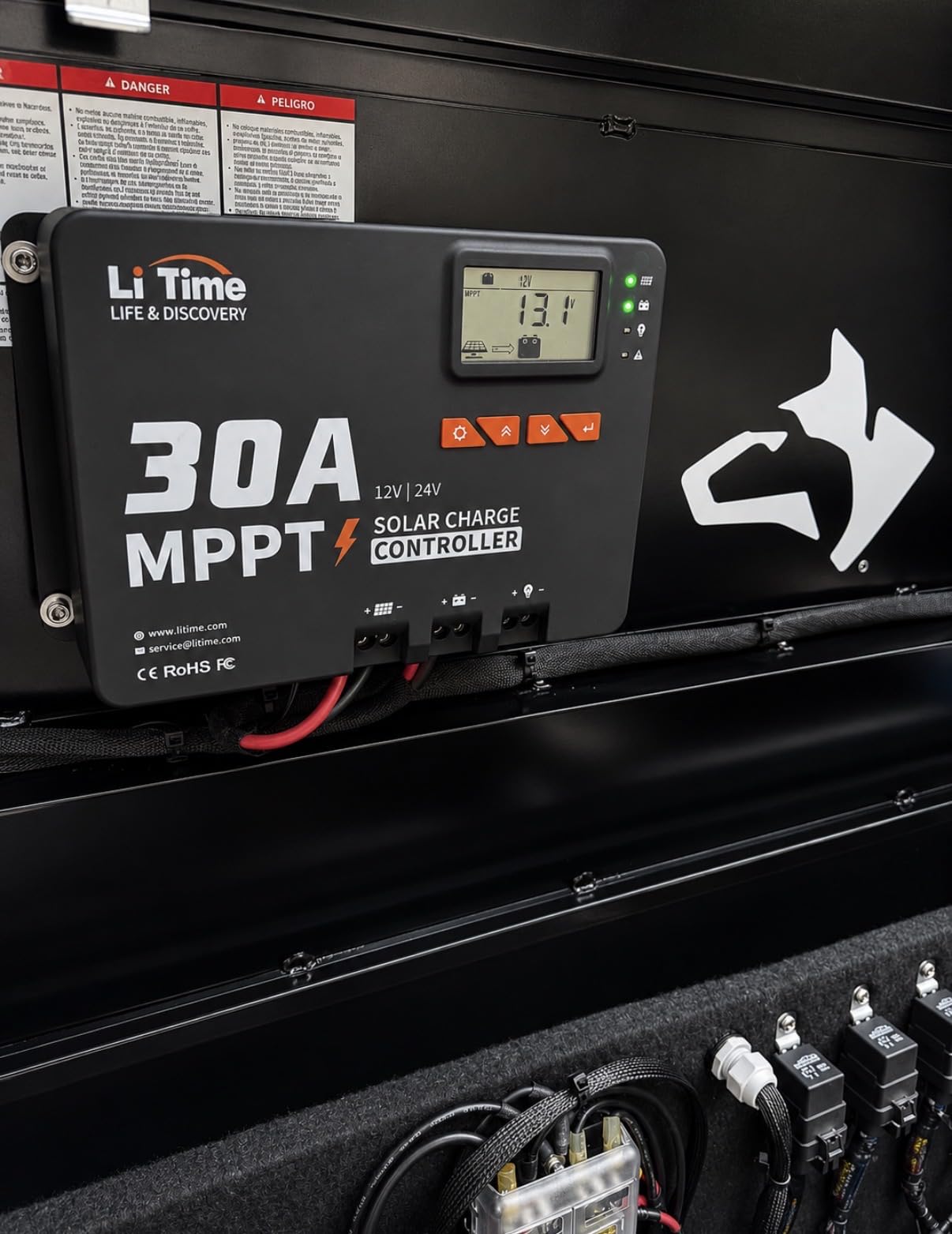
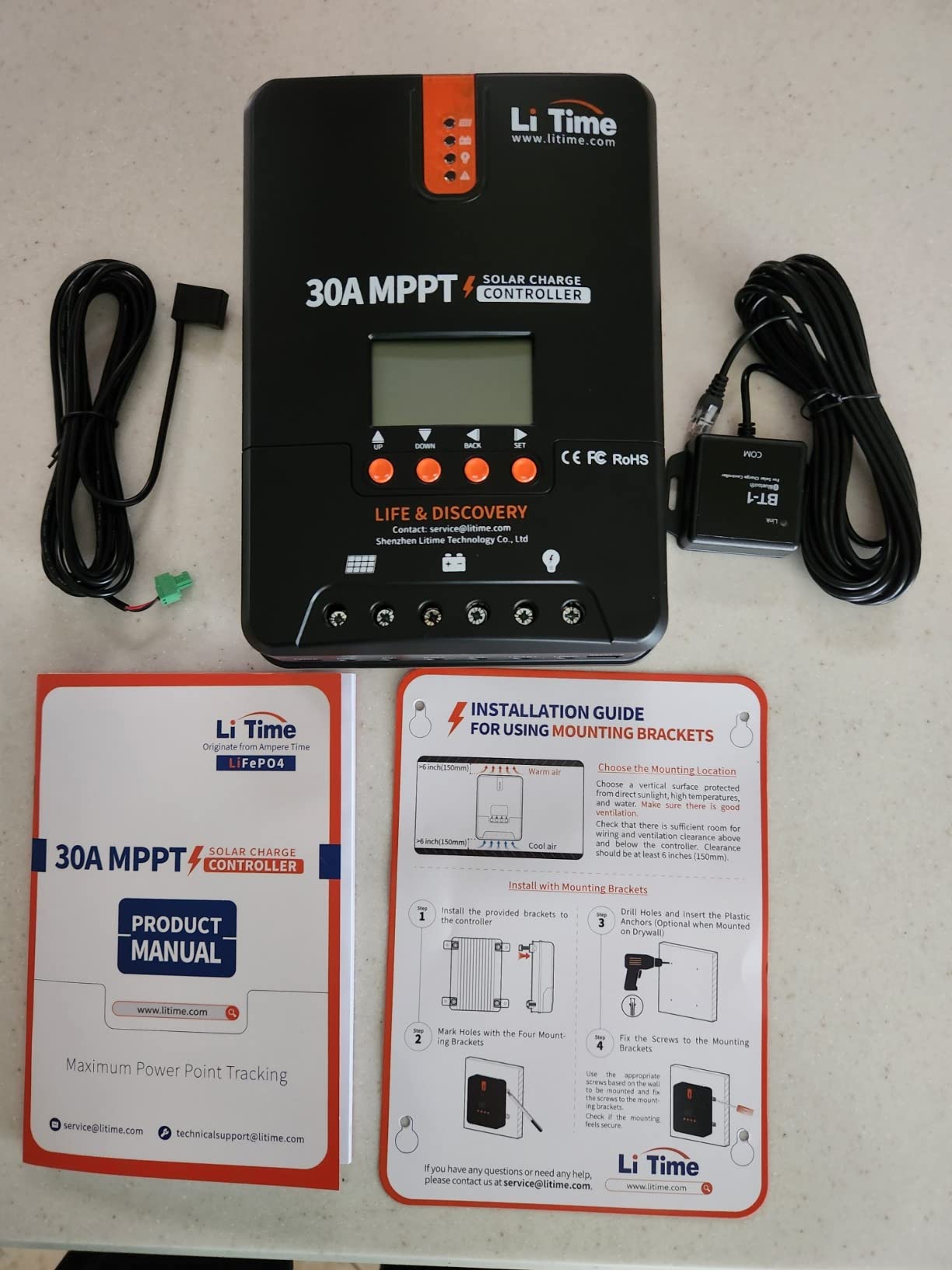
Bluetooth is built in with a companion app for remote control and status display, and the LCD has four menu buttons plus multi-colour LED status indication. Reviewers call out that it produces no RF interference, which was confirmed by amateur radio operators, a small thing that matters if your cabin has a radio and a long antenna run.
Protection covers reverse connection, overpower, overvoltage, short circuit and over-temperature. Copper wire connectors, heat shrink tubes and screws are included, and the product carries product liability insurance, which is not nothing when a claim follows a failed component into a remote install.
Best for a LiFePO4 cabin on 450W or less of panel
Choose this when the bank is lithium, the array is 450W or under at 12V, and you want monitoring without buying a module. At 4.4 pounds and 9.65 by 3.25 by 7.09 inches it is a substantial box, so plan the cabinet accordingly, and the aluminum body means it needs less forced cooling than the plastic-cased options.
Warranty is two years, which sits between the Rover’s three years and the one-year terms in the budget tier, and the operating temperature figure published for the product is 45 degrees Celsius, so in a hot southern cabin enclosure, keep it shaded.
Watch out for the sizing ceiling and the documentation
The array ceiling is the one that bites. One owner undersized the system and reported being unable to push more than 450W of panel, which is the same mistake as buying a 10A controller for a 200W panel. Size the controller to the array you will have in five years, not the array you have now.
Two documentation issues appear repeatedly in the reviews: the app had compatibility problems with newer Android versions until they were addressed, and the manual contains conflicting guidance on the remote temperature sensor for LiFePO4. If your cabin is cold, resolve the temperature sensor question before you rely on winter charging, and keep the printed manual with the system.
9. SUNAPEX 10A MPPT: The Smallest MPPT Option
SUNAPEX MPPT Solar Charge Controller 12V 10A for LiFePO4 AGM Gel Batteries
MPPT 12V 10A
30V Voc ceiling
Zero night-time drain
1-year warranty
Pros
- MPPT performance at a price that otherwise buys only PWM controllers
- Zero battery drain through blocking diodes when the sun is down
- Compact 4.1 by 2 by 0.8 inch body with standard SAE fittings
- Gradual current ramp instead of dumping amps into the bank on connect
Cons
- 30V open-circuit input limit means many 36V to 40V Voc panels will not work
- Display is hard to read in sunlight and the current readout shows for only 5 seconds
- 12V only
- with no weather sealing rating published
This is unusual in a way that matters at a remote cabin: it drains nothing from the bank at night. Most 24-hour MPPT designs draw from the battery after sunset, and on a small system with a big bank and a small array, that parasitic draw is a real fraction of your monthly surplus. Blocking diodes eliminate it entirely, and the difference shows up over a winter on a weekend-only cabin.
It is also MPPT at a price band where the alternatives are all PWM, and the review record contains an owner pulling full 100W from a 100W panel on a sunny winter day. The gradual current ramp on connection is another small, sensible behaviour: instead of dumping current into a cold bank at first light, it eases in.
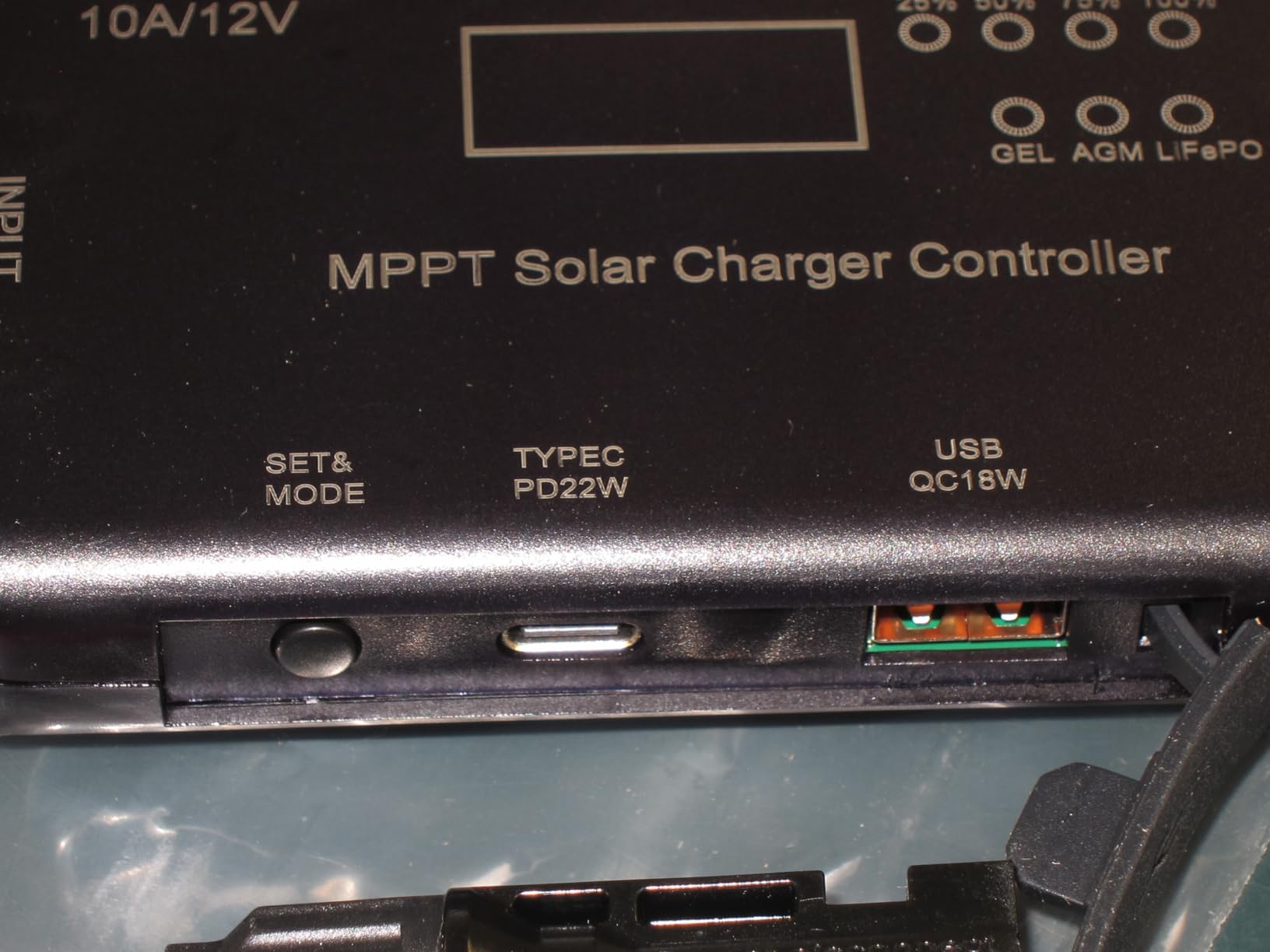
Charging is a four-stage program, bulk, absorption, float and equalisation, with compatibility across lead-acid, gel, AGM and LiFePO4. Protection covers overcharge, overvoltage, reverse current, reverse polarity, short circuit and over-temperature. Type-C and USB output ports let you charge a phone or a device straight from the panel, which is popular with owners running a small electronics load.
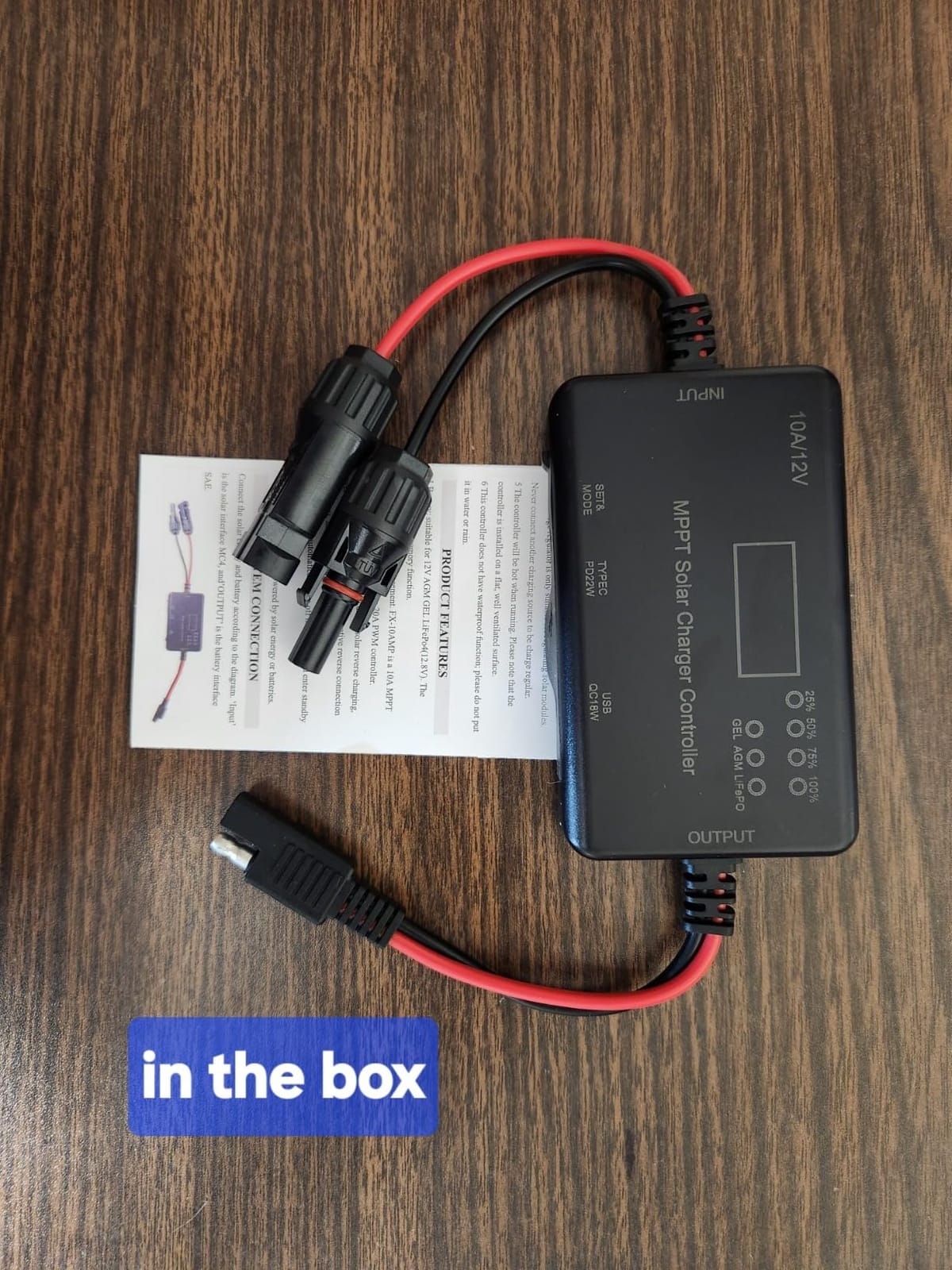
The enclosure is 4.1 by 2 by 0.8 inches and 0.17 kg, the most compact box in the roundup, with upgraded SAE connectors for fast setup. Customer service has been reported as responsive, including replacing a unit after the return window had passed.
Best for a tiny 12V array where night-time drain is the worry
A single 100W panel, a 100Ah to 200Ah bank, a weekend cabin, mild winters. That is the use case, and in it the zero-drain design matters more than the MPPT label. The compact body fits inside a small junction box and the SAE connectors make installation fast enough to do in one visit.
It is also 12V only, so it cannot follow a bank upgrade to 24V. If there is any chance of that, the ECO-WORTHY or the Rover is the safer purchase.
Watch out for the 30V ceiling, which catches people out
Maximum input open-circuit voltage is 30V. Many modern panels have a Voc of 36V to 40V, and those will not work here, and the review record shows at least one owner discovering this only after delivery. Check your panel’s Voc against 30V before you buy, and add your cold correction on top.
The display is a dark purple that some buyers find nearly unreadable in direct sunlight, and the current readout appears for about five seconds after a button press with no watt display. No weather sealing rating is published, so keep it inside. Warranty is one year, tied for the shortest stated term here, which is acceptable only on a system small enough that a failure is an inconvenience rather than a loss of power for a season.
10. POWLAND 120A MPPT: The Large or Upgrade-Proof System
POWLAND 120A MPPT Solar Charge Controlle 12V/24V/36V/48V/60V/72V/84V/96V Auto,Max Input 230V Solar Charger, LCD Display Intelligent Regulator for AGM, Gel, Lithium ect
120A MPPT
Automatic 12V to 96V
230V max PV input
LCD diagnostics
Pros
- Only controller here that spans 12V through 96V automatically
- 120A of headroom covers large cabin arrays and future bank growth
- 230V PV input tolerance allows very high open-circuit panel voltages
- Detailed LCD showing PV voltage
- current
- charge stage
- warnings and diagnostics
Cons
- No equalisation stage
- so flooded lead-acid users lose that function
- White plastic housing is not obviously rugged for a damp utility room
- Brand has a shorter track record than Renogy or EPEVER
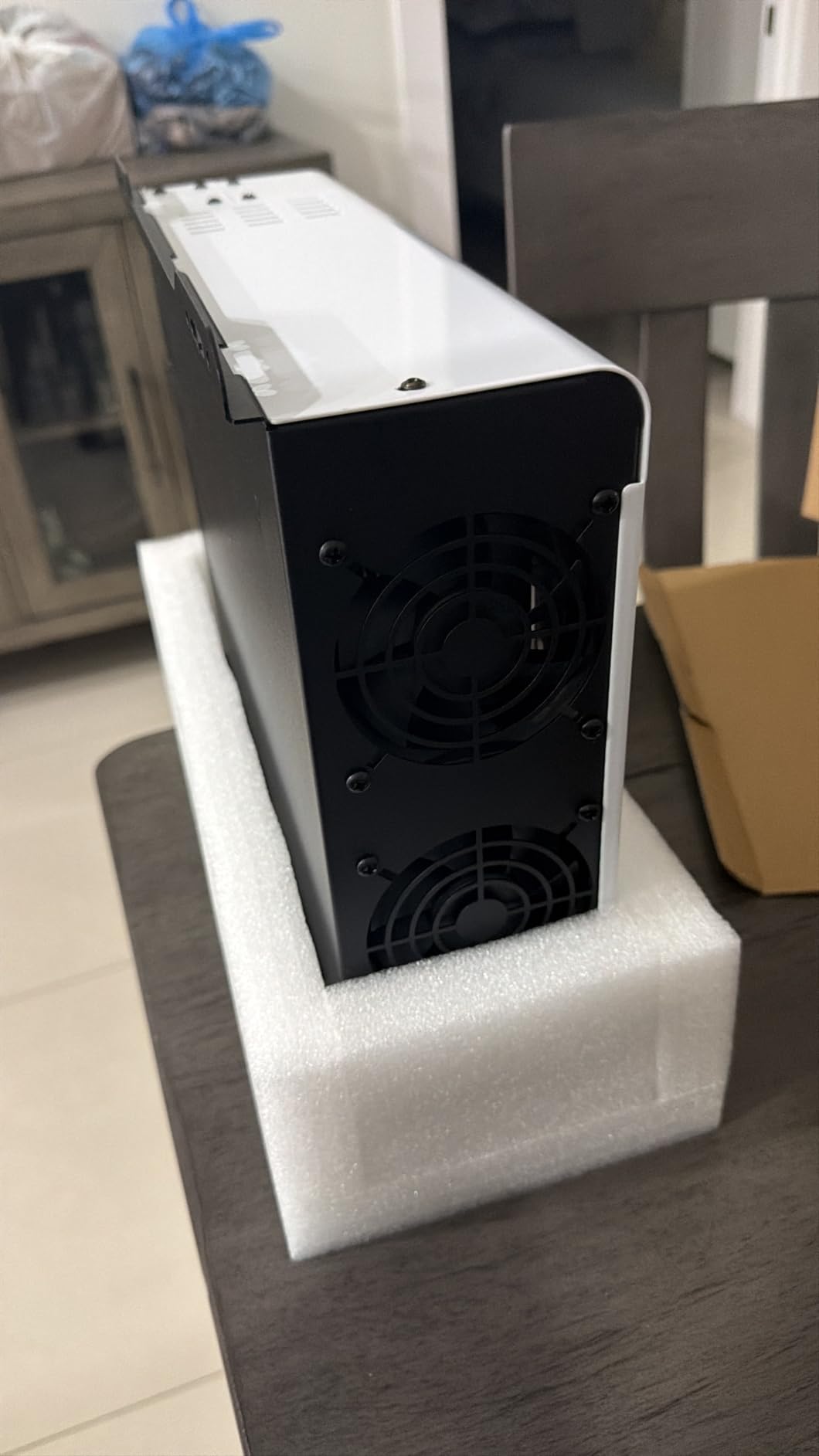
This is the only controller in the roundup that auto-detects from 12V all the way to 96V, and that single fact changes the upgrade maths. A cabin that starts on a 12V bank and moves to 24V, then to 48V as the load grows, can keep the same controller rather than replacing it at each step. Every other unit here tops out at 24V or 12V.
The 120A rating and 230V maximum PV input are sized for a full-time cabin rather than a weekend one. At 120A you can attach a multi-kilowatt array and still have controller headroom, which is what you want if the plan is to add panels every couple of winters rather than in one expensive weekend. MPPT conversion efficiency is stated up to 98 percent, with roughly 30 percent more harvest than PWM claimed for the same array.
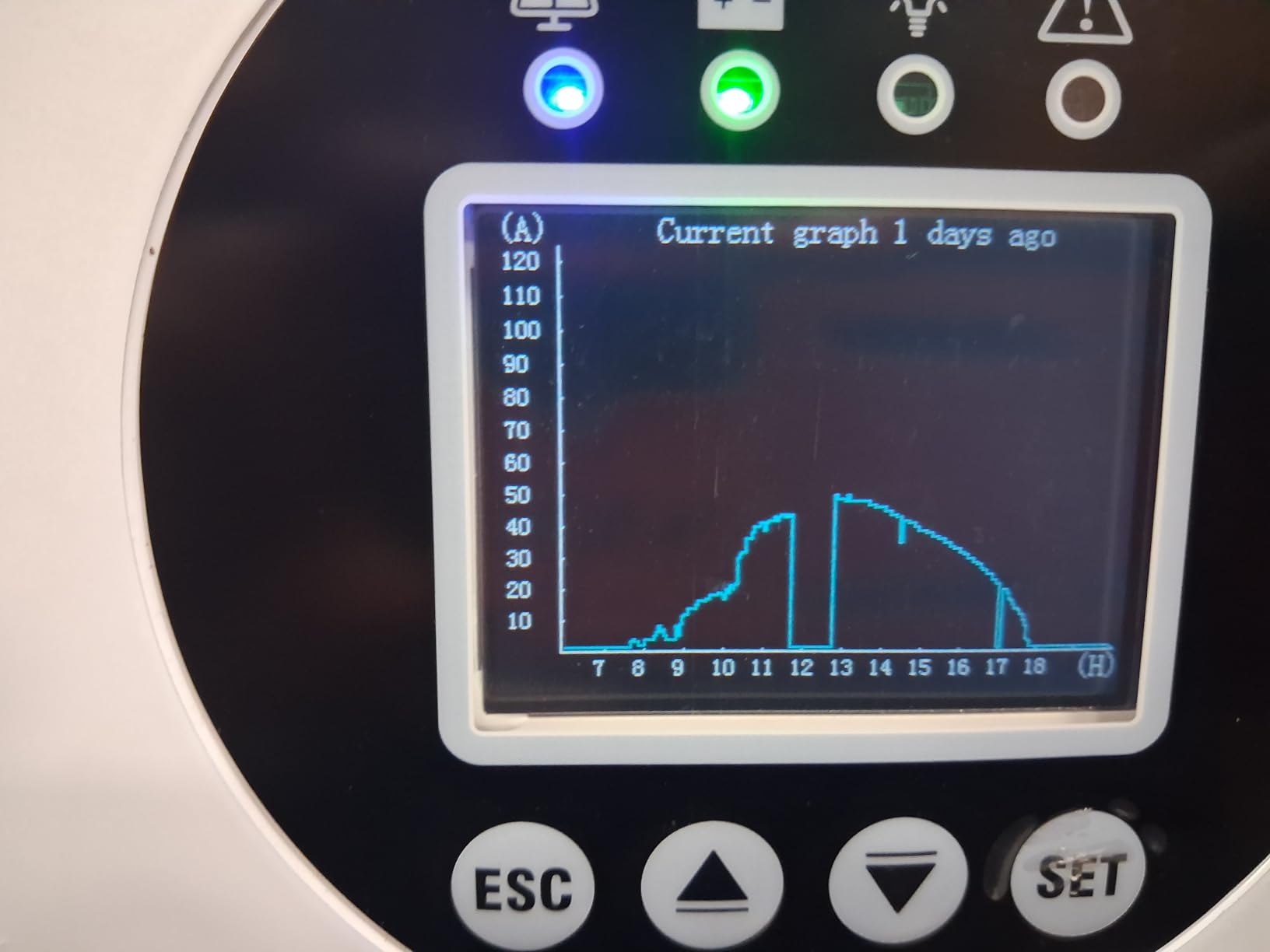
The display is the best diagnostic in this roundup. A high-resolution LCD reports PV input voltage and current, charging mode and stage, system warnings and diagnostics, which means you can read a fault code at the cabin instead of guessing and then driving to town. For a site nobody monitors, that is worth more than any app.
Protection covers reverse polarity, overload and open circuit, and the package includes a detailed manual with 24/7 technical support. Reviewers respond well to the auto-detection, the current headroom and the level of detail available on screen.
Best for a full-time cabin or a system you expect to grow
This is the right pick for a lived-in cabin with a refrigerator, a water pump and a plan to add a second array. The 120A rating means the controller will not be the limiting component in three years, and the voltage range means a system upgrade does not force a controller replacement. On a 48V bank, a 230V input ceiling gives you enormous freedom in string configuration.
For most weekend cabins it is simply more controller than the site can use, and the extra capacity buys nothing. Match the controller to the array you have, not the array you might have.
Watch out for the missing equalisation stage and the enclosure
Charging is a three-stage program, bulk, absorption and float. There is no equalisation stage, which matters if you run flooded lead-acid and want to periodically balance the cells. A lithium or AGM bank does not need it, so this is a lead-acid-specific concern.
The white plastic housing does not read as rugged for a damp or dusty utility room, and no ingress rating is published, so plan to mount it inside a cabinet. The brand also has a shorter track record than Renogy or EPEVER, which at 133 reviews and a full-time cabin is a fair thing to weigh against the alternative, and three picks here carry fewer reviews still. Confirm your inverter and battery ecosystem before committing, since retrofit matching is where off-grid projects usually stall.
How to Size a Solar Charge Controller for an Off-Grid Cabin
Size the controller from the array first and the battery bank second, in that order. Most cabin sizing errors come from doing it backwards and buying a controller to match a battery bank that the panels can never fill. Work through these five steps.
Step 1: Cold-corrected open-circuit voltage. Take each panel’s Voc from its datasheet, add them for a series string, then apply a cold correction factor. At zero degrees Fahrenheit, panel Voc rises roughly 25 to 30 percent above the 25C rating. Add that correction before you compare against a controller’s ceiling, because a three-panel series string of typical 400W panels lands somewhere near 160V cold, well above the 100V maximum published by the Renogy Rover and the EPEVER Tracer and far above the 25V and 30V limits of the smaller units here. Any controller whose published max PV input sits below your cold-corrected Voc will shut down or fail in January.
Step 2: Short-circuit current with margin. Add the panels’ Isc and size the controller’s input rating at roughly 1.25 times that figure. The margin covers the fact that Isc is measured at 25C and rises in cold, plus reflection and edge effects. The EPEVER Tracer and the Renogy Rover both exceed 30A battery-side, which is what makes them workable above a 400W array at 12V.
Step 3: Array watts against the controller’s PV limit. The published max PV input is the number that matters, not the panel nameplate. For a 400W panel on a 12V bank, you need a controller rated for at least 400W of PV input, and the Rover’s 400W at 12V limit is the exact fit. For a 300W panel, the same rule applies with more margin, and a 30A unit is comfortable rather than tight.
Step 4: Bank voltage. Decide 12V, 24V or 48V before you buy anything, because it is the least reversible decision. A 12V system is right below roughly 400W of panel. Above that, 24V halves the current for the same power and reduces cable losses over long runs between array and shed, which is often the real reason to step up. 48V is for full-time cabins with a substantial load. Nine of the ten controllers here do not exceed 24V.
Step 5: Battery-side charge current against the bank. Match the controller’s rated battery-side charge current to the array, not to the batteries. A 30A controller on a 500Ah bank gives a 0.06C charge rate, which is a reasonable daily top-up. A 10A controller on that same bank gives 0.02C, which is fine for maintenance and poor for anything else. And if your bank is far larger than the array can fill, no controller change fixes it. The DIY Solar Forum case is the clearest example we found: the batteries were the biggest single problem, and a PWM controller was pushing roughly 10A where 46A was needed.
One sizing question deserves a direct answer, because people ask it constantly. What size solar charge controller do you need for a 400W solar panel? A 30A MPPT controller, with a published max PV input at or above 400W at your bank voltage and a Voc ceiling comfortably above your cold-corrected string voltage. What size MPPT controller for a 300W solar panel? A 20A to 30A MPPT unit is the right band, and a 10A controller is the point at which you start leaving current on the table.
On oversizing, the answer is yes within limits. You can pair a larger controller with a smaller array and it will simply harvest what the array produces. What you cannot do is exceed the PV input voltage limit, and what you should avoid is buying far more current capacity than any array you will own, because the extra cost buys nothing and a lower-current controller is easier to keep cool.
LiFePO4 in an Unheated Cabin: The Cold-Charging Problem
Lithium iron phosphate cannot be charged below freezing, and a cabin equipment shed in a cold climate is frequently unheated and uninsulated. This is the single most repeated warning in the cabin solar forums, and it is the reason lithium retrofit plans stall: the batteries are fine in the cellar and the problem only appears in the shed where the controller and bank actually live.
The failure mode is not dramatic. The controller does not overcharge the bank; it simply refuses to charge, or the battery’s internal management system blocks the charge, and you discover in March that the bank has spent the winter at a low state of charge. Repeated deep discharge is far more damaging to a lithium bank than a missed charge, so the block turns into a capacity problem across seasons.
There are two reliable fixes. Buy a controller with an explicit low-temperature charge cutoff and a temperature sensor, so charging stops automatically below the threshold and restarts when the bank warms. The EPEVER Tracer includes a temperature sensor unit, which is why it ranks well for cold installs. Or heat the location, which sounds excessive until you compare it to replacing a battery bank, and forum owners regularly recommend keeping a working inverter and replacing only the charge controller and batteries when they move to lithium.
A lithium menu option on a controller is not the same as low-temperature control. One competitor roundup in this category makes exactly that point, and it is worth repeating: confirm that the cutoff is a charging cutoff tied to a temperature input, not just a profile selection that changes the absorption voltage.
What a Charge Controller Cannot Fix for Your Cabin
The disadvantages of using a solar charge controller are real, and none of them are the controller’s fault. It cannot create energy the array never captured, it cannot recover a charge that was never taken, and it cannot protect a battery bank that has been mis-sized from the beginning.
First, a battery bank larger than the array can support. This is the most common cabin failure and it shows up as a bank that never reaches full charge, no matter how good the controller is. Second, parasitic draw when the cabin is empty. One owner measuring his own system recorded about 2.5 kWh per day of idle draw against 7.5 to 8 kWh on an occupied weekend, and that ratio drove his battery sizing decision. A controller with a low self-consumption figure, like the Wanderer 10A at under 10mA, helps at the margin but cannot fix a 2.5 kWh per day load.
Third, two non-matching panel sets on one bank. A recurring question on the Small Cabin Forum is whether an older or differently oriented panel array can feed the same battery bank through a second controller. It can, electrically, but the two controllers will fight each other unless one is diode-isolated, and the older array’s output will be clipped whenever the bank voltage is already high. If you have a legacy array, either give it its own controller with a blocking diode arrangement or accept that it will contribute only in poor weather.
Fourth, seasonal solar yield that nameplate wattage hides. A PVWatts model for one owner’s 2,400 square foot cabin in southwest Washington showed 111 kWh from a 6 by 430W array in January against 325 kWh in July, a 3.2 to 1 seasonal ratio. Sizing off the annual average in that case would leave the cabin short in December. Size off the worst month.
Fifth, remote serviceability, which no competitor roundup treats as a selection criterion. At a cabin ninety minutes from town, a failed controller is a service visit, not a swap. That argues for a unit with a stated warranty, a brand with a support path, and published electrical limits you can read before you drive out there rather than diagnose in the dark.
Frequently Asked Questions
How do you get power to an off-grid cabin?
You need four things working together: a solar array sized to your worst month, a charge controller to regulate it, a battery bank sized to your load, and an inverter to turn stored DC into household AC. The charge controller is the keystone because it is the only component that decides how much of the sunlight you actually capture, and the only one that can permanently damage a battery bank if it is set for the wrong chemistry or temperature. Size the controller from the array’s cold-corrected Voc and Isc, not from the battery bank.
Is MPPT really better than PWM for an off-grid cabin?
On a cabin, yes, and the gap widens as conditions get worse. A PWM controller can only deliver current at battery voltage, so it discards the difference between the panel’s operating voltage and the battery’s charging voltage. An MPPT controller tracks the panel’s maximum power point and recovers most of that. Expect a 20 to 30 percent harvest gain on a 200W panel feeding a 12V bank on a cold morning. PWM is still defensible for a single low-Voc panel in a mild climate with no expansion planned.
What size solar charge controller do I need for a 400W solar panel?
A 30A MPPT controller. The published max PV input needs to be at least 400W at your bank voltage, and the Voc ceiling needs to sit above your panel’s cold-corrected open-circuit voltage after adding roughly 25 to 30 percent for freezing temperatures. A 20A PWM unit technically passes a 400W panel at 12V but will not harvest the full nameplate output, and it leaves no room for a second panel.
Can you oversize a solar charge controller?
Yes, within voltage limits. A larger controller paired with a smaller array simply harvests what the array produces, and that is a reasonable way to buy growth headroom. What you cannot exceed is the controller’s maximum PV input voltage, and a 100V ceiling on a series string that hits 110V cold in January will shut the unit down. Avoid oversizing current capacity far beyond any array you will realistically own, because the extra cost buys nothing.
What are the disadvantages of using a solar charge controller?
A controller cannot create energy the array never captured, cannot recover a charge that was never taken, and cannot fix a battery bank that is larger than the array can support. It also draws a small parasitic current at night unless it uses blocking diodes, and a controller with no low-temperature charge cutoff will refuse to charge a LiFePO4 bank in an unheated shed. Remote monitoring usually costs extra, since many brands sell the Bluetooth radio as a separate module.
Conclusion
The best solar charge controllers for cabins are decided by published electrical limits, not by amp labels. The Renogy Rover 30A MPPT is the pick for most cabins, with a 100V Voc ceiling, 400W of PV input at 12V, LiFePO4 support and the largest review record in the group at 4050. Go to the Renogy Wanderer 10A if you have one panel and a small bank, and step up to the EPEVER Tracer 30A MPPT if you are running lithium in a cold climate and want a temperature sensor in the box.
Before you buy, do the cold-corrected Voc calculation, because that is the number that decides whether the controller survives January. And measure what your cabin draws when nobody is there, because that figure, not the panel wattage, is what sizes the bank. If you want a starting point for the rest of the system, our solar generators for cabins guide covers the backup side of the same problem.