
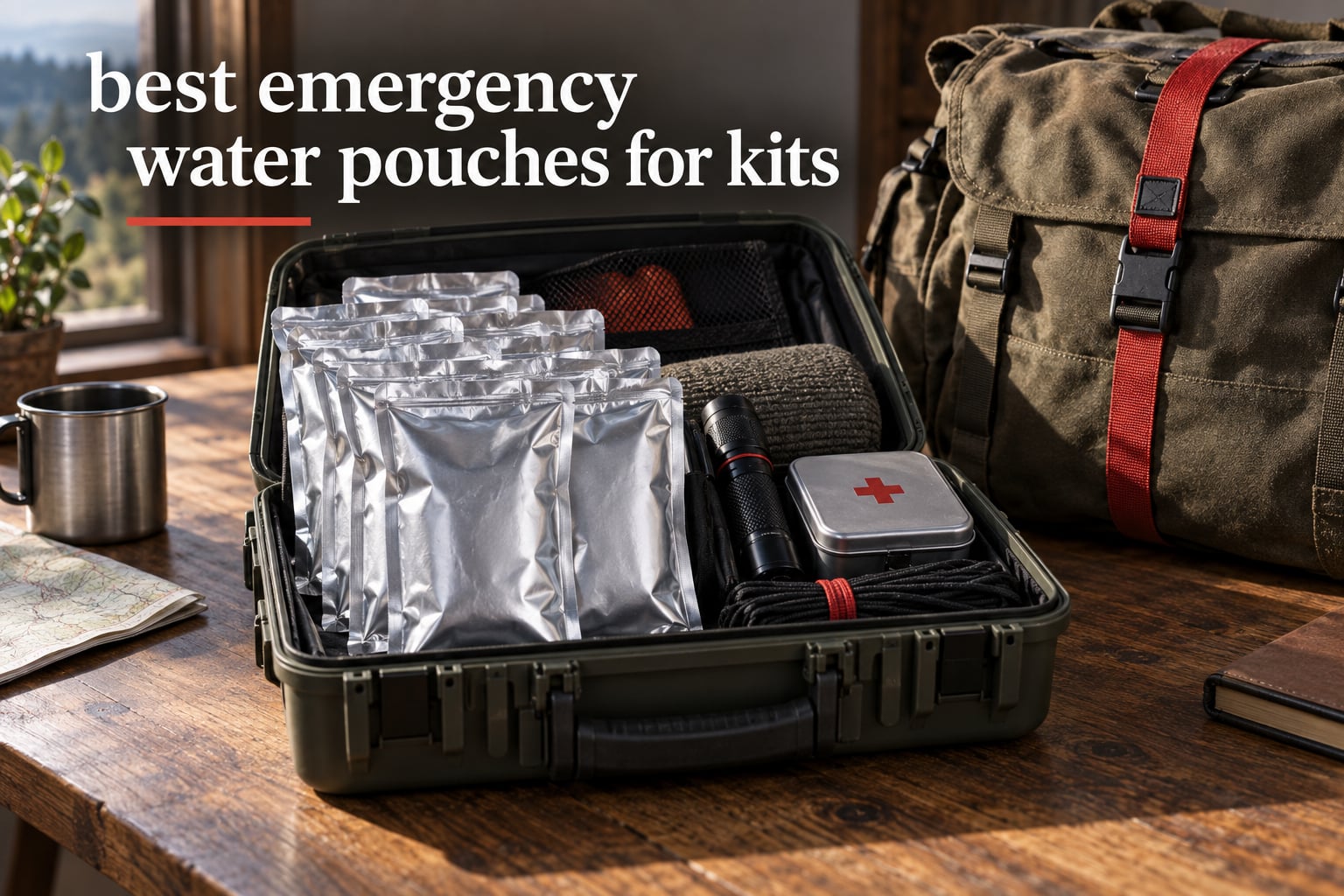
The best emergency water pouches are the ones that taste clean, seal properly and stack flat enough to fit the gaps in a go-bag. We put 11 of them through that filter for 2026, and the Datrex Emergency Water Packet 4.227 oz 18-pack came out on top: it pairs a five-year shelf life with US and Canadian Coast Guard approval, dates every packet individually, and holds a 4.6 rating across more than 3,800 reviews.
That matters more than it sounds. Most survival kit buyers underestimate how much water they need, then overpay for a case that does not cover a single day. A standard 4.225 oz pouch is roughly one big gulp, so one person needs about 19 of them per day and 57 for a 72-hour emergency. We worked that arithmetic for you below, alongside the picks that hold up best in heat, in freezing garages and in overstuffed backpacks.
We also cover what actually goes wrong: sharp foil corners splitting a ziploc bag, wide crimped seams eating pack space, pouches arriving with a pre-punched hole, and the aftertaste that makes people reach for the plastic bottles instead. If you are still assembling the rest of your kit, start with our emergency preparedness kit roundup and use the water picks here to finish the job.
Table of Contents
Top 3 Picks: Best Emergency Water Pouches (October 2026)
Datrex Water Packet 18-Pack
- 5 year shelf life
- US and Canadian Coast Guard approved
- 18 sachets of 4.227 oz

Mayday 50-Pack
- Highest rating at 4.8
- ISO 18813:2022 compliant
- Freeze tolerant from 32 F to 149 F
The three products above are the ones we would buy first: a small-format pack for a single kit, a bulk case for stocking several vehicles at once, and the highest-rated option in the category.
Best Emergency Water Pouches Compared Side by Side in 2026
| Product | Specifications | Action |
|---|---|---|
| Datrex 18-Pack Water Pouches |
|
Check Latest Price |
| Datrex Case of 64 |
|
Check Latest Price |
| Mayday 50-Pack |
|
Check Latest Price |
 SOS 62-Pack SOS 62-Pack |
|
Check Latest Price |
 SOS 12-Pack SOS 12-Pack |
|
Check Latest Price |
 SOS 24-Pack SOS 24-Pack |
|
Check Latest Price |
 Medique Single Pouch Medique Single Pouch |
|
Check Latest Price |
 Mainstay 60-Pack Mainstay 60-Pack |
|
Check Latest Price |
 SOS Case of 96 SOS Case of 96 |
|
Check Latest Price |
 Mayday Case of 100 Mayday Case of 100 |
|
Check Latest Price |
 Datrex 64-Pack 4 oz Datrex 64-Pack 4 oz |
|
Check Latest Price |
Counting Best Emergency Water Pouches: How Many Per Person You Need
Plan on one gallon of water per person per day, and three days of supply per person for a standard emergency kit. In 4.225 oz pouches that works out to about 19 pouches per person per day and 57 pouches per person for a 72-hour kit. This is the single most common mistake in consumer survival kits: a kit advertised as a three-day supply often carries a fraction of one gallon per person per day.
Here is the arithmetic you need:
1 gallon of water = about 19 pouches of 4.225 oz
1 day per person = about 19 pouches
3 days per person = about 57 pouches
7 days per person = about 133 pouches
14 days per person = about 266 pouches
30 days per person = about 570 pouches
For a family of four, the 72-hour requirement is roughly 228 pouches, which is why we prefer bulk cases over multi-pack formats. A 96-pouch case covers four people for about a day and a quarter, and a 100-pouch case does slightly better. Covering a family of four for two weeks means roughly 1,064 pouches, and a full month is closer to 2,280.
The second rule is that sealed pouches are a short-horizon backup, not a long-term supply. Preparedness communities broadly treat pouch water as the first three days of a response, then move to a filter plus bulk storage for anything longer. Our water storage tank roundup covers the bulk side of that plan.
11 Best Emergency Water Pouches Reviewed
1. Datrex Emergency Water Packet 4.227 oz 18-Pack: Best Emergency Water Pouches Overall
Datrex Emergency Water Packet 4.227 oz – 3 Day/72 Hour Supply (18 Packs) , White
18 sachets at 4.227 oz
5 year shelf life
US and Canadian Coast Guard approved
Expiry printed per packet
Pros
- Clean taste with no chemical aftertaste
- Survives temperature swings without leaking
- Small enough for go-bags and first aid kits
- Expiry date printed on every packet
Cons
- Some pouches arrive with a pre-punched hole near the tear notch
- Several pouches are needed per person per day
- Water is hard to pour until the opening is cut wider
This is the pouch I keep coming back to. The 18-pack is small enough to live in a single go-bag or a first aid kit, and each of the 18 sachets is dated individually, which makes rotation honest instead of guesswork. Sales rank sits at number two in Home Emergency Survival Kits, and the review base is the largest in this entire comparison at more than 3,800 ratings.
Taste is the reason forums single it out. On r/preppers and survivalistboards threads, posters repeatedly describe Datrex as the one brand that simply tastes like water, without the plastic or glue note that turns up in most foil-laminate pouches. The owner reviews on this listing back that up, describing water that tastes like ordinary purified water rather than like packaging.
The construction is the real differentiator. These are foil sachets filled at an FDA-certified facility, and the listing carries USCG, Canadian Coast Guard, EC and NZ approval under NSN 8960 0112 4454 3. That approval line is the benchmark serious buyers check first, and very few consumer pouches in this category carry it.

Buyers report that these pouches hold up to years of temperature swings in a car with no leaking, which matches what you would expect from a heavy foil laminate with a sealed seam. At 4.227 oz they stack flat, and a full 18-sachet pack is light enough that you can add it to a bag without a serious weight conversation.
Two practical warnings from owners. First, a fair number of pouches arrive with a small pre-punched hole near the tear notch, so keep a small pair of scissors in the kit. Second, water can be hard to pour cleanly until the opening is cut wider, so expect a wet pocket the first time you drink from one.

What to check before you buy the 18-pack
Confirm you are getting 18 pouches and not a single sachet, because the box count is what makes this a kit product rather than a single serving. Check the print on the carton for a manufacturing date, since an already-aged pouch has less usable life ahead of it, and plan on three boxes to reach a 72-hour reserve for one person.
Decide in advance how you will open them. A 4.225 oz pouch is not a cup: cut the corner cleanly, drink from the spout, and wipe the seam before resealing it in your pocket. Most owners who complain about mess are squeezing the pouch instead of using the pour spout.
When the 18-pack is the wrong buy
Skip it if you are stocking a vehicle with two or more adults. Eighteen pouches is under a single day’s supply for one person, so a car kit built around this pack still needs three of them, or a bulk case, behind it. The full kit checklist is a good place to see how water fits with the rest of your supplies.
Also skip it if you expect to drink it casually. At 4.227 oz per pouch, a box lasts a long time in normal use, so buying the volume you actually need up front rather than topping up later.
2. Datrex Water Pouches Case of 64: Best Emergency Water Pouches for Multi-Kit Stockpiles
Datrex Emergency Survival Water Pouch (Pack of 64), 125ml
64 pouches at 125 ml
5 year shelf life
BPA free with no preservatives
Made in the USA
Pros
- Covers several kits or vehicles in one case
- Pre-measured sachets stack flat
- One of the largest review bases here
Cons
- Not a single-pouch option so a full case has to be purchased
- Only two cons listed by buyers
If you are building more than one kit, this is the format that saves you from ordering four separate packs. Sixty-four pouches is a little over three gallons, so it covers two people for three days with a margin, which is exactly the shape most household kits need.
With more than 3,000 reviews at a 4.6 average and 81 percent five-star ratings, this is one of the most thoroughly proven pouches here. The low end of the rating distribution sits at 3 percent, so there is very little buyer regret to dig through.
The packaging detail is the part worth noting. The sachets are BPA free with no artificial preservatives, made in the USA, and shelf-stable with no mixing, filtering or additional purification required. That last point saves real preparation time when you are assembling five kits in one evening.
How this case compares to the smaller formats
Against the 18-pack, the trade is straightforward: you give up compactness and gain 46 extra pouches. Against the 96 and 100-pouch cases, you give up raw volume and gain a better per-pouch efficiency because the carton is lighter.
The 64-count also balances neatly across use cases. Divide it three ways for three go-bags, or split it between a home reserve and two vehicle kits at roughly 21 pouches each, which is about 26 hours per vehicle.
Where the 64-case falls short
You cannot buy fewer than a full case, so if you only need to top up a first aid kit, this is overbuilt. That is a real drawback for a category where the single-sachet option exists precisely for small jobs.
Second, the pouches share the Datrex tear-notch behaviour, so plan on scissors in each kit you fill. It is a minor inconvenience that recurs across the whole Datrex line rather than something unique here.
3. Mayday 73021 Emergency Water 50-Pack: Best Emergency Water Pouches for Cold Climates
Mayday 73021 Emergency Water Packets (50-Pack)
50 pouches at 4.225 oz
5 year shelf life
ISO 18813:2022 compliant
Tested from 32 F to 149 F
Pros
- Tied for the highest average rating at 4.8
- 86 percent five-star reviews
- Withstands freezing without adverse effects
- Airtight foil resists punctures
- Very packable
Cons
- Wide crimp seams take up space when packing tight
- Needs a knife or scissors to open
- Some buyers received pouches close to the end of the shelf life
This is the highest-rated pouch in the roundup, at 4.8 with 86 percent five-star reviews, and it carries the lightest complaint load of any option here. The Mayday 73021 is also the only one in this roundup that states compliance with ISO 18813:2022, a recognised emergency water standard, which tells you the testing was done against a written specification.
Temperature is the headline. The listed range is 32 F to 149 F, and the pouches can be frozen without adverse effects. That matters in a car over winter or an unheated garage, where water in a rigid container would burst and pouch water simply does not.

One reviewer documented detailed freeze-thaw behaviour and left a useful number: allow roughly one pouch of empty volume for every ten pouches in any container that will freeze, or the seams can split. That is a packing rule worth remembering before you throw a winter case into a shed.
The pouches are unflavored, caffeine free and vegetarian, with airtight, leak-resistant construction and no mixing, filtering or purification needed. Straightforward to hand to a child, which matters for family kits.

Why ISO 18813 compliance is worth caring about
It is an international standard for sealed drinking water intended for emergency use, and a manufacturer claiming it means the pouch was tested against a published specification rather than an internal target. In a category where certification claims go unverified on most listings, that is a genuine signal.
Check pouch dates on arrival. Some buyers reported receiving stock already close to the end of its five-year shelf life, which is not a defect but does shorten your usable window and matters if you are rotating on a schedule.
What to watch for with this case
Second, the crimped seam runs up to about half an inch on some pouches, and that eats space when you are packing tightly. The flat marketing photo is not a realistic packing guide, so measure the gap in your bag before you commit a 50-count to it.
The listings also describe the case as suitable for emergency kits, go bags, vehicles, offices, schools and shelters, which is why the same 50-count format does double duty as both a carry item and a stockpile item.
4. S.O.S Emergency Drinking Water 62-Pack: Best Emergency Water Pouches for Bug-Out Bags
S.O.S Emergency Drinking Water – 62 Packets (4.22 oz Each) – 5-Year Shelf Life, Disaster Preparedness Supply, Portable Survival Water with Usage Tips – Ideal for Home, Car, Hiking, Camping
62 sachets at 125 ml
5 year shelf life
US and Canadian Coast Guard approved
Usage tips included
Pros
- Covers several kits in one order
- Compact and light for vehicle and bag storage
- Includes survival usage tips
- Large review base for the format
Cons
- Wide crimped seams add bulk
- Volume is survival-level rather than comfortable
- Requires scissors to open
Sixty-two pouches is a little over three gallons, which makes this the most natural bug-out bag format here. Split it between two go-bags and each person carries 31 pouches, close to 39 hours of water, without the pack weight doubling.
The approval story is the same as Datrex: USCG, Canadian Coast Guard, EC and NZ approval under NSN 8960 0112 4454 3. If your kit has to pass a workplace or institutional procurement check, that line is frequently the criterion the buyer is actually verifying.

At a 4.6 rating across 946 reviews, this is a well-proven listing with a stable distribution: 78 percent five-star and only 3 percent one-star. The pack also includes Tips for Survival by Marvin B. Lark, which is a small touch that some buyers call out as useful orientation material for a kit handed to a family member who has never opened one.
Dispensing is simple by design. Each pouch is a measured 125 ml sachet, so there is no measuring step at the moment you need the water, which is the part that goes wrong most often in a real evacuation.

How to split this case across a household
Two bags, two people, 31 pouches each. That is close to 39 hours of water per person, and it leaves a real gap to the 72-hour mark that you fill with a filter or a stored gallon container rather than more foil.
If you are running a three-person household, keep 20 pouches per person in the home reserve and move the remainder to the car. The flat profile is forgiving in a bag, and the light weight means it does not fight you when you are repacking under pressure.
What limits this option
Owners are blunt that the volume is a survival ration rather than a comfortable drinking supply. Sixty-two pouches is a little over three gallons, and at 19 pouches per person per day that is roughly 57 hours for two people, not a full 72 hours. Anyone planning beyond that window needs a different approach.
Forum posters on r/preppers and survivalistboards describe SOS pouches as sharing a similar plastic or chemical aftertaste with other private-label foil pouches. If clean taste is your top priority, the Datrex picks are the better call, and this is not the pouch to buy for someone sensitive to that note.
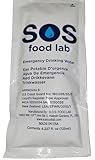
5. S.O.S Emergency Water Packets 12-Pack: Best Emergency Water Pouches for First-Aid Kit Top-Ups
SOS Emergency Water Packets – 3 Day/72 Hour Supply (12 Packets)( 4.227 fl Oz/125 ml)
12 sachets at 4.227 fl oz
3 day supply labeling
5 year shelf life
Multi-layer metal laminate
Pros
- Smallest multi-pouch case count in the comparison
- Light and compact for a glove box or first aid kit
- Documented freeze and heat cycling results
Cons
- Twelve pouches are heavy for the volume
- Too little to be a bug-out bag's only water
- Needs scissors to open
This is the top-up option. Twelve pouches is a little over half a quart, which is a sensible addition to a first aid kit, a desk drawer or a vehicle glove box, and it is the only small-format SOS option in this roundup.
One documented test stands out. A reviewer ran five years of freeze and heat cycling through this pouch format and reported a single leak out of two dozen. That is the kind of long-horizon field data you rarely see, because most buyers just put the box away and forget about it.
Reviewers also report that the water tastes good and that people who needed it in a real emergency credit it for keeping them going. At 4.6 across 327 reviews with 78 percent five-star, the listing is stable and well understood for what it is.
Where a 12-pack actually belongs
Think of it as the last-resort layer, not the supply. A first aid kit with 12 pouches next to it can keep someone functional long enough to reach a tap, a vehicle or a neighbor with a larger reserve. That is a real function and it costs you very little pack space.
It is also the right size for a hiking emergency kit, where you carry a filter for real hydration and sealed pouches as the backup if the filter fails or the water you find is not worth trusting.
Why 12 pouches will not carry a bug-out bag
Twelve pouches is just over half a pint, about 40 percent of a gallon. As a sole water source for a single adult it covers roughly 15 hours, which is not a plan for an evacuation. Buyers are consistent on this point, and the pack is explicitly described as a supplement.
It is also heavier than the water inside it would suggest, because of the outer carton and the layered foil. If pack weight is critical in your kit, move up to the 50-pack or 62-pack formats rather than carrying several 12-packs.
6. S.O.S Food Lab 24-Pack: Best Emergency Water Pouches for Vehicle Kits
SOS Food Lab Emergency Water Individual 4.22 oz Packets – 24 Packets
24 pouches at 4.22 oz
Ready to drink, no treatment
Printed expiration dates
Multi-layer foil
Pros
- Tastes like ordinary purified water
- Survived repeated freezing in a car with no ruptures
- Expiration dates clearly labelled
- Reports of water lasting past the printed date
Cons
- Sharp foil corners can split a ziploc bag
- Very hard to open
- Highest three-star share of the SOS formats
Twenty-four pouches is a clean split for a car: about 25 hours of water for one person, or 12 pouches each for a driver and a passenger. It is also the format buyers most often describe as a baseline supply rather than a complete hydration plan.
Two things stand out in the reviews. Owners report water that tastes like ordinary purified water with no chemical aftertaste, and they report pouches that survived repeated freezing and thawing in a car over winter with no leaks or ruptures. Some also say their supply lasted well past the printed five-year date.

The most useful practical note in this whole roundup is the corner warning: the foil corners are sharp enough to split a ziploc bag inside a backpack. If you travel with your water in a dry bag or a ziploc, keep the pouches in the carton or wrap the tops.
The packaging itself is the durable multi-layer foil build, which is why the same pouches come out of a frozen trunk without rupturing where a rigid bottle would not.

Why vehicle storage suits this format
A trunk or back seat sees exactly the conditions this pouch is built for: heat in summer, cold in winter, and vibration on bad roads. The reported freeze and thaw results make it a lower-risk choice than a rigid bottle that can split in a hot car.
The printed expiration dates also help here, because vehicle supplies are the ones people forget. Write the purchase date on the carton in marker, check it twice a year, and replace the whole case rather than hunting for individual pouches.
Where this pouch falls down
Opening is the repeated complaint, and it is a real one. One reviewer needed a nail clipper to get into a pouch, which is exactly the wrong experience in an emergency when you are doing it one-handed in the dark.
The rating tells the same story from a different angle: 4.5 overall, with a 3 percent one-star share but the highest three-star share among the SOS formats. That middle band is packaging damage, and it is worth inspecting the box the day it arrives.
7. Medique 78804 Single Emergency Water Pouch: Best Emergency Water Pouches for Single Top-Ups
SOS 78804 Emergency Drinking Water Pouch, 125ml
One 125 ml pouch
Purified by reverse osmosis, UV and ozonation
5 year shelf life
Flat and pocket sized
Pros
- Only single-pouch option in the comparison
- Tests one serving before committing
- Triple-purified by three methods
- Fits a pocket or first aid kit
Cons
- Sold one at a time so stocking takes many orders
- Lowest average rating here at 4.4
- One serving is roughly one big gulp
Everyone in this category sells you a case. This one does not, and that is the entire point. If you want to know whether the taste and the seal work for you before committing to a 60 or 100-pouch case, buying a single pouch is the cheapest possible test.
The purification is unusually well documented for a consumer pouch: reverse osmosis, UV sterilization and ozonation, all three listed as the treatment method. Combined with a five-year shelf life, that is a strong specification sheet for something that fits in a jacket pocket.
It rates 4.4 across 322 reviews, the lowest average here, with a 5 percent one-star share. That tracks with the format mismatch: buyers who want a single sachet generally end up satisfied, while people who meant to stock a kit are frustrated by the unit-at-a-time format.
When a single pouch is the right purchase
Use it as a trial before a bulk order, and as an add-on when your kit has one empty slot. Two or three in a hiking kit alongside a filter is a sensible arrangement, because the pouches cover the case where your filter is damaged or the water source is contaminated.
It is also the easiest way to test taste tolerance in your household. Hand one to the person who complained about aftertaste in your last kit and get a straight answer in about a minute.
Why it will not work for stocking
Replenishing a kit one pouch at a time is impractical, and anyone buying this for a car or a go-bag should look at the 24-pack, 50-pack or 62-pack instead. The format is a sampling tool, not a supply format.
The 5 percent one-star share also points at occasional damage on a single unit. With no case to inspect, you cannot swap a leaking pouch, which is a real limitation compared with a bulk box where you hold spares.
8. Mainstay Emergency Drinking Water 60-Pack: Best Emergency Water Pouches for Extreme Temperatures
Mainstay Emergency Drinking Water 4.225 oz (60 Pack)
60 pouches at 4.224 oz
5 year shelf life, no special storage
Handles -40 F to 210 F
US Coast Guard approved
Pros
- Widest stated temperature range in the comparison
- US Coast Guard approved
- No oxygen transfer through the packaging
- One owner has kept the same pouches for over a decade
Cons
- Lot and expiry are embossed and hard to read
- Heaviest case for its pouch count
- Slight off-taste reported once water ages past a few years
This is the longest-serving design in the roundup, and it holds the most extreme temperature claim here: minus 40 F to 210 F, with no special storage required. If your kit lives in a garage, a shed or a vehicle parked outdoors year-round, that range is the whole argument.
The packaging claim is specific and checkable. No oxygen transfer means no route for bacterial contamination through the pouch wall, and the foil and mylar laminate is BPA free and handles heat better than plastic bottles. Buyers with long-term exposure say they trust it for vehicle and ditch-bag storage for that reason.
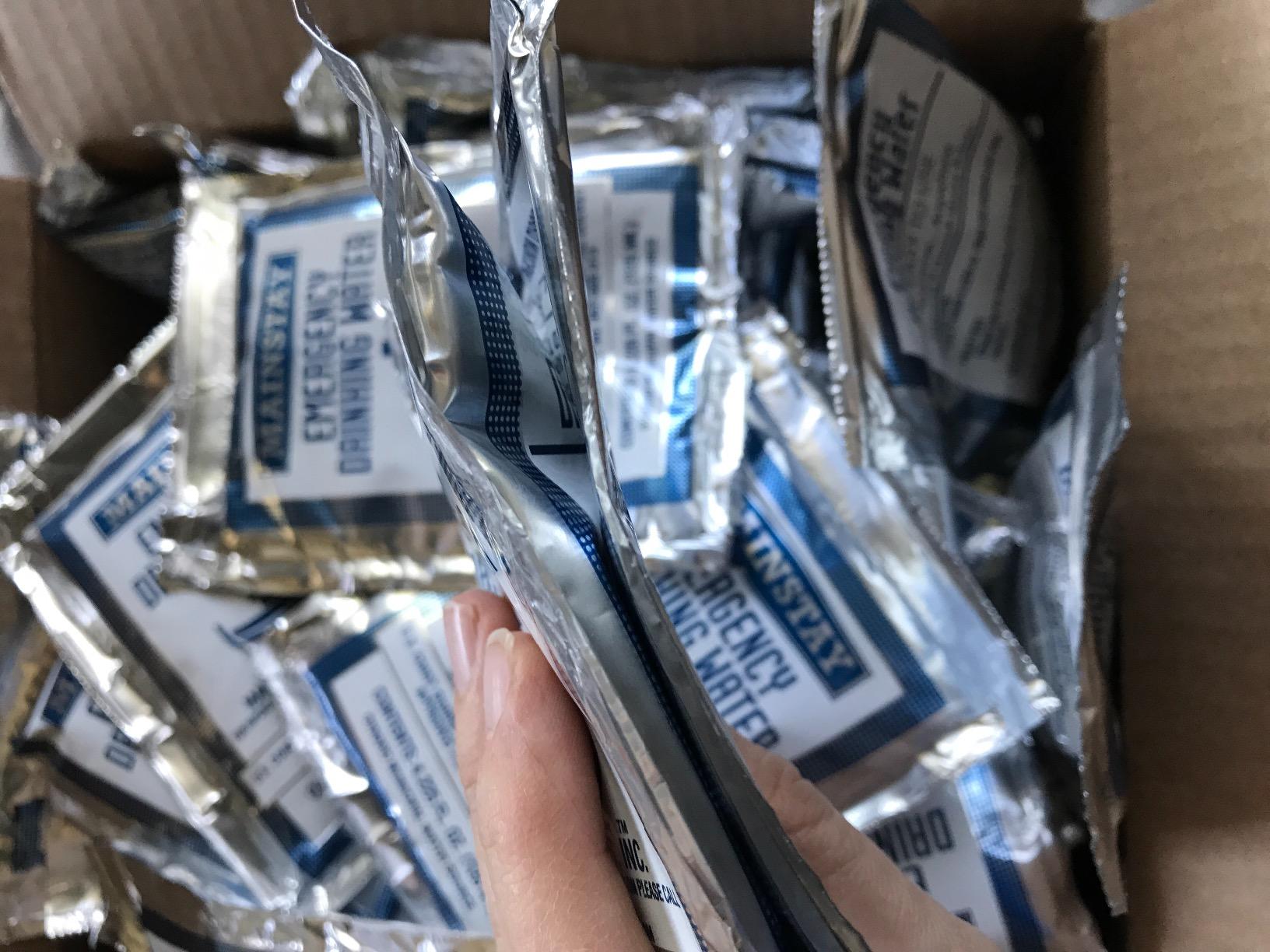
At 4.6 across 169 reviews, the volume is modest but the sentiment is unusually positive, including one owner who has kept the same pouches for well over a decade. That longevity is the strongest real-world evidence here for a five-year label actually meaning something.
Each pouch holds 4.224 oz, so the 60-count lands just under three gallons, which makes this the volume pick to pair with a garage or shed cache rather than a carry bag.

Why the temperature range changes the buying decision
Only two of the products here publish a temperature range. The Mayday 50-pack is specified from 32 F to 149 F and can be frozen without adverse effects, and the Mainstay 60-pack claims minus 40 F to 210 F with no special storage. If your storage sees a freezing winter or a hot attic, those two ranges are the whole decision, and the products that publish nothing leave you guessing.
Combined with US Coast Guard approval and a stated shelf life of 1,825 days, this is the pick to make when you are stocking one location rather than carrying water on your back.
The date-stamping problem to plan around
Lot number and expiry are pressure-printed into the mylar rather than inked on the surface, and buyers report they are genuinely hard to read. Inspect each pouch closely, or keep your own written record on the carton when it arrives.
That is a bigger inconvenience than it sounds for rotation, because your whole system depends on knowing when the oldest pouch expires. Write the purchase date on the case in marker and rotate on a fixed calendar rather than trusting the embossed stamp alone.
9. S.O.S Food Labs Case of 96: Best Emergency Water Pouches for Group Supplies
Emergency Water Pouches Case of 96 for Survival Kits, Disaster Supplies, 5 Year Shelf Life – SOS Brand
96 pouches per case
5 year shelf life
Manufacturing and expiry printed on carton
Double-packed for transit
Pros
- One of the two largest case counts here
- Manufacturing and expiry dates verifiable on the box
- Heavy-duty pouches that stay sealed
- Responsive service and partial refunds for damaged units
Cons
- Heaviest case in the comparison
- Highest one-star share at 8 percent
- Quality control varies by pouch
Ninety-six pouches is roughly 3.2 gallons, which makes it a community-scale number. One case covers a family of four for about a day and a quarter, so two cases cover four people for 72 hours.
The dates on this one are printed on the carton rather than embossed into the pouch film, which is a real operational advantage. Manufacturing and expiration dates are both verifiable without opening anything, and owners call that out specifically when they describe their rotation setup.
Buyer sentiment is strong on the water itself, described as tasting like good filtered water straight from the pouch, and the pouches are described as heavy-duty and resistant to opening unless you deliberately apply effort. Service also comes up well, with reports of partial refunds for individual damaged pouches.
How to inspect this case on arrival
Open the carton and press each pouch gently along the seams. The 8 percent one-star share in this listing is driven by individual pouches arriving punctured or later leaking, and that is a quality-control issue rather than a design flaw, so checking on arrival is the fix.
Keep a count of what you inspected. A 96-pouch case at about 30 pounds is awkward enough that you will want to know quickly if several units are compromised rather than finding out when you need them.
When this format is wrong
It is the heaviest and bulkiest option here, so it is a poor fit for a hiking pack or a small go-bag. A single person carrying 96 pouches on their back is carrying a large share of their kit weight in water pouches.
It is also the weakest fit for a two-person household. Choose the 62-pack or 64-pouch case instead and keep the difference as backup for a group kit or an office.
10. Mayday Emergency Water Case of 100: Best Emergency Water Pouches for Shelter Supplies
Mayday Emergency Water Pounches Case of 100. Emergency Preparedness, Survival and Backpacking
100 pouches at 4.225 oz
US Coast Guard approved
5 year shelf life
A little over 3 gallons per case
Pros
- One of the two largest case counts in the comparison
- 100 pouches per case
- Lowest negative feedback share here
- Reported to have no off-taste
Cons
- About 27 lb for the full case
- Occasional odd taste as water ages
This is the pick to make for a shelter, a community reserve or an office kit, because 100 pouches is a little over three gallons, and a clean count of a hundred is a number you can allocate per person without splitting boxes.
The rating matches the Mayday 50-pack at 4.8, and it carries the lowest negative feedback share in this comparison, with 88 percent five-star and 1 percent one-star. Very few consumer pouches carry both Coast Guard approval and a complaint profile that small.
Owners highlight the flat, pocketable shape, which is unusual at this volume, and report water with no off-taste. The listed shelf life is five years and the contents are purified, ready-to-drink rations, so no preparation is needed at distribution time.
Allocating a 100-pouch case
Four people get 25 pouches each, which is about 31 hours of water per person. Ten people get 10 pouches each, which covers roughly 12 hours. Write the allocation on the carton so the math is not re-argued in an emergency.
For an office or school supply, this is the format that scales cleanly, since you can buy two cases and split them by floor or by room without breaking any smaller boxes open.
What to consider before buying at this size
Weight is the first constraint: the full case is about 27 lb, so plan where it physically lives and make sure two people can move it. A 27 lb box is not a one-person carry over uneven ground.
Second, buyers occasionally report a slightly odd taste developing as the water ages past a few years. If your rotation slips, that shows up first here, so mark the purchase date and replace on schedule rather than letting a case sit for a decade.
11. Datrex Water Pouches Case of 64, 4 oz: Best Emergency Water Pouches for To-Go Bags
Datrex Water Pouches Case of 64-4 Ounce Pouches
64 pouches at 4 oz
Individually sealed
Compact case
Designed for to-go and survival kits
Pros
- Consistent 64-count case format
- Well sealed pouches
- Compact box that stores easily
Cons
- Lowest rating in the comparison at 4.3
- Thinnest review base at only 33 ratings
- Sparse listing with little technical detail
This is the 64-count case in the smaller 4 oz format, and the reason to consider it is footprint. Sixty-four individually sealed pouches in a flat box pack tighter than the same count in 4.225 oz sachets, which makes it a reasonable choice for a to-go bag or a lunch-box style kit.
The honest caveat is that this is the least documented listing in the comparison. The spec sheet is thin, there is no approval information listed, and the review base is only 33 ratings, so there is very little independent testing data behind it.
It is 4.3 here, the lowest rated pick, with a 15 percent three-star share, the highest of any product in this roundup. That middle band is a signal that the pouches work but the buying experience around them does not always land.
When the smaller pouch size earns its place
For a kit that is packed tight and carried often, a 64-count in a compact box can outperform a nominally larger pack. Volume and footprint are different things, and the flat case wins on the second one.
It also works as a straightforward add-on if you already run the other Datrex case and want a second box in a different size for a secondary bag.
Why we rank it last
The combination of the lowest rating, the thinnest review base and the missing certification detail means there is not much independent evidence to lean on. Every other pick here carries more than 100 ratings, and most of them state an approval or a standard.
If certification is your priority, take the other Datrex case instead. Choose this one only when pack footprint matters more to you than documented sourcing.
Best Emergency Water Pouches Buying Guide: Six Criteria That Decide the Winner
Approval and standards are the first filter. Look for US Coast Guard approval, or a stated compliance figure such as ISO 18813:2022, before you look at anything else. In this roundup, the Datrex 18-pack, the two SOS packs and the Mainstay 60-pack carry Coast Guard approval, and the Mayday 50-pack states ISO compliance.
Temperature tolerance is the second filter, and it depends entirely on where the kit lives. A vehicle or garage needs a wide range such as minus 40 F to 210 F, while a bedroom closet does not. The Mayday 50-pack and the Mainstay 60-pack are the two to consider for unheated storage.
Seal integrity is the third. Reviews repeatedly point to punctures, pre-punched holes and the sharp foil corners on the 24-pack that can split a ziploc bag. Buy in a format where you can inspect the box on arrival, and press the seams before you stack it away.
Case format is the fourth criterion and the one people get wrong. Match the count to the number of people: about 19 pouches per person per day, 57 per person for three days, and then buy in the largest case that you can physically move and rotate.
Date legibility is the fifth, and it is more important than it sounds. The Mainstay 60-pack embosses its lot and expiry into the mylar where they are hard to read, while the 96-pouch SOS case prints manufacturing and expiry dates on the carton where you can check them in seconds. Your rotation schedule depends entirely on knowing which pouches are oldest.
Taste is the sixth. On r/preppers and survivalistboards threads, Datrex is repeatedly described as the only brand that simply tastes like water, while SOS and comparable private-label foil pouches are described as sharing a similar plastic or chemical aftertaste. If someone in your household reacts badly to that note, test a single pouch first.
Finally, pair your water with the rest of the kit rather than treating it as the whole answer. A radio and a working light change outcomes in the first night more than a third case of water does. Our emergency radio roundup covers that side, and the preparedness kit guide shows how the pieces fit together.
Do Best Emergency Water Pouches Taste Like Plastic? The Honest Answer
Usually, yes, at least a little. The foil laminate that keeps shelf-stable water drinkable for five years has a faint taste, and the majority of reviewers across this category mention a plastic or chemical note when they describe the water rather than the packaging. It is mild, but it is the single most-discussed quality factor in emergency water.
The exception people keep naming is Datrex. Across r/preppers and survivalistboards discussions, posters describe it as the one option that simply tastes like water, with no chemical note, and the owner reviews we read line up with that. The SOS 24-pack and 96-pouch case also come back clean in reviews, described as tasting like ordinary purified water or like good filtered water.
Two practical notes. First, taste reports shift as water ages, and buyers of older Mainstay and Mayday pouches mention a slight off-taste appearing past a few years, so rotation protects flavor as well as safety. Second, cold water changes perception: pouches kept in a vehicle or a garage taste cleaner than pouches that have spent time in a warm cupboard, so serve them cool when you can.
If aftertaste is a deal-breaker, the order of preference is Datrex first, then the SOS formats, then everything else. The single-sachet Medique pouch exists precisely so you can test before committing to a case.
How to Store Best Emergency Water Pouches and When to Rotate Them
Store them cool, dark and dry, and keep them off a concrete floor where damp is a problem. A five-year label assumes sensible storage, and a garage roof in summer or a car in full sun is not sensible storage even when the pouch survives it physically.
Freezing is a lesser problem than heat, but it is not free. The Mayday 50-pack is specified from 32 F to 149 F and can be frozen without adverse effects, and one reviewer documented leaving about one pouch of empty volume for every ten in a container that will freeze so the seams do not split. That rule applies broadly.
Mark the purchase date on the carton in marker the day it arrives. Then run a rotation schedule rather than trusting your memory: check every six months, replace anything expiring inside a year, and always consume or discard what is closest to its date first.
Where the printed date is hard to read, as with the Mainstay 60-pack, your own written record becomes the only reliable source. Do not skip the marking step, because an undated box is the most common reason prepared supplies quietly age out.
Best Emergency Water Pouches vs Filters vs Bulk Gallons
For the first 72 hours, sealed pouches are the right answer, because they need no preparation, no moving parts and no judgement call about whether a water source is safe. They are also the most compact option per serving, which is why they belong in a go-bag.
For anything longer than a week, switch the primary supply. A filter handles an unknown water source, and bulk storage handles volume at a fraction of the cost per gallon. Communities consistently treat pouch water as the opening response and bulk water or filtration as the sustainment layer, and the arithmetic supports them: 19 pouches per person per day adds up fast.
Bulk storage also changes the weight picture entirely. One r/preppers user reported military-surplus mylar water bags with spouts holding 2.5 gallons, which reframes the entire cost-per-gallon conversation for anyone stocking more than a week per person. Pair that with the tanks in our water storage tank roundup and you have a two-layer plan.
Use a hybrid rather than choosing once. A 62-pouch case in the car, a filter in the pack, and stored gallons at home gives you three different answers to the same problem, and no single product has to be right for every scenario.
Seller Red Flags When Buying Best Emergency Water Pouches
Missing lot and expiry information is the clearest warning sign. A listing with no readable date, no manufacturer and no standard such as Coast Guard approval or ISO 18813 is asking you to trust marketing copy. The Datrex 64-pack in 4 oz format is the weakest documented listing in this roundup for exactly that reason.
Volume padding in kit claims is the second red flag. A kit advertised as a 30-day supply that contains a handful of 4.225 oz pouches is not a 30-day supply for anyone, because 19 pouches per person per day is the floor, not the target. Check the pouch count and do the division yourself.
Fear-based private labels are the third. Preparedness forums are openly skeptical of brands that sell the emergency rather than the specification, and the useful counter-test is simple: does the listing state a purification method, a shelf life figure and an approval? If not, you are buying a logo.
Finally, distrust sponsored taste tests. Forum readers repeatedly say they trust a stranger’s five-year freeze and heat cycling report more than a paid video comparison, and the practical notes in this roundup follow that standard: they come from owner reviews rather than from produced content.
Frequently Asked Questions
How much water do you need in an emergency kit?
Plan on one gallon of drinking water per person per day, and three days of supply per person for a standard 72-hour emergency kit. In 4.225 oz emergency water pouches that is about 19 pouches per person per day and 57 pouches per person for three days. A family of four therefore needs roughly 228 pouches to cover a 72-hour emergency, and considerably more for a two-week or month-long supply.
How many emergency water pouches make a gallon?
A US gallon is 128 fluid ounces, and each standard emergency water pouch holds 4.225 oz, so one gallon equals about 19 pouches. Three gallons is roughly 57 pouches, fourteen gallons is about 266 pouches, and thirty gallons is around 570 pouches. Buying cases of 60 to 100 pouches is the practical way to reach these numbers without dozens of separate orders.
Do emergency water pouches expire after 5 years?
A five-year label is a tested estimate based on sealed foil laminate packaging that blocks oxygen and light, and it assumes cool, dark, dry storage. Pouches will drink fine past that date in most cases, and owners report water lasting well past the printed date. Heat and freeze cycles shorten the window, so mark the purchase date on the carton and rotate on a schedule rather than leaving cases untouched for a decade.
Can you drink emergency water pouches without purifying them?
Yes. Sealed pouches are filled with purified water and are intended to be drunk directly once opened, with no boiling, filtering or chemical treatment required. The Mayday 50-pack lists purified water as the only ingredient, and the single Medique pouch is purified by reverse osmosis, UV sterilization and ozonation. Purification is only needed for water you collect yourself, not for factory-sealed pouches.
What does Datrex emergency water taste like?
Datrex is the most frequently recommended brand for taste. On preparedness forums, posters repeatedly describe it as the one emergency water pouch that simply tastes like water, with no plastic or chemical aftertaste, and the owner reviews we read back that up. Comparable foil-laminate pouches from other brands are more often described as carrying a faint plastic or glue note, particularly once the water is past a few years old.
Our Final Recommendation: The Best Emergency Water Pouches
The best emergency water pouches for 2026 are the Datrex Emergency Water Packet 4.227 oz 18-pack for a single kit, the Datrex 64-pouch case when you are filling several bags or vehicles, and the Mayday 50-pack if your storage gets cold and you want the highest rating in the roundup. All three carry a five-year shelf life and enough independent review history to trust.
Whichever you choose, do the arithmetic first: 19 pouches per person per day, 57 for a 72-hour emergency. Most people who regret their purchase did not buy the wrong pouch, they bought the right pouch in too small a quantity, or they treated a three-day supply as a three-week one. Mark the purchase date, store the cases somewhere cool, and check them twice a year.