
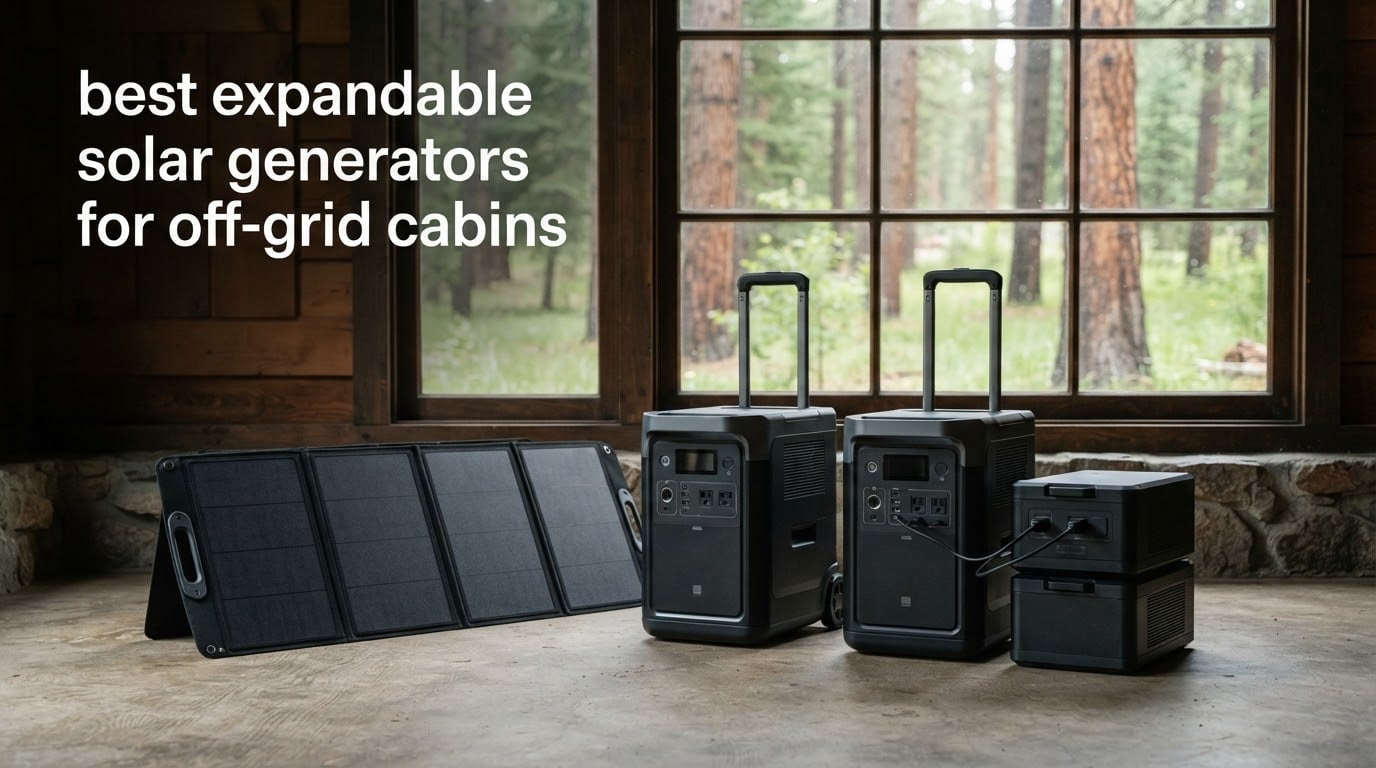
The BLUETTI AC200PL is the best expandable solar generator for off-grid cabins, because it pairs the largest proven track record in this class with a modular battery bus that grows from 2,304Wh to 8,448Wh as your load list changes. I compared eight expandable stations side by side, checked the expansion math on each, and worked through a real cabin load list against every capacity tier.
Most buying guides for this topic stop at three specs: watt-hours, inverter watts and solar input. That leaves out the one thing that matters most to anyone living in a cabin, which is how the battery grows after you have owned the thing for a year. Two seasons in, a weekend cabin turns into a four-season home office, and a 2kWh station suddenly feels like a mistake you cannot undo without buying a second station.
Expandability fixes that. A modular battery bus means you buy the inverter once and add battery packs as cash and demand allow, instead of replacing the whole box. Our team spent weeks reading owner reports on these platforms and the failure patterns are consistent: capacity is rarely the reason a station disappoints people, inverter headroom and recharge speed are.
If you are still working out the basics of running a cabin on stored energy, start with our general solar generator guide. If you are sizing a stationary battery bank instead, our deep cycle battery roundup covers that path.
Table of Contents
Top 3 Picks: Best Expandable Solar Generators for Off-Grid Cabins in 2026
BLUETTI AC200PL Solar Kit
- 2304Wh expandable to 8448Wh
- 2400W AC output
- 1200W solar input
- Panel included

Anker SOLIX F3800
- 3.84kWh expandable to 26.9kWh
- 6000W 120V and 240V output
- 1400W solar input

EcoFlow DELTA Pro 3
- 4096Wh expandable to 48kWh
- 4000W AC with 120V and 240V
- 2600W solar input
Quick Overview: All 8 Expandable Stations Side by Side
| Product | Specifications | Action |
|---|---|---|
| BLUETTI AC200PL |
|
Check Latest Price |
| Anker SOLIX F3800 |
|
Check Latest Price |
| EcoFlow DELTA Pro 3 |
|
Check Latest Price |
 AFERIY 3840Wh AFERIY 3840Wh |
|
Check Latest Price |
 Jackery HomePower 3600 Plus Jackery HomePower 3600 Plus |
|
Check Latest Price |
 PECRON F3000LFP PECRON F3000LFP |
|
Check Latest Price |
 BLUETTI Elite 400 BLUETTI Elite 400 |
|
Check Latest Price |
 EcoFlow DELTA 3 Ultra EcoFlow DELTA 3 Ultra |
|
Check Latest Price |
What Makes a Solar Generator Expandable?
An expandable solar generator is a battery-powered portable power station with a built-in inverter and modular battery bays that accept extra battery packs, letting you grow stored capacity from a few kilowatt-hours to 10kWh or more over time as your off-grid cabin needs grow.
That is the whole concept in one sentence. Mechanically it works like this: panels feed a LiFePO4 battery bank through a built-in MPPT charge controller during the day, and a pure sine wave inverter converts the stored DC into the 120V household current your appliances expect at night.
The practical difference between an expandable and a fixed-capacity station shows up in three places. First, you can add capacity without buying a new inverter. Second, added packs sit on the same high-voltage bus, so you do not lose efficiency stacking them. Third, a station that started at 2kWh and grew to 6kWh cost you less total than buying a 6kWh box outright, and you were never forced to make that decision on day one.
The catch is that expansion is not free and it is not universal. Some platforms cap at two extra packs, some charge a separate cable or adapter for each add-on, and a few advertise a ceiling that only becomes reachable with a specific brand of battery. We checked the ceiling for every station in this roundup and put it in the table above so you are not doing that arithmetic blind.
How Much Power Does an Off-Grid Cabin Actually Need?
Add up the watts each appliance draws while it runs, multiply by the hours it runs per day, and you have your daily watt-hour target. Then size for a few cloudy days on top. Most cabin loads fall into four tiers:
500Wh to 1,000Wh — phones, laptops, lights, a router, a CPAP machine and a medical oxygen concentrator. This is a weekend hunting cabin with no refrigeration.
1,500Wh to 2,000Wh — one refrigerator, interior lights, phone charging and a small freezer. This covers the majority of seasonal cabins and matches the BLUETTI AC200PL class.
3,000Wh to 4,000Wh — a refrigerator, a chest freezer, a window AC unit, lighting, router and Starlink. Most full-time cabin owners land here once they add climate control.
5,000Wh and above — a full appliance list including a well pump, a microwave, a water heater or electric baseboard heat. This is where expansion stops being a feature and becomes the reason you bought the platform.
Here is a concrete worked example. Off-grid builders describe running a refrigerator, a deep freezer, a window AC, lights and chargers while finishing a cabin. A realistic daily budget for that list looks like roughly 1,200Wh for the refrigerator, 1,500Wh for the chest freezer, about 750Wh for a few hours of window AC, 200Wh of lighting and 150Wh for networking and a CPAP machine. That is close to 3,800Wh per day before you add a single power tool.
For a three-day stretch with zero sun, you are looking at 11,400Wh of stored energy. Only a station that has been expanded past its base capacity gets you there, which is exactly the argument for buying the expansion-ready platform now and adding packs later. If your list is smaller, the same math shows you can ride through a storm on one base station and skip expansion entirely.
One number catches people out here: inverter output, not capacity. A 4,000Wh battery that can only deliver 2,400W will trip the instant you start a refrigerator compressor and a window AC together. Match your inverter watts to the largest simultaneous load, not to your battery size.
1. BLUETTI AC200PL Solar Kit – The Most Proven Expandable Station
BLUETTI AC200PL Solar Generator & 350W Solar Panel Included 2304Wh LiFePO4
2,304Wh base expandable to 8,448Wh
2,400W AC and 3,600W lifting
1,200W solar input
72 pounds
Pros
- Most proven platform in the group with 2607 ratings
- Bundled 350W foldable solar panel in the kit
- 0-80% in 60 minutes on 2400W AC input
- 3000+ cycle LiFePO4 rated for a 10-year lifespan
- 11 ports including a 30A TT30 RV outlet
Cons
- 2400W output rules out dryers and central AC
- Around 20W of idle draw with the inverter on
- Heavy for its capacity at 72 pounds
We kept coming back to this one because of the review count. Two thousand six hundred ratings across a multi-year platform is a different kind of evidence than a launch-week sample, and the pattern in those reviews is unusually consistent: owners report the same unit working year after year in RV and off-grid setups.
The station starts at 2,304Wh of LiFePO4 chemistry and expands to 8,448Wh. The battery is rated for 3,000+ cycles, which works out to roughly a decade of daily cycling, and it carries a full-scale BMS against overcharging and short circuits.
Recharge speed is where it wins its category. It takes 0 to 80% in 60 minutes on a 2,400W AC input, and it accepts up to 1,200W of solar for a full charge in a range the manufacturer puts at 1.9 to 3.8 hours depending on conditions. The bundle also includes a 350W foldable panel, so it is a working off-grid system the day it arrives.
Experienced owners in the reviews offer two pieces of calibration advice worth passing on. Run a full discharge and recharge cycle after delivery so the battery management system learns its real capacity, and factor roughly 20W of idle consumption plus the manual’s 90% usable capacity limit into any runtime estimate. That is the difference between a station that disappoints you and one that quietly does exactly what the panel says.
Is the BLUETTI AC200PL strong enough for a refrigerator and a freezer?
Yes, and owners confirm it in the reviews. The 2,304Wh base capacity covers a refrigerator, a chest freezer, lighting and networking for a full day with room left over. The limit is simultaneous draw: at 2,400W continuous you can run both appliances and lights, but you cannot add a window AC unit or a microwave to that mix without a trip.
It also carries a 30A TT30 RV outlet, which matters if you are running a trailer alongside the cabin. Under-10ms UPS switchover keeps network and home electronics alive through an outage without a reboot.
When does a 2,400W inverter stop being enough?
The moment you want resistance heat, a clothes dryer or central air. Those are 3,000W-plus loads and the station will either refuse to start them or trip its surge limit. Owners running furnaces, space heaters or power tools are the group that reports frustration, and experienced users push firmware updates because several fixes live in the app rather than the manual.
One further caveat: a reviewer notes the unit’s own idle draw is around 20W with the inverter on, so very small loads drain capacity faster than the label implies. Size up a little if your load list is mostly lights and chargers, and see our guide to other expandable gear we test for how we handle the same sizing question in a different category.
2. Anker SOLIX F3800 – 6,000W and 240V From One Station
Anker SOLIX F3800 Portable Power Station, 3,840Wh
3,840Wh base expandable to 26.9kWh
6,000W AC on 120V and 240V
1,400W solar input
132.3 pounds
Pros
- Grows to 26.9kWh with up to six add-on packs
- True 6000W dual-voltage 120V and 240V output
- Charges an EV at up to 6000W through the NEMA 14-50
- EV-class LFP cells rated for a 10-year lifespan
- App control over Wi-Fi or Bluetooth
Cons
- Heaviest station in this roundup at 132.3 pounds
- Cubic 34-inch footprint takes real floor space
- 1400W solar input is modest against a 3.84kWh battery
This is the station that shows up in most AI-generated buying answers for this query, and the reason is the headline numbers. 3,840Wh base, expandable to 26.9kWh, and 6,000W of AC output available on both 120V and 240V from a single box rather than a paired setup.
That 240V capability is the part that separates it from most of this list. A well pump, a larger window AC unit, an electric water heater and most power tools want 240V, and a station with only 120V output simply cannot serve them no matter how many watt-hours it stores.
Expansion runs deep here. Add up to six extra battery packs and you have 26.9kWh of usable storage, which is a genuine off-home system. The batteries are EV-class LFP cells and Anker rates them at a 10-year lifespan under its InfiniPower management.
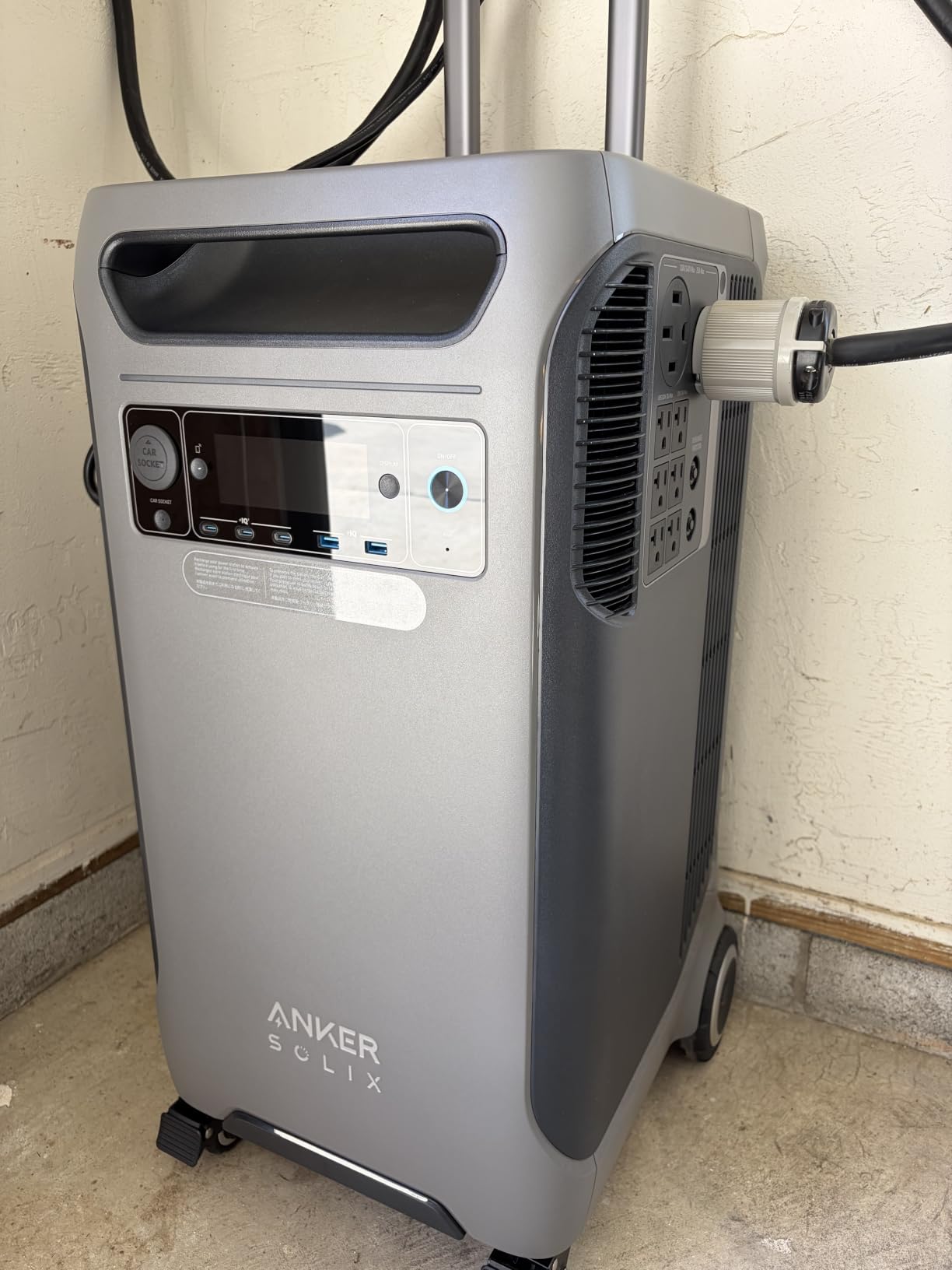
There are practical details that decide whether it fits your site. It weighs 132.3 pounds, the heaviest in this roundup, and its 34-inch cubic footprint needs a dedicated corner of a garage or mudroom. It also ships without the Smart Generator 5500 accessory, so auto start-stop is an add-on rather than a standard feature.
One verified buyer report documents a cold-soak problem worth knowing before you buy for a northern cabin: after sitting in a freezing truck bed overnight, the station would not charge until it had warmed up. Low-temperature charging lockout is standard battery management behaviour, not a defect, but it changes how you deploy the unit between October and March. If cold charging is your main concern, the winter cabin heat guide covers the rest of that season.
Can the F3800 run a well pump and a refrigerator at the same time?
Yes. 6,000W continuous and 10,200W starting watts give you real headroom for motor-start loads, and the 240V output opens up the appliance range that 120V-only stations cannot touch. The reviewer accounts describing it as a robust inverter for its weight class are, in practice, describing an inverter that is oversized for the class.
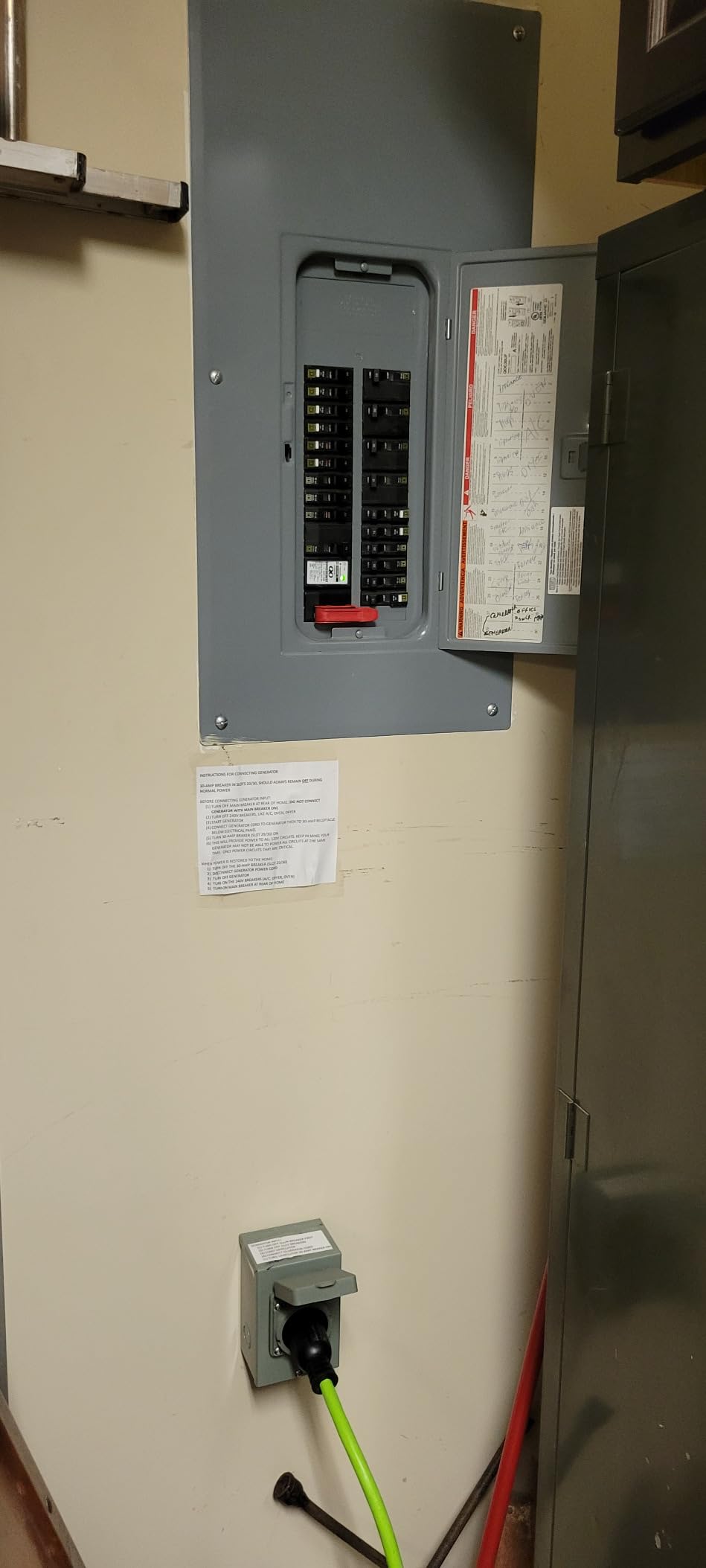
It can also push 6,000W into an EV through the NEMA 14-50 port with no grounding accessories needed, and it powers an RV through the NEMA 14-50 or L14-30 ports. That makes it a two-in-one purchase for anyone running a cabin and a road vehicle.
What are the real drawbacks?
Weight and floor space, mostly. At 132.3 pounds you are not lifting this onto a shelf, and the cubic 34-inch body is the least shelf-friendly design in the roundup. The 1,400W solar input is also the quiet issue: a 3,840Wh battery that can only accept 1,400W from panels takes well over two full sun days to refill, which is where the “recharge is slower than expected” complaints from cabin owners come from.
3. EF ECOFLOW DELTA Pro 3 – The Biggest Expansion Ceiling
EF ECOFLOW DELTA Pro 3 Portable Power Station, 4096Wh, 4000W AC Output
4,096Wh LFP expandable to 48kWh
4,000W AC, 6,000W with X-Boost
2,600W combined solar
115 pounds
Pros
- 4096Wh base expanding all the way to 48kWh
- Dual solar inputs totaling 2600W
- 10ms UPS switchover for network gear
- Runs at 30 dB with X-Quiet technology
- IP65-rated battery pack with a 5-year warranty
Cons
- Widest rating spread in the roundup at 4.2
- No built-in 12V car output port
- 115 pounds is difficult to move alone
- Ships with fewer accessory cables than the previous model
The DELTA Pro 3 has the largest expansion ceiling of anything in this roundup. It starts at 4,096Wh and scales to 48kWh with extra batteries or smart generators, which means the same hardware can back a weekend cabin today and a whole-home outage in five years.
Charging is its headline. Dual solar inputs total 2,600W, and combining sources can push 7,000W, so a station that drained itself over a storm can be back near full the next clear day. The inverter delivers 4,000W continuous, 6,000W with X-Boost, and up to 12,000W when linked to a second station, with true 120V and 240V support from a single unit.
For a cabin with electronics, the 10ms UPS switchover is a genuinely useful detail. Computers, network attached storage and routers ride through an outage without a reboot, which matters if you are working from the cabin on a stormy week.
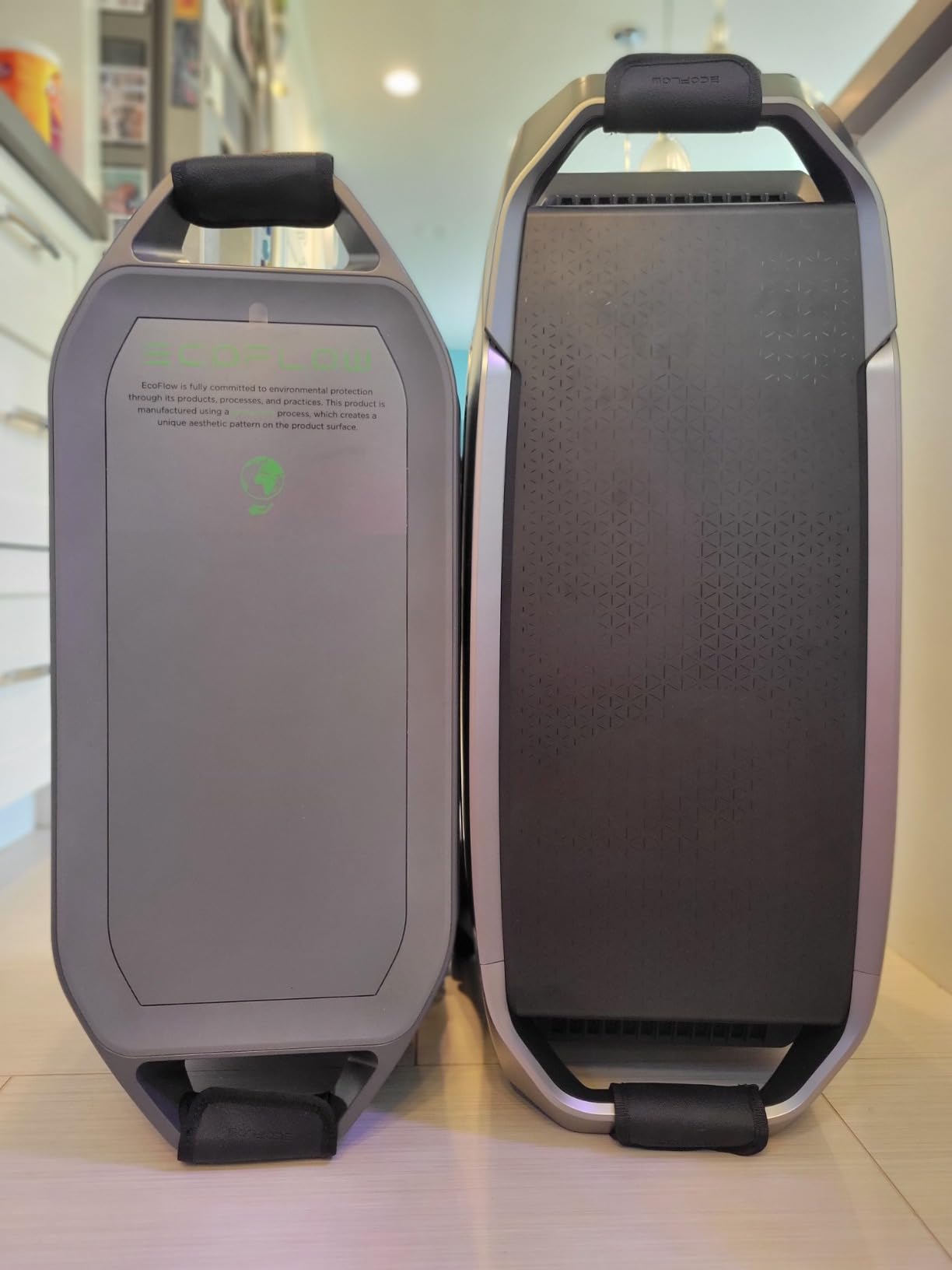
The rating here is lower than the rest of the field, and the reason is in the distribution. Fourteen percent of ratings are one-star, and the heavy complaints cluster around handling, the missing 12V car port, fewer included cables and one detailed account of a battery management lockout alongside difficult return logistics. Several buyers report successfully running furnaces, well pumps, RV trailer loads and Starlink off-grid.
Note that the 115-pound figure is a real problem for a single person. This is a two-person lift, and it is worth planning the path from your door to its final position before delivery day.
Is 2,600W of solar input enough for a cabin?
It is the best solar input number in this roundup, and it is the reason this station recovers fastest after a heavy-use day. On a clear day with 2,600W of panels feeding a 4,096Wh battery, you are looking at a substantial top-up in a single session rather than a trickle across two or three days.
The trade-off is that dual solar inputs mean two strings to wire correctly on a cabin roof or ground mount, so plan the cable runs before the panels go up.
Who should skip this one?
Solo buyers who have to move the station regularly, and anyone put off by the 4.2 average. The 4.2 is dragged down by a meaningful share of dissatisfied owners rather than by a single bad batch, and the issues involved, weight, missing port, cable omissions, are fixable but real. The 48kWh ceiling is unmatched, so if you already know you will grow into a whole-home system, this is the platform to buy.
4. AFERIY 3840Wh – Most Ports per Dollar of Capacity
AFERIY 3840Wh Portable Power Station,Expandable Solar Generator to 11520Wh
3,840Wh LFP expandable to 11,520Wh
3,600W continuous, 7,200W peak
15 output ports
104.7 pounds
Pros
- Grows to 11520Wh with expansion packs
- 15 ports including USB-C PD 3.0 and a 12V car socket
- Recharges in as little as 1.5 hours
- UL Listed with a 7-year support period
- App scheduling and remote shutdown
Cons
- Published weight differs between the spec table and the copy
- ABS plastic housing is less impact resistant than metal cases
- 120V output only so 240V appliances are unsupported
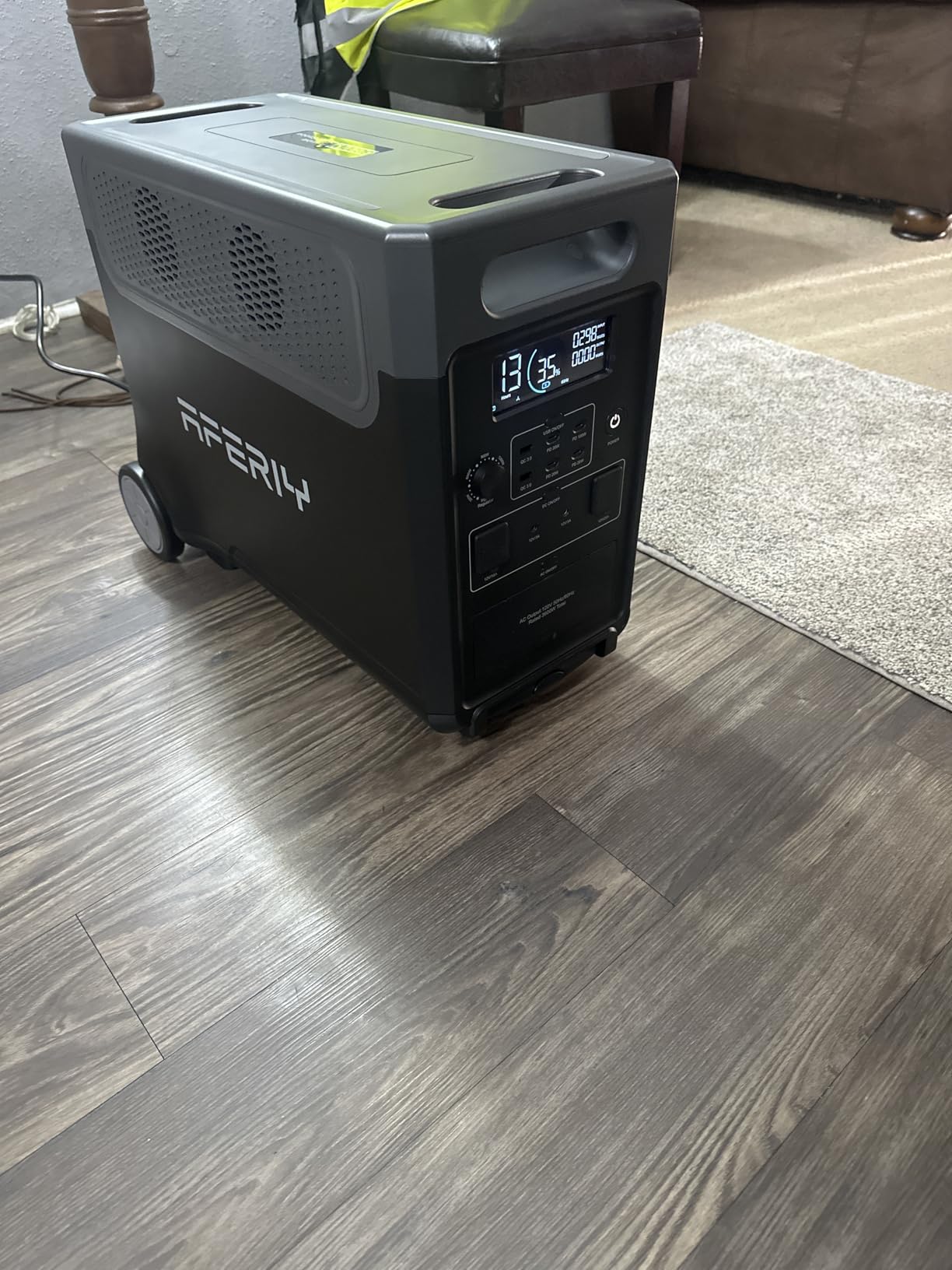
For a cabin owner who counts ports before they count brand names, this is the station in the roundup that makes the most sense. Fifteen output ports across AC, USB-A, USB-C PD 3.0, DC5521, XT60 and a 12V car socket, on a 3,840Wh battery that expands to 11,520Wh.
The inverter gives 3,600W continuous and 7,200W peak, which is enough headroom for a refrigerator and a freezer starting at the same moment, plus a window AC unit. It also carries a 5+2 year warranty and a 7-year support period behind a UL listing.
Runtime claims on household essentials are quoted at 17 hours, though that figure moves with the load, so treat it as a best case rather than a promise. Reviewers are generally positive about value for the capacity class, with 71% of ratings at five stars and recurring praise for the port count, fast charging and the sub-10ms UPS switchover that keeps computers, security cameras and medical freezers running.
Two honesty notes. The listing states a weight of 104.7 pounds in the spec table and 80.46 pounds in the product copy, so plan for the heavier figure when you are deciding how to move it into position. And the ABS plastic housing is adequate but not as rugged as the metal enclosures used by BLUETTI and Jackery, which matters in a garage or shed where the unit may get knocked.
Is the AFERIY 3840Wh good enough for a full-time cabin?
Yes for 120V loads. With 3,600W continuous and 3,840Wh base capacity you can cover a refrigerator, a chest freezer, a window AC unit, lighting and networking, which is the standard full-time list. The UPS transfer under 10ms means sensitive electronics survive a power interruption without a reboot.
There is also a federal angle worth checking with your tax professional. The listing states the unit is eligible for the U.S. Residential Clean Energy Credit up to 30%, so if that applies to you it changes the arithmetic considerably.
What are buyers actually complaining about?
Weight uncertainty and the plastic case come up most, followed by questions about how the 17-hour runtime figure was reached. Buyers who connect the expansion packs should confirm the connection method in advance, because plug-compatible is not the same as physically straightforward, and the 120V-only output rules out 240V entirely.
5. Jackery HomePower 3600 Plus – Best for Winter Cabins
Jackery HomePower 3600 Plus Power Station, 3584Wh, 3600W AC Output
3,584Wh expandable to 21kWh
3,600W output, 7,200W in parallel
77.2 pounds
Operates to -4 degrees F
Pros
- Rated to operate down to -4 degrees F
- 6000 cycle ceramic membrane cells tested to 302 degrees F
- Expands to 21kWh per station or 43kWh across several
- Luggage-style chassis with wheels and a telescoping handle
- Full charge in 2 hours on hybrid AC and DC
Cons
- Manual Transfer Switch sold separately for whole-home integration
- Only two AC outlets
- 77.2 pounds still needs the built-in hand truck
- 3584Wh sits just below the 4096Wh class leaders
This is the one to buy if your cabin sits somewhere that gets cold. The manufacturer rates it for operation down to -4 degrees F, and that is the single most differentiating number on this list for a northern property. Most competitors simply refuse to charge below freezing.
The battery itself is unusual. Ceramic membrane cells tested to 302 degrees F, rated for 6,000 cycles and a 10-year lifespan, wrapped in an automotive-grade cell-to-body structure. That cycle figure is roughly double what most LiFePO4 packs in this class claim.
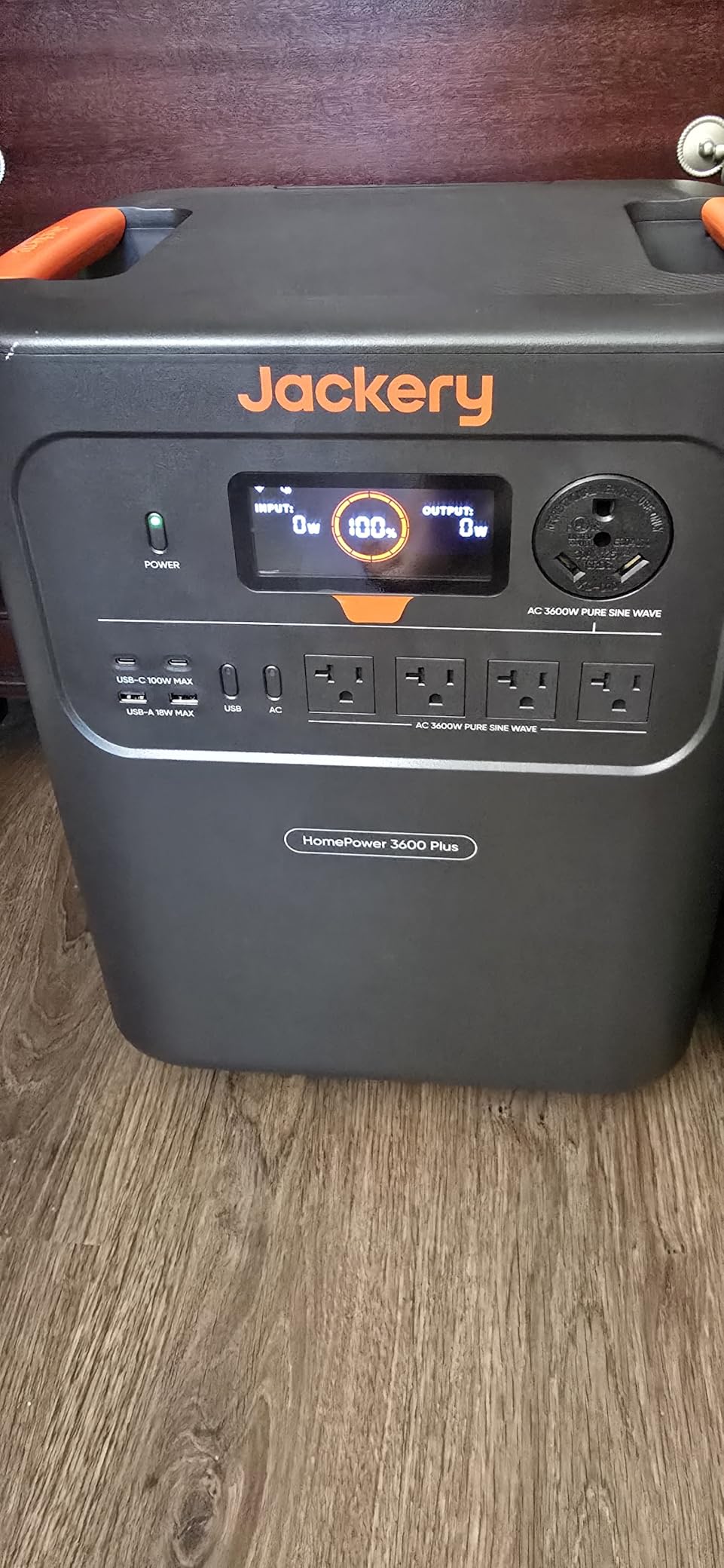
Capacity starts at 3,584Wh and expands to 21kWh per station, or 43kWh across multiple linked stations. Output is 3,600W, doubling to 7,200W in parallel, and the 120V and 240V dual voltage in parallel mode covers dryers, heaters and pumps that 120V-only competitors cannot.
Recharging is fast. A full charge takes 2 hours on the hybrid AC and DC path, 2.5 hours on AC alone, 4 hours on solar, or 2.5 hours from a gas generator. Reviewers are overwhelmingly positive at 83% five-star ratings, and many are repeat Jackery owners describing it as a brand they already trust.
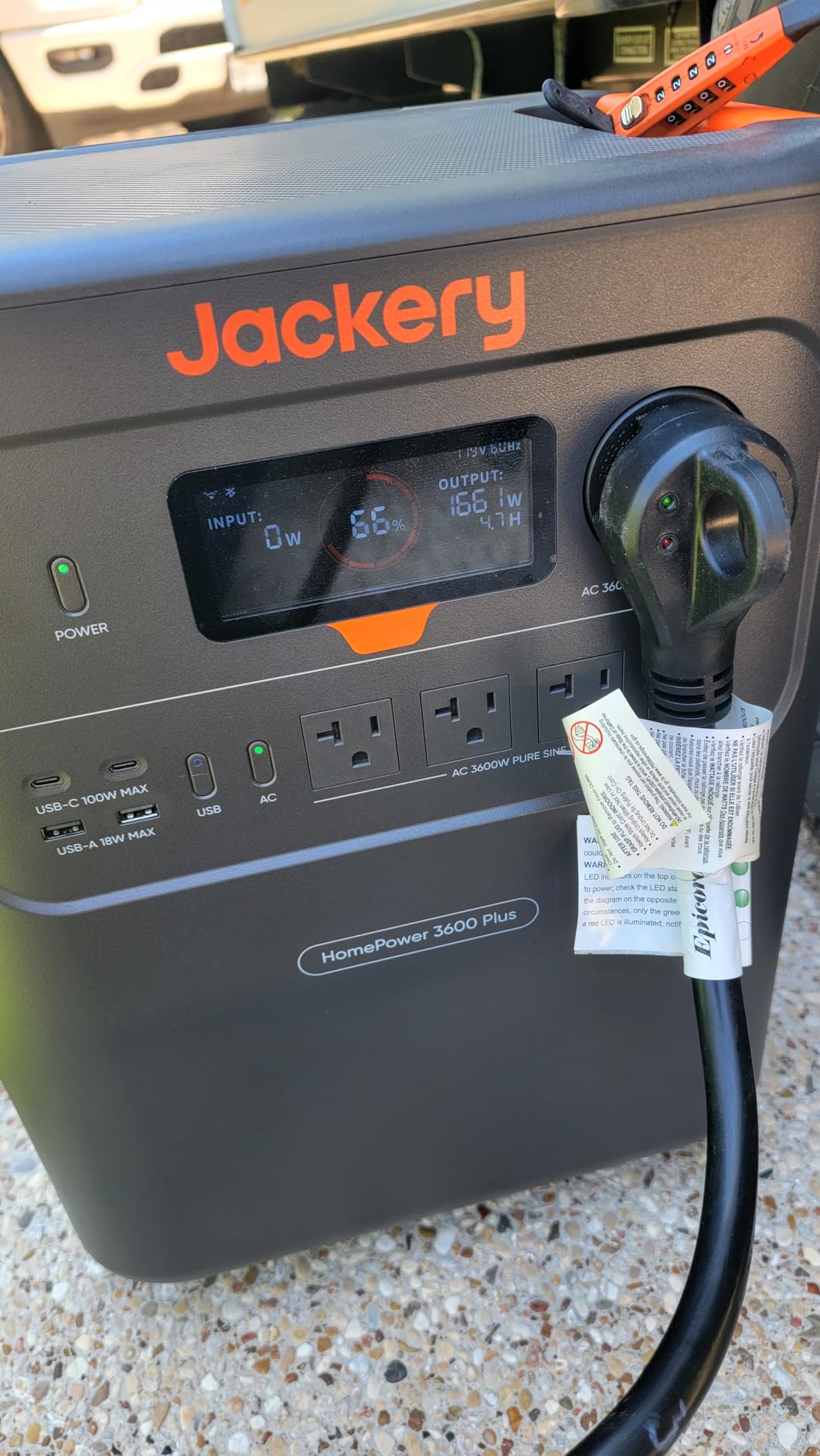
Real-world reports are the strongest part of this review set. Owners describe running a refrigerator, a freezer, an oxygen concentrator, a 15k BTU RV air conditioner and a water heater off this station. At 77.2 pounds it is the lightest 3.6kWh-class LFP station here, and the built-in wheels and telescoping handle make that weight far more manageable than a bare 77-pound box.
Can it handle a 240V appliance in a cold cabin?
Yes, with one condition. The 240V output is available in parallel mode, so it needs a second station or the right parallel configuration rather than appearing on a single box. Inside that constraint it reaches 7,200W, and 3,600W single-station is plenty for a window AC, a well pump or a space heater.
The cold rating covers operating temperature. Like every lithium station here, it manages charging below freezing, and the practical habit is to bring the station into the heated part of the cabin and let it settle before you put solar into it in January.
What is missing that you will have to buy separately?
A manual transfer switch. Whole-home integration needs one, and it is not included with the base station. There are also only two AC outlets, which is thin for a device with this much capacity, and at 3,584Wh you give up a little against the 4,096Wh leaders.
6. PECRON F3000LFP – The Lightest Full-Size Expandable Station
PECRON Portable Power Station F3000LFP, 3072Wh Solar Generator, 3600W LiFePO4 Battery Home Backup, Fast Charging Power Station Expand Capacity to 10752Wh, Solar Generators for Home Use, Camping, RV
3,072Wh LFP expandable to 10,752Wh
3,600W pure sine wave
1,600W solar input
63.3 pounds
Pros
- Lightest full-size expandable station in this roundup at 63.3 pounds
- 13 ports including six AC outlets and two 100W USB-C
- 0-100% recharge in about 2 hours on 1800W AC
- 1600W solar input for off-grid recovery
- Compact 19.3 by 11.6 by 11.1 inch footprint
Cons
- Expansion requires a separately sold XT120-M cascade cable
- Listed voltage is 220V AC which may limit some 120V setups
- Smallest review base of the established brands here
- 2+3 year warranty is shorter than some rivals
At 63.3 pounds this is the station you can actually move by yourself, and it is 30 pounds lighter than the next unit on this list. For a cabin with a step, a narrow doorway or a long carry from the truck, that difference decides more than any spec beyond capacity.
It is not a stripped-down unit. 3,072Wh of LiFePO4, expandable to 10,752Wh, 3,600W of pure sine wave output, and 13 ports, which is the highest port count in the roundup. Six are AC outlets, plus two 100W USB-C PD ports, two 18W USB-A, a car port and two DC 5525 outputs.
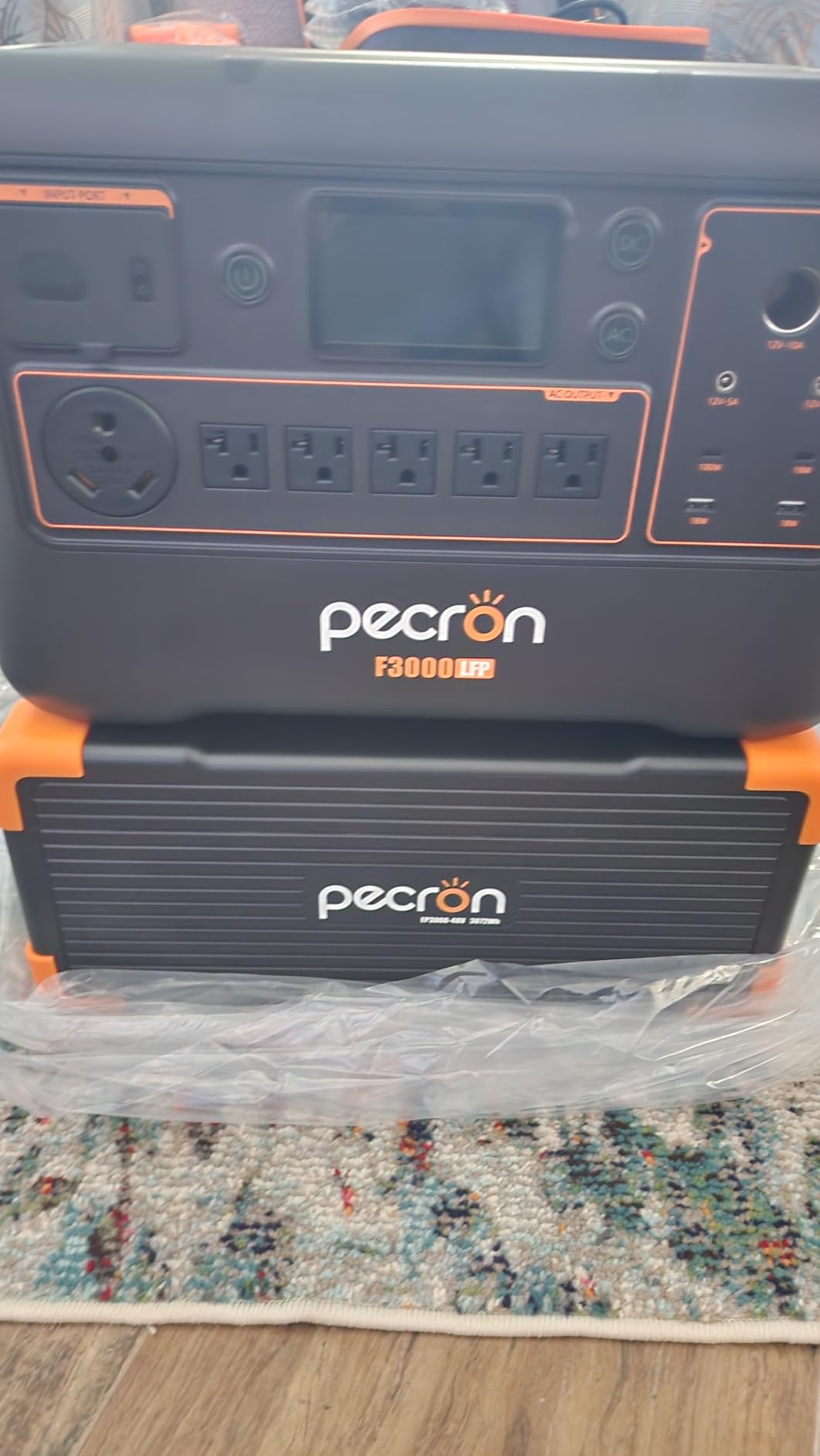
Charging is quick. A full 0 to 100% takes about 2 hours on 1,800W AC input, with up to 1,600W of solar and combined charging on top. The 8 to 20ms UPS switchover protects computers and medical devices, which is the right call for anyone running a CPAP or an oxygen concentrator at a remote cabin.
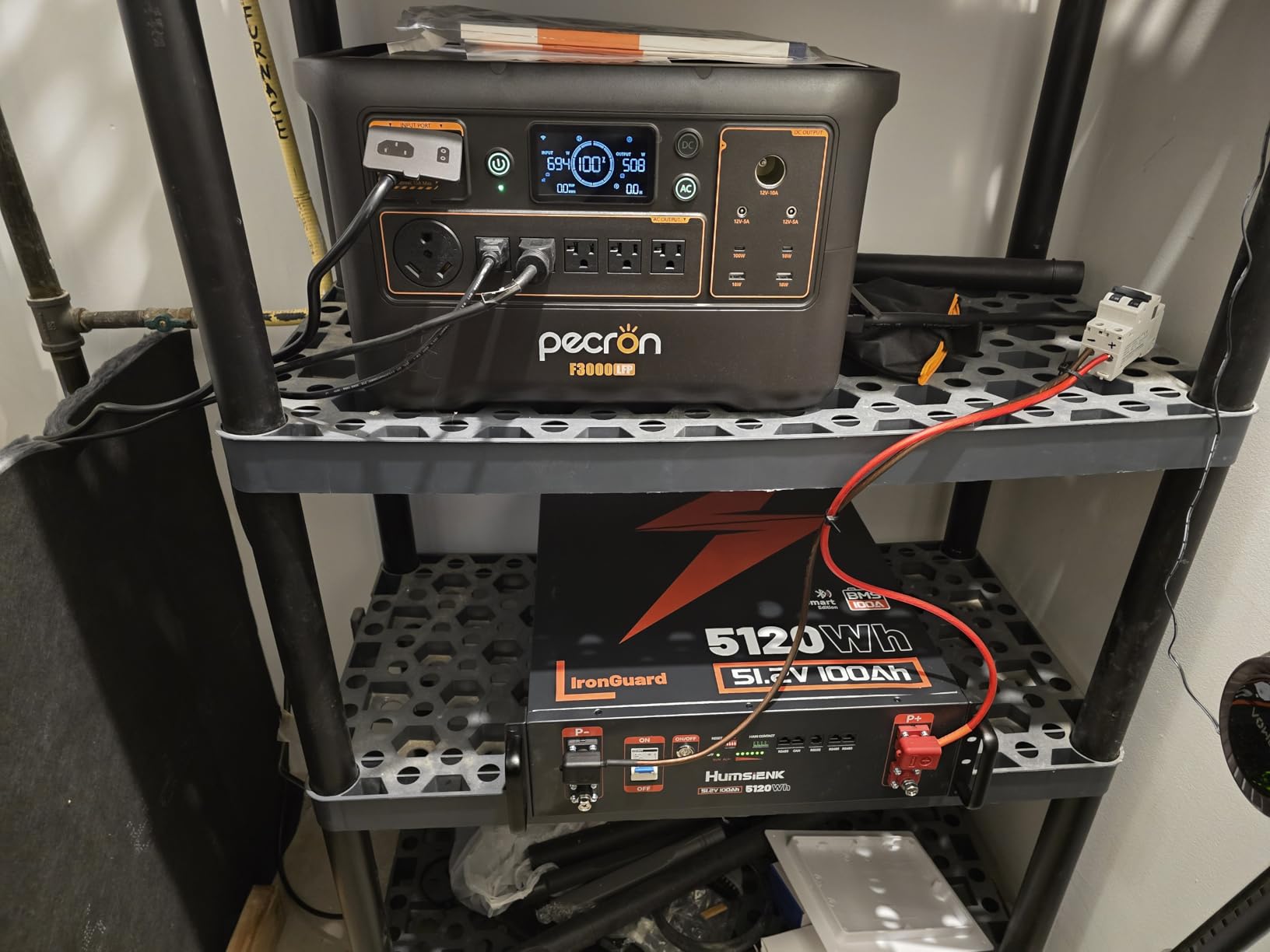
Buyers highlight exactly the three things that would make this the sensible pick: port count, the 2-hour AC recharge and the 63.3-pound weight. The most repeated caution is that adding the extra battery requires a cascade cable sold separately, which is exactly the sort of hidden line item that turns an expansion plan into a headache.
There is also a regional compatibility question. The listing states 220V AC, and depending on where you are that can limit some 120V-only setups. Confirm the output configuration with the manufacturer before ordering, particularly for a cabin in a 120V territory.
Is 63.3 pounds light enough for a solo cabin owner?
Yes. At that weight one person can lift and reposition it without a hand truck, which is the reason this unit exists in this roundup. The footprint of 19.3 by 11.6 by 11.1 inches is also the most shelf-friendly of the group, so it works in a cabinet or under a workbench in a way the cubic 34-inch Anker does not.
The trade is inverter headroom against weight. 3,600W of pure sine wave output is plenty for a refrigerator, freezer, window AC and tools, but there is no 240V output here, so 240V appliances are out of reach.
How much should you trust a newer brand with a smaller review base?
Be measured. The 4.5 average across 145 reviews is genuinely good, but it is a fraction of the BLUETTI AC200PL’s 2,607. The warranty is 2+3 years with 24/7 support, which is respectable, and 24/7 support matters a great deal for a product that may sit alone at a remote property for months. Just do not expect the same depth of long-term field data.
7. BLUETTI Elite 400 – Highest Rated With a Thin Track Record
BLUETTI Elite 400 Portable Power Station 3840Wh LiFePO4 Battery 2600W
3,840Wh LFP with 3,000+ cycles
2,600W AC and 3,900W surge
80% charge in 70 minutes
86 pounds
Pros
- Highest average rating in the roundup at 4.8 with 88% five-star
- Reaches 80% charge in 70 minutes on combined AC and solar
- Very quiet under light loads compared with a gas generator
- 15ms switchover for Wi-Fi and security cameras
- Includes a rolling trolley for an 86-pound body
Cons
- 2600W output is the lowest continuous figure here
- Smallest review base in the roundup at 59 ratings
- 86 pounds still needs the trolley to move
- 41-inch vertical body is awkward to shelf
On the numbers alone this is the best-looking station in the roundup. 4.8 average, 88% five-star ratings, 3,840Wh of LiFePO4 with 3,000+ cycles and a 60-month warranty. The catch, and it is a real one, is that 4.8 comes from 59 ratings.
What owners do report is impressive. Reviewers describe running a 15 cubic foot chest freezer on 24/7 duty with two 400W solar suitcases, a 15k BTU camp trailer air conditioner for three hours, a mini-split, a dryer and a small MIG welder without an overload.
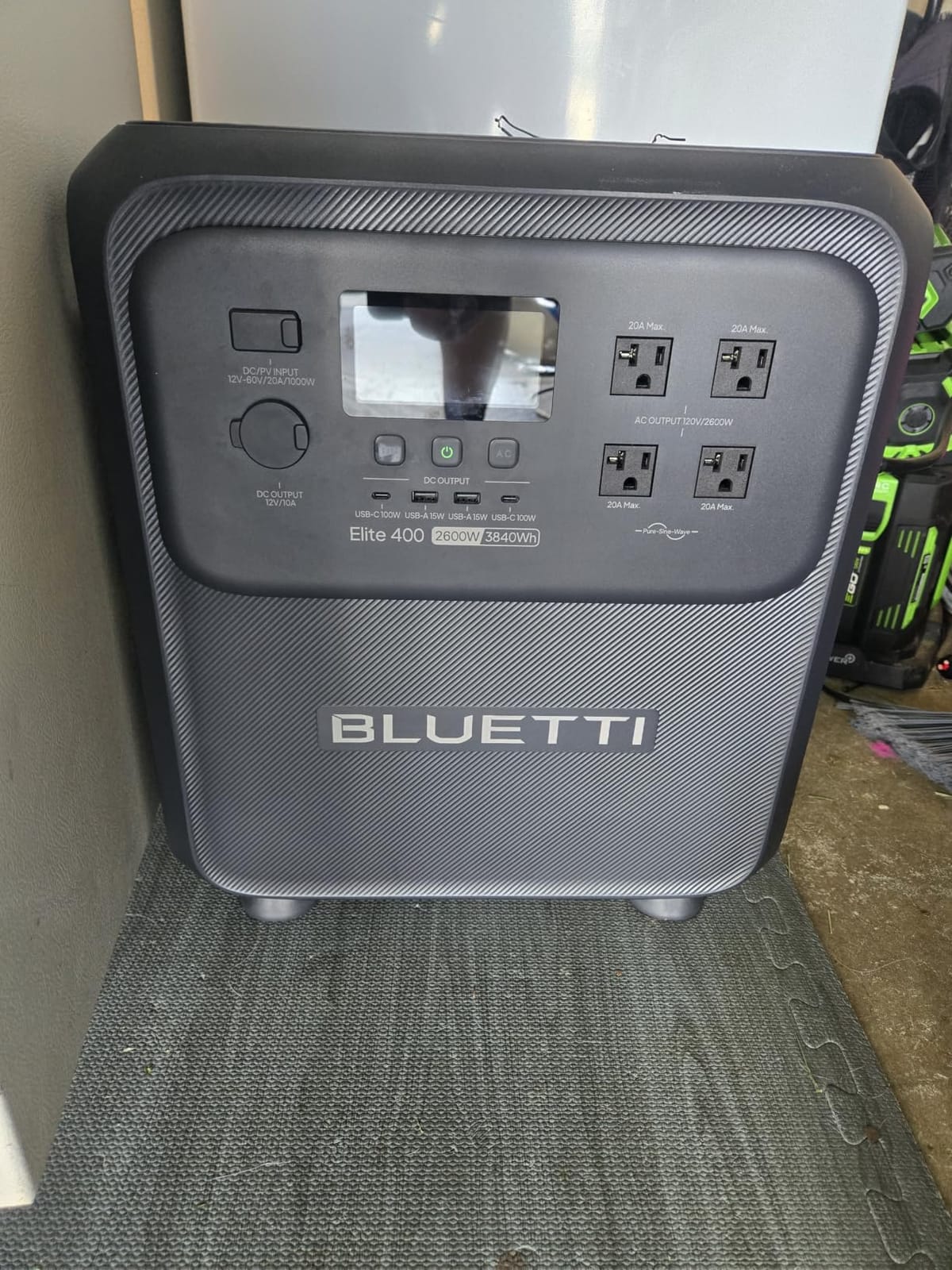
Charging is the second strength. It reaches 80% in 70 minutes on 2,800W of combined AC and solar input, runs a full charge in about 2.5 hours on an 1,800W wall outlet, and takes solar-only at 1,000W for a full charge in roughly 6 hours. It also supports DC-DC alternator and car charging, which is useful for a cabin near a road.
The 15ms switchover is fine for Wi-Fi, security cameras and pet feeders, and nine ports cover refrigerators, power tools, welders and shop compressors. For most cabin loads that is genuinely everything you would plug in.
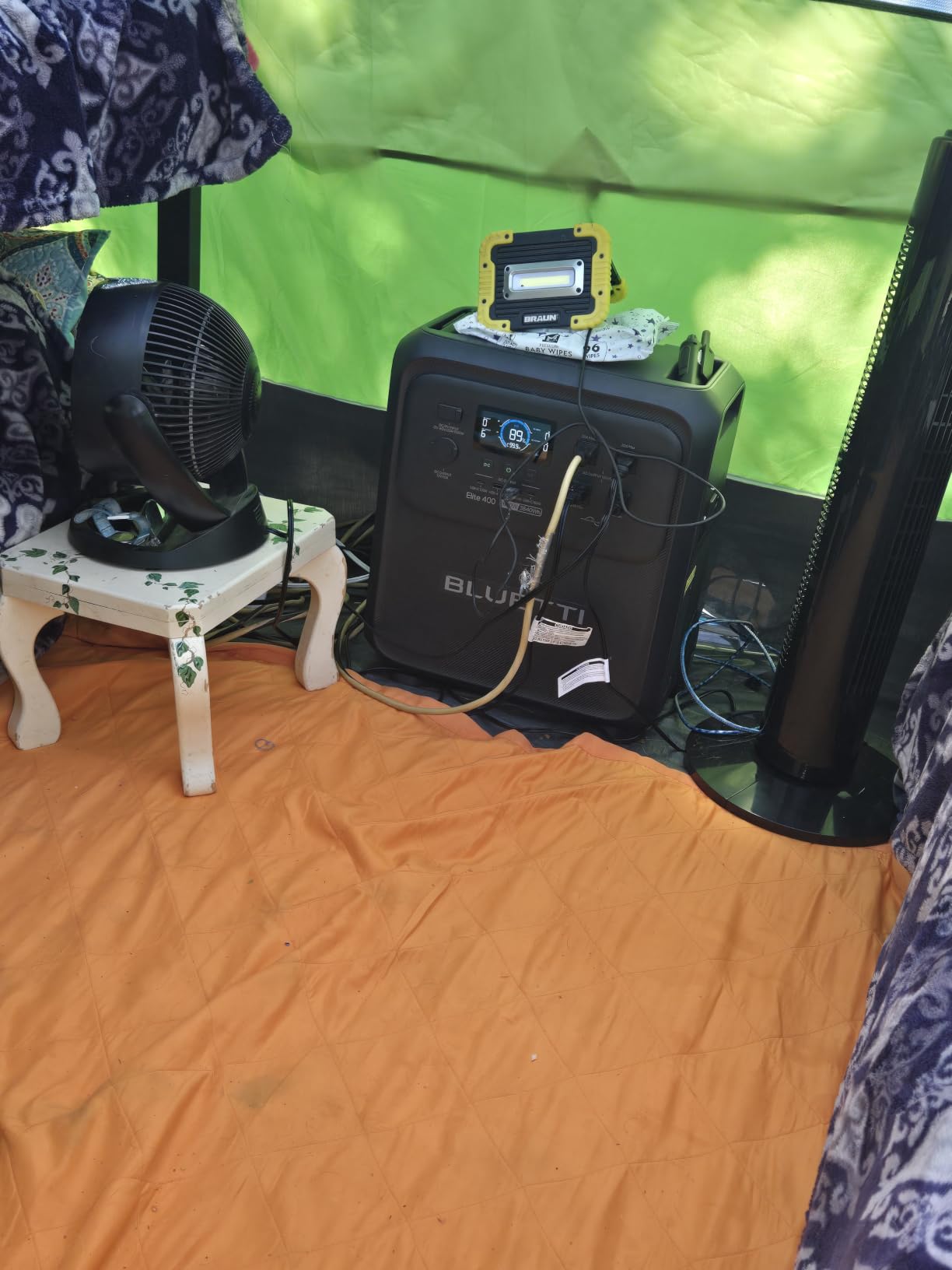
The limitation is the inverter. At 2,600W continuous it is the lowest in the group, so 120V heating appliances and central AC are out of reach, and that is the consistent caveat in every review that mentions a limit. The tall 17 by 11 by 41-inch vertical body is also less stable to shelf than a wide-form unit, and 86 pounds still requires the included trolley.
Is a 4.8 rating from 59 reviews meaningful?
Treat it as a strong signal with a small sample, not as a settled reputation. Launch products routinely start high and settle as volume grows, and the honest comparison is that the BLUETTI AC200PL’s 4.6 comes from 2,607 ratings spanning years of ownership. If reliability over a decade is your priority, the review depth is worth more than the score.
What the 59 reviews do support is that for appliances specifically, this one performs. Chest freezers, a dryer, a welder and a mini-split are all documented runs, which is a wider real-world spread than most stations of this size can show.
What should you know before buying at 2,600W?
Know that this is an appliance station, not a heating station. A refrigerator, freezer, lighting, router, power tools and a smaller window AC all fit. Electric baseboard heat, a clothes dryer and central air do not. If your cabin needs resistance heat in winter, this is the wrong tool and the Jackery HomePower 3600 Plus or Anker SOLIX F3800 are the right ones.
8. EF ECOFLOW DELTA 3 Ultra – Turnkey Solar Kit for a First Cabin
EF ECOFLOW DELTA 3 Ultra 3072Wh Solar Generator with 2X220W Solar Panels
3,072Wh LiFePO4 rated for 10 years
3,600W AC and 7,200W surge
25 dB under load
Two 220W panels included
Pros
- Two 220W folding solar panels included in the bundle
- 3600W continuous handles microwaves and power tools
- 25 dB under load suits sleeping in the cabin
- Under 10ms UPS for sensitive electronics
- LiFePO4 with EV-grade CTC structure rated for 10 years
Cons
- Panels and connecting cables are not included in the box
- 120V output only so 240V appliances are unsupported
- Smallest review base in the roundup at 33 ratings
If this is your first off-grid power purchase, a bundled kit removes the single most common beginner mistake, which is buying a battery and then realising you have no panels wired to it. The DELTA 3 Ultra arrives as 3,072Wh of LiFePO4 plus two 220W folding panels with carrying cases.
The output is 3,600W continuous with 7,200W surge, which covers microwaves, heaters and power tools. It runs at 25 dB under load with X-Quiet 3.0, quiet enough to sleep next to, which matters in a small cabin where a gas generator would be unusable at night.
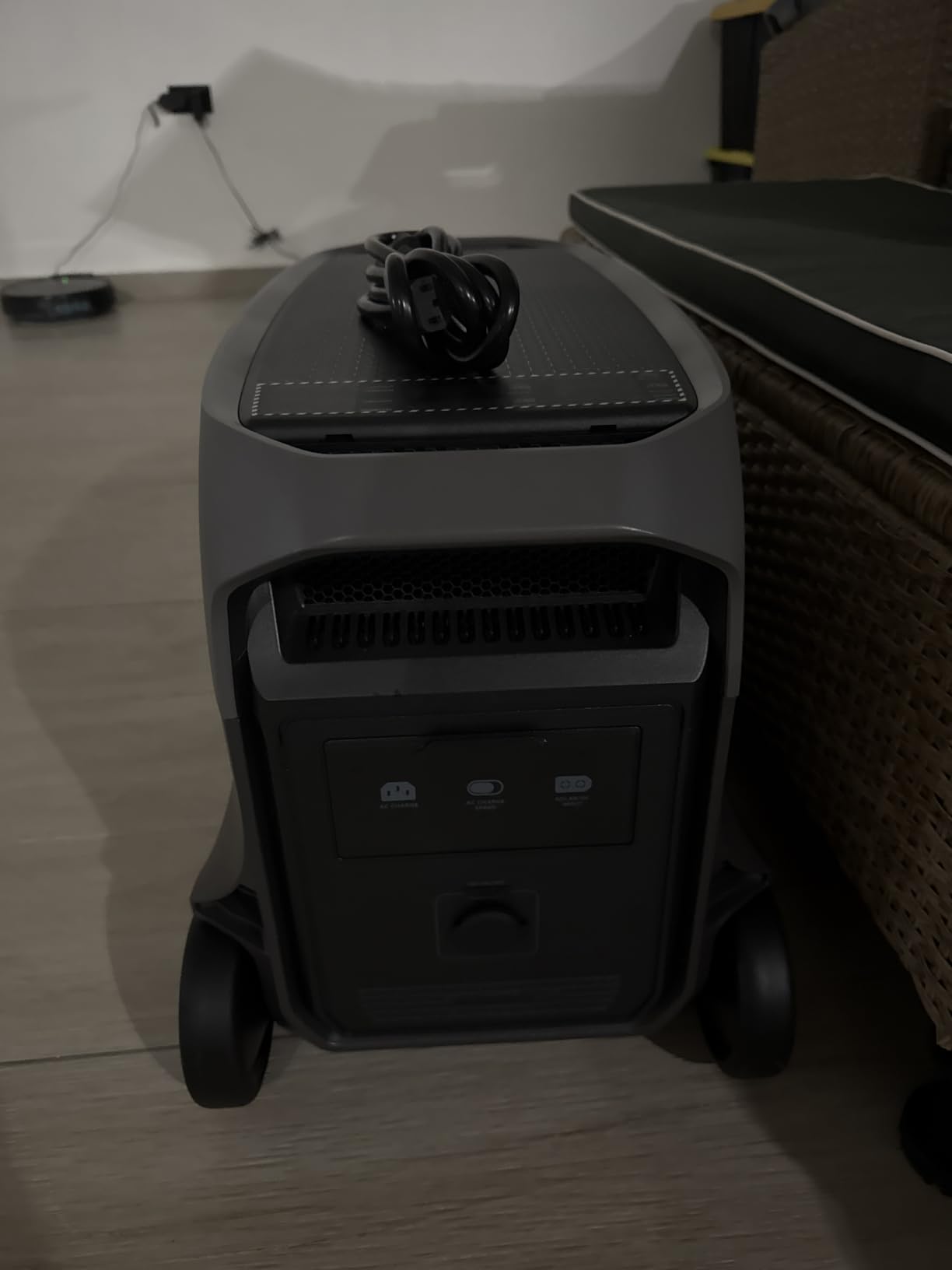
Battery longevity is the quiet strength. The LiFePO4 pack uses an EV-grade cell-to-body structure with 24/7 protection and is rated for 10 years of daily use. The under-10ms automatic UPS switchover keeps PCs, routers and medical equipment running without interruption.
Owners report real runtime results, including one user running a 7 cubic foot chest freezer for nine hours on 17% of the battery, and another running a full-size refrigerator for a week off a single panel.
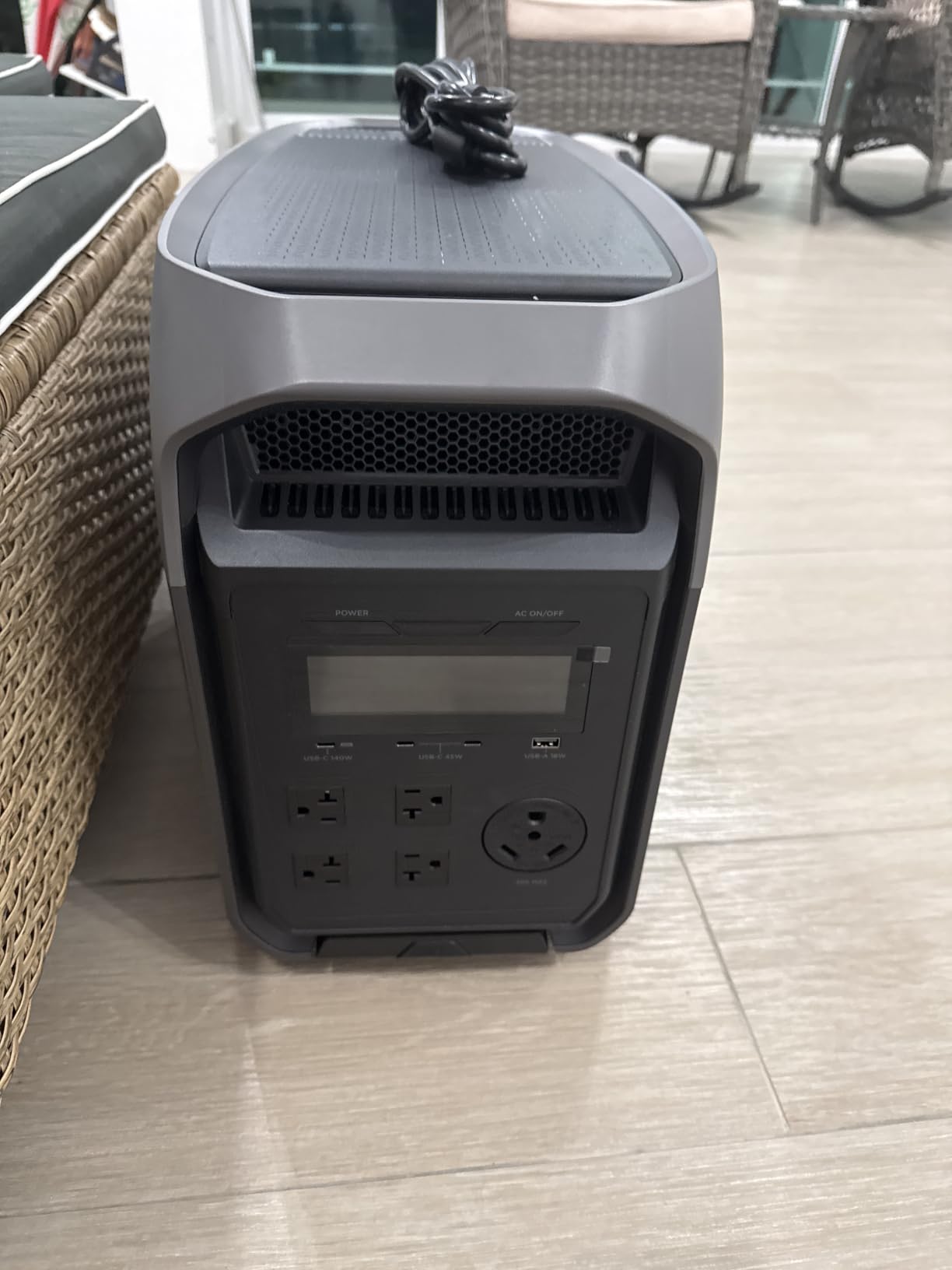
Now the significant caveat, because it is the most common complaint in the reviews. The panels are shipped separately from the station, and one reviewer reports receiving only the power station. The bundle also does not include the cables or Y-connectors needed to link the two panels, and the included XT60i cable is only about 6 feet, so a parallel connector and extensions have to be purchased separately. Confirm the full parts list with the seller before you rely on the bundle.
Is a bundled solar kit really better than buying panels separately?
For a first cabin, usually yes, because foldable panels you can point at the sun in spring are far better than panels still in a shipping box. The counter-argument comes from experienced reviewers: bundled foldable panels are poor value per watt against separate rigid panels for a permanent site. If your roof or ground mount is ready now, rigid panels cost less per watt over their life.
Whichever route you take, budget for the connection hardware. That is the most common complaint in this unit’s reviews and it is an easy, cheap fix if you know about it in advance.
Who should look elsewhere?
Anyone with 240V appliances, and anyone uneasy about a 33-rating sample. The output is 120V-focused, so a well pump or electric water heater is out. The 4.6 average is promising but thin, and at 3,072Wh the expansion ceiling is lower than most of this list. For a first cabin with a modest load list, though, the completeness of the package is the argument.
How Expansion Actually Works and When to Stop Adding
Expansion is not one button. Every platform in this roundup uses extra battery packs that plug into a dedicated port on the station, usually with a proprietary connector, and most cap the number of packs. The F3800 accepts up to six add-ons to reach 26.9kWh. The AFERIY reaches 11,520Wh. The PECRON tops out at 10,752Wh but needs a separately sold cascade cable to get there.
Three costs hide inside the word expandable, and buyers regularly discover them late.
The first is the pack itself. Added battery capacity is the most expensive watt-hour you will ever buy in this platform, and the per-kWh rate is almost always worse than the rate inside the base station. A station that is 70% full of capacity when you buy it is the best deal the manufacturer will ever offer you.
The second is hardware. Cascade cables, Y-connectors and parallel adapters are frequently sold separately, and a buyer who assumed the pack came with everything will be ordering a second accessory in week two.
The third is time to recover. You are not buying a cheaper battery, you are buying a battery that has already lost a portion of its design cycle life before it ever reached your shed.
So when do you stop adding? Three rules cover nearly every case.
Stop when your inverter is your limit, not your battery. If your largest simultaneous load is 1,500W, a station with a 2,400W inverter will not benefit from another 5kWh of storage. Buy the output first, then fill the capacity.
Stop when your solar input cannot refill what you have. A 4,000Wh battery accepting 1,000W of panels needs four full sun days to refill. Adding a second battery doubles the storage and the recovery time. If recharge speed is your real complaint, the fix is a bigger array, not a bigger bank.
Stop when one more pack crosses you into a fixed system. At that point a professionally installed solar array with a stationary battery bank and a proper transfer switch is usually the better answer, and we get into that below.
For most cabin owners the sweet spot is one extra pack. That is enough to ride through a two to three day storm with a standard appliance load, and it keeps the whole system on a single manufacturer’s app and a single warranty.
Buying Guide: 6 Specs That Decide the Purchase
Six specifications decide almost every expandable solar generator purchase for a cabin. Rank them in this order.
1. Battery chemistry. LiFePO4 is the only acceptable answer for a stationary cabin installation. Look for 3,000+ rated cycles, which works out to roughly a decade of daily use, and treat NMC and lead-acid alternatives as unsuitable for a primary power source. The Jackery HomePower 3600 Plus leads this group at 6,000 cycles.
2. Base capacity and the expansion ceiling. Buy the base station at the largest size you can comfortably lift, because that is the lower cost per watt-hour. Then confirm the ceiling, since it varies enormously. The DELTA Pro 3 reaches 48kWh, the F3800 reaches 26.9kWh, and the AC200PL reaches 8,448Wh.
3. Inverter output, continuous and surge. Continuous watts determine what runs at the same time. Surge watts determine what can start. A refrigerator compressor, a well pump and a power tool all draw a spike at startup, and a station with too little surge headroom trips rather than starting them.
4. Voltage output, 120V or 240V. This is the most cabin-specific decision and the one most shopping guides skip. A 120V-only station cannot run a well pump, an electric water heater, a clothes dryer, a large window AC or most power tools. If any of those are on your list, a dual-voltage station such as the F3800, the DELTA Pro 3 or the Jackery in parallel mode is the requirement, not a nicety.
5. Solar input wattage. This is the number most people ignore and regret. Solar input ranges from 1,000W on the BLUETTI Elite 400 to 2,600W across the DELTA Pro 3’s dual inputs. It determines how quickly a big battery returns to full after a storm, and it is the direct answer to the most common complaint from cabin owners, which is that recharge is slower than expected.
6. Cold-weather charging. Lithium cells refuse to charge below about 32F, and most stations pause or refuse rather than risk damage. If your cabin is a winter property, either choose a station rated for low-temperature operation, such as the Jackery at -4 degrees F, or plan to bring the station into the heated space and let it settle before charging. One verified buyer of the F3800 documented exactly this lockout after the station sat in a freezing truck bed overnight.
Two further specs worth checking before you order: UPS switchover time, where 10ms or less keeps computers and network gear from rebooting, and whether the unit supports pass-through charging, which lets you run the cabin from solar while the battery tops up.
Solar Generator vs Fixed Solar and a Battery Bank
A portable power station is the right answer for a cabin with uncertain or modest loads, a seasonal occupancy pattern, and no plan to ever wire 240V circuits into the building. It is a plug-and-play system you can commission in an afternoon.
A fixed solar array with a stationary battery bank and a transfer switch is the right answer for a full-time home, anything involving electric heat, a well pump on 240V, or a load list that will grow for a decade. It costs more, it takes a permit and licensed electrical work, and it delivers lower cost per kilowatt-hour over its life.
This is the single most common question in off-grid Facebook groups, and the honest answer is that a 2,304Wh portable station and a fixed system are solving different problems. The rule of thumb we use: if your daily load is under about 3kWh and you do not intend to run electric heat, a portable expandable station is the sensible first step. Above that, start planning the install.
Our deep cycle battery guide covers the stationary side of that decision.
Solar Panel Sizing for Your Expandable Station
Size your array to refill the battery in one good sun day. Take your station’s watt-hour capacity, apply a realistic solar harvest factor, and you have your array target. Roughly, you want about 1 watt of panel for every 4 watt-hours of battery capacity.
Worked against this roundup, that means 1,000W of panels for the 3,840Wh AFERIY or BLUETTI Elite 400, and about 1,200W for the AC200PL, which matches its 1,200W input limit. The DELTA Pro 3 at 4,096Wh wants roughly 1,200W and can absorb up to 2,600W across two inputs if you want faster recovery.
Two practical notes. First, never exceed the station’s rated solar input, because the MPPT charge controller is sized for that ceiling and overfeeding it is a common and avoidable mistake. Second, and this is the question that comes up constantly, a solar charge controller does stop drawing power from the panels once the battery reaches its set charge level. The array simply idles, which is why you should not judge panel size by what the panels can produce but by what the battery can absorb.
For a fixed cabin site, rigid panels beat the foldable ones in bundles by a wide margin per watt. Folding panels make sense for seasonal use and for testing a site before you commit to a roof mount.
Winter and Cold-Weather Cabins
Lithium iron phosphate batteries stop accepting charge below roughly 32F. That single fact decides whether a solar station works in a northern cabin, and it is the most common winter complaint in off-grid communities.
Two approaches work. The first is to choose a station rated for low-temperature operation. The Jackery HomePower 3600 Plus is rated to -4 degrees F, which makes it the clear pick in this roundup for a four-season northern cabin.
The second is operational. Keep the station inside the heated portion of the building, let it warm to room temperature, and only then apply solar. A documented F3800 owner found the same thing after a freezing night in a truck bed: the unit would not charge until it had warmed up. That is the battery management system protecting the cells, not a fault.
Size for winter demand, too. Heating loads in the coldest months dwarf your summer load list, which is the point at which a portable station stops being sufficient and a fixed system with more capacity becomes the right call. Our guide to small wood stoves for cabins covers the other half of that problem.
Running a Lithium Power Station Safely Inside a Cabin
Lithium fires are rare but they are not survivable in a small wooden cabin. Five habits cover most of the risk.
Charge and store the station on a non-combustible surface, such as a concrete floor, a metal shelf or a ceramic tile area, never on bare wood or carpet.
Keep the unit away from the stove, the woodstove flue and any heat source, and leave clearance on all sides for airflow.
Do not store a station at full charge and empty for long periods. Roughly 40 to 60 percent is the storage level that ages a cell best.
Never charge a station that has taken a physical impact until it has been inspected, and never use a station with a swollen, dented or damaged casing.
Install a working smoke and carbon monoxide alarm in the cabin, and keep a fire extinguisher rated for lithium-ion batteries within reach of wherever the station lives.
The good news is that these are heat, impact and ventilation problems, not problems with the chemistry itself. Every unit in this roundup carries a battery management system, and the AFERIY is UL Listed with a 7-year support period. Treat the station like any other appliance in the cabin: give it room to breathe and a safe surface, and it is no more of a hazard than a refrigerator.
Frequently Asked Questions
What is the best expandable solar generator for an off-grid cabin?
The BLUETTI AC200PL is our top pick for most cabins because it combines 2,304Wh of base capacity that expands to 8,448Wh, a 2,400W inverter, 1,200W of solar input and the largest proven review base of any station we tested at 2,607 ratings. If you need 240V output for a well pump or electric heat, the Anker SOLIX F3800 is the stronger choice at 6,000W and 26.9kWh of expansion headroom.
What is the best expandable solar generator?
An expandable solar generator is a portable power station with modular battery bays that accept extra battery packs, letting you grow stored capacity over time as your needs change. The best one for a cabin balances inverter output, solar input wattage and expansion ceiling, since buying the largest base station you can carry gives you the lowest cost per watt-hour and the expansion packs fill in later.
How big of a solar generator do you need to run a house?
A weekend cabin with lights, a router and a CPAP needs 500Wh to 1,000Wh. Adding a refrigerator and a freezer puts you at 1,500Wh to 2,000Wh. A refrigerator, chest freezer, window AC, lighting and networking needs 3,000Wh to 4,000Wh. A full list including a well pump, microwave or electric heat needs 5,000Wh and above, which in practice means an expanded station or a fixed battery bank.
Can you live off the grid with a solar generator?
For a cabin with a daily load under roughly 3kWh and no electric heat, yes. A portable expandable station paired with a correctly sized solar array can run a refrigerator, freezer, lighting, networking and small appliances indefinitely. Once you add 240V loads, a well pump, electric heat or full-time occupancy, a fixed solar array with a stationary battery bank and a transfer switch is the correct answer.
What type of backup generator is best for an off-grid solar system?
For an off-grid cabin that has no other power source, a portable LiFePO4 power station is the most useful type because it is silent, produces no exhaust and can sit indoors, so it works safely where a gas generator cannot. If the system already has a fixed battery bank, a gas generator is a better emergency backup because it can refuel and run indefinitely.
What are the common problems with off-grid solar?
The most repeated problems are slower-than-expected recharge when clouds or winter cut panel output, high solar input limits on large batteries so a big bank trickles back up over days, cold-soak charging lockout below about 32F on lithium stations, the physical weight of large units, and confusion over safe indoor placement in a wooden cabin.
How many batteries do I need to go off-grid?
For a typical cabin load list of about 3,800Wh per day, one station with one expansion pack is the practical answer and covers a two to three day storm with no sun. The exception is a large battery that can only accept 1,000W to 1,400W of solar, which needs an extra pack to recover in reasonable time. Check the expansion ceiling, the connection cable requirements and your solar input limit before committing.
Does a solar charge controller stop charging when the battery is full?
Yes. The MPPT charge controller in a solar generator reduces and eventually stops drawing from the panels once the battery reaches its set charge level, which protects the cells from overcharging. That is why panel array size should be matched to what the battery can absorb rather than to what the panels can produce on a perfect day.
Can an off-grid solar system work without batteries?
Technically yes, but only for direct daytime loads and only if your appliances run on the panel’s DC output. Without storage you lose everything after sunset, and most household appliances need the pure sine wave inverter a power station provides. For a cabin where anyone sleeps, batteries are not optional.
Bottom Line
The BLUETTI AC200PL is the best expandable solar generator for off-grid cabins because it is the only one in this roundup combining a 2,304Wh base that grows to 8,448Wh, fast charging, a bundled panel and 2,607 ratings of real-world evidence. Buy that one and add a pack in year two when your load list tells you to.
Go with the Anker SOLIX F3800 if you need 240V for a well pump, heater or power tools, and with the EF ECOFLOW DELTA Pro 3 if you already know a fixed system is coming in a few years. For a northern cabin, the Jackery HomePower 3600 Plus is the only station here rated to operate down to -4 degrees F.
Whichever you choose, buy the largest base station you can comfortably lift, match your inverter to your biggest simultaneous load, and size the solar array to refill it in one good sun day. Everything after that is expansion, and expansion is the easy part.