
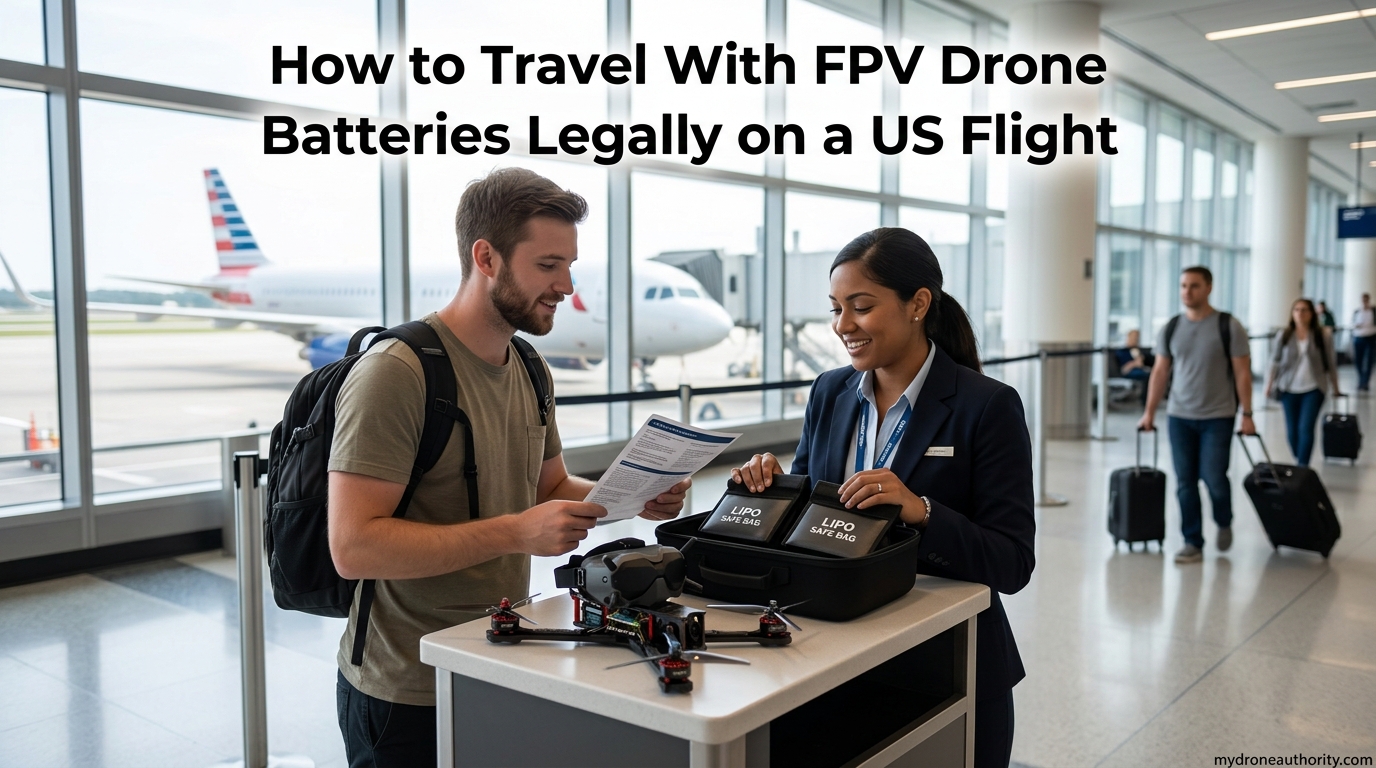
Flying with FPV drone batteries does not have to end with your gear confiscated at the checkpoint. Once you understand how the FAA watt-hour rule works, packing your LiPos for a US flight becomes almost routine. I have flown domestically with half a dozen 6S packs, a charged whoop, and a transmitter more times than I can count, and the process is the same every time.
This guide breaks down exactly how to travel with FPV drone batteries legally on a US flight in 2026. You will learn the FAA and TSA regulations, how to calculate watt hours for any pack, how to protect XT60 connectors, and what to say when a TSA agent asks what that ” device with wires” is.
FPV pilots face different challenges than DJI camera drone owners. Our batteries usually have exposed XT60 or XT30 connectors, we carry more packs, and airport staff are less familiar with our gear. The good news is that almost every standard FPV LiPo falls well under the 100Wh limit, which makes the rules simpler than they first appear.
Table of Contents
FAA and TSA Rules for FPV Drone Batteries
Two agencies matter when you travel with FPV drone batteries in the United States: the FAA writes the rules, and TSA enforces them at the checkpoint. Both agencies treat lithium polymer (LiPo) and lithium-ion batteries as dangerous goods because of their fire risk if short-circuited or damaged.
The FAA classifies spare lithium batteries under 49 CFR 175.10. That regulation allows passengers to carry spare LiPo and Li-ion batteries for personal electronics, including drone batteries, within specific watt-hour limits. TSA officers at the security checkpoint apply those FAA limits and also check that each battery is protected against accidental short circuit.
The most important FAA rule to remember is this: spare lithium batteries are never allowed in checked baggage. They must travel in your carry-on bag, period. A battery installed inside a device can sometimes go in a checked bag, but every loose spare pack goes in the bin that stays with you in the cabin.
TSA may also refuse batteries that lack clear labels showing voltage, capacity, and chemistry. If you fly with self-built 18650 packs or packs where the original label has peeled off, expect questions. Carry a printed copy of the FAA regulation and the TSA rules page on your phone so you can show the exact wording if asked.
The 100Wh Rule Explained
The single number that controls almost everything about FPV drone battery travel is 100 watt-hours. The FAA divides spare lithium batteries into three categories based on their watt-hour rating, and the rules change at the 100Wh and 160Wh thresholds.
Batteries at or below 100Wh need no airline approval and have no quantity limit for personal use. Batteries between 101Wh and 160Wh require advance airline approval, with a maximum of two spare packs per passenger. Batteries above 160Wh are prohibited on passenger flights entirely.
Here is the part most FPV pilots do not realize: almost every common FPV pack is already under 100Wh. A 6S 1300mAh LiPo, the most popular 5-inch freestyle pack, lands at roughly 29Wh. Even a chunky 6S 1800mAh pack sits around 40Wh. You would need to fly with a 6S 4500mAh pack or larger to even approach the 100Wh line.
The only FPV pilots who routinely cross the 100Wh threshold are long-range pilots and large cinematic rig operators running 6S 4000mAh packs or bigger Li-ion packs built from 21700 cells. If that describes your setup, you need to request airline approval before you fly and limit yourself to two spares in the 101-160Wh range.
How to Calculate Watt Hours for Any FPV Battery
Watt hours (Wh) tell you how much total energy a battery stores. The formula is simple and worth memorizing because airline staff may ask you to prove your packs are compliant on the spot.
The watt-hour formula is Wh equals nominal voltage multiplied by amp-hours. In shorthand: Wh equals V times Ah. Nominal voltage for a LiPo is 3.7V per cell, so a 4S pack has a nominal voltage of 14.8V and a 6S pack has a nominal voltage of 22.2V.
Because battery labels print capacity in milliamp-hours (mAh), you first need to convert to amp-hours by dividing by 1000. A 1300mAh pack is 1.3Ah. A 1800mAh pack is 1.8Ah.
Here are worked examples for common FPV packs so you can see the math in action.
Example 1: 4S 1300mAh LiPo (typical 4-inch freestyle pack)
Nominal voltage: 14.8V (4 cells times 3.7V). Capacity in Ah: 1.3. Calculation: 14.8 times 1.3 equals 19.24Wh. Well under 100Wh.
Example 2: 6S 1300mAh LiPo (typical 5-inch freestyle pack)
Nominal voltage: 22.2V (6 cells times 3.7V). Capacity in Ah: 1.3. Calculation: 22.2 times 1.3 equals 28.86Wh. Well under 100Wh.
Example 3: 6S 1800mAh LiPo (typical 5-inch cruising pack)
Nominal voltage: 22.2V. Capacity in Ah: 1.8. Calculation: 22.2 times 1.8 equals 39.96Wh. Still under 100Wh.
Example 4: 6S 1500mAh Li-ion pack built from 18650 cells
Nominal voltage: 22.2V. Capacity in Ah: 1.5. Calculation: 22.2 times 1.5 equals 33.3Wh. Under 100Wh, but remember self-built packs draw more scrutiny at security.
The takeaway: if you fly 5-inch or smaller quads, your packs are almost certainly legal without any special approval. Run the math once for each pack size in your bag, write the Wh rating on a piece of tape on each pack, and you are prepared for any question.
Carry-On vs Checked Baggage: Where Each Battery Goes
The location of your batteries inside your luggage matters as much as the watt-hour rating. The FAA has strict rules about which bags can hold which batteries.
All spare lithium batteries must go in your carry-on baggage. This rule applies to every loose LiPo pack you bring. There is no exception for small packs, no exception for low-capacity whoop batteries, and no exception for batteries in LiPo safe bags. Checked luggage goes into a cargo hold where a battery fire cannot be reached quickly, so the FAA bans spare LiPos there entirely.
A battery installed inside a device is treated differently. If a LiPo is physically inside your FPV quad and the quad is fully powered off, that battery is considered “installed” rather than “spare.” An installed battery may travel in either carry-on or checked baggage, but the device must be completely shut down and protected against accidental activation and physical damage.
My strong recommendation: keep your quad in your carry-on too. Checking an FPV frame risks damage, and a damaged battery is exactly what causes the in-flight fire scenarios that drive these regulations in the first place.
What happens if you accidentally leave a spare LiPo in a checked bag? TSA screening of checked bags can detect lithium batteries through their CT scanners. If they find one, they will pull your bag, page you at the gate, and require you to remove the battery before the bag can load. In the worst case, your bag misses the flight and you miss your connection. Always do a final walkthrough of any checked bag for loose batteries before you hand it over.
Terminal Protection and Short Circuit Prevention
Both the FAA and TSA require every spare lithium battery to be protected against short circuit and accidental activation. For FPV pilots, that requirement is specifically about your battery connectors. This is an area where FPV gear differs from camera drone batteries, and it is the single most common reason TSA pulls an FPV pilot aside.
The exposed XT60 and XT30 connectors on FPV LiPos are exactly what the regulations mean by “exposed terminals.” If a metal object touches both pins at the same time, the pack shorts and can vent or ignite. TSA officers are trained to look for exposed terminals, and an exposed XT60 sticking out of a bag is a guaranteed secondary inspection.
Here is how to protect each connector type the right way.
For XT60 connectors, use dedicated XT60 silicone terminal caps. These slip over the exposed pins and stay in place with friction. They cost only a few dollars for a pack of ten, and they are the cleanest solution. If you do not have caps, you can also use a small piece of electrical tape folded over the connector, though tape leaves residue over time.
For XT30 connectors on smaller whoop packs, use XT30 silicone caps or wrap the connector in a small strip of electrical tape. The same principle applies: nothing conductive should be able to reach both pins.
Beyond connector caps, every spare battery should also sit inside its own LiPo safe bag or a dedicated battery case. A fireproof LiPo bag is the gold standard and is what most experienced FPV travel guides recommend. The bag contains both the short-circuit protection and the fire containment in one item.
Original battery packaging also counts as terminal protection if you still have it. A battery shipped inside its retail box with the connector recessed into a foam cutout satisfies the requirement.
Finally, label every pack. TSA wants to see voltage, capacity in mAh, cell count, and chemistry printed on the battery. If the original label is missing or has peeled off, write the specs on a piece of tape and stick it to the pack. Reddit users in r/fpv have repeatedly reported that unlabeled or hand-labeled packs draw extra questions, and that commercial packs with original labels sail through faster.
Packing Tips for FPV Drones and Batteries
How you physically pack your FPV gear determines whether you sail through security or get pulled aside for ten minutes. The goal is to make your bag easy to scan and easy to inspect if it does get pulled.
Set every battery to storage voltage before you leave home. Storage voltage for a LiPo is 3.80V to 3.85V per cell. For a 6S pack, that is roughly 22.8V to 23.1V total. Storage voltage reduces the energy inside the pack, which reduces both the fire risk and the consequences if a pack is damaged in transit. It also keeps your packs healthy if they sit unused at your destination. Use your charger’s storage mode the night before you fly.
Use a dedicated FPV backpack or hard case. A backpack designed for FPV gear keeps your quad, goggles, transmitter, and batteries separated by foam dividers. Each battery gets its own slot, which prevents connectors from contacting each other and prevents the packs from shifting during transit. Hard cases offer more crush protection if you expect to be forced to gate-check, but backpacks are more likely to fit under the seat in front of you and avoid gate-checking entirely.
Pack batteries in a single layer at the top of the bag. When TSA X-rays your carry-on, a neat single layer of batteries scans cleanly and reads as obviously safe. A tangled pile of packs with wires crossing every which way reads as suspicious and triggers a hand search. Lay each battery flat in its LiPo bag, all facing the same direction.
Separate the quad from the batteries. Do not pack a battery inside the quad even if the connector is unplugged. TSA may interpret a battery-and-frame combination as suspicious. Pack the quad on one side of the bag with props removed and the battery on the opposite side.
Keep props and tools in a checked bag if possible. Sharp propellers and metal tools can read as threats on the X-ray and slow you down. If you must carry props in your carry-on, put them in a clear ziplock at the top of the bag.
Bring a printed copy of the FAA regulation. Section 49 CFR 175.10 is the specific rule that allows spare lithium batteries in carry-on baggage. Print the relevant page or save a PDF on your phone. If a TSA officer or gate agent is uncertain, showing them the exact regulation often resolves the situation in seconds.
Have a gate-check backup plan. Sometimes you will be forced to gate-check your carry-on because the flight is full. If that happens, you need to be able to quickly remove every spare battery before handing over the bag. Keep all your batteries in one removable insert or pouch so you can pull them out in under a minute at the gate. The installed battery in your quad can stay in the checked bag, but every loose spare must come into the cabin with you.
Navigating Airport Security with FPV Gear
The security checkpoint is where most FPV travel problems happen, and the cause is almost always communication rather than regulation. TSA officers see camera drones every day. They rarely see a built 5-inch FPV quad with bare wires and an XT60 connector sticking out. The fix is to explain your gear in language they recognize.
Call your drone a “camera drone” or a “remote-controlled camera quadcopter.” The phrase “FPV drone” means nothing to most TSA officers and can sound suspicious. The phrase “camera drone” or “RC quadcopter with a camera” immediately maps to something they have seen before and classifies your gear as consumer electronics rather than unidentified hardware. Reddit users on r/fpv consistently report that this single phrasing change cuts checkpoint friction dramatically.
Be patient and transparent. Pull your batteries out of the bag and place them in their own bin if the layout of the checkpoint allows it. Offer to open each LiPo bag for the officer before they ask. If they swab your hands and gear for explosive residue, cooperate fully. The swab is routine for anyone carrying electronics.
Expect questions about the number of batteries. TSA officers sometimes believe there is a hard three-battery limit. There is not, as long as every pack is under 100Wh. The FAA sets no quantity cap for personal-use packs under 100Wh. If an officer questions your six-pack setup, calmly explain that the rule is watt-hour based, not quantity based, and show them the printed regulation. A polite, informed traveler almost always wins that conversation.
Be prepared for smaller airports to be more cautious. Major hubs like Atlanta, LAX, and JFK see drone batteries daily and rarely bat an eye. Smaller regional airports may see your 6S packs for the first time. Budget extra time, lead with the regulation printout, and stay calm if the officer calls over a supervisor. Escalation never helps; patience almost always does.
Know what to do if a battery is flagged. If TSA decides a specific battery does not meet the rules, they will typically give you the option to surrender it rather than miss your flight. If the issue is missing terminal protection, ask if you can tape the connector right there and re-screen it. If the issue is a missing label, ask if you can write the specs on the pack on the spot. Many issues are fixable at the checkpoint if you stay calm and offer solutions.
Bring only what you can afford to lose. Even with perfect preparation, an individual officer can make a call you disagree with. If you fly with a one-of-a-kind prototype pack or an irreplaceable custom Li-ion build, accept that there is a small but real chance it gets confiscated. For travel, commercial packs with original labels are always safer than self-built packs.
How Many LiPo Batteries Can You Bring on a Plane?
The answer depends entirely on the watt-hour rating of each pack. The FAA sets no quantity limit on spare lithium batteries rated at or below 100Wh for personal use. If every pack in your bag is under 100Wh, you can legally carry as many as you want.
For packs rated between 101Wh and 160Wh, the limit is two spare batteries per passenger, and you must obtain advance approval from the airline. Call the airline’s customer service line before your flight and ask for written confirmation, usually by email, that you are cleared to carry two large packs. Show that confirmation at the gate if asked.
Batteries rated above 160Wh are prohibited on passenger flights entirely. There is no approval process and no exception. If you need to transport a pack above 160Wh, it has to ship as hazardous cargo through a freight carrier.
In practice, most FPV pilots travel with four to eight packs for a typical flying trip, all under 100Wh, and never hit a wall. The quantity is not the issue; the labeling, terminal protection, and carry-on placement are what actually determine whether your trip goes smoothly.
Frequently Asked Questions
Can I bring an FPV drone on a plane?
Yes, you can bring an FPV drone on a plane in your carry-on baggage. The drone itself is treated as consumer electronics. Remove the battery, remove the props, and pack the frame securely. Call it a camera drone or RC quadcopter at security to avoid confusion.
Can I take drone batteries on an airplane?
Yes, you can take drone batteries on an airplane as long as each spare battery is rated at 100 watt-hours or less. Spare lithium batteries must travel in your carry-on baggage, never in a checked bag. Each battery must be protected against short circuit with terminal caps or tape.
Do lithium batteries go in checked bags or carry-ons?
Spare lithium batteries must always go in carry-on baggage. The FAA prohibits spare lithium batteries in checked luggage because a fire in the cargo hold cannot be reached quickly. A battery installed inside a powered-off device may go in either bag, but loose spares are carry-on only.
How many LiPo batteries can I take on a plane?
There is no quantity limit for spare lithium batteries rated at 100Wh or less. For batteries between 101Wh and 160Wh, the limit is two per passenger with airline approval. Most FPV packs, including 6S 1300mAh and 6S 1800mAh LiPos, are well under 100Wh, so quantity is rarely the limiting factor.
What happens if I accidentally leave a lithium battery in my checked bag?
TSA baggage screening can detect lithium batteries in checked luggage. If they find one, they will pull your bag and page you at the gate to remove the battery. In the worst case, your bag misses the flight and you miss your connection. Always check every checked bag for loose batteries before you hand it over.
How do I calculate watt hours for my drone battery?
Multiply nominal voltage by amp-hours. Nominal voltage for a LiPo is 3.7V per cell, so a 6S pack is 22.2V. Convert mAh to Ah by dividing by 1000. For a 6S 1300mAh pack: 22.2V times 1.3Ah equals 28.86Wh.
Conclusion
Traveling with FPV drone batteries on a US flight comes down to four things: keep every spare under 100Wh, put all spares in your carry-on, cap your XT60 and XT30 connectors, and label every pack. Run the watt-hour math once for each pack in your bag, set them all to storage voltage before you leave, and call your quad a camera drone at the checkpoint.
The rules are friendly to FPV pilots because almost every standard pack is already under the 100Wh line. The pilots who run into trouble are the ones who skip terminal protection, fly with unlabeled or hand-labeled packs, or forget a spare in a checked bag. Handle those three things and you will be flying your quads at your destination the same afternoon you land.
Print the FAA regulation, pack your LiPo safe bags, and enjoy the flight. Once you have done this once or twice, the whole process takes about ten minutes at the checkpoint and becomes just another part of traveling with FPV gear in 2026.