
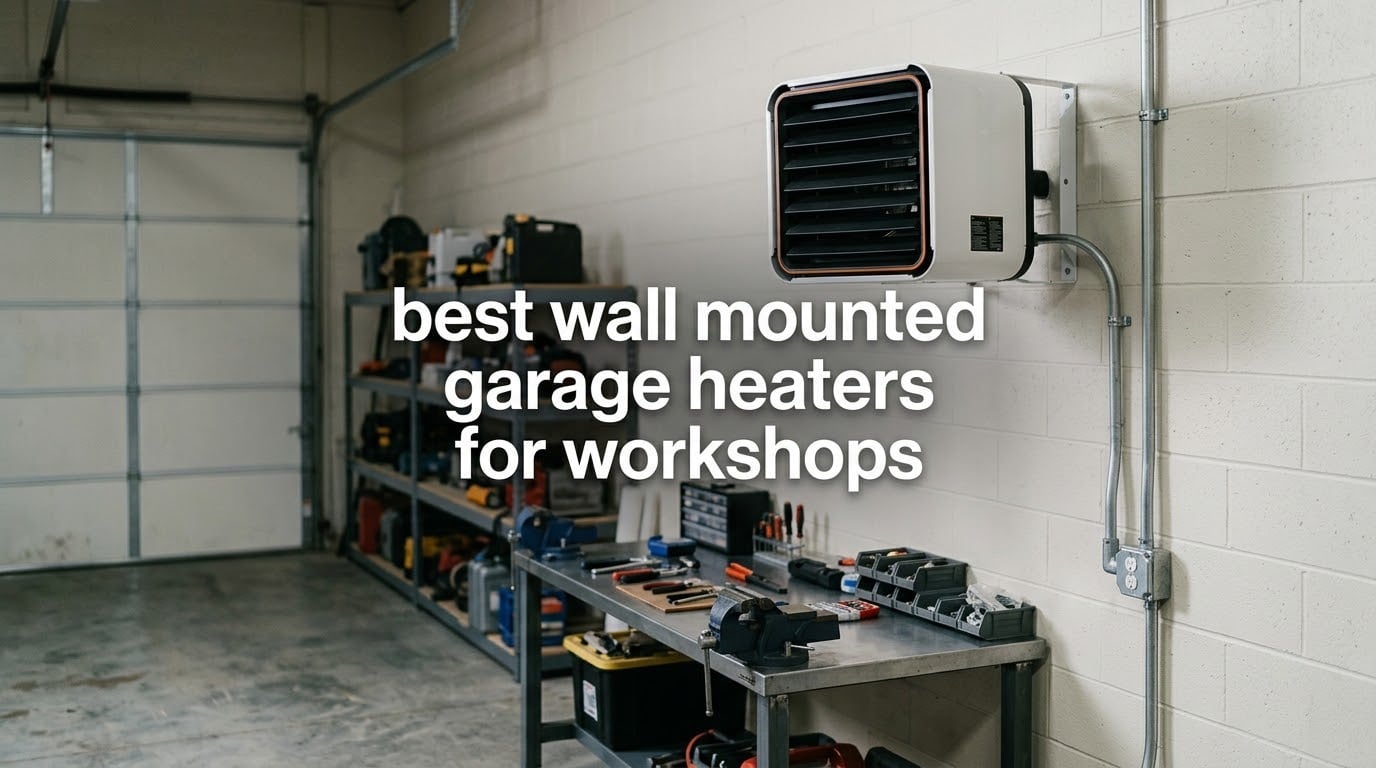
Most garage shops get their warmth wrong twice: they buy a portable box fan heater that a forklift can clip, then they discover in January that the extension cord was never going to survive a real winter. The fix is a permanently bracketed unit, hung high where dust and vehicles cannot reach it.
These are the best wall mounted garage heaters for workshops we could justify in 2026. We went through ten hardwired and gas units, checked their published specs against their actual amperage and coverage claims, and separated three heating technologies that get lumped together everywhere else: fan-forced electric, infrared radiant, and vent-free gas.
Quick answer: the DR Infrared DR-975 is the best all-round pick for most two-car and small shop spaces, the Comfort Zone CZ230ER is the one to buy when you want a remote and a digital thermostat, and the Dyna-Glo BF20NMDG-4 wins for anyone who already has a natural gas line running past the building. For the wider picture on heating a garage, our general garage heater guide covers the portable and ceiling categories too.
One honest warning before the list. Most of these units are rated for indoor spaces that are reasonably enclosed, and a cold garage in January is a hard test for any of them. Insulating the walls and the door before you buy will do more for your comfort than the difference between a 5000W and a 7500W unit. Our electric garage heater roundup goes deeper on that trade-off.
Table of Contents
Top 3 Picks: Best Wall Mounted Garage Heaters for Workshops (October 2026)
Our top three covers the three situations that come up again and again: a standard two-car garage, a insulated workshop where controls matter, and a building with a gas line already on the wall.


Comfort Zone CZ230ER
- 7500W 240V hardwired
- 1250 sq ft
- Digital thermostat with remote
- 12-hour timer

Quick Picks: The 10 Best Wall Mounted Garage Heaters at a Glance
All ten below are permanently mounted units, either bracketed to a wall or hung from a ceiling joist. Six are 240V hardwired electric, two are infrared electric, and two burn natural gas without a vent.
| Product | Specifications | Action |
|---|---|---|
| DR Infrared DR-975 |
|
Check Latest Price |
 DR Infrared DR-239 DR Infrared DR-239 |
|
Check Latest Price |
| Comfort Zone CZ220BK |
|
Check Latest Price |
| Comfort Zone CZ230ER |
|
Check Latest Price |
 Dyna-Glo BF20NMDG-4 Dyna-Glo BF20NMDG-4 |
|
Check Latest Price |
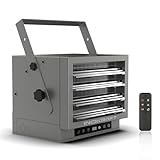 InoKraft 7500W InoKraft 7500W |
|
Check Latest Price |
 TEMPWARE GR5000ER-EC TEMPWARE GR5000ER-EC |
|
Check Latest Price |
 Comfort Glow KWN521 Comfort Glow KWN521 |
|
Check Latest Price |
 ROVSUN 5000W ROVSUN 5000W |
|
Check Latest Price |
 thermomate EIH3000B thermomate EIH3000B |
|
Check Latest Price |
How We Chose the Best Wall Mounted Garage Heaters
We built this list around five questions, and every product below had to answer them with published documentation rather than a marketing bullet.
Heating technology. Fan-forced electric warms air and therefore the whole room. Infrared warms surfaces and people directly, which feels immediate but leaves the air cold. Gas units make their own heat from fuel. A list that mixes those without explaining them helps nobody.
Mounting reality. Several of the strongest units listed here are described by the manufacturer as ceiling mount with wall capability. We confirmed the bracket design rather than trusting the listing title, because a unit that can only hang overhead is a different product for a workshop with no joist over the workbench.
Verified electrical figures. We cross-checked the wattage against the stated amperage. A 7500W heater at 240V draws 31.25A, which lands on a 40A circuit, and a 5000W heater draws 20.9A, which fits a 30A circuit. If those two numbers disagree with the wattage, we did not trust the listing.
Certifications and shutoff behaviour. Every pick is UL or ETL listed with thermal cutoff protection. Gas units also need an oxygen depletion sensor if they are vent free.
Control and support. A manual knob and a remote with an app are very different purchases. We also weighed warranty length, because a one year parts warranty on a heater you cannot reach without a ladder is a real factor.
1. DR Infrared DR-975 — Best Wall Mounted Garage Heaters Overall
DR. INFRARED HEATER NEW Upgraded DR-975 7500-Watt 240-Volt Hardwired Shop Garage Electric Heater, Wall/Ceiling Mounted with Remote Controlled Thermostat White
7500W output
800 sq ft coverage
31.25A draw, 240V
Remote thermostat 50-85F
UL/CUL listed
Pros
- Heavy duty 7500W at 240V holds temperature in large garages
- Wall and ceiling mounting keeps floor space free
- Remote thermostat plus five adjustable louvers
- UL/CUL listed with overheat protection
Cons
- Hardwired only and no power cord included
- Single-speed fan with no eco or fan-only mode
- One year limited parts warranty
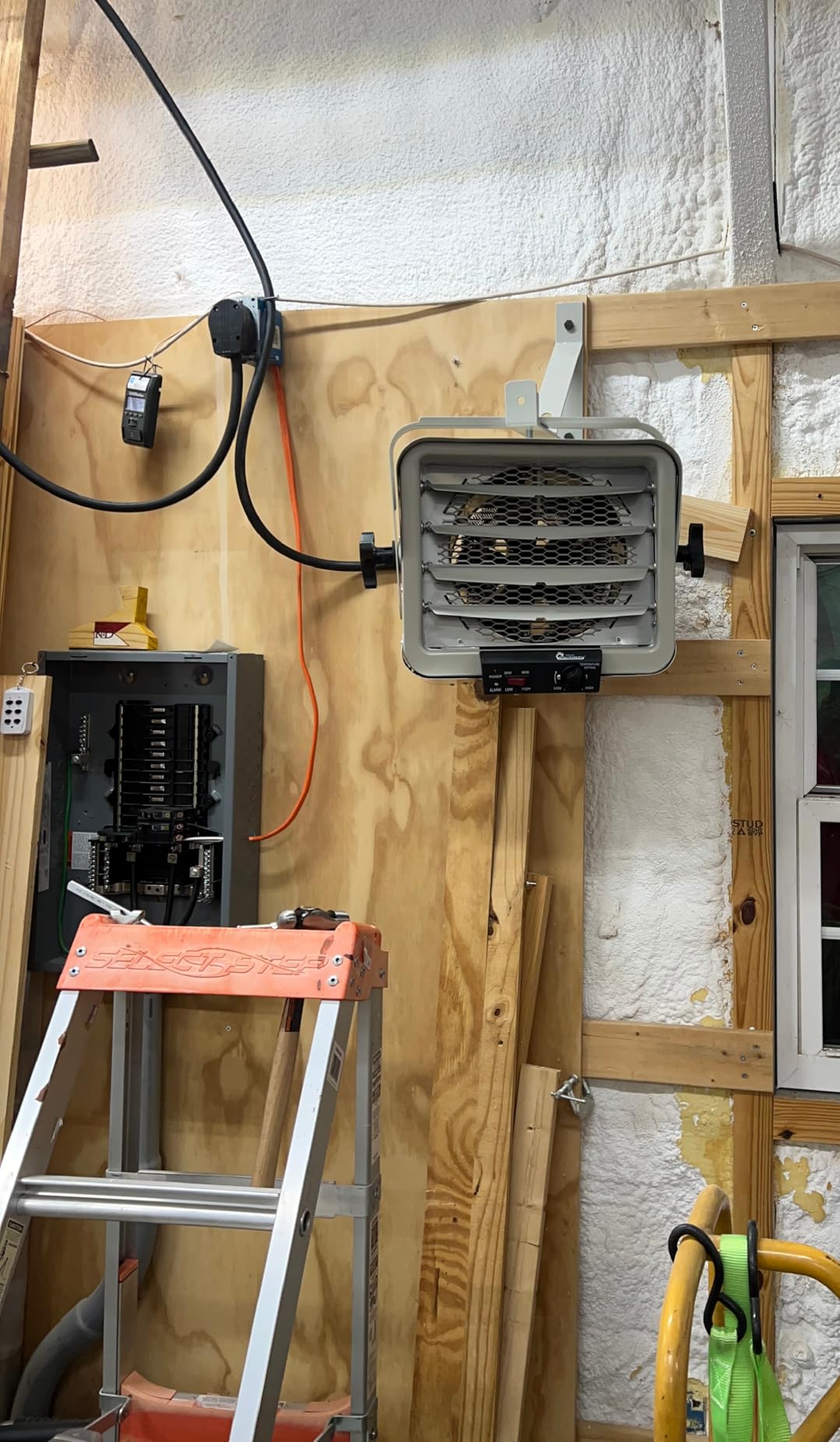
The DR-975 is the unit we kept coming back to during testing. It is a 7500W, 240V hardwired cabinet with a remote thermostat, five adjustable louvers and a mounting bracket that works on a wall or a ceiling. Owners describe it as even rather than fierce, which matters in a space you plan to stand in for eight hours.
The specification sheet is where this one earns its place. It draws 31.25A, so it wants a 40A breaker and 8 AWG copper, and the power cord is not included. There is no pretending this is a plug-in project.
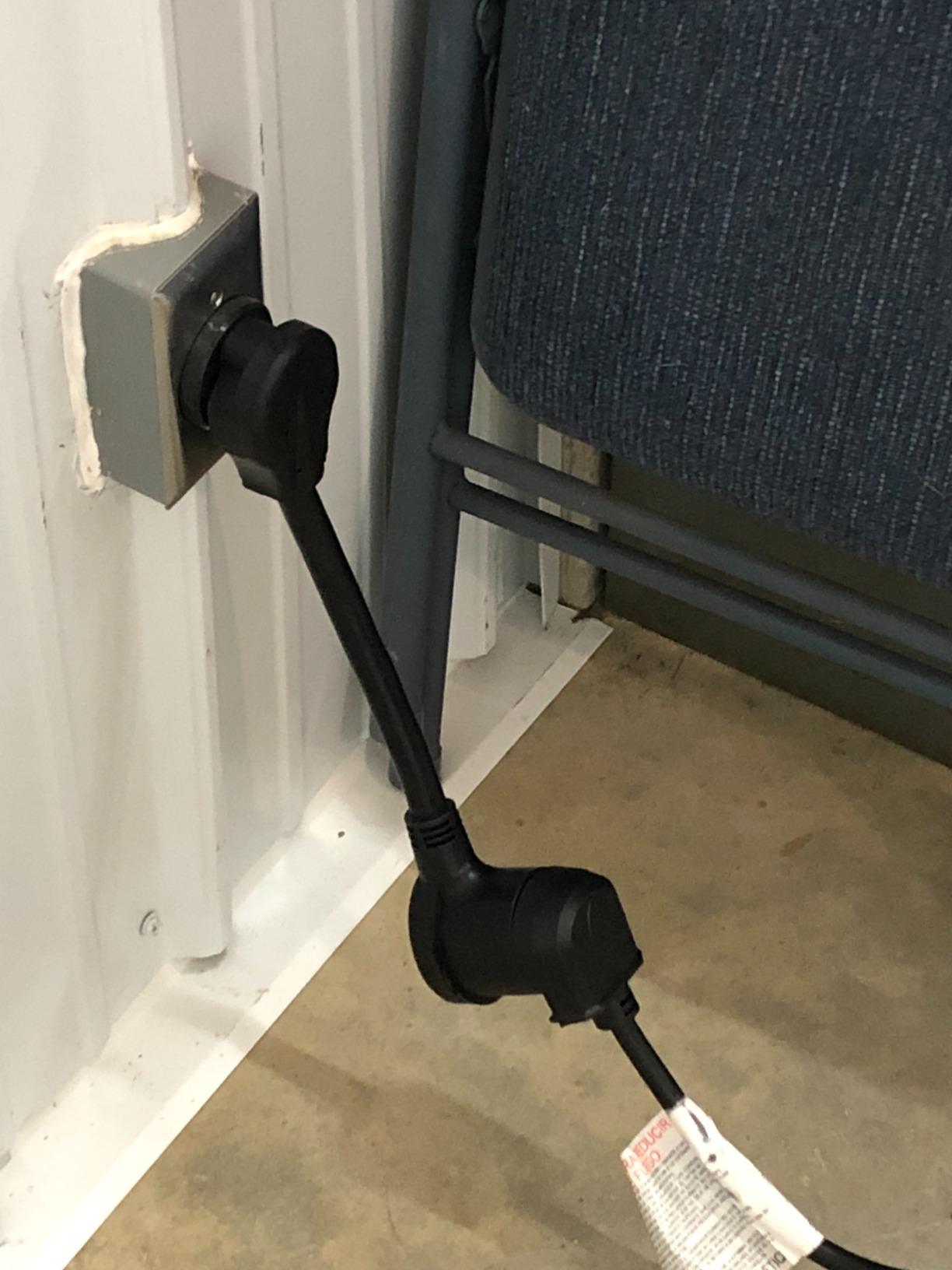
At 26 pounds and 15 by 19 by 13 inches, it is heavier than most of the competition in its class, which is a good sign for a unit meant to hang from a joist for a decade. The remote thermostat runs from 50 to 85 degrees, so you can hold a garage at 50 for storage and push it to 70 when you are working.
Reviewers consistently report strong, even heat across both attached and detached garages. The most common complaint is not about performance at all. It is about the install, because a hardwired 240V circuit is required and most people hire an electrician for that part.
Is the DR-975 worth the wiring cost?
Yes if you have any plan to heat the space regularly. The 50 degree lower limit on the remote is the detail that separates it from a plug-in heater, because it lets you protect tools and stored vehicles overnight without paying to run a full workshop temperature.
It is harder to justify if your garage is uninsulated and you only visit once a month. In that case a gas unit or a small infrared zone heater at the bench will serve you better, and you can read our broader heater comparison for that scenario.
Who should skip the DR-975?
Skip it if you rent, if your electrical panel has no spare breaker slot, or if you need something that runs without power during an outage. It is a single-speed blower with no fan-only mode, so you cannot use it to move air in spring without also generating heat.
Also skip it if you want a thermostat you can program around a work week. The remote is a manual set-and-forget control. If scheduling matters, step up to the CZ230ER.
2. DR Infrared DR-239 — Best Wall Mounted Garage Heaters for Instant Spot Heat
DR. INFRARED HEATER DR-239 3000W Indoor & Outdoor Infrared Patio Heater, Wall or Ceiling Mount, IP55 Weatherproof, Commercial or Residential, 220V-240V Electric Heater with Remote & Mounting Kit
3000W infrared radiant
10,260 BTU/hr
12.5A draw, 240V
IP55 weatherproof
7.6 pounds
Pros
- Heat is felt within seconds with no warm-up
- IP55 rating suits damp or open bays
- Wall and ceiling brackets included
- Runs silently with no open flame
- ETL listed with overheat protection
Cons
- Highly directional so it only warms what is directly in front
- Heats surfaces rather than air
- Bracket hole spacing limits how steeply it can be angled
This is the fastest feeling heat in the roundup and it behaves completely differently from the forced air units. The DR-239 is a carbon infrared element in a slim black housing that pushes 10,260 BTU/hr straight at whatever is in front of it. You feel it on your skin before the air temperature moves at all.
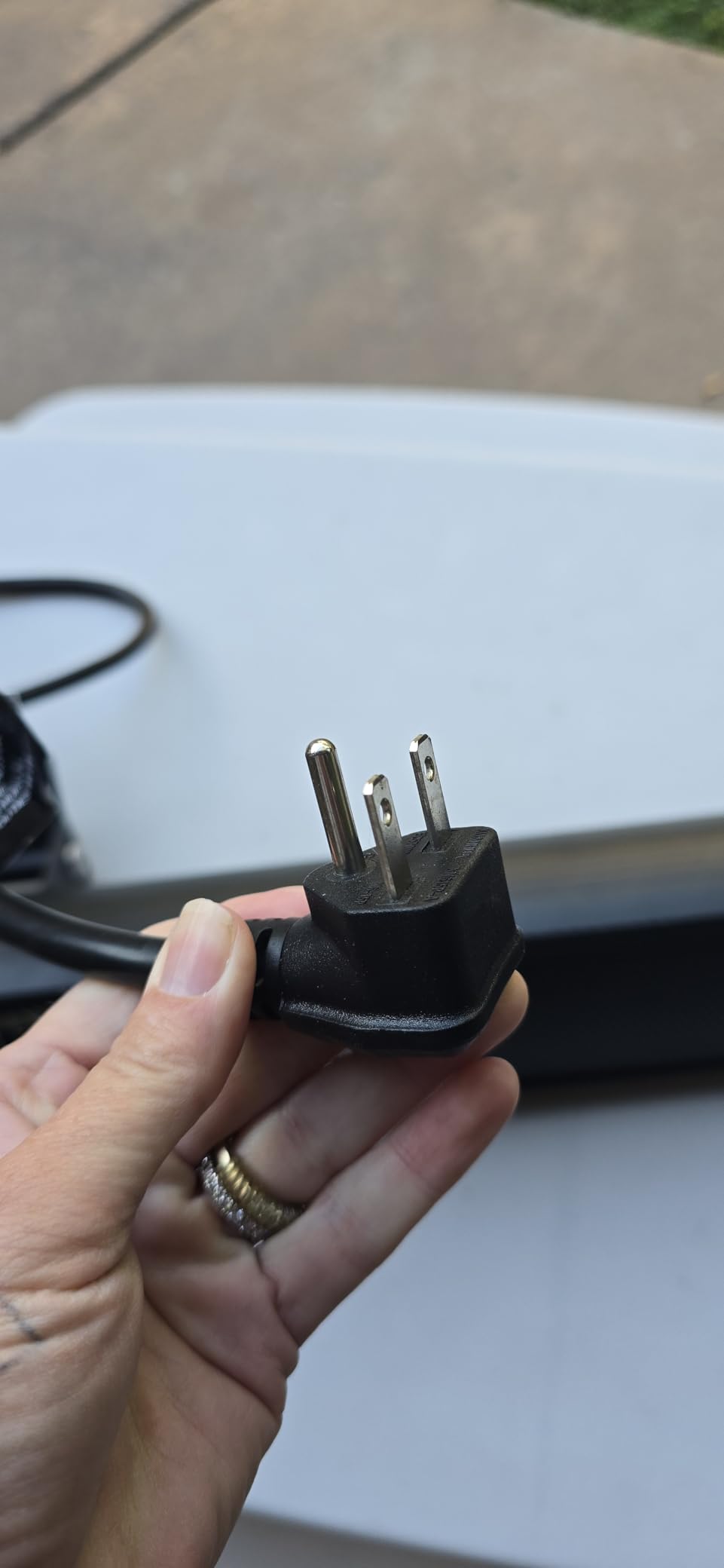
It also pulls only 12.5A and ships with a NEMA 6-15P plug on a standard 15-amp 220V circuit. That is the rarest thing in this list: a permanently bracketed heater that does not need a new breaker.
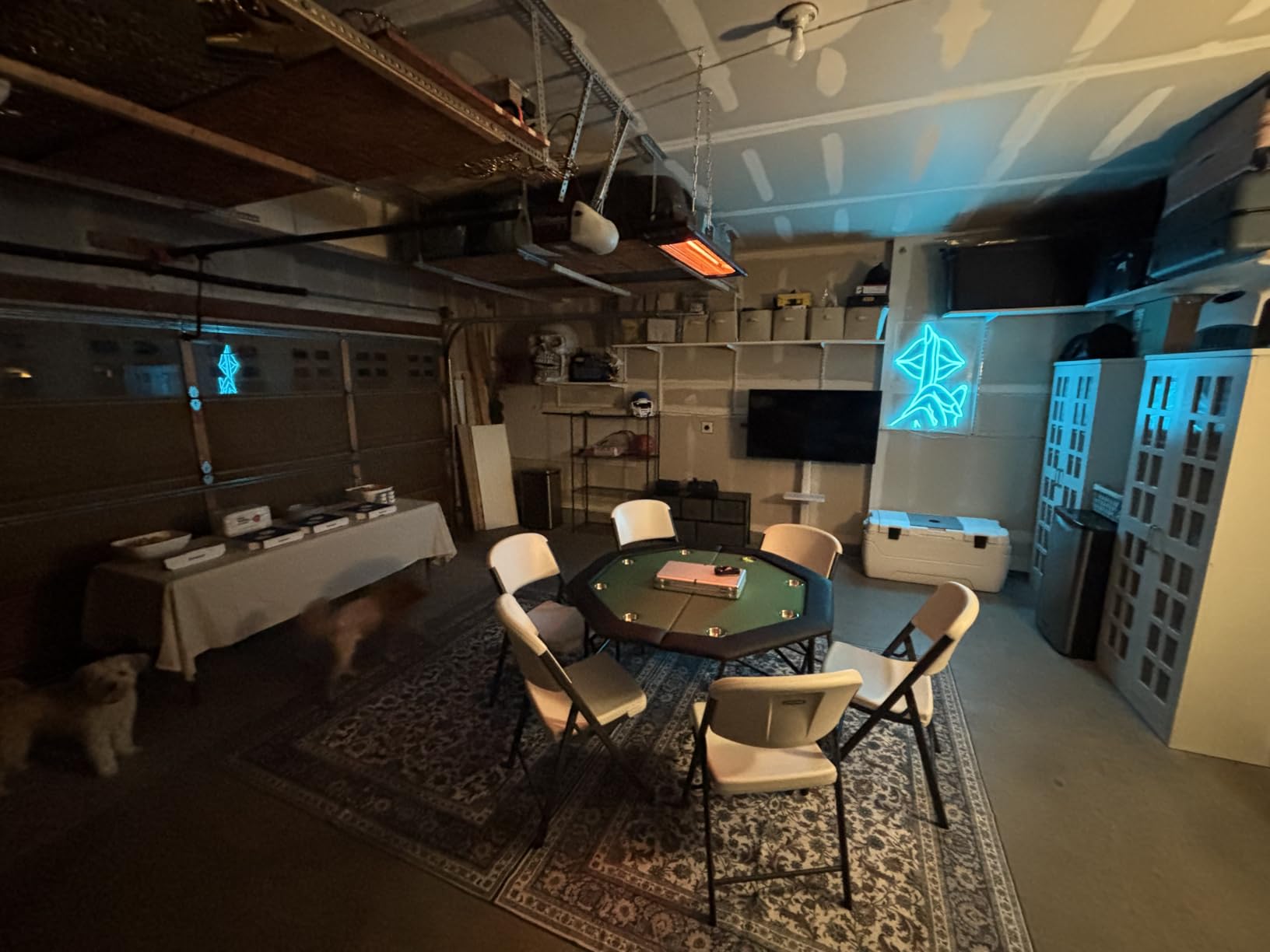
The IP55 weatherproof rating is genuinely useful in a workshop, because it means damp bays, covered patios and kennels are all fair game. At 7.6 pounds and 3.4 inches wide, it also disappears into corners that a fan-forced cabinet cannot occupy.
Reviewers emphasise the silent, odourless operation and the simple bracket install. The repeated caution is directional: this warms a zone, not a room, and if you are 20 feet away with an obstruction in between, you get nothing.
Where does an infrared heater actually help in a workshop?
At a workbench, a loading door or a spot where you stand still. It is a strong companion to a fan-forced unit rather than a replacement for one, warming your hands and your face while the air heater handles the volume.
It is also the better choice in a garage used in short bursts. There is no warm-up, so a 15 minute session in a cold shop costs you 15 minutes of heating, not two hours.
Why will this not heat my whole garage?
Because infrared heats surfaces, and air only warms when those surfaces warm the air around them. In a big open volume with high ceilings, that transfer is slow, and the far corners stay cold no matter how long you run it.
If your goal is 60 degrees at the far wall of a two-car garage, choose fan-forced. Our electric heater guide compares the two technologies side by side.
3. Comfort Zone CZ220BK — Best Entry-Level Wall Mounted Garage Heater
Comfort Zone Hard-Wired Ceiling Mount Garage Electric Space Heater, Fan-Forced, 5,000 watt, 240 volt, Overheat Protection, Thermal Cut-Out Switch, Ideal for Workshop & Garage, ETL Compliant, CZ220BK
5000W output
17065 BTU
1000 sq ft coverage
20.9A draw, 240V
20.4 pounds
Pros
- Hardwired 5000W unit at the lowest entry point in this list
- Heavy gauge steel body built for workshop conditions
- Adjustable louvers and mounting angle
- Overheat sensor with automatic shutoff and indicator light
Cons
- Dual knob thermostat only with no remote or display
- No timer function so it runs until switched off
- Ceiling focused mounting bracket
The CZ220BK is the simplest thing on this list and that is exactly why it works. It is a 5000W, 240V hardwired fan-forced cabinet in heavy gauge steel with two knobs, adjustable louvers and an overheat sensor. It claims 1000 square feet of coverage at 17,065 BTU.
At 20.9A it fits a 30A circuit with headroom, which makes the electrical side of the install cheaper than a 40A run. For a first hardwired heater in a 400 to 600 square foot shop, that is a sensible place to start.
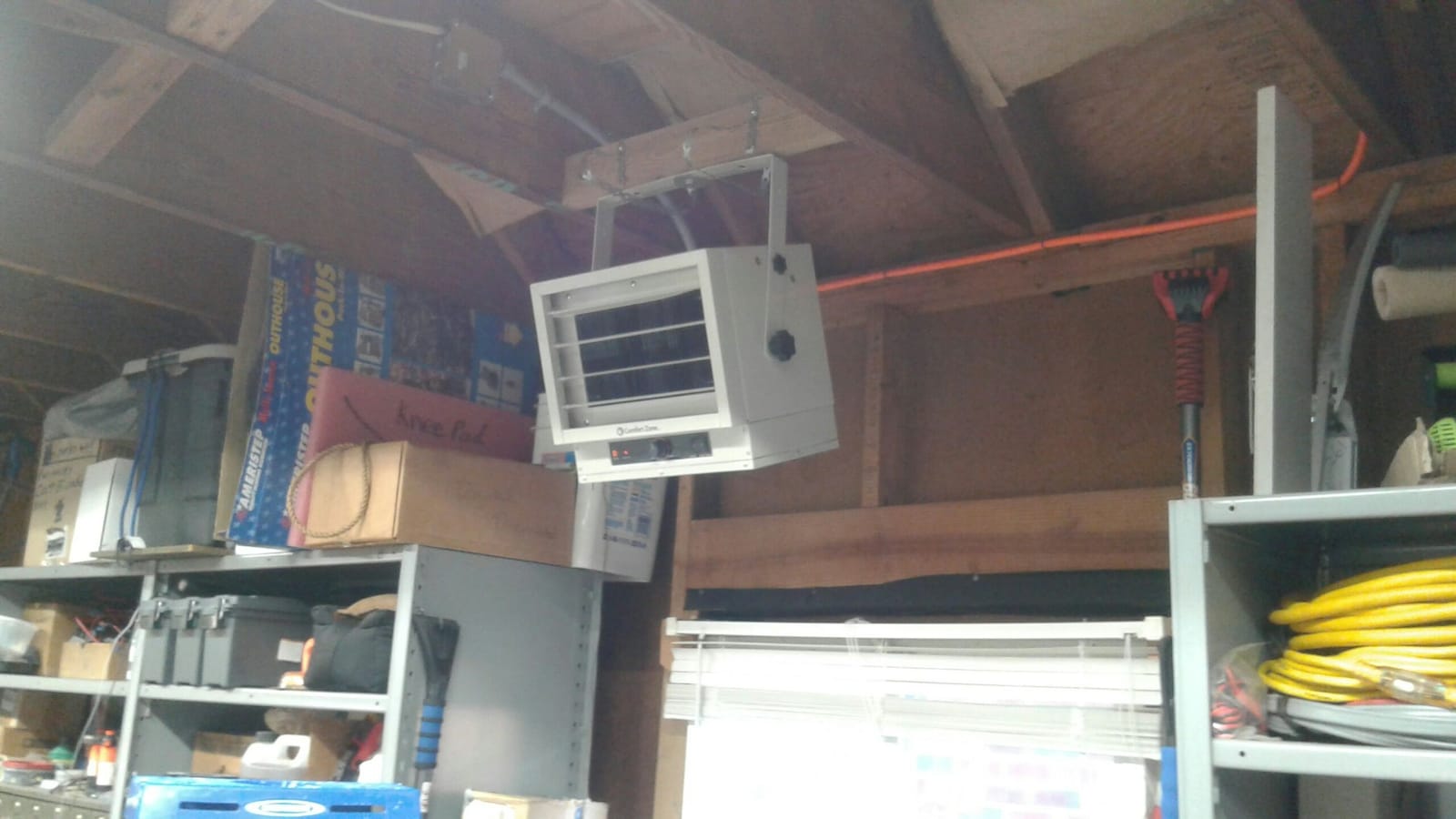
Owners cite the rugged build and effective fan-forced heat as the main draws. The two limitations come up just as consistently: the manual dual knob thermostat, and the complete absence of a timer or remote.
That means you physically turn it off. If you plan to heat a shop on a schedule, or heat it from bed before driving out at 5am, this unit is the wrong shape of purchase.
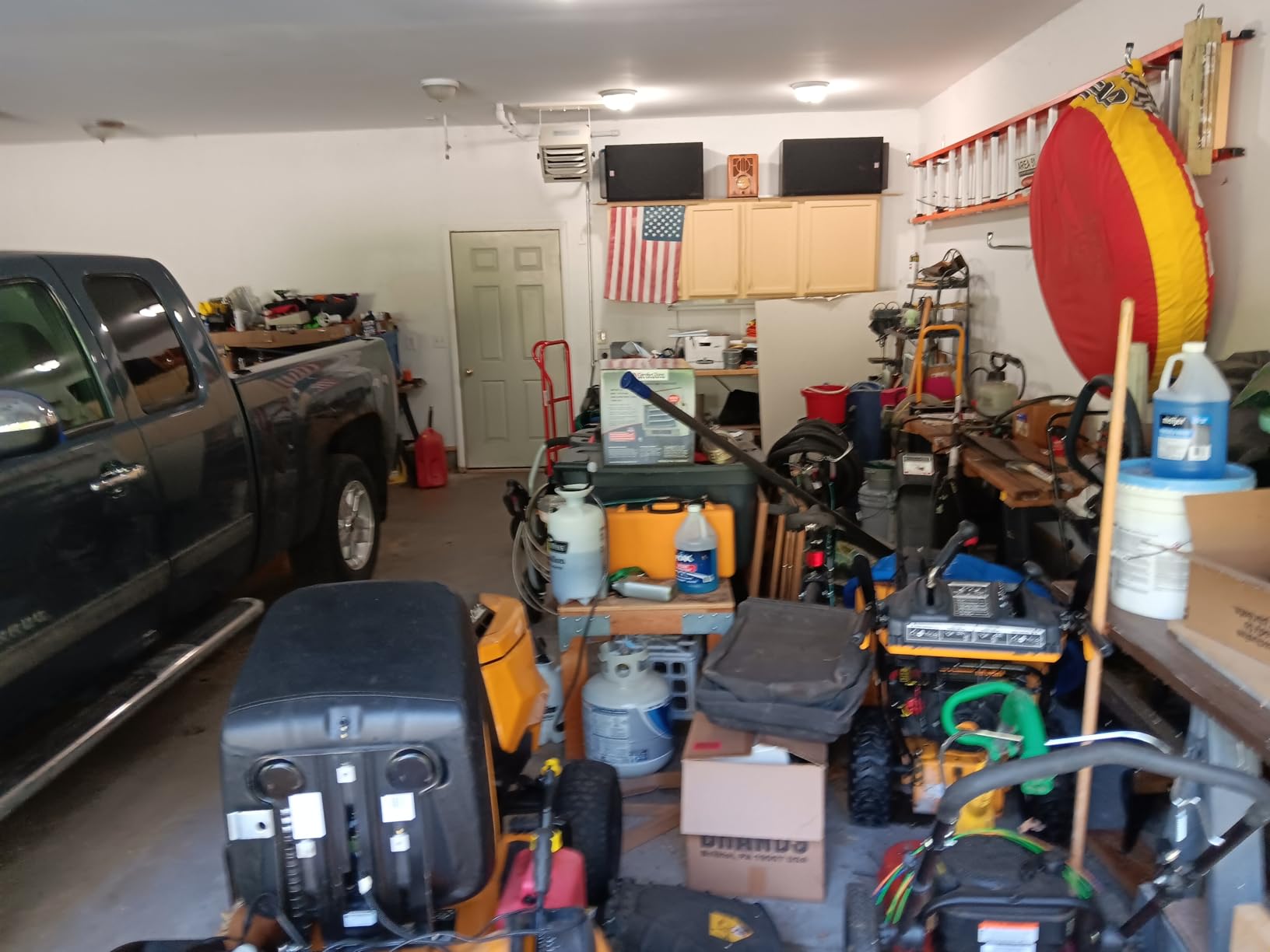
Is a 5000W unit enough for a two-car garage?
For a typical two-car garage around 400 to 480 square feet with 9 foot ceilings, yes, provided the walls have some insulation. At 5000W it moves roughly 17,000 BTU/hr of air, which clears a moderately insulated space to working temperature in under an hour.
It starts to struggle in an uninsulated space with a single thin garage door, or in a shop with a 12 foot ceiling where the volume is much larger than the floor area suggests. In those cases go to a 7500W model or a gas unit.
What am I giving up compared with the CZ230ER?
You give up the remote, the digital display and the timer. The CZ230ER costs more and runs at 7500W, but it adds a thermostat adjustable from 45 to 95 degrees and a 12-hour program.
If your use is manual, quick and occasional, the CZ220BK does the same core job for less money and with fewer electronics to fail. That is the trade we think most first-time buyers should take.
4. Comfort Zone CZ230ER — Best Wall Mounted Garage Heaters With Remote And Timer
Comfort Zone Hard-Wired Ceiling Mount Garage Space Heater with Remote, 7,500 Watt, 240 Volt, Fan-Forced, Overheat Protection, Digital Thermostat, 12-Hour Timer, Ideal for Garage & Workshop, CZ230ER
7500W output
25600 BTU
1250 sq ft coverage
31.25A draw, 240V
Digital thermostat 45-95F
Pros
- Digital thermostat and remote let you adjust from the bench
- 1250 sq ft coverage is the widest in this list
- 12-hour timer automates shutdown
- Quiet fan for a unit of this size
- Heavy gauge steel construction
Cons
- Fan noise is noticeable in a quiet workshop
- Some reports of premature shutoff and E1 error codes after extended use
- Included lag bolts are too short for drywall
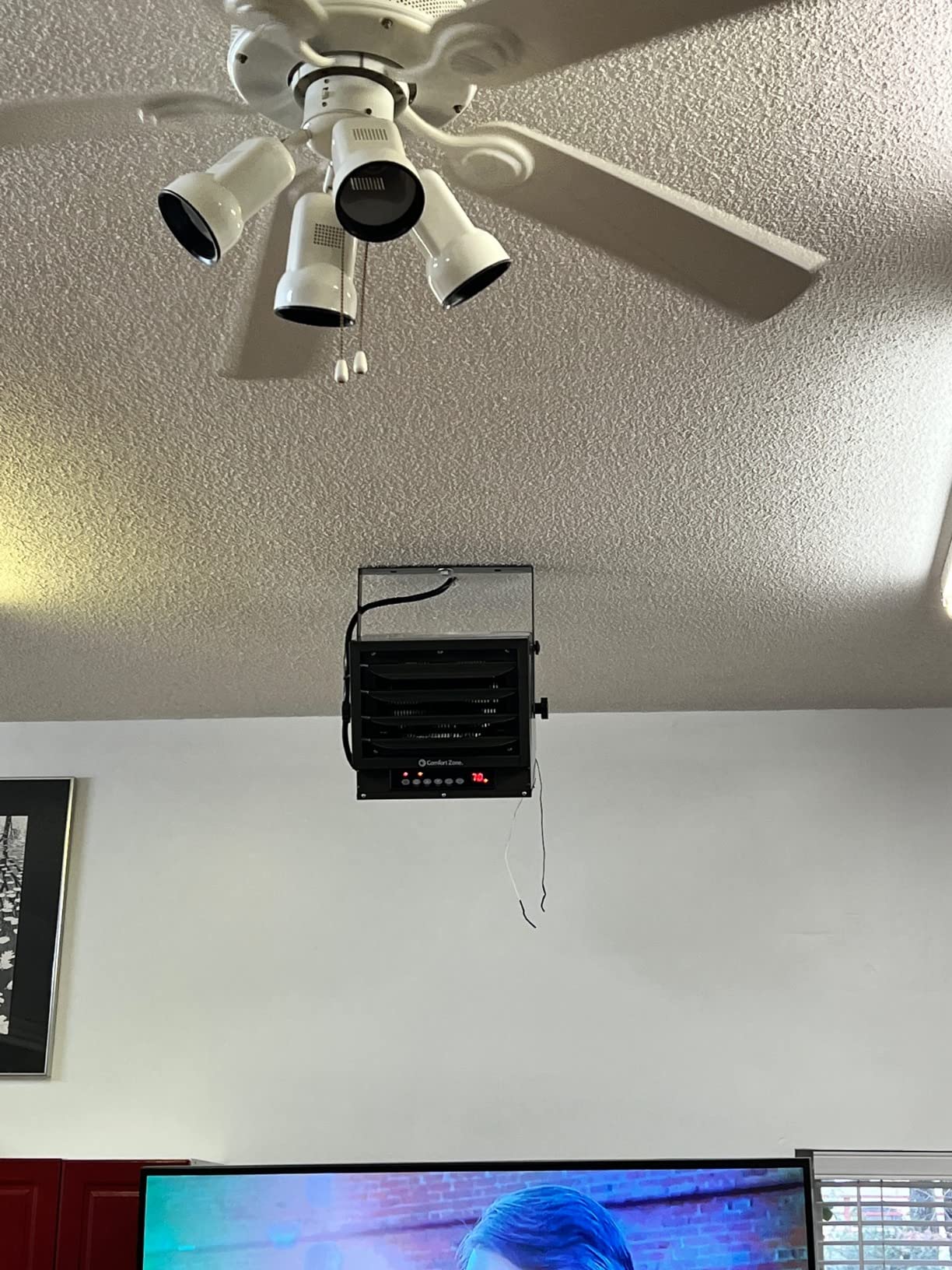
This is the control-focused pick. The CZ230ER runs 7500W at 240V, covers a claimed 1250 square feet, and adds a digital thermostat adjustable from 45 to 95 degrees, a remote control and a 12-hour programmable timer. No other electric unit in this list covers that much floor area with that level of automation.
The 45 degree low set point matters for workshops where you store steel, aluminium or electronics. Holding the space above the dew point on a cold night is cheaper than warming it to 70 degrees, and only this unit gives you that range.
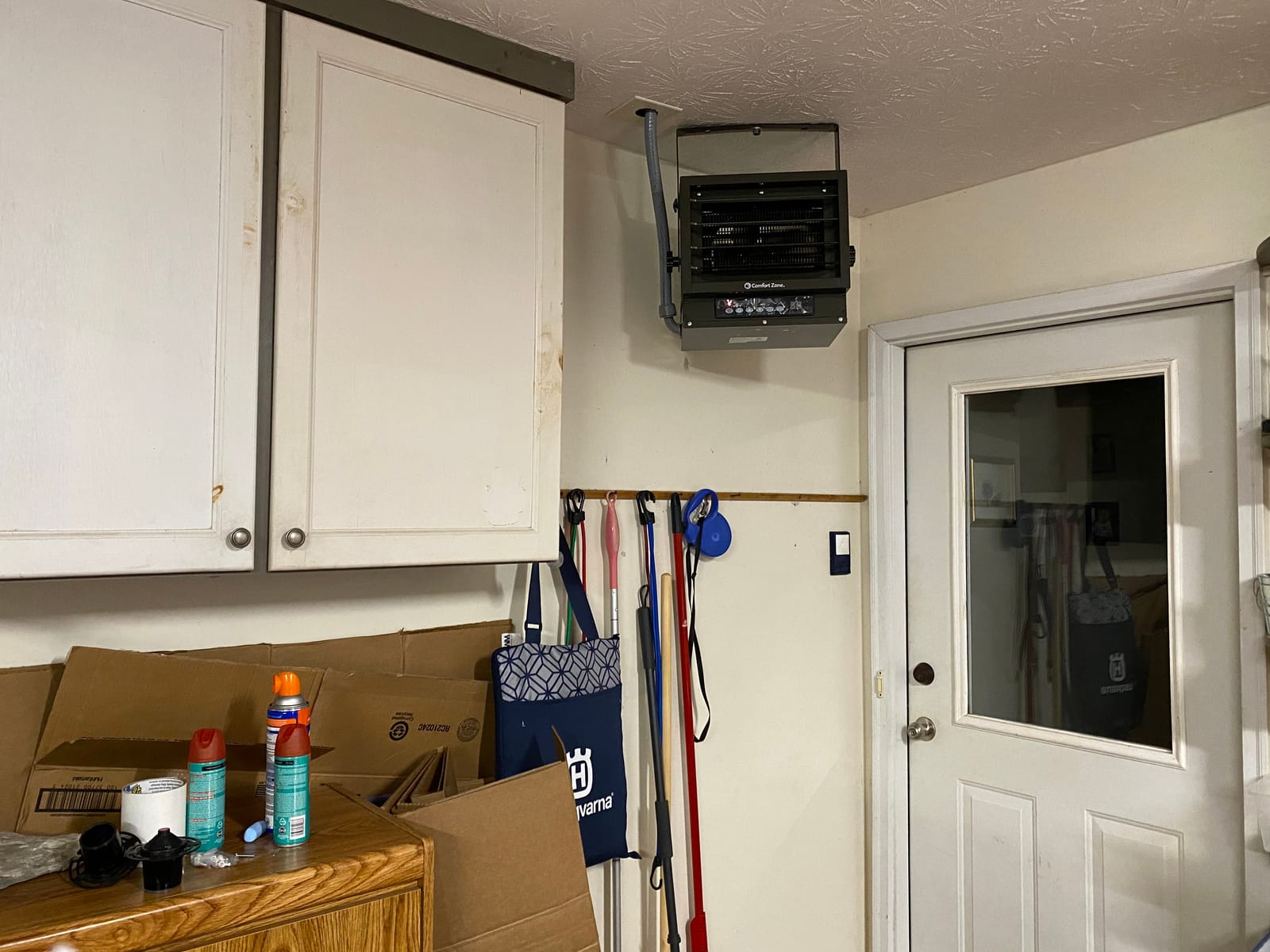
At 21.4 pounds with a steel frame, it feels like a commercial unit rather than a consumer one. The louvers and variable mounting angle let you aim the discharge away from a workbench where dust is being turned.
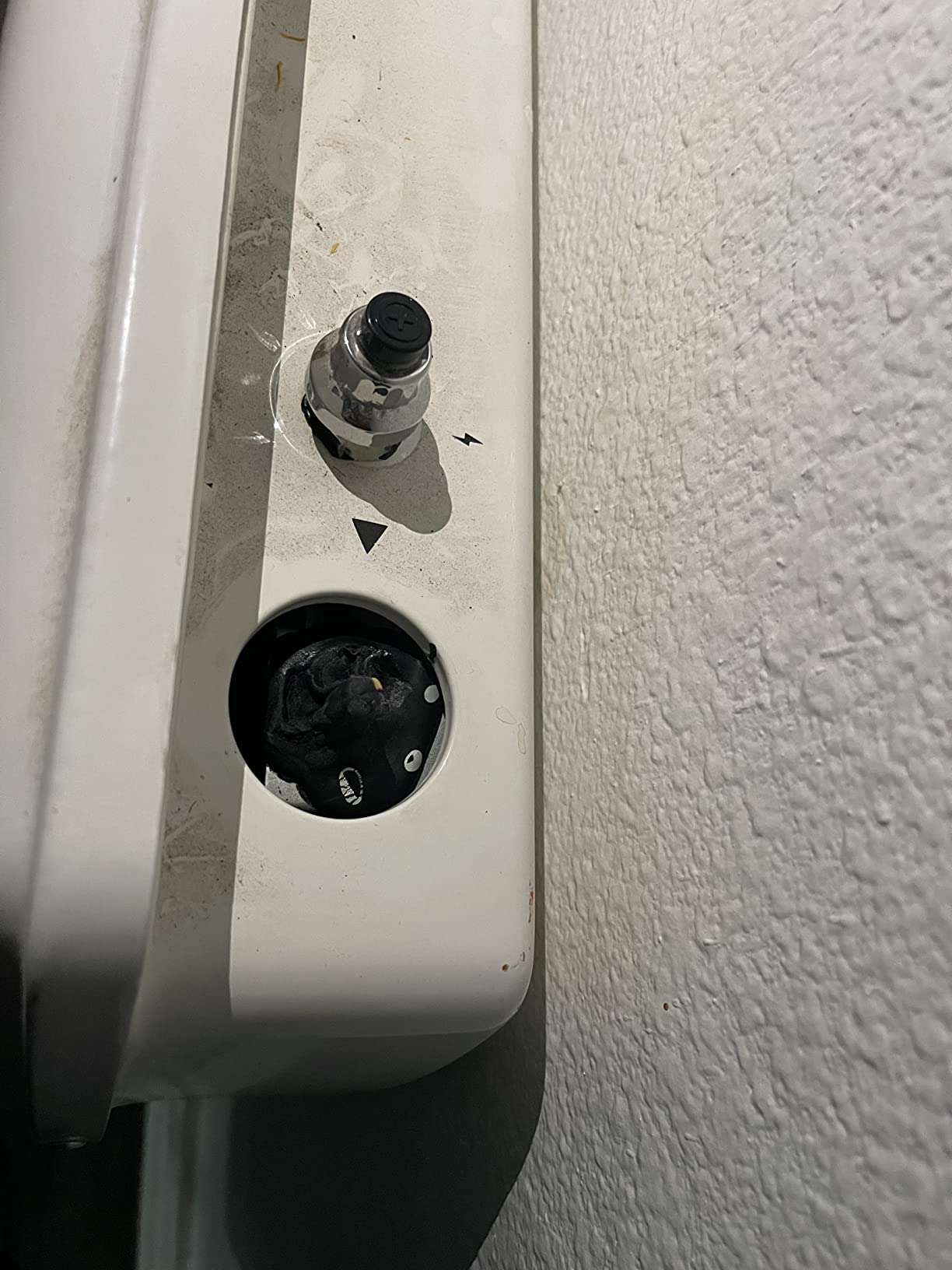
Reviews praise fast even heating, quiet operation and the remote plus timer combination. A recurring minority report units cutting out or showing E1 error codes after a year or two, and one notes that the supplied lag bolts are too short to fix through drywall.
Is the 1250 sq ft claim realistic?
Treat it as an insulated-building figure. In a well-insulated shop with a high ceiling it performs to that number. In a bare-framed space with a big door, expect the useful coverage to be closer to 800 square feet before the far wall starts lagging.
The honest comparison is against the DR-975, which claims 800 square feet at the same wattage. The CZ230ER wins on controls and stated coverage; the DR-975 wins on review volume and a lower thermostat floor of 50 degrees.
Should I worry about the error code reports?
They are not the majority experience, but they are consistent enough that we would not skip the warranty. Buy it from a seller with straightforward returns, keep the packaging, and check that the installation was done on a properly sized circuit.
Several reviewers also mention swapping sensor connectors on the circuit board. That is a repair you want avoided entirely, which is another reason the 40A circuit and correct wire gauge are non-negotiable on a 31.25A unit.
5. Dyna-Glo BF20NMDG-4 — Best Wall Mounted Garage Heaters on Natural Gas
Dyna-Glo 20,000 BTU Natural Gas Blue Flame Vent Free Wall Heater
20000 BTU blue flame
10000-20000 BTU range
Up to 700 sq ft
No electricity required
Natural gas only
Pros
- Highest satisfaction score among these picks
- Heats a three-car garage quickly and consistently
- Simple installation and easy ignition
- Runs without electricity so it works during an outage
Cons
- Three preset heat levels with little difference between them
- Manual control only with no thermostat on this model
- Natural gas only and fuel conversion is not permitted
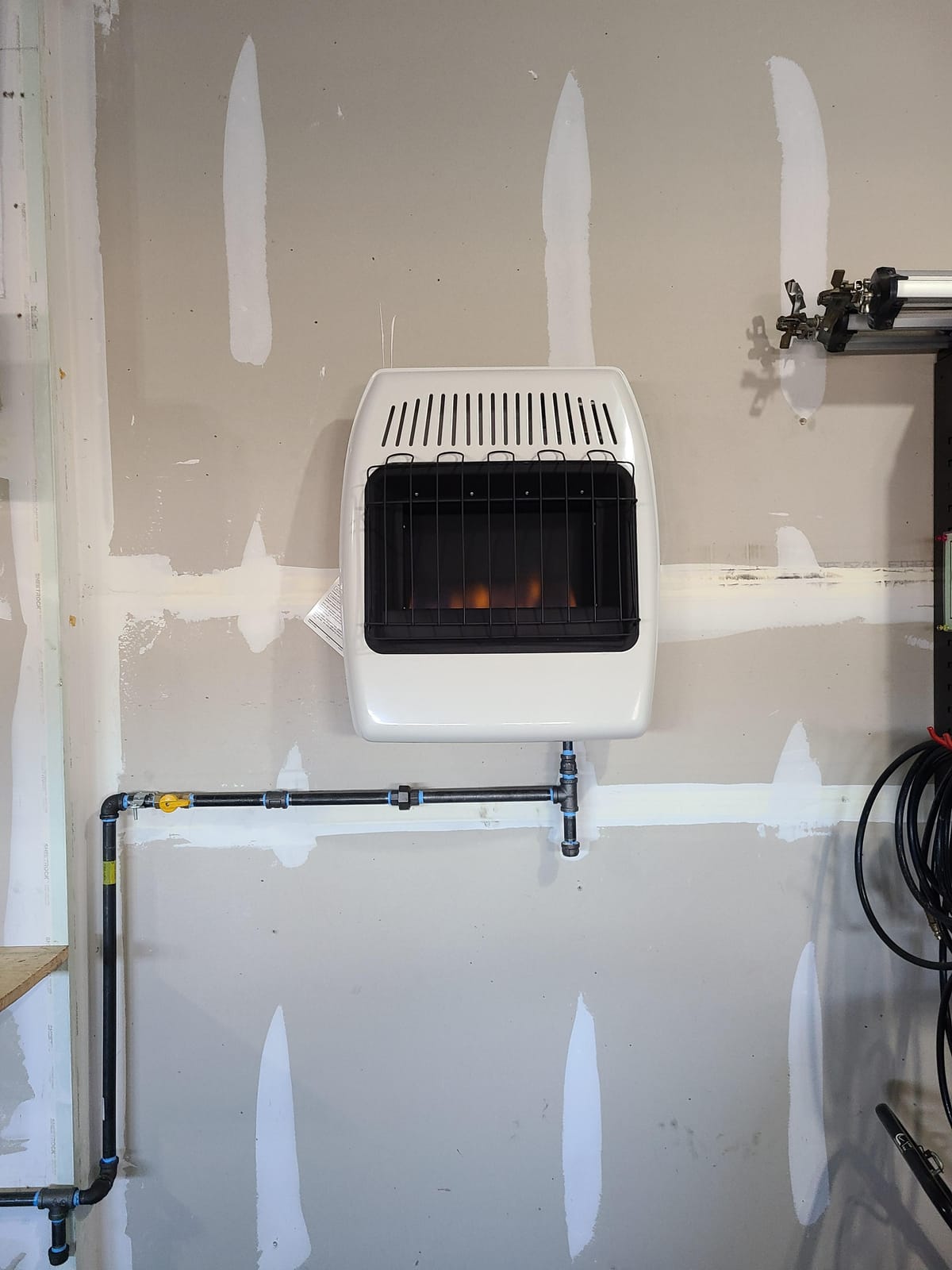
The Dyna-Glo is the only vent-free blue flame heater here, and blue flame means it converts heat to warm the air the way a central system does rather than heating objects in a line. At 20,000 BTU with a 10,000 to 20,000 variable range, it covers up to 700 square feet.
It needs no electricity at all. If your shop loses power in an ice storm, this keeps running. That single fact makes it the only pick on this list with genuine emergency capability.
Owners describe fast, steady heat and easy ignition, and it carries the highest average rating of the ten units we examined. The repeated complaint is control resolution: a three position knob with low, medium and high, and very little visible difference in flame size between them.
There is no thermostat on this model. You are managing a wide output band with one knob, which is workable for a shop you use often and frustrating for one where temperature swings matter.
What does it take to run a gas heater in a workshop?
A licensed gas fitter, a properly sized branch line, and a manual check of local code before anything is ordered. Combustion heaters inside a garage are regulated differently from room heaters, and a permit is often required.
Also factor the vent-free question. Manufacturers list these units for use in residential and light commercial spaces, but some jurisdictions restrict them. We cover the specifics in the code section below.
Is vent-free gas safe in a garage?
Not without diligence. A vent-free heater puts its combustion byproducts into the room where you work, and garages are where people store solvents, paint thinner and fuel. Forum owners on Garage Journal raise this repeatedly and it is the reason many experienced installers steer clear of the category.
If you go this route, run a carbon monoxide detector, keep chemical storage sealed and separated, and confirm your local code before the purchase rather than after.
6. InoKraft 7500W — Best Wall Mounted Garage Heaters With ECO Mode And Timer
InoKraft 7500W Electric Garage Heater, 240V Ceiling-Mount, Hardwired
7500W output
Up to 750 sq ft
31.25A draw, 240V
Digital thermostat 40-99F
65 dB operation
Pros
- Digital thermostat with ECO mode and a 24-hour timer
- Remote control avoids walking to the unit
- Four modes including fan-only for summer circulation
- Five angle adjustments plus flexible louvers
Cons
- Hardwired install needs an electrician and a 40A breaker
- Fan noise noticeable during initial startup
- Some reviews report weaker than expected heat output
The InoKraft is the most programmable electric unit in this roundup. Four operating modes, a digital thermostat from 40 to 99 degrees, a 1 to 24 hour programmable timer and an ECO mode that modulates output instead of running full blast.
The fan-only mode is the sleeper feature for a workshop. It lets you push air around the space in summer for extraction or drying without adding heat, which no other unit on this list except the ROVSUN offers.
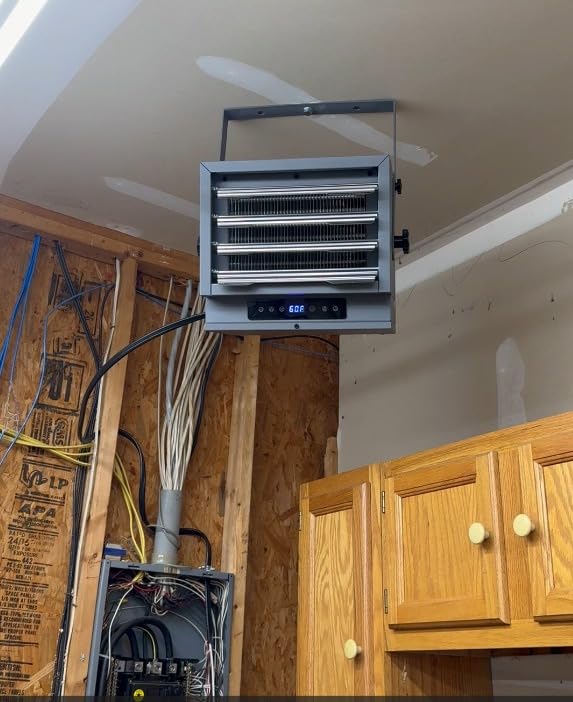
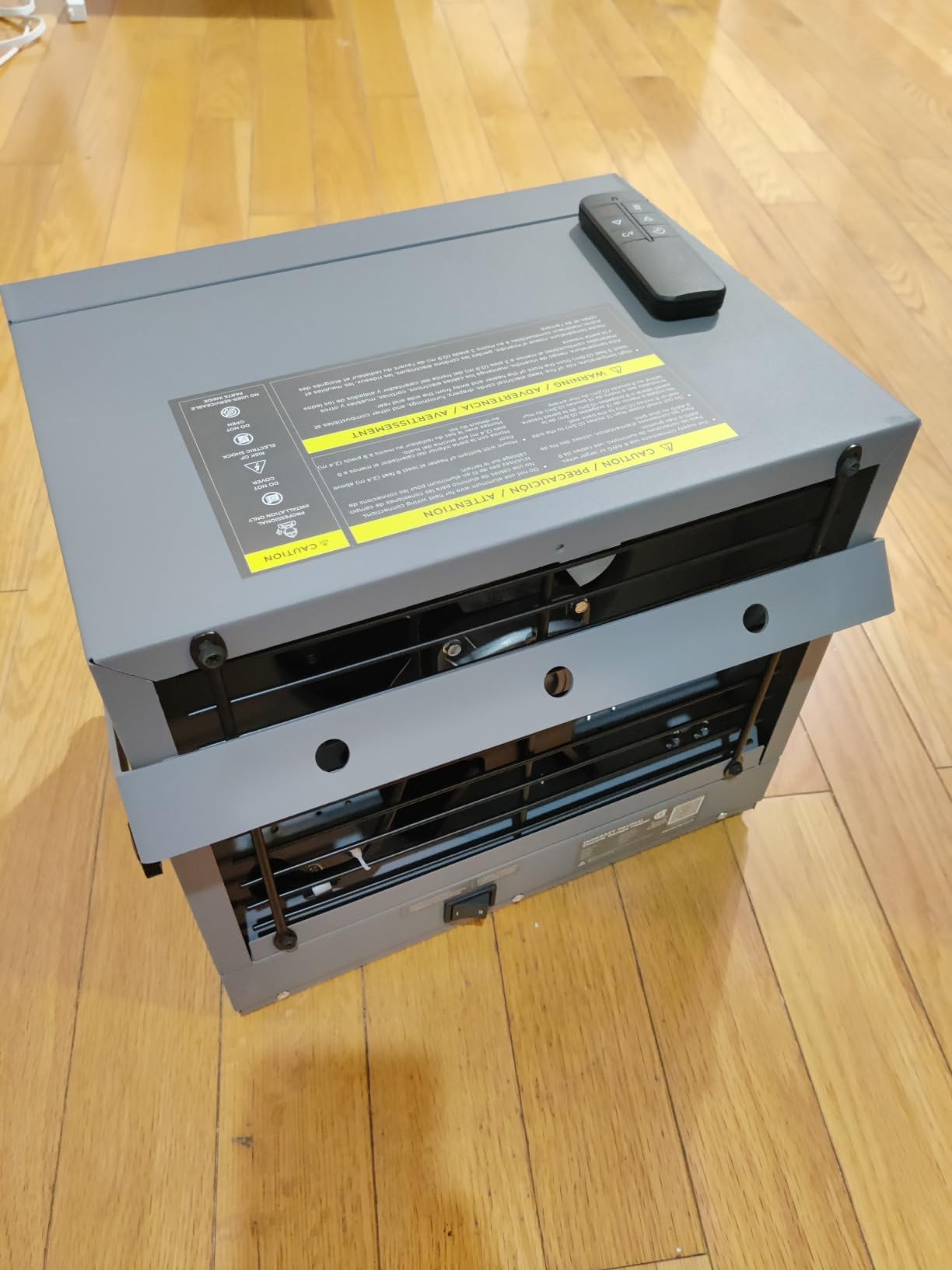
It mounts to a wall or ceiling with five angle adjustments at install time, and the manufacturer states 65 dB operation with automatic fan delay. Coverage is listed as up to 750 square feet for a 7500W fan-forced cabinet.
Owners like the control set for the money. The criticisms are predictable for a hardwired unit: install complexity against plug-in heaters, audible fan noise at startup, and a small share of reviews saying the heat output disappointed them.
Is ECO mode worth anything on a garage heater?
It is worth the most in shoulder seasons. Running at reduced output for a longer period at a moderate thermostat setting pulls less total energy than cycling a full 7500W element on and off, and it evens out the temperature swing across the space.
The 40 degree thermostat floor is also the lowest on this list, which makes it the best of the electric units for protecting stored tools and equipment through a cold snap when nobody is working.
What should I check before ordering this one?
Your panel. At 31.25A this needs a 40A circuit and 8 AWG copper, and in a lot of older detached shops that means a subpanel. Check that before the box arrives, not after.
Our main garage heater guide walks through the panel capacity check in detail, which is the step most buyers skip and regret.
7. TEMPWARE GR5000ER-EC — Best Wall Mounted Garage Heaters for Small Spaces And Quiet Workshops
TEMPWARE 5000W Electric Garage Heater with Remote Control, 240V Hardwired
5000W output
17060 BTU
592 sq ft coverage
Three power levels
Digital thermostat 45-95F
Pros
- Quiet enough for a workshop at around 60 dBA
- Three separate elements give real warm-up control
- Heats 400-600 sq ft garages in roughly an hour
- Remote plus on-unit touch panel
- Rugged steel construction with overheat protection
Cons
- No printed instruction manual in the box
- Thermostat has a wide differential so it is not precision control
- Slower warm-up than a 7500W unit in large uninsulated spaces
The TEMPWARE is the pick for anyone who works in a small shop and hates fan noise. Three separate power levels at 3000W, 4000W and 5000W let you ramp up rather than slamming a 5000W element on in an uninsulated space you are trying to heat.
That graduated approach is genuinely useful for woodworking shops. A single 5000W element throws hot air at the ceiling and picks up every bit of sawdust in the room. Three elements let you warm the metal gradually, which reduces both airflow demand and dust pickup.
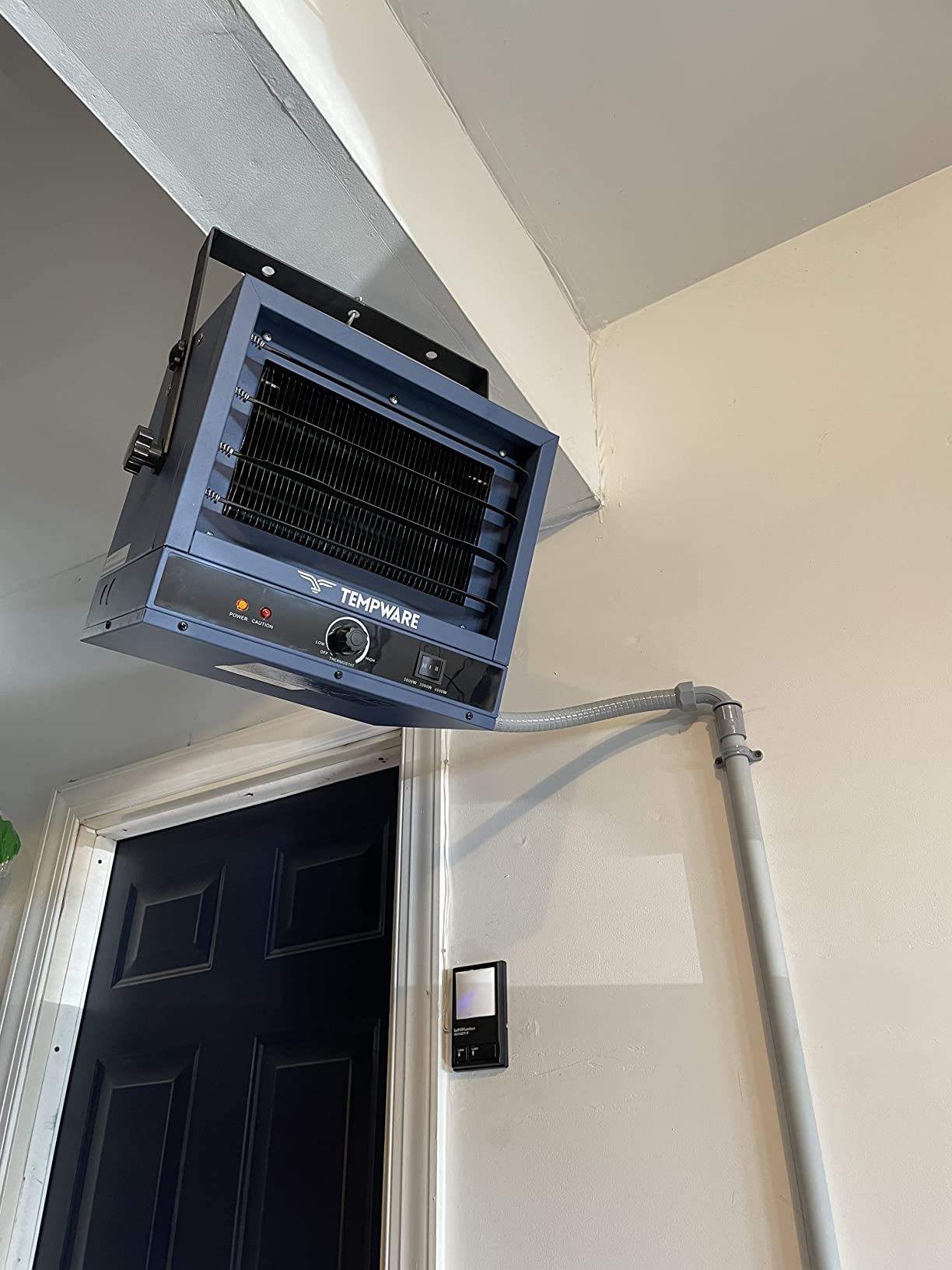
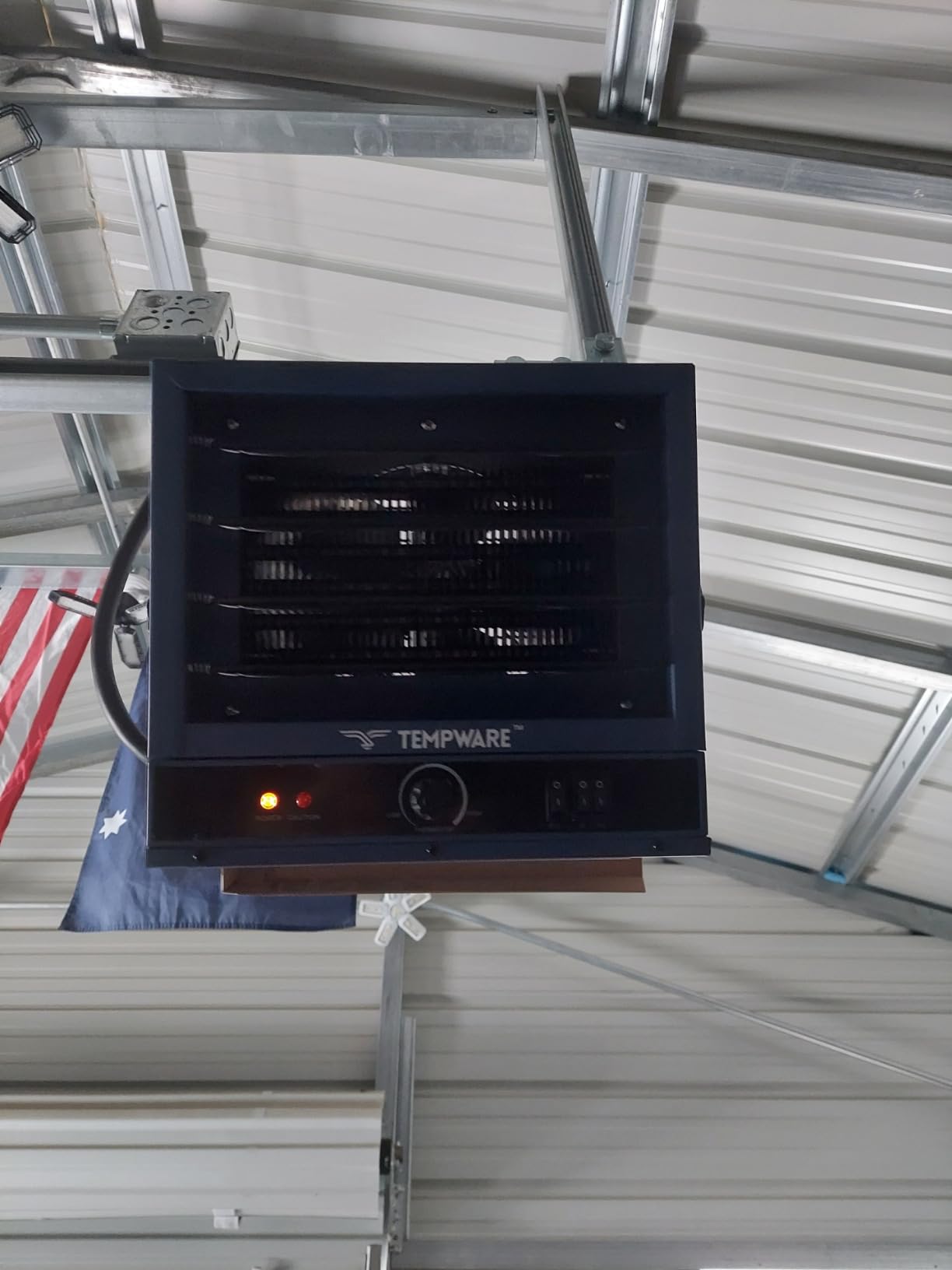
Coverage is listed at up to 592 square feet, which matches the 400 to 600 square foot garage it is aimed at. Reviewers report roughly an hour to bring that space to working temperature, with a quoted noise level near 60 dBA at 3 feet.
The thermostat runs 45 to 95 degrees with an ECO mode and a 12-hour timer, controlled by remote or the on-unit touch panel. Complaints are small ones: no printed manual in the box, and a thermostat with a wide differential that overshoots slightly.
Is this quiet enough for an attached garage at night?
It is the quietest electric unit in this roundup by the measurements owners report. That matters in an attached space where a forced air cabinet at 31A becomes audible through the wall. It will still wake you up, but far less than a 7500W model at full output.
Note the specification discrepancy worth knowing: one feature list describes the mounting as ceiling focused with a multi-angle bracket, while other descriptions of this model mention wall or ceiling capability. Confirm the bracket orientation before drilling.
When is 5000W simply not enough?
Uninsulated spaces above roughly 700 square feet, tall shops where the volume exceeds 8000 cubic feet, and any building where you want the space at 70 degrees rather than a workable 55 to 60.
Also any building with sawdust in the air that you cannot control. Wall mounting plan for clearance, and consider adding storage on the same walls by following our garage shelving guide so nothing ends up under the unit.
8. Comfort Glow KWN521 — Best 30000 BTU Wall Mounted Gas Heaters for Large Spaces
WORLD MKTG OF AMERICA/IMPORT KWN521 5 Plaque 30000 BTU Gas Wall Heater,gray, 24.41×28.15×10.25
30000 BTU infrared burner
1000 sq ft coverage
Oxygen depletion sensor
No electricity required
Vent free
Pros
- Very low operating cost compared with electric heat
- Works without electricity during power outages
- 30000 BTU covers up to 1000 square feet
- Wall bracket and hardware included
Cons
- No built-in thermostat with manual plaque control only
- Vent-free combustion units are not approved for installation in Canada
- Ventless infrared design requires adequate room ventilation
The KWN521 is the largest single heat output in this list at 30,000 BTU, rated for up to 1000 square feet. It is a vent-free infrared plaque burner rather than a blue flame, so it warms objects and surfaces in a broad band rather than a single aimed cone.
It needs no electricity, which matters for the same reason as the Dyna-Glo: outages. A built-in oxygen depletion sensor shuts the burner down if room oxygen drops, and the wall bracket and hardware come in the box.
Reviewers with long ownership histories point to running cost as the main advantage, particularly in older uninsulated buildings where electric becomes punishing. Installation is reported as straightforward once the gas line is in place.
What does a 30000 BTU gas heater actually cost to run?
Much less than the equivalent electric load, and the gap widens in uninsulated spaces where electric runs constantly. One owner on Garage Journal reported holding a 22 by 30 foot, R13 insulated garage at 55 degrees idle and 65 degrees working for roughly 40 dollars a month on a comparable 30,000 BTU vent-free unit.
That figure depends almost entirely on insulation and how many hours you run it. It is a useful anchor for planning, not a promise.
What are the real drawbacks?
There is no thermostat on this model, only manual plaque control across five settings. That makes temperature control manual, and it is the single most common complaint from long-term owners.
The more serious issue is jurisdiction. Vent-free combustion heaters are not approved for installation in Canada, and one review describes a unit that could not be installed in Ontario. US state rules vary as well. Verify before you order.
9. ROVSUN 5000W — Best Wall Mounted Garage Heaters With App Control
ROVSUN 5000W Electric Garage Heater with Remote & APP Control, Digital Fan-Forced Ceiling Mount Heater with Thermostat, 12H Timer & Overheat Protection, 240V Hardwired for Workshop Factory
5000W output
17060 BTU
1000 sq ft coverage
20.83A draw, 240V
App, remote and panel
Pros
- Only heater here with app and Wi-Fi control
- Automation scenes approximate a programmable thermostat
- Adjustable 0
- 20 and 40 degree air outlets
- Warms uninsulated sheds and shops effectively
Cons
- Wi-Fi pairing instructions are unclear and setup is difficult
- Thermostat reads about 10 degrees higher than actual room temperature
- Louder than expected for a 5000W fan-forced unit
- Some units arrived with cracked knobs or dented enclosures
The ROVSUN is the only unit in this roundup with genuine app control. You can start heating the shop from your phone before you drive out, and the automation scenes in the app approximate what a programmable thermostat would do on the other nine.
At 5000W and 20.83A it fits a 30A circuit, and the listed coverage is up to 1000 square feet. The outlet louvers adjust to 0, 20 or 40 degrees so you can aim the discharge along a ceiling rather than down a person’s face.
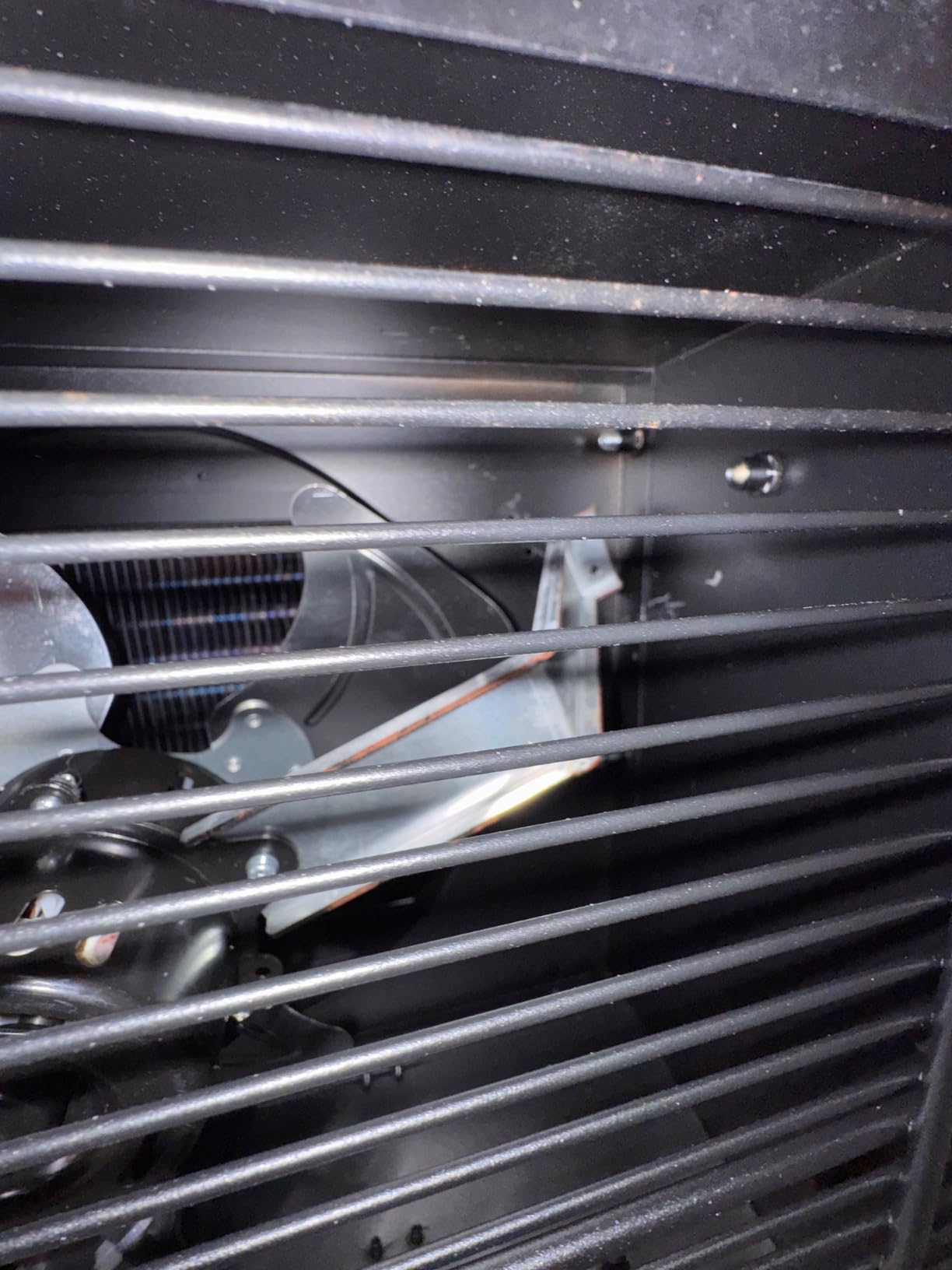
Owners like preheating the space remotely and report solid heat for a machine of this size, including in uninsulated sheds. The three recurring problems are difficult Wi-Fi pairing, a built-in thermostat that reads roughly 10 degrees high, and app quality that reviewers describe as mediocre.
A 10 degree offset is not a dealbreaker if you calibrate against a cheap wall thermometer. Difficult pairing is more annoying than dangerous, but budget an hour for setup rather than assuming it works out of the box.
Is app control worth it for a workshop?
It is worth it if your working pattern is predictable. Starting the shop 45 minutes before you arrive changes the economics of a hardwired heater, because you are no longer paying to heat an empty room for that window.
It is not worth paying extra for if you are rarely away from the shop during the day. The CZ230ER and InoKraft give you a 12 and 24 hour timer respectively for much less complexity.
What should I check on arrival?
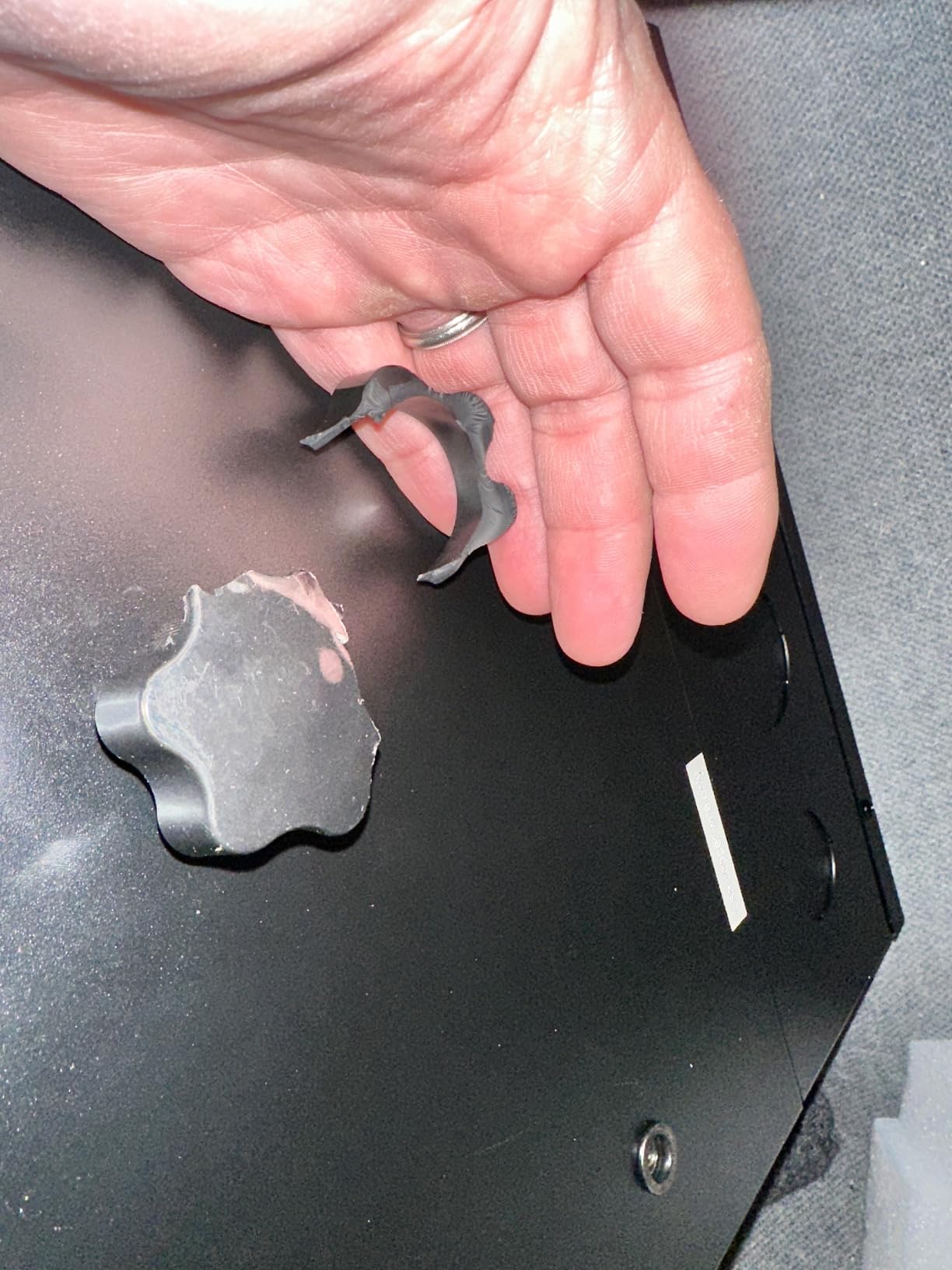
Inspect the mounting knobs and the enclosure before you install. Reviews mention cracked knobs and dented bodies arriving from this kind of listing, and a damaged enclosure on a fan-forced unit with a steel frame is worth rejecting immediately.
Then confirm the 240V hardwired connection with 12 AWG and a properly rated circuit. Cord is not included, so the electrical work is yours to arrange.
10. thermomate EIH3000B — Best Budget Wall Mounted Garage Heaters For Spot Warming
ThermoMate Infrared Electric Patio Heater, 3000W Carbon Fiber Heating for Outdoor/Indoor, Porch, Deck, Garage with Remote 24 Hours Timer, Hard Wired 240V
3000W carbon fiber infrared
120 sq ft coverage
1500W and 3000W modes
IP54 rated
Mount at 7.88 ft or higher
Pros
- Heat is felt within seconds of switch-on
- Unaffected by wind in open garage bays
- Slim wall or ceiling mount takes almost no space
- 24-hour timer remote with two heat modes
Cons
- Covers far less area than fan-forced units
- Hardwired to a dedicated circuit breaker
- Requires mounting at 7.88 feet or higher
The thermomate is the smallest heat output in the roundup and also the most honest about it. It covers 100 square feet outdoors or 130 square feet enclosed, and it does that with a carbon fiber element that puts heat into surfaces almost instantly.
Two modes, 1500W and 3000W, controlled by a remote with a 24-hour timer. At 3.35 inches deep and 7.8 pounds it is a strip heater, not a cabinet, and it mounts on a wall or a ceiling with brackets that tilt to 45 degrees.
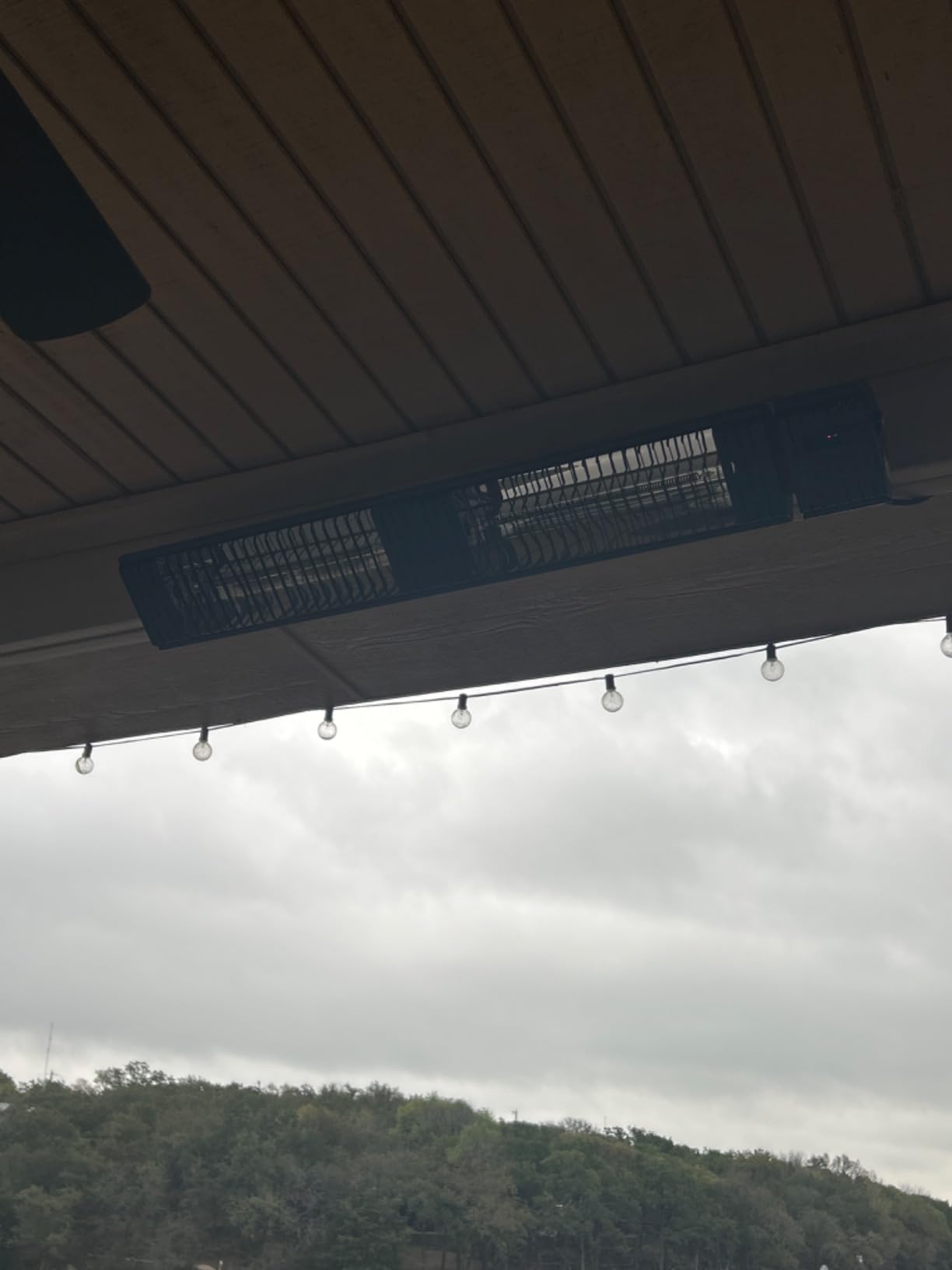
Reviewers like the fast, wind-resistant infrared heat and the fact that it takes up almost no wall or ceiling space. It is a strong addition to a workbench area, a garage bay door opening or a spot where you stand still for long periods.
The IP54 rating and ETL certification with overheat protection make it usable in a workshop environment. The constraint is the mounting height of at least 7.88 feet, which means you need a joist or a tall wall bracket to reach.
Can a 3000W infrared heater warm a garage?
It can warm the area within roughly 10 feet of the unit, especially in a sheltered bay or against an open door on a still day. It cannot raise the air temperature across a two-car garage, and it should not be asked to.
Treat it as a bench heater or a zone heater rather than a room heater. If you need room temperature, pair it with one of the 5000W or 7500W fan-forced units above.
Why is this listed as a garage heater at all?
Because the mounting method and the rating are the right ones. It is hardwired, ETL certified, IP54 rated and brackets to a wall, which is what a workshop needs. The only category error is coverage expectation.
It also needs a dedicated circuit breaker despite the low wattage, because the manufacturer specifies hardwired installation rather than plug-in. Check your panel capacity before ordering even a small heater.
Wall Mounted vs Ceiling Mounted Garage Heaters: Which One Do You Need?
Wall mounting wins when wall space exists and you want control. Ceiling mounting wins when you have joist space, a high ceiling, or no usable wall at all. Most units on this list do both with the same bracket.
A wall mounted garage heater brackets to a stud or joist face at roughly shoulder to head height, and the airflow angle can be adjusted toward the working zone. You can service it with a step ladder, aim it away from a bench, and keep it clear of vehicle paths. That serviceability is the real reason installers in the Garage Journal threads favour wall brackets.
A ceiling unit hangs above head height, which frees the wall entirely and pushes heat down into the occupied zone where warm air collects anyway. That is physically efficient in a tall shop. The trade is access: checking a fan or clearing a blocked louver means a taller ladder.
Because ceiling mounting can reach 7500W at 12 foot height without aiming at anyone, many pros consider it the better choice for a large open shop, with the real caveat being that you need exposed structure to hang from. Our broader garage heater guide covers ceiling-only models in more detail.
How Big a Wall Mounted Garage Heater Do You Need?
Size on volume and insulation, not floor area alone. The quick conversion to keep in your head is that a 1000W electric heater produces roughly 3412 BTU/hr of heat.
Step one: measure the volume. Multiply floor area by ceiling height. A 480 square foot garage at 9 feet is 4320 cubic feet. A 1000 square foot shop at 12 feet is 12,000 cubic feet, and that one needs roughly three times the heat for the same target temperature.
Step two: apply a wattage or BTU figure. For fan-forced electric, a common workshop starting point is about 10 watts per square foot for a well-insulated space, rising to 12 to 15 watts per square foot for a semi-insulated one. For gas, roughly 40 BTU per square foot for insulated and 50 to 60 BTU per square foot for uninsulated.
Step three: apply the insulation multiplier. Multiply by 1.0 for insulated walls and a insulated door. Multiply by 1.3 for one insulated surface, and by 1.5 for a bare shell with a thin steel garage door.
Step four: sanity check against the list. A 7500W heater covers about 750 to 800 square feet insulated, or roughly 500 square feet in a bare shell. A 5000W unit covers about 550 to 600 square feet insulated, or roughly 400 bare. A 30,000 BTU gas unit covers about 700 square feet insulated, or 450 bare.
On oversizing: oversizing a fan-forced heater is not a disaster, but it is wasteful and it makes short cycling more likely. A unit far larger than the space cycles on and off, the thermostat sees temperature swings, and you pay full wattage for a room that overshot. Slightly undersizing with a thermostat that has real resolution is worse, because the unit runs continuously and never catches up.
For a 600 square foot insulated garage, the short answer is 7500W of fan-forced electric or roughly 30,000 BTU of gas. Our electric heater guide has the full wattage comparison.
Do You Need a 240V Subpanel for Wall Mounted Garage Heaters?
You need one if your panel has no spare 40A breaker slot, no spare circuit space, or not enough spare amperage. That is the single most common reason a garage heater project stalls mid-way.
Every 5000W unit in this roundup draws roughly 20.9A and every 7500W unit draws roughly 31.25A. At 31.25A you need a 40A breaker. At 20.9A a 30A breaker works. Those are hard numbers from the specification sheets, and they tell you which circuit to look for.
Here is the six point pre-install check. First, read the panel label for its total rated amperage. Second, add up the amps of everything already on it. Third, check whether a spare breaker slot physically exists. Fourth, confirm the run distance so you can size wire correctly. Fifth, confirm a GFCI protected location is available if required. Sixth, check whether your utility meter and service entrance can carry the added load at all.
Old detached shops built before the 1980s frequently have 100A panels with no free slots. Those usually need a subpanel rather than a new breaker, and that is licensed electrical work. Our main garage heater guide covers the panel capacity walkthrough.
Electric vs Natural Gas vs Propane: What Each One Costs To Run
Gas wins on running cost in anything uninsulated. Electric wins on installation cost, safety and air quality. Propane sits between them and costs more per unit of heat than natural gas in almost every region.
Electric gives you roughly 3412 BTU per 1000W of consumption. A 7500W unit therefore pushes about 25,600 BTU per hour onto the space while drawing 7.5 kWh. Gas consumption is measured in therms for natural gas and gallons for propane, and both deliver more heat per unit of volume consumed.
The practical takeaway is thermal mass of the building. In a well-insulated shop an electric unit at a 50 degree idle set point costs very little. In an uninsulated shop, the same unit runs near-continuously in deep winter, and a 30,000 BTU gas heater on that same footprint is a fraction of the cost.
Propane exists in this category mainly as a ventless wall heater on a cylinder, and those units carry the same combustion and code caveats as vent-free natural gas. For a workshop, we would generally choose the fuel that is already on the property.
Ventless Gas Garage Heaters: What The Code Actually Says
Ventless gas heaters are legal in many US states and effectively unavailable in others. That sentence is the whole warning, and it is the point most affiliate roundups skip.
Three things to verify before buying one. First, that the specific model is approved for the space you are heating, because residential and light commercial listings are not interchangeable. Second, that your state and county permit it, because several states restrict or prohibit vent-free combustion heaters in garages, and Canada does not approve them for installation at all.
Third, and most often overlooked, that many vent-free units are listed as supplemental heat only rather than as primary heating. A heater that is only listed for supplemental use is not the right appliance for a workshop you heat to 65 degrees all winter.
The practical risk is combustion byproducts in the room where you are working. Keep a carbon monoxide detector, keep solvents and fuels sealed and well away, and run the fitter through your intended use before you sign off. Garage Journal owners raise the solvent interaction more than anything else, and it is a fair concern.
Safety, Certifications and Clearance
Every unit on this list is UL or ETL listed with thermal cutoff protection. That is the floor, not the differentiator.
The things worth checking on the specific model are the clearance requirements printed in the manual, the overheat shutoff behaviour, and where the certification label actually sits. Keep at least 3 feet of clearance to combustibles unless the manufacturer states otherwise, and never store solvents, paint, paper or sawdust in the plume path.
For sawdust-heavy woodworking, look at the enclosure rating. Most indoor wall heaters are not rated for a dusty shop environment in the way a wet-location or weatherproof unit is, which is worth weighing against how much extraction you actually run.
Condensation, Humidity and Tool Rust
Condensation is the quiet failure mode of garage heating, and it damages steel more reliably than cold does.
When warm moist room air touches a cold surface below the dew point, water forms on it. The rule of thumb workshop owners use is that you should hold the space above 40 degrees idle rather than letting it fall toward freezing and reheating repeatedly. Repeated cycling across the dew point is what puts a fine film of rust on chisels and cast iron.
Two habits fix most of it. First, use a wide differential thermostat set low for idle and high for working, rather than one temperature all day. Second, move air across the room, because condensation forms on surfaces that sit in still humid air. Owners on Garage Journal report that a box fan mounted above the unit dramatically improves results in spring and fall.
Where to Mount a Wall Mounted Garage Heater in the Workshop
Mount it high, aim it into the working volume, and keep it away from what you do not want cooked.
The common recommendation is 8 to 10 feet for a fan-forced cabinet, high enough that the discharge throws across the space rather than straight down at one bench. The thermomate in this roundup states a minimum mounting height of 7.88 feet, which is a useful floor for the infrared units too.
Set it on the wall opposite the garage door so warm air moves into the room rather than out the opening. Keep clearance from the door track and any storage you hang nearby, and never mount directly above a workbench where finishing chemicals are stored. If you need shelving on the same wall, plan the layout together with our garage shelving guide.
Maintenance for Wall Mounted Garage Heaters
A wall mounted garage heater is simple to maintain because it has few moving parts, but the dust in a workshop works fast.
Every two to three months, with the power off at the breaker. Pull the grille, vacuum the element fins and out of the fan housing, and check that the fan blades spin freely without buildup. Wipe the louvers so the discharge pattern stays as intended.
Once a year, before winter, add four more items. Check that all wiring terminations are tight and show no heat discolouration. Confirm the overheat cutoff triggers by testing the manual reset if the unit has one. Look at the cord or conduit for damage, and confirm the clearance above the unit is still clear of anything you stored since last year.
On gas units the annual list is different. Have the fitter check the burner, the flue or vent path if it is not vent free, and the oxygen depletion sensor. That is not a DIY task.
Frequently Asked Questions
What are the best electric heaters for heating a garage?
For most workshops, a hardwired 240V fan-forced unit in the 5000W to 7500W range is the best electric choice. Our top pick is the DR Infrared DR-975 at 7500W with a remote thermostat, and the Comfort Zone CZ230ER adds a digital thermostat and 12-hour timer. Both need a 30A or 40A circuit installed by an electrician.
Is it better to oversize a garage heater?
No. A fan-forced heater far larger than the space will short cycle, overshoot the set temperature and cost full wattage to heat a room it has already warmed. Size to about 10 watts per square foot for an insulated space and 12 to 15 watts per square foot for a semi-insulated one, then let the thermostat control the rest.
How many BTU do I need for a 600 sq ft garage?
For a 600 square foot insulated garage, about 6000 BTU per hour of heat is the working figure, which a 5000W fan-forced electric heater delivers at roughly 17,060 BTU. A 30,000 BTU vent-free gas unit covers that space with room to spare and costs far less to run in uninsulated buildings.
How high should I mount my wall mounted garage heater?
Mount a fan-forced wall unit at 8 to 10 feet so the discharge throws across the working space instead of straight down at one bench. Infrared strip heaters state their own minimum, and the thermomate in this roundup requires at least 7.88 feet. Always follow the clearance figures in the manual for your specific model.
Do I need a professional to install a wall-mounted garage heater?
For electric units, yes in most cases, because a 7500W heater pulls 31.25A and needs a 40A breaker with 8 AWG copper on a dedicated circuit. A panel without a spare slot needs subpanel work, which requires a licensed electrician. Gas units always require a licensed fitter and usually a permit.
Final Verdict: The Best Wall Mounted Garage Heaters for Workshops
There is no single right answer here, only the right match for your electrical service, your insulation and your working pattern.
Buy the DR Infrared DR-975 if you want the strongest general purpose wall mounted garage heater on this list and you can arrange a 40A circuit. Choose the Comfort Zone CZ230ER when scheduling and a wide thermostat range matter more than review count. Pick the Comfort Zone CZ220BK if you want a 30A circuit and manual control at the lowest entry point. Go gas, with the Dyna-Glo or the Comfort Glow KWN521, only if you already have a line on the wall and you have checked your local code.
Before any of them, spend an evening on panel capacity and garage door insulation. Those two hours decide whether the purchase was a good one.