
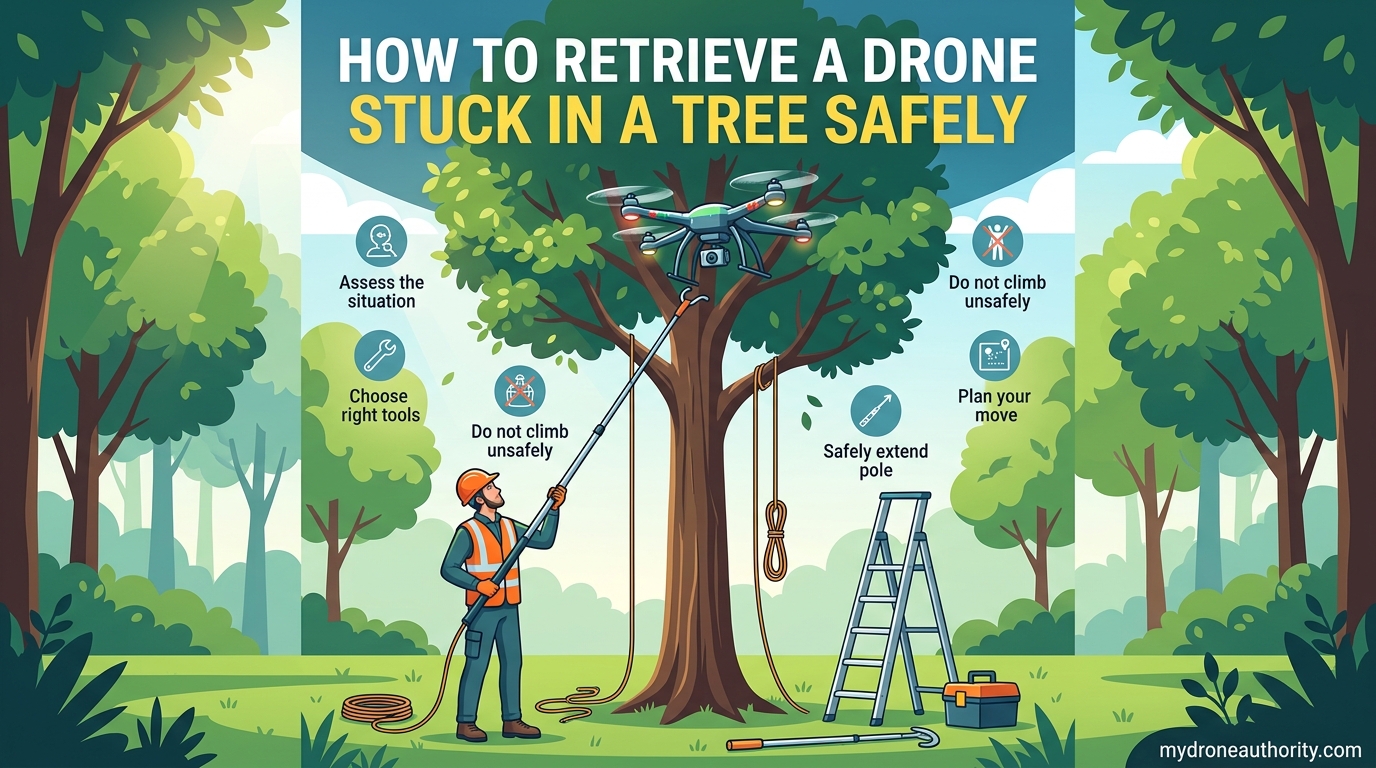
Every drone pilot knows the feeling. One moment you are cruising along, the next you hear that awful crack of branches and your quad is wedged 40 feet up an oak. Learning how to retrieve a drone stuck in a tree safely can save you hundreds of dollars and a trip to the emergency room.
I have been flying drones since 2026 and have personally fished quads out of pines, maples, and one memorable cell tower. This guide walks through every method that actually works, ranked from simplest to most involved, with the safety warnings that most tutorials skip.
You will learn how to assess height and risk, choose the right tool for the job, decide when to call a pro, and what to do after the drone is back on the ground. I have also pulled real techniques from r/fpv, r/dji, and arborist communities so you get practical advice, not theory.
Table of Contents
Safety First: Critical Warnings Before You Attempt Retrieval
Before you do anything else, read this section. Most drone damage and pilot injuries happen during panicked retrieval attempts, not the original crash.
Check for Power Lines
If the tree is anywhere near overhead power lines, stop. A drone touching or near energized lines can conduct lethal voltage through any rope, pole, or line you extend toward it. Maintain at least 10 feet of clearance from any utility line, and call the utility company if the drone is in contact with one. They will retrieve it, often at no charge.
Wait for Calm Weather
Wind, rain, and ice all multiply the risk of retrieval. Wet branches are slippery, gusts can knock a ladder sideways, and rain makes poles conductive. If conditions are bad, mark the location and come back when it clears. I waited three days for one recovery, and the drone survived fine.
Protect Against Falling Objects
A drone falling from 50 feet carries enough energy to crack a skull. Wear a hard hat, never stand directly under the drone, and keep bystanders, kids, and pets at least 30 feet back. The same goes for the branches and tools you may dislodge.
Never Climb Without Proper Gear
Climbing a tree without a harness, helmet, and climbing experience is the single most dangerous thing drone owners attempt. Falls from 20 feet are routinely fatal. If the drone is high enough that you would need to free-climb, skip to the professional help section.
Assess the Situation First
Spend five minutes reading the situation before grabbing any equipment. The right method depends on height, tree type, and how the drone is wedged.
Estimate the height using a laser rangefinder, a phone app, or by counting tree trunk sections. Drones under 15 feet are usually a simple pole job. Anything between 15 and 40 feet needs a long pole, throw line, or ladder. Beyond 40 feet, you are looking at climbing gear, an aerial lift, or professional help.
Look at how the drone is sitting. If it is perched loosely on a flat branch, a gentle shake or pole nudge will drop it. If it is tangled deep in forks or thorns, pulling may rip the props or arms. Note the tree species too. Pines have flexible branches that bounce, oaks hold tight, and dead trees drop limbs without warning.
Finally, check the battery. If the drone is still powered on and responding to controls, you may be able to fly it out. If the battery died, the props are locked and only physical methods will work.
How to Retrieve a Drone Stuck in a Tree: Method Selection by Height
The best method for how to retrieve a drone stuck in a tree depends almost entirely on height. Use this quick reference, then read the matching section for step-by-step instructions.
Under 15 feet: hand-held pole or ladder reach. 15 to 40 feet: telescopic pole, throw line, or fishing line technique. 40 to 80 feet: arborist throw line, climbing, or rental lift. Over 80 feet: call an arborist or tree service with a bucket truck.
No-Equipment Retrieval Methods
These are the methods you can try with what you already have. They work best for low to moderate heights and loosely wedged drones.
Try Flying It Out First
If the drone still has battery and is responding, the gentlest fix is to fly it out. Power up the motors slowly. Apply a small amount of throttle and nudge the stick in the direction of open air. Avoid full throttle, which can drive the drone deeper into branches or snap props against wood. If the drone wobbles or strains against a branch, kill the motors immediately to avoid burning out the ESCs.
Shake the Branch
This is the most recommended method in r/fpv and r/dji threads, and for good reason. It works. Grab the trunk or the lowest branch of the tree and shake rhythmically. If the tree is small enough, a sustained 30-second shake will often bounce the drone loose. For taller trees, climb a few rungs on a ladder to reach a higher branch and shake from there.
Be ready to catch the drone or let it fall onto soft ground, a blanket, or a jacket you have spread underneath. Never try to catch it bare-handed from a high fall, the props can cut your fingers.
Wait for Wind
If the tree is large and the drone is loosely perched, sometimes you do nothing. A strong gust within a day or two will often shake it loose. Several Reddit users reported their drones falling out after 24 to 72 hours of waiting. Lay a tarp underneath to cushion the fall and check back each morning. This is not ideal if the tree is over a road or if rain is forecast.
Tool-Based Retrieval Methods
When shaking fails, you need tools. These are the four methods that work most reliably, ranked by ease of use.
Use a Long Telescopic Pole
A telescopic pole is the workhorse of drone recovery. A 24-foot DocaPole or similar extension pole reaches most residential tree drones. For extra reach, you can duct-tape a second pole end-to-end, though flex becomes a problem past 30 feet.
Tip the pole with something soft. Wrap the end in a tennis ball, foam pipe insulation, or a folded microfiber cloth. A bare pole tip will scratch the drone shell or crack a prop. Gently push the drone sideways off the branch, never downward, which can drive it deeper into the canopy.
Have a second person stand to the side to spot the fall zone. Move slowly and let the drone tip over the edge of the branch on its own.
Use a Ladder Combined With a Pole
If the pole alone is too short, a ladder adds 6 to 12 feet of reach safely, as long as the ladder is on level ground and someone is footing it. An extension ladder leaned against the trunk, with you on a middle rung using a pole, can reach drones up to about 35 feet. Never stand on the top two rungs, and never lean out sideways.
The Fishing Line and Throw Weight Technique
This is the method professional arborists use, scaled down for drones. You need a throw weight (a small sandbag, 8 to 12 ounces), a throw line, and a length of stronger paracord.
Step 1: Tie the throw weight to the throw line. Step 2: Toss the weight over the branch that holds the drone, going over the branch a few feet past the drone so the line drops on the far side. Step 3: Pull both ends of the throw line so it saws back and forth across the branch. Step 4: When the line is close to the drone, the sawing motion will either push the drone off the branch or snag it so you can pull it down.
This method works on drones up to about 60 feet if you can throw accurately. A slingshot or arborist throw launcher extends the range significantly.
The Weighted Fishing Line Trick
A lighter variant uses monofilament fishing line and a 1-ounce sinker. Cast or throw the sinker over the branch, then pull the line back and forth. The thin line cuts through small twigs that hold the drone and can wiggle it loose. The downside is that fishing line snaps easily and can snap back at you, so wear eye protection.
DIY Drone Retrieval Pole Build
If you do not want to buy a telescopic pole, you can build one for under $20. This is the ABS pipe hack that TravelByDrone popularized and it works surprisingly well.
Buy two or three 10-foot sections of 1.5-inch ABS pipe and a coupler for each joint. Wrap the business end in foam pipe insulation secured with zip ties. Total reach with three sections is around 28 feet, and the whole rig weighs under 4 pounds.
The joints flex, so this works best for pushing motions rather than pulling. Label each section so you can reassemble it quickly next time. Keep the kit in your car or range bag.
High Tree Retrieval (50 to 100+ Feet)
Drones stuck above 50 feet are in a different category. Poles and throw lines still work but become unreliable, and climbing becomes the realistic option.
Rent an Aerial Lift
A scissor lift, boom lift, or bucket truck can put you right next to the drone. Rentals run about $200 to $400 per day for a towable boom lift that reaches 50 to 70 feet. Home Depot and Sunbelt Rentals stock these in most cities. You need a flat surface to park on and clear overhead access.
This is overkill for a single $300 drone, but if you fly professionally or have a high-end cinematography rig, it is the safest high-reach option short of hiring an arborist.
Hire an Arborist
Arborists climb trees for a living and have the gear to reach any height. Most tree service companies will retrieve a drone for a service-call fee, typically $75 to $200 depending on travel and climb time. Some arborists advertise drone retrieval specifically on their websites and in local Facebook groups.
Bartlett Tree Research and several regional tree services have published retrieval guides, which tells you this is a service they actively offer. Call a few local companies, describe the height and tree type, and ask for a quote.
Use an Arborist Throw Line and Launcher
If you want to handle high retrievals yourself, invest in an arborist throw line kit (about $50) and a slingshot-style throw weight launcher (another $50). With practice, you can place a throw weight 80 feet up and pull a heavier rope over the branch. From there, the sawing and pulling technique works the same as at lower heights.
When to Call a Professional Drone Retrieval Service
Some situations are not worth the risk. Call a pro if any of the following apply.
The tree is taller than 50 feet and you have no climbing experience. The tree is dead, leaning, or storm-damaged. The drone is near power lines, over a structure, or over a public area where it could hit someone. You have already tried two methods and the drone is wedged tighter than before.
Professional drone retrieval services charge anywhere from $75 to $500 depending on height, location, and difficulty. Some independent operators advertise on Facebook Marketplace, TaskRabbit, or local drone groups. Tree service companies and arborists are usually more reliable and insured.
One forum user reported paying $80 for a tree service to retrieve a Mini 4 Pro from 30 feet up. Another paid $250 for an arborist climb on a 70-foot pine. Get a quote before committing.
What NOT to Do When Your Drone Is Stuck
These are the methods that consistently cause more damage than they fix.
Do Not Send a Second Drone Up
Tempting, but the failure rate is high. Pilots on r/fpv routinely report getting a second quad stuck alongside the first, often because the same wind or branch catches it. The only time this works is with a small toy drone carrying a fishing line that you intentionally crash into the stuck drone to snag it. Even then, success is rare.
Do Not Yank Hard on Lines or Poles
Aggressive pulling snaps arms, rips wiring, and bends motor shafts. Apply gentle, steady pressure and let gravity do the work when the drone comes loose.
Do Not Use a Metal Pole Near Power Lines
Aluminum and steel poles are excellent conductors. A metal pole contacting a live wire will kill you instantly. Use only fiberglass or wood poles anywhere near utilities.
Do Not Climb in Wet or Windy Conditions
Wet bark is slippery, wet branches snap, and wind shifts your balance. Wait for a calm, dry day for any climb.
Do Not Throw Heavy Objects at the Drone
Hitting the drone with a ball or rock to knock it loose will almost certainly damage it. The throw line technique works because the line goes over the branch, not at the drone itself.
After Retrieval: Checking for Damage
Getting the drone down is only half the job. Now you need to find out if it still flies. This is a step no competitor covers, and it matters.
Inspect the Exterior
Look for cracked arms, bent props, damaged gimbal mounts, and loose motors. A hairline crack on an arm can fail catastrophically in flight. Replace any prop with visible nicks or bends, they cost a few dollars each and are not worth the risk.
Check for Water Damage
If the drone sat overnight in rain or dew, water likely entered the chassis. Remove the battery immediately and do not power the drone on. Place it in a bag of uncooked rice or a sealed container with silica gel packets for 48 hours. Look for condensation inside the camera lens, which signals moisture inside the gimbal.
Powering on a wet drone short-circuits the board and turns a recoverable situation into a total loss. Be patient.
Test in a Hover Before Real Flight
Once the drone is dry and visually intact, do a low hover test in an open area, no higher than 10 feet. Watch for vibrations, drifting, or motor error messages. If anything looks off, send it to a repair center before flying again.
Pull the Flight Logs
Connect to the app and download the last flight log. It will show exactly what caused the crash, whether it was pilot error, a low-battery auto-land into a tree, or a sensor failure. This helps you prevent a repeat.
Build a DIY Drone Rescue Kit
Every regular pilot should keep a retrieval kit in the car. Here is what to include.
A 24-foot telescopic pole (DocaPole or similar). An arborist throw weight and 200 feet of throw line. A roll of paracord. A small first-aid kit. A pair of work gloves. Duct tape and zip ties. A microfiber cloth and foam pipe insulation for pole tip padding. A headlamp for low-light retrievals.
Total cost is about $80 to $120, and the kit will pay for itself the first time you avoid a $200 arborist bill.
How to Prevent Your Drone from Getting Stuck Again
Prevention is cheaper than retrieval. A few habits will keep you out of trees.
Set a safe altitude floor in your flight app so the drone will not descend below tree-canopy height. Enable obstacle avoidance sensors if your drone has them. Avoid flying directly over trees, especially with a low battery, since failsafe RTH can sometimes descend straight down into branches. Keep your battery above 25 percent when flying near trees.
Install propeller guards for casual flights in wooded areas. They will not stop every collision, but they reduce the chance of snagging on small branches.
Frequently Asked Questions
What to do if a drone gets stuck in a tree?
First, assess height and surroundings, checking for power lines. If the drone still has battery, try flying it out gently. For heights under 30 feet, use a telescopic pole or shake the branch. For taller trees, use the fishing line and throw weight technique or hire an arborist. Never free-climb without safety gear.
How much do people charge for drone recovery?
Drone retrieval services typically charge between $75 and $500. A simple tree service call for a low-height retrieval runs about $75 to $150. Arborist climbs on tall trees cost $200 to $500 depending on height, travel, and difficulty. Some independent operators on TaskRabbit or local drone groups charge less.
Can you call the fire department to get a drone out of a tree?
Generally, no. Fire departments will respond if the drone is a hazard to the public or entangled in power lines, but they usually will not retrieve a hobby drone from a tree. Call the fire department only if the drone poses a safety risk, such as dangling over a roadway or near electrical equipment. For routine retrievals, contact a tree service company instead.
How to find a lost drone in the woods?
Start by checking the last GPS coordinates in your flight log. Use the Find My Drone feature in the DJI Fly app or equivalent. Walk to the last known position and scan the canopy with binoculars. If the battery still has charge, trigger the buzzer or flashing lights from the app. Mark a wide search grid and check during daylight when sunlight reflects off the drone shell.
Is it safe to climb a tree to get a drone down?
Only if you have proper climbing gear, a harness, a helmet, and training. Free-climbing to retrieve a drone is extremely dangerous and falls from as low as 15 feet can be fatal. If you are not an experienced climber, hire an arborist instead. The cost of a professional is far lower than the cost of a fall.
Can I use another drone to retrieve a stuck drone?
It is risky and usually not worth it. Pilots frequently report getting the second drone stuck alongside the first. The only version that occasionally works is flying a small toy drone with a fishing line attached and intentionally crashing it into the stuck drone to snag a line. Even then, success is rare and you risk losing two drones instead of one.
Conclusion
Knowing how to retrieve a drone stuck in a tree safely comes down to picking the right method for the height, respecting the hazards, and knowing when to call a professional. Start with the simplest option, fly it out or shake the branch, then work up to poles, throw lines, and finally arborists.
Safety always beats speed. A drone worth $500 is not worth a broken arm or a fall from 30 feet. Keep a retrieval kit in your car, fly with obstacle avoidance on, and never let a low battery lure you into a tree-line descent. Your future self will thank you.
1 thought on “How to Retrieve a Drone Stuck in a Tree Safely (October 2026)”