
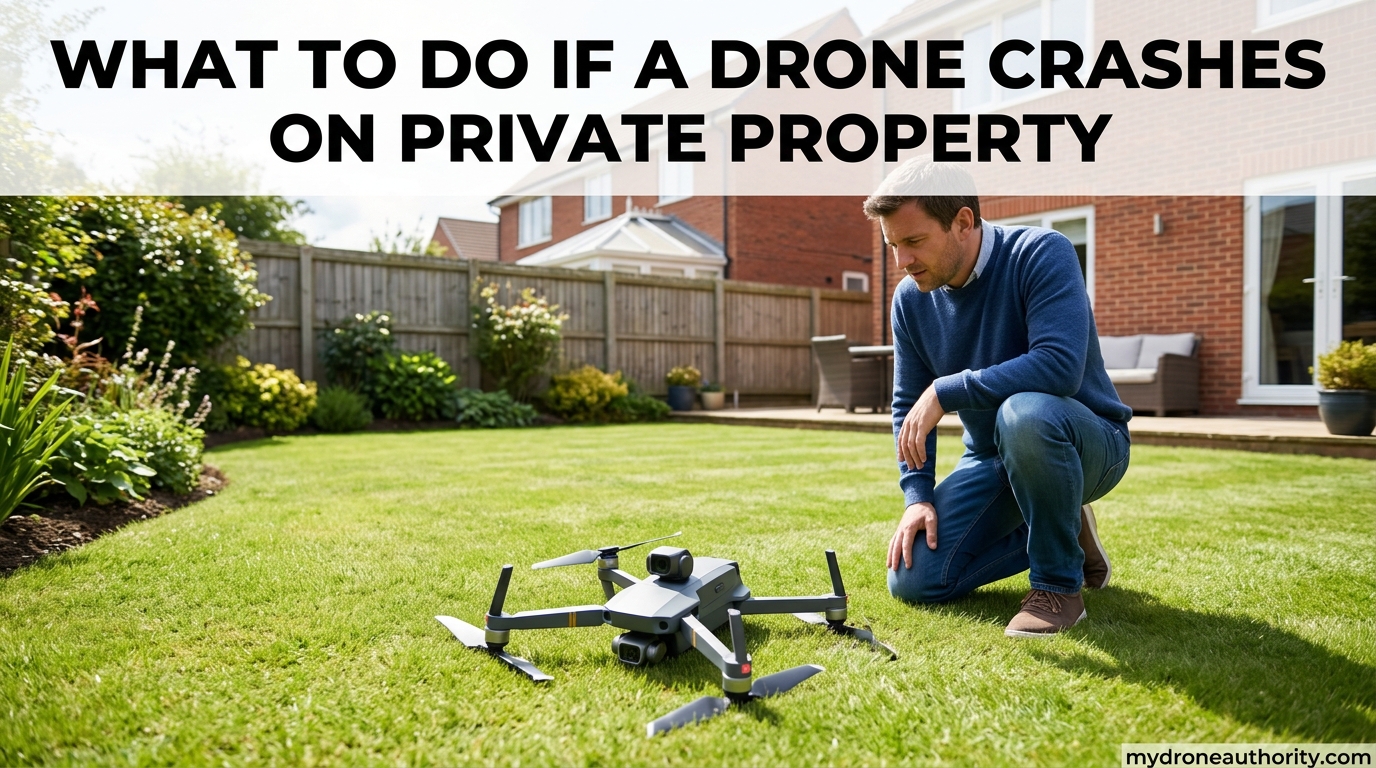
Picture this: you’re flying your drone on a calm afternoon, capturing smooth aerial footage, when a sudden gust of wind or a low-battery warning sends it drifting over the fence line. Seconds later, your screen goes dark and your aircraft is sitting in a neighbor’s backyard, on a commercial lot, or somewhere you cannot legally walk onto. Knowing exactly what to do if your drone crashes on someone else’s property can protect your equipment, your wallet, and your legal record.
A drone crash on private property triggers a messy overlap of FAA regulations, state property law, and local trespassing rules. Most pilots panic, ignore the rules, or worse, climb the fence to grab their quadcopter and end up facing charges. This guide breaks down the immediate actions, your recovery rights, the FAA’s 10-day reporting rule, and the cleanest path to getting your aircraft back without making the situation worse.
Table of Contents
What to Do If Your Drone Crashes on Someone Else’s Property: Immediate Actions
The first few minutes after a drone crash on private property matter more than most pilots realize. What you do (and what you avoid doing) shapes whether this becomes a quick conversation with a neighbor or a police report. Follow these steps in order.
Step 1: Stay Where You Are and Do Not Trespass
This is the single most important rule. No matter how expensive your drone is, walking onto someone else’s property without permission is trespassing in every state. Property owners can call the police, press charges, and turn a simple accident into a criminal matter. Even if the gate is open or the yard looks empty, you do not have permission to enter.
Stay on public property, the sidewalk, or your own side of the property line. If you have a clear line of sight to the drone, take a photo from where you stand as documentation.
Step 2: Document Everything From Where You Stand
Open your phone and start recording. Capture the drone’s location, the surrounding property, any visible damage to fences, landscaping, or structures, and the timestamp. Take a screenshot of your flight app showing the last known GPS coordinates, battery level, and altitude before the crash. This data is your proof of how the incident occurred, and your flight log is what the FAA will ask for if a report is required.
If there were witnesses, get their contact information. Their account matters if the property owner later claims the drone damaged something or injured someone.
Step 3: Locate the Property Owner
Find out who owns or controls the property. For a residential home, this is usually as simple as knocking on the front door and asking politely. For a commercial building, look for a management office, security desk, or posted contact number. Public property requires contacting the agency responsible for the land, such as parks and recreation or the local municipality.
Approach the conversation calmly. Explain that you are a drone pilot, your aircraft had a mechanical issue or weather event, and you would like permission to retrieve it. Offer to come at their convenience and to repair any damage the drone may have caused.
Step 4: Note Whether Anyone Was Hurt or Anything Was Damaged
If the drone struck a person, a vehicle, a window, or any structure, this is no longer just a recovery situation. It is now a reportable incident under FAA rules, and the property owner may have a liability claim against you. Note every detail, photograph any damage, and exchange contact and insurance information just as you would after a car accident.
Step 5: Contact Local Law Enforcement If the Owner Refuses Access
If the property owner will not let you retrieve the drone or will not respond at all, do not escalate. Call your local non-emergency police line and request a civil standby or documentation of the situation. Police cannot force the owner to hand over the drone, but their presence often resolves the issue, and their report creates an official record you will need for any civil claim.
Your Legal Rights as a Drone Owner
Drone owners have a recognized legal interest in their aircraft, but that interest does not override property rights. The law treats a crashed drone similarly to other lost personal property, which means you retain ownership and the right to demand its return, even when it lands on land you do not own.
Common Law and Lost Personal Property
Under common law principles, lost personal property still belongs to its original owner. The finder of a crashed drone does not automatically acquire ownership simply because the item landed on their land. You remain the legal owner, and the property owner is generally expected to allow reasonable retrieval or to make arrangements for return.
However, common law also recognizes that property owners control access to their land. They are not legally required to walk out and hand you the drone, and they can set reasonable conditions on when and how you retrieve it. This is why a polite, well-documented request matters.
The Right to Demand Return
If a property owner refuses to return your drone after you have made a clear, documented request, they may be committing “conversion,” which is the civil equivalent of theft. Conversion occurs when someone intentionally exercises control over another person’s property in a way that denies the owner their rights. You can file a civil claim for the fair market value of the drone, and in some states, you can pursue the claim in small claims court without an attorney.
When You Might Lose the Right to the Drone
Your right to recover the aircraft weakens if the property owner can show the drone caused damage, violated a local privacy ordinance, or was being operated illegally. In those cases, they may have a counterclaim, and a court could weigh both sides before ordering return. This is rare for a simple crash, but it is a real risk if you were flying in a no-fly zone or recording people without consent.
Property Owner Rights Explained
Property owners have strong rights over their land, but those rights are not unlimited, and they absolutely do not include the right to destroy or shoot down a drone. Understanding where their rights end helps you know what to push back on during a recovery conversation.
Can a Property Owner Keep Your Crashed Drone?
No, not legally. As explained above, common law treats the drone as your lost personal property, and the owner cannot convert it into their property just because it landed on their land. They can hold it temporarily, set conditions on retrieval, or demand that you arrange pickup at a specific time, but they cannot simply declare ownership.
If a neighbor says the drone is “theirs now” because it landed in their yard, that is not legally accurate. You can escalate to law enforcement for documentation and then file a civil claim for conversion if they continue to refuse return.
Can a Property Owner Shoot Down or Disable a Drone?
No. Shooting down, netting, jamming, or otherwise disabling a drone is a federal crime under 18 U.S.C. 32, which criminalizes destroying aircraft. The FAA classifies drones as aircraft, and courts have repeatedly held that property owners cannot legally shoot down a drone flying over their land, even at low altitude. Several homeowners have faced federal charges and civil lawsuits for doing exactly this.
This distinction is important: the rule against shooting down a drone applies whether the drone is actively flying or already crashed. Once the drone has crashed, destroying it would be destruction of property on top of the aircraft statute.
Who Controls the Airspace Over Private Property?
The FAA controls the national airspace system, including the airspace above private homes and yards. While property owners own the land and have rights to exclude people from the surface, the FAA has exclusive jurisdiction over navigable airspace. This means local governments cannot pass their own drone flight rules that conflict with FAA regulations, though states can regulate takeoff, landing, and privacy.
The practical takeaway: the property owner controls the ground, the FAA controls the sky, and your right to operate the drone is governed by FAA Part 107 rules or the recreational exception, not by the homeowner.
How to Recover Your Drone: Step-by-Step Process
The recovery process for a drone lost on private property follows a clear escalation path. Start with the most cooperative approach and move up only if needed.
Step 1: Make First Contact Politely
Knock on the door or call the listed contact number. Identify yourself, explain that your drone had an issue and landed on their property, and ask permission to retrieve it at their convenience. Bring proof of ownership such as a receipt, the original box, or the serial number registered to your FAA drone registration account. Offer to repair any damage the drone may have caused.
Step 2: Schedule a Retrieval Time
If the property owner is not home or asks you to come back, set a specific date and time. Send a polite text or email confirming the appointment so you have a written record. Most drone retrieval situations resolve at this step with no further escalation needed.
Step 3: If They Refuse, Send a Written Request
If the owner refuses access or ignores you, send a written request by certified mail. State that you are the registered owner of a drone with serial number, that it landed on their property on a specific date, and that you request its return within a reasonable timeframe, typically 10 to 14 days. Keep a copy and the certified mail receipt.
Step 4: Request a Civil Standby From Police
Call the non-emergency police line and request a civil standby. Explain that you have legal ownership of property being held by another party and you need an officer present while you attempt retrieval. Police will not force the owner to surrender the drone, but they will document the interaction and often encourage cooperation.
Step 5: File a Small Claims Court Case
If the property owner continues to refuse, file a claim in small claims court for either the return of the property or its fair market value. Bring your proof of ownership, the certified mail receipt, the police report, photos of the drone on their property, and any written communication. Filing fees are typically low, and many jurisdictions cap small claims at amounts that comfortably cover most consumer drones.
Step 6: Consider a Demand Letter From an Attorney
For high-value commercial drones or situations where the owner is hostile, a demand letter from an attorney often resolves the matter without going to court. Most people take a letter from a law firm seriously, and the cost is usually far less than the value of the aircraft.
FAA Reporting Requirements After a Drone Crash
The FAA has specific reporting rules that apply to drone crashes, and many pilots do not know they exist until it is too late. Failing to file a required report can result in fines and enforcement action against your remote pilot certificate.
The 10-Day FAA Reporting Rule
Under 14 CFR 107.9, a remote pilot in command must report any drone accident to the FAA within 10 calendar days if specific thresholds are met. The rule applies to Part 107 certified pilots operating commercially, and recreational flyers should follow the same standard as a best practice even when not strictly required.
The $500 Damage Threshold
An FAA report is required when any of the following occur: serious injury to any person or loss of consciousness, damage to property (other than the drone itself) with a repair cost or fair market value of at least $500, or any incident occurring in restricted airspace. The $500 threshold refers to the property damage caused by the drone, not the value of the drone.
If your drone clipped a shingle off a roof, broke a window, dented a car, or knocked over landscaping, estimate the repair cost. If it meets or exceeds $500, you must report. If you are unsure, report anyway, as over-reporting carries no penalty and under-reporting does.
How to File the Report
File the report through the FAA DroneZone portal at faa.gov/go/dronezone. Provide your remote pilot certificate number, the drone registration number, the date and location of the incident, a description of what happened, and the extent of any injuries or damage. The FAA will review the report and may follow up for additional information.
When the FAA Gets Involved Independently
The FAA’s official guidance for property owners who find a crashed drone is to call local law enforcement first. Law enforcement will contact the FAA if the crash investigation requires FAA participation, particularly when injury, serious property damage, or airspace violations are involved. This is exactly the paragraph pattern that currently wins the featured snippet from faa.gov, and it is the authority chain you should expect to encounter.
Insurance Coverage for Drone Crashes on Private Property
Insurance is the part most pilots skip thinking about until a crash happens. Whether your accident is covered depends on what you were doing, what you hit, and what kind of policy you carry.
Does Homeowners Insurance Cover Drone Accidents?
Sometimes. Many homeowners policies treat a drone as personal property for damage to the aircraft itself, similar to a laptop or camera. Liability coverage for damage or injury you cause to others is less consistent. Some policies explicitly exclude aircraft, including drones, while others extend personal liability coverage to recreational drone use. Commercial use under Part 107 is almost never covered by a standard homeowners policy.
Call your insurance agent before you need to file a claim. Ask specifically whether recreational drone use is covered for both property damage and liability, and get the answer in writing.
Drone-Specific Insurance Policies
For commercial operators and serious hobbyists, dedicated drone insurance is the safer route. Companies like SkyWatch, DroneInsurance.com, and Aviation Office of Insurance offer hull coverage for the drone itself and liability coverage for damage you cause to people or property. Policies can be purchased annually or by the hour for individual flights. Premiums are typically modest compared to the cost of replacing a drone and paying a liability claim out of pocket.
What to Document for an Insurance Claim
If you intend to file a claim, document the scene thoroughly. Photograph the crashed drone, any property damage, the flight log from your app, weather conditions at the time, and any witness statements. File a police report if the property owner is involved, and submit your FAA report within 10 days if the thresholds are met. Insurance adjusters will want all of this before processing the claim.
FAQs
Is it illegal to fly drones over someone else’s property?
Flying a drone over someone else’s property is not automatically illegal under federal law because the FAA controls the national airspace. However, you can still face legal issues if you violate local privacy ordinances, capture images of people without consent, fly below the minimum safe altitude in a careless way, or use the drone for harassment. State and local laws add additional restrictions on takeoff, landing, and surveillance.
What if a drone crashes on your property?
If a drone crashes on your property, call local law enforcement. Do not destroy, keep, or disable the drone, as doing so can expose you to civil liability or federal charges. You are not obligated to help retrieve it, but you should allow the owner to recover it at a reasonable time. If anyone was injured or property was damaged, document everything for insurance and FAA purposes.
Does home insurance cover drone accidents?
Homeowners insurance sometimes covers recreational drone use for both damage to the drone itself and liability for damage or injury you cause, but coverage varies by policy. Commercial drone operations under Part 107 are almost never covered by a standard homeowners policy. Always confirm coverage in writing with your insurer before flying.
Do I need to report a drone crash?
Yes, if you are operating under Part 107 and the crash caused serious injury, loss of consciousness, or at least $500 in property damage to anything other than the drone, you must report it to the FAA within 10 calendar days through the DroneZone portal. Recreational pilots are strongly encouraged to follow the same standard even when not strictly required.
Can I destroy a drone flying over my property?
No. Destroying, shooting down, jamming, or disabling a drone is a federal crime under 18 U.S.C. 32 because the FAA classifies drones as aircraft. Courts have consistently ruled that property owners cannot legally shoot down a drone, even one flying low over their land. The proper response is to call law enforcement and report the incident.
Can a neighbor keep your drone if they find it on their property?
No, not legally. Under common law, a crashed drone remains the property of its owner, and the finder cannot claim ownership simply because it landed on their land. The owner has the right to demand return, and refusal can constitute the civil tort of conversion. If the neighbor refuses, document the request in writing and pursue a small claims court case.
Conclusion: Key Takeaways for Drone Crash Recovery
Handling a drone crash on someone else’s property comes down to a few simple principles: do not trespass, document everything, ask permission politely, and escalate through the proper legal channels if the property owner will not cooperate. Knowing what to do if your drone crashes on someone else’s property keeps a bad moment from becoming a legal disaster.
Remember the FAA reporting threshold: if the crash caused $500 or more in property damage or any serious injury, file your report within 10 days through the FAA DroneZone. Confirm your insurance coverage before you ever take off, and carry proof of ownership whenever you fly. A little preparation turns a stressful recovery into a routine conversation.
Fly smart, respect property lines, and always have a recovery plan. Your drone is replaceable, but your clean legal record is not.