
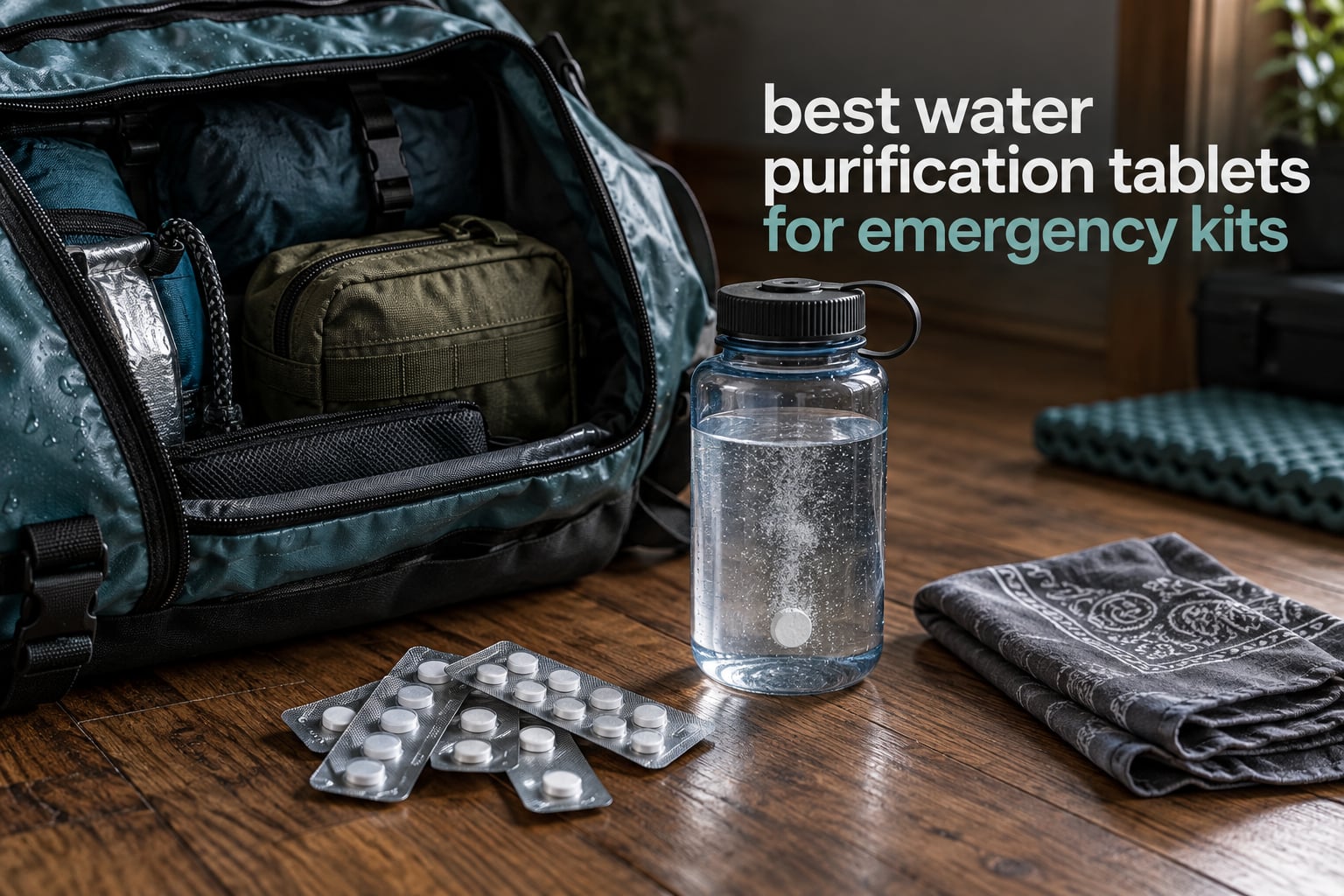
A disaster kit that cannot turn a puddle into drinkable water is missing the one item most families never think to test. Water purification tablets are the only treatment method that stores flat for years, needs no batteries, no pump and no training, and still works when the grid is gone and the nearest shop is three days away.
That matters because an emergency preparedness kit is mostly things that sit untouched until the worst week of your life. If you are building one, start with the emergency preparedness kit checklist we use and the water storage tanks we recommend for long supply, then fill the treatment gap with the picks below.
We compared ten of the best water purification tablets for emergency kits on the things that actually decide whether a kit works under stress: active ingredient, contact time, whether the chemistry kills Cryptosporidium and Giardia cysts, shelf life, litres treated per tablet, taste after treatment and how the packaging survives a decade in a garage. Every rating and review count below is copied straight from the listing.
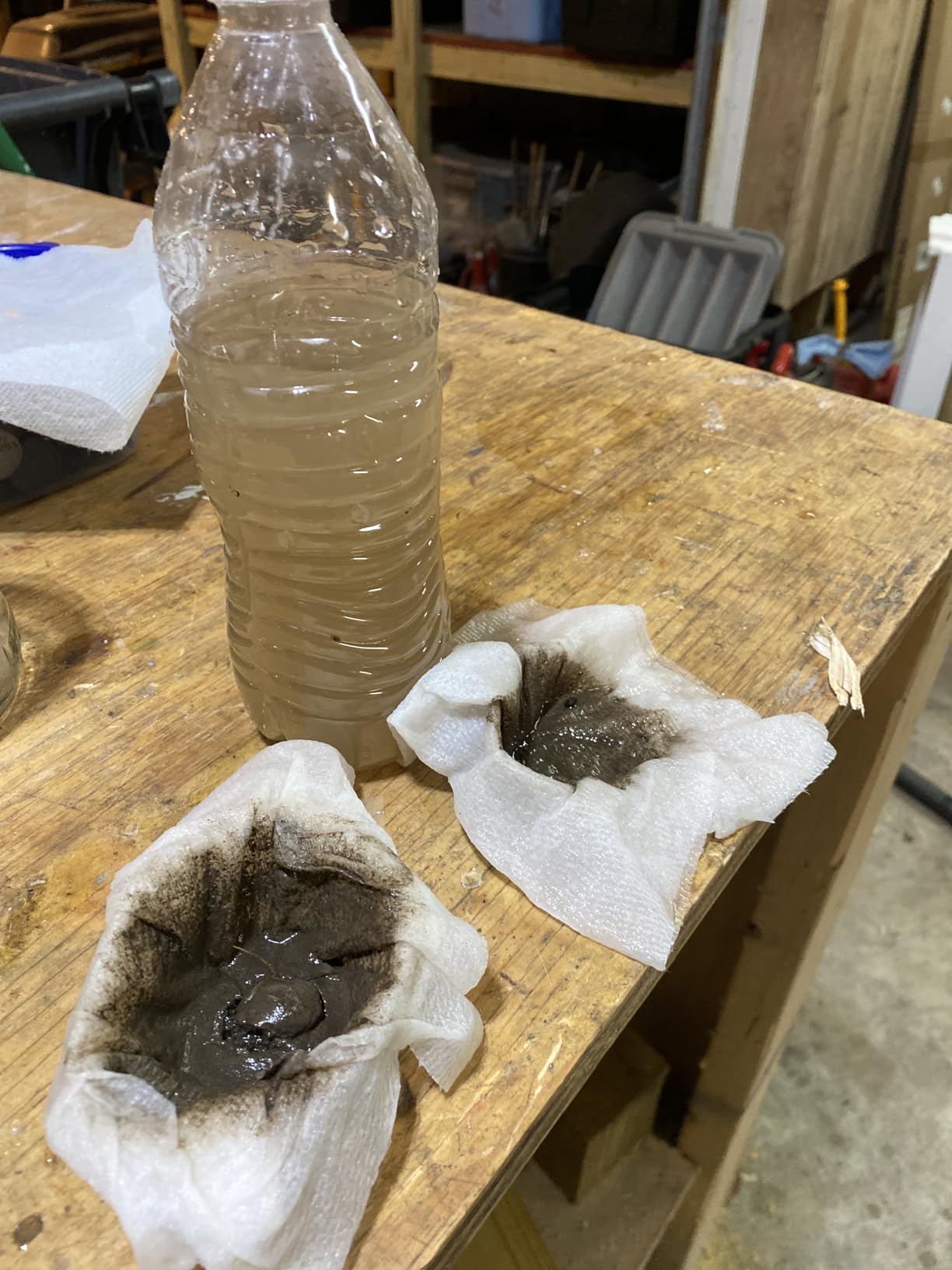
Two warnings before the picks. Tablets disinfect water; they do not filter it, so silt, sediment, heavy metals and chemical pollution survive the dose. And visible cloudiness has to be pre-filtered through a cloth or bandana before you drop a tablet in, which is the single most skipped step in emergency treatment.
Table of Contents
Top 3 Picks: Best Water Purification Tablets for Emergency Kits (October 2026)

Potable Aqua with PA Plus
- Iodine plus neutralizer tablets
- Effective against bacteria and Giardia lamblia
- 30 minute contact time

Potable Aqua Twin 50ct Pack
- 100 iodine doses per purchase
- Four-year shelf life
- Glass bottles for long storage

Aquatabs 49mg 100 Pack
- Chlorine based with no iodine aftertaste
- One tablet treats 0.75-2 litres
- Individually foil sealed
Quick Overview: Water Purification Tablets for Emergency Kits in 2026
| Product | Specifications | Action |
|---|---|---|
| Potable Aqua with PA Plus Two 50ct Bottles |
|
Check Latest Price |
| Potable Aqua Twin Pack 100ct |
|
Check Latest Price |
| Aquatabs 49mg 100 Pack |
|
Check Latest Price |
 Katadyn Micropur MP1 20 Count Katadyn Micropur MP1 20 Count |
|
Check Latest Price |
 Coghlan’s Drinking Water Germicidal Tablets Coghlan’s Drinking Water Germicidal Tablets |
|
Check Latest Price |
 Aquatabs 397mg Tank Kit with Test Strips Aquatabs 397mg Tank Kit with Test Strips |
|
Check Latest Price |
 Rothco Chlor-Floc Military Tablets Rothco Chlor-Floc Military Tablets |
|
Check Latest Price |
 Ef-Chlor 400mg 64 Tablets Ef-Chlor 400mg 64 Tablets |
|
Check Latest Price |
 NartiChlor CD Tablets 60 Count NartiChlor CD Tablets 60 Count |
|
Check Latest Price |
 ZOXY 100 Count Chlorine Tablets ZOXY 100 Count Chlorine Tablets |
|
Check Latest Price |
1. Potable Aqua Water Purification Tablets with PA Plus: the best balanced kit tablet
Potable Aqua Water Purification Tablets With PA Plus – Two 50 count Bottles
Iodine treatment plus PA Plus neutralizer
50 doses per bottle
30 minute contact time
2.24 ounces
Pros
- Neutralizer tablets remove iodine taste and colour
- Effective against bacteria and Giardia lamblia
- Two-part system is easy to follow under stress
- Largest evidence base with 26853 reviews
Cons
- Iodine is unsuitable for thyroid conditions and iodine allergies
- 100 doses cover only about 25 to 30 gallons
- Light sensitive so opened bottles lose potency
We keep coming back to this twin bottle because it removes the single biggest complaint about chemical water treatment. You treat, you wait, then you drop in a PA Plus tablet and the iodine taste and colour disappear, so people actually drink the water instead of grimacing through it.
With 26853 reviews at a 4.7 average, this is the most thoroughly proven option in the lineup. The chemistry is iodine based, effective against bacteria and Giardia lamblia, and the bottle is dark glass, which matters more than most buyers realise because light is what degrades iodine.
The catch is the iodine itself. Anyone with a thyroid condition, an iodine allergy, or who is pregnant is told to avoid this chemistry, and the warning is easy to miss in the fine print on the label. The second catch is arithmetic: 100 doses across both bottles treat roughly 25 to 30 gallons, so a four-person household rotating through it weekly will chew through a pack in a season.
Who the two-bottle system suits best
It suits a family kit where adults will be the ones treating water and where taste decides whether the water gets drunk. The treat-then-neutralize sequence is one extra step, but it is a step you can do while the kettle boils or while you walk back to the car.
It also suits anyone who wants an ingredient they can identify by name on a label. Tetraglycine hydroperiodide iodine has decades of military and NGO use behind it, and that track record is documented in reviews rather than marketing copy.
When to pick something else
If anyone in the household has thyroid trouble, skip it and go straight to chlorine dioxide. If you need more than about 30 gallons of coverage per purchase, the cost per litre climbs quickly and a chlorine tablet pack stretches further.
Long-haul bug-out bags should rotate these bottles every few years rather than trusting a decade-old purchase. Iodine degrades faster than chlorine chemistry once the bottle is open, and potency loss is invisible until you need it.
2. Potable Aqua Twin 50ct Bottles: the simplest stockpile option
Potable Aqua Water Purification Tablets, Portable and Effective Water Purification Solution for Camping, Hiking, Emergencies, Natural Disasters and International Travel, Two 50ct Bottles, Blue
Iodine germicidal tablets
100 doses across two bottles
Four-year shelf life
Rated to 1000 ppm TDS
Pros
- 100 doses from a single purchase
- Aftertaste is milder than most iodine tablets
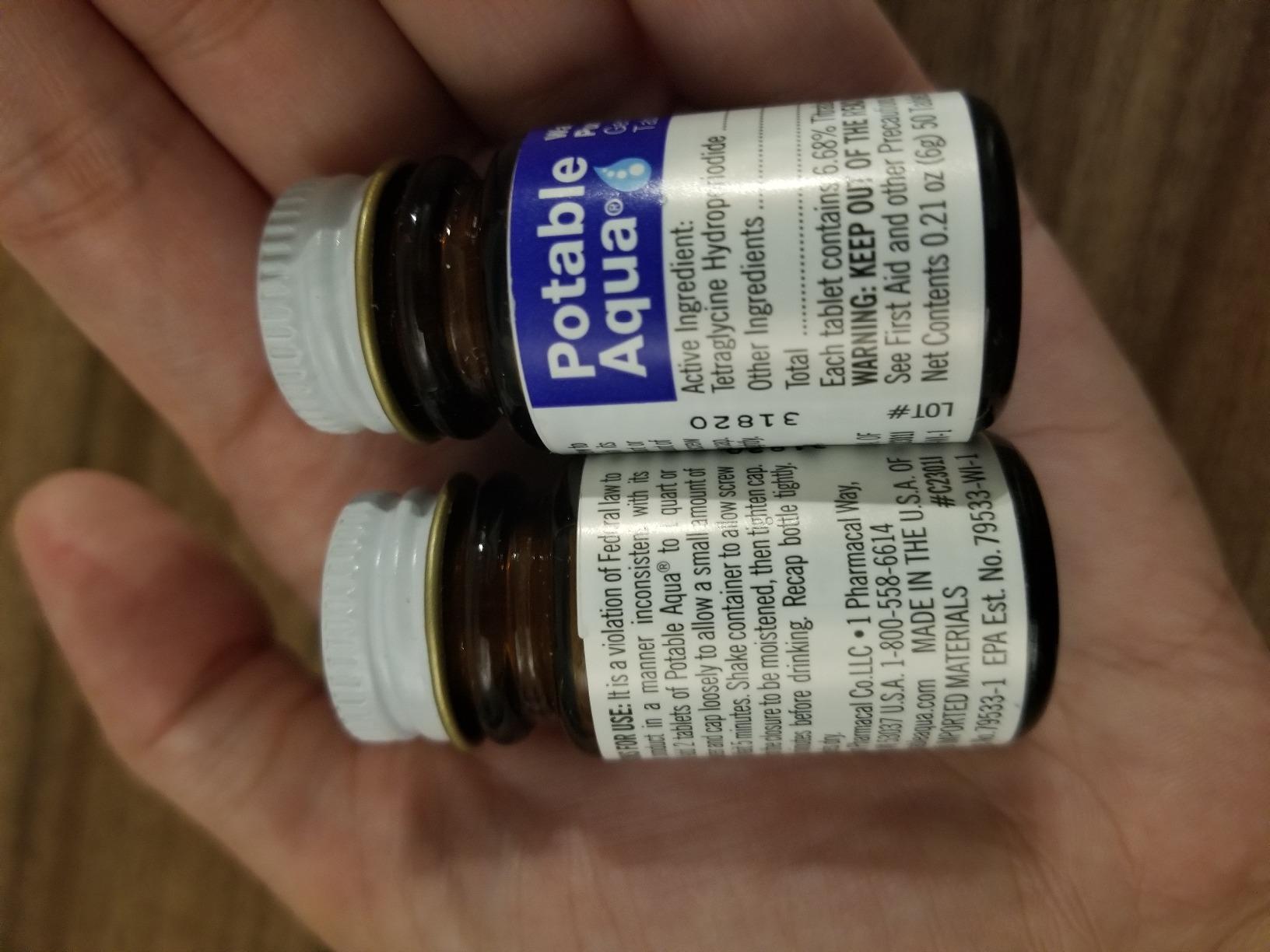
- Glass bottles with metal caps seal well
- Handles water up to 1000 ppm TDS
Cons
- Still leaves an iodine aftertaste without neutralizer
- 30 minute wait that stretches in cold water
- Kills organisms only and not sediment or chemicals
This is the same iodine chemistry as our top pick with the neutralizer tablets removed. If your kit already carries a separate neutralizer, or if your group can live with a mild aftertaste, this pack gives you twice the doses per purchase for less weight and less bulk.
Reviewers describe the taste as barely noticeable next to typical iodine tablets, and the four-year shelf life is the number that matters for a stockpile. The bottles measure 9 by 1 by 6 inches, which means they fit a go bag side pocket or a vehicle glovebox without a fight.
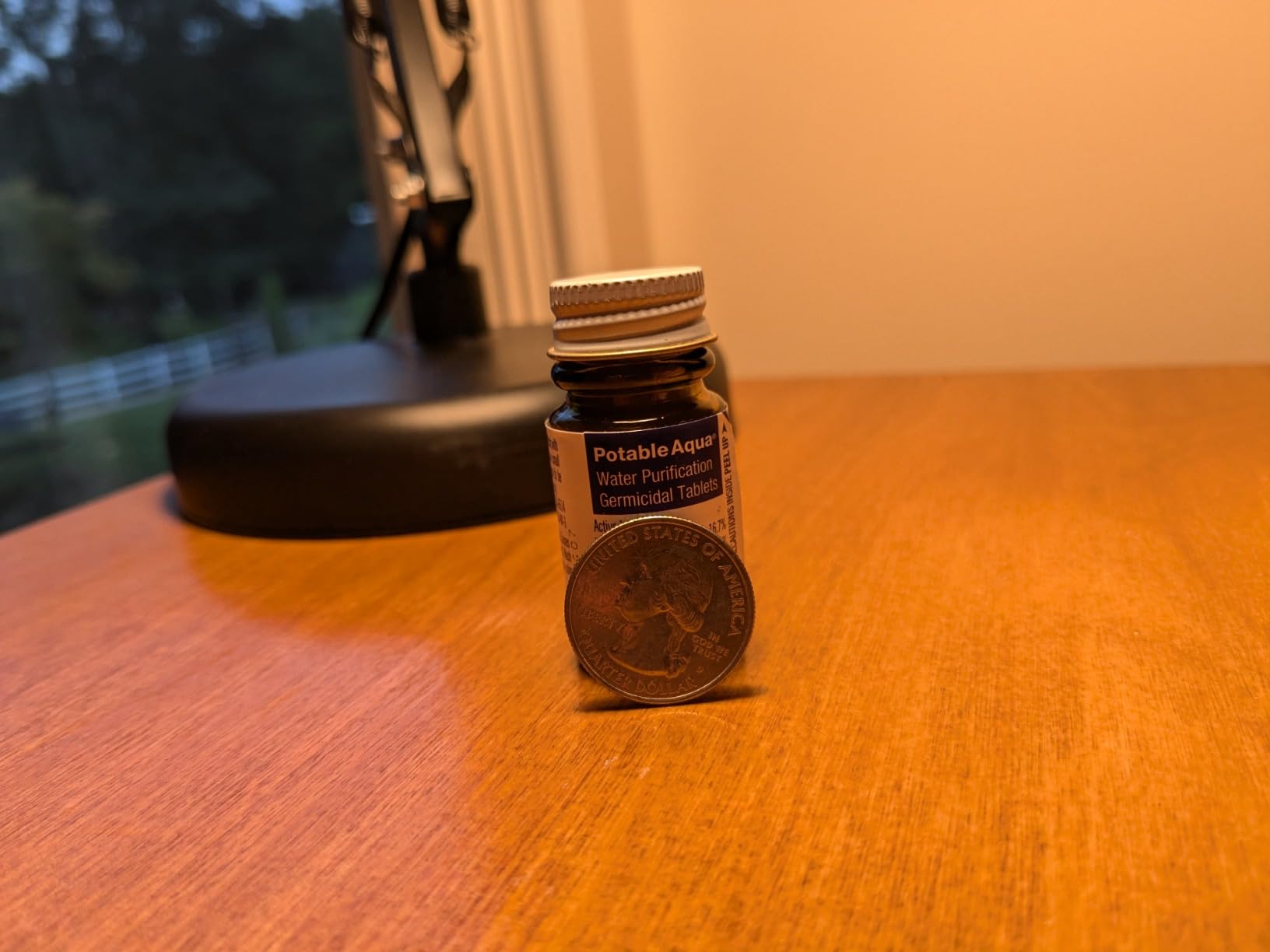
The listed capacity is 50 quarts and the manufacturer rates it for water with total dissolved solids up to 1000 ppm, so it copes with ordinary tap, well and rainwater sources. That TDS ceiling is higher than most chlorine dioxide tablets manage, which is a quiet advantage when the emergency is a flooded basement rather than a backcountry stream.
Why the plain twin pack earns its slot
Dose count is the deciding factor here. A household of four treating four litres per person per day for three days needs about 48 doses, and one purchase covers that twice over with room for a second trip to the same source.
Long-term reviewers on hiking and travel forums treat this as a permanent fixture rather than a consumable, largely because the sealed glass bottles survive being dropped, soaked and carried for years.
Where it falls short
The missing neutralizer is the whole point of the trade-off. Reviews include buyers who still notice an iodine aftertaste and regret not buying the two-part version instead.
The 30-minute contact time is also the practical constraint. In cold water it stretches further, and a waiting period you cannot shorten is awkward when the group is cold and moving.
3. Aquatabs 49mg 100 Pack: best choice for a group kit
Aquatabs 49mg Water Purification Tablets, 100 Pack, Hiking & Camping
Chlorine based calcium hypochlorite
0.75 to 2 litres per tablet
30 minute contact time
Pros
- No iodine taste colour or odour
- Individually foil sealed for storage
- One tablet covers up to 2 litres
- Printed expiry reaches October 2030
Cons
- Cloudy water needs filtering first
- 30 minute wait that stretches in cold water
- Higher cost per litre than bulk chlorine tablets
When several people need to treat water at the same time, chlorine tablets win on logistics. One person per water bottle means four people hydrate a group in a single 30-minute window instead of taking shifts, which is why forum hikers favour them for group trips.
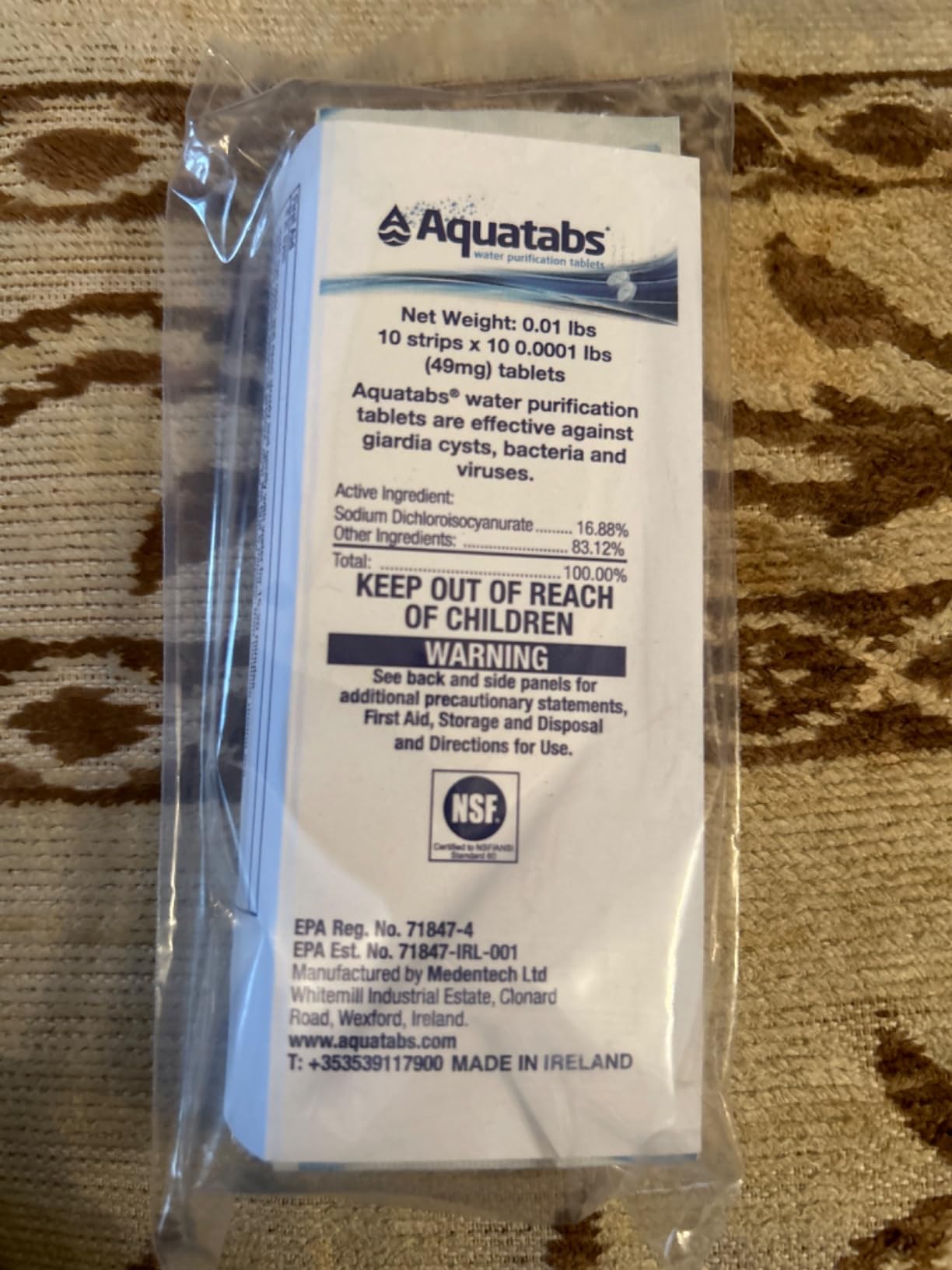
Aquatabs uses chlorine rather than iodine, and the reviews make the reason obvious: treated water comes out with no unpleasant taste, colour or odour. The manufacturer claims 99.9999% bacteria, 99.99% virus and 99.9% cyst reduction, and the foil-sealed strips are praised as the reason the printed expiry on this pack runs into 2030.
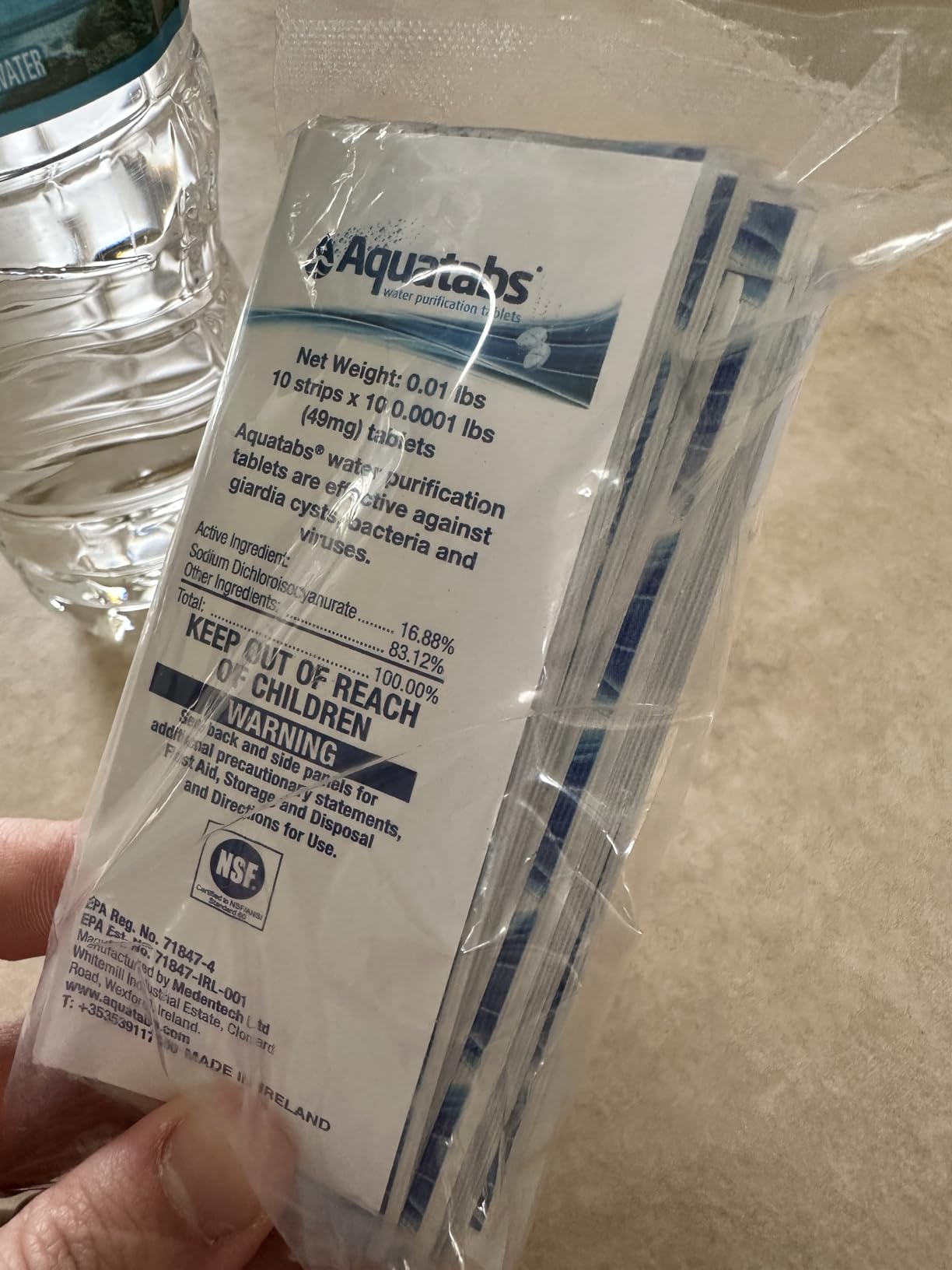
Dose rate depends on temperature. One 49mg tablet treats 0.75 litres of cold water or up to 2 litres of room temperature water in 30 minutes, which is a big planning difference when you are counting tablets for a cold-weather scenario.
Why groups pick chlorine over iodine
There is no neutralizer to remember, so the process is one step instead of two. That is a real advantage when half the group is helping and nobody wants to track which bottle is which.
The strong sales rank in the camping and hiking category also signals that these are the tablets most hikers have actually carried and used, rather than bought and forgotten.
Where the trade-offs sit
Owners repeatedly advise filtering cloudy water first, because chlorine chemistry works on organisms, not on suspended sediment. Clear a stream source through a bandana before dosing.
The wait is 30 minutes, longer in cold or turbid water, and the cost per litre runs higher than buying bulk chlorine tablets in quantity. For a household drinking four litres a day, that adds up.
4. Katadyn Micropur MP1: the chlorine dioxide option
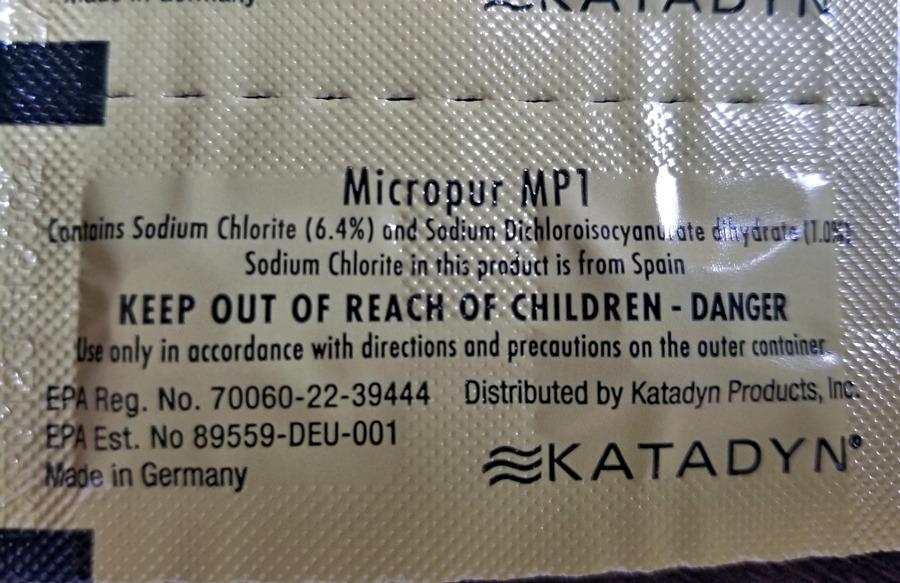
Katadyn Micropur MP1 Water Purification Tablets, 20 Count
Chlorine dioxide
One tablet per litre
15 minutes clear water
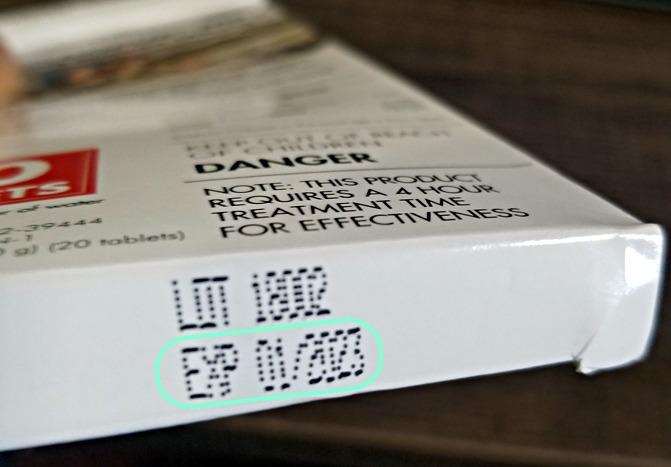
Five-year shelf life
Pros
- Chlorine dioxide kills Cryptosporidium and cysts
- No iodine off-taste or chemical residue
- No pump or filter equipment needed
- Five-year shelf life in sealed tablets
Cons
- Only 20 tablets per bottle so families need several
- Up to 4 hours wait in cold or cloudy water
- Rated only up to 300 ppm TDS
Chlorine dioxide is the same active agent municipal drinking water plants use, and it is the only chemistry in this group that reliably destroys Cryptosporidium, the chlorine-resistant protozoan cyst that worries anyone drawing from North American backcountry or flood water. If cyst safety is your deciding spec, this is the tablet.
Taste is the second win. One tablet per litre at a 4 ppm in-use concentration leaves no iodine off-taste and no chemical residue, which is why users going filterless on forums name chlorine dioxide as their only acceptable chemical option.
The five-year shelf life and individually sealed tablets make this a straightforward stockpile item. There is no pump, no filter and no measuring equipment to lose.
Where chlorine dioxide earns the premium
Any water source that could carry cysts: beaver ponds, shallow flooded farmland, untreated surface water in a flood zone. Iodine and standard chlorine tablets simply do not have a reliable answer there.
It is also the easiest chemistry to hand to a child or a guest, because the taste objection disappears. A 4.7 average across 626 reviews with a strong five-star share reflects that.
What limits it in a kit
Twenty tablets is a hiking quantity, not a family quantity. A four-person household needing 48 litres for three days would need several bottles, so this is a cyst-safe backup layer rather than the whole supply.
The wait time is the other catch: 15 minutes in clear water, but up to 4 hours in cold or cloudy conditions, and the 300 ppm TDS ceiling rules out hard or saline sources.
5. Coghlan’s Drinking Water Germicidal Tablets: the lightweight legacy pack
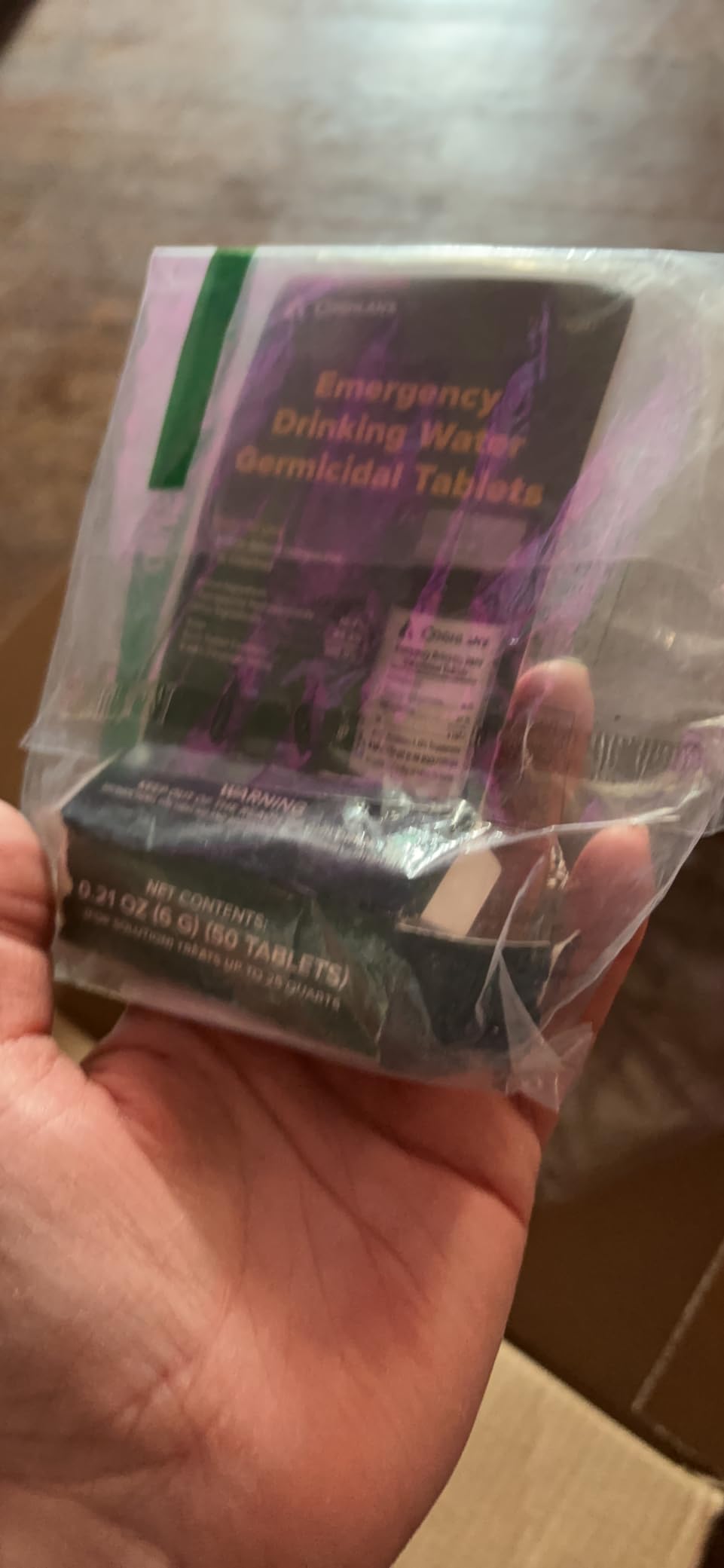
Coghlan’s Drinking Water Germicidal Tablets – 50 Tablets for Safe Emergency Water Purification, Camping, Hiking, Backpacking, and Survival Preparedness
Iodine germicidal tablets
50 tablets per bottle
About 1 litre per tablet
Limited use
Pros
- Genuinely light and simple for a day pack
- 50 tablets cover roughly 25 litres
- Long field history in hiking and cleanup kits
- Small enough for a vehicle emergency kit
Cons
- Metal cap can rust from iodine contact inside the bottle
- Leaves noticeable taste and colour unneutralized
- Labeled for short-term or limited use only
Coghlan’s has been a hiking and camping shelf staple for decades, and the reviews reflect that: owners talk about disaster cleanup duty and trail trips where nothing else was available. At 4.6 stars across 454 reviews it holds up, just without the polish of newer kits.
Each bottle carries 50 tablets with a listed capacity of 25 litres, so roughly a litre per tablet. The whole package weighs 18.14 grams, which is genuinely nothing in a pack that also has to carry shelter and food.
Two practical complaints recur. The metal cap can rust from contact with the iodine chemical, which is unsightly and can contaminate the neck of the bottle, and the tablets leave a noticeable taste and colour because there is no neutralizer in the pack.
Who this pack still suits
Anyone building several kits at once. Vehicle trunks, trailer drawers, boat storage hatches and one per family member all benefit from a cheap, light, simple pack that nobody has to be trained on.
It is also a reasonable backup layer to a filter, since the use is labelled short-term or limited rather than continuous drinking.
Why it is not the top pick
The label explicitly limits use to short-term or limited emergencies, which makes it a poor choice for a household tank or a long shelter-in-place scenario where days of treatment add up.
Add the rusting cap and the untreated iodine aftertaste and you are carrying a tablet that works but asks more of the person drinking it.
6. Aquatabs 397mg Tank Kit with Test Strips: for stored water and RV tanks
Aquatabs Water Purification Tablets for Drinking – 100 Tablets + 2 Chlorine Test Strips – Water Purifier Starter Kit – for Boat and RV Tanks – By Aquamarine Water Solutions
Sodium dichloroisocyanurate
One tablet per 4 gallons
30 minute wait
EPA registered and NSF certified
Pros
- Test strips turn a blind dose into a measurable check
- Time-release formula protects water for weeks
- EPA registered and NSF certified
- Dose size suits RV and boat tanks
Cons
- Strong chlorine smell and taste after treatment
- Built for storage tanks rather than on-trail use
- Requires a wait of at least 30 minutes
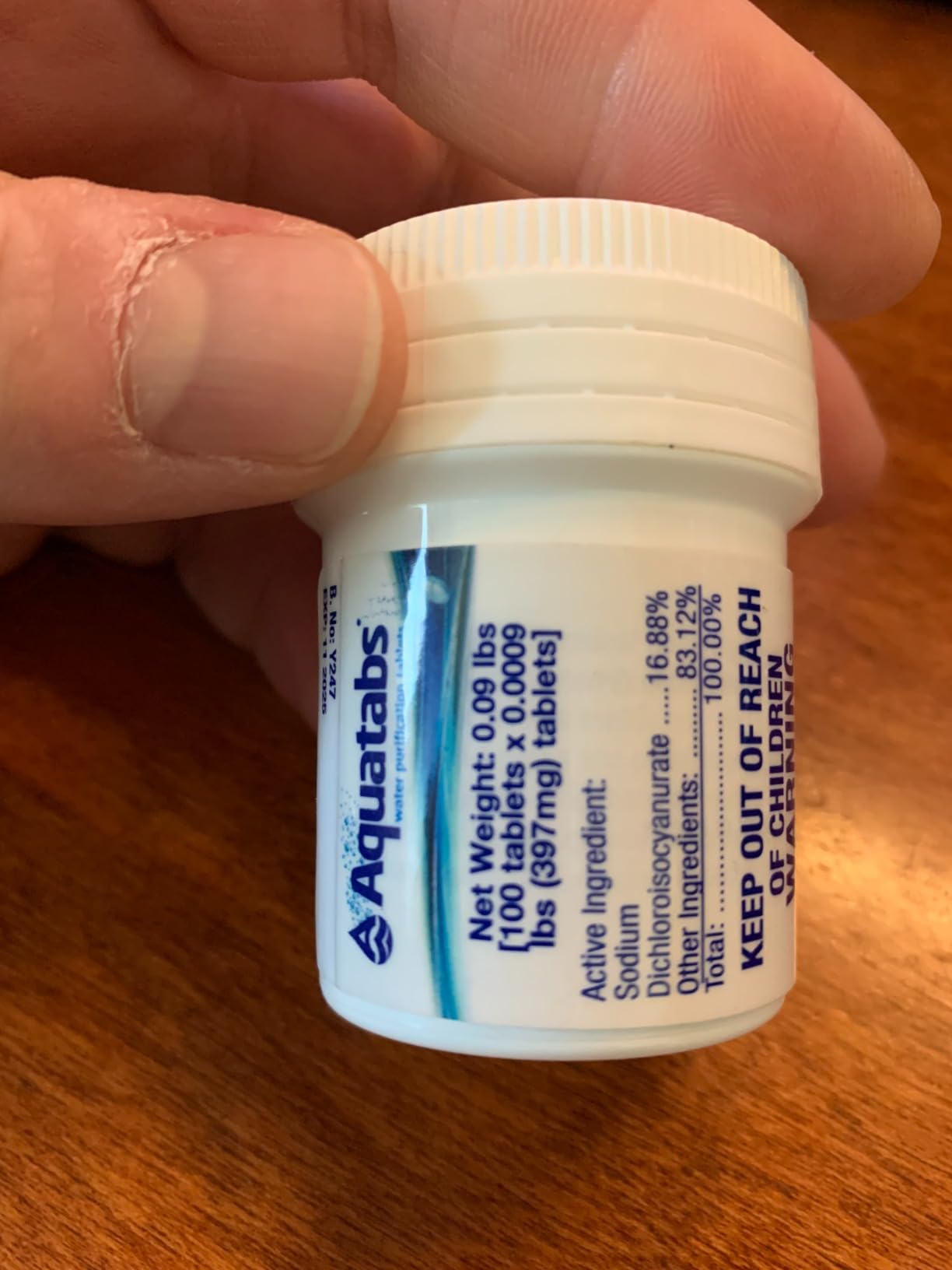
This is the pick for anyone whose emergency is about stored water rather than a stream. One 397mg tablet treats four gallons in 30 minutes, and the time-release formulation keeps killing microorganisms for weeks after that single dose, which matters enormously when you cannot re-treat a tank on demand.
The bundled chlorine test strips and colour chart are the detail that separates it from a generic chlorine tablet. Instead of guessing whether the dose took, you verify residual free chlorine yourself, and buyers with RV and boat systems value that measurable check.
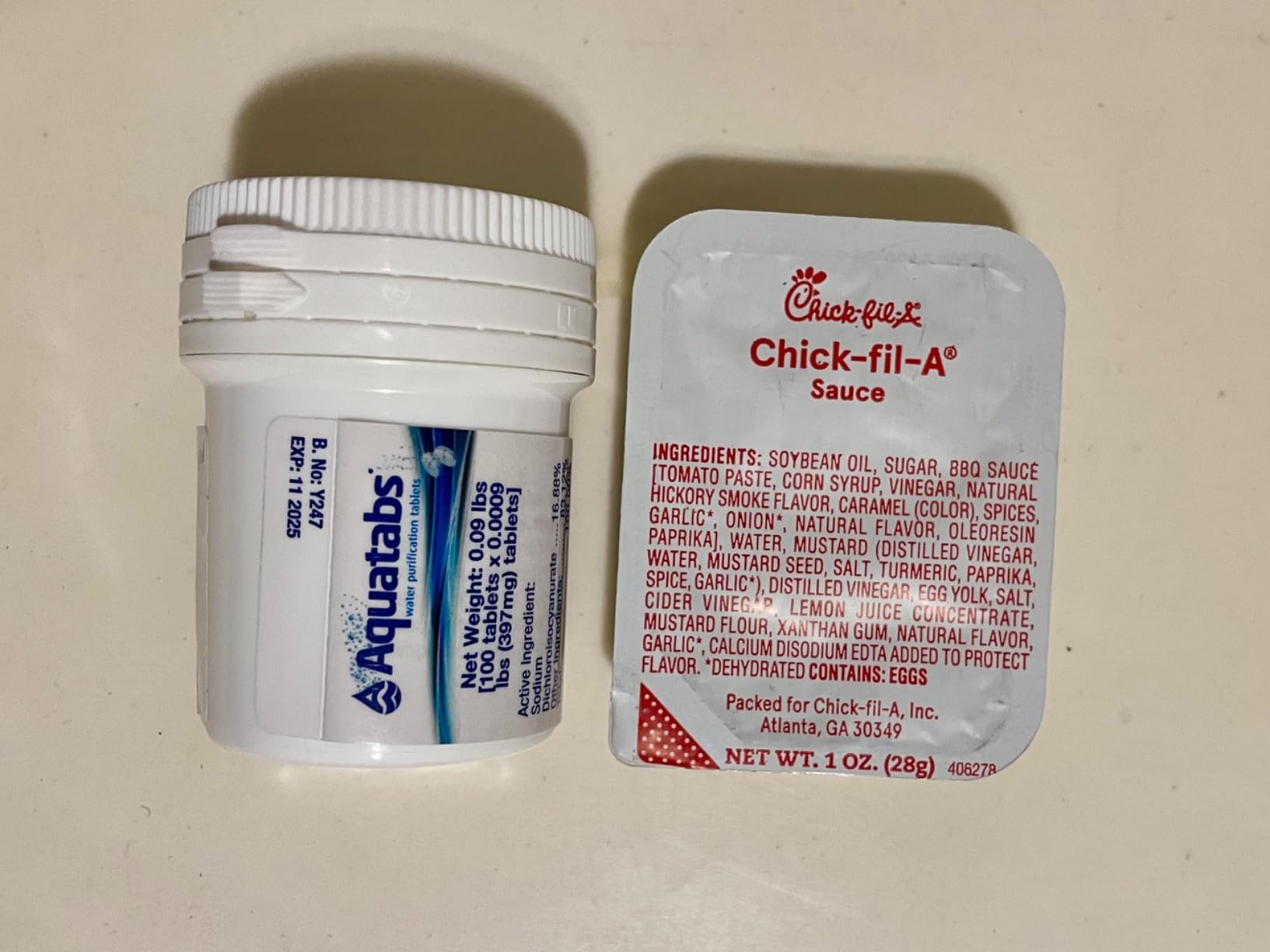
It is also EPA registered and NSF certified, rated for water with total dissolved solids up to 400 ppm, and reviewers using it on RV plumbing report that it removes the rotten-egg smell caused by bacteria growth in the system.
Why stored-water situations need this kind of tablet
Emergency preparedness guidance usually assumes you hold enough drinking water for several days in sealed containers. A time-release tablet protects that reserve from contamination after the initial fill, which a single-dose hiking tablet cannot promise.
The four-gallon dose also makes the maths easy. Ten tablets cover a 40-gallon storage tank, so a household can treat its whole reserve in one session.
Where it is the wrong tool
The chlorine smell and taste are strong, and one three-star reviewer judged the result worse than tap water. If palatability matters for daily drinking, this is unpleasant.
It is also the wrong shape for the trail. Nothing about a four-gallon tank dose helps someone who needs a litre at a roadside stream at dusk, and it costs more than standard drinking-water tablets.
7. Rothco Chlor-Floc: for green, sediment-laden water
Chlor-Floc US Military Water Purification Tablets
Coagulant and flocculant chemistry
30 packets per box
About 1 litre per packet
Two-year shelf life
Pros
- Clears visibly green sediment-heavy water
- Developed to US Military specification
- Light packets split easily between kits
- Milder taste than plain chlorine tablets
Cons
- Only about 1 litre per packet in a 30 packet box
- Cardboard box with no resealable waterproof seal
- Two-year shelf life means frequent rotation
Every other tablet on this list treats clear water. Chlor-Floc is the one that handles the pond water scenario, because its coagulation and flocculation chemistry settles visible silt and algae out of the container rather than leaving it suspended.
It was developed to US Military specification model 3503-30, and that pedigree is the reason campers and preppers trust it. Reviewers also report a milder taste than standard chlorine tablets, with sunlight cutting the residual flavour further.
Where flocculation changes the outcome
Flood water and shallow pond water carry sediment that shields bacteria from the disinfectant. Flocculating first binds those particles into settleable clumps, then you decant the clearer water above and dose that. It is a two-stage treatment, and it is the only pick here that addresses turbidity at all.
For a kit staged in a rural area near open water, that capability is worth more than a longer shelf life.
Why it cannot be your only treatment
Each packet treats roughly one litre, so a 30-packet box covers about 8 gallons. That is a single weekend of drinking for a family, not a stockpile.
The box is cardboard with no resealable waterproof container, so users improvise with a ziplock. The two-year shelf life is the shortest of the chlorine options here, and the taste is still described as unpleasant enough that reviews advise against drinking it for more than a couple of days.
8. Ef-Chlor 400mg 64 Tablets: for volume and household water
Ef-Chlor Water Purification 64 Tablets – 400mg Portable Drinking Water Purification & Sterilization Tablet Ideal for Emergencies Survival Purifies 26.4 Gallons – 39.62 Gallons in 1 Tablet
One tablet treats up to 150 litres of clear water
Three-year shelf life
Usable 24 hours covered
Pros
- Largest single dose in the lineup at 150 litres
- Useful for well water and rainwater cisterns
- Treated water stays usable 24 hours covered
- No boiling required
Cons
- Does nothing for sediment or cloudiness
- Leaves a slight taste
- Longer handling than a single-dose hiking tablet
This is the volume option. One 400mg tablet treats up to 150 litres of clear water for permanent drinking use, or 26.4 gallons of clouded water in an emergency, and that capacity is far beyond anything else on this list.
The strongest following comes from rural homeowners rather than backpackers, using a tablet as a weekly maintenance dose on well water to handle sulfur and iron-bacteria problems. Campers report the same tablets doubling as a sanitising rinse for camp dishwashing during a power cut.
At a 4.7 average the satisfaction level is high, but the 81-review pool is thin next to the 26,000-review leaders, so treat the rating as encouraging rather than settled.
When a household well changes the maths
If your emergency scenario is contaminated well water or a rainwater cistern rather than a hiking trip, per-litre tablet counting stops being the right unit. One tablet per 150 litres makes a 64-count box the practical answer.
Covered treated water stays usable for 24 hours, which lets you dose a batch in the morning rather than measuring every glass.
Where the volume trick does not help
It does nothing for sediment, cloudiness or appearance, so turbid water still needs filtering first, and the handling steps take longer than dropping a single hiking tablet into a bottle.
The three-year expiry is the other watch point. Inside a kit that sits unopened for five years, that date passes quietly.
9. NartiChlor CD Tablets: no-mix chlorine dioxide in a small pack
The Original NartiChlor CD Tablets | 60 Count
Chlorine dioxide tablets
One tablet per litre at 100 ppm
No measuring or mixing
Individually packed
Pros
- Chlorine dioxide with no strong taste or smell
- Dead simple one tablet per litre dosing
- Individually packed for stockpiling
- Sits inside pool and spa supply chains
Cons
- Lowest rating in this lineup at 4.2 stars with 11% one-star reviews
- Small 60-count pack with only one tablet per litre of capacity
- Sits in the pool-chlorine category so it is not filed with hiking water purifiers
The appeal is simplicity. One tablet into one litre of water, no measuring, no mixing, no neutralizer to remember, and the chlorine dioxide chemistry leaves no strong taste, smell or residue. For indoor use, travel kits and odor control it does a clean job.
That said, this is the weakest evidence base in the lineup. The listing averages 4.2 stars across 44 reviews with an 11% one-star share, and a 44-review sample simply does not tell you much about long-term field consistency.
Where the no-mix format helps
Panic dosing is where wrong chemistry does damage. A one-tablet-per-litre format removes the arithmetic entirely, which is genuinely useful for a household treating water while distracted.
Individual packing also suits splitting a supply across a go bag, a vehicle kit and a home kit without breaking a seal.
Why the rating gives us pause
A double-digit one-star share with only 44 reviews usually means inconsistent experiences rather than one isolated complaint. There is not enough review volume here to treat the rating as reliable.
The 60-count pack at one tablet per litre also covers just 60 litres, and the product sits in the pool chlorine category rather than alongside hiking water purifiers, so expect to do your own sourcing research.
10. ZOXY 100 Count Chlorine Tablets: longest storage for hard water
Water Tablets Purification for Drinking (100 Count) – Water Filtration System Survival for Camping, Boating, Hiking, Backpacking, Emergencies – Portable Water Treatment for Safe Drinking Anywhere
Sodium dichloroisocyanurate
Up to 4 gallons per tablet
30 minutes to 1 hour
Five-year shelf life
Pros
- Four gallons per tablet from a 100-count bottle
- Five-year storage life
- Highest TDS rating in the lineup at 1500 ppm
- Compact bottle for survival kits
Cons
- Explicitly does not inactivate Cryptosporidium
- Treatment takes 30 minutes to 1 hour
- Dose varies with water clarity
Capacity and shelf life are the pitch here. One tablet purifies up to 4 gallons in 30 minutes to an hour, the bottle promises five years of storage, and the 1500 ppm total dissolved solids rating is the highest in this group, which matters for hard, saline or brackish sources.
The same sodium dichloroisocyanurate chemistry used in Aquatabs means no unpleasant taste, colour or odour after treatment, and the compact 100-count bottle suits a survival kit that also has to hold tools and food.
Why the hard-water rating matters
Most tablets here top out between 300 and 1000 ppm TDS. If your emergency water comes from a coastal well, an irrigation channel or a hard-rock spring, the higher ceiling means the dose will actually perform.
Five years of stated storage is the other advantage, the longest promise among the non-iodine options we covered, and it reduces how often you have to rotate a stockpile.
The cryptosporidium problem
The listing states plainly that it does not inactivate Cryptosporidium, and that is the deciding flaw for anyone drawing from flood water or backcountry sources. Standard chlorine chemistry cannot defeat the cyst wall.
Dosage also varies with water clarity, so cloudy water needs filtering first and a different dose after. With a 4.4 average on 44 reviews, the reliability evidence is thin as well.
How We Chose the Best Water Purification Tablets for Emergency Kits
We treated this as a kit problem rather than a hiking problem. A backpacker can tolerate a four-hour wait because they planned for it; a household in a flooded street cannot, and the chemical that wins on paper can lose badly at 2am.
The first filter was cyst safety. Cryptosporidium is chlorine resistant, so any tablet whose chemistry cannot kill it is a backup layer at best. That pushed chlorine dioxide options to the top of the ranking and ruled out one chlorine listing outright.
The second filter was contact time, weighted heavily toward shorter waits and long cold-water allowances being disclosed rather than hidden. Buyers accept four hours when they are told about it in advance.
The third was shelf life and packaging, because a kit that sits for five years needs sealed individual tablets or dark glass, not a tub of loose pills. Finally we checked litres per tablet against realistic household demand, and read the negative reviews as carefully as the positive ones.
Buying Guide: How Many Tablets Your Emergency Kit Actually Needs
Start with the volume maths rather than the tablet count. Guidance for a 72-hour kit assumes roughly 4 litres of drinking water per person per day for drinking and basic hygiene, which is the number most emergency preparedness references use.
At four litres per person per day, one person needs about 12 litres over three days and roughly 12 to 50 tablets depending on the product. A two-person household needs about 24 litres, which the 100-count iodine packs cover with room to spare. A four-person household needs about 48 litres, and that is where the small 20-count and 60-count packs stop being sufficient.
Divide that volume by the litres each tablet treats and add a margin of about 30 percent for a second collection trip or a warm-weather dose. If the kit doubles as a car kit, size for the passengers, not the driver.
Match the chemistry to the risk
Iodine is gentle, well documented and cheap, but it leaves taste and colour and is unsuitable for thyroid conditions, iodine allergies and pregnancy. Chlorine is tasteless and handles larger volumes, but standard chlorine tablets do not reliably kill Cryptosporidium. Chlorine dioxide kills cysts and leaves no aftertaste, at a higher cost per litre and a colder-water wait.
Coagulant and flocculant tablets are a complement rather than a replacement. They clear turbidity so a disinfectant can reach the organisms, and they belong in a kit that might draw from pond or flood water.
Pre-filter before you dose
Cloudy water defeats chemical treatment because suspended particles shield pathogens from the disinfectant. Pour suspect water through a bandana, a coffee filter or a clean sock into a clear container, let the solids settle, then dose the clearer water above.
This step costs nothing, needs no equipment beyond a cloth, and is the difference between a full dose working and doing almost nothing.
Plan for storage and rotation
Sealed foil strips and dark glass bottles are what make a five-year shelf life real. Store the supply somewhere cool and dry, away from direct sunlight, and set a calendar reminder to check the printed expiry rather than trusting the date on the outer packaging.
Keep tablets in a sealed bag or a waterproof pouch if the outer box is cardboard. Accidental ingestion is a genuine household risk with kids in the house, so a labelled container with a child-resistant closure sits inside the kit rather than loose in a first aid bag.
Know what tablets cannot do
Chemical treatment kills living organisms. It does not remove sediment, heavy metals, salts, fuel, pesticides or any chemical contaminant, and no tablet on this list makes chemically polluted water drinkable. It also does not improve taste or clarity on its own.
If you are filtering anyway, tablets are the backup, not the primary. Many hikers on forums carry both for exactly that reason: a filter for the daily litres, a small pack of chlorine dioxide tablets for the days the filter breaks.
Frequently Asked Questions
What are the most effective water purification tablets?
Chlorine dioxide is the most effective chemistry here because it destroys Cryptosporidium, the chlorine-resistant cyst that iodine and standard chlorine tablets cannot reliably kill. Chlorine dioxide also leaves no iodine aftertaste. For pure volume on clear water, chlorine tablets such as Aquatabs treat more litres per tablet with no taste penalty.
Do water purification tablets actually work?
Yes, when used exactly as directed and when the water is clear. Tablets disinfect water by oxidising or disrupting the cell structure of bacteria, viruses and protozoa. They do not remove sediment, heavy metals or chemical contamination, and visible cloudiness must be filtered out before dosing or the dose is largely wasted.
What are the downsides of using water purification tablets?
The main drawbacks are taste, wait time and dose ambiguity. Iodine leaves a noticeable taste and colour unless a neutralizer tablet is added. Contact times range from 15 minutes in clear water to as much as four hours in cold or cloudy conditions, and dosage varies with water temperature and clarity. Tablets also provide no taste or odour improvement.
Which chlorine tablets are most effective for purifying drinking water?
Among the picks, the 49mg Aquatabs are the most effective general-purpose chlorine choice, treating 0.75 to 2 litres per tablet in 30 minutes with individually foil-sealed storage. The 397mg Aquatabs tank tablets are built for storage systems and keep protecting water for weeks, while ZOXY tablets offer four-gallon capacity and a five-year shelf life but do not inactivate Cryptosporidium.
What are the best water purification tablets for water tanks?
For water tanks, RV systems and stored reserves, the 397mg Aquatabs kit is built for the job: one tablet per four gallons in 30 minutes, a time-release formula that keeps killing microorganisms for weeks, EPA registration and NSF certification, and chlorine test strips that let you verify residual disinfectant instead of guessing.
How long do water purification tablets take to work?
Most need between 15 and 30 minutes. Chlorine dioxide takes 15 minutes in clear water, chlorine tablets such as Aquatabs need 30 minutes, and iodine typically needs 30 minutes. Cold water and cloudy water extend every one of those times, with some chlorine dioxide products requiring up to four hours in those conditions.
Are water purification tablets safe for children?
The treated water is safe to drink once the full contact time has passed, but the tablets themselves must be stored away from children because accidental ingestion of a concentrated dose is harmful. Iodine-based products also carry warnings for thyroid conditions, iodine allergies and pregnancy, which is why many families choose chlorine dioxide instead.
Conclusion: Which Tablets Belong in Your Kit
For most households the answer to the best water purification tablets for emergency kits question is layered rather than singular. A chlorine dioxide tablet such as Katadyn Micropur covers the cyst risk in a small pouch, and a larger chlorine pack such as Aquatabs or the Potable Aqua twin bottles handles the daily volume with no aftertaste.
Our single pick remains the Potable Aqua tablets with PA Plus, because the neutralizer solves the taste problem that stops people drinking treated water, and 26853 reviews at 4.7 stars make it the least risky choice in the set. Add a filter as the primary method if you can carry one, keep the tablets as the backup that works when the filter does not.
Whatever you choose, check the printed expiry before you seal the kit, pre-filter anything cloudy, and store the supply where children cannot reach it. For the rest of the kit around it, our emergency radio picks and storm weather radio guide cover the communications side of the same bag.