
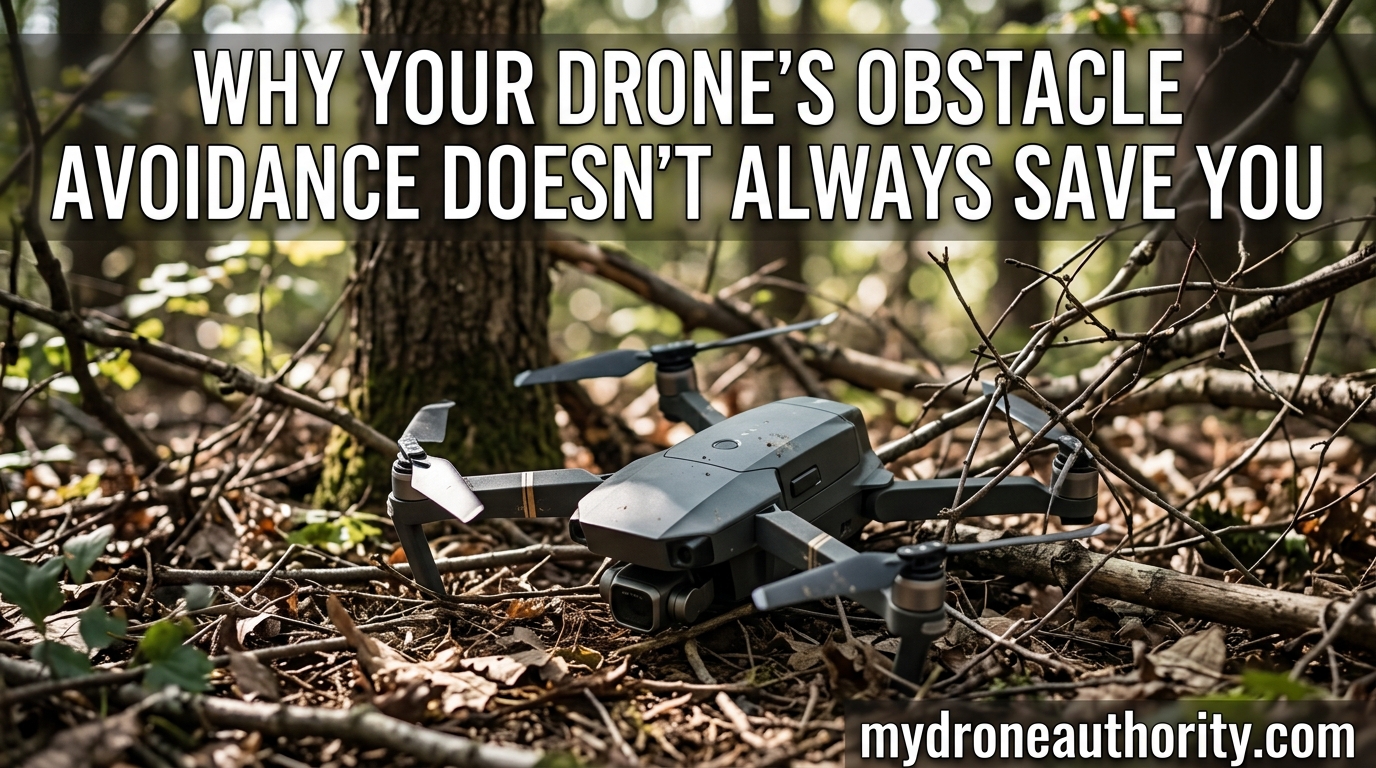
You just unboxed a brand-new drone with obstacle avoidance, and the marketing made it sound bulletproof. Brake, bypass, hover, save the day. So you fly a little closer to that tree line than you normally would. Then you hear the unmistakable crack of propellers hitting branches, and your drone drops into the brush.
This is the gap most pilots discover the hard way. Drone obstacle avoidance is genuinely impressive technology, but it has well-documented limitations that manufacturers undersell and pilots underestimate. The system can save you in many situations, and it can also give you just enough confidence to fly into the one scenario it was never designed to handle.
In this guide, we are going to break down exactly why your drone’s obstacle avoidance doesn’t always save you. We will cover the sensor technology, the specific failure modes real pilots have reported, the environmental conditions that blind the system, and how to combine automation with your own pilot judgment so you stop trusting the machine blindly and start using it as the co-pilot it was designed to be.
Table of Contents
What Is Drone Obstacle Avoidance, Really?
Drone obstacle avoidance is an electronic safety system that uses onboard sensors to detect objects in the drone’s flight path and automatically adjusts the drone’s trajectory to prevent a collision. It is not autopilot, and it is not a replacement for line-of-sight piloting. It is a backup layer that kicks in when something gets too close.
The confusion starts with how the feature is marketed. When a manufacturer says a drone has omnidirectional obstacle sensing, pilots hear “this drone cannot crash.” What it actually means is the drone has sensors pointing in multiple directions that can detect certain types of obstacles under certain conditions at certain speeds. Every word in that sentence matters.
Detection and avoidance are also two different things. Detection means the sensor registers that something is there. Avoidance means the flight controller decides what to do about it, brake, hover, climb, or route around. DJI calls this APAS, or Advanced Pilot Assistance Systems, and it is the brain that interprets the sensor data and chooses a response. Even when detection works perfectly, the avoidance logic can still fail if the situation is outside what the algorithm was trained to handle.
Modern systems got significantly better over the last few years. The DJI Mavic 3 series and newer Air models pack directional vision sensors, LiDAR on some pro models, and infrared sensors for closer range work. The DJI Mini 4 Pro and Mini 5 Pro brought dual vision sensors to a sub-250-gram airframe for the first time. But the underlying physics of what each sensor can and cannot see has not changed. That is where the trouble starts.
The Sensors Behind the Magic (And Their Blind Spots)
To understand why drone obstacle avoidance doesn’t always save you, you have to understand what the sensors actually see. Each sensor type has strengths and a hard list of things it simply cannot detect. Most consumer drones use a combination, and the combination itself has gaps.
Stereo Vision Cameras
Stereo vision cameras are the workhorses of modern obstacle avoidance. They use two cameras spaced slightly apart to mimic human binocular vision and calculate depth through parallax. They are excellent at detecting large, textured, well-lit objects like buildings, vehicles, and tree trunks. They are essentially blind to anything thin, transparent, or low-contrast.
A bare branch in winter, a wire fence against the sky, or a glass building will likely not register at all. Stereo vision also needs light. At dusk or in heavy shadow, the effective detection range drops dramatically, sometimes to nearly zero.
LiDAR Sensors
LiDAR fires laser pulses and measures how long they take to bounce back, building a point cloud of the environment. It is more accurate than vision in low light and works well for solid, irregular surfaces like rock faces or building facades. LiDAR is increasingly common on enterprise and prosumer drones.
But LiDAR has its own blind spots. It can struggle with power lines, suspended cables, and very thin objects because the laser beam can pass on either side without a clean return. Reflective surfaces like wet metal or glass can scatter the beam and produce garbage data. Snow and heavy rain scatter LiDAR pulses and create false positives that make the drone refuse to move.
Infrared Sensors
Infrared sensors emit infrared light and measure the reflection to gauge distance. They are cheap, lightweight, and common on smaller drones where space and payload are tight. They work reasonably well for short-range detection of large, opaque objects.
Infrared fails badly with black surfaces that absorb the wavelength, transparent objects that let the light pass through, and direct sunlight that floods the sensor with ambient infrared. A black car in direct sun can be effectively invisible to an infrared-only avoidance system.
Ultrasonic Sensors
Ultrasonic sensors use high-frequency sound waves, usually for near-ground altitude holding and low-speed obstacle detection. They are reliable for detecting flat, solid surfaces below the drone, which is why they are typically pointed downward.
Ultrasonic sensors struggle with soft surfaces that absorb sound, like heavy fabric or dense foliage, and they are easily confused by wind and noise. They have very short range and are basically useless for forward flight at any meaningful speed.
Time-of-Flight (ToF) Sensors
Time-of-Flight sensors work similarly to LiDAR but typically use LEDs instead of lasers, making them cheaper and more compact. They are common on mid-range consumer drones for short-range obstacle detection and precision hovering.
ToF sensors share many of LiDAR’s limitations. They suffer in bright sunlight because the ambient light overwhelms the returned signal, and they have similar issues with thin, transparent, and highly reflective objects.
Why Drone Obstacle Avoidance Doesn’t Always Save You
This is the core question. Why does drone obstacle avoidance fail even on expensive, modern airframes with the latest sensors? The answer is not one single failure mode. It is a combination of physics, software logic, and pilot behavior that stacks up until the system simply cannot save you.
Speed Versus Detection Distance
Every sensor has a maximum detection distance, and every drone has a braking distance at a given speed. If you are flying faster than the system can detect, process, and brake, the obstacle avoidance mathematically cannot save you. A drone that can detect obstacles 30 meters out and needs 25 meters to brake from full speed has almost no margin for error at its top speed.
This is also why obstacle avoidance often works in your backyard tests but fails in the field. You test at low speed, the math works, and you conclude the system is solid. Then you fly flat-out across a field, an unexpected wire appears, and there is no time to stop.
Side and Rear Movement Blind Spots
Many drones only have full obstacle sensing in the forward direction, with reduced or no sensing to the sides and rear. Even omnidirectional systems have weaker sensors on the sides. Pilots who fly sideways, especially when framing a shot, regularly report clipping branches the side sensors never registered.
This is one of the most common crash scenarios in the DJI subreddit. A pilot is tracking a subject sideways, the front sensors are clear, and the side of the drone meets a branch the side sensor missed entirely.
Active Track and Autonomous Mode Failures
Active Track and similar autonomous modes are where obstacle avoidance gets pushed to its limits. The drone is making its own movement decisions, often at speed, and the avoidance system has to keep up in real time. A DJI Mini 5 Pro pilot on Reddit reported exactly this scenario. They were testing Active Track in cycling mode for the first time, and the obstacle avoidance failed badly enough that they posted about it as a warning to other pilots.
The pattern is consistent. The drone locks onto a subject, the subject moves behind an obstacle, and the tracking algorithm prioritizes keeping the subject in frame over stopping for an obstacle the sensor may or may not have seen. Autonomy and avoidance can actively conflict, and autonomy often wins.
Return to Home Descent Failures
Return to Home is supposed to be the safe fallback when you lose orientation or signal. The drone flies back to its launch point and lands. But RTH descents are a documented failure mode for obstacle avoidance. The downward sensors may not detect a tree branch, a power line, or the edge of a roof as the drone drops straight down.
Experienced pilots on MavicPilots have shared multiple reports of drones returning home safely to the correct GPS coordinates and then descending directly into tree branches the system never registered. The horizontal flight was protected. The vertical descent was not.
Slanted Sensors on Mini-Class Drones
The DJI Mini series has a specific known issue. The forward-facing vision sensors are mounted at a slight upward angle to fit the compact airframe. This means the sensors look slightly up and over obstacles rather than straight ahead. A Reddit user described flying a Mini 3 into a bush at ground level because the slanted sensors were aimed above the bush and never detected it. The propellers got caught and the drone went down.
This is not a defect, it is a design constraint of fitting obstacle sensors on a sub-250-gram airframe. But it means Mini-class pilots need to know their forward sensors are looking slightly upward and that low obstacles below the sensor’s line of sight may be invisible to the system.
Environmental Conditions That Defeat Obstacle Avoidance
Even with perfect pilot behavior and a fully functional sensor suite, certain environments consistently cause failures. These are conditions where the physics of the sensors simply cannot cope with what is in front of them.
Thin Branches and Power Lines
This is the number-one crash cause in forum reports. Stereo vision cannot resolve thin objects reliably, LiDAR and ToF pulses pass on either side of wires without a clean return, and infrared bounces off in unpredictable ways. A bare branch in winter or a single power line against a bright sky may as well not exist to most consumer drone sensors.
If you fly near power lines, fly below them or well to the side. Never assume the obstacle avoidance system will stop the drone in time, because it almost certainly will not register the wire at all.
Glass and Reflective Surfaces
Glass buildings, windows, and glossy reflective surfaces are kryptonite for every sensor type. Vision sensors see through the glass or get confused by reflections. LiDAR and ToF bounce off at unpredictable angles. Infrared passes through or scatters. Flying near glass facades is one of the highest-risk scenarios for any drone with obstacle avoidance.
If you must fly near reflective buildings, slow to a crawl and treat the obstacle avoidance system as if it is off. It probably already is, functionally.
Low Light and Night Flying
Stereo vision cameras need light to build a depth map. At dusk, in heavy shadow, or at night, the effective detection range of vision-based systems drops to near zero. Some drones disable vision-based obstacle avoidance automatically in low light and warn you, but the warning is easy to miss in flight.
Infrared and ultrasonic sensors still work in the dark, but their range and accuracy are limited. If you are flying at night, assume your obstacle avoidance is operating at a fraction of its daytime capability.
Snow, Rain, and Fog
Precipitation scatters light and sound. Snow creates constant false positives that make the drone refuse to move. Heavy rain blinds vision sensors and degrades LiDAR. Fog reflects every wavelength back at the sensor and makes the drone think it is surrounded by obstacles when it is surrounded by water vapor.
Most consumer drones are not rated for sustained flight in precipitation anyway, but even light snow or fog can effectively disable the avoidance system without any warning to the pilot.
Flying Below Tree Canopy
The forest environment is brutal for obstacle avoidance. Thin branches everywhere, dappled light that confuses vision sensors, and uneven surfaces that return inconsistent data to ultrasonic and infrared sensors. Pilots who fly below tree canopy regularly report false readings, where the drone suddenly brakes for nothing or refuses to fly forward.
The opposite problem is worse. The drone does not brake, because the branches are too thin to register, and you fly into them. Forest flights are one of the clearest cases where pilot skill matters more than sensors.
The Hidden Danger: Over-Relying on the Safety Net
Here is the part most guides skip. The single biggest reason drone obstacle avoidance doesn’t always save you is not the technology. It is the pilot. When you believe the system will catch your mistakes, you make riskier decisions. This is called automation bias, and it is a documented phenomenon in aviation psychology that affects every pilot from beginners to airline captains.
The pattern looks like this. You get a drone with obstacle avoidance. You fly carefully at first. The system works in your test flights. You start flying a little faster, a little closer to objects, a little more aggressively, because the safety net is there. Then one day you fly into a scenario the system was never designed to handle, and the safety net has a hole exactly where you needed it.
A Reddit user said it well. They noted that knowing the obstacle avoidance is not there, or not reliable, has made them a more cautious flyer. There are lots of situations where obstacle avoidance does not work well, and accepting that fact makes you safer, not less safe.
This is the counterintuitive truth. Pilots who treat obstacle avoidance as a backup fly more carefully than pilots who treat it as a primary system. The technology is most useful in the hands of someone who already assumes it might fail. It is least useful in the hands of someone who assumes it will not.
There is also a specific scenario where obstacle avoidance makes flying more dangerous. In tight environments like narrow tree gaps or between buildings, the system can suddenly brake when it detects an obstacle the pilot was already aware of and was already avoiding. The unexpected brake causes loss of control in a tight space where the pilot needed to maintain momentum. Sometimes the safest move is to fly through manually, and the system actively fights you.
When You Should Actually Turn Obstacle Avoidance Off
There is no internal links section here because this is rarely covered, but it should be. There are real scenarios where the safest thing you can do is disable obstacle avoidance entirely. Knowing when to turn it off is part of being a competent pilot.
Fly through tight tree gaps manually. The sensors will likely panic, brake unexpectedly, or refuse to move. If you have the skill to fly the gap cleanly, turn the avoidance off and trust your eyes.
Fly indoors near reflective surfaces. Glass walls, mirrors, and glossy floors confuse every sensor type. The drone may refuse to take off, suddenly brake mid-flight, or drift unpredictably. Most indoor filming is done with obstacle avoidance disabled for exactly this reason.
Shoot cinematic passes near objects. Sometimes you want to fly close to a subject for the shot, and the obstacle avoidance keeps stopping you short. Disabling it for the planned shot, while maintaining careful manual control, is the standard approach for cinematic pilots.
Fly when the system causes false-positive hovering. If your drone keeps stopping for no visible reason in conditions like snow, fog, or near reflective surfaces, the sensors are lying to you. Continuing to fight the system is more dangerous than turning it off and flying manually.
Best Practices: Combining Pilot Skill With Technology
The goal is not to ignore obstacle avoidance. It is to use it as one tool among many. Here is how experienced pilots combine the technology with their own judgment to fly safely in challenging environments.
Learn the 1:1 Rule
The 1:1 rule is a simple mental model for safe distance. If your drone can detect obstacles 30 meters ahead, you should never fly faster than a speed that allows you to stop within roughly that same distance. The detection range and the braking distance need to be at least equal, ideally with significant margin.
This is one of the PAA questions that almost no competitor answers clearly. The 1:1 rule is not an official regulation, it is a pilot heuristic for matching your speed to your sensor’s effective range. Fly slower in low light. Fly slower near thin obstacles. Fly slower when you cannot clearly see what is ahead.
Pre-Flight Sensor Check
Before every flight, point the drone at a known obstacle at a known distance and verify the sensors respond. Walk around the drone and check that each sensor face is clean, no smudges, no dust, no moisture. A dirty sensor is a blind sensor, and most pilots never check.
Speed Discipline
Match your speed to the environment. Open field with clear visibility, you can fly faster. Tree line, urban environment, or low light, slow down. The single biggest factor in whether obstacle avoidance can save you is how fast you are going when something goes wrong.
Active Scanning
Do not just stare at the drone. Constantly scan the environment around it, especially in directions the sensors are weakest. If you are flying sideways, watch the side the drone is moving toward. If you are descending, watch below the drone. Your eyes can see thin branches and wires the sensors cannot.
Settings: Brake vs Bypass
DJI offers two main avoidance modes. Brake stops the drone when it detects an obstacle. Bypass attempts to route around it. Brake is safer for beginners and in tight environments where automated routing might send the drone somewhere worse. Bypass is better for open environments where you want the drone to maintain forward progress. Choose the mode that matches the flight, and do not be afraid to switch mid-session.
Is Drone Obstacle Avoidance Improving?
Yes, slowly. Sensor fusion, combining data from multiple sensor types to compensate for individual weaknesses, is getting better. AI-powered obstacle prediction, where the system tries to anticipate moving obstacles rather than just react to static ones, is starting to appear on high-end models. Range and refresh rates are improving with each generation.
But the fundamental physics are not going away. Thin objects will still be hard to detect. Glass will still confuse sensors. Speed will always be bounded by detection and braking distance. The technology will keep getting better, and the limitations will keep existing. Treat every improvement as a slightly larger safety margin, not as permission to stop paying attention.
FAQs
Is drone obstacle avoidance good?
Yes, drone obstacle avoidance is a valuable safety feature that has prevented countless crashes. It works well for large, solid, well-lit obstacles at moderate speeds. The key is treating it as a backup system, not a replacement for pilot attention.
Is obstacle avoidance necessary for drones?
Obstacle avoidance is not strictly necessary for drones, but it is highly recommended for beginners, pilots flying in complex environments, and anyone using autonomous flight modes. Experienced pilots can fly safely without it, but it provides an extra layer of protection when conditions allow it to function.
Is drone obstacle avoidance improving?
Yes, drone obstacle avoidance is improving with each generation. Sensor fusion, AI-powered prediction, and longer detection ranges are all advancing. However, fundamental limitations like thin object detection, glass surfaces, and speed-versus-braking physics will continue to constrain the technology.
What is the 1:1 rule for drones?
The 1:1 rule for drones is a pilot heuristic that says your drone’s braking distance at a given speed should be no greater than the sensor’s effective detection range. If your sensors detect obstacles 30 meters out, fly slow enough to stop within 30 meters. This keeps the safety margin positive.
Which drone has the best obstacle avoidance?
As of 2026, drones with omnidirectional vision sensing and LiDAR generally offer the best obstacle avoidance. The DJI Mavic 3 series, DJI Air 3S, and enterprise models like the Matrice series are commonly cited as leaders. Budget and Mini-class drones have capable systems but with known limitations due to slanted sensor mounts and smaller form factors.
Why did my drone crash even with obstacle avoidance on?
Your drone likely crashed because the obstacle was outside the system’s detection capability. Common causes include thin branches, power lines, glass, low-light conditions, flying faster than the braking distance, or relying on side sensors that are weaker than the forward sensors. Obstacle avoidance is a backup, not a guarantee.
Does drone obstacle avoidance work at night?
Drone obstacle avoidance does not work well at night. Stereo vision cameras need light to build depth maps, and their effective range drops to near zero in low light. Infrared and ultrasonic sensors still function but have limited range and accuracy. Many drones automatically disable vision-based avoidance in low light. Always assume reduced capability after dark.
Final Thoughts on Drone Obstacle Avoidance Limitations
Drone obstacle avoidance is real, useful technology that has saved a lot of drones from a lot of trees. The drone obstacle avoidance limitations we covered here, sensor blind spots, environmental failures, autonomous mode conflicts, slanted Mini-class sensors, and the psychology of over-reliance, are not reasons to avoid the feature. They are reasons to use it intelligently.
The pilots who crash least are not the ones with the best sensors. They are the ones who understand exactly what their sensors cannot see and fly accordingly. Treat obstacle avoidance as a co-pilot that gets confused easily, and you will get more out of it than the pilot who trusts it like an autopilot. Keep your speed matched to your detection range, scan the environment yourself, know when to turn the system off, and remember that the most important safety feature on your drone is still sitting on the ground holding the controller.