
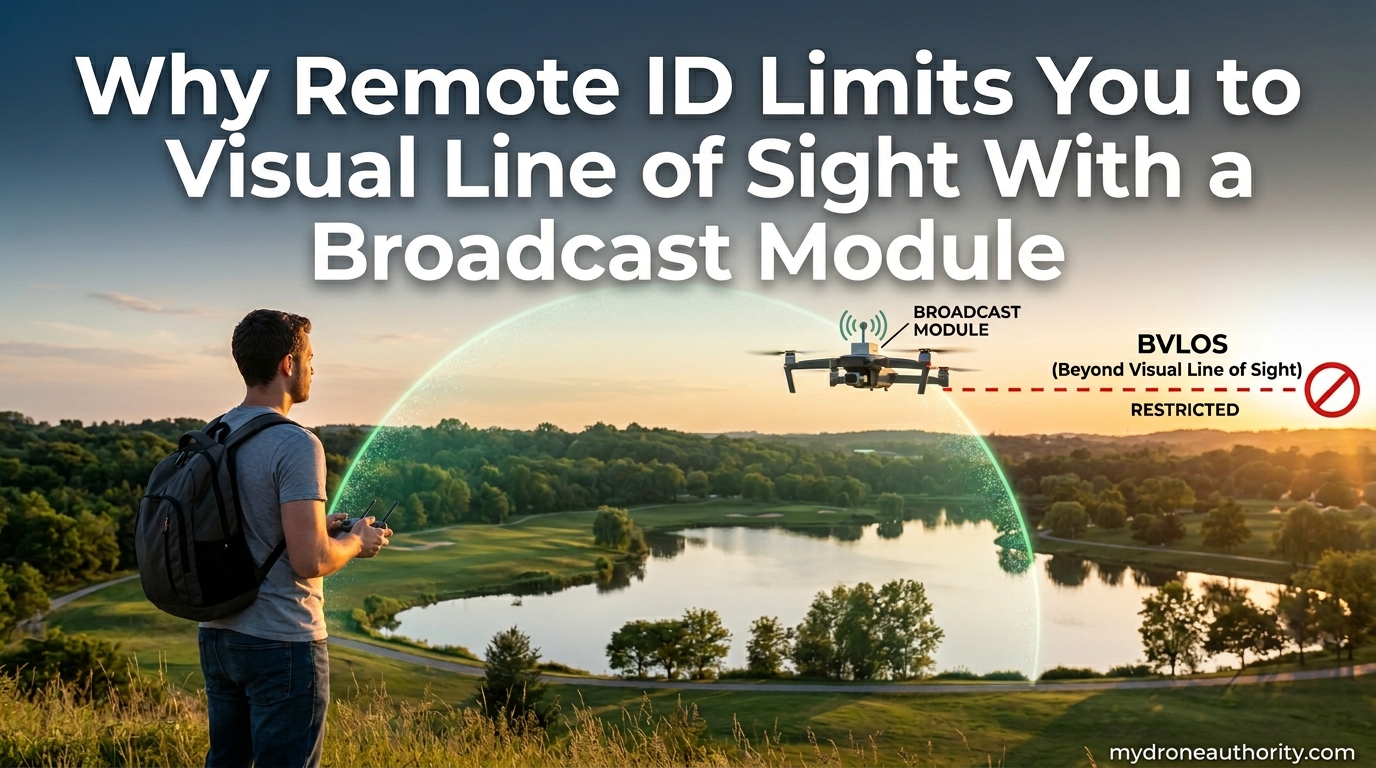
If you have ever strapped a Remote ID broadcast module to a drone and tried pushing it past the horizon, you already know the rule bites hard. Pilots operating a drone with a Remote ID broadcast module must be able to see their drone at all times during flight. That single sentence from the FAA is the reason your module-equipped quad has to stay within visual line of sight (VLOS) — even when your radio link and battery could carry it miles farther.
This article explains exactly why Remote ID limits you to visual line of sight with a broadcast module, what the FAA was thinking when it wrote the rule, and how that design choice differs from a Standard Remote ID drone that can fly under first-person view (FPV) goggles or beyond visual line of sight (BVLOS) with a waiver.
We will cover the regulatory reasoning behind 14 CFR Part 89, the critical difference between broadcasting your takeoff location versus your live control station location, and what those distinctions mean for recreational and Part 107 commercial operators in 2026. By the end, the VLOS restriction on broadcast modules will make complete sense.
Table of Contents
What Is Remote ID and Why It Exists
Remote ID is the ability of a drone in flight to broadcast identification and location information that can be received by other parties. Think of it as a digital license plate for unmanned aircraft. The rule lives in 14 CFR Part 89, which took full effect in March 2024.
The FAA built Remote ID for three reasons: airspace safety, national security, and accountability. When a drone flies somewhere it should not, the FAA, law enforcement, and federal security partners need a way to identify the operator quickly.
Remote ID is required for any drone that must be registered with the FAA. That covers both recreational aircraft over 250 grams and nearly all Part 107 commercial drones, regardless of weight. If your drone carries a registration number, it needs to broadcast Remote ID when it flies.
The data travels over unlicensed radio spectrum — typically Wi-Fi (2.4 GHz or 5 GHz) or Bluetooth — using the ASTM F3411 standard, which is built on the OpenDroneID protocol. Anyone with a compatible receiver or smartphone app can pick up that signal and see who is flying, where, and how high.
Why Remote ID Limits You to Visual Line of Sight With a Broadcast Module
Here is the core question, answered directly: why does Remote ID limit you to visual line of sight with a broadcast module?
The reason is that a broadcast module transmits the drone’s takeoff location, not the remote pilot’s live control station location. A Standard Remote ID drone, by contrast, continuously broadcasts where the pilot is standing in real time. That single data point is the entire reason for the VLOS rule.
When a broadcast module starts up, it records its current GPS position as the takeoff point and then broadcasts that fixed location for the rest of the flight. It does not know where you walked off to after launch. A Standard RID aircraft, because it is integrated with the ground control station, can update and rebroadcast the live remote pilot location every few seconds.
That matters for accountability. If law enforcement or another pilot needs to find the person actually controlling the aircraft, a Standard RID signal points right at them. A broadcast module signal only points at the patch of ground where the drone took off — which could be a parking lot the pilot left 20 minutes ago.
To close that accountability gap, the FAA applied a simple guardrail: if you fly with a broadcast module, you must keep eyes on the drone at all times. VLOS means you can always see the aircraft unaided (other than corrective lenses) and you are always close enough to land it quickly if challenged. The visible drone effectively becomes the link between the broadcast signal and the human responsible for it.
This is also why the FAA’s Remote ID final rule explicitly treats broadcast modules as a fallback option for aircraft that lack built-in RID, rather than a fully equivalent compliance path. The agency wanted a minimal-friction way to keep legacy and homebuilt drones legal, but only within the safer VLOS envelope where a missing “live pilot location” data element is less of a problem.
The Three Ways to Comply With Remote ID
The FAA gives operators three paths to satisfy 14 CFR Part 89:
- Standard Remote ID Drone (SRID): A drone produced under a declaration of compliance that broadcasts both aircraft data and live remote pilot location. No VLOS requirement tied to Remote ID itself.
- Remote ID Broadcast Module (MRID): A self-contained, FAA-accepted add-on that broadcasts aircraft data and a fixed takeoff location. Requires VLOS for the entire flight.
- FAA-Recognized Identification Area (FRIA): A defined geographic area, established by a community-based organization or educational institution, where drones can fly without any Remote ID broadcast at all.
Only the broadcast module path carries the VLOS restriction. Standard RID drones and FRIA operations have their own rules, but the visual-line-of-sight tie is specific to modules.
Standard Remote ID vs Broadcast Module: Key Differences
The fastest way to understand the VLOS rule is to put a Standard RID drone and a broadcast module side by side:
- Pilot location broadcast: Standard RID sends live control station location; module sends fixed takeoff location only.
- Visual line of sight: Standard RID has no Remote ID-driven VLOS requirement (other rules may still require it); module requires VLOS for the entire flight.
- Operations Over People: Standard RID aircraft can be eligible for OOP categories 1 through 4; modules cannot be used to satisfy OOP requirements.
- BVLOS: Standard RID can support BVLOS under a Part 107 waiver; modules cannot.
- Swapping between drones: A module can be moved from one aircraft to another (re-registration required for Part 107); Standard RID is tied to the airframe.
- FPV goggles: Standard RID permits FPV with a visual observer; module use generally rules out sustained FPV because you cannot maintain true VLOS while wearing goggles.
Notice the pattern. Every difference traces back to that one missing data element: the live pilot location. Once the FAA could not rely on the signal to point at the operator, it had to use the next best thing — a visible aircraft the operator is clearly attached to.
What Data Does a Remote ID Broadcast Module Transmit
Both Standard RID and broadcast modules must transmit the same core aircraft data set under ASTM F3411:
- Drone identification (serial number or session ID)
- Drone latitude, longitude, and geometric altitude
- Drone velocity
- Time mark
- Takeoff or remote pilot location (latitude, longitude)
- Emergency status indicator
Yes, Remote ID does broadcast altitude. The signal also carries the aircraft’s horizontal velocity and an emergency flag the operator can trigger. What the module version does not carry is an updated remote pilot location — only the takeoff coordinates it captured at power-up.
That fixed takeoff point is the technical root of the VLOS rule. The FAA needed the pilot location for accountability, the module could not provide a live one, so visual contact became the substitute.
When a Person Cannot Use a Remote ID Broadcast Module
Because of the VLOS and pilot-location limits, there are specific situations where a broadcast module is not an option at all:
- Beyond Visual Line of Sight (BVLOS): BVLOS operations require a Part 107 waiver, and broadcast modules cannot satisfy Remote ID for BVLOS flight because they do not broadcast live pilot location.
- Operations Over People: OOP compliance under Part 107 Subpart D requires a Standard Remote ID declaration of compliance. A module is not an acceptable substitute.
- Operations at night (without proper equipment): Anti-collision lighting is required, and some OOP categories still require Standard RID — modules will not qualify.
- Any scenario where the rule specifically calls for “Standard Remote ID”: If a regulation or waiver names Standard RID, a broadcast module cannot fulfill it.
A simple test: if the operation depends on knowing where the pilot is in real time, or on a declared, airframe-integrated compliance package, a broadcast module will not work.
Broadcast Range and Real-World Limitations
Forum posts on r/drones, MavicPilots, and PhantomPilots are full of pilots surprised by two things: how far the signal actually travels, and how often the module disconnects from their app.
Most modules broadcast over Bluetooth or Wi-Fi on the unlicensed 2.4 GHz band. In open air, that signal can travel roughly half a mile to a mile — farther than many pilots expect. In dense urban environments or around metal structures, useful range drops sharply. Pilots frequently report “Remote ID disconnected” warnings even when the module is working fine; the issue is the receiving phone or app losing the weak signal, not the broadcast failing.
None of that broadcast range matters for the VLOS rule, though. The FAA’s VLOS requirement is about accountability, not signal reach. Even if your module broadcasts clearly for two miles, you still must keep the drone in sight.
Remote ID Is Not Detect and Avoid
A common point of confusion in drone forums is the difference between Remote ID and Detect and Avoid (DAA). Remote ID is an identification system. It tells other people who you are and where your aircraft is.
Detect and Avoid is a collision avoidance system. It actively senses other aircraft and helps the pilot (or autopilot) avoid them. ADS-B, the system used in manned aviation, is a DAA-related broadcast but is not Remote ID and is not a substitute for it.
Remote ID will not stop your drone from hitting another aircraft, and it will not help you see an incoming plane. That is why VLOS matters operationally, not just legally — when you fly a module-equipped drone, you are the detect-and-avoid system.
Practical Tips for Flying With a Broadcast Module
After reading hundreds of forum threads, here is what experienced pilots recommend for module users in 2026:
- Register the module separately under Part 107: Commercial operators register the module itself, then tie it to each drone it flies on. Recreational pilots can share a module across aircraft registered under the same $5 recreational registration.
- Mount the module away from flight controllers and GPS units: Several RC plane hobbyists report GPS interference or compass errors when the module sits too close to the airframe electronics.
- Treat “disconnected” warnings with caution, not panic: If your module was working on the ground and you see a disconnect alert at altitude, the broadcast is likely still going — your phone just lost the receive link.
- Keep an actual visual observer if you want to push distance: A second set of eyes keeps you legal and safe when you are stretching the VLOS envelope.
- If you need BVLOS or Operations Over People, upgrade to a Standard RID drone: No module workaround exists for those operations.
The pilots who get frustrated with broadcast modules are usually trying to make them do something the FAA never designed them to do. Treat the module as a VLOS-only compliance path for legacy and custom aircraft, and the limits stop feeling arbitrary.
Frequently Asked Questions
What is the difference between Remote ID and broadcast module?
Remote ID is the overall FAA requirement under 14 CFR Part 89 that drones broadcast identification and location data. A broadcast module is one of three ways to comply with that requirement. The key difference is that a Standard Remote ID drone broadcasts the pilot’s live control station location, while a broadcast module only broadcasts the fixed takeoff location — which is why the FAA requires VLOS for module users.
Does Remote ID broadcast altitude?
Yes. Remote ID broadcasts geometric altitude along with latitude, longitude, velocity, a time mark, aircraft identification, an emergency status flag, and either takeoff or pilot location.
How far does Remote ID broadcast?
Most Remote ID broadcast modules transmit over Wi-Fi or Bluetooth on the 2.4 GHz band. Useful range typically runs from about half a mile to one mile in open air, but drops significantly in urban or obstructed environments. The VLOS rule still applies regardless of how far the signal reaches.
When can a person not use a Remote ID broadcast module?
A broadcast module cannot be used for beyond visual line of sight (BVLOS) operations, Operations Over People under Part 107 Subpart D, or any scenario that specifically requires a Standard Remote ID declaration of compliance. Modules are limited to VLOS flight only.
Can you fly BVLOS with a Remote ID broadcast module?
No. BVLOS operations require a Part 107 waiver and Standard Remote ID because the FAA needs the live remote pilot location broadcast. A broadcast module only transmits a fixed takeoff point, so it cannot satisfy Remote ID for BVLOS flight.
Why do broadcast modules require visual line of sight?
Broadcast modules require VLOS because they transmit the drone’s takeoff location instead of the pilot’s live control station location. Without a real-time pilot location, the FAA uses visual contact as the accountability link between the broadcast signal and the person responsible for the aircraft.
Conclusion
The VLOS rule on broadcast modules is not arbitrary. It exists because a Remote ID broadcast module transmits your takeoff location, not where you are actually standing during the flight. Without that live pilot location, the FAA needs another way to keep the operator accountable — and visual contact is the simplest, most reliable substitute.
Once you understand why Remote ID limits you to visual line of sight with a broadcast module, the rest of the rule falls into place: no BVLOS, no Operations Over People, no FPV without an observer, and no workaround. If your flying needs push past VLOS, the answer is not a better module — it is an upgrade to a Standard Remote ID drone and, where required, a Part 107 waiver. Fly smart, keep eyes on your aircraft, and treat the broadcast module for what it was designed to be: a VLOS-only compliance tool for the drones you already own.