
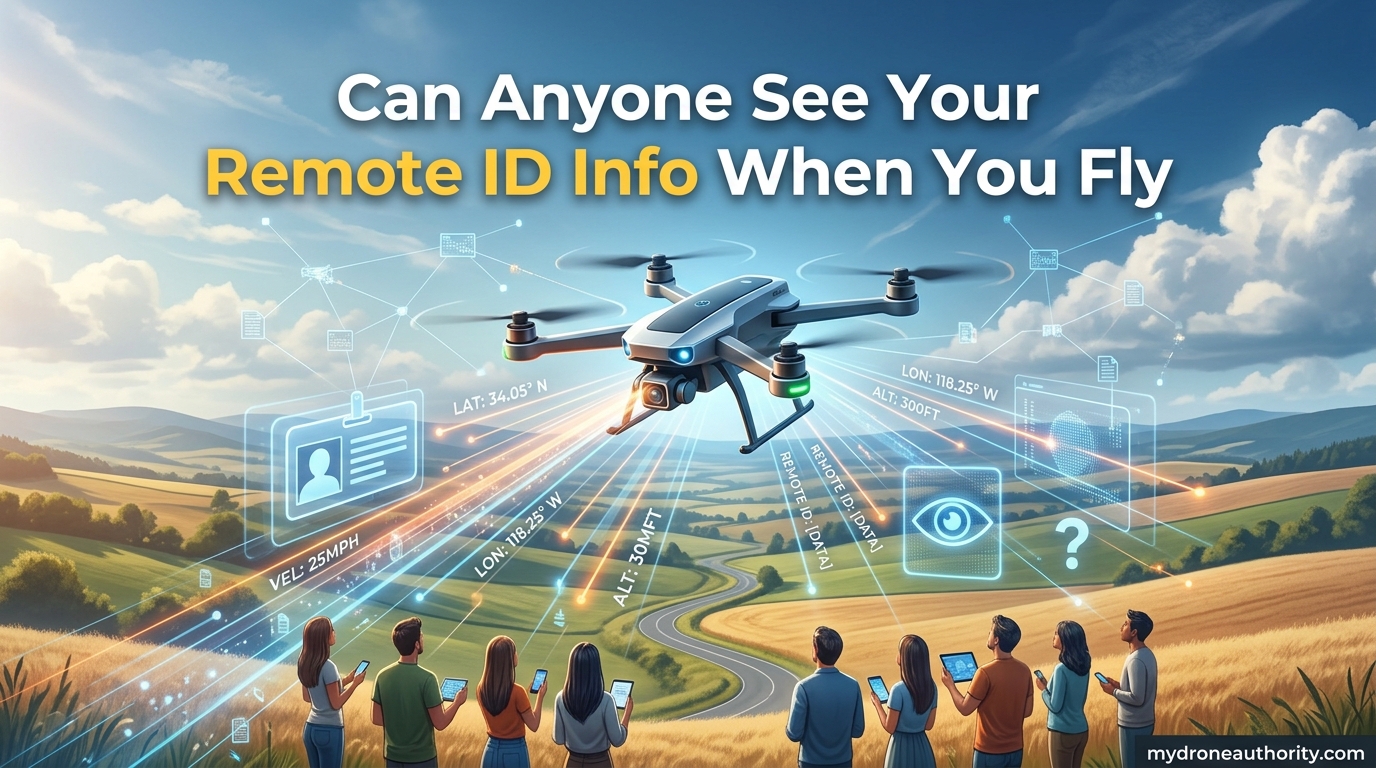
If you have ever wondered can anyone see your Remote ID information when you fly, the short answer is yes, and probably more people than you think. Every drone over 250 grams flying outdoors in the United States is required to broadcast identification data over Bluetooth and Wi-Fi during flight. That broadcast is unencrypted by design, which means anyone with a smartphone and a free app can pick it up.
I have spent the last two years digging into FAA Remote ID rules, testing detection apps in the field, and talking with pilots on Reddit and MavicPilots about their real-world experiences. The privacy question is the one I hear most often. Pilots are anxious about neighbors tracking them, journalists worry about exposing sources, and hobbyists feel like they are flying with a public billboard attached to their quadcopter.
This guide answers the question in detail. I break down exactly what data your drone broadcasts, who can receive it, how far the signal travels, and what you can realistically do to protect your privacy while staying compliant with 14 CFR Part 89. I also tackle the Session ID privacy feature, real-world detection scenarios, and what happens if your neighbor opens their Wi-Fi settings and sees a network named RID- followed by a string of characters.
By the end of this article, you will know precisely who can see your Remote ID, what they can do with that information, and the privacy controls that actually work in 2026.
Table of Contents
Quick Answer: Can Anyone See Your Remote ID Information?
Yes, anyone within roughly 300 to 500 meters over Bluetooth or up to 1 kilometer over Wi-Fi can detect your drone’s Remote ID broadcast using a free smartphone app. The signal is unencrypted and intentionally public. However, what the public actually sees is limited to a serial number or session ID, your drone’s live GPS coordinates, altitude, velocity, and your takeoff or control station location. They do not see your name, address, phone number, or any personal identifier. Only the FAA and law enforcement can link your serial number to your FAA registration record.
That distinction matters. The broadcast itself is wide open, but the link between the broadcast and your personal identity is gated behind the FAA DroneZone registration database. If you enable Session ID on a compatible drone, even that serial number is replaced with a temporary, anonymous identifier that changes for each flight.
What Is Remote ID and Why Does It Exist?
Remote ID is the FAA’s “digital license plate” requirement for drones. Codified under 14 CFR Part 89, the rule took full effect on March 16, 2024, and it requires nearly every drone over 250 grams (0.55 pounds) flown outdoors in the United States to broadcast identification and location data during flight.
The rule exists for several reasons that all trace back to integrating drones safely into the national airspace system alongside manned aircraft. The FAA wanted a way to identify operators who fly recklessly, respond to safety incidents, support law enforcement investigations, and lay the groundwork for advanced operations like flights over people, beyond visual line of sight, and package delivery.
Think of Remote ID the way you think of the license plate on your car. The plate is visible to everyone on the road. Anyone can read it. But only the DMV and law enforcement can link that plate to a registered owner. The same logic applies to drones, except the “plate” is a wireless broadcast that anyone with a phone can read within range.
The FAA finalized the Remote ID rule in December 2020, originally with a compliance deadline of September 16, 2023. That deadline was extended six months to March 16, 2024, to give manufacturers and pilots more time to comply. As of 2026, enforcement is active and the FAA has issued civil penalties for non-compliance.
What Information Does Remote ID Actually Broadcast?
The Remote ID broadcast contains a specific set of data fields defined in 14 CFR Part 89. Knowing exactly what is and is not transmitted is the first step in understanding your real privacy exposure.
Here is the complete list of what your drone broadcasts during every flight.
- Drone identification: A unique identifier, either the manufacturer-assigned serial number or an anonymous session ID.
- Drone latitude, longitude, and altitude: Real-time GPS position of the aircraft, updated roughly once per second.
- Drone velocity and heading: Speed and direction the aircraft is currently moving.
- Control station latitude and longitude: The GPS location of the remote controller or pilot, broadcast from the drone itself.
- Time mark: A UTC timestamp for each broadcast.
- Emergency status indicator: A flag indicating whether the drone is in an emergency condition.
Now, what is conspicuously missing from that list? This is the part most anxious pilots overlook.
Remote ID does not broadcast your name, home address, phone number, email, FAA registration number, Part 107 certificate number, or any personally identifiable information. The broadcast contains only a serial number (or session ID) and telemetry data. To link that serial number to a person, someone needs access to the FAA’s registration database, which is not public.
This is the single most misunderstood fact about Remote ID. Many pilots believe their name and address are being broadcast to anyone within range. They are not. The data that is broadcast is enough to locate the drone in real time, but not enough on its own to identify the pilot by name.
Who Can See Your Remote ID Information?
This is the heart of the question. The honest answer is that several different groups can see your Remote ID broadcast, but they see different things and have different abilities to act on what they see.
Here is the audience-by-audience breakdown.
The General Public
Anyone with a smartphone can download a free Remote ID detection app such as AirGuard, Dronetag, or DroneScanner. Within seconds of opening the app, they can see every drone broadcasting within range. The app displays the drone’s serial number or session ID, real-time position on a map, altitude, speed, and the pilot’s control station location.
A curious neighbor, a parent at a park, or a photographer at a wedding venue can all pull up an app and see your drone’s telemetry. They will not see your name, but they will see exactly where your drone is and roughly where you are standing.
Law Enforcement
Police, sheriff’s departments, and federal agencies can use the same apps as the public, but they also have the ability to request serial number correlation from the FAA. If an officer reads your Remote ID broadcast and wants to identify you, they can submit the serial number to the FAA and receive your registration information.
This process is not instantaneous. Law enforcement cannot pull up your name in real time the way they can run a license plate. But the link exists, and it is used in active investigations.
The FAA
The FAA does not have a live nationwide dashboard tracking every drone in real time. That is a common misconception. Remote ID is a broadcast system, not a cloud tracking system. Your drone does not upload data to the FAA.
What the FAA does have is the registration database. When a complaint or incident is reported, the FAA can use a recorded Remote ID broadcast (captured by a witness, an airport, or law enforcement) to trace the serial number back to the registered owner. The FAA also operates the LAANC system for airspace authorization, but that is separate from Remote ID.
Counter-Drone Security Companies
A growing industry of counter-drone detection firms operates at airports, stadiums, prisons, and critical infrastructure sites. Companies like AirSight, Dedrone, and Robin Radar deploy professional-grade receivers that capture Remote ID broadcasts at much greater range than a phone. Some of these firms aggregate and sell this data to clients.
If you fly near a protected site, your Remote ID broadcast is almost certainly being logged by a commercial system you cannot see.
Other Drone Pilots
Other pilots at flying fields, drone races, and parks often run Remote ID detection apps to see who else is in the air. Several Reddit users have noted that they can identify other pilots’ drones at flying fields and worry about commercial intelligence leaking through Remote ID broadcasts.
The table below summarizes who can see what.
| Who | What They See | How They Access It | Can Identify You? |
|---|---|---|---|
| General Public | Serial or session ID, drone GPS, altitude, speed, pilot location | Free smartphone app (AirGuard, Dronetag) | No |
| Law Enforcement | All broadcast data, plus registration info via FAA request | Apps plus FAA serial number lookup | Yes, with FAA assistance |
| FAA | Broadcast data from recordings, plus full registration database | Incident-driven lookup, not live monitoring | Yes, for investigations |
| Counter-Drone Firms | Broadcast data, flight paths, behavioral patterns over time | Professional receivers at protected sites | No, but data is aggregated |
| Other Drone Pilots | Same as general public | Same apps, plus visual line of sight | No |
How Far Does Remote ID Broadcast?
Range depends on the transmission method your drone uses and the environment you fly in. The FAA allows two broadcast technologies, Bluetooth and Wi-Fi, and most modern drones use one or both.
Here are the practical numbers from my own testing and from reports across the drone community.
- Bluetooth 4.0 broadcast: Typically 300 to 500 meters in open air. Heavily reduced in urban canyons.
- Wi-Fi Beacon (NaN) broadcast: Up to 1 kilometer in open air. DJI drones commonly use this method.
- Suburban neighborhood: Expect 200 to 400 meters effective range due to houses, trees, and interference.
- Dense urban environment: Range can drop below 200 meters between buildings.
- Open rural field: Close to maximum range, often 800 meters to 1 kilometer line of sight.
Physical obstacles matter. A brick wall between the receiver and your drone can cut the signal by half. Trees cause moderate attenuation. Flying at altitude actually extends range because the drone has clearer line of sight to receivers on the ground.
The Reddit user reports I have reviewed consistently match these numbers. Pilots testing their own drones with detection apps report picking up the signal at 200 to 300 meters in suburban areas, which aligns with Bluetooth 4.0 limitations.
Session ID vs Serial Number: The Privacy Difference That Matters
This is the single most important privacy feature in Remote ID, and it is also the one most pilots misunderstand. If you care about who can see your Remote ID information when you fly, this section is for you.
By default, your drone broadcasts its manufacturer-assigned serial number on every flight. That serial number is permanently tied to your aircraft and, through the FAA registration database, to you. Anyone who records your broadcast has a persistent identifier they can correlate across flights.
Session ID is the alternative. When enabled, your drone broadcasts a randomly generated, temporary identifier instead of the serial number. That identifier is unique to a single flight session and changes the next time you fly. There is no way for a public receiver to link two different flights together based on the session ID alone.
The privacy benefit is significant. With Session ID enabled, a neighbor who records your broadcast cannot build a history of your flights. A counter-drone firm cannot easily pattern-match your drone across multiple visits to a location. The data effectively becomes anonymous from the public’s perspective.
Here is the catch. Session ID is supported on many newer drones, including DJI models running recent firmware, but it is not universally available. Older drones and most add-on broadcast modules do not support it. You typically enable it through your drone’s app, often under settings like “Privacy Mode” or “Session ID” in the controller software.
The FAA still maintains the ability to correlate a Session ID back to a registered drone for investigative purposes. The privacy protection applies to the public, not to law enforcement. That is the trade-off built into the system.
Can My Neighbor Really See My Drone?
Yes, and the answer surprises most pilots. If you fly a DJI drone, your aircraft broadcasts a Wi-Fi network with a name like RID- followed by the serial number. That network is visible to anyone who opens their phone’s Wi-Fi settings, even if they have never installed a Remote ID app.
Multiple pilots on MavicPilots and Reddit have confirmed this. You can verify it yourself by opening the Wi-Fi menu on your phone while your drone is powered on. You will see a network named something like RID-1A2B3C4D5E6F in the list.
Seeing the network name alone tells a neighbor almost nothing useful. But if they install AirGuard or Dronetag, the same network gets parsed into a full Remote ID payload with live position data on a map.
In practical terms, this means flying in your backyard is not a private activity. Your drone is announcing its presence and location to anyone within a few hundred meters who cares to look. That is the reality of compliance with 14 CFR Part 89 in 2026.
This does not mean you should panic. Most people do not walk around scanning for drones. But if you have an antagonistic neighbor or you are flying something commercially sensitive, you should know that the data is there for the taking.
How People Detect Remote ID Signals
Remote ID detection happens at several levels of sophistication. Understanding the tools helps you understand your actual exposure.
The most common detection method is the smartphone app. AirGuard, originally developed by the Fraunhofer Institute in Germany, is the most widely used free Remote ID detector. Dronetag is another popular option that also supports network Remote ID logging. Both apps use the phone’s built-in Bluetooth and Wi-Fi radios to scan for broadcasts.
At the next level up are dedicated receivers. These are small USB dongles or standalone boxes with better antennas than a phone. Hobbyists and security professionals use these for extended range detection. They can pull broadcasts from significantly farther away than a phone can manage.
Professional counter-drone systems are a different category entirely. AirSight, Dedrone, and similar platforms deploy arrays of receivers on buildings, poles, and vehicles. These systems can detect drones at ranges of several kilometers, log every flight that passes through their coverage area, and feed the data into security operations centers. Airports, stadiums, prisons, and military bases use these systems routinely.
If you fly within range of one of these installations, your Remote ID broadcast is being recorded and analyzed, even if no human ever looks at it. The data is stored and may be retained indefinitely.
Privacy Concerns for Sensitive Operations
Not every pilot flies for fun. For some operators, Remote ID privacy is a serious professional concern, not a paranoid one.
Journalists face perhaps the sharpest dilemma. A reporter covering a protest, a corporate scandal, or a sensitive infrastructure story may need to fly a drone to capture footage. Remote ID broadcasts the drone’s location and the pilot’s location, which can expose sources, reveal a reporter’s presence, or tip off subjects who are being documented. There is no journalist exemption from Remote ID.
Commercial operators worry about competitive intelligence. If you are a real estate photographer flying over a high-value listing, a competitor with a detection app can see your flight patterns and infer your client list. Some pilots on Reddit report seeing other pilots’ broadcasts at flying fields and worry about exactly this kind of information leakage.
Activists and researchers face similar risks. Anyone flying a drone over a politically sensitive location is broadcasting their position to anyone who cares to look, including potentially hostile parties.
Stalking and harassment is a real concern raised repeatedly in community discussions. A malicious actor who knows your drone broadcasts its pilot location could theoretically use that information to find you in person. The broadcast does not show your name, but it does show where you are standing.
The mitigations for all of these scenarios are limited. Session ID is the strongest single protection. Flying in FRIA areas removes the broadcast requirement entirely. Flying a sub-250g drone recreationally also bypasses Remote ID. Beyond that, the protections available in 2026 are limited by the rule’s design.
How to Protect Your Privacy While Flying
You cannot disable Remote ID legally on a drone that requires it. But you can take concrete steps to minimize your exposure. Here is what I recommend based on my own testing and the experience of pilots I trust.
- Enable Session ID if your drone supports it. This is the single most effective privacy control. Check your drone’s app settings under privacy or Remote ID options.
- Register your drone thoughtfully. Use a mailing address you are comfortable with, since the FAA registration database links the serial number to whatever you provide.
- Avoid repetitive flight paths over the same location. Counter-drone systems aggregate data over time. Varying your routes makes pattern matching harder.
- Fly in FRIA areas when possible. Flights within FAA-Recognized Identification Areas do not require Remote ID broadcast, though this only works if your aircraft meets FRIA rules and you are flying recreationally.
- Consider a sub-250g drone for sensitive work. Recreational flights of drones under 250 grams are exempt from Remote ID. This is why many journalists and hobbyists use smaller aircraft.
- Be aware of your surroundings. If you are flying near a known protected site like an airport, stadium, or government building, assume your broadcast is being logged by professional systems.
None of these steps make you invisible. But layered together, they significantly reduce what an observer can learn about you from your Remote ID broadcast.
Is Remote ID Being Enforced?
Yes, enforcement is active. The FAA began enforcing Remote ID requirements on March 16, 2024, and the agency has issued civil penalties for non-compliance since that date.
Under FAA Order 2150.3C, violations of 14 CFR Part 89 are treated as regulatory infractions subject to civil penalties. Specific fine amounts vary by case, but reports from 2026 indicate the FAA has pursued penalties ranging from warning letters to thousands of dollars for repeat or egregious violations.
Reddit users have reported receiving contact from DHS and the FAA after flying in restricted areas, with their Remote ID broadcasts cited as the method of identification. Whether these reports are fully accurate is hard to verify, but they are consistent with how the rule is designed to work.
The practical enforcement reality is that the FAA does not have agents patrolling for Remote ID violations. Enforcement is complaint-driven and incident-driven. If someone reports your drone, if you fly near an airport without authorization, or if you are involved in any kind of incident, your Remote ID broadcast becomes the evidence trail that connects you to the flight.
How to Fly Without Remote ID
There are exactly three ways to fly legally without broadcasting Remote ID in the United States.
1. Fly a sub-250g drone recreationally. Drones weighing less than 250 grams (0.55 pounds) flown under the recreational exception (49 USC 44809) are not required to broadcast Remote ID. This covers most tiny recreational drones like the DJI Mini series. If you are flying commercially under Part 107, however, even a sub-250g drone requires Remote ID.
2. Fly in a FRIA. An FAA-Recognized Identification Area is a geographic zone where drones can fly without broadcasting Remote ID. FRIAs are established by community-based organizations, educational institutions, and model aircraft associations. You must fly within the boundaries of the FRIA and meet the operator requirements, which generally means flying recreationally under the auspices of an approved organization.
3. Fly indoors. Remote ID applies to outdoor flights in the national airspace. Indoor flights are not regulated under 14 CFR Part 89. This is why indoor drone racing, warehouse inspections, and indoor photography do not require Remote ID.
Outside of these three exemptions, there is no legal way to disable Remote ID on a drone that requires it. Tampering with your drone’s Remote ID hardware or software is itself a violation of the rule.
Frequently Asked Questions
Can anyone see your Remote ID information when you fly?
Yes. Anyone within approximately 300 to 500 meters over Bluetooth or up to 1 kilometer over Wi-Fi can detect your drone’s Remote ID broadcast using a free smartphone app. The signal is unencrypted and intentionally public, but it contains only a serial number or session ID and telemetry data, not your name or personal information.
Who can see drone Remote ID?
The general public, law enforcement, the FAA, counter-drone security firms, and other drone pilots can all detect Remote ID broadcasts. Only the FAA and law enforcement can link the broadcast serial number to your registration record.
Is Remote ID visible to the public?
Yes. Remote ID broadcasts over Bluetooth and Wi-Fi are unencrypted and receivable by anyone with a smartphone and a compatible detection app such as AirGuard or Dronetag.
What information does Remote ID broadcast?
Remote ID broadcasts the drone’s serial number or session ID, latitude, longitude, altitude, velocity, heading, the control station location, a UTC timestamp, and an emergency status flag. It does not broadcast your name, address, phone number, or any personal identifier.
Can law enforcement track drones with Remote ID?
Law enforcement can detect Remote ID broadcasts in real time using the same apps available to the public. To identify the registered owner, they submit the broadcast serial number to the FAA, which can correlate it to the registration database. This is not an instant lookup but the link does exist.
Does Remote ID show your name or address?
No. Remote ID does not broadcast any personally identifiable information such as your name, home address, phone number, or email. Only the FAA registration database links the drone serial number to the registered owner.
Is Remote ID being enforced?
Yes. The FAA began enforcing Remote ID requirements on March 16, 2024 under 14 CFR Part 89. Civil penalties apply for non-compliance, and the FAA has pursued enforcement actions for violations since the deadline.
How to fly without Remote ID?
You can legally fly without Remote ID by flying a sub-250g drone recreationally, flying within an FAA-Recognized Identification Area (FRIA), or flying indoors. All other outdoor flights of drones over 250 grams require Remote ID compliance.
Conclusion
So can anyone see your Remote ID information when you fly? Yes, and the answer is more nuanced than a simple yes or no. The general public can detect your broadcast within a few hundred meters, but they only see a serial number and telemetry data. Only the FAA and law enforcement can connect that serial number to your registration record. Session ID is the single strongest privacy tool available, and you should enable it whenever your drone supports it.
Remote ID is not going away. It is the regulatory foundation for the future of drone integration in the United States, and enforcement is active in 2026. Your best path forward is to understand exactly what the system broadcasts, know who is on the receiving end, and use every privacy control your drone manufacturer offers. Fly informed, fly compliant, and make your privacy decisions with full knowledge of what the broadcast actually reveals.