
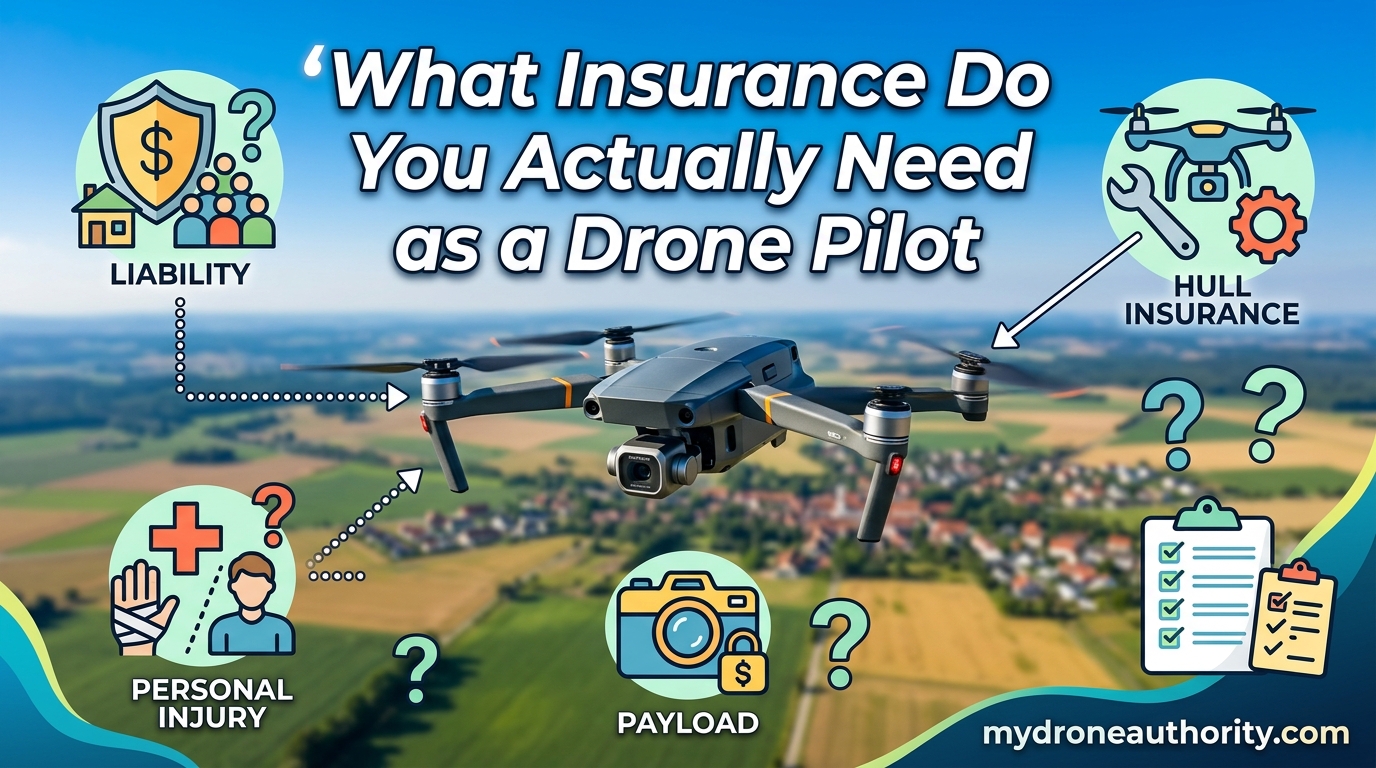
Drone insurance is a specialized form of coverage that protects drone operators from financial losses caused by liability claims, physical damage to the drone, theft, and equipment loss. The two essential types are liability insurance (required or strongly recommended for commercial pilots) and hull insurance (protects your drone investment). Most pilots need at least $1 million in liability coverage, and the right policy depends on whether you fly recreationally, commercially, or both.
I learned this the hard way two years ago. A friend of mine who runs a small real estate photography business took what should have been a routine roof inspection job. He had been flying for three years, had his Part 107 certificate, and flew maybe 80 jobs without incident. That afternoon, a sudden gust of wind pushed his DJI Inspire 2 into a $42,000 custom garage door. The homeowner’s insurance company came after him personally. The settlement wiped out everything he had built. He had no drone insurance.
That story repeats itself more often than most pilots want to admit. According to data shared by major aviation insurers, drone-related property damage and injury claims have grown steadily every year as commercial drone operations expand. The hard truth is this: the FAA does not technically require drone insurance, but your clients, your state, your business structure, and your own financial survival almost certainly do.
This guide breaks down exactly what insurance you actually need as a drone pilot in 2026. I have spent the last several months comparing policies, talking to underwriters, reading the fine print on DJI Care Refresh, and surveying commercial and recreational pilots about their real experiences with claims. Whether you are flying a $300 Mini 4 Pro for fun or running a five-drone inspection fleet, the principles below will help you figure out what coverage makes sense for your situation.
Table of Contents
Quick Answer: What Insurance Do You Actually Need as a Drone Pilot?
Here is the short version, optimized for the featured snippet:
- Liability insurance: Required or strongly recommended for ALL commercial pilots. $1 million minimum, $2 million preferred for most client contracts.
- Hull insurance: Recommended if your drone is worth more than $500, or if you cannot afford to replace it out of pocket.
- Payload insurance: Needed if you carry expensive cameras, LiDAR sensors, or thermal equipment valued over $1,000.
- Recreational pilots: Liability coverage is optional but strongly advised if you fly near people, vehicles, or property. Hull insurance depends on drone value.
- Part 107 commercial pilots: Most need at least $1M liability and hull coverage on every drone they operate.
- Client contracts: Most commercial clients require proof of insurance (a Certificate of Insurance or COI) before you can take the job.
Skip the long version and go straight to the provider comparison? Jump to the How to Choose section. Want to understand each coverage type in detail first? Keep reading.
Is Drone Insurance Legally Required?
The short answer is no, drone insurance is not legally required by the FAA in the United States for either recreational or commercial pilots. The long answer is more complicated, because clients, state agencies, and international regulators have their own rules. Let me walk through each layer.
FAA Requirements for Part 107 Pilots
The Federal Aviation Administration does not mandate drone insurance for Part 107 commercial operators. You can hold a valid Remote Pilot Certificate, register your drone, and operate legally without carrying a single dollar of insurance coverage.
That said, the FAA has been signaling for years that some form of financial responsibility may eventually become mandatory. The FAA Reauthorization Act of 2024 directed the agency to study the feasibility of requiring proof of insurance for certain commercial operations, particularly operations over people (OOP) and beyond visual line of sight (BVLOS). The rulemaking process is slow, but the direction of travel is clear.
For now, what the FAA does require is:
- Drone registration (every drone over 0.55 lbs must be registered)
- Marking your drone with the registration number
- A valid Part 107 certificate for commercial operations
- The TRUST test completion for recreational flyers
None of these require insurance. But the absence of a federal mandate does not mean you are protected if something goes wrong. Without insurance, you are personally liable for every dollar of damage your drone causes.
State and Local Insurance Requirements
Several U.S. states have started to add their own insurance requirements for specific drone operations, even though no universal state mandate exists. Minnesota was one of the first, requiring commercial drone operators conducting certain mapping and surveying work to carry liability coverage. Other states are watching closely.
Some local jurisdictions have gone further:
- California State Parks: Requires $1M liability for commercial drone operations on state park land
- Florida: Some municipalities require proof of insurance for drone work near beaches and public events
- New York City: Requires commercial drone operators to carry liability insurance for takeoff and landing permits in city parks
- Texas: No state mandate, but many state agencies require COI before issuing photography permits
Beyond state law, public entities including police departments, fire departments, university campuses, and federal land managers (like the National Park Service) routinely require a Certificate of Insurance (COI) with $1M to $5M in liability coverage before allowing drone operations on their property. If you want to do any government-adjacent work, insurance is effectively mandatory.
International Drone Insurance Requirements
Flying outside the United States? The rules tighten up fast. Many countries legally require drone insurance:
- Canada: $100,000 CAD liability minimum for drones over 250g
- United Kingdom: EC 785/2004 mandates liability insurance for all drones over 250g, including recreational pilots
- European Union: Mandatory third-party liability insurance in every member state under the EU UAS Regulation 2019/947
- Australia: Liability insurance required for commercial operations under Civil Aviation Safety Authority (CASA) rules
- Japan: Mandatory liability insurance for all commercial and many recreational flights
If you plan to take your drone across borders, check the destination country’s rules well before you pack your case. Several pilots have had equipment confiscated at foreign airports for not having valid insurance documentation.
Client Contract Requirements
This is where insurance stops being optional in any practical sense. Most commercial clients will not hire an uninsured drone operator, period. Construction companies, real estate brokerages, roof inspection firms, wedding venues, and film production companies all routinely require proof of insurance before signing a contract.
Typical client requirements include:
- $1M to $2M general liability coverage
- Drone-specific liability endorsement (not just general business insurance)
- Additional insured endorsement naming the client
- Waiver of subrogation in favor of the client
- Certificate holder listing the client as a certificate holder on the COI
If you cannot produce a COI within 24 hours of a client request, you will lose the job. Period. Speed of COI issuance is one of the most important features to look for in a drone insurance provider, and it is one reason on-demand providers like SkyWatch.AI have become popular with new commercial pilots.
Recreational vs Commercial Rules
Recreational pilots have fewer insurance requirements, but skipping coverage is still risky. The Community-Based Organization (CBO) guidelines under the FAA’s recreational flyer rules do not mandate insurance, and the TRUST test does not ask about it. However, your homeowner’s or renter’s insurance may have an aviation exclusion that specifically removes drone coverage from your policy.
Read your homeowner’s policy carefully. Many standard policies contain a “personal aircraft” exclusion that applies to drones. A crash into a neighbor’s car or a passerby on a public sidewalk could leave you personally responsible for medical bills and property damage with no insurance backup at all.
The bottom line: even for recreational pilots, $30 to $50 a year in basic liability coverage is cheap insurance against a five-figure liability claim.
The Essential Types of Drone Insurance Explained
There is no single product called “drone insurance.” What you actually buy is a combination of coverages, each designed to protect against a different kind of loss. Let me walk through every type of drone insurance you might encounter, what it covers, and when you need it.
Liability Insurance (Third-Party Coverage)
Liability insurance is the foundation of any drone insurance policy. It covers you if your drone causes damage to someone else’s property or injures someone, and they decide to sue you or file a claim.
Liability coverage includes:
- Bodily injury: Medical bills, lost wages, and pain and suffering claims if your drone hits a person
- Property damage: Repair or replacement costs if your drone damages buildings, vehicles, or other property
- Legal defense costs: Lawyer fees, court costs, and settlements up to your policy limit
- Personal and advertising injury: Coverage for non-physical injuries like privacy violations or defamation (in some policies)
Most liability policies for drone pilots start at $1 million per occurrence. Higher limits ($2M, $5M, or even $25M for enterprise operations) are available, and many commercial clients require a minimum of $1M before signing a contract.
Liability is not optional for commercial work. It is the bare minimum.
Hull Insurance (Physical Damage to Your Drone)
Hull insurance is the drone industry term for physical damage coverage on the aircraft itself. It covers repairs or replacement if your drone is damaged in a crash, lost in a flyaway, or destroyed by fire. Some policies also include theft protection as part of the hull coverage.
What hull insurance typically covers:
- Accidental crash damage
- Flyaway losses (drone disappears and cannot be recovered)
- Water damage from lake or ocean landings
- Fire and smoke damage
- Theft and vandalism (sometimes as a separate rider)
What hull insurance usually does NOT cover:
- Loss of your drone while you were flying recklessly or under the influence
- Mechanical or electrical failure from normal wear and tear
- Damage from operating the drone outside manufacturer specifications
- Losses that occur while you are flying without proper certification
- Cosmetic damage that does not affect flight safety
Hull coverage is usually expressed as a percentage of the drone’s replacement value. The annual premium for hull insurance typically runs between 8% and 12% of the drone’s retail value, depending on the model, your flight experience, and your claims history. So a $2,000 drone might cost $160 to $240 per year to insure for hull.
Payload and Equipment Insurance
Standard hull insurance covers the aircraft itself, but most drone operators carry expensive additional equipment: cinema cameras, gimbals, LiDAR sensors, thermal imaging cameras, RTK GPS units, and tablet controllers. These items often cost more than the drone they are attached to.
Payload insurance covers the equipment mounted on or carried by your drone that is not part of the standard airframe. A real estate photographer might have $5,000 in camera and lens equipment. A surveyor might carry $30,000 in LiDAR and mapping gear. A public safety pilot might have $15,000 in thermal imaging equipment.
Some policies bundle payload coverage into the hull policy, while others require a separate rider. Read the declarations page carefully. If you carry a $10,000 camera and your policy only covers $2,000 in payload, you are dangerously underinsured.
Personal Injury Coverage
Personal injury coverage is a specialized form of liability protection that covers non-physical injuries. For drone pilots, this matters more than you might think, because drones raise legitimate privacy concerns.
Personal injury can include:
- Privacy invasion claims (flying over private property and capturing identifiable images)
- Defamation or libel (rare for drone pilots, but possible)
- False arrest or detention (more relevant for commercial security work)
- Mental anguish claims from drone sightings
Some drone policies include personal injury as part of the standard liability package. Others exclude it or sell it as a separate endorsement. If you shoot weddings, real estate, or any work that involves private individuals, make sure personal injury is included.
Ground Equipment and Non-Owned Drone Coverage
Ground equipment insurance covers the things that never leave the ground but are still essential to your drone operation:
- Ground control stations and tablets
- Batteries and charging equipment
- Monitors, cases, and transport gear
- Computers used for flight planning and post-production
Non-owned drone coverage is a niche but valuable coverage for pilots who occasionally fly drones they do not own. If you rent a drone for a specific project, or if you borrow a friend’s aircraft for a paid job, non-owned coverage protects you against claims arising from operating equipment that is not on your standard policy.
Non-owned coverage is also useful for drone instructors and training schools. Students fly training drones that the school owns, but the instructor is legally responsible for safe operation. Non-owned coverage closes that gap.
Common Policy Exclusions (What is NOT Covered)
Here is the part most drone pilots wish they had read before signing up. Every drone insurance policy has exclusions, and the differences between providers often come down to how many of these standard exclusions they have removed.
Common exclusions in drone insurance policies:
- War and nuclear events: Standard across the industry, rarely a concern for civilian pilots
- Intentional acts: Damage caused on purpose is not covered
- Illegal operations: Flying in restricted airspace without authorization, or flying under the influence
- Mechanical failure: Most policies exclude failures from normal wear and tear, manufacturing defects (covered by manufacturer warranty), or maintenance issues
- Confiscation by authorities: If your drone is seized by law enforcement, the loss is not covered
- Data loss: Most policies do not cover the value of photographs, video, or sensor data lost in a crash
- Spying or surveillance: Operations performed for unlawful surveillance are excluded
- Operations outside the policy territory: A U.S. policy does not cover you flying in Europe or Asia without an international endorsement
Some providers like BWI Fly and Global Aerospace have built their reputation on offering fewer exclusions than competitors. If you are doing complex commercial work, paying a small premium premium for a policy with broader coverage often pays for itself the first time a borderline claim comes up.
How Much Does Drone Insurance Cost?
Drone insurance pricing has come down significantly over the last five years as the market has matured. What used to cost $2,000 a year can now be obtained for $500 or less in many cases. Here is a realistic breakdown of what you should expect to pay.
Liability Coverage Pricing Breakdown
For a $1 million general liability policy covering drone operations:
- On-demand hourly coverage: $5 to $15 per hour of flight time. SkyWatch.AI is the most popular provider in this space.
- Monthly commercial coverage: $50 to $100 per month for $1M liability. Good for part-time commercial pilots.
- Annual commercial coverage: $475 to $1,200 per year for $1M liability. Best value for full-time commercial pilots.
- Annual recreational coverage: $30 to $75 per year for $500K to $1M liability. Most recreational pilots pay under $50.
Higher liability limits cost more. A $2M policy runs about 30% to 50% more than a $1M policy. A $5M policy for enterprise work can run $2,000 to $5,000 per year.
Hull Insurance Cost
Hull insurance is priced as a percentage of the drone’s replacement value. The industry standard is between 8% and 12% of replacement cost annually for a basic policy.
Examples:
- DJI Mini 4 Pro ($759 retail): $60 to $90 per year for hull coverage
- DJI Air 3 ($1,099 retail): $90 to $130 per year
- DJI Mavic 3 Pro ($2,200 retail): $175 to $265 per year
- DJI Inspire 3 ($16,000 retail): $1,300 to $1,900 per year
- Custom enterprise rig ($50,000): $4,000 to $6,000 per year
Note that DJI Care Refresh is sometimes compared to hull insurance, but it is fundamentally different. DJI Care Refresh is a manufacturer-backed service plan that covers accidental damage to your drone. It is closer to an extended warranty than to insurance. The maximum number of replacements is limited (usually 2 per year), and DJI Care Refresh provides zero liability coverage. For comprehensive protection, you need actual third-party drone insurance in addition to or instead of DJI Care Refresh.
On-Demand vs Annual Policies
On-demand insurance lets you activate coverage for a specific flight or time window. You only pay for the time you are actually flying. This model has exploded in popularity among part-time commercial pilots and hobbyists who fly occasionally.
On-demand advantages:
- Pay only for time you fly
- Activate coverage from your phone minutes before takeoff
- Get a COI immediately for client contracts
- No long-term commitment
On-demand disadvantages:
- Higher per-hour cost than annual coverage
- Some policies require activation before each flight (not retroactive)
- May not cover storage or transit between flights
- Liability limits can be lower than annual policies
Annual policies make sense for pilots flying more than 50 to 75 hours per year commercially. The math works out: at $10 per hour, 75 hours costs $750. An annual policy with the same coverage typically costs $475 to $600. As your flight hours climb, annual coverage becomes the obvious value choice.
Real Cost Examples by Pilot Type
To put this in practical terms, here is what real pilots in 2026 are actually paying:
- Weekend hobbyist flying a $1,000 Mini 4 Pro: $35 per year recreational liability + $80 per year DJI Care Refresh = $115 total annual spend
- Part-time real estate photographer flying a $3,500 Mavic 3 Pro: $55 per month on-demand liability through SkyWatch.AI ($660/year) + $300 per year hull insurance = $960 total
- Full-time roof inspector with a $15,000 Matrice setup: $850 per year $1M liability + $1,400 per year hull + $400 per year payload = $2,650 total
- Two-drone surveying operation with $80,000 in equipment: $2,200 per year $2M liability + $4,800 per year fleet hull + $1,500 payload = $8,500 total
These numbers vary based on claims history, geographic territory, deductible choices, and the specific provider. Always get at least three quotes before committing.
How to Choose the Right Drone Insurance Provider
Not all drone insurance providers are the same. The cheapest policy is rarely the best one, and the most expensive policy is not always the most comprehensive. Here is how I evaluate providers, and what to look for.
Aviation Specialists vs General Insurers
Aviation-specialist insurers understand drones. Their underwriters know what a Part 107 waiver looks like, what BVLOS means, and how to price a fleet policy. They also tend to offer fewer exclusions than general insurance companies that have added drone coverage as an afterthought.
General insurers (large home and auto companies) sometimes offer drone policies as a rider on homeowner’s or business insurance. These policies can be convenient if you already have a relationship with the company, but they often come with hidden restrictions. The policy may exclude commercial operations, limit coverage to a specific drone model, or deny claims if you do not have a Part 107 certificate when one is required.
For serious commercial work, an aviation specialist is almost always the better choice. The Hartford, Global Aerospace, BWI Fly, and SkyWatch.AI are the most well-regarded aviation-specialist providers in the U.S. market.
Top Drone Insurance Providers Compared
Here is a quick comparison of the most popular drone insurance providers serving U.S. pilots in 2026:
- SkyWatch.AI: Best for on-demand commercial pilots. $10/hour or $55/month for $1M liability. Mobile app activation. Fast COI issuance. Limited hull options.
- BWI Fly (Aviation Specialty Insurance): Best for full-time commercial operators. Annual policies starting at $475/year. Up to $25M liability limits. Global coverage. Comprehensive hull and payload options.
- Global Aerospace: Best for enterprise and fleet operations. Aviation underwriting expertise. Industry-specific policies for surveying, agriculture, and public safety. Higher minimum premiums.
- The Hartford: Best for established small businesses. Bundles drone coverage with general business insurance. Good for pilots who also have other business operations to insure.
- State Farm Personal Articles Policy: Best for hobbyists on a budget. $60 to $100 per year for hull coverage on drones up to certain values. No liability coverage, and one of the most painful claims experiences in the industry based on pilot reports.
- Academy of Model Aeronautics (AMA): Best for hobbyists who want liability plus hull. $85/year membership includes $500K to $2M liability, $250K personal injury, and hull coverage up to $20K. Requires flying at AMA-sanctioned fields for full coverage.
Red Flags to Watch For
Before buying any drone insurance policy, read the sample policy documents carefully. Watch for these red flags:
- Vague coverage descriptions that do not list specific dollar amounts or sublimits
- Excessive exclusions, especially for normal drone operations
- Long waiting periods before coverage takes effect
- Claims processes that require you to use specific repair shops
- Requirements to share flight logs immediately after every incident (some providers do this, which is fine, but be aware)
- Policies that automatically renew without easy cancellation
- Coverage that excludes common drone operations like flying at night or over people
If the provider will not send you a sample policy before you buy, that is itself a red flag.
Tips to Reduce Your Premium
Smart pilots can lower their insurance costs without sacrificing coverage:
- Get your Part 107 certificate: Insurers offer 5% to 15% premium discounts for certified pilots
- Keep detailed flight logs: Pilots with documented safe flight history get better rates
- Take a recurrent training course: Some providers offer discounts for completing manufacturer safety training
- Bundle policies: If you need hull and liability from the same provider, ask for a multi-policy discount
- Choose a higher deductible: Doubling your deductible can cut your premium by 20% to 30%
- Pay annually instead of monthly: Annual payment often unlocks 5% to 10% in additional savings
- Maintain a clean claims history: Even small claims can affect your renewal premium for three to five years
Do not sacrifice essential coverage just to save $50. A single uninsured liability claim can bankrupt a small drone business.
Drone Insurance for Recreational vs Commercial Pilots
The insurance needs of a recreational hobbyist and a full-time commercial drone operator are different in important ways. Here is a side-by-side look at what each group actually needs.
Recreational pilots typically need:
- Basic liability coverage ($500K to $1M) for accidents involving people or property
- Hull coverage if the drone is worth more than $500 or cannot be easily replaced
- AMA membership or similar CBO participation for community liability protection
- No client contracts, so no COI is required
Commercial pilots typically need:
- $1M to $2M liability coverage as a baseline, more for enterprise clients
- Hull coverage on every drone they operate
- Payload coverage for cameras, sensors, and accessories
- Personal injury coverage for privacy-related claims
- Quick COI issuance capability for client contracts
- Coverage that spans their full geographic service area
Recreational pilots can often get by with under $100 per year in coverage. Commercial pilots typically spend $1,000 to $5,000 per year. The difference reflects the higher risk profile, the larger equipment investments, and the contractual obligations of professional work.
Industry-Specific Insurance Considerations
Different drone industries have unique insurance needs. Here is what matters in the most common sectors.
Real Estate and Aerial Photography
Real estate drone work usually involves lower-risk flights in populated areas. The biggest exposure is crashing into a home or car during a shoot. Most real estate clients do not require insurance, but listing agents and brokerages increasingly ask for a COI before allowing drone photography. $1M liability with hull coverage is standard.
Construction and Roof Inspection
Construction sites are high-risk environments. The drone is often operating close to workers, equipment, and partially built structures. Most general contractors require $2M liability minimum before allowing drone inspections. Hull coverage is essential because job sites are rough on equipment.
Mapping, Surveying, and LiDAR
Surveyors carry the most expensive drone equipment, often $30,000 to $100,000 in LiDAR sensors and RTK gear. Payload insurance is not optional. Many surveying clients require aviation-specific underwriters who understand how professional mapping operations work.
Agriculture and Crop Spraying
Agricultural drone work has unique liability exposure. Chemical drift claims, crop damage, and livestock disturbance are all real possibilities. Aviation insurance specialists who underwrite agricultural aviation can extend traditional crop-dusting liability policies to drone operations.
Public Safety and Emergency Response
Police and fire department drone operations often have immunity from civil claims under state tort laws, but volunteer pilots and contract operators do not. Public safety drone insurance typically requires $5M to $25M in liability coverage, plus specialized hull policies for thermal and zoom cameras.
Film and Production
Film production drone work is high-pressure and high-value. Productions require $5M to $10M in liability, plus the ability to add additional insureds quickly. Hull coverage on $50,000+ camera packages is non-negotiable. Many film pilots also carry non-owned coverage for rented equipment.
What to Do in the First 24 Hours After a Drone Incident
Even with insurance, how you respond in the first 24 hours after an incident can make or break your claim. Here is the playbook I have assembled from insurer guidelines and pilot interviews.
First hour:
- Make sure everyone is safe and call 911 if there are injuries
- Do not admit fault to anyone on the scene
- Document the scene with photos and video from your phone
- Note the time, location, weather, and witnesses
Hours 1 to 6:
- Save your flight logs immediately (the app may overwrite them)
- Contact your insurance provider and open a claim
- Request a claim number in writing
- Refuse to sign any documents from the other party until you have spoken to your insurer
Hours 6 to 24:
- Get a written incident report from any witnesses
- Preserve all damaged equipment for the adjuster
- Send your insurer the full flight log, controller data, and any onboard footage
- Do not repair or dispose of damaged equipment until the adjuster releases it
One pilot I spoke with was dropped by his insurer because he could not produce flight log data after an incident. The flight log was the only objective evidence of what happened, and without it, the claim was denied. Always preserve your logs.
How Drone Insurance Integrates With Your Drone Business
If you run your drone operation as a business, your drone insurance is one layer of protection inside a broader risk management strategy. Here is how the pieces fit together.
Drone Insurance and General Business Insurance
General liability insurance covers your business for slip-and-fall claims, product liability, and other non-aviation risks. Most general liability policies explicitly EXCLUDE aircraft operations, which means drone operations are not covered by default.
You need a drone-specific policy that either stands alone or is added to your general liability as an aviation endorsement. The Hartford and a few other providers offer combined policies, but most drone pilots buy drone insurance from an aviation specialist and general liability from a separate provider.
Drone Insurance and LLCs
Forming an LLC for your drone business is a smart move, but an LLC does not eliminate the need for insurance. The LLC protects your personal assets from business debts, but only if you maintain the corporate veil. Mixing personal and business assets, skipping required filings, or operating without insurance can pierce the veil and leave you personally exposed.
For an LLC-owned drone operation, the typical insurance stack looks like this:
- Drone liability policy ($1M to $2M)
- Drone hull and payload policy (per aircraft value)
- General business liability policy ($1M minimum)
- Professional liability (errors and omissions) policy if you provide consultation services
- Commercial property policy for ground equipment, computers, and office space
- Workers’ compensation if you have employees
Total annual cost for this stack ranges from $3,000 to $8,000 for a small drone business, depending on coverage limits and claims history.
Workers’ Comp and Drone Pilots
If you hire other drone pilots, most states require you to carry workers’ compensation insurance. Workers’ comp covers injuries to employees on the job, including drone-related injuries. Some states exempt single-member LLCs and sole proprietors, but the rules vary. Check with your state’s workers’ comp board.
Certificate of Insurance (COI) Best Practices
The Certificate of Insurance is the document that gets you hired. Here is how to make sure yours checks every box a client needs:
- Issue the COI in the legal name of your business entity (LLC, S-corp, etc.)
- Add the client as an additional insured
- Include a waiver of subrogation
- List coverage limits and policy effective dates
- Provide 30 days’ notice of cancellation if the client requires it
- Have the COI ready within hours of a request
Most aviation insurance providers can issue a COI in under an hour through an online portal. If yours takes three days to issue a certificate, you are losing jobs to faster competitors.
Common Drone Insurance Mistakes to Avoid
After surveying dozens of pilots and reading hundreds of forum threads, these are the most common insurance mistakes I see new drone pilots make.
Mistake 1: Assuming homeowner’s insurance covers drone accidents. Most homeowner’s policies contain aviation exclusions. Check before you fly.
Mistake 2: Confusing DJI Care Refresh with insurance. DJI Care Refresh is a manufacturer service plan. It covers damage to your DJI drone, but it does not cover liability claims from third parties, and it caps the number of replacements.
Mistake 3: Skipping liability to save money. Hull coverage is nice, but liability is what protects you from financial ruin. If you can only afford one type, buy liability.
Mistake 4: Buying the cheapest policy without reading it. The cheapest policy usually has the most exclusions. Read the declarations page and exclusions list carefully.
Mistake 5: Not telling your insurer about operational changes. If you add a new drone, start flying at night, or begin BVLOS operations, your insurer needs to know. Operating outside your policy terms can void coverage.
Mistake 6: Waiting until your first incident to buy insurance. You cannot buy insurance after the crash. Get covered before you accept your first paid job.
Mistake 7: Not maintaining flight logs. Insurers may deny claims if you cannot produce flight log data after an incident.
Mistake 8: Letting coverage lapse. A 30-day gap in coverage can mean a denied claim. Set calendar reminders for renewal dates.
The Future of Drone Insurance in 2026
Drone insurance is evolving fast. Several trends worth watching:
- Usage-based insurance: Insurers are starting to offer policies priced based on actual flight hours, with telematics data from the drone’s flight controller feeding directly into premium calculations
- Parametric coverage: Some BVLOS operations are using parametric policies that pay out based on whether a flight completed successfully, regardless of fault
- AI-powered underwriting: Several providers are using machine learning to assess pilot risk profiles based on flight history, training records, and operational data
- Embedded insurance: Drone manufacturers are starting to bundle insurance with aircraft purchases, similar to how auto manufacturers offer financing and insurance at the dealership
- Mandatory insurance rules: Expect at least one more U.S. state to mandate drone insurance for commercial operations within the next two years
Regardless of how the market evolves, the basic principles remain the same. Know your coverage, read your policy, keep your logs, and never fly without at least liability protection in place.
Frequently Asked Questions About Drone Insurance
Is drone insurance required by law in the United States?
Drone insurance is not legally required by the FAA for either recreational or commercial pilots in the United States. However, some states and local jurisdictions have specific insurance requirements, and most commercial clients will not hire an uninsured drone operator. Internationally, countries like the UK, Canada, and EU member states require liability insurance for most drone operations.
How much does a $1,000,000 liability insurance policy cost for a drone pilot?
A $1 million liability policy for a drone pilot typically costs $475 to $1,200 per year as an annual commercial policy, $50 to $100 per month for monthly on-demand coverage, or $5 to $15 per hour for hourly on-demand coverage. Recreational pilots can often get $1M liability for $30 to $75 per year. Prices vary based on the pilot’s experience, claims history, drone value, and the specific provider.
What is the difference between DJI Care Refresh and drone insurance?
DJI Care Refresh is a manufacturer-backed service plan that covers accidental damage to your DJI drone, with a limited number of replacements per year. It does not provide any liability coverage for third-party injury or property damage. Drone insurance is a third-party policy that covers liability claims, hull damage, and payload equipment, and is required or recommended for commercial operations.
Do I need drone insurance as a recreational pilot?
Drone insurance is not legally required for recreational pilots, but it is strongly recommended. Most homeowner’s and renter’s insurance policies contain aviation exclusions that may leave you unprotected in a drone accident. Basic liability coverage costs $30 to $75 per year and can prevent a five-figure liability claim from damaging your personal finances.
Does homeowner’s insurance cover drone accidents?
Most standard homeowner’s insurance policies contain personal aircraft exclusions that remove drone coverage. A drone crash into a neighbor’s car or a passerby on a public sidewalk could leave you personally responsible for medical bills and property damage. Check your specific policy’s exclusions section or call your insurance agent to confirm whether your homeowner’s policy covers drone liability.
What is hull insurance for a drone?
Hull insurance covers physical damage to your drone itself, including crash damage, flyaway losses, water damage, fire, and sometimes theft. Hull coverage is typically priced at 8% to 12% of the drone’s replacement value annually. For example, a $2,000 drone would cost $160 to $240 per year to insure for hull. Hull insurance does not cover liability claims from third parties.
How do I get a Certificate of Insurance (COI) quickly for a client?
Most aviation drone insurance providers can issue a Certificate of Insurance within an hour through an online portal. SkyWatch.AI, BWI Fly, and Global Aerospace all offer same-day COI issuance. The COI should list your business entity as the insured, add the client as an additional insured if requested, and include the coverage limits and effective dates. Plan ahead by setting up your COI template before your first client request.
What happens if I crash my drone without insurance?
Without insurance, you are personally liable for all damages caused by your drone. If you crash into a vehicle, building, or person, you can be sued for repair costs, medical bills, lost wages, and pain and suffering. A single serious incident can result in tens or hundreds of thousands of dollars in personal liability, and you may have to liquidate personal assets or declare bankruptcy to satisfy a judgment.
How much liability coverage do I need as a commercial drone pilot?
Most commercial drone pilots start with $1 million in liability coverage, which satisfies the requirements of most small to mid-size client contracts. Larger clients, government agencies, and enterprise operations often require $2 million to $5 million. High-risk industries like public safety, film production, and energy infrastructure may require $5 million to $25 million. Match your coverage to the highest requirement among your typical client base.
Final Thoughts: What Insurance Do You Actually Need as a Drone Pilot?
After everything I have researched, tested, and read, the answer is simpler than the insurance industry makes it sound. Most drone pilots need three things: liability insurance to protect against third-party claims, hull insurance to protect the drone itself, and the discipline to keep their coverage current and their flight logs intact.
Recreational pilots can get by with $30 to $100 per year in basic liability coverage from AMA, State Farm Personal Articles Policy, or a low-cost recreational drone policy. Commercial pilots need a more robust stack: at least $1M liability, hull coverage on every aircraft, payload coverage for expensive equipment, and the ability to issue a Certificate of Insurance to a client within hours. Part 107 pilots just starting out should consider on-demand providers like SkyWatch.AI for flexibility, then transition to annual policies as their flight hours grow.
What insurance you actually need as a drone pilot comes down to your operational profile, your equipment value, and your client requirements. Use the decision points in this guide to map your situation to the right coverage, and always get at least three quotes from aviation-specialist providers before signing up.
The cost of drone insurance is small compared to the cost of operating without it. Pick the policy that fits your situation, keep your flight logs, and get back to flying.