
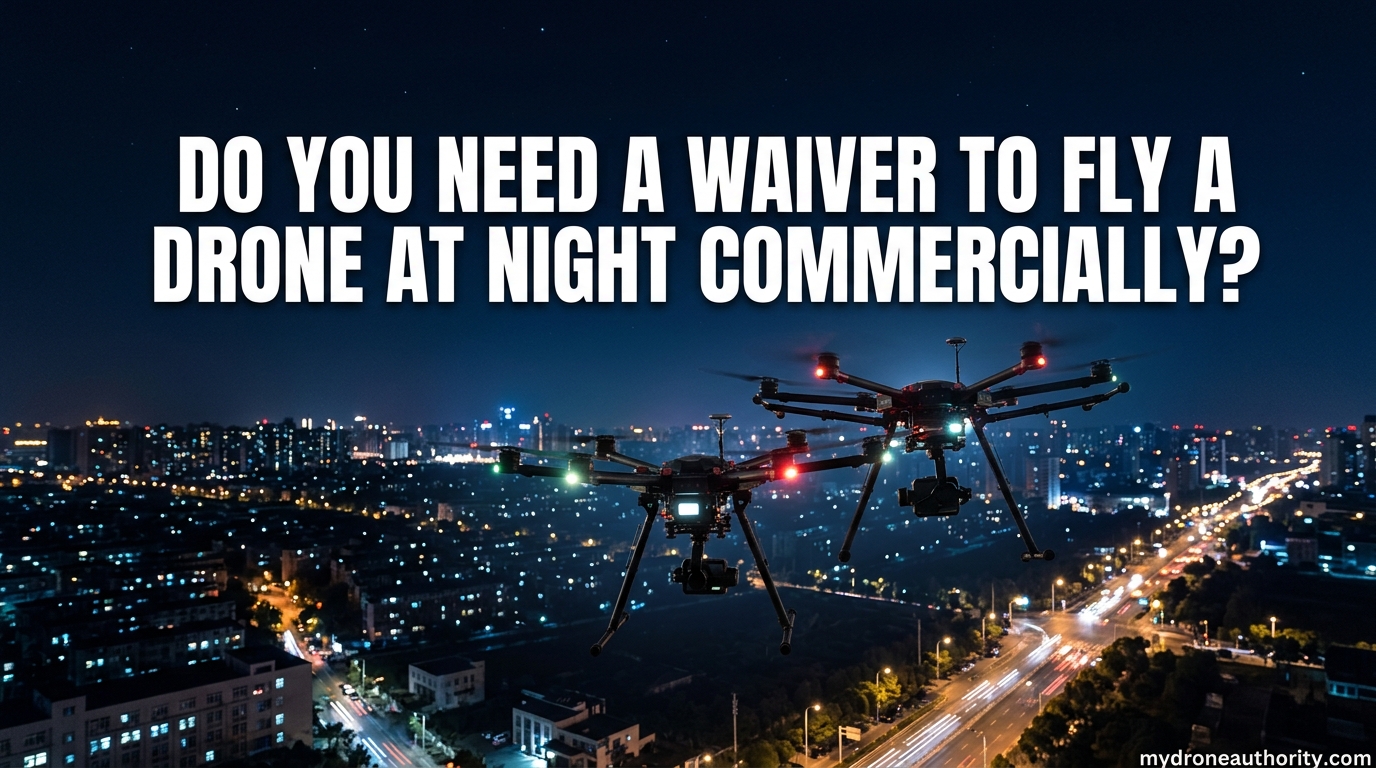
If you are scratching your head wondering whether you need a waiver to fly a drone at night commercially, you are not alone. This is one of the most confusing topics in the entire Part 107 landscape, and outdated information is still circulating across forums and even some older blog posts. The short answer is no, in most cases you no longer need a separate waiver to fly a drone at night commercially, provided you meet a specific set of FAA requirements that took effect in April 2021.
The confusion exists because the rules changed. Before 2021, every commercial night flight required a Part 107.29 waiver, no exceptions. Pilots who earned their Remote Pilot Certificate before that rule change often still believe a waiver is mandatory. Reddit threads, YouTube videos, and even some flight schools continue to repeat pre-2021 guidance that simply no longer applies.
Our team has tracked FAA Part 107 night operations regulations closely since the original rule change, and in this guide we walk through exactly what the current 2026 rules require. We cover the FAA definition of night, the four requirements you must satisfy to fly without a waiver, the situations where a waiver is still mandatory, penalties for non-compliance, and a practical pre-flight checklist you can use before your next after-dark job.
By the end, you will know with certainty whether your specific night operation needs a waiver, what gear you must have on board, and what training you are required to complete before you take off. We also address the differences between night and civil twilight, Remote ID requirements, and common mistakes that catch even experienced pilots off guard.
Table of Contents
Quick Answer: Do You Need a Waiver to Fly a Drone at Night Commercially?
No, you do not need a waiver to fly a drone at night commercially as long as you satisfy four core requirements under 14 CFR Part 107.29. The FAA eliminated the blanket night waiver requirement in April 2021, replacing it with a set of conditions that, when met, allow legal commercial night flight under your existing Part 107 certificate.
To fly commercially at night without a waiver, you must meet all four of the following:
- Hold a current Part 107 Remote Pilot Certificate
- Have completed the updated night operations training module
- Equip your drone with anti-collision lighting visible for 3 statute miles, flashing at 40 to 100 beats per minute
- Comply with all other applicable Part 107 regulations, including visual line of sight, airspace rules, and Remote ID
If you cannot satisfy any one of these conditions, then a waiver is required for that specific operation. We detail exactly which scenarios still need a waiver later in this guide.
What the FAA Actually Defines as Night
Understanding the FAA definition of night matters because it determines which set of rules applies to your flight. The FAA draws a clear line between civil twilight and actual night, and the lighting and training requirements attach only during the period officially classified as night.
Under FAA regulations, night is defined as the time between the end of evening civil twilight and the beginning of morning civil twilight, as published in the American Air Almanac. Civil twilight is the period when the sun is between 6 degrees and 0 degrees below the horizon. Once the sun drops more than 6 degrees below the horizon, you are officially in night conditions and the anti-collision lighting and training requirements kick in.
Many pilots get tripped up here. Civil twilight is not the same as night for FAA purposes, even though it is dark enough during civil twilight that some pilots feel lighting is necessary for safety. The anti-collision lighting mandate only applies during official night hours. That said, flying during civil twilight still requires you to maintain daytime visibility standards and comply with all standard Part 107 rules.
The table below summarizes the key differences.
| Condition | Civil Twilight | Night |
|---|---|---|
| Sun position | 0 to 6 degrees below horizon | More than 6 degrees below horizon |
| Anti-collision lighting required? | No | Yes (3 SM, 40-100 bpm flashing) |
| Night training required? | No | Yes |
| Waiver needed (if all rules met)? | No | No |
In Alaska, civil twilight definitions can behave differently because of extreme latitude. Alaskan pilots should consult the local twilight tables carefully, as civil twilight can last much longer or, during certain seasons, the sun may never drop below the 6-degree threshold in the way it does in the lower 48 states.
The Four Requirements for Flying a Drone at Night Commercially Without a Waiver
Each of the four FAA requirements for legal commercial night flight exists for a specific safety reason. Skipping any one of them puts you out of compliance and exposes you to enforcement action. We break down each requirement below.
Requirement 1: Hold a Current Part 107 Remote Pilot Certificate
You must hold a valid Remote Pilot Certificate issued under Part 107. This certificate is the foundation of legal commercial drone operations in the United States, and night flight is no exception. If your certificate has expired or you never earned one, you cannot legally fly a drone at night for commercial purposes under any circumstance.
To keep your certificate current, you must complete recurrent training every 24 calendar months. Since the 2021 rule update, the recurrent training now includes the night operations curriculum. Pilots who completed recurrent training before the update may need to take the new version to ensure their night endorsement is on record.
Requirement 2: Complete the Updated Night Operations Training
The FAA added a dedicated night training module to the Part 107 knowledge base in 2021. If you earned your certificate before April 2021, you must complete the new recurrent training that includes night operations before flying commercially at night. This applies even if you previously held a Part 107.29 night waiver.
The training covers topics including night vision physiology, lighting requirements, illusions and disorientation at night, and how to operate safely in low-light conditions. You can complete the training through the FAA’s online course on the FAASafety.gov website. There is no separate test, but you must finish the module and have it recorded against your certificate.
Requirement 3: Equip Your Drone with Anti-Collision Lighting
This is the requirement that catches the most pilots off guard. Your drone must carry anti-collision lighting that is visible for at least 3 statute miles and flashes at a rate between 40 and 100 beats per minute. The light must be mounted so it is visible from above and below the aircraft, and it must be turned on during the entire night flight.
A steady red or green position light is not enough. Many consumer drones ship with navigation lights that are only visible for a few hundred feet. Those lights do not satisfy the 3-statute-mile requirement and will not keep you compliant if you are operating at night.
The table below summarizes the anti-collision lighting specifications.
| Specification | FAA Requirement | Common Compliance Issue |
|---|---|---|
| Visibility | 3 statute miles minimum | Stock navigation lights only visible 200-300 feet |
| Flash rate | 40 to 100 beats per minute | Pilots using steady lights or wrong flash pattern |
| Color | Aviation red or flashing white acceptable | Non-aviation-grade lights not visible at distance |
| Coverage | Visible from above and below | Single-direction mount leaving blind spots |
| Operation | Lit during entire night flight | Battery dies mid-flight, leaving drone unlit |
Requirement 4: Comply with All Other Part 107 Rules
Night flight does not exempt you from any other Part 107 regulation. You still must fly below 400 feet above ground level, maintain visual line of sight, yield right of way to manned aircraft, avoid operating over people unless you meet the category requirements, and respect controlled airspace authorization through LAANC.
You also must comply with the Remote ID rule, which we cover in detail later. Failing any one of these standard rules during a night flight can result in the same penalties you would face during the day, with the added risk of additional charges for night-specific violations if your lighting or training is also out of compliance.
Anti-Collision Lighting Requirements Explained
The anti-collision lighting requirement deserves its own deep dive because it is the most common reason commercial night flights get flagged for violations. Forum discussions on r/drones and r/dji confirm that pilots routinely misunderstand the 3-statute-mile visibility and the flash rate specifications.
What 3 Statute Miles of Visibility Actually Means
Three statute miles is roughly 15,840 feet. The FAA wants your anti-collision light visible at that distance so manned aircraft pilots have time to see your drone and adjust course. Standard LED strobes sold for drones, including popular brands like Firehouse and StrobeX, are designed specifically to meet this threshold when properly mounted.
The light must be visible from any angle above and below the aircraft. A single strobe mounted on top of the drone may leave a blind spot underneath. Many pilots mount two strobes, one on top and one underneath, or use a single 360-degree strobe designed for aviation use.
The 40-100 Beats Per Minute Flash Rate
The flash rate matters because the FAA found that a steady light at distance can blend into ground clutter and become invisible. A flashing light at the specified rate is far more detectable to the human eye and to manned aircraft pilots scanning for traffic.
Forty to 100 beats per minute translates to one flash roughly every 0.6 to 1.5 seconds. Most aviation strobe lights sold for drones come pre-configured within this range, but you should verify with the manufacturer documentation. Some cheap LED strobes sold on Amazon flash too quickly, sometimes 200 or more beats per minute, which puts them out of compliance.
Position Lights vs Anti-Collision Lights
Pilots often confuse position lights with anti-collision lights. Position lights are the red (left), green (right), and white (rear) lights that show orientation. Anti-collision lights are the high-intensity flashing lights designed to make the aircraft visible from a distance.
For Part 107 night operations, the requirement is specifically for anti-collision lighting. Position lights are not mandated by Part 107, though many pilots use them in addition to anti-collision strobes for added safety and situational awareness.
When You DO Still Need a Waiver for Night Operations
Although the blanket night waiver requirement was eliminated in 2021, there are still specific situations where you must obtain a Part 107 waiver to fly at night. These waivers apply when your operation falls outside the standard Part 107 rules that the night lighting and training requirements do not cover.
Flying Beyond Visual Line of Sight at Night
Beyond Visual Line of Sight (BVLOS) operations require a Part 107 waiver at any time of day, including at night. The night lighting and training requirements do not grant you permission to fly BVLOS. If your commercial job requires you to fly beyond what you can see with your own eyes (without the aid of binoculars or a screen), you must apply for a BVLOS waiver through the FAA DroneZone.
Flying Over People at Night
Flying over people is governed by Part 107.39 and requires the drone to meet specific category requirements based on weight and injury risk. If you cannot meet the category requirements for your specific operation, you need a waiver. Night operations do not change these requirements, but they do add the lighting layer on top.
Operating Multiple Aircraft Simultaneously
Part 107 limits a single remote pilot to operating one drone at a time. If your commercial job requires you to fly multiple aircraft simultaneously, such as a coordinated mapping mission or inspection project, you need a waiver for multiple drone operation regardless of whether you are flying at night.
Drone Light Shows and Swarms
Drone light shows and swarm operations are a unique category. Even though the individual drones may be compliant with night lighting requirements, the operation itself typically requires both a multiple-aircraft waiver and an airspace authorization. Forum discussions from drone light show operators confirm that securing these waivers remains one of the most difficult approval processes in commercial drone operations.
Step-by-Step Waiver Application Process
If your operation does require a waiver, here is how to apply through the FAA DroneZone.
Step 1: Identify the specific Part 107 regulation you need waived. The FAA requires you to cite the exact regulation. Generic requests get denied.
Step 2: Write a risk mitigation plan. The FAA wants to see how you will mitigate the safety risk created by operating outside the standard rules. Include details on your aircraft, pilot experience, operational area, and any safety equipment or procedures you will use.
Step 3: Submit the application through the FAA DroneZone. Log in to your account at faadronezone.faa.gov and navigate to the Part 107 waiver application portal. Paste your risk mitigation narrative into the appropriate fields.
Step 4: Wait for FAA review. Processing times vary. Simple waivers may be approved in a few weeks, while complex BVLOS or swarm waivers can take 90 days or longer.
Step 5: Carry the waiver with you during operations. If you receive the waiver, you must have it accessible during the approved flights, and you must comply with every condition specified in the approval.
Recreational vs Commercial Night Drone Rules
The rules differ depending on whether you are flying for commercial purposes under Part 107 or recreationally under 49 USC 44809. The distinction matters because the requirements are not identical, and many hobbyists assume the rules are the same.
Recreational flyers operating under 49 USC 44809 can fly at night without a waiver as long as they follow a few basic conditions. They must fly within visual line of sight, operate in uncontrolled airspace (Class G) or have authorization for controlled airspace, and comply with any applicable community-based organization safety guidelines if they are flying under one.
Recreational flyers do not need to complete the Part 107 night training module, but they are still encouraged to understand the unique risks of night flight. They also are not required to have the same anti-collision lighting as commercial pilots, though the FAA strongly recommends it for safety.
The biggest practical difference is certification. Recreational flyers do not need a Remote Pilot Certificate, but they also cannot legally fly for any commercial purpose under 44809. If you are being paid, hired, or flying in furtherance of a business, you are a commercial operator and Part 107 applies in full.
Common confusion points include pilots who fly both recreationally and commercially. The same drone can be flown under either rule set depending on the purpose of the flight, but the operator must comply with the applicable set of rules for each flight. You cannot mix and match.
Remote ID Requirements at Night
Remote ID is not optional at night or any other time. As of September 2023, nearly all drone operators in the United States must comply with the Remote ID rule, regardless of whether they fly recreationally or commercially.
Remote ID broadcasts identification and location information from your drone. The broadcast includes the drone’s latitude, longitude, altitude, velocity, and the control station’s location. The FAA uses this data for safety, security, and compliance enforcement.
You have three options for Remote ID compliance. You can fly a drone with built-in Standard Remote ID, attach a Remote ID broadcast module to a drone without built-in capability, or fly at an FAA-recognized identification area (FRIA). FRIA operations are limited and require pre-arrangement with an organization hosting a recognized field.
At night, Remote ID works exactly the same as during the day. There is no special night configuration, and the broadcasting requirements do not change based on time. However, because night operations are more likely to attract law enforcement or FAA scrutiny if something looks suspicious, having visible Remote ID compliance can quickly resolve questions during a checkpoint encounter.
Penalties for Flying at Night Without Compliance
The FAA takes night operations violations seriously because they directly affect manned aviation safety. Penalties for non-compliant night commercial flights can be severe, both financially and professionally.
Civil Fines
Civil penalties can reach up to $75,000 per violation depending on the severity and circumstances. A typical night flight without proper anti-collision lighting alone can trigger fines in the thousands of dollars range. Multiple violations in a single flight can stack quickly.
Certificate Suspension or Revocation
If you hold a Remote Pilot Certificate, the FAA can suspend or revoke it for serious or repeated violations. Losing your certificate means losing your ability to legally operate commercially until the FAA restores it, which can take months or years.
How the FAA Catches Violations
Most night flight violations come to the FAA’s attention through reports from manned aircraft pilots, local law enforcement, or members of the public who see a drone operating suspiciously at night. The Remote ID broadcast also makes it far easier for the FAA to identify and trace non-compliant flights back to the operator.
Law enforcement officers are not FAA inspectors and cannot enforce FAA regulations directly, but they can detain operators, contact the FAA, and gather evidence that the FAA later uses in enforcement action. If local police question your night drone operation, having your Remote Pilot Certificate, proof of completed night training, and a visibly flashing anti-collision strobe on your drone will go a long way toward resolving the situation quickly.
Real-World Enforcement Examples
Pilots on r/drones have shared stories of FAA follow-up after night flights where neighbors reported unusual drone activity. In several cases, the FAA conducted interviews and reviewed Remote ID data to determine whether the operator was compliant. Operators who could not produce evidence of completed night training or whose drones lacked compliant anti-collision lighting faced fines or formal warnings.
Night Drone Flight Pre-Flight Checklist
Use this checklist before every commercial night flight to confirm you are meeting all FAA requirements. We recommend printing it or saving it to your phone for quick reference at the field.
Step 1: Verify your certification. Confirm your Part 107 Remote Pilot Certificate is current and you have completed the night operations training module within the last 24 calendar months.
Step 2: Check the official twilight times. Look up the civil twilight and official night times for your exact flight location and date using a sunrise and sunset calculator or FAA almanac source. Confirm your planned flight window falls within the official night period if you intend to fly under night rules.
Step 3: Inspect your anti-collision lighting. Verify your strobe is rated for 3 statute mile visibility, flashes at 40 to 100 beats per minute, and is mounted to provide visibility from above and below the aircraft. Test the strobe before takeoff and confirm it is functioning.
Step 4: Check airspace authorization. If you are flying in controlled airspace, confirm you have an active LAANC authorization for your flight window. LAANC authorizations are time-specific and must cover your entire planned flight, including night hours.
Step 5: Confirm Remote ID is broadcasting. Verify your drone’s Remote ID is transmitting correctly before takeoff. If you are using a broadcast module, ensure it is powered and properly registered.
Step 6: Brief any visual observers. If you are using a visual observer, brief them on their role, communication protocol, and the planned flight path. Visual observers can be especially valuable at night when depth perception is reduced.
Step 7: Check weather and visibility. Confirm flight visibility meets the minimum requirements for your operation and that conditions are safe for low-light flying. Be especially cautious of fog, which can drastically reduce visibility at night.
Step 8: Set battery reserves conservatively. Plan for shorter flight times than you would expect during the day. Cold night air can reduce battery performance, and unexpected lighting loads on the strobe can also draw down your battery faster than expected.
Common Mistakes Pilots Make at Night
Even experienced commercial pilots make avoidable mistakes when transitioning to night operations. Knowing the common pitfalls ahead of time can save you from fines, lost certificates, and damaged equipment.
The most common mistake is using a drone’s stock navigation lights and assuming they satisfy the anti-collision lighting requirement. Stock lights are typically only visible for a few hundred feet and do not flash at the required rate. Every commercial night flight must have a dedicated 3-statute-mile strobe installed.
Another frequent error is skipping the night training module. Pilots who completed recurrent training before April 2021 often assume their existing training covers them. The new night curriculum is mandatory, and you must have it on record to fly legally at night.
Confusing civil twilight with night is also a recurring problem. Some pilots turn on their strobes during civil twilight and assume they are flying under night rules. While this is harmless from a safety standpoint, it does not change the regulatory classification of your flight, and you must still comply with all standard Part 107 daytime requirements during civil twilight.
Relying on outdated pre-2021 information is perhaps the most widespread problem. Many YouTube videos, blog posts, and forum threads still reference the old waiver requirement. Always verify your information against the current FAA Part 107 guidance rather than relying on third-party content that may not have been updated.
Finally, pilots sometimes forget to factor in the additional battery drain from anti-collision strobes. A strobe running for the duration of a 20-minute flight can noticeably reduce your battery reserve, especially in cold night conditions. Plan accordingly.
Practical Tips for Safe Commercial Night Operations
Beyond meeting the legal requirements, there are several practical steps you can take to make your commercial night flights safer and more successful. Our team has compiled these based on field experience and pilot reports.
Use a visual observer whenever possible. At night, your depth perception and ability to judge distances degrade significantly. A second set of eyes on the aircraft, especially one positioned at a different vantage point, can help maintain situational awareness and ensure you keep the drone within visual line of sight.
Practice in a controlled environment first. Before taking on a paid night job in unfamiliar terrain, fly your drone at night in an open field or familiar location to get a feel for how the lighting looks from your perspective on the ground. This practice helps you recognize how visible your strobe actually is at various distances.
Plan your flight path with landing zones in mind. At night, identifying a safe emergency landing spot is harder than during the day. Identify and mark potential landing areas before takeoff so you can act quickly if you lose battery or experience an issue.
Dress for the conditions. Night flying often means colder temperatures, especially in desert or mountain environments. Cold fingers and reduced dexterity can affect your ability to operate controls precisely. Layered clothing and warm gloves are essential gear.
Communicate with local authorities if you are flying in a populated area. A quick courtesy call to local police or a security office can prevent misunderstandings if residents report seeing a drone with flashing lights at night. Many pilots carry a printed copy of their Part 107 certificate and night training completion record for this exact reason.
Use your drone’s camera settings to your advantage. If you are doing commercial photography or videography at night, adjust your camera’s ISO, shutter speed, and aperture for low-light conditions well before takeoff. Trying to tune these settings mid-flight while also managing safety responsibilities is a recipe for mistakes.
Frequently Asked Questions
Can commercial drones fly at night without a waiver?
Yes. Commercial drones can fly at night without a waiver if the operator holds a current Part 107 Remote Pilot Certificate, has completed the updated night operations training, and equips the drone with anti-collision lighting visible for 3 statute miles flashing at 40 to 100 beats per minute. The blanket night waiver requirement was eliminated in April 2021.
Do I need a Part 107 license to fly a drone at night?
Yes, you need a Part 107 Remote Pilot Certificate to fly a drone at night for any commercial purpose. Recreational flyers do not need a Part 107 certificate, but they also cannot legally accept payment or fly in furtherance of a business.
Are you allowed to use a drone at night?
Yes, you are allowed to fly a drone at night in the United States. Commercial pilots must comply with Part 107.29 requirements including anti-collision lighting and night training, while recreational pilots must comply with 49 USC 44809.
What is the FAA waiver for drones?
A Part 107 waiver is an official FAA document that approves drone operations outside the standard Part 107 regulations. Waivers are required for operations like flying beyond visual line of sight, flying over people without meeting category requirements, or operating multiple drones simultaneously.
Can you fly a drone at night recreationally?
Yes. Recreational drone pilots can fly at night under 49 USC 44809 without a waiver. They must maintain visual line of sight, fly in compliant airspace, and follow any applicable community-based organization safety guidelines.
How far must anti-collision lights be visible at night?
Anti-collision lights on a drone flown commercially at night must be visible for at least 3 statute miles. This visibility requirement ensures manned aircraft pilots can see the drone in time to avoid a collision.
What flash rate is required for drone anti-collision lights?
The FAA requires anti-collision lights to flash at a rate between 40 and 100 beats per minute. This translates to approximately one flash every 0.6 to 1.5 seconds. Steady lights or flash rates outside this range do not comply with the regulation.
Do I need a license to fly a drone under 250g at night?
Commercial operators still need a Part 107 Remote Pilot Certificate to fly a drone under 250g at night for commercial purposes, regardless of the drone’s weight. Recreational flyers operating under 49 USC 44809 do not need a certificate, but the drone must be registered if required.
Final Thoughts on Drone at Night Commercial Waiver Requirements
Understanding whether you need a waiver to fly a drone at night commercially comes down to whether you can meet the four core FAA requirements: a current Part 107 certificate, completed night training, anti-collision lighting visible for 3 statute miles flashing at 40 to 100 beats per minute, and full compliance with all other Part 107 regulations. Meet all four and you can fly commercially at night without a separate waiver.
If your operation falls outside standard Part 107 in any way, including BVLOS, multiple aircraft, or non-compliant operations over people, you will still need a Part 107 waiver for that specific aspect of your flight. The night lighting and training requirements do not override any other Part 107 limitations.
Our team recommends bookmarking the official FAA Part 107 waivers page and verifying your night training record in the FAASafety.gov system before your next after-dark commercial job. The rules are clear once you understand them, and compliance is straightforward when you have the right lighting, the right training, and the right checklist in hand.