
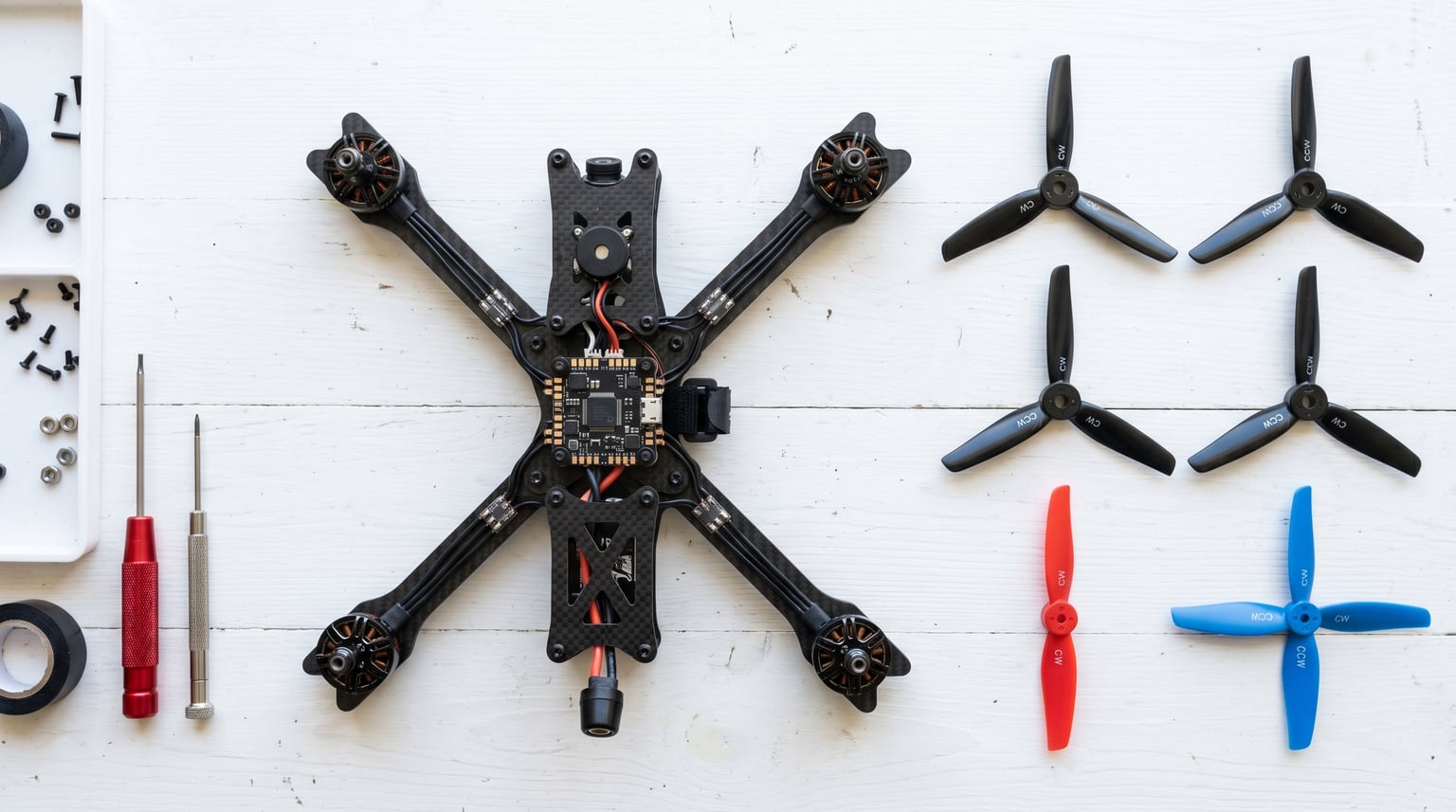
When I built my first quadcopter back in 2026, I spent a frustrating hour staring at two identical-looking propellers wondering which one went where. I had three CW and three CCW blades laid out on my workbench, and the markings on them felt like a secret code. That moment of confusion is exactly why our team wrote this guide.
CW vs CCW propellers refers to the direction a drone’s blades rotate when viewed from above the aircraft. CW (clockwise) and CCW (counterclockwise) propellers are not interchangeable on a quadcopter, and putting the wrong one on the wrong motor can cause your drone to flip, drift, or even lose a propeller mid-flight. In this guide, we break down what each term means, how to tell them apart by sight, which motor each one pairs with, and why getting it right is critical for stable, safe flight.
Table of Contents
What Are CW vs CCW Propellers? The Basic Definition
CW and CCW describe the rotation direction of a propeller as seen from above the drone looking down. A CW (clockwise) propeller spins in the same direction as a clock’s hands when viewed from the top. A CCW (counterclockwise) propeller spins the opposite way, against the clock’s hands.
Both propellers generate the same amount of thrust, but the pitch of their blades is mirror-imaged. A CW prop and a CCW prop are physically different parts, even though they look almost identical at first glance. The difference is in the way the airfoil is twisted along the blade’s length.
This naming convention applies to any multirotor with more than one propeller, including quadcopters, hexacopters, octocopters, and agricultural drones. Single-propeller setups like RC planes generally use a CW prop on a pusher or tractor configuration without pairing it with a CCW counterpart.
How to Identify CW vs CCW Propellers Visually
You can tell a CW and CCW propeller apart by looking at the leading edge, which is the high edge of the blade. Hold the propeller flat in front of you with the hub facing your chest and the tips pointing away. If the high (leading) edge of the blade is on the right side, it is a CW propeller. If the high edge is on the left side, it is a CCW propeller.
Manufacturers also use two common marking systems. Many stamp or mold an “L” (for left/CCW) or an “R” (for right/CW) directly into the hub or blade. Others use a small notch, dot, or color code on the leading edge. Always check both the visual orientation and any printed marking before installing.
Here is a step-by-step check I use on my own builds:
- Lay the propeller flat on a table with the hub facing you.
- Look at the blade’s leading edge (the higher, sharper side of the airfoil).
- If the leading edge tilts to the right, it is a CW propeller.
- If the leading edge tilts to the left, it is a CCW propeller.
- Confirm by checking for an “L” or “R” marking on the hub.
For tri-blade props, do the same test on any one of the three blades. The orientation is identical for every blade on the propeller because they are all twisted the same way.
Why Quadcopters Use Both CW and CCW Propellers
Every spinning propeller creates a torque reaction, which is a twisting force on the body of the drone in the opposite direction of the prop’s spin. If a quadcopter used four CW props, the entire aircraft would spin uncontrollably in the yaw axis the moment it took off.
To cancel out this torque, quadcopters pair two CW motors with two CCW motors, arranged in a diagonal pattern. The torque from the CW motors is exactly cancelled by the torque from the CCW motors. The result is a stable aircraft that hovers without spinning on its own.
Yaw control (the rotation of the drone around its vertical axis) works by slightly speeding up the CW motors while slowing down the CCW motors, or vice versa. This imbalance creates a small net torque that rotates the drone left or right on command. The physics depends entirely on the correct pairing of CW and CCW propellers with the correct motors.
Quadcopter Motor Placement: Which Motor Spins Which Way
The standard convention for a quadcopter X frame is to look down at the drone from above with the front facing away from you. Motors 1 and 4 (front-left and rear-right) spin CCW, while motors 2 and 3 (front-right and rear-left) spin CW. This diagonal pairing is the most common layout, used by Betaflight, INAV, and most modern flight controllers.
For a quadcopter Plus frame (square layout), motor 1 at the front-left and motor 2 at the front-right also use one CW and one CCW motor in a diagonal pair. The exact numbers depend on your flight controller’s configuration, but the principle stays the same: pair CW with CCW diagonally across the frame.
To match the propellers to the motors, install a CCW propeller on each CCW motor and a CW propeller on each CW motor. Here is the standard X-frame motor-to-prop mapping:
- Motor 1 (front-left): spins CCW, requires a CCW propeller
- Motor 2 (front-right): spins CW, requires a CW propeller
- Motor 3 (rear-left): spins CW, requires a CW propeller
- Motor 4 (rear-right): spins CCW, requires a CCW propeller
Always confirm the rotation direction with a short motor test before tightening the prop nuts. I learned this the hard way after a firmware flash swapped my motor directions without warning, and my drone flipped on takeoff.
Thread Direction and Self-Locking Nuts Explained
CW and CCW motors also have opposite prop shaft threads. A CW motor has a left-hand (reverse) thread, and a CCW motor has a right-hand (standard) thread. The threads turn in the opposite direction of the prop’s spin, which is what creates a self-locking effect.
When the motor spins, it tries to tighten the prop nut rather than loosen it. This is critical because drone motors spin at 8,000 to 12,000 RPM in flight, and any prop nut that loosens during operation will throw the propeller off the aircraft. Forum users have reported losing props mid-flight when they used the wrong nut thread on a motor.
The prop nuts for CW and CCW motors also look slightly different. CW motor nuts are typically marked with a notch, a red dot, or a “CCW” stamp, while CCW motor nuts are unmarked or marked with “CW.” Using a standard M5 nut on a CW motor is one of the most common mistakes new builders make, and it can be dangerous.
Point of View: Why Top View Is the Standard
The single biggest source of confusion I see in forum threads is the point of view issue. CW and CCW are always defined from the top of the drone looking down, not from the pilot’s perspective or from underneath. If you flip the drone upside down, the directions reverse.
From the top: Motor 1 spins counterclockwise (CCW). From the bottom: that same motor appears to spin clockwise. The motor itself is not changing direction. The viewpoint is changing.
This convention exists for a practical reason. The top view is the perspective used in every flight controller software, every wiring diagram, and every motor layout guide. Sticking to one viewpoint eliminates the most common installation mistake in drone building.
How to Check and Reverse Motor Direction
Before installing any propeller, always do a motor direction test with the prop removed. Connect the drone to Betaflight or your flight controller software, remove all props for safety, and use the motors tab to spin each motor individually. Watch the rotation from above and verify it matches the expected CW or CCW pattern for that motor position.
If a motor spins the wrong way, you have two options. The simplest fix is to swap any two of the three motor wires between the ESC and the motor, which reverses the rotation. The other option is to use BLHeli or BLHeli32 configuration software to invert the motor direction in the ESC settings without rewiring.
Both methods work reliably, but I prefer the software approach for clean builds because it keeps the wiring consistent. The wire-swap method is faster and works on any ESC, including those without configurable direction settings.
Common Mistakes and How to Avoid Them
The most common mistake is installing a CW prop on a CCW motor. The prop will not produce lift correctly, the drone will flip on takeoff, and the prop nut will loosen mid-flight because the threads spin in the loosening direction. Always double-check the prop orientation before tightening any nut.
The second most common mistake is using the wrong prop nut thread. CW motors require reverse-thread nuts. Installing a standard right-hand nut on a CW motor means the flight forces will unscrew it within seconds of takeoff. Buy the correct nut set with your motors and never mix and match.
The third mistake is skipping the motor direction test. Always run a no-prop motor test in Betaflight or your flight controller’s software before installing the props. It takes 30 seconds and prevents the kind of crash that destroys $300 in components.
Forum users frequently report losing props or crashing on the first flight because they trusted the prop markings without verifying the actual spin direction. A 30-second motor test is the cheapest insurance you can buy for any drone build.
Frequently Asked Questions
How do I know which propeller is CW and CCW?
Hold the propeller flat in front of you with the hub facing your chest. If the leading (high) edge of the blade tilts to the right, it is a CW propeller. If it tilts to the left, it is a CCW propeller. You can also check for an L (CCW) or R (CW) marking on the hub.
How do I determine CW or CCW on a motor?
Look at the motor from above the drone while it spins at low throttle. If the motor turns clockwise, it is a CW motor. If it turns counterclockwise, it is a CCW motor. Match the motor’s rotation to a propeller of the same direction (CW prop on CW motor, CCW prop on CCW motor).
What is the difference between a CW motor and a CCW motor?
A CW motor spins clockwise when viewed from above and has a left-hand (reverse) thread on its prop shaft. A CCW motor spins counterclockwise and has a standard right-hand thread. The opposite threads create a self-locking effect that keeps prop nuts from loosening in flight.
What direction should drone motors spin?
In a standard X-frame quadcopter, the front-left and rear-right motors spin CCW, while the front-right and rear-left motors spin CW. This diagonal pairing cancels out torque and keeps the drone stable. Always confirm your specific layout in Betaflight or your flight controller software.
What happens if I put a CW prop on a CCW motor?
The propeller will not generate lift correctly, the drone will flip violently on takeoff, and the prop nut will loosen mid-flight because the motor’s spin will unscrew it. The aircraft will likely crash within seconds and could throw the loose propeller at high speed.
Final Thoughts on CW vs CCW Propellers
CW vs CCW propellers is one of the first concepts every drone builder needs to understand, and it is also one of the most commonly misunderstood. The prop direction, the motor direction, the prop nut thread, and the motor position on the frame all work together as a single system. Getting any one of these wrong can ruin a build or cause a crash.
Take five minutes before every build to identify your props, label your motors, run a no-prop motor test, and verify the rotation pattern. Our team has built dozens of quadcopters and we still do this every single time. The peace of mind is worth more than the five minutes it costs.