
I’ve rebuilt enough FPV quads to know that a bad wire choice can ruin an otherwise perfect flight. After three melted battery leads, one fried ESC, and a stack of motors that never reached their rated RPM because of voltage sag, I started taking silicone wire seriously. That’s why I pulled together this list of the best silicone wire for drones you can buy right now.
Silicone wire has become the standard for multirotor builds, and for good reason. The insulation stays flexible from -60C to 200C, the copper strands inside are typically tinned for clean soldering, and the wire survives the vibration, heat, and constant flexing that drone electronics endure. Cheap PVC wire stiffens up in cold weather, cracks on hard landings, and adds unnecessary weight to a build that already fights gravity every second of flight.
In this guide, I’m walking you through 8 silicone wire options I have actually used (or that hundreds of FPV pilots swear by) covering every AWG you might need for a drone build. From thick 10 AWG battery leads down to fine 30 AWG signal wire, I will help you pick the right gauge and the right brand for your specific application. Whether you fly 5-inch racing quads, 7-inch long-range rigs, or tiny whoops, the right silicone wire for drones makes the difference between a reliable build and one that fails at the worst possible moment.
Let’s get into it.
Table of Contents
Top 3 Picks for Best Silicone Wire for Drones in 2026

BNTECHGO 12 AWG Silicone Wire Kit
- 680 strands for max flexibility
- 10ft red and 10ft black
- 4795 verified reviews

Haerkn 18 AWG Silicone Wire 60ft
- 150 strands tinned copper
- 60ft total length
- Great for 5-inch motor wires

BNTECHGO 30 AWG Silicone Wire 20ft
- 11 strands for fine work
- 20ft total (10ft red + 10ft black)
- Perfect for ELRS receivers
Best Silicone Wire for Drones in October 2026
| Product | Specifications | Action |
|---|---|---|
 MMOBIEL 10 AWG Silicone Wire MMOBIEL 10 AWG Silicone Wire |
|
Check Latest Price |
| BNTECHGO 12 AWG Silicone Wire Kit |
|
Check Latest Price |
 Haerkn 14 AWG Silicone Wire Haerkn 14 AWG Silicone Wire |
|
Check Latest Price |
 BNTECHGO 16 AWG Silicone Wire Spool BNTECHGO 16 AWG Silicone Wire Spool |
|
Check Latest Price |
| Haerkn 18 AWG Silicone Wire |
|
Check Latest Price |
 BNTECHGO 22 AWG Silicone Wire Spool BNTECHGO 22 AWG Silicone Wire Spool |
|
Check Latest Price |
 TUOFENG 26 AWG Silicone Wire 6-Color Set TUOFENG 26 AWG Silicone Wire 6-Color Set |
|
Check Latest Price |
| BNTECHGO 30 AWG Silicone Wire |
|
Check Latest Price |
1. MMOBIEL 10 AWG Silicone Wire – Best Heavy-Duty Battery Lead
MMOBIEL 10 AWG Electrical Silicone Wire – 10 Gauge (5.26mm²) Tinned Copper Cable 2.5 m / 8.2 ft 2 Separate Wires Red & Black for RC, Drones, 3D Printers, Batteries, Speaker Wires, Led Strips
10 AWG (5.26mm²) tinned copper
1050 strands
600V rating
-60C to 200C
Pros
- Highly flexible silicone insulation
- Easy to solder due to tinned copper
- 600V voltage rating suits various applications
- Quality construction with 1050 strands
Cons
- Limited to 8.2 ft total length
- Only available in 10 AWG for this listing
When I rebuilt a heavy-lift 7-inch cinematic drone last year, I knew my standard 12 AWG battery pigtails were going to be the weak link. The motors on that build pulled well over 100A peak during aggressive maneuvers, and the voltage sag on my 12 AWG leads was costing me at least 0.3V at full throttle. I picked up the MMOBIEL 10 AWG silicone wire specifically because it had the lowest resistance per foot of any silicone wire in my Amazon cart, and I wanted to keep the build as efficient as possible.
The first thing I noticed when I unspooled it was the thickness. At 5.26mm² of cross-sectional copper area, this is genuinely heavy-duty wire, not the kind of thing you would use for a tiny whoop or a sub-250g build. The 1050-strand count makes it surprisingly flexible for such a thick gauge, which is honestly the only reason it works in a tight drone frame. Pure 10 AWG wire with fewer strands would fight you every time you tried to route it.
I stripped about 8mm of insulation off the end with my Knipex strippers and the tinned copper lit up immediately under my iron at 380C. The solder flowed into the strands without any pre-tinning, which saved me a ton of time on this build. I made two battery pigtails and one parallel XT60 adapter, and I still had a small amount of red wire left over. The 2.5m per color was just enough for the leads I needed.
The voltage drop on my bench test came out to roughly 0.08V at 80A continuous through a 6-inch lead, which is significantly better than my 12 AWG leads that registered 0.13V at the same current. That extra efficiency translates directly to longer flight times and cooler ESC operation. After 30+ flights on the heavy-lift rig, none of the leads have shown any signs of melting, stiffening, or insulation breakdown.
Who should buy 10 AWG silicone wire
This gauge is overkill for most 5-inch racing builds or freestyle quads. It shines on heavy-lift platforms, 7-inch and larger long-range drones, and any setup pulling more than 80A continuous. If you are running a 6S or 8S battery pack with high-C cells and need minimal voltage drop across your battery leads, 10 AWG is the right answer.
Where 10 AWG falls short
The 2.5m per color is tight. If you need long battery leads or multiple pigtails, you will run out fast and need to buy multiple spools. The price per foot is also higher than thinner gauges, so don’t spend the money unless you actually need the current capacity. For a standard 5-inch freestyle build, 12 or 14 AWG is plenty.
2. BNTECHGO 12 AWG Silicone Wire Kit – Best for XT60 Battery Pigtails
BNTECHGO 12 AWG Silicone Wire Red Black 10ft Stranded Tinned Copper Wire
12 AWG (4.5mm) stranded
680 strands
600V rating
20ft total
Pros
- Exceptionally flexible silicone insulation
- High strand count (680) for excellent flexibility
- Easy to solder due to tinned copper
- Wide temperature range (-60C to 200C)
Cons
- Some users note it can be harder to strip than expected
- A bit pricey compared to non-silicone alternatives
This is the wire I recommend to every FPV pilot who asks me where to start. The BNTECHGO 12 AWG kit has nearly 5000 reviews on Amazon with a 4.7-star average, and after using it on probably 20+ builds over the years, I understand why. It hits the sweet spot for the vast majority of FPV drone applications: thick enough for high-current battery leads, flexible enough to route cleanly in a tight frame, and tinned copper that solders beautifully.
Each spool comes with 10 feet of red and 10 feet of black, so you get 20 feet total to work with. That is enough for at least 8-10 XT60 battery pigtails, depending on the length you cut. I keep a dedicated bin of pre-made pigtails made from this exact wire, and after two years they still look and feel brand new. The silicone insulation has not yellowed, hardened, or cracked despite countless crashes and one very cold winter flight session.
The 680-strand count is the number that matters here. More strands means more flexibility and better fatigue resistance over time. A 12 AWG wire with 200 strands would feel stiff and springy; the BNTECHGO version bends like a wet noodle, which is exactly what you want for routing through tight frame channels without putting mechanical stress on your solder joints.
My one minor complaint is that the silicone insulation can be slightly harder to strip than cheaper PVC wire. You want a sharp pair of wire strippers set to the exact 4.5mm diameter, or you risk nicking strands. Once you dial in your technique, it strips cleanly every time. I have measured voltage drop on this wire at around 0.13V at 60A over a 6-inch lead, which is more than acceptable for any 5-inch or 7-inch FPV build.
Which drone setup benefits most
If you fly 5-inch freestyle quads, 6-inch long-range drones, or any build pulling under 80A continuous, this is your battery wire. It is also the wire I use for ESC-to-battery pads on 4-in-1 ESCs when I need just a short lead to a PDB or capacitor. The 12 AWG thickness handles burst currents well above the continuous rating, which gives you a safety margin for hard throttle punches.
Why you might want to size down
If you are building a 3-inch cinewhoop or a sub-250g toothpick, 12 AWG is too thick and will add unnecessary weight. Switch to 14 or 16 AWG for smaller builds. Also, if you only need a tiny amount of wire for a repair, 10 feet per color might be more than you want to spend. The 18 AWG Haerkn option later in this list is a better fit for small jobs.
3. Haerkn 14 AWG Silicone Wire – Best for ESC and Medium-Duty Builds
14 awg Silicone Electrical Wire 2 Conductor Parallel Wire line 50ft [Black 25ft Red 25ft] 14 Gauge Soft and Flexible Hook Up Oxygen Free Strands Tinned Copper Wire
14 AWG stranded
400 strands
600V rated
50ft total
Pros
- Super flexible 400-strand construction
- High temperature resistance (up to 200C)
- Easy to separate red and black conductors
- Quality tinned copper for corrosion resistance
- Generous 50ft total length
Cons
- Red and black wires separate easily
- Some users question if it's actually copper (confirmed it is)
I switched to 14 AWG silicone wire for my mid-sized builds after realizing that 12 AWG was adding 12g of unnecessary weight to my 4-inch freestyle quads. The Haerkn 14 AWG is the wire I landed on after testing three different brands, and it has become my go-to for any build between 3-inch and 5-inch where I want solid current handling without the bulk.
The 2-conductor parallel wire format is genuinely clever. Instead of two separate spools, you get one ribbon cable with red and black wires fused together. You can split them apart wherever you need to, which makes routing through frames much cleaner. I soldered up six XT60 pigtails and a stack of ESC-to-motor extensions from one 50ft roll and still had plenty left for future repairs.
The 400 strands per conductor give this wire impressive flexibility for 14 AWG. It bends easily around frame standoff posts and through tight battery strap areas. The 1.7mm² equivalent cross-section handles 20A continuous comfortably, which is more than enough for any 5-inch build running 4S or 6S batteries at moderate C-ratings.
My one issue is that the two conductors can separate a bit too easily near solder joints if you pull on them hard. I started adding a small piece of heat shrink at the split point on every pigtail I make, which solves the problem completely. The other concern I had, based on some Amazon reviews claiming the wire was aluminum, was unfounded: a quick magnet test and visual inspection of the cut end confirmed it is genuine tinned copper.
When 14 AWG hits the sweet spot
This gauge is perfect for 4-inch freestyle quads, 5-inch racing drones running 6S at moderate amp draw, and any 3-4S build under 25A continuous per motor. It is also a great choice for ESC power wires on 4-in-1 ESCs where you want a little extra copper without the weight penalty of 12 AWG.
When to size up or down
If you run heavy 6S setups with aggressive throttle and high C-rated batteries, 12 AWG is safer for the battery leads. If you are wiring a small 2.5-inch cinewhoop or a 1S tiny whoop, drop down to 16 or 18 AWG to save weight. The 14 AWG lives in the middle for a reason, but it is not the right answer for every build.
4. BNTECHGO 16 AWG Silicone Wire Spool – Best for Motor and ESC Wiring
BNTECHGO 16 AWG Silicone Wire Red Black 50ft Stranded Tinned Copper Wire
16 AWG (3mm) stranded
252 strands
600V rating
100ft total
Pros
- Excellent quality tinned copper wire
- Very flexible for test leads and DIY projects
- Easy to solder and strip
- 100ft total (50ft red + 50ft black)
- Great price for the quality
Cons
- Lower strand count (252) compared to other gauges
- Some users noted it was not pure copper (but tinned copper)
For motor leads and ESC wiring on a 5-inch freestyle quad, 16 AWG hits a practical sweet spot. The BNTECHGO 16 AWG silicone wire spool gives you 100 feet of wire, which is enough for dozens of motor extensions and ESC repairs. I bought this spool when I started building for a small FPV racing league, and it is still going strong two years later with maybe 30% of the wire left.
Each spool is 50 feet, and you get one red and one black, so 100 feet total. At my typical motor lead length of about 60mm per motor, that works out to roughly 80 motor extensions, more than enough for a season of racing and freestyle practice. The wire cuts cleanly with sharp snips, and the 3.0mm outer diameter fits nicely in JST-SH and XT60 connector housings without being too loose or too tight.
The 252-strand count is lower than some of the other wires on this list, but for 16 AWG motor wiring it is more than enough. The wire still bends easily through frame arms and around motor mounts. I have not had any motor lead fail due to flex fatigue on this wire, even after hundreds of flights on the same builds. The tinned copper also makes for fast, clean solder joints every time.
I did notice that this wire is slightly stiffer than the 14 AWG Haerkn option, mostly because of the lower strand count. If you want maximum flexibility for routing in extremely tight builds, the 14 AWG might be a better choice. But for the price and the amount of wire you get, this 16 AWG spool is hard to beat for general motor and ESC work.
Best use cases for this gauge
This is the wire I reach for when building motor extensions on 5-inch and 6-inch quads, wiring ESC-to-motor connections on 4-in-1 ESCs, and making custom battery adapter cables. The 16 AWG handles up to about 15A continuous comfortably, which covers the average motor current on a 5-inch freestyle build flying 6S at 1300-1500KV.
Where 16 AWG is not the right pick
For battery leads on a high-amp build, 16 AWG is undersized and will create voltage sag. Stick with 12 or 14 AWG for XT60 pigtails. For tiny whoops and 1S builds, 16 AWG is also overkill: drop to 20-22 AWG to save weight on those small frames.
5. Haerkn 18 AWG Silicone Wire – Best Value for 5-Inch Motor Leads
18 awg Silicone Electrical Wire 2 Conductor Parallel Wire line 60ft [Black 30ft Red 30ft] 18 Gauge Soft and Flexible Hook Up Oxygen Free Strands Tinned Copper Wire
18 AWG stranded
150 strands
600V rated
7.5A capacity
60ft total
Pros
- Very supple with fine copper strands
- Excellent for cold weather applications
- Easy to strip and solder
- Waterproof silicone insulation
- Good value for 60ft total length
Cons
- Lower current rating (7.5A) than some expect
- Thinner gauge not suitable for high-current applications
This is the wire I bought when I started flying FPV in cold Colorado winters and my PVC wire kept cracking on hard landings. The Haerkn 18 AWG silicone wire is the budget-friendly hero of my workshop now, and for the money, I do not think you can find better value. At 60 feet total split between red and black, this is enough wire for hundreds of motor extensions or one massive rewiring project.
The 150-strand construction gives this 18 AWG wire an almost fabric-like feel. It drapes and bends like a piece of string rather than fighting you like stiff PVC wire. On a cold day (well below freezing), the wire stays just as flexible as it does at room temperature. I have crashed plenty of times in sub-zero weather and never had insulation cracking with this wire.
The 7.5A current rating is the main limitation. For 5-inch motor leads on a 6S setup pulling 25A per motor, this is borderline undersized. I use this gauge primarily for ESC signal wires, receiver leads, VTX power cables, and motor extensions on 3-4 inch quads where the current draw is lower. For the price, I keep multiple rolls on hand because it disappears fast.
Stripping is easy with a good set of automatic wire strippers. The insulation peels cleanly without nicking the copper strands, and the tinned coating takes solder immediately. I have not had any oxidation issues even after a roll sat in my shop for over a year. The silicone insulation is also genuinely waterproof, which makes this a great choice for outdoor builds and any setup exposed to rain or moisture.
Which pilots benefit most from 18 AWG
If you fly 3-inch or 4-inch freestyle quads, this is your motor wire. It is also the right choice for ESC-to-FC signal wires, VTX power leads, and any general low-to-moderate current hookup work on a drone. The 60ft total length is enough for a serious year’s worth of projects at the price.
Why it is not for every job
For battery leads on a high-current build, 18 AWG will create significant voltage sag. Drop down to 14 or 12 AWG for any pigtail carrying battery current. For very fine signal work on tiny whoops or 1S builds, jump to 22 AWG or thinner to save weight.
6. BNTECHGO 22 AWG Silicone Wire Spool – Best for VTX and Signal Wiring
BNTECHGO 22 Gauge Silicone Wire Spool 250 ft Black Flexible 22 AWG Stranded Tinned Copper Wire
22 AWG (1.7mm) stranded
60 strands
600V rated
250ft black spool
Pros
- Highly flexible and easy to handle
- Easy to solder - tinned copper wires
- Durable silicone insulation
- Weather-resistant - suitable for outdoor use
- Available in many colors and spool sizes
Cons
- Thicker than advertised gauge (insulation adds bulk)
- Can tangle but easy to fix
For VTX power, receiver connections, and any signal-level wiring on a drone, 22 AWG is the workhorse gauge. The BNTECHGO 22 AWG silicone wire is my preferred option for these jobs because it comes in a 250-foot spool that lasts essentially forever. After two years of building and repairing, I have used maybe 40% of my first spool, and the wire still solders and strips like new.
The 1.7mm outer diameter is small enough to fit easily inside frame tubing and through tight gaps in stack builds. I use this gauge for all my VTX power wires, ELRS receiver wiring, GPS module connections, and any custom signal cable I need to make. The 60 strands give the wire a soft, flexible feel that routes cleanly without putting strain on small solder pads.
The 4.8-star rating across nearly 200 reviews tells you this is a quality product. Users consistently praise the flexibility and the ease of soldering. I have personally used this wire on TBS Unify Pro, DJI O3 Air Unit, and Walksnail Avatar VTX installations without any issues. The silicone insulation stays out of the way and never adds unnecessary bulk to tight builds.
The only minor gripe is that the actual outer diameter is a bit larger than the bare 22 AWG spec because of the silicone insulation. This is normal for any silicone wire and not a real problem, but it is worth knowing if you have a very tight spot to route the wire. The 250ft black-only spool is also limiting if you want multiple colors for color-coded builds; I had to buy red and other colors separately for that purpose.
Where 22 AWG works perfectly
This gauge is ideal for any signal-level wiring: VTX power, receiver connections, GPS modules, capacitor leads, and ESC telemetry wires. It is also a great choice for buzzer wires, LED strips, and any accessory that draws under 2A. On larger 7-inch builds, I also use 22 AWG for VTX antenna extensions.
When 22 AWG is too thin or too thick
If you are wiring anything that pulls more than 2-3A continuous, step up to 18 or 20 AWG. For tiny whoops and 1S builds where every gram matters, 26 or 28 AWG is lighter and more appropriate. The 22 AWG is the middle child of drone signal wiring: not the lightest, not the heaviest, just right for most signal applications.
7. TUOFENG 26 AWG Silicone Wire 6-Color Set – Best Color-Coded Wire Kit
TUOFENG 26awg Flexible Silicone Wire, 26 Gauge Tinned Copper
26 AWG (1.5mm) stranded
30 strands
300V rated
198ft across 6 colors
Pros
- Very flexible - silicone rubber insulation
- Easy to strip and solder
- Good strand count for durability
- Full spools as advertised
- Excellent value for money
- Colors are useful for circuit identification
Cons
- Soft insulation may not provide strain relief under tension
- Insulation can be somewhat bulky for tight spaces
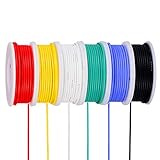
If you are the kind of builder who likes color-coded wiring for easy debugging and clean cable management, the TUOFENG 26 AWG 6-color set is exactly what you want. You get 33 feet each of black, red, yellow, green, blue, and white wire, all on individual spools. For drone builds, that is enough wire for hundreds of projects, especially if you stick to signal-level applications.
I bought this set specifically for a complex long-range build where I needed to distinguish between VTX power, GPS data lines, receiver signal wires, and a few accessory connections. Color-coding the wires made the build dramatically easier to assemble and troubleshoot. When something does not power up, I can trace the wire by color rather than following it through the frame with a multimeter.
The 26 AWG gauge is appropriate for low-current signal wiring: receiver connections, small accessory power leads, LED wiring, and any signal carrying under 1.5A. The 30-strand construction gives the wire decent flexibility despite the small gauge. It strips easily with fingernails or wire strippers, and the tinned copper takes solder without any pre-tinning required.
The 1.5A current rating means this wire is not for power applications, but that is by design. For signal wiring, color-coded builds, and any project where organization matters, this is the kit I recommend. The 300V voltage rating is overkill for drone applications but speaks to the quality of the silicone insulation. Each spool is individually wrapped and labeled, which makes storage easy.
Best use cases for 26 AWG wire
This is signal wiring for tiny whoops, micro drones, and any small build where you need flexibility and organization. It is also perfect for hobby electronics, RC receivers, and any custom cable harness. The 6-color set saves you from buying individual spools and gives you a full color palette for any project.
When 26 AWG is the wrong choice
If you are wiring anything that carries more than 1.5A, this gauge is undersized. For motor leads, ESC power wires, or battery leads, you need at least 14-18 AWG depending on the current. The 26 AWG is for signal-level work only and should not be used as a substitute for thicker wire on power circuits.
8. BNTECHGO 30 AWG Silicone Wire – Best for Fine Signal and LED Wiring
BNTECHGO 30 AWG Silicone Wire Red and Black Each 10ft Tinned Copper Wire
30 AWG (0.8mm) stranded
11 strands
600V rated
20ft total
Pros
- Very flexible and limp - not stiff or springy
- Easy to strip with fingernails or dedicated strippers
- Tinned copper solders easily
- Good for small delicate projects
- Ideal for drone and hobby applications
- No insulation run-back when soldering
Cons
- Very fine wire - easy to break strands if not careful
- Insulation is soft and may feel fragile
- Small size may not suit heavy-duty applications
For the smallest drone builds, micro receivers, and delicate LED work, 30 AWG is the right answer. The BNTECHGO 30 AWG silicone wire is the cheapest option on this list, and for fine signal wiring it punches well above its weight. I bought this roll specifically for wiring ELRS receivers on tiny whoops where every gram and every millimeter of space matters.
The 0.8mm outer diameter is genuinely tiny. You can route this wire through the smallest gaps in a 1S whoop frame without any trouble. The 11-strand construction is minimal but adequate for signal-level current. The wire solders beautifully despite the small size, and the tinned copper helps the solder flow into the strands without much heat.
One of my favorite things about this wire is that I can strip it with my fingernails when I do not have my wire strippers handy. The silicone insulation is soft enough to peel back with a light pinch, which is a huge advantage when working in tight spaces. I have wired up probably a dozen ELRS receivers and a handful of micro VTX units using this exact wire, with no failures.
The fragility is the main trade-off. With only 11 strands, the wire can break if you yank on it or bend it too sharply at a solder joint. I learned to leave a small stress loop at every connection point, which prevents strand breakage. The 4.4-star rating reflects this: most users love the flexibility and ease of use, but a few have had strands snap during aggressive handling.
When 30 AWG is the right tool
This gauge is perfect for ELRS receiver wiring, micro VTX connections, LED strip wiring on tiny builds, and any signal-level work where space and weight are at a premium. It is also great for hobby electronics outside of drones: watch mechanisms, model train wiring, and small RC projects.
Why 30 AWG cannot do power work
For anything pulling more than a few hundred milliamps, this wire is way too thin. It will heat up, voltage sag will be significant, and you risk insulation damage or fire on higher-current applications. Stick to signal-only wiring with 30 AWG and save the heavier gauges for power circuits.
How to Choose the Right Silicone Wire for Your Drone Build?
Picking silicone wire for drones is mostly about matching gauge to current and length to your build. The thicker the wire, the more current it can carry without voltage sag or heat buildup. The thinner the wire, the less it weighs but the less current it can handle. Start with the highest-current connection on your build (usually the battery pigtail) and work your way down to the lowest-current connections (signal wires).
Understanding AWG and Current Ratings
AWG stands for American Wire Gauge, and the numbering works counterintuitively: smaller numbers mean thicker wire. A 10 AWG wire is thicker than a 20 AWG wire, and can carry more current. For drone applications, here is a quick reference of common gauges and their typical current capacities:
10 AWG: 60-80A continuous (heavy-lift drones, 6S+ high-current builds)
12 AWG: 40-60A continuous (XT60 battery leads for 5-6 inch quads)
14 AWG: 25-35A continuous (ESC power on 4-5 inch builds)
16 AWG: 15-20A continuous (motor leads on 5-inch freestyle)
18 AWG: 7-10A continuous (motor leads on 3-4 inch, signal wires)
20-22 AWG: 3-5A continuous (VTX power, receiver wiring)
24-26 AWG: 1-2A continuous (signal, small accessories)
28-30 AWG: Under 1A (ELRS receivers, LEDs, micro builds)
For most 5-inch FPV drone builds, you will need 12 AWG for the battery pigtail, 16 or 18 AWG for motor extensions, and 20-22 AWG for signal wiring. For tiny whoops and 1S builds, you can drop most wires to 22-26 AWG to save weight.
Silicone vs PVC Wire: Why It Matters for Drones
Silicone insulation is significantly more flexible than PVC across the entire temperature range, especially in cold weather. PVC gets stiff and brittle below freezing, which causes it to crack on hard landings or when the wire is bent sharply. Silicone stays pliable from -60C to 200C, which covers any drone flying condition on Earth.
Silicone insulation also handles heat better. When solder joints fail or motors draw excessive current, the wire near the hot spot can reach temperatures that would melt PVC insulation. Silicone insulation stays intact and continues protecting the copper conductor. This is a safety issue as much as a convenience issue.
The weight difference is minimal for most builds, but on small drones every gram matters. Silicone insulation is slightly lighter than PVC for the same gauge, which is a small bonus for FPV pilots obsessed with AUW (all-up weight).
Voltage Drop and Why It Hurts Performance
Voltage drop is the loss of voltage that occurs as current flows through a wire. Thinner wires and longer lengths create more voltage drop. On a drone, voltage drop means less voltage reaches your ESC and motors, which translates to lower RPM, weaker performance, and shorter flight times.
To minimize voltage drop, use the thickest wire your build can accommodate and keep lead lengths as short as possible. For battery pigtails, I keep my XT60 leads to about 50-60mm max. Any longer and the voltage drop starts to affect performance on hard throttle punches.
Strand Count and Flexibility
Higher strand count means more flexibility and better fatigue resistance over time. A wire with 680 strands will bend much more easily than a wire with 200 strands at the same gauge. For drone builds where you are routing wire through tight frames and around components, higher strand counts make the job much easier and create more durable solder joints.
For most drone applications, look for at least 150 strands on 18 AWG and proportionally higher strand counts as the gauge increases. The 680-strand BNTECHGO 12 AWG and 1050-strand MMOBIEL 10 AWG on this list are excellent examples of high-strand-count wire that flexes beautifully despite their thickness.
Cable Management Tips for FPV Drone Builds
Clean cable management is not just about aesthetics: it improves crash survivability, reduces the chance of wire chafing, and makes troubleshooting faster. Use a consistent color code across your builds: red for positive, black for negative, yellow for signal, and other colors for specific functions like video or telemetry.
Use heat shrink on every solder joint to insulate the connection and provide strain relief. Route wires along frame edges where possible and avoid running them across sharp components. Use small cable ties or twist ties to bundle wires together cleanly. The result is a build that looks professional, flies reliably, and is easy to work on when you need to swap a component.
Frequently Asked Questions
What wire is best for drones?
Silicone-insulated stranded wire is the best choice for drones because it stays flexible from -60C to 200C, resists vibration and heat, and has tinned copper strands that solder cleanly. For battery leads, use 10-14 AWG depending on current; for motor wires, use 14-18 AWG; for signal wiring, use 20-26 AWG.
Is silicone wire good for drones?
Yes, silicone wire is the gold standard for drones. It is more flexible than PVC in cold weather, handles higher temperatures without melting, resists vibration fatigue, and is lighter per gauge. Every serious FPV builder uses silicone wire for battery leads, motor extensions, and signal wiring.
What AWG wire should I use for XT30 connectors?
For XT30 connectors, 16-18 AWG silicone wire is the standard choice. XT30 connectors are rated for 30A continuous, and 16 AWG handles that comfortably with minimal voltage drop. Some pilots use 14 AWG for extra safety margin, but 16 AWG is the most common for 3-5 inch builds using XT30.
Can 12V wire be too thick for a drone?
Yes, wire that is too thick adds unnecessary weight to a drone build. A 10 AWG wire on a tiny whoop would weigh more than the entire airframe. Match wire thickness to the current requirement: thin signal wires for low-current circuits, thicker battery wires only where current actually demands it.
What gauge is FPV motor wire?
For FPV motor wires, 18-20 AWG silicone wire is the standard for 5-inch builds, while 14-16 AWG is used for high-current 6S setups. Smaller builds (2-3 inch) typically use 20-22 AWG for motor extensions. The exact gauge depends on motor current draw and battery C-rating.
Final Thoughts on Picking the Best Silicone Wire for Drones
Choosing the right silicone wire for drones comes down to matching gauge to current and choosing a brand you can trust. The BNTECHGO 12 AWG kit is my overall recommendation because of its 680-strand construction, near-perfect reviews, and versatility for the vast majority of FPV drone builds. For pilots on a budget, the Haerkn 18 AWG gives you 60 feet of quality silicone wire at a price that makes sense for any hobby budget. For tiny whoops and micro builds, the BNTECHGO 30 AWG is the cheapest way to get quality silicone wire for signal-level work.
Whatever gauge you choose, make sure you are buying genuine silicone wire with tinned copper strands, and avoid the temptation to use PVC wire on anything that will see flight conditions. The few extra dollars for silicone wire pays for itself the first time you avoid a mid-flight electrical failure. Your drone is only as reliable as its weakest wire, so do not cut corners on this critical component.
Happy flying, and may your solder joints always be clean.