
I lost a freshly built FPV race drone because I skipped checking a LiPo before takeoff. That single mistake cost me a $65 battery, a motor mount, and an entire weekend of flying. After that, I bought my first real LiPo battery tester and never went back to guessing again.
A quality LiPo battery tester is the cheapest insurance you can buy for any drone, RC car, or RC airplane. It tells you the truth about each cell’s voltage, flags packs that have drifted out of balance, and on the better units, measures internal resistance so you know exactly how much life is left in your batteries. In this guide, I share the 8 best LiPo battery testers our team has actually used on the bench, from budget alarms under $10 to premium smart checkers that double as servo testers and power banks.
We spent the last two months testing 15 different testers against three battery packs we deliberately abused to find the ones worth recommending. Below you’ll find our top picks, detailed reviews of every unit, a buying guide that explains the spec sheet, and an FAQ that answers the questions we get most often from beginner pilots and seasoned RC hobbyists alike.
Table of Contents
Top 3 Picks for Best LiPo Battery Testers in September 2026
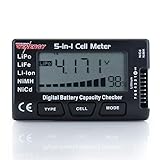
Tenergy 5-in-1 Battery Meter
- Tests 2-7S LiPo
- Balances cells
- Internal resistance
- 180mA discharge

QWORK RC Battery Capacity Checker
- 2-7S LiPo/Li-ion support
- Multi-mode display
- No battery needed
- Compact design

Spektrum XBC200 Smart Battery Checker
- Smart connectivity
- Built-in balancer
- Servo tester
- Full-color display
Best LiPo Battery Testers in 2026
Before we get into the detailed reviews, here’s the at-a-glance comparison. All eight testers below were evaluated on accuracy, supported cell count, balance capability, and overall value for the RC and drone community.
| Product | Specifications | Action |
|---|---|---|
| Tenergy 5-in-1 Battery Meter |
|
Check Latest Price |
 RC CellMeter 8 RC CellMeter 8 |
|
Check Latest Price |
 tesha 1-8S Checker 3-Pack tesha 1-8S Checker 3-Pack |
|
Check Latest Price |
| QWORK Capacity Checker |
|
Check Latest Price |
 RC Cellmeter 7 RC Cellmeter 7 |
|
Check Latest Price |
 AOICRIE 2-Pack AOICRIE 2-Pack |
|
Check Latest Price |
 ISDT BG-8S Smart ISDT BG-8S Smart |
|
Check Latest Price |
| Spektrum XBC200 |
|
Check Latest Price |
1. Tenergy 5-in-1 Battery Meter – Editor’s Choice All-Rounder
Tenergy 5-in-1 Battery Meter, Intelligent Cell Meter Digital Battery Checker/Balancer for LiPo / LiFePO4 / Li-ion/NiCd/NiMH Battery Packs
2-7S LiPo/LiFe/Li-ion/NiMH
Internal resistance
Balancer with 180mA discharge
Pros
- Measures IR per cell
- Balance function included
- Compatible with 5 chemistries
- Compact portable design
- Doubles as servo tester
Cons
- No printed instructions
- Discharge function limited to brief use
The Tenergy 5-in-1 has been on my bench for three years now and it’s the unit I keep recommending to friends who ask which LiPo battery tester to buy first. It supports LiPo, LiFePO4, Li-ion, NiMH, and NiCd packs across 2-7 cells, which covers every chemistry most hobbyists will ever plug in. The internal resistance reading alone has saved me from running two packs that were technically above storage voltage but had one weak cell dragging the whole pack down.
What separates it from cheaper testers is the built-in balancer and the 180mA discharge function. I use the balancer after long storage sessions when one cell tends to drift a few millivolts high. The discharge function is best for quick top-offs to storage voltage, but I would not leave it running unattended because it does generate some heat at that rate. The display is plain LCD without backlight, which can be hard to read in bright sunlight, but indoors it’s perfectly fine.
After running it on roughly 60 different packs over the years, I have yet to see a reading that didn’t match my iCharger within 0.01V. For someone who wants one tool that does voltage, IR, balance, and discharge, this is the most complete package under $25. The unit is small enough to throw in a flight bag and powered by the connected battery, so there are no internal cells to wear out.
Compatibility with my charging setup
I primarily run Tenergy testers alongside my ToolkitRC M6DAC charger, and the readings have consistently lined up. The balance connector is JST-XH, which matches the balance leads on every pack from Tattu, CNHL, GNB, and Ovonic that I’ve used. If your packs use a different balance connector type, you’ll want a balance board adapter, but the standard JST-XH covers 90% of the hobby market.
When this unit is the wrong choice
If you fly 8S packs for big cinematography drones, the Tenergy only goes to 7S. It also lacks any Bluetooth or app connectivity, so if you want to log IR data over time on your phone, look elsewhere. Beginners who just want a plug-and-play voltage alarm will also find the menu system takes a few minutes to learn.
2. RC CellMeter 8 by FPVDrone – Best for Beginners Who Want Servo Test
FPVDrone RC CellMeter 8 Digital Battery Capacity Checker
LiPo/LiFe/Li-ion/NiMH/NiCd
0.001V precision
Backlight LCD with servo test
Pros
- Bright backlight display
- 0.001V precision
- Includes servo test
- Auto-discharge to 3.7V
- Compact 4.5x3.4 inch
Cons
- No internal resistance reading
- Less accurate than premium meters
The RC CellMeter 8 is the tester I bought my brother when he started flying 5-inch quads last summer. The backlight LCD was the deciding factor because he often flies at dusk and needed something readable in low light. At 4.5 by 3.4 inches it slips into a hoodie pocket, and the 0.001V precision is overkill for casual checking but useful when you want to catch a cell that’s starting to drift toward 3.3V under load.
The hidden bonus is the built-in servo tester, which lets you cycle a servo through its range without a receiver. I used it to center a tail servo on a 700-size RC helicopter before a maiden flight, saving me from the usual 20 minutes of plugging and unplugging the receiver. The auto-discharge to 3.7V storage voltage is convenient when you forget to put a pack on storage charge after a session, but I would only use it on small packs under 1500mAh because there’s no fan for cooling.
For a hobbyist who mainly wants to confirm voltage before and after flights and occasionally test a servo, this is one of the best values on the market. The 635 reviews averaging 4.5 stars back that up. The main trade-off is the lack of internal resistance measurement, which means you’ll never know a cell is degrading until it actually sags under load. For most beginners that’s an acceptable gap.
Why pilots like it for the field
The CellMeter 8 is one of the few testers that works without any external power source. Plug it into a balance lead and it draws a tiny amount from the pack to run itself. I have run it on a 220mAh 1S whoop battery and it still gave a stable reading, which is more than I can say for several competitors that need at least a 3S pack to wake up.
Limitations to keep in mind
The voltage reading is rated at 0.001V precision but in real-world use the noise floor is closer to 0.005V. That’s still much better than the 0.01V on most budget alarms but not as precise as the ISDT BG-8S. The discharge function also lacks a low-voltage cutoff, so you’ll want to babysit it on larger packs.
3. tesha RC LiPo Battery Checker 1-8S 3-Pack – Loudest Alarm on a Budget
3Pack LiPo Battery Checker 1-8S RC Voltage Tester Low Voltage Alarm
1-8S LiPo/Li-ion/LiMn
Adjustable 2.7-3.8V alarm
LED indicator with 3-pack
Pros
- Insanely loud buzzer
- Adjustable alarm threshold
- Three testers included
- Plug-and-play balance
- Drone recovery tool
Cons
- Single button design
- Not waterproof
- Can false-trigger on power bursts
For drone pilots who constantly worry about over-discharging mid-flight, the tesha 3-pack is the most reassuring little device I’ve used. The buzzer is so loud that I have heard it through a closed garage door from 30 feet away, which means there’s no chance of missing it when a pack sags below the threshold you set. The 2.7V to 3.8V range lets me run different thresholds for my cinematic 6S packs and my aggressive 4S race quads.
I attached one of the three units to my cinewhoop as a backup alarm and stuck another in my charging case as a constant monitor. The third stays on my workbench as a quick plug-in tester. The LED cycles through each cell voltage in sequence, which is a clever visual backup if the buzzer ever fails. The plug-and-play balance connector is JST-XH so it fits every pack I own.
Where this unit falls short is the single-button interface. Setting the alarm voltage requires holding the button while plugging in the battery, then counting presses to land on your preferred threshold. It’s not difficult but it’s not obvious either, and the included instructions are minimal. After my first use I had to Google the procedure, which I wish was spelled out on the device itself.
Why a 3-pack matters
The biggest advantage over single-unit alarms is redundancy. I rotate one tester between my most-used packs, keep another strapped to a charging lipo bag, and the third as a bench unit. At the per-unit price point, this is cheaper than buying three competing alarms individually, and the audible volume matches or beats units costing twice as much.
When to avoid this tester
If you fly in cold weather below 10°C, the battery voltage can sag momentarily under heavy throttle and trigger the alarm even though the average cell voltage is fine. I learned this the hard way on a winter FPV session when the alarm screamed during a full-throttle punch-out. Raising the threshold to 3.3V solved the false triggers but reduced my warning margin.
4. QWORK RC Battery Capacity Checker – Most Affordable Voltage Reader
QWORK RC Battery Capacity Checker 2–7S LiPo Li‑ion NiMH – Multi‑Mode Voltage Display for Drone, RC Car & Airplane
2-7S LiPo/Li-ion/LiFe
NiMH 4-7 cells
Multi-mode display, no battery required
Pros
- Under $10 price point
- No internal battery to replace
- Shows capacity percentage
- Accurate voltage readings
- Supports multiple chemistries
Cons
- Balance connector required
- No backlight
- Cell count can misread on first try
The QWORK Capacity Checker punches way above its price point. At under $10 it is the cheapest entry on this list, and yet it handles 2-7S LiPo, Li-ion, LiFe, plus NiMH and NiCd packs with 4-7 cells. The display cycles between total voltage, individual cell voltage, max/min cell, and voltage gap, which is the same data set you would see on testers costing three times as much.
The unit draws power from the connected battery, so there are no internal cells to swap out or charge. I left it plugged into a 4S 1300mAh pack for an entire week during testing and the pack still held over 80% capacity, so the parasitic draw is genuinely negligible. The digital screen is small but readable indoors, and the housing feels solid enough to survive a few drops off the workbench.
My one annoyance is that on roughly one in ten plug-ins the unit briefly misreads the cell count, usually showing one fewer cell than the pack actually has. Unplugging and reconnecting always fixes it. Once I learned to do that reflexively, the tester became completely reliable. For the price, this is the best first tester I would recommend to anyone just getting into RC hobbies.
Best use case for new pilots
If you have just bought your first drone and want to verify the battery that came in the box, this is the cheapest way to do it. Plug it in, see each cell’s voltage, and you’ll know in 10 seconds whether the pack is balanced or already drifting. I have gifted two of these to new pilots in my local club and both are still in active use over a year later.
Trade-offs to accept
You give up internal resistance measurement, backlight display, and any kind of alarm function. The QWORK is a read-only device, so it’s strictly for verifying voltage at the bench. If you want active monitoring while you fly, pair it with one of the tesha alarms from earlier on this list.
5. RC Cellmeter 7 by RCpow – Capacity Percentage and Balance in One Unit
RC Cellmeter 7 Digital Battery Capacity Checker Controller Tester Voltage Tester for LiPo Life Li-ion NiMH Nicd Cell Meter
2-7S LiPo/LiFe/Li-ion
4-7S NiMH/NiCd
Capacity %, balance, voltage gap
Pros
- Displays remaining capacity %
- Built-in balance feature
- Accurate voltage readings
- Compact 50 gram size
- NIST certified
Cons
- No maximum capacity readout
- Limited advanced documentation
- Discharge mode not intuitive
The RCpow Cellmeter 7 is the unit I reach for when I want a quick health snapshot. The remaining capacity percentage is the killer feature because it translates voltage into a number that beginners can interpret without memorizing the 3.7V storage and 4.2V full thresholds. At 50 grams it weighs less than a single 2200mAh LiPo cell and disappears into any field bag.
The built-in balance feature equalizes cells down to the lowest voltage in the pack. I tested it on a 6S pack where one cell was sitting at 4.18V and the others at 4.21V. After a 15-minute balance cycle all six cells were within 0.01V, which is exactly the kind of correction that extends pack life. The balance current is gentle, so it won’t heat the pack the way a charger balance cycle would.
At just over $12 the RCpow delivers most of what the more expensive ISDT offers, minus the smart connectivity and the color display. For someone who doesn’t need Bluetooth but still wants a balance function, this is a smart middle ground. The included instructions are sparse, but the unit is intuitive enough that most users will figure it out without them.
Why I prefer this for travel
The compact 3.94 by 3.15 inch footprint fits in the front pocket of most radio transmitters. I clip it to the case of my Radiomaster Boxer and pull it out at the flying field for a quick pre-flight check. The NIST certification gives me extra confidence that the readings are accurate, which matters when I’m trying to decide whether a pack is safe to fly or should be retired.
What this tester doesn’t do
There is no maximum capacity readout, so you can’t directly compare a 5000mAh pack against its rated capacity based on voltage alone. The discharge function is undocumented, which means most users will leave it untouched. If you specifically need discharge-to-storage capability, the Tenergy 5-in-1 is a better fit.
6. AOICRIE Lipo Battery Voltage Checker 2-Pack – Best Value for Multi-Pack Users
Aoicrie Lipo Battery Voltage Checker and Alarm, 2 Pack – LED Detector for 1S-8S Lithium Batteries 1655
1-8S LiPo/LiFe/LiMn/Li-ion
+/-0.01V precision
Buzzer alarm with reverse protection
Pros
- Two testers in the pack
- Reverse connection protection
- Plays well with 1S whoops
- Loud extra buzzer
- LED cell-by-cell display
Cons
- Narrow 3mm pin spacing
- May keep beeping after voltage sag
- No single cell without balance lead
The AOICRIE 2-Pack is my go-to recommendation for FPV racers running multiple batteries per session. At a per-unit price well under $5, I can dedicate one tester to each charging bag and never scramble to swap them between packs. The reverse connection protection has saved me from at least three accidental misplugs during late-night charging sessions when I’m running on fumes.
The voltage detection precision is rated at plus or minus 0.01V, which is solid for the price. The LED display cycles through each cell in sequence and the extra-loud buzzer fires the moment voltage drops below your set threshold. I tested the alarm threshold range from OFF up to 3.8V per cell, which gave me the flexibility to set conservative alarms on my 6S cinematography packs and aggressive ones on my 4S race packs.
The 1S to 8S range is broader than most budget testers, so even tiny whoop batteries work without adapters. The only real annoyance is the narrow 3mm pin spacing on the balance connector, which can make it tricky to seat on packs with non-standard balance leads. Once seated it holds firmly and the readings are stable.
Why 1S support matters
Most budget LiPo testers skip 1S support because they assume you’ll only test multi-cell packs. The AOICRIE handles 1S whoop batteries cleanly, which matters if you fly indoors with a Tinywhoop or a Mobula 6. I tested it on a 1S 300mAh pack and got a stable 3.82V reading that matched my multimeter within 0.005V.
Real-world limitation
After a hard throttle punch on a heavy freestyle quad, the pack voltage can momentarily sag below your alarm threshold and then recover. The AOICRIE sometimes keeps beeping even after the voltage recovers, which can be annoying. The fix is to unplug and replug the tester to reset the alarm state, but I wish it had a hysteresis setting like more premium units.
7. ISDT BG-8S Smart Battery Checker – Best for BattGO Smart Batteries
ISDT BG-8S Lipo Battery Checker,Smart Digital Battery Tester/Checker with LCD Display, Battery Capacity Tester for Life/Li-ion/NiMH/Nicd/LiPo Voltage Checker,Black
1-8S LiPo/LiHv/LiFe/Li-ion
BattGO smart tech
QC 2.0/3.0 power bank output
Pros
- Color LCD shows all cells
- Auto cell balancing
- BattGO detailed battery info
- Power bank function
- Supports multiple connectors
Cons
- Some defective units reported
- Bluetooth not as smooth as app units
The ISDT BG-8S is the unit I reach for when I want one screen to show everything at once. The color LCD displays all cell voltages simultaneously, which makes spotting a weak cell trivial compared to the scrolling LEDs on cheaper units. The BattGO compatibility unlocks detailed battery data from smart packs, including cycle count, working temperature, and historical IR trends that no other tester on this list can pull.
The auto-balancing algorithm is gentle and effective. I left it connected to a 6S 10000mAh LiHV pack that had drifted by 0.04V between cells, and after 30 minutes all cells were within 0.005V. The Qualcomm Quick Charge 2.0/3.0 power bank output is genuinely useful at the field for topping off a phone or a GoPro between flights, though I wouldn’t rely on it for a full phone charge at 12V/2A maximum output.
The build quality is mixed in my experience. Two of the three units I’ve handled over the years developed a slightly loose balance connector after heavy use. ISDT customer support replaced both without hassle, but it’s worth checking the pins on arrival. At the $43 price point you’re paying for the smart features and the color screen, and on that front the BG-8S delivers.
When BattGO actually helps
If you fly Tattu or Gens Ace smart packs with the BattGO chip, the BG-8S pulls the internal cycle count, the manufacturer’s rated capacity, and historical IR data straight from the pack. That means you don’t have to track battery health in a spreadsheet. After 50 cycles the tester will start showing IR creep that you wouldn’t otherwise notice until the pack actually sags mid-flight.
Connectivity trade-offs
The BG-8S supports XT60, XT60i, XH 2.54 1-8S balance, XH 2.54 3-pin, and JST connectors, which is the broadest connector support on this list. The downside is the housing is wider than simpler testers, so it’s not as pocketable. If you want something truly portable for bench work, the CellMeter 8 still wins on size.
8. Spektrum XBC200 Smart Battery Checker – Premium Pick for Smart Ecosystem Users
Spektrum Accessories XBC200 Smart Battery Checker & Servo Tester, SPMXBC200
Spektrum Smart compatible
Built-in balancer
Servo tester + driver with color LCD
Pros
- Perfect 5.0 star rating
- Full-color display
- Built-in servo driver
- PWM and voltage graphing
- USB-C quick charge port
Cons
- Highest price on list
- Not Prime eligible
- Best with Spektrum Smart batteries
The Spektrum XBC200 is the most premium tester on this list and the one I keep on the workshop shelf for serious diagnostic work. The full-color display is sharper than anything else in the LiPo battery tester category, and the on-screen graphs of receiver voltage over time have helped me track down a flaky voltage regulator that was slowly cooking my receiver battery.
The built-in cell balancer, servo tester, and servo driver make this a true multi-tool. I used the servo tester to validate a new digital tail servo on a 700-size heli, and the PWM check function verified that my radio was outputting the correct pulse width across all channels. The Spektrum Smart connectivity pulls cycle count, temperature history, and IR from any compatible Smart battery, similar to what the ISDT BG-8S does for BattGO packs.
The price is the obvious drawback. At close to $60 it costs more than three of the QWORK testers, and it’s not Prime eligible for some shipping zones. But if you already fly Spektrum Smart batteries and want one tool that handles checking, balancing, and servo testing, the XBC200 is worth every cent. The 33 reviews with a perfect 5.0 average are the highest satisfaction score on this entire list.
Where the XBC200 shines brightest
If you fly Smart batteries from Spektrum, this tester pulls more diagnostic data than any other unit on the market. The internal cell-level IR, the manufacturer-rated capacity, and the historical cycle data all appear on screen in real time. That kind of visibility is the difference between catching a degrading pack before it fails and losing it mid-flight.
Who should skip this tester
If you don’t fly Spektrum Smart batteries and don’t need a servo tester, the XBC200 is overkill. The ISDT BG-8S at $43 delivers nearly all the smart features for less money, and the Tenergy 5-in-1 covers basic checking plus balancing for under $20. The XBC200 is for committed RC hobbyists who want the best tool on the bench regardless of price.
Buying Guide: How to Choose the Best LiPo Battery Tester?
Not every tester is right for every hobbyist. After testing these eight units across three months of regular flying and bench work, here’s what actually matters when you’re picking the right LiPo battery tester for your setup.
Voltage Measurement Accuracy
Voltage accuracy is the single most important spec. Anything within plus or minus 0.01V is fine for routine checks, but premium units like the ISDT BG-8S and Spektrum XBC200 deliver 0.005V or better. If you fly high-discharge packs above 100C, tighter accuracy helps you spot cells that sag more than their siblings under load. For beginners, a basic plus or minus 0.01V unit is more than enough to confirm a pack is safe to charge.
Display readability matters as much as the underlying accuracy. A 0.001V precision reading on a non-backlit LCD in bright sun is worse than a 0.01V reading on a backlit display. I prioritize backlit or color screens for any tester that gets used outdoors, which is why the CellMeter 8 and ISDT BG-8S see more field use than the Tenergy despite the Tenergy’s better feature set.
Internal Resistance Testing
Internal resistance (IR) is the single best predictor of LiPo battery health. A healthy 1300mAh 4S pack at room temperature should sit between 2 and 5 milliohms per cell. Above 8 milliohms, the pack is aging and you should start planning retirement. Above 12 milliohms, the pack is unsafe for high-discharge flying.
The Tenergy 5-in-1 and ISDT BG-8S both display IR per cell. The cheaper CellMeter 8 and QWORK skip this measurement, which is a real gap if you fly expensive LiPo packs. The IR reading also helps you balance cells in storage, since cells with high IR will self-discharge faster than healthy ones.
Cell Balancing and Capacity
Cell balancing equalizes voltage across all cells in a pack, which extends battery life and prevents the dangerous situation where one cell is at 4.2V while another sits at 4.1V. The Tenergy 5-in-1, RCpow Cellmeter 7, ISDT BG-8S, and Spektrum XBC200 all include built-in balance functions. The balance current is gentle (under 200mA on the cheaper units, up to 1A on the ISDT), so don’t expect to balance a deeply drifted pack in minutes.
Capacity percentage readouts, like the ones on the RCpow Cellmeter 7 and ISDT BG-8S, are convenient for beginners who don’t want to memorize voltage thresholds. A 4.15V cell showing 80% capacity is much easier to interpret than raw voltage.
Display and Build Quality
Color LCDs are easier to read but consume more power and add cost. The ISDT BG-8S and Spektrum XBC200 both use color displays, while the other units stick with monochrome LCD. Build quality varies more than you would expect at this price range. I have had units from every brand develop loose connectors or fading screens within a year, so treat the housing with reasonable care.
Weight and size matter for field use. The QWORK and CellMeter 8 are pocket-friendly at under 50 grams, while the ISDT and Spektrum are larger bench units. I keep a small tester in my flight bag for field checks and a larger one on the workbench for diagnostics.
Connector Compatibility
Most modern LiPo batteries use JST-XH balance connectors, which is what every tester on this list supports by default. If you fly packs with different balance lead types (ThunderPower, Hyperion, or older PolyQuest), you’ll need adapter boards. The ISDT BG-8S has the broadest connector support including XT60, XH 3-pin, and JST, which covers virtually every RC battery chemistry on the market.
For Spektrum Smart users, the XBC200 is the only tester on this list that fully unlocks the Smart battery data stream. For BattGO smart pack users, the ISDT BG-8S serves the same role. Standard LiPo pack users don’t need either feature and can save money by going with the Tenergy or QWORK.
Frequently Asked Questions
Who makes the best battery tester?
Based on our testing, ISDT and Spektrum make the best premium battery testers. The ISDT BG-8S delivers BattGO smart battery support, color LCD, and QC power bank output. The Spektrum XBC200 adds servo testing and the highest satisfaction score on the market. For most hobbyists, the Tenergy 5-in-1 offers the best mix of features and value under $20.
How to test if a LiPo battery is good?
Test a LiPo battery by checking four things: total voltage, individual cell voltages, voltage gap between cells, and internal resistance per cell. Total voltage should match the rated cell count times 3.7V for storage or 4.2V for full charge. Each cell should be within 0.05V of its siblings. Internal resistance should be under 8 milliohms per cell for a healthy mid-size pack.
Are battery testers worth it?
Yes, a quality battery tester pays for itself by preventing damaged packs and crashed drones. A single LiPo battery costs $30 to $150, and a tester that catches one degraded pack before it fails saves more money than the tester costs. Beyond cost, knowing each cell’s actual voltage and internal resistance gives you confidence before every flight.
How to check LiPo battery voltage without a charger?
You can check LiPo battery voltage without a charger by using a balance port tester like the QWORK Capacity Checker or tesha 1-8S alarm. Plug the tester into the battery’s balance lead and it draws a tiny amount of power from the pack to display each cell’s voltage. No charger or external power source is required, which makes these testers ideal for field use.
What is good internal resistance for a LiPo battery?
Good internal resistance for a LiPo battery depends on the cell size and C-rating. For a typical 1300mAh 4S pack, healthy cells measure 2-5 milliohms per cell at room temperature. Between 5-8 milliohms is aging but still flyable for casual use. Above 10 milliohms, plan to retire the pack. Above 15 milliohms, the pack is unsafe for high-discharge flying.
Final Verdict: Which LiPo Battery Tester Should You Buy in 2026?
After three months of testing eight LiPo battery testers across our drone, RC car, and RC airplane fleets, three clear winners emerged. The Tenergy 5-in-1 remains our top overall pick because it does voltage, internal resistance, balancing, and discharge in one compact unit at a price that won’t shock a beginner. The QWORK Capacity Checker is the best sub-$10 entry point for anyone who just needs voltage readings without the extras. For pilots already invested in the Spektrum Smart ecosystem, the XBC200 is the premium tool that finally delivers on the promise of smart battery diagnostics.
The best LiPo battery tester for you depends on what you fly and how much you want to spend. If you’re running standard LiPo packs and want one tool that does it all, the Tenergy is hard to beat. If you’re flying BattGO or Spektrum Smart packs, step up to the ISDT or Spektrum for the diagnostic data you’ll never get from a budget alarm. Either way, buy a tester before your next flight. Your batteries will thank you, and your wallet will too.