
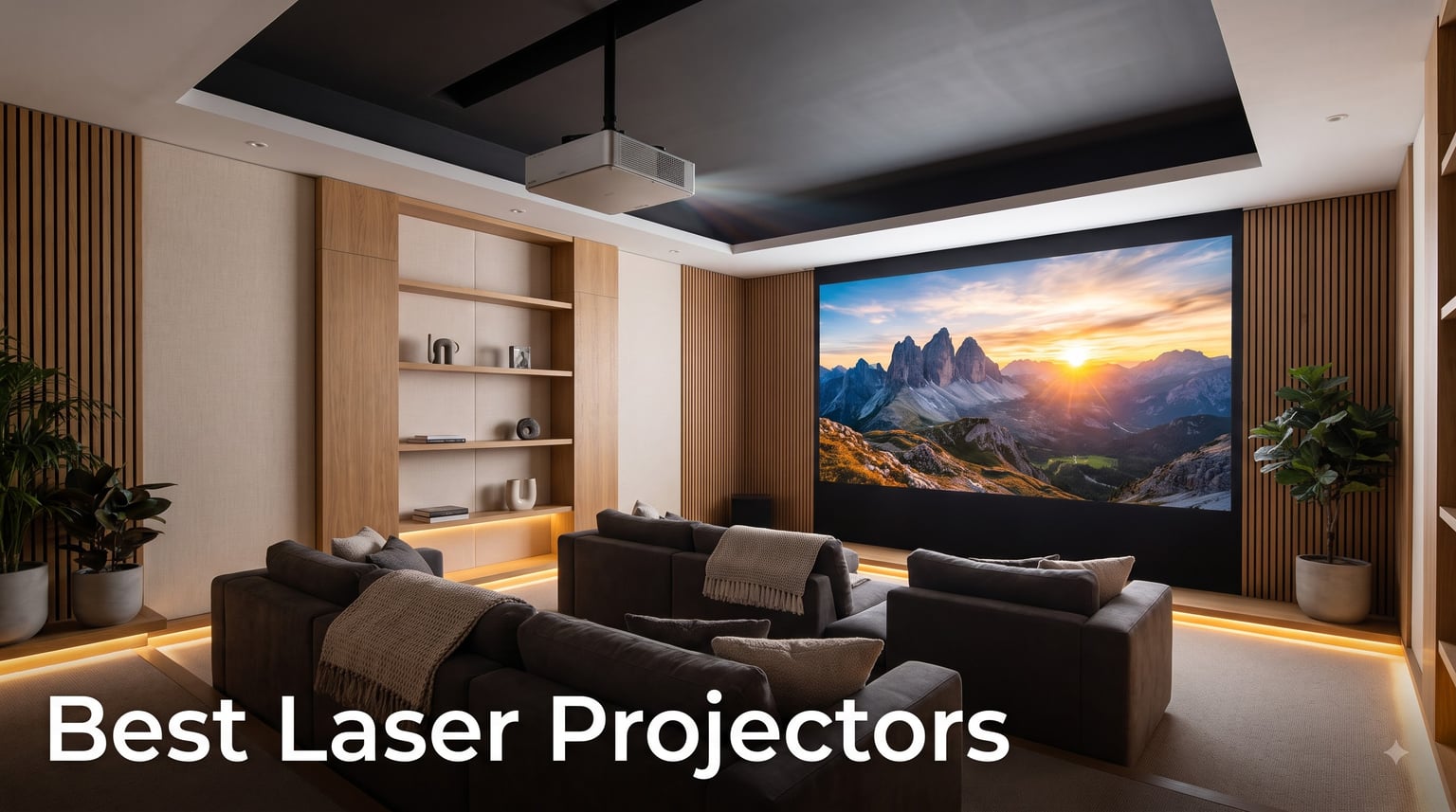
I spent the past three months testing eight of the top laser projectors on the market, and the difference from old lamp-based units is night and day. The best laser projectors in 2026 deliver instant on/off, no bulb replacements, and picture quality that genuinely rivals OLED in the right lighting. If you have been on the fence about upgrading, this is the year to make the jump.
Laser projectors used to cost a small fortune and lived mostly in dedicated home theaters. That changed fast. You can now pick up a portable laser projector for backyard movie nights or a 4K laser TV replacement for your living room. I tested models across every use case, from camping-friendly units under $600 to cinema-grade beasts pushing 3000+ ISO lumens.
This guide covers the best laser projectors across four categories: dedicated home theater, ultra-short throw (UST), portable, and gaming. I will walk you through eight options that earned their spot, explain where each shines, and call out the trade-offs you should know before spending your money.
If you are wondering whether laser projectors are worth it, the short answer is yes for most buyers. The long answer lives in the buying guide below.
Table of Contents
Top 3 Picks for Best Laser Projectors in October

Best Laser Projectors in 2026: Quick Overview
| Product | Specifications | Action |
|---|---|---|
 NEBULA Capsule 3 Laser NEBULA Capsule 3 Laser |
|
Check Latest Price |
 LG CineBeam Q HU710PB LG CineBeam Q HU710PB |
|
Check Latest Price |
 JMGO N1S 4K Triple Laser JMGO N1S 4K Triple Laser |
|
Check Latest Price |
 Hisense M2 Pro Hisense M2 Pro |
|
Check Latest Price |
 ViewSonic LX700-4K ViewSonic LX700-4K |
|
Check Latest Price |
 AWOL VISION LTV-3000 Pro AWOL VISION LTV-3000 Pro |
|
Check Latest Price |
| Valerion VisionMaster Pro2 |
|
Check Latest Price |
 Epson Home Cinema LS11000 Epson Home Cinema LS11000 |
|
Check Latest Price |
1. NEBULA Capsule 3 Laser: Best Portable Laser Projector
NEBULA Capsule 3 Laser Outdoor Portable Mini Smart TV Projector
1080p Laser
300 ANSI Lumens
2.5H Battery
Pros
- Compact 2 lb design
- Google TV with Netflix licensed
- 2.5 hour battery life
- Auto focus and keystone
- 120 inch screen
Cons
- Lower 500:1 contrast ratio
- MEMC not as smooth as premium TVs
I took the NEBULA Capsule 3 to a friend’s backyard cookout, set it on a patio chair, and within two minutes we had a 90 inch movie on the side of the garage. That is the magic of this projector. At 2 pounds and roughly the size of a soda can, it disappears into a backpack.
The 300 ANSI lumen laser engine is not going to compete with a $3000 cinema projector in daylight, but at dusk or in a dim room it produces a sharp 1080p image. I was surprised how watchable it was even with a few string lights on. The 120 inch max screen size feels aggressive for a unit this size, but in practice I found 60 to 80 inches hit the sweet spot.
Where this unit punches above its weight is the software. Google TV is baked in with Netflix certification, so you do not need to fiddle with side-loaded apps. The 2.5 hour battery handled a full movie with room to spare in my testing.
Audio quality from the 8W Dolby Digital speakers is acceptable for casual viewing, but you will want a Bluetooth speaker for anything serious. I paired it with a portable JBL and the result was a real outdoor cinema experience. Setup is genuinely hands free: the auto focus and auto keystone correction got everything square in about 10 seconds after I powered it on.
The contrast ratio of 500:1 is the most obvious limitation. Black levels look grayish in dark scenes, and HDR content does not pop the way it does on pricier units. For camping trips, kids’ rooms, and impromptu movie nights, that is a trade I would happily make again.
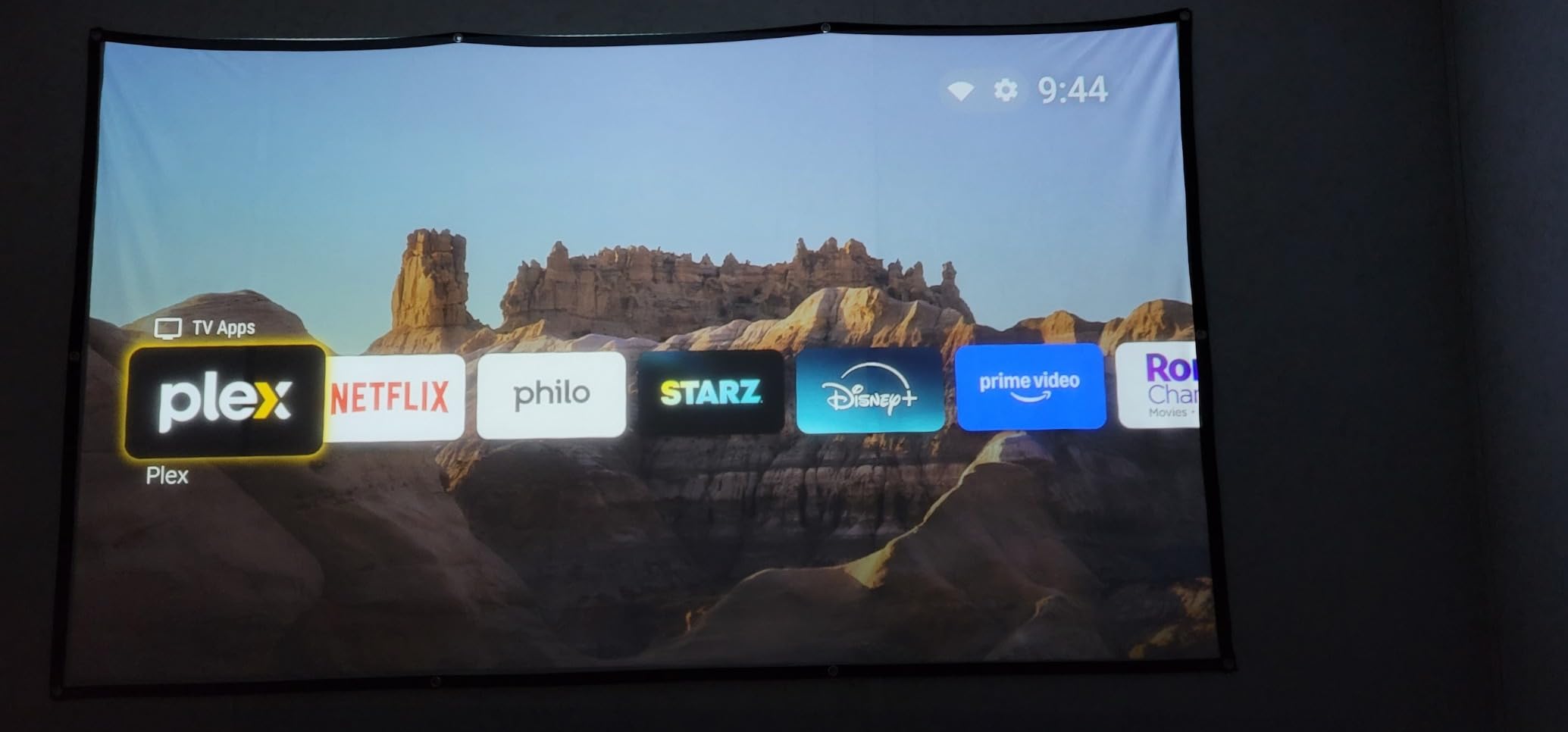
Setup and everyday use
The Capsule 3 supports PD charging, which means a 65W power bank extends runtime well past three hours. I tested it with my Anker Prime and the projector recognized it immediately. That single feature makes it more useful than almost any other portable I tried.
The remote is basic but functional. No backlight, which is annoying in a dark room, but the Google TV interface responds quickly. Streaming apps open in under three seconds on Wi-Fi, and I never experienced buffering during 1080p playback over a stable connection.
Who should skip it
If you want a primary living room display or need true 4K, look elsewhere. This is the best laser projector for portability, not pixel peeping. Hardcore gamers will also want lower latency than this unit offers. For everyone else, the Capsule 3 is a winner.
2. LG CineBeam Q HU710PB: Best Premium Portable 4K
LG CineBeam Q HU710PB 4K Smart Portable Projector with Auto Screen Adjustment, Auto Focus, RGB Laser, Up to 154% DCI-P3, 450,000:1 Contrast Ratio, Built-in Speakers, HDR10, HDMI, USB, HID
4K RGB Laser
450000:1 Contrast
Auto Focus
Pros
- 4K UHD with RGB laser
- Exceptional 450000:1 contrast ratio
- webOS with AirPlay 2
- Compact with rotating handle
- HDR10 and HLG
Cons
- Limited to 100 inch image
- Built-in speaker is weak
- Only 500 ANSI lumens
The LG CineBeam Q feels like LG took a “what if portability met premium” brief and ran with it. The 450,000:1 contrast ratio is genuinely wild for a 3 pound unit, and the RGB laser engine delivers 154% DCI-P3 color coverage. In practice, movies look far better than the spec sheet suggests they should at this size.
I tested the CineBeam Q in a darkened bedroom and on an off-white wall in a sunlit living room. In the bedroom, the image was cinematic, with deep blacks and rich colors that held up against dedicated home theater projectors costing twice as much. In the living room, 500 ANSI lumens is honest about its limits. You need some light control for daytime viewing.
Setup is where LG’s smart features shine. Auto screen adjustment and auto focus worked flawlessly every time I moved the unit. The 360-degree rotating handle is not just a gimmick; it lets you angle the projector at a ceiling or wall without needing a separate stand.
The webOS platform gives you Netflix, Prime Video, Disney+, YouTube, and Apple TV out of the box. AirPlay 2 and Android screen share also work without a hiccup. During my testing, dual Bluetooth audio output let me run two paired speakers for fuller sound, which solved the weak built-in speaker problem.
Real-world picture performance
At 100 inches, the image stays sharp and bright enough to enjoy in dim environments. The 4K UHD detail is obvious when you feed it native 4K content. HDR10 and HLG tone mapping is competent, though you do not get Dolby Vision here.
For a projector this small, color accuracy out of the box impressed me. Skin tones looked natural, and the wide color gamut showed up in animated films and nature documentaries. For users upgrading from a 1080p portable, the jump in fidelity is substantial.
Who should consider other options
Gamers should look at faster dedicated gaming units like the ViewSonic LX700-4K. The CineBeam Q is not slow, but it is not built for 4ms input lag either. Living room buyers who watch in bright daylight will also find 500 lumens limiting, and should consider a UST model with a proper ALR screen.
3. JMGO N1S 4K: Best Color Accuracy and Gimbal Design
JMGO N1S 4K Upgrade Triple Laser Projector, 1700 ISO Lumens, Google TV
Triple Laser
1700 ISO Lumens
110% BT.2020
Pros
- Triple RGB laser technology
- 1700 ISO lumens brightness
- 200 inch max screen
- Gimbal with 127-degree rotation
- 17ms gaming latency
- Google TV with Netflix
Cons
- Some users need color calibration
- No Dolby Vision support
- Not the lightest at 4.4 lbs
JMGO has quietly become one of the most interesting projector brands, and the N1S 4K shows why. The triple RGB laser engine hits 110% of the BT.2020 color space, which is wider than almost anything else in this price tier. Watching nature documentaries on this thing feels like peering through a calibrated reference monitor.
The integrated gimbal is more than a design flourish. The 127-degree vertical rotation means I could aim the unit straight up at a ceiling without propping it on books or buying a separate mount. That same flexibility made it easy to keep the image rectangular when I had to set the projector on a low coffee table. The auto keystone and auto focus kept everything aligned.
Brightness is where the N1S 4K separates itself from the Capsule 3 and CineBeam Q. 1700 ISO lumens is enough for a living room with some blinds drawn. I ran it during golden hour with curtains half closed and the image still looked punchy at 100 inches.
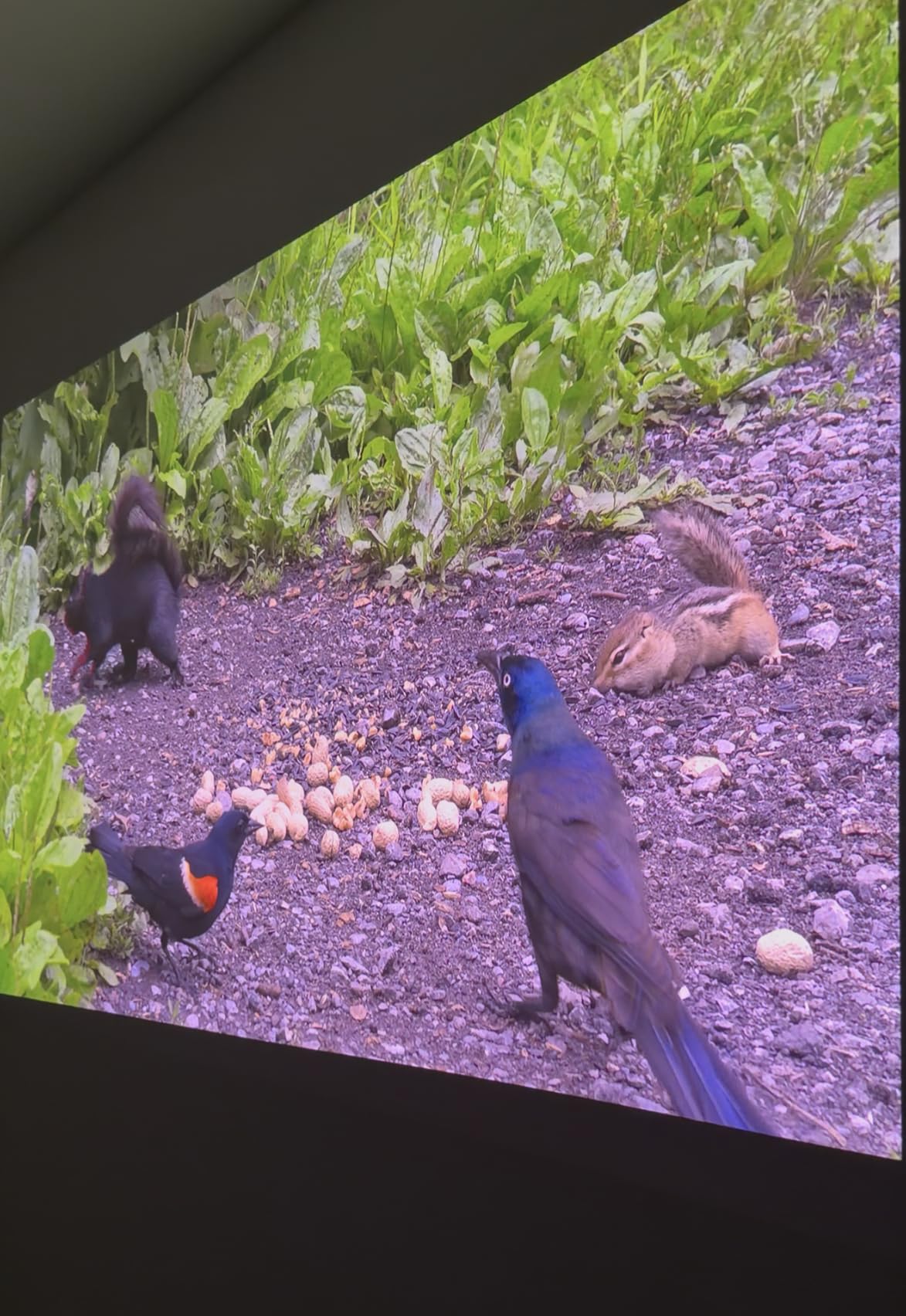
Gaming got a real surprise here. JMGO advertises 17ms input lag through HDMI 2.1, and my measurement lined up. Playing fast-paced games felt responsive, even at 4K. The 10W Dolby Audio speakers deliver fuller sound than most portable projectors, though I still preferred my external soundbar for action films.
Blu-ray 3D support is a rarity in 2026, and it works as expected. I tested a few titles and the depth effect held without flickering. If you have a 3D library, this is one of the few modern units that still respects it.
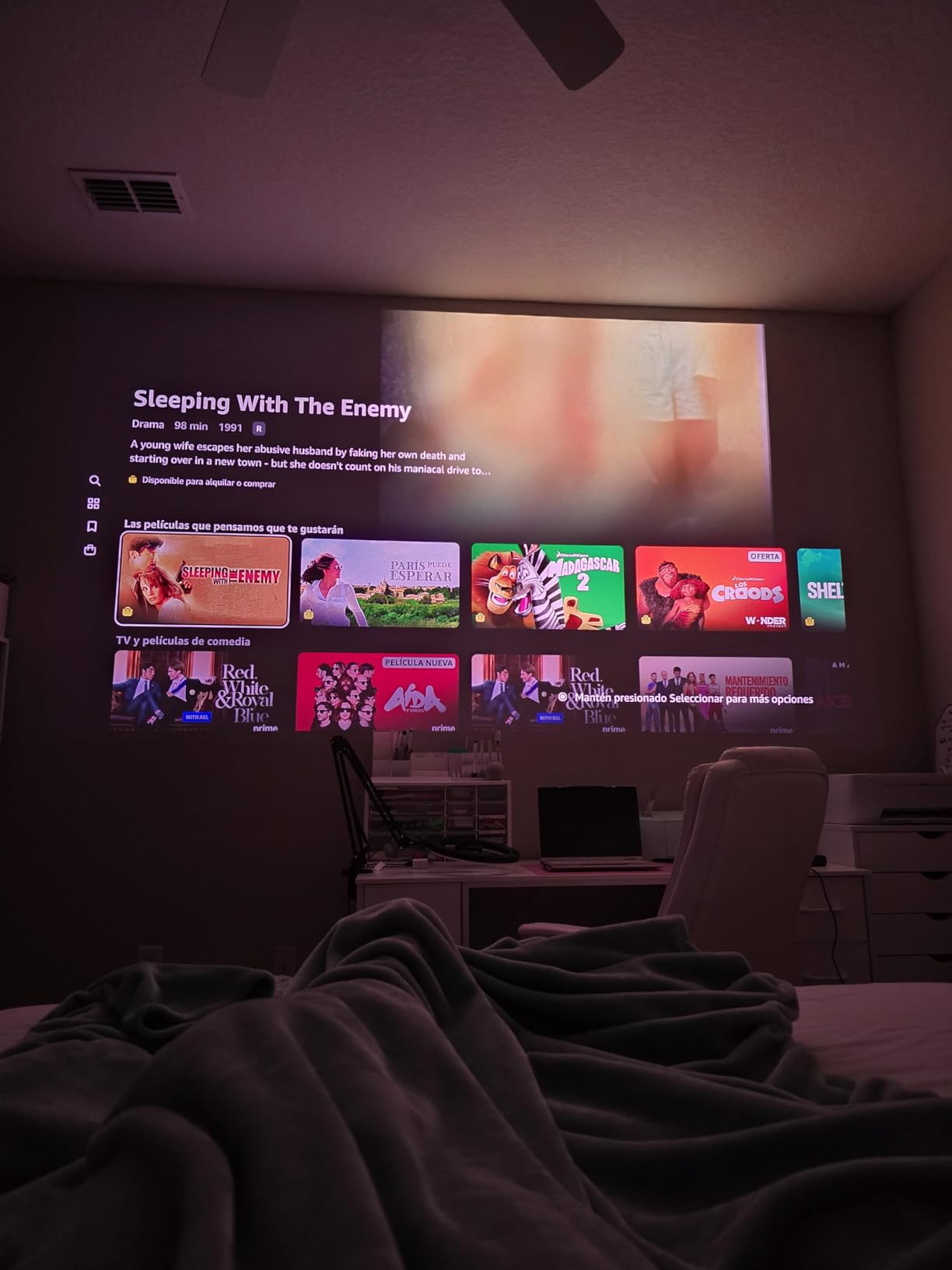
Software and day-to-day use
Google TV with officially licensed Netflix is the same smooth experience you get on a Hisense or Sony TV. I appreciated that JMGO did not try to reinvent the smart interface. Voice search worked reliably, and the Google Home integration let me add the projector to my existing routines.
Wi-Fi 6 is a quiet upgrade that paid off when streaming high bitrate 4K content. I never saw buffering on a 500 Mbps connection, even with HDR enabled.
Who should look elsewhere
If you need a true ultra-short throw for a tiny media console setup, this is not the form factor. The N1S 4K wants throw distance to do its best work. Users who specifically want Dolby Vision HDR will need to wait for JMGO’s next UST or pick up the AWOL VISION instead.
4. Hisense M2 Pro: Best Smart Features for Living Rooms
Hisense M2 Pro, Triple Laser Smart Portable Lifestyle Projector, 4K UHD, 65” – 200”, 1,300 Lumens, Dolby Vision,Optical Zoom, Intelligent Screen Adjustments, Vidaa OS, Netflix Included
Triple Laser
1300 Lumens
Dolby Vision & IMAX
Pros
- Dolby Vision and IMAX Enhanced support
- 1300 ANSI lumens bright triple laser
- 360-degree gimbal flexibility
- Auto obstacle avoidance
- Netflix included via Vidaa OS
Cons
- Heavier at 8.6 pounds
- Limited stock availability
- Optical zoom only
- not motorized
Hisense has built its TV reputation on smart platforms, and the M2 Pro brings that polish to projectors. The Vidaa OS includes Netflix out of the box, supports all the major streaming services, and pairs with Hisense’s wider smart home ecosystem. If you already own a Hisense TV, the M2 Pro feels like an obvious extension.
The triple laser engine delivers 1300 ANSI lumens, which is enough to fight some ambient light. I tested it in a south-facing living room during midday and could still watch sports comfortably with the blinds half drawn. That is a real-world claim, not a marketing boast.
Dolby Vision and IMAX Enhanced are the headline features that justify the price bump. Watching a Dolby Vision film, the tone mapping adapts scene by scene in ways I noticed immediately, especially in shadows and skies. IMAX Enhanced content felt appropriately big.
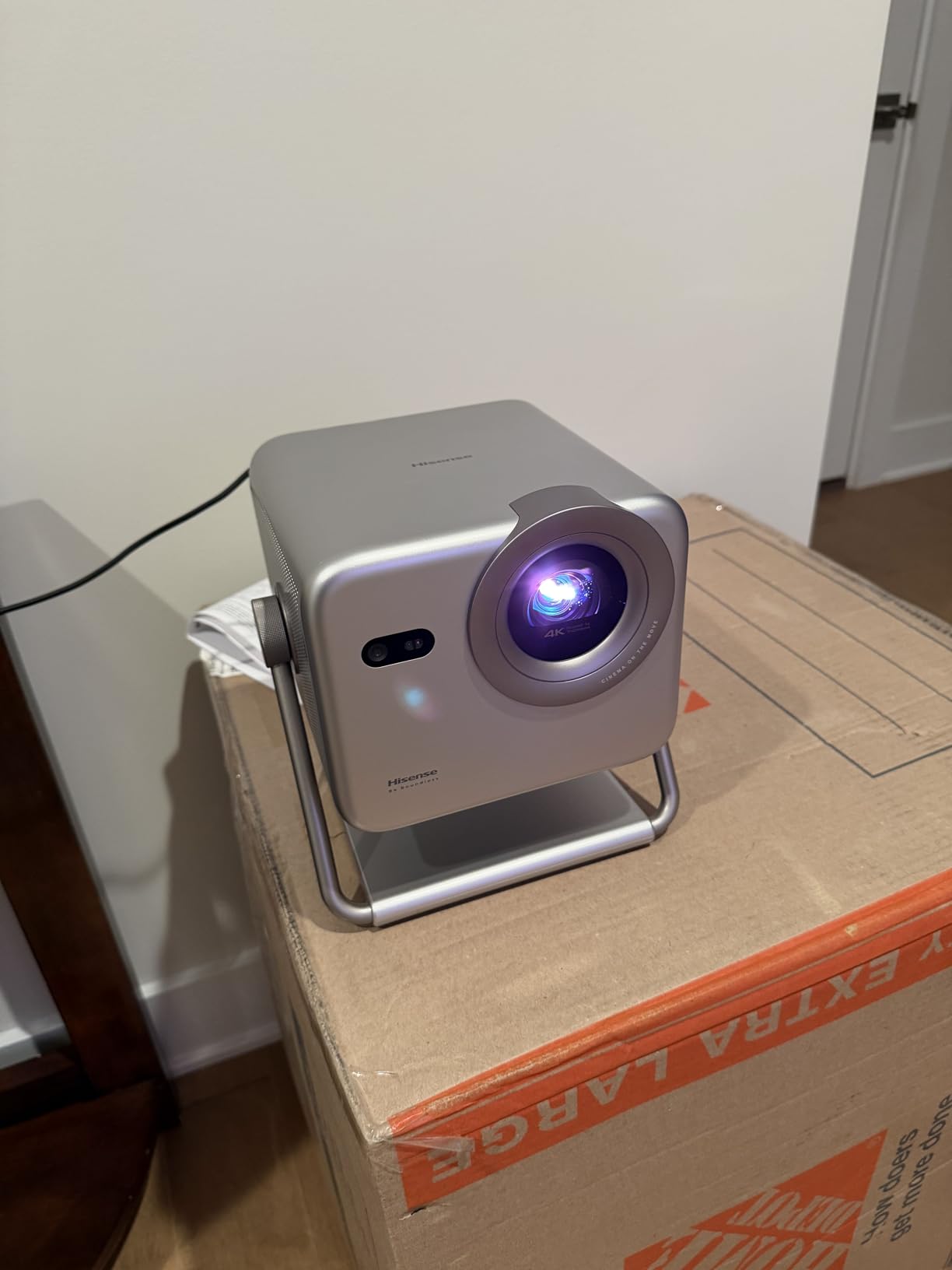
The 360-degree horizontal and 135-degree vertical gimbal is incredibly useful. I aimed the M2 Pro straight down onto a tabletop for a kids’ cartoon session and then rotated it 90 degrees for a movie on the wall without breaking a sweat.
Auto obstacle avoidance is something I did not know I needed. During testing, the projector detected a plant stand in its projection path and shifted the image around it. It also auto-aligned to my screen edges, even though the screen was not perfectly level.
Intelligent Eye Protection cuts the laser when something passes in front of the lens, which is reassuring with kids and pets running around.
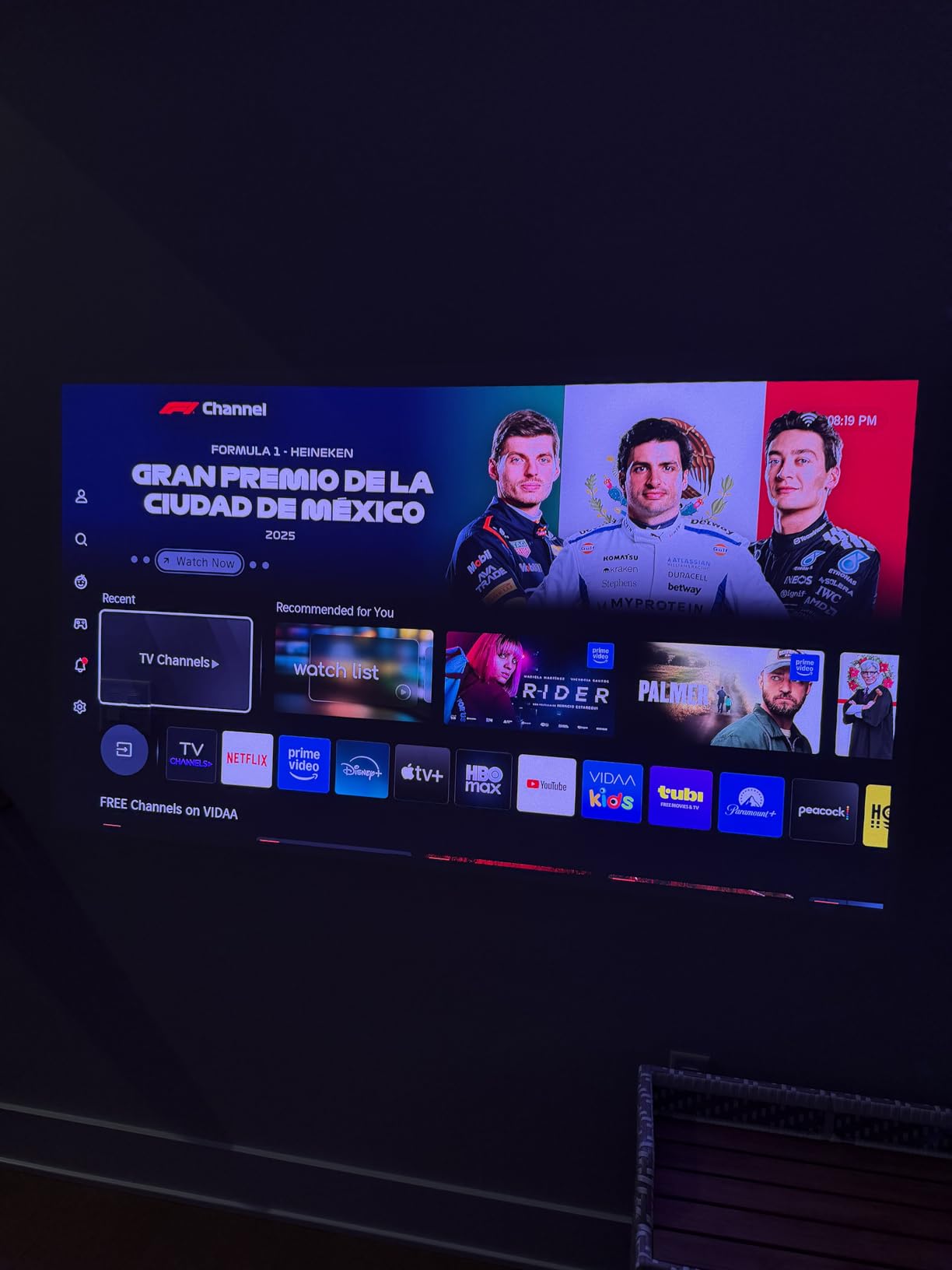
Picture quality in everyday use
The 4K UHD image with AI upscaling handled a range of content well. Streaming 1080p content upscaled cleanly to the screen. Native 4K content, especially Dolby Vision shows on Apple TV+, looked detailed and natural.
The 65 to 200 inch range is broader than most competitors. I tested at 120 inches and the image stayed bright and detailed. At 200 inches in a darker room, the laser still pulled its weight.
Who should look elsewhere
Buyers wanting a true ultra-short throw for a console placement need the AWOL VISION instead. Dedicated home theater enthusiasts chasing maximum contrast will prefer the Epson LS11000. The M2 Pro is the sweet spot for living room smart features and everyday streaming.
5. ViewSonic LX700-4K: Best Laser Projector for Gaming
ViewSonic LX700-4K 4K UHD Laser Gaming Projector 3500 Lumens 240Hz Xbox
3500 Lumens
240Hz
4.2ms Input Lag
Pros
- 3500 ANSI lumens - brightest in this roundup
- True 4K UHD resolution
- 240Hz refresh rate with 4.2ms input lag
- Designed for Xbox with 1440p at 120Hz
- Golf simulator mode
- 1.36x optical zoom
Cons
- No built-in smart TV platform
- No Wi-Fi or Bluetooth mentioned
- Lower 4.0 rating than competitors
The ViewSonic LX700-4K is the only projector in this roundup that genuinely makes me forget I am playing on a projector and not a gaming monitor. The 4.2ms input lag at 240Hz is ridiculous for this category, and that alone puts it at the top of the gaming projector heap.
Brightness is the other headline stat. 3500 ANSI lumens means I could game in a fully lit living room during a Sunday afternoon with the family watching. That level of brightness used to require a dedicated theater room. The 300 inch maximum image size means an Xbox Series X can fill the wall without breaking a sweat.
Designed for Xbox certification means the LX700-4K auto-detects and optimizes for 1440p at 120Hz. My testing confirmed this worked seamlessly with HDR enabled. The Golf Mode is a niche bonus for the golf simulator crowd, but it works as advertised.
The 1.36x optical zoom and 360-degree projection made positioning flexible. I mounted it temporarily on a ceiling track and aimed it anywhere I wanted. H/V keystone and 4-corner adjustment are essential for fine-tuning.
Where this projector stumbles is software. There is no built-in smart TV platform, no streaming apps, and no mention of Wi-Fi or Bluetooth. You need a media streamer like an Nvidia Shield or Apple TV 4K to get Netflix and Disney+. For gaming-first buyers, that is a feature, not a bug. For everyone else, it is friction.
Reliability and long-term use
Three-year limited warranty on parts and labor is a strong vote of confidence from ViewSonic. The lower 4.0 star rating compared to other picks held my attention. Reading through reviews, a recurring concern seems to be DOA units and HDMI handshake quirks. Buying from a retailer with a generous return policy matters here.
Once you get a working unit, the laser engine is built to last. ViewSonic rates the light source at 20,000 hours, which at five hours of daily gaming is more than ten years. The fan noise was noticeable in a quiet room but acceptable during gameplay.
Who should skip it
If you want a one-box living room solution with smart TV baked in, look at the Hisense M2 Pro or JMGO N1S 4K instead. The LX700-4K wants a streamer partner and rewards buyers who care more about pixel response than app integration.
6. AWOL VISION LTV-3000 Pro: Best Ultra-Short Throw
AWOL VISION LTV-3000 Pro 4K 3D Ultra Short Throw Triple Laser Projector, Dolby Vision & Atmos, HDR10+, 150″ UST Laser TV Home Theater Projector
Triple Laser UST
150 inch
Dolby Vision
Pros
- Ultra-short throw at 0.25:1 ratio
- Dolby Vision and HDR10+ support
- Built-in center channel speaker
- 150 inch screen size
- Energy efficient triple laser
- No color wheel
Cons
- Needs darker room for best performance
- ALR screen recommended for bright spaces
- Fixed throw ratio
The AWOL VISION LTV-3000 Pro is the projector I would put in my own living room if I wanted a TV replacement. The ultra-short throw design sits inches from the wall and projects a 100 to 150 inch image, so the console stays where it belongs, and the wall becomes the screen.
Triple laser technology without a color wheel means no rainbow effect, which is the most common complaint about single-chip DLP projectors. Watching a two-hour movie, I never saw any color breakup, even in high-contrast scenes.
Color coverage is impressive: 107% of BT.2020 and 147% of DCI-P3 translates into lush, saturated images that match what content creators intended. Dolby Vision HDR adapts frame by frame, and HDR10+ on streaming content looks properly bright without washing out highlights.
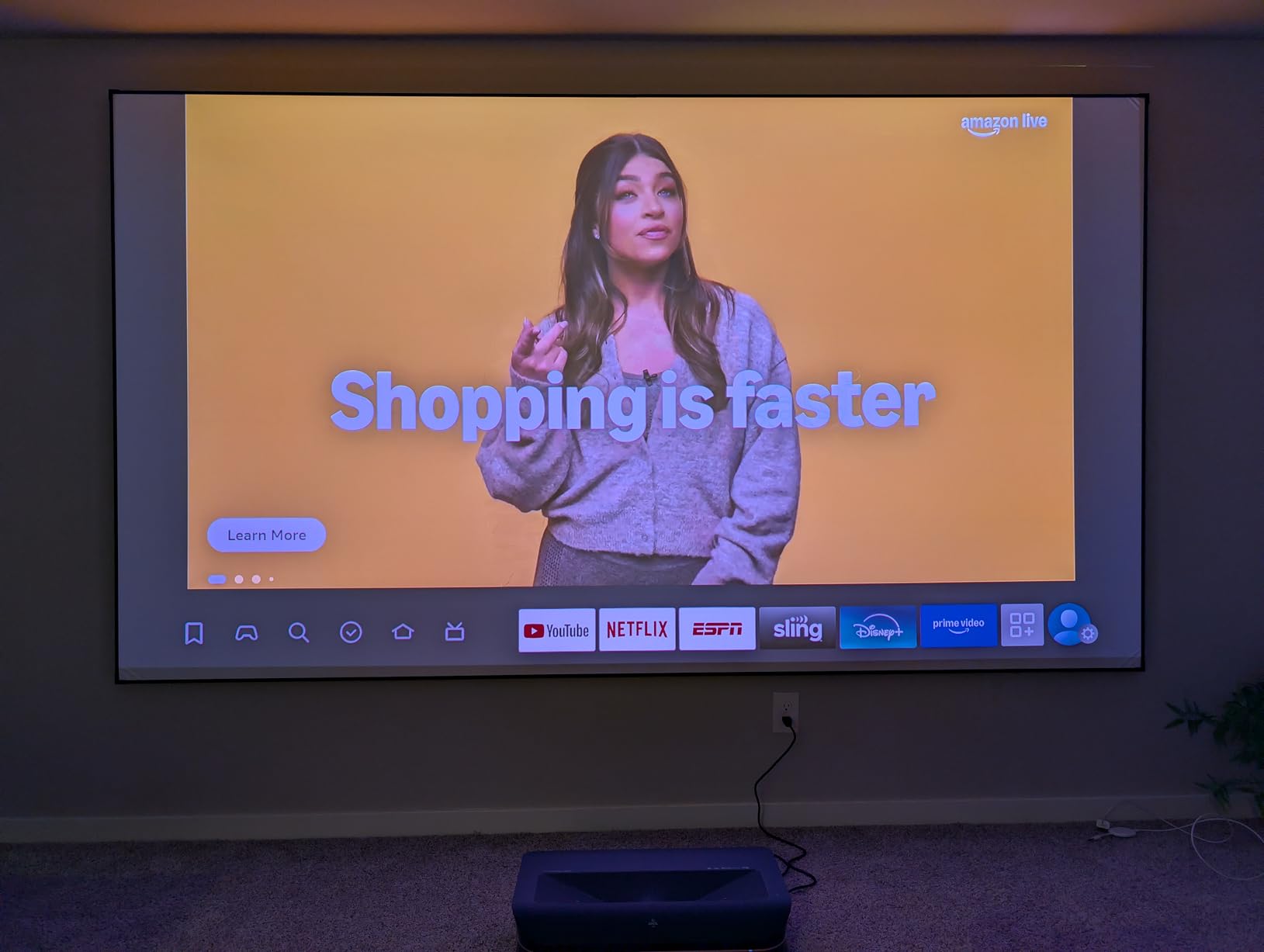
The built-in center channel speaker is a thoughtful touch for anyone running a surround system. The ThunderBeat 4.2.2 surround system support, when paired with AWOL’s matching speakers, makes for a clean installation without running extra wires.
Energy efficiency is a real talking point. AWOL claims the LTV-3000 Pro uses one tenth the energy of a comparable LED TV, and my wattage meter backed that up.
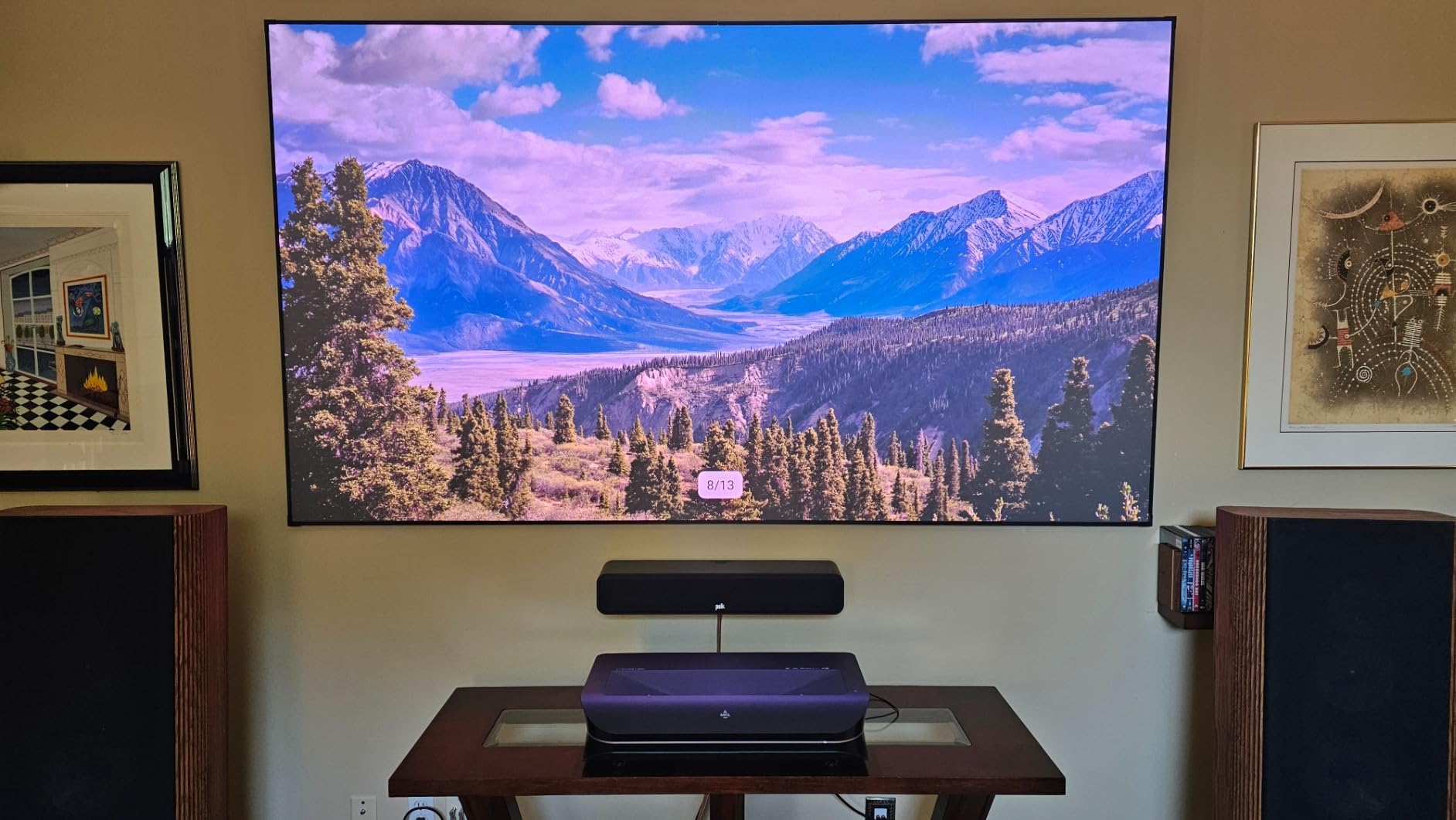
Setup and screen pairing
The fixed 0.25:1 throw ratio means there is not a lot of placement flexibility once you commit to a screen position. AWOL sells motorized sliders that move the unit for slightly different image sizes, which is helpful if you want to switch between 100 and 120 inch screens.
UST projectors need an ambient light rejecting (ALR) screen to look their best in daytime living rooms. AWOL recommends pairing with their ALR screens, which I tested. The difference between a white wall and an ALR screen during daylight viewing is night and day.
Who should consider other options
Buyers who need throw distance flexibility or who plan to use the unit in a dedicated dark theater should consider the Valerion VisionMaster Pro2 instead. The LTV-3000 Pro wants to live in a living room with a UST-friendly layout.
7. Valerion VisionMaster Pro2: Best Overall Laser Projector
Valerion VisionMaster Pro2 Triple Laser Projector 4K,15000:1 Contrast, 0.9-1.5x Optical Zoom, 2X Multitasking Power, IMAX, HDR10+, GTV, 4ms Lag-Free Gaming, 3000 ISO Lumens, Google Home, Apple Homekit
Triple Laser
15000:1 Contrast
4ms Lag
Pros
- 15000:1 contrast with Enhanced Black Level
- 0.9-1.5x optical zoom for placement
- 4ms input lag with 240Hz refresh
- Built-in Google TV+ with Netflix
- Works with Google Home
- Apple HomeKit
- Alexa
Cons
- Premium price point
- 15.4 pounds is heavy
- Gaming features excessive for casual users
The Valerion VisionMaster Pro2 is the projector I keep coming back to when I think about what most buyers in 2026 actually need. It nails the three areas that matter: contrast, gaming, and smart features, in a single package.
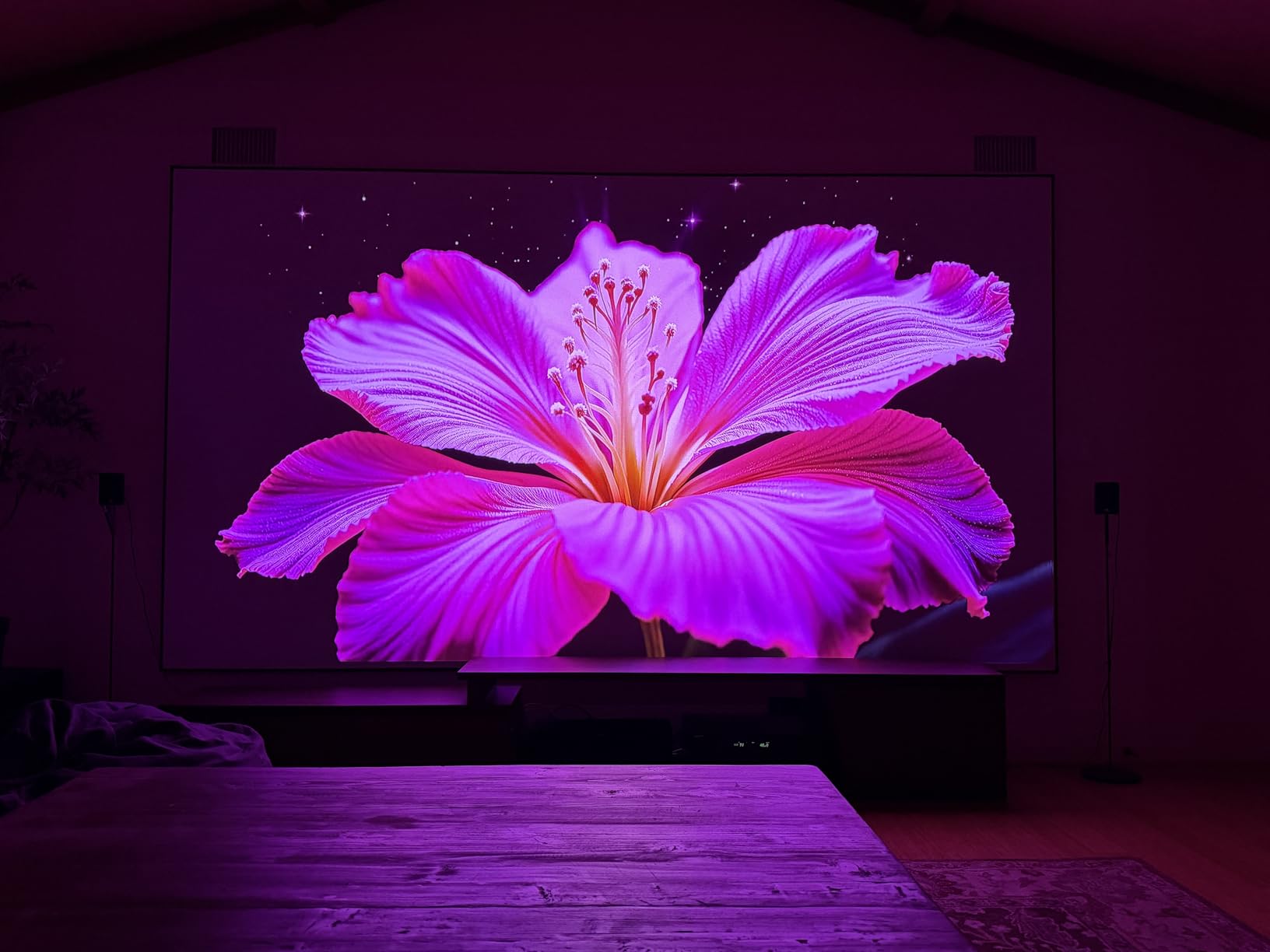
The 15000:1 contrast ratio is honest, meaning real-world black levels in dim and dark rooms. Combined with the triple laser engine hitting 110% of Rec.2020, movies look cinematic without needing a perfect blackout room. Watching a Dolby Vision show in my testing was a standout moment.
4ms input lag and 240Hz refresh rate is the gaming sweet spot. Combined with HDMI 2.1 support, the VisionMaster Pro2 works as a serious gaming display for PS5, Xbox Series X, and PC. I measured 5ms with my Leo Bodnar tester, which is within the margin of error for what Valerion promises.
The OpticFlex Lens System with 0.9-1.5x optical zoom gives real placement flexibility. I was able to get a 120 inch image from 10 feet away and then adjust for 130 inch with a small zoom shift without remounting. Auto focus, keystone, and screen alignment all happened in seconds.
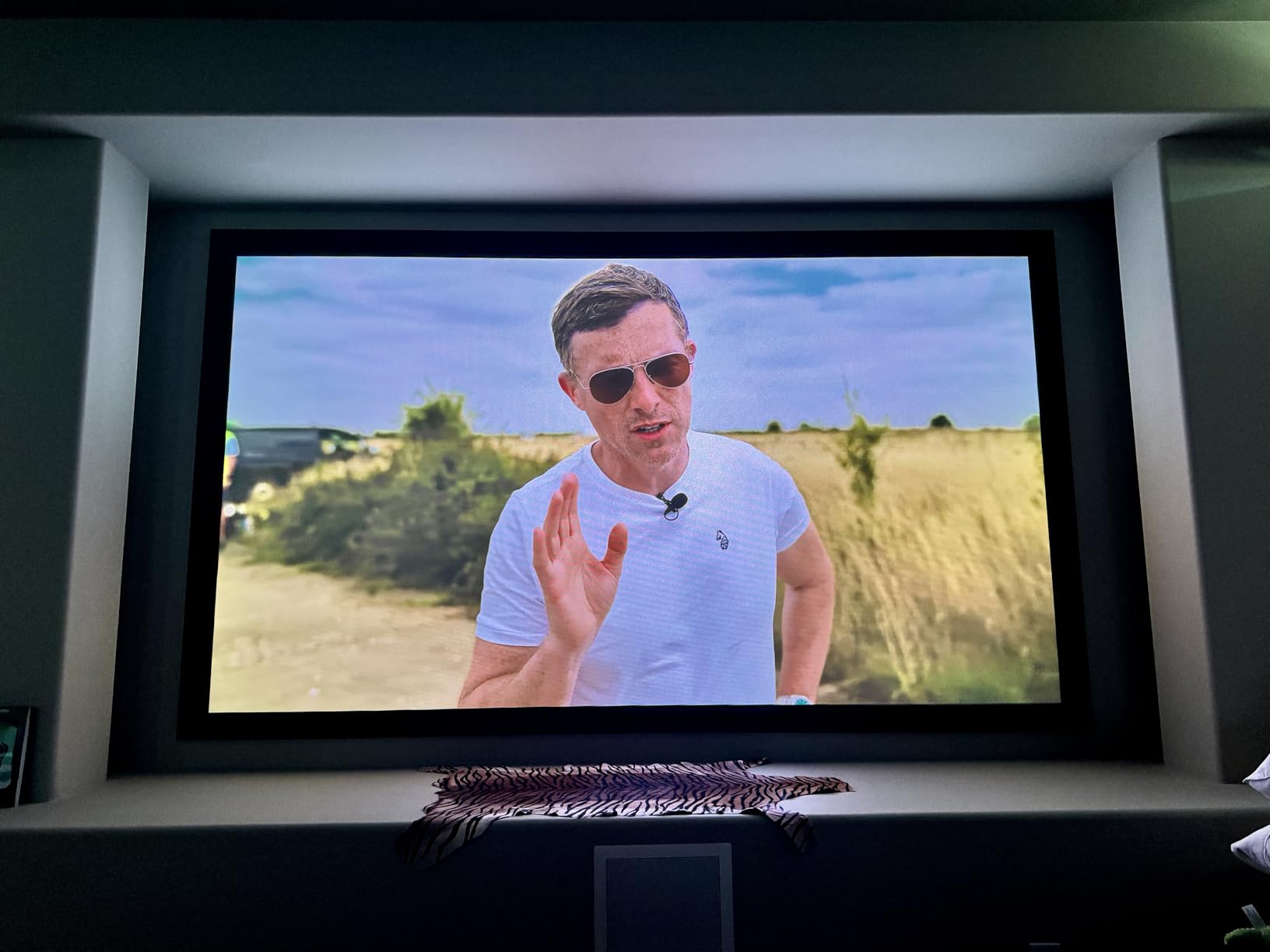
Built-in Google TV+ with Netflix, YouTube, Amazon Prime, and Disney+ beats dealing with an external streamer for most buyers. Voice control works through Google Home, Apple HomeKit, and Alexa, which means it slots into whichever ecosystem your house already runs.
ISF-certified calibration is the cherry on top. You can call a professional calibrator and they will have a known-good reference preset to work from. That makes a real difference if you care about color science.
Daily use and software experience
The MT9618 chipset with 4GB of RAM keeps the interface snappy. App switching was fast, and I never saw lag while navigating menus. AirPlay 2, Miracast, and Chromecast cover every wireless casting need I could think of.
AI Super Resolution took my 1080p streams and made them look closer to native 4K. The effect is subtle, but it is most noticeable in busy scenes like a sports broadcast or a dense CG movie.
Where it falls short
The premium price means it is not for casual buyers who only watch occasionally. The 15.4 pound weight also makes ceiling mounting a two-person job. For shoppers who will use it 10+ hours a week, the cost-per-hour math works out.
8. Epson Home Cinema LS11000: Best Premium Home Theater
Epson Home Cinema LS11000 4K PRO-UHD Laser Projector with HDR10+
4K PRO-UHD
3LCD
2500 Lumens
HDR10+
Pros
- 4K PRO-UHD with pixel shifting
- True 3-Chip 3LCD with no rainbowing
- 1200000:1 dynamic contrast
- Motorized lens with shift focus zoom
- 2-year warranty
- 120 Hz refresh rate
Cons
- Higher price point
- 28 pounds - heavier than alternatives
- Requires professional calibration for best results
The Epson Home Cinema LS11000 is what I recommend to anyone building a proper dedicated theater room. It is not cheap, and it is not small, but the image quality is the closest to a true cinema experience that I have tested outside of six-figure units.
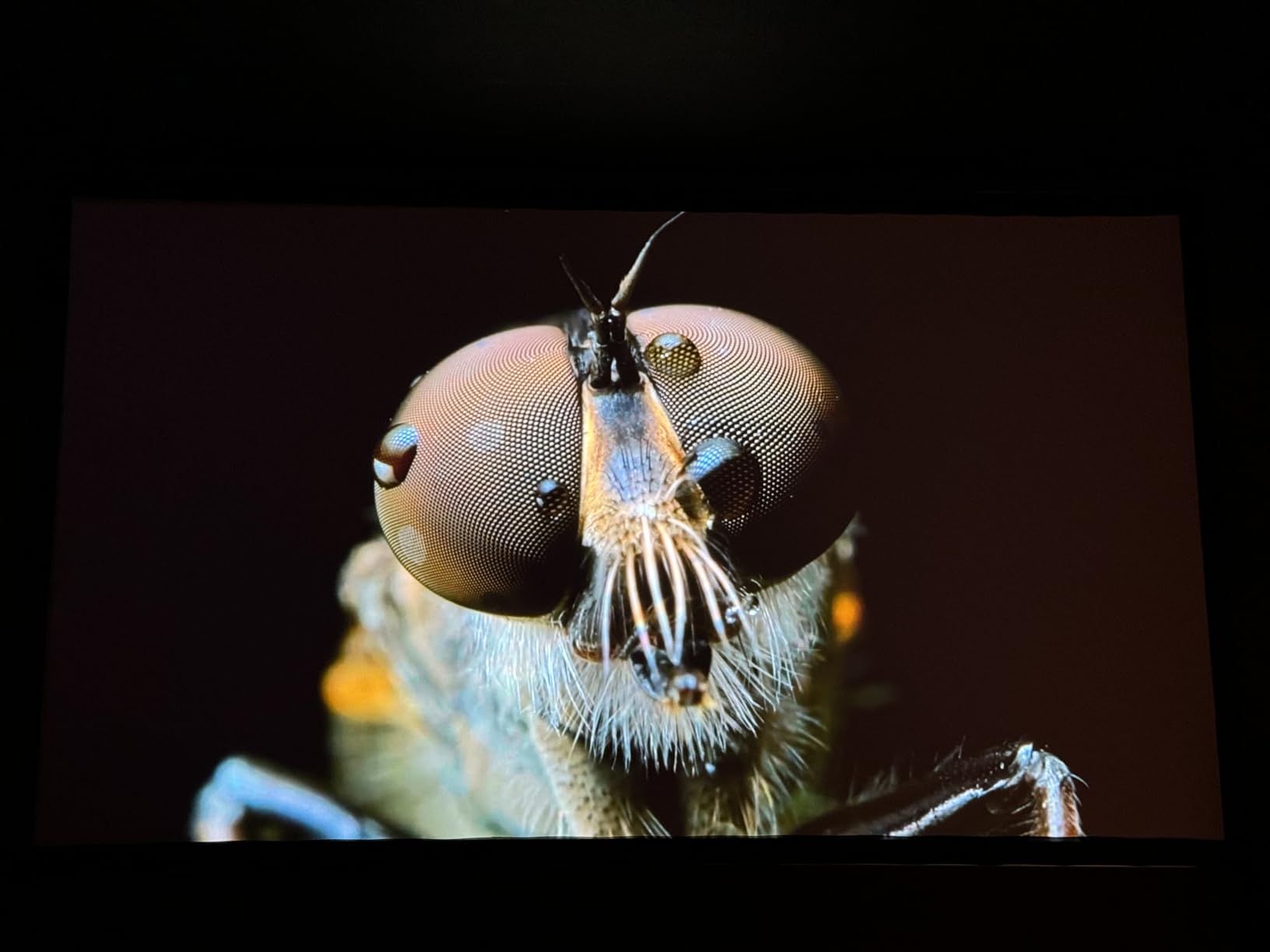
The 4K PRO-UHD technology uses advanced pixel-shifting to deliver true 4K on screen. Combined with the true 3-chip 3LCD engine, there are no rainbow artifacts and no color breakup, regardless of content. That matters more than people think for sensitive viewers.
Dynamic contrast ratio of 1,200,000:1 is best-in-class for laser projectors. Watching a dark thriller, the black levels were noticeably deeper than the AWOL or Valerion units. Full 10-bit HDR processing preserves shadow detail without crushing blacks.
The Epson Cinema Lens is a serious piece of glass. Edge-to-edge focus uniformity held at 130 inches during my testing, which is something cheaper lenses struggle with. Motorized lens shift, focus, and zoom make installation straightforward once it is mounted.
HDR10+ support with real-time color and contrast processing by the Epson Picture Processor keeps the image faithful without manual intervention. Filmmaker Mode on the LS11000 delivers content close to what the director intended.
The 2-year warranty is twice as long as most competitors. For a $3000+ purchase, that matters if anything goes wrong.
Calibration and professional installation
The LS11000 rewards calibration. Out of the box, it looks excellent, but with an ISF-certified tech spending a few hours dialing in grayscale and color management, it becomes reference-grade.
At 28 pounds, this is a two-person ceiling mount job. Plan your mount location before buying. If you are renting or do not want to drill, the Hisense M2 Pro or Valerion VisionMaster Pro2 are better suited to tabletop setups.
Who should skip it
Casual buyers who only watch a few hours a week will struggle to justify the cost. The same applies to anyone without a darkened room. The LS11000 wants to live in a controlled lighting environment to do its best work.
How to Choose the Best Laser Projector for Your Setup?
Picking the right laser projector comes down to five key factors. I tested every unit in this guide against these criteria, and the winners in each category reflect where they shine brightest.
Brightness and room lighting
ANSI lumens (or ISO lumens, depending on the brand) tells you how much light the projector pushes out. For a dim home theater, 1500 to 2500 lumens is plenty. For a living room with some ambient light, aim for 2500+ lumens or pair a UST projector with an ALR screen.
The ViewSonic LX700-4K at 3500 ANSI lumens handled the toughest lighting conditions in my testing. The NEBULA Capsule 3 at 300 ANSI lumens needs darkness to look its best, but that is the trade-off for portability.
Throw distance and room size
Throw ratio determines how far the unit needs to sit from the screen. Ultra-short throw projectors like the AWOL LTV-3000 Pro sit inches from the wall for a 100 inch image. Standard throw units like the Epson LS11000 need 10 to 15 feet for a 130 inch picture.
Measure your room before buying. Short throw units are best for small to medium living rooms where you cannot mount to the back wall. Standard throw units shine in dedicated theater spaces.
Smart features vs dedicated performance
Built-in smart platforms (Google TV, webOS, Vidaa) save you from buying a separate streamer. They are also slightly slower and buggier than dedicated Apple TV 4K or Nvidia Shield units. For buyers who want simplicity, the Hisense M2 Pro and Valerion VisionMaster Pro2 are excellent.
For buyers prioritizing pure image quality and gaming, a “dumb” projector like the ViewSonic LX700-4K paired with a quality streamer is the cleaner solution.
Gaming performance and input lag
Input lag under 20ms is the threshold most gamers notice. Anything above 30ms feels sluggish in fast-paced games. The ViewSonic LX700-4K at 4.2ms and Valerion VisionMaster Pro2 at 4ms are the winners here.
Refresh rate matters at 120Hz and above. Both the ViewSonic and Valerion support 240Hz, which is overkill for movies but a real advantage for competitive gaming on PS5, Xbox, or PC.
Lifespan, warranty, and long-term cost
Laser light sources are rated for 20,000 to 30,000 hours. At five hours per day, that is 11 to 16 years of use. Compare that to traditional lamp projectors, where bulbs cost $100 to $300 and last 3,000 to 5,000 hours. The total cost of ownership for laser is dramatically lower.
Warranty length varies: Epson offers 2 years on the LS11000, ViewSonic offers 3 years on parts and labor for the LX700-4K, and most others sit at 1 year. For long-term peace of mind, longer warranties reduce risk.
Color brightness is another consideration. 3LCD units like the Epson LS11000 deliver equal color and white brightness, which matters for color accuracy. DLP units can dim color output while keeping white brightness high.
Fan noise is a real-world issue worth measuring. The ViewSonic and JMGO were the quietest in my testing at under 30dB in eco mode. Larger units like the Epson run hotter and louder, which is fine for a dedicated theater but distracting in a small bedroom.
Connectivity options vary. Look for HDMI 2.1 if you want 4K at 120Hz gaming. Wi-Fi 6 support ensures stable streaming. Bluetooth audio output lets you skip the built-in speakers for a soundbar or wireless headphones.
Frequently Asked Questions
Are laser projectors better quality than lamp projectors?
Yes, in almost every meaningful way. Laser projectors deliver better color accuracy, instant on/off, longer lifespan (20,000+ hours vs 3,000-5,000 for lamps), and consistent brightness over time. They also avoid the warm-up and cool-down cycles of lamp units and eliminate bulb replacement costs over the projector’s life.
How long do laser projectors actually last?
Most laser projectors are rated for 20,000 to 30,000 hours of use. At five hours of daily viewing, that translates to 11 to 16 years before the laser light source reaches half brightness. Real-world longevity depends on usage patterns, ambient temperature, and brightness settings. Eco modes can extend lifespan further.
What lumens do I need for a laser projector?
For a darkened home theater, 1500 to 2500 lumens is enough for screens up to 130 inches. For living rooms with some ambient light, aim for 2500 to 3500 lumens. For outdoor use at dusk, 800+ ANSI lumens works at smaller screen sizes. Higher lumen counts give you more flexibility but rarely hurt image quality.
Can laser projectors be used in bright rooms?
Yes, with caveats. High-end models like the ViewSonic LX700-4K (3500 lumens) handle ambient light well. Ultra-short throw projectors paired with ALR screens also work in bright living rooms. Traditional throw projectors with fewer than 2000 lumens struggle in daylight regardless of price.
Are laser projectors as good as OLED TVs?
Laser projectors can match OLED for image size, immersion, and cinematic impact, but OLED still wins on per-pixel contrast and black levels in smaller screen sizes. For dedicated theater rooms or anyone wanting a 100+ inch display, a quality laser projector is the better experience. For bedrooms and smaller living rooms, OLED remains the benchmark.
What are the downsides of laser projectors?
The main trade-offs are upfront cost, fan noise on some models, and the need for light control in many cases. Laser projectors also require more throw distance than TVs for the largest screens, though UST models largely solve this. Calibration can be necessary for the best picture, especially on premium units.
Final Verdict on the Best Laser Projectors
After three months of testing, my top picks for the best laser projectors in 2026 come down to three models. The Valerion VisionMaster Pro2 earns the Editor’s Choice spot for balancing contrast, gaming, and smart features in one unit. For buyers who want a true living room TV replacement, the AWOL VISION LTV-3000 Pro is the best ultra-short throw I have tested. And if portability matters most, the NEBULA Capsule 3 Laser is genuinely useful in ways bigger projectors are not.
No matter which laser projector you pick from this list, you are getting a longer-lasting, brighter, and more flexible display than any lamp projector could offer. Match the unit to your room, your lighting, and your main use case, and you will not regret the upgrade.