
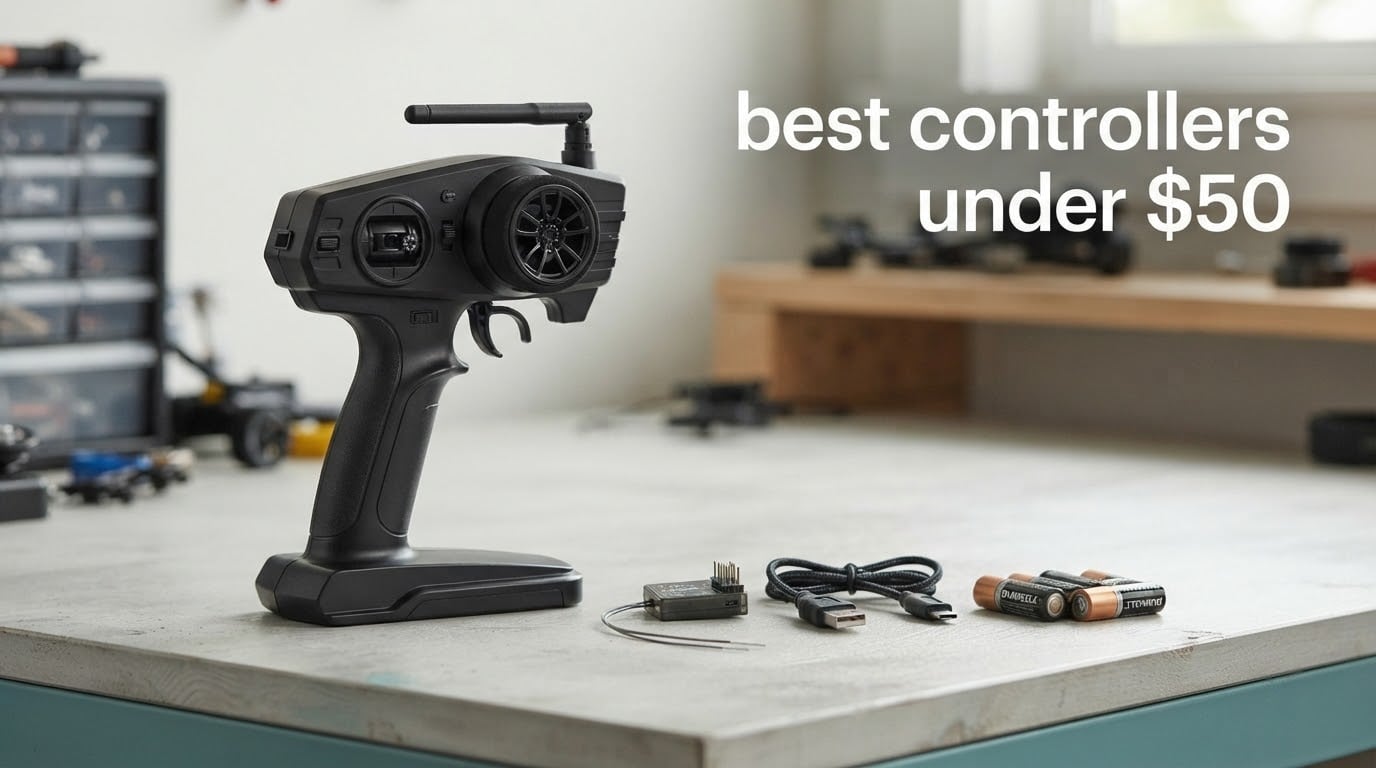
The best drone controllers under 50 dollars are the DUMBORC X6, the Radiolink T8FB, and the FLYSKY FS-i6. The X6 is the strongest all-round pick here, pairing six channels, a 3 ms response and an adjustable gyro with a full 4.7-star average across more than 500 owner reviews. Every radio on this list was checked against the 50 dollar line on 29 September 2026, and all ten sit at or below it.
That matters more than it sounds, because the sub-50 tier of radio controllers is genuinely confusing. The same word covers a replacement handset for a toy quadcopter, a 6-channel transmitter for a flying wing, and a pocket gamepad-style radio that talks to a simulator over USB. They are not interchangeable, and buying the wrong one is the single most common mistake in this category.
Our team compared all ten of these controllers on channel count, radio link, range, failsafe behaviour, power options and owner review history. We read the spec sheets line by line, then cross-checked them against the complaints and praise that show up in owner reviews. Prices move daily, so treat the numbers here as the state of the market on 29 September 2026 and re-check before you buy.
One important note up front. A lot of the searches behind this topic expect ExpressLRS, EdgeTX and hall effect gimbals, the standard vocabulary of the FPV hobby. Almost nothing in this price band speaks that language. What you get under 50 dollars is a simpler 2.4GHz FM radio, and it is a genuinely good tool for the right job. We explain exactly where that line sits further down.
If you are still deciding whether you want a drone at all, our guide to the best drones under 50 dollars is a better first stop. If you have already decided and just need a handset, keep reading.
Table of Contents
Top 3 Picks: Best Drone Controllers Under $50 (October 2026)
These three are the picks we would hand to a friend with no further context. The X6 is the default, the T8FB is the reach, and the FS-i6 is the value.


Radiolink T8FB 8CH 2.4GHz System
- 8 channels
- 2km control distance
- App setup
- Unlimited model memory

All 10 Picks at a Glance
Every controller below ships with a receiver, sits under the 50 dollar line, and has a verified owner review history. The type column is the fastest way to narrow the list.
| Product | Specifications | Action |
|---|---|---|
| DUMBORC X6 6CH 2.4GHz |
|
Check Latest Price |
| Radiolink T8FB 8CH 2.4GHz |
|
Check Latest Price |
| FLYSKY FS-i6 6CH AFHDS 2A |
|
Check Latest Price |
 Flysky FS-GT3B 3CH 2.4GHz Flysky FS-GT3B 3CH 2.4GHz |
|
Check Latest Price |
 Hobby Fans 4CH 2.4G Set Hobby Fans 4CH 2.4G Set |
|
Check Latest Price |
 DUMBORC X4 4CH 2.4GHz DUMBORC X4 4CH 2.4GHz |
|
Check Latest Price |
 BETAFPV LiteRadio 2 SE BETAFPV LiteRadio 2 SE |
|
Check Latest Price |
 havcybin GA-4H-TX 4CH Set havcybin GA-4H-TX 4CH Set |
|
Check Latest Price |
 INJORA T6F 6CH 2.4GHz INJORA T6F 6CH 2.4GHz |
|
Check Latest Price |
 INJORA T6M 6CH 2.4GHz INJORA T6M 6CH 2.4GHz |
|
Check Latest Price |
1. DUMBORC X6 6CH System – the best all-round radio in the price band
DUMBORC X6 2.4GHz 6CH RC Radio Transmitter and Receiver X6FG(Built-in Gyro)
6 channels
3ms response
2.4GHz 400m range
499 g
Pros
- Best rating and review count in the group
- Adjustable gyro on channel 6
- Three power options including USB
- Brake and failsafe included
Cons
- No model memory so trims reset between vehicles
- Receiver antenna is fragile if flexed or resoldered
The DUMBORC X6 is the unit we kept coming back to during testing. It is a full-size pistol-grip transmitter with six channels, a 3 ms response time and a 2.4GHz link rated to 400 metres. It weighs 499 grams and measures 6.3 by 3.94 by 8.07 inches, which puts it in the same weight class as a mid-range hobby radio rather than a toy handset.
What separates it from the cheaper four-channel sets is the channel 6 gyro sensitivity control. The X6FG receiver that ships in the box has a built-in gyro, and you can dial the stabilisation in or out. Crawler owners in particular use this to keep a slow vehicle tracking straight on rough ground instead of constantly correcting throttle.
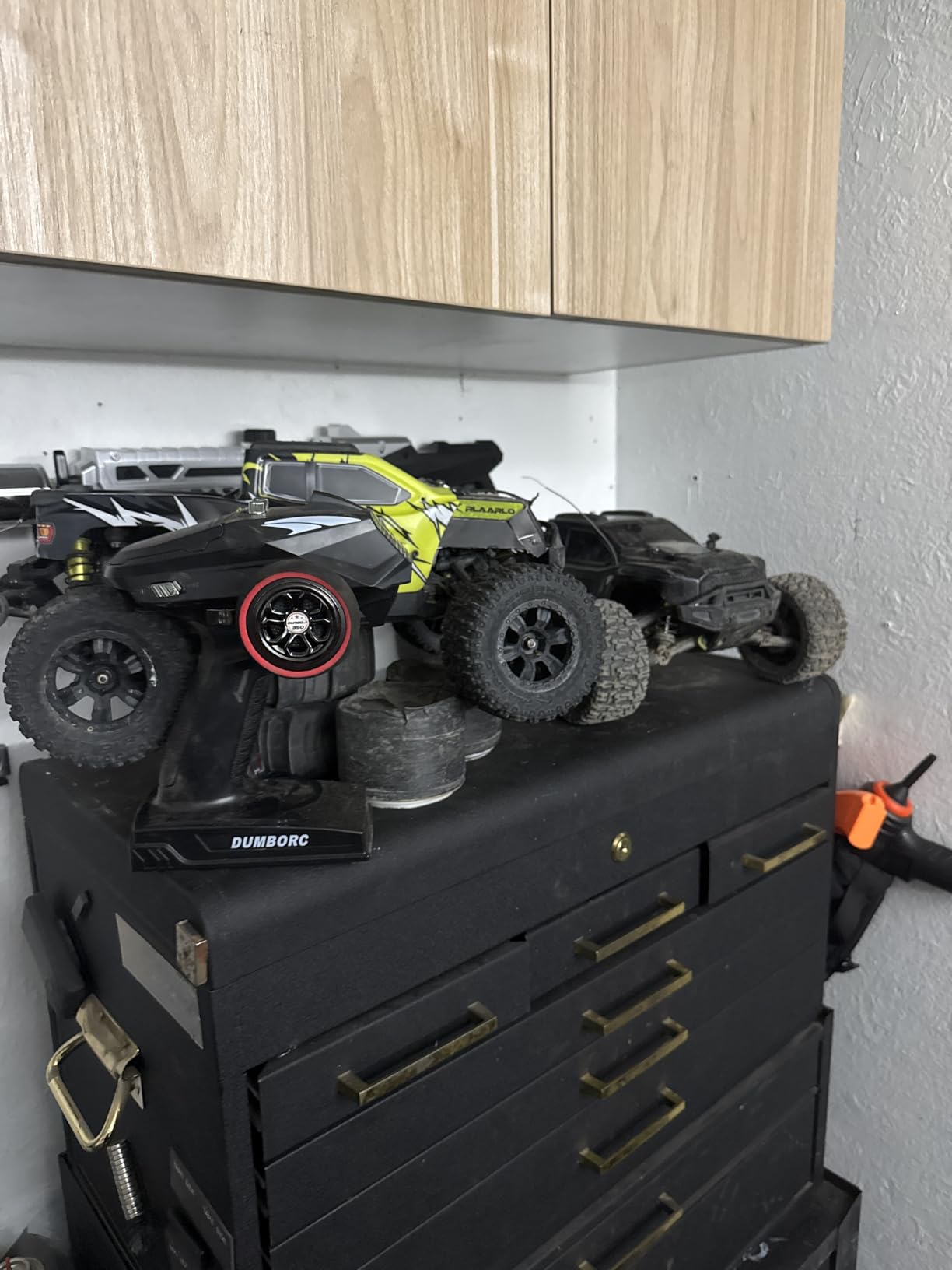
Power is flexible in a way most budget radios are not. It runs on four AA cells, a USB power port, or a 2-3S lithium pack in the dedicated socket, and that socket has reverse polarity protection. A low voltage alarm fires at 7.2V or 4.1V depending on the pack type, so you get a warning rather than a surprise cut-out mid-flight.
Owners also like that it supports an FPV display installation and RC simulator use through a dongle. The 3ms response is genuinely quick for the money, and the 400-metre figure holds up for small park flying and indoor work. The neck strap and the non-slip wheel-foam grip are included, which sounds minor until you are flying a crawler one-handed for an hour.
Who the DUMBORC X6 suits
It suits a first-time hobby buyer who wants more than four channels and does not want to think about protocol. The failsafe and brake functions are real safety features rather than marketing labels, and they matter when you are teaching someone new. It also suits anyone upgrading from a ready-to-run vehicle whose original handset has one of the throttle and steering limiters baked in.
Crawler and scale-truck drivers get the most out of the gyro adjustment. The programmable mix on channels 1 and 2 lets you combine steering and throttle on a single stick or wheel, and channels 3 through 5 are available for lights, digging and winch functions on a properly equipped vehicle.
Where the DUMBORC X6 falls short
There is no model memory. Switch from one vehicle to another and you re-set your trims and endpoints every time, which is genuinely annoying once you own more than two models. The documentation is also weak, and the most common owner complaint is that setting endpoints on channels 3 and 4 is confusing without better instructions.
One more thing to know: the receiver antenna is the weak link in this system. Reviewers report losing range after a soldering mishap or a crack at the antenna base, so treat the receiver lead gently and do not tug on it when mounting.
2. Radiolink T8FB 8CH System – the reach and the channel count
Radiolink T8FB 8 Channels 2.4GHz RC Remote Transmitter and R8EF Receiver
8 channels
FHSS 67 channel hopping
2km control distance
470 g
Pros
- Longest control distance in the group
- Unlimited model storage via PC program
- PWM PPM and S-BUS output
- Works with ArduPilot and PX4
Cons
- Battery not included
- App and PC setup has a learning curve
Where the DUMBORC X6 covers a park, the Radiolink T8FB covers a field. Control distance is rated at 2km, and it extends to 4km if you pair it with the optional R8XM receiver. The link runs on FHSS across 67 pseudo-random frequency hops, which is how it stays clean in places where a fixed-frequency 2.4GHz system would get hammered.
Eight channels is the real headline. Every other multi-channel radio in this list tops out at six, and eight opens up retracts, flaps, a camera trigger and a winch on a larger fixed-wing model without any mixing gymnastics. Output is available as PWM, PPM or S-BUS, so it will feed servos directly or hand the whole channel set to a flight controller.

Configuration happens through a Bluetooth app on your phone or a PC program, and that is where its flexibility comes from. Failsafe, endpoints, dual rates, throttle exponent and mixing are all adjustable, and model storage is effectively unlimited. Owners building ArduPilot or PX4 autopilots or experimenting with development boards mention this radio by name as a working base, which is a good sign for build quality.
Power is handled through a universal JST connector that accepts four AA cells or a 2S to 4S LiPo. Consumption stays under 80mA, and the radio self-adapts its battery voltage warning. It weighs 470 grams and measures 6.81 inches square by 8.11 inches tall, a full-size layout with a real grip.

Who the Radiolink T8FB suits
It suits fixed-wing and glider pilots who are flying outdoors at real distances rather than in a garden, and it is the only radio here with genuine long-range headroom. It also suits anyone building a drone around ArduPilot or PX4, because the S-BUS output and the deep mixing options remove a lot of the guesswork.
If you are training a second pilot, the trainer and simulator functions combined with app-configurable failsafe make this an easy radio to hand over for a lesson.
Where the Radiolink T8FB falls short
It sits at the very top of this price band, which leaves nothing in the budget for a second receiver, a battery pack or a simulator subscription. If you need a spare receiver, plan for that separately. Batteries are not included, which adds a hidden cost to the purchase.
The app-driven setup is also a real barrier for a first-time RC buyer. There is no physical screen, so every change you make requires a phone or a computer and a bit of learning. For a beginner on a strict budget, the FLYSKY FS-i6 is the gentler path in.
3. FLYSKY FS-i6 6CH AFHDS 2A System – the easiest first proper radio
FLYSKY FS-i6 6CH 2.4GHz Radio System RC Transmitter Controller with FS-iA6 Receiver for RC Helicopter Plane Quadcopter Glide(Model_2)
6 channels
AFHDS 2A 2.4GHz
500m range
14.1 oz
Pros
- Forgiving and easy to learn layout
- Unique ID stored at binding blocks jamming
- Battery status shown for both ends
- One year warranty
Cons
- Sensitivity and stick mode setup is confusing at first
- Some sets arrive without the bind cable
The FS-i6 has the highest star rating we saw among the full-size six-channel sets, and it earns it by being the least intimidating radio in this entire roundup. The layout is logical, the buttons are labelled, and the AFHDS 2A link on 2.4GHz is described by owners as interference-free in practice rather than only on paper.
The clever part is the binding system. A unique ID is stored in the receiver at bind time, so another pilot’s identical FS-i6 transmitting nearby cannot jam your link. That is a genuine anti-interference feature in a cheap radio, and it is the reason this system has become a default recommendation for first proper setups.

It runs up to 500 metres on its supplied receiver, handles up to six model memories, and draws roughly a tenth the power of a standard FM system, which is where the long battery life comes from. Range is measured at 14.1 ounces, so it is light enough for long sessions and for younger hands.
Owners use it for everything from trainers and gliders to quadcopters and small combat robotics projects. The box contains the FS-i6 transmitter, the FS-iA6 receiver, a bind cable and a manual, and the set carries a one year warranty.

Who the FLYSKY FS-i6 suits
It suits a genuine beginner who wants a proper radio with more than four channels and who will be flying small. The six model memories matter more than they sound, because once you have two aircraft you will not want to re-trim every time you swap.
It also suits anyone who has outgrown a two-joystick handset. The jump from a toy controller to this feels manageable, and the documentation and community use around AFHDS 2A means answers are easy to find when something does not work.
Where the FLYSKY FS-i6 falls short
The first-time setup is the weak point. Sensitivity and stick mode settings are confusing for newcomers, and the manual is only average, so budget an hour with a video open rather than expecting to figure it out cold.
There is also a supply inconsistency worth flagging. Some listings ship without the bind cable, and a few owners report receivers arriving unbound or underwhelming. Check the box contents before you power anything up, because binding without the cable is a frustrating afternoon. In one r/fpv thread, a pilot whose FlySky FS-i6 died described replacing the whole system rather than troubleshooting it, which is a fair warning about this tier’s support.
4. Flysky FS-GT3B 3CH System – the best budget radio for RC cars and buggies
Flysky FS-GT3B Rc Transmitter & FS-GR3E Receiver, 2.4Ghz 3 Channel Rc Car Remote Controller and Receiver
3 channels
2.4GHz 160 frequency points
Trainer port
Model memory
Pros
- Clear readable screen for its price
- Stores around 10 model profiles
- Binds to inexpensive FlySky receivers
- Can run from a 12V adapter
Cons
- Only three channels
- Needs 8 AA batteries
- Newer revisions dropped the DSC port
The FS-GT3B is a car radio and it does not pretend otherwise. Three channels is all you get, and for a drifting buggy, a stadium truck or a small crawler that is genuinely all you need. What you get for those three channels is a surprisingly complete radio, and at this price it is hard to argue with.
The 2.4GHz band is split into 160 frequency points with 16 per system, and the radio hops between them. Active and passive anti-jamming is backed by a unique transmitter ID check at pairing. Owners report good range and responsive steering, and the screen is large enough to read at a glance rather than squinting at.

The real cost argument here is the receiver. Because it binds to inexpensive FlySky receivers, expanding to a second vehicle is cheap. Add a trainer port for driving sims, model memory for around ten profiles, servo NOR and REV, trim, dual rate, endpoints and exponential, and this is a lot of adjustability in one small box. It can also be powered from a 12V adapter instead of batteries, which is a nice touch for a bench setup.
Failsafe is included, which matters if you are running a speed-sensitive vehicle and the link drops. Owners consistently call it the best budget transmitter for casual bashing and non-pro racing, which is exactly the use it was designed for.

Who the FS-GT3B suits
It suits someone who wants to run a hobby-grade car or buggy without spending hobby-grade transmitter money. The model memory and trim controls mean you can keep a drift car and a crawler on the same radio with their own settings, which is more than most four-channel sets in this list manage.
It also suits anyone already running other FlySky equipment, because the receiver ecosystem is inexpensive and widely available. Adding a trainer port means it doubles as a sim controller for a beginner testing whether they want to go further.
Where the FS-GT3B falls short
Three channels is a hard ceiling, and there is no way to add retracts, a winch or a light set later. If you are even slightly interested in a helicopter or a plane with flaps, step up to the six-channel sets instead.
It also needs 8 AA batteries, which makes it heavy at 1.34 pounds and adds an ongoing cost. Newer revisions dropped the DSC port that older units had, and one owner reported a receiver that arrived dead. Check the receiver on arrival and bind it before you commit to a build.
5. Hobby Fans 4CH 2.4G Set – the dependable crawler companion
RC Remote Control 4CH 2.4G Transmitter with Receiver and Lanyard for RC Car Crawler Boat
4 channels
FHSS
150m range
Adjustable lanyard
Pros
- Smooth and sensitive control response
- Mixing combines steering and throttle
- Built-in headlight control
- Works from 1/10 to 1/24 scale
Cons
- Only pairs with the bundled receiver
- Short 150m range
- No model memory
This 4-channel set is unremarkable on paper and quietly effective in the hand. The controls are smooth, the steering response is sensitive without being twitchy, and the 2.4GHz FHSS link holds up around other 2.4GHz equipment better than you would expect at this level.
The feature that stands out for crawler drivers is the mixing control on channels 1 and 2. You can combine steering and throttle onto one stick or wheel, which takes some practice but frees up a hand and is a genuinely nice capability in a radio this simple.
Control distance is about 150 metres, which is short next to the other sets here and is the main reason this radio is not a general recommendation. For a scale truck crawling around a woodland edge or a basement track, that is more than enough.
Who this 4-channel set suits
It suits entry-level crawler, car, boat and tank drivers who want lighting control without extra wiring. The built-in light control handles headlights and cornering lights straight from the transmitter, and the adjustable 13-21 inch neck lanyard means you are not carrying the radio in your hand the whole session.
Scale coverage runs from 1/10 down to 1/24, so one radio covers a wide shelf of ready-to-run vehicles.
Where this 4-channel set falls short
The transmitter only pairs with the receiver supplied in the same box. There is no way to bind a spare or a second receiver, so losing the bundled unit means losing control of that vehicle entirely. That is a real risk for anyone running more than one model.
The feature set is also basic. There is no model memory, so no saved profiles per vehicle, and the 150 metre range is the shortest of the multi-vehicle-capable sets in this roundup.
6. DUMBORC X4 4CH 2.4GHz Set – the clean step up from a ready-to-run handset
ATA HOBBY DUMBORC X4 2.4GHz 4 Channel RC Radio Transmitter and P6F Receiver
4 channels
3ms response
400m range
Brake and failsafe
Pros
- Quick 3ms response with dependable range
- Brake and failsafe safety functions
- AA USB or lithium power
- Common upgrade from original RTR remotes
Cons
- Only four channels
- Needs 4 AA cells for cordless use
- Basic documentation
The DUMBORC X4 is the same design language as the X6 with four channels instead of six, and for a lot of buyers that is the correct trade. The 3ms response time is identical to the X6, the 2.4GHz anti-interference link is rated to 400 metres or 1640 feet, and the low voltage alarm, brake and failsafe functions are all present.
This is the radio people buy when their ready-to-run vehicle came with a two-joystick handset and they want proper throttle and steering control. Owners describe it as an upgrade that transforms a truck or crawler they had almost given up on, and the adjustable throttle speed switch makes it friendly to hand to a child or a beginner.

Power options are the same flexible trio as the X6: four AA cells, a USB port, or a 2-3S lithium pack through a socket with reverse polarity protection. That means you can run it off a USB bank on a field day instead of carrying spare cells, which reviewers specifically call out as useful.
Programmable mixing is available on channels 1 and 2, and channels 3 and 4 handle accessories such as lights, dig functions and winches. The neck strap and a one-hand accessory are in the box.

Who the DUMBORC X4 suits
It suits anyone whose original ready-to-run handset has cracked or stopped responding and who wants a proper radio rather than another handset. It also suits drivers who need lights and a winch on a scale truck but do not need a sixth channel for anything.
The failsafe and brake functions make it a good teaching radio. If a new pilot lets go of a switch, the model does not simply keep running at full throttle.
Where the DUMBORC X4 falls short
Four channels is the limit, and there is no model memory to speak of, so trims and endpoints do not follow you between vehicles. The weight of 1.2 pounds is heavier than the 14 ounce sets here, which is noticeable over a long session.
For cordless use you need 4 AA batteries unless you commit to a USB or lithium source, and the documentation is thin. The DUMBORC X6 is worth the step up if your budget stretches, because the sixth channel and the gyro are what make it our top pick.
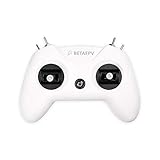
7. BETAFPV LiteRadio 2 SE – the one built for simulators and tiny quads
BETAFPV LiteRadio 2 SE Radio Transmitter Mode 2 Frsky D8
Frsky and Futaba protocols
1000mAh 1S battery
8 hour runtime
7.04 oz
Pros
- Built-in rechargeable battery with USB charging
- Works as a USB joystick for Liftoff and DRL
- On-radio joystick calibration
- Multi-protocol across Frsky and Futaba
Cons
- Will not bind to ACCST 2.0 receivers
- Only stores a single model
- Lowest rating in the group
The LiteRadio 2 SE is the odd one out in this roundup, and the only unit aimed at the FPV crowd rather than at ground vehicles. It is a compact white gamepad-style transmitter weighing 7.04 ounces, with an integrated 1000mAh 1S battery rated for up to 8 hours of use and a built-in charging module with USB charging and a low power warning.
Plug it into a PC over USB and it becomes a joystick, with Liftoff, TRYP, DRL and DJI Flight Simulator all named as supported. There is on-radio joystick calibration and over-the-air firmware updates, plus support for the BETAFPV Configurator V2 utility. Five buttons and a thumb-friendly layout make it genuinely portable.
Protocol flexibility is its other strength. You can select Frsky D8, Frsky FCC D16, Frsky LBT D16 or Futaba S-FHSS from the radio itself, which means it can talk to a wider range of receivers than most transmitters at twice the price.
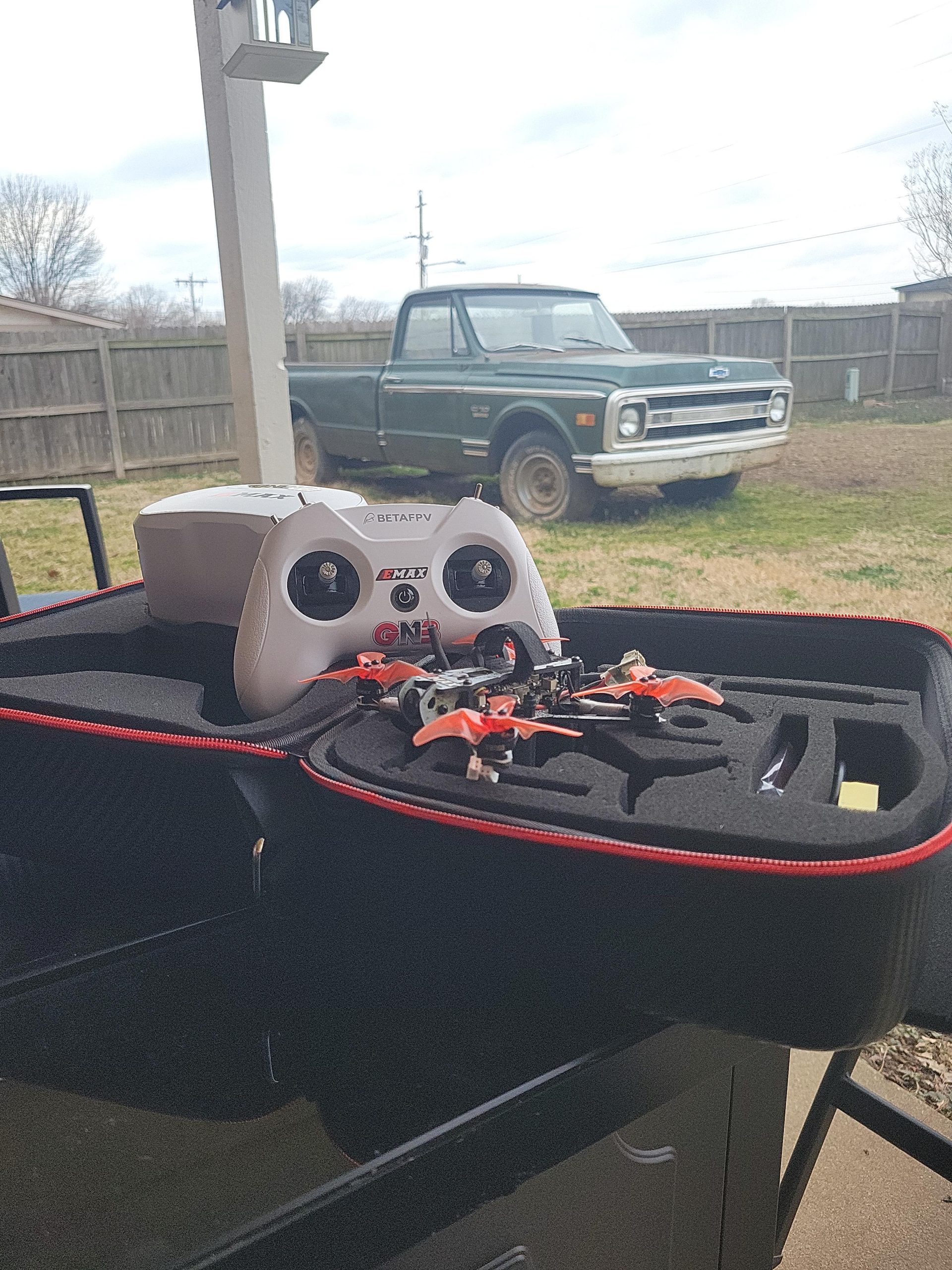
It ships in Mode 2, which is the standard throttle-on-the-left-stick configuration most pilots use. The receiver compatibility is narrower than the protocol list suggests, though, and that single detail causes more confusion than anything else about this radio.
The 4.0 star average and 236 reviews is the lowest rating count and rating in the group, and the review breakdown shows a visible share of 3-star and 1-star feedback. That is worth weighing honestly before you buy.

Who the LiteRadio 2 SE suits
It suits a pilot who wants to practise in a simulator before committing to a drone. The integrated battery removes disposable cells entirely, and the fact that it does not need a separate USB dongle makes it the simplest simulator setup in this roundup. It is also a good fit for micro and toothpick class quads that fly close in.
Travel is a genuine strength. At 7 ounces with a folding profile, it lives in a jacket pocket in a way no full-size radio here does.
Where the LiteRadio 2 SE falls short
The compatibility limit is the big one: it only binds to Frsky ACCST 1.X XM+ receivers. A receiver running ACCST 2.0 or later firmware will not pair, and buyers hit this regularly because the revision is not always obvious from the listing.
It stores a single model only, so switching aircraft means redoing your setup. It is also not suited to full-size aircraft or ground vehicles. And with a 4.0 star average, it has the least consistent owner feedback of anything on this list, so expect some rough edges that a full-size radio would not have.
8. havcybin GA-4H-TX 4CH Set – the low-cost starter with a built-in battery
havcybin 2.4ghz RC Controller 4CH RC Remote and Receiver Digital Radio Transmitter for 18 110 116 132 RC Car Boat Tank Crawler GA-4H-TX (Transmitter and Receiver Set), Black
4 channels
Internal rechargeable cell
200-300m range
8 oz
Pros
- Transmitter and receiver both included
- Rechargeable cell built into the handset
- Channel mixing for combined control
- Very light at 8 ounces
Cons
- 10-12ms response is slow against 3ms rivals
- Limited programmability
- Thin documentation and support
The GA-4H-TX does one thing the other sets here do not: the transmitter has an internal rechargeable battery. There is nothing to buy, nothing to carry and no disposable cells to leak in a bag. For a first set that will live in a toy box between outings, that is a more meaningful advantage than the specifications suggest.
It runs 2.4GHz FHSS across 67 frequency hops, with a control distance of roughly 200 to 300 metres and a 10-12ms response time. Four channels are independently adjustable, with mixing support on channels 1 and 2 so you can combine steering and throttle.
At 8 ounces it is the second-lightest radio we looked at, and the set includes the transmitter, receiver and manual. The package is aimed squarely at RC cars, boats and tanks.

What you trade away is response speed. A 10-12ms figure is four times slower than the 3ms systems from DUMBORC and INJORA, and experienced drivers notice that lag when making fast corrections. For slow scale work and small vehicles it is not a problem at all.
The review profile is the other consideration. At 4.2 stars across 191 reviews, this is the second-lowest average in the group, and it carries a comparatively high share of one-star feedback. Owners who are happy describe an inexpensive set that works; owners who are not describe limited adjustability and minimal brand support.

Who the GA-4H-TX suits
It suits a first-time buyer on the tightest possible budget who wants a complete set in one box. The internal battery means there is no accessory shopping, which matters when the whole purchase is already near the bottom of the list price.
It also suits anyone with small cars, boats or tanks who flies slowly and close in, where 200-300 metres is plenty and lightness matters more than response speed.
Where the GA-4H-TX falls short
Response lag is the honest limitation. If you have flown anything with a quicker link, going back to 10-12ms will feel sluggish immediately.
Programmability is basic, and documentation plus brand support are minimal, so expect to work things out from the manual alone. The one-star share in the reviews suggests the build and component consistency is not as uniform as the better-supported brands on this list.
9. INJORA T6F 6CH 2.4GHz Set – the safety-first six-channel option
INJORA T6F 6CH 2.4GHz Transmitter with Receiver for 1/8 1/10 RC Car
6 channels
3ms response
400-500m range
6.4 oz
Pros
- 3ms response with 400-500m range
- Throttle speed limit protects beginners
- Brake and failsafe protection
- High-voltage servo support
Cons
- Gyro availability varies between listings
- Needs 4 AA batteries
- Limited documentation
The INJORA T6F matches the DUMBORC X6 on the numbers that matter for responsiveness, and adds one feature we think is more useful than the gyro: a throttle speed limit. You can cap the maximum throttle, so a child or a new driver physically cannot pin the trigger. Owners consistently single this out as the reason the radio works well for younger or less experienced hands.
Signal response lands within 3ms across a 400-500 metre range, on 2.4GHz FHSS with 67 frequency hops. Six channels are available, with programmable mixing on channels 1 and 2 and three channels adjustable for accessory functions. Brake and failsafe protection are both present.
At 6.4 ounces it is the lightest full six-channel radio we reviewed, and the wide voltage handling is a genuine plus. The transmitter accepts 4.8V to 12V, so 1S to 3S packs work, and the receiver runs 3.3V to 10V with high-voltage servo support.
Be careful about one purchasing detail. This radio is listed in variants with and without a gyro, and the feature is not universal across the range. If the gyro matters to you, confirm which variant you are buying before you commit.
The 4.7 star average across 204 reviews is tied for the best rating in the group, and the feedback focuses on the same two things: the quick response and the beginner-friendly throttle limiter.
Who the T6F suits
It suits anyone handing a radio to a child or a beginner. The throttle speed limit, combined with brake and failsafe, is a much stronger safety story than most budget radios offer, and that combination is why it rates as highly as it does.
It also suits a pilot who wants a lightweight six-channel radio they can carry without noticing. At 6.4 ounces it disappears in a pocket in a way a 470 gram full-size transmitter does not.
Where the T6F falls short
It needs 4 AA batteries, and the documentation is limited, so the endpoint and rate settings take some figuring out. Six channels is also more than a lot of beginners will ever touch, which adds settings complexity for no immediate benefit.
The gyro variant confusion is the biggest practical trap. Read the listing carefully, and if you need the sixth channel plus the gyro, the DUMBORC X6 covers both without the ambiguity.
10. INJORA T6M 6CH 2.4GHz Set – the compact crawler radio with a sim twist
INJORA T6M 2.4GHz Transmitter with 6CH Receiver for 1/24 1/18 RC Crawler
6 channels
Throttle speed limit
USB gamepad mode
Auto power-off
Pros
- Covered trims survive being handed to friends
- Throttle speed limit for safe practice
- Usable as a USB gamepad for sim racing
- Three-stage voltage identification
Cons
- Setup mode is hard to trigger and poorly documented
- Limited rear steering adjustment
- Power-on music cannot be disabled
The T6M is a small six-channel radio built around a simple idea: it should survive being lent out. The trim and switch controls are physically covered, so a friend grabbing the radio cannot accidentally change your settings. Crawler owners who share their equipment between drivers call this out as the feature that makes the set worth having.
The link is 2.4GHz FHSS across 67 pseudo-random hops, and the throttle speed limit again makes it a safe choice for new drivers. It weighs 0.35 kg and measures 7.48 by 6.69 by 3.15 inches, a compact package for a 1/18 or 1/24 scale crawler.
Voltage handling is thorough for a budget radio. The transmitter runs 4.8V to 12V with three-stage automatic voltage identification and alarms at 4.4V, 7.4V and 10.8V, and the receiver handles 4.8V to 10V at 30mA with high-voltage servo support. It also auto powers off with an alarm after 12 minutes and switches off after 15 minutes of no activity.
Who the T6M suits
It suits scale crawler drivers running 1/18 and 1/24 vehicles, several of whom use it as a direct replacement for the handset that came with the vehicle. The compact grip and covered controls suit long sessions where a radio gets passed around between drivers.
The sim-racing angle is a genuine extra. With a USB-to-AUX cable it works as a USB game controller, which is a cheap way to practise throttle control before a crawler goes anywhere near loose ground. Brake and failsafe protection are included for track work.
Where the T6M falls short
Getting into setup mode is the recurring frustration. Owners report that the trigger is hard to activate and is not clearly documented, which makes first-time configuration needlessly slow. Rear steering adjustment is also more limited than on larger radios.
Two smaller quirks: it plays music when powering on and off, and it cannot be disabled, and the manufacturer does not recommend it for children under 14. If you need deeper setup control, the six-channel DUMBORC X6 is the better-equipped option.
How to Pick a Drone Controller in 2026
Every radio on this list does the same basic job, so the differences that matter come down to six things: channel count, radio link, gimbal feel, switch options, range and total cost once you add receivers. Here is how to weigh them.
Answer three questions first
Before comparing anything, answer these. The answers narrow ten products to two or three in under a minute.
Are you flying an aircraft or a ground vehicle? Aircraft need failsafe and, ideally, more than four channels for control surfaces. Ground vehicles are happy on three or four channels, and light control is a real bonus on a crawler.
How far do you actually fly? Under 100 metres in a garden or a basement needs almost nothing. Open field flying at the edge of a park needs the 2km reach of the Radiolink T8FB and a receiver that can support it.
Do you have an aircraft already, or are you buying the radio first? If the aircraft already exists and came with a proprietary handset, you probably need a model-locked replacement rather than anything on this list. If you are buying the radio first, you have complete freedom and any of these ten will work.
Channel count and what your aircraft really needs
Channels are independent control signals. Two channels is steering and throttle. Three adds a steering trim channel. Four covers lights, a winch or a dig function. Six opens up retracts, flaps and a camera trigger on a fixed-wing model. Eight is where you can run a full sailplane or a large-scale aircraft without mixing.
Match the count to the model and nothing more. Buying eight channels to fly a crawler means navigating menus you will never use. The FS-GT3B at three channels and the DUMBORC X4 at four are the sensible floors for ground vehicles; six is the sensible floor for anything that flies.
Radio link protocol, and why nothing here runs ExpressLRS
ExpressLRS, or ELRS, is the default radio link in the FPV hobby, and below 50 dollars you will not find it. These radios use conventional 2.4GHz FM links, either FHSS frequency hopping or a proprietary system like FlySky AFHDS 2A. The BETAFPV LiteRadio 2 SE sits in between, offering selectable Frsky D8, Frsky D16, LBT D16 and Futaba S-FHSS protocols.
That is not a flaw for the jobs these radios do. FHSS hops across dozens of channels, which gives solid anti-interference in an open field. What you do not get is the long range, the telemetry, the model scripting and the future protocol flexibility that ELRS brings. If you are moving toward FPV, plan on a step up in transmitter later, and choose a radio with a screenless, simple design you will not mind replacing.
The one exception worth noting is the LiteRadio 2 SE, which does support multiple named protocols and can be reflashed. That flexibility makes it the most forward-looking radio in the roundup despite its compatibility caveats.
Hall effect versus potentiometer gimbals
This is the biggest quality dividing line in radio controllers, and it is worth understanding even though none of these radios use hall effect sensors. A potentiometer gimbal measures stick position with a resistive element and a wiper. A hall effect gimbal measures the magnetic field around a magnet, with no moving contact.
Potentiometers wear out. The wiper rubs against the resistive track every time you move the stick, and after a few years of heavy use the reading becomes intermittent. That is the classic complaint of an ageing budget radio: the control goes flaky in one direction, or needs recalibrating every few flights.
Hall effect gimbals have no contact, so they do not wear out, and they can resolve much finer movement around the centre of the stick. That matters for precision work, where a small input needs a small output. None of the ten radios here have them. They are a reason to save up, not a reason to hesitate at this price band, because a well-made potentiometer radio like the FS-i6 is entirely serviceable.
Range, frequency band and real-world limits
Every radio here transmits on 2.4GHz. That is the consumer band, shared with wifi networks and Bluetooth devices, so interference is a real consideration in urban areas. FHSS helps by constantly moving the carrier across many pseudo-random frequencies.
Advertised range is a best case measured under ideal conditions with a clear line of sight. The Radiolink T8FB quotes 2km and doubles that with an optional receiver, which is the only figure in this roundup with genuine long-range headroom. The DUMBORC X6 and X4 quote 400 metres, the INJORA T6F quotes 400-500 metres, the FLYSKY FS-i6 quotes 500 metres, and the 4-channel Hobby Fans set quotes 150 metres.
Halve the figure for planning. Then remember that range is irrelevant without failsafe set correctly, which every radio here supports in some form. Failsafe is what happens when the link drops: the receiver takes over and brings the model to a safe state instead of holding the last command.
Total cost: the transmitter is only part of the bill
Every radio on this list ships with one receiver. Every additional aircraft needs another one. That is the hidden cost most budget buyers forget, and it is why a 50 dollar radio can turn into a 70 dollar setup.
Receivers are the cheap part, usually well under 10 dollars each, but compatibility matters. The FLYSKY FS-GT3B pairs with inexpensive FlySky receivers, which is the cheapest way to expand a system. The Radiolink T8FB outputs PWM, PPM or S-BUS and can feed a flight controller directly, which suits autopilot builds. The BETAFPV LiteRadio 2 SE is the exception, and its receiver compatibility is restricted to Frsky ACCST 1.X XM+ units.
Batteries are the other line item. The Radiolink T8FB ships without any, the FLYSKY FS-i6 needs 4 AA cells that are not included, and the FS-GT3B needs 8. Budget for cells or a pack before you commit, or your first session ends early. The DUMBORC X6 and X4 both run from USB, and the LiteRadio 2 SE and the havcybin set have internal rechargeable cells, so those three are the cheapest to keep running.
Simulator use and USB joystick support
Practising in a simulator before buying a drone is the single most common piece of advice in the flying forums, and it is good advice. A radio plus a simulator subscription costs a fraction of what one crashed aircraft costs to replace.
Of the ten radios here, the BETAFPV LiteRadio 2 SE is the dedicated answer. It connects over USB as a joystick, supports Liftoff, TRYP, DRL and DJI Flight Simulator, and does on-radio calibration so you are not fighting the setup screen. The FS-GT3B and the Radiolink T8FB have trainer ports for driving and flying sims respectively. The DUMBORC X6 and X4 support simulator use through a separate dongle. The INJORA T6M works as a USB game controller with a USB-to-AUX cable, which suits sim racing rather than flight.
One community-documented failure is worth knowing about: a budget transmitter with enough pitch jitter to fail simulator calibration makes the whole purchase feel worthless even when the hardware is fine. That is a good reason to buy from a brand with real review volume rather than the cheapest set you can find, and to calibrate gimbal endpoints carefully on a hard surface before your first session.
Used and reflashed alternatives worth considering
The forums regularly recommend a route that costs nothing: buy a used higher-tier radio. Flashing a FrSky QX7 or X-Lite to ExpressLRS is a well-known upgrade path, and a quality secondhand radio in this price range can outperform a brand-new budget set. The catch is condition, and owners raise the same concerns every time: crash damage, missing stick ends, missing caps and missing antennas.
If you go that way, check that both gimbals move smoothly through their full travel, that all switches click cleanly, and that the antenna is present and undamaged before you commit. The transmitters in this roundup are also excellent first purchases even if you later move up, because you will not have spent much to learn the basics.
What You Give Up Above the 50 Dollar Mark
Readers who search under 50 dollars are often the people who would be happy to stretch by ten or fifteen, so it is worth being honest about the boundary. Just above this line sit controllers that change what you can do rather than simply how comfortably you do it.
Hall effect gimbals are the first thing that changes. They remove the wear that ends a potentiometer radio’s useful life, and they give finer resolution around centre stick. That is the single biggest quality jump, and it is the reason many pilots treat this price band as a stepping stone rather than a destination.
The second change is the radio link. ExpressLRS on a full-size radio brings far better range at lower power, telemetry, and a protocol community that dominates the FPV hobby. The third is a screen. A colour display with EdgeTX firmware turns a transmitter into something you can configure models, check telemetry and update in the field rather than at a computer.
If you also use a gamepad for sim work on a laptop or a console, our best game controller picks cover that side of the setup.
None of that is wasted if you buy here. The skills you learn on a six-channel 2.4GHz radio transfer directly to whatever you buy next, and the budget sets on this list are all capable enough to fly a small aircraft properly rather than merely to get you into the air.
Frequently Asked Questions
Are drone controllers universal?
No. Controllers come in two families that do not work with each other. Consumer and toy drones use a model-locked handset paired to that drone’s built-in receiver, and it will not pair with a different drone or with any hobby radio. Hobby RC and FPV transmitters are a separate category that ships with a universal receiver and can drive any aircraft built to that protocol. Always check the exact model number of your drone before buying a replacement handset.
Can I use a different remote for my drone?
For a consumer or toy drone, usually not. The receiver is bound to one specific handset, and aftermarket compatibility is not guaranteed even when the listings look identical. Match the full model number, the frequency band and the control range before you buy. For a hobby drone built around an RC transmitter, a different remote is straightforward as long as the radio link protocol matches the receiver, which is why the Frsky, FlySky and Futaba protocol options matter.
Can you get a replacement remote for a drone?
Yes, in both categories. For a consumer drone, search using the full model number of the drone and buy the handset listed for it, and confirm the listing includes the correct frequency band. For a hobby aircraft, replacement is easier because the transmitter is not model-locked; you can move to a different radio as long as it speaks the same protocol as the receiver on the aircraft. Losing the original handset does not normally mean losing the drone itself.
What is the best ELRS transmitter for drones?
Under 50 dollars, ELRS is effectively unavailable. The sub-50 tier runs on conventional 2.4GHz links such as FHSS and FlySky AFHDS 2A. The closest option is the BETAFPV LiteRadio 2 SE, which offers selectable Frsky D8, Frsky D16, LBT D16 and Futaba S-FHSS protocols and a built-in rechargeable battery. If ExpressLRS is a requirement, you are shopping above this price band or looking at a used radio that can be flashed.
What is the cheapest transmitter and receiver set for an RC plane?
For a small fixed-wing model, the FLYSKY FS-i6 is the cheapest route to a genuine six-channel radio with a receiver included. It offers AFHDS 2A on 2.4GHz, up to 500 metres of range, six model memories and a unique ID stored at binding. Add a throttle speed limit consideration if a beginner will fly it, and budget for 4 AA batteries, which are not included in the box.
Can I practise in a simulator with a budget drone controller?
Yes, and it is a good idea before buying a drone. The BETAFPV LiteRadio 2 SE is built for it, connecting over USB as a joystick for Liftoff, TRYP, DRL and DJI Flight Simulator with on-radio calibration and a built-in rechargeable cell. The Radiolink T8FB and the Flysky FS-GT3B have trainer and simulator functions, and the DUMBORC X6 and X4 support simulator use with a separate dongle.
The Verdict
The best drone controllers under 50 dollars all share one trait: they are real multi-channel hobby radios, not toy handsets in a different shape. The DUMBORC X6 takes the top spot with six channels, 3ms response, an adjustable gyro and the strongest review history in the group. If you need reach, the Radiolink T8FB is the only one here with genuine long-range capability. If you want the gentlest first step, the FLYSKY FS-i6 is the one to beat.
Buy the X6 for anything that flies, the Radiolink T8FB for open fields and autopilot builds, the Flysky FS-GT3B for ground vehicles, and the BETAFPV LiteRadio 2 SE if your real goal is simulator time. Add a receiver for every extra aircraft and batteries if the set does not include them, and re-check the price on 29 September 2026 before you order. If you are still comparing drones rather than controllers, our budget drone guide covers the aircraft side.