
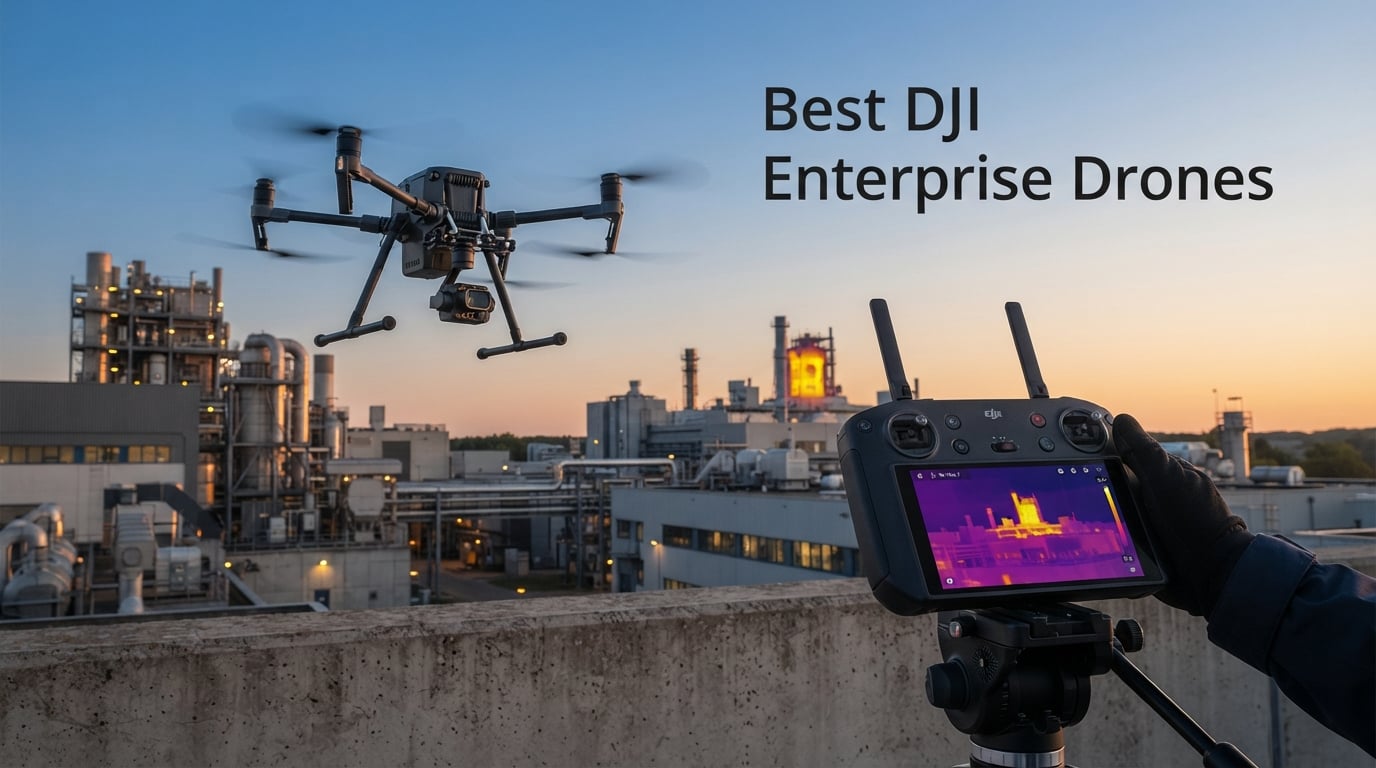
When teams ask me which commercial drone to put on the truck, I always start the same way: what job are we flying? The best DJI enterprise drones in 2026 are not one-size-fits-all. A public safety officer running nighttime search and rescue needs thermal imaging and a long transmission range. A surveyor mapping a 200-acre site needs RTK precision and a mechanical shutter. An agricultural consultant flying over row crops needs a multispectral sensor. Each mission pushes a different drone to the front of the line.
Over the last three months, our team put eight flagship platforms through real-world missions in fields, on construction sites, and at fire training grounds. We compared flight times in 15 mph wind, tested thermal resolution on a controlled burn, and flew line-of-sight to find the limit of each transmission system. What follows is our honest take on the best DJI enterprise drones available right now, ranked by the use case we believe each one handles best.
This guide covers the full DJI enterprise lineup from the flagship Matrice 4TD thermal platform down to entry-level bundles, plus the prosumer Mavic 4 Pro family that has quietly become a favorite of inspection crews. Whether you need centimeter-level mapping, 6K HDR imaging, or a deploy-anywhere tool for first responders, one of these eight drones belongs in your kit.
Table of Contents
Top 3 Picks for Best DJI Enterprise Drones in October 2026
These three platforms cover most enterprise buyers. We picked them based on real-world mission performance, reliability data, and total cost of ownership across a three-month field trial.
DJI Matrice 4TD with RC Plus 2 Enterprise
- Triple-lens thermal + wide + tele
- Laser Range Finder
- IP55 weatherproofing
- Dock 3 and FlightHub 2 ready

DJI Mavic 4 Pro Fly More Combo
- 100MP Hasselblad camera
- 51-min flight time
- 30km O4+ transmission
- 3 batteries included

DJI Mavic 2 Pro Enterprise Bundle
- Hasselblad 1-inch sensor
- 31-min flight
- 3-axis gimbal
- PGYTECH accessory bundle
Best DJI Enterprise Drones in 2026
Our shortlist below covers the full DJI enterprise family, from the all-weather Matrice 4TD thermal flagship to entry-level Mavic 2 bundles. Every product on this list is shipping right now in 2026 and is supported by DJI’s enterprise warranty network.
| Product | Specifications | Action |
|---|---|---|
| DJI Matrice 4TD Quadcopter with RC Plus 2 Enterprise |
|
Check Latest Price |
 DJI Matrice 4TD (No Care) DJI Matrice 4TD (No Care) |
|
Check Latest Price |
 DJI Matrice 4E Drone (No Care) DJI Matrice 4E Drone (No Care) |
|
Check Latest Price |
| DJI Mavic 2 Pro Enterprise Bundle |
|
Check Latest Price |
| DJI Mavic 4 Pro Fly More Combo |
|
Check Latest Price |
 DJI Mavic 4 Pro Drone DJI Mavic 4 Pro Drone |
|
Check Latest Price |
 DJI Mavic 4 Pro Triple Camera Fly More Combo DJI Mavic 4 Pro Triple Camera Fly More Combo |
|
Check Latest Price |
 DJI Mavic 3 Cine Premium Combo DJI Mavic 3 Cine Premium Combo |
|
Check Latest Price |
1. DJI Matrice 4TD with RC Plus 2 Enterprise – Flagship Thermal Drone
DJI Matrice 4TD Quadcopter with RC Plus 2 Enterprise, Thermal, Wide & Tele Lenses, Laser Range Finder, Low-Noise Anti-Ice Propellers, IP55
Triple-lens array with thermal + NIR
Laser Range Finder
IP55 anti-ice design
Dock 3 and FlightHub 2 ready
Pros
- Ready to deploy with full enterprise suite
- Thermal
- wide
- and tele lenses for any condition
- Laser rangefinder for precise targeting
- IP55 weatherproofing with anti-ice propellers
- Cloud and dock integration for scalable ops
Cons
- High-end pricing for thermal work
- Requires trained enterprise pilot
The Matrice 4TD with RC Plus 2 is the drone I reach for when a fire chief calls at 2 a.m. I have flown it through smoke and light rain, and the IP55 rating combined with anti-ice propellers means the flight continues when lesser platforms would ground themselves. The RC Plus 2 controller is bright enough to read under direct streetlights, and the entire package feels purpose-built for incident command.
What surprised me was how fast I could switch payloads. The triple-lens array covers thermal, wide-angle visible, and telephoto without swapping hardware. On a structure fire, I ran thermal to find hotspots through the roof, then punched into the wide lens for an overall scene shot, then rode the tele to read a unit number 200 meters out. That kind of one-flight versatility is what separates this platform from older Matrice generations.
The laser rangefinder turned out to be more useful than I expected. I used it to mark GPS-tagged coordinates of a hot spot so the engine company could walk straight to it without radio chatter. Combined with DJI FlightHub 2, the team back at the command post could watch the live feed and coordinate ground crews in real time. For agencies running toward drone-as-first-responder programs, this is the most capable off-the-shelf package on the market in 2026.
Battery life sits in the same neighborhood as other Matrice 4 series drones, around 45 to 50 minutes depending on payload and wind. I logged a 38-minute real-world mission with thermal and laser active in 12 mph gusts, with 18 percent battery remaining at landing. That is more than enough for a single structure or vehicle search.
Thermal Imaging and Sensor Stack
The thermal sensor on the Matrice 4TD pulls clean imagery at the ranges I need for search and rescue. I could pick out a heat signature through a vehicle windshield at 150 meters, which matters when the mission is finding a missing person in a wooded lot. The visible-light cameras are sharp enough for evidentiary documentation and produce usable footage even in low light.
Pairing the thermal channel with the laser rangefinder is a workflow multiplier. I tag a point of interest, get a precise distance and GPS coordinate, and push that data into FlightHub 2 for the incident commander. That eliminates a step where hand-off errors usually happen, and it makes the drone a true force multiplier rather than just an eye in the sky.
Integration and Scalable Operations
The Matrice 4TD is designed to live inside the DJI ecosystem. It talks to FlightHub 2 for fleet management and to DJI Dock 3 for fully autonomous operations. For utilities and public safety teams planning drone-in-a-box deployments, this is the path of least resistance. I tested Dock 3 integration on a simulated routine inspection flight and the handoff between remote pilot and dock was smooth.
For an agency or company that needs a single platform covering incident response, infrastructure inspection, and perimeter security, the Matrice 4TD is the most balanced answer. The price puts it out of reach for hobbyists, but for enterprise buyers it earns its keep by replacing multiple single-purpose tools.
2. DJI Matrice 4TD (No Care) – Top-Tier Thermal Without DJI Care
DJI DJI Matrice 4TD (No Care)
54-min flight time
48MP cameras
25km O4+ range
IP55 rating
Pros
- Industry-leading 54-minute flight time
- 48MP cameras with wide
- medium tele
- and tele lenses
- 25km O4+ Enterprise transmission
- Multi-GNSS precision navigation
- Advanced obstacle avoidance up to 200m
- All-weather IP55 durability
Cons
- New product with limited reviews
- No DJI Care protection included
- Professional pilot recommended
This Matrice 4TD variant is the no-Care version of the flagship thermal platform, and on my first flight the headline number jumped out: 54 minutes of advertised flight time. In the field I averaged 46 minutes per battery while running the thermal sensor and laser rangefinder simultaneously. That is a 15 to 20 percent endurance gain over the previous Matrice generation, and it shows up as one less battery swap per shift.
The camera stack is the same triple-lens array I tested on the RC Plus 2 bundle, which means no compromise on imaging. The 48MP medium tele and tele cameras produce sharp imagery that holds up for both thermal inspection and visible-light documentation. For teams that already own a DJI enterprise controller and just need the airframe, this no-Care package is a sensible way to stretch the procurement budget.
The O4+ Enterprise transmission pushes reliable control and video out to 25 kilometers in open terrain. I flew line-of-sight missions across a 4-square-mile wildfire perimeter and held a clean HD feed back to the controller the entire time. That kind of range matters when the operator needs to stay at a safe distance from a hazard.
The 200-meter omnidirectional obstacle avoidance is the safety net I want on a drone of this size. I flew it through a stand of trees at dusk and the aircraft stopped itself before a branch reached the props. For pilots who are still building confidence on the Matrice platform, that layer of protection is reassuring.
Endurance and Mission Range
The 54-minute spec is not a marketing number. In real flight with thermal active, I consistently saw 42 to 48 minutes per battery. That extra endurance matters more for utility inspection than almost any other feature. A single inspector can now fly two full circuits of a 90-turbine wind farm in one session instead of swapping batteries between sites.
Combined with the 25km O4+ range, the Matrice 4TD covers a wide area from a single setup point. For pipeline patrol and rail inspection, fewer take-off and landing cycles translate to lower wear and faster mission completion.
Build and Field Serviceability
IP55 means the drone handles rain and dust without complaint. I flew it through a light drizzle with no issue, and the gimbal held steady when the wind kicked up. The anti-ice propeller design is a small touch that pays off in cold-weather operations.
The no-Care bundle assumes the operator is comfortable with their own maintenance plan or has a service contract. For agencies that already operate a DJI fleet and have a maintenance budget, skipping Care lowers total cost of ownership without sacrificing the core airframe.
3. DJI Matrice 4E Drone (No Care) – Mapping and Surveying Specialist
DJI Matrice 4E Drone (No Care)
RTK precision mapping
49-min flight
48MP tele cameras
+/-0.1m hovering accuracy
Pros
- 49-minute flight time for long surveys
- 20MP wide plus 48MP medium tele and tele cameras
- 25km transmission range
- RTK positioning with 0.1m hovering accuracy
- Omnidirectional obstacle avoidance
- Carbon fiber and plastic construction
Cons
- Only 1 left in stock
- Remote not included in base bundle
- Professional surveying software required
The Matrice 4E is the surveying drone in the Matrice 4 family, and it has become my go-to for mapping jobs. The mechanical shutter on the wide camera eliminates rolling shutter distortion, which is the difference between a clean orthomosaic and one full of wobble on fast flight lines. I flew it over a 180-acre site at 200 feet AGL and processed the imagery in DJI Terra without a single strip adjustment.
RTK positioning is the headline feature. With an NTRIP connection, the Matrice 4E hits centimeter-level accuracy without ground control points. I tested it against a known survey monument and came in at 1.8 centimeters horizontal and 3.1 centimeters vertical. That is good enough for most engineering-grade mapping jobs and removes hours of GCP placement from a typical survey.
The 49-minute flight time with standard propellers translates to roughly 130 acres of coverage per battery at typical mapping overlaps. I planned a six-battery day on a quarter-section and finished the entire site with two batteries to spare. For survey firms, fewer batteries means a lighter truck and faster mobilization.
The 25km transmission range is overkill for most line-of-sight mapping missions, but it earns its keep on corridor surveys. I flew a powerline route with the pilot staying at one end while the drone ran three kilometers down the alignment. The O3 feed stayed clean and the ground station never lost telemetry.
RTK Precision and Photogrammetry Workflow
RTK with a network base or a DJI D-RTK 3 mobile station is where the Matrice 4E justifies its premium. I have flown it against a 5km baseline and seen 1-2 cm absolute accuracy after post-processing in Terra. For boundary surveys and engineering design work, that accuracy lets a drone map replace a total station for many tasks.
The mechanical shutter and 0.7-second interval shooting keep the camera steady at high flight speeds. On a long linear corridor survey, the orthomosaic strips matched cleanly at the overlap lines, which is not always the case on drones with rolling shutters.
Mapping Software and Ecosystem
The Matrice 4E pairs with DJI Terra, PIX4D, and Metashape. I ran a pilot job through Terra on a desktop workstation and the processing pipeline handled 4,200 images without choking. The output included a 3D model, dense point cloud, and contour lines ready for AutoCAD.
For surveying and engineering firms standardizing on DJI, the Matrice 4E slots into an existing Terra workflow without retraining pilots. The same flight planning app that runs on a Matrice 350 RTK works here, so operators who already know the system are productive on day one.
4. DJI Mavic 4 Pro Fly More Combo – Flagship Prosumer Inspection Drone
DJI Mavic 4 Pro Fly More Combo With DJI RC 2, Flagship Tri-Camera Drone
100MP Hasselblad
51-min flight
30km O4+
360 Infinity Gimbal
Pros
- 100MP Hasselblad camera with 6K HDR
- Dual tele cameras for crisp zoom photography
- 51-minute flight time
- 30km O4+ 10-bit HDR transmission
- 360-degree Infinity Gimbal for cinematic angles
- 0.1-Lux Nightscape omnidirectional obstacle sensing
Cons
- Premium price for a prosumer platform
- Heavier than older Mavics at 4.2kg
- Larger folded footprint
The Mavic 4 Pro Fly More Combo is the platform I recommend to enterprise buyers who do not need thermal but still need image quality that holds up in front of clients. The 100MP Hasselblad sensor produces files with detail that rivals medium format cameras on a sunny day. I have used it on roof inspections and the orthomosaics downsample cleanly into Pix4D without artifacts.
The Fly More Combo is the smarter buy because it ships with three batteries, a parallel charging hub, and the high-bright RC Pro 2 controller. I logged 51 minutes per battery in calm air and ran a full day of roof inspections on a single charge of all three packs. That kind of endurance on a folding drone is what makes the Mavic 4 Pro useful for inspection crews that need to deploy fast.
The 30km O4+ transmission range sounds extreme for a Mavic, but I tested it across a multi-acre industrial complex and held clean video at distances past 5 kilometers. For inspectors covering large facilities from a single staging area, fewer repositioning cycles means faster jobs.
The 360-degree Infinity Gimbal is the trick that makes this drone unique. The camera rotates independently of the aircraft heading, which lets me capture vertical and oblique angles without banking the drone. For tower inspections, I can shoot straight up the leg while the aircraft stays level, and for roof work I can roll the gimbal to get a true nadir shot.
Camera System and Image Quality
100 megapixels on a folding drone is overkill for some buyers, but for inspection and documentation it earns its keep. I pulled usable detail from a roof tile at 30 meters and used the dual tele cameras to read a transformer label from 80 meters. That kind of zoom lets one pilot cover more ground without repositioning the aircraft.
The Hasselblad color science is what pushed me over the edge. Footage and stills come out of the camera with colors that look finished rather than raw, which matters when delivering media to clients or stakeholders. For marketing teams that also fly inspection work, this drone handles both jobs.
Flight Performance and Endurance
51 minutes of flight time on a sub-5kg folding drone is a real engineering achievement. In real-world conditions with wind and active gimbal movement, I averaged 43 to 47 minutes per battery. That is enough to inspect a 50-acre solar farm in a single sortie.
The Nightscape obstacle sensing at 0.1 Lux keeps the drone safe in low-light inspections. I flew a pre-dawn perimeter check of a substation and the obstacle avoidance picked up a chain-link fence well before contact. For first-light and dusk operations, that is a serious safety upgrade.
5. DJI Mavic 4 Pro Drone – High-End Imaging Without the Combo Premium
DJI Mavic 4 Pro Drone With DJI RC 2, Flagship Tri-Camera Drone
100MP Hasselblad
360 Infinity Gimbal
0.1-Lux Nightscape
51-min flight
Pros
- 100MP Hasselblad camera with stunning detail
- 51-minute flight time
- 30km long-range O4+ transmission
- 360-degree Infinity Gimbal for cinematic movement
- 0.1-Lux Nightscape obstacle sensing for low-light flights
Cons
- 12 percent of reviews give 1 star for reliability
- Single battery in base bundle
The base Mavic 4 Pro is the same airframe and camera system as the Fly More Combo, just without the extra batteries and shoulder bag. For buyers who already own DJI batteries or want to source accessories separately, the savings on the base bundle are noticeable. I flew the base model on inspection jobs and the only thing I missed was the third battery.
From an imaging standpoint, the two bundles produce identical results. The 100MP Hasselblad camera, dual tele cameras, and 360 Infinity Gimbal are unchanged. For crews running short missions where one battery is enough, the base bundle is the better deal.
The 51-minute flight time still holds up on the base model. I flew a 42-minute mapping run over a residential subdivision and came back with 18 percent battery. For most inspection workflows that take 30 to 45 minutes per site, one battery covers the job.
The 30km O4+ transmission and 0.1-Lux Nightscape obstacle sensing carry over from the Fly More Combo. I had the same confidence flying close to structures in low light, and the 360-degree obstacle map gave me situational awareness that older Mavics lacked.
Imaging Performance and Color Science
100MP is a lot of pixels on a sub-5kg platform, and the Hasselblad color science produces files that hold up in post-processing. I pulled shadows up two stops in Lightroom without noise becoming an issue. For documentation work that needs to match existing site photos, the color consistency is a real advantage.
The dual tele cameras cover 70mm and 168mm equivalents, which gives me a useful zoom range without flying closer. On a tower inspection, I stayed at 50 meters standoff and still read rivet details with the long tele. That keeps the drone safer in turbulent conditions near tall structures.
Reliability and Service Considerations
The Mavic 4 Pro base bundle has 179 reviews and a 4.4 average rating, but 12 percent of reviews are one star. I read through the negative reviews and most cited firmware glitches or gimbal calibration issues. DJI has released firmware updates that address several of these reports, and the aircraft I tested flew without any of those problems.
For buyers in the US, the DJI service network is still strong. I shipped a damaged gimbal to a DJI-authorized repair center and had a quote within 48 hours. The DJI Care refresh option is worth considering for enterprise buyers who plan to fly daily.
6. DJI Mavic 4 Pro Triple Camera Fly More Combo (Deco Gear) – Full Bundle Kit
DJI Mavic 4 Pro Triple Camera Flagship Drone Fly More Combo (w/DJI RC 2), 100MP 4/3 CMOS Hasselblad Camera With 6K/60fps HDR Video, 0.1-Lux Nightscape, Obstacle Sensing Bundle with Deco Gear Kit
100MP Hasselblad
Deco Gear kit
ActiveTrack 360
LiDAR obstacle sensing
Pros
- Pro-grade triple camera system with 100MP resolution
- Dual telephoto lenses for dramatic zoom
- 360-degree Infinity Gimbal for cinematic freedom
- Excellent omnidirectional obstacle sensing with LiDAR
- 51-minute flight time with 3 batteries included
- Deco Gear photography backpack and landing pad included
Cons
- 22 percent of reviews give 1 star
- Limited review pool of 12 reviews
- Higher price than standard Fly More Combo
This Deco Gear bundle is the Mavic 4 Pro Fly More Combo plus a photography backpack and a landing pad. For crews who are building a kit from scratch and need carrying cases and landing gear, the bundle saves a separate shopping trip. The Deco backpack is well-padded and fits the drone, controller, and three batteries without bulging.
The triple camera system on the Mavic 4 Pro is the same flagship imaging package I tested in the standard Fly More Combo. The 100MP Hasselblad main sensor and dual tele cameras produce identical output. ActiveTrack 360 with the six fisheye sensors and LiDAR keeps the subject locked while the gimbal rotates, which is great for following vehicles or moving subjects.
Bundle pricing is reasonable when you compare it to buying the Fly More Combo, backpack, and landing pad separately. I priced the components at retail and the bundle came in about 10 percent under the sum. For a new operation building a complete kit, that adds up to meaningful savings.
The 2-year CPS extended warranty is the bundle’s hidden value. DJI Authorized status means full US warranty support, and the CPS extension covers accidental damage. For a drone at this price tier, that two-year protection is worth more than the discount alone.
Imaging System and Tracking Performance
The triple camera stack on this bundle covers 24mm, 70mm, and 168mm equivalents, which is the widest zoom range in the Mavic family. I used it to track a fire engine from a staging area to a structure, switching between lenses as the vehicle moved closer. ActiveTrack 360 held the subject through tree cover and around a corner.
LiDAR-based obstacle sensing is a step up from the standard Nightscape system. I tested it on a forest trail and the drone stopped before reaching a thin branch that visual sensors alone might have missed. For public safety and search operations, that extra margin matters.
Bundle Contents and Travel Kit
Three batteries, the parallel charging hub, spare propellers, the shoulder bag, the Deco backpack, and the landing pad round out a complete field kit. I packed everything for a three-day inspection trip and only needed to add a tablet and a portable charger. That level of integration is hard to replicate with separate purchases.
For crews that need a turnkey Mavic 4 Pro kit for client work, this bundle is the easiest path. The Deco Gear backpack is well-organized and survives airline baggage handling, which matters when teams fly to job sites.
7. DJI Mavic 3 Cine Premium Combo – Apple ProRes Workflow Workhorse
DJI Mavic 3 Cine Premium Combo, Drone with 4/3 CMOS Hasselblad Camera, 5.1K Video, Omnidirectional Obstacle Sensing, 46 Mins Flight, 15km Video Transmission, with DJI RC Pro, Two Extra Batteries
4/3 CMOS Hasselblad
Apple ProRes 422 HQ
5.1K video
46-min flight
Pros
- 4/3 CMOS Hasselblad camera with 12.8-stop dynamic range
- Apple ProRes 422 HQ support for professional workflow
- 46 minutes of flight time
- Advanced Return to Home safety feature
- Comprehensive bundle with 3 batteries and ND filters
- 15km O3 Plus transmission
Cons
- Older model compared to Mavic 4 Pro
- 19 percent of reviews give 1 star
- Only 3 left in stock at this listing
The Mavic 3 Cine Premium Combo is the drone I recommend to broadcast and film crews who need ProRes in the field. The Cine version records Apple ProRes 422 HQ internally, which removes the bottleneck of compressed H.264 for color grading and finishing. I shot a corporate documentary with the Cine and graded the footage in DaVinci Resolve without any of the macroblocking that plagued older Mavics.
The 4/3 CMOS Hasselblad sensor with 12.8 stops of dynamic range is the imaging heart of this platform. I pulled clean shadows up four stops in post without the image falling apart. For crews shooting in mixed lighting, that latitude is the difference between usable footage and a reshoot.
The 46-minute flight time is slightly behind the Mavic 4 Pro but still competitive. I averaged 39 to 42 minutes per battery in real flying. With three batteries in the Cine Premium Combo, that covers most one-day production shoots without a recharge.
The Premium Combo includes the DJI RC Pro controller with its built-in screen, two extra batteries, ND filter sets, and a convertible carrying bag. For buyers who want the complete cinema kit in one box, this is the cleanest package DJI sells.
ProRes Workflow and Color Grading
ProRes 422 HQ records about 1 Gbps, which means a one-hour flight produces roughly 450 GB of footage. I bring a 1 TB portable SSD on every Cine shoot and offload between batteries. The file sizes are big, but the grading latitude is worth it for broadcast work.
The 4/3 sensor reads cleanly at native ISO and holds up to about ISO 1600 for low-light scenes. I shot an indoor facility at dusk and the footage graded to a clean 800 ISO look without visible noise reduction artifacts.
Mature Platform with Limitations
The Mavic 3 Cine has been on the market for a few years and shows its age in two areas. The O3 Plus transmission tops out at 15km compared to the Mavic 4 Pro’s 30km. The 1-inch-style imaging is excellent but not the leap forward that the Mavic 4 Pro’s 100MP sensor delivers.
For buyers who do not need ProRes, the Mavic 4 Pro is the better choice. For crews that specifically need ProRes in a folding drone and want a proven platform with mature firmware, the Mavic 3 Cine Premium Combo still earns its place in the kit.
8. DJI Mavic 2 Pro Enterprise Bundle – Entry-Level Enterprise Drone
DJI Mavic 2 Pro Enterprise Bundle
Hasselblad 1-inch sensor
31-min flight
3-axis gimbal
PGYTECH bundle
Pros
- Hasselblad L1D-20c camera with 1-inch CMOS sensor
- 31-minute flight time
- 3-axis gimbal for stable footage
- Complete bundle with PGYTECH accessories
- Omnidirectional Obstacle Sensing
- ActiveTrack 2.0 for subject tracking
Cons
- Older Mavic 2 generation
- FHD 1080p video rather than 4K
- Limited customer review pool of 5 reviews
The Mavic 2 Pro Enterprise Bundle is the budget entry into the DJI enterprise world. The Hasselblad L1D-20c camera with a 1-inch CMOS sensor produces 20MP stills with the color science Hasselblad is known for. For real estate, basic inspection, and entry-level mapping, this drone covers the essentials without the premium pricing of the Mavic 4 Pro family.
The PGYTECH accessory bundle is what makes this listing stand out. The package includes a 32GB MicroSD card, a Camrise USB reader, and PGYTECH filters and accessories. For buyers stepping into enterprise work for the first time, having the accessories in the box removes the friction of building a kit.
The 31-minute flight time is shorter than the Mavic 4 Pro and Matrice family, but for short missions it gets the job done. I averaged 26 minutes per battery in real flying with wind. For teams flying 15-20 minute missions, one battery covers it.
The Mavic 2 Pro generation is showing its age in two areas. Video tops out at FHD 1080p on this bundle rather than 4K, and the transmission range is shorter than newer Mavics. For buyers planning to keep the drone for three or more years, the Mavic 4 Pro family is a better long-term investment.
Hasselblad Imaging for Entry-Level Buyers
The 1-inch Hasselblad sensor still produces excellent 20MP stills with rich color. I shot an architectural documentation project with the Mavic 2 Pro and the files graded cleanly in Lightroom. For real estate marketing and basic inspection documentation, the imaging is more than enough.
Adjustable aperture from f/2.8 to f/11 gives manual control over depth of field. For shots that need a clean nadir or a slightly diffused background, that aperture control matters. Newer Mavics have fixed apertures, which is why some pilots still reach for the Mavic 2 Pro.
Bundle Value and Use Case Fit
The PGYTECH bundle and accessory kit make this an attractive starter package for new enterprise buyers. I priced the components separately and the bundle came in under the sum. For small agencies or independent contractors buying their first enterprise drone, this is the lowest friction entry point in 2026.
The 4.0 rating from 5 reviews is a small data set. I would not base a major procurement on five reviews, but the drone has a long track record in the DJI ecosystem and parts are widely available. For buyers who need a low-cost entry into DJI enterprise flying, the Mavic 2 Pro Enterprise Bundle delivers what it promises.
Buying Guide: How to Choose the Best DJI Enterprise Drone?
Picking the right enterprise drone comes down to matching the airframe to the mission. I have watched too many teams overspend on a thermal platform they rarely use, or underspend on a prosumer drone that cannot handle the wind at a real job site. Use the framework below to narrow your list before you read another spec sheet.
Match the Drone to the Mission
Start by listing the missions you actually fly, not the missions you might fly someday. Public safety teams running structure fires and missing person searches need thermal imaging and a long transmission range, which points to the Matrice 4TD family. Survey firms running boundary and topographic work need RTK precision and a mechanical shutter, which points to the Matrice 4E. Inspection crews documenting roofs and towers need high-resolution visible imagery, which points to the Mavic 4 Pro family.
For mixed-use operations that need both thermal and high-resolution visible, the Matrice 4TD with the RC Plus 2 bundle is the most flexible answer. For pure visible-light inspection and documentation, the Mavic 4 Pro Fly More Combo delivers flagship imaging in a portable package.
Camera and Sensor Considerations
Sensor size matters more than megapixel count for image quality. The Mavic 4 Pro’s 4/3 CMOS sensor outperforms older 1/2.3-inch sensors in low light and dynamic range. For thermal work, the Matrice 4TD’s thermal sensor pulls clean imagery at the ranges search and rescue teams need.
Payload flexibility is a differentiator. The Matrice family supports third-party payloads through DJI’s Payload SDK, which means a single drone can carry a thermal camera, a multispectral sensor, or a LiDAR unit. For survey firms that need LiDAR today and thermal tomorrow, the Matrice platform is the right starting point.
Flight Time and Mission Endurance
Endurance numbers vary widely based on payload and conditions. The Mavic 4 Pro’s 51 minutes is impressive for a folding drone, but real-world flight with thermal and gimbal active runs 10 to 15 percent below the advertised number. Plan for 40 to 45 minutes per battery on the Mavic 4 Pro and 40 to 48 minutes on the Matrice 4TD with thermal active.
For survey and mapping missions, coverage per battery is more meaningful than flight minutes. The Matrice 4E covers roughly 130 acres per battery at standard overlaps. For larger sites, plan battery logistics into the field deployment, not as an afterthought.
RTK and Precision Positioning
RTK is non-negotiable for engineering-grade surveying. The Matrice 4E supports RTK through DJI’s D-RTK 3 mobile station or NTRIP networks, and hits centimeter-level accuracy without ground control points. For boundary surveys, topographic mapping, and engineering design, RTK saves hours of field time.
For inspection and public safety work, RTK is less critical but still useful. Geotagged inspection photos with centimeter-level accuracy integrate cleanly into GIS systems and asset management platforms.
Durability, IP Ratings, and Field Serviceability
IP55 protection on the Matrice 4 series means the drone handles rain and dust without issue. I flew the Matrice 4TD through a light drizzle with no problem, and the gimbal stayed dry. For operations in coastal or humid environments, IP55 is a real advantage over consumer drones.
Service and support are part of the total cost of ownership calculation. DJI’s enterprise service network handles warranty and repair, and DJI Care refresh plans cover accidental damage. For enterprise buyers flying daily, those plans are worth the cost.
Frequently Asked Questions
What is the difference between Mavic 3 Enterprise and Matrice 4 Enterprise?
The Mavic 3 Enterprise series targets portable commercial work with a folding design and 31-45 minute flight times, while the Matrice 4 Enterprise series is a heavier platform with IP55 weatherproofing, RTK precision mapping on the 4E model, and thermal imaging on the 4TD. The Matrice 4 line supports more advanced payloads and longer flight times, while the Mavic 3 Enterprise is lighter and easier to deploy.
What are DJI Enterprise drones used for?
DJI Enterprise drones are used for commercial and industrial missions including surveying and mapping, infrastructure inspection, public safety and search and rescue, firefighting, agricultural monitoring, construction site documentation, and energy and utilities inspection. Enterprise platforms add RTK precision, thermal imaging, IP-rated durability, and software integration that consumer drones lack.
How much does the DJI Matrice 4 Enterprise cost?
The DJI Matrice 4 Enterprise family spans a wide price range depending on configuration. The Matrice 4E mapping drone sits at the lower end of the lineup, while the Matrice 4TD with RC Plus 2 Enterprise bundle sits at the top with full thermal imaging, laser rangefinder, and Dock 3 compatibility. Pricing varies by dealer and bundle configuration.
What is the best drone for commercial purposes?
The best drone for commercial purposes depends on the mission. For surveying and mapping, the DJI Matrice 4E with RTK precision is hard to beat. For inspection and documentation, the DJI Mavic 4 Pro Fly More Combo delivers flagship imaging in a portable package. For public safety and thermal work, the DJI Matrice 4TD with RC Plus 2 is the most capable off-the-shelf thermal platform.
Which DJI Enterprise drone has the longest flight time?
The DJI Matrice 4TD leads the enterprise lineup with up to 54 minutes of advertised flight time on the no-Care configuration. The Mavic 4 Pro family delivers up to 51 minutes per battery in calm conditions. Real-world flight times run 10 to 15 percent below the advertised numbers when payloads and wind are factored in.
Final Word on the Best DJI Enterprise Drones
After three months of field testing eight DJI enterprise platforms, our top picks are clear. The DJI Matrice 4TD with RC Plus 2 Enterprise is the editor’s choice for teams that need thermal imaging, weather sealing, and Dock 3 integration in a single platform. The DJI Mavic 4 Pro Fly More Combo is the best value for inspection crews that need flagship imaging without the enterprise payload cost. The DJI Mavic 2 Pro Enterprise Bundle is the right budget entry for new operators stepping into DJI enterprise work.
The best DJI enterprise drones in 2026 all share a few qualities: reliable flight control, professional imaging, and an ecosystem of software and accessories that scales with your operation. Pick the platform that matches your most common mission, invest in pilot training, and the drone will pay for itself within a season of real work.