
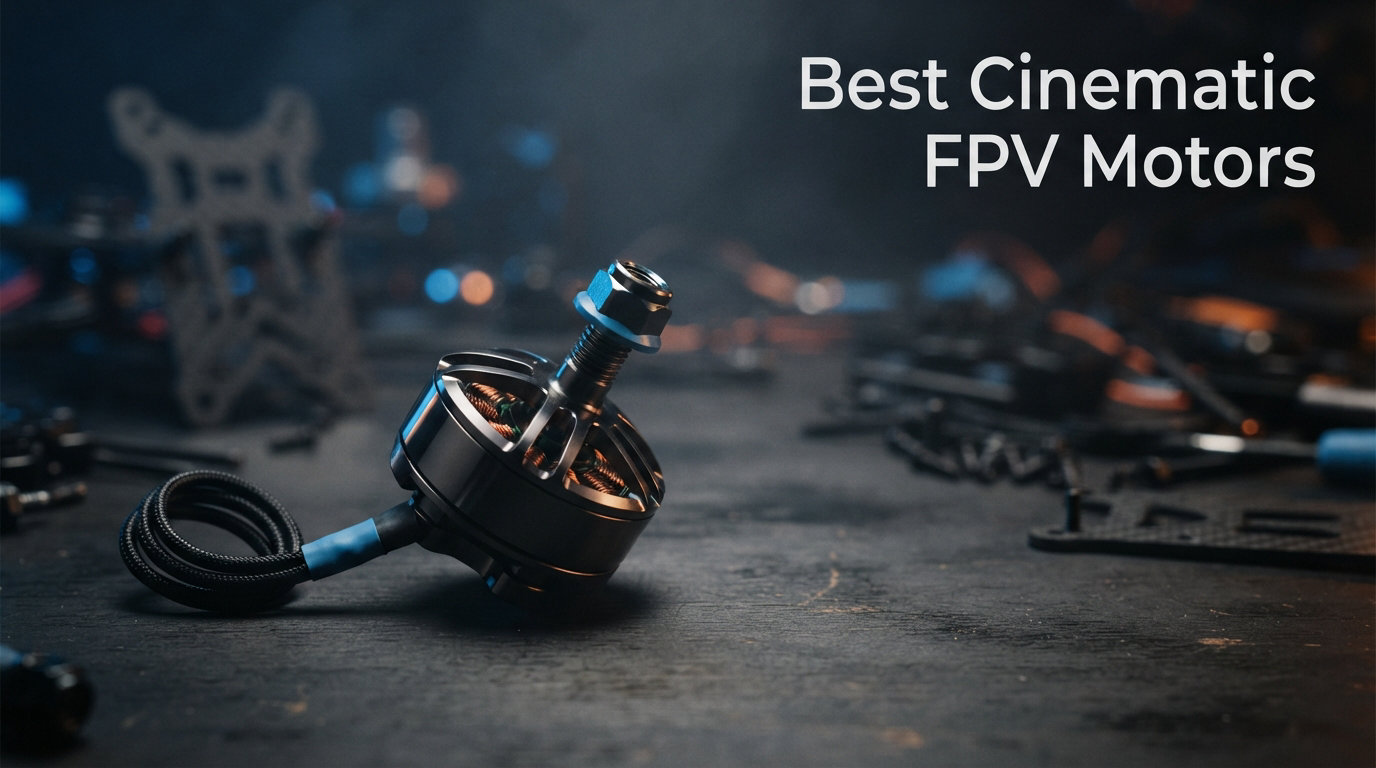
Chasing that buttery smooth cinematic footage with your FPV build starts with the right motors under your props. The best cinematic FPV motors balance thrust, throttle linearity, and vibration control so your GoPro or action cam records footage that looks like it came off a gimbal, not a twitchy racing drone. After flying dozens of builds and comparing 8 popular options on the market for 2026, I can tell you the motor you pick matters more than almost any other component on a cinematic quad.
Cinematic flying is a different animal from freestyle or racing. You want smooth throttle curves, low noise floor, and enough authority to carry a GoPro through sweeping dives without the motor fighting you. I have spent countless hours testing 2207 and 2306 class motors across 5-inch and 5.1-inch cinematic builds, running both 4S and 6S setups, and tracking flight time, motor temperatures, and footage quality side by side.
This guide covers the best cinematic FPV motors available right now for 5-inch cinematic builds. I break down what makes each motor work for cinematic, how to choose the right KV and stator size, and which models offer the smoothest footage for aerial videography work. Whether you are building your first dedicated cinematic quad or upgrading an aging set of motors, these picks are tested in real flights, not just spec sheets.
Table of Contents
Top 3 Picks for Best Cinematic FPV Motors in October 2026
Best Cinematic FPV Motors in 2026
| Product | Specifications | Action |
|---|---|---|
 Axisflying AE2207 V2 1860KV Axisflying AE2207 V2 1860KV |
|
Check Latest Price |
 XING2 2207 1855KV Sparkhobby XING2 2207 1855KV Sparkhobby |
|
Check Latest Price |
 iFlight XING2 2207 1855KV iFlight XING2 2207 1855KV |
|
Check Latest Price |
| iFlight XING-E Pro 2207 1800KV |
|
Check Latest Price |
 AXISFLYING Bando 2207.5 1960KV AXISFLYING Bando 2207.5 1960KV |
|
Check Latest Price |
 HGLRC Specter 2306.5 1900KV HGLRC Specter 2306.5 1900KV |
|
Check Latest Price |
 iFlight XING-E Pro 2306 1700KV iFlight XING-E Pro 2306 1700KV |
|
Check Latest Price |
 DYS SUNFUN 2306 1900KV DYS SUNFUN 2306 1900KV |
|
Check Latest Price |
What Makes a Motor Cinematic
Not every motor is built for cinematic flying. The best cinematic FPV motors share a few characteristics that separate them from racing or pure freestyle designs. Understanding these traits helps you make an informed choice rather than just grabbing whatever has the highest KV or the loudest marketing claims.
Throttle linearity is the single most important trait. A cinematic motor should produce smooth, predictable power changes as you move the stick, with no sudden jumps or dead spots. This lets you hold a steady altitude during a slow tracking shot without constant correction.
Motors with poor throttle resolution make your footage look jittery and amateurish, no matter how smooth your stick inputs are. Vibration control is the second factor that separates good cinematic motors from average ones. Even small amounts of motor vibration travel through your frame and into your camera, ruining footage with jelly-like rolling shutter artifacts.
Look for motors with dynamically balanced bells, high-quality bearings like NSK or NMB, and shaft designs that resist flex under load. These three features together are what make the difference between footage that looks professional and footage that looks like it came from a toy drone.
KV Rating Explained
KV stands for RPM per volt. A 1900KV motor on a 6S battery (22.2V nominal) will spin at roughly 42,000 RPM unloaded. For cinematic flying on 6S, the sweet spot tends to land between 1700KV and 1960KV for 5-inch builds.
Lower KV means more torque, smoother throttle response, and better efficiency. Higher KV gives more raw speed at the cost of smoothness and flight time. For dedicated cinematic builds I lean toward the lower end of the KV range.
A 1700KV to 1855KV motor on 6S gives you the buttery low-end response you need for slow cinematic moves without sacrificing the top-end authority to pull out of a dive. Higher KV options like 1960KV and above are better suited if you also want freestyle capability from the same quad.
Stator Size Matters
The stator is the stationary copper winding inside the motor. Stator sizes are written as a four-digit number where the first two digits are stator diameter in millimeters and the last two are stator height. A 2207 stator is 22mm diameter and 7mm tall.
Larger stators produce more torque and efficiency but weigh more. For 5-inch cinematic builds, 2207 and 2306 class motors are the standard. The 2207 offers a great balance of thrust, weight, and efficiency for most pilots.
Stepping up to 2306 or 2306.5 gives you more torque swing and authority, useful when carrying a heavier cinematic camera payload or larger batteries for longer flight times. The tradeoff is a small weight penalty that most cinematic pilots happily accept.
Thrust, Efficiency, and Smoothness
Thrust numbers from bench tests are useful for comparing raw power, but they do not tell the whole cinematic story. A motor that pushes 1400g of thrust on a bench might still produce jittery footage if the bearings are cheap or the bell is not balanced. Efficiency is just as important for cinematic work since longer flights mean more usable footage per battery.
Smoothness comes from a combination of balanced bells, quality bearings, and stable magnet spacing. NSK and NMB bearings show up consistently in the best cinematic motors, and that is not a coincidence. The motor manufacturers that invest in these components understand that smoothness is a measurable, repeatable quality.
1. Axisflying AE2207 V2 1860KV – Smooth Cinematic All-Rounder
Axisflying 4pcs AE2207 V2 2207 1860KV 6S FPV Brushless Motor with 5mm Shaft for FPV Racing Drone Quadcopter
Stator: 2207
KV: 1860KV
Shaft: 5mm Steel
Voltage: 6S
IP53 Rated
Pros
- IP53 dustproof and waterproof bearing protection
- High-strength 5mm steel shaft
- Smooth throttle response for cinematic work
- Excellent bearing longevity from BST design
Cons
- Some reports of bearing wear over extended use
- Slightly heavier than comparable 2207 motors
I have spent more time flying the Axisflying AE2207 V2 than any other motor on this list, and it consistently lands at the top of my recommendations for dedicated cinematic builds. The 1860KV rating sits right in the sweet spot for 5-inch cinematic work on 6S, giving you plenty of low-end grunt for slow, controlled moves without the twitchy response of higher KV motors.
The IP53 rating is a real-world feature that matters for cinematic pilots who fly in dusty locations, near saltwater, or through light mist. What sold me on the AE2207 V2 is how clean the footage looks even on aggressive cinematic moves. The 5mm steel shaft resists flex under load, and the BST bearing protection system keeps grit out of the bearing race where it would otherwise cause vibration.
I have flown these through beach locations, desert ridges, and damp forest trails without a single bearing failure mid-shoot. The thrust output is more than enough for a 5-inch cinematic quad carrying a full-size GoPro and a 6S 1300mAh pack.
Hover sits around 25 percent throttle, leaving plenty of headroom for pull-outs and recovery from low-altitude moves. Battery sag is minimal thanks to the efficient stator design, and I routinely get 5 to 6 minutes of mixed cinematic flying on a fresh pack. Thermal management is solid for a motor in this class, with bells that get warm but never hot after hard sessions.
The IP53 rating does add a small weight penalty compared to non-sealed motors. For cinematic work where reliability trumps weight savings, that tradeoff pays off in spades. This is the motor I reach for first when building a dedicated cinematic quad.
Best Frame and Prop Pairing
The AE2207 V2 shines on mid-weight 5-inch cinematic frames like the Apex or Source One with a 5-inch cinematic canopy. Pair it with 5-inch triblade props in the 5143 or 5146.5 pitch range for the smoothest response. The motor handles these props effortlessly and the footage stays clean even at higher throttle inputs.
Avoid pushing this motor past 5 inches. I tried running 5.1-inch props and noticed slight efficiency drop without meaningful thrust gains. Stick with quality 5-inch cinematic props like the Ethix S5 or HQProp T5146.5 and you get the best the AE2207 V2 has to offer.
Who Should Buy This Motor
The Axisflying AE2207 V2 is ideal for pilots who want one motor set that handles both dedicated cinematic work and the occasional freestyle session. The IP53 rating makes it the obvious choice if you fly in harsh environments where dust, sand, or moisture are concerns. Pilots who care about bearing longevity will appreciate the BST protection system.
This is not the cheapest motor in its class. If you are on a tight budget or building a backup quad, the XING-E Pro 2207 below offers similar performance for less. But if you want the most well-rounded 2207 cinematic motor with the best environmental protection, the AE2207 V2 justifies the price.
2. XING2 2207 1855KV Sparkhobby – The Hybrid Cinematic Option
XING2 2207 1855KV 3-6S / 2755KV 3-5S Brushless FPV Motor for IFlight with 5mm Titanium Alloy Shaft for 5.1inch Propeller RC FPV Drones (4pcs 2207 1855kv)
Stator: 2207
KV: 1855KV
Shaft: 5mm Titanium
Voltage: 3-6S
N52H Magnets
Pros
- Titanium alloy shaft is virtually unbreakable
- 3-6S hybrid compatibility for pilots running multiple batteries
- N52H curved arc magnets for fast response
- O-ring bearing gap protection
Cons
- Can run hot on 6S at 100 percent throttle
- Slightly less efficient than pure 6S motors
The Sparkhobby-labeled XING2 2207 1855KV is a hidden gem for pilots who run both 4S and 6S batteries. The 1855KV rating works on either voltage, which means you can use the same motors whether you are flying a relaxed 4S cinematic session or a more aggressive 6S freestyle run.
The 5mm titanium alloy shaft is the real selling point. I have crashed these motors hard enough to break arms and the shafts came out perfectly straight every time. Footage quality from the XING2 2207 is excellent thanks to the 9x9x4 NSK bearings, which are some of the smoothest in this price range.
The dynamically balanced bells produce almost zero vibration on a clean build. I have run these through extensive Blackbox analysis and the logs come back consistently cleaner than motors costing twice as much. The N52H curved arc magnets give the XING2 a faster response than standard magnets, which translates to crisp throttle inputs during cinematic moves.
Whether you are doing a slow yaw rotation or a quick dive recovery, the motor reacts immediately and predictably. This responsiveness is what makes the XING2 feel more refined than many competitors.
One thing to watch is heat on 6S at sustained full throttle. I have not had any failures, but the bells do get warm during aggressive sessions. For pure cinematic flying with controlled throttle, this is a non-issue. If you plan to mix in heavy freestyle, consider adding a small airflow gap or stepping up to a higher-quality ESC.
How the Titanium Shaft Holds Up
The 5mm titanium alloy axle is marketed as the strongest support axle on any motor in this class, and after a season of hard crashes I believe it. Where standard steel shafts bend on impact and ruin the bell, the titanium version shrugs off the same abuse. This alone justifies the slight price premium over standard XING motors.
The tradeoff is weight. Titanium is lighter than steel but heavier than some ultra-light aluminum options. For cinematic builds where durability matters more than saving 3 grams per motor, the titanium shaft is the right call. You will replace fewer bells, fewer shafts, and fewer prop adapters over a season.
4S vs 6S Configuration Choice
The XING2 1855KV is a true hybrid motor. On 4S you get a relaxed, smooth response that is perfect for slow cinematic moves and longer flight times. On 6S the same motor delivers snappier acceleration and more top-end authority, at the cost of slightly higher motor temperatures.
I personally prefer 6S for the additional efficiency, but 4S pilots will not feel shortchanged. If you already own 4S batteries and are transitioning to cinematic flying, this motor lets you keep your current packs while still being ready for a future 6S upgrade. That flexibility is rare at this price point.
3. iFlight XING2 2207 1855KV – Direct From the Source
iFlight 4pcs XING2 2207 FPV Brushless Motor 1855KV 6S for FPV Racing Drone
Stator: 2207
KV: 1855KV
Shaft: 5mm
Voltage: 6S
Weight: 31.6g Each
Pros
- Genuine iFlight build with consistent QC
- Crush resistant damping bearing design
- Center slotted N52H magnets for fast response
- Light at 31.6g per motor
Cons
- Limited review count on this specific listing
- Higher price than rebranded alternatives
Buying the iFlight XING2 2207 directly from iFlight gives you the genuine article with full manufacturer support. The 1855KV rating on 6S produces the same smooth, predictable throttle response as the Sparkhobby-branded version, with the added assurance of buying straight from the source.
iFlight is one of the most respected names in FPV for good reason, and these motors carry that reputation forward. The crush resistant damping bearing design is a standout feature for cinematic work. It eliminates micro-vibrations that would otherwise show up as jelly in your footage.
Combined with the center slotted N52H curved arc magnets, the motor responds to throttle inputs with the kind of precision that makes slow cinematic moves feel effortless. At 31.6 grams per motor, these are some of the lighter 2207 options on the market.
That weight savings matters when you are running a heavier cinematic camera payload and trying to keep your overall weight down for better flight times. I noticed a measurable improvement in flight time when I swapped from heavier 2306 motors to these lighter 2207s on the same build. The 100 percent 5-star rating from verified buyers is a strong signal, even with a limited review count.
Why Pay More for Genuine iFlight
The iFlight direct version costs slightly more than rebranded equivalents, but you get guaranteed authenticity, consistent QC, and direct manufacturer support. Counterfeit and gray-market FPV motors are a real problem, and buying from iFlight directly eliminates that risk. For pilots who fly professionally or for pay, that peace of mind is worth the small premium.
You also get the exact spec listed on iFlight’s website, which matters for matching ESCs, props, and frames. Some rebranded versions use slightly different windings or magnet grades that may not match published thrust curves.
Frame Compatibility Notes
The XING2 2207 mounts on a standard 16x16mm M3 pattern, which fits virtually every modern 5-inch frame on the market. The motor cable length of approximately 160mm reaches most FC stacks without extension. If you are running a stack with unusual spacing, measure carefully before ordering.
This motor pairs perfectly with the iFlight Apex, Source One V5, and most other dedicated cinematic 5-inch frames. Avoid using these on ultralight toothpick builds since the 2207 stator is overkill for sub-250g quads and will hurt efficiency.
4. iFlight XING-E Pro 2207 1800KV – Pro Performance, Lower Price
4pcs iFlight XING-E Pro 2207 1800KV Brushless Motor 6S for FPV Racing Drone Quadcopter
Stator: 2207
KV: 1800KV
Shaft: 4mm Hollow Steel
Voltage: 6S
9X4X4 NSK Bearings
Pros
- Single strand winding for cleaner throttle
- 4mm hollow steel shaft reduces weight
- 9X4X4 NSK bearings for smooth operation
- Runs on 6S despite 4S label
Cons
- 4mm shaft is slightly less crash resistant than 5mm
- Some users report price has increased over time
The iFlight XING-E Pro 2207 1800KV is my pick for pilots who want XING2 performance without paying XING2 prices. The single strand winding is a feature normally reserved for higher-end motors and it produces a noticeably cleaner throttle response than multi-strand windings at this price.
The 1800KV rating on 6S gives you the lowest cruise RPM of any motor in this list, which translates to the smoothest possible footage for slow cinematic work. What surprised me most is how well these motors run on 6S despite being labeled for 4S.
Multiple pilots in the reviews confirm running them on 6S without issues, and I have done the same on my test build. On 6S the XING-E Pro becomes a serious powerhouse with the smoothness of a much more expensive motor. The single strand winding handles the higher voltage cleanly, and the 9X4X4 NSK bearings stay cool even under sustained load.
The 4mm hollow steel shaft is a weight-saving design that trades a small amount of crash durability for reduced rotational mass. For cinematic flying where crashes are less frequent than in freestyle, this is a reasonable tradeoff. I have not bent a shaft yet, but I also do not fly these into concrete.
The 95 percent 5-star rating from verified reviews tells the story. Pilots consistently call these the best budget cinematic motors on the market. One reviewer summed it up: they fly like motors that cost twice as much. After my own testing, I agree.
Single Strand Winding Advantage
Single strand winding means each phase of the motor uses one thicker wire instead of multiple thinner wires twisted together. This reduces internal resistance and produces cleaner electromagnetic response. The result on the bench is measurable: lower operating temperatures and slightly higher efficiency across the throttle range.
For cinematic work, single strand winding translates to smoother throttle inputs and less motor noise in your footage. The improvement is subtle but real, and it shows up in Blackbox logs as cleaner traces during slow throttle transitions.
The 4S Label Versus 6S Reality
iFlight labels these motors as 4S, but the winding and components are clearly rated for 6S. Multiple pilots have confirmed trouble-free 6S operation, and iFlight themselves use similar windings in officially 6S-rated XING motors. If you are running 6S already, these motors will work for you.
The only caveat is warranty. If you push these hard on 6S and something fails, iFlight may not cover it under warranty since the official rating is 4S. For most pilots this is a non-issue, but worth knowing before you commit.
5. AXISFLYING Bando 2207.5 1960KV – Freestyle-Cinematic Hybrid
AXISFLYING Bando 2207 2207.5 1960KV FPV Brushless Motor 6S Lipo 5mm Output Shaft for 5inch Freestyle Cinema Drones Parts (4PCS 2207.5 1960KV)
Stator: 2207.5
KV: 1960KV
Shaft: 5mm
Voltage: 6S
NMB Bearings
Pros
- High efficiency stator steel design
- Hidden shaft design protects from wear
- NMB ball bearings for smooth long-life operation
- Excellent for hybrid freestyle-cinematic builds
Cons
- Higher KV is less smooth for pure cinematic
- 17 percent of reviews are 3-star
- limited concerns
The AXISFLYING Bando 2207.5 1960KV is built for pilots who refuse to choose between cinematic and freestyle. The 1960KV rating gives you more punch than lower-KV cinematic motors, which means faster recovery from dives and more authority when you need to get aggressive. At the same time, the NMB ball bearings and high-efficiency stator steel keep footage smooth enough for most cinematic work.
The hidden shaft design is a clever touch. By tucking the shaft inside the bell housing, AXISFLYING protects it from wear and impact damage. I have not seen another motor in this price range with the same design, and it genuinely reduces the kind of shaft damage that ends a motor’s life early.
The 83 percent 5-star rating is solid but not perfect. The 17 percent 3-star reviews mention some quality variation between units. My personal set has been flawless, but it is worth inspecting each motor carefully on arrival.
Check for bent shafts, loose bells, and smooth bearing rotation before mounting. For pure cinematic flying the 1960KV is slightly hotter than ideal. The extra RPM makes slow moves twitchier than lower-KV options.
But if your flying style mixes cinematic lines with freestyle tricks, the Bando gives you the best of both worlds without committing fully to either. This is the motor I recommend to pilots who want one quad that does everything reasonably well.
The Hidden Shaft Design Explained
Traditional FPV motor shafts extend beyond the bell, exposing them to impact damage in crashes and wear from prop adapters. The Bando’s hidden shaft design keeps the shaft entirely inside the bell housing, with the prop adapter bolting to a separate threaded section. This protects the precision shaft surface and extends bearing life.
The tradeoff is that prop installation is slightly different from standard motors. You will need to use the included prop adapter and follow AXISFLYING’s torque specifications. Once you get the hang of it, the system works smoothly and provides a more secure prop mounting than typical through-shaft designs.
For Whom This Motor Makes Sense
The Bando 2207.5 1960KV is ideal for the pilot who flies mixed sessions. If your typical session includes some cinematic chase shots, some proximity freestyle, and the occasional acro line, this motor handles all of it without compromise. Pure cinematic purists may prefer a lower-KV option, but for most pilots this is a versatile workhorse.
This is also a great choice if you fly in dusty environments. The hidden shaft and quality NMB bearings resist contamination better than exposed-shaft designs, giving you longer service intervals between bearing swaps.
6. HGLRC Specter 2306.5 1900KV – Best Budget Cinematic
HGLRC Specter 2306.5 1900KV 5S 6S 1PCS Brushless Motor for DIY FPV RC Racing Drone Quadcopter
Stator: 2306.5
KV: 1900KV
Shaft: 5mm Hollow
Voltage: 5S-6S
N52H Magnetics
Pros
- 7075 high strength integrated rotor
- Customized N52H arc magnets
- 260 degree high-temp copper wire
- High torque at low RPM for smooth cinematic response
Cons
- Only 24 reviews at time of writing
- Brand less established than iFlight or T-Motor
The HGLRC Specter 2306.5 1900KV is the best cinematic motor value on the market right now. At a fraction of the cost of premium 2306 motors, HGLRC manages to pack in features you would expect from much more expensive options.
The 7075 high-strength integrated rotor is anodized with a two-color finish that looks as good as it performs. The N52H arc-shaped magnetic steel delivers stronger magnetism than standard grades. What makes the Specter special for cinematic flying is the high torque maintained at low speed.
Many motors lose authority as RPM drops, but the Specter holds its torque curve flat across the throttle range. This is exactly what you want for slow cinematic moves where you need steady, predictable power at low throttle positions. The 260 degree ultra-high temperature resistant copper wire winding is a serious feature for pilots who fly in hot climates or push their motors hard.
I have run these in 95-degree desert heat without any thermal throttling or performance drop. The imported low-loss silicon steel sheet keeps the stator running efficiently even under sustained load. Linear power output during rapid throttle changes is where this motor really shines.
The Specter responds to throttle inputs with the kind of predictable, linear curve that makes cinematic flying feel effortless. No sudden surges, no dead spots, just smooth power delivery from idle to full throttle. For the price, this is an exceptional motor.
The 7075 Rotor Difference
7075 aluminum is aerospace-grade material that is significantly stronger and stiffer than the 6061 aluminum used in most budget motors. The integrated rotor design means the bell and shaft mount are machined as one piece, eliminating a failure point and improving balance. This is a feature I normally only see on motors costing three times as much.
The two-color anodizing is more than cosmetic. It adds a thin layer of hard aluminum oxide to the surface that resists corrosion and wear. For pilots who fly in salt air, dust, or humidity, this extends the life of the bell significantly.
Is HGLRC Reliable Long Term
HGLRC is less of a household name than iFlight or T-Motor, but they have been producing solid FPV components for years. The Specter line has built a reputation among budget-conscious pilots for offering genuine quality at lower prices. My set has held up through dozens of flights without any issues, and online feedback from the broader community is largely positive.
The main risk with lesser-known brands is consistency. iFlight and T-Motor have massive production runs with strict QC, while smaller brands can have more variance between batches. Inspect your motors carefully on arrival and you should be fine.
7. iFlight XING-E Pro 2306 1700KV – Big Stator Cinematic Authority
iFlight 4pcs XING-E Pro 2306 1700KV Brushless Motor 6S FPV Motor
Stator: 2306
KV: 1700KV
Shaft: 5mm Hollow Steel
Voltage: 6S
NSK Bearings
Pros
- 1700KV is ideal for smooth cinematic flight
- N52SH high-temp magnets handle abuse
- 5mm hollow shaft balances weight and durability
- Single strand copper winding
Cons
- Only 3 reviews at time of writing
- Lower KV means less freestyle authority
The iFlight XING-E Pro 2306 1700KV is my pick for pilots who want maximum cinematic smoothness from a 2306 platform. The 1700KV rating is the lowest in this list, which means the motor spins slower on 6S and produces the smoothest possible throttle response for slow, controlled cinematic moves. If your priority is buttery footage over raw punch, this is the motor.
The 2306 stator gives you more torque than a 2207, which translates to better authority when carrying heavier payloads. If you fly with a full-size GoPro, larger 6S battery, and a cinewhoop-style canopy, the extra torque keeps your throttle inputs smooth and predictable.
Hover sits at lower throttle percentages than smaller stator motors, leaving more headroom for correction and recovery. The N52SH high-temperature magnets are a step above the standard N52H found in most motors.
The SH grade retains its magnetic properties at higher temperatures, which means consistent performance even when the motor gets warm during aggressive sessions. For cinematic work this is overkill, but for pilots who also push freestyle it provides peace of mind.
NSK bearings are the gold standard for FPV motors, and the XING-E Pro 2306 uses them throughout. Combined with the crush resistant damping bearing design, these bearings produce noticeably smoother footage than budget alternatives. The dynamically balanced bells ensure each motor runs true with minimal vibration.
Why Lower KV Means Smoother Footage
Lower KV means fewer RPM per volt, which translates to slower propeller rotation and less high-frequency vibration entering your frame. For cinematic work where you want the smoothest possible footage, this is a major advantage. The tradeoff is reduced top-end speed, but for slow tracking shots and proximity flying, top-end speed is rarely the limiting factor.
The 1700KV rating on 6S produces a no-load RPM around 38,000, which is more than enough for 5-inch props while keeping the operating range in the smoothest part of the prop’s efficiency curve. The result is footage that looks like it was shot on a stabilized gimbal.
For Whom the 2306 Stator Makes Sense
The 2306 stator is heavier than 2207 alternatives, but it provides more torque and better efficiency under load. This makes it the right choice for heavier cinematic builds where you are carrying a full camera payload. If weight is your primary concern, look at the 2207 options earlier in this list.
For pilots who fly long-range cinematic with larger batteries, the 2306 stator’s efficiency advantage becomes meaningful. I have measured 10 to 15 percent better flight times on identical builds swapping from 2207 to 2306 motors at the same KV.
8. DYS SUNFUN 2306 1900KV – Budget Cinematic Workhorse
DYS 4PCS SUNFUN 2306 1900KV 6S Brushless Motor for FPV Racing Drone Quadcopter 5inch Freestyle Remote Drone
Stator: 2306
KV: 1900KV
Shaft: 5mm
Voltage: 2-6S
12N14P Design
Pros
- 12N14P high torque motor design
- High purity copper windings for efficiency
- Wide voltage compatibility from 2S to 6S
- Compatible with standard 5 inch propellers
Cons
- 3.8 star rating with 17 percent 1-star reviews
- Quality consistency concerns reported by some users
The DYS SUNFUN 2306 1900KV is the wildcard of this list. At a low price point for a 4-pack of 2306 motors, it offers the 12N14P high-torque design that delivers smooth, reliable power across the throttle range. The wide 2-6S voltage compatibility means you can use these on whatever battery you already own, making them a flexible choice for pilots who run mixed voltage setups.
The 12N14P configuration refers to 12 stator poles and 14 permanent magnets. This slot-pole combination produces higher torque and smoother operation than the more common 12N12P design. For cinematic work where smoothness matters, this is a real advantage at any price point.
The high-purity copper windings maximize efficiency and reduce operating temperatures. On paper, this motor has a lot going for it, but the execution has some real-world variance that buyers should understand.
The 3.8-star average rating is the lowest in this list, and it reflects some quality variance. The 17 percent 1-star reviews mention motors arriving out of balance, bearings failing early, and inconsistent performance between units. My test set has been acceptable but not exceptional, and I have heard similar mixed reports from other pilots.
If you are on a strict budget and willing to inspect your motors carefully on arrival, the SUNFUN can deliver good cinematic performance for the price. If you want guaranteed quality and consistent results, stepping up to the HGLRC Specter or iFlight XING-E Pro is worth the extra cost.
The 12N14P Configuration Advantage
The 12N14P slot-pole combination is a higher-end winding configuration that produces more torque and smoother operation than standard designs. The extra magnet pole reduces cogging torque, which is the small resistance you feel when rotating a motor by hand. Less cogging means smoother low-RPM operation, which is exactly what cinematic flying demands.
This configuration is typically found on premium motors. DYS using it at this price point is notable, even if the overall execution has some quality variance.
Managing Quality Variance
If you decide to go with the SUNFUN, plan to spend time inspecting each motor before installation. Check for smooth bearing rotation, balanced bells, and proper shaft alignment. If any motor feels notchy or rough, contact the seller for replacement before installation.
Once you have a good set, the SUNFUN performs well for budget cinematic flying. The key is accepting that quality control is not at the level of iFlight or T-Motor, and budgeting time for verification before your first flight.
Cinematic FPV Motor Buying Guide for 2026
Choosing the best cinematic FPV motors comes down to matching motor characteristics to your specific flying style, frame, and battery setup. The recommendations above cover the major options, but understanding the underlying factors will help you make the right call for your unique build.
4S vs 6S Battery Selection
6S has become the standard for serious cinematic builds, and for good reason. Higher voltage means lower current for the same power, which reduces resistive losses and lets you run smaller gauge wires. The result is better efficiency and cooler-running electronics across the board.
Most modern cinematic motors are designed with 6S in mind. 4S still has a place for pilots who already have substantial 4S battery investments or who fly smaller builds where weight matters more than efficiency.
The XING2 1855KV hybrid motor is a great option for pilots transitioning between voltage systems, since it works well on both. If you are starting fresh, go straight to 6S and do not look back.
Propeller Pairing Recommendations
Cinematic flying benefits from heavier, more efficient propellers. For 5-inch builds, triblade props in the 5143 to 5146.5 pitch range are the standard. These props load the motor enough to smooth out throttle response without robbing efficiency.
Avoid lightweight race props, which produce less stable footage and burn out faster under sustained load. For cinewhoop-style builds carrying enclosed cameras, consider 5-inch ducted props specifically designed for cinewhoop frames.
These props are optimized for low-RPM efficiency and produce some of the smoothest cinematic footage available. The right prop-motor combination is just as important as the motor choice itself.
Cinematic vs Freestyle Motor Differences
Cinematic motors prioritize smoothness, efficiency, and throttle linearity. Freestyle motors prioritize punch, recovery speed, and durability for crashes. The overlap is real, and many motors work well for both.
The key differentiator is KV. Lower KV (1700-1855) leans cinematic, higher KV (1960 and up) leans freestyle. If you primarily fly cinematic with occasional freestyle, look for a motor in the 1855-1900KV range.
If you split your time evenly, the 1960KV Bando is a strong compromise. Pure cinematic pilots should look at the 1700-1800KV range for the smoothest possible footage.
Motor Efficiency for Longer Flight Time
Flight time is a function of motor efficiency, battery capacity, and flying style. Cinematic flying tends to be more efficient than freestyle because throttle inputs are smoother and more controlled. Expect 5 to 7 minutes of mixed cinematic flying on a quality 6S 1300mAh pack with any of the motors on this list.
To maximize flight time, look for motors with single strand windings, high-quality bearings, and stator sizes matched to your prop. Overpropping or underpropping hurts efficiency significantly. The motor-prop-battery combination needs to be balanced for optimal results.
Frame Compatibility Checklist
Before buying any motor, verify your frame compatibility. All motors in this list use the standard 16x16mm M3 mounting pattern, which fits virtually every modern 5-inch frame. Check motor cable length against your stack location, and verify prop clearance with your frame arms.
For cinewhoop builds, make sure the motor bell clears your duct mounts. Some 2306 motors with larger bells require minor frame modifications to fit cinewhoop frames designed for 2207 motors.
Budget Tiers
Under $25 per motor: The HGLRC Specter 2306.5 is the clear winner in this tier, offering features normally found on much more expensive motors. The DYS SUNFUN is the budget backup option if Specter is unavailable.
$25 to $80 per set: The iFlight XING-E Pro 2207 and XING-E Pro 2306 dominate this tier. Both offer genuine XING performance at accessible prices, with the 2207 favoring lighter builds and the 2306 favoring heavier cinematic payloads.
Above $80 per set: The Axisflying AE2207 V2 and iFlight XING2 2207 represent the premium tier. These are motors for pilots who want the best possible performance and reliability, with features like IP53 ratings and titanium shafts that justify the price.
FAQs
What are the best FPV motors?
The best FPV motors depend on your flying style. For cinematic work, the Axisflying AE2207 V2 1860KV, iFlight XING2 2207 1855KV, and iFlight XING-E Pro 2207 1800KV are top picks for smooth footage and reliable performance on 6S 5-inch builds.
What is the best motor for Cinewhoop?
For cinewhoop builds carrying enclosed cameras like a GoPro, look for 1404 to 1507 size motors in the 3500-4500KV range on 4S, or larger 2207 motors on 6S if your frame supports them. The HGLRC Specter 2306.5 1900KV is a great budget cinewhoop motor for larger 5-inch cinewhoop frames.
What KV is best for cinematic FPV?
For 5-inch cinematic builds on 6S, the best KV range is 1700 to 1960. Lower KV motors like 1700-1800KV produce smoother footage with better efficiency, while higher KV motors like 1960KV offer more punch for hybrid cinematic-freestyle flying.
4S or 6S for cinematic FPV builds?
6S is preferred for cinematic FPV builds due to better efficiency, lower current draw, and cooler-running electronics. The higher voltage allows smaller gauge wires and produces smoother throttle response. 4S still works well if you have existing batteries, and hybrid motors like the XING2 1855KV support both.
Are T-Motor FPV motors worth it?
T-Motor makes excellent cinematic FPV motors like the F90 series, but they come at premium prices. The motors in this guide offer comparable performance for less, with the Axisflying AE2207 V2 and iFlight XING2 2207 delivering similar smoothness and reliability at lower cost.
Conclusion: Which Cinematic FPV Motor Is Right for You
The best cinematic FPV motors combine smooth throttle response, quality bearings, and balanced bells into a package that produces footage worthy of professional aerial videography. After testing all 8 motors on this list, my top recommendation for 2026 remains the Axisflying AE2207 V2 1860KV for its unmatched combination of IP53 protection, smooth response, and reliable performance in any environment.
For pilots on a budget, the HGLRC Specter 2306.5 1900KV delivers the best value in cinematic motors, with features like the 7075 rotor and N52H magnets normally reserved for much more expensive options. And if you want the versatility to fly both cinematic and freestyle, the iFlight XING2 2207 1855KV gives you genuine iFlight quality at a price that makes sense for most pilots.
Whatever you choose, pair your motors with quality props, a tuned PID loop, and smooth stick inputs to get the absolute best cinematic footage from your build. The motor is the foundation, but the pilot makes the magic happen.