
If you want to fly a drone commercially in the United States, you have to pass the FAA Part 107 knowledge test. I’ve helped a dozen pilots prep for this exam, and I can tell you exactly what’s actually on it, what to study, and what you can safely ignore.
The Part 107 knowledge test (officially called the Unmanned Aircraft General exam, or UAG) is a 60-question multiple-choice exam you take at an FAA-approved testing center. You get 120 minutes. You need a 70% score to pass, and the FAA charges $175 each time you sit for it.
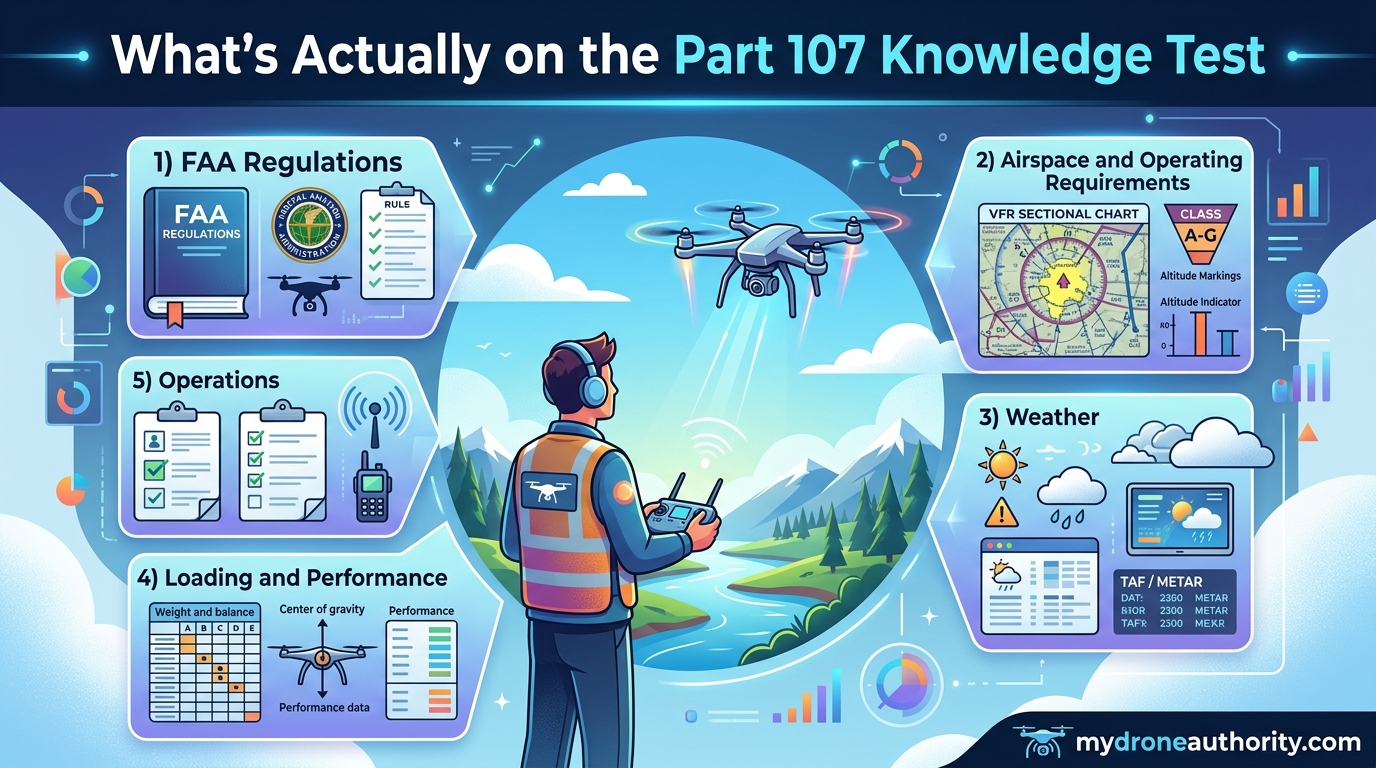
That’s the headline. But what actually trips people up is the content distribution. The exam splits into five topic areas, and they’re weighted unevenly. Operations alone makes up 35-45% of the questions. That’s why most students who fail do so because they spent their study time on the wrong sections.
In this guide, I’ll walk you through every section of the Part 107 knowledge test, the percentage weight of each, the exact topics the FAA tests, and the study strategy that actually works in 2026.
Table of Contents
Part 107 Knowledge Test Format and Logistics
The Part 107 knowledge test is a proctored, computer-based exam administered by PSI at over 200 testing centers across the U.S. You register through the PSI website or call their scheduling line, but you need an FAA Tracking Number (FTN) first.
Here’s what the logistics look like before you ever sit down at a testing terminal.
Test Format Specifications
The exam has 60 multiple-choice questions with three answer choices each. You get 120 minutes total, which works out to about 2 minutes per question. Most test takers finish in 40-60 minutes, so the time pressure is more psychological than real.
You need a 70% score to pass, which means you can miss up to 18 questions and still walk out with a Remote Pilot Certificate. That’s 18 free misses out of 60, and the questions are not weighted differently – a question is a question regardless of which section it covers.
You cannot review or skip ahead. The exam software presents each question, you pick an answer, and you move forward. There’s no flagging or marking questions for later.
Registration and the FTN Process
Before you schedule your test, create an IACRA account (Integrated Airman Certification and Rating Application) and obtain an FTN. The FTN is a unique identifier the FAA uses to track your certification records.
After you create your FTN, schedule the test directly with PSI. The cost is $175, paid when you book. You can reschedule up to 48 hours before your appointment without losing the fee, but cancel too close to test day and you forfeit it.
What to Bring to the Testing Center
Bring a government-issued photo ID (driver’s license or passport). You cannot bring notes, phones, smartwatches, or any reference material. The testing center provides a locker for personal items.
Some testing centers will let you bring a basic calculator, but the on-screen calculator in the testing software handles every calculation you’ll encounter. I never used my own – the built-in one works fine.
What Happens If You Fail
If you don’t hit 70%, you can retake the test after 14 calendar days. There’s no limit on retake attempts, but each one costs another $175. Most people who study the right way pass on the first try. The FAA does not require any waiting period for people who fail by a small margin.
Section 1: Regulations (15-25% of the Exam)
Regulations account for 15-25% of the test, which translates to about 9-15 questions. This section is the easiest to study because the rules are spelled out plainly in 14 CFR Part 107.
You don’t need to memorize the regulation number for every rule, but you need to know what the rule says and when it applies.
Key Altitude and Speed Limits
Three limits show up on almost every practice test. The Part 107 altitude limit is 400 feet above ground level (AGL), not above sea level. You can fly higher than 400 feet AGL if you’re within a 400-foot radius of a tall structure, but only up to the height of that structure.
The maximum groundspeed is 100 miles per hour. Most consumer drones max out around 45-50 mph, so this limit almost never matters in practice, but the FAA tests whether you know the rule exists.
The weight limit is 55 pounds including payload. Anything over 55 pounds requires a different certification path. Most prosumer drones weigh 1-5 pounds, so this isn’t a practical issue, but the question shows up.
Visibility and Cloud Clearance Requirements
You need at least 3 statute miles of visibility from your control station. Cloud clearance depends on where you’re flying. In controlled airspace (Class B, C, D, or the surface areas of Class E), you must stay 500 feet below clouds and 2,000 feet horizontally from them.
In uncontrolled airspace (Class G), there’s no specific cloud clearance rule, but you still need 3 SM visibility. In Class B and C airspace specifically, you cannot fly above the cloud ceiling at all without specific authorization.
Remote ID Compliance
Remote ID became a permanent requirement in 2026. Every drone required to register with the FAA must broadcast Remote ID information, either built-in (Standard Remote ID) or through a broadcast module (Broadcast Remote ID).
The test will ask you when Remote ID is required, what information it broadcasts, and what the operating rules are. The simple answer: any drone you fly under Part 107 needs to comply with Remote ID rules.
Operations Over People and at Night
Operations over people require Category 1-4 aircraft classification, with Category 1 being the easiest requirements to meet. Most sub-250-gram drones qualify as Category 1.
Night operations require anti-collision lighting visible for 3 statute miles with a flash rate of 1-100 times per second. You can no longer use daylight-only restriction waivers for night flying – you just need the right lighting equipment.
Section 2: Airspace Classification and Sectional Charts (15-25%)
Airspace and sectional charts make up 15-25% of the exam, or roughly 9-15 questions. This is the section that fails most first-time test takers. The questions assume you can read a sectional chart and identify airspace types by their boundaries.
I spent 30 hours on airspace alone when I prepped for my own test, and it paid off. Most of the practice test questions I missed were in this section.
The Six Airspace Classes
Class A airspace covers 18,000 feet MSL up to Flight Level 600. You will never fly a drone here. The Part 107 test asks if you know that Class A is off-limits to small UAS without specific authorization.
Class B airspace surrounds the busiest airports (think JFK, LAX, O’Hare). It’s an upside-down wedding cake shape with multiple shelves, typically from the surface up to 10,000 feet MSL. You need ATC authorization through LAANC before flying in Class B.
Class C airspace surrounds airports with a control tower and radar approach control, like smaller regional hubs. The shape is an upside-down cake with a 5 NM core and 10 NM shelf. LAANC authorization is required.
Class D airspace surrounds airports with a control tower but no radar approach control. It’s a 5 NM radius cylinder, typically from the surface to 2,500 feet AGL. You need ATC authorization to fly here.
Class E airspace is everything else that’s controlled but not A, B, C, or D. It’s the “default” controlled airspace and often shows up as faded magenta lines on sectional charts. Some Class E starts at the surface, some at 700 or 1,200 feet AGL.
Class G airspace is uncontrolled. It’s everywhere Class E isn’t. The Part 107 rules allow drone operations in Class G without ATC authorization, but you still need to follow all the visibility and altitude rules.
Reading Sectional Charts
Sectional charts are the test-taker’s biggest headache. The exam includes 2-4 chart-based questions where you identify airports, airspace, restricted areas, or obstacles from a chart excerpt.
Key chart symbols to know: blue circles are airports with control towers, magenta circles are airports without towers. Solid blue lines are Class E airspace starting at 700 feet AGL, faded magenta lines are Class E starting at 1,200 feet AGL.
Maximum Elevation Figures (MEF) appear in quadrants on the chart and tell you the highest obstacle (including terrain and structures) in that quadrant, plus a buffer. They are advisory only, not regulatory.
LAANC Authorization
LAANC (Low Altitude Authorization and Notification Capability) is the FAA’s system for drone pilots to get near-real-time airspace authorization. It works with FAA-approved UAS Service Suppliers like AirMap, Skyward, and Kittyhawk.
LAANC only works in controlled airspace. If you’re in Class G, you don’t need it. If you’re in Class B, C, D, or surface Class E, you request authorization through the app, and the FAA responds (usually within minutes) with approved altitudes and time windows.
Airspace Suffixes and Restrictions
Airspace can have suffixes that change the operating rules. “C” means ceiling. “SFC” means surface. “NOTAM” stands for Notice to Air Missions and indicates temporary restrictions. TFRs (Temporary Flight Restrictions) are also tested.
Military Training Routes (MTRs) and Victor Airways may appear on the exam. You won’t fly a drone in a Victor airway, but the test may ask whether you know that they’re for manned aircraft.
Section 3: Weather (11-16% of the Exam)
Weather accounts for 11-16% of the exam, roughly 7-10 questions. This section requires you to decode METARs, TAFs, and apply weather minimums to drone operations.
If you’ve never read aviation weather reports before, this section will feel like learning a new language. Spend 5-6 hours practicing METAR decoding and the rest gets easier.
METAR Decoding
A METAR is a routine surface weather observation issued typically once per hour from airports. The format looks like this: METAR KORD 121851Z 24015KT 10SM FEW040 SCT100 BKN250 21/14 A3008 RMK AO2.
Breaking that down: KORD is Chicago O’Hare, the 121851Z means the 12th day of the month at 18:51 Zulu (UTC) time, 24015KT means wind from 240 degrees at 15 knots, 10SM is 10 statute miles visibility, FEW040 is few clouds at 4,000 feet, and so on.
You need to know: how to read wind direction and speed, visibility codes, cloud cover abbreviations (FEW, SCT, BKN, OVC), temperature/dewpoint, and altimeter setting (A3008 means 30.08 inches of mercury).
TAF Reading
TAF (Terminal Aerodrome Forecast) is the airport-specific weather forecast covering a 24-30 hour period. The format is similar to METAR but includes forecast periods and change indicators like “BECMG” (becoming) and “TEMPO” (temporary).
The Part 107 test will give you a TAF and ask what conditions are forecast for a specific time window. Practice reading 3-4 TAFs and you’ll recognize the pattern.
Cloud Clearance Rules
Cloud clearance is the single most tested weather concept. In controlled airspace (Class B, C, D, and surface E), you must stay 500 feet below clouds and 2,000 feet horizontally from them.
In Class G airspace below 1,200 feet AGL, you need 500 feet below clouds and 2,000 feet horizontally from them if you’re flying above 400 feet AGL. Below 400 feet in Class G, no specific cloud clearance rule applies, but 3 SM visibility is still required.
Density Altitude and Performance
Density altitude is pressure altitude corrected for non-standard temperature. High density altitude (hot day, high elevation) reduces drone performance. The propellers produce less lift, batteries drain faster, and climb rates suffer.
The exam will test whether you understand that high density altitude decreases aircraft performance. It will not test specific calculations, but you should know the concept and what factors contribute to it.
Weather Sources
ASOS (Automated Surface Observing System) and AWOS (Automated Weather Observing System) are automated weather stations at airports. They report METAR-style observations. ATIS (Automatic Terminal Information Service) is a continuous broadcast of recorded aeronautical information in busy airspace.
For drone pilots, the 1-800-WX-BRIEF number connects you to an actual briefer for a formal weather briefing. The exam may ask whether you should call this before a commercial flight. The answer is yes – or use an official aviation weather app like 1800wxbrief.com.
Section 4: Loading and Performance (7-11% of the Exam)
Loading and performance is the smallest section, accounting for 7-11% of the exam or 4-7 questions. Despite being short, the questions are technically dense.
This section assumes you understand how weight, balance, and atmospheric conditions affect aircraft performance. Most of the content was written for manned aircraft, but the principles apply.
Weight and Balance Basics
The center of gravity (CG) must be within the manufacturer’s specified range. Adding payload to a drone shifts the CG. The exam will ask whether adding weight forward or aft of the CG limits affects stability.
For multirotor drones, the CG must be at or near the geometric center of the aircraft. Adding a heavy camera or sensor payload can shift this, and the test wants you to recognize when this could cause problems.
Density Altitude Effects
As I mentioned in the weather section, density altitude combines pressure altitude and temperature. The higher the density altitude, the thinner the air, the less lift, and the worse your drone performs.
A drone that flies fine at sea level on a 70-degree day may struggle to climb at 5,000 feet elevation on a 95-degree day. The test will present a scenario and ask whether conditions are favorable for safe operation.
Battery and Prop Considerations
Cold temperatures reduce battery efficiency. Lithium polymer batteries lose significant capacity below 20 degrees Fahrenheit. The exam will ask whether cold-weather operations require additional precautions.
Propeller efficiency also changes with air density. High-altitude operations may require different propeller pitch or RPM settings to maintain performance.
Section 5: Operations (35-45% of the Exam)
Operations is the largest section, accounting for 35-45% of the exam or 21-27 questions. If you only study one section thoroughly, study this one. More test takers lose points here than in any other section.
The FAA includes operations content because flying safely isn’t just about technical knowledge – it’s about decision-making, situational awareness, and risk management.
Crew Resource Management (CRM)
CRM is a set of soft skills for safe operations: communication, leadership, decision-making, and workload management. In drone operations, CRM means keeping your visual observer informed, communicating with ATC, and recognizing when conditions are deteriorating.
The exam will present scenarios where you need to decide whether to launch, continue, or terminate a flight based on changing conditions. Apply CRM principles and you’ll usually get the right answer.
Hazardous Attitudes
The FAA identifies five hazardous attitudes that lead to poor aeronautical decisions. These show up directly on the test.
- Anti-authority: “Don’t tell me what to do.” Following rules doesn’t apply to me.
- Impulsivity: “Do something quickly.” Acting without thinking through consequences.
- Invulnerability: “It won’t happen to me.” Believing accidents happen to other pilots.
- Macho: “I can do it.” Taking unnecessary risks to prove yourself.
- Resignation: “What’s the use?” Giving up when problems appear.
The test will give you a scenario involving one of these attitudes and ask how to handle it. The correct answer always involves recognizing the attitude and choosing the safer option.
Preflight Inspections
You must conduct a preflight inspection before every flight. This includes checking the aircraft structure, propellers, batteries, control links, and the operating environment.
The exam will list specific preflight steps and ask which ones are required. Memorize the full preflight checklist: aircraft condition, control system verification, payload security, weather check, airspace check, and emergency procedures review.
Emergency Procedures
What do you do if you lose link with the aircraft? If the battery drops to critical? If another aircraft enters your airspace? The test covers emergency decision-making.
The universal rule: when in doubt, prioritize people on the ground over the aircraft. If the drone is heading toward people, take whatever action minimizes harm, even if it means losing the aircraft.
Bottle to Throttle and Fitness for Duty
“Bottle to throttle” refers to the FAA rule prohibiting flying within 8 hours of consuming alcohol. For Part 107, the rule is the same: no alcohol within 8 hours of operating a drone commercially.
Fitness for duty also covers fatigue, illness, medication, and emotional state. The test will ask whether a pilot should fly under various impairment conditions. The answer is always to ground yourself.
What You Can Skip and What to Focus On
Not every topic in the Part 107 study materials shows up with equal frequency. Here’s how to prioritize your study time based on what real test takers report.
Topics You Can Spend Less Time On
Aeronautical decision-making models beyond CRM and hazardous attitudes rarely appear. You don’t need to memorize the specific DECIDE model or 5P checklist. Just know the principles.
Detailed physiology (hypoxia, decompression sickness) is mostly irrelevant for drone operations. The exam includes 1-2 physiology questions, and they ask about general fitness for duty, not specific medical conditions.
Aerodynamics beyond basic lift, drag, thrust, and weight concepts. The exam doesn’t ask you to calculate lift coefficients or analyze airflow patterns. Know the four forces of flight and you’re covered.
Topics to Spend More Time On
Airspace classification and chart reading deserve 8-10 hours of study. This is the section where most test takers lose points.
METAR and TAF decoding deserves 4-6 hours of practice. Read 20-30 real METARs and you’ll start recognizing the patterns.
Regulations – specifically the operating rules in Part 107 Subpart B – deserve 4-6 hours. Know the rules, not just the concepts.
Operations and CRM deserve 6-8 hours because the section is so heavily weighted. Focus on hazardous attitudes, emergency procedures, and preflight checklists.
Reddit Test Taker Experiences and Common Mistakes
Real test takers on r/Part107 and r/drones share consistent patterns about what tripped them up.
One user reported passing with 93% after 2 weeks of focused study using a paid practice test app. Another passed with 90% after 2 days of cramming with free YouTube resources. The test felt easier than expected, finishing in 40 minutes for both.
Multiple users said the actual test felt different from practice tests – the question phrasings caught them off-guard. Chart reading questions with specific FAA figure references (Figure 25, Figure 47, Figure 69) appeared more often than study materials suggested.
4 Common Mistakes That Cause Most Failures
Mistake 1: Skipping the FAA testing supplement. The FAA provides a free testing supplement with the actual chart figures and airport diagrams used on the exam. Not studying it guarantees you’ll miss the chart-based questions.
Mistake 2: Confusing AGL and MSL. The 400-foot altitude limit is AGL (above ground level), not MSL (mean sea level). Every practice test has at least one question testing this distinction.
Mistake 3: Memorizing without understanding. The exam questions are phrased to test understanding, not recognition. If you only memorize rules, you’ll miss the application questions.
Mistake 4: Poor time management. Although you have 2 minutes per question, spending 5 minutes on a single chart question leaves you rushed for the rest. Skip hard questions, mark them mentally, and come back.
7-Day Study Plan to Pass the Part 107 Test
If you have a week to prepare, here’s the study plan I’d recommend based on what’s actually tested.
Days 1-2: Regulations and Airspace
Day 1, focus on Part 107 Subpart B operating rules. Read the actual regulation text on the FAA website – it’s surprisingly short. Quiz yourself on altitude limits, visibility minimums, and operating restrictions.
Day 2, dive into airspace classification. Use the FAA’s airspace simulator to visualize each class. Spend 3-4 hours reading sectional charts from your local area until you can identify every airspace type at a glance.
Days 3-4: Weather and Performance
Day 3, learn METAR and TAF decoding. Use the aviationweather.gov site to pull real METARs from major airports. Decode 20-30 reports by hand until the format becomes familiar.
Day 4, focus on cloud clearance rules and density altitude. Run through the visibility and cloud clearance logic for each airspace class. Understand why high density altitude hurts performance.
Days 5-6: Operations and CRM
Day 5, study operations. Memorize the preflight checklist, emergency procedures, and the five hazardous attitudes. Quiz yourself on scenarios where each attitude might appear.
Day 6, take a full-length practice test under timed conditions. Review every wrong answer thoroughly. Take a second practice test and aim for 85% or higher.
Day 7: Final Review and Rest
Day 7, review the FAA testing supplement figures one more time. Re-read the regulations on operations over people and night operations. Then stop studying by 6 PM and get a full night’s sleep.
A well-rested brain performs better than a cram session on test day. Show up calm, read each question carefully, and trust your preparation.
Frequently Asked Questions
How hard is it to pass the Part 107 knowledge test?
The Part 107 knowledge test is moderately difficult for first-time test takers. Most students who study 10-20 hours total pass on the first attempt with scores in the 80-95% range. The hardest sections for most people are airspace classification and METAR decoding. The passing score is 70%, which means you can miss up to 18 out of 60 questions and still earn your Remote Pilot Certificate.
How many questions can you miss on the FAA Part 107 test?
You can miss up to 18 questions on the Part 107 knowledge test and still pass. The exam has 60 multiple-choice questions and requires a 70% score, which equals 42 correct answers. That leaves 18 wrong answers as your margin. Test takers who fail usually miss 20-25 questions, often concentrated in airspace classification and weather sections.
Is the FAA 107 test open book?
No, the Part 107 knowledge test is not open book. It is a closed-book, proctored exam administered at FAA-approved testing centers. You cannot bring notes, study materials, phones, or smartwatches into the testing room. A basic on-screen calculator is provided by the testing software for any calculations you might need.
Will the FAA know if I fly my drone without a Part 107 certificate?
Yes, the FAA can take enforcement action if you fly a drone commercially without a Part 107 Remote Pilot Certificate. Drones are required to be registered with the FAA, and commercial operations without certification can result in fines starting at $1,000 per violation, certificate revocation for licensed pilots who violate rules, and potential criminal charges in serious cases. The FAA has increased enforcement in 2026, including drone detection technology at major events.
What percentage is each section on the Part 107 test?
The Part 107 knowledge test is weighted across five sections. Operations accounts for 35-45% of questions, Regulations and Airspace each account for 15-25%, Weather accounts for 11-16%, and Loading and Performance accounts for 7-11%. Operations is by far the most heavily weighted, so allocate your study time accordingly. Airspace and weather trip up more test takers than any other sections.
How long should I study for the Part 107 test?
Most successful Part 107 test takers study 10-20 hours total over 1-2 weeks. Studying more than 30 hours tends to result in diminishing returns and test fatigue. The most effective approach combines reading the actual Part 107 regulations, taking multiple practice tests under timed conditions, reviewing wrong answers thoroughly, and spending extra time on airspace classification and METAR decoding. Cramming the night before rarely works well for this exam.
Final Thoughts on the Part 107 Knowledge Test
The Part 107 knowledge test is more manageable than most people expect. The exam rewards preparation and understanding over memorization, and the 70% passing score gives you a generous margin. Study the right sections in the right order, take practice tests under real conditions, and you’ll join the thousands of commercial drone pilots flying legally in 2026.
After you pass, you’ll receive a temporary Remote Pilot Certificate from the FAA. Your permanent certificate arrives by mail within 6-8 weeks. From there, register your drone if you haven’t already, get any required LAANC authorizations, and start flying commercially.