
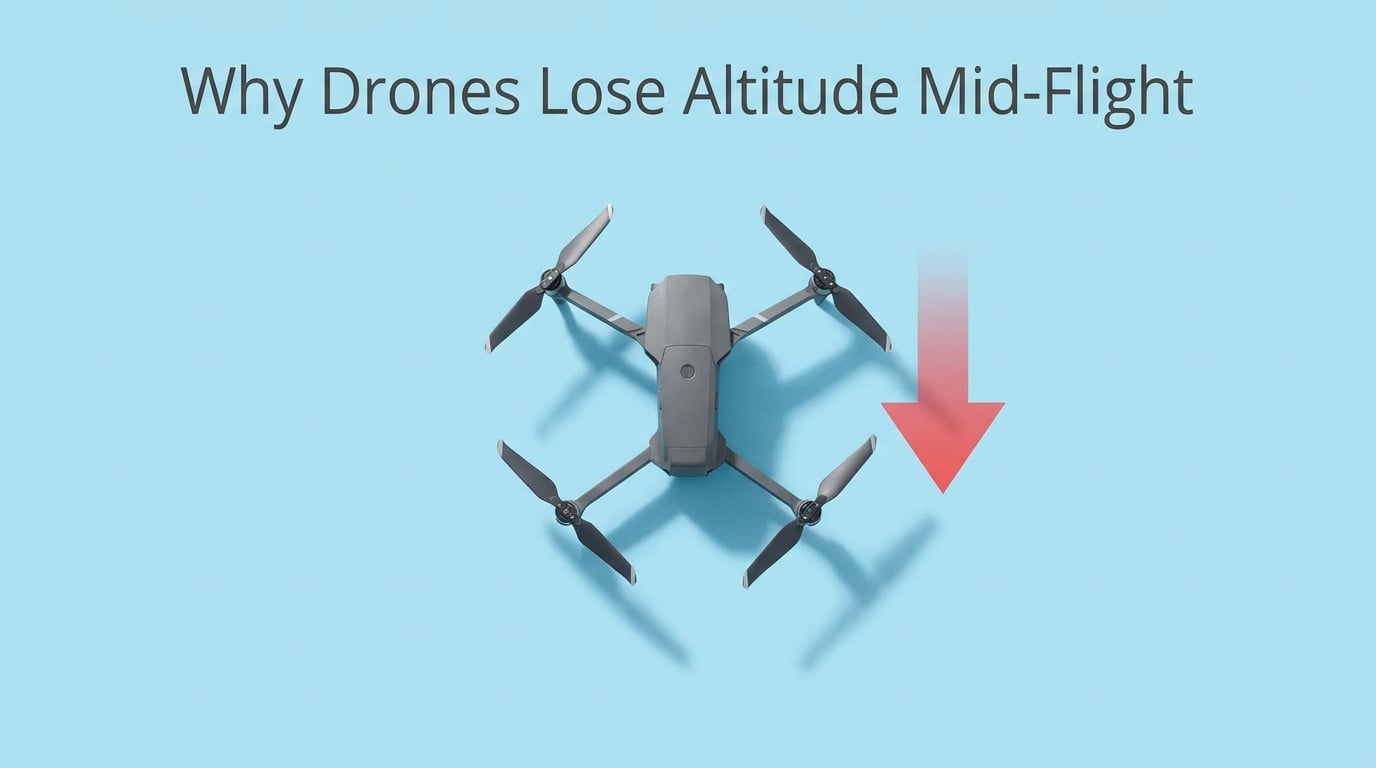
A drone loses altitude on its own mid-flight when something disrupts the balance between motor thrust and gravity. In my experience, the six most common causes are battery voltage sag, wind or weather interference, GPS signal loss, barometer or IMU sensor malfunctions, motor and ESC failures, and incorrect return-to-home settings. Each of these can trigger an uncontrolled descent ranging from a gentle dip to a complete drop out of the sky.
I have been flying drones for years and have personally seen all six of these causes play out in real flights. I remember one afternoon last year when my DJI Mini dropped 30 feet in two seconds over a parking lot. The culprit turned out to be a battery that had dropped below 3.3 volts per cell under load, even though the app showed 38% charge remaining. That single incident is why I now run a strict pre-flight battery test on every pack I own.
This guide walks you through every common reason your drone might lose altitude on its own, how to diagnose the problem, and what to do about it. We will cover the technical causes, the user-fixable causes, and the cases where you need a professional repair shop.
Table of Contents
Battery Issues Are the Most Common Cause of Mid-Flight Altitude Loss
When pilots ask what causes a drone to lose altitude on its own mid-flight, the answer is almost always battery-related. Lithium-polymer (LiPo) batteries are sensitive to load, temperature, and age. When a battery cannot deliver the voltage the motors demand, the flight controller cannot maintain lift and the drone begins to descend.
Voltage Sag Explained
Voltage sag is the momentary drop in battery voltage when motors draw high current. Healthy batteries handle this surge, but worn or cold cells can dip below the safe cutoff threshold for a fraction of a second. When that happens, the flight controller may interpret the dip as a critical failure and reduce throttle output, causing sudden altitude drops.
I have seen forum users on r/dji and mavicpilots.com report drones dropping 100+ feet in seconds because of voltage sag that the battery indicator never warned them about. The displayed percentage can show 40% or higher right up until the moment the drone falls out of the sky.
Cold Weather Battery Performance
Cold temperatures reduce the chemical reactivity inside LiPo cells. A battery that performs perfectly at 70 degrees Fahrenheit may sag badly at 35 degrees. Most drone manufacturers recommend pre-warming batteries to at least 60 degrees before flight in cold conditions.
Battery Age and Cell Damage
Batteries that have been through 200+ charge cycles, stored fully charged for months, or physically damaged will lose capacity and develop internal resistance. A swollen or puffy battery is a clear sign of damage and should be retired immediately. Flying on a damaged battery is one of the fastest ways to trigger a sudden drone altitude drop.
Wind and Weather Conditions Can Push Your Drone Off Course
Even a drone that is technically working perfectly can lose altitude in challenging weather. Wind, thermal activity, and precipitation can all overwhelm the flight controller’s ability to maintain position and altitude.
Wind Speed Thresholds
Most consumer drones are rated for wind resistance between 20 and 30 miles per hour. Beyond that, the motors must work harder to hold position, drawing more current and draining the battery faster. Pilots flying in coastal or mountain areas should check wind forecasts and the drone’s own wind reading before takeoff.
Thermal Updrafts and Downdrafts
Air rising from sun-heated pavement or sinking over cool water can shift a drone dozens of feet in seconds. Downdrafts are particularly dangerous because they push the drone toward the ground faster than the altitude hold system can compensate. This is one of the most overlooked causes of drone altitude loss on sunny afternoons.
Flying in Rain or Fog
Moisture on the propellers, sensors, and motors adds weight and disrupts the barometer. Many pilots have watched their drone descend on its own after flying through fog, even with a full battery and strong GPS. If you see condensation forming on the camera lens, land immediately.
GPS Signal Loss Disrupts Altitude Hold
GPS does more than tell your drone where it is on a map. It also gives the flight controller a reference for holding position and altitude. When GPS drops out, the drone switches to ATTI mode and begins to drift, sometimes visibly losing altitude in the process.
How GPS Helps Drones Hover
With a strong GPS lock, the flight controller knows exactly where it is in three-dimensional space. It compares the current altitude to the target altitude and adjusts the motor speeds hundreds of times per second to keep the drone level. Without GPS, the controller is essentially blind to small changes in position.
Common GPS Interference Sources
Tall buildings, dense tree cover, and high-voltage power lines can all block or reflect GPS signals. Flying close to a cell tower or military installation can also cause sudden GPS dropout. If your drone app shows fewer than 8 satellites locked, treat the flight as a degraded GPS scenario and fly conservatively.
Switching to ATTI Mode
When GPS is unavailable, the controller falls back to attitude (ATTI) mode, which only uses the IMU and barometer. In ATTI mode, the drone will drift with the wind and may struggle to hold altitude. This is the most common reason pilots describe a drone losing altitude when hovering, especially in urban canyons.
Sensor Malfunctions Including Barometer and IMU Errors
Modern drones rely on a suite of sensors to maintain stable flight. The barometer measures air pressure to estimate altitude, the IMU measures rotation and acceleration, and the compass provides heading. When any of these sensors malfunction, the drone may fly erratically or descend on its own.
Barometric Altimeter Drift
The barometer compares current air pressure to a baseline reading taken at takeoff. If the pressure changes mid-flight (such as from a weather front moving in) or if the sensor is contaminated, the barometer may report a false altitude. The flight controller then “corrects” by lowering the drone to match the wrong reading.
Forum users on r/Multicopter have reported barometer drift of 30 to 50 feet during flights across pressure boundaries. I have personally watched a barometer fail in a sudden weather shift and trigger a phantom altitude drop of about 20 feet.
IMU Calibration Issues
The IMU needs to be calibrated whenever the drone experiences a hard landing or significant temperature change. An uncalibrated IMU feeds bad rotation data to the flight controller, which then over- or under-corrects the motors. The result can be a wobble, drift, or a drone descending on its own mid-flight.
Compass Interference
Compass interference is less common in consumer drones today because most have moved to multi-band GNSS, but it still happens near large metal objects, vehicles, and reinforced concrete. A confused compass can cause the drone to fly in circles or lose position lock, which often looks like an altitude problem from the ground.
Motor and ESC Failures Lead to Sudden Drops
When a motor or ESC fails, the affected propeller slows down or stops entirely. The other three motors must compensate, but they cannot always generate enough lift. The result is a tilt and a sudden, often violent, descent.
ESC Desync Events
An ESC desync happens when the electronic speed controller loses synchronization with the motor. The motor briefly stops while the other three keep spinning, producing a sudden tilt. ESC desyncs are usually caused by damaged motor windings, bad firmware, or voltage spikes from the battery.
Motor Bearing Wear
Motor bearings wear out over time, especially in dusty or sandy environments. A worn bearing causes the motor to spin unevenly, drawing more current and producing less thrust. Pilots who notice increased vibration, unusual noise, or reduced flight time should inspect the motors before the next flight.
Propeller Damage
A cracked, bent, or nicked propeller generates less lift and more vibration. Even small nicks on the leading edge can cause asymmetric thrust. Always inspect propellers before every flight and replace them at the first sign of damage. This is one of the easiest causes of sudden altitude drops to prevent.
Why Drones Lose Altitude When Turning or Yawing
Many FPV and freestyle pilots notice that their drone loses altitude when turning or yawing, especially at high speed. The reason is physics: when a drone yaws, the propellers briefly trade some of their vertical lift for horizontal motion. The faster the yaw, the more lift is lost.
In a hover, yaw movement is so slow that the altitude loss is barely noticeable. In an aggressive FPV turn, the same drone can lose 10 to 20 feet in a single second. Pilots who feel this happening can either reduce yaw rate or add throttle during the turn. Tilting the drone also causes altitude loss for the same reason, which is why a banking turn feels like a temporary drop.
RTH (Return to Home) Behavior That Causes Unexpected Descents
Return-to-home is a safety feature, but it can sometimes be the reason a drone begins to descend on its own. RTH is triggered by low battery, lost controller signal, or pilot command. The drone ascends to a preset RTH altitude and then flies back to the home point.
RTH Altitude Settings
If the RTH altitude is set higher than the drone’s current altitude, the drone will climb before returning. If it is set lower, the drone will descend first, which can look like an uncontrolled altitude drop from the ground. Pilots flying in mountainous areas or near tall trees should set RTH altitude high enough to clear any obstacles in the flight path.
Some DJI drones have a smart RTH feature that calculates the correct altitude based on the takeoff point and the surrounding terrain. I always recommend enabling this feature and verifying the RTH altitude before every flight.
Step-by-Step Troubleshooting When Your Drone Drops Altitude
If your drone loses altitude mid-flight, follow these steps in order. Most issues can be diagnosed and fixed without sending the drone in for repair.
Immediate In-Flight Actions
The instant you notice altitude loss, switch to manual or sport mode and apply full throttle. This gives the motors maximum authority to recover. If the drone does not respond, attempt an emergency landing in the safest nearby open space. Fighting the flight controller is often worse than a controlled descent.
Post-Flight Diagnostics
After a safe landing, check the battery voltage per cell, inspect the propellers for nicks, look at the motor bells for smooth rotation, and review the flight log for voltage spikes or sensor errors. Most drone apps include a built-in flight log viewer that shows altitude, GPS, battery, and motor data over time.
Reading Flight Logs
Flight logs are the single best diagnostic tool. A log showing a steady battery voltage right up to the drop suggests a motor or ESC issue. A log showing rapid voltage decline suggests a battery problem. A log showing GPS dropout or barometer drift points to sensor issues. If you cannot read your own logs, the community on r/dji and mavicpilots.com is very helpful at interpreting them.
Pre-Flight Checklist to Prevent Altitude Loss
Most altitude loss incidents can be prevented with a simple pre-flight routine. I run through this checklist on every flight, no matter how short.
Battery Inspection
Check the battery charge percentage, look for swelling or puffy cells, and verify the voltage on a checker if possible. A full battery that reads under 4.2 volts per cell after sitting overnight is a sign of internal damage.
Sensor Calibration
Calibrate the IMU and compass if the app recommends it, and verify the barometer baseline at the takeoff location. Do not calibrate sensors indoors or near metal objects.
Weather Verification
Check the wind speed, temperature, and any incoming weather fronts. If wind is above your drone’s rated limit, or if the temperature is below 40 degrees Fahrenheit, take extra time to warm the batteries.
When to Seek Professional Repair Help
Some altitude loss issues are beyond a pilot’s ability to fix. If your drone shows repeated motor imbalance, sudden voltage drops on a fresh battery, or persistent sensor errors after recalibration, take it to an authorized service center. Continuing to fly a damaged drone risks total loss and can be dangerous to people on the ground.
As a general rule, I send any drone in for service if I have had two unexplained altitude events within 10 flights. The cost of a professional diagnosis is far less than the cost of a replacement drone or, worse, an injury.
Frequently Asked Questions
What causes a drone to lose altitude on its own mid-flight?
The most common causes are battery voltage sag, wind or weather interference, GPS signal loss, barometer or IMU sensor malfunctions, motor and ESC failures, and unexpected return-to-home activations. A single flight log review can usually identify the culprit.
Why did my drone fall out of the sky suddenly?
Sudden drops are almost always caused by a critical failure: a battery that sagged below the cutoff voltage, an ESC desync that stopped one motor, a propeller that broke free mid-flight, or a complete GPS and barometer failure at the same moment. Check the flight log to confirm which one occurred.
What altitude do drones stop working?
Most consumer drones are software-limited to 400 feet (120 meters) above takeoff by FAA rules. They will not physically stop working at higher altitudes, but propeller efficiency drops as air thins, so flight times shrink dramatically above 10,000 feet.
How accurate are drone altimeters?
Barometric altimeters are typically accurate within 1 to 3 feet when properly calibrated. GPS altitude is less accurate, usually within 10 to 15 feet vertically. Most drones use both sensors together for the best result.
Why does my drone lose altitude when hovering?
Altitude loss during a hover usually points to a GPS dropout or a barometer drift. Check the app for satellite count and any barometer warnings. Recalibrating the IMU and barometer at the takeoff point often solves the issue.
Why does my DJI drone disconnect mid-flight?
DJI drones disconnect when the controller signal is blocked, when the drone flies beyond the controller’s range, or when electromagnetic interference overwhelms the link. Flying in urban areas, near power lines, or behind metal structures increases the chance of a disconnect.
Final Thoughts on Drone Altitude Loss
A drone that loses altitude on its own mid-flight is telling you something. Whether the cause is a tired battery, a stiff wind, a dropped GPS lock, or a failing motor, the drone is trying to communicate that something needs attention. Our team has found that the pilots who fly the most safely are the ones who treat every altitude event as a learning opportunity and run a full post-flight check after each one.
Start with the battery, then check the propellers, then the sensors, then the motors. Walk through this order every time and you will catch most issues before they become crashes. If you found this guide helpful, our site has more resources on drone maintenance, troubleshooting, and safe flight practices for pilots of every skill level.