
If you fly FPV drones, race RC cars, or run any lipo-powered build, you’ve heard the same advice a hundred times: store your packs at 3.8V per cell. I’ve been running lipos for nearly a decade, and I can tell you that one number, more than any other setting on your charger, decides whether your pack lasts 50 cycles or 300. In this guide, I’ll break down what LiPo storage voltage actually is, why 3.8V per cell is the sweet spot, and how to build a storage routine that protects both your batteries and your wallet.
You’ll learn the chemistry that makes 3.8V stable, the exact pack voltage to target for 2S through 8S builds, what happens when you skip storage charging, and the step-by-step process our team uses on every pack before it goes on the shelf.
Table of Contents
What Is LiPo Storage Voltage and Why 3.8V Per Cell Matters
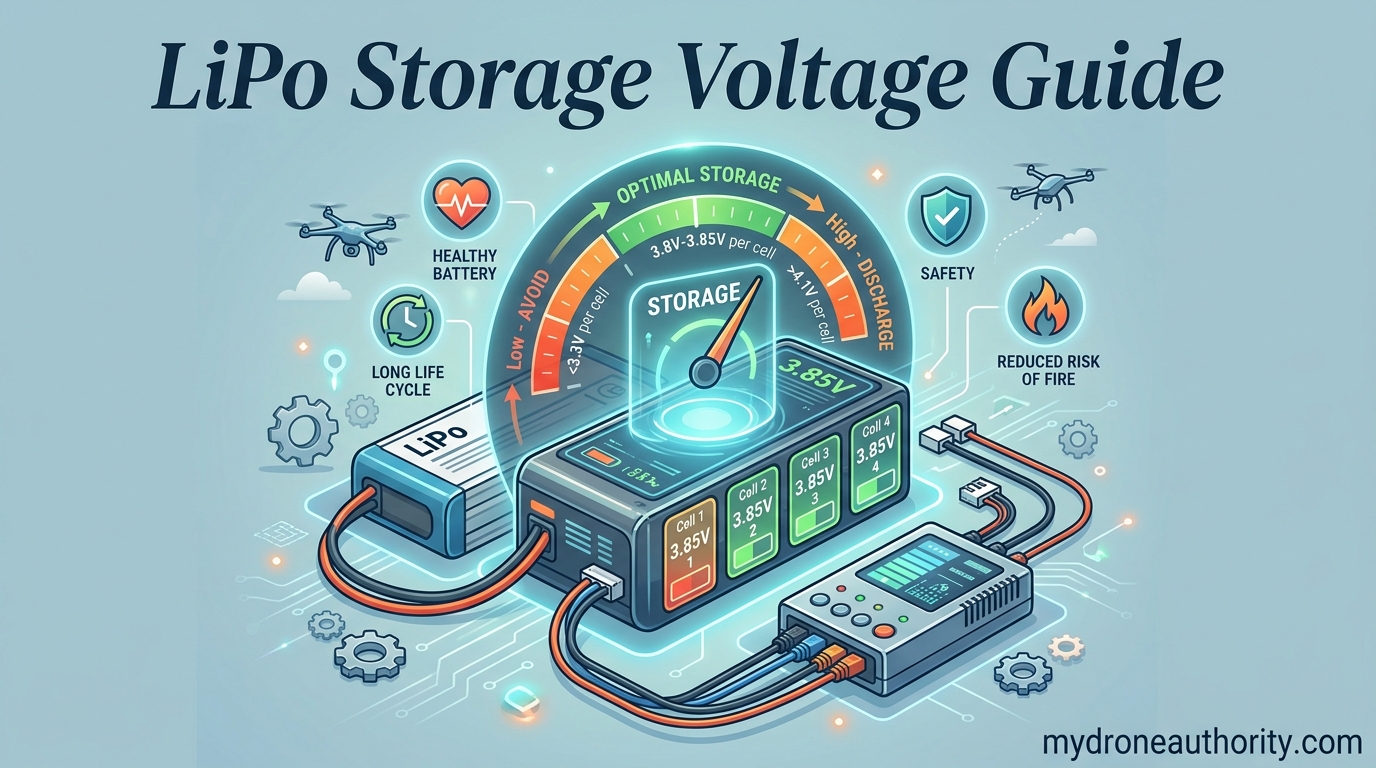
LiPo storage voltage is the state of charge where each cell sits around 3.8V (3.80V-3.85V), roughly 40-50% of total capacity. It’s the voltage level where the battery experiences the least chemical stress during periods of inactivity, which directly translates into longer cycle life, lower internal resistance growth, and a much smaller chance of swelling or puffing while the pack sits on a shelf.
I treat storage voltage as a “rest state” for the battery. Just like you wouldn’t sprint a marathon at full pace, you don’t want to leave a LiPo at 4.2V per cell (full) or 3.2V per cell (empty) for days or weeks. Both extremes stress the chemistry. The 3.8V target lands the cell in a relaxed middle, where the electrolyte is stable, the anode and cathode are not under heavy strain, and self-discharge is gentle.
When I started flying FPV, I used to leave my 4S packs fully charged between weekend sessions. After about a year, my packs were puffed, voltage sag was awful, and runtime dropped by 30%. Switching to a strict storage routine (charge to 3.8V per cell right after the last flight) gave me a different experience: my packs stayed flat, voltage hold during punch-outs was consistent, and I got over 200 cycles out of premium 6S packs before they finally gave up. That single habit change mattered more than any charger upgrade or brand switch.
The Chemistry Behind 3.8V Per Cell Stability
3.8V per cell is the voltage where the lithium cobalt oxide (or NMC) cathode and graphite anode are at their most electrochemically stable, with minimal side reactions and electrolyte decomposition. This is the core reason every LiPo manufacturer and charger manufacturer converged on this number.
Here’s what’s happening inside the cell. When a LiPo is fully charged at 4.2V per cell, the cathode is fully delithiated, the electrolyte is under high oxidative stress, and the SEI (solid electrolyte interphase) layer is being forced to grow. That growth permanently consumes cyclable lithium, which is why a pack stored at full charge loses capacity faster over time.
Drop the voltage to 3.8V and the stress drops dramatically. The cathode is only partially delithiated, the electrolyte isn’t being pushed, and the SEI growth slows to a crawl. The cell essentially “rests” in a low-stress configuration.
Go the other way, below 3.5V per cell, and a different problem starts: copper dissolution from the anode current collector. Once you dip below roughly 3.0V per cell, copper ions migrate into the electrolyte and can plate onto the cathode during the next charge, creating internal micro-shorts. This is why deep-discharge damage is often permanent and not fixable by simply recharging.
The 3.8V-3.85V band is genuinely the chemical Goldilocks zone. It’s high enough to avoid copper dissolution concerns even after months of self-discharge, and low enough to keep the cathode and electrolyte from degrading aggressively. Reddit’s r/fpv community often phrases this as “3.8V is right in the middle,” and they’re not wrong, but the deeper truth is that this range sits in a flat plateau of the cell’s voltage curve where side reactions are minimized.
LiPo Voltage Ranges: From Empty to Fully Charged
A standard LiPo cell operates between 3.2V (empty cutoff) and 4.2V (full charge), with 3.8V sitting in the middle as the storage target. Knowing where each voltage falls on the State of Charge (SOC) curve helps you read your charger’s readings and make smarter decisions in the field.
Here’s the voltage-to-percentage breakdown our team uses as a quick reference:
4.20V per cell – 100% charged. Full punch, maximum capacity, but high chemical stress. Never store here for more than a few hours.
3.95V-4.10V per cell – 85-90% charged. Common “fly now” voltage for race day. Still too high for storage.
3.80V-3.85V per cell – 40-50% charged. The storage sweet spot. Low stress, stable chemistry, ideal for days to months of inactivity.
3.70V per cell – Around 25-30% charged. Acceptable for storage in a pinch, but lower than ideal.
3.50V per cell – About 10-15% charged. Below the safe storage zone. Time to charge or top up before longer storage.
3.20V per cell – Hard cutoff. Flying below this risks permanent damage. Do not store at or below this voltage.
The exact percentage mapping varies slightly between cell manufacturers and chemistries, but the shape of the curve is consistent: voltage drops slowly from 4.2V to about 3.7V, then falls off rapidly between 3.7V and 3.2V. That long flat top is exactly why 3.8V is such a forgiving target; small voltage differences equal very small capacity differences, so being 0.05V off doesn’t really matter.
Storage Voltage by Cell Count (2S, 3S, 4S, 6S, 8S)
Multiply 3.8V by the number of cells in series to get the total pack storage voltage. This is the most practical reference I keep taped to my charging bench, because chargers show pack voltage, not per-cell voltage.
Here’s the chart our team uses for the most common LiPo configurations in FPV, RC cars, and fixed-wing builds:
1S (3.7V nominal) – Storage: 3.80V-3.85V. Common in tiny whoops and micro quads.
2S (7.4V nominal) – Storage: 7.60V-7.70V. Popular for smaller cinewhoops and park flyers.
3S (11.1V nominal) – Storage: 11.40V-11.55V. Used in mid-size FPV quads, 3D planes, and small RC crawlers.
4S (14.8V nominal) – Storage: 15.20V-15.40V. Workhorse for 5-inch FPV racers and speed-run RC cars.
5S (18.5V nominal) – Storage: 19.00V-19.25V. Niche use in freestyle and some high-power planes.
6S (22.2V nominal) – Storage: 22.80V-23.10V. The current standard for competitive FPV racing and high-end freestyle.
8S (29.6V nominal) – Storage: 30.40V-30.80V. Found in large RC helis, big EDF jets, and high-power ground vehicles.
Always verify storage voltage by checking individual cells on your charger’s balance screen. A pack showing 22.8V total might have one cell at 3.85V and another at 3.78V if balance is drifting, which signals that the pack needs attention. Cell balance is one of the clearest early warnings of a degrading LiPo.
If you fly LiHV (Lithium High Voltage) chemistry, the math shifts slightly. LiHV cells charge to 4.35V per cell max, and the storage target moves up to 3.85V-3.90V per cell. The principle is the same (about 40-50% of usable capacity) but the numbers are different. Don’t mix LiHV storage targets with standard LiPo settings, or you’ll over-discharge the pack.
Risks of Leaving LiPos Fully Charged
Storing a LiPo at 4.2V per cell accelerates capacity fade, increases internal resistance, and raises the risk of swelling, puffing, and thermal runaway. The longer the pack sits at full charge, the more permanent damage accumulates inside the cells.
I’ve personally seen “forgotten” packs go from a healthy 1300mAh to 1050mAh in under three months of full-charge storage. The same pack, stored at 3.8V per cell across the same period, would have lost maybe 2-3% capacity from normal self-discharge alone.
Here’s what happens internally when you leave a LiPo at 4.2V per cell:
Electrolyte oxidation. The high voltage pushes the electrolyte to decompose at the cathode surface, generating gas (the source of puffing) and consuming active lithium.
SEI layer growth. The protective layer on the anode thickens, which permanently traps lithium that can no longer cycle.
Metal dissolution. At high voltage, transition metals (cobalt, nickel) can leach from the cathode into the electrolyte, contaminating the cell.
Voltage sag increase. Internal resistance climbs as the SEI thickens and the electrolyte breaks down. You’ll feel this as weaker punch and shorter flight times.
These effects are all cumulative and mostly irreversible. You can’t undo them by switching to proper storage later. That’s why experienced pilots and racers treat “storage charge immediately after the last flight” as a non-negotiable habit, not a maybe.
If you do accidentally leave a pack at full charge for a week or two, don’t panic. Set it to storage voltage as soon as you notice, then check the cells for puffing or voltage drift. A single incident of full-charge storage won’t kill a healthy pack, but repeating it month after month absolutely will.
How to Storage Charge Your LiPo Properly
Set your charger to “Storage” mode, which automatically balances each cell to 3.80V-3.85V regardless of starting voltage. This is the safest, most accurate method and the one every modern balance charger supports.
Here’s the step-by-step process our team uses on every pack after the last flight of the day:
Step 1: Let the pack cool down. Wait 10-15 minutes after flying before you handle the battery. A hot pack is harder on the charger and more prone to errors. I usually use this time to put away my gear and clean up the pit area.
Step 2: Inspect the pack. Look for puffing, damaged leads, or a burnt smell. If the pack is physically compromised, do not charge it; recycle it safely.
Step 3: Connect the balance lead. Plug both the main discharge lead and the balance lead into your charger. The balance connection is critical; it lets the charger monitor and adjust individual cell voltages.
Step 4: Select Storage mode. On the charger menu, choose “Storage” and set the chemistry to LiPo (or LiHV if applicable). Set the cell count to match the pack (2S, 3S, 4S, 6S, etc.).
Step 5: Start the charge. The charger will automatically charge or discharge each cell to bring it to 3.80V-3.85V. For a fully discharged pack, this means charging. For a fully charged pack, this means discharging. The process typically takes 20-40 minutes for a 1300mAh 6S pack.
Step 6: Verify and disconnect. Once the charger reports “Done,” check the cell voltages on the screen. All cells should be within 0.01V-0.02V of each other. Disconnect the pack and move it to storage.
If your charger doesn’t have a dedicated Storage mode (rare these days, but possible on very old units), you can do it manually: set the charger to LiPo balance charge at 3.8V per cell target. Some chargers allow a custom voltage, otherwise you’ll need to use the discharge function to bring a full pack down.
A useful trick for race day: many pilots end the last flight when the pack is already at 3.80V-3.85V per cell (about 40-50% capacity). This means no storage charging is needed at all; the pack is already in its rest state. This is the most efficient workflow for busy race weekends.
Temperature Considerations for LiPo Storage
Store LiPos at room temperature, ideally between 15°C and 25°C (59°F to 77°F), for the best balance of low degradation and safe handling. Temperature interacts with voltage in ways that catch a lot of pilots off guard.
High storage temperatures (above 30°C/86°F) accelerate every degradation mechanism I mentioned earlier. Electrolyte decomposition, SEI growth, and metal leaching all speed up significantly with heat. A pack stored at 4.2V per cell in a hot garage will degrade many times faster than the same pack stored at 3.8V in a climate-controlled room.
Low storage temperatures are gentler on the chemistry but introduce their own issues. Storing below 0°C (32°F) can cause lithium plating on the anode, and very cold packs should be warmed up before charging. Self-discharge also drops in cold conditions, which is useful for long-term storage but can mask cell problems if you don’t check the pack periodically.
Humidity matters too. Aim for a dry environment (below 50% relative humidity) to prevent corrosion on the cell tabs and balance leads. Many long-term storage enthusiasts use ammo cans with desiccant packs, which is overkill for short-term storage but excellent for packs that will sit for 3-6 months.
For seasonal storage (a winter break, summer vacation), the process is similar but with a few extra checks. Make sure each pack is at 3.8V per cell, then top them up to storage voltage every 2-3 months because lipos self-discharge at roughly 1-3% per month. Storage in a fire-resistant LiPo bag inside an ammo can with desiccant is the gold standard for long-term peace of mind.
What Storage Voltage Will Not Fix (And What Actually Helps)
Storage voltage protects chemistry, but it won’t reverse existing damage or compensate for physical abuse, heat stress, or over-discharge incidents. Knowing the limits of storage voltage helps you set realistic expectations for battery life.
Storage voltage is a maintenance tool, not a repair tool. If a pack is already puffed from heat or overcharge damage, setting it to 3.8V won’t shrink it back. If a cell has been pushed below 3.0V per cell and developed internal micro-shorts, no amount of storage charging will restore it.
What storage voltage does fix is the slow, invisible damage that comes from leaving packs at full charge between sessions. It’s a preventive habit, and it’s one of the cheapest performance gains available in any RC hobby.
Signs your storage routine is working include:
Consistent voltage hold. A healthy stored pack loses only 1-3% per month to self-discharge. If you check a stored pack after a month and it’s down 5-10% or more, something is off.
Stable cell balance. Cells stay within 0.01V-0.02V of each other across storage periods. Drift above 0.05V between cells signals aging.
No puffing. Storing at 3.8V should not cause a healthy pack to swell. If it does, the pack was already compromised.
Consistent flight performance. Punch, top speed, and flight time stay consistent across many cycles. A pack that slowly loses performance over 50-100 cycles likely had degradation from the start.
Long cycle life. Premium LiPos stored at 3.8V per cell regularly deliver 200-300+ cycles before noticeable degradation. Budget packs stored properly still often hit 100-150 cycles. Either way, that’s far better than the 30-50 cycles you get from chronically overcharged storage.
For the best results, pair storage voltage with other habits: don’t run packs below 3.5V per cell under load, avoid hot charging right after flights, retire any pack that puffs more than a few millimeters, and keep an eye on internal resistance (IR) over time. A rising IR reading on a pack that has been properly stored is a sign of natural aging, not a storage failure.
FAQ’s
What is the best storage voltage for LiPos?
The best storage voltage for standard LiPo batteries is 3.80V to 3.85V per cell. This range puts each cell at roughly 40-50% of total capacity, where the chemistry is most stable and self-discharge is minimal. For LiHV packs, target 3.85V to 3.90V per cell instead.
What is the ideal storage voltage for LiFePO4?
LiFePO4 (A123 and similar) cells use a different chemistry with a nominal voltage of 3.2V-3.3V per cell. The ideal storage voltage for LiFePO4 is around 3.30V to 3.40V per cell, which corresponds to roughly 50% state of charge. Do not apply standard LiPo storage targets to LiFePO4 packs, as the voltage ranges are not interchangeable.
Why are LiPo batteries 3.7 volts?
LiPo cells are labeled 3.7V because that is the nominal voltage, the average voltage the cell sits at during normal discharge between 4.2V (full) and 3.2V (empty). The actual voltage changes with state of charge: 4.2V at full, 3.8V at storage, and 3.2V at cutoff. 3.7V is simply the marketing-friendly middle number used for cell count and pack labeling.
What is the safe cell voltage for a LiPo battery?
The safe operating range for a standard LiPo cell is 3.2V to 4.2V per cell. Going below 3.0V per cell risks permanent copper dissolution damage. Going above 4.2V per cell risks electrolyte breakdown and swelling. For storage specifically, 3.80V to 3.85V per cell is the safe target for packs not in active use.
How long can LiPo batteries be stored at storage voltage?
LiPo batteries can be stored at 3.8V per cell for months at a time with minimal degradation. Self-discharge is typically 1-3% per month, so check packs every 2-3 months and top them up to storage voltage as needed. With proper temperature control (15-25C) and dry conditions, packs can sit for 6-12 months at storage voltage with only minor capacity loss.
How close to 3.8V do I need to be for storage voltage?
Within 0.05V is perfectly fine. The voltage curve between 3.7V and 3.9V per cell is very flat, so a 0.05V difference represents only a few percentage points of state of charge variation. Anything from 3.75V to 3.85V per cell is acceptable for storage. Do not stress about getting an exact number; the goal is to avoid the high-stress extremes.
Final Thoughts on LiPo Storage Voltage
Storage voltage at 3.8V per cell is the single most important habit for protecting LiPo battery life, performance, and safety. It costs nothing, takes only a few minutes per pack, and adds dozens or even hundreds of cycles to your battery investment.
Pick up the habit today. After your last flight or run of the day, plug your packs into your charger’s Storage mode, wait for the cells to balance to 3.80V-3.85V, and put them in a dry, room-temperature spot. Check them every few weeks if they’re sitting longer than a month, and retire any pack that shows puffing, severe voltage drift, or rising internal resistance. That routine, more than any other factor, will keep your lipos healthy, your flights consistent, and your wallet happy well into 2026 and beyond.