
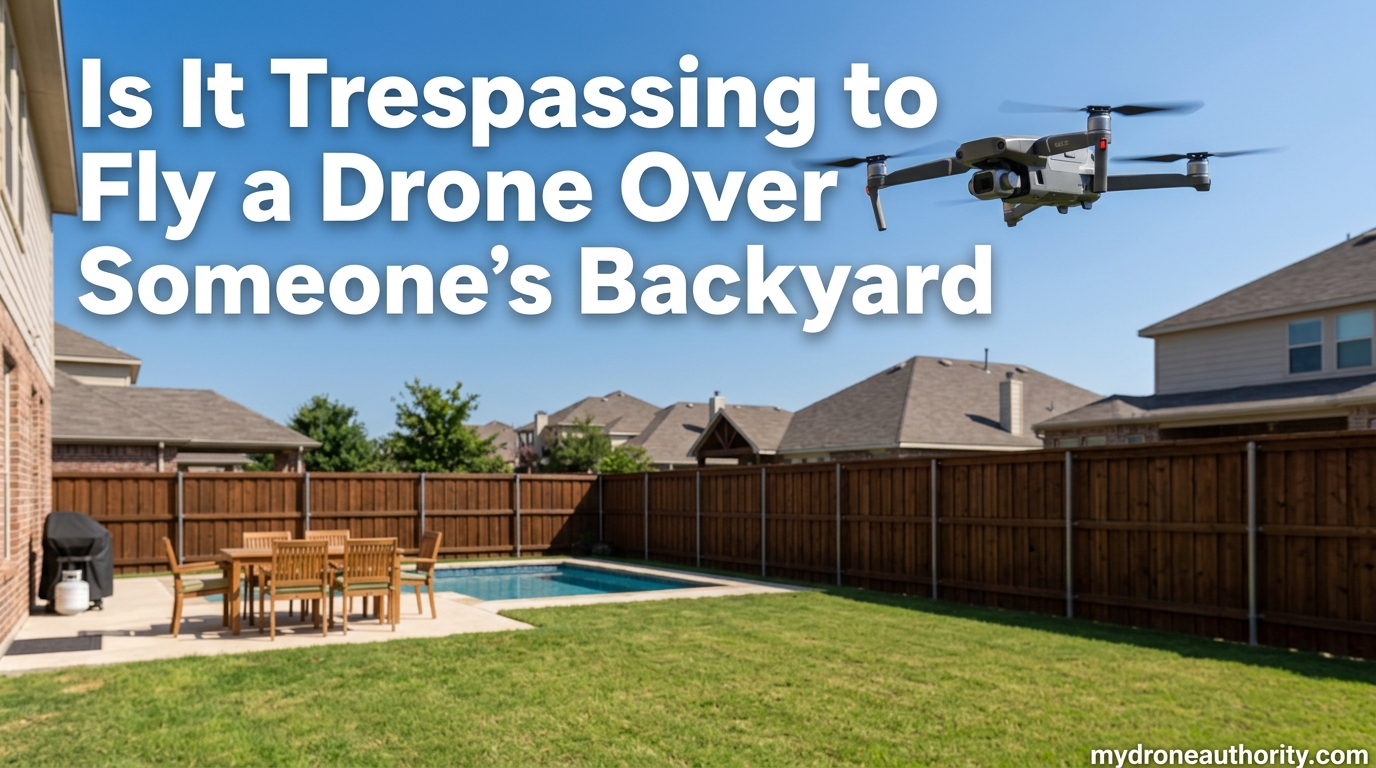
Yes, you can legally fly a drone over someone’s backyard in most cases, but it depends on altitude, what you’re doing, and the state you live in. Under federal law, the FAA controls all airspace from the ground up, so simply flying over a backyard is not automatically trespassing. However, flying low enough to peer into windows, hovering for long periods, or recording video without consent can cross into trespassing or invasion of privacy territory under state law.
I’ve been flying drones for six years, and the question of whether you can fly a drone over someone’s backyard comes up almost weekly in pilot forums. The short answer is yes, but the longer answer matters more if you want to stay out of court. In this guide, I’ll walk you through what the FAA actually controls, where state laws step in, and how to fly near homes without sparking a neighbor feud.
Here’s what we’ll cover:
- Why federal airspace law makes backyard flights legal in most cases
- The 400-foot rule and the 200-foot privacy threshold
- State-specific drone privacy and trespassing laws
- What property owners can and cannot do about drones
- Best practices for flying in residential neighborhoods
Table of Contents
Is Flying a Drone Over Someone’s Backyard Considered Trespassing?
No, flying a drone over someone’s backyard is generally not trespassing under federal law, because the FAA has authority over all navigable airspace. Trespassing traditionally applies when someone physically enters another person’s land or interferes with their exclusive possession of it. Airspace above that land belongs to the public, not the homeowner.
That said, drone flights can still become trespassing or invasion of privacy claims when they meet specific conditions. Flying under 200 feet over a fenced backyard, hovering for more than a few minutes, or capturing identifiable images of people in private spaces can all trigger state-level violations. The line between legal flight and trespass is more about behavior than location.
Courts have wrestled with this question for years. The most cited case is U.S. v. Causby (1946), where the Supreme Court ruled that property owners have rights to airspace only when aircraft fly so low that they cause a “direct and immediate interference” with the land’s use. Low-flying aircraft that don’t disturb the owner don’t constitute a taking. Modern courts apply this same logic to drones, with some important modern twists.
For drone pilots, the practical takeaway is this: high-altitude, quick transits are safe. Low-altitude, slow, or stationary flights invite problems. We dig into the specific numbers below.
What Federal Law Says: FAA Airspace Authority
The Federal Aviation Administration controls all airspace in the United States from the ground up. This means the FAA, not homeowners, decides who can fly where. No state or local trespassing law can override the FAA’s authority over navigable airspace, but states retain power to regulate privacy, harassment, and nuisance on the ground.
For commercial drone pilots, FAA Part 107 governs every flight. Part 107 requires a remote pilot certificate, allows flights up to 400 feet above ground level (or 400 feet above a structure), and requires visual line of sight to the drone at all times. It does not require permission to fly over private property, only permission to operate in controlled airspace (which requires LAANC authorization).
For recreational pilots, Section 44809 of the FAA Reauthorization Act of 2018 provides similar altitude and airspace access. Recreational flyers must pass the TRUST test, follow community-based safety guidelines, and stay below 400 feet AGL. None of these rules prohibit flying over private property.
The critical point is what the FAA does not regulate: privacy, nuisance, and harassment are state law issues. A drone pilot with a perfect FAA compliance record can still face criminal charges or civil lawsuits under state law for peeping, stalking, or trespassing behaviors that happen to use a drone as the tool.
Here are the key federal rules that apply when flying over a backyard:
- Stay below 400 feet above ground level (or 400 feet above the tallest structure within a 400-foot radius)
- Maintain visual line of sight with the drone at all times
- Never operate in a careless or reckless manner that could harm people or property
- Obtain airspace authorization before flying in controlled airspace (Class B, C, D, or surface E)
- Comply with Remote ID requirements for most drones
These rules define what the FAA considers safe flight, not what is socially or legally acceptable in a neighborhood. A 400-foot transit over homes at 30 mph is dramatically different from a 50-foot hover outside someone’s bedroom window, even though the FAA rules technically permit both.
Altitude Limits: The 400-Foot Rule and the 200-Foot Threshold
The 400-foot rule is the most important altitude limit in U.S. drone law. Under 14 CFR 91.119, drones cannot fly higher than 400 feet above ground level without special waiver. This rule exists for manned aircraft safety, not privacy, but it has become the de facto ceiling for nearly all drone operations.
The 200-foot threshold is not a formal FAA rule. It’s a practical guideline drawn from state privacy statutes and nuisance law. Below 200 feet, drones become capable of identifying facial features, license plates, and activities inside homes. Above 200 feet, the images become too small and indistinct to support most privacy claims. Several states explicitly use 200 feet in their drone privacy laws, and courts often reference it as the point where privacy interests become compelling.
For drone pilots, the safe flight zones look like this:
- 400 feet and above: Almost no privacy concerns, but limited utility for ground photography
- 200-400 feet: Safe transit altitude, minimal privacy risk, excellent for mapping and inspection
- 100-200 feet: Acceptable for short-duration work (roof inspections, real estate), higher scrutiny
- Below 100 feet: Highest legal risk, requires clear purpose, avoid lingering
- Below rooftop level: Maximum legal risk, treat as if you’re walking through someone’s yard
In my experience flying real estate shoots, the 200-foot line is where neighbors stop complaining. Transits at 250-300 feet rarely draw attention, while 80-foot hovers get you a phone call within minutes. The physics of camera resolution support this: at 200 feet, a 1-inch camera sensor produces barely identifiable faces. At 80 feet, faces are sharp and clear.
One subtle rule: if you’re flying over a structure, you can fly up to 400 feet above the structure, not just 400 feet AGL. A drone inspecting a 200-foot radio tower can legally fly at 600 feet. This is rarely relevant for backyard flights, but matters for tall buildings and infrastructure.
State Drone Privacy and Trespassing Laws
State laws vary widely, and this is where most drone trespassing disputes actually play out. While the FAA owns the airspace, states own privacy, harassment, and trespassing law. The patchwork of state regulations means your legal exposure depends almost entirely on where you fly.
Some states have passed specific drone privacy statutes. Others rely on existing peeping Tom, stalking, or trespassing laws applied to drone behavior. A few states have no drone-specific laws at all, leaving pilots and homeowners to navigate general privacy principles.
Here’s an overview of how key states handle drone flights over private property:
California: One of the most restrictive states. California Penal Code Section 647 makes it a misdemeanor to fly a drone over private property to capture images of people in areas where they have a reasonable expectation of privacy, especially for sexual arousal or commercial use without consent. Violations carry fines up to $11,000 per offense and potential jail time.
Florida: Florida Statute 934.50 prohibits using a drone to capture images of privately owned property with a reasonable expectation of privacy without written consent. Violations are first-degree misdemeanors. The law explicitly does not restrict airspace access, only the act of recording.
Texas: Texas Government Code 423.002 makes it illegal to use a drone to capture images of private property or individuals with the intent to conduct surveillance. Law enforcement use, real estate marketing, and utility inspections are exempted. Violations are Class C misdemeanors.
New York: New York Civil Rights Law Section 50 prohibits using a drone to capture images of people in areas where they have a reasonable expectation of privacy without consent, except for news gathering or athletic events. Violations can result in civil damages and injunctions.
Oregon: Oregon Revised Statute 161.605 covers drone use for voyeurism and invasion of privacy. Low-altitude flights for harassment or surveillance can be charged under existing privacy statutes.
States with no specific drone laws: Many states, particularly in the Mountain West and Midwest, have not passed drone-specific privacy laws. Pilots in these states rely on general trespassing, harassment, and nuisance statutes, which courts apply inconsistently.
For pilots, the state law reality is simple: know the state you’re flying in. The same flight that’s perfectly legal in Wyoming could trigger a $10,000 fine in California. We recommend checking your state legislature’s website for current drone laws, as this area changes quickly.
HOA and local ordinances add another layer. Many HOAs have their own drone rules, and cities like Chicago, Miami Beach, and New York City have local drone restrictions that go beyond state law. Always check both state and local rules before flying in a new area.
Property Owner Rights and Reasonable Expectation of Privacy
Property owners do not own the airspace above their homes, but they do have a right to privacy in spaces not visible to the public. The legal concept of “reasonable expectation of privacy” comes from Fourth Amendment case law and has been extended to drone flights.
A reasonable expectation of privacy exists in places where a person has a subjective expectation of privacy that society considers reasonable. Inside a home, in a fenced backyard, or inside a bathroom, the expectation is strong. In a front yard visible from the street or on a public balcony, the expectation is weaker.
Drone flights that capture identifiable images of people in areas of strong privacy expectation can support an invasion of privacy claim, even if the flight itself is FAA-legal. This is the legal foundation for most “drone voyeurism” cases and the source of the most successful homeowner lawsuits against drone pilots.
U.S. v. Causby remains the controlling precedent for airspace disputes. The 1946 case involved a chicken farmer whose birds were killed or injured by low-flying military aircraft. The Supreme Court ruled that frequent low-altitude flights that disturbed the use of the land constituted a partial taking, requiring just compensation. Modern courts extend this to drones, but most drone flights do not rise to the Causby level of disturbance because they are brief, infrequent, and don’t damage the property.
Property owners do have rights when drone flights become problematic:
- They can document the flight and contact local police if they believe a law is being broken
- They can pursue civil damages for invasion of privacy, nuisance, or harassment
- They can request a restraining order if the flights are persistent and targeted
- They can sue in small claims court for documented damages in some states
What they cannot do is shoot down the drone. We cover this in detail below, but damaging or destroying a drone, even one flying over your property, is a federal crime under 18 U.S.C. 32. It can also violate state criminal laws against destruction of property. Shooting a drone is a serious mistake, and one that has landed homeowners in federal prison.
For pilots, the practical lesson is to err on the side of privacy even when FAA rules allow the flight. A 250-foot transit over homes is much less likely to trigger a complaint than a 75-foot shot of someone’s pool. The legal risk may be the same, but the social risk is dramatically different.
Can Police Fly Drones Over Your Backyard?
Yes, police can fly drones over your backyard, but they generally need a warrant to use the drone for surveillance of activities not visible from the air at high altitude. The Fourth Amendment protects against unreasonable searches, and most courts treat drone surveillance as a search that requires a warrant.
The leading case on police drone use is Florida v. Riley (1989), which involved a helicopter flyover. The Supreme Court ruled that police observation from public airspace did not constitute a search. Courts have applied this principle to drones in some cases, but most recent rulings require warrants for drone surveillance that reveals activities inside the curtilage of the home, the protected area immediately surrounding it.
In practice, police drone flights fall into these categories:
- Patrol and search-and-rescue: Generally allowed without a warrant, similar to helicopter use
- Traffic and accident response: Allowed without a warrant, even in residential areas
- Pre-raid surveillance: Almost always requires a warrant under recent circuit court decisions
- Ongoing criminal investigation of private spaces: Requires a warrant in most jurisdictions
- Mass surveillance or persistent monitoring: Strongest warrant requirement, often challenged
If police fly a drone over your backyard, you generally cannot prevent it, but you can ask the operator for identification, agency affiliation, and the purpose of the flight. Recording the flight is legal in most states, and any evidence obtained without a warrant may be suppressible in court.
For homeowners, the key insight is that warrantless drone surveillance of the curtilage of your home, the fenced backyard, patio, or pool area, is increasingly being struck down by courts. Police know this and generally seek warrants before using drones in privacy-sensitive cases. The most common warrantless drone use is for traffic accidents, not backyard surveillance.
How Long Can a Drone Hover Before It’s a Problem?
There is no hard legal limit on hover time, but common sense and case law suggest that drones hovering for more than a few minutes invite legal exposure. Brief transits are far less likely to support a trespassing or harassment claim than extended stationary flights.
Forum users in pilot communities report that neighbor complaints start at around 5-10 minutes of stationary flight at low altitude. Hovering for 20+ minutes, especially at altitudes under 100 feet, is virtually guaranteed to provoke a response, even if the drone is doing nothing wrong from an FAA perspective. Reddit users in r/drones and r/dji have shared numerous stories of 20-30 minute hover incidents that led to police calls, sometimes even when the drone was capturing nothing identifiable.
For practical purposes, drone pilots should keep residential hover times short:
- Under 2 minutes: Generally safe at any altitude
- 2-5 minutes: Acceptable for specific tasks (roof photos, real estate shots)
- 5-10 minutes: Higher complaint risk, especially at low altitude
- 10+ minutes: Almost certain to provoke complaint, possible police response
- Persistent daily flights: Likely to trigger restraining order or lawsuit
The legal threshold for “aerial trespass” is not time alone, but the combination of time, altitude, and behavior. A 5-minute hover at 200 feet for roof inspection is very different from a 5-minute hover at 50 feet outside a window. Courts look at the totality of circumstances, but the more invasive the flight appears, the more legal risk you carry.
Best Practices for Flying Drones Near Residential Areas
Most drone-related disputes could be avoided with better communication and a few simple habits. After six years of flying in residential areas and reviewing hundreds of forum complaints, I’ve found that pilots who follow these guidelines almost never have problems, even when neighbors are initially skeptical.
Fly at higher altitudes when possible. The single most effective way to reduce complaints is to fly higher. If your mission allows, stay above 150 feet over residential areas. The images are still useful for many purposes, and the social cost is dramatically lower. A 250-foot transit produces results that are functionally similar to a 100-foot shot for most mapping and inspection tasks.
Keep transits fast and direct. Slow-moving drones read as more menacing than fast ones. If you need to pass over a backyard, do it at a reasonable speed and keep moving. Stationary or slow-moving flight reads as surveillance, even if it’s not.
Tell neighbors before you fly. I always knock on doors before residential flights. Most neighbors are curious, not hostile, and a 60-second conversation can prevent an hour of conflict. Showing them what you’re doing, the drone you’re flying, and the photos you’re capturing turns potential adversaries into allies.
Post signage if doing commercial work. Real estate agents, roof inspectors, and other commercial operators should post visible signage indicating the drone flight is in progress. Many states require this under commercial drone privacy laws, and it dramatically reduces complaints.
Check the B4UFLY app before flying. The FAA’s B4UFLY app shows airspace restrictions, temporary flight restrictions, and other critical information. It won’t tell you about state privacy laws, but it will keep you out of controlled airspace violations that can compound state law issues.
Carry proof of Remote ID compliance. The FAA’s Remote ID rule requires most drones to broadcast identification and location information. If a neighbor or police officer approaches you, having your Remote ID working provides immediate identification and demonstrates that you’re operating legally.
Avoid flying at night without good reason. Night flights are more disruptive to neighbors and trigger additional FAA requirements (anti-collision lighting visible for 3 statute miles). Forum reports of police involvement spike dramatically for night flights, even when the drone is doing nothing wrong.
Document your flights. Keep a flight log with date, time, location, altitude, and purpose. If a complaint arises, this documentation is invaluable. Most drone apps (DJI Fly, Autel Sky, etc.) record GPS tracks automatically, so save those files.
Have insurance. Drone liability insurance is inexpensive ($50-150 per year for hobbyists) and covers you if a neighbor sues. Some homeowner’s policies cover drone incidents, but many exclude aviation. Carry a separate policy if you fly commercially.
For homeowners dealing with unwanted drone flights, the equivalent best practices are different. Document the flights with photos and video, noting date, time, duration, and what the drone appeared to be doing. Avoid confrontation, as the drone pilot may also be recording. Contact local police if you believe a law is being broken, but understand that many drone flights are technically legal even when they feel intrusive.
If you can identify the pilot, a polite conversation often resolves the issue. Most drone pilots are reasonable, and a complaint that doesn’t escalate can still prompt better behavior in the future. The pilots who ignore polite requests are the ones to document for potential legal action.
The most important thing to remember is that the law and social norms are not always the same. A flight that is technically legal under FAA rules can still be a problem in a neighborhood. Drone pilots who care about being good neighbors will fly higher, faster, and with more communication than the law strictly requires. Homeowners who care about their privacy will document unwanted flights and pursue legal remedies when needed.
Frequently Asked Questions
Is it illegal for someone to fly a drone over your backyard?
Generally no, the FAA controls all airspace and allows drone flights over private property, including backyards. However, low-altitude flights, hovering, or recording video in areas with a reasonable expectation of privacy can violate state privacy and trespassing laws.
Can I disable a drone from flying over my property?
No, you cannot legally shoot down, disable, or interfere with a drone, even one flying over your property. Damaging a drone is a federal crime under 18 U.S.C. 32 and may violate state laws against destruction of property. Document the flight, contact police if you believe a law is being broken, and pursue civil remedies instead.
Is flying a drone over someone’s property considered trespassing?
Not under federal law, because the FAA has authority over all airspace. However, drone flights can constitute trespassing under state law if they meet specific conditions: flying at low altitudes, hovering for extended periods, capturing images in privacy-protected areas, or causing nuisance through noise or harassment.
Can I fly a drone over my neighbor’s yard?
Yes, you can generally fly a drone over your neighbor’s yard under federal airspace rules. Stay below 400 feet AGL, maintain visual line of sight, and avoid hovering at low altitudes or capturing identifiable images in private spaces, which can violate state privacy laws.
Can police use a drone to look in my backyard?
Police can fly drones over residential areas for patrol, search and rescue, and accident response, but most courts require a warrant for drone surveillance of activities not visible from public airspace, especially inside the curtilage of your home (fenced backyard, patio, or pool area).
How low can you fly a drone over private property?
There is no federal minimum altitude over private property, but pilots commonly use 200 feet as a practical privacy threshold. Below 200 feet, drone images become detailed enough to identify people and activities, increasing the risk of state privacy law violations.
What can I do if a drone keeps flying over my house?
Document each flight with photos, video, and notes on date, time, and duration. Contact local police if you believe a law is being broken. Never shoot at or interfere with the drone. If you can identify the pilot, a polite conversation often resolves the issue. For persistent problems, consult an attorney about restraining orders or civil action.
Final Thoughts on Flying Drones Over Backyards
Flying a drone over someone’s backyard is generally legal under federal airspace rules, but whether it qualifies as trespassing depends on altitude, behavior, and state law. The FAA owns the airspace, but states own privacy, and the courts have drawn clear lines: high-altitude transits are fine, low-altitude hovers are not.
For drone pilots, the path forward is straightforward: fly higher than you think you need to, keep your flights short, communicate with neighbors, and never use a drone to peer into private spaces. For homeowners, the path is equally clear: document unwanted flights, report violations to police, and never shoot at a drone, even when it feels invasive. The federal law is unambiguous on that point.
Drone law is changing fast, and the rules we’ve covered here reflect the state of the law in 2026. I update this guide regularly as new state laws pass and court decisions come down. If you have a specific question about a flight in your area, your best resource is an attorney licensed in your state, as this article is for educational purposes and is not legal advice.