
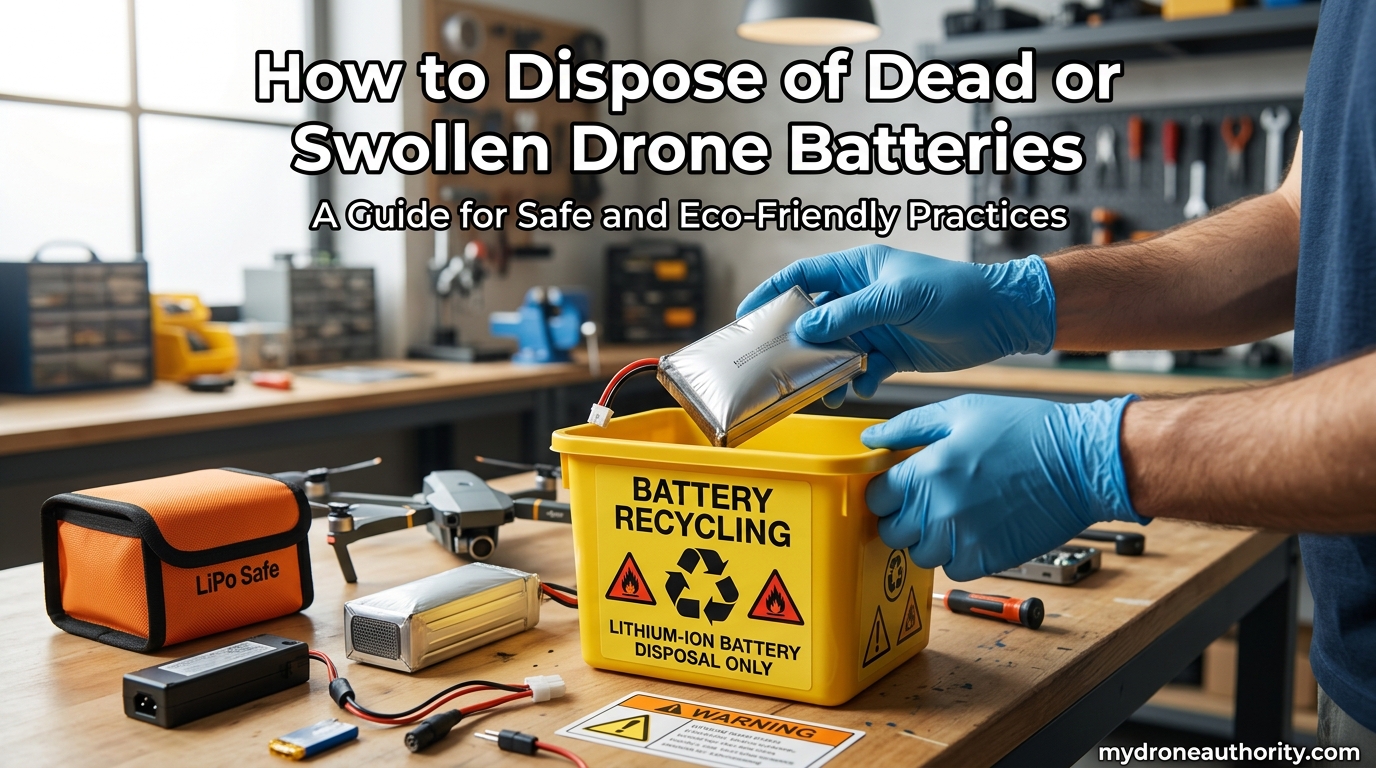
A swollen drone battery is a serious safety hazard that needs immediate attention. The good news is that disposing of a dead or swollen drone battery in the US is straightforward once you know the steps. Most major hardware stores, electronics retailers, and certified mail-in programs accept them free of charge.
I’m writing this because I learned the hard way what a puffy LiPo can do. Last year, a swollen DJI Mavic battery vented in my garage and triggered the smoke detector at 2 a.m. I now treat every battery that shows signs of swelling as a small fire that hasn’t started yet. In this guide, our team breaks down the exact process we use to safely discharge, package, and recycle drone batteries the right way.
Table of Contents
Why Drone Batteries Are Hazardous and What Causes Swelling
Drone batteries are almost always lithium-based, either lithium-polymer (LiPo) or lithium-ion (Li-ion). Both chemistries store a huge amount of energy in a small package, and both can fail violently if damaged. When a LiPo cell breaks down, it releases flammable electrolyte vapors and oxygen inside the sealed pouch. That gas has nowhere to go, so the battery puffs up like a small pillow.
That puffed shape is the warning sign. The technical term for what is happening is “outgassing,” and it usually means the cell has entered a path called thermal runaway. Thermal runaway is a self-heating chemical reaction. Once it starts, the cell temperature climbs on its own until the electrolyte ignites. A single drone battery contains enough energy to burn down a car, a garage, or a recycling truck.
In my experience, swelling usually shows up for one of four reasons. The battery was left fully charged for weeks or months. It was drained below 3.0V per cell during a flight. It was exposed to high heat, like sitting in a car in July. Or it was physically damaged in a crash. DJI and other manufacturers have all issued recalls and advisories about exactly these failure modes.
Drone batteries fail more often than phone or laptop batteries because they push cells harder. FPV pilots in particular run packs at high C-ratings, which generates heat and stresses the chemistry. Even a battery that “still works” can be one internal short away from a fire.
How to Tell If Your Drone Battery Is Swollen or Damaged
The fastest way to check a drone battery is to look at it on a flat surface. Place the battery upright on a table and see if it rocks. A healthy LiPo sits flat. A swollen one tilts because the puffed cell breaks the geometry.
Visual cues are usually the first clue. Look for a rounded or pillow-shaped cell, gaps between cell layers, a cracked hard case on DJI Smart Flight Batteries, or any sign of crusty white residue around the seams. That white residue is dried electrolyte and means the seal has failed.
Smell is another giveaway. A failing LiPo often smells sweet, chemical, or like acetone or nail polish remover. If you open your drone case and that smell hits you, the battery is venting. Our team has caught two bad packs this way during field reviews.
Performance is the third signal. If your drone is cutting flights short, sagging voltage under load, taking longer to charge, or running hotter than usual, the pack is on its way out. Don’t ignore these warnings hoping for one more flight. Swollen and damaged batteries are not recoverable. The only safe move is disposal.
Immediate Steps When You Find a Swollen Drone Battery
Stop using the battery the moment you suspect swelling, leaking, or damage. Power down the drone, unplug the charger, and move the pack to a safe spot away from anything flammable. A metal bucket filled with sand is the gold standard, but a ceramic pot or a LiPo safety bag works too. Never store a damaged battery in a wood cabinet, on a carpet, or inside a car.
Do not charge it to “test” it. Do not fly it one more time. Both of those actions can push a damaged cell into thermal runaway. The Reddit r/diydrones community and r/spicypillows (a subreddit literally dedicated to swollen battery photos) are full of stories from people who tried to squeeze one more flight and ended up with a melted drone.
If the battery is actively smoking, hissing, or on fire, leave the room, close the door, and call 911. A LiPo fire burns extremely hot and produces toxic fluoride gas. Do not try to smother it with water. A regular ABC fire extinguisher will knock down the flames, but only a Class D extinguisher is rated for lithium-metal fires. Most of us don’t have one, so evacuation is the right call.
If the battery is just puffed and cool, you have time. Move it outside or onto a concrete floor, keep it away from kids and pets, and start planning the discharge and disposal process. The next sections walk through both.
Safe Discharge Methods Before Disposal
Before you can hand a battery off to a recycler, US Department of Transportation rules and most recycler policies require the pack to be discharged to 0V. This is for your safety, the carrier’s safety, and the workers at the recycling facility. A fully discharged LiPo can’t easily go into thermal runaway.
There are three discharge methods drone pilots actually use. Each has tradeoffs.
Light Bulb Discharger
This is the method I recommend for most people. You hook the battery up to a 12V automotive or halogen bulb through the main discharge lead. The bulb draws current and slowly drains the pack down to 0V. A typical 4S 1500mAh drone pack takes several hours to discharge this way, but it’s passive and safe. You can buy ready-made LiPo dischargers online, or build one with a ceramic bulb socket, XT60 connector, and a 55W bulb.
LiPo Charger Storage Mode
If you have a smart charger that supports storage or discharge mode, you can run the pack down to 3.8V per cell (storage) or all the way to 0V (some hobby chargers have a “destroy” or “discharge” function). This is faster than the bulb method but you need to monitor it. Never leave a discharging LiPo unattended. Keep it in a LiPo bag, on a concrete floor, away from anything flammable.
Resistor Discharge
High-wattage power resistors discharge a pack quickly. This is the method experienced FPV racers use because they go through batteries faster. The risk is heat. A small resistor can glow red and ignite nearby materials. Only use this method outside on a non-flammable surface with a resistor rated for the wattage.
After discharge, use a multimeter to confirm each cell is below 0.5V. Most recycling drop-off points will accept a 0V pack. If the battery is so damaged you can’t safely discharge it, label it “DAMAGED LITHIUM BATTERY, DO NOT USE,” tape the terminals, and call your local hazardous waste facility for instructions. Many will accept it as-is in a fireproof container.
Why You Should NOT Use the Salt Water Method
You’ll see the salt water disposal method recommended on YouTube and older forum posts. The idea is that salt water neutralizes the cells so they can be trashed. This advice is outdated and dangerous. Salt water does not fully discharge a LiPo. It corrodes the metal and produces hydrogen and chlorine gas, which is toxic. The cells can still short, spark, and ignite after sitting in water for weeks. Fire departments across the US, including the Reading, UK fire service cited in several AI Overviews, have documented lithium battery fires started by salt-water-discharged packs.
Skip the salt water. Use a light bulb or a smart charger instead.
Where to Dispose of Drone Batteries in the US
The US has a strong network of free battery recycling drop-offs, but you have to know where to look. Lithium batteries are technically classified as Universal Waste by the EPA, and most municipalities prohibit them in curbside trash. Throwing one in the regular garbage can result in a fire in the collection truck. Several waste haulers have publicly stated they will fine residents for lithium batteries in the trash.
Here are the drop-off points drone pilots actually use.
Home Depot
Home Depot accepts all rechargeable batteries, including LiPo drone packs, at the customer service desk. Drop them in the clear Call2Recycle bins near the entrance. The service is free, no purchase required. There are over 2,000 Home Depot locations in the US, so most pilots are within driving distance of one.
Best Buy
Best Buy runs a free in-store recycling program that covers lithium-ion batteries of any size, including drone batteries. Bring the pack to the customer service area. They do not accept damaged or leaking batteries, so make sure your pack is discharged and cool before you walk in.
Lowe’s
Lowe’s also partners with Call2Recycle and accepts rechargeable batteries at most locations. The bin is usually near the returns desk. Call ahead to confirm because rural stores sometimes have limited drop-off hours.
Call2Recycle Mail-In Program
If there’s no convenient drop-off near you, Call2Recycle runs a free mail-in program. Order a pre-paid shipping label on their site, package the battery per their instructions, and drop it at any UPS or USPS location. This is the easiest option for FPV pilots in rural areas with a stack of dead LiPos.
DJI and Manufacturer Programs
DJI, Autel, and Skydio all have battery take-back programs. If your drone battery is swollen and still under warranty, contact the manufacturer first. DJI has been known to ship a free replacement and a pre-paid return label for swollen Smart Flight Batteries. This is one of the easiest ways to get rid of a bad pack and save money on a new one.
Local Hazardous Waste Facilities
Every US county runs a household hazardous waste (HHW) facility that accepts lithium batteries, often for free. Search “[your county] household hazardous waste” to find the nearest location. These facilities will also take damaged or leaking batteries that retailers reject.
How to Transport a Damaged Battery Safely
Transporting a swollen or dead drone battery to a recycler comes with rules. The US Department of Transportation classifies damaged lithium batteries as Class 9 hazardous materials. That doesn’t mean you need a hazmat license for personal transport, but it does mean you need to use common sense.
Discharge the battery to 0V before transport. Tape over the terminals with electrical tape so they can’t short against metal in the car. Place the battery in a fireproof LiPo bag, a metal container, or a sealed plastic tub with sand. Never put a damaged battery loose in a backpack or on a car seat.
Drive the battery directly to the drop-off point. Don’t leave it in a hot car. Don’t take it into a store unless the retailer has confirmed they accept damaged packs. If the battery is leaking, smoking, or unusually hot, call your local fire department non-emergency line and ask for guidance. Most will tell you to bring it to the HHW facility in a metal bucket of sand.
If you need to ship a battery via mail, only use the Call2Recycle or manufacturer pre-paid program. The US Postal Service and UPS both prohibit undeclared damaged lithium batteries in their networks. Don’t try to ship a swollen pack in a regular box. The fine is up to $50,000, and you could be liable if a sorting facility catches fire.
How to Prevent Drone Battery Swelling in the First Place
Prevention is the long-term answer. Most swollen LiPos are the result of storage mistakes, not manufacturing defects. Our team follows the same five rules on every drone, and we replace far fewer batteries than we used to.
First, never store a LiPo fully charged. After a flight, discharge the pack to storage voltage (3.8V per cell) using your charger’s storage mode. Storage at full charge is the number one cause of swelling I see in the field.
Second, store batteries at room temperature. A LiPo left in a hot car or a freezing garage degrades quickly. The ideal range is 60 to 80 degrees Fahrenheit. Most pilots store packs in a fireproof LiPo bag inside a climate-controlled closet.
Third, don’t run packs below 3.0V per cell. Set your drone’s low-voltage warning to 3.3V per cell so you have time to land. Deep-discharge permanently damages the chemistry and sets the stage for swelling.
Fourth, balance charge every cycle. A balanced pack charges and discharges evenly, which extends cell life. Most modern smart chargers do this automatically.
Fifth, retire batteries that have crashed, been wet, or are more than two years old. A 2018 battery on a 2026 drone is a fire risk. Replace it. The cost of a new pack is far less than the cost of a garage fire.
Discharge Method Comparison for Drone Batteries
Here is a quick comparison of the three main discharge methods we use in our shop. Use this to pick the right one for your situation.
Light Bulb Discharger. Safest for beginners. Takes 4 to 12 hours depending on pack size. Low risk of fire. Bulbs cost a few dollars at any hardware store. Works for any LiPo with a main discharge lead.
Smart Charger Storage or Destroy Mode. Best for pilots who already own a hobby charger. Faster than the bulb method. Requires monitoring. Confirms voltage on the screen at the end. Risk if left unattended.
High-Wattage Resistor. Fastest method. Best for experienced FPV pilots with a stack of batteries. Generates significant heat. Must be done outside on concrete. Not for beginners.
Salt Water (DO NOT USE). Outdated and dangerous. Does not fully discharge cells. Produces toxic gas. Can still catch fire after soaking. Skip this method.
Frequently Asked Questions About Disposing of Drone Batteries
How do I dispose of old drone batteries?
The easiest way to dispose of old drone batteries in the US is to drop them off free at Home Depot, Best Buy, or Lowe’s customer service desks through the Call2Recycle program. If the pack is damaged or swollen, contact your county household hazardous waste facility for instructions. Never put lithium batteries in curbside trash or recycling bins.
How do I dispose of a bulging lithium battery?
Move the bulging lithium battery to a fireproof container like a metal bucket with sand. Discharge it slowly to 0V using a 12V light bulb or smart charger in discharge mode. Tape the terminals, label it DAMAGED LITHIUM BATTERY, and bring it to a household hazardous waste facility. Do not put it in the trash and do not use the salt water method.
Does Home Depot accept old lithium batteries?
Yes, Home Depot accepts all rechargeable lithium batteries including LiPo drone packs at the customer service desk through their Call2Recycle partnership. The service is free and no purchase is required. Damaged, leaking, or visibly swollen batteries may be rejected, in which case you should take them to a county household hazardous waste facility.
Is battery swelling a fire hazard?
Yes, a swollen battery is a serious fire and explosion hazard. Swelling means the cell is venting flammable electrolyte gas and is on the path to thermal runaway. Move the battery to a non-flammable surface away from your home, do not charge it, do not use it, and arrange for proper disposal as soon as possible.
Can I throw a drone battery in the regular trash?
No. Lithium drone batteries are classified as hazardous waste under US EPA rules and are banned from curbside trash in most municipalities. Throwing one in the garbage can cause fires in collection trucks and recycling facilities. Always use a certified drop-off point like Home Depot, Best Buy, Lowe’s, Call2Recycle mail-in, or a county hazardous waste facility.
Final Thoughts on Disposing of a Dead or Swollen Drone Battery
Disposing of a dead or swollen drone battery in the US doesn’t have to be stressful once you know the playbook. Move the battery to a fireproof container. Discharge it to 0V using a light bulb or smart charger. Tape the terminals and label it. Drop it off at Home Depot, Best Buy, Lowe’s, your county hazardous waste facility, or a Call2Recycle mail-in location.
Most importantly, never ignore a puffy pack and never toss a LiPo in the trash. The few minutes it takes to discharge and recycle a battery the right way can save your home, your car, or a recycling worker’s life. Our team has handled hundreds of dead LiPos this way without a single incident. You can do the same.
Have a swollen drone battery story or a local drop-off tip? Drop it in the comments so other pilots can find the nearest US recycling location.