
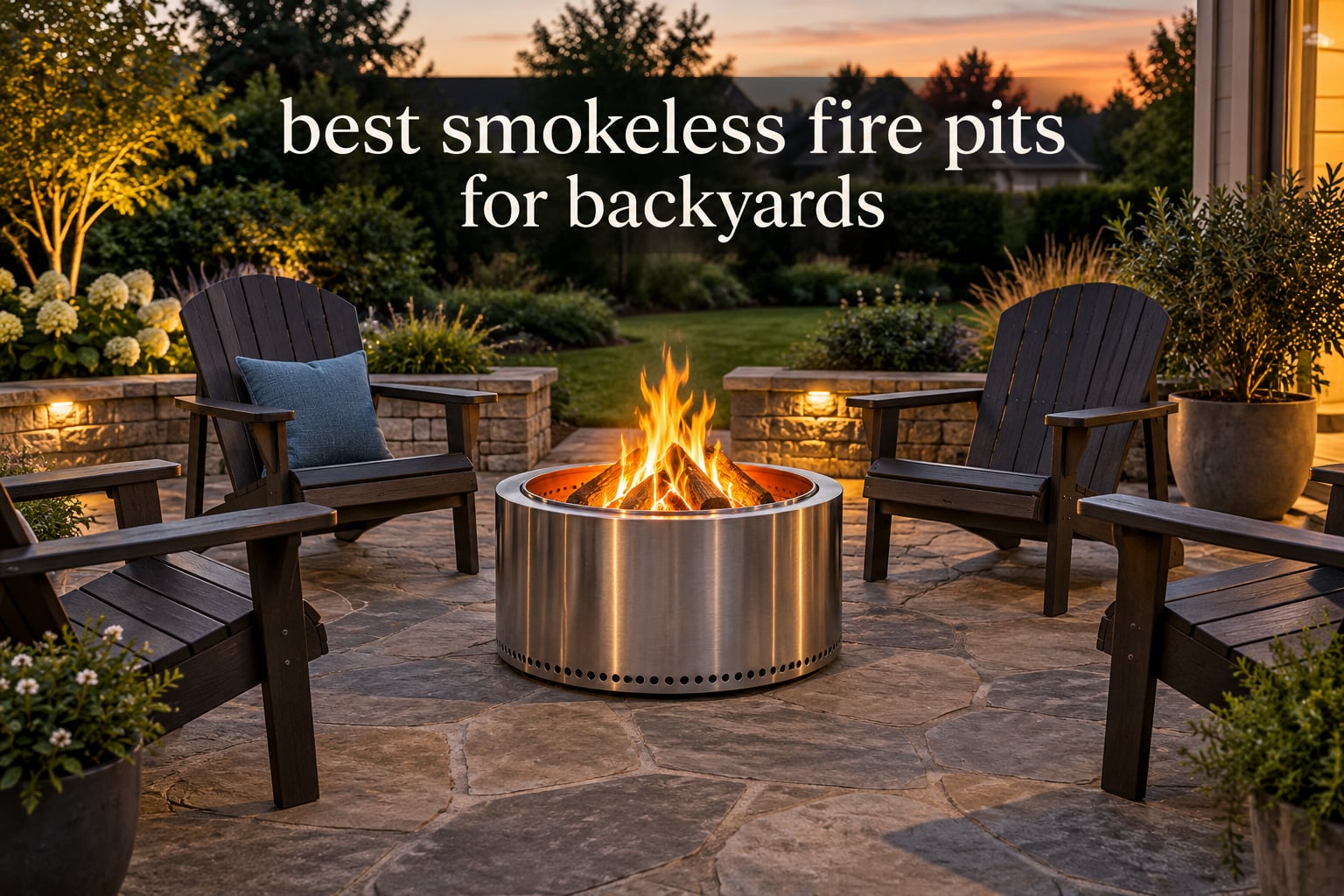
The single biggest complaint about backyard fire pits is not heat. It is smoke drifting into the neighbour’s kitchen window or straight into your eyes three feet away. Smokeless fire pits for backyards were built to fix exactly that, by forcing fresh air through the burning wood a second time so the smoke particles burn off before they reach your neighbours.
We spent weeks reading owner feedback, comparing airflow layouts and checking the specs that actually decide whether a pit performs in a backyard rather than on a camping site. Ten models made the list: seven wood-burning stainless designs, one propane fire bowl and two larger patio units built for groups. We are not lab-testing BTU output with thermocouples, so we are not claiming that, and we will say up front that every pit here produces some smoke under the wrong conditions.
If you are still working out which direction to go, our wood burning fire pit guide covers the open-pit side, and our propane fire pit picks go deeper on gas models. For the smokeless category specifically, everything below is built around backyard conditions: seating distance, decking, grass and cleanup.
Table of Contents
Top 3 Picks: Best Smokeless Fire Pits for Backyards (October 2026)

Solo Stove Bonfire with Stand
- 304 stainless steel
- Removable ash pan
- Stand and case included


Best Smokeless Fire Pits for Backyards in 2026
| Product | Specifications | Action |
|---|---|---|
| Solo Stove Bonfire with Stand |
|
Check Latest Price |
| Outland Living Firebowl 893 |
|
Check Latest Price |
| TIKI Patio Smokeless Fire Pit |
|
Check Latest Price |
 OutVue 19.5 Inch Smokeless Fire Pit OutVue 19.5 Inch Smokeless Fire Pit |
|
Check Latest Price |
 EAST OAK Fuoco 21 Inch Fire Pit EAST OAK Fuoco 21 Inch Fire Pit |
|
Check Latest Price |
 Cuisinart Cleanburn 24 Inch Cuisinart Cleanburn 24 Inch |
|
Check Latest Price |
 VEVOR 28 Inch Smokeless Fire Pit VEVOR 28 Inch Smokeless Fire Pit |
|
Check Latest Price |
 OutVue 42 Inch 4-in-1 Fire Pit OutVue 42 Inch 4-in-1 Fire Pit |
|
Check Latest Price |
 Panovue 19.5 Inch Smokeless Fire Pit Panovue 19.5 Inch Smokeless Fire Pit |
|
Check Latest Price |
 HGD 20 Inch Portable Smokeless Firepit HGD 20 Inch Portable Smokeless Firepit |
|
Check Latest Price |
1. Solo Stove Bonfire with Stand: Best Overall Wood-Burning Smokeless Fire Pit
Solo Stove Bonfire w/Stand | 19.5″ Smokeless Wood Fire Pit, Gunmetal
19.5 inch wood burning
304 stainless steel
21.7 lb
Removable ash pan
Pros
- Very low smoke output in steady burn
- Removable ash pan and base plate
- Includes stand and carrying case
- Light at just over 21 lb for a wood pit
Cons
- Costs more than most comparable wood pits
- Wood burning means splitting and hauling firewood
The Bonfire is the pit we keep coming back to for a suburban backyard, and it is the one we would hand to a friend with no other context. Owners rate the airflow design highly for staying in steady, low-output burn once it is up to temperature, and the 304 stainless body with its high-heat ceramic coating is the reason it is likely to still look good in a decade.
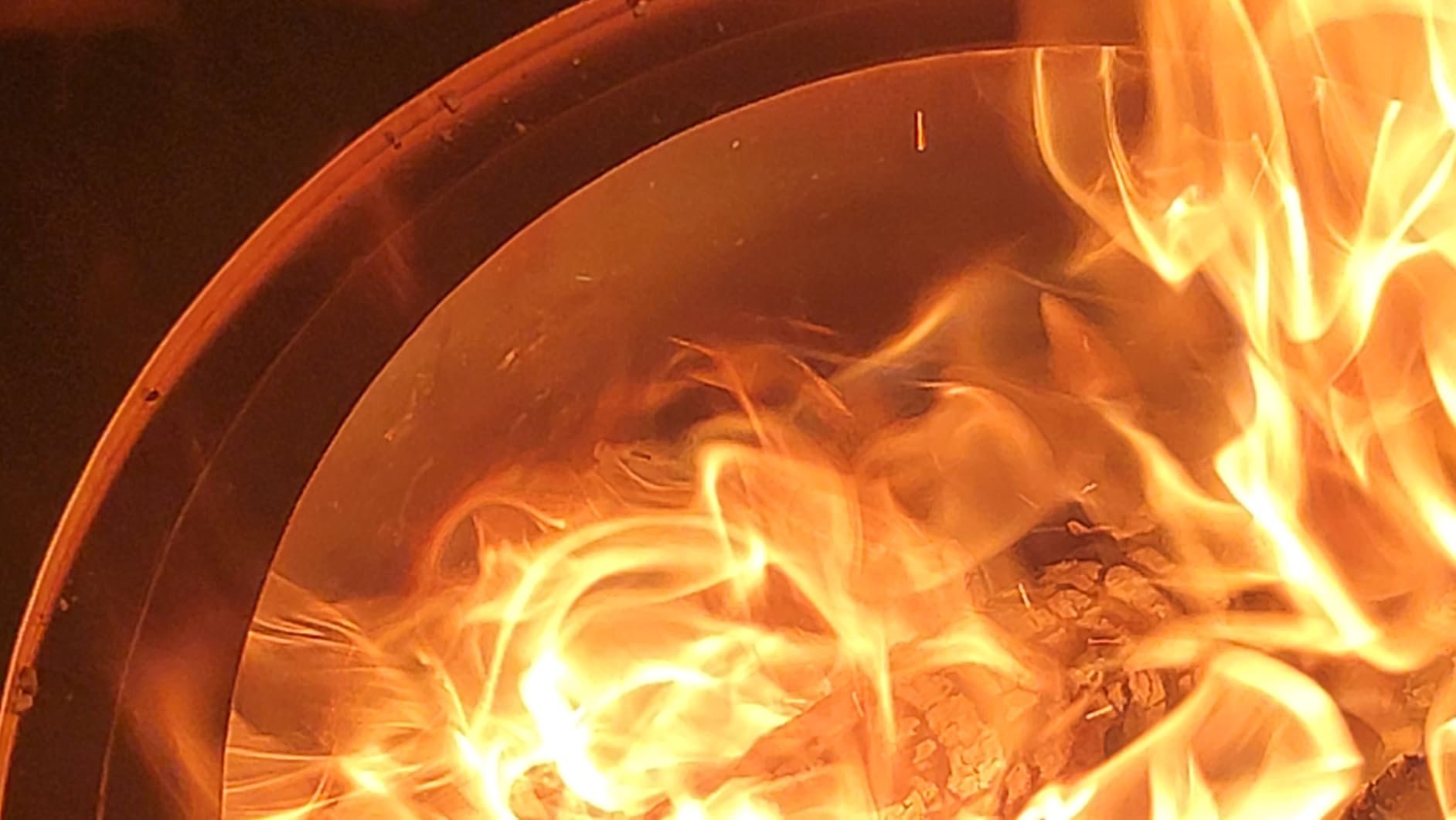
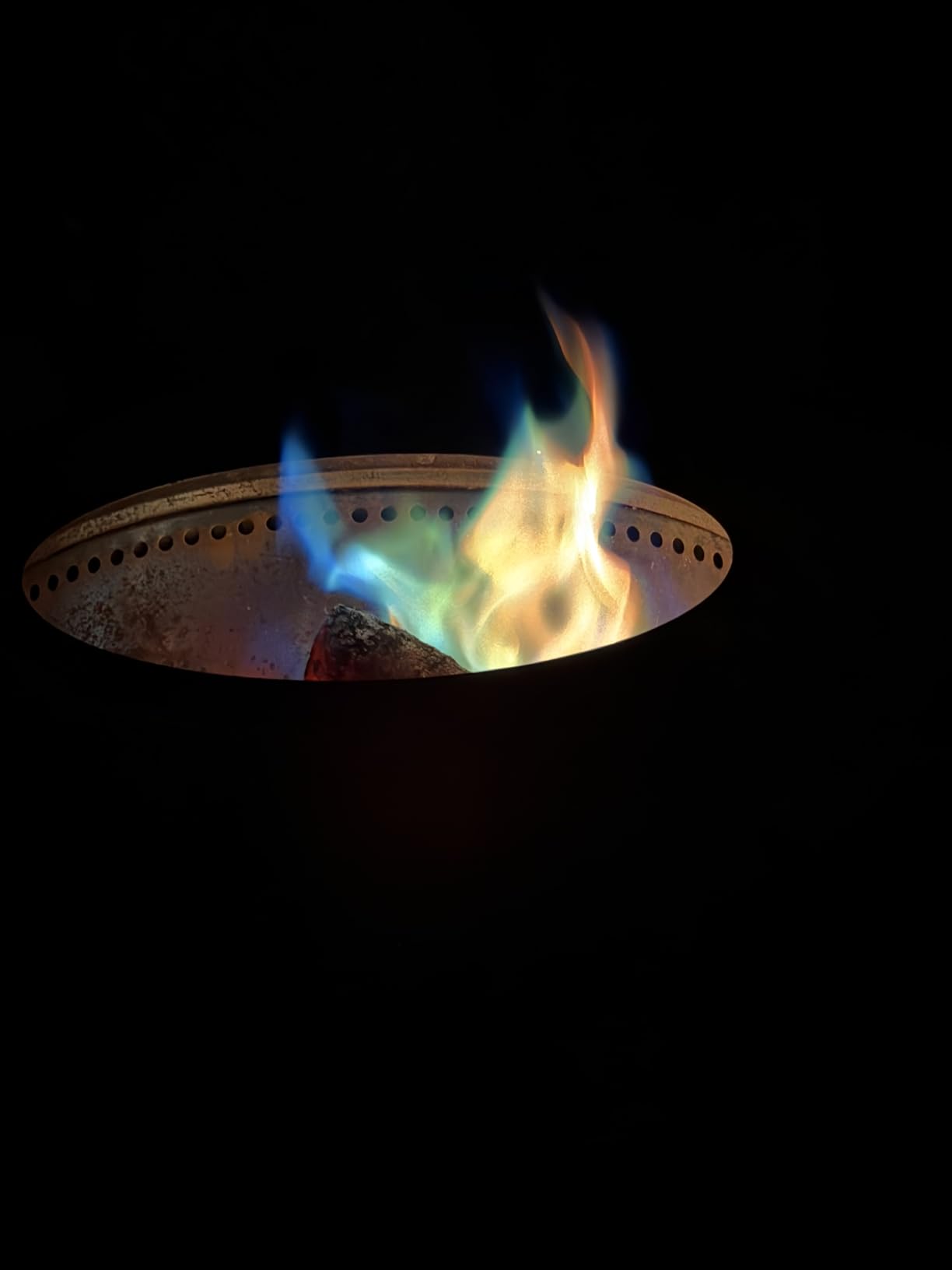
Its airflow design pulls air through bottom vents and up through the inner chamber rather than letting smoke escape sideways, which is the mechanism behind the reduced smoke. Once the double walls heat up, the fire looks almost like a gas burner sitting inside a steel drum. That appearance is part of the appeal, but it is also the reason some buyers miss seeing open flames.
Reviewers emphasise how simple the ash story is. The ash pan lifts out and the base removes for cleaning, so there is no tipping the whole pit over and no hunting for a trash bag at the end of a night.
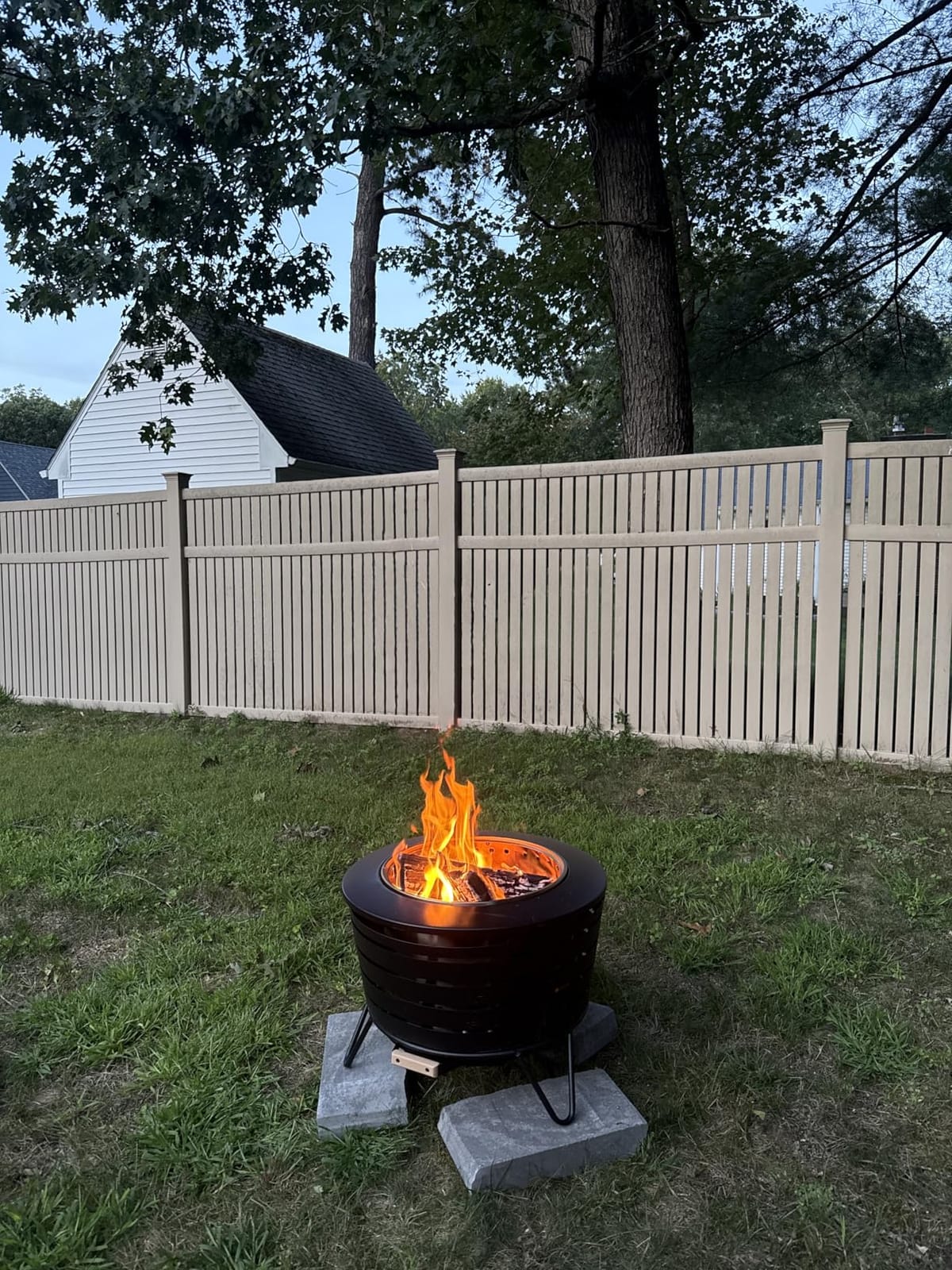
At 19.5 inches across and 21.7 pounds, it sits between the small camping pits and the large patio units, which suits a group of four to six people on a deck or patio. The included stand means you can place it on a wood deck without inventing your own protection.
What surprised us most is how little the size limits it. If your seating circle is tight, the four-foot heat radius of a 25-inch bowl covers more ground, so a larger pit is the better answer for sprawling patios. For a deck, a narrow yard or a family that wants to move the pit to a storage shelf in winter, the Bonfire’s weight and shape are the advantage.
The honest trade-off is cost and fuel handling. This is one of the more expensive pits in our group, and you are buying firewood and splitting time along with it. If you would rather not touch a chainsaw, look at the propane pick further down instead.
Why the Bonfire suits a suburban backyard
Its biggest structural advantage is the removable ash pan and base plate, which turns cleanup into a two-minute job rather than a chore. Combined with the included stand, that means one pit can move between a patio, a deck and a storage spot without anyone inventing a workaround.
Reviewers consistently mention that once the fire is properly loaded, the smoke output drops to a level where nobody on the street notices it. For households with close neighbours or a house that shares a wall with the patio, that is the whole point of the purchase.
Where the Bonfire disappoints
The purchase price is high for the category, and that cost lands differently if you are furnishing an entire outdoor space. Add a stand or lid on top and you should budget for the accessory ecosystem before you commit.
The fire is contained and hot, but tall double walls mean you see less of the flame than you would in an open pit. Owners who bought it for the visible fire sometimes regret that trade, and in genuinely cold weather you will feel the difference described below.
2. Outland Living Firebowl 893: Best Propane Pick for Backyards
Outland Living Portable Propane Fire Pit, 19-inch, 58,000 BTU with Fire Pit Cover & Carry Kit, Smokeless Gas Firebowl | Perfect for Camping, Patio, Backyard, Tailgating, Deck, RV| Black 893 Deluxe
Propane gas burn
58000 BTU per hour
23 lb
19 inch round bowl
Pros
- Genuinely smokeless with no ash
- Adjustable flame output
- Cover and carry kit included
- CSA approved for many ban conditions
Cons
- No wood crackle or real flame character
- Heat does not radiate downward at foot level
- Carry strap instructions are unclear
The Firebowl is the only gas model here, and for some backyards it is the only sensible answer. If anyone in the household has asthma, if you live under a burn restriction, or if you simply do not want ash in a fire pit at the end of every night, a propane bowl removes the problem rather than reducing it.
It runs at 58,000 BTU per hour on a stainless burner and comes with a pre-attached 10-foot hose, regulator, stabilizer ring, lava rock set and a cover and carry kit. No tools, no assembly. You hook up a standard 20-lb propane tank, ignite manually and adjust the flame.
Owners praise the portability more than anything: at 23 pounds it is the easiest unit here to move between a patio, a deck and a campsite without a second person. It also holds up on a wooden deck better than any wood-burning pit in this roundup, since there are no embers.
The flame output is adjustable, which makes it useful for two very different jobs: marshmallows and a low simmer, or a full patio glow for eight or ten people.
Where it loses is atmosphere. A gas burner with lava rock gives you a clean yellow flame with a faint hiss, and no crackle, no scent of resin, no glowing bed of embers. People who bought a wood pit because of the smell and sound tend to notice that gap within a week.
Reviewers also point out that the heat rises rather than pushing outward at seat height, so feet and legs can stay cool if everyone is sitting in a normal chair. Sit lower or add a lap blanket and it stops mattering.

Why a propane bowl wins for certain backyards
Owners highlight that the unit is CSA approved, which matters because it can be used during many campfire restrictions where wood burning is prohibited. Combined with zero ash and zero ember output, it is the lowest-risk way to keep a fire going all evening in a residential space.
There is also nothing to buy after the purchase. Lava rock, hose, regulator, cover and carry kit are all in the box, which makes the true cost of entry lower than it looks next to a wood pit that needs a stand, a lid and firewood.
Where the propane bowl falls short
If you want the sensory half of a campfire, this is the wrong tool. There is no crackle, no wood smoke aroma in your clothes the next morning and no visible ember bed to sit around.
It also needs a propane tank and the fuel is not as cheap per hour as a stack of split wood. Owners report the carry strap instructions being confusing on first assembly, so budget a few minutes with the manual.
3. TIKI Patio Smokeless Fire Pit: Best for Large Groups
TIKI Patio 25-Inch Smokeless Outdoor Wood Burning Fire Pit with Cover
25 inch wood burning
Stainless with powder coat
45 lb
Four foot heat radius
Pros
- Four foot heat radius covers a big seating circle
- Removable ash pan
- Stand and cover included
- Handles firewood or wood packs
Cons
- At about 45 lb it needs two people to move
- Screen poker deflector and griddle sold separately
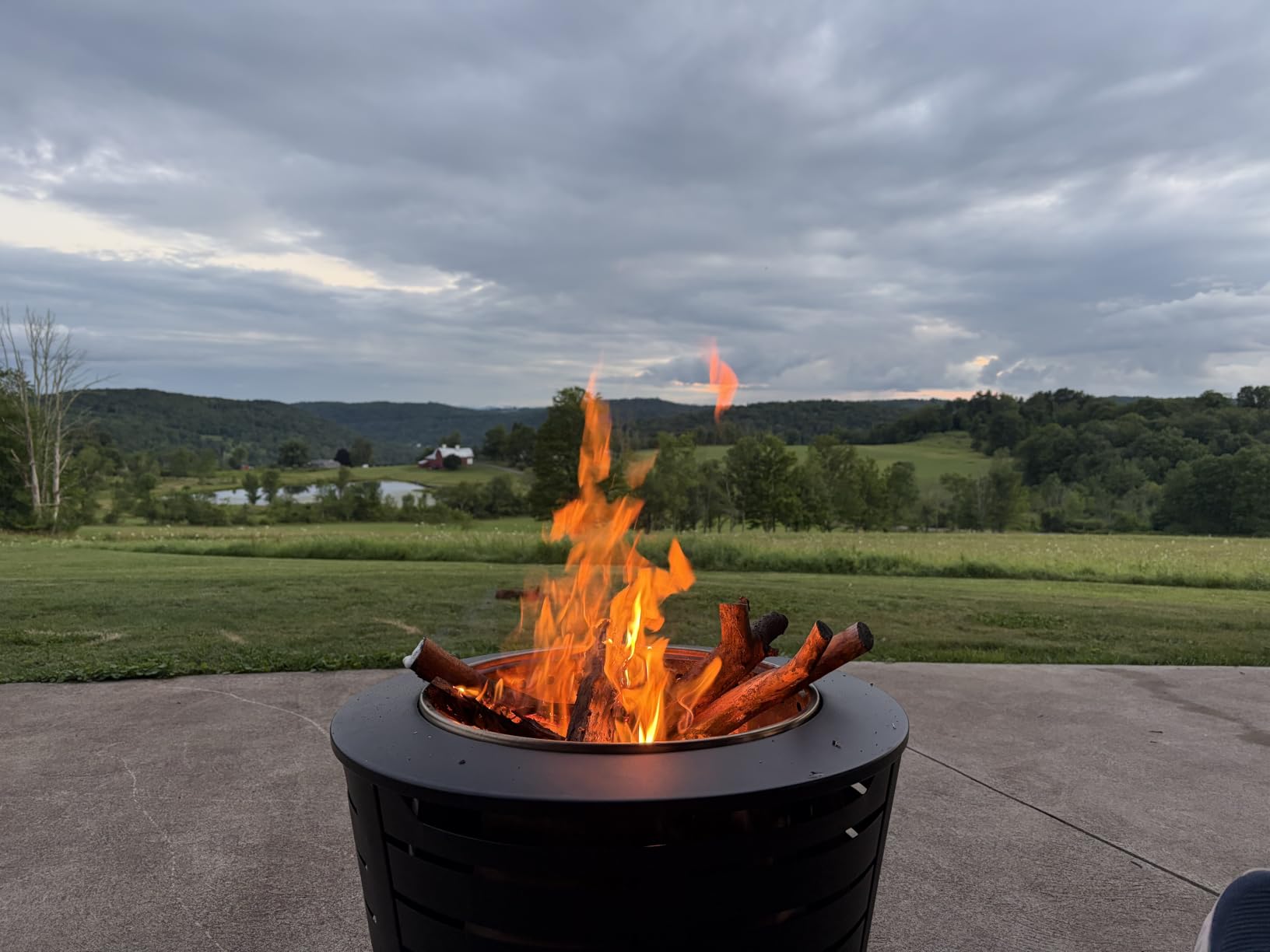
The 25-inch bowl is the one to buy when your seating plan involves more than six people or a wide patio. Owners describe an evenly heating bowl that throws warmth roughly four feet in every direction, which is what makes a large circle of chairs workable instead of everyone crowding the near edge.
The patented internal airflow system is what reduces smoke, and reviewers report that a full load of firewood settles into a steady burn after the first few minutes. It accepts split logs or TIKI wood packs, which matters if you do not have a splitter.
Construction is 16-gauge stainless steel with a black powder-coated finish, and a removable ash pan keeps cleanup straightforward. The cover and stand are both in the box, so the basics of weather protection and deck placement are handled.
You can add a screen, poker, heat deflector, tabletop or griddle from the same accessory line, and that ecosystem is the quiet strength of this pit. It is a system rather than a single object.
The trade-off is weight. At roughly 45 pounds, this is the heaviest portable pit in the group, and owners say it needs two people or a dolly if it has to cross a lawn or change surfaces. If your pit lives in one spot, that does not matter at all.
Because the accessory screen, heat deflector and griddle are sold separately, the purchase price understates what a full cooking setup costs. Plan for that before you commit to cooking on it every weekend.
Why the TIKI handles a big group
Heat radius is the deciding factor, and reviewers single out the even warmth across the full bowl rather than a hot centre. That is what lets eight people sit in a ring instead of two rows, which changes the layout of an entire evening.
The cover and stand being included also means it works on a wood deck from day one, without a separate trip for a separate accessory.
Where the TIKI is not the right buy
If you plan to stow it in a garage each winter, 45 pounds will make you reconsider every time. This is a permanent backyard piece rather than a portable one.
The accessory ecosystem is real but it is add-on. Buyers who assume the screen and griddle are included are disappointed, and the second purchase adds meaningfully to the total.
4. OutVue 19.5 Inch Smokeless Fire Pit: Best Portable Pick
OutVue 19.5 inch Stainless Steel Smokeless Fire Pit with Tote Bag
19.5 inch wood burning
Stainless steel
22 lb
Groups of 4 to 8
Pros
- Tool free assembly in seconds
- Lift out ash tray
- Waterproof cover doubles as a tote bag
- Deck protective bottom brackets
Cons
- Not small enough for backpacking
- Still needs a heat safe surface and clearances
This is the pit for anyone who wants the same unit in the backyard, at a friend’s place, or at a campsite. At 19.5 inches and 22 pounds it is light enough for one person to load into a car, and the assembly needs no tools at all.
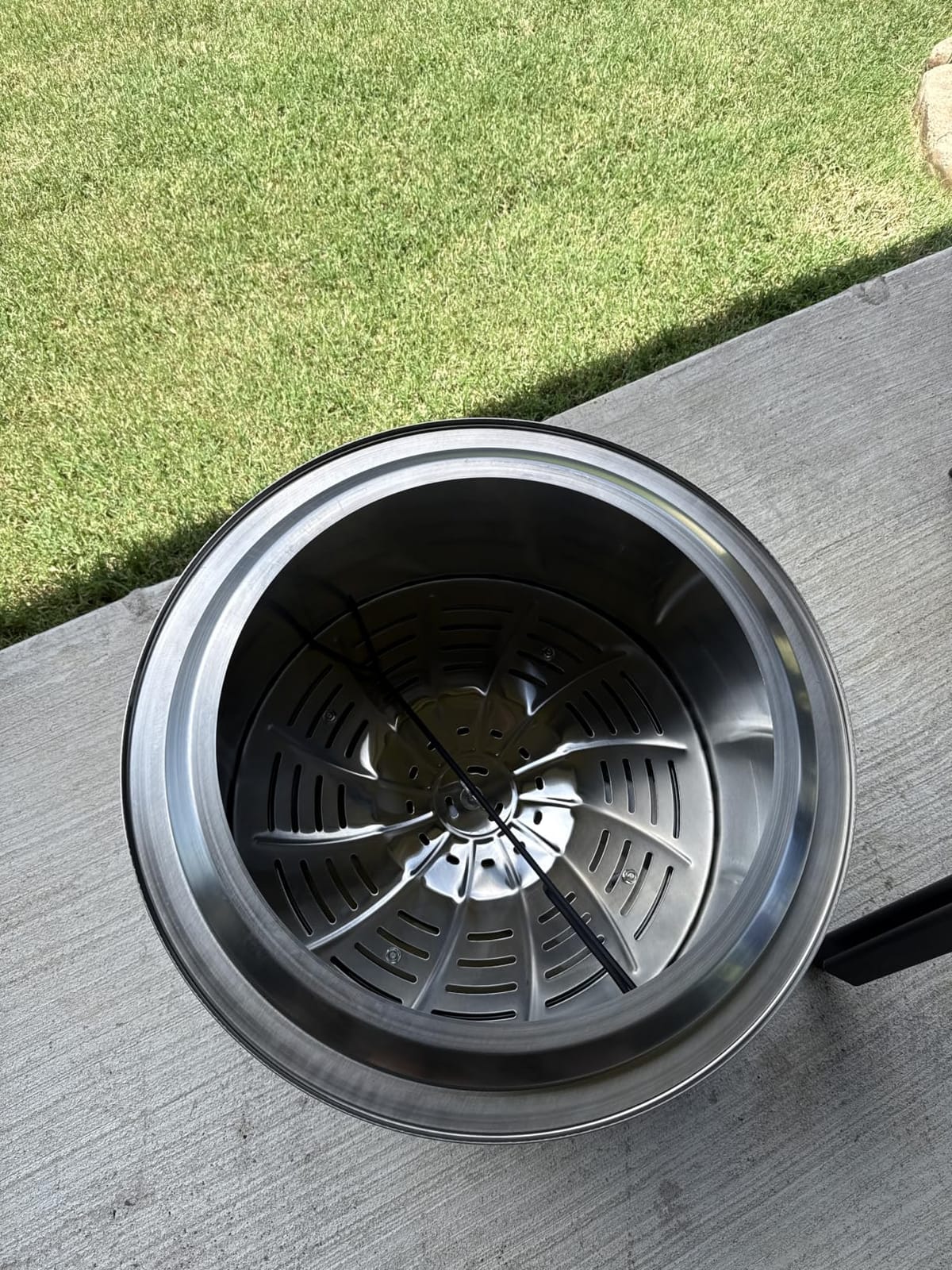
Owners like the internal airflow system for producing a noticeably clean burn without the premium-tier price, and the lift-out ash tray means you clean it standing up rather than tipping steel onto a bag. The fire poker and a waterproof cover that doubles as a tote bag are included.
Owners also flag the bottom brackets, which raise and insulate the base to help protect wooden decking from heat. That is not a substitute for a proper fire mat, but it adds a layer between the hot ring and the boards.
Reviewers describe it as a genuinely capable pit for four to eight people, which is a wider range than the diameter alone would suggest. The airflow does the work rather than the size.
The limitation is real but modest: this is a car-camping and patio pit, not a backpacker’s stove. If your idea of portable means carrying it on foot for a mile, the dimensions are wrong. If it means trunk-to-yard, this is built for it.
Second, owners stress that it still needs a heat-safe surface and normal fire-pit clearances. A lightweight stainless pit is still hot enough to mark a wooden floor if you get it wrong.
Why the OutVue 19.5 travels well
Owners consistently mention that the no-tool setup means it goes from box to lit in a couple of minutes, which is what actually determines whether you use it at a campsite or leave it in the garage.
The cover that doubles as a carry bag is a small design decision that removes a real annoyance. When the bag and the poker are in the box, the pit is genuinely a single-object purchase.
Where it is the wrong tool
It is not compact enough for backpacking or for anyone carrying gear far from a vehicle. The listed diameter suits groups, not solo backcountry cooking.
Reviewers are clear that it needs a proper non-combustible surface and full clearance from children, pets, grass and buildings. Portable does not mean position-independent.
5. EAST OAK Fuoco 21 Inch Smokeless Fire Pit: Best Value
East Oak Fuoco 21 Inch Smokeless Fire Pit, Outdoor Wood Burning Bonfire Firepit with Stand, Removable Ash Pan | Portable Stainless Steel Fireplace with Carrying Bag for Outside, Patio & Backyard
21 inch wood burning
304 stainless steel
10.8 lb
Stand and ash pan included
Pros
- Only 10.8 lb at 21 inches
- 304 stainless resists rust
- Cone shaped airflow boosts combustion
- Carry bag and ash pan included
Cons
- Light body needs a level surface in wind
- Base must be inverted for packing
The Fuoco solves the problem nobody mentions in portable fire pit reviews: weight. At 10.8 pounds it is the lightest 21-inch pit we reviewed, roughly half the weight of most of its size class, and owners who have carried theirs across a yard or up a set of steps say it changes how often they move it.
The cone-shaped airflow design is claimed to lift combustion efficiency substantially over a straight-wall bowl, and the practical result owners report is a clean, low-smoke fire from hardwood with a fast light-up. The polished 304 stainless body is also the finish most likely to resist surface rust over time.
Everything needed for a proper setup is in the box: a stand, a removable ash pan, a raised protective base and a branded carry bag. The base inverts over the bowl for storage, so the pit nests into a tight space in winter.
Reviewers describe it as comfortably seating four to six people, which matches a 21-inch diameter and a standard back patio.
The single con that matters is stability. A body this light needs a level, hard surface. On uneven ground or in a stiff breeze, owners report it needs more attention than a heavier pit, and a stand alone will not fix a slope.
Be honest about the storage claim too: the nesting design saves space but adds a step to setup, so this is a pit you unpack thoughtfully rather than toss together in ninety seconds.
Why the Fuoco is the value pick
Owners highlight that the stand, ash pan and carry bag are all included. Across this category those accessories are routinely sold separately, so the total cost of getting a working backyard setup is lower here than with models that need a second order.
The 304 stainless finish is the other quiet win. Budget pits that use coated alloy steel are the ones owners report spotting rust on after a season of condensation, and this one is not built that way.
Where the Fuoco disappoints
At 10.8 pounds the whole unit moves in a breeze, so it needs a genuinely level base. Owners using it on grass report tipping more often than on a patio.
The lightweight body also means more care when it is hot. A heavier pit resists an accidental knock; this one needs to be placed, not nudged.
6. Cuisinart Cleanburn 24 Inch: Best for Big Logs
Cuisinart Outdoor Fire Pit, Cleanburn Smokeless System, Wood Burning, 24″
24 inch wood burning
Double wall with bottom vents
Burns logs to 18 inches
22 lb
Pros
- Handles logs and chunks up to 18 inches
- Removable ash base tray empties in seconds
- Integrated handle for moving it
- Stainless wind guard and bowl ring
Cons
- Enamel exterior can wear with long term use
- One year warranty is shorter than rivals
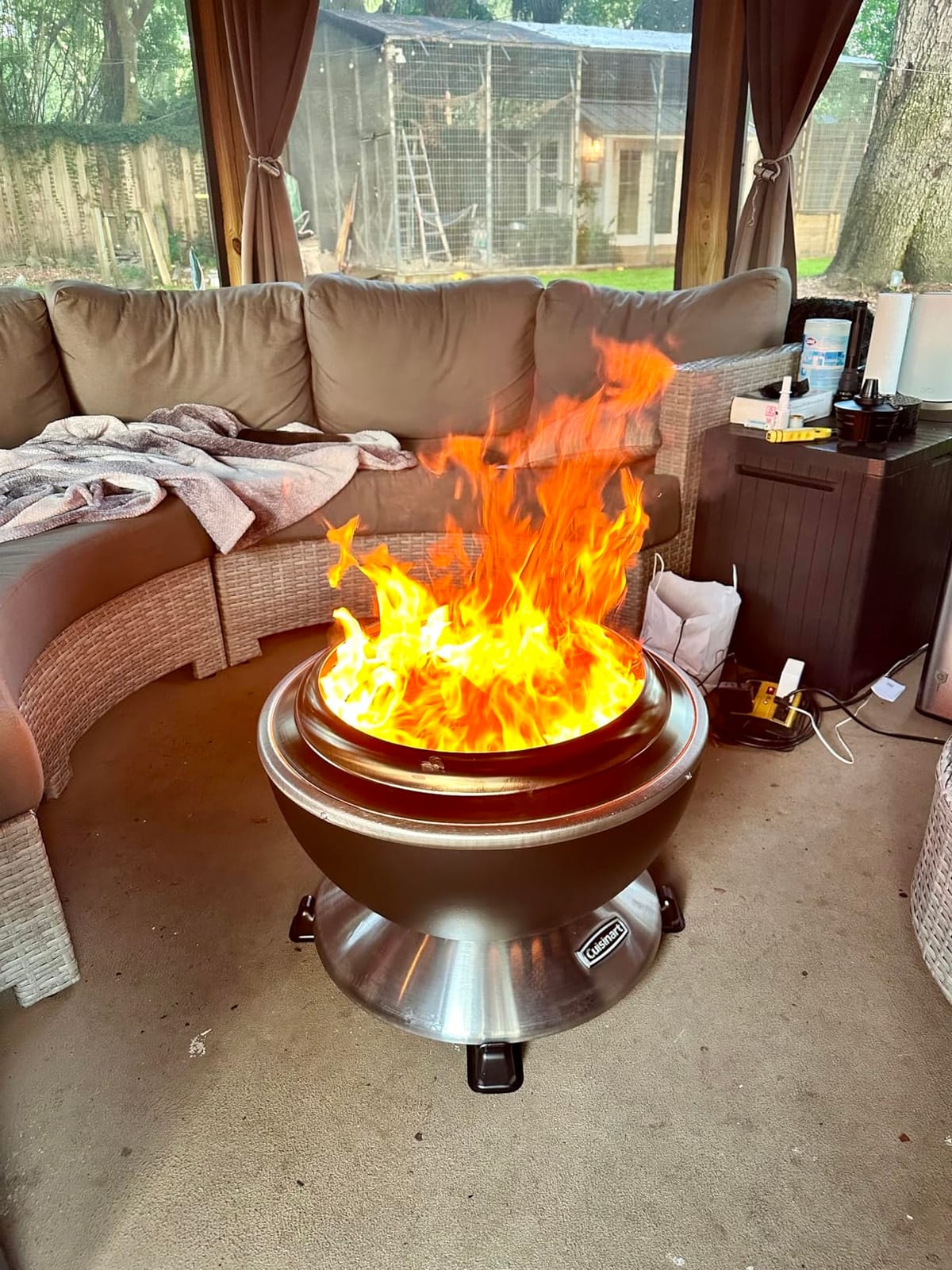
The Cleanburn answers a question most reviews ignore: how big a log can you actually put in. Owners report that the 24-inch bowl and its bottom vents take logs and chunks up to 18 inches and still ignite quickly, which means fewer trips to the woodpile and a longer burn per load.
Double-wall construction is what drives the airflow here, with curved inner walls and bottom vents feeding fresh air into the fire so smoke is burned a second time before it exits the top. In steady state owners report a clean burn with far less haze than an open pit of the same size.
Cleanup is the part owners mention most. The ash base tray pulls straight out and empties in seconds, and the wind guard, bowl ring, ash base and fire bowl are all stainless steel rather than coated alloy.
At 22 pounds with an integrated handle and a locking base, it is one of the easier 24-inch pits to reposition for a different group of chairs.
Two honest drawbacks. The enamel-coated exterior can show wear over long-term use according to a small number of owners, which matters if you leave it outside year-round. And the one-year manufacturer warranty is shorter than the coverage on some of the premium stainless pits in this roundup.
If your priority is the widest possible steel and the longest warranty, look higher. If your priority is burning what you already have in the shed, this is the most capable option at this size.
Why the Cleanburn eats big firewood
The 18-inch log capacity is the practical difference. When a pit takes smaller fuel only, you end up with five or six trips per night and more kindling. Owners using this one report feeding it less often than their open fire pit.
The fully stainless removable ash tray is the second thing reviewers praise, because cleaning speed is what determines whether anybody lights a fire on a weeknight.
Where the Cleanburn falls short
A one-year warranty is thin for a pit expected to last a decade outdoors, and replacement parts are not the focus of this brand the way they are for Solo Stove or TIKI.
Owners who want a finish that stays factory-fresh should note the enamel exterior can wear, particularly on the outer ring where hands and tools touch it.
7. VEVOR 28 Inch Smokeless Fire Pit: Best for Wide Patio Heat
VEVOR Smokeless Fire Pit Stove Bonfire, H: 17 in x Dia: 28 in,Wood Burning Fireplaces with Removable Ash Pan, SUS430 Stainless Steel Inner Portable Outdoor Firepit,for Outdoor Patio Camping, Black
28 inch wood burning
SUS430 stainless inner liner
41 lb
Pull out ash tray
Pros
- Wide 28 inch diameter throws heat outward
- Ignites in about three minutes
- Inner liner rated to 1832 degrees
- Poker and three foot pads included
Cons
- Heavy at about 41 lb for one person to lift
- Better to let it burn out naturally
The VEVOR is the biggest heat footprint in the group, and for a large hardscaped patio that is the entire pitch. A 28-inch diameter throws warmth well past a normal chair, so it works as a primary heat source on a covered terrace rather than only as a centrepiece.
The construction detail that matters here is the lining. The inner chamber is SUS430 stainless rated to 1832 degrees, while the Q235A outer wall carries a high-temperature powder coating rated to 1472 degrees. In plain terms, the part that sees the flame is built for more heat than the part you can touch.
Owners report ignition in roughly three minutes, which is quick even compared with other smokeless designs, and the deep furnace with secondary combustion vents holds a long, even burn from a wide base plate.
The pull-out ash tray doubles as a carrying handle, and the package includes a poker and three foot pads that improve stability on a patio and cut spark escape.
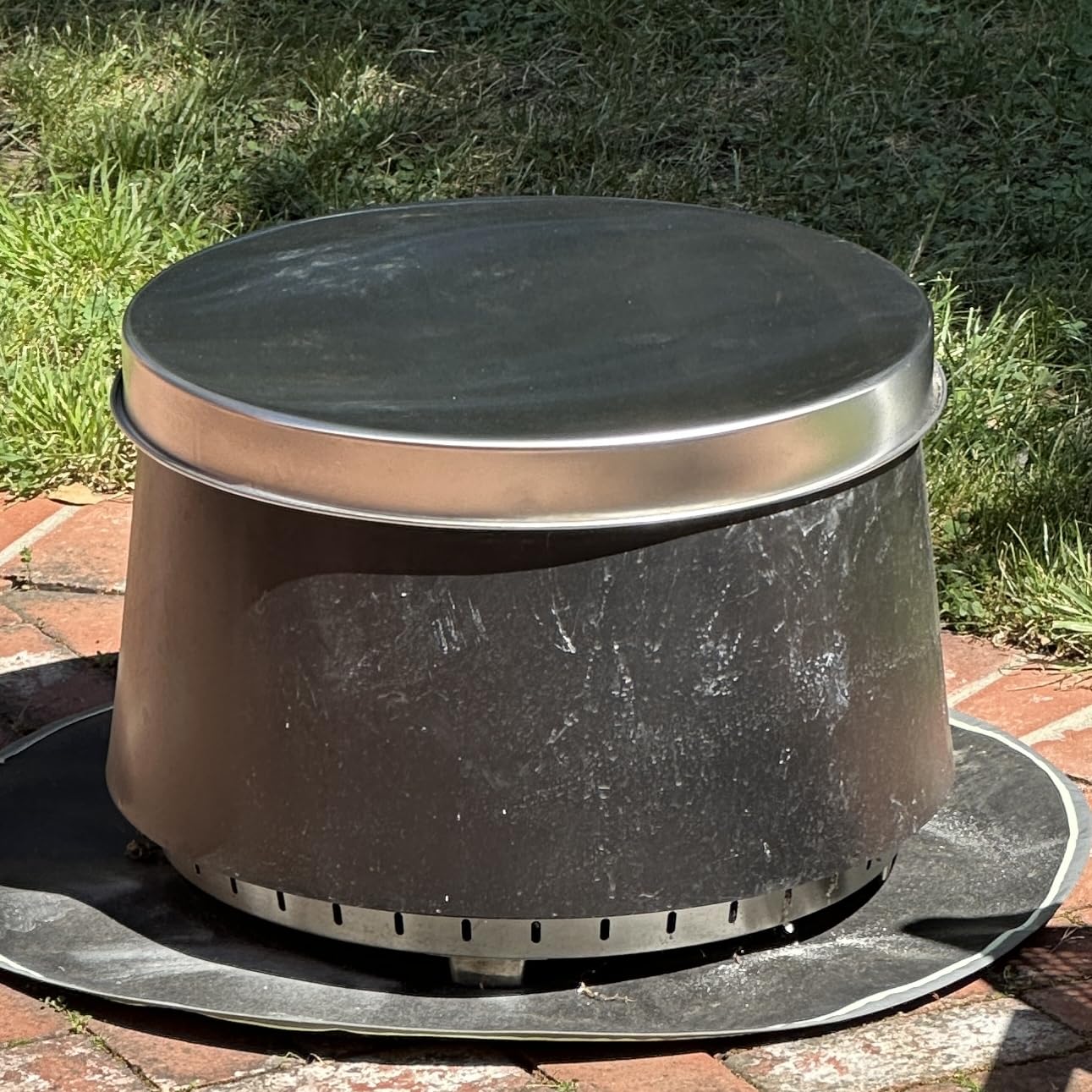
The weight is the honest limitation. At about 41 pounds, this is not a one-person carry across a lawn, and owners flag that as the main drawback for anyone without a dolly. It also needs a heat-safe base, since the foot pads are an improvement rather than a substitute for concrete.
Reviewers advise letting it extinguish naturally rather than dousing it, which protects the coating from rapid thermal shock and reduces long-term rust risk.
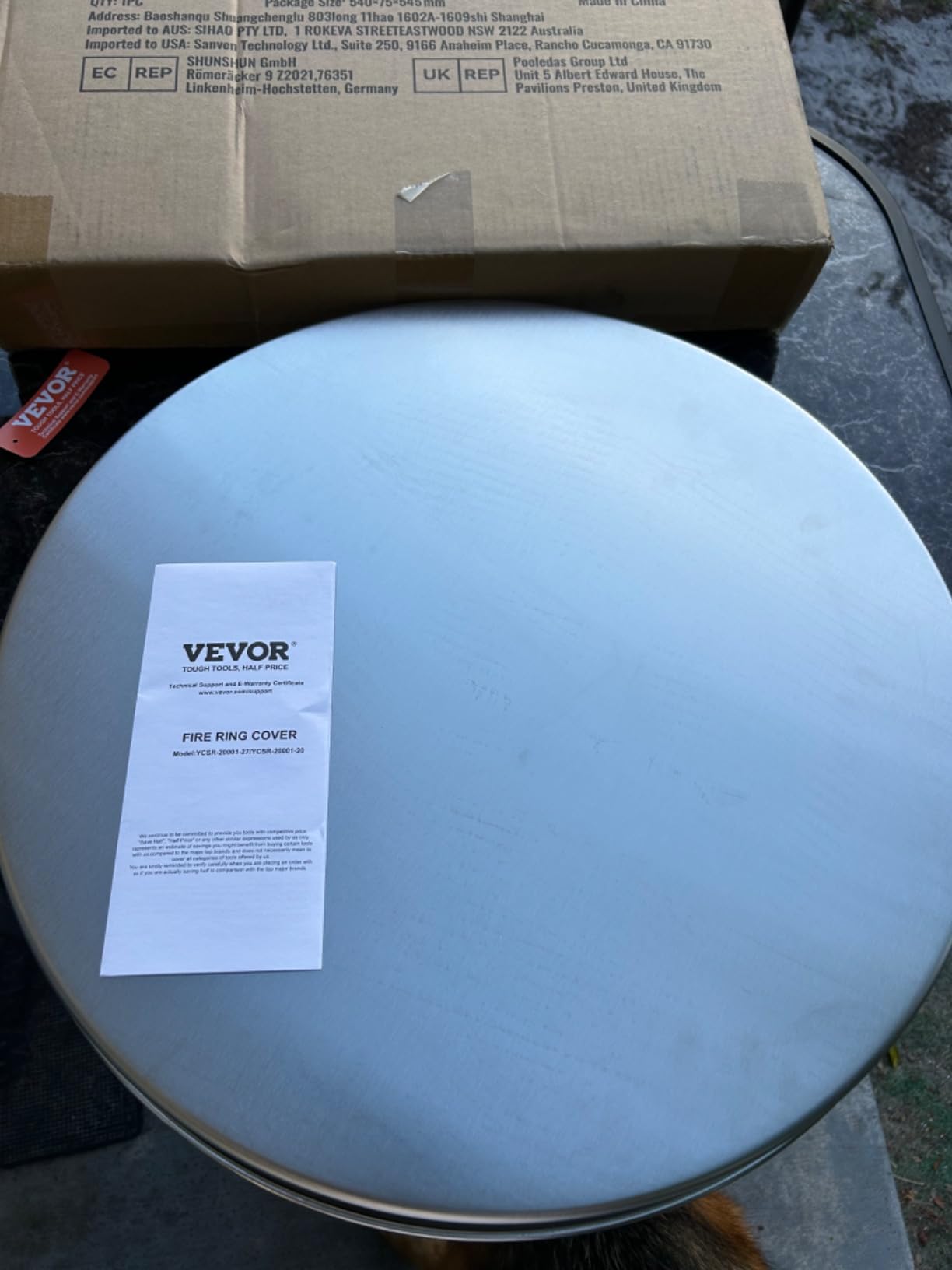
Why the VEVOR heats a big patio
Surface area is the reason. Owners with large seating circles report the widest usable warm area of any pit they have owned, because the 28-inch body pushes heat outward instead of straight up.
The three included foot pads are worth more than they look. They raise the hot base ring off a hardscape and reduce the sparks that escape underneath.
Where the VEVOR is not ideal
At about 41 pounds it is a two-person or dolly job. If you expect to move the fire between the patio and a storage shed regularly, that becomes a daily friction point.
Owners also recommend a dedicated non-combustible pad. This pit throws noticeably more heat outward than the smaller bowls in this roundup, so the surface underneath matters more.
8. OutVue 42 Inch 4-in-1 Fire Pit: Best for Cooking
OutVue 42 Inch Smokeless Fire Pit with 2 Grills, Large Firepits for Outside
42 inch wood burning
Two swivel grills
51 lb
Convertible tabletop
Pros
- Two height adjustable 360 degree swivel grills
- Holds up to 30 lb of wood
- Mesh vent screens reduce flying sparks
- Converts into a 42 inch round tabletop
Cons
- No waterproof cover or lid included
- About 51 lb and roughly 20 minutes to assemble
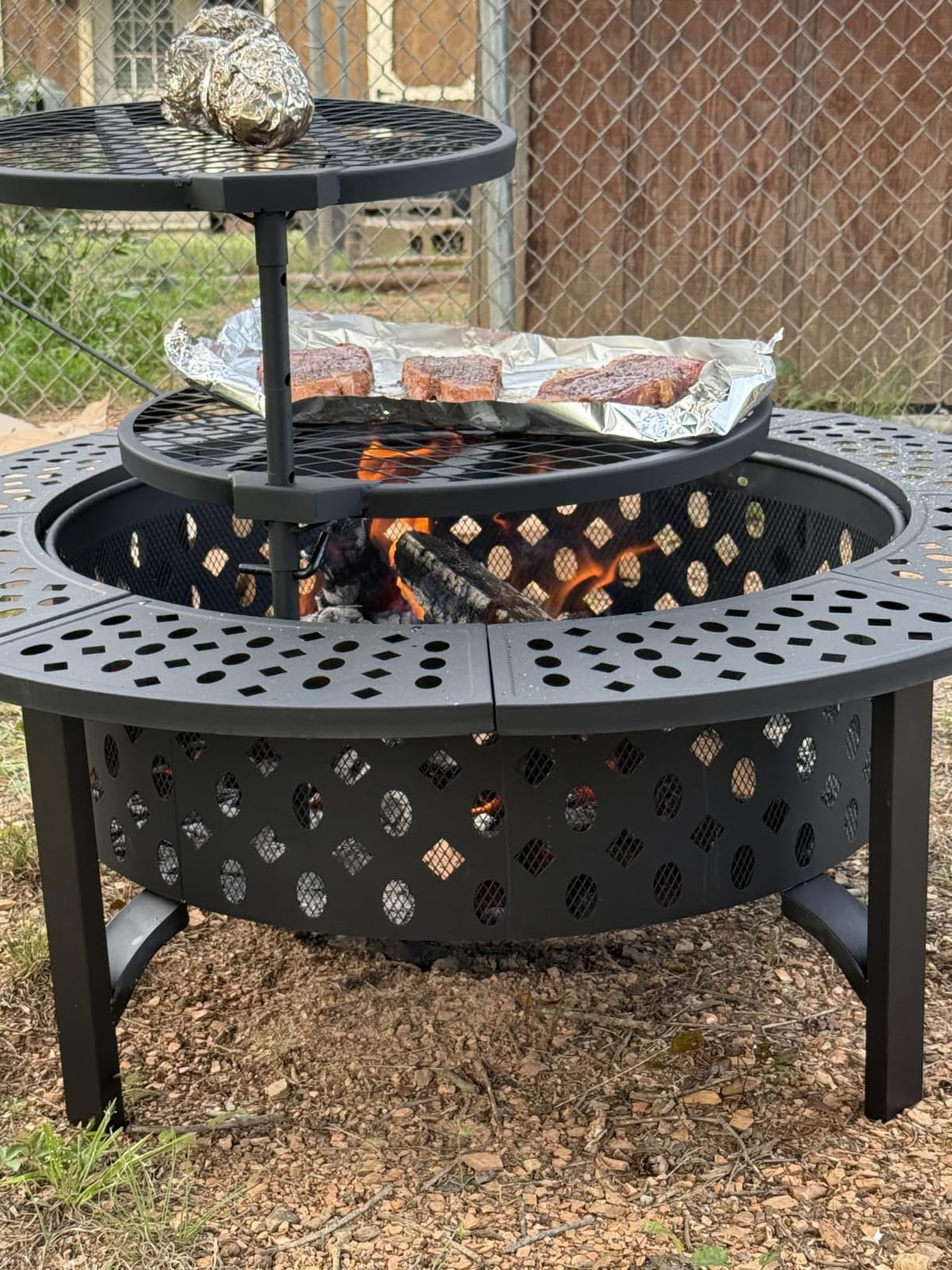
This is the cooking answer in this roundup, and the 4-in-1 design is genuinely clever. The same body works as a smokeless fire pit, a barbecue, a full bonfire and a 42-inch round tabletop when the grills are removed.
The cooking hardware is the headline: two height-adjustable 360-degree swivel grills that detach for cleaning. Adjustable height is what separates a real grill from a grate, because you control the distance between coals and food rather than guessing with a fixed rack.
Owners report holding up to 30 lb of wood, which supports a genuinely large bonfire rather than a token fire. The geometric cut-out sides catch the firelight and look good after dark, and drilled vents feed the airflow the smokeless claim depends on.
Mesh screens on the vent openings reduce flying sparks and embers, which is a genuine safety gain over an open-sided pit. Four legs and 51 pounds of steel give it real stability on uneven ground.
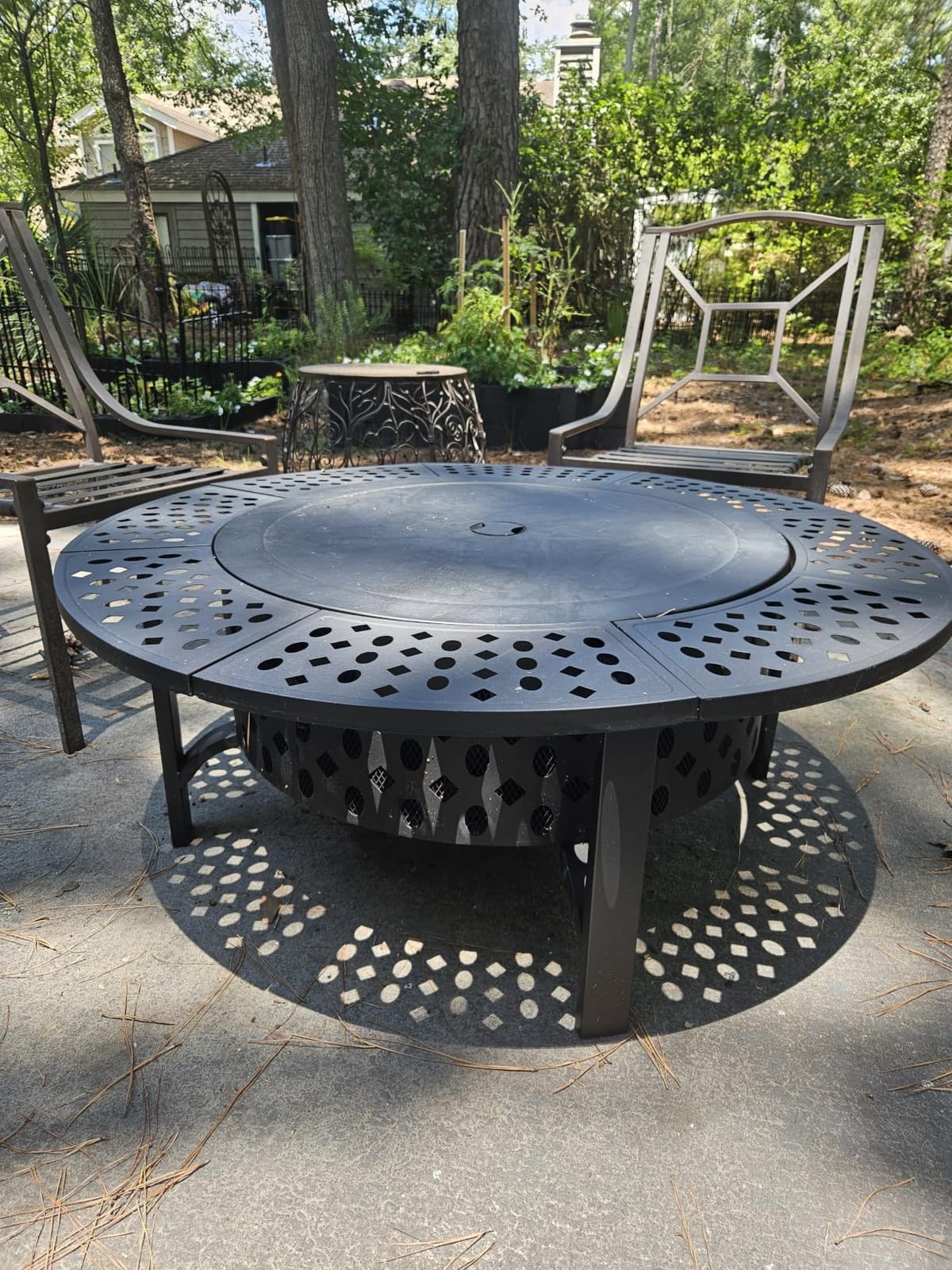
It is the largest and heaviest object here at about 51 pounds, and owners treat it as a permanent backyard fixture rather than something to reposition. There is also no waterproof cover or lid in the box, so it needs to live under cover when you are not using it or the steel will weather.
Budget roughly 20 minutes for assembly, and have a second adult present given the size of the parts.
Why the OutVue 42 works as a grill
Height-adjustable swivel grills give you direct control of cooking temperature, and the two-grill layout lets you run one over direct heat and one off to the side. That is how you cook steak and vegetables at the same time.
The ember mesh is the underrated feature for anyone with a wooden fence, deck or dry planting nearby. Sparks are the fire risk you cannot engineer out of a wood fire, and this reduces them.
Where the OutVue 42 disappoints
No cover and no lid means you are buying weather protection separately or leaving a 51-pound steel body exposed to rain and snow. That matters more than it sounds for long-term finish.
Owners also report assembly taking around 20 minutes, which is fine once and annoying every time you need to move it. And its 42-inch footprint is a real estate commitment on anything smaller than a generous patio.
9. Panovue 19.5 Inch Smokeless Fire Pit: Best Budget Pick
Panovue 19.5 inch Smokeless Fire Pit with Carry Bag & Fire Poker
19.5 inch wood burning
Stainless steel
20.7 lb
Moveable ash pan
Pros
- Stainless body resists rust and heat warping
- Cover doubles as carry bag and poker included
- Moveable ash pan cleans up quickly
- Quick assembly
Cons
- Smoke reduction trails premium airflow designs
- 19.5 inch bowl suits three to four people
The Panovue is the way into the smokeless category without paying a premium-tier price, and reviewers generally consider it strong value. The stainless body resists rust and will not deform under high heat, which are the two failures that kill cheaper pits after a season.
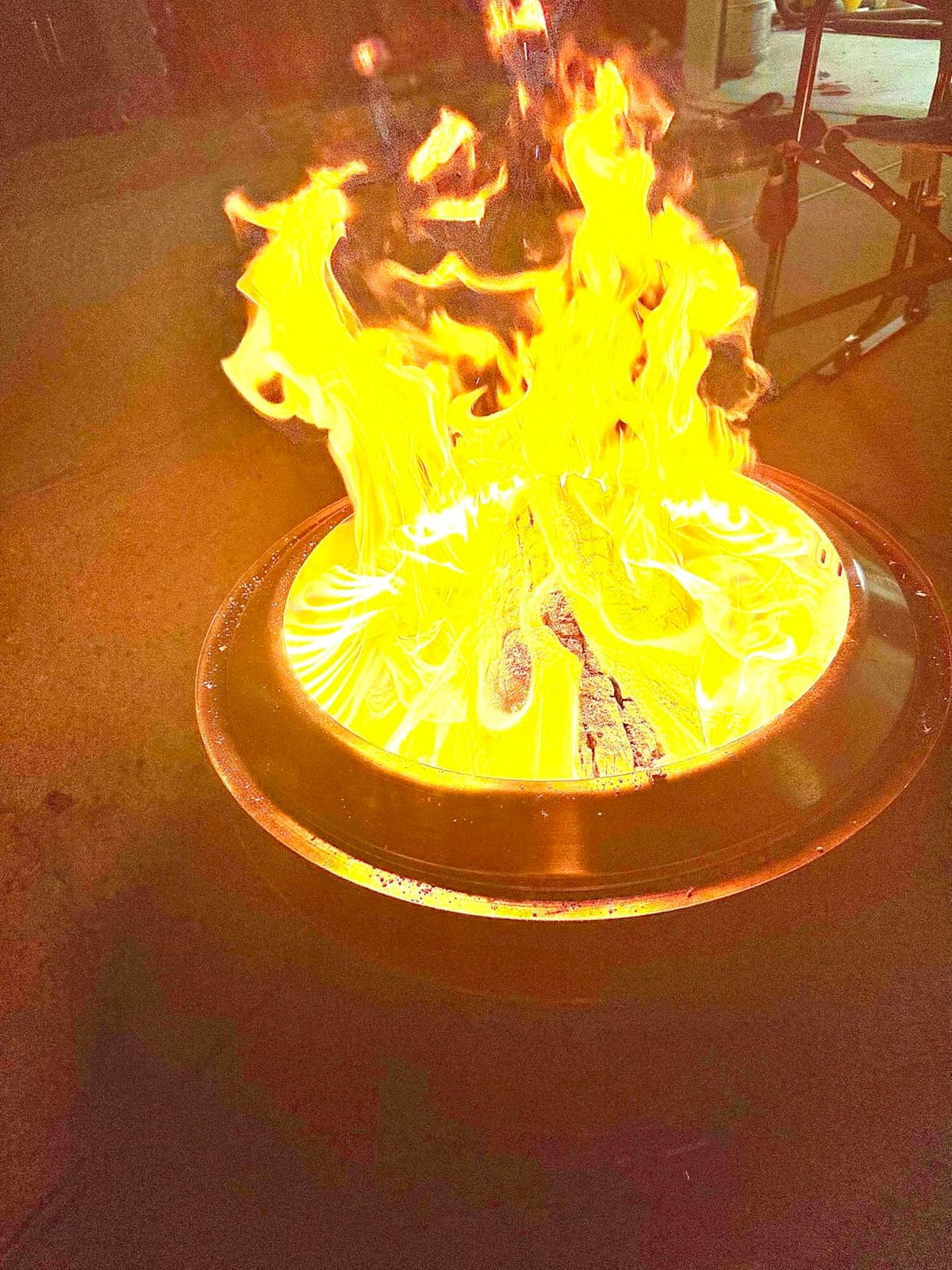
The internal airflow system delivers a genuinely low-smoke flame for its class. Owners are more measured about it than owners of premium pits, describing the smoke reduction as good rather than dramatic, and noting some visible smoke when the fire is cold, windy or loosely loaded.
Cleanup and packing are handled well for the price. The waterproof cover doubles as a carry bag, a fire poker is included, and a moveable ash pan means you empty standing up. Deck-protective bottom brackets add a layer between the hot base and wooden boards.
At 20.7 pounds it is one of the easier pits in the group to move, and it assembles in minutes with no tools.
Two limits are worth stating plainly. First, the smoke reduction is a step behind the premium airflow designs, and owners comparing the two notice the difference on a windy night. Second, a 19.5-inch bowl is really a three-to-four-person pit, so larger groups will crowd it.
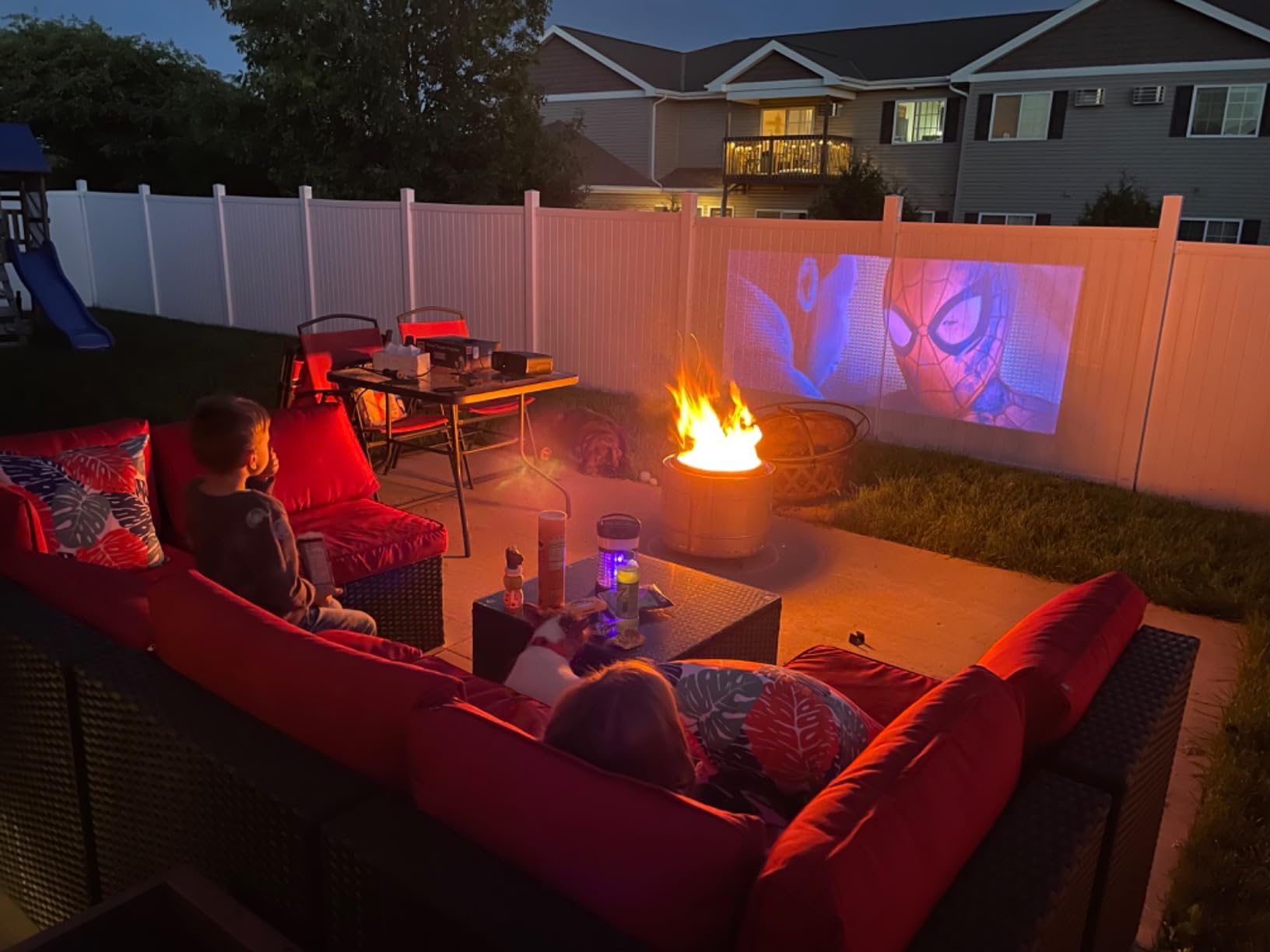
Reddit budget threads regularly conclude that unbranded stainless designs like this perform close to the named premium models for most backyards. If your priority is a clean burn at the lowest sensible cost, that trade is worth taking.
Why the Panovue makes sense on a budget
Owners consistently mention stainless steel as the deciding feature at this level. Coated alloy pits in the same price bracket are the ones that pit and spot with rust after a wet winter.
The cover, carry bag and poker are included, so there is no second order before the first burn. That single fact removes the most common reason budget buyers end up spending more later.
Where the Panovue is not enough
Smoke reduction is good, not premium. Owners report visible smoke in cold or windy conditions, which is exactly when you are most likely to be outside.
The bowl size suits a couple or a small family. If you routinely host eight or more people around a fire, step up to a 24-inch or larger pit instead.
10. HGD 20 Inch Portable Smokeless Firepit: Best for Camping and Storage
HGD 20 inch Smokeless Firepit Outdoor, Portable Smokeless Fire Pit for Camping with Travel Bag, Stainless Steel Wood Burning Stove for Backyard & Patio, Easy Setup & Compact Storage
20 inch wood burning
Double wall with vent holes
18 lb
Collapses for storage
Pros
- Collapses flat with a travel bag included
- Removable ash pan avoids tipping the stove
- Stainless body holds up under hot flames
- Easy to light and burns efficiently
Cons
- Travel bag may not fit the collapsed pit
- Visible smoke at startup before airflow engages
The HGD is the pit for people with genuinely small storage. It breaks down and nests, and with the included travel bag it can live in a closet between seasons. At 18 pounds it is also light enough for one person to carry from a car to a campsite pitch.
The double-wall design with vent holes moves hot air over the fire to create a secondary burn, and owners report an efficient burn that lights easily with ordinary kindling. Heat output is good for its size relative to premium pits costing far more.
The removable ash pan is the detail owners rate most, because it means you never have to tip the whole stove to empty it. That is a real difference when you are on uneven ground at a campsite.
All-stainless construction is what gives it long-term durability in our view, and it is available in the same Modern Series in a 28-inch size if you later want more heat.
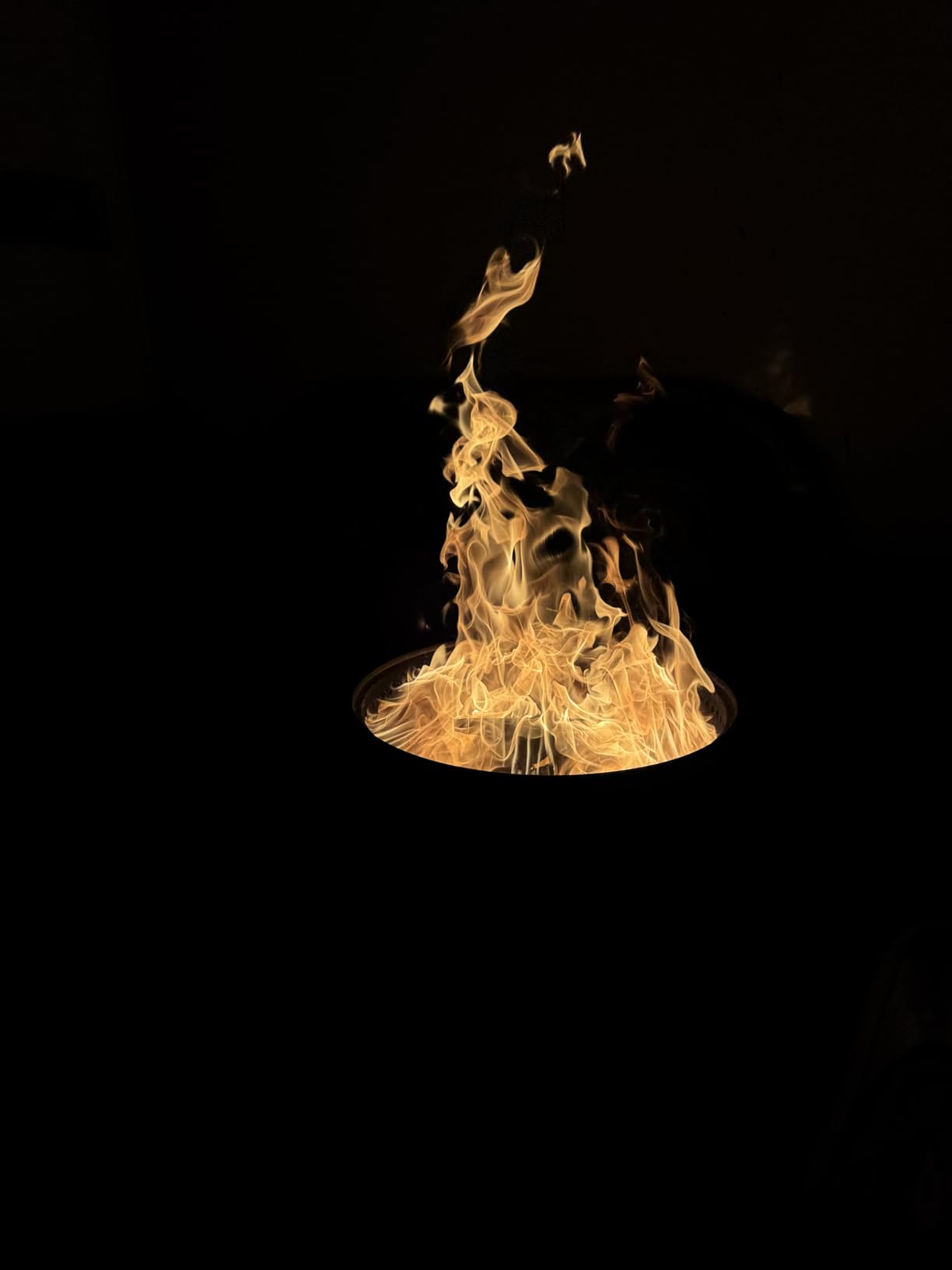
Owners report two honest problems. Some find the included travel bag is the wrong size for the collapsed pit, so measure before you rely on it. Others note visible smoke at startup before the airflow design engages, which is the normal warm-up phase rather than a fault.
Reviewers also flag that the bottom and outer walls run very hot, so a stand and a fireproof pad are worth adding if you are putting it on anything but concrete.
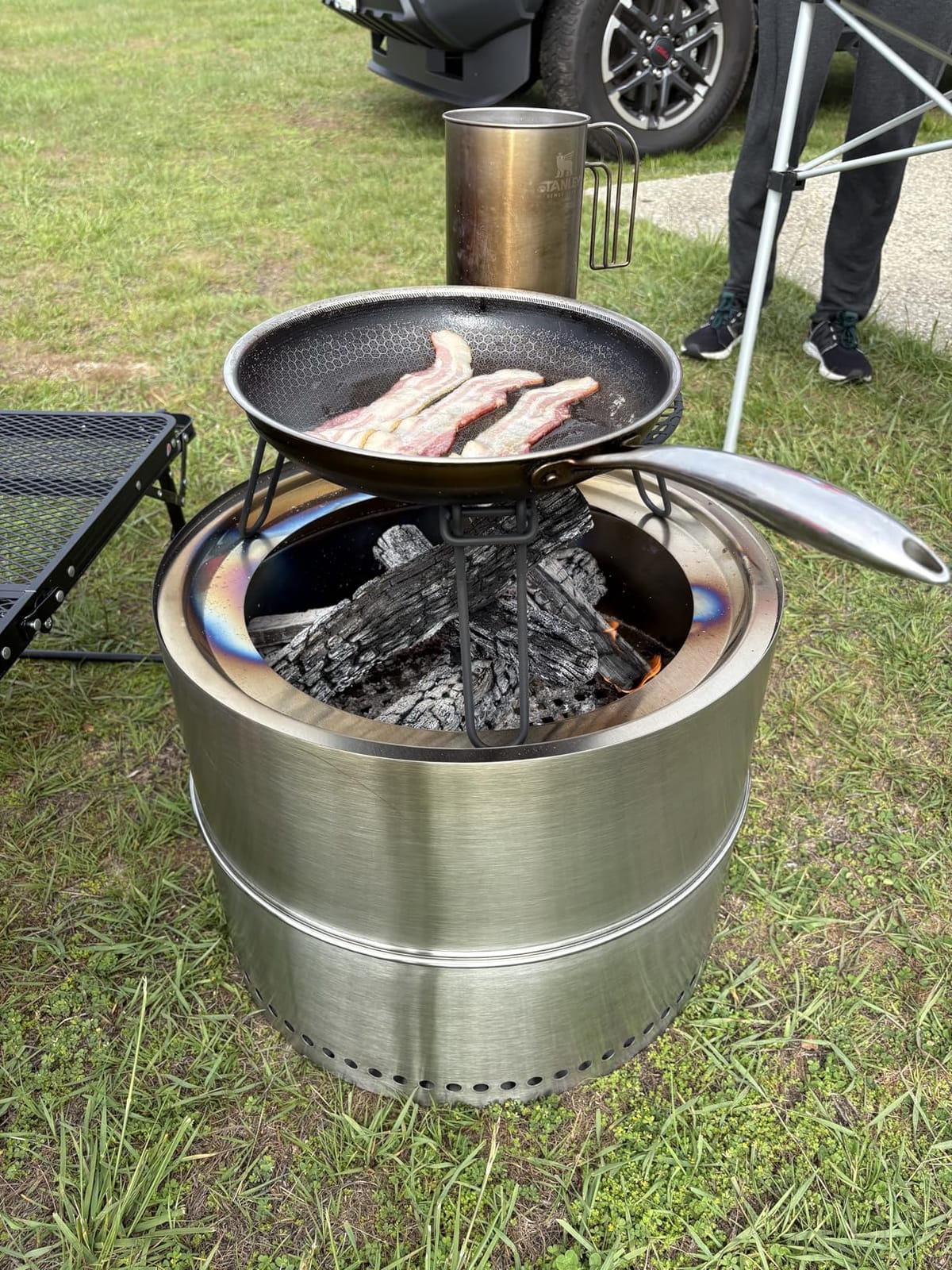
Why the HGD suits small spaces and travel
Collapsing flat is the feature that changes behaviour. If your fire pit lives in a garage corner all year, you will use it far less than one you can pull out of a cupboard in ninety seconds.
Owners also appreciate the removable ash pan, which turns a dirty job into a two-minute one and removes the temptation to skip cleanup entirely.
Where the HGD disappoints
The travel bag quality is inconsistent according to owners, so treat it as a bonus rather than part of the system.
There is some startup smoke before the walls heat up, and the exterior runs hot enough that a stand and fireproof pad are sensible additions rather than optional extras.
How Smokeless Fire Pits Actually Reduce Smoke
A smokeless fire pit is a double-walled steel fire pit that pulls air through bottom vents and recirculates it through an inner chamber, so smoke particles burn a second time before exiting the top. That secondary combustion is the whole mechanism, and everything else about these pits exists to feed it.
The sequence runs like this. Air enters through holes near the base, heats as it moves up the inner chamber and meets fresh oxygen, and the resulting hot secondary burn consumes the unburned gases and fine particles that a traditional open pit simply releases. The heat then rises and exits through the top vents. The outer wall stays cooler at the same time, which is why these pits are safer to stand near without changing the fact that the top ring still gets hot enough to burn.
Every model here uses some version of that design, from the Solo Stove’s airflow-efficient burn to the EAST OAK’s cone-shaped chamber and the Cuisinart’s double wall with curved inner surfaces and bottom vents. Gas pits like the Outland Living bowl skip the problem entirely because there is no wood smoke to reburn.
Loading and weather matter as much as design. Owners report the cleanest burns when hardwood is stacked below the top vents, never above them, and when the fire is not starved of air. A loosely loaded pit in a cold wind will smoke no matter what brand it is, which is why the startup and windy-night complaints appear under every model in this roundup.
One realism check on heat. Double-wall pits send more of their energy upward than a traditional open fire does, so owners often report feeling less heat at seat height in genuinely cold weather. Several YouTube reviewers say they fall back to a cheap open pit for the coldest nights. If your priority is raw warmth in January, pair a smokeless pit with a patio heater rather than expecting one object to do both jobs.
And the caveat worth repeating: these pits still produce carbon monoxide and still need ash disposal. Reduced smoke is not zero smoke, and no design exempts you from a local burn ban.
How to Choose a Smokeless Fire Pit for Your Backyard
Most buyers choose on diameter and regret it. The decisions that actually determine whether you are happy a year from now are fuel type, real heat radius, weight and how the ash comes out.
1. Fuel type: wood or propane
Wood gives you crackle, scent and a real ember bed. It costs you splitting, hauling and a trip to the bin every night. Propane gives you instant ignition, no ash and use during many burn restrictions, and costs you the atmosphere entirely. Our propane fire pit guide covers the gas category in more detail if your household leans that way.
2. Size and how many people it warms
Roughly, a 19.5 to 21-inch diameter handles three to six people, a 24-inch bowl handles six to eight, and 28 inches or more warms a wide patio or a larger circle. Heat radius, not diameter, is the number to check in the specs, and the 25-inch TIKI is the clearest example here with a stated four-foot radius.
3. Heat output and heat direction
For gas pits, BTU per hour is the comparable number. For wood pits, no manufacturer rating is standardised, so judge by the stated heat radius and the bowl volume. Remember that smokeless designs push heat upward, so a larger pit is the answer if you want warmth rather than ambience.
4. Material and durability
304 stainless steel is the most rust-resistant choice and is used by the Solo Stove Bonfire and the EAST OAK Fuoco. Coated alloy steel is cheaper but is where rust complaints start, particularly on models with a carbon steel outer wall. Whichever you choose, dry the pit after wet weather and cover it when it is not in use.
5. Cleaning and ash handling
Look for a removable ash pan or a pull-out ash tray rather than a fixed floor. Every wood-burning pit in this roundup has one, but they differ in capacity and in whether the whole unit still has to be moved to empty it. The Solo Stove Bonfire, the TIKI, the EAST OAK Fuoco, the Cuisinart Cleanburn, the Panovue and the HGD all use a lift-out pan, and the VEVOR uses a pull-out tray. The propane bowl produces no ash at all.
6. Portability and weight
Weight ranges from 10.8 pounds for the EAST OAK Fuoco to about 51 pounds for the OutVue 42. If you plan to move the pit more than once a season, anything over 30 pounds needs two people or a dolly.
7. Cooking and accessories
Only the OutVue 42 in this group ships with cooking grills. The TIKI ecosystem offers a screen, heat deflector, tabletop and griddle separately, and the Solo Stove line sells a stand, lid, ember shield and cooking hub. Budget for accessories before you commit, because that is where the real total cost sits.
8. Safety features and clearance
Check the stated clearance distances, whether a stand is included, and whether the vent openings have mesh to limit sparks. Then decide on your surface: concrete, gravel, a fire mat on grass, or a stand plus mat on wood or composite decking. If you plan to cook often, our smokeless grill guide covers the different constraints indoors.
Frequently Asked Questions
Are smokeless fire pits worth it?
For most backyards, yes. The pits reduce smoke dramatically after the fire is up to temperature, which keeps neighbours onside and stops smoke soaking into your clothes and house. Expect visible smoke for the first five to ten minutes during warm-up, and less sideways heat at seat height than an open fire pit, so they are strongest as ambience and light-heat sources rather than cold-weather heaters.
Can you use a smokeless fire pit on a wood deck?
Not directly on the boards. Use the manufacturer’s stand so the hot base ring sits above the deck surface, and place a fireproof mat underneath it. Follow the clearance distance printed in your manual, since that figure is what an insurer or fire authority will ask about, and never use the pit near a railing, a wall or a low overhang.
What to put under a fire pit to protect grass
Put down a purpose-built fire pit mat or heat shield rated for the pit’s footprint, ideally with the legs resting on it. A heavy steel base plate also works. Clear dry leaves and brown grass for several feet in every direction, because the risk comes from escaping embers landing outside the mat, not from the mat itself.
What type of fire pit is best for composite decking?
Composite boards scorch and melt more readily than real wood, so use the maximum protection: a stand plus a fireproof mat, with generous clearance from the house and any railing. A propane bowl on a stand is the lowest-risk option because it produces no embers. Never leave a lid or accessory on the decking while the pit is hot.
Is Breeo or Solo Stove better for a backyard?
Solo Stove offers the tighter design language, a lighter body and a deeper accessory ecosystem including cooking hardware and replacement parts. Breeo is the stronger live-fire cooking platform, with heavier cast iron cooking surfaces and a wider range of sizes. For pure ambience and heat in a residential backyard, the Solo Stove line is the more common choice; for cooking as the main event, Breeo wins.
Do smokeless fire pits produce carbon monoxide?
Yes. A wood-burning fire of any kind produces carbon monoxide, and a smokeless pit does not change that. It reduces visible smoke and particulates by burning gases a second time, not by removing combustion exhaust. Use the pit outdoors only, keep it clear of enclosed spaces, and never run one in a garage, shed or under a covered porch.
Can smokeless fire pits be used during fire bans?
Not automatically. No fire pit design exempts you from a local burn ban, and restrictions are issued by your local fire authority rather than by the manufacturer. A propane bowl is the usual exception because it is not burning wood, which is why the CSA-approved gas models are popular in restricted neighbourhoods. Always check your local authority’s current order.
How long does a smokeless fire pit stay hot?
It depends on fuel load and pit size rather than on any fixed rating. A well-loaded 24-inch to 28-inch pit with hardwood burning below the top vents holds a steady high output for several hours, while a 19.5-inch bowl with a light load will drop off sooner. Keep four to six logs stacked below the top vents and use hardwood rather than softwood for the longest, cleanest burn.
Final Verdict
For most backyards, the Solo Stove Bonfire with Stand is the pick. Its removable ash pan, included stand and carrying case make it the least fussy ownership experience in this group, and at 19.5 inches it fits the seating circle most people actually build.
Go bigger with the TIKI 25-inch if your group regularly passes six people. Go propane with the Outland Living Firebowl if smoke, ash or burn restrictions are the deciding factors. Cook on the OutVue 42 if the fire is a kitchen as much as a campfire.
Whatever you choose, put it on concrete, gravel or a proper fire mat, dry it after wet weather, and remember that smoke-less is not smoke-free. If you want a broader look at the category, our full smokeless fire pit roundup covers the wider field. Last reviewed in 2026, and updated as new models land.