
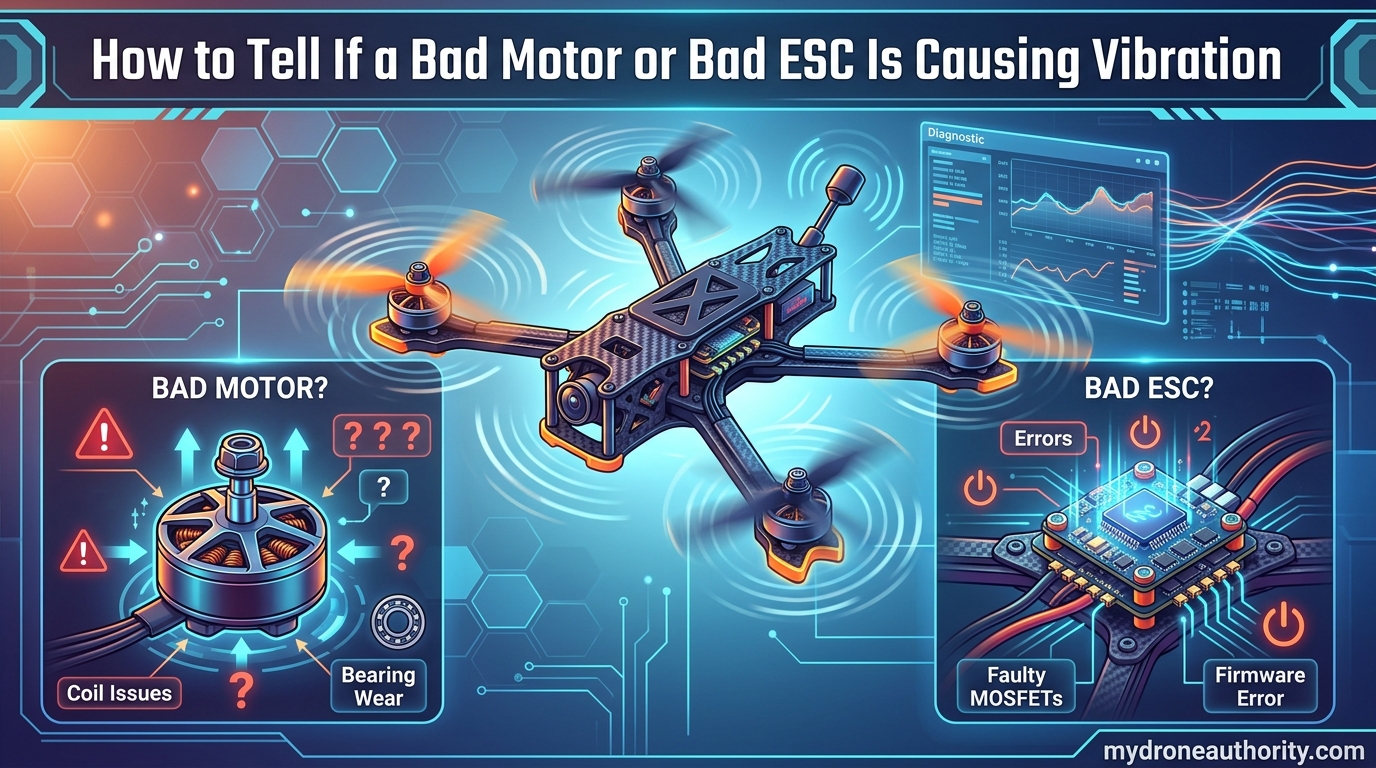
Nothing kills a flight session faster than a quadcopter that suddenly starts shaking, stuttering, or vibrating on the bench. The frustrating part? The symptom looks identical whether the motor or the ESC is the culprit. In this guide, I’ll walk you through exactly how to tell if a bad motor or a bad ESC is causing your vibration, using the same diagnostic order experienced FPV pilots rely on in the field.
You’ll learn the 60-second motor swap test, how to read burn marks and smell, and how to use a cheap multimeter to confirm a faulty MOSFET or broken motor winding. By the end, you’ll know which part to replace instead of guessing and wasting money on the wrong component.
Table of Contents
What Is an ESC and What Does a Brushless Motor Actually Do?
Before diagnosing anything, it helps to know what each part is responsible for. The ESC (Electronic Speed Controller) is the brain of the power delivery system. It takes a signal from your flight controller and switches power to the three motor phases thousands of times per second using MOSFETs. The brushless motor is the mechanical part that turns that switched power into rotation.
If the ESC sends dirty or uneven power, the motor vibrates even though the motor itself is fine. If the motor has a damaged winding, shorted phase, or bad bearing, it vibrates even though the ESC is doing its job. That overlap is exactly why the question “motor or ESC?” is so common on every FPV forum.
Quick Answer: How to Tell If a Bad Motor or a Bad ESC Is Causing Your Vibration
The fastest way to tell if a bad motor or a bad ESC is causing your vibration is the motor swap test. Swap the suspect motor with a known-good motor from another arm. If the vibration moves with the motor, the motor is bad. If the vibration stays on the same arm, the ESC is bad. This single test resolves around 80% of cases without any tools.
If you don’t have a spare motor handy, fall back to the symptom checklist and the multimeter tests below. Burn marks on the ESC and a burnt smell point to the ESC. A hot motor within seconds of arming points to the motor.
The Motor Swap Test: The Easiest 60-Second Diagnostic
This is the gold standard test recommended across RC Groups, IntoFPV, and Reddit’s r/fpv communities. It works because it isolates the variable. You stop guessing and let the hardware tell you the answer.
Step 1: Disarm your craft, unplug the battery, and remove the suspect motor from its arm. Leave the ESC wires connected for now.
Step 2: Remove a known-good motor from another arm on the same quad. Swap their physical positions, but keep each motor connected to its original ESC.
Step 3: Plug in the battery and arm the motors (props off, always). Spin up each one gently.
Step 4: Watch where the vibration goes. If the problem now shows up on the arm where you placed the suspect motor, the motor is bad. If the problem stays on the original arm, the ESC is the culprit.
Step 5: For confirmation, you can also swap the ESC signal leads between arms in Betaflight or your radio’s motor tab. If the twitch follows the ESC output, you’ve nailed it down to the ESC.
Signs Your Motor Is the Problem (Bad Motor Symptoms)
Bad motor symptoms tend to be mechanical or thermal. The motor will often tell you it’s unhappy through heat, smell, and resistance. Here’s what to look for.
- The motor gets hot to the touch within 10 seconds of arming, even with no prop installed.
- You smell burnt varnish or see visible smoke coming from the windings.
- The motor feels gritty or notchy when you spin it by hand, indicating a worn or rusted bearing.
- One phase wire is discolored, melted, or has visible copper exposed.
- The motor makes a scraping sound when turned slowly by hand, suggesting a bent shaft or loose bell.
- Spinning it manually produces inconsistent magnetic resistance compared to an identical motor.
If two or more of these line up, your motor is almost certainly the issue. Confirm with the multimeter winding test in the next section before you order a replacement.
Signs Your ESC Is the Problem (Bad ESC Symptoms)
Bad ESC symptoms are mostly electrical and behavioral. The motor may be perfectly healthy, but the ESC feeds it garbage power. Watch for these red flags.
- The motor twitches, stutters, or jerks instead of spinning smoothly. Stuttering almost always points to the ESC.
- The motor refuses to start at all, or only jitters when you raise throttle.
- You see burn marks, dark spots, or tiny holes blown in the MOSFET chips on the ESC.
- The ESC gets significantly hotter than the other three on the same craft.
- The motor desyncs mid-throttle, suddenly stopping or reversing direction.
- Black Box logs show timing errors or desync events on one specific ESC output.
- The motor spins fine after a fresh ESC firmware flash (BLHeli or Bluejay), pointing to corrupted firmware rather than hardware.
Twitching and stuttering are the loudest clues. A bad motor rarely stutters cleanly; it usually just gets hot, noisy, or weak. Stuttering is the ESC failing to commutate properly.
How to Test a Motor for Bad Windings with a Multimeter
If the motor swap test pointed at the motor, or you want to confirm before buying parts, a multimeter continuity test takes about two minutes. You’re checking the three phase wires for balanced resistance and shorts to the bell.
Step 1: Unplug the motor from the ESC. You need access to the three small wires (usually colored white, black, and red, or three matching colors depending on the brand).
Step 2: Set your multimeter to the lowest ohms (resistance) range, often the 200-ohm setting on cheap meters.
Step 3: Measure resistance between phase A and phase B. Note the value. Repeat for B to C, then C to A.
Step 4: Compare the three readings. On a healthy brushless motor, all three should be very close (typically under 0.5 ohms and within 0.1 ohms of each other). If one reading is significantly higher or shows open-line (OL), that phase is broken.
Step 5: Check for a short to the motor casing. Put one probe on any phase wire and the other on the metal motor bell. You should see infinite resistance (OL). Any continuity here means a winding is shorted to the can, and the motor is bad.
Step 6: For a final sanity check, spin the motor by hand. It should turn smoothly with even magnetic “cogging” steps. Any grinding or skipping confirms a mechanical failure inside.
How to Test an ESC for Bad MOSFETs
The ESC test is slightly more involved, but it pinpoints exactly which MOSFET has failed. MOSFETs are the little black switching chips on the ESC board, and they’re the most common point of failure. You’ll use your multimeter in diode mode.
Step 1: Unplug the battery and the motor from the suspect ESC. Never probe a live ESC.
Step 2: Visually inspect every MOSFET under good light. Look for tiny holes, black scorch marks, cracked cases, or discolored solder pads. A blown MOSFET is usually obvious to the naked eye.
Step 3: Set your multimeter to diode test mode (the symbol looks like a triangle with a line).
Step 4: Identify the three MOSFET legs: gate, drain, and source. On most ESCs, the large pad the motor wire solders to is the drain, the small middle leg is the gate, and the leg tied to ground is the source.
Step 5: Place the red probe on the source and the black probe on the drain. A healthy MOSFET will read around 0.4 to 0.7 volts (the body diode drop). Reverse the probes and you should see OL (open) in one direction.
Step 6: Test between gate and source. You should see OL or a very high reading in both directions. Any low reading here means the gate is blown through.
Step 7: If any MOSFET reads close to zero (short) in both directions, that MOSFET is dead. A single blown MOSFET causes the classic stutter because one phase never switches correctly.
If you’re comfortable with a soldering iron, you can replace individual MOSFETs. Most pilots simply swap the entire ESC, especially on 4-in-1 boards where individual chip replacement is fiddly.
Motor vs ESC Symptoms Comparison Table
Here’s a side-by-side reference for the most common symptoms. Use this to narrow down the cause before you reach for tools.
- Stuttering or twitching: ESC
- Hot motor within seconds of arming: Motor
- Burn marks on the board: ESC
- Burnt varnish smell from windings: Motor
- Motor doesn’t spin at all: Either, lean ESC if no heat
- Desync mid-flight: ESC (often firmware)
- Gritty feel when spun by hand: Motor
- Works fine after BLHeli or Bluejay reflash: ESC (firmware)
- Visible smoke from the bell: Motor
- One phase wire melted or discolored: Motor
Sound Diagnosis: What a Bad Motor vs Bad ESC Sounds Like
Sound is one of the most overlooked diagnostic tools, and almost no competitors cover it. Once you’ve heard the difference a few times, you can call it from across the bench.
A bad motor sounds mechanical. You’ll hear grinding, scraping, clicking, or a low-frequency rumble that gets louder with RPM. The motor may also whine at an unusual pitch compared to the other three. A bent shaft or bad bearing has a very distinct metallic chirp.
A bad ESC sounds electrical. The motor will make a buzzing, chirping, or rapid ticking sound as it tries to commutate. It might emit a high-pitched squeal followed by silence when a MOSFET drops out. The classic “ESC stutter” is a rapid, uneven buzzing that doesn’t match throttle input.
Record audio with your phone next to each motor. Comparing recordings side-by-side makes the difference obvious even to a beginner.
Can a Bad ESC Damage a Good Motor?
Yes, and this is one of the most important reasons to diagnose early. A bad ESC can absolutely fry a healthy motor. If a MOSFET fails shorted, the motor sees continuous DC current on one phase instead of switched AC. Within seconds, that phase winding overheats, the varnish melts, and you smell the burnt-electronics odor.
This is why pilots on r/Multicopter repeatedly warn against running a motor that’s twitching for more than a few seconds. The motor itself may be fine, but the failed ESC will cook it. Always unplug the battery as soon as you notice stuttering, and don’t repeatedly arm to “test it” without investigating the ESC first.
The reverse is also true: a shorted motor winding can draw enough current to blow MOSFETs on the ESC. That’s why the motor swap test comes first, before any prolonged bench testing.
When to Repair vs Replace a Motor or ESC
For motors, replacement is almost always the right call. A motor with bad windings or a shorted phase is not repairable by hobbyists. Bearing swaps are doable on larger motors, but if you’ve confirmed a winding fault, just buy a new motor. Match the KV, stator size, and mounting pattern to keep your quad balanced.
For ESCs, you have a real choice. Single standalone ESCs are cheap and easy to swap. On 4-in-1 boards, individual MOSFET replacement is possible if you have decent soldering skills, and Oscar Liang has detailed walkthroughs on pinpointing and replacing the bad chip. If three of four ESCs are still healthy, replacing one MOSFET saves you from buying a whole new board.
The general rule: if only one MOSFET is blown and you’re comfortable with a soldering iron, repair it. If the board has multiple failures, water damage, or a burnt voltage regulator, replace the whole ESC. Also reflash fresh BLHeli or Bluejay firmware after any repair, since corrupted firmware can mimic a hardware failure.
One more preventive tip that the T-Motor blog and most experienced pilots agree on: avoid prop strikes, keep your ESCs clean and dry, and never exceed the rated current. Most vibration-causing failures trace back to one of those three abuses.
How to tell if motor or ESC is bad?
Swap the suspect motor with a known-good motor from another arm. If the vibration moves with the motor, the motor is bad. If it stays on the same arm, the ESC is bad. Confirm with a multimeter continuity test on the motor windings or a diode-mode test on the ESC MOSFETs.
What is the most common cause of vibration?
The most common cause of sudden vibration is a failed MOSFET on the ESC, which causes the motor to stutter instead of spinning smoothly. Bent shafts, damaged bearings, and crashed props are the next most common culprits on the motor side.
Can a bad ESC damage a motor?
Yes. A failed ESC MOSFET can send continuous current through one motor phase instead of switching it, which overheats the winding and melts the varnish within seconds. Always disconnect power as soon as you notice stuttering to protect the motor.
How to check if ESC is ok?
Visually inspect the MOSFETs for burn marks or holes. Then test each MOSFET in diode mode with a multimeter: you should see roughly 0.4 to 0.7 volts in one direction and open line in the other. A reading close to zero in both directions means the MOSFET is shorted and the ESC is bad.
How to tell if a drone motor is bad?
Look for a motor that gets hot within 10 seconds of arming, smells like burnt varnish, feels gritty when spun by hand, or has discolored phase wires. A multimeter should show roughly equal low resistance between all three phases, with no continuity to the motor bell.
Conclusion
Diagnosing whether a bad motor or a bad ESC is causing your vibration doesn’t have to be a guessing game. Start with the 60-second motor swap test, then confirm with a visual inspection, a smell test, and a multimeter on either the motor windings or the ESC MOSFETs. Stuttering and burn marks point to the ESC; heat, smell, and gritty rotation point to the motor.
Act fast when you notice vibration. A bad ESC can cook a healthy motor in seconds, and a shorted motor can blow a perfectly good ESC. Run the swap test first, replace only the confirmed failure, and reflash your ESC firmware before the next flight. Your future self, your wallet, and your quadcopter will all thank you.