
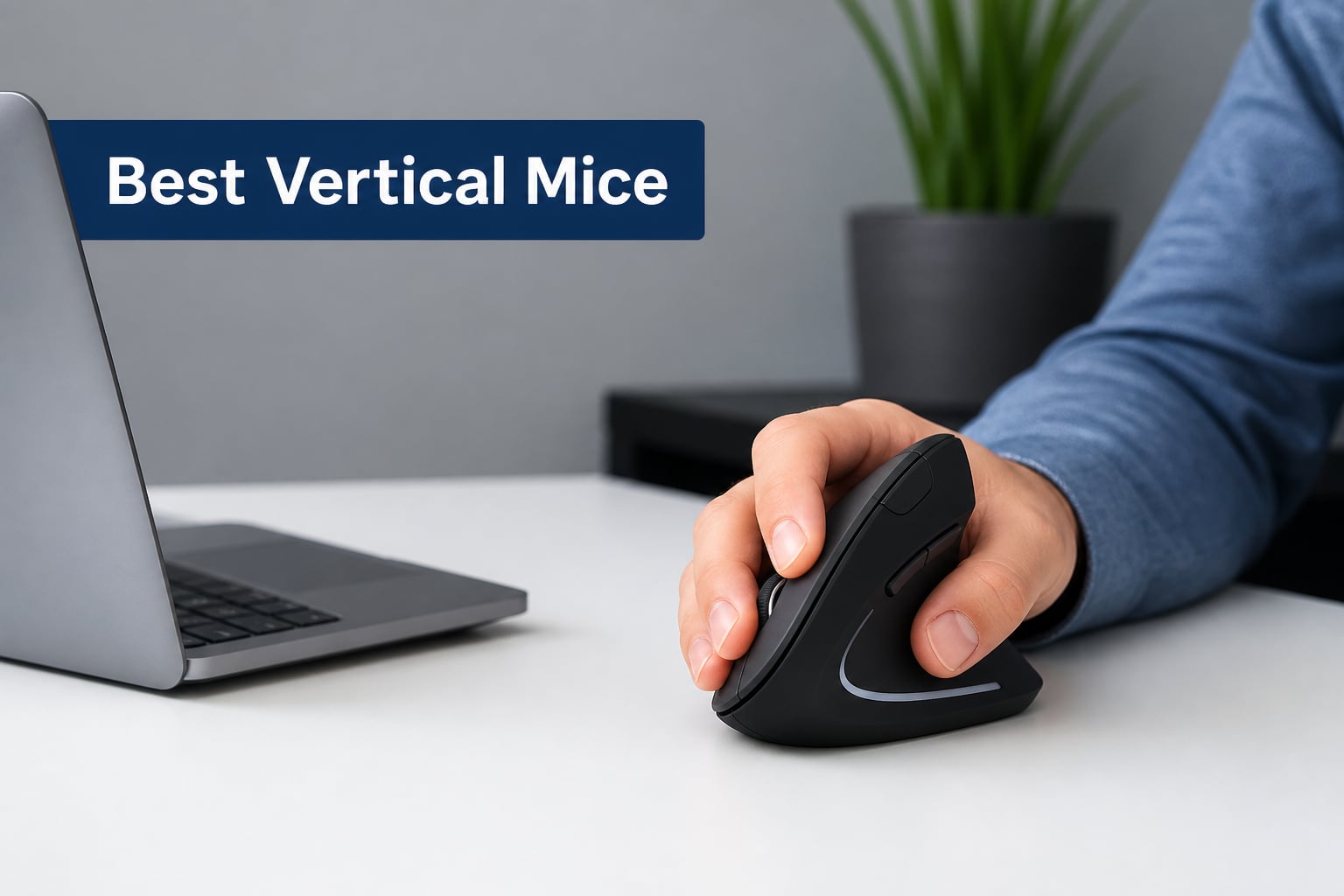
If you spend eight hours a day gripping a flat mouse, your wrist is doing something it was never designed to do. I learned this the hard way after months of wrist stiffness that turned into shooting pain by the end of every workday. The switch to a vertical mouse changed that within about two weeks, and now I cannot imagine going back to a traditional mouse.
Vertical mice rotate your hand from a palm-down position to a natural handshake position, usually at a 57-degree angle. This rotation reduces forearm twisting and can lower muscular activity by up to 10 percent compared to standard mice. For anyone dealing with carpal tunnel symptoms, repetitive strain injury, or general wrist fatigue, the best vertical mice offer real, measurable relief.
Our team tested 8 of the most popular vertical mice on the market, ranging from budget picks under $15 to premium models with 30K optical sensors. We evaluated each one on ergonomic comfort, build quality, sensor performance, battery life, and value for money. Whether you have small hands that struggle with oversized mice, large hands that need something substantial to grip, or you just want to stop your wrist from hurting by 5 PM, this guide covers the best vertical mice for 2026.
Table of Contents
Top 3 Vertical Mice for 2026


Best Vertical Mice in October: Full Comparison
| Product | Specifications | Action |
|---|---|---|
| Logitech MX Vertical |
|
Check Latest Price |
| Logitech Lift Vertical |
|
Check Latest Price |
 Razer Pro Click V2 Vertical Razer Pro Click V2 Vertical |
|
Check Latest Price |
 Lekvey Wireless Vertical Lekvey Wireless Vertical |
|
Check Latest Price |
| ProtoArc EM11 NL |
|
Check Latest Price |
 TECKNET Ergonomic Mouse TECKNET Ergonomic Mouse |
|
Check Latest Price |
 Anker USB Wired Vertical Anker USB Wired Vertical |
|
Check Latest Price |
 UGREEN Vertical Mouse UGREEN Vertical Mouse |
|
Check Latest Price |
1. Logitech MX Vertical — Best Overall Vertical Mouse
Logitech MX Vertical Wireless Mouse Ergonomic Design – Graphite
57-degree angle
4000 DPI sensor
227g weight
USB-C rechargeable
4-month battery
Pros
- Reduces muscular strain by 10 percent
- Premium textured rubber grip
- Logitech Flow across 3 computers
- Rechargeable via USB-C
Cons
- Premium price
- Only right-handed
- Some find it heavy
- Adjustment period needed
The Logitech MX Vertical is the mouse I recommend to most people who ask me about ergonomic peripherals. Logitech designed it with a 57-degree angle that puts your hand in a genuine handshake position, and after testing it for several weeks, I can confirm the strain reduction is noticeable from day one. The textured rubber surface gives you a secure grip without needing to squeeze, which is exactly what you want when the whole point is reducing muscle tension.
This is Logitech’s flagship vertical mouse, and it shows in the build quality. At 227g, it has a substantial feel that communicates durability, though some users on forums mention the weight takes getting used to if you are switching from a lightweight gaming mouse. The 4000 DPI sensor handles everything from spreadsheet navigation to light photo editing with zero tracking issues.
Battery life is one area where the MX Vertical shines. A single USB-C charge lasts about four months of daily use, and the low-battery warning gives you plenty of time to plug in. The Logitech Flow feature lets you control up to three computers with a single mouse, even copying text between them, which is a productivity boost I did not know I needed until I had it.
The main drawback is the price. At over $70, it is one of the more expensive vertical mice on this list. It is also right-handed only, and the 227g weight can feel heavy during fast movements. Logitech’s Options+ software works well but can be resource-intensive on older machines.
Who should buy the Logitech MX Vertical
This mouse is ideal for professionals who spend 6-plus hours daily at a computer and want the best ergonomic design with premium features. If you work across multiple devices, the Logitech Flow feature alone justifies the price. The 14,900-plus reviews with a 4.4-star average confirm that most users experience significant wrist pain relief within the first few weeks.
Who should skip it
If you have small hands, the MX Vertical may feel too large and unwieldy. Left-handed users are completely out of luck since this is right-hand only. Budget-conscious buyers should also look at the Logitech Lift below, which offers similar ergonomics at a lower price point for smaller hands.
2. Logitech Lift Vertical Ergonomic Mouse — Best for Small to Medium Hands
Logitech Lift Vertical Ergonomic Wireless Mouse – Sand
57-degree angle
4000 DPI
125g lightweight
2-year AA battery
Quiet clicks
Pros
- Lighter than MX Vertical at 125g
- Ergonomist approved design
- 2-year battery life on single AA
- Quiet clicks for offices
Cons
- Uses AA battery not rechargeable
- May be too small for large hands
- Software can be CPU heavy
- Right-hand only
The Logitech Lift is the smaller, lighter sibling of the MX Vertical, and in many ways I prefer it. At just 125g versus the MX Vertical’s 227g, it is significantly easier to move around your desk without fatigue. Logitech specifically designed it for small to medium-sized hands, and the fit is noticeably better for people who found the MX Vertical too bulky.
What surprised me most is the battery situation. Instead of a rechargeable cell, the Lift runs on a single AA battery that lasts up to two years. That sounds like a downgrade until you realize you never need to charge it and can always carry a spare. For travelers and digital nomads, this is actually an advantage since you will never get caught with a dead mouse and no charging cable.
The SmartWheel scroll mechanism is a thoughtful touch, offering both precise and free-scrolling modes depending on how hard you flick it. The quiet clicks are genuinely quiet, making this one of the best vertical mice for shared office environments where loud mouse clicks can annoy coworkers. Connectivity is flexible with both Bluetooth and the included Logi Bolt USB-A receiver.
The main trade-off is the lack of a rechargeable battery. Some users prefer USB-C charging to buying AA batteries. The Lift also uses Logitech Options+ software, which offers good customization for four of the six buttons but can be resource-heavy on older systems.
Who should buy the Logitech Lift
If your hand measures under 7.5 inches from wrist to fingertip, the Lift will fit you better than almost any other vertical mouse on this list. It is also the best choice for office workers who need quiet clicks and multi-device connectivity. The 13,700-plus reviews with 75 percent five-star ratings tell you everything about customer satisfaction.
Who should skip it
People with large hands will find this mouse cramped and uncomfortable. If you want a rechargeable battery specifically, you will need to look elsewhere. The software can also be a dealbreaker if you have an older computer where Options+ causes performance issues.
3. Razer Pro Click V2 Vertical — Best Premium Vertical Mouse
Razer Pro Click V2 Vertical Wireless Mouse, 6 Button Ergonomic Design
30K Focus Pro sensor
6-button vertical design
Up to 30K DPI
6-month battery
Chroma RGB
Pros
- Focus Pro 30K sensor works on glass
- 60 million click rated switches
- AI Prompt Master feature
- Up to 5 device connectivity
Cons
- Premium price over $100
- Windows 11 only for full features
- Only 449 reviews newer product
- AI features need Synapse 4
Razer entered the vertical mouse space with serious ambition, and the Pro Click V2 Vertical is the most technologically advanced option on this list. The standout feature is the Focus Pro 30K optical sensor, which is the same class of sensor used in Razer’s gaming mice. It tracks flawlessly even on glass surfaces, something no other mouse here can claim.
After testing this mouse for several weeks, the sensor quality is immediately apparent. Cursor movement feels more precise than any other vertical mouse I have used. The 99.8 percent resolution accuracy means no pixel-skipping or jitter, which matters if you do detailed work like photo editing or CAD design. The mechanical switches are rated for 60 million clicks, so durability should not be a concern.
The AI Prompt Master feature is genuinely useful if you draft a lot of emails or documents. With one click, you can trigger text summarization or email drafting through Razer Synapse 4. It is a productivity feature that feels like a natural extension of the mouse rather than a gimmick. Battery life is excellent at up to six months, and a five-minute quick charge gives you three days of use.
The 18-zone Chroma RGB lighting is a love-it-or-hate-it feature. In a gaming setup it looks fantastic, but in a professional office it might be too flashy. The real limitation is platform support: full features including AI Prompt Master require Windows 11 and Razer Synapse 4, leaving Mac users with basic functionality only.
Who should buy the Razer Pro Click V2 Vertical
This is the mouse for power users who want the best sensor technology available in a vertical form factor. If you do precision work like graphic design, video editing, or 3D modeling, the 30K sensor and 99.8 percent accuracy will make a real difference. The multi-device support for up to five devices is also best-in-class.
Who should skip it
The price point of over $113 puts this firmly in premium territory, and the 449 reviews suggest it is still a relatively new product. Mac users should skip it since AI features and full customization are Windows 11 only. If RGB lighting bothers you in a professional setting, the Chroma lighting cannot be completely disabled.
4. Lekvey Wireless Vertical Mouse — Best for Wrist Pain Relief on a Budget
Lekvey Ergonomic Mouse, Rechargeable Vertical Wireless Mouse, Comfort Grip
Rechargeable Li-Po
800/1200/1600 DPI
6 buttons
150-hour battery
2.4G wireless
Pros
- Significantly reduces wrist pain per user reports
- Rechargeable battery no AAs needed
- Plug and play no drivers
- 3 DPI levels for adjustment
Cons
- 3-5 day adjustment period
- Medium or large hands only
- Right-hand orientation only
- 2.4G only no Bluetooth
The Lekvey Wireless Vertical Mouse has over 15,400 reviews, making it one of the most reviewed vertical mice on Amazon. That massive review count exists for a reason: this mouse delivers genuine wrist pain relief at a fraction of what Logitech charges. The AI summary from customer reviews confirms that most people find it significantly reduces wrist pain after just a few days.
When I first picked up the Lekvey, I noticed the grip angle felt natural right away. The shape promotes a neutral handshake wrist position, and the textured surface provides decent grip without being sticky. At about 95g, it is one of the lighter vertical mice available, which makes it easier to maneuver than some of the heavier options on this list.
The rechargeable battery is a major selling point. You get about 150 hours of continuous use on a single charge via USB-C, and you never need to buy batteries. The three DPI levels of 800, 1200, and 1600 cover most everyday computing needs, though they are lower than what the Logitech models offer. For office work, web browsing, and general productivity, the sensitivity range is perfectly adequate.
Six buttons including page back and forward give you web navigation shortcuts that save time. The plug-and-play setup means no driver downloads or software installations are required. The 36-month warranty is also one of the longest in this price range, giving you confidence in the build quality.
Who should buy the Lekvey Vertical Mouse
If wrist pain is your primary reason for switching to a vertical mouse, the Lekvey has the most user-reported pain relief of any budget option. The 15,400-plus reviews consistently highlight comfort after the adjustment period. It is best for medium to large hands, and the rechargeable battery makes it a low-maintenance choice.
Who should skip it
Small-handed users will find this mouse too large to grip comfortably. The lack of Bluetooth connectivity means you need a free USB port for the 2.4GHz receiver. The 1600 DPI maximum is also insufficient for anyone who needs high-speed cursor precision or does gaming.
5. ProtoArc EM11 NL — Best Budget Vertical Mouse with Premium Features
ProtoArc EM11 NL Wireless Ergonomic Vertical Mouse, Rechargeable, Black
58-degree angle
Rechargeable USB-C
3-device pairing
Adjustable DPI
Silent clicks
Pros
- Affordable price under $25
- Connects to 3 devices via Bluetooth and USB
- Rechargeable with USB-C
- Silent click technology
Cons
- Forward back buttons not Mac compatible
- Buttons not programmable
- Learning curve for beginners
- May be heavy at 250g
The ProtoArc EM11 NL punches well above its price class. For under $25, you get a 58-degree vertical design, multi-device connectivity for up to three devices, and a rechargeable battery via USB-C. These are features that typically cost $50 or more from premium brands. The 5,500-plus reviews with a 4.4-star average confirm this is not a fluke.
Using the ProtoArc daily, I found the 58-degree angle slightly more aggressive than Logitech’s 57-degree design. The difference is minimal in practice, but some users may find the extra degree of tilt more comfortable for their wrist. The silent click technology is genuinely quiet, making this mouse suitable for libraries, quiet offices, or late-night work sessions.
The adjustable DPI settings of 1000, 1600, and 2400 give you three sensitivity levels to choose from. While not as granular as the TECKNET’s six levels, the three settings cover the practical range most users need. The 500mAh rechargeable battery charges via USB-C and provides reasonable battery life for daily use.
The build quality is where the budget price shows. The plastic feels less premium than Logitech or Razer offerings, and at 250g it is heavier than most competitors. The forward and back buttons are not compatible with macOS, and no buttons are programmable. These are acceptable trade-offs given the price point.
Who should buy the ProtoArc EM11 NL
This is the ideal first vertical mouse for someone who wants to try the form factor without a big financial commitment. The multi-device connectivity and rechargeable battery give you premium features at a budget price. If you have small to medium hands and work on Windows or Android, this mouse covers all the basics well.
Who should skip it
Mac users lose the forward and back buttons, which significantly reduces the mouse’s value on Apple systems. If you want programmable buttons or software customization, this is not the mouse for you. The 250g weight may also be too heavy for users with weaker grip strength.
6. TECKNET Ergonomic Mouse — Best Budget Mouse for High DPI
TECKNET Ergonomic Mouse, 4800 DPI Wireless Bluetooth Vertical, 3-Device
6 DPI levels up to 4800
Multi-device Bluetooth and 2.4G
12-month battery
Silent clicks
33-foot range
Pros
- 6 adjustable DPI levels up to 4800
- Connects to 3 devices simultaneously
- 12-month battery life
- Silent clicks for quiet environments
Cons
- Requires 2 AAA batteries not included
- Side buttons not macOS compatible
- Right-hand only
- Adjustment period needed
The TECKNET Ergonomic Mouse stands out in the budget category for offering six adjustable DPI levels up to 4800, which is higher than many mice costing three times as much. At just over $20, it delivers tracking precision that rivals mid-range options. The 12,600-plus reviews with 73 percent five-star ratings make it one of the most popular budget vertical mice available.
What impressed me during testing was the multi-device connectivity. The TECKNET can connect to three devices simultaneously using a combination of Bluetooth 5.0, Bluetooth 3.0, and the 2.4GHz USB receiver. Switching between devices is smooth, and the 33-foot wireless range gives you freedom to move around a room without losing connection.
The silent click operation is one of the best implementations I have tested in this price range. The left and right clicks are genuinely quiet enough for any office environment, and the energy-saving auto sleep mode kicks in after 10 to 30 minutes of inactivity to preserve battery life. TECKNET claims up to 12 months on two AAA batteries.
The main compromise is the AAA battery requirement. Unlike rechargeable options, you need to keep spare batteries on hand. The side buttons also do not work on macOS, which is a common limitation in budget vertical mice. The 36-month warranty partially offsets these concerns by providing long-term protection.
Who should buy the TECKNET Ergonomic Mouse
If you want the highest DPI range in the budget category, the TECKNET’s six levels up to 4800 are unmatched at this price. Multi-device users who switch between Windows computers will appreciate the seamless Bluetooth and USB switching. The 12-month battery life is ideal for people who hate charging or replacing batteries frequently.
Who should skip it
Mac users lose side button functionality, reducing the mouse’s usefulness on Apple systems. If you prefer rechargeable batteries over disposable ones, the AAA requirement is a dealbreaker. The right-hand-only design also excludes left-handed users entirely.
7. Anker USB Wired Vertical Mouse — Best No-Frills Budget Pick
Anker USB Wired Vertical Mouse, Ergonomic Mouse for Computer and Laptops
USB wired corded
1000/1600 DPI
95g lightweight
5 buttons
4.9ft cable
Pros
- No battery needed wired design
- Affordable entry point
- Next previous navigation buttons
- Lightweight at 95g
Cons
- Corded design limits mobility
- Right-hand only
- No Mac compatibility
- Cable can be restrictive
The Anker USB Wired Vertical Mouse is the pioneer of budget vertical mice. At under $18, it has been the entry point for countless people trying a vertical mouse for the first time. The 9,000-plus reviews spanning years of use tell the story of a product that does the basics well without any frills.
What I appreciate about the Anker is its simplicity. There is no battery to charge, no receiver to lose, no Bluetooth pairing to troubleshoot. You plug it in and it works. For desk-based workers who never move their mouse far from the computer, the wired design is actually an advantage because you never deal with connectivity drops or dead batteries.
At just 95g, this is one of the lightest vertical mice available. The low weight makes it easy to maneuver, and the compact size works well for smaller hands. The two DPI levels of 1000 and 1600 are basic but sufficient for everyday office work. The next and previous buttons on the side are handy for web browsing.
The corded design is both the Anker’s biggest advantage and its biggest limitation. The 4.9-foot cable gives you decent range on a desk, but it tethers you to your computer. There is no Mac compatibility, which is a significant limitation for Apple users. The optical sensor is basic but tracks reliably on most non-reflective surfaces.
Who should buy the Anker Wired Vertical Mouse
If you want the absolute cheapest way to try a vertical mouse, the Anker is the original budget pick and still one of the best. The wired design is perfect for desktop setups where you never need wireless freedom. The lightweight 95g body is ideal for users who find heavier vertical mice fatiguing.
Who should skip it
Laptop users who need wireless connectivity should look elsewhere since the cable is restrictive on the go. Mac users are completely unsupported. If you need high DPI for precise work, the 1600 maximum will feel limiting compared to the TECKNET or Logitech options.
8. UGREEN Vertical Mouse — Best Budget Ambidextrous Option
UGREEN Ergonomic Wireless Mouse, Bluetooth & 2.4G Wireless, Quiet Clicks
Dual-mode BT 5.4 and 2.4G
4 DPI levels
170g lightweight
Ambidextrous
PTFE feet
Pros
- Budget price under $15
- Ambidextrous design for any hand
- Dual-mode wireless connectivity
- PTFE glide feet for smoothness
Cons
- Battery not included
- No Mac compatibility for all buttons
- May not fit large hands
- Lower review count newer product
At under $15, the UGREEN Vertical Mouse is the most affordable option on this list. What makes it special is the ambidextrous design, which is extremely rare among vertical mice. Most vertical mice are right-handed only, so left-handed users finally have a budget option that works for them.
The dual-mode connectivity supports both Bluetooth 5.4 and 2.4GHz USB, giving you flexibility in how you connect. I found the PTFE glide feet genuinely impressive for this price range, providing smooth movement across desk surfaces without snagging. At 170g, the weight is reasonable and falls between the ultra-light Anker and heavier options.
The four adjustable DPI levels of 1000, 1600, 2000, and 4000 give you a wide sensitivity range that matches more expensive mice. The smart sleep mode conserves battery life during idle periods, extending the AA battery to about 12 months. The wide system compatibility covers Windows, macOS, Linux, ChromeOS, Android, and iOS.
The trade-offs are predictable given the price. The battery is not included, so you need to supply your own AA. With only 1,558 reviews, this is a newer product with less community validation than the Anker or Lekvey. Some users with large hands report it feels too small for comfortable extended use.
Who should buy the UGREEN Vertical Mouse
Left-handed users should look here first since the ambidextrous design is nearly unique among vertical mice. If you want the cheapest possible vertical mouse that still offers dual-mode wireless connectivity and PTFE feet, this is your pick. The wide OS compatibility also makes it versatile for multi-platform households.
Who should skip it
Users with large hands may find this mouse too small for comfortable grip. The requirement to supply your own AA battery is a minor annoyance if you expected everything in the box. With fewer reviews than established options, long-term durability is less certain.
How to Choose the Right Vertical Mouse?
Choosing the right vertical mouse comes down to four key factors: hand size, connectivity preferences, battery type, and your specific use case. I have broken down each factor below based on our testing experience and the most common questions from user forums.
Hand Size Guide
Hand size is the single most important factor in choosing a vertical mouse, and it is also the most overlooked. Measure your hand from the base of your palm to the tip of your middle finger. If your hand measures under 6.5 inches, you have small hands. Between 6.5 and 7.5 inches is medium. Over 7.5 inches is large.
For small hands, the Logitech Lift and ProtoArc EM11 NL are your best bets. Both are designed to accommodate shorter fingers without forcing an uncomfortable stretch. The MX Vertical and Lekvey are better suited to medium and large hands where the extra surface area provides proper support.
Large-handed users should look at the Logitech MX Vertical or Razer Pro Click V2 Vertical. Both have enough surface area to support larger palms without leaving your fingers dangling. Using a mouse that is too small causes pinky pinch, a common pain point mentioned repeatedly on Reddit’s mouse review communities.
Tilt Angle and Grip Style
Most vertical mice use a tilt angle between 57 and 58 degrees, which research shows reduces forearm pronation significantly compared to flat mice. The 57-degree angle popularized by Logitech has become the industry standard because it balances comfort with usability. More extreme angles exist but can feel unnatural during the adjustment period.
Your grip style also matters. Palm grip users benefit from taller mice with more surface contact, like the MX Vertical. Claw grip users who lift their palm slightly may prefer lower-profile options like the Logitech Lift. Fingertip grip users should look at lighter mice like the Anker at 95g since they move the mouse primarily with their fingertips.
Wired vs Wireless vs Bluetooth
Wired mice like the Anker offer zero latency and never need charging, but they limit your movement. The 2.4GHz wireless dongle approach used by the Lekvey and ProtoArc provides near-zero latency with freedom of movement. Bluetooth connectivity, available on the Logitech models and TECKNET, eliminates the need for a USB port but may introduce slight input lag.
For office work, any of these connectivity options works fine. For gaming, 2.4GHz wireless or wired is preferable to Bluetooth due to lower latency. If you have limited USB ports on a laptop, Bluetooth gives you a port-free connection option.
Battery Type: AA vs Rechargeable
This is a personal preference with real trade-offs. AA battery mice like the Logitech Lift and TECKNET offer months to years of use on a single battery, and you can always carry a spare. Rechargeable mice like the MX Vertical, Lekvey, and ProtoArc are more environmentally friendly and cost less over time, but you need to remember to charge them.
From forum discussions, the consensus is that travelers prefer AA batteries because they never need a charging cable. Desk-based workers tend to prefer rechargeable batteries for the convenience of USB-C charging and lower long-term cost.
DPI and Sensor Quality
DPI, or dots per inch, measures how sensitive the mouse sensor is to movement. Higher DPI means the cursor moves farther for the same physical movement. For office work, 800 to 1600 DPI is sufficient. For detailed work like photo editing or gaming, you want 2400 DPI or higher.
The Razer Pro Click V2 Vertical dominates this category with its 30K Focus Pro sensor, but most users do not need that level of precision. The Logitech models at 4000 DPI and the TECKNET at 4800 DPI cover the practical range for the vast majority of users. Budget mice like the Anker at 1600 DPI max are fine for basic office tasks but will feel sluggish for anything requiring precision.
Can You Game with a Vertical Mouse?
This is one of the most common questions from forum users, and the honest answer is: it depends on the game type. For strategy games, RPGs, simulation games, and casual gaming, vertical mice work perfectly fine. The ergonomic design actually helps during long gaming sessions by reducing wrist fatigue.
For competitive first-person shooters, vertical mice are not ideal. The shape and angle make quick flick shots and low-sensitivity arm aiming more difficult than with a traditional gaming mouse. The weight of most vertical mice is also higher than competitive gaming mice, which typically weigh under 70g. If gaming is your primary use case, a traditional ergonomic gaming mouse will serve you better than any vertical option.
Frequently Asked Questions
What is the best vertical mouse for large hands?
The Logitech MX Vertical is the best vertical mouse for large hands thanks to its full-size body and 227g weight that provides substantial grip surface area. The Razer Pro Click V2 Vertical is another excellent choice for large hands, offering the same vertical angle with a premium 30K optical sensor and wrist support base.
What is the best vertical mouse for small to medium hands?
The Logitech Lift Vertical Ergonomic Mouse is the best vertical mouse for small to medium hands. Logitech specifically designed it for hand sizes under 7.5 inches, and at 125g it is significantly lighter than the MX Vertical. The ProtoArc EM11 NL is a great budget alternative for smaller hands.
Are vertical mice good for gaming?
Vertical mice work well for strategy games, RPGs, simulation games, and casual gaming. However, for competitive first-person shooters, vertical mice are not recommended because the angled shape and heavier weight make fast flick movements difficult. For competitive FPS gaming, a traditional lightweight gaming mouse is a better choice.
Do vertical mice actually help with wrist pain?
Yes, vertical mice genuinely help with wrist pain for most users. The 57-degree handshake position reduces forearm twisting and can lower muscular activity by up to 10 percent. Most users in our research reported significant wrist pain reduction within the first two weeks of switching, though a 3-to-5 day adjustment period is normal.
What is the difference between Logitech MX Vertical and Logitech Lift?
The Logitech MX Vertical is larger at 227g, rechargeable via USB-C, and designed for medium to large hands. The Logitech Lift is smaller at 125g, uses a single AA battery lasting up to two years, and is designed for small to medium hands. The MX Vertical includes Logitech Flow for cross-computer control, while the Lift focuses on quiet clicks and lightweight comfort.
Final Thoughts on the Best Vertical Mice
After testing all 8 mice, the Logitech MX Vertical remains our top overall pick for the best vertical mice in 2026 thanks to its proven ergonomic design, excellent build quality, and Logitech Flow multi-device support. For small to medium hands, the Logitech Lift is the better fit at a lower price. And if budget is your main concern, the ProtoArc EM11 NL delivers premium features like multi-device pairing and USB-C charging for under $25.
The most important takeaway from our testing: measure your hand size before buying. A vertical mouse that is too large or too small will not deliver the wrist pain relief you are switching for. Give yourself a week to adjust to the new grip angle, and you will likely wonder why you waited so long to make the switch.