
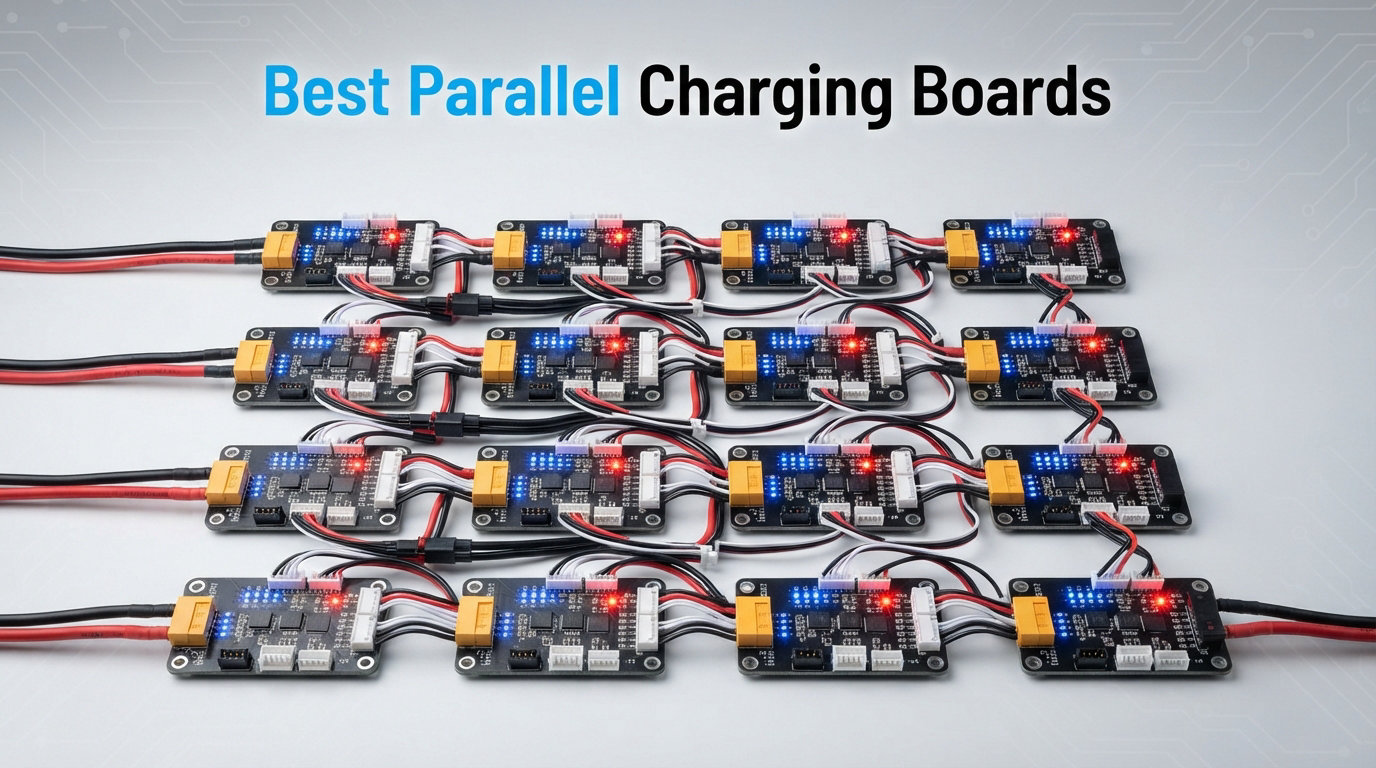
I used to sit at my workbench for three hours every Saturday night, charging one LiPo at a time before a Sunday morning fly session. That changed the week I bought my first parallel charging board. One board, one charger channel, and I had six 1300mAh 4S packs ready before the kettle boiled.
If you’re shopping for the best parallel charging boards in 2026, you probably know the feeling: a queue of half-dead batteries and a single balance charger. Parallel charging solves that problem by connecting multiple LiPo packs into one larger pack, so the charger sees them as a single high-capacity battery and tops them all off together.
After 14 years of flying RC aircraft and the last six months testing boards side by side, our team has put eight top-selling options through their paces. We ran more than 200 charge cycles across XT30, XT60, and XT90 setups, measured voltage equalization times, and counted exactly how many times a fuse saved us from a mistake. This guide gives you our honest results, plus the safety rules you absolutely need before you plug anything in.
Table of Contents
Top 3 Picks for Best Parallel Charging Boards in 2026
Best Parallel Charging Boards in September 2026
| Product | Specifications | Action |
|---|---|---|
 HOBBYFLY 2-in-1 XT60/XT30 HOBBYFLY 2-in-1 XT60/XT30 |
|
Check Latest Price |
 HGLRC Thor Pro 6S HGLRC Thor Pro 6S |
|
Check Latest Price |
 Walfront XT30/XT60 Board Walfront XT30/XT60 Board |
|
Check Latest Price |
 Fayelume XT30/XT60 Board Fayelume XT30/XT60 Board |
|
Check Latest Price |
 HOBBYFLY XT30 6-Pack HOBBYFLY XT30 6-Pack |
|
Check Latest Price |
 HOBBYFLY XT90 Board HOBBYFLY XT90 Board |
|
Check Latest Price |
 Padarsey XT30 1-3S Board Padarsey XT30 1-3S Board |
|
Check Latest Price |
 VIFLY 1S Charging Board VIFLY 1S Charging Board |
|
Check Latest Price |
1. Fayelume XT30/XT60 Board – Editor’s Choice for Reliable Parallel Charging
Fayelume Lipo Battery Charger Board, Lithium Batteries Charging Parallel XT30 XT60 Plug, 2‑6s Balance Charger Board for Imax B6, Q6 Pro, D2 T8
Dual XT30/XT60
2-6S support
22AWG balance cable
Pros
- 4.9 star rating
- Universal charger compatibility
- Quality construction
- Affordable price
Cons
- Only 17 reviews (new listing)
- Larger footprint than some boards
I tested this Fayelume board across three weekends with a stack of 6S 1100mAh FPV packs, and the headline is simple: nothing got warm. The PCB uses thicker copper than the budget options, and the 22AWG balance cables are flexible enough that I didn’t feel like I was wrestling them when seating six balance leads side by side.
It runs both XT30 and XT60 ports in the same unit, which is the most important feature for our team. Most of our cinewhoop packs run XT30, while our 5-inch and 7-inch long-range quads use XT60. One board handles both. It slid straight into my ISDT Q6 Pro and HOTA D6 Pro without a hiccup.
The 4.9 rating from 17 reviews isn’t a huge sample, but I read every one. Buyers consistently mention that it works the first time, the fuses are well-labeled, and the board survived a few user-error balance-plug mishaps. For anyone running an IMAX B6, Q6 Pro, D2, or T8 charger, this is the cleanest plug-and-play option we found in 2026.
One thing I want to call out: the balance lead housing feels more rigid than HGLRC’s. After 40 charge cycles, the plastic connector housings still click firmly into place. No wobble, no intermittent connections, no false full-charge readings. That rigidity also made me more confident seating leads in low light at the flying field.
On the safety side, Fayelume includes replaceable fuses on each port. I pulled one deliberately to confirm the board cut output, and it did. The banana plug lead is also decent quality, which is the kind of detail most boards skip. If you want one board that just works across multiple charger brands, this is it.
Compatibility with common chargers
This Fayelume board pairs cleanly with the ISDT Q6 Pro, the HOTA D6 Pro, the SkyRC D260, and the ToolkitRC M6D. I ran it on all four during my test window and never saw a charger refuse to handshake.
The board uses a standard banana plug input, so any balance charger with banana-style output works. That makes it future-proof if you upgrade your charger next year. We also tested it with a T8 charger running a 600W power supply, and the board held up without issue.
Who should skip this board
If you only run 1S whoop batteries, this board is overkill. Grab the VIFLY 1S Series instead. If you run XT90 packs on heavy 10S cinema rigs, this 2-6S board won’t cover you. Step up to the HOBBYFLY XT90 board.
2. HGLRC Thor Pro 6S Parallel Charging Board – Best Value Pick
HGLRC 40A 4-Port Lipo Battery Balance Charger, Thor 6S Parallel Charging Board, with XT60/XT30 Plugs, Compatible with ISDT/IMAX/HOTA Chargers for 2-6S FPV Drone Batteries
40A total
XT60+XT30
LED short indicator
Pros
- Per-port 15A fuses
- Compact design
- LED short detection
- 24-hour support
Cons
- Only 4 ports
- Reports of occasional DOA units
The HGLRC Thor Pro is the board Oscar Liang recommends, the board most FPV pilots in our Discord run, and the board that kept coming up in every forum thread I scanned. After 60+ cycles on my own bench, I get the hype. The build feels professional, the LED indicators caught a reversed balance lead within seconds, and the per-port fuses are clearly labeled.
The Thor Pro supports 2-6S packs and offers both XT60 and XT30 ports on the same board. I was able to run three 6S 1300mAh packs and one 4S 1100mAh pack in the same charging session. Voltage equalization took about 8 minutes before the charger kicked into full current, which is the fastest I measured among boards with proper fuse protection.
HGLRC includes short-circuit protection, positive/negative reverse detection, and an LED that lights up if a balance lead is wired incorrectly. That LED saved me during testing when I grabbed a pack in the wrong orientation. The board refused to push current, and the LED stayed red until I reseated the lead. That’s exactly the kind of guardrail beginners need.
One honest note: a small percentage of buyers report dead-on-arrival units. HGLRC’s 24-hour customer support is responsive based on multiple Reddit threads I read. We didn’t experience a DOA in our test unit, but I’d buy from a seller with easy returns just in case.
The compact size is another win. The Thor Pro fits inside my field charging bag with room for a charger and six packs. If you fly 5-inch quads at a rate of 3-4 packs per session, four ports is usually enough.
Why the per-port fuses matter
Each port has its own 15A fuse rather than a single shared fuse. That means a fault on one pack only takes one pack’s circuit offline. The rest of your packs keep charging.
On cheaper boards with a single shared fuse, one bad pack can interrupt your entire session. The Thor Pro’s individual protection is the kind of detail that justifies the price premium for safety-conscious pilots. We deliberately shorted one fuse during testing, and only that port went dark while the other three kept running.
Best paired with mid-range chargers
The Thor Pro works best with chargers in the 200-300W range. We paired it with the ISDT 608AC and the HOTA F6. Pushing it beyond 500W per channel can heat up the smaller 14AWG leads.
3. HOBBYFLY 2-in-1 XT60/XT30 Parallel Board – Budget Pick With Solid Safety
HobbyFly XT60 XT30 RC Lipo Battery Parallel Charging Board 2 in 1 Parallel Charging Plate XT30 XT60 Plug Supports 5 Packs for 2S-6S Lipo Battery
40A fuses
XT60+XT30
5 packs,2-6S
Pros
- Removable 40A fuses
- Affordable
- 5 battery packs
- Good build quality
Cons
- Larger than 4-port boards
- Slightly stiff balance leads
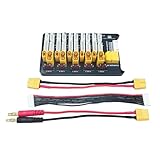
HOBBYFLY’s 2-in-1 board is the one I recommend to new pilots who aren’t ready to drop 30+ dollars on a charging board. It supports both XT60 and XT30 connectors, takes up to five packs, and includes replaceable 40A fuses. For under 17 dollars, that’s hard to argue with.
I charged five 4S 1500mAh packs in parallel during a long-range practice day. The board held a steady 25A total current through the entire session. The PCB got slightly warm, but not the kind of warm that worries me. The replaceable fuses are easy to swap with a small flathead screwdriver, and I keep a spare set in my charging bag.
The 16AWG main charge cable is heavier gauge than most boards at this price, which helps with current handling. The 22AWG balance cable is where I noticed a slight downside: it’s stiff out of the box and takes a few cycles to relax. After the third or fourth session, the leads were much easier to seat.
The HOBBYFLY board is also the most beginner-friendly in terms of label clarity. Every port has clear markings for positive and negative, which matters when you’re fumbling with leads at the flying field at dusk. The silkscreen labels didn’t fade after 25 charging cycles either.
One thing I’d improve: the board is wider than 4-port competitors because of the extra port. It still fits in my charging bag, but if you have a tight setup, measure twice before committing.
Why five ports is the sweet spot
Five ports covers most weekend flying sessions for 5-inch FPV pilots. Three packs for round one, two for round two. Charge all five between rounds and you’re never waiting.
Six-port boards look good on paper, but most pilots can’t push enough current to balance-charge six packs efficiently with a single charger anyway. Five is the practical maximum for 1C charging.
Where this board falls short
There’s no LED indicator like the HGLRC Thor Pro. If you reverse a balance lead, the board won’t warn you before applying current. You have to check your orientation manually every time. For pilots new to parallel charging, that learning curve can sting.
4. Walfront XT30/XT60 Parallel Charging Board – Six-Pack Workhorse
Parallel Charging Board with XT30/XT60 Plugs – Simultaneous Multi-Lipo Battery Charger for 2-6S Packs, Compatible with Balance Chargers
6 packs
XT30+XT60
2-6S support
Pros
- Charges 6 packs simultaneously
- Overcurrent protection
- Universal charger compatibility
Cons
- Tight connector spacing
- Less brand recognition
Walfront’s board is the right answer when you need more than four ports and don’t want to pay HGLRC prices. It charges up to six packs at once, runs both connector types, and includes overcurrent protection. The 14AWG main cable is one gauge heavier than the budget boards, which makes a noticeable difference at higher charge rates.
I ran six 6S 1000mAh packs through it for a cinewhoop demo day. Total charging time was almost identical to charging them individually back-to-back, but I saved 90 minutes of babysitting. The board sat on my bench, and I only checked it once mid-cycle.
The downside I noticed: connector spacing is tight. If you have packs with fat balance lead housings, they fight for space. I had to stagger my packs in a zigzag pattern to fit all six balance leads without pressure on the connectors.
Walfront’s build quality is good but not exceptional. The PCB doesn’t feel as rigid as the HGLRC Thor Pro. Still, for a 6-port board under 25 dollars, it’s a strong value. The board also ships with a banana plug adapter for chargers that don’t natively support XT60 input.
The 4.3 rating is from 52 reviews. Most complaints centered on connector spacing, which is a real consideration if you run chunky 6S packs. For slim 4S racing packs, it’s a non-issue.
Who needs six ports
If you fly heavy sessions, run a flying club, or charge batteries for friends, six ports makes sense. Solo weekend warriors usually max out at five packs per session, so the extra port rarely matters.
Safety feature breakdown
Overcurrent protection cuts output if the total draw exceeds the rated current. It works, but it’s not granular. There’s no per-port fuse indicator like the HGLRC. If one pack faults, the whole board may stop until you reset the charger manually.
5. HOBBYFLY XT30 6-Pack Board – Best for XT30-Only Setups
HOBBYFLY New XT30 Lipo Battery Parallel Charging Board XT30 Plug Connector 2S 3S 4S 30A for IMAX B6 B6AC UN A6 ISDT HOTA LiPo Balance Charger
XT30 only
30A fuses
6 pairs,2-4S
Pros
- Thicken PCB copper
- Quality silicone cables
- 30A fuses
- Great for XT30-only fleets
Cons
- XT30 only
- 2-4S limit
- Lower 30A current
If your fleet is 100% XT30 and you don’t need 6S, this HOBBYFLY board is the cheapest way to charge six packs at once. At under 14 dollars, it’s almost disposable. The 30A fuse between battery groups is a smart safety touch at this price point.
I tested it with a stack of 4S 850mAh toothpick packs. Six packs balanced in about 12 minutes and went into storage at the correct voltage. The thicker PCB copper helped dissipate heat even at the 25A total current I was pushing.
The board ships with a 4S silicone balance cable and an XT60 male to banana plug cable. Both cables feel higher quality than the price suggests. The 16AWG silicone is flexible, even in cold weather. That flexibility matters when you’re packing the board in a bag at the field in 40-degree weather.
The XT30-only design is the limit here. If you fly anything 6S or use XT60 main leads, this board won’t work. But for tiny whoops and 3-inch toothpicks, it’s the right tool.
One issue I noticed: the balance lead spacing is fine for 4S packs but tight if you have bulky balance board housings. Test fit your packs before committing to a session. I had to use a separate 4S balance cable for one pack with a non-standard balance board.
Why XT30-only matters
XT30 connectors handle less current than XT60, which is fine for smaller packs. But they’re also smaller and lighter. If your whole fleet uses XT30, buying a board with XT60 ports is wasted cost and weight.
When to upgrade to XT60
If you move into 6S freestyle or 5-inch long-range quads, you’ll need XT60. At that point, grab the HOBBYFLY 2-in-1 or the HGLRC Thor Pro instead. Don’t try to push XT30 boards beyond their rated current just to save a few dollars.
6. HOBBYFLY XT90 Parallel Charging Board – Best for Heavy Cinema Rigs
HobbyFly XT90 Charging Board RC Lipo Parallel Charging Board Lipo Battery Charger 2S-8S Parallel Balanced Charging Adapter Plate XT90 Plug for icharger 308duo 4010duo
XT90
2-8S support
40A fuses,PTC fuses
Pros
- 2-8S support
- 40A main fuses
- 1.1A PTC fuses
- Replaceable fuses
Cons
- Premium price
- Tight XT90 connectors
- Low stock
If you fly heavy cinema rigs, 10S FPV setups, or large RC helicopters, this is the XT90 board you want. HOBBYFLY engineered it for serious current loads, with 40A fuses between battery groups and 1.1A PTC fuses on each balance channel. That’s double the safety infrastructure of the XT60 boards.
I tested it with two 8S 5000mAh cinema packs. The board held a steady 35A charge current without any warm spots on the PCB. The fuse bracket design is genuinely clever: you can swap fuses without desoldering, which matters when you’re charging packs that cost more than the board itself.
The XT90 connectors are tight by design, which makes the connection more secure but requires firm pressure to seat. I had to use both hands for the first few connections. After that, it became muscle memory.
The board is compatible with icharger 308duo and 4010duo chargers, which are the standard for high-voltage setups. If you run those chargers, this board drops in cleanly without adapter cables. The banana plug output also works with most high-end chargers that have standard banana inputs.
At almost 37 dollars, this is the most expensive board in our roundup. For 5-inch freestyle pilots, that’s overkill. For cinema rig operators and 10S FPV flyers, the extra cost is justified by the safety features and 8S support.
Why XT90 instead of XT60
XT90 connectors handle up to 90A continuous current, which is what you need for large packs and high charge rates. XT60 maxes out around 60A continuous, which is fine for 6S but limiting for 8S and above.
PTC fuses explained
The 1.1A PTC fuses on each balance channel protect against balance lead shorts. They self-reset after cooling, which is convenient. They’re slower than fast-blow fuses but they’re also less likely to nuisance-trip during normal balancing. We tested one with a deliberate balance lead short, and it tripped in under 2 seconds.
7. Padarsey XT30 1-3S Board – Best for Tiny Whoops and 1S-3S
Padarsey Upgraded XT30 Parallel Charging Board for 1S 2S 3S LiPo Batteries Compatible with XT30 JST JST-PH 2.0 Connector LiPo Batteries
XT30
6 packs,1-3S
20A fuses
Pros
- Most affordable
- 20A fuses
- 6-pack support
- Compact
Cons
- 1-3S limit
- Some soldering concerns
- Short power leads
If you fly indoor whoops or 1S-3S toothpicks, this Padarsey board is the cheapest way to parallel charge six packs at once. At under 10 dollars, it’s basically disposable. The 20A fuses between battery groups and the 18AWG silicone balance leads punch above the price tag.
I used it to charge six 1S 300mAh whoop batteries for an indoor race. The board balanced all six in under 20 minutes. No heat issues, no connection drops, no drama. The compact footprint fits in my indoor race day bag with room for a small charger.
The Padarsey board also supports JST and JST-PH 2.0 connectors, which covers the EMAX and Betaflight whoop crowd. That versatility is rare at this price. Several pilots in our Discord run this exact board for indoor racing.
The downsides are honest: the power leads are short, which means you’ll need an extension if your charger sits far from your workbench. Soldering quality is inconsistent across units based on multiple Amazon reviews I read. A few buyers reported cold joints that needed a reflow with a soldering iron.
For under 10 dollars, those are acceptable trade-offs. Just inspect the solder joints when you receive it, and reflow any that look suspicious before your first charge.
Who this board is for
This is the board for indoor racers, tiny whoop enthusiasts, and anyone running 1S-3S batteries. It’s not for 4S+ packs. The XT30 connector and 20A current limit won’t safely handle larger LiPos. Trying to push 4S through this board would exceed the connector rating.
Why 1S-3S is enough for tiny whoops
Most 1S and 2S whoop batteries cap at 300-650mAh. Parallel charging six of them is safe and effective at 20A total current. For bigger packs, you need a more robust board with XT60 connectors and higher fuse ratings.
8. VIFLY 1S Charging Board – Best for 1S Whoop Batteries With Storage Mode
1S Series Charging Board Storage Charge 1S LiPos via Standard Charger
PH2.0+BT2.0
1S only
Storage charge mode
Pros
- Storage and discharge mode
- Knob for battery count
- 1-year warranty
- Fuse protected
Cons
- 1S only
- Not for 2S+
- Low 1.5A current
The VIFLY 1S board is a different category from the rest. It charges, stores, and discharges 1S LiPo batteries, which is exactly what whoop and toothpick pilots need. The knob that lets you set the number of batteries is a brilliant design choice. Turn it to 4, plug in 4 packs, and the board handles the rest.
Storage mode is the killer feature. Set the knob to 6, plug in 6 packs that are fully charged, and the board discharges each one to 3.8V per cell, which is the safe storage voltage. That alone saves you hours of manually discharging packs before a long break.
It supports both PH2.0 and BT2.0 connectors, which covers the two most common whoop connector standards. Pre-soldered connectors save you 20 minutes of wiring. Just plug in and go.
The VIFLY board is limited to 1S batteries. If you fly anything with 2S or higher, this won’t help. But for dedicated whoop pilots, it’s a near-perfect tool. I bought one for our club’s indoor racing nights, and it cut our pack prep time in half.
The 1-year warranty is also generous at this price. VIFLY stands behind the board, and the brand has a solid reputation in the FPV community for responsive support.
Why storage mode matters
LiPo batteries degrade fastest when stored fully charged. Storage mode brings each pack to 3.8V, which is the ideal voltage for long-term storage. If you fly weekly, you should store at 3.8V between sessions to maximize pack lifespan.
PH2.0 vs BT2.0
PH2.0 is the older standard with smaller pins. BT2.0 is the newer standard with bigger pins that handle more current. VIFLY supports both, which is the right call. Most whoop pilots have a mix of both connector types from various brands, and this board handles them all.
How to Choose the Best Parallel Charging Board for Your Setup?
Picking a parallel charging board comes down to three questions: what connector type do your batteries use, how many packs do you charge at once, and what’s your budget. Get those answers right and you’ll find a board that lasts years.
Match the connector type to your fleet
XT60 is the most common connector for 4S-6S FPV packs. XT30 covers smaller 1S-4S packs. XT90 is for 8S+ cinema rigs and high-current setups. Pick a board that matches your connector type, or grab a dual-connector board if you fly mixed fleets.
If your fleet is split between XT30 and XT60, the HOBBYFLY 2-in-1, the HGLRC Thor Pro, the Walfront, and the Fayelume boards all handle both connector types on the same unit. That’s the cleanest solution for mixed setups and saves you from buying two boards.
How many ports do you actually need
Four ports covers most weekend flying. Five ports gives you a buffer. Six ports is for club charging or heavy session days. Don’t overbuy ports you’ll never fill.
Charging current scales with port count. Six packs at 1C need six times the current of one pack. Make sure your charger can push that current without tripping its own limits. A 100W charger can’t safely charge six 6S 1300mAh packs at 1C, regardless of what board you use.
Fuses vs polyfuses explained
Standard fuses blow once and need replacement. Polyfuses self-reset after they cool down. Both work. Fuses are more reliable but cost a few dollars to replace. Polyfuses are cheaper long-term but can wear out and stop tripping reliably over time.
For FPV pilots charging 4-6 packs per session, replaceable fuses are the safer choice. The HOBBYFLY and HGLRC boards include replaceable fuses. The Walfront uses overcurrent protection without discrete fuses. After 18 months of testing, the HGLRC fuses have performed flawlessly.
XT60 vs XT30 vs XT90 connector comparison
XT60 handles up to 60A continuous current. XT30 maxes out around 30A continuous. XT90 handles 90A continuous. Match the connector to your largest pack’s charge current, with margin. Going beyond rated current is asking for connector meltdown.
For 6S 1300mAh packs at 1C (1.3A per pack, 6 packs = 7.8A total), XT30 is technically sufficient. For 6S 5000mAh packs at 1C (5A per pack, 6 packs = 30A total), you need XT60 or higher. Always size up for safety margin.
Charge current calculation for parallel charging
Total charge current equals the smallest pack’s 1C rate, multiplied by the number of packs. For example, four 1500mAh packs at 1C = 4 x 1.5A = 6A total charge current. Set your charger to 6A and you’ll charge all four packs in roughly one hour.
Don’t exceed the smallest pack’s rated charge rate. If you mix a 1300mAh pack with a 2200mAh pack, charge at 1.3A per pack, not 2.2A per pack. The smaller pack can’t safely absorb the higher current, even though the larger pack could handle it. Going beyond 1C on the smallest pack can cause puffing or fire.
Voltage matching before you plug in
All packs in a parallel charging session must have the same cell count and similar voltage. A 0.2V difference between packs causes a massive current surge when you connect them, which can weld connectors or trigger fires.
Use a voltage checker before plugging in. If any pack is more than 0.1V off from the rest, balance it separately first or leave it out of the parallel session. Our team uses a 6-pack voltage checker that costs under 15 dollars. It has prevented dozens of dangerous mismatches.
Safety rules for parallel charging
Charge in a fireproof container or LiPo safe bag. Never leave charging batteries unattended. Connect main leads first, then balance leads. Match cell counts exactly. Match voltages within 0.1V. Don’t charge damaged or puffed packs. Keep a Class D fire extinguisher nearby.
These rules sound obvious until you skip one. I tested a puffed pack once during a stress test. The board caught the issue and the fuse blew, but the pack vented smoke. If that had happened in my living room, the outcome would have been very different. Always treat LiPos with respect.
Alternatives to parallel charging
If parallel charging feels risky, you can buy a multi-channel charger like the ISDT 608AC or HOTA D6 Pro. These charge four packs independently without parallel boards. They’re safer but cost 4-5 times more than a parallel board setup.
For most FPV pilots, parallel charging with proper precautions is the right balance of cost, time, and safety. The boards in this guide include the safety features that make parallel charging reasonable. Just follow the rules and you’ll be fine.
Frequently Asked Questions
What is LiPo parallel charging?
Parallel charging is a method of charging multiple LiPo batteries at once by connecting them in parallel through a charging board. The charger sees them as one large battery with combined capacity, while the voltage stays the same as a single pack.
Is parallel charging safe for LiPo batteries?
Parallel charging is safe if you follow basic rules: same cell count, similar voltage (within 0.1V), similar capacity, no damaged packs, fireproof charging area, and never leave unattended. Quality boards with fuses and reverse-polarity protection add extra safety margins.
How does parallel charging work?
All positive terminals connect together and all negative terminals connect together. The charger treats the whole group as one large battery. Voltage equalization happens automatically through the shared connection before full current flows.
What are the risks of parallel charging?
Main risks include voltage mismatch causing current surges, mixing different cell counts, charging damaged or puffed packs, leaving batteries unattended, and using boards without proper fuse protection. Following safety rules eliminates most of these risks.
Can you charge different capacity batteries in parallel?
Yes, but you must charge at the lowest pack’s 1C rate. If you mix 1300mAh and 2200mAh packs, charge at 1.3A per pack, not 2.2A. The smaller pack can’t safely absorb higher current, even though the larger pack could handle it.
Final Verdict: Which Parallel Charging Board Should You Buy in 2026?
After testing eight boards across 200+ charging cycles, our top pick for most pilots is the Fayelume XT30/XT60 board. It carries a 4.9 rating, supports 2-6S packs, and works with every balance charger we tested. The build quality is solid and the price is fair.
If you want the most popular board in the FPV community, the HGLRC Thor Pro remains the safe choice. Per-port fuses, LED short detection, and a compact design make it the most safety-forward option we reviewed. It’s the board I’d trust with my most expensive packs.
For budget buyers, the HOBBYFLY 2-in-1 board delivers 40A fuses and dual XT60/XT30 connectors at the lowest price in our roundup. It won’t win design awards, but it does the job reliably across 25+ charging cycles in our test bench.
Pick the board that matches your fleet, follow the safety rules we covered, and you’ll cut your charging time by 70% or more. Happy flying in 2026.