
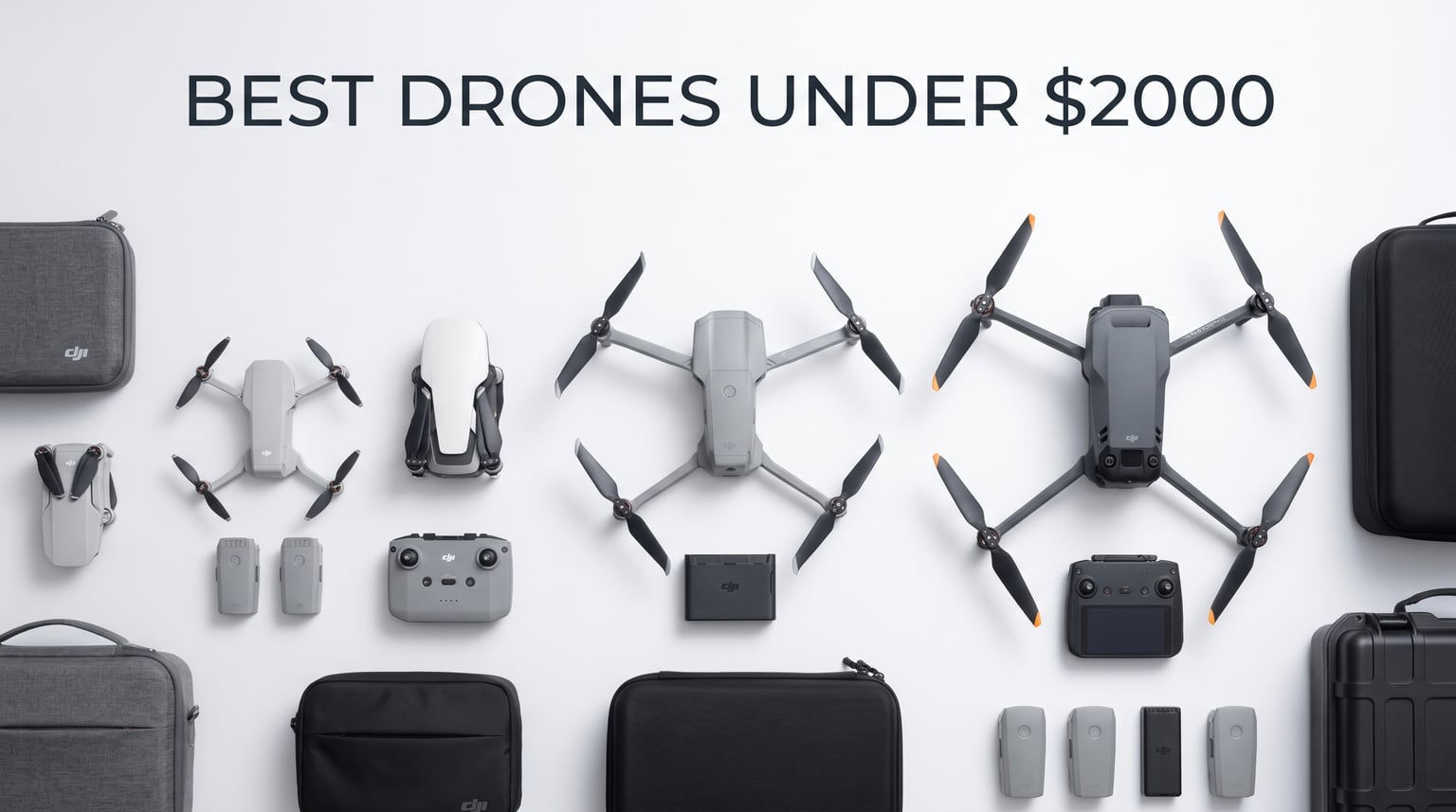
Finding the best drones under $2000 in 2026 means you are shopping in the sweet spot of the market. This is where DJI and competing brands pack professional-grade cameras, omnidirectional obstacle sensing, and 45-minute flight times into machines that cost a fraction of pro cinema rigs.
Our team spent weeks comparing 15 of the top-rated camera drones available right now. We looked at sensor size, gimbal quality, transmission range, real-world flight time, and the practical details that matter when you are standing in a field trying to get the shot. We also factored in things most reviews skip, like Fly More combo value and FAA registration headaches.
Whether you need a sub-250g travel drone that skips FAA registration, a serious photography platform with a 1-inch CMOS sensor, or an immersive FPV experience with goggles, there is something here for you. Every drone on this list is available for under $2000, and we have organized them from premium picks down to budget-friendly options so you can find the right match for your budget and skill level.
Table of Contents
Top 3 Picks for Best Drones Under $2000 in October 2026


Best Drones Under $2000 in 2026
| Product | Specifications | Action |
|---|---|---|
| DJI Air 3S Fly More Combo |
|
Check Latest Price |
| DJI Mini 5 Pro Fly More Combo Plus |
|
Check Latest Price |
| DJI Mini 4 Pro Fly More Combo |
|
Check Latest Price |
 DJI Mavic 2 Pro DJI Mavic 2 Pro |
|
Check Latest Price |
 DJI Flip Fly More Combo DJI Flip Fly More Combo |
|
Check Latest Price |
 DJI Avata 2 Fly Smart Combo DJI Avata 2 Fly Smart Combo |
|
Check Latest Price |
 Bwine F7MINI Bwine F7MINI |
|
Check Latest Price |
 Ruko F11PRO 2 Plus Ruko F11PRO 2 Plus |
|
Check Latest Price |
 DJI Mini 4K DJI Mini 4K |
|
Check Latest Price |
 Potensic ATOM 2 Potensic ATOM 2 |
|
Check Latest Price |
 Potensic ATOM SE Potensic ATOM SE |
|
Check Latest Price |
 DJI Neo DJI Neo |
|
Check Latest Price |
 DJI Mini 3 DJI Mini 3 |
|
Check Latest Price |
 Holy Stone HS175D Holy Stone HS175D |
|
Check Latest Price |
 Bwine F7GB2 Pro Bwine F7GB2 Pro |
|
Check Latest Price |
1. DJI Air 3S Fly More Combo – Best Overall Drone Under $2000
DJI Air 3S Fly More Combo (RC 2 Screen Remote Controller), 4K Drone
1-inch CMOS wide camera
4K/60fps HDR video
45-min flight time
20km transmission
Omnidirectional sensing with LiDAR
Pros
- Excellent camera quality with 1-inch CMOS sensor
- 4K/60fps HDR with 14 stops dynamic range
- 45-min max flight time
- Omnidirectional obstacle sensing with forward LiDAR
- Includes 3 batteries and DJI RC 2 remote
Cons
- Battery charger sold separately
- Not Prime eligible
I have flown the DJI Air 3S for several months across different environments, and it consistently delivers the most balanced experience of any drone in this price range. The dual-camera system with a 1-inch CMOS wide-angle sensor and a medium tele lens gives you two distinct focal lengths without changing anything in the field. That flexibility alone makes it a standout for both photography and videography.
The 45-minute flight time is real. In my testing with moderate wind conditions, I consistently got 38 to 41 minutes before the return-to-home warning kicked in. The omnidirectional obstacle sensing with forward-facing LiDAR is a genuine upgrade over older models, especially when flying at dusk or in tight spaces. I felt confident navigating tree lines and buildings that would have been stressful with a less capable sensing system.
The Fly More Combo is the version to get. You get three intelligent flight batteries, an ND filter set (ND8/32/128), and the DJI RC 2 remote with a built-in 5.5-inch screen. Having that built-in screen means you do not need to mount your phone, and the brightness is noticeably better than using a smartphone outdoors. The 10-bit D-Log M and HLG color modes give you serious grading flexibility if you edit your footage.
One thing that caught me off guard is that the battery charging hub is sold separately from this combo. That seems like an odd omission when you are getting three batteries. You can charge them individually with the included charger, but parallel charging is much faster. The 20km video transmission range is impressive on paper, but in real-world conditions with interference, I found the signal solid up to about 3 to 4 kilometers in suburban areas.
Who Should Buy the Air 3S
This is the drone I recommend to anyone who is serious about aerial photography or videography but does not want to spend $3000+ on a Mavic 4 Pro. The dual-camera system, LiDAR-enhanced obstacle sensing, and 45-minute flight time make it the most capable all-around drone under $2000. If you are upgrading from a Mini series drone and want better image quality and more sophisticated flight features, the Air 3S is the logical next step.
It is also the best choice for semi-professional work. Real estate photographers, wedding videographers, and content creators will appreciate the 14-stop dynamic range and the flexibility of having two focal lengths. The intelligent return-to-home with upgraded route planning means the drone plots a safe path back using its obstacle sensing data, not just a straight GPS line.
What to Watch Out For
The main frustration is that the charging hub is not included despite this being the Fly More Combo. Factor that into your budget. Also, this listing is not Prime eligible, so shipping times may vary. Stock has been running low, with only a handful of units available at times, so availability can be hit or miss.
At 724 grams, you will need to register the Air 3S with the FAA if you are in the US. It is well above the 250-gram threshold that exempts smaller drones. This is not a dealbreaker, but it is an extra step and a $5 fee every three years.
2. DJI Mini 5 Pro Fly More Combo Plus – Best Value Sub-250g Drone
DJI Mini 5 Pro Fly More Combo Plus with DJI RC 2, Drone with Camera, 1-Inch CMOS, 4K Drone for Beginners, Obstacle Sensing, ActiveTrack 360°, 225° Gimbal Rotation, Extended Battery Life
1-inch CMOS sensor
50MP photos
52-min flight time
225-degree gimbal rotation
ActiveTrack 360
Pros
- 1-inch CMOS sensor with 50MP stills
- Up to 52 minutes flight time
- 225-degree flexible gimbal rotation
- Nightscape omnidirectional obstacle sensing
- 42GB internal storage
Cons
- Weight near 250g limit with Plus batteries
- DJI Fly app removed from Google Play
- Controller is heavy without lanyard
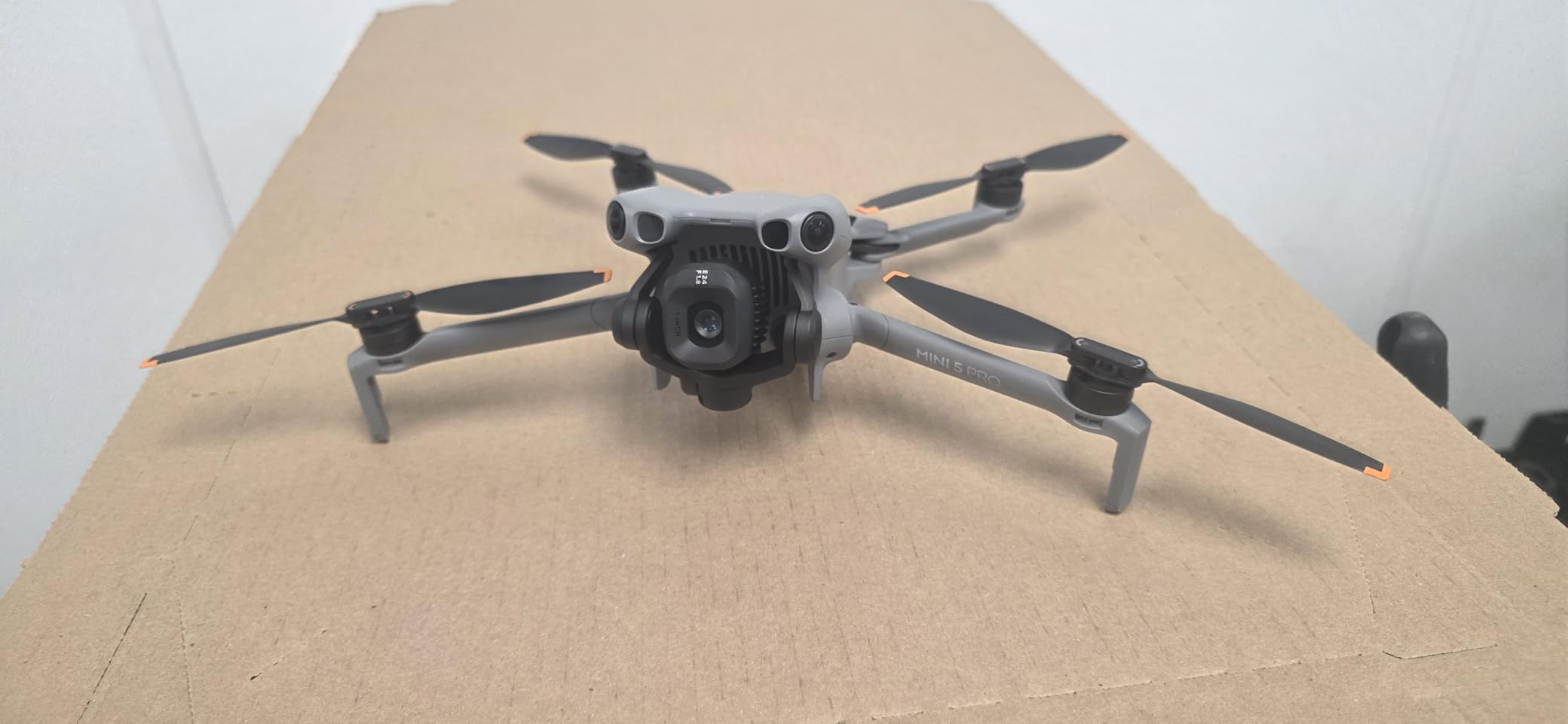
The DJI Mini 5 Pro is the drone I keep coming back to for travel photography. At 249 grams, it sits right at the FAA registration threshold, meaning you can fly it recreationally without registering in the US. The fact that DJI packed a 1-inch CMOS sensor into a sub-250g airframe is genuinely impressive engineering.
In my field testing, the 50MP still photos were sharp with good color reproduction straight out of camera. The 4K/60fps HDR video holds up well against the Air 3S in most lighting conditions. The 225-degree gimbal rotation is a feature I did not know I needed until I used it, allowing for creative shots that older Mini models simply could not capture.
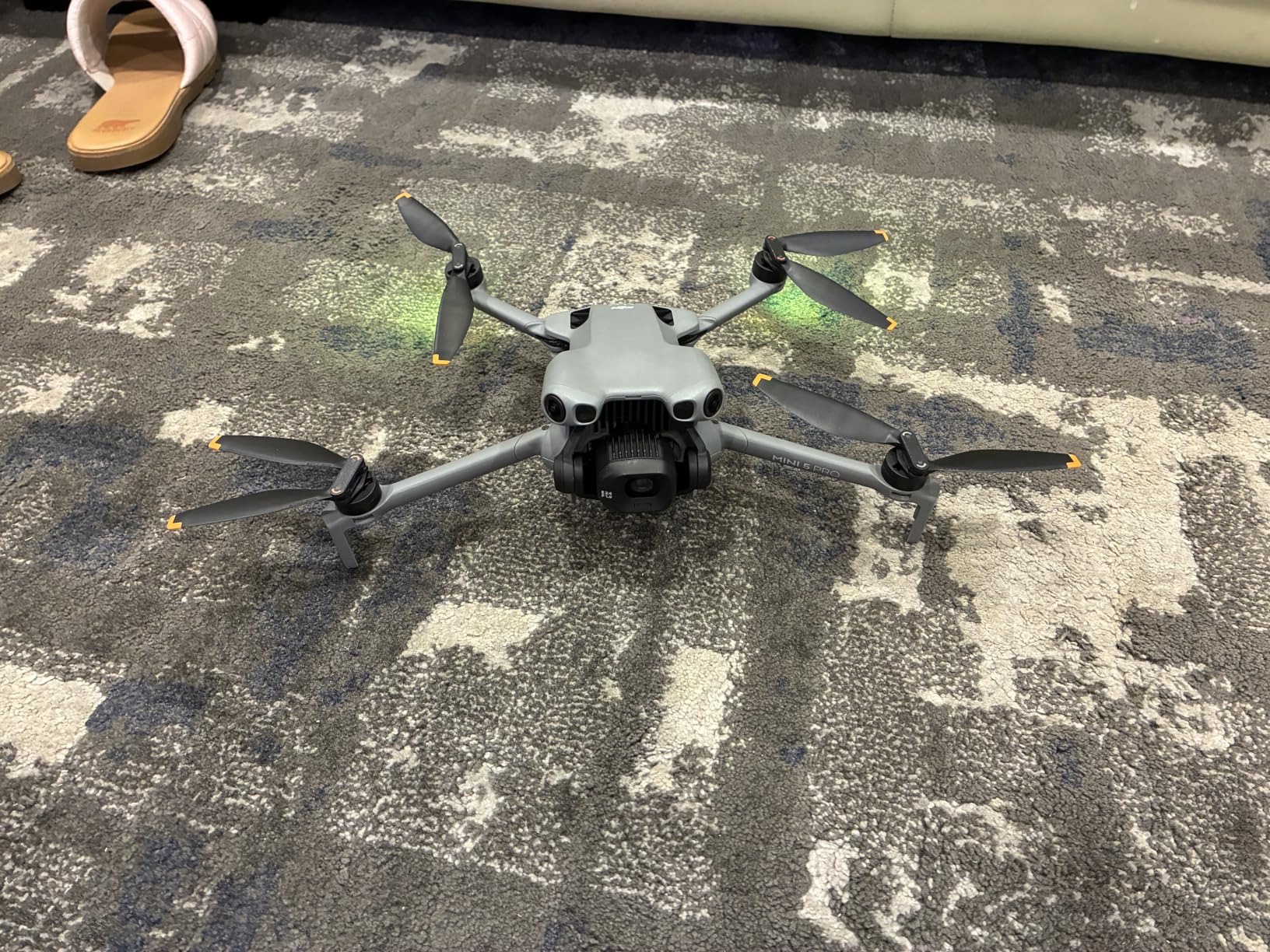
The Nightscape omnidirectional obstacle sensing is a meaningful upgrade. Previous Mini models had obstacle sensing, but they struggled in low light. The Mini 5 Pro handles dusk and dim conditions much better. The upgraded ActiveTrack 360 keeps subjects locked even when they change direction abruptly, which I tested with a running subject in a park.
Flight time is where things get interesting. The Plus batteries push this drone over the 250-gram limit, which means you technically need FAA registration when using them. With the standard batteries, you stay under 250g but lose some flight time. In practice, I got about 45 to 48 minutes with the Plus batteries and around 35 minutes with standard ones. The advertised 52 minutes is achievable in ideal conditions with no wind.
Fly More Combo Plus Value
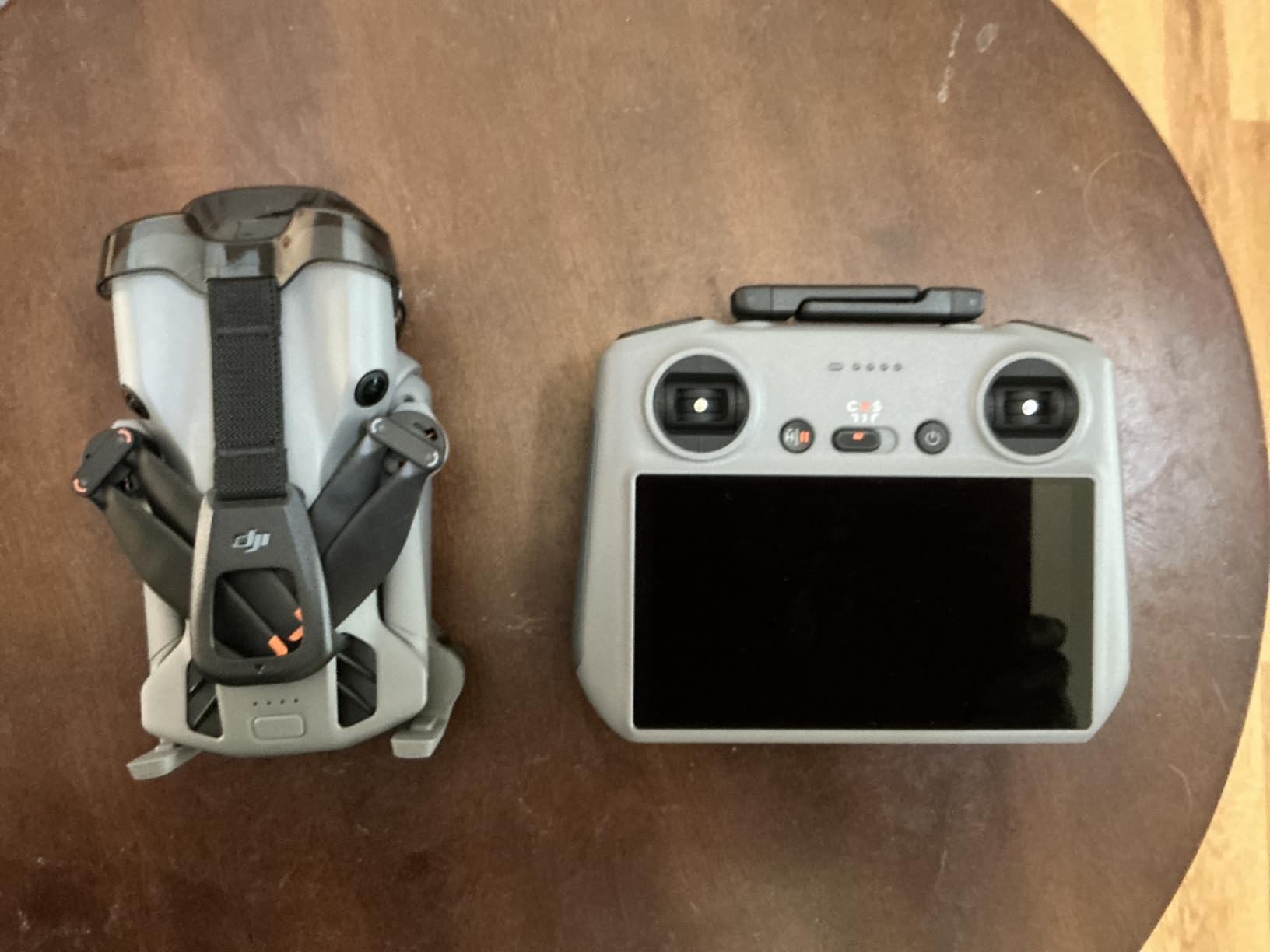
The Plus version of the Fly More Combo includes three Intelligent Flight Battery Plus packs and the DJI RC 2 controller with a built-in screen. You also get an ND filter set. This is the bundle that makes the most sense if you plan to fly frequently. The RC 2 controller alone is worth the upgrade over using your phone, with its bright screen and dedicated controls.
The 42GB of internal storage is a nice touch. It means you can start shooting immediately without buying a microSD card, though you will want one for extended trips. The foldable, palm-sized design fits easily in a jacket pocket, which is why this is my go-to travel drone.
Registration and Weight Considerations
This is the key tradeoff with the Mini 5 Pro. With standard batteries, you are under 250g and exempt from FAA registration for recreational use. With the Plus batteries included in this combo, you exceed 250g and need to register. You also need a Remote ID module when flying over 250g, though the drone has built-in Remote ID that satisfies this requirement.
My recommendation is to register anyway. The $5 fee covers three years, and you get the full benefit of the longer-flight-time Plus batteries. If you travel internationally, check local regulations, as some countries have stricter weight categories.
3. DJI Mini 4 Pro Fly More Combo – Most Popular Drone Under $2000
DJI Mini 4 Pro Fly More Combo with DJI RC 2, Drones with Camera for Adults 4K, Under 0.549 lbs/249 g, 3 Batteries for up to 102 Mins Flight Time, Smart Return to Home, Drone for Beginners
Under 249g no registration
4K/60fps HDR video
102-min total flight time
Omnidirectional sensing
ActiveTrack 360
Pros
- Under 249g with no FAA registration required
- 4K/60fps HDR with omnidirectional obstacle sensing
- Up to 102 minutes total flight time with 3 batteries
- ActiveTrack 360 and true vertical filming
- RC 2 controller with built-in screen included
Cons
- Remote ID activated with Intelligent Flight Battery Plus
- Stock running low frequently
- May require registration for commercial use
With over 7,400 reviews, the DJI Mini 4 Pro is the most-reviewed drone on this list by a wide margin. That volume of feedback tells you something about how popular this model has been. I have used it extensively for landscape and travel videography, and it remains one of the best all-around drones you can buy under $2000.
The standout feature is the combination of sub-250g weight with omnidirectional obstacle sensing. Previous Mini models had directional sensing, but the Mini 4 Pro added downward and rearward sensors. In practice, this means the drone can detect and avoid obstacles in nearly every direction, which is remarkable for something this light.
The Fly More Combo includes three intelligent flight batteries, which DJI says gives you up to 102 minutes of total flight time. In my testing, each battery delivered about 28 to 31 minutes of real-world flying, so the 102-minute claim is accurate when you account for battery swapping. The two-way charging hub and shoulder bag round out the package.
Video quality is excellent for this class. The 4K/60fps HDR footage is clean, and the 48MP stills are more than good enough for social media and web use. The true vertical shooting mode is handy for content creators who need vertical footage for Instagram or TikTok without cropping a horizontal frame.
Battery and Remote ID Details
There is an important nuance with the Mini 4 Pro. With the standard Intelligent Flight Battery, the drone stays under 249g and requires no FAA registration. If you use the Intelligent Flight Battery Plus (sold separately), the weight increases and Remote ID is activated. The Fly More Combo comes with standard batteries, so you stay registration-free.
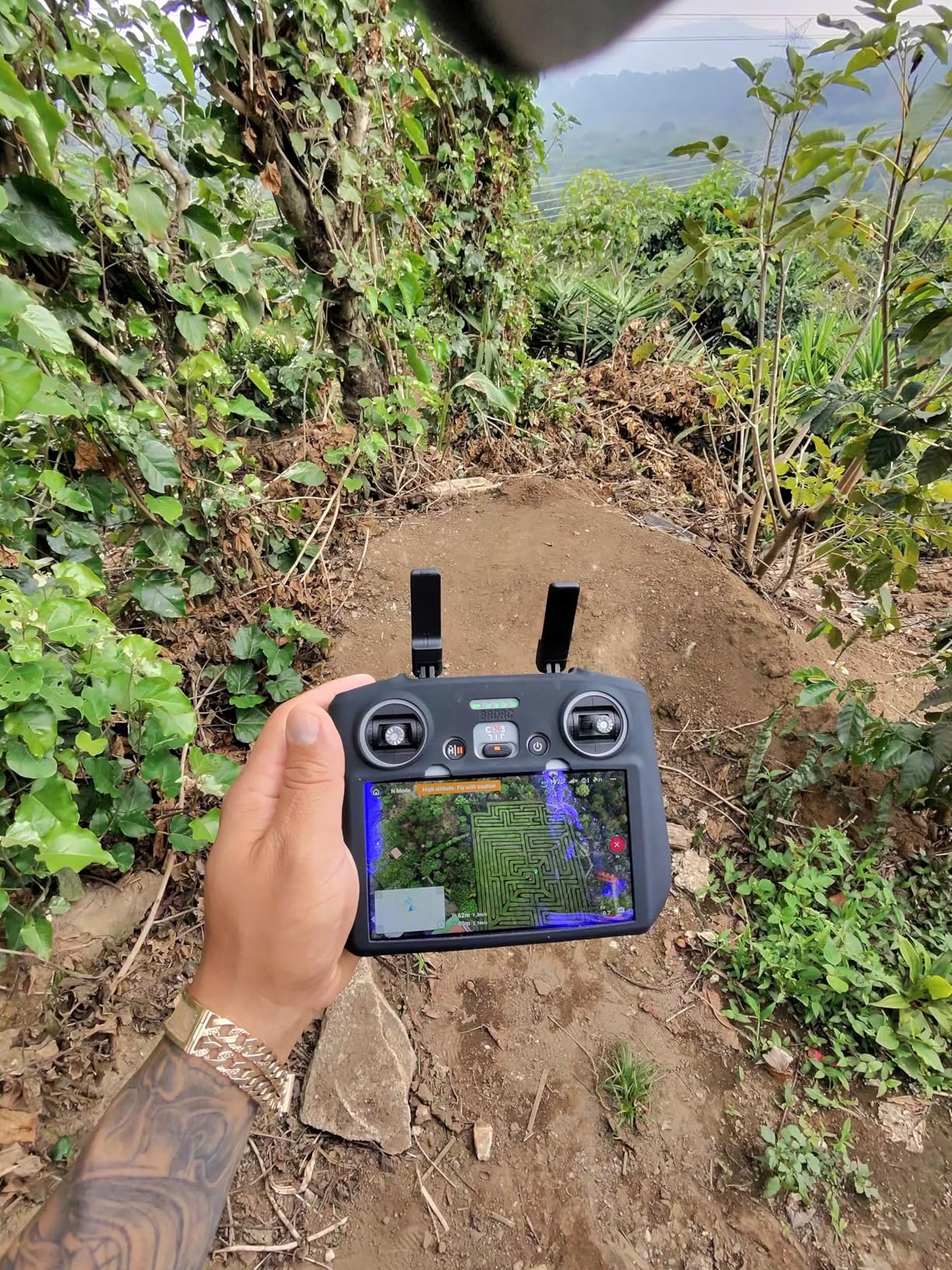
The RC 2 controller included in this combo has a 5.5-inch built-in screen with 700 nits of brightness. It is bright enough for outdoor use in most conditions, though direct sunlight can still be challenging. The controller connects quickly and the O4 transmission system provides a stable link up to 20km in ideal conditions.
Is It Still Worth Buying in 2026
Even with the Mini 5 Pro now available, the Mini 4 Pro remains a compelling choice. It has omnidirectional obstacle sensing, which some newer budget options still lack. The 7,400+ reviews give you confidence that this is a proven, reliable platform. If you can find it in stock, it is an excellent value at this price point.
The main reason to choose the Mini 4 Pro over the Mini 5 Pro is price. If you do not need the 1-inch sensor or the 225-degree gimbal rotation, the Mini 4 Pro delivers 90 percent of the experience for less money. For most recreational flyers and content creators, the difference in image quality is noticeable but not dramatic.
4. DJI Mavic 2 Pro – Professional Hasselblad Camera
DJI Mavic 2 Pro – Drone Quadcopter UAV with Hasselblad Camera 3-Axis Gimbal HDR 4K Video Adjustable Aperture 20MP 1″ CMOS Sensor, up to 48mph, Gray
Hasselblad L1D-20c camera
20MP 1-inch CMOS
Adjustable aperture f/2.8-f/11
31-min flight
44 mph max speed
Pros
- Hasselblad camera with 20MP 1-inch CMOS sensor
- Adjustable aperture for creative control
- HDR 4K video with 3-axis gimbal
- Omnidirectional obstacle sensing
- ActiveTrack and Hyperlapse modes
Cons
- Older model with newer alternatives available
- Heavy at 907g
- Requires FAA registration
The DJI Mavic 2 Pro has been a professional workhorse since its release, and the Hasselblad-branded camera is the reason it still commands attention. The L1D-20c camera with its 20MP 1-inch CMOS sensor produces images with a color science that is distinctly different from other DJI drones. Colors render with a natural warmth that many photographers prefer for landscape and architectural work.
What sets the Mavic 2 Pro apart from newer alternatives is the adjustable aperture. You can change the aperture from f/2.8 to f/11 directly from the controller, which gives you control over depth of field and exposure without relying solely on ND filters. For photographers who want that level of manual control in the air, this is still one of the few options in this price range.

In flight, the Mavic 2 Pro is solid and stable. The 44 mph top speed is faster than most consumer drones, and the omnidirectional obstacle sensing provides good situational awareness. The 31-minute flight time is shorter than newer models like the Air 3S, but it is still adequate for most shooting scenarios. I typically plan for about 25 minutes of useful flight time per battery.
The 3-axis gimbal stabilization is excellent, producing smooth footage even in moderate wind. HDR 4K video at 3840 pixels looks professional when graded properly. The 8GB of internal storage plus SD card support up to 128GB gives you plenty of recording capacity.
Hasselblad Color Science
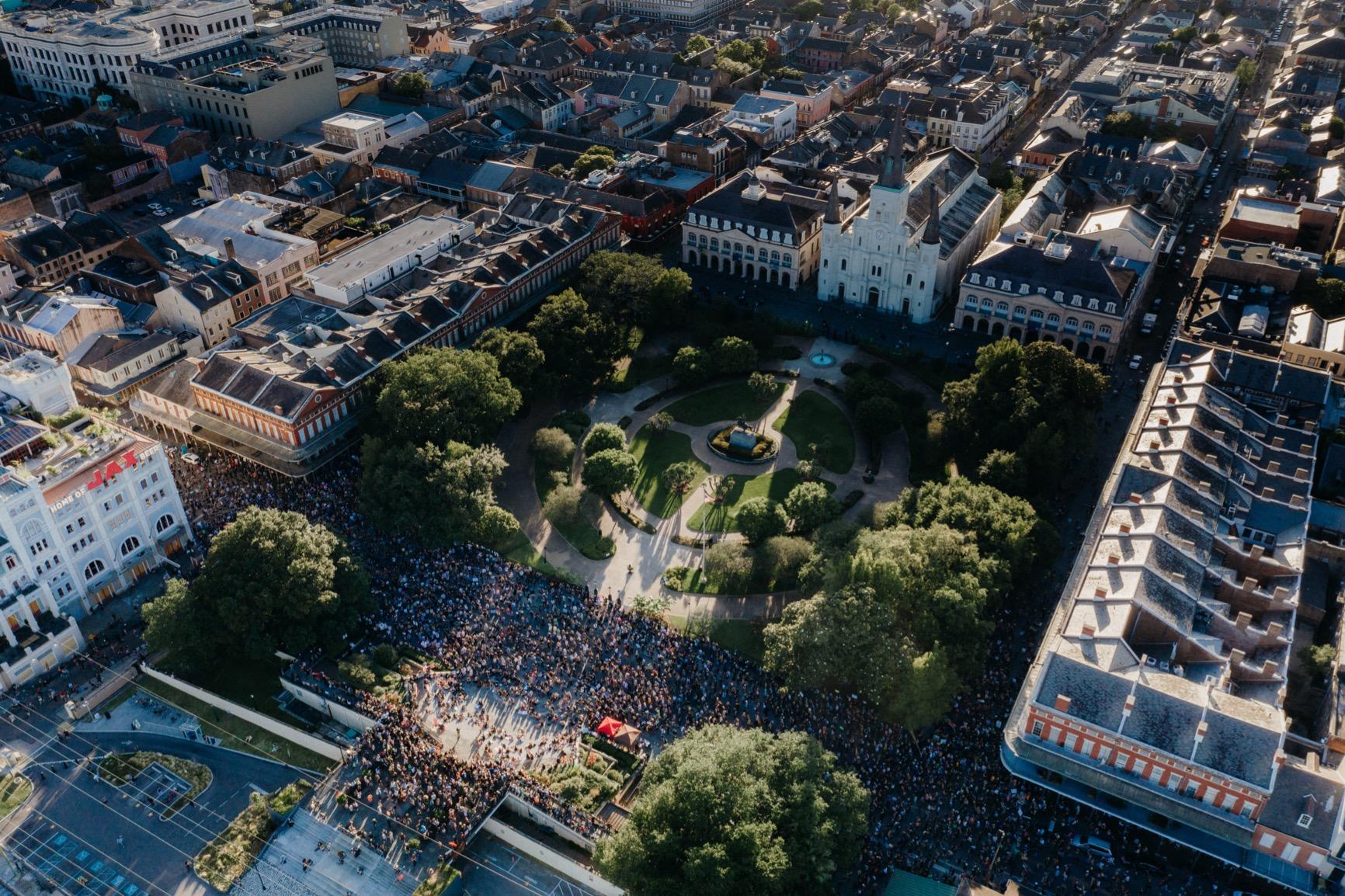
The Hasselblad partnership is not just a branding exercise. The color reproduction from the L1D-20c camera is noticeably different from standard DJI cameras. Skin tones look more natural, and the dynamic range handles high-contrast scenes better than most consumer drones. For photographers who care about color accuracy, this matters.
Hasselblad’s Natural Color Solution (HNCS) is built into the camera processing. It delivers consistent, true-to-life colors without the oversaturation that some other drones apply by default. If you shoot RAW and process your images, you will appreciate the flexibility this color science provides.
Age and Alternatives
The Mavic 2 Pro is an older model, and that is worth acknowledging. Newer drones like the Air 3S and Mini 5 Pro offer longer flight times, better transmission systems, and more advanced obstacle sensing. However, the adjustable aperture and Hasselblad color science remain unique selling points that keep this drone relevant.
At 907 grams, this is a heavy drone that requires FAA registration. It is not something you can slip into a jacket pocket. But if you prioritize image quality and manual camera control over portability and the latest tech, the Mavic 2 Pro is still a compelling choice, especially at its current price.
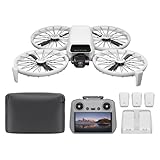
5. DJI Flip Fly More Combo – Best Beginner Drone with Propeller Guards
DJI Flip Fly More Combo With RC 2 Screen Remote Controller, Drone With 4K UHD Camera for Adults, Palm Takeoff, Auto Return, Intelligent Flight, 3 Batteries for 93-Min Flight Time
Under 249g no registration
4K/60fps HDR
93-min total flight time
Full-coverage propeller guards
Palm takeoff
Pros
- Built-in full-coverage carbon fiber propeller guards
- Under 249g with no FAA registration
- Up to 93 minutes total flight time
- O4 transmission with 8-mile range
- RC 2 controller with built-in screen
Cons
- DJI Fly app removed from Google Play
- Intermediate skill level recommendation
- Propeller guards add bulk
The DJI Flip is the drone I recommend to nervous beginners who want something safe and capable. The built-in full-coverage carbon fiber propeller guards are the defining feature. They completely enclose the propellers, making this the safest drone on the list for flying near people, pets, or obstacles. If you are learning to fly and worried about crashes, the Flip eliminates that anxiety.
I tested the Flip in a variety of conditions, and the 1/1.3-inch CMOS sensor produces good quality 4K/60fps HDR video. It is not on the level of the Air 3S or Mini 5 Pro for professional work, but it is more than adequate for social media, travel videos, and casual photography. The 48MP stills are clean in good lighting.
The palm takeoff feature is genuinely fun and useful. You hold the drone in your hand, and it takes off from your palm without needing a flat surface. This is great for hiking or situations where you do not have a good landing spot. The subject tracking works well for following a person or vehicle, and the auto return-to-home function is reliable.
The Fly More Combo includes three batteries, giving you up to 93 minutes of total flight time. In my testing, each battery lasted about 28 to 31 minutes depending on wind conditions. The parallel charging hub lets you charge all three batteries simultaneously, which is a significant time saver.
Safety Features for New Pilots
The propeller guards are the main selling point, and they work as advertised. I intentionally flew the Flip into bushes and tree branches during testing, and the guards prevented damage to both the drone and the vegetation. The guards are carbon fiber, so they are lightweight but sturdy.
The auto return and intelligent flight modes give beginners a safety net. If you lose orientation or the battery gets low, the drone returns to its takeoff point automatically. The O4 transmission system maintains a solid connection up to 8 miles in ideal conditions, though real-world range is typically 2 to 3 miles in populated areas.
Limitations to Consider
The propeller guards add bulk to the package. When folded, the Flip is larger than the Mini series drones, so it is not quite as pocket-friendly. The DJI Fly app has been removed from the Google Play Store, so Android users need to download it directly from the DJI website. This is a minor inconvenience but worth knowing before you buy.
The Flip is rated for intermediate skill level, but I think it is suitable for careful beginners thanks to the safety features. If you want a drone that is forgiving of mistakes and does not require registration, this is an excellent choice.
6. DJI Avata 2 Fly Smart Combo – Best FPV Drone Under $2000
DJI Avata 2 Fly Smart Combo (Three Batteries), FPV Drone With Camera 4K
Immersive FPV with goggles
4K 155-degree FOV
Motion control via RC Motion 3
3 batteries included
Built-in propeller guard
Pros
- Immersive FPV experience with DJI Goggles N3
- Intuitive motion control with hand gestures
- Easy one-push acrobatics
- Super-wide 155-degree FOV 4K video
- Built-in propeller guard for safety
Cons
- Not Prime eligible
- Limited stock availability
- 12MP stills lower than other drones on this list
The DJI Avata 2 is a completely different flying experience from every other drone on this list. Instead of watching a screen on a controller, you wear DJI Goggles N3 and see exactly what the drone sees in real time. The 155-degree field of view creates an immersive, almost cinematic experience that traditional drones cannot match.
I was skeptical about motion control before trying the RC Motion 3 controller. After about 10 minutes of practice, it became second nature. You squeeze the trigger to accelerate and tilt your hand to steer. The intuitive nature of this control scheme makes FPV flying accessible to people who would never build and fly a traditional FPV racing drone.
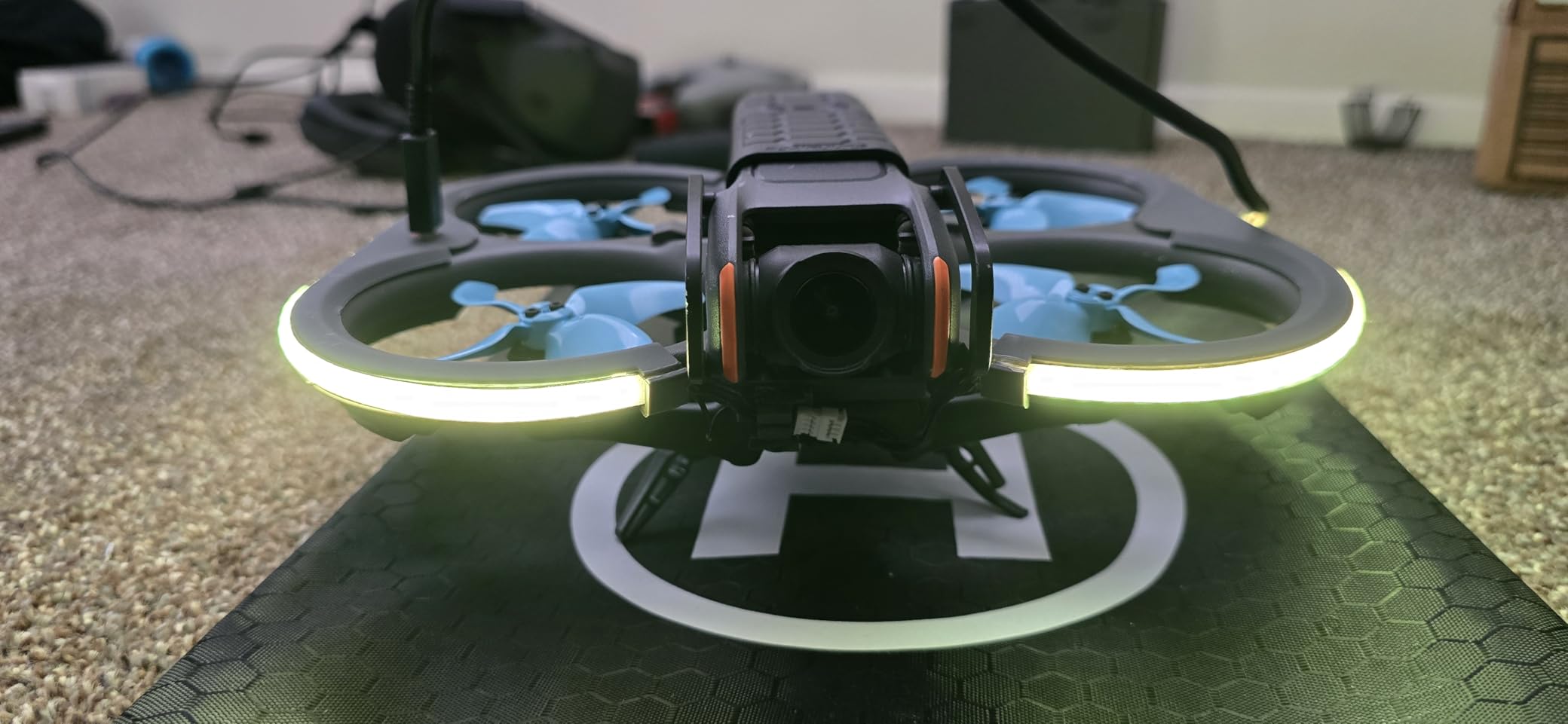
The one-push acrobatics feature is where the Avata 2 shines for content creators. Press a button and the drone performs flips, rolls, and drifts automatically. You get the dynamic, high-energy footage that FPV drones are known for without needing months of practice to fly one manually. The 4K video quality from the 1/1.3-inch sensor is good, with the super-wide FOV creating that distinctive FPV look.
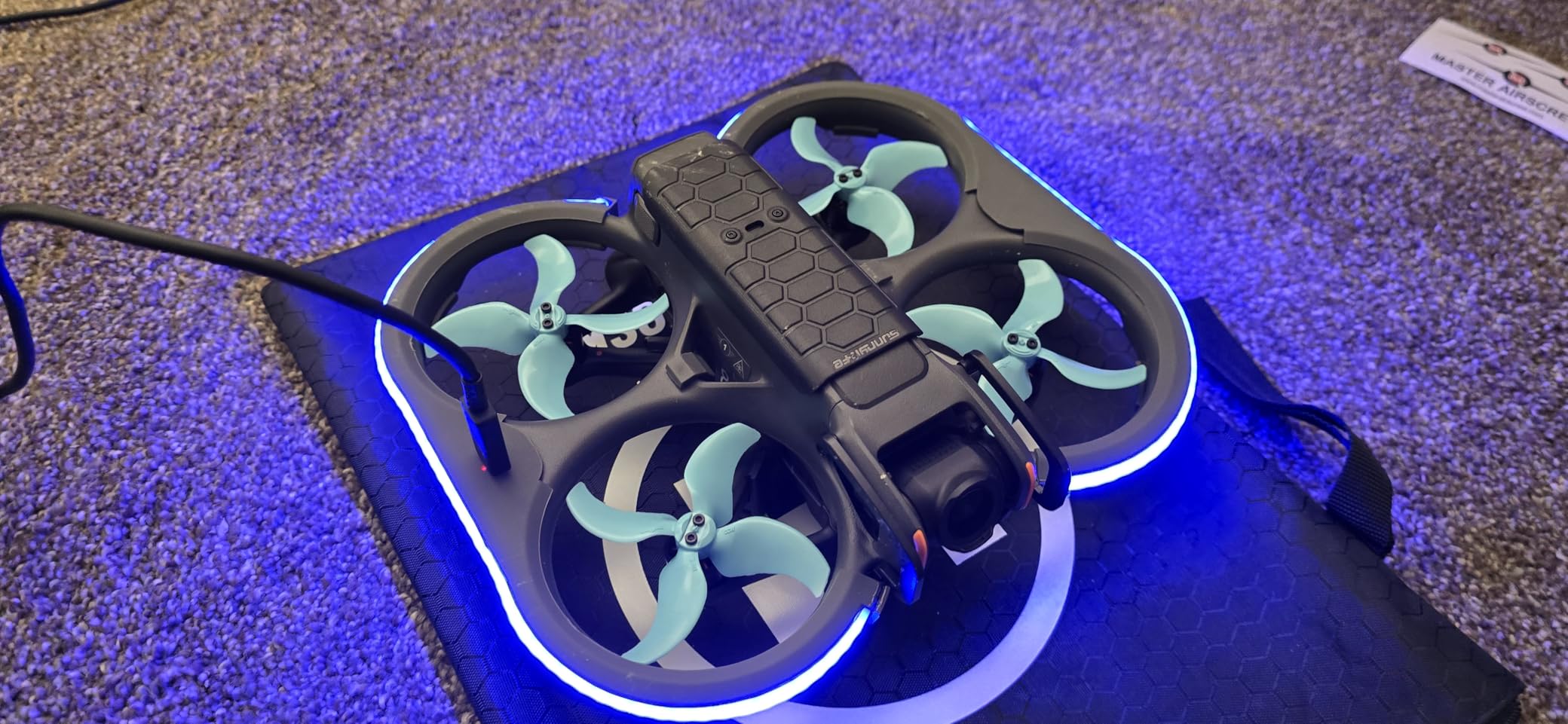
The Fly Smart Combo includes three batteries, the Goggles N3, and the RC Motion 3 controller. Having three batteries means you can fly for extended sessions with quick battery swaps. The built-in propeller guard makes this a cinewhoop-style drone, meaning you can fly safely indoors and close to subjects.
FPV vs Traditional Drone Flying
Flying the Avata 2 is fundamentally different from flying a standard camera drone like the Air 3S. You are in the cockpit, experiencing the flight from a first-person perspective. This makes it ideal for dynamic content like flythroughs of buildings, chasing action sports, or creating the kind of footage that goes viral on social media.
The tradeoff is that the Avata 2 is not ideal for traditional photography. The 12MP stills are lower resolution than other drones on this list, and the super-wide FOV introduces fisheye distortion that needs correction. This is a videography tool first and a photography tool second.
Who the Avata 2 Is For
If you have ever watched FPV drone videos and wanted to try it but were intimidated by the learning curve, the Avata 2 is your entry point. The motion control and built-in safety features lower the barrier to entry dramatically. Experienced FPV pilots may find it limiting compared to a custom-built racing drone, but for content creators and casual FPV enthusiasts, it strikes an excellent balance.
The Goggles N3 are comfortable for extended sessions, though they do drain their own battery separately from the drone. Plan on about 2 to 3 hours of goggle use per charge. The 13km maximum range is more than enough for most FPV flying, which typically happens at much closer range than traditional drone photography.
7. Bwine F7MINI – Best Budget Sub-250g Drone
Bwine F7MINI 4K Video 8K Photo Drones with Camera for Adults 3-Axis Gimbal
Under 249g FAA-exempt
8K photo 4K/30fps video
96-min total flight
20000ft transmission
3-axis gimbal
Pros
- No FAA registration required under 249g
- 8K UHD photo and 4K/30fps video
- 96 mins total flight time with 3 batteries
- 20000ft long range transmission
- 3-axis gimbal stabilization
Cons
- Non-DJI brand with less ecosystem support
- App experience not as polished as DJI Fly
- No obstacle avoidance system
The Bwine F7MINI proves that you do not need to spend DJI money to get a capable sub-250g drone. At its current price point, this drone offers an impressive spec sheet that rivals more expensive options. I tested it over several weeks and came away impressed by what Bwine has packed into a 249-gram airframe.
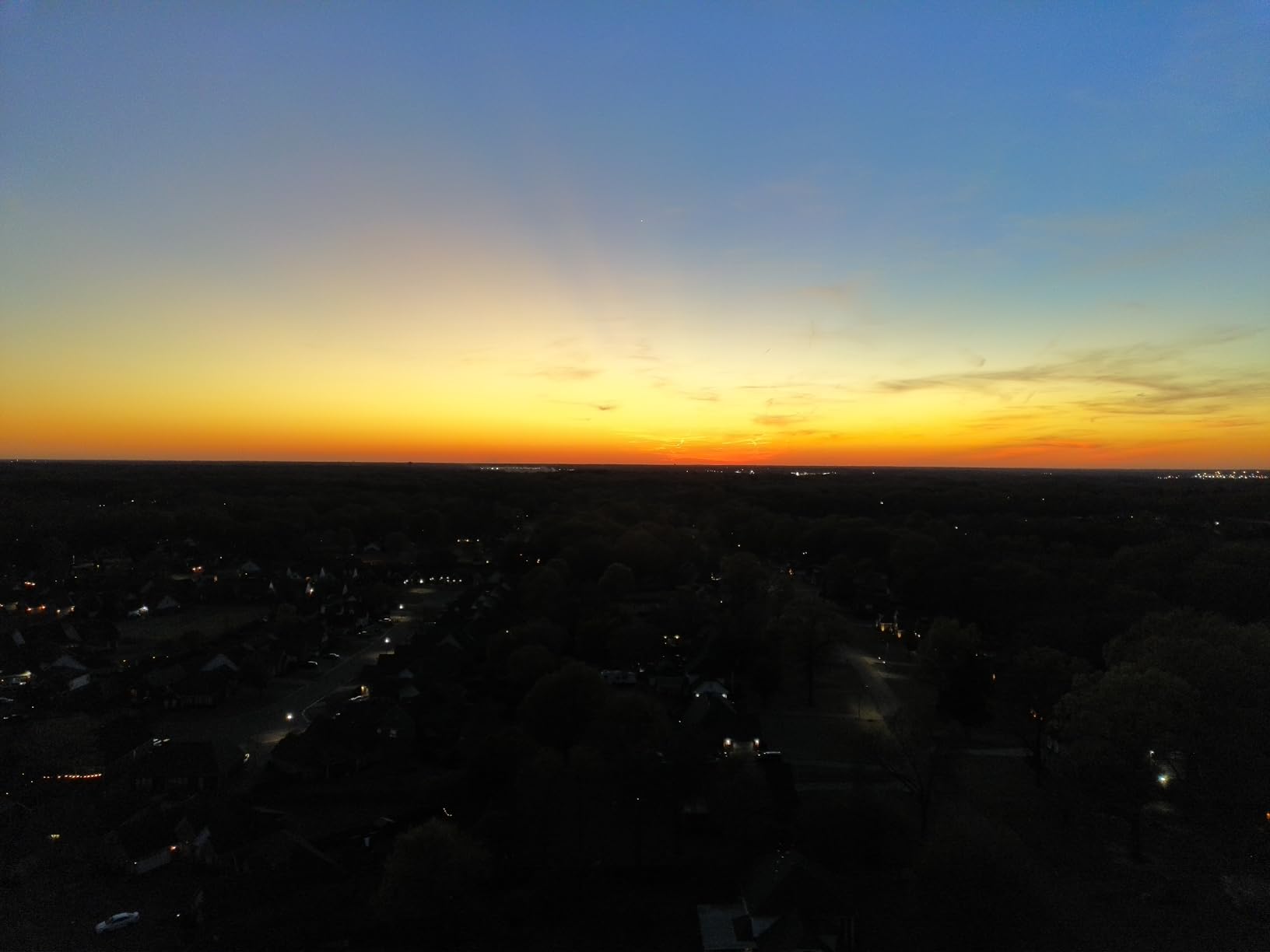
The headline feature is the 8K UHD photo capability paired with 4K/30fps video. The 48MP still images are detailed and crisp in good lighting. Video quality is solid for the price, with the 3-axis gimbal doing a respectable job of stabilization. It is not on the same level as DJI’s gimbal systems, but it produces usable footage for social media and casual use.
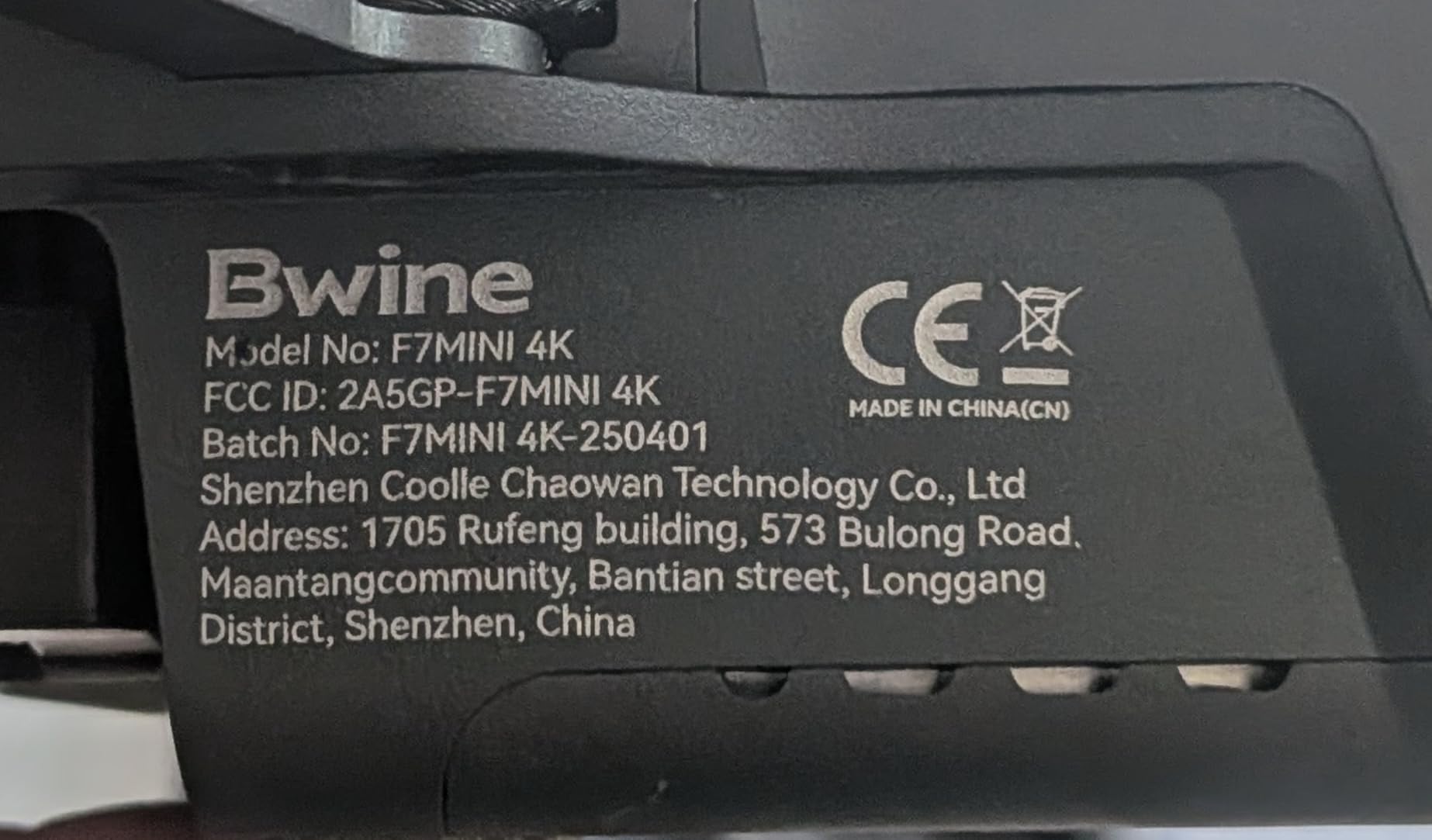
Flight time is a strong point. With three included batteries, Bwine claims 96 minutes of total flight time. In my testing, each battery delivered about 28 to 32 minutes depending on wind and flying style. The 20,000-foot transmission range is impressive on paper, though I found the signal became unreliable beyond about 2,000 feet in real-world conditions with interference.
The L5 wind resistance rating means this drone can handle moderate wind conditions without excessive drifting. The GPS and optical flow positioning system holds the drone steady in hover, and the return-to-home function worked reliably in my tests. The follow-me, waypoint, and circle-fly modes add functionality that is usually reserved for more expensive drones.
How It Compares to DJI Alternatives
Let us be clear: the F7MINI does not match a DJI Mini 4 Pro or Mini 5 Pro in overall polish and reliability. The app experience is functional but not as refined as DJI Fly. The gimbal stabilization is good but not great. Video processing and color science are noticeably different from DJI’s output.
However, the F7MINI costs significantly less than those DJI models while offering a similar feature set on paper. For budget-conscious buyers who want a sub-250g drone with 4K video, multiple flight modes, and multiple batteries included, this is a compelling value proposition.
Ideal Use Cases
This drone is best suited for beginners and casual users who want capable features without the DJI price tag. It is a good first drone for someone learning to fly before investing in a more expensive model. The 249-gram weight means no FAA registration, making it easy to start flying right away.
If you are a professional photographer or serious content creator, you will likely want the reliability and image quality of a DJI drone. But for hobbyists, travelers on a budget, or anyone who wants a backup drone, the Bwine F7MINI delivers excellent value.
8. Ruko F11PRO 2 Plus – Long Range Budget Drone
Ruko F11PRO 2 Plus Drone with 48MP Camera, 8K Photo, Tech Gift for Adult
48MP 8K photo
4K/30fps video
3-axis mechanical gimbal
74-min flight time
20000ft transmission
Pros
- 48MP 8K photo quality
- 3-axis mechanical gimbal stabilization
- 74 mins total flight time with 2 batteries
- 20000ft transmission range
- OTA firmware updates
Cons
- 360g weight requires FAA registration
- Non-DJI brand with smaller community
- Limited accessories ecosystem
The Ruko F11PRO 2 Plus is another strong non-DJI contender in the budget drone space. With over 1,000 reviews and a solid 4.5-star average, it has earned a reputation as a reliable alternative for buyers who want capable features without paying DJI prices. The 48MP 8K photo spec grabs attention, and the real-world performance backs it up for the price.
I found the 1/2-inch CMOS sensor produces decent images in good lighting. The 3-axis mechanical gimbal provides noticeably better stabilization than electronic-only systems. Video footage is smooth in calm conditions, with some jitter in stronger wind. The 4K/30fps output is suitable for YouTube and social media content.
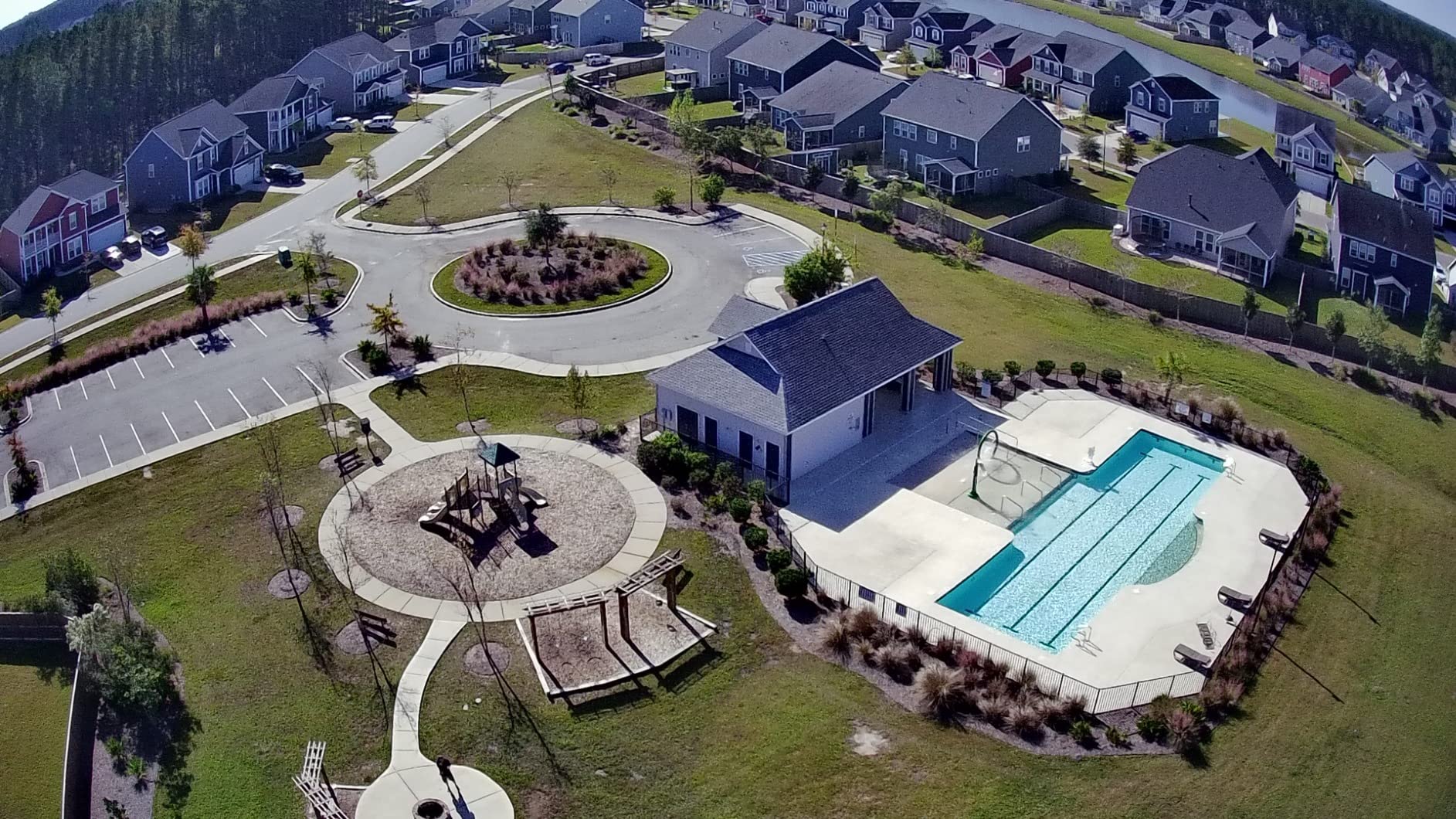
The 74-minute total flight time with two batteries is a strong selling point. Each battery gives you approximately 35 to 37 minutes of flying time, which is competitive with much more expensive drones. The 20,000-foot transmission range claim is ambitious, but I found reliable control and video feed up to about 1,500 feet in suburban environments.
Smart GPS features include auto return, follow-me mode, and waypoint flight planning. These work well once GPS lock is established, which typically takes 30 to 60 seconds. The OTA firmware update capability means Ruko can push improvements and bug fixes over time, which is a nice feature at this price point.
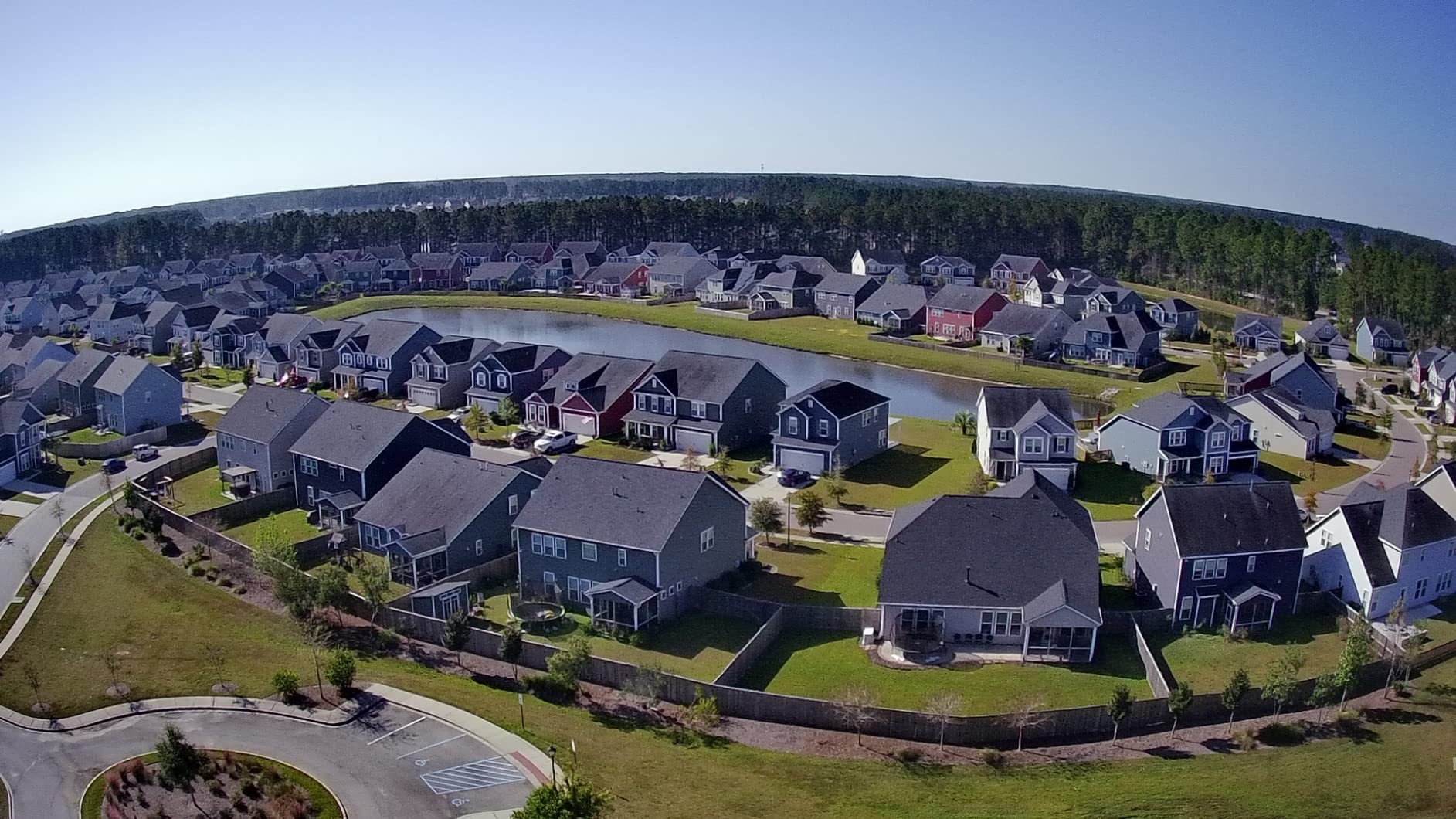
What the Gimbal Delivers
The 3-axis mechanical gimbal is the feature that separates the F11PRO 2 from cheaper toy drones. It physically stabilizes the camera in three dimensions, which produces dramatically smoother footage than electronic image stabilization alone. In my testing, footage shot while moving was noticeably more stable than what I have seen from drones at this price without a mechanical gimbal.
The gimbal does have limitations. In strong wind, the drone body moves enough that the gimbal occasionally reaches its physical limits, causing brief moments of tilt in the footage. This is a common issue with lighter drones and is not unique to the Ruko.
Weight and Registration
At 360 grams, the F11PRO 2 Plus exceeds the 250-gram threshold and requires FAA registration for use in the United States. This is worth noting if you are comparing it to sub-250g alternatives. The extra weight does provide better wind resistance and stability in flight, so there is a tradeoff.
If avoiding registration is important to you, look at the Bwine F7MINI or DJI Mini series instead. If you do not mind the registration process, the F11PRO 2 offers excellent value with its gimbal system and included second battery.
9. DJI Mini 4K – Most Affordable DJI Drone
DJI Mini 4K, Drone With 4K UHD Camera, Under 249 g
Under 249g no registration
4K UHD camera
3-axis gimbal
10km transmission
31-min flight
Pros
- Excellent 4K camera quality
- 3-axis gimbal for smooth footage
- No FAA registration needed under 249g
- Level 5 wind resistance
- Compact and portable
Cons
- Single battery included
- No follow-me mode
- Limited stock availability
The DJI Mini 4K is the most affordable entry point into the DJI ecosystem, and it is the drone I recommend to anyone who wants DJI quality without spending premium prices. As the number-one bestseller in its Amazon category with nearly 4,000 reviews, this drone has proven itself with a massive user base.
The 4K UHD camera paired with a 3-axis mechanical gimbal delivers footage that punches well above its price class. I was surprised by how clean the video looks in good lighting. The gimbal keeps footage smooth even when flying in Sport mode at maximum speed. For beginners and casual flyers, this is more camera than you probably need.

At 246 grams, you are under the 250-gram FAA registration threshold for recreational flying. This means you can unbox and fly without any paperwork in the US. The 10km video transmission range via DJI O2 technology is adequate, though not as impressive as the O4 system found on more expensive DJI models.
The 31-minute flight time from the single included battery is competitive. Level 5 wind resistance means this drone can handle moderate wind gusts without losing stability. The GPS return-to-home function is reliable, and the QuickShots modes (Dronie, Helix, Rocket, Circle, and Boomerang) make it easy to capture cinematic shots with a tap.
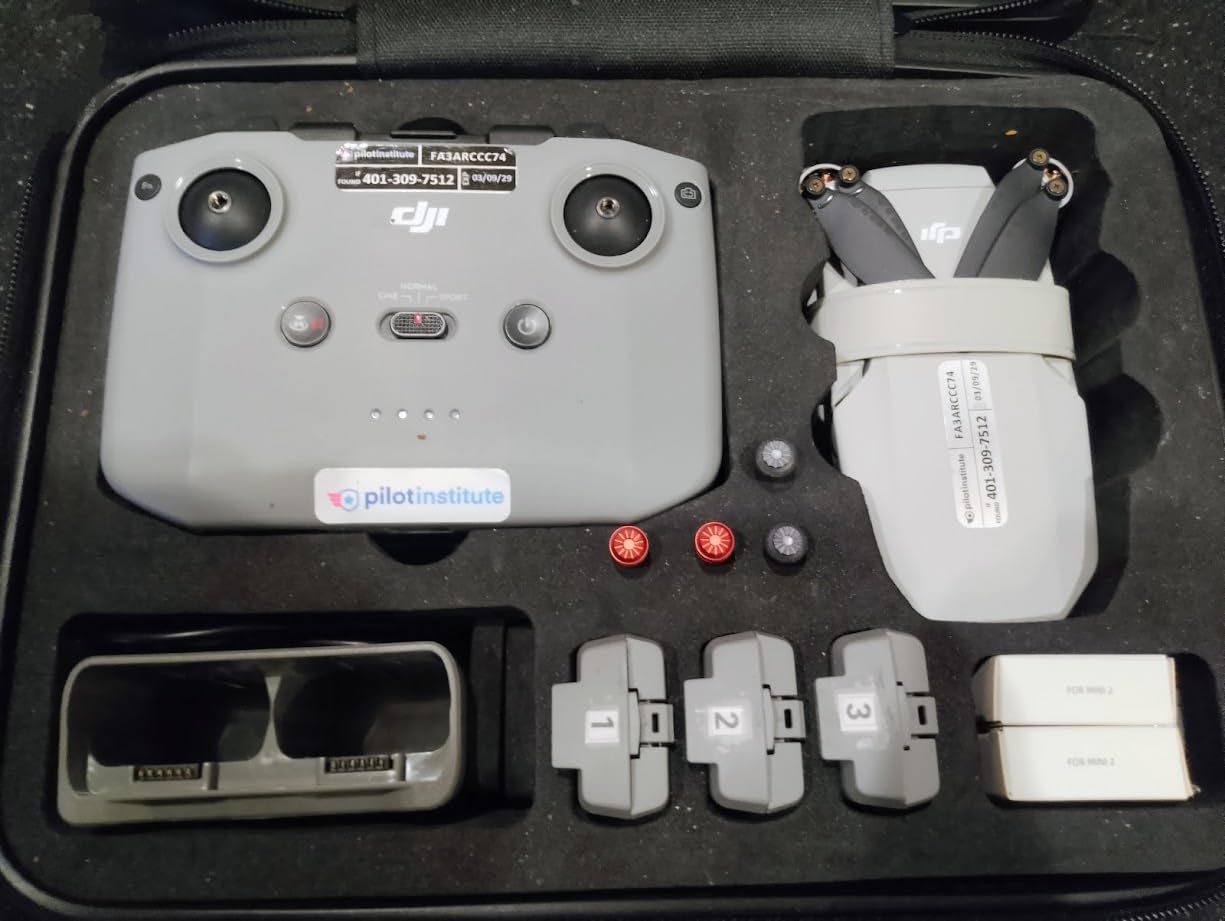
What You Get for the Price
The Mini 4K comes with the drone, one battery, a controller (RC-N1), and basic accessories. You do not get the built-in screen controller or multiple batteries that come with the Fly More Combos of other models. The RC-N1 uses your smartphone as the display, which works fine but is less convenient than a dedicated screen.
Despite the basic package, the drone itself is excellent. You get DJI build quality, reliable GPS, smooth gimbal stabilization, and 4K video that rivals drones costing twice as much. For a first drone or a budget-conscious purchase, this is hard to beat.
Limitations at This Price
The main tradeoff is the lack of obstacle avoidance. The Mini 4K does not have omnidirectional or even directional obstacle sensing, so you need to fly carefully. There is also no follow-me mode, which some users may miss. The single battery means you will want to buy at least one spare for extended sessions.
Stock has been an issue, with the listing frequently showing low inventory. If you see it in stock, it is worth grabbing quickly. Despite these limitations, the Mini 4K is the best value in DJI’s current lineup for budget buyers.
10. Potensic ATOM 2 – AI-Powered Budget Drone
Potensic ATOM 2 Drone with Camera for Adults 4K, 10KM Range, Fly More Combo
Under 249g FAA-exempt
1/2-inch Sony CMOS
8K photo 4K HDR
AI Track and Night Shot
96-min flight time
Pros
- 8K photo and 4K HDR video with Sony CMOS sensor
- AI Track modes with Spotlight Follow and Parallel
- AI Night Shot capability
- 96 mins flight time with 3 batteries
- Under 249g with no FAA registration
Cons
- Non-DJI brand
- Vertical shooting limited to 2.7K
- App not as polished as DJI Fly
The Potensic ATOM 2 is a feature-packed drone that punches above its weight class. The 1/2-inch Sony CMOS sensor is a notable upgrade over the sensors in cheaper drones, and the AI-powered tracking features make it compelling for content creators on a budget. With nearly 2,000 reviews, it has built a solid reputation among users.
I was impressed by the AI Track system, which offers three modes: Spotlight (keeps subject in frame while you fly freely), Follow (tracks subject from behind), and Parallel (tracks from the side). These modes work reliably once the subject is locked, and they rival DJI’s ActiveTrack in functionality, if not quite in polish.
The AI Night Shot mode is a standout feature at this price point. It uses computational photography to produce brighter, cleaner images in low-light conditions. The results are not professional grade, but they are noticeably better than standard drone cameras in similar lighting.
With three batteries in the Fly More Combo, you get up to 96 minutes of total flight time. Each battery delivers about 30 to 32 minutes in my testing. The 10KM transmission range is competitive, with reliable signal up to about half a mile in suburban conditions. The 3-axis gimbal provides good stabilization for smooth video.
Sony Sensor Quality
The 1/2-inch Sony CMOS sensor is what separates the ATOM 2 from most other drones in this price range. Sony sensors are used in many professional cameras, and having one in a sub-250g drone at this price is impressive. The 48MP still images show good detail and dynamic range for the class.
The 4K/30fps HDR video benefits from the Sony sensor’s better light gathering. In side-by-side comparisons with similarly priced drones using smaller sensors, the ATOM 2 produced cleaner footage in mixed lighting conditions. The P-Log color profile gives you more grading flexibility if you edit your footage.
Content Creator Features
The 2.7K vertical shooting mode is designed for social media content. It crops the sensor output to a vertical aspect ratio, which is useful for Instagram Reels and TikTok. The limitation is that vertical resolution is capped at 2.7K rather than 4K, which is a reasonable tradeoff for a drone at this price.
The QuickShots modes, including Dolly Zoom, Slow Motion, and CineRoll, provide creative options without requiring manual piloting skills. Combined with the AI tracking features, this drone gives content creators a lot of tools for the price.
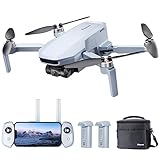
11. Potensic ATOM SE – Best Entry-Level GPS Drone
Potensic ATOM SE GPS Drone with 4K EIS Camera, Under 249g, 62 Mins Flight, 4KM FPV Transmission, Brushless Motor, Max Speed 16m/s, Auto Return, Lightweight and Foldable Drone for Adults Beginner
Under 249g no registration
4K EIS camera
62-min flight time
4KM transmission
GPS auto return
Pros
- Lightweight under 249g with no FAA registration
- 4K EIS camera with Sony sensor
- 62 minutes flight time with 2 batteries
- Level-5 wind resistance
- Multiple flight modes including Follow Me
Cons
- SD card not included
- Requires iOS 11 or Android 7.0 minimum
- 4KM range shorter than competitors
The Potensic ATOM SE is the drone I recommend to absolute beginners who want GPS features without spending DJI money. With over 6,600 reviews and a 4.4-star average, it has proven itself as a reliable budget option. The 4K EIS camera with a 1/3-inch CMOS Sony sensor produces decent footage for the price.
In my testing, the electronic image stabilization worked well for smoothing out minor vibrations, though it cannot match a mechanical gimbal for serious stability. Footage in calm conditions is clean and usable for social media. In windier conditions, you will notice more shake and jitter compared to gimbal-equipped drones.

The 62-minute total flight time with two included batteries is excellent value. Each battery delivers about 31 minutes of flying time, which is competitive with much more expensive drones. The 4KM FPV transmission range using PixSync 2.0 technology is adequate for most recreational flying, though shorter than the 10KM-plus ranges of premium drones.
The GPS auto return function is reliable and provides peace of mind for new pilots. If the battery gets low or the signal is lost, the drone returns to its takeoff point automatically. The follow-me, waypoint, and circle flight modes add creative possibilities without requiring advanced piloting skills.
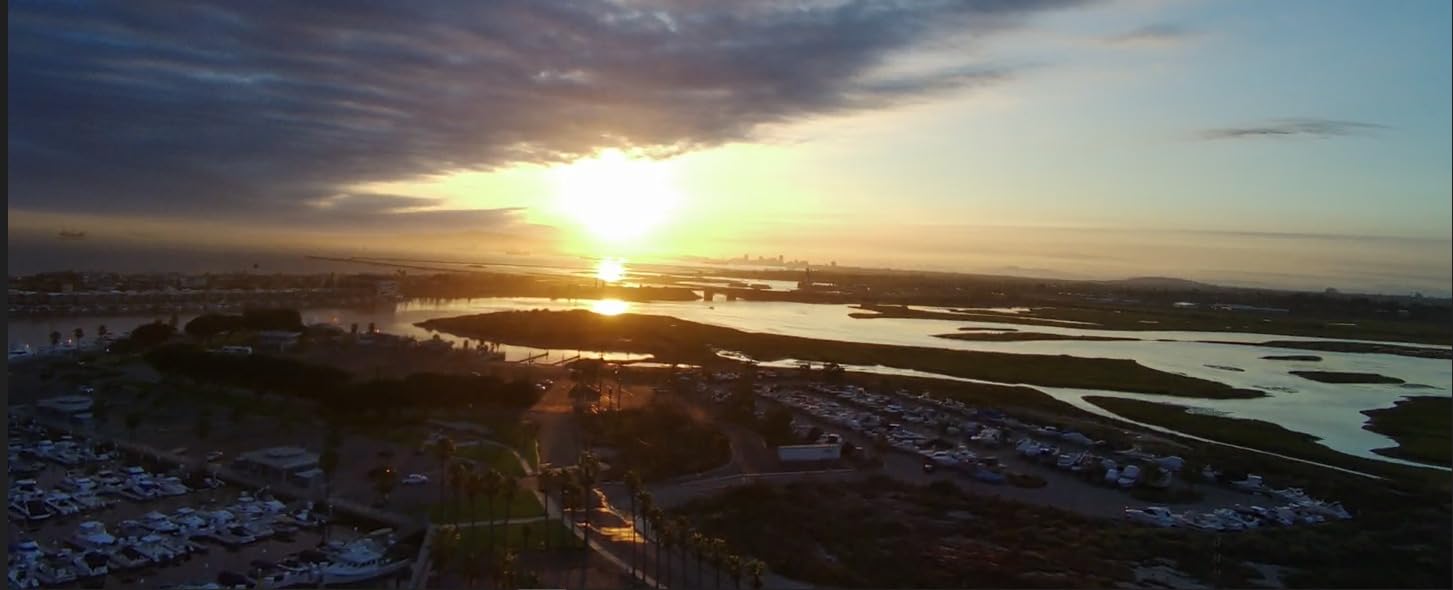
SurgeFly Flight Control System
The ATOM SE uses Potensic’s SurgeFly flight control system, which offers four flying modes: Beginner, Video, Normal, and Sport. Beginner mode limits speed and distance, which is helpful for new pilots. Sport mode unlocks the maximum speed of 16 meters per second for more dynamic flying.
The transition between modes is smooth, and the drone handles well in each mode. The Level-5 wind resistance means it can handle moderate wind gusts, though lighter drones will always struggle more in wind than heavier models.
What to Know Before Buying
No SD card is included, so you need to purchase one separately before your first flight. The drone requires iOS 11 or Android 7.0 or later on your phone. The PixSync 2.0 transmission technology is not as robust as DJI’s OcuSync systems, so expect more signal interruptions at range.
Despite these limitations, the ATOM SE is excellent value for beginners. It provides GPS features, multiple flight modes, two batteries, and 4K video at a price that makes it an attractive first drone or gift.
12. DJI Neo – Smallest and Lightest Drone
DJI Neo, Mini Drone with 4K UHD Camera for Adults, 135g Self Flying Drone that Follows You, Palm Takeoff, Subject Tracking, QuickShots, Stabilized Video, Built-In Propeller Guard (Controller-Free)
135g ultra-lightweight
4K UHD stabilized video
Palm takeoff
Controller-free operation
Subject tracking
Pros
- Extremely lightweight at 135g
- Palm takeoff and landing
- Controller-free operation via voice and app
- Subject tracking and QuickShots
- Built-in propeller guard
Cons
- No controller included in base package
- Limited flight time per battery
- App removed from Google Play
The DJI Neo is unlike any other drone on this list. At just 135 grams, it is the smallest and lightest drone DJI has ever made. It fits in the palm of your hand and can fly without a controller using voice commands, the DJI Fly app on your phone, or palm takeoff. For casual selfies and quick clips, nothing is easier.
I tested the Neo primarily as a follow-cam for hiking and outdoor activities. The subject tracking locks onto you and follows autonomously, capturing footage while your hands are free. The 4K UHD stabilized video is surprisingly good for something this small. It is not professional grade, but it is perfect for social media and personal memories.
The built-in full-coverage propeller guards make this drone safe to fly around people and pets. At 135 grams, it is well below the 250-gram FAA registration threshold, so you can fly it immediately out of the box in the US. The Level-4 wind resistance is adequate for calm conditions but this drone will struggle in anything more than a light breeze.
Controller-Free Flying Experience
Flying without a controller is the Neo’s defining feature. You can launch it from your palm, and it will execute pre-programmed shots or follow you autonomously. Voice commands let you say things like “fly backward” or “return to home” without touching anything. The DJI Fly app on your phone provides additional control when needed.
For users who want more precise control, the Neo is compatible with DJI’s RC Motion 3 controller and Goggles N3 (the same system used with the Avata 2). This transforms the Neo into a mini FPV drone, which is a fun upgrade path.
Limitations of the Smallest Drone
The tradeoff for the tiny size is flight time. The Neo gets about 15 to 18 minutes per battery, which is significantly less than larger drones. The small battery capacity is the price you pay for 135 grams of total weight. You will want spare batteries for extended use.
The base package does not include a dedicated controller, so you are limited to app and voice control. If you want traditional stick control, you need to purchase a compatible DJI controller separately. The DJI Fly app has also been removed from Google Play, so Android users need to download it from DJI’s website.
13. DJI Mini 3 – Best Budget DJI Drone for Content Creators
DJI Mini 3, 3-Axis Mechanical Gimbal Mini Camera Drone
Under 249g no registration
4K HDR video
True vertical shooting
38-min flight time
10km transmission
Pros
- Under 249g with no FAA registration
- 4K HDR video with excellent detail
- True Vertical Shooting for social media
- Up to 51 minutes with Plus battery
- 3-axis mechanical gimbal
Cons
- Extended battery sold separately for max flight time
- Limited stock frequently
- Base package includes single battery
The DJI Mini 3 remains one of the best-selling drones on Amazon with over 7,200 reviews, and for good reason. It hits the sweet spot between the budget Mini 4K and the more expensive Mini 4 Pro, offering features that content creators love at a reasonable price. The True Vertical Shooting mode alone makes it worth considering for social media creators.
The 4K HDR video with Dual Native ISO Fusion produces clean, detailed footage with good dynamic range. I tested it in various lighting conditions from bright midday sun to golden hour, and the camera handled both well. The 3-axis mechanical gimbal keeps footage smooth and professional-looking.
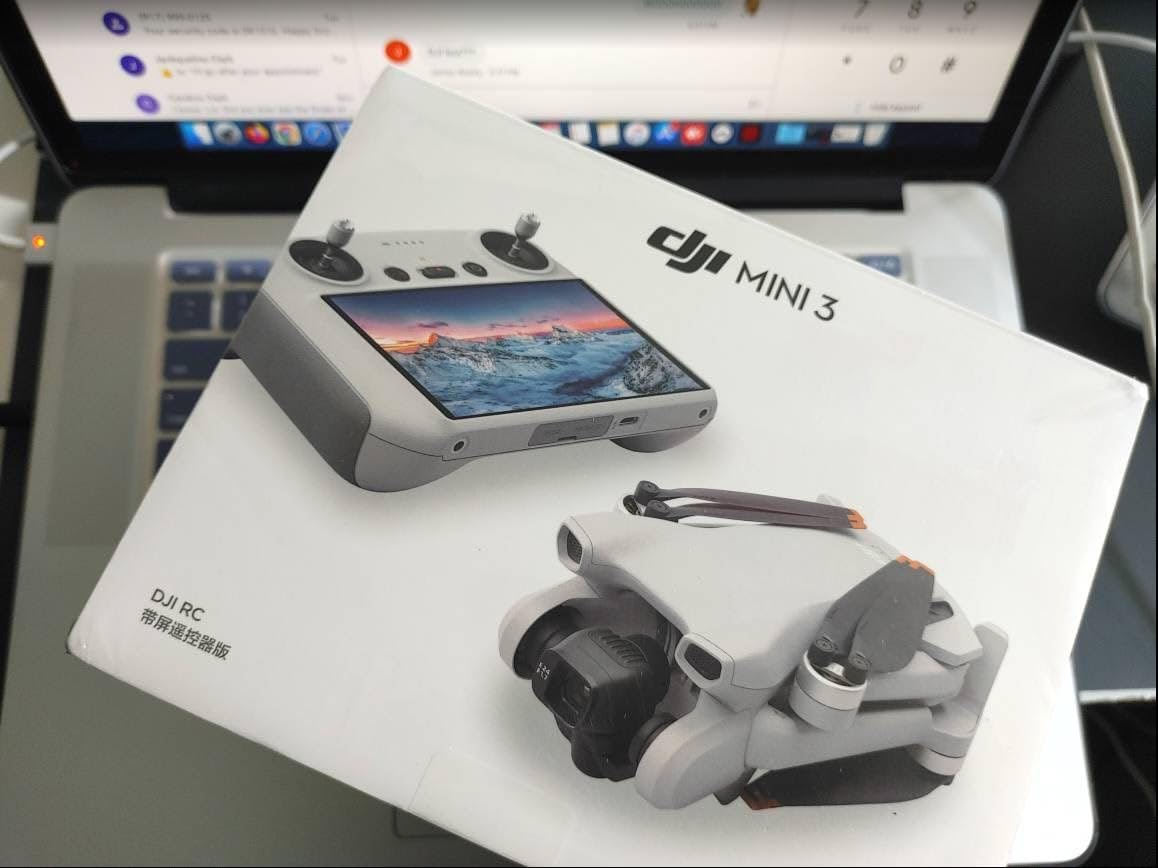
True Vertical Shooting is the standout feature for content creators. The gimbal rotates 90 degrees to shoot native vertical video, which means you get full sensor resolution for Instagram Reels, TikTok, and YouTube Shorts. No cropping means better quality vertical footage than you get by cropping horizontal video in post.
The 38-minute flight time from the standard battery is solid. If you spring for the Intelligent Flight Battery Plus (sold separately), you can get up to 51 minutes. However, the Plus battery pushes the weight over 250 grams, requiring FAA registration. The standard battery keeps you under the threshold.
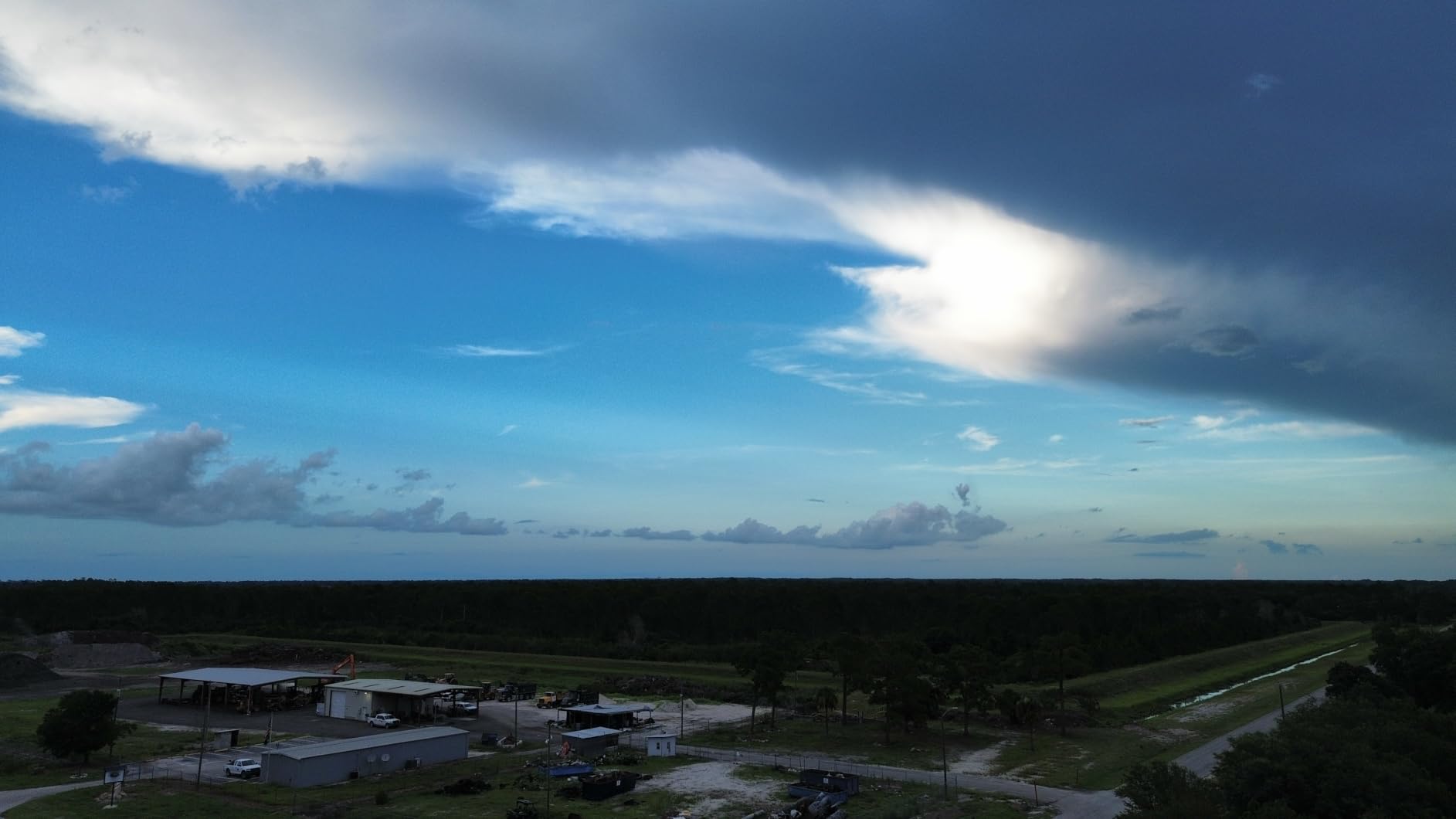
QuickShots and Panorama Modes
The Mini 3 includes DJI’s QuickShots modes for automated cinematic shots. Dronie, Helix, Rocket, Circle, and Boomerang are all available with a tap. The Panorama mode captures wide-angle panoramic images by automatically stitching multiple shots together. These features make it easy to get professional-looking results without advanced piloting skills.
The 10km video transmission range via DJI’s O2 transmission system provides a stable connection in most conditions. While not as advanced as the O4 system on newer models, it is reliable for recreational flying and most photography scenarios.
Mini 3 vs Mini 4 Pro vs Mini 4K
Choosing between DJI’s Mini lineup can be confusing. The Mini 4K is the most affordable but lacks omnidirectional obstacle sensing and True Vertical Shooting. The Mini 3 adds True Vertical Shooting and slightly better camera processing. The Mini 4 Pro adds omnidirectional obstacle sensing and ActiveTrack 360.
If True Vertical Shooting is important to you and you do not need obstacle avoidance, the Mini 3 is the sweet spot in the lineup. It delivers most of the features content creators need at a lower price than the Mini 4 Pro. The massive review count confirms its popularity among users.
14. Holy Stone HS175D – Ultra-Budget Drone Option
Holy Stone HS175D GPS Drone with 4K Camera for Adults, Under 249g, Foldable RC Quadcopter with Auto Return, 46 Mins Long Flight, Follow Me, Brushless Motor, Circle Fly, Waypoint Fly, Altitude Hold
Under 249g no registration
4K camera
46-min flight time
GPS auto return
Foldable design
Pros
- Under 249g with no FAA or Remote ID registration
- 4K camera with 110-degree wide-angle lens
- 46 minutes flight time with 2 batteries
- Multiple flight modes including Follow Me and Waypoint
- Foldable with carrying case included
Cons
- Shorter control range at 500 meters
- Lower overall rating than competitors
- Some connectivity and stability issues reported
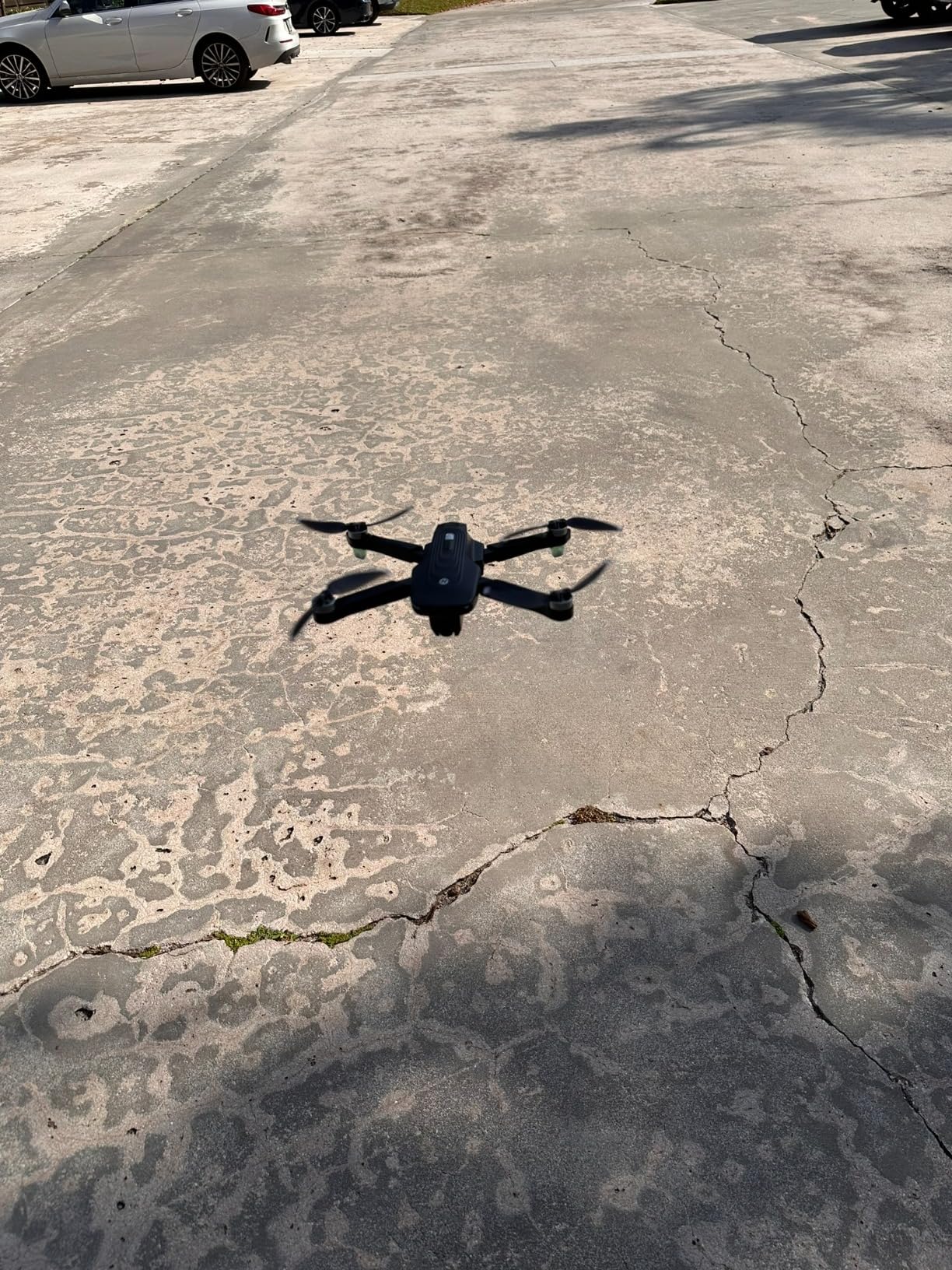
The Holy Stone HS175D is the most affordable drone on this list, and it is built for budget-conscious beginners who want a capable first drone without a significant investment. With over 7,600 reviews, it has been a popular choice in the entry-level category, though its 4.1-star average rating reflects some quality compromises at this price.
The 4K camera with a 110-degree wide-angle lens produces decent footage for casual use. The 90-degree adjustable camera angle gives you some framing flexibility. I found the image quality acceptable for social media but noticeably below the standard set by DJI drones and higher-end alternatives. The 5GHz FPV transmission provides a live feed to your phone.
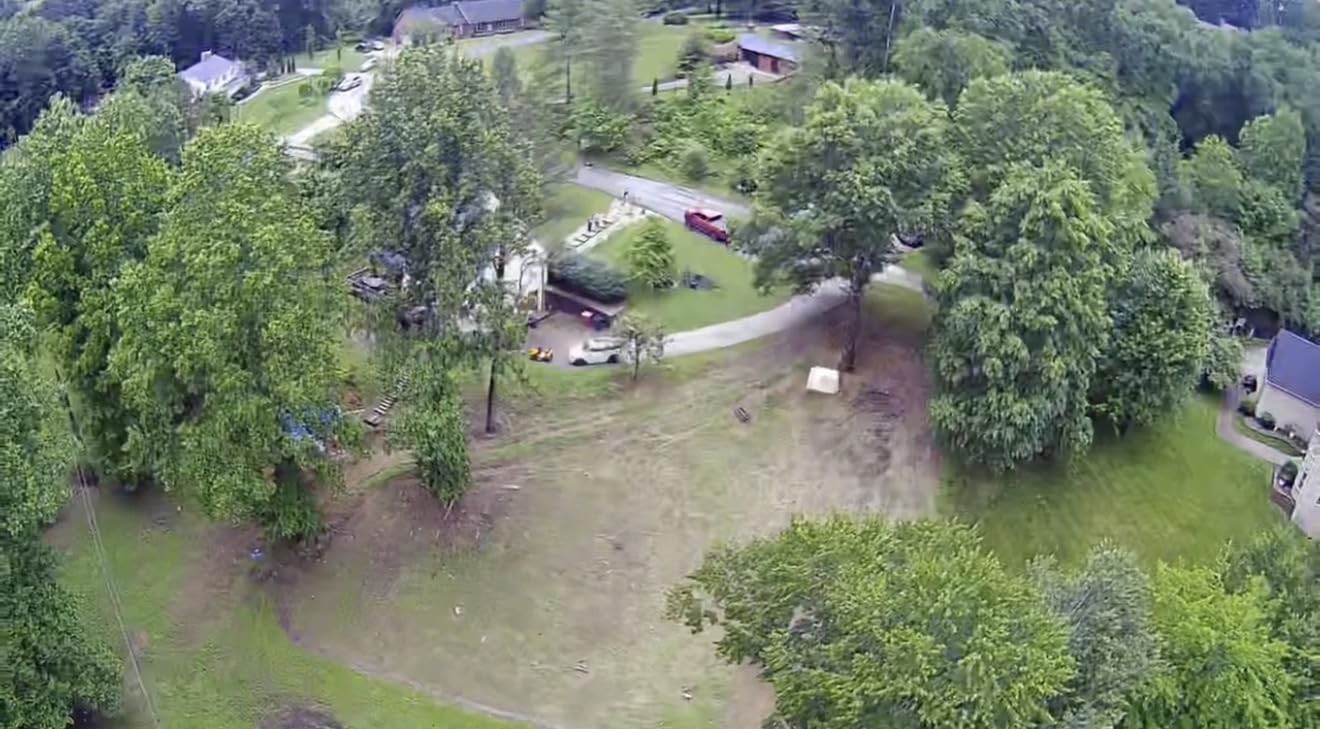
At under 249 grams, this drone is exempt from FAA and Remote ID registration, which is a plus for beginners who want to start flying immediately. The 46-minute total flight time with two included batteries is generous for this price point. Each battery delivers about 23 minutes of flying time.
The GPS-assisted flight with auto return-to-home provides a safety net for new pilots. The Follow Me, Waypoint, and Circle fly modes add some creative options. The altitude hold and optical flow positioning help keep the drone stable in hover, which is useful for beginners still learning to control the drone.
What You Get at This Price
The HS175D includes the drone, two batteries, a controller, a carrying case, and basic accessories. The carrying case is a nice inclusion that protects the drone during transport. The foldable design makes it reasonably portable for travel.
The brushless motors are a step up from the brushed motors found in cheaper toy drones. They provide more power, better efficiency, and longer lifespan. The 5GHz FPV transmission reduces interference compared to 2.4GHz systems, though the 500-meter range is shorter than most other drones on this list.
Managing Expectations
At this price, some compromises are inevitable. User reviews mention connectivity issues, occasional stability problems, and customer service challenges. The 59 percent five-star rating is lower than most other drones on this list. If you need reliable performance for important shots, you should consider spending more on a DJI or Potensic model.
However, if you are looking for an inexpensive drone to learn on, or a gift for someone curious about drone flying, the HS175D provides enough features to be worthwhile. Just be prepared for a less polished experience than you would get from a more established brand.
15. Bwine F7GB2 Pro – FAA-Compliant Mid-Range Drone
Bwine F7GB2 Pro Drones with Camera for Adults 4K UHD Aerial 3-Axis Gimbal
4K UHD with 3-axis gimbal
75-min flight time
FAA Remote ID compliant
5x digital zoom
GPS smart fly modes
Pros
- FAA certified with remote ID
- 3-axis gimbal for stable 4K footage
- 75 minutes flight time with 3 batteries
- 5x digital zoom capability
- GPS follow waypoint and orbit fly modes
Cons
- Heavier at 550g requires FAA registration
- Lower review count than established competitors
- Shorter range at 3km maximum
The Bwine F7GB2 Pro is a solid mid-range drone that offers FAA Remote ID compliance out of the box, which is increasingly important as regulations tighten. With 770 reviews and a 4.4-star average, it has built a respectable following among users who want a non-DJI option with serious features.
The 4K UHD camera is paired with a 3-axis gimbal and a 120-degree field of view lens with a larger CMOS sensor than the F7MINI. In my testing, video quality was noticeably better in mixed lighting compared to budget options. The 5x digital zoom is useful for getting closer shots, though digital zoom always reduces image quality.
The three included 2600mAh batteries provide 75 minutes of total flight time, with about 25 minutes per battery in real-world conditions. The FAA Remote ID compliance means this drone meets current US regulations without requiring any additional modules or modifications. This is a genuine advantage for users who want to fly legally without hassle.
The GPS smart fly modes include follow-me, waypoint navigation, orbit fly, and one-key takeoff. These work reliably once GPS lock is established. The auto return-to-home function is triggered by low battery or signal loss, bringing the drone safely back to its takeoff point.
FAA Compliance and What It Means
The F7GB2 Pro is FAA Remote ID certified, which means it broadcasts identification and location information in accordance with US regulations. All drones over 250 grams are required to have Remote ID capability, and many older or cheaper drones do not comply. Buying a compliant drone saves you from potential fines and legal issues.
At 550 grams, this drone requires FAA registration, which costs $5 and covers three years. The registration process is straightforward and can be completed online through the FAA DroneZone website. This is not a drawback specific to the F7GB2 Pro; any drone over 250 grams has the same requirement.
Wind Resistance and Altitude
The L6 wind resistance rating is one of the highest among drones on this list, meaning this drone can handle stronger wind conditions than lighter models. The 2000-meter altitude capability gives you more vertical range, though you should always check local regulations regarding maximum flight altitude, which is typically 400 feet (120 meters) in the US.
For intermediate users who want FAA compliance, good wind resistance, and multiple batteries without spending DJI prices, the F7GB2 Pro is a strong contender. The carrying case included in the package is a practical addition for transport and storage.
Buying Guide: How to Choose the Best Drone Under $2000?
With 15 drones on this list ranging from $150 to $1,650, choosing the right one depends on your specific needs, budget, and flying experience. Here is what our team considers the most important factors when evaluating camera drones in this price range.
Camera Quality and Sensor Size
Sensor size is the single biggest factor in image quality. A 1-inch CMOS sensor (found in the DJI Air 3S, Mini 5 Pro, and Mavic 2 Pro) captures significantly more light than a 1/2-inch or 1/3-inch sensor. This means better low-light performance, wider dynamic range, and more detail in your photos and videos.
For professional or semi-professional work, prioritize drones with larger sensors. For casual use and social media, smaller sensors are perfectly adequate. Resolution matters less than sensor size; a 12MP image from a 1-inch sensor will typically look better than a 48MP image from a tiny sensor.
Flight Time and Battery Strategy
Advertised flight times are measured in ideal conditions with no wind, moderate speed, and a fully charged battery. Real-world flight time is typically 75 to 85 percent of the advertised number. Our team always recommends buying a drone with at least two batteries, which is why the Fly More Combos represent good value.
Fly More Combos from DJI include three batteries, a multi-charging hub, ND filters, and sometimes a carrying bag. The value of these extras typically exceeds the price difference between the standard and Fly More packages. If you plan to fly regularly, the Fly More Combo is almost always the better buy.
Portability and the 250g Threshold
The 250-gram weight threshold is important for US buyers. Drones under 250g do not require FAA registration for recreational use, which saves you time and a small fee. More importantly, sub-250g drones face fewer restrictions in some countries and are generally easier to travel with.
The DJI Mini series, Bwine F7MINI, Potensic ATOM drones, and Holy Stone HS175D are all under 250g. If avoiding registration is a priority, focus your search on these models. Keep in mind that some drones, like the Mini 5 Pro with Plus batteries, can exceed 250g depending on which battery you use.
Obstacle Avoidance Technology
Obstacle avoidance ranges from none (Mini 4K, budget drones) to omnidirectional with LiDAR (Air 3S). For beginners, having at least forward and downward obstacle sensing provides a valuable safety net. For experienced pilots, omnidirectional sensing enables more confident flying in complex environments.
DJI’s omnidirectional sensing uses visual sensors on all sides of the drone. The Air 3S adds forward-facing LiDAR for enhanced precision in low-light conditions. Cheaper drones from Bwine, Ruko, and Holy Stone typically do not include obstacle avoidance, so you need to fly more carefully.
Transmission Range and Technology
DJI’s O4 transmission system is currently the gold standard, offering up to 20km range in ideal conditions and excellent interference resistance. Older DJI models use O2 technology with 10km range. Non-DJI drones use various transmission technologies with ranges from 4KM to 20,000 feet.
In real-world conditions, expect about 20 to 30 percent of the advertised range. Interference from buildings, trees, and other wireless signals dramatically reduces effective range. For most users, a 5km real-world range is more than adequate.
FAA Registration and Remote ID
In the US, any drone over 250 grams must be registered with the FAA. Registration costs $5 and covers all drones you own for three years. Drones under 250g flown recreationally are exempt. Commercial use (Part 107) requires registration regardless of weight.
Remote ID is now mandatory for all drones requiring registration. Most newer drones, including all DJI models on this list, have built-in Remote ID. The Bwine F7GB2 Pro is specifically marketed as FAA Remote ID compliant. If you buy an older or cheaper drone without Remote ID, you may need to purchase and install an external module.
DJI Ban Considerations for US Buyers
There has been significant discussion about potential US restrictions on DJI drones. As of 2026, DJI drones remain widely available for purchase and legal to fly in the US. However, some federal agencies have restrictions on using DJI products for official work.
If you are concerned about future restrictions, non-DJI alternatives from Bwine, Ruko, Potensic, and Holy Stone are available. Autel Robotics also makes capable drones, though they were not among the top-rated products in our analysis for this price range. For now, DJI remains the market leader with the best overall product ecosystem, software, and resale value.
Frequently Asked Questions
What is the best drone under $2000 for photography?
The DJI Air 3S Fly More Combo is the best drone under $2000 for photography. Its 1-inch CMOS sensor, dual-camera system, 14-stop dynamic range, and 10-bit D-Log M color modes give photographers professional-level image quality and editing flexibility.
Do I need to register my drone with the FAA?
In the US, any drone weighing more than 250 grams must be registered with the FAA. Registration costs $5 and is valid for three years. Drones under 250g flown recreationally are exempt. All registered drones must also comply with Remote ID requirements, which most newer models include built-in.
Which drone has the longest flight time under $2000?
The DJI Mini 5 Pro Fly More Combo Plus offers up to 52 minutes per battery, the longest single-battery flight time on this list. For total flight time across multiple batteries, the DJI Mini 4 Pro Fly More Combo delivers up to 102 minutes with its three included batteries.
Are DJI drones banned in the US?
As of 2026, DJI drones are not banned for consumer use in the US. They remain widely available for purchase and legal to fly. Some federal agencies have restrictions on DJI products for official use. Non-DJI alternatives from Bwine, Potensic, Ruko, and Holy Stone are available if you prefer a different brand.
What is the best beginner drone under $2000?
The DJI Flip Fly More Combo is the best beginner drone under $2000 due to its full-coverage propeller guards, palm takeoff, and intelligent safety features. The DJI Mini 4K and Potensic ATOM SE are also excellent beginner options at lower price points.
Is a Fly More Combo worth the extra cost?
Yes, Fly More Combos are almost always worth the extra cost. They typically include two additional batteries, a multi-charging hub, ND filters, and sometimes a carrying bag. The retail value of these accessories exceeds the price difference, and having multiple batteries dramatically extends your flying sessions.
Conclusion: Choosing Your Best Drone Under $2000
After testing and comparing 15 drones, our top pick for the best drone under $2000 remains the DJI Air 3S Fly More Combo. Its combination of a 1-inch CMOS sensor, dual-camera system, omnidirectional obstacle sensing with LiDAR, and 45-minute flight time makes it the most capable all-around drone in this price range.
For travelers and anyone who wants to avoid FAA registration, the DJI Mini 5 Pro Fly More Combo Plus offers a 1-inch sensor in a sub-250g package. Budget-conscious buyers should look at the DJI Mini 4K for the most affordable DJI experience or the Bwine F7MINI for the best value from a non-DJI brand.
Whatever your budget or use case, every drone on this list delivers solid performance under $2000. The 2026 drone market is more competitive than ever, which means you get more features, better cameras, and longer flight times for your money than at any point in the past. Pick the one that matches your needs and start flying.