
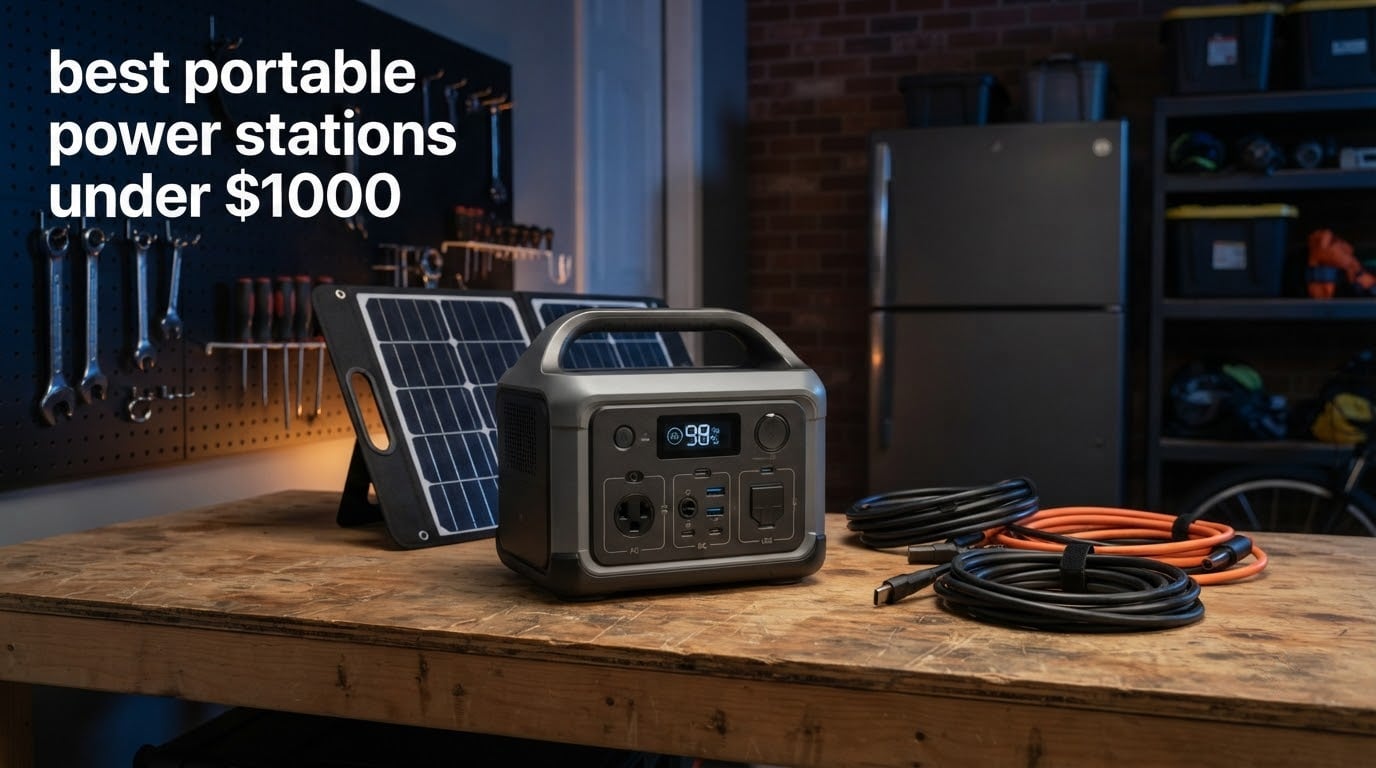
Last updated: October 2026 — every capacity, output, weight, cycle-life and recharge figure below comes from the current manufacturer specification and verified buyer feedback. We refreshed this list after the newest wave of 1kWh LiFePO4 units landed, and we removed anything whose real-world output could not justify a place.
If you have been comparing battery generators for months, the hardest part is not finding options. It is that almost every roundup online slices the market by use case — garage door, Starlink, tailgating — instead of by what your money can actually buy. We took the opposite approach and built this list around the best portable power stations under $1000 as a single bracket, then sorted every pick by what it can run.
Our team has handled portable power stations on drone field kits, on camper vans and in apartment outage kits, and we compared all 12 units in this list on the same basis: usable capacity after inverter loss, continuous AC output against surge headroom, recharge speed, weight you can actually lift, and warranty length. The result is a list where five of the twelve are under 400Wh, six sit in the 1kWh sweet spot, and one is a large-format unit that stretches the ceiling to its limit.
One thing to know before you read further: this bracket is where portable power stations stop being gadget purchases and start being real backup equipment. If you are shopping purely for phones and cameras, you can spend far less — our portable power station picks under $500 cover that tier in detail. If your load list includes a refrigerator or medical device, the picks here are where the conversation actually gets interesting.
Table of Contents
Top 3 Picks: Best Portable Power Stations Under $1000 (October 2026)

Jackery Explorer 1000 v2
- 1070Wh capacity
- 1500W AC with 3000W surge
- 23.8 lb
- 4000+ cycle LFP battery
All twelve stations, side by side. The three columns that decide most purchases are usable capacity, continuous output and weight — everything else is a preference.
| Product | Specifications | Action |
|---|---|---|
| Jackery Explorer 1000 v2 |
|
Check Latest Price |
 EcoFlow RIVER 2 EcoFlow RIVER 2 |
|
Check Latest Price |
 Jackery Explorer 300 Jackery Explorer 300 |
|
Check Latest Price |
 BLUETTI AC180 BLUETTI AC180 |
|
Check Latest Price |
 GRECELL 999Wh GRECELL 999Wh |
|
Check Latest Price |
 ALLWEI 256Wh ALLWEI 256Wh |
|
Check Latest Price |
 Anker SOLIX C1000 Gen 2 Anker SOLIX C1000 Gen 2 |
|
Check Latest Price |
 EcoFlow Delta 3 Classic EcoFlow Delta 3 Classic |
|
Check Latest Price |
 Anker SOLIX C300 Anker SOLIX C300 |
|
Check Latest Price |
 BLUETTI Elite 100 mini BLUETTI Elite 100 mini |
|
Check Latest Price |
 BLUETTI AC200PL BLUETTI AC200PL |
|
Check Latest Price |
 EcoFlow RIVER 3 EcoFlow RIVER 3 |
|
Check Latest Price |
How We Ranked These 12 Stations
Every unit here was scored on the same five criteria, in this order: usable battery capacity, continuous AC output with its surge headroom, recharge speed from a wall outlet, physical weight, and warranty length. Brand reputation and review volume broke the remaining ties.
We also weighed the details that spec sheets hide: idle draw with the inverter left on, whether outputs switch off cleanly, whether the included solar cable is usable, and how the unit behaves as a UPS. Where verified buyers repeatedly report the same fault, we treat that as a real limitation and write it into the review rather than leaving it out.
1. Jackery Explorer 1000 v2 — The Best All-Rounder in the Bracket
Jackery Explorer 1000 v2 Portable Power Station,1070Wh,1500W
1070Wh
1500W continuous AC
3000W surge
23.8 lb
4000+ cycle LFP
Pros
- 1500W continuous with 3000W surge
- Very fast charging with app-enabled emergency mode
- 4000+ cycle LFP battery
- Light at 23.8 lb with foldable handle
- 100W USB-C PD plus 7 outlets
Cons
- Solar charging restricted to Jackery panels
- Emergency charge mode must be enabled in the app each time
- Solar panel sold separately
The Explorer 1000 v2 is the unit we keep coming back to because it refuses to specialise. 1070Wh of LiFePO4 capacity sits behind 1500W of continuous pure sine wave AC output, and surge peaks at 3000W, which is enough headroom for a refrigerator compressor, a small window unit or a kettle. For a list where most picks trade one of those away, that combination is the whole argument.
At 23.8 lb with a foldable handle, it is heavy enough to be a real battery and light enough for one person to move between a hallway and a garage. That single-person carry is where several competitors in this list fall down: the 37 lb and 72 lb units are effectively two-person or vehicle-only gear.
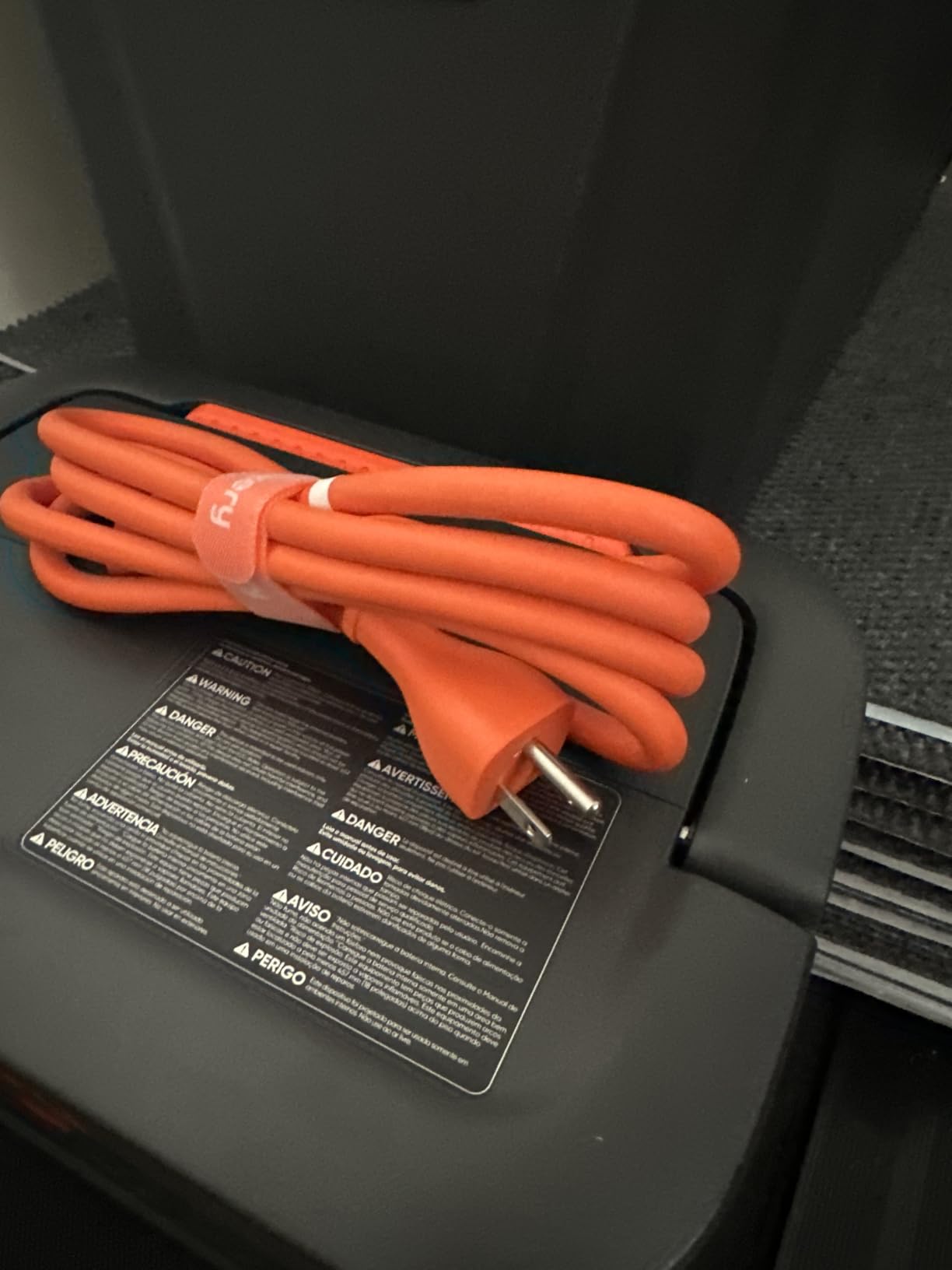
Recharging is where it separates itself. The default full charge from a wall outlet takes 1.7 hours, and enabling the emergency mode in the Jackery app drops that to about one hour from empty to full. Reviewers treat that as the feature that makes storm prep practical, because you can refill between outage windows rather than overnight.
The battery is rated to hold over 70% of original capacity past 4000 cycles, which works out to well beyond a decade of daily use. The app also carries a 30 dB quiet charging mode, which matters more than it sounds when the unit is charging in a bedroom the night before a storm.
Who this station suits
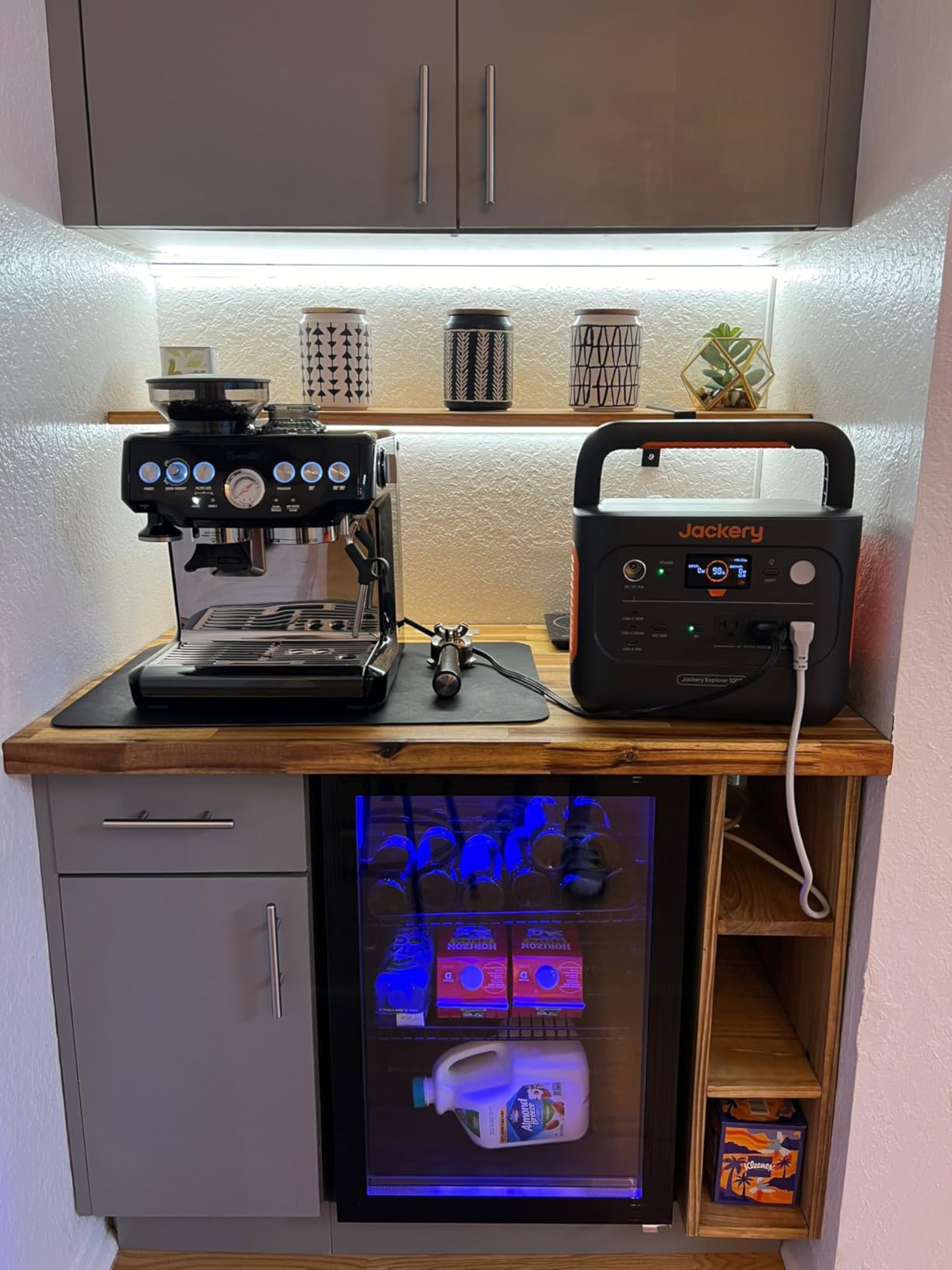
A household that wants one device to cover the essentials: refrigerator, router and modem, a few lamps, a medical device and phone charging, for a day or two. It also handles a weekend of campground use without needing a separate solar budget if you charge it before you leave.
Where it falls short
Solar charging is locked to Jackery-branded panels, and no panel is included, so a mixed-brand solar setup is not an option. The emergency charge mode has to be switched on in the app every single time, which is an extra step when a storm is already overhead.
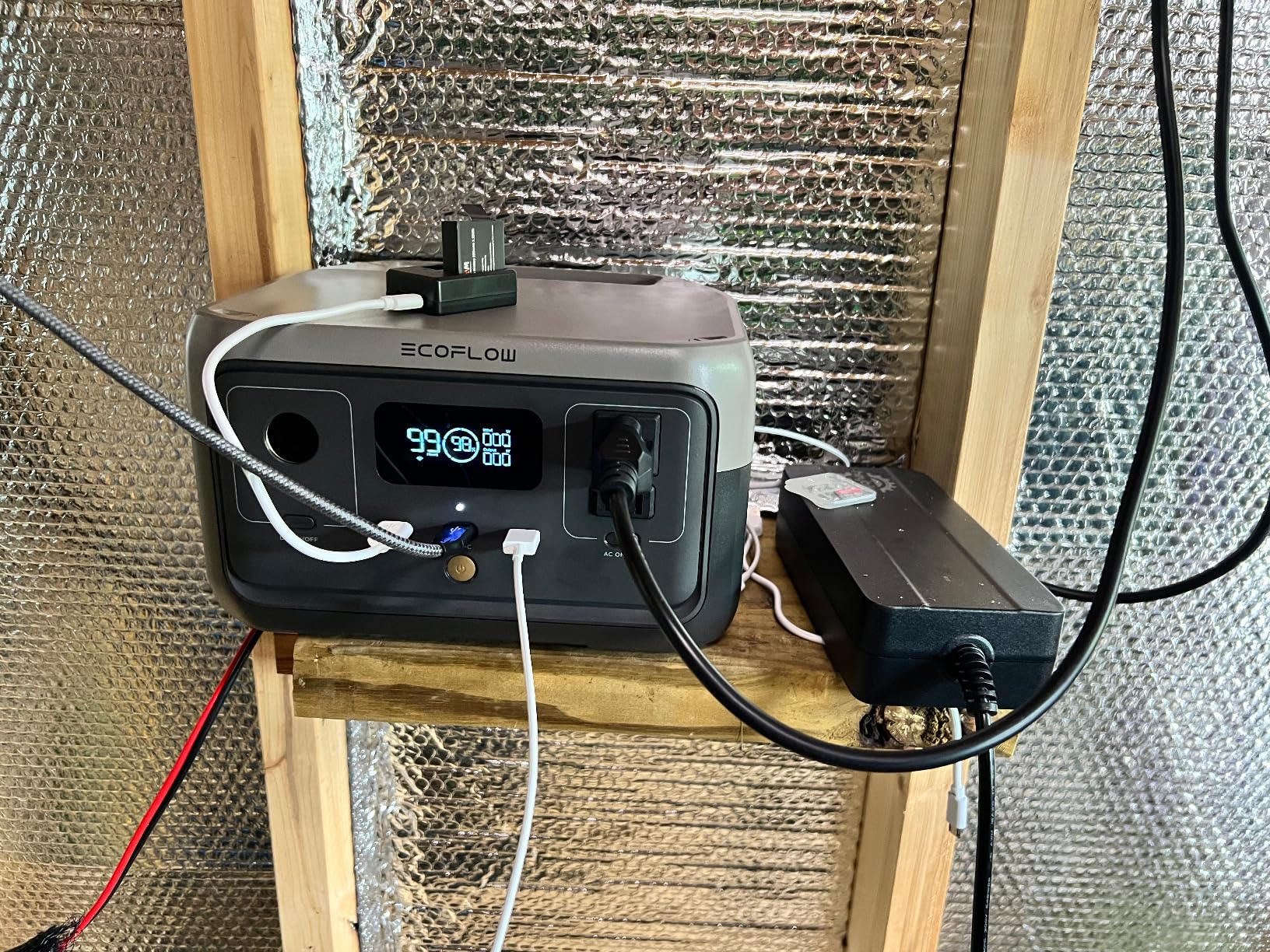
2. EcoFlow RIVER 2 — Best Light-Duty Station With UPS Behaviour
EF ECOFLOW Portable Power Station RIVER 2, 256Wh 300W
256Wh
300W AC, 600W with X-Boost
1 hr wall recharge
7.7 lb
3000+ cycles
Pros
- Full AC recharge in about one hour
- Extremely light at 7.7 lb with carry handle
- 3000+ cycle LFP cells
- Six outlets covering AC USB-A USB-C and car
- Works as a line-interactive UPS for network gear
Cons
- Not suited to coffee makers or microwaves
- Only one USB-C port
- Audible cooling fan at maximum charge speed
The RIVER 2 draws a clear split from its 4,500-plus reviews, and the pattern in them is consistent: people who wanted a small, fast-recharging box for network gear and cameras are delighted, while people who expected a fridge-sized capability are disappointed. Knowing which one you are is the entire decision.
Capacity is 256Wh with 300W of rated AC output, expandable to 600W through EcoFlow’s X-Boost function. Switchover to battery happens in under 30ms, which is fast enough that a router, a modem and a laptop never notice an outage. Six outlets run at once, including a 60W USB-C port and a car socket.
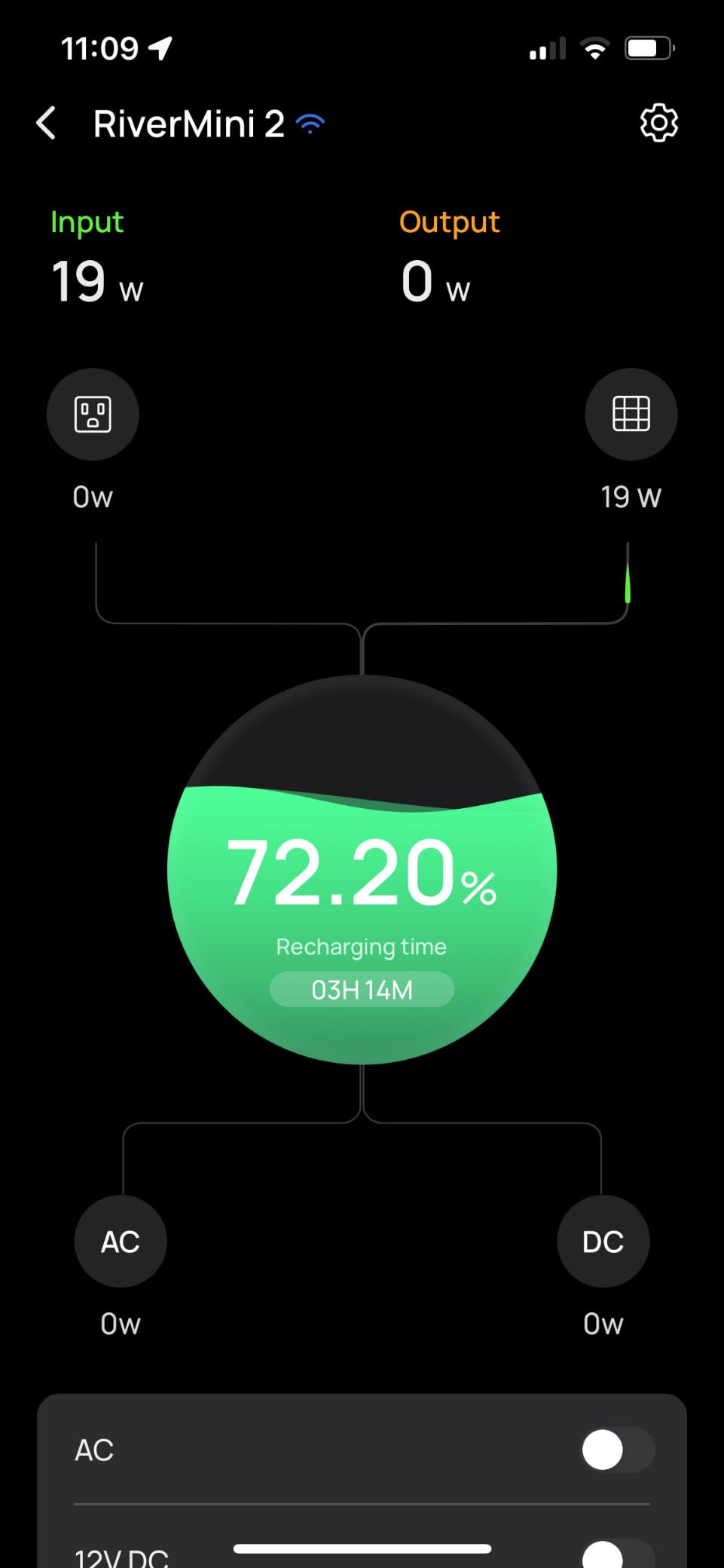
Two practical details stand out. The full wall recharge is about one hour through X-Stream, and the whole unit weighs 7.7 lb, so it moves between rooms or into a vehicle without planning around it. The warranty is five years, longer than most of the sub-400Wh competitors here.
At 4.3 stars across more than 4,500 reviews, the rating spread is the widest in this list. Light-duty users rate it enthusiastically; a minority report battery percentage drift or units that drain while idle, and the cooling fan is audible at full charge speed in a quiet room.
Who this station suits
Apartment dwellers, van lifers and remote workers who need the router, modem, laptop and cameras to survive an outage or a long off-grid workday. It also works as a weekend unit for a weekend of devices without a single heavy appliance.
Where it falls short
It is not a fridge station. Anything with a heating element or a compressor above 300W is outside its envelope, and the single USB-C port means choosing between a laptop and a phone when both need power at once. Solar input tops out at 110W, and low-wattage third-party panels can charge it inconsistently.
3. Jackery Explorer 300 — The Most Proven Compact Pick
Jackery Explorer 300 Portable Power Station,292Wh
292Wh
300W continuous, 600W surge
7.1 lb
4000+ cycle LFP
6 devices
Pros
- Lightest full-size option in the roundup
- Powers six devices including drones and CPAP
- LiFePO4 chemistry for 4000+ cycles
- 11273 reviews make reliability easy to judge
- 80% solar top-up in about 2.8 hours
Cons
- Solar panel sold separately
- 300W ceiling requires careful wattage math
- Some listings still describe the cell type as lithium ion
More than 11,000 reviews at 4.6 stars makes the Explorer 300 the most statistically proven compact station available, and for drone pilots or campers that matters more than raw specs. Buying patterns are consistent: people buy it for a weekend, come back a month later, and buy a second one.
Capacity is 292Wh with 300W rated output and 600W peak surge. The port selection is unusually good for the size: two AC outlets, a 100W USB-C PD port, two USB-A ports and a 120W car port, all running at once. The 100W USB-C port alone will fast-charge most laptops and most drone battery chargers.
The battery is LiFePO4 rated past 4000 cycles to 70% capacity, which the manufacturer frames as more than eleven years of service life. Solar charging reaches about 80% in 2.8 hours with a 100W Jackery panel, and wall charge takes around four hours.
At 7.1 lb with an integrated handle, this is the unit we recommend for anyone who needs backup power but does not want to think about weight. The constraint is the 300W ceiling: high-draw appliances need real wattage math, and the listing copy for some versions still says lithium ion rather than LFP, so check the spec page before buying.
Who this station suits
Campsites, van trips and drone field days where the load list is laptops, camera batteries, a couple of drone packs and a CPAP machine. It is also the easiest unit here to hand to a family member for a weekend.
Where it falls short
It will not run a refrigerator for any meaningful length of time, and 292Wh disappears quickly once a laptop and a router are drawing. No solar panel is included, and the four-hour wall charge time means you need to plan a day ahead rather than a night before.
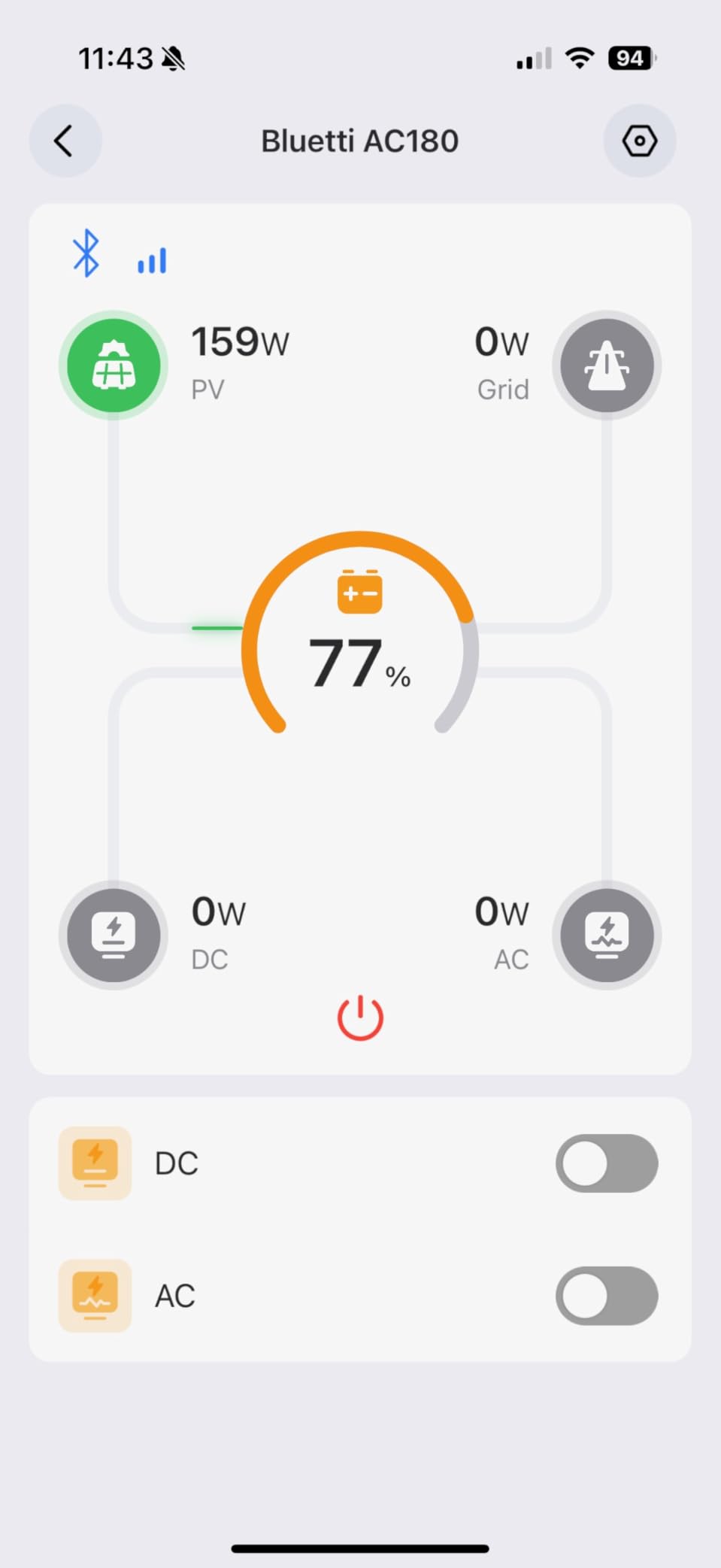
4. BLUETTI AC180 — Best 1kWh Pick When Solar Is the Plan
BLUETTI AC180 Portable Power Station 1152Wh 1800W LiFePO4 Solar Generator
1152Wh LiFePO4
1800W AC, 2700W boosted
500W solar input
20ms UPS
37.4 lb
Pros
- Full wall charge in about one hour at 1440W input
- 1800W continuous with 2700W app boost
- 500W solar input refills in 2.8-3.3 hours
- 20ms UPS for routers and medical devices
- Quiet running with a clear live power display
Cons
- Heaviest unit in the mid tier at about 37 lb
- Around 20W idle draw reduces usable runtime
- Only one USB-C port
The AC180 is the station to buy if you have panels or plan to buy them. The 500W solar input is far and away the highest in the mid-capacity class on this list, and it refills the full 1152Wh pack in roughly 2.8 to 3.3 hours of good sun. Most competitors in the same class cap out near 200W and quietly need two days.
On the output side you get 1800W continuous, with an app-enabled boost to 2700W for resistive loads. Eleven outlets are listed, eight of them main outputs, and the 20ms UPS switchover is quick enough to carry a router, a desktop or a medical device straight through an outage.
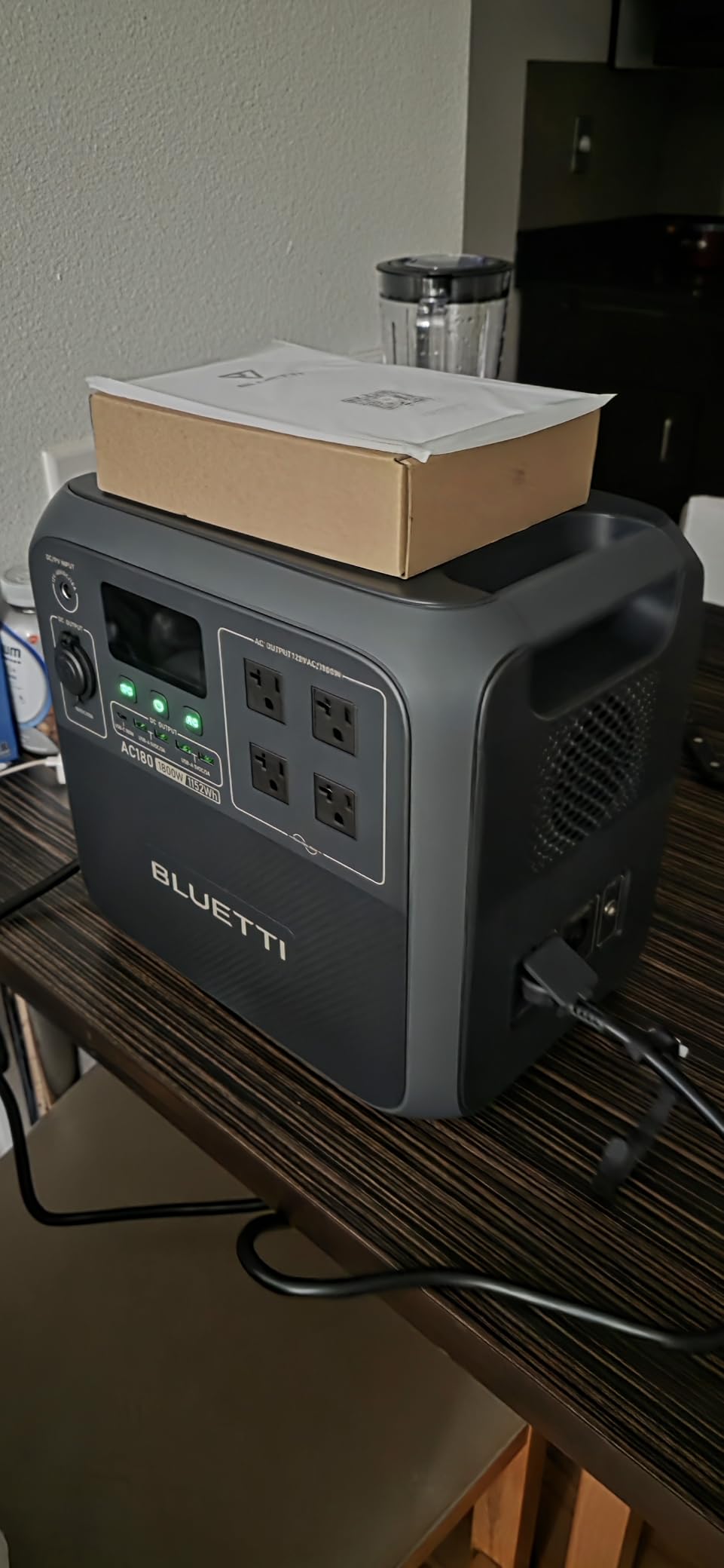
Wall charging is the other headline: 1440W of AC input fills the battery in about an hour. Reviewers consistently single that out, because a station that refills between outage windows is worth more than one with a larger battery that takes two days to come back.
There are honest deductions. At roughly 37 lb it is the heaviest unit in the 1kWh class here, and idle consumption of around 20W with the inverter on, plus a 90% usable-capacity cap, means real runtime falls short of the headline 1152Wh. The top wireless charging pad is also the most repeated hardware complaint.
Who this station suits
Cabins, workshops, sheds and vans where panels are part of the build, and households that want a refrigerator plus internet plus lights through an overnight outage. It suits people who can leave the unit in one place rather than carry it between rooms.
Where it falls short
Weight rules it out for one-person carry-up-stairs use, and the 20W idle draw quietly eats into overnight runtime. One reviewer recommends installing the firmware update and running a full discharge cycle on arrival to clear up early under-performance, which is a small extra step most buyers skip.
5. GRECELL 999Wh — Most Ports and Features per Unit
GRECELL 999Wh Solar Generator 1000W Portable Power Station for Outdoor
999Wh
1000W pure sine wave, 2000W surge
23 lb
10 device outputs
2 year warranty
Pros
- 999Wh with 1000W pure sine wave output
- Ten device outputs including wireless pad and SOS light
- Built-in MPPT controller for solar
- AC solar and car cables all included
- Short-circuit and surge protection
Cons
- Only a 2 year warranty
- 0.85 conversion factor cuts real runtime
- AC output must be switched off when idle
The GRECELL T-1000 does something none of the other 1kWh units here do: it puts 999Wh behind a 1000W pure sine wave inverter at this price point, with a 2,000W surge. That is a different shape of machine from the 1800W-and-2000W units above it — less peak headroom, but a much lower draw ceiling for the same stored energy.
Port count is the gimmick and the genuine strength. Two AC sockets, three USB QC ports, a USB-C PD port, two 12V DC outputs, a car socket, a wireless charging pad, an LED lamp and an SOS flashlight. For a family outage kit or a tailgate, the extras matter more than the wattage.
A built-in MPPT controller is a genuine inclusion, and the box ships with AC, car and solar charging cables plus a storage bag. At 23 lb the unit is one of the more manageable 1kWh options, and the 3,126 reviews give a reasonably clear picture of long-term behaviour.
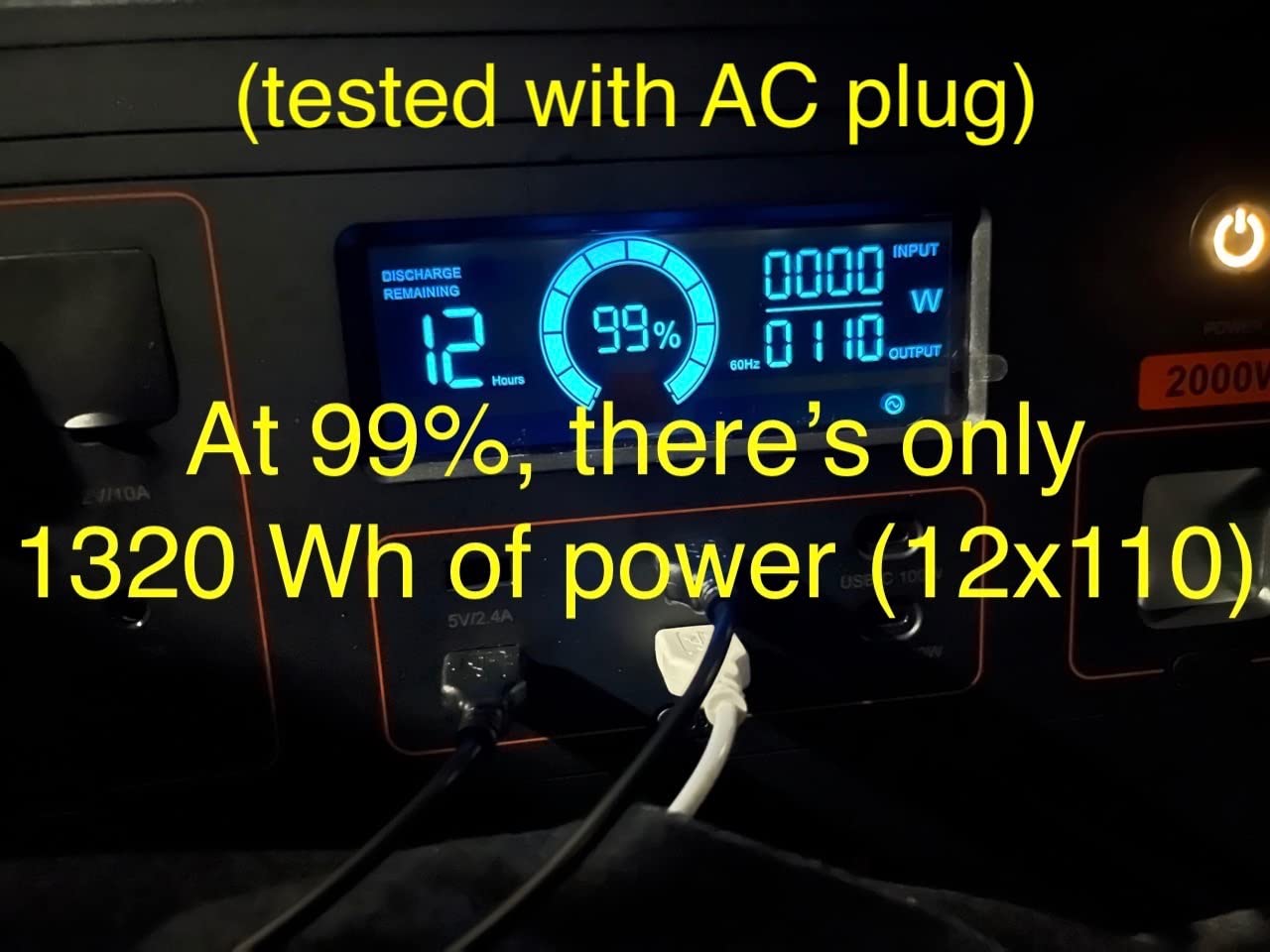
What the rating spread shows is that value buyers are satisfied and durability sceptics are not. The warranty is two years, half what Jackery, EcoFlow and BLUETTI offer on comparable units, and the 0.85 conversion factor means you get closer to 850Wh of usable energy than 999Wh.
Who this station suits
Anyone building an all-in-one kit: a small business back office, a tailgate, a group of campers, or a home where many small devices need charging at once rather than one heavy appliance. It is also a good first station for someone who wants capacity without a large invoice.
Where it falls short
The two-year warranty is the real drawback, since a portable power station is a ten-year purchase. You also have to remember to switch the AC output off when idle or the unit drains itself, and the wireless pad needs its own button activation every time.
6. ALLWEI 256Wh — The Entry-Level Pick With Genuine LFP Cells
ALLWEI Portable Power Station 300W, 256Wh Solar Generator LiFePO4 Battery
256Wh LiFePO4
300W continuous, 600W surge
6.4 lb
3000 cycles
6 outputs
Pros
- Entry-level price with LiFePO4 cells rated for 3000 cycles
- Very light at 6.4 lb and thin for tight spaces
- Display shows live wattage and runtime estimate
- USB ports sustain about 21W combined for camera dew heaters
- Three-level LED light with SOS mode and pass-through charging
Cons
- No 24V DC output for RV users
- Solar input is capped
- Warranty length is listed inconsistently
The ALLWEI answers the question camper communities ask most often: how cheap is too cheap. This is the floor of the bracket, and the surprising part is that it does not cut chemistry. The 256Wh pack is LiFePO4 rated for 3000 charge-discharge cycles, with a six-layer battery management system and pass-through charging.
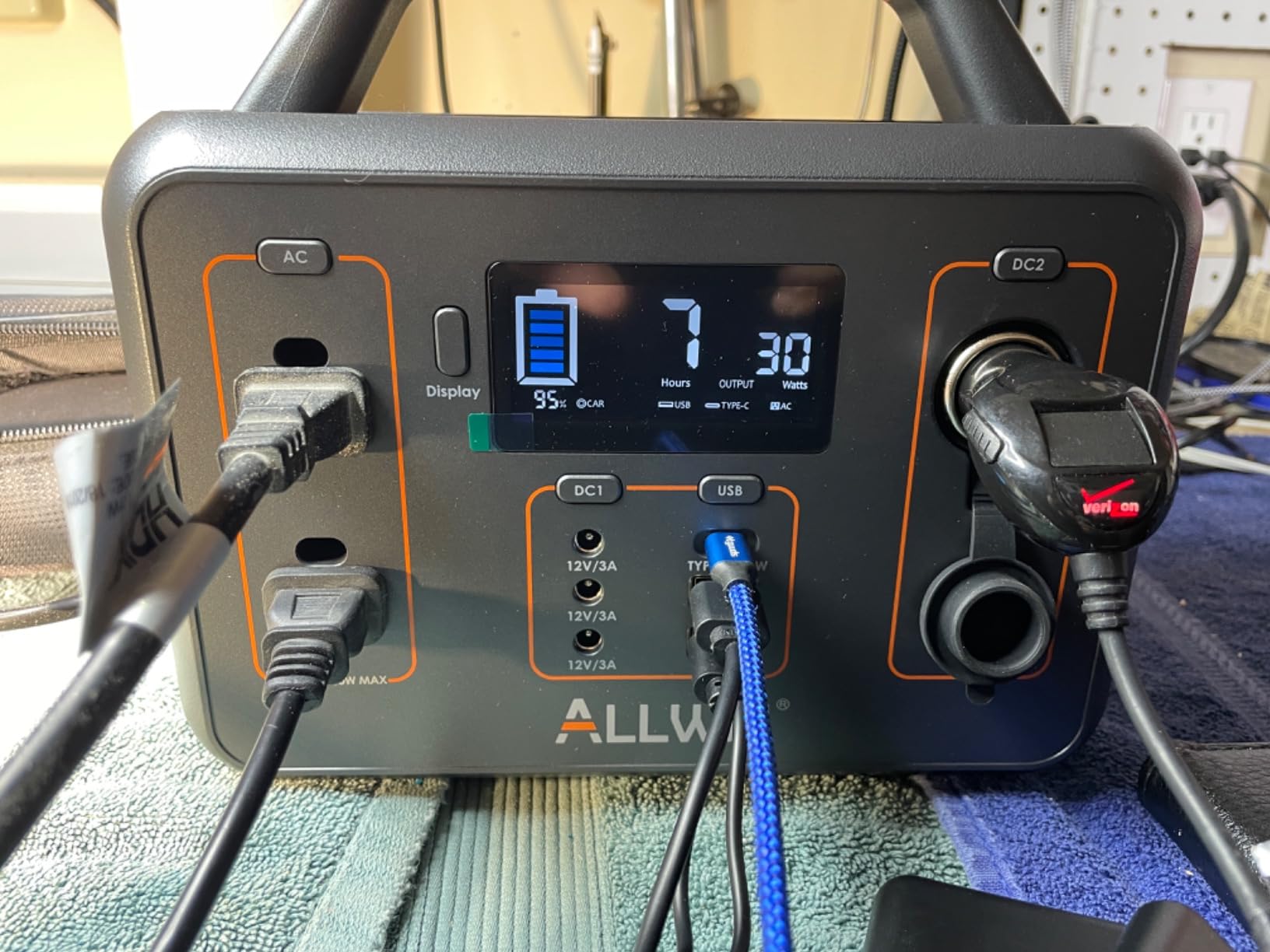
Output is 300W continuous with 600W of pure sine wave surge across six ports, including a 60W USB-C PD port. Six output points in a 6.4 lb body is a lot of flexibility for the money, and the display shows live wattage, estimated runtime and the exact remaining percentage.
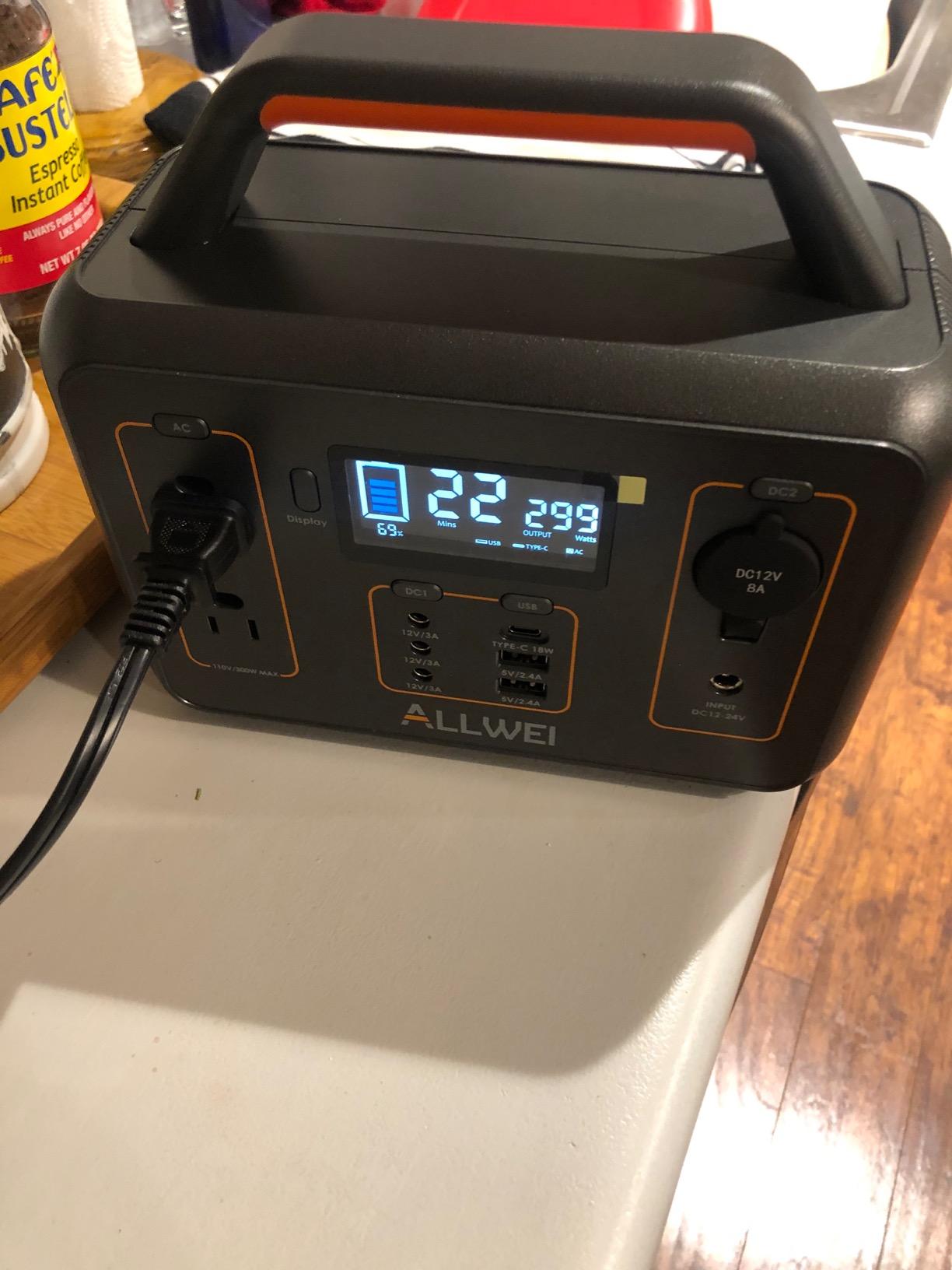
The detail that gets mentioned most in detailed reviews is the USB output: the ports genuinely sustain about 21W combined, which is enough for camera dew heaters and other low-draw gear that cheap units throttle. The three-level LED light with SOS mode sits at the handle end, where you can reach it in the dark.
Recharge options are AC wall at 3.5 to 4 hours, car at 3.5 to 4 hours, or a 100W panel at 4 to 5 hours, and combining AC with solar brings it down to about 2 to 2.5 hours. What you give up is the 24V DC output RV users may need, and there is a small minority reporting inaccurate charge readings.
Who this station suits
First-time buyers, tent campers, and anyone building a grab-and-go kit for cameras, phones, a router and lights. The 6.4 lb weight and thin footprint make it easy to store in a cupboard and easy for a single person to carry.
Where it falls short
256Wh is genuinely small. It runs a CPAP machine or a laptop, not both plus much else, and the solar input cap limits you to smaller panels. The warranty length is listed inconsistently between the specification list and the product copy, so confirm it before you buy.
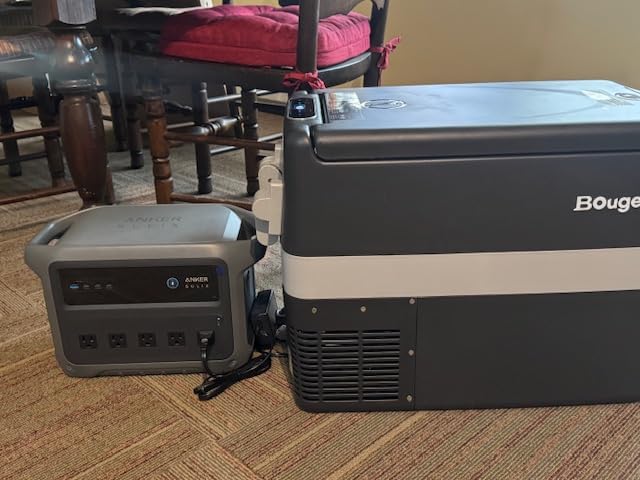
7. Anker SOLIX C1000 Gen 2 — Fastest Recharge in the Roundup
Anker SOLIX C1000 Gen 2 Portable Power Station
1024Wh LiFePO4
2000W AC, 3000W peak
49 min full charge
600W solar
about 25 lb
Pros
- 49 minute full recharge at 1600W input
- 2000W output with 1024Wh across 10 ports
- Under 10ms UPS switchover for medical devices and servers
- Quiet enough that owners cannot hear it in operation
- 14% smaller and 11% lighter than comparable models
Cons
- Gen 2 removes battery expandability
- A small amount of self-discharge over weeks unplugged
- No protective case or cable storage included
Recharge speed is the Anker SOLIX C1000 Gen 2 headline, and it is genuinely the fastest in this list: 49 minutes for a full charge from a wall outlet at 1600W, once HyperFlash is enabled in the app. When a storm is forecast, that is not a marketing line — it is the difference between topping up between outage windows and waiting overnight.
Under the lid, 1024Wh of LiFePO4 sits behind 2000W of continuous output with 3000W peak, spread across 10 ports. Owners report running a refrigerator for six to twelve hours on a charge, and the sub-10ms UPS switchover keeps CPAP machines, laptops and servers running through an interruption without a hiccup.
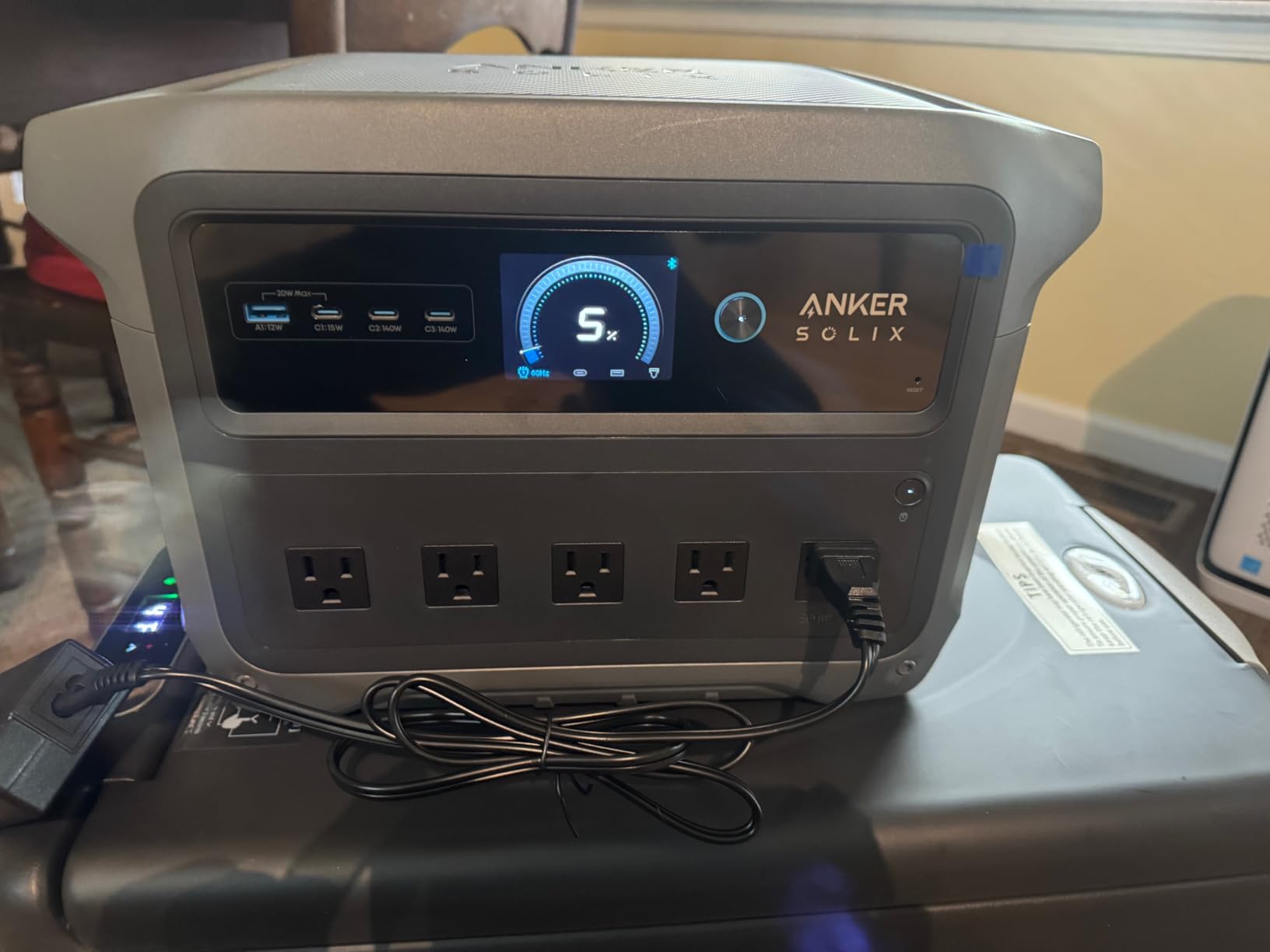
Two more details stand out. The unit is described as 14% smaller and 11% lighter than comparable models, and it is quiet enough in operation that several owners say they cannot hear it. One verified reviewer recorded sustained laptop charging while solar was feeding in, without the output dropping below 99%.
The trade-off in this generation is expandability. The Gen 2 drops the add-on battery support found on earlier C1000 versions, so this is a fixed 1024Wh rather than a starting point. Reviewers also note some self-discharge over weeks of sitting unplugged and measurable harmonic distortion when driving a microwave.
Who this station suits
Households that want maximum recharge speed and near-silent backup for a fridge, a router and medical equipment. It also suits remote workers who need a server or a laptop to survive a brief outage without a manual restart.
Where it falls short
If you plan to grow capacity later, this generation cannot grow, and that decision is harder to reverse than a missing accessory. No protective case or cable storage is included, which matters for van and truck setups where ports get knocked around.
8. EcoFlow Delta 3 Classic — Best for Home Office and Home Backup
EF ECOFLOW Portable Power Station Delta 3 Classic, 1024Wh 1800W AC
1024Wh LiFePO4
1800W AC, 3600W surge
0-80% in 45 min
500W solar
26.7 lb
Pros
- 0-80% in 45 minutes with a full recharge in about an hour
- 1800W output with 3600W surge and X-Boost
- Under 10ms UPS for servers PCs and medical devices
- Overwhelmingly five star reviews - the strongest spread here
- Flawless app control and reliable high-wattage solar intake
Cons
- Heavy at 26.7 lb for this class
- Cannot use DELTA 2 or DELTA 3 Series expansion batteries
- Some one-star reviews report dead or used units from third-party sellers
- 12V vehicle charging capped around 100W
The Delta 3 Classic has the strongest rating distribution in this roundup, with 90% five-star reviews and only 4% one-star. That matters when you are buying something you hope to touch only during bad weather — the review base says very few owners have had a bad experience with the hardware.
Output is 1800W continuous with 3600W surge and X-Boost lifting capability up to 2600W, which covers refrigerators, microwaves and laptops without drama. Recharge is 0 to 80% in 45 minutes with X-Stream, roughly an hour end to end, and 500W solar input refills the pack in about 2.5 hours.
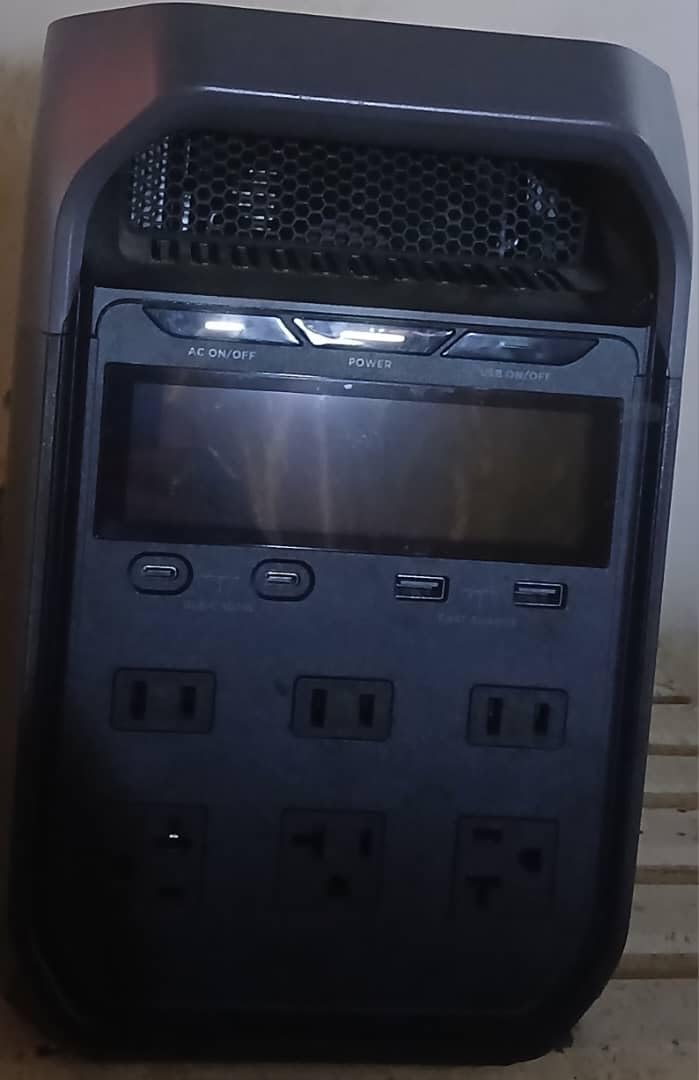
The UPS is the quiet winner for home offices. Under 10ms switchover means desktops, servers and network gear ride through an outage, and the app adds scheduling, a Storm Alert mode and a self-powered mode that starts the unit before you get home.
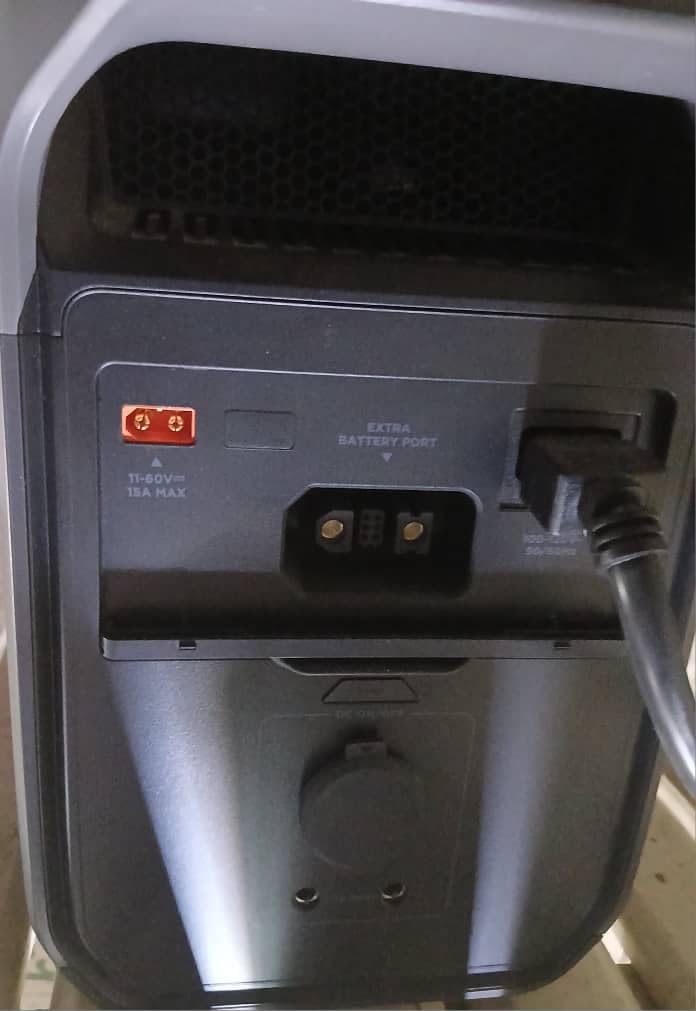
Physical design is better than the weight suggests: dual top handles, non-skid feet and a tuck-away input cover. The negatives are the 26.7 lb weight, no compatibility with DELTA 2 or DELTA 3 Series expansion batteries, and a small cluster of one-star reviews that describe units arriving dead or already opened through third-party sellers.
Who this station suits
Home offices, home medical setups and households that want one box to run internet, a monitor, a laptop and a small fridge through an outage. The sub-10ms switchover is the deciding factor for anyone with a server or a desktop that dislikes sudden power loss.
Where it falls short
Expansion is closed off, so this is a fixed 1024Wh. 12V vehicle charging is limited to about 100W, so topping up on a long drive is a slow process, and at 26.7 lb it is a two-person move for many people.
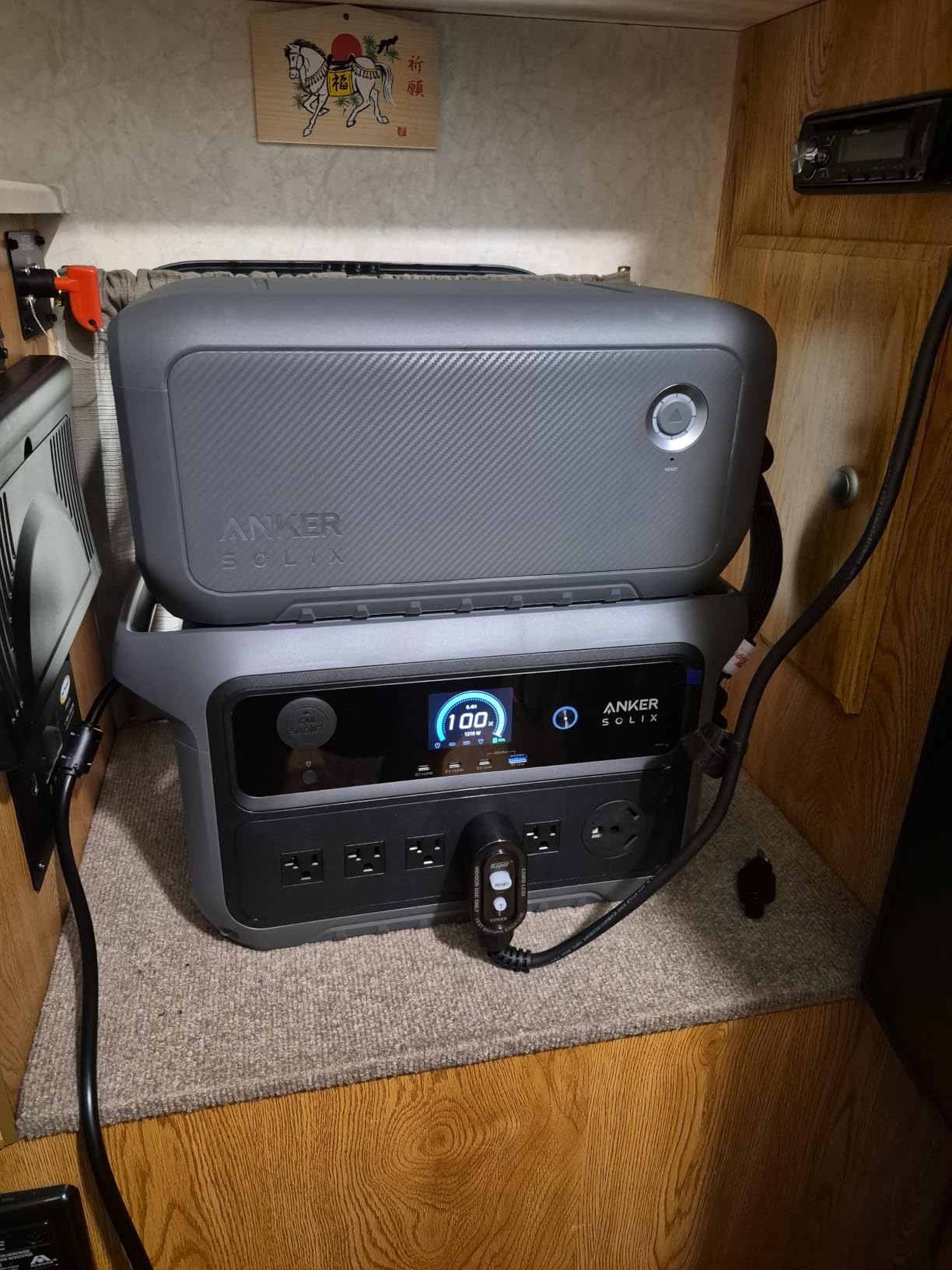
9. Anker SOLIX C300 — Best Compact Pick for USB-C Charging
Anker SOLIX C300 Portable Power Station, 288Wh Solar Generator for Camping
288Wh LiFePO4
300W AC, 600W surge
140W two-way USB-C
25dB
9.1 lb
Pros
- Two-way 140W USB-C ports are class-leading for the size
- Very quiet at 25dB
- 15% smaller than similar designs and light enough to carry
- 3000 cycle LiFePO4 with temperature control
- 80% recharge in 50 minutes from a wall outlet
Cons
- Shoulder strap sold separately
- Not compatible with PS30 PS200 or PS400 panels
- 288Wh suits devices rather than appliances
- Some listings quote a 360W total output figure
The C300 is defined by its USB-C ports. Two-way 140W USB-C output is the fastest laptop charging you will find in a unit this small, and being two-way it also takes a USB-C charge. If your load list is a laptop, a phone, a camera and a drone charger, this is the most efficient way to serve it.
Capacity is 288Wh with 300W of AC output and 600W surge across three AC outlets, a 120W car socket, two 140W USB-C ports, a 15W USB-C and a USB-A. It reaches 80% in about 50 minutes on wall power, and rated noise is 25dB from just over three feet away.
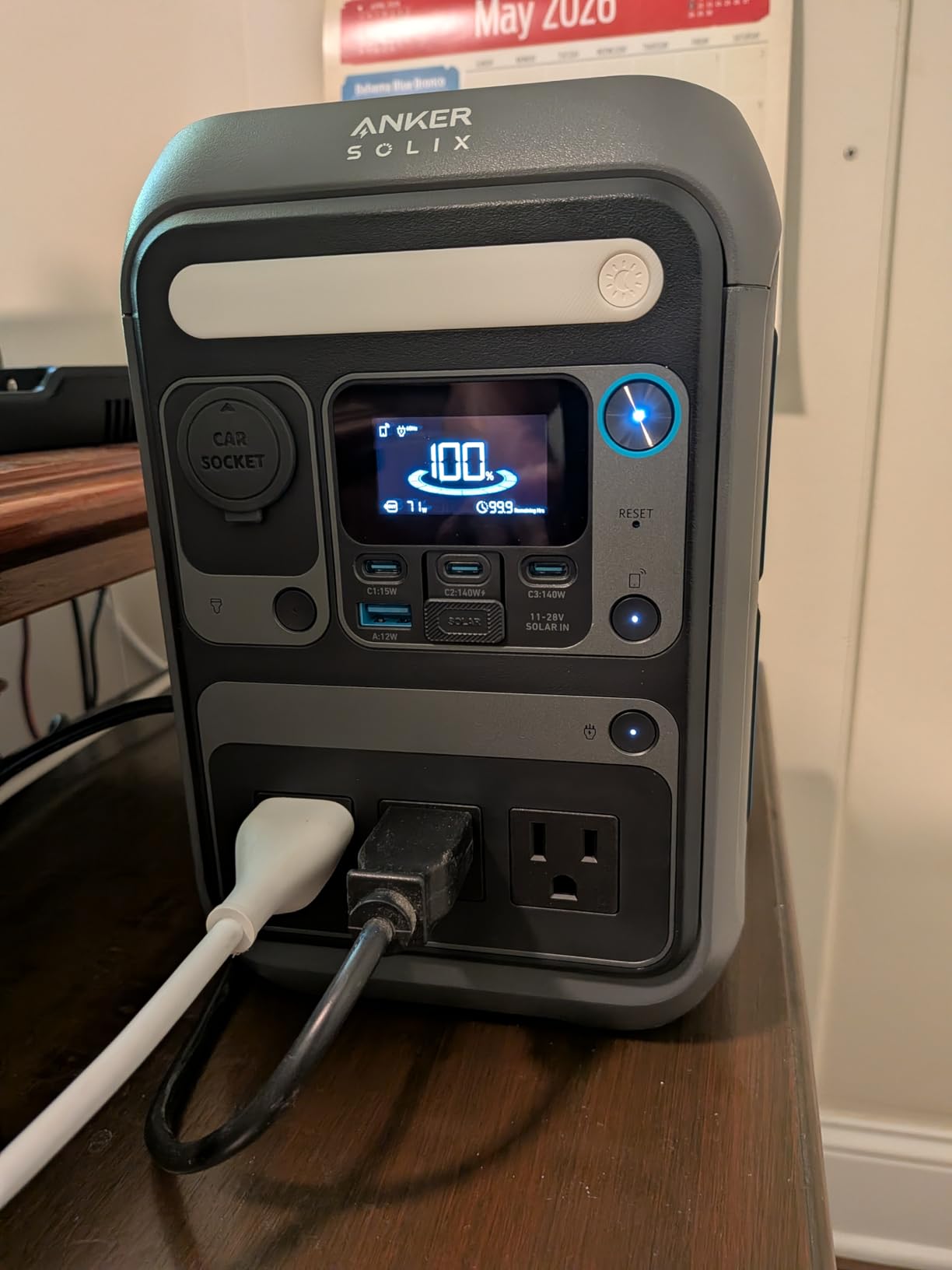
At 9.1 lb and 15% smaller than comparable designs, it is a genuine indoor unit rather than a garage-only one. Running noise low enough to sit in a bedroom matters if the outage lands at night and the station is the one charging the CPAP machine.
The battery is LiFePO4 rated for 3000 cycles with smart temperature control, backed by a five-year warranty. The constraints are size and ecosystem: the shoulder strap is sold separately, and it will not accept Anker SOLIX PS30, PS200 or PS400 panels.
Who this station suits
Remote workers, photographers and campers whose load is electronics rather than appliances. The two-way 140W USB-C ports also make it a good travel companion for anyone who would rather not carry four separate chargers.
Where it falls short
288Wh will not run a refrigerator or a space heater for long, and 300W of continuous output is a hard ceiling. Solar input is limited to 100W and excludes three of Anker’s own panel models, which is frustrating if you already own a larger SOLIX panel.
10. BLUETTI Elite 100 mini — Best 1kWh in the Smallest Footprint
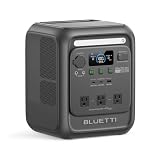
BLUETTI Elite 100 mini Portable Power Station for Camping 1004.8Wh 700W LFP
1004.8Wh LiFePO4
700W AC, 1400W surge
6000+ cycles
0-80% in 1.5 hr
23.5 lb
Pros
- Compact 1kWh capacity in a 23.5 lb vertical footprint
- 6000+ cycle LFP battery advertised for up to 17 years
- 140W USB-C fast charging plus three 700W AC outlets
- 10ms UPS keeps CPAP routers and laptops running
- 0-80% recharge in about 1.5 hours
Cons
- 700W continuous output limits it to small appliances and electronics
- Only three AC outlets for a full-size unit
- Waveform is not confirmed as pure sine wave for sensitive equipment
The Elite 100 mini exists because most 1kWh stations are shaped like suitcases. This one is a vertical tower at 23.5 lb, and BLUETTI describes it as roughly 45% smaller and 36% lighter than comparable 1kWh units. In a hallway, a closet or a small apartment, that footprint is the entire selling point.
Inside is 1004.8Wh of LiFePO4 rated for more than 6000 cycles, which BLUETTI translates to a lifespan of up to 17 years of daily use — the highest cycle rating in this roundup. Output is 700W continuous with 1400W surge, plus 140W USB-C fast charging and multiple DC ports.
Recharge takes about 1.5 hours from 0 to 80%, and the 10ms UPS switchover keeps a CPAP machine, a router or a laptop running through an outage. Idle consumption is listed under 10W, one of the lowest figures here, which preserves more of the rated capacity overnight than most rivals.
What you give up for that size is output headroom. 700W continuous means a refrigerator will start but a microwave will not, and three AC outlets is thin for a full-size unit. Buyers of sensitive medical or audio gear should verify the waveform with the manufacturer first.
Who this station suits
Apartments, small offices and camper interiors where floor or shelf space is the constraint. It suits anyone who wants 1kWh of banked energy without a 37 lb box, and it can stay plugged in indefinitely without meaningful self-discharge.
Where it falls short
700W is modest next to the 1800W and 2000W units in the same capacity class. With only three AC outlets, larger device counts need USB ports instead, and the pure sine wave question is worth resolving before you commit if a medical device is involved.
11. BLUETTI AC200PL — The Most Capable Unit You Can Fit Under the Cap
BLUETTI AC200PL Portable Power Station 2304Wh 2400W LiFePO4 Solar Generator
2304Wh LiFePO4
2400W AC, 3600W lifting
1200W solar
expands to 8448Wh
72 lb
Pros
- 2304Wh with 2400W continuous output in this bracket
- 0-80% AC recharge in about 60 minutes
- 1200W solar input for a 1.9-3.8 hour full charge
- 11 ports including a 30A TT30 RV port and 48V DC
- Expands to 8448Wh with B300 B210P or B230 packs
Cons
- 72 lb is a two-person carry
- Inverter noise is audible under heavy load
- Front ports lack protective flip covers
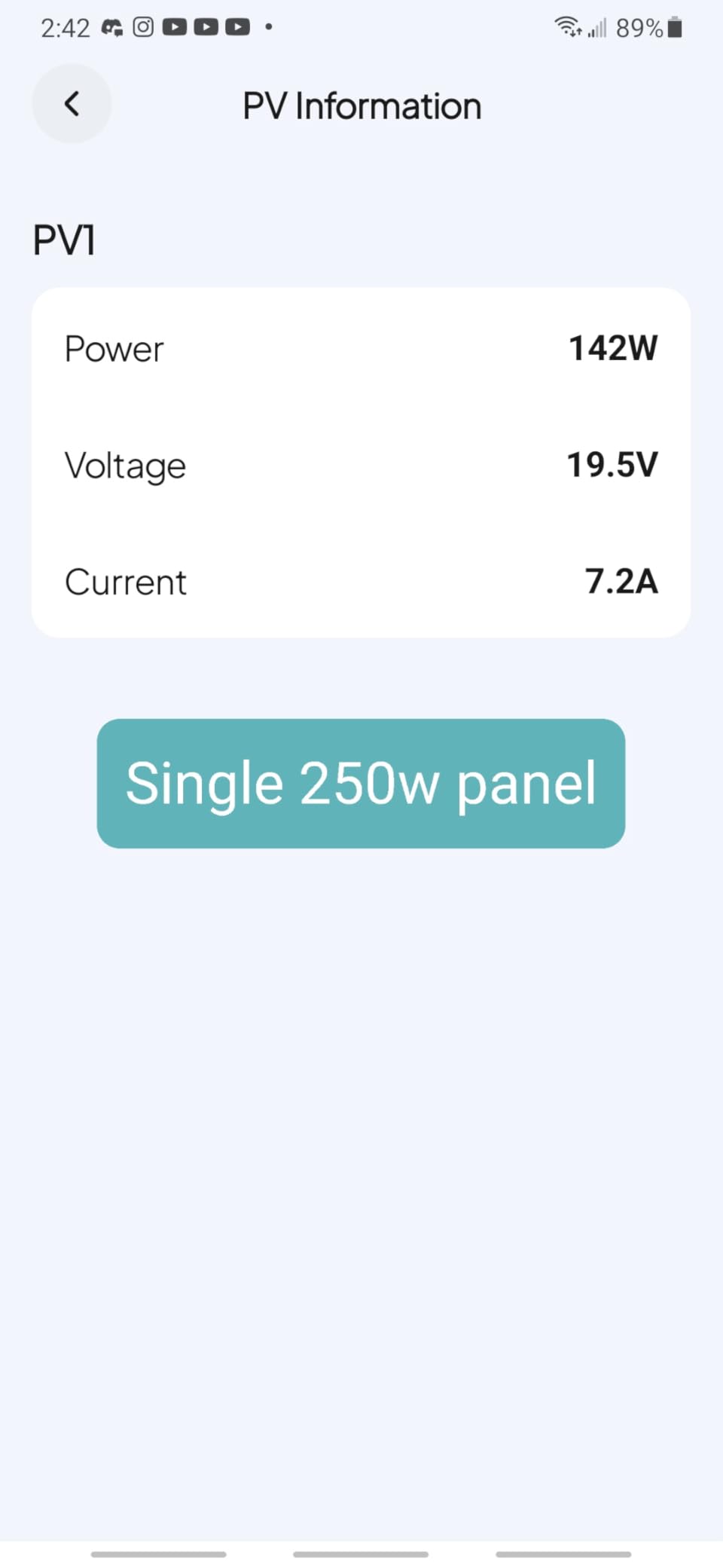
The AC200PL is the reason the ceiling is worth arguing about. At 2304Wh and 2400W of continuous AC output, it is the only unit in this roundup that can carry a short kitchen or utility load rather than just a list of small essentials. It is also the only one you can grow to 8448Wh with expansion batteries, which changes what the purchase means over a decade.
Recharge is 60 minutes from 0 to 80% on AC, and solar input reaches 1200W, so a full charge takes roughly 1.9 to 3.8 hours depending on conditions. The port count is eleven, including four 2400W AC outlets, a 30A TT30 RV port, a 48V DC output, a car socket, two 100W USB-C PD ports and two USB-A ports.
The battery is LiFePO4 rated for 3000+ cycles with a stated ten-year lifespan, backed by a five-year warranty and full-scale BMS protection. Sub-10ms UPS support is included, so it can carry networking or a small server through short interruptions.
Buyers consistently treat this as the value pick of the large class, and the objections are physical rather than electrical. At 72 lb it is a two-person lift, the inverter is audible under sustained heavy load, and the front sockets sit without protective flip covers. Ours is a garage or shop unit, not a living-room one.
Who this station suits
Households that want a refrigerator, freezer, sump pump, internet gear and lights through a multi-day outage without thinking about it. It also suits RV and off-grid builds that need a 30A port and 48V DC output, and buyers who intend to add expansion packs later.
Where it falls short
Weight is the dealbreaker for anyone without a second pair of hands or a dolly. It also does not fix the ceiling problem for whole-home use — this much capacity still cannot carry central air, electric resistance heating or a well pump for long.
12. EcoFlow RIVER 3 — Best Always-On Router and Network Backup
EF ECOFLOW Portable Power Station RIVER 3, 245Wh 550W
245Wh LFP
300W AC, 600W with X-Boost
1 hr wall charge
IP54
7.8 lb
Pros
- Only 7.8 lb with an integrated handle and 30% smaller than average
- GaN inverter doubles runtime on sub-100W appliances
- Full AC recharge in about an hour with one cable and no adapter
- Sub-20ms UPS switchover for routers and laptops
- IP54 rated and fireproof with drop resistance
Cons
- 300W ceiling stops space heaters and hair dryers
- OLED televisions can spike over 300W and shut it down
- X-Boost does not work while on AC charge
- No expansion slots and no wireless charging
The RIVER 3 is the most interesting small unit in this list because of its inverter. EcoFlow’s X-GaN technology is claimed to double runtime on appliances drawing under 100W, and in practice that means a router, a modem, a monitor and a laptop are the loads it serves best. As an always-on UPS for a home office, it is close to ideal.
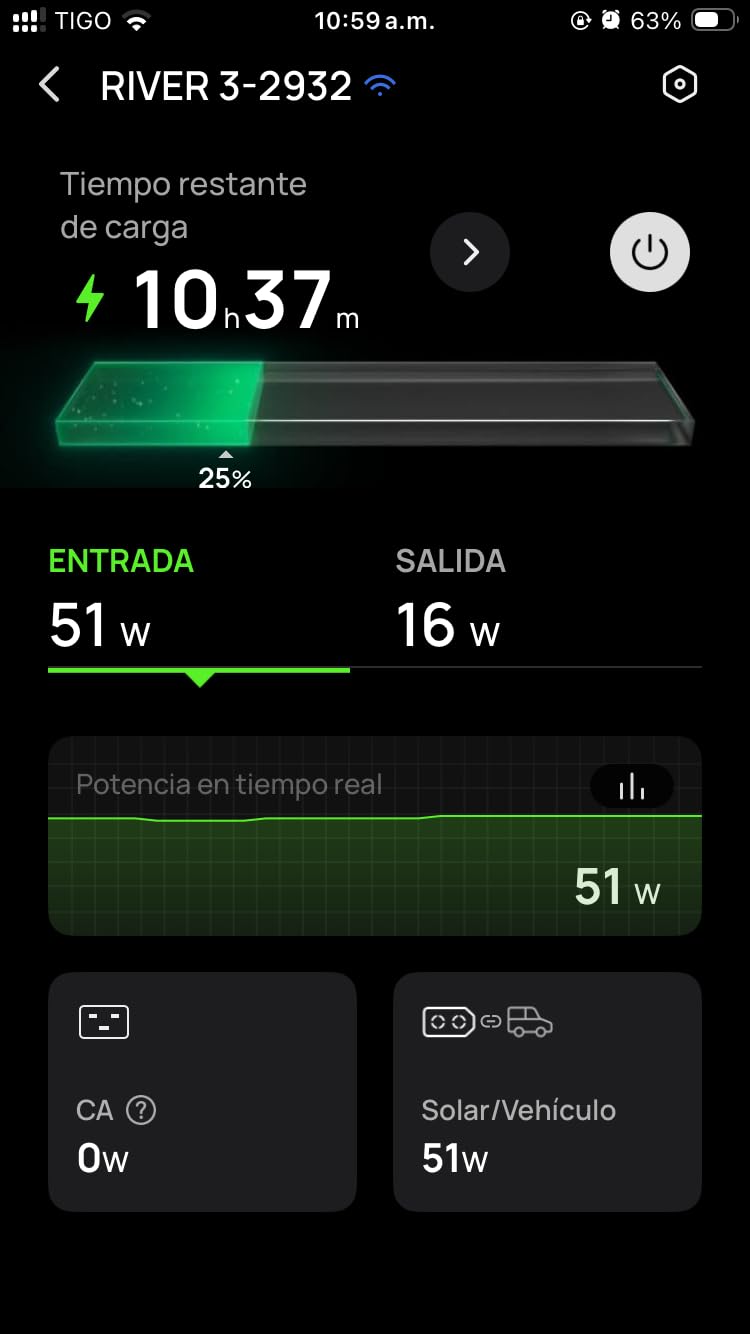
Capacity is 245Wh with 300W continuous output and 600W available through X-Boost. Wall recharge is a full 0 to 100% in about an hour with a single cable and no brick, solar input is 110W for roughly 2.6 hours, and switchover is under 20ms, or 10ms in some configurations.
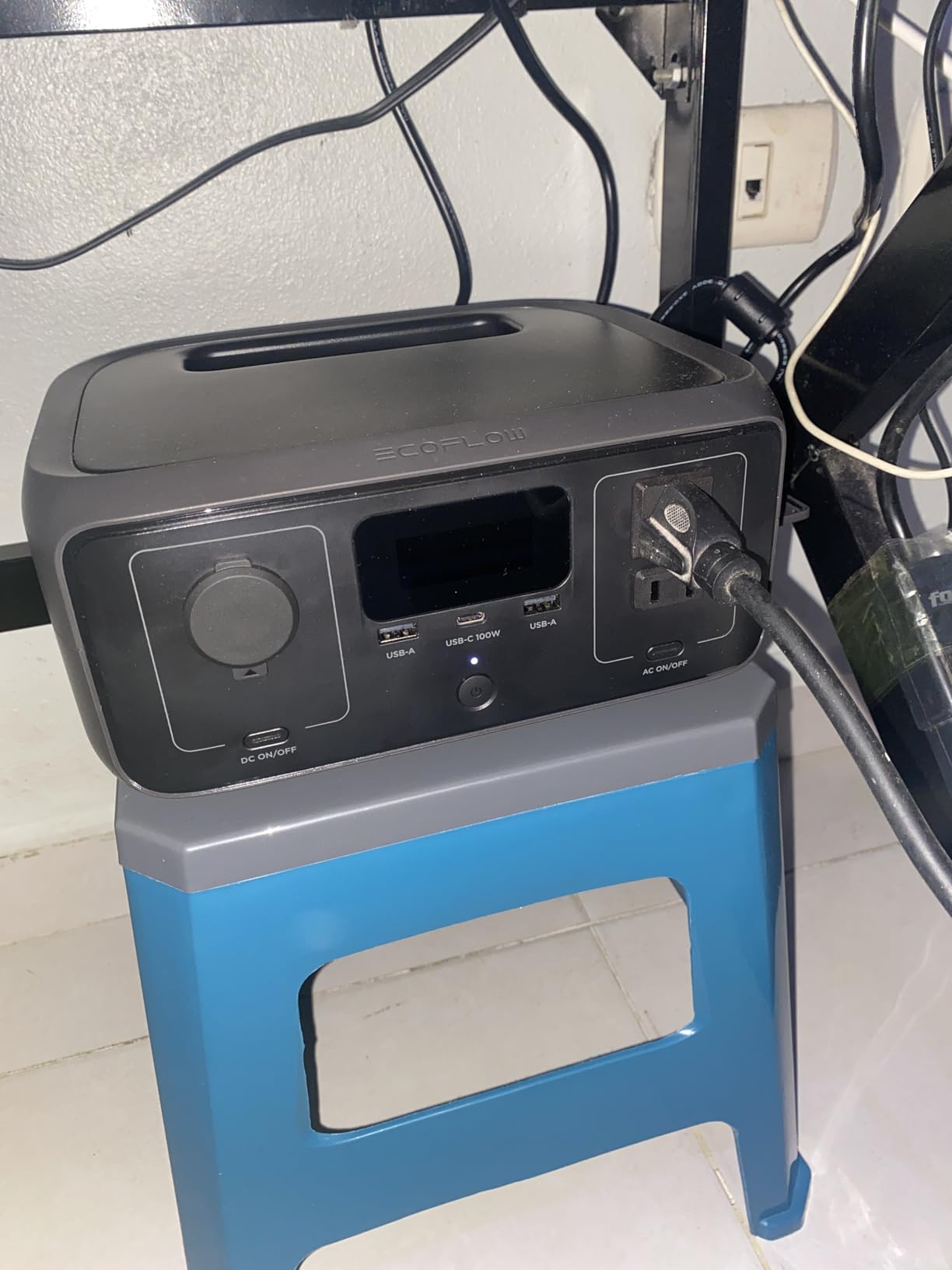
At 7.8 lb it is one of the lightest units here, with an IP54 rating, a fireproof and drop-resistant build, 40-plus safety protections and operating noise under 30dB. The app exposes Wi-Fi status, charge limits and slow or fast charging control, which is more granular than most competitors offer.
Two behaviours catch people out. X-Boost does not work while the unit is on AC charge, which is exactly the scenario UPS buyers care about, and an OLED television drawing over 300W can trigger a shutdown. There are also no expansion slots, no LED light and a single 100W USB-C port.
Who this station suits
Home offices, apartment residents and van lifers whose outage load is networking, a laptop and small electronics. If your backup list is under 100W per device, the GaN efficiency means the small capacity goes much further than the watt-hour number suggests.
Where it falls short
245Wh gives about two hours under meaningful load. It cannot run a fridge, a space heater or a hair dryer, and a modern OLED television may trip the shutdown. The two-year warranty is also the shortest on this list alongside the ALLWEI.
What This Budget Does Not Buy
Being clear about the ceiling saves a lot of disappointment. Nothing in this bracket, at any capacity, will run a whole house. Even the 2304Wh AC200PL runs out in hours against central air, electric resistance heating, a well pump or a sump pump cycling for days.
Also out of reach: sustained high-draw kitchen appliances. A microwave or an electric kettle will start on the 1800W and 2000W units and trip them on the 700W and 300W units. And if your plan involves wiring a station into household circuits, the ceiling is a safety question, not a budget one — that needs a transfer switch and an electrician.
How to Choose: Chemistry, Tiers and the Feature Checklist
Start with capacity tiers. Three classes cover everything in this list. The 256Wh to 300Wh class powers phones, cameras, laptops, a router and a CPAP machine for a night; think of it as a weekend or desk unit. The 1000Wh to 1150Wh class runs a refrigerator overnight, keeps internet alive for a day and carries a small medical load — this is the practical sweet spot and where most readers should start. The 2300Wh class adds a freezer, a sump pump and lights across a multi-day outage, at the cost of portability.
Do the runtime math before you buy. Divide watt-hours by your device wattage to get a theoretical number, then derate. Inverter conversion loss, idle draw and a usable-capacity cap of around 90% mean you should plan on roughly 80 to 85% of the headline figure. If your load list totals 300W, a 1070Wh station gives you about six to seven hours in practice, not ten.
Check chemistry first. Every unit in this list uses LiFePO4 cells rated between 3000 and 6000+ cycles, which is a decade of daily use rather than a few years. Our LiFePO4 portable power station guide covers why the chemistry matters for backup duty, where the cell chemistry is doing thermal work in a hot garage rather than a mild living room.
Then work down the feature checklist. Look for a pure sine wave inverter if you are running medical, audio or motorised equipment. Confirm continuous AC output against the largest motor you plan to run, and treat surge figures as headroom rather than as a running number. Check solar input wattage if panels are part of the plan, since 500W and 1200W inputs behave very differently from 100W. Verify UPS switchover time if you cannot tolerate a reboot, and confirm whether the unit supports expansion batteries if you may outgrow it.
Account for refill time. Outage readiness is not about capacity alone, it is about capacity times the number of times you can refill. A 1152Wh unit that recharges in an hour can be cycled through a long storm; a 999Wh unit that needs a full day of sun cannot. This is why the Anker SOLIX C1000 Gen 2 and the BLUETTI AC180 rank as highly as they do despite similar capacity. For a refrigerator-specific approach, our portable power stations for refrigerators guide works through startup surge in detail.
Finally, weigh the weight honestly. Anything above 30 lb changes its category. Below that, one person can move it between rooms during an outage. Above it, you are committing to a location before the storm, which is sometimes exactly what you want. If the station will live in a vehicle, treat anything above 25 lb as a two-person lift and plan accordingly.
Safety Rules Before an Outage
First, the advantage over a gas generator is real but specific: there is no combustion, so there is no carbon monoxide risk indoors, and that is why these units are safe to run inside a home. Keep the unit itself ventilated anyway, away from bedding or enclosed cabinets, and never charge it on an uninflatable surface overnight.
Second, do not connect a portable power station to household wiring without a transfer switch and a licensed electrician. Back-feeding a panel without one creates a serious hazard for lineworkers and for anyone who works on the wiring during an outage. This is the single most misunderstood safety point in the category.
Third, check the waveform for sensitive loads. Pure sine wave output is what medical devices, audio equipment and variable-speed motors need; a minority of units in this bracket are not confirmed as pure sine wave, so verify before connecting. And never attempt to start a refrigerator and a microwave on the same 300W unit.
Frequently Asked Questions
Which brand of portable power station is the most reliable?
Reliability tracks warranty length and cycle rating more than brand name. In this roundup, BLUETTI, EcoFlow and Anker all offer five-year warranties, while GRECELL and the EcoFlow RIVER 3 carry two. Jackery states over 4000 cycles to 70% capacity and BLUETTI quotes 3000 to 6000+ depending on model. The largest verified review counts here sit with Jackery, so its long-term data is the deepest available.
Is Jackery or Anker better?
Jackery leads on proven volume and faster app-based charge modes, with the Explorer 1000 v2 offering 1500W from 1070Wh and 4000+ cycle life. Anker leads on recharge speed and quiet operation, with the SOLIX C1000 Gen 2 reaching a full charge in 49 minutes and running near-silently. For outage prep choose Anker for refill speed; for camping and long-term ownership confidence choose Jackery.
What is the best budget portable power station?
The ALLWEI 256Wh is the entry-level pick in this roundup, and it is one of the few budget units that uses LiFePO4 cells rated for 3000 cycles rather than cheaper chemistry. At 6.4 lb with six outputs including 60W USB-C PD, it covers phones, cameras, a router, lights and a CPAP machine. If your load includes a laptop for a full workday, step up to the EcoFlow RIVER 2 or Anker SOLIX C300 instead.
Is Jackery or EcoFlow better?
EcoFlow generally leads on charging speed and inverter technology, with 0-80% in 45 minutes on the Delta 3 Classic and a GaN inverter in the RIVER 3. Jackery leads on app-controlled charging modes, port selection and a deeper long-term review record, with more than 11,000 reviews on the Explorer 300 alone. EcoFlow for speed and solar intake, Jackery for proven durability and control.
What is the best affordable portable power station?
Affordability depends on runtime needs. For electronics only, the EcoFlow RIVER 2 at 256Wh and 7.7 lb gives six outlets, a one-hour wall recharge and a five-year warranty. For genuine backup capability at a mid-level outlay, the BLUETTI AC180 at 1152Wh and 1800W is the better value because it refills in about an hour from a wall and roughly three hours on 500W of solar.
What is the best portable power generator under $1000?
The best portable power stations under $1000 divide into three answers. The Jackery Explorer 1000 v2 is the best overall balance of capacity, output and weight. The BLUETTI AC180 is best when solar is central to the plan, with 500W input. The BLUETTI AC200PL delivers the most capability at 2304Wh and 2400W, and is the only pick that expands further. Full comparison above.
Can a portable power station under $1000 run a refrigerator during an outage?
Yes, with the right tier. A 1070Wh station such as the Jackery Explorer 1000 v2 runs a typical 150W refrigerator compressor for roughly six to seven hours after derating, and the Anker SOLIX C1000 Gen 2 is reported by owners to cover six to twelve hours. Check startup surge, since compressors can draw three times running wattage at start. Avoid 256Wh units, which run a fridge for well under an hour.
Bottom Line
The best portable power stations under $1000 come down to one honest question: how big is your load list. For most households, the Jackery Explorer 1000 v2 is the answer — 1070Wh, 1500W of pure sine wave output, 23.8 lb and a battery rated past 4000 cycles, with the deepest review base in the class behind it.
Add solar to your plan and the BLUETTI AC180 takes over, thanks to 500W solar input and a one-hour wall recharge. Need maximum capacity without breaking the ceiling, and able to grow later? The BLUETTI AC200PL at 2304Wh and 2400W is the only pick that carries a real utility load and expands to 8448Wh.
For pure portability, the ALLWEI, Jackery Explorer 300, EcoFlow RIVER 2, EcoFlow RIVER 3 and Anker SOLIX C300 all sit under 10 lb and serve electronics rather than appliances. Pick the one whose port mix matches your gear, charge it fully before the forecast turns, and it will be ready when the lights go out.