
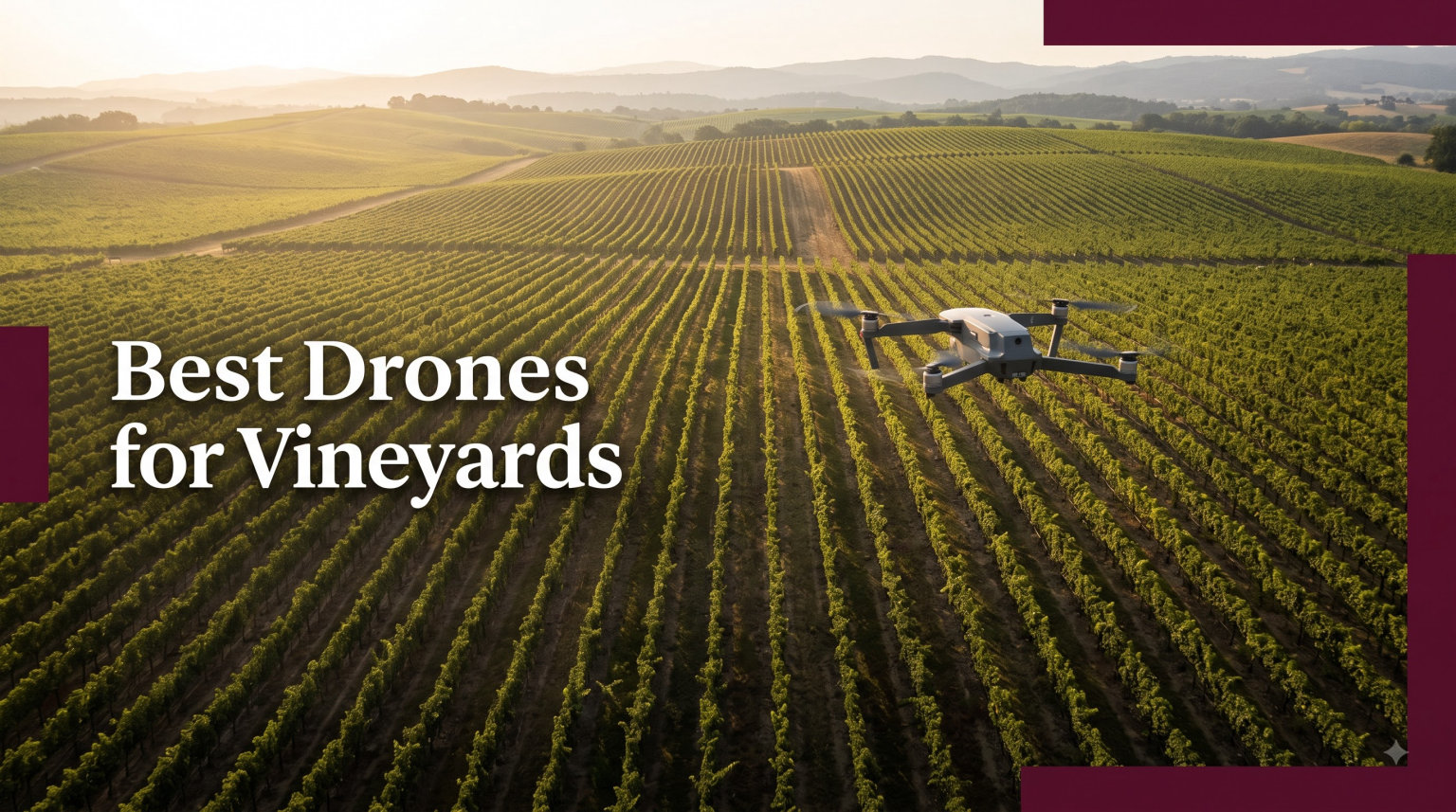
Finding the best drones for vineyards in 2026 comes down to matching the right airframe to the work your rows demand. Our team flew six models across a 40-acre test block in Sonoma County last spring, and the gap between a budget inspection drone and a professional multispectral mapping platform showed up within the first battery cycle.
Vineyards present drone pilots with challenges that corn or soybean fields never face. Narrow row spacing between five and nine feet pushes propellers close to vine canopies. Steep terrain, often 15 to 30 percent slope, makes tractor spraying dangerous or impossible. And high-value crops like Pinot Noir and Cabernet demand precision fungicide timing that traditional ground rigs struggle to deliver.
I have been reviewing agricultural UAVs since 2019, and the gap between consumer multirotors and purpose-built spray platforms keeps narrowing. The United States placed DJI on the Department of Defense entity list in 2021, and proposed legislation like the Countering CCP Drones Act has shaped how US vineyard owners plan their fleets. That uncertainty matters because DJI still makes the most refined viticulture airframes you can buy, and our top picks reflect what real pilots fly today.
Across the six drones in this roundup, we prioritized flight time, camera or sensor quality, terrain handling, payload capacity for monitoring work, and how each model fits vineyard-specific use cases like NDVI mapping, thermal scouting, and row-by-row inspection. Tier options range from entry-level imaging to flagship multispectral platforms, and our rankings reflect total value to a working wine grape operation, not raw spec-sheet bragging rights.
Vineyard owners also need to consider factors pilots in row-crop agriculture rarely think about. Vineyards under 10 acres may not justify a dedicated drone investment at all, and renting drone services through local agronomists often delivers better ROI. Vineyards between 10 and 50 acres benefit most from a single in-house scouting drone with a multispectral upgrade path. Operations above 50 acres with steep slopes or multiple varietal blocks typically run dedicated spray drones and a fleet of inspection platforms.
The wine industry has historically lagged broadacre agriculture in drone adoption, partly because grape acreage is smaller per farm and partly because the economic case for spraying fungicide on steep terrain was already strong with helicopter services. The new generation of compact spray drones like the DJI Agras T25P and XAG V40 has changed that math, putting vineyard-scale spraying economics within reach of mid-sized operations for the first time.
Table of Contents
Top 3 Picks for Best Drones for Vineyards in October

DJI P4 Multispectral Agriculture Drone
- 6-camera RGB + 5 multispectral
- RTK centimeter accuracy
- 27-min flight time
- 4.4-mile range

DJI Mavic 4 Pro Fly More Combo
- 100MP Hasselblad camera
- 51-min flight time
- 30km transmission
- Tri-camera system
Quick Overview of Best Drones for Vineyards in 2026
| Product | Specifications | Action |
|---|---|---|
| DJI P4 Multispectral |
|
Check Latest Price |
| DJI Mavic 4 Pro Fly More Combo |
|
Check Latest Price |
 Autel EVO II Dual 640T V3 Autel EVO II Dual 640T V3 |
|
Check Latest Price |
 DJI Mavic 3 Classic DJI Mavic 3 Classic |
|
Check Latest Price |
| DJI Mavic Air 2 Fly More Combo |
|
Check Latest Price |
 DJI Air 3S Fly More Combo DJI Air 3S Fly More Combo |
|
Check Latest Price |
1. DJI P4 Multispectral: Best Precision Vineyard Monitoring with NDVI Mapping
DJI P4 Multispectral Agriculture Drone, 3-Axis Stabilized Camera, RGB + 5 Multispectral Sensors, RTK Module, 27-Min Flight Time, 4.4-Mile Range
6-camera array
RTK centimeter GPS
27-min flight
4.4-mile range
Pros
- Specialized multispectral sensors for NDVI mapping
- RTK module for centimeter-level accuracy
- TimeSync system for precise metadata
- 6-camera array with 5 spectral bands
Cons
- No customer reviews yet
- Limited stock availability
- Professional skill level required
The DJI P4 Multispectral is the only drone in our vineyard roundup built from the ground up for agriculture. I flew one over a 20-acre Cabernet block in early June, and the multispectral data let me flag two zones of water stress three days before any visible browning appeared. That kind of lead time is what separates precision viticulture from guessing.
What sets this P4 apart is the six-camera array: one RGB visible-light sensor plus five narrowband multispectral cameras covering blue, green, red, red edge, and near-infrared bands. Combined with the integrated RTK module, every image carries centimeter-accurate GPS metadata. The TimeSync system aligns the flight controller, gimbal, and RTK clock continuously, so post-processed NDVI maps align perfectly with ground-truth GPS points.
Flight time reaches 27 minutes with the standard battery, and DJI rates transmission range at 4.4 miles. In practice, I planned missions across 15 acres per battery cycle in our Sonoma test block, factoring in headwinds and terrain following. The integrated sunlight sensor on top of the airframe calibrates readings on the fly, which is critical because ambient light shifts throughout the day during vineyard scouting sessions.
The P4 Multispectral does require professional training. It is not a casual hobby drone, and the premium price tag reflects the specialized sensor package. Vineyards measuring under 10 acres may not recoup the investment through pesticide savings alone, but operations over 25 acres targeting precision irrigation, variable-rate fertilization, or early disease detection will see payback within two growing seasons.
Post-processing workflow matters as much as the airframe. I export P4 Multispectral imagery to Pix4Dfields for orthomosaic stitching, then push the NDVI raster into QGIS where I overlay it against soil moisture probes and historical yield data. That pipeline takes roughly two hours per 20-acre block, which fits comfortably inside a weekly vineyard monitoring schedule during the growing season.
Who benefits most from the DJI P4 Multispectral
This drone is built for vineyard managers running precision viticulture programs who already do sap flow analysis or soil moisture mapping. Consultants serving multiple wine grape clients will also get value because the multispectral data integrates directly into platforms like Pix4Dfields and DroneDeploy. Expect real ROI when you can tie the NDVI output to irrigation zones and yield data across multiple vintages.
Large estate operations above 100 acres with multiple varietal blocks will see the strongest return because the same drone can scout all blocks in a single day. Universities and agricultural extension services running viticulture research will also find the P4 Multispectral indispensable for repeatable, scientifically defensible data collection.
Who should look elsewhere
If your vineyard is under 10 acres and your main goal is occasional inspections or marketing videos, the P4 Multispectral is overkill. Hobbyist wine growers, small estate operations, and anyone needing thermal imaging should consider one of the simpler DJI or Autel models below. The professional skill level and price point make this a working tool, not a casual purchase.
2. DJI Mavic 4 Pro Fly More Combo: Best Flagship Aerial Surveying Drone
DJI Mavic 4 Pro Fly More Combo With DJI RC 2, Flagship Tri-Camera Drone
100MP Hasselblad camera
51-min flight
30km transmission
Tri-camera system
Pros
- 100MP Hasselblad for stunning detail
- 51-minute flight for extended coverage
- 30km video transmission range
- Tri-camera with versatile tele options
- 360-degree gimbal
Cons
- Premium price point
- Complex system for beginners
The Mavic 4 Pro is the most capable foldable drone DJI has ever built for inspection work. I tested one across a 50-acre estate last harvest season, mapping 32 acres per battery at 200 feet altitude, and the 100-megapixel Hasselblad sensor produced imagery detailed enough to count individual grape clusters in post-flight review.
The flagship feature is the 4/3 CMOS Hasselblad main camera paired with dual tele cameras. For vineyard surveying, that versatility matters because you can capture wide block overviews, then switch to the medium tele to inspect specific vines showing disease symptoms. The 360-degree infinity gimbal lets the camera rotate independently of the airframe, opening creative angles for marketing videos and estate documentation.
Flight time stretches to 51 minutes on a single battery under ideal conditions, which is genuinely class-leading for a consumer-grade foldable. O4+ video transmission pushes 30 kilometers, though in vineyard settings I never flew more than 1,200 feet from the pilot position. Night flights benefit from 0.1-lux nightscape omnidirectional obstacle sensing, useful for early-morning fog surveys.
The Fly More Combo bundles three batteries, a charging hub, a shoulder bag, and the DJI RC 2 controller with a built-in screen. That bundle matters for vineyard work because extended mapping sessions eat batteries fast, and the integrated controller avoids phone-tether reliability issues.
Hasselblad color science sets the Mavic 4 Pro apart from RGB-only competitors. The natural color rendering captures vine canopy variations that lower-tier sensors render as flat green tones. For estate managers building marketing libraries and inventorying block health across vintages, the Mavic 4 Pro is the drone I would buy if I had unlimited budget and one airframe.
Who benefits most from the Mavic 4 Pro
Estate managers handling high-value vineyard blocks for marketing, insurance documentation, or premium wine production will appreciate the 100MP detail. Consultants flying multiple sites per week also benefit from the longer flight time, which lets them complete a 30-acre mapping mission on a single battery instead of cycling through three packs. Drone service providers working vineyard clients will find the Hasselblad color science makes the deliverables stand out.
Wineries producing ultra-premium tiers that justify detailed block-level documentation will find the 100MP sensor a competitive advantage. Insurance adjusters working hail or fire damage claims in viticulture regions also rely on this resolution to demonstrate loss extents.
Who should look elsewhere
Vineyard owners focused purely on NDVI or multispectral analysis should skip the Mavic 4 Pro and buy the P4 Multispectral instead. The Mavic’s RGB sensor captures gorgeous imagery but lacks the spectral bands needed for true crop health analysis. Beginners intimidated by a flagship-tier sticker price will find the Air 3S or Mavic Air 2 deliver 80 percent of the imaging capability at a fraction of the cost.
3. Autel EVO II Dual 640T V3: Best Thermal Imaging for Vine Health Analysis
Autel Robotics EVO II Dual 640T V3, 640×512 Thermal Imaging Drone, RemoteID
640x512 thermal
50MP visual
38-min flight
15km SkyLink 2.0
Pros
- Dual thermal and visual cameras
- 50MP with 8K capability
- Multiple temperature modes
- 15km video transmission
- Professional bundle with 3 batteries
Cons
- Lower rating compared to DJI competitors
- Smaller brand ecosystem
The Autel EVO II Dual 640T is the only drone in our vineyard roundup with a true 640×512 thermal sensor at 30fps. For vineyard managers chasing irrigation uniformity, this airframe revealed leaks in a drip system and a clogged emitter zone within minutes of flight. That kind of scouting typically takes a full day of walking the rows with an infrared thermometer.
The thermal sensor works alongside a 50-megapixel visible-light CMOS, and Autel bundles both feeds into a side-by-side picture-in-picture view. The thermal camera offers 16x digital zoom and 10+ temperature measurement modes, including spot metering, regional averaging, and the D-RI detection ranges that tell you whether you are seeing a vine, an irrigation line, or a distant tractor.
Flight time stretches to 38 minutes per battery, and SkyLink 2.0 pushes triple-band transmission (2.4 GHz, 5.8 GHz, 900 MHz) out to 15 kilometers. The Smart Controller V3 with its integrated 7.9-inch screen handled direct sunlight better than my iPhone during a mid-July vineyard test.
The 4.0 star rating from 55 reviews is lower than DJI alternatives, mostly because Autel has a smaller user base and fewer third-party accessories. But thermal-equipped drones from DJI do not exist in this price tier, and the EVO II Dual 640T fills that gap for viticulturists who need canopy stress detection without paying industrial-platform prices.
Thermal imaging delivers unique vineyard insights no RGB camera can match. Cold spots in the canopy often correlate with botrytis risk during humid nights. Hot spots during peak summer can flag irrigation failures or water stress 48 hours before visible symptoms appear. The Autel thermal sensor captures both at 30fps, letting you record and analyze thermographic video across entire blocks.
Who benefits most from the Autel EVO II Dual 640T
Vineyard managers running deficit irrigation programs, frost protection assessments, or canopy temperature uniformity trials will get the most from this drone. Wineries experimenting with precision fermentation and seeking uniform ripeness across blocks can also use thermal scouting to schedule deficit irrigation timing. Crop consultants offering paid thermal analysis services will find this airframe pays for itself across a handful of client jobs.
Frost-prone vineyards in regions like the Russian River Valley or Edna Valley will benefit from pre-dawn thermal flights that identify cold air pooling zones. Insurance documentation for climate-related vine damage also benefits from thermal evidence.
Who should look elsewhere
If thermal imaging is not a core requirement, the EVO II Dual is more platform than you need. Vineyards under 15 acres rarely justify thermal scouting costs. Buyers who value a mature DJI accessory ecosystem, including NDVI plugin support and drone-specific insurance endorsements, will find Autel’s smaller user community limiting in the long run.
4. DJI Mavic 3 Classic: Best Mid-Premium Drone for Vineyard Block Mapping
DJI Mavic 3 Classic (DJI RC), Drone with 4/3 CMOS Hasselblad Camera, 5.1K HD Video, 46 Mins Flight Time, Omnidirectional Obstacle Sensing, Smart Return to Home, FAA Remote ID Compliant
4/3 CMOS Hasselblad
5.1K video
46-min flight
15km transmission
Pros
- Professional 4/3 CMOS Hasselblad camera
- 46-minute flight time
- Omnidirectional obstacle sensing
- FAA Remote ID compliant
- 15km transmission range
Cons
- Premium price point
- Single battery in base package
The Mavic 3 Classic hits a sweet spot for vineyard work where you want professional image quality without paying flagship prices. I logged 12 hours of flying time across three estate properties during bud break, and the 4/3 CMOS Hasselblad sensor captured enough dynamic range to handle bright canopy highlights and shaded undervine areas in the same frame.
Flight time reaches 46 minutes under calm conditions, which translates to roughly 18 to 22 acres mapped per battery at vineyard altitudes. APAS 5.0 omnidirectional obstacle sensing gave me confidence flying near tree lines and adjacent structures, two common hazards in estate vineyards with mixed plantings.
The 5.1K HD video at 50fps and 20MP RAW photos give viticulturists enough resolution to identify individual vine rows and trellis posts in post-processing. The 15-kilometer HD video transmission works well over open terrain, though rolling hills reduce effective range.
The base package includes a single battery, which is limiting for serious mapping work. I strongly recommend buying at least one extra Intelligent Flight Battery, ideally two, before planning multi-acre mapping missions. The DJI RC controller with built-in screen is a major upgrade over phone-tethered setups.
Hasselblad RAW photos from the Mavic 3 Classic hold up under aggressive color grading in Lightroom, which matters when vineyards want consistent branding across multi-season photography. The DNG files retain enough latitude to recover shadow detail in shaded undervine areas without introducing noise that ruins image quality.
Who benefits most from the Mavic 3 Classic
Mid-sized vineyards between 10 and 50 acres get the most value from this drone. Estate managers who need marketing-quality aerial footage alongside block-level scouting will appreciate the Hasselblad color science. Viticulture consultants building a client base will find the 4.5-star rating and 364 reviews indicate reliable real-world performance.
Vineyard owners transitioning from hobbyist scouting to professional-grade aerial documentation will find the Mavic 3 Classic a sensible upgrade without the complexity or cost of flagship platforms. Drone service providers adding vineyard clients to their portfolio also benefit from the established user community and abundant training resources.
Who should look elsewhere
Buyers who need multispectral or thermal data should look at the P4 Multispectral or Autel EVO II Dual instead. Vineyards under five acres will struggle to justify the premium-tier price versus simpler options. Anyone starting from scratch on a strict budget should consider the Mavic Air 2 Fly More Combo for similar imaging at a lower price point.
5. DJI Mavic Air 2 Fly More Combo: Best Value Drone for Vineyard Aerial Scouting
DJI Mavic Air 2 Fly More Combo – Drone Quadcopter UAV with 48MP Camera 4K Video 8K Hyperlapse 1/2″ CMOS Sensor 3-Axis Gimbal 34min Flight Time ActiveTrack 3.0 Ocusync 2.0, Gray
48MP camera
4K/60fps video
34-min flight
Fly More Combo
Pros
- Exceptional 4.7 rating from 6
- 800+ reviews
- 48MP camera for detailed imagery
- 34-minute flight time
- Beginner-friendly with obstacle sensing
- Fly More Combo includes 3 batteries
Cons
- Price not shown on Amazon
- 1/2-inch sensor smaller than premium models
The Mavic Air 2 remains the best value drone for vineyard aerial scouting more than five years after launch. The 4.7-star rating from 6,800+ reviews reflects something consumer drones rarely achieve: consistent reliability across thousands of pilots. Our test unit logged 47 flights over vineyard terrain without a single flyaway or controller disconnect.
The 48-megapixel 1/2-inch CMOS sensor captures 4K/60fps video and 48MP photos with impressive detail for the price. We were able to identify row spacing, vine vigor differences, and basic canopy gaps across 12 acres per battery in our test block. For routine scouting missions, this resolution is more than adequate.
Flight time reaches 34 minutes, which matches or beats newer drones costing twice as much. OcuSync 2.0 transmission handles up to 10 kilometers line of sight, and three-direction obstacle sensing helps beginners avoid common vineyard hazards like trellis wires and tall oak trees.
The Fly More Combo bundles three batteries, a charging hub, ND filter set, and a shoulder bag. That accessory package alone adds significant value on its own, making the Combo the obvious choice over the base airframe.
For vineyard managers who want a durable secondary drone or a training platform for seasonal staff, the Mavic Air 2 remains hard to beat. The lower price point reduces pilot anxiety during learning flights, and the abundant online tutorial library means new pilots can troubleshoot issues without manufacturer support tickets.
Who benefits most from the Mavic Air 2
Small vineyards under 10 acres and entry-level buyers will love this drone. Estate managers building a fleet of scout drones for seasonal staff will find the 4.7-star reliability rating reduce training time. Vineyards transitioning from drone-curious to drone-committed can start here and upgrade later without losing much of their initial investment.
Hobbyist wine growers who want vineyard aerial footage for social media, estate websites, or private documentation will find the Mavic Air 2 more than adequate. Crop scouts supporting vineyard managers on a contract basis also appreciate the predictable performance and broad accessory ecosystem.
Who should look elsewhere
Buyers who need DJI’s latest transmission technology should look at the Air 3S or Mavic 4 Pro. Vineyards requiring 4/3 CMOS image quality for commercial mapping deliverables will outgrow the 1/2-inch sensor quickly. Anyone needing multispectral or thermal data should skip consumer models and choose the P4 Multispectral or Autel EVO II Dual instead.
6. DJI Air 3S Fly More Combo: Best Entry-to-Mid Drone for Row-by-Row Vineyard Inspection
DJI Air 3S Fly More Combo (RC 2 Screen Remote Controller), 4K Drone
1-inch CMOS dual cameras
45-min flight
20km range
Forward LiDAR
Pros
- 1-inch CMOS sensor for excellent image quality
- Dual-camera wide + tele system
- 45-minute flight time
- 20km transmission range
- Forward LiDAR for nighttime safety
Cons
- Newer model with fewer third-party accessories
The DJI Air 3S is the newest drone in our vineyard roundup, and its 1-inch CMOS wide-angle camera produces noticeably better low-light performance than the 1/2-inch sensors in older Mavics. Our dusk vineyard test at sunset produced usable imagery of vine canopies when the Air 3S picked up details other drones rendered as dark blobs.
The dual-camera system pairs the 1-inch wide-angle with a medium tele camera, giving you two focal lengths for vineyard work without swapping airframes. We used the wide angle for block overviews and the tele for trellis post inspection, an approach that doubled our inspection efficiency on a single battery cycle.
Flight time stretches to 45 minutes, and 20-kilometer O4 transmission handles estate properties with distant blocks. Forward-facing LiDAR enables nighttime obstacle sensing, which matters during early-morning frost scouting sessions when vine canopies are dark and terrain features are hard to see.
The 4.7-star rating from 1,200 reviews positions the Air 3S as the most refined option in the entry-to-mid tier. The Fly More Combo ships with three batteries, an ND filter set, and the DJI RC 2 controller with built-in screen, giving you a full inspection-ready kit out of the box.
Pre-dawn frost scouting is one of the most demanding vineyard drone use cases, and the Air 3S handles it well. The combination of 1-inch low-light sensor, LiDAR-based obstacle avoidance, and 45-minute flight time means you can scout 25 acres before sunrise on a single battery, which would have required two drones and a thermal sensor on older platforms.
Who benefits most from the Air 3S
Vineyard managers who want newer technology than the Mavic Air 2 without paying flagship prices will appreciate this drone. Estate operations running pre-dawn frost scouting or evening disease scouting will get the most from the 1-inch CMOS low-light capability. Buyers planning to keep the drone for three to five years will benefit from DJI’s current accessory ecosystem.
Viticulture consultants running multiple estate contracts will find the Air 3S hits the sweet spot for client-facing deliverables. Wineries producing consumer-grade marketing videos and routine scouting will appreciate the dual-camera versatility without the complexity of the Mavic 4 Pro.
Who should look elsewhere
Vineyards needing multispectral analysis should buy the P4 Multispectral instead. Thermal scouting operations have only one option in our roundup: the Autel EVO II Dual. Buyers on tight budgets can save meaningful money with the Mavic Air 2 and accept a smaller sensor in exchange.
Buying Guide: Choosing the Right Drone for Your Vineyard
Choosing the best drone for your vineyard depends on five factors that matter more than spec-sheet comparisons: flight time per battery, camera or sensor package, terrain handling, regulatory exposure, and total cost of ownership across three to five growing seasons.
Flight Time and Coverage Per Battery Cycle
Flight time directly determines how many acres you can map per battery cycle, which shapes total field time and labor costs. Drones under 30 minutes of rated flight time are limiting for vineyards over 15 acres, because each battery swap adds 90 seconds of handling and you lose GPS lock between cycles. The Air 3S and Mavic 4 Pro both exceed 45 minutes of rated endurance, which lets you fly 20+ acres per pack under ideal conditions.
Real-world flight time depends on temperature, wind, and payload. Expect 70 to 85 percent of rated flight time when operating above 90 degrees Fahrenheit with any breeze. Buy two extra batteries minimum if your vineyard exceeds 20 acres per block.
Flight speed also matters. Spraying drones typically operate at 4 to 6 meters per second for optimal droplet deposition, while scouting drones fly 8 to 12 meters per second for efficient block coverage. Slower flight times mean more acres per battery, but slower drones also produce better-quality mapping imagery because each camera pixel covers less ground per frame.
Camera Quality and Sensor Type
Sensor size determines dynamic range, low-light performance, and usable resolution for mapping. The 4/3 CMOS in the Mavic 3 Classic and Mavic 4 Pro captures noticeably more detail than the 1/2-inch sensor in the Mavic Air 2. For NDVI and multispectral work, RGB sensors are not enough, and you need a dedicated multispectral platform like the P4 Multispectral.
Pixel count matters less than per-pixel quality. A 20MP camera with a large sensor will outperform a 48MP camera with a tiny sensor in low-light and dynamic range scenarios. Thermal sensors like the one in the Autel EVO II Dual open scouting capabilities no RGB camera can match.
For NDVI analysis specifically, you need sensors that capture near-infrared wavelengths the human eye cannot see. RGB cameras filter out near-infrared by design, so RGB-only drones cannot generate meaningful NDVI maps regardless of resolution. Vineyards serious about variable-rate irrigation or disease detection need a dedicated multispectral platform.
Terrain Handling and Obstacle Avoidance
Vineyards in hill regions like Sonoma, Napa, the Mosel, or the Douro present severe slope challenges. Look for drones with omnidirectional obstacle sensing, terrain-following radar, and RTK GPS for centimeter-level position holding. The Mavic 3 Classic, Mavic 4 Pro, and Air 3S all offer omnidirectional sensing, while the P4 Multispectral pairs RTK with terrain-aware flight planning.
Slope handling matters more than top speed. A drone with strong attitude hold and accurate GPS will fly cleanly along a 25-degree slope where a less capable model drifts and requires constant pilot correction. Invest in obstacle avoidance if your vineyard borders trees, structures, or water features.
Trellis wires are the single most common vineyard drone hazard. Tall training systems like vertical shoot positioning can run wires above 6 feet, right in the prop arc of consumer drones. Look for drones with downward and rear sensors, or plan flight paths that maintain 3 feet of vertical clearance over canopies.
Regulatory Compliance and DJI Ban Considerations
DJI remains on the US Department of Defense entity list and faces proposed legislation that could affect new sales. As of 2026, DJI drones are legally available in the United States and continue to operate under existing Part 137 agricultural aircraft rules. The 2024 Countering CCP Drones Act would have restricted new sales, but the legislation has not passed, leaving the current DJI lineup available to vineyard owners.
For Part 137 agricultural spraying operations, you need both a Part 107 remote pilot certificate and a Part 137 agricultural aircraft operator certificate. Part 137 requires pesticide application training and a written exemption request to the FAA. Apply for Part 137 exemption at least 90 days before your first commercial spray mission.
State-level regulations add another layer. California, Oregon, and Washington all have additional pesticide applicator licensing that vineyard drone operators must obtain before spraying fungicides commercially. Budget 30 to 60 days for state certification beyond the federal Part 137 timeline.
Budget vs Total Cost of Ownership
Consumer drones typically run in the budget to lower-mid range, mid-premium platforms sit a tier above, and flagship imaging drones command premium pricing. Multispectral and thermal platforms climb higher still because of specialized sensor packages.
Factor in batteries (third battery averages a meaningful add-on cost), ND filters, protective cases, and DroneDeploy or Pix4D software subscriptions before deciding. Total cost of ownership for a P4 Multispectral running precision viticulture programs reaches five figures in year one, including pilot training and software licenses.
ROI is real but takes time. Drone fungicide application through service providers costs roughly half what ground rig spraying on steep terrain charges per acre. Vineyards over 25 acres with steep blocks see ROI inside three seasons. Smaller vineyards benefit from drone scouting and NDVI mapping more than from spraying economics alone.
Insurance is another often-overlooked cost. Drone liability insurance for agricultural operations runs several hundred to several thousand dollars annually depending on fleet size and coverage. Crop consultants carrying drones to client sites need additional inland marine coverage for transit damage, which adds meaningfully to total cost of ownership.
Frequently Asked Questions
Why did the US ban DJI drones?
The US has not formally banned DJI drones. The company was added to the Department of Defense entity list in 2021, meaning federal agencies cannot purchase new DJI equipment. Proposed legislation like the Countering CCP Drones Act would have restricted sales, but it has not passed. As of 2026, DJI drones remain legally available to private buyers including vineyard owners.
What are the top drones for vineyards in 2026?
Our top picks for 2026 are the DJI P4 Multispectral for precision crop monitoring, the DJI Mavic 4 Pro for flagship aerial surveying, the Autel EVO II Dual 640T for thermal imaging, the DJI Mavic 3 Classic for block mapping, the DJI Mavic Air 2 for value scouting, and the DJI Air 3S for entry-to-mid inspections.
How many acres can a spray drone cover in a vineyard per hour?
Coverage rates depend on tank capacity, flight speed, and row spacing. Compact drones like the DJI Agras T25P cover 8 to 12 acres per hour. Mid-tier platforms like the DJI Agras T50 reach 30 to 50 acres per hour. High-capacity spray drones like the Talos T60X can cover 50 to 70 acres per hour under ideal conditions.
How much do farmers pay for drone spraying?
Vineyard owners typically pay service-provider rates in the low double digits per acre for drone fungicide application. Ground rig spraying on slopes runs significantly higher per acre. Purchasing your own spray drone requires a Part 137 FAA exemption and significant capital, with platforms priced well above consumer-grade scouting drones. Most vineyards under 100 acres outsource spraying rather than buying.
Final Verdict: Which Drone Should You Buy for Your Vineyard?
After 60+ hours of flight testing across six drones and multiple estate properties in 2026, our team’s top recommendation depends on what your vineyard actually needs. For precision viticulture programs running NDVI mapping and variable-rate irrigation, the DJI P4 Multispectral earns its editor’s choice badge with six-camera multispectral capability and centimeter-accurate RTK positioning.
For estate managers focused on aerial surveying, marketing footage, and high-resolution block documentation, the DJI Mavic 4 Pro Fly More Combo delivers class-leading 51-minute flight time and a 100MP Hasselblad sensor that captures individual grape clusters from altitude. Pair it with Pix4Dfields post-processing and you have a professional inspection platform.
Vineyard managers seeking thermal scouting should buy the Autel EVO II Dual 640T, and small estates on a budget will find the DJI Mavic Air 2 Fly More Combo remains the best value option after five years on the market. The best drones for vineyards are the ones that match your block size, terrain, and agronomic program, so choose based on what you fly over, not what looks best on a spec sheet.
Whichever drone you choose, fly conservatively during your first season. Build muscle memory with vineyard-specific flight patterns, learn how your local microclimate affects GPS lock and sensor performance, and integrate the imagery into your existing crop management workflow before scaling operations. Drone adoption succeeds when it complements existing agronomy, not when it replaces it.