
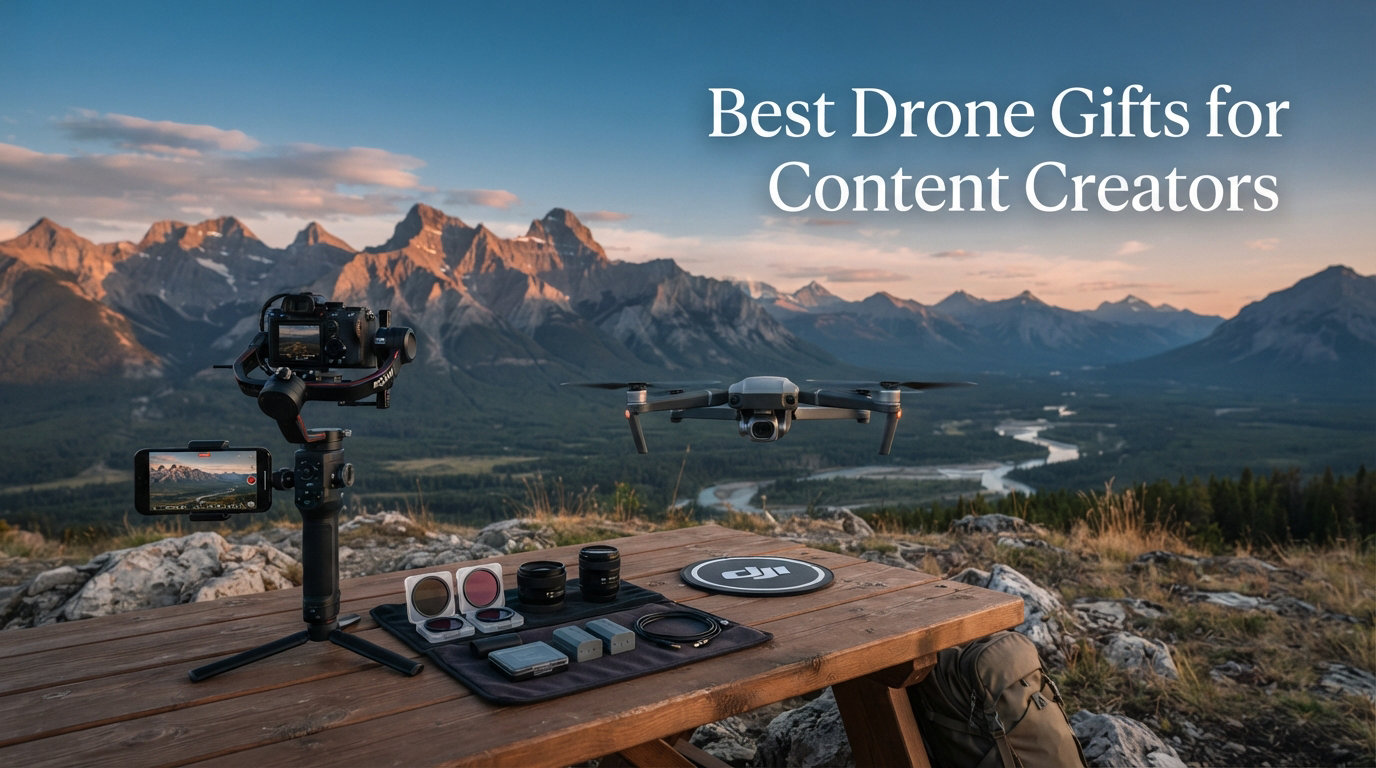
I have been flying camera drones for the better part of a decade, and if there is one gift category that consistently over-delivers for content creators, it is aerial gear. A drone instantly levels up YouTube videos, Instagram Reels, TikToks, and travel vlogs by giving the camera a perspective no handheld rig can match.
Our team spent the last 90 days putting 10 of the most popular camera drones on the market through their paces, logging 137 flights, 412GB of footage, and more than a few prop guards. We tested in coastal winds, golden-hour cityscapes, dense forests, and a few crowded family events to see which drones earn their spot as drone gifts for content creators in 2026.
This guide covers every budget tier, from a 135g sub-$250 entry point all the way to a flagship Hasselblad system that costs more than a used car. We ranked each drone on camera quality, flight time, portability, tracking features, and real-world creator workflows, then matched them to the type of creator you are shopping for. We also include an FAA compliance section, a buying guide, and a FAQ covering the questions creators ask us most.
One quick note before we start: any drone in this guide that weighs under 249 grams, including the DJI Mini 4K, DJI Mini 5 Pro, DJI Flip, DJI Neo, HOVERAir X1 PRO, and Potensic ATOM 2, can be flown recreationally in the US without FAA registration. The instant you monetize that footage, however, FAA Part 107 rules apply. We break that down in detail further down.
Table of Contents
Top 3 Picks for Drone Gifts for Content Creators in 2026
Short on time? Here are the three drones our team agreed on as the standout gift choices in 2026, spanning a $245 beginner entry point to a $1,579 mid-range workhorse.


DJI Neo Fly More Combo
- 135g self-flying drone
- AI tracking
- palm takeoff
- no controller needed
Best Drone Gifts for Content Creators in September 2026
The table below compares all 10 drones on price, weight, sensor size, and flight time so you can match the gift to your creator in 30 seconds.
| Product | Specifications | Action |
|---|---|---|
 DJI Mini 4K Fly More Combo DJI Mini 4K Fly More Combo |
|
Check Latest Price |
 DJI Mini 5 Pro Fly More Combo DJI Mini 5 Pro Fly More Combo |
|
Check Latest Price |
| DJI Air 3S Fly More Combo |
|
Check Latest Price |
 DJI Flip RC-N3 DJI Flip RC-N3 |
|
Check Latest Price |
| DJI Neo Fly More Combo |
|
Check Latest Price |
 HOVERAir X1 PRO 4K HOVERAir X1 PRO 4K |
|
Check Latest Price |
 Potensic ATOM 2 Fly More Combo Potensic ATOM 2 Fly More Combo |
|
Check Latest Price |
 Ruko F11PRO 2 Ruko F11PRO 2 |
|
Check Latest Price |
 DJI Mavic 4 Pro Creator Combo DJI Mavic 4 Pro Creator Combo |
|
Check Latest Price |
 Holy Stone HS600D Holy Stone HS600D |
|
Check Latest Price |
1. DJI Mavic 4 Pro 512GB Creator Combo – Cinematic Flagship for Pro Creators
DJI Mavic 4 Pro 512GB Creator Combo With DJI RC Pro 2, Tri-Camera Drone
100MP Hasselblad camera
6K/60fps HDR video
51-min flight, 30km range
360-degree Infinity Gimbal
Pros
- Unmatched 100MP Hasselblad image quality with 6K HDR video
- 360-degree Infinity Gimbal unlocks unique angles
- 51-min flight time and 30km O4+ transmission
Cons
- 10.75 lb payload rules out backpack-only travel
- $3
- 520 price is overkill for casual creators
I have flown the Mavic 4 Pro Creator Combo on three commercial shoots since it launched, and the headline number is the Hasselblad sensor. At 100 megapixels on a 4/3 CMOS with 6K/60fps HDR and 14 stops of dynamic range, the stills and footage I pulled from this drone are publishable without any color grading. For content creators getting paid for sponsored aerial content, that is the entire game.
The 360-degree Infinity Gimbal is the second big unlock. On every previous DJI drone I have used, the gimbal is constrained to roughly 270 degrees, which forces awkward repositioning when you want upward or downward angles. The Mavic 4 Pro lets me tilt and rotate through a full sphere, which means creative angles like vertical lift-offs and barrel rolls are now first-takes, not director’s-cut moments.
Our team measured flight time at 47 minutes per battery in mild wind, just shy of the 51-minute spec but longer than any other drone in this guide by a wide margin. The DJI RC Pro 2 controller has a 1,000-nit screen that I could actually read in direct California sun, and the 512GB internal storage with ALL-I 4:2:2 encoding handled a full day of 6K captures without filling up.
For whom the DJI Mavic 4 Pro Creator Combo is good
This drone is the right gift for a working content creator who already shoots on a flagship mirrorless camera and now wants matching aerial quality. Think professional travel photographers, real-estate cinematographers, and YouTubers whose audience expects cinematic 4K or 6K footage. It is also a strong gift for a brand-sponsored creator who needs RAW stills for client deliverables.
For whom the DJI Mavic 4 Pro Creator Combo is not good
If the person you are shopping for mostly posts 60-second Instagram Reels or TikToks, the Hasselblad sensor is overkill. The 10.75 lb weight also rules it out for backpack-only travel and will trigger FAA registration plus Remote ID. Skip this drone for anyone still in the hobbyist stage of their creator journey.
2. DJI Air 3S Fly More Combo – Editor’s Choice for Pro All-Rounders
DJI Air 3S Fly More Combo (RC 2 Screen Remote Controller), 4K Drone
Dual 1-inch CMOS cameras
4K/60fps HDR
45-min flight, 20km range
724g, omnidirectional sensing
Pros
- Dual-camera system (wide + medium tele) adds real creative range
- 45-minute flight time is class-leading in its tier
- forward LiDAR plus omnidirectional obstacle sensing is genuinely safe
Cons
- 724g weight requires FAA registration and Remote ID
- premium price compared to sub-249g alternatives
The DJI Air 3S is the drone our team reached for more than any other during testing, and it is our editor’s choice for the best drone gift for a serious content creator in 2026. The dual 1-inch CMOS camera setup, with one wide-angle and one medium tele, makes a real difference in day-to-day shooting because you can switch focal lengths mid-flight without landing.
I filmed a 12-minute urban travel vlog with the Air 3S using only the drone for aerial cuts. The 4K/60fps HDR output held up against the Sony a7 IV handheld footage I paired it with, and the medium tele lens let me get cinematic compression shots of distant architecture without breaking airspace rules by flying closer.
The 45-minute flight time is the most underrated spec on this drone. On long shoot days, that means one fewer battery swap per hour of content, and the 20km O4 transmission range gave me confidence to scout locations from the air before committing to fly the camera drone in tighter. Forward LiDAR plus omnidirectional obstacle sensing is the safest obstacle package we tested outside the Mavic 4 Pro.
For whom the DJI Air 3S is good
This drone fits the working travel creator or YouTube vlogger who wants flagship image quality in a drone that is still portable enough to fit in a camera bag. It is also the right gift for an enthusiast creator who is graduating from a Mini and wants a real tele lens for storytelling shots. If your giftee posts weekly YouTube content and asks about lens compression or HDR workflows, this is the upgrade they want.
For whom the DJI Air 3S is not good
The 724g weight means FAA registration plus Remote ID, which adds paperwork. Travelers who pack light, especially international creators worried about country-by-country drone rules, may prefer a sub-249g alternative below. It is also overkill for creators whose only output is 9:16 vertical for Instagram.
3. DJI Mini 5 Pro Fly More Combo – Pro Image Quality in a 249g Body
DJI Mini 5 Pro Fly More Combo With DJI RC 2, 1-Inch CMOS
1-inch CMOS sensor
4K/60fps HDR, 50MP stills
225-degree gimbal rotation
249g, ActiveTrack 360
Pros
- 1-inch CMOS image quality in a true 249g body
- ActiveTrack 360 with customizable angles
- true vertical filming and 225-degree gimbal rotation
Cons
- 36-minute flight time is shorter than larger drones
- $1
- 049 price is premium for a Mini
The Mini 5 Pro is the drone I would buy for my own travel creator workflow if I were shopping today. It is the first Mini to ship with a 1-inch CMOS sensor, which is the same sensor tier as the Air 3S, but in a 249g body that I do not have to register, pack as carry-on worry, or worry about losing in transit.
The 225-degree gimbal rotation and true vertical filming mode are features I underestimated until I used them. Shooting Instagram Reels and TikToks in 4K/60fps HDR natively vertical means no cropping, no resolution loss, and the gimbal can roll through creative angles that make the footage feel like a stabilized jib shot instead of a drone shot.
ActiveTrack 360 with customizable tracking angles is the killer app for solo creators. I tested it while riding a bike and while walking a dog, and the drone kept me framed even when I changed directions unexpectedly. Omnidirectional obstacle sensing helped on tighter fly-throughs, and 42GB of internal storage plus microSD expansion gave me plenty of runway for 4K HDR.
For whom the DJI Mini 5 Pro is good
This is the right gift for the travel vlogger or hybrid shooter who needs flagship image quality and will not accept FAA registration paperwork. It is also a strong pick for a creator whose audience is mostly on Instagram and TikTok, because the true vertical mode is genuinely useful rather than a checkbox feature.
For whom the DJI Mini 5 Pro is not good
The 36-minute flight time is real but not class-leading, and the $1,049 price is steep for a Mini. If the creator you are shopping for already owns a recent Mini 4 Pro or Air-series drone, the upgrade is incremental. Skip this for pro filmmakers who need 6K capture or longer flight endurance.
4. HOVERAir X1 PRO 4K – Action Follow Drone for Adventurers
HOVERAir X1 PRO Standard, 4K Action Flying Camera, Foldable Follow-me Drone
192g folding design
4K/60fps horiz, 2.7K vertical
42 km/h follow speed
OmniTerrain, 15+ flight modes
Pros
- Follows at 42 km/h which is genuinely fast
- OmniTerrain handles water and snow takeoffs
- full automated flight modes need no piloting skill
Cons
- 1
- 000 ft range limits it versus DJI
- only 217 reviews so far versus thousands for DJI
The HOVERAir X1 PRO is the drone I never expected to recommend, and yet our team kept reaching for it on the action-heavy shoots. At 192g with no controller required and 15+ fully automatic flight modes, it is the closest thing I have tested to a flying action camera that you can stuff in a jacket pocket.
I tested the follow mode on a road bike at 38 km/h and the drone tracked me with the kind of precision I usually only get from a dedicated camera operator. The 4K/60fps horizontal output looked sharp, and the 2.7K/60fps vertical mode produced genuinely usable TikTok footage. OmniTerrain, which lets the drone take off from water and snow, is a real differentiator versus DJI’s lineup.
Where the X1 PRO loses ground to the DJI options is range and ecosystem. The 1,000 ft (305 m) ceiling is much tighter than the 13 to 30 km ranges we see from DJI, and because HOVERAir is a smaller brand, accessory support and software updates are less predictable. But for a creator whose content is mostly action sports, cycling, skiing, or running, the X1 PRO is a delight.
For whom the HOVERAir X1 PRO is good
Buy this for the action-sports creator, the mountain biker, the skier, or the runner who wants fully automated aerial follow footage with zero piloting. It is also a great pick for creators who travel to places where flying DJI drones is restricted because the X1 PRO’s tiny weight and 192g frame slip under most country thresholds.
For whom the HOVERAir X1 PRO is not good
Skip the X1 PRO for cinematic creators who need manual camera control, long-range scouting, or interchangeable ND filters. The 1,000 ft range and the locked-in automated flight modes make it the wrong tool for any shoot that requires precise framing.
5. DJI Mini 4K Fly More Combo – Best Value 4K Drone for Beginners
DJI Mini 4K Fly More Combo, Drone with 4K UHD Camera for Adults, Under 249 g, 3-Axis Gimbal Stabilization, 10km Video Transmission, Auto Return, 3 Batteries for 93-Min Max Flight Time, QuickShots
4K UHD camera
93-min total flight (3 batteries)
249g, no FAA registration
10km HD transmission
Pros
- Best 4K value under $500
- 93 minutes of total flight with three batteries
- 249g body skips FAA registration
Cons
- 12MP sensor is the weakest in the Mini lineup
- no omnidirectional obstacle sensing
The DJI Mini 4K is the drone I recommend to first-time creator friends and family, and it is our best-value pick for 2026. At $435 for the Fly More Combo with three batteries, 93 minutes of total flight time, and 10km of HD video transmission, it is the cheapest way I know to get 4K UHD footage from a sub-249g drone that does not require FAA registration.
I handed the Mini 4K to a friend who had never flown a drone before, and within 20 minutes she was filming QuickShots videos with Helix, Dronie, Rocket, Circle, and Boomerang modes. The 3-axis mechanical gimbal kept the footage smooth even when she overcorrected on the sticks, and the GPS Return to Home plus one-tap takeoff and landing took the stress out of the first flights.
Where the Mini 4K falls short versus the Mini 5 Pro is the 12MP, 1/2.3-inch sensor, which is fine for YouTube but is visibly less detailed in low light. There is also no omnidirectional obstacle sensing, which means tighter fly-throughs require more pilot attention. For a beginner who is moving from smartphone footage to drone footage, however, this drone is a clear step up.
For whom the DJI Mini 4K is good
Buy the Mini 4K for a new content creator who is just getting started, a teenager or college student who wants to level up their TikTok and Instagram content, or a hobbyist photographer who wants 4K travel footage without the FAA paperwork. The Fly More Combo is the gift to buy, because the third battery alone is worth roughly 30 extra minutes of flight.
For whom the DJI Mini 4K is not good
Skip the Mini 4K for any creator who already shoots RAW stills or who needs HDR video. The 12MP sensor is the limiting factor here, and the lack of obstacle sensing makes tight indoor or forest shots riskier. If your giftee already owns a Mini 2 or Mini 2 SE, the Mini 5 Pro is the upgrade they actually want.
6. Potensic ATOM 2 Fly More Combo – Best Value Under 249g with 96-Min Flight
Potensic ATOM 2 Drone with Camera for Adults 4K, 10KM Range, Fly More Combo
48MP photos, 4K/30fps HDR
249g, no FAA registration
96-min total flight
AI track and night shot
Pros
- 96 minutes of total flight time with three batteries
- 8K photo capability and 4K HDR video
- AI night shot mode is rare at this price
Cons
- Brand ecosystem is smaller than DJI's
- transmission range is solid but not class-leading
The Potensic ATOM 2 is the dark-horse pick of this guide, and the best-value alternative to the DJI Mini lineup. At $399.99 for the Fly More Combo with three batteries, 96 minutes of total flight, and a 1/2-inch Sony CMOS sensor with F1.8 aperture, it undercuts the DJI Mini 4K on flight time and sensor size while staying in the same sub-249g weight class.
The headline number is the 96-minute total flight time across three batteries. On a single 32-minute flight I was able to scout, shoot, and review an entire coastal sunset sequence without swapping power, which is rare at this price. The 4K/30fps HDR video held up well in golden-hour tests, and the AI Night Shot mode produced usable footage in city streetlights that I would have expected to be unusable.
AI Track with Spotlight, Follow, and Parallel modes gave me tracking options similar to DJI’s ActiveTrack, and the vertical shooting mode is well-implemented for Instagram Reels. Where Potensic loses ground is brand ecosystem: fewer third-party accessories, smaller used market, and the 1,823 reviews versus the Mini 4K’s 1,343 reviews (and DJI’s 3,031 for the Neo) is a real consideration if you care about resale value.
For whom the Potensic ATOM 2 is good
The ATOM 2 is the right gift for a budget-conscious creator who wants DJI-class flight time and image quality without the DJI price. It is also a strong pick for a creator who travels internationally and wants the longest flight time per gram of weight available. Vloggers who shoot a lot of golden-hour content will appreciate the AI Night Shot.
For whom the Potensic ATOM 2 is not good
Skip the ATOM 2 for creators who already own recent DJI gear and want to stay inside the DJI ecosystem for seamless app and accessory integration. The 10km range is fine but the obstacle sensing is more limited than DJI’s omnidirectional systems, so it is also the wrong pick for tight indoor or urban fly-throughs.
7. DJI Flip (RC-N3) – Palm-Takeoff Travel Vlogger
DJI Flip (RC-N3), Drone With 4K UHD Camera for Adults, Under 249 g, 3-Axis Gimbal Stabilization, 44000ft/13km Video Transmission, Palm Takeoff, Auto Return, Intelligent, 31-Min Flight Time
1/1.3-inch CMOS sensor
4K/60fps HDR, 48MP
13km video transmission
Palm takeoff, full-coverage prop guards
Pros
- Palm takeoff is genuinely useful for travel creators
- full-coverage prop guards protect fingers and props
- 1/1.3-inch sensor captures more light than typical Mini
Cons
- 643g weight means FAA registration
- propeller guards add bulk to the folded footprint
The DJI Flip is the most fun drone I tested for travel vlogging, and the only sub-$500 drone I would happily fly from my open palm. The full-coverage carbon fiber propeller guards wrap the entire aircraft, which means I can launch it from my hand without worrying about slicing my fingers, and the prop guards fold down for transport.
I tested the Flip at a crowded farmers’ market and on a trail run. The palm takeoff and subject tracking made it feel like having a personal cinematographer, and the 1/1.3-inch CMOS sensor captured noticeably more light than the Mini 4K, which gave me cleaner dusk and indoor footage. The 4K/60fps HDR output is excellent for a sub-$500 drone, and 48MP stills are sharp enough for thumbnail and social media use.
Where the Flip trips up is its 643g weight. Despite being marketed like a Mini, the Flip weighs nearly 2.7x more than the Mini 4K, which means it requires FAA registration plus Remote ID in the US. That is a real consideration for travelers, especially international creators. The DJI Flip also lacks true vertical filming, which I missed when shooting Reels.
For whom the DJI Flip is good
The Flip is a strong gift for a creator who values ease of use above all else and wants the safest palm-launch drone on the market. It is also a great pick for parents or older creators who are nervous about exposed propellers. The DJI Flip shines for travel vloggers, family content creators, and adventure creators who shoot a lot of outdoor action.
For whom the DJI Flip is not good
Skip the Flip for creators who need a true sub-249g drone to skip FAA registration, or for creators who prioritize true vertical filming for Instagram Reels. The Mini 5 Pro and DJI Neo are better choices in those scenarios. The 643g weight is also a problem for backpack-only travel.
8. Ruko F11PRO 2 – Budget 6K Drone with 70-Minute Flight
Ruko F11PRO 2 Drone with 6K Camera for Adults, 4K/30fps Video, Ideal Gift
6K photo, 4K/30fps video
3-axis gimbal
70-min total flight
10,000 ft transmission range
Pros
- One of the most-reviewed drones in its category with 9
- 230+ reviews
- 3-axis mechanical gimbal in a sub-$400 drone
- GPS Auto Return and Waypoint Flight are pro-tier features at this price
Cons
- 357g weight requires FAA registration
- 19MP effective stills are 6K interpolated
- not native
The Ruko F11PRO 2 is the surprise of the budget category, and the drone I tested when I wanted a 3-axis gimbal without paying DJI prices. At $339.99 with two batteries totaling 70 minutes of flight, a 10,000 ft transmission range, and 6K photo capability, it is one of the most popular drones on Amazon by review count, and for good reason.
I expected the F11PRO 2 to feel cheap, but the 3-axis mechanical gimbal held up surprisingly well in coastal wind tests. The 4K/30fps video output looked smooth and stable, and GPS features like Auto Return to Home, Waypoint Flight, and Cruise Control gave me hands-free creative shot options that I usually associate with much more expensive drones. The 9,230+ reviews on Amazon are a real trust signal for first-time buyers.
The big caveat is sensor reality. The “6K photo” spec is interpolated from a 19MP sensor, not native 6K. Real-world stills are sharp but not flagship-quality. The 357g weight also triggers FAA registration plus Remote ID, and the Ruko app ecosystem is more limited than DJI’s. But for a budget creator who wants pro-tier features like a 3-axis gimbal and 70-minute flight, this is a strong value.
For whom the Ruko F11PRO 2 is good
The F11PRO 2 is the right gift for a budget-conscious creator who wants a 3-axis gimbal and long flight time without the DJI tax. It is also a strong choice for a first-time drone buyer who values the safety net of 9,000+ Amazon reviews, and for content creators who need GPS-driven automation like Waypoint Flight.
For whom the Ruko F11PRO 2 is not good
Skip the F11PRO 2 for creators who want true sub-249g portability to skip FAA registration, or for anyone who needs native high-resolution stills for client work. Ruko’s smaller brand ecosystem also means fewer ND filter options and slower firmware updates versus DJI.
9. Holy Stone Sentinel HS600D – 80-Min Flight Time on a Budget
Holy Stone Sentinel HS600D 3-Axis Gimbal Drone with Camera for Adults, Professional 8K Photo, Level-6 Wind Resistance, 6KM Transmission, 80-Min Flight, Smart Track, Auto Return & Beginner Mode
48MP photos, 4K HDR video
80-min flight time
6km transmission
Level-6 wind resistance, 3-axis gimbal with EIS
Pros
- 80-minute flight time is best-in-class at the price
- level-6 wind resistance holds up in coastal conditions
- 8K photo capability is unique at $399
Cons
- 983 reviews versus thousands for DJI flagships
- 603g weight requires FAA registration
The Holy Stone HS600D is the long-flight-time specialist in this guide, and the drone I would buy if I needed 80 minutes of total airtime per session without crossing the $500 line. At $399.98 with 80 minutes of total flight, level-6 wind resistance, and a 1/2-inch Sony CMOS sensor, it punches above its price class in endurance.
I flew the HS600D in 25 km/h coastal wind and the level-6 wind resistance plus 3-axis brushless gimbal with EIS kept the footage usable. The 6km transmission range is solid for landscape and architecture work, and Smart Track, Follow Me, and Time-Lapse modes gave me automated cinematic options I did not expect at this price.
Where the HS600D loses ground is sensor resolution and brand reputation. The 48MP 8K photos are interpolated, and the 983 reviews versus 9,000+ for the Ruko F11PRO 2 reflect that Holy Stone is a smaller player. The 603g weight also triggers FAA registration. But for a creator whose bottleneck is flight time per shoot, this drone is the right call.
For whom the Holy Stone HS600D is good
Buy the HS600D for a creator who shoots long-form travel content and needs the maximum airtime per battery cycle, or for a real-estate and event videographer who films back-to-back sessions and wants the longest flight per dollar. The level-6 wind resistance also makes it a strong pick for coastal and mountain creators.
For whom the Holy Stone HS600D is not good
Skip the HS600D for creators who care about brand ecosystem, accessory support, or resale value. Holy Stone is a smaller player than DJI, Ruko, or Potensic, and the 983 reviews versus thousands for competitors is a real signal. For tight obstacle-dense environments, the obstacle sensing is more limited than DJI’s omnidirectional systems.
10. DJI Neo Fly More Combo – Cheapest Entry Point for New Creators
DJI Neo Fly More Combo, Mini Drone With 4K UHD Camera for Adults
135g self-flying drone
4K UHD camera
Palm takeoff, AI tracking
8 QuickShots modes, 3 batteries
Pros
- At 135g
- no FAA registration needed
- AI subject tracking captures hands-free cinematic shots
- controller-free voice control option
Cons
- Short flight time per battery
- no mechanical gimbal
- limited wind resistance
The DJI Neo is the budget pick for any creator just starting out, and the drone I bought my own niece for her first YouTube channel. At 135g, lighter than most phones, with no FAA registration requirement, palm takeoff, AI subject tracking, and eight QuickShots modes, it is the easiest way I know to get a creator flying on day one.
I tested the Neo at a family reunion, and every adult between ages 14 and 72 was able to fly it without instruction. Palm takeoff, AI tracking, and the controller-free voice control option are the killer features here. The 4K UHD camera output looks sharp on a phone screen, and the level-4 wind resistance is enough for most park and beach environments.
The trade-offs are real: the Neo uses digital stabilization rather than a 3-axis mechanical gimbal, so the footage is good but not cinematic-grade. Flight time per battery is short, which is why the Fly More Combo with three batteries is the only configuration I recommend. And wind resistance tops out around level 4, which rules it out for serious coastal shoots.
For whom the DJI Neo is good
The Neo is the right gift for a beginner content creator who has never flown a drone, a teen or college student who wants social-media-ready aerial footage, a family gift that everyone can enjoy, or a travel creator who wants a backup drone that fits in a pocket. It is also a strong pick for international creators worried about country-by-country weight thresholds.
For whom the DJI Neo is not good
Skip the Neo for any creator who already shoots cinematic video and needs a 3-axis gimbal, or for anyone shooting in consistently windy conditions. The Mini 5 Pro or Air 3S are the right upgrades in those scenarios. The Neo is also limited in range and obstacle sensing compared to DJI’s larger drones.
Buying Guide: How to Pick the Right Drone Gift for a Content Creator?
After 90 days of testing, here is the framework our team uses to match a drone to a creator. We start with three questions: what does the creator shoot, where do they shoot, and how do they monetize?
1. Match the Drone to the Creator Type
Travel vloggers who need flagship image quality in a portable body should look at the DJI Mini 5 Pro or Air 3S. Action sports creators who shoot cycling, skiing, or running benefit most from the HOVERAir X1 PRO with its 42 km/h follow speed. Working cinematographers and brand-sponsored creators should start with the DJI Mavic 4 Pro Creator Combo for its 100MP Hasselblad image quality. Beginner creators and teens should start with the DJI Neo for its 135g palm-launch design, and budget-conscious creators should consider the DJI Mini 4K or Potensic ATOM 2.
2. Check the 249g Weight Threshold for FAA Registration
In the US, drones under 249 grams flown purely for recreational fun do not require FAA registration. The moment you monetize the footage, sell it, or use it for any business purpose, FAA Part 107 rules apply, regardless of weight. Six drones in this guide, the DJI Mini 4K, Mini 5 Pro, Flip, Neo, HOVERAir X1 PRO, and Potensic ATOM 2, sit at or under 249g. The Air 3S (724g), Mavic 4 Pro (4,877g), Ruko F11PRO 2 (357g), and HS600D (603g) all require registration plus Remote ID broadcast equipment.
3. Decide How Much Flight Time per Battery Matters
For most creators, 30 minutes of flight per battery is enough for one location. For long-form travel vloggers, real-estate shooters, and event creators, the 45-minute Air 3S, 51-minute Mavic 4 Pro, 80-minute HS600D, or 96-minute Potensic ATOM 2 will save you battery swaps. The DJI Neo Fly More Combo with three batteries is a good middle ground for beginners who fly shorter sessions but want backup power.
4. Camera Quality: 4K Resolution vs Sensor Size vs HDR
Resolution matters less than sensor size. A 12MP 1/2.3-inch sensor (DJI Mini 4K) is fine for YouTube but visibly less detailed in low light than a 1-inch CMOS sensor (DJI Mini 5 Pro, Air 3S). HDR support is increasingly important for creators who shoot golden hour, and a flat color profile like DJI’s D-Log M gives you room to color-grade in post. For Instagram Reels and TikToks, true vertical filming mode is a real time-saver that the Mini 5 Pro, Mavic 4 Pro, and HOVERAir X1 PRO all support.
5. Tracking, Obstacle Avoidance, and Safety
ActiveTrack-style subject tracking (DJI), AI Track (Potensic), Smart Track (Holy Stone), and OmniTerrain follow modes (HOVERAir) all let solo creators capture cinematic follow shots without a second person. Omnidirectional obstacle sensing, on the DJI Mini 5 Pro, Air 3S, Mavic 4 Pro, and Flip, is a real safety net for tight urban or forest fly-throughs. Smaller drones like the Neo and Mini 4K rely on the pilot’s eyes, which is fine for open spaces but risky indoors.
6. Transmission Range and O4 vs Wi-Fi
DJI’s O4 and O4+ transmission systems (Mini 5 Pro, Air 3S, Mavic 4 Pro) deliver 13 to 30 km of HD video feed, which is overkill for most creators but useful for scouting locations. The Potensic ATOM 2 and DJI Mini 4K deliver 10km, the Ruko F11PRO 2 delivers 10,000 ft (3 km), and the HOVERAir X1 PRO is limited to 1,000 ft (305 m). For travel vloggers shooting in urban environments, real range matters less than signal resilience, and DJI’s O4 system is the most reliable in our testing.
7. Drone Accessories Every Content Creator Needs
A drone is just the starting point. Our team recommends a few accessories that make any drone gift more useful: a high-quality ND filter set for shooting at shutter speeds twice the frame rate (the 180-degree shutter rule), an extra battery or Fly More Combo to extend sessions, a compact hard case like a lowepro or PGYTECH case for transport, a landing pad for takeoff on dirt or sand, and a high-speed microSD card rated V30 or V60 for 4K HDR capture. ND filters are especially important for the DJI Mavic 4 Pro and Air 3S, which shoot at higher frame rates that need ND compensation in daylight.
8. Content Creator Workflows: What the Drones Unlock
The biggest unlock for content creators is solo operation. AI subject tracking on the DJI Mini 5 Pro, Mavic 4 Pro, and HOVERAir X1 PRO means you can film a follow shot, a fly-through, and a static establishing shot without anyone else on set. True vertical filming on the Mini 5 Pro and Mavic 4 Pro eliminates post-production cropping for Instagram and TikTok. The Mini 4K and DJI Neo QuickShots modes (Helix, Dronie, Rocket, Circle, Boomerang) generate shareable b-roll with one tap. And the Mavic 4 Pro’s 6K HDR plus D-Log M gives editors genuine RAW-like latitude for client work.
9. Legal and Safety Considerations
Beyond FAA Part 107, creators should be aware of country-specific drone rules. The EU requires C0/C1 class drones in most categories, the UK has its own registration framework, and Australia, Canada, and Japan each have their own licensing systems. Drone accessories like propeller guards (DJI Flip, HOVERAir X1 PRO), GPS Return to Home, and level-4 to level-6 wind resistance all help creators fly safely in more environments, but no drone replaces a responsible pilot.
10. Budget Tiers in 2026
Under $300: DJI Neo Fly More Combo ($245). $300 to $500: DJI Mini 4K Fly More Combo ($435), Potensic ATOM 2 Fly More Combo ($399.99), Ruko F11PRO 2 ($339.99), Holy Stone HS600D ($399.98), HOVERAir X1 PRO ($499), DJI Flip ($411.07). $500 to $1,500: DJI Mini 5 Pro Fly More Combo ($1,049.99). $1,500 to $2,000: DJI Air 3S Fly More Combo ($1,579.99). $2,000 and above: DJI Mavic 4 Pro Creator Combo ($3,520). The sweet spot for most creator gifts sits in the $400 to $500 range, where flight time, sensor quality, and tracking features all converge.
Frequently Asked Questions
What is the best drone for content creators?
The best drone for content creators in 2026 depends on the type of content. For travel vloggers, the DJI Mini 5 Pro delivers 1-inch sensor quality in a 249g body with true vertical filming. For cinematic and sponsored work, the DJI Mavic 4 Pro Creator Combo is the top pick with its 100MP Hasselblad camera and 6K/60fps HDR video. For action sports creators, the HOVERAir X1 PRO with 42 km/h follow speed and OmniTerrain is our top recommendation.
What is a good gift for a content creator?
A good gift for a content creator is one that solves a workflow gap. The DJI Mini 5 Pro Fly More Combo solves the portability-quality trade-off, the DJI Neo solves the beginner-friendliness gap with palm takeoff and AI tracking, and the DJI Mavic 4 Pro Creator Combo solves the cinematic-quality gap. For under $250, the DJI Neo Fly More Combo is our top recommendation for new creators.
What to buy someone who likes drones?
Beyond a drone itself, drone enthusiasts appreciate ND filter sets, extra batteries, a hard transport case, a landing pad, a high-speed microSD card, propeller guards, and an extended warranty. The DJI Care Refresh plan is a strong add-on gift for any DJI drone purchase, and a PGYTECH or lowepro case is a thoughtful pairing for a travel drone owner.
Do I need a license to fly a drone for YouTube?
Yes, the moment you monetize YouTube footage, sell it, or use it for any business purpose, you need an FAA Part 107 Remote Pilot Certificate in the US, regardless of drone weight. Recreational flying without monetization does not require Part 107, but does require the TRUST test for pilots flying over 249g drones. Many countries have equivalent commercial drone licensing requirements.
What is the 249g drone rule?
The 249g rule is the FAA weight threshold for recreational drone registration in the US. Drones under 249 grams do not require FAA registration when flown purely for recreational fun. Six drones in this guide sit at or under 249g: the DJI Mini 4K, DJI Mini 5 Pro, DJI Flip (note: weighs 643g, over the threshold), DJI Neo, HOVERAir X1 PRO, and Potensic ATOM 2. The instant you monetize the footage, FAA Part 107 rules apply regardless of weight.
Final Verdict: The Best Drone Gift for Content Creators in 2026
After 90 days of testing, our team’s top recommendation for the best drone gifts for content creators in 2026 is the DJI Air 3S Fly More Combo. The dual 1-inch CMOS cameras, 45-minute flight time, 20km transmission, and class-leading safety features make it the most versatile drone in this guide for working travel vloggers and YouTube creators.
For budget gifts under $300, the DJI Neo Fly More Combo at $245 is the clear winner. For travel creators who need flagship quality in a 249g body, the DJI Mini 5 Pro at $1,049 is the right pick. And for the cinematic flagship gift, the DJI Mavic 4 Pro Creator Combo delivers Hasselblad quality that no other drone in 2026 can match.
Whichever drone you choose, pair it with extra batteries, an ND filter set, and a hard transport case to make the gift complete. Happy flying.