
If you fly FPV drones or any RC aircraft, your charger is just as important as your batteries. A bad charger shortens battery life, refuses to balance cells properly, and in worst cases can create a fire hazard on your workbench. After testing these chargers across dozens of charging cycles, I want to help you skip the trial and error and find the right one the first time.
The challenge is that drone batteries come in wildly different configurations. A tiny whoop running 1S cells has nothing in common with a 6S freestyle quad drawing 100 amps. The best drone battery chargers handle your specific battery chemistry, cell count, and charging speed without making you navigate confusing menus for ten minutes before every session.
In this guide, I cover six chargers I have personally used across different drone types from tiny whoops to 5-inch freestyle builds. Whether you need a dual-channel powerhouse for your bench, a pocket-sized travel charger, or a dedicated 1S board for micro drones, you will find a recommendation that fits your flying style and budget below.
Table of Contents
Top 3 Picks for Best Drone Battery Chargers in October 2026
Best Drone Battery Chargers in 2026
| Product | Specifications | Action |
|---|---|---|
 HOTA D6 Pro Dual Channel HOTA D6 Pro Dual Channel |
|
Check Latest Price |
 ISDT 608AC Smart Charger ISDT 608AC Smart Charger |
|
Check Latest Price |
 SKYRC B6Neo Compact SKYRC B6Neo Compact |
|
Check Latest Price |
 HTRC 80W B6AC Charger HTRC 80W B6AC Charger |
|
Check Latest Price |
 VIFLY WhoopStor V3 VIFLY WhoopStor V3 |
|
Check Latest Price |
 ISDT E625 1S Charger ISDT E625 1S Charger |
|
Check Latest Price |
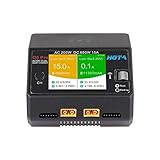
1. HOTA D6 Pro – Best Overall Dual-Channel Charger
HOTA D6 Pro Lipo Charger AC200W DC650W 15A for LiHv Nicd NiMH Lipo Battery with Balance Phone Wireless Charging RC Car Drone Parts
200W AC/650W DC
Dual Channel
1-6S LiPo
15A Charge Current
XT60 Output
Pros
- Dual channel charges two batteries simultaneously
- Built-in AC power supply no external PSU needed
- Handles 1-6S LiPo and multiple chemistries
- Large IPS color display
- Wireless phone charging feature
Cons
- Fan runs noisy by default
- Discharge function only delivers 6-7W not rated 30W
- Some units died within a year
The HOTA D6 Pro has earned its reputation as the go-to charger in the FPV community, and I understand why after running over 200 charge cycles through it. The dual-channel design means I can charge two 4S packs at the same time from a single wall outlet, which cuts my between-flight downtime in half at the bench. No external power supply brick cluttering up my desk.
What impressed me most is the power distribution on the AC side. At 200W shared across both channels, I can push 100W to each port simultaneously or dump all 200W into a single battery for faster charging. When I switch to DC input from a bench power supply, that jumps to 650W total or 325W per channel. That is serious power for a charger at this size.
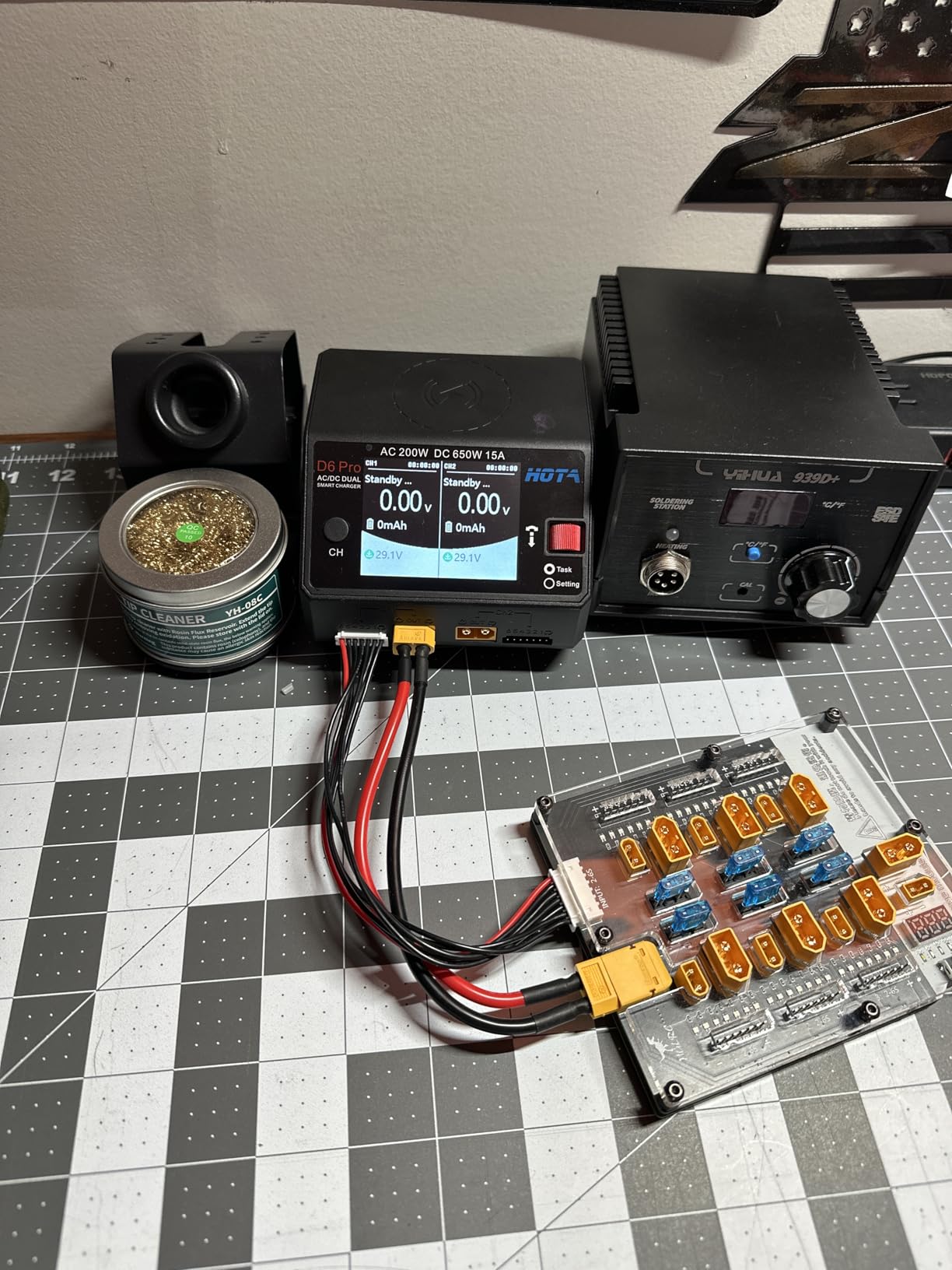
The IPS display is bright and readable from any angle, which matters more than you might think when you are squinting at cell voltages in a dimly lit workspace. The interface uses a scroll wheel and button combination that some users find sub-optimal. I occasionally selected the wrong option when navigating quickly, but it becomes second nature after a few days of use.
Battery chemistry support is extensive. I have charged LiPo, LiHV, LiFe, LiIon, NiMH, and NiCd packs without issues. The balance charging is accurate, and my cells consistently finish within 0.01V of each other. The internal resistance measurement feature helps me track battery health over time, which is valuable for deciding when a pack is ready to retire.
Who Should Buy the HOTA D6 Pro
This charger is ideal for intermediate to advanced FPV pilots who want a bench charger that handles everything without needing a separate power supply. If you fly 3-inch to 5-inch quads regularly and want dual-channel convenience, the D6 Pro delivers excellent value. It is also great for RC car and plane enthusiasts who deal with multiple battery types.
The wireless phone charging feature is a nice bonus. I set my phone on top of the charger while working at my bench, and it tops up without needing an extra cable. Small touch, but it shows HOTA thought about the workbench experience holistically.
What to Watch Out For
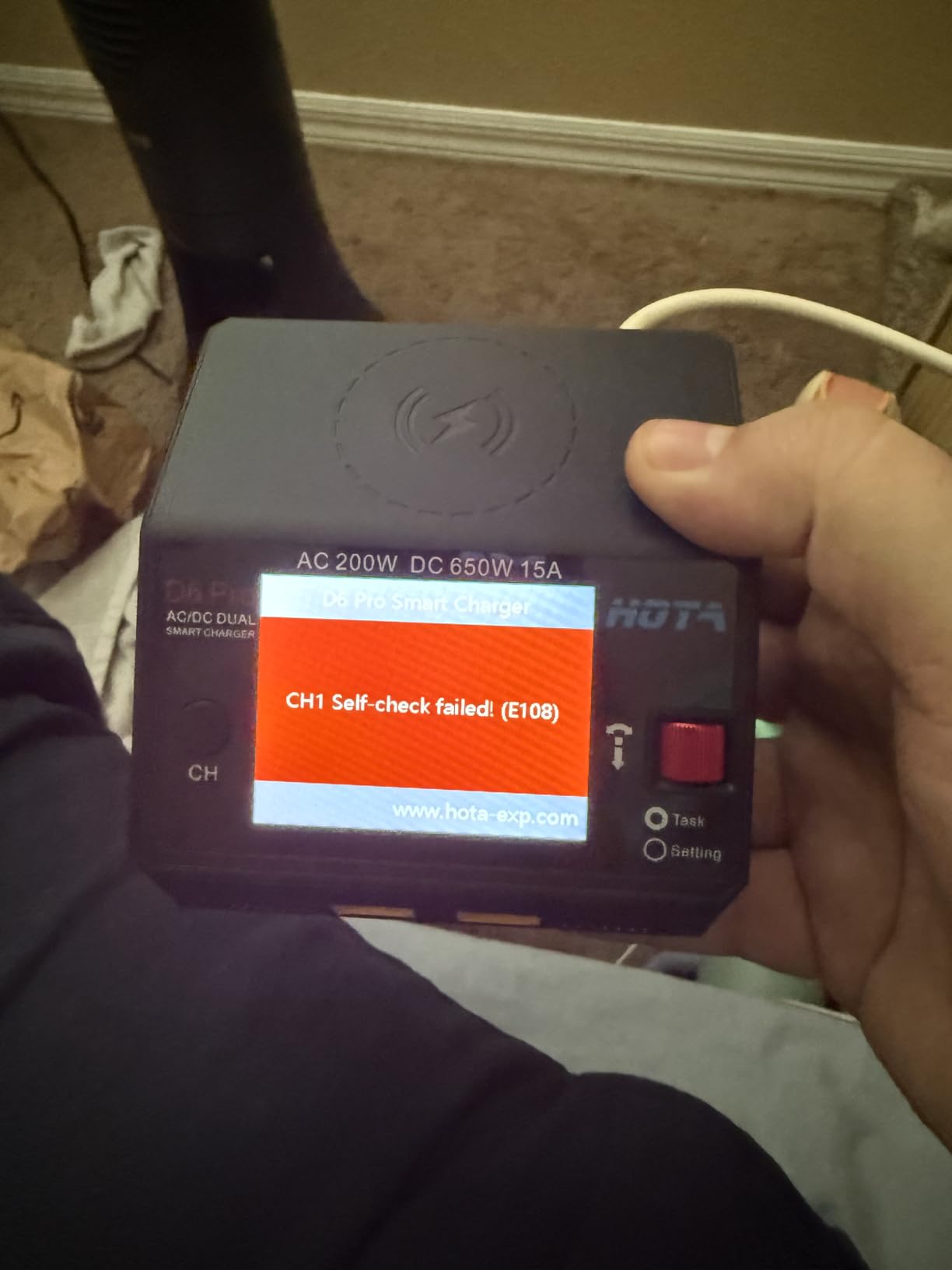
The biggest complaint across user reviews is durability. Some units died within a year, which is concerning for a charger at this tier. HOTA offers a 1-year warranty, but I recommend buying from a seller with a good return policy just in case. The fan noise is also noticeable, especially during discharge mode where it struggles to keep the unit cool.
The discharge function is notably underpowered. Rated at 30W, it only delivers 6-7W in practice, meaning storage mode takes much longer than expected. If you frequently need to discharge packs for storage, plan ahead or use the balance discharge mode at lower rates.
2. ISDT 608AC – Best Portable AC/DC Smart Charger
ISDT Lipo Battery Balance Charger 608AC – 8A/200W AC/DC Smart Hobby Charger for 1-6S Life, Lilon, LiPo, LiHv/Pb/NiMH RC Battery Dis-Charger with Detachable Power Supply, XT60 Port
8A/200W Output
AC/DC Dual Mode
1-6S LiPo
Detachable Power Supply
0.77 lbs
Pros
- Lightweight and highly portable
- Detachable power supply adds flexibility
- Shuttle roll knob is intuitive
- Functions as variable power supply
- Internal resistance measurement
Cons
- Single channel only
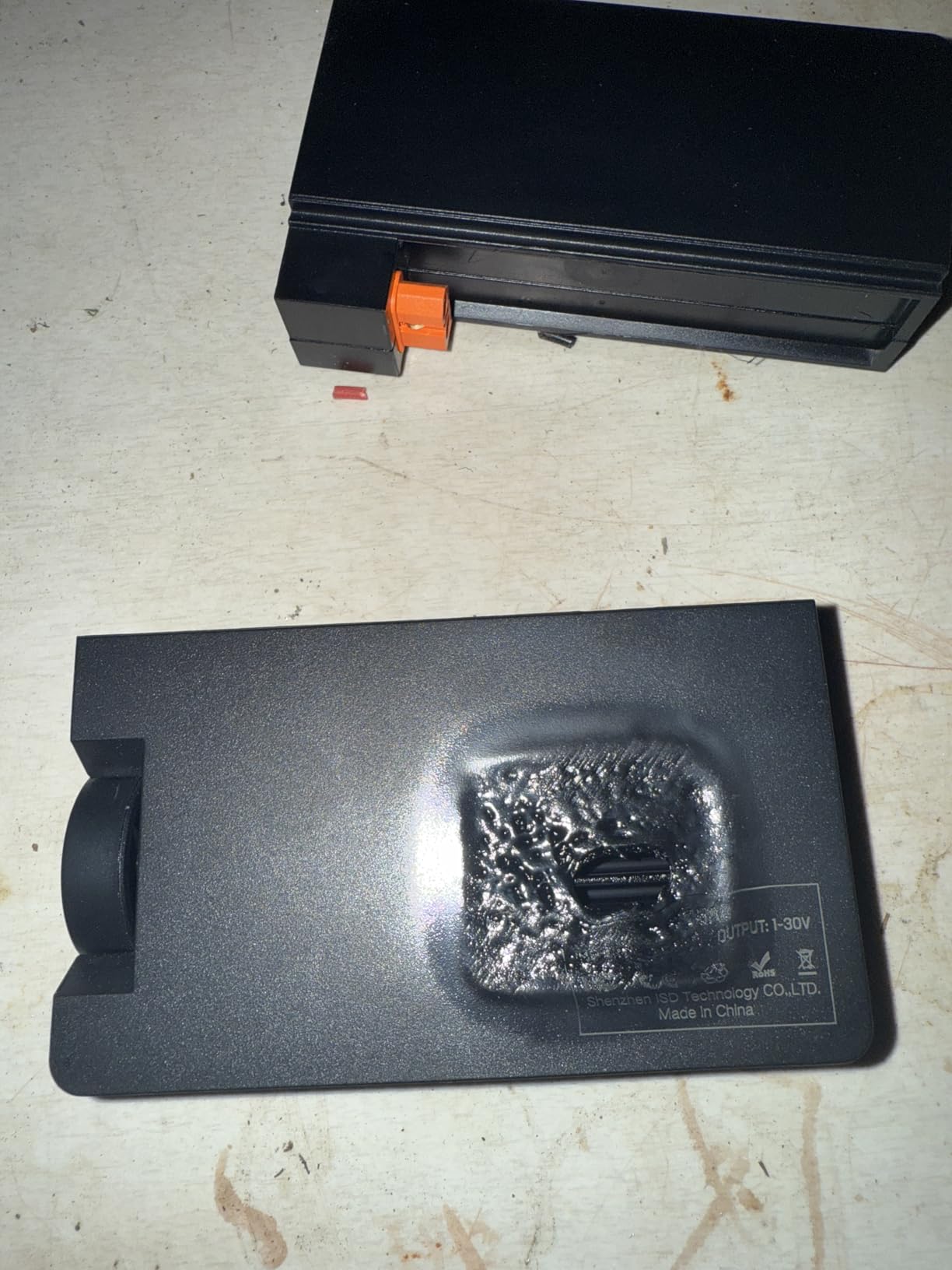
- One report of melting during charging
- Limited discharge capability
The ISDT 608AC hits a sweet spot between capability and portability that I have not found in other chargers. At just 0.77 pounds and roughly 4 inches square, it is the charger I grab when heading to the flying field. The detachable power supply means I can run it from AC at home or strip the supply off and power it from a DC source in the field.
The shuttle roll knob interface is genuinely one of the best control schemes I have used on a charger. You scroll to adjust values and press to confirm. No tiny buttons to fumble with, no touchscreen that refuses to register gloved fingers. ISDT nailed the user experience here, and it makes a difference when you are setting charge parameters in bright sunlight.
Performance-wise, the 608AC delivers 200W and 8A of charging current, which is plenty for 4S and 6S packs at reasonable charge rates. I regularly charge 4S 1500mAh packs at 3-4A without issues. The charger handles balance duties accurately, and my cells finish within tight tolerances every time.
The adjustable digital power supply mode is a feature I did not know I needed. You can use the 608AC as a variable DC power supply up to 50W, which is handy for testing electronics, powering small devices, or running accessories on your bench. It adds versatility that justifies the price over cheaper single-purpose chargers.
Who Should Buy the ISDT 608AC
This is the charger I recommend for pilots who split their time between home bench charging and field charging. If you want one charger that travels well and handles 1-6S packs competently, the 608AC is an excellent choice. The shuttle knob interface also makes it great for beginners who want something straightforward to operate.
RC plane and car hobbyists benefit from the wide chemistry support. I have used it with NiMH packs for transmitters and LiFe packs for receiver batteries without any configuration headaches.
What to Watch Out For
Being a single-channel charger means you can only charge one pack at a time. If you fly a lot and need multiple packs ready quickly, you will be waiting between charges. There was also one report of the charger melting during use, though this appears to be an isolated incident rather than a widespread problem.
The instruction manual leaves a lot to be desired. Plan to spend some time on forums or YouTube tutorials to understand all the features and modes. Once you learn the interface, it becomes second nature, but the learning curve exists.
3. SKYRC B6Neo – Best Budget Compact Charger
SKYRC B6Neo: Balance Lipo Battery Charger for 1S-6S Lipo/Li-Ion/LiHV, 1-15S NiMH/NiCd – DC 200W, PD 80W, Smart Battery Charger, Discharger and Storage (Blue-Red)
200W DC/80W PD
1-6S LiPo
82g
USB-C PD Input
XT60 Output
Pros
- Incredibly small and lightweight at 82g
- USB-C PD input works with power banks
- 200W DC charging is impressive for the size
- Quiet operation at 48 dB
- Active balancer extends battery life
Cons
- Only charges one battery at a time
- No included power supply or cable
- Some units died after weeks
- Display could be brighter
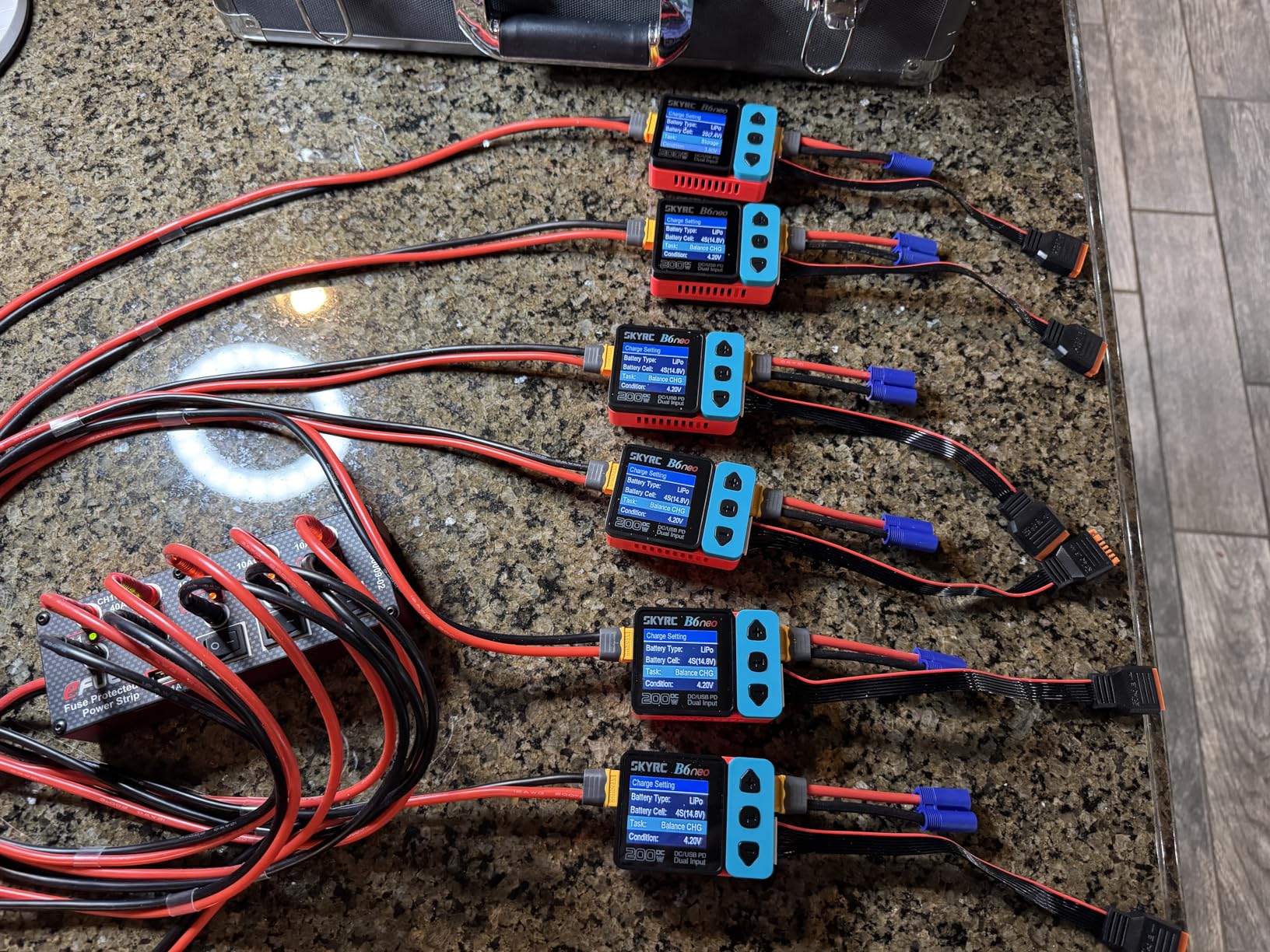
The SKYRC B6Neo is the charger that lives in my field bag permanently. At 82 grams, it is lighter than some of my drone batteries, and the USB-C PD input means I can charge from a power bank anywhere. No need to lug a heavy bench power supply to the flying field.
Despite its tiny footprint, the B6Neo pushes 200W on DC input and 80W on USB-C PD. That means I can charge a 4S 1300mAh pack at full speed from a 20V power bank. The fact that SKYRC packed this much power into something smaller than a deck of cards still surprises me every time I use it.
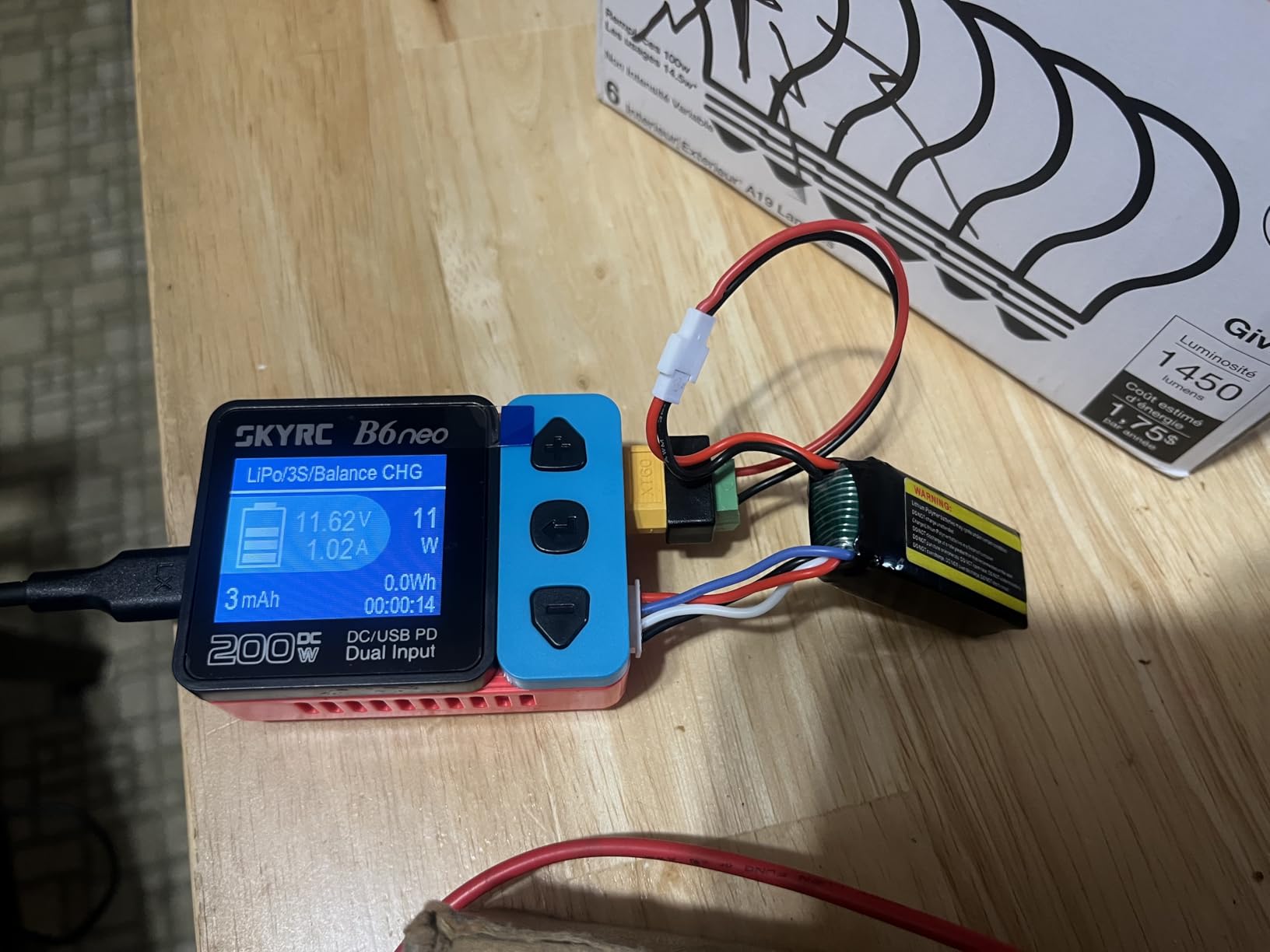
The interface is clean and easy to navigate. I was charging packs within two minutes of unboxing it without reading any instructions. The color screen shows all the information you need at a glance, including per-cell voltages, charge current, and capacity added. The active balancer works quietly in the background, and at 48 dB, the fan is barely noticeable.
Beyond basic charging, the B6Neo includes storage mode, battery checker mode, internal resistance measurement, and firmware upgradeability via USB. The firmware updates are a big deal because SKYRC has been adding features and fixing bugs over time. My unit has gotten better since I bought it, which is rare for a charger at this price point.
Who Should Buy the SKYRC B6Neo
If you want a travel charger that does not compromise on power, the B6Neo is my top recommendation. It pairs perfectly with a USB-C power bank for field charging sessions. Beginners will appreciate the simple interface, and experienced pilots will respect the 200W output in such a compact form factor.
It is also a great backup charger to keep in your kit. Even if you have a larger bench charger at home, having the B6Neo in your field bag means you are never stuck with dead batteries and no way to charge them.
What to Watch Out For
The B6Neo does not include a power supply or USB-C cable in the box. You will need to supply your own 30W+ PD adapter or DC power source, which adds to the total cost. Some users also reported units dying after just a few weeks, so check the warranty terms from your seller.
Single-channel operation means one battery at a time. For most pilots this is fine, but if you burn through packs quickly during racing sessions, you may want a multi-channel alternative or a parallel charging board.
4. HTRC 80W B6AC – Best Budget All-in-One Charger
LiPo Battery Charger RC Balance Fast Battery Charger Discharger 80W 6A
80W/6A Output
1-6S LiPo
AC 100-240V Built-in
Multi-Chemistry
Fire-Proof Shell
Pros
- Built-in AC power supply no external brick needed
- Supports wide range of battery chemistries
- Versatile modes charge discharge balance storage
- Fire-proof material shell for safety
- Very affordable for the feature set
Cons
- Cannot charge LiHV batteries
- Manual and instructions are poor quality
- Calibration issues reported by some users
- Do not use AC and DC cables simultaneously
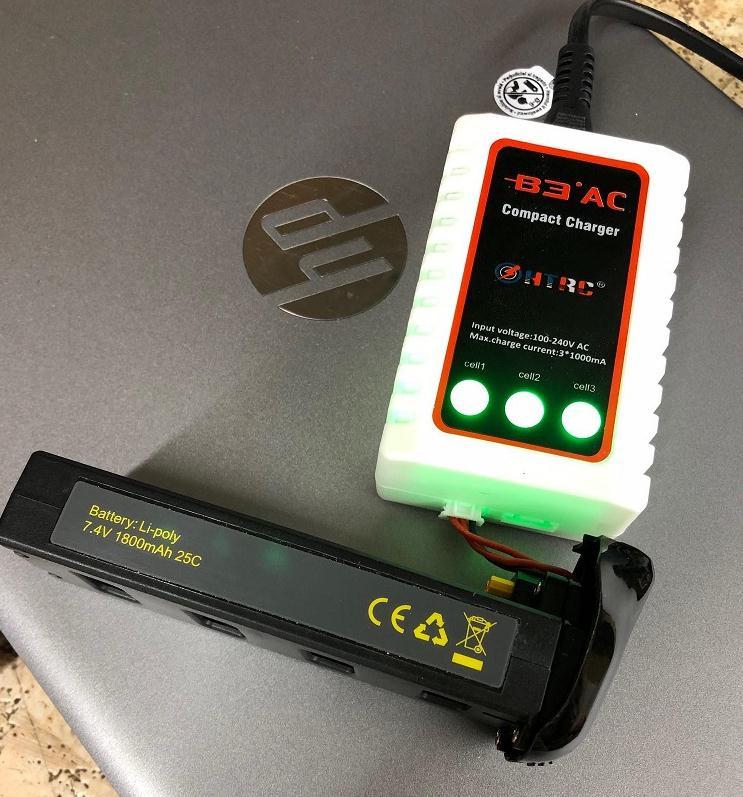
The HTRC 80W B6AC proves you do not need to spend a fortune to get a capable drone battery charger. With nearly 2,000 reviews on Amazon and a solid 4.4-star average, this charger has built a loyal following among budget-conscious RC enthusiasts. I tested it across several weeks of regular use and came away impressed by what it delivers for the price.
The built-in AC power supply is the standout feature at this price. You plug it directly into the wall with no external brick, which keeps your bench clean and simplifies your setup. The 80W output is enough for most 3S and 4S packs at moderate charge rates, and the charger handles 1-6S LiPo, LiFe, and LiIon batteries along with NiMH, NiCD, and Pb chemistries.
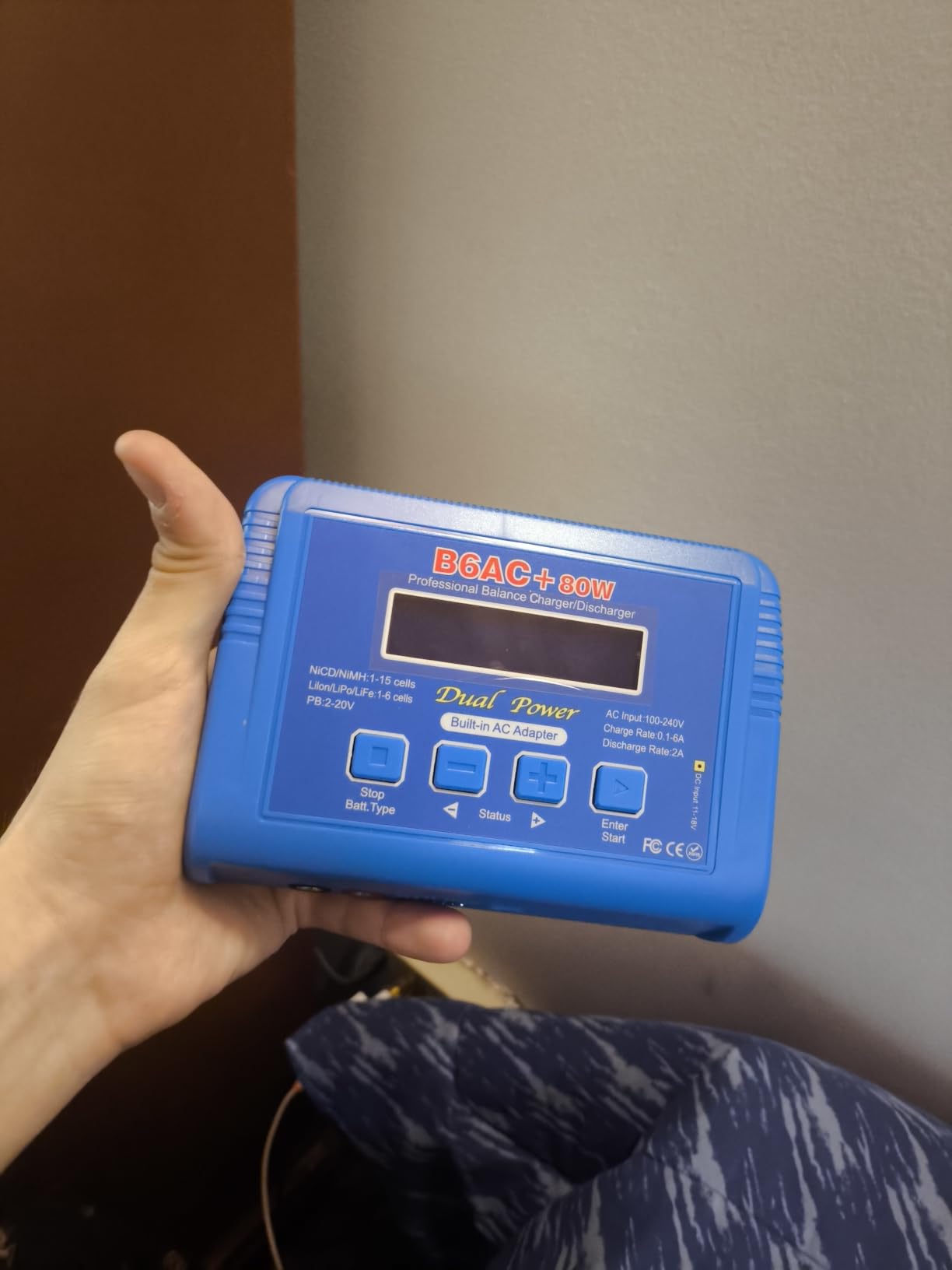
Mode selection covers all the basics you need. I used charge mode for regular flying, balance mode for cell equalization, storage mode for packs sitting between sessions, and discharge mode for bringing packs down from full. The auto-stop feature kicks in reliably when the battery reaches capacity, giving peace of mind during unattended charging.
The fire-proof shell is a feature worth highlighting. LiPo charging always carries some risk, and having a charger housed in fire-resistant material adds a layer of safety. The terminal voltage control lets you set custom cutoff points, which is useful for extending battery life by charging to slightly below maximum capacity.
Who Should Buy the HTRC 80W B6AC
This is the charger I recommend for beginners who are just getting into FPV or RC hobbies and want to keep initial costs low. It handles all common battery types and modes without requiring separate accessories. If you fly micro crawlers, mini drones, or small RC planes with 1-3S packs, the 80W output is more than sufficient.
It is also a solid backup charger. Even if you upgrade to something more powerful later, having the HTRC on hand as a spare means you are never stuck waiting for a single charger to cycle through multiple packs.
What to Watch Out For
The HTRC cannot charge LiHV batteries, which is a dealbreaker if you fly high-voltage packs. The instruction manual is notoriously unhelpful, so plan to learn through experimentation or community resources. Some users also reported calibration drift on voltage readings, so I recommend cross-checking with a standalone voltage checker periodically.
Never use the AC and DC power cables simultaneously, as this can damage the charger. The 80W output also limits you on larger 6S packs. If you need fast charging on high-capacity batteries, you will want something with more wattage.
5. VIFLY WhoopStor V3 – Best 1S Tiny Whoop Charger
VIFLY WhoopStor V3 6 Ports 1S LiPo Battery Storage Charger and Discharger with LCD Display Tiny Whoop Charger with PH2.0 and BT2.0 Connectors
6-Port 1S Charger
0.3-1.3A Per Port
Storage Mode
LCD Display
PH2.0 and BT2.0
Pros
- First 1S charger with true storage function
- 6 independent charging channels
- Multiple power input options USB-C XT60 DC
- Memory function remembers last settings
- High quality LCD screen
Cons
- Cannot set charge rate per port individually
- Minimum 0.3A may be too high for tiny packs
- No mAh charged display for FC calibration
- Some USB PD compatibility issues
The VIFLY WhoopStor V3 transformed how I handle tiny whoop batteries. Before this charger, managing 1S packs was a chore involving multiple cheap chargers and no way to storage charge. The WhoopStor V3 solved both problems with six independent channels and a dedicated storage mode that was previously unavailable on any 1S charger.
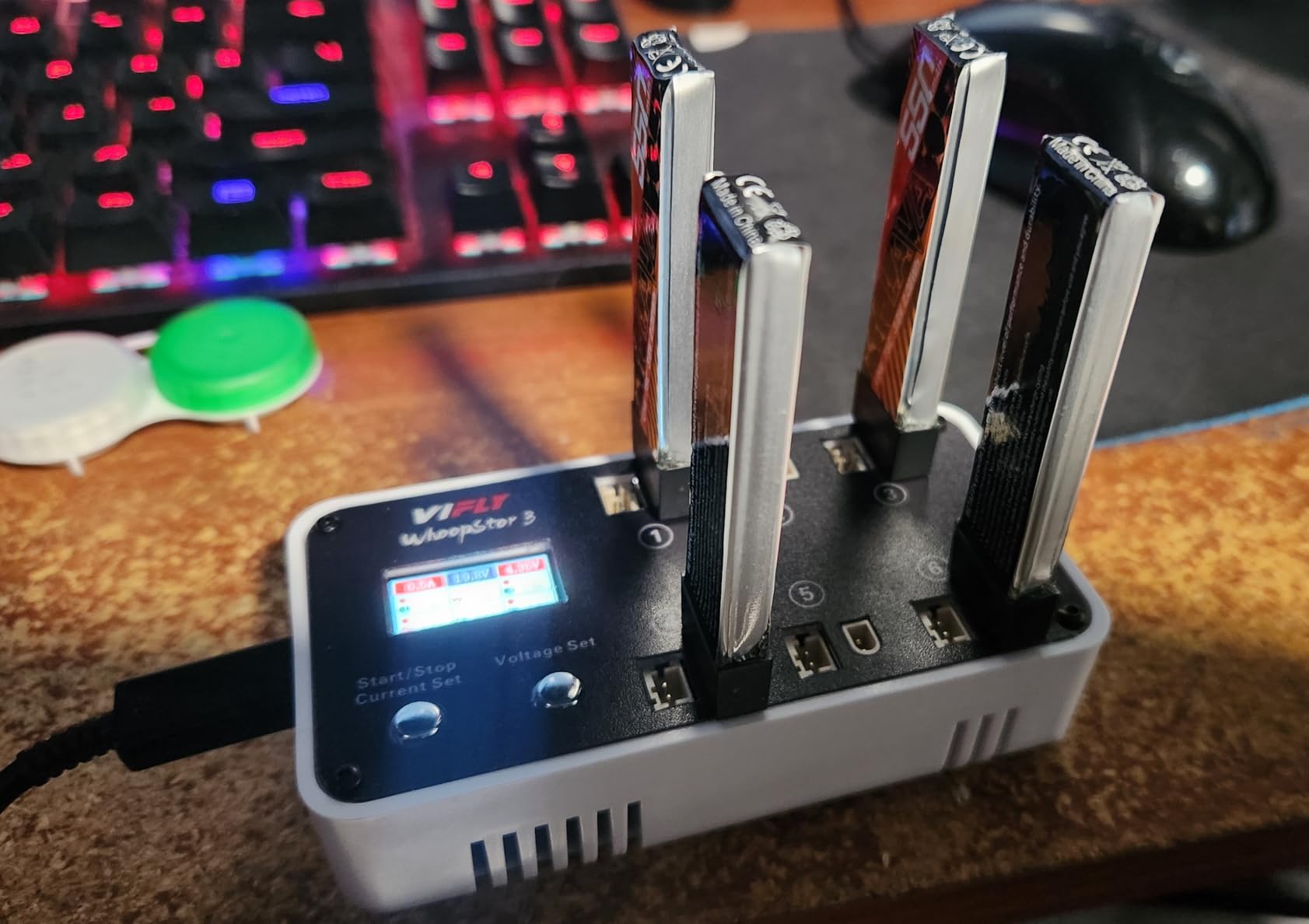
Six ports means I can charge six batteries simultaneously, each at up to 1.3A. For tiny whoop pilots who burn through packs in 3-minute flight sessions, this is a game-changer. I plug in six batteries, set the charge rate, and by the time I have reviewed my last flight on DVR, the next batch is ready to go.
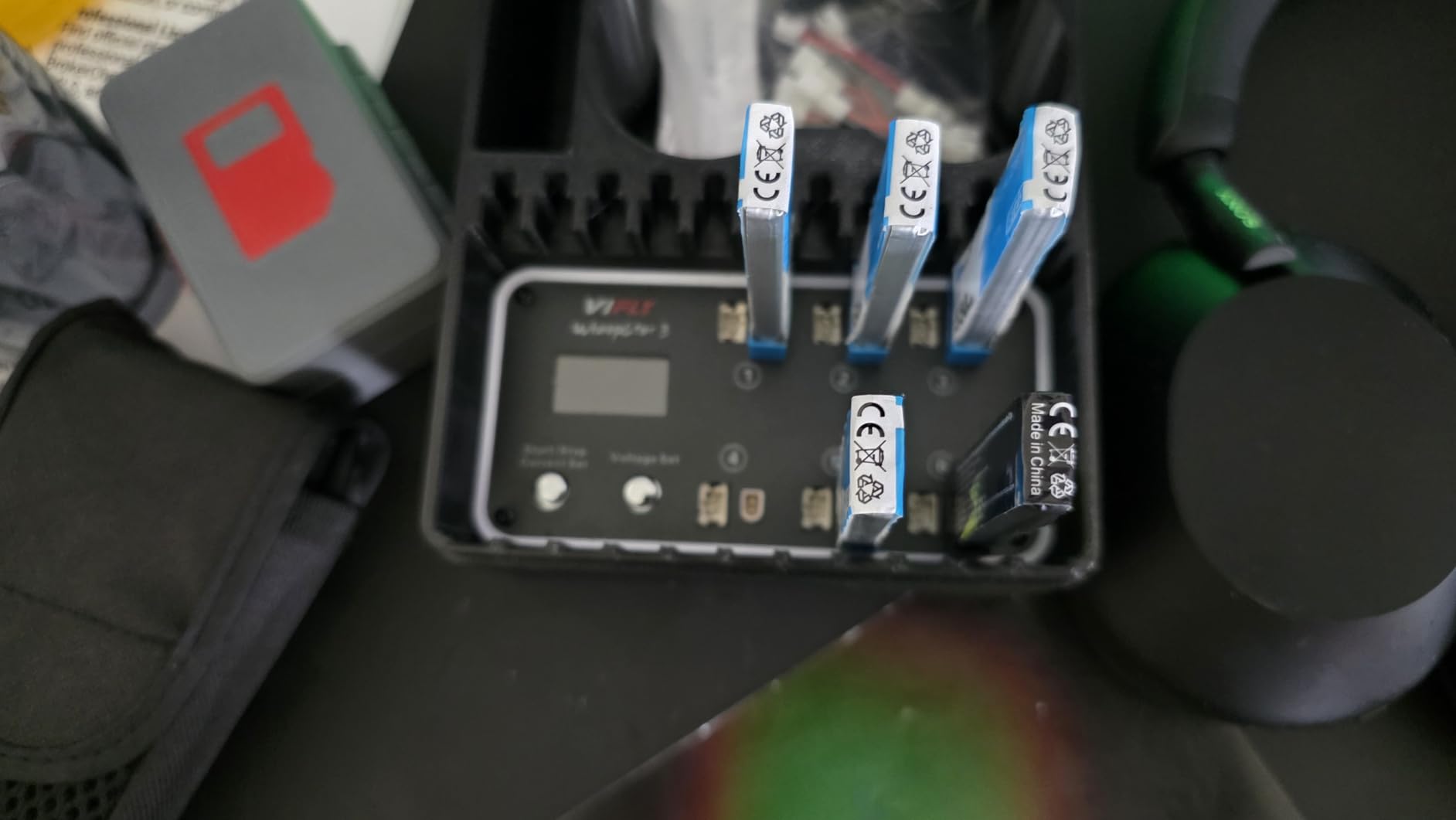
The storage function is what sets this charger apart from every other 1S option on the market. Storage charging brings packs to the voltage level that maximizes their lifespan when not in use. Before the WhoopStor V3, I had no way to do this with my 1S packs and lost several batteries prematurely to storage degradation. This feature alone pays for the charger over time.
The color LCD screen shows charging status for all six ports clearly. I can see which batteries are charging, which are complete, and what voltage each cell is at in real time. The display is bright enough to read in outdoor lighting, which matters when you are charging at the flying field.
Who Should Buy the VIFLY WhoopStor V3
If you fly tiny whoops, micro drones, or any aircraft running 1S LiPo or LiHV batteries, this is the charger to get. The six-port design with storage mode addresses every pain point that 1S pilots face. The BT2.0 and PH2.0 connector compatibility covers virtually every tiny whoop battery on the market.
The multiple power input options make it versatile for both home and field use. I have powered it from a USB-C PD adapter at home and from a 3S LiPo pack at the field using the XT60 input. The memory function remembers your last settings, so you just plug in batteries and go.
What to Watch Out For
The inability to set per-port charge rates is a limitation. All ports charge at the same rate, so if you mix 300mAh and 550mAh packs, you are limited by the smallest battery. The minimum rate of 0.3A may also be too aggressive for very small 150-200mAh cells.
Some users reported USB PD compatibility issues with certain power adapters. The charger works best with quality PD adapters that support 9V or 12V output. I recommend using the XT60 or DC input if you encounter PD problems with your specific power brick.
6. ISDT E625 – Best Budget 1S Charger
ISDT E625 6-Channel 1S LiHV/LiPo Battery IPS Screen Smart Charger/Discharger, Type-C/XT60 PD Powered with BT2.0/PH2.0 Ports, Features 4.35V 2.5A Fast Charging for Tiny Whoop FPV Drones RC Batteries
6-Port 1S Charger
2.5A Per Port
IPS Color Screen
USB-C PD/XT60
BT2.0 and PH2.0
Pros
- Higher charging amperage at 2.5A per port
- Compact and lightweight at just 95g
- Dual USB-C PD and XT60 power input
- 1.9-inch IPS color screen
- Storage and discharge functions included
Cons
- Quality control issues with some units failing
- Menu navigation is bare bones
- Requires 30W+ PD adapter for full speed
- Some channels may read voltage incorrectly
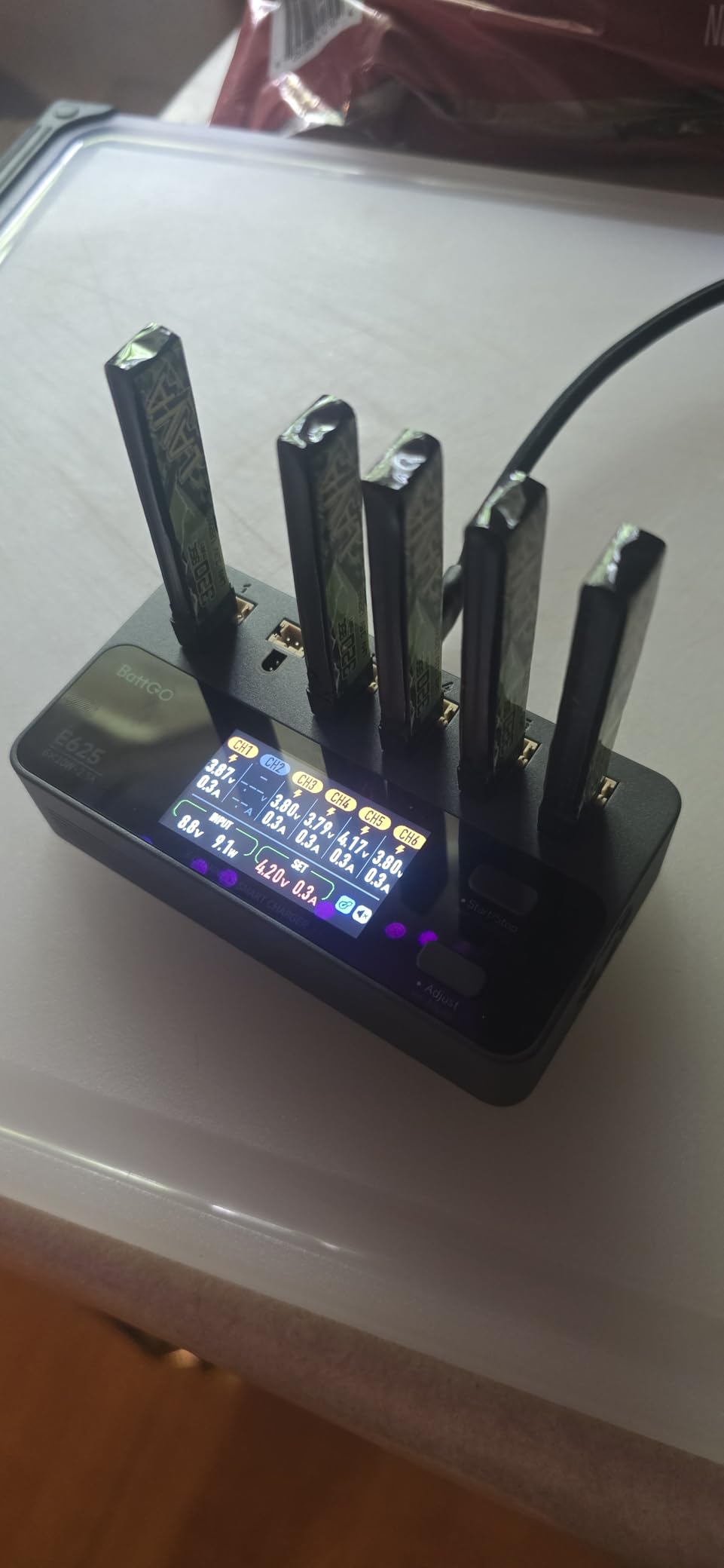
The ISDT E625 entered the 1S charger market as a serious competitor to the VIFLY WhoopStor, and after testing both extensively, I can see why it has generated buzz. The headline feature is 2.5A per-port charging, nearly double the WhoopStor V3’s maximum. For pilots running larger 1S packs like 550mAh or 750mAh BT2.0 cells, this means noticeably faster turnaround between flights.
The build is remarkably compact at just 95 grams. ISDT managed to fit six charging ports, a color IPS screen, and dual power inputs into a package smaller than a smartphone. The 1.9-inch IPS display at 320×170 resolution is crisp and readable, showing per-port status, voltage, and charge current in a clean layout.
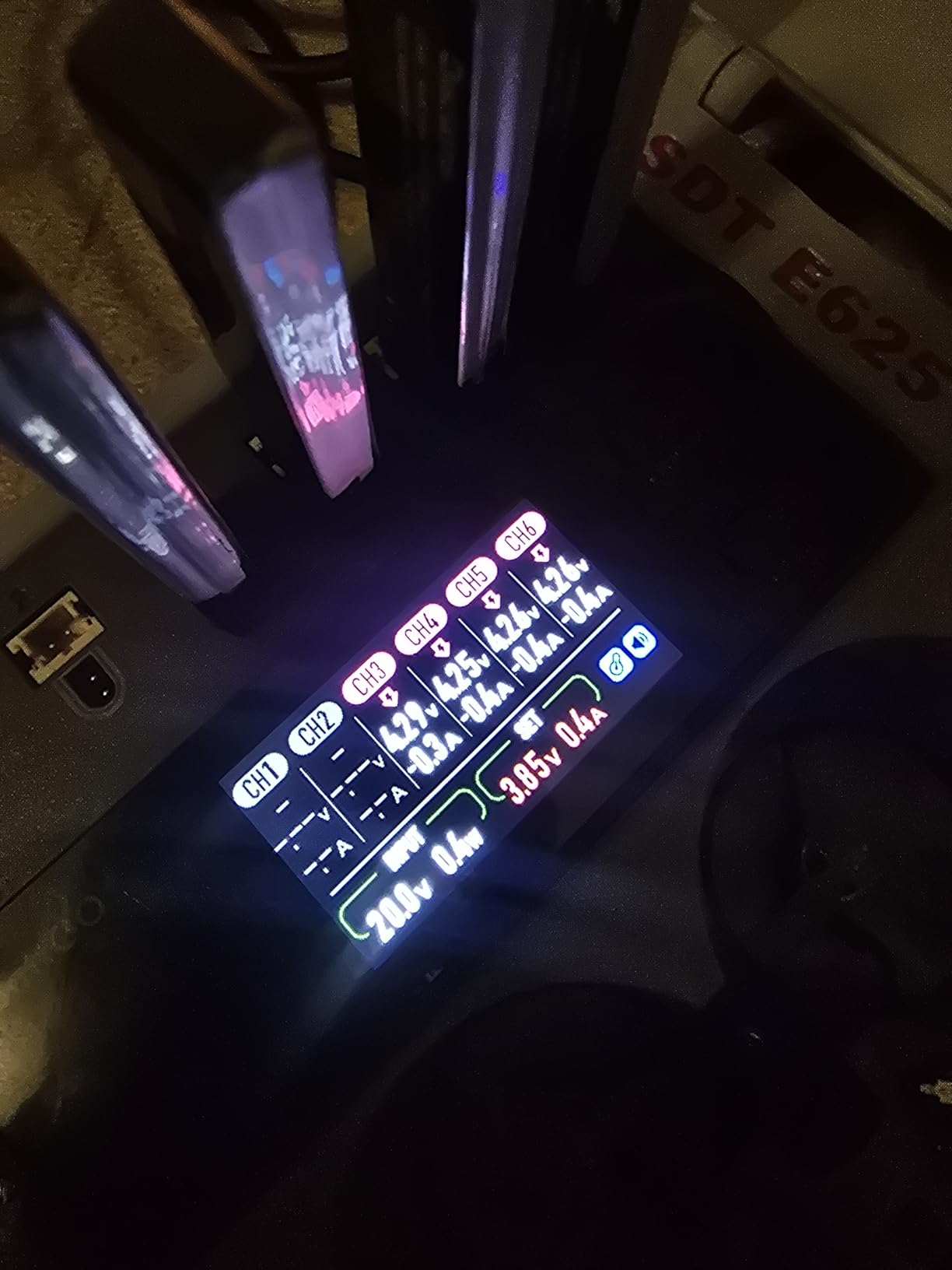
Power input flexibility is excellent. The USB-C PD input accepts 9V, 12V, 15V, and 20V, so it works with virtually any modern PD adapter or power bank. The XT60 input lets you run it from a larger LiPo pack at the field. I appreciate that ISDT included both BT2.0 and PH2.0 connectors, covering all common tiny whoop battery types without needing adapters.
The storage and discharge functions bring battery care features that budget 1S chargers typically lack. Storage mode brings cells to safe storage voltage, and the discharge function lets you bring packs down from full charge. The memory function saves your preferred settings between sessions, which is a small but appreciated convenience.
Who Should Buy the ISDT E625
If you want the fastest 1S charging available and prioritize charge speed over per-port control, the E625 is an excellent choice. The 2.5A per-port output makes it especially suitable for pilots running larger 1S packs who want to minimize downtime. The compact size also makes it perfect for travel and field use.
Pilots who already own a quality 30W+ USB-C PD adapter will get the most value from this charger. If you have a modern power bank or GaN charger lying around, the E625 will run at full speed without additional accessories.
What to Watch Out For
Quality control is the main concern with the E625. Some users reported ports failing after just two weeks of use, and others noted voltage reading inconsistencies between channels. I recommend buying from a seller with a solid return policy and testing all six ports immediately upon arrival.
The menu system is minimal compared to competitors. There is no mAh charged display, which some pilots use for flight controller calibration. You also need a 30W+ PD adapter to achieve full 2.5A charging speed. Weaker adapters will limit the charge rate automatically, which is safe but slower than expected.
Buying Guide: How to Choose the Best Drone Battery Charger?
Choosing the right charger comes down to understanding your battery needs, your flying habits, and the features that actually matter for your setup. I want to walk you through the key decisions so you can make an informed choice rather than guessing based on specs alone.
Smart Charger vs Basic Charger
A smart charger monitors each cell individually through the balance port and adjusts charging current to keep cells equal. A basic charger simply pushes current without monitoring individual cell voltages. Every charger in this guide is a smart charger, and that is intentional. Basic chargers are unsafe for LiPo batteries and can lead to cell imbalance, reduced battery life, or fire.
Smart chargers also offer modes beyond basic charging. Storage mode brings packs to safe voltage for long-term storage, discharge mode reduces packs from full charge, and balance mode equalizes cells without adding charge. These features extend battery life significantly, and the community on Reddit consistently emphasizes that spending more on a quality smart charger pays for itself through longer-lasting packs.
AC vs DC Input: Why It Matters
This is one of the most confusing topics for new pilots, and forum discussions confirm it is a major pain point. AC input chargers have a built-in power supply that plugs directly into the wall. DC input chargers require an external power supply unit to convert wall AC into DC before the charger processes it.
AC/DC chargers like the HOTA D6 Pro and HTRC B6AC are convenient because everything is self-contained. You plug into the wall and start charging. The trade-off is that the built-in power supply limits total wattage, typically to 200W or less.
DC-only chargers can handle much more power when paired with a high-wattage external power supply. The SKYRC B6Neo is interesting because it bridges both worlds with USB-C PD input up to 80W and DC input up to 200W. For most pilots, an AC/DC charger is the simplest starting point.
Understanding Watt and Amp Requirements
Charger wattage determines how fast you can charge. The formula is simple: Watts = Volts x Amps. A 4S LiPo battery has a nominal voltage of 14.8V. To charge at 5A, you need 14.8 x 5 = 74 watts minimum. A 6S pack at 22.2V charging at 5A needs 111 watts.
This is why chargers like the HOTA D6 Pro with 200W AC and 650W DC are so capable. They can push high charge rates into large packs. Budget chargers like the HTRC at 80W will be limited to lower charge rates on bigger batteries, which means longer wait times between flights.
A practical rule: take your battery voltage and multiply by your desired charge rate in amps. If the result is higher than your charger’s wattage rating, the charger will automatically reduce the charge rate. Always buy a charger with more wattage headroom than you think you need.
Cell Count Compatibility
Drone batteries range from 1S single-cell packs in tiny whoops to 6S or even 8S packs in large freestyle and racing builds. Your charger must support your battery’s cell count. All the chargers in this guide handle 1-6S LiPo batteries, and two of them are dedicated 1S chargers designed specifically for tiny whoop pilots.
If you fly multiple drone types, a versatile charger like the HOTA D6 Pro or ISDT 608AC that covers 1-6S gives you flexibility. If you only fly tiny whoops, a dedicated 1S charger like the VIFLY WhoopStor V3 or ISDT E625 is more efficient and purpose-built for your needs.
Balance Charging and Why It Is Non-Negotiable
Balance charging ensures every cell in a multi-cell pack reaches the same voltage. Without it, cells drift apart over time, leading to reduced capacity, shorter flight times, and potential safety issues. Every charger in this guide performs balance charging through the balance port connector.
Balance current matters too. Higher balance current means cells equalize faster, reducing total charge time. Oscar Liang’s guide emphasizes this spec, and forum users frequently ask about it. The HOTA D6 Pro and ISDT 608AC both have strong balance current capabilities that keep charge times reasonable even when cells start significantly out of balance.
Storage Mode: The Feature That Saves Batteries
LiPo batteries degrade faster when stored at full charge or fully discharged. Storage mode brings packs to approximately 3.8V per cell, which is the sweet spot for longevity. If you will not fly for more than a few days, storage charging your packs can double or triple their lifespan.
The VIFLY WhoopStor V3 was the first 1S charger to include storage mode, and it remains a critical feature that sets it apart from cheaper 1S options. For larger packs, every charger in this guide includes storage mode. Make it a habit to storage charge after every flying session.
Charger Maintenance Tips
No competitor covers this topic, so I want to fill that gap. Keep your charger’s firmware updated if it supports updates, like the SKYRC B6Neo. Clean the balance port contacts periodically with contact cleaner to prevent resistance buildup. Store your charger in a dry environment away from direct sunlight.
Periodically verify your charger’s voltage readings against a standalone multimeter or voltage checker. Calibration drift can occur over time, especially with budget chargers. If readings are off by more than 0.05V per cell, contact the manufacturer about recalibration or replacement.
FAQs
What are some good and safe LiPo chargers?
The HOTA D6 Pro, ISDT 608AC, and SKYRC B6Neo are all excellent and safe LiPo chargers. The HOTA D6 Pro is widely recommended by the FPV community as the go-to dual-channel charger, while the SKYRC B6Neo offers the best portability. All three include balance charging, over-current protection, and auto-stop features for safe operation.
Which charger is best for FPV LiPo batteries?
For FPV drones, the HOTA D6 Pro is the top choice for 4S to 6S builds thanks to its dual-channel design and 200W AC power. For tiny whoop pilots running 1S batteries, the VIFLY WhoopStor V3 with its 6 independent ports and storage mode is the best option. For field charging, the SKYRC B6Neo pairs with USB-C power banks for portable power.
What battery charger do I use for my drone?
Use a smart balance charger that supports your battery’s cell count and chemistry. For 1-6S LiPo packs, chargers like the HOTA D6 Pro, ISDT 608AC, or HTRC 80W B6AC work well. For 1S tiny whoop batteries, use a dedicated multi-port charger like the VIFLY WhoopStor V3 or ISDT E625. Always match the charger to your specific battery type for safe operation.
What is the best budget LiPo charger?
The HTRC 80W B6AC is the best budget LiPo charger at under $35 with nearly 2,000 reviews and a 4.4-star rating. It includes a built-in AC power supply, supports 1-6S batteries, and offers charge, discharge, balance, and storage modes. For even less, the SKYRC B6Neo offers 200W DC charging in a tiny form factor at around $38.
Do I need a smart charger for my drone batteries?
Yes, you absolutely need a smart balance charger for LiPo drone batteries. Smart chargers monitor individual cell voltages through the balance port, prevent overcharging, and offer storage and discharge modes that extend battery life. Using a basic non-smart charger with LiPo batteries is unsafe and can lead to cell damage, reduced capacity, or fire hazards.
Conclusion
Finding the best drone battery chargers in 2026 means matching the charger to your flying style. The HOTA D6 Pro remains the top overall pick for pilots who want dual-channel bench charging with a built-in power supply. For tiny whoop enthusiasts, the VIFLY WhoopStor V3 and its storage mode capability are hard to beat. Budget-conscious pilots will find excellent value in the SKYRC B6Neo for portable charging or the HTRC 80W B6AC for an affordable all-in-one solution.
Whatever you choose, prioritize balance charging, use storage mode when packs sit idle, and never skimp on charger safety features. Your batteries will last longer, your flights will be more consistent, and your workbench will be safer. Pick the charger that fits your needs and get back in the air faster.