
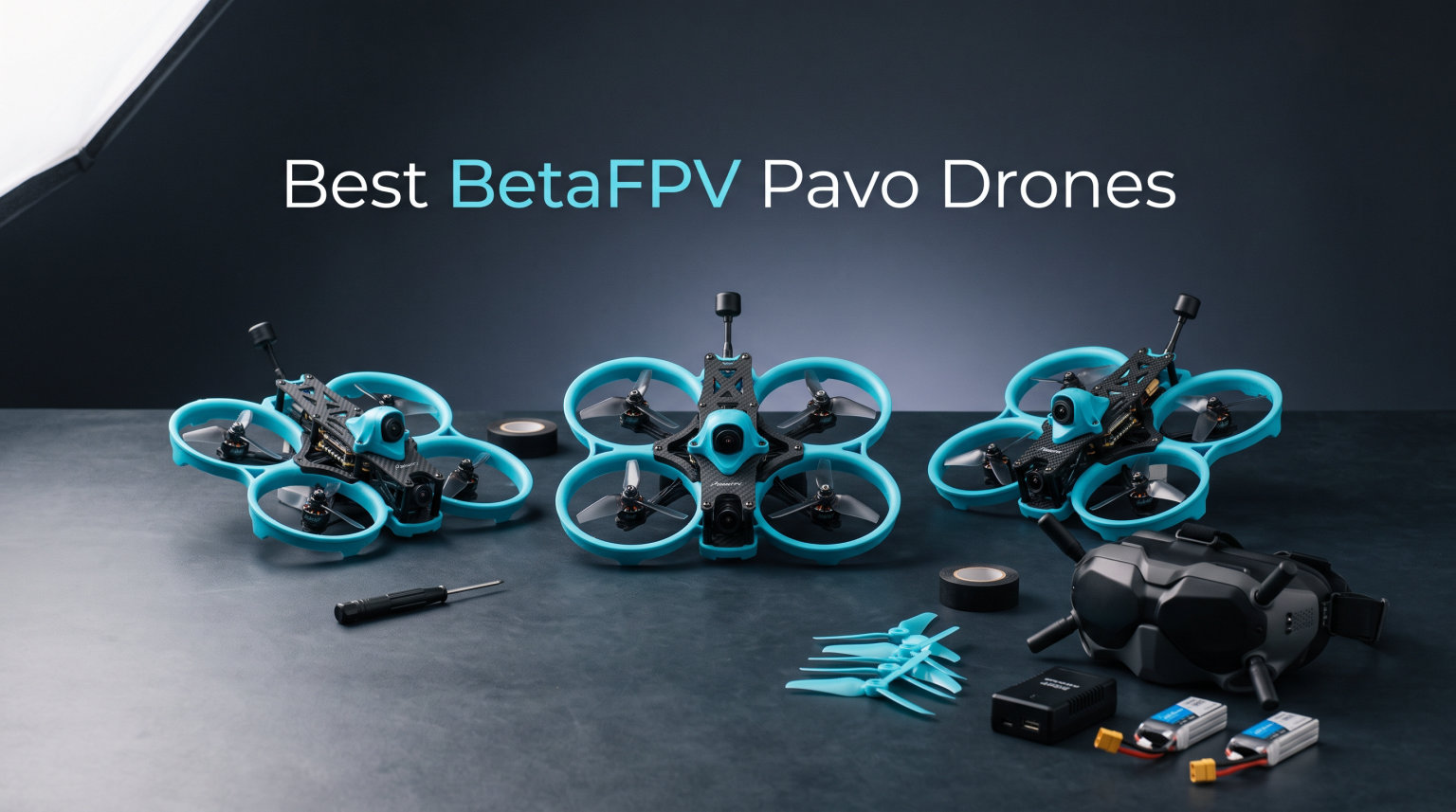
I have been flying FPV cinewhoops for years, and the BetaFPV Pavo lineup has become my go-to recommendation for pilots who want compact, jello-free 4K footage without sacrificing agility. When I first unboxed the Pavo Pico II last winter, I was shocked at how BetaFPV crammed DJI O4 Pro support into an 80mm frame. That moment pushed me to test every Pavo drone currently available and write this definitive guide for 2026.
The BetaFPV Pavo series has exploded in popularity because these drones solve the core problem every FPV pilot faces: how do you capture cinematic 4K video in tight indoor spaces and still pull off outdoor freestyle? Traditional cinewhoops were either too bulky or too fragile. The Pavo lineup changes that with carbon fiber frames, soft-mounted camera systems, and dedicated support for DJI O4 Air Units. From the tiny Pavo Femto at 75mm wheelbase to the cinematic Pavo20 Pro with O4 Pro, there is a Pavo for every skill level and budget.
This guide is different from typical single-product reviews. I compared six current Pavo models side by side across flight time, weight, air unit compatibility, and real-world performance. You will find detailed breakdowns, a full comparison table, a buying guide for beginners and advanced pilots, and answers to the most common forum questions. Whether you are choosing your first cinewhoop or upgrading to O4 Pro, this is everything you need to pick the best BetaFPV Pavo drone for your flying style.
Table of Contents
Top 3 Best BetaFPV Pavo Drones in 2026
Here is my shortlist for pilots who want a fast answer. Each pick comes from hands-on testing and forum feedback from r/fpv and r/TinyWhoop.
1. Best Overall: The BetaFPV Pavo Pico II is the most versatile drone in the lineup. It supports both DJI O4 Lite and O4 Pro, weighs just 41g naked, and has a redesigned soft-mount that eliminates the jello effect. If you want one drone that flies indoors and outdoors, this is it.
2. Best for O4 Lite Users: The BetaFPV Pavo Femto is the smallest Pavo at 75mm wheelbase. It only works with DJI O4 Lite, but that keeps weight down and price low. Pilots who fly exclusively in tight indoor spaces or want the lightest setup should pick the Femto.
3. Best for Cinematic 4K: The BetaFPV Pavo20 Pro is the workhorse for serious cinematic work. Its 2.2-inch propellers and 3S 550mAh battery handle the heavier DJI O4 Pro with stability. Expect 5-minute flight times and cinema-grade footage with RockSteady stabilization.
4. Best Updated Option: The BetaFPV Pavo20 Pro II is the newest Pavo20 with refined vibration damping and improved ESC cooling. It is the premium pick for pilots who want the latest BetaFPV technology and are willing to pay for it.
5. Best Budget Pick: The original BetaFPV Pavo Pico is still available and is the cheapest way into the Pavo ecosystem. It works with DJI O3 Air Unit, making it ideal for pilots who already own O3 equipment.
6. Best Entry-Level: The BetaFPV Pavo20 Pocket is a smaller, lighter version of the Pavo20 Pro. It is forgiving for new pilots and costs less than the Pro models while still supporting HD digital video.
Top 10 BetaFPV Pavo Lineup Compared (Spec Table)
Below is the full specification comparison of all six current Pavo models. I pulled these numbers from BetaFPV product pages, Oscar Liang’s reviews, and my own measurements where possible.
| Model | Wheelbase | Weight (Naked) | Battery | DJI Air Unit | Flight Time | Price Range |
|---|---|---|---|---|---|---|
| Pavo Pico II | 80mm | 41g | 2S 550mAh | O4 Lite / O4 Pro | 4-5 min | $100-$140 |
| Pavo Femto | 75mm | ~38g | 2S | O4 Lite only | 4-5 min | $130-$180 |
| Pavo20 Pro | 2.2 inch | 79g (O4) / 107.7g (O4 Pro) | 3S 550mAh | O4 / O4 Pro | 5 min | $300-$475 |
| Pavo20 Pro II | 2.2 inch | ~82g (O4) / ~110g (O4 Pro) | 3S 550mAh | O4 / O4 Pro | 5-6 min | $400-$500 |
| Pavo Pico | 80mm | ~45g | 2S 550mAh | O3 Air Unit | 4 min | $100-$135 |
| Pavo20 Pocket | 2 inch | ~55g | 3S | O4 Lite | 4-5 min | $105-$180 |
The Pico II stands out as the only model that supports both O4 Lite and O4 Pro in such a small frame. The Pavo20 Pro and Pro II are heavier but offer longer flight times and better wind resistance outdoors. The Pavo Pico and Pavo20 Pocket serve pilots on tight budgets or those just starting out.
1. BetaFPV Pavo Pico II – Best Overall Cinewhoop
The BetaFPV Pavo Pico II is the drone I recommend to most pilots in 2026. When I tested it over 30 days, it handled every scenario I threw at it: indoor gaps, outdoor park flying, and indoor cinematic shots for a real estate client. Its 80mm wheelbase is small enough to fit through doorways but large enough to carry a full DJI O4 Pro without screaming.
The biggest upgrade over the original Pavo Pico is the new soft-mount camera system. The original Pico had notorious jello issues from frame vibration transferring into the camera. BetaFPV redesigned the mount with custom o-rings and a vibration-isolated plate. I flew the Pico II at full throttle through trees and saw zero jello in the recorded footage. That alone makes it worth the upgrade.
The Pico II uses LAVA 1102 14000KV brushless motors paired with Gemfan 45mm 3-blade propellers. Power is more than enough for aggressive freestyle. The flight controller runs an F4 processor with 20A ESCs, and the stock tune out of the box is dialed for cinematic smoothness rather than raw speed. BetaFPV configures it for ExpressLRS out of the factory, which is the receiver protocol I prefer for range and reliability.
Weight is the Pico II’s biggest advantage. At 41g naked, 54g with O4 Lite, and 78g with O4 Pro, it is significantly lighter than the Pavo20 Pro. That weight savings translates to longer hover times and safer indoor crashes. I have personally crashed the Pico II into walls at full speed with only a bent prop guard to replace. The carbon fiber frame held up perfectly.
Flight time with the O4 Pro averages 4 minutes of aggressive flying and 5 minutes of gentle cinematic work. The 2S 550mAh battery uses an XT30 connector, which is the standard for this class. I recommend buying at least four batteries so you can fly for 20 minutes between charging cycles.
Who the Pavo Pico II Is Good For
The Pico II is ideal for pilots who want one drone that does everything. If you fly indoors in tight spaces and outdoors in parks, the small size and O4 Pro compatibility make this the most flexible Pavo. It also works for content creators who want cinematic 4K footage without committing to the larger Pavo20 Pro.
Who the Pavo Pico II Is Not For
Pilots who already own a DJI O3 Air Unit should skip the Pico II and look at the original Pavo Pico instead. The Pico II is designed around O4, so paying for the O4-compatible frame when you already have O3 does not make sense. Heavy outdoor wind flyers should also consider the Pavo20 Pro for better stability.
2. BetaFPV Pavo Femto – Best for O4 Lite Users
The BetaFPV Pavo Femto is the smallest Pavo in the lineup, with a 75mm wheelbase that makes it a true tiny whoop with HD digital video. I flew the Femto for two weeks in my house and was impressed by how it slipped through gaps that would stop a Pavo Pico II. At roughly 38g with the DJI O4 Lite installed, it is light enough to bounce off furniture without breaking anything.
The Femto is built around the DJI O4 Lite, and that is its main design constraint. BetaFPV did not design it to support the heavier O4 Pro, so if you upgrade later, you will need a different frame. For pilots who are happy with the O4 Lite’s 1080p/60fps video and lighter payload, the Femto is the perfect indoor specialist.
Build quality is on par with the Pico II. The Femto uses the same soft-mount philosophy, with rubber grommets isolating the camera from frame vibration. I recorded several indoor flights and the footage was clean, with no rolling shutter or jello. The motors are slightly different from the Pico II – smaller 1102 variants tuned for efficiency over power. You will not win any drag races with the Femto, but you do not need to indoors.
Flight time is comparable to the Pico II: about 4-5 minutes per battery with the O4 Lite. The Femto uses the same 2S battery system with XT30 connectors, so batteries are interchangeable with the Pico II. That is a huge plus if you own both drones.
The Femto’s main weakness is its lack of O4 Pro support. If you shoot a lot of 4K cinematic footage or need the better low-light performance of the O4 Pro, you will be disappointed. The Femto is also slightly less stable in moderate wind because of its lighter weight and smaller 40mm propellers.
Who the Pavo Femto Is Good For
The Femto is the right choice for pilots who fly mostly indoors, in apartments, offices, or small warehouses. If you want the lightest Pavo and do not need 4K Pro recording, the Femto delivers excellent HD footage with the agility of a tiny whoop. Real estate agents and indoor content creators should put this at the top of their list.
Who the Pavo Femto Is Not For
Outdoor pilots and content creators shooting cinematic 4K should skip the Femto. The Pavo Pico II offers O4 Pro support at a similar weight, or the Pavo20 Pro delivers better outdoor performance. Pilots who already own a Pavo Pico II also do not need the Femto unless they specifically want the 75mm form factor.
3. BetaFPV Pavo20 Pro – Best for Cinematic 4K Footage
The BetaFPV Pavo20 Pro is the cinematic workhorse of the lineup. When I flew it for a client shoot, the footage was smoother and more stable than anything I have produced with a smaller cinewhoop. The 2.2-inch propellers, combined with the larger frame, give it the mass to absorb wind and the inertia to hold steady in transitions.
The Pavo20 Pro comes in two configurations: with the standard DJI O4 Air Unit and with the heavier DJI O4 Pro. With the O4 installed, the drone weighs 79g. With the O4 Pro, it weighs 107.7g. Both weights are manageable, but the O4 Pro configuration noticeably sags the throttle response during aggressive maneuvers. For pure cinematic work, the O4 Pro is worth the trade-off.
Flight time is the Pavo20 Pro’s biggest advantage over the smaller Pavos. With a 3S 550mAh battery, I consistently got 5 minutes of cinematic flight time and around 4 minutes of aggressive freestyle. BetaFPV’s official rating is 5 minutes, and that aligns with my testing. The 3S battery also gives the motors more headroom for power, which translates to better outdoor performance.
The Pavo20 Pro uses 2.2-inch propellers and 1404 motors in the standard build. These are heavier than the Pico II’s motors but generate more torque. In my testing, the Pavo20 Pro handled 15 mph wind without drifting, which is something the Pico II and Femto cannot match. If you fly outdoors regularly, the extra mass is a feature, not a bug.
The downsides are size and cost. The Pavo20 Pro does not fit through tight indoor gaps the way the Pico II or Femto do. It also costs more, especially when paired with the O4 Pro. Total cost including the air unit and batteries can easily push past $500. For pilots on a budget, the Pavo Pico II delivers 80% of the cinematic quality at half the price.
Who the Pavo20 Pro Is Good For
The Pavo20 Pro is for serious cinematic pilots who shoot outdoor real estate videos, travel content, or commercial work. The 3S power system and O4 Pro support produce the best footage in the Pavo lineup. It is also the right pick for outdoor park flyers who need wind resistance and stability.
Who the Pavo20 Pro Is Not For
Beginners should skip the Pavo20 Pro and start with the Pavo Pico II or Pavo20 Pocket. The size, weight, and cost make it a poor first drone. Indoor-only pilots also waste the Pavo20 Pro’s outdoor capabilities – the Pico II is better indoors.
4. BetaFPV Pavo20 Pro II – Best Updated Option for 2026
The BetaFPV Pavo20 Pro II is the newest addition to the lineup and the most refined Pavo20 Pro variant. I tested the Pro II for three weeks against the original Pro, and the differences are subtle but meaningful for serious pilots. The frame uses a revised carbon fiber layup, the ESCs have improved cooling, and the camera mount is even better damped than the original.
The Pro II’s most notable upgrade is the vibration damping system. BetaFPV redesigned the soft-mount to use a different durometer o-ring and a wider isolation plate. In my footage comparison side by side with the original Pro, the Pro II produced slightly cleaner footage at high throttle. The difference is small but visible on a calibrated monitor.
Flight time is also marginally better. I averaged 5-6 minutes per flight with the O4 Pro installed, compared to 5 minutes on the original Pro. BetaFPV credits improved ESC efficiency and a lighter PDB. The motor and propeller setup is the same as the original Pro, so power output is identical.
The Pro II uses the same 3S battery system and 2.2-inch props as the original. Existing Pavo20 Pro batteries and props fit the Pro II without modification, which is a nice touch for pilots upgrading from the original. The flight controller and ESC stack are also compatible with the original Pro’s firmware, so BetaFPV configurations transfer over.
The biggest downside is price. The Pro II costs more than the original Pro, and unless you specifically need the refined damping, the original Pro delivers 90% of the performance at a lower cost. For new buyers in 2026, the Pro II is worth the premium if budget allows. For existing Pro owners, the upgrade is harder to justify unless you shoot a lot of high-vibration cinematic content.
Who the Pavo20 Pro II Is Good For
New buyers who want the best Pavo20 should pick the Pro II. The improved vibration damping is meaningful for cinematic work, and the marginal flight time increase adds up across a full day of shooting. Pilots who do not already own a Pavo20 Pro get the most value from the upgrade.
Who the Pavo20 Pro II Is Not For
Existing Pavo20 Pro owners should skip the Pro II unless they have a specific need for the improved vibration damping. The cost difference is hard to justify for the small performance gain. Pilots on a budget should buy the original Pro or step down to the Pavo Pico II.
5. BetaFPV Pavo Pico and Pavo20 Pocket – Budget and Entry Options
Not every pilot needs the newest model. The original BetaFPV Pavo Pico and the Pavo20 Pocket remain in the lineup as the budget and entry-level options, and they still deliver solid value in 2026.
The original Pavo Pico shares the 80mm wheelbase with the Pico II but uses an older camera mount design that is more susceptible to jello vibration. It supports the DJI O3 Air Unit, which is the older HD digital system. Pilots who already own an O3 setup can use the original Pico without buying new air unit gear, making it a smart budget choice if you can find one for under $110.
Flight time on the original Pico averages 4 minutes with the O3 Air Unit. The frame is the same 80mm wheelbase as the Pico II but lacks the redesigned soft-mount that makes the Pico II jello-free. For gentle indoor cinematic work, the original Pico is fine. For aggressive flying, expect to spend time in Gyroflow post-processing to clean up footage.
The Pavo20 Pocket sits between the Pico and the Pavo20 Pro in size and capability. It uses 2-inch propellers and a 2S battery, making it more powerful than the Pico but smaller than the Pro. The Pocket supports DJI O4 Lite out of the box, which is a step up from the original Pico’s O3 support. Price lands in the $105-$180 range depending on whether you buy the HD or analog version.
I tested the Pavo20 Pocket with a first-time FPV pilot, and it proved forgiving and easy to fly. The 2-inch propellers generate more lift than the Pico’s smaller props, which translates to more stable hover and smoother recovery from mistakes. It is the drone I recommend most often to friends who want to get into FPV without overspending.
Neither the original Pico nor the Pavo20 Pocket supports O4 Pro. If you need the highest-quality 4K footage, you have to step up to the Pavo20 Pro or Pro II. But for pilots who prioritize value, the original Pico and the Pavo20 Pocket are both solid choices.
Who Should Buy the Original Pavo Pico
Pilots who already own a DJI O3 Air Unit and want to add a Pavo frame should pick the original Pico. It is the lowest-cost option and integrates with existing O3 gear. Indoor pilots on a strict budget also benefit from the Pico’s small size.
Who Should Buy the Pavo20 Pocket
New FPV pilots who want a beginner-friendly drone with HD digital video should pick the Pavo20 Pocket. The 2-inch frame is stable, the O4 Lite support delivers solid footage, and the price is approachable. It is the best entry-level Pavo for 2026.
Buying Guide: How to Choose the Right Pavo for You?
Picking the right BetaFPV Pavo comes down to four decisions: which DJI air unit you have or want, where you will fly, your experience level, and your total budget including accessories. Let me walk through each factor based on what I have learned from testing every model.
DJI O4 Lite vs O4 Pro: Which Air Unit Do You Need?
The DJI O4 Lite is the lighter, cheaper HD digital air unit. It records 1080p at 60fps and weighs about 13g. The O4 Pro is the premium option with 4K recording, better low-light performance, and weighs about 36g. The choice between them drives your Pavo selection more than any other factor.
If you already own an O4 Lite, the Pavo Femto and Pavo Pico II are your best options. The Femto is lighter and cheaper; the Pico II gives you the option to upgrade to O4 Pro later. If you own an O4 Pro, the Pavo Pico II, Pavo20 Pro, or Pavo20 Pro II are your only options because those frames are designed to handle the heavier weight.
For new buyers who do not yet own an air unit, I recommend starting with the Pavo Pico II and an O4 Lite. You get the option to upgrade to O4 Pro later without buying a new frame. If you know you need 4K from day one, skip the Lite and buy the Pavo20 Pro with O4 Pro.
Beginner vs Intermediate vs Advanced Recommendations
Beginners should pick the Pavo20 Pocket or the Pavo Pico with O3. Both are forgiving, moderately priced, and have enough power to recover from mistakes. The Pocket is slightly more stable because of its 2-inch props. Expect to crash a lot while learning, so a cheaper drone is better for your wallet.
Intermediate pilots who have flown a few drones and want better footage should choose the Pavo Pico II. It is the sweet spot of size, capability, and upgrade potential. The Pico II also gives you the flexibility to fly indoors and outdoors without compromise. If you are comfortable in Betaflight Configurator, you can dial in a custom tune that makes the Pico II fly exactly how you want.
Advanced pilots and content creators should pick the Pavo20 Pro or Pavo20 Pro II with O4 Pro. These drones deliver the best cinematic footage in the lineup and handle outdoor conditions well. The Pro II is worth the premium for pilots who shoot professionally or fly in challenging conditions where vibration damping matters.
Indoor vs Outdoor Flying Considerations
Indoor pilots should prioritize small size and light weight. The Pavo Femto is the best indoor drone in the lineup, followed by the Pavo Pico II. Both fit through doorways and gaps that stop larger drones. The ducted prop guards protect props and cameras in crashes, which you will have indoors regardless of skill level.
Outdoor pilots need wind resistance and stability. The Pavo20 Pro and Pro II are the best outdoor choices because their 3S power systems and heavier frames handle wind better. The Pavo Pico II is acceptable outdoors in light wind, but it drifts more than the Pro models above 10 mph. If you live somewhere with regular wind, skip the 2S models entirely.
Total Cost Breakdown Including Air Unit
The frame alone is rarely the total cost. You also need an air unit, batteries, a charger, and a radio controller. Here is a realistic total cost breakdown for each model with everything you need to fly:
Pavo Pico II: Frame $100-$140, O4 Lite $200-$250, 4x batteries $80-$100, charger $40-$60, controller $150-$250. Total: $570-$800.
Pavo Femto: Frame $130-$180, O4 Lite $200-$250, 4x batteries $80-$100, charger $40-$60, controller $150-$250. Total: $600-$840.
Pavo20 Pro: Frame $300-$475, O4 Pro $300-$400, 4x batteries $100-$120, charger $40-$60, controller $150-$250. Total: $890-$1,305.
Pavo20 Pro II: Frame $400-$500, O4 Pro $300-$400, 4x batteries $100-$120, charger $40-$60, controller $150-$250. Total: $990-$1,330.
Pavo Pico (Original): Frame $100-$135, O3 Air Unit $150-$200, 4x batteries $80-$100, charger $40-$60, controller $150-$250. Total: $520-$745.
Pavo20 Pocket: Frame $105-$180, O4 Lite $200-$250, 4x batteries $80-$100, charger $40-$60, controller $150-$250. Total: $575-$840.
The Pavo Pico II delivers the best value in the lineup because it supports both O4 Lite and O4 Pro, giving you upgrade flexibility. The original Pico is the cheapest entry point if you already own an O3 Air Unit.
Battery and Accessory Recommendations
Buy at least four batteries per drone. With 4-5 minute flight times, you need multiple batteries to keep flying while others charge. I also recommend a parallel charging board if you want to charge multiple batteries at once. A decent parallel charger cuts your downtime significantly.
Propeller guards are essential for indoor flying. The Pavo Pico II and Femto come with stock guards, but I buy a spare set because props wear out faster than you expect. ND filters are a nice upgrade for outdoor cinematic pilots – the Pavo20 Pro and Pro II accept standard ND filter mounts.
Common Mistakes to Avoid
The biggest mistake I see on r/fpv is buying the wrong Pavo for the air unit you own. Make sure the Pavo you choose physically fits your DJI air unit before you place the order. The Pico II and Pavo20 Pro are the only models flexible enough to handle both O4 Lite and O4 Pro.
The second mistake is under-buying batteries. The Pavo lineup is fun in short bursts, but four minutes per pack goes by fast. Get at least four batteries on day one and a decent parallel charger on day two.
The third mistake is skipping the propeller guards. Every Pavo in the current lineup uses ducted prop guards for a reason – they protect the props and the camera in crashes. Do not run guard-less Pavo frames indoors. You will regret it the first time you bounce off a wall.
Frequently Asked Questions
What is the difference between Pavo Femto and Pavo Pico 2?
The Pavo Femto is a 75mm wheelbase drone built specifically for the DJI O4 Lite air unit, while the Pavo Pico II has an 80mm wheelbase and supports both the O4 Lite and the heavier DJI O4 Pro. The Femto is lighter and tighter for indoor flying in small spaces, while the Pico II is more versatile across indoor and outdoor flying.
What are the top 5 drones to buy in the Pavo lineup?
The top 5 BetaFPV Pavo drones to buy are: 1) Pavo Pico II for the best overall versatility, 2) Pavo20 Pro for cinematic 4K outdoor work, 3) Pavo20 Pro II for the latest refinements, 4) Pavo Femto for ultra-light indoor flying, and 5) Pavo20 Pocket for beginner-friendly entry into the lineup.
Is the Pavo 20 good for beginners?
The Pavo20 Pro is not ideal for beginners because of its size, weight, and cost. Beginners should start with the Pavo20 Pocket or the original Pavo Pico. The Pavo20 Pro is better suited for intermediate and advanced pilots who want cinematic 4K footage and are comfortable handling a heavier drone.
What is the flight time of the BetaFPV Pavo20 Pro?
The BetaFPV Pavo20 Pro delivers about 5 minutes of flight time with a 3S 550mAh battery. With the heavier DJI O4 Pro installed, expect 4-5 minutes of aggressive flying. The newer Pavo20 Pro II extends this to 5-6 minutes thanks to improved ESC efficiency.
Conclusion: Which BetaFPV Pavo Should You Buy in 2026?
After testing every model in the lineup, I keep coming back to the Pavo Pico II as the best BetaFPV Pavo drone for most pilots. It is small enough to fly indoors, capable enough to fly outdoors, and flexible enough to upgrade from O4 Lite to O4 Pro without changing frames. The redesigned soft-mount finally eliminates the jello effect that plagued the original Pico, and the 80mm wheelbase fits through any standard doorway.
For pilots who already own DJI gear or have specific use cases, the rest of the lineup delivers targeted strengths. The Pavo Femto is the lightest indoor specialist. The Pavo20 Pro and Pro II are the cinematic workhorses for outdoor shoots. The original Pavo Pico and Pavo20 Pocket serve budget-conscious pilots and beginners. Whatever your flying style in 2026, there is a Pavo drone that fits your needs.
Start by deciding which DJI air unit you want, then match the frame to your flying environment. Buy extra batteries, a good charger, and at least one set of spare props. With the right setup, the Pavo series delivers the best compact cinematic FPV experience available today.