
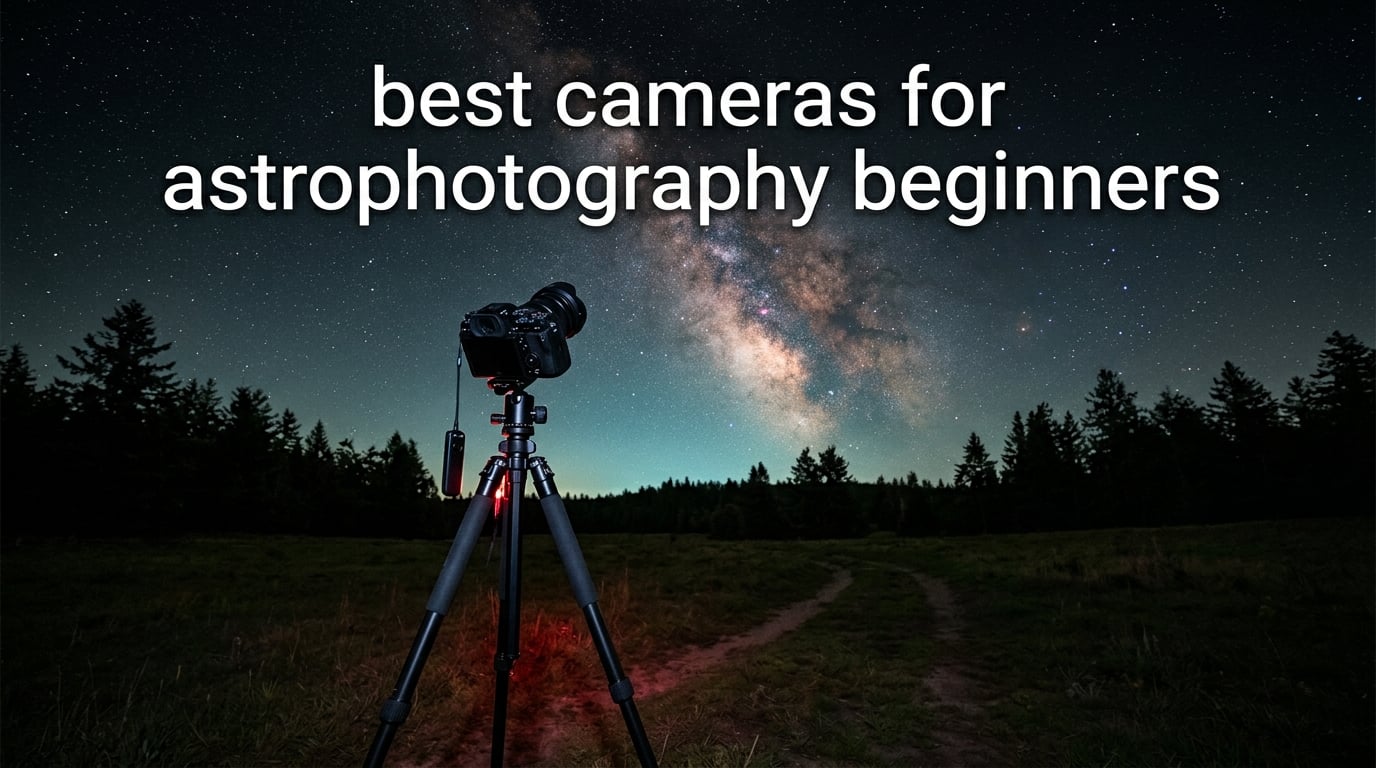
Short answer: the Canon EOS Rebel T7 is our top pick among the best cameras for astrophotography beginners if you want the least risky first step, the Nikon D7500 is the strongest all-round body for high-ISO night work, and the Canon EOS 6D gives you a full-frame sensor for the least money of any full-frame option here. Every camera below shoots manual, writes RAW files, and reaches an ISO high enough to record faint starlight.
That said, most beginners underestimate how little the camera body matters. A fast wide-angle lens, a solid tripod, and eventually a star tracker will improve your night-sky photos far more than a jump from one camera generation to the next. A CloudyNights setup thread makes the point plainly: in a realistic budget build, the camera was the cheapest single component, with the mount and refractor dwarfing it. I have leaned on that hard throughout this guide.
We compared all ten bodies below on the four things that actually decide an astrophotography purchase: usable high-ISO range, RAW bit depth, manual exposure flexibility, and how much they weigh on a tripod at 2am. We left out one category on purpose. Dedicated cooled astronomy cameras like the ZWO and ToupTek units dominate the shopping carousel for this query, and they are genuinely excellent for deep-sky stacking, but they have no screen, no viewfinder, and no lens mount, so they are a second purchase rather than a first one. More on that in the buying guide.
Table of Contents
Top 3 Picks for the Best Cameras for Astrophotography Beginners (October 2026)

Canon EOS Rebel T7
- 24.1 MP APS-C CMOS
- RAW at ISO 100-6400
- Optical viewfinder
- Most owner feedback here

Canon EOS 6D
- 20.2 MP full-frame
- Clean high-ISO output
- Compact body
- Lowest-cost full-frame route
Best Cameras for Astrophotography Beginners in 2026: Quick Overview
| Product | Specifications | Action |
|---|---|---|
| Canon EOS Rebel T7 |
|
Check Latest Price |
 Sony Alpha a6400 Sony Alpha a6400 |
|
Check Latest Price |
 Nikon D7500 Nikon D7500 |
|
Check Latest Price |
 Canon EOS 5D Mark IV Canon EOS 5D Mark IV |
|
Check Latest Price |
 Canon EOS RP Canon EOS RP |
|
Check Latest Price |
 Panasonic Lumix G85 Panasonic Lumix G85 |
|
Check Latest Price |
| Canon EOS 6D |
|
Check Latest Price |
 Sony Alpha 7 IV Sony Alpha 7 IV |
|
Check Latest Price |
 Nikon Z 50 Two Lenses Nikon Z 50 Two Lenses |
|
Check Latest Price |
 Sony Alpha a6700 Sony Alpha a6700 |
|
Check Latest Price |
1. Canon EOS Rebel T7 – Best Starter DSLR for Night Sky Shots
Canon EOS Rebel T7 DSLR Camera EF-S 18-55mm f/3.5-5.6 is II Lens Kit
24.1 MP APS-C CMOS
ISO 100-6400, expandable 12800
30s long exposure
9-point AF
Pros
- 24.1 MP APS-C sensor gives room to crop night-sky frames
- Full manual exposure control for long exposures
- Optical viewfinder needs no battery while framing
- Lightest DSLR body here at 1 pound
- Wi-Fi and NFC for phone transfers
Cons
- No in-body image stabilization
- 3 fps burst is slow for star-trail sequences
- Kit lens is too slow for faint deep-sky targets
I keep coming back to the Rebel T7 as the first camera I hand to a friend who wants to try night photography. It is the simplest body in this list to learn: a mode dial, a shutter dial, and a menu that gets out of your way. There is no deep menu diving required to get a 20-second exposure at ISO 3200 in RAW, which matters more than anything else in a first session.
The 24.1 MP APS-C CMOS sensor is the reason it still works. At 10 to 20 seconds per frame, that resolution gives you enough width to crop a nightscape later and still keep usable detail in the Milky Way core. The native ISO range runs 100 to 6400 and expands to 12800, and reviewers consistently report that 1600 to 3200 is the sweet spot for a first wide-field attempt.

The optical viewfinder is a quiet, underrated advantage. You can frame the sky at full darkness without a screen washing out your eyes, and it draws no power while you do it. On a cold three-hour shoot that conserves battery in a way an electronic viewfinder never does.
Where it falls short is stabilization and burst speed. There is no in-body image stabilization, so every long exposure depends entirely on tripod discipline, and 3 fps is sluggish if you want a rapid intervalometer star-trail sequence. The bundled 18-55mm f/3.5-5.6 kit lens is the real limitation. It is a daylight kit lens, and at f/5.6 you will be counting photons that never arrive.

What the Rebel T7 does well for night skies
It handles the core night-sky workflow without any special software. Manual mode, RAW capture, a 30-second maximum exposure, and an intervalometer-compatible shutter all live on the main dial. For Milky Way nightscapes, star trails, meteor showers, and aurora from a dark site, it covers every beginner target.
Sensor size is the limit, not capability. The 1.6x crop factor of an APS-C sensor means a 24mm lens frames like a 38mm, so wide-field work is tighter than full frame. For beginners that is a fair trade for the lower purchase cost and the far lighter body.
Where the Rebel T7 falls short
Buy this body, not this bundle, if you can. The EF-S 18-55mm f/3.5-5.6 IS II will not reach the faint emission nebulae that a fast prime at f/2.8 gathers in seconds. The 9-point autofocus system is also dated, though it is largely irrelevant once you switch to manual focus at infinity for astro work.
If you already own a tripod and a wide prime, this body costs almost nothing as a second camera and it is a genuinely capable astro sensor. If you are starting from zero, budget for the lens before you celebrate the body purchase.
2. Sony Alpha a6400 – Compact Mirrorless for Dark-Site Trips
Sony Alpha a6400 Mirrorless Camera: Compact APS-C Interchangeable Lens Digital Camera with Real-Time Eye Auto Focus, 4K Video, Flip Screen & 16-50mm Lens – E Mount Compatible – ILCE-6400L/B, Black
20.1 MP stacked Exmor RS CMOS
425 phase-detect points
11 fps
10.3 oz body
Pros
- Light enough to carry to a dark site on foot
- Stacked back-illuminated sensor reads out fast
- 11 fps burst
- Time-lapse and slow-motion modes for star trails
- Strong third-party E-mount lens support
Cons
- No in-body image stabilization
- Limited native Sony APS-C lens lineup
- Menu system and phone app are hard to learn
- Tilting screen is awkward at high tripod angles
At 10.3 ounces, the a6400 is the body we would put in a pack for a night where the drive is rough and the ground is uneven. Mirrorless helps here for a reason that has nothing to do with image quality: there is no mechanical mirror to shift, so nothing inside the camera moves when you fire the shutter. That removes a vibration source that DSLRs have to solve with mirror lock-up.
The 20.1 MP APS-C Exmor RS sensor is stacked and back-illuminated, which means it reads out pixels far faster than a conventional sensor. The practical effect for astro is clean, low-lag live view when you magnify a star to focus, and no rolling-shutter skew on moving targets. Reviewers note that files from this body still hold up years later.

Manual exposure, RAW capture, and a time-lapse movie mode are all present, so it handles both single long exposures and star-trail sequences. The 3-inch 180-degree tilting touchscreen helps with low-angle framing, which matters more on a tracker than it does on a straight tripod.
The Sony menu system is the honest drawback. It is a dense, function-nested interface, and the smartphone app has earned its own complaints from owners. Budget an evening with the manual before your first night out, or set your settings once and save them to a memory card profile.
Why the a6400 suits beginners who move around
The combination of weight, stacking sensor, and lack of moving parts makes this a strong dark-site camera. APS-C crop factor here is 1.6x, so a 16mm prime frames like a 24mm, and that is wide enough for a large chunk of the Milky Way band.
Third-party E-mount glass is also a genuine advantage for astro. Fast primes in this mount are common, and a fast prime is the single lens upgrade that changes your night-sky results most.
Where it will disappoint you
There is no in-body image stabilization, so a tripod is non-negotiable. Stabilization does not freeze stars anyway, but it does let you frame and check composition handheld before you commit the shot.
Sony’s own APS-C lens range is the weakest part of the package, so you are relying on third-party lenses for anything fast. If you want the smoothest first-time experience with the least lens shopping, a body in a system with more affordable glass may serve you better.
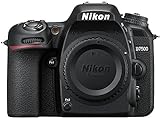
3. Nikon D7500 – The High-ISO DSLR Workhorse
Nikon D7500 DX-Format Digital SLR Body
20.9 MP DX-format CMOS
14-bit RAW
8 fps burst
3.2-inch tilting touchscreen
Pros
- Owners single out its high-ISO output for Milky Way work
- 14-bit RAW preserves shadow detail at night
- 8 fps with a deep buffer suits star-trail sequences
- 51-point AF with 15 cross-type sensors
- Tilting touchscreen helps low-angle tripod framing
Cons
- Single SD card slot with no backup for long sessions
- Heavier than compact mirrorless at 1.7 pounds
- No depth-of-field preview for focus checking at infinity
Ask a room of amateur astronomers which DSLR they trust for unguided wide-field work and the D7500 comes up more than almost anything else. The reason is high-ISO behaviour: owners consistently single it out for clean files at the ISO 1600 to 3200 range that a Milky Way session actually lives in, with less chroma noise in the shadows than entry-level bodies manage.
Image quality, ISO range, and metering sit close to the professional D500, which is unusual at this tier. For astro the relevant details are 14-bit RAW, a native ISO base of 100 usable well past 6400, and a max shutter speed of 1/8000 seconds that gives you plenty of headroom for bright foreground exposures.
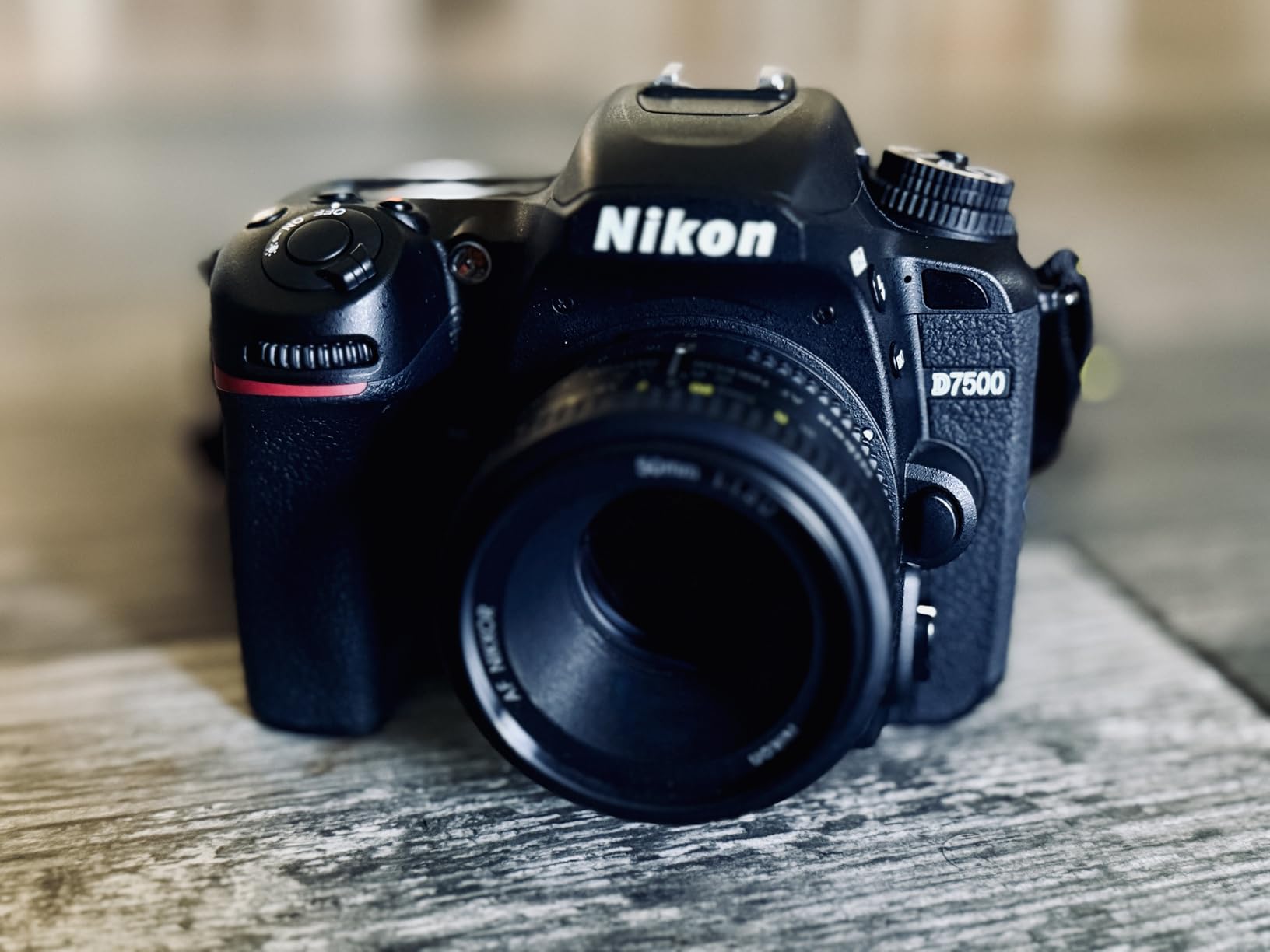
It is also a genuinely pleasant camera to use in daylight, which matters for a beginner who wants one body for everything. 8 fps with a large buffer handles rapid interval sequences, and the 51-point AF with 15 cross-type sensors tracks moving subjects when you switch back to normal shooting.
Two things slow it down for night work. The single SD slot means one card failure can end a long session, and there is no depth-of-field preview button, so checking focus at infinity means a little menu work or a magnified live view check.

What you gain with a DX sensor at this level
The 20.9 MP DX sensor is the sweet spot for beginners: enough resolution to crop a nebula, a 1.5x crop factor that tightens your field of view usefully, and a file size that still stacks comfortably on a laptop. A CloudyNights thread debating one-shot-colour versus monochrome cameras makes the same underlying point, that sensor choice matters less than getting out with the setup you have.
For deep-sky stacking through a telescope, this body will not reach the low read noise of a cooled astronomy camera. It does not need to for a first year of learning.
Where the D7500 costs you
At 1.7 pounds, it is a heavy object to balance on a lightweight travel tripod. If your tripod cannot carry a camera plus a fast wide lens without flexing, every long exposure risks vibration, and vibration is the one thing that ruins star points.
There is also a real learning curve for anyone coming up on an entry-level DSLR. Owners coming from smaller bodies describe the control layout as a step up rather than a gentle introduction.
4. Canon EOS 5D Mark IV – Premium Full-Frame Upgrade
Canon EOS 5D Mark IV DSLR Camera (Body Only)
30.4 MP full-frame CMOS
ISO 100-32000, expandable to 102400
Interval recording
7 fps
Pros
- 30.4 MP full-frame sensor with a very wide ISO range
- Interval recording and mirror lock-up for long exposures
- Dual Pixel CMOS AF is smooth and reliable in live view
- 7 fps with a deep buffer for stacking and panoramas
Cons
- Body design is older and heavier than modern mirrorless
- Fixed non-touchscreen rear LCD
- High price makes it a poor first camera
We include this body because it represents the far end of what a beginner might aspire to, and because seeing the gap is instructive. The 30.4 MP full-frame sensor with a native ISO 100 to 32000 range, expandable to 102400, gathers light in a way no crop body here can match. Wide-field nebulae and integrated flux nebula mosaics are simply easier from full frame.
The features that matter specifically for night work are interval recording and mirror lock-up. Mirror lock-up holds the reflex mirror up so it does not slap back down mid-exposure, which is exactly the shutter-vibration problem that wrecks star points on a DSLR. Interval recording runs a timed sequence without you touching anything between frames.

Dual Pixel CMOS AF makes manual-focus assist smooth, so hitting precise focus on a faint star through an adapter is a calmer process. The 7 fps burst and deep buffer support multi-frame stacking and mosaic work.
It is a 1.24 kg body, and the fixed non-touchscreen rear LCD belongs to a previous design era. Against a modern articulating screen, framing high or low on a star tracker is noticeably more awkward.

What full frame actually buys an astro shooter
Total light gathered. A full-frame sensor has roughly four times the area of an APS-C sensor, so for the same exposure you collect several times more signal. That translates into shorter exposures, lower ISO, and less noise to clean up in stacking.
It also widens your field of view for a given focal length, which matters enormously for the Milky Way band and for large emission complexes that will not fit in a crop frame at prime focus.
Why we would not start here
The cost puts it out of reach for most first-time buyers, and the money saved on the body could instead buy a fast wide lens, a tracking mount, and a fast astro lens combined. That is the honest arithmetic of a first night-sky kit, and it is the same point the forum setup threads keep making.
Buy this body second, after you know what you want to photograph and after your lens and mount choices are settled.
5. Canon EOS RP – Smallest Full-Frame in the Lineup
Canon EOS RP Full-Frame Mirrorless Interchangeable Lens Camera + RF24-105mm Lens F4-7.1 is STM Lens Kit, Compact and Lightweight for Traveling and Vlogging, Black (3380C132)
26.2 MP full-frame CMOS
16 oz body
Articulating touchscreen
Single SD slot
Pros
- Small and light full-frame body that is easy on a travel tripod
- High ISO output with little visible grain
- 24-105mm IS STM kit lens covers wide to short tele
- Articulating screen simplifies high-angle framing
Cons
- No in-body image stabilization
- No mechanical shutter so the sensor stays exposed on lens changes
- Canon RF mount has limited fast lens choice
- Cropped 4K capped at 24 fps
The RP exists because a lot of beginners want full frame and do not want to carry it. At 16 ounces it is one of the lightest full-frame bodies made, and owners describe setting it up on a small travel tripod as straightforward. For a hobby that involves driving to dark sites, that weight difference is not trivial.
The 26.2 MP full-frame sensor produces high ISO frames with little visible grain according to owners, which is the property that actually matters for Milky Way work. The bundled 24-105mm f/4-7.1 IS STM gives you stabilization in the lens and covers from wide angle to short telephoto in one walk-around zoom.

The fully articulating touchscreen is more useful for astro than it first appears. On a star tracker, the camera often ends up at an awkward height or pointed upward, and a screen that tilts and swings to the side removes the neck-cracking that a fixed panel causes.
There is no in-body image stabilization here, only lens-based IS, and that does nothing for stars. There is also no mechanical shutter, so the sensor stays exposed when you change lenses, and you need good light discipline to avoid catching a flare in a long frame.

Best reasons to step up to full frame here
Full frame plus a lightweight body is a rare combination, and for portable nightscapes it is hard to beat. The wider field of view from a short focal length means more of the Milky Way band in a single frame, which is the single biggest visual jump for a beginner.
The lens-based stabilization in the kit lens also helps you frame and compose handheld before switching to a tripod, which speeds up setup in the dark.
Where beginners get caught out
The RF mount is the issue. Third-party RF glass is mostly APS-C, and the fast wide primes that transform night-sky work are the hardest thing to find in this mount. Check that a suitable lens exists before you commit to the body, not after.
The 4K video is also cropped and capped at 24 fps, which is irrelevant to stills but disappointing if you also shoot video. The kit lens is soft at the frame edges, so treat it as a placeholder and plan one fast prime.
6. Panasonic Lumix G85 – Stabilized and Weather-Sealed
Panasonic LUMIX G85 4K Digital Camera, 12-60mm Power O.I.S. Lens, 16 Megapixel Mirrorless Camera, 5 Axis in-Body Dual Image Stabilization, 3-Inch Tilt and Touch LCD, DMC-G85MK (Black)
16 MP Micro Four Thirds no low-pass filter
5-axis dual IBIS
Weather sealed
30 fps 4K photo mode
Pros
- 5-axis dual in-body stabilization is rare at this tier
- Weather-sealed body and lens suit cold damp nights
- Intervalometer and 4K photo mode for time-lapse sequences
- Full manual exposure and focus with two mode dials
- Large Micro Four Thirds lens ecosystem
Cons
- 16 MP sensor holds less fine detail for cropping
- Noticeably noisier at ISO 6400 and above than larger sensors
- 4K is cropped and capped at 100 Mbps
- Heavier and bulkier than compact Micro Four Thirds bodies
The G85 is the odd one out in this lineup because it is the only body with in-body stabilization that we would consider for night work. Five-axis dual sensor-shift IBIS is a genuine rarity at this tier, and while it cannot freeze stars, it makes the difference between a usable frame and a blurry one when you are setting up in the dark and mounting the camera by feel.
More importantly, the body and the 12-60mm kit lens are both weather-sealed. Dew, damp grass, and cold hands are the conditions you will actually meet on a long night, and sealed controls are a real advantage when you are working with gloves on.

The 16 MP Micro Four Thirds sensor has no low-pass filter, which helps fine detail relative to other Micro Four Thirds bodies. The intervalometer and 4K photo mode give you a dedicated star-trail shooting mode, and two customizable mode dials let you put exposure settings on the top of the camera where your fingers find them.
Sensor size is the compromise. At ISO 6400 and above, owners report noticeably more noise than larger sensors produce, and 16 megapixels gives you less room to crop a nebula than any other body in this list.

Why the extra reach is useful for astro
A Micro Four Thirds sensor has a 2x crop factor, so a 12mm lens frames like a 24mm. That makes ultra-wide nightscapes easier to compose than on any other system here, and the mount has a deep catalogue of compact wide primes that cost very little.
If planets are on your list, that same 2x reach helps with longer focal lengths, and 300mm-plus telephotos in this mount stay small enough to carry to a dark site.
Where the smaller sensor bites
Noise is the honest cost. When you push ISO to gather faint light, the grain and colour noise in the shadows are heavier, and stacked frames from a smaller sensor carry that noise forward. It is manageable, and stacking still recovers a lot, but it is a real limit.
Sixteen megapixels is the other one. When you crop to isolate a nebula from a wide field, you run out of resolution sooner than with a 24 or 26 MP body. And despite the compact lens ecosystem, this particular body is heavier and bulkier than the small Micro Four Thirds cameras it replaced.
7. Canon EOS 6D – Best Full-Frame Value Pick
Canon EOS 6D 20.1 MP CMOS Digital SLR Camera with 3.0-Inch LCD (Body Only)
20.2 MP full-frame CMOS
4.5 fps
Optical 0.71x viewfinder
1080p video
Pros
- Full-frame 20.2 MP sensor delivers clean high-ISO night frames
- Highest average rating in the group
- Compact relative to other full-frame DSLRs
- Full manual controls and a bright optical viewfinder
- Broad compatibility with affordable Canon EF lenses
Cons
- 11-point autofocus system is dated
- No image stabilization so a solid tripod is required
- 1080p video only with no 4K
- Older body with no Wi-Fi app and no touchscreen
The 6D carries the highest average rating of any camera in this group, and for astro there is a clear reason. The 20.2 MP full-frame sensor is roughly four times the area of the crop sensors elsewhere in this list, so at a given ISO it collects several times more starlight. Owners report clean high-ISO results, and that is the single measure that matters most for wide-field work.
Full manual exposure control and a bright 0.71x optical viewfinder make framing straightforward in total darkness. The optical viewfinder also means unlimited time spent composing without draining the battery, which is a meaningful advantage on a long session where the cold has already thinned your power reserve.

It is also compact for a full-frame DSLR, and it takes Canon EF lenses, a mount with an enormous catalogue of affordable glass. A fast EF prime is the obvious next purchase and it is where most of your improvement will come from.
The 11-point autofocus system is genuinely dated, and there is no image stabilization at all, so a solid tripod carries the entire burden of keeping stars point-like. Video is 1080p only.
Where a used full-frame body makes sense
This is the body we would point someone toward who is buying used rather than new. A full-frame sensor at a generation or two old still gathers far more light per frame than any current crop body, and the manual controls, RAW capture, and 30-second exposures are all present. The gap between this and a current body is smaller for astro than it is for sports or video.
Check the shutter count, look for a clean sensor, and test the live view magnification for focus. Avoid bodies with a heavy dust spot pattern or a sticky rear dial, which are the two most common complaints on aging DSLRs.
Why age still shows
There is no Wi-Fi app connectivity and no touchscreen, so file transfer and focus checking are manual processes. The 11-point AF is slow for anything that moves, which rules it out for planetary work where your subject drifts between frames.
If you want video at all, look elsewhere. For stills of the night sky on a tripod, none of that touches what you are actually doing.
8. Sony Alpha 7 IV – Flexible Hybrid Full-Frame
Sony Alpha 7 IV Full-frame Mirrorless Interchangeable Lens Camera
33 MP Exmor R back-illuminated full-frame
ISO base 100
10 fps
5-axis SteadyShot
Pros
- 33 MP full-frame sensor with excellent dynamic range and low-light capability
- 5-axis stabilization plus a fully articulating screen
- 759-point AF with Real-time Eye AF
- CFexpress Type A and SD dual card slots protect long sessions
- Owners report 2000+ shots per charge
Cons
- Menu system and feature set carry a real learning curve
- High cost for a first interchangeable-lens body
- 4K 120p is heavily cropped
The Alpha 7 IV is the most capable astro body in this list on paper, and the 33 MP Exmor R back-illuminated full-frame sensor is the reason. Back-illumination and a large sensor together mean excellent dynamic range and low-light capability, so you can hold the bright core of a nebula while still pulling signal out of the faint outer regions in the same exposure.
5-axis SteadyShot sensor-shift stabilization plus a fully articulating screen is the best combination for tripod work in the list. The stabilization does not stop star trails, but it lets you compose and find focus handheld, and the articulating screen makes the awkward angles a tracker forces on you far more manageable.

Dual card slots, one of them CFexpress Type A, are a real protection for long night sessions. If a card fails at 3am you lose the session; two slots mean you can split a sequence across both. Battery life is another quiet strength, with owners reporting more than 2000 shots per charge.
None of that makes it a beginner camera. The menu system and feature set carry a real learning curve, the 4K 120p mode is heavily cropped, and the cost is a stretch for a first interchangeable-lens body.

What it does that nothing else here does
Stabilization on a full-frame body changes how the camera feels in the field. You can handhold a test frame to check the Milky Way before you mount anything, and the 1.07x class viewfinder with a tilting screen makes manual focus on a faint star far less fiddly than on a fixed-screen body.
The sensor also handles prime focus through a telescope better than anything else here, with the resolution and dynamic range to support heavy cropping on planetary discs.
Where a beginner should hesitate
Complexity is the real cost, not the money. Every menu layer is a decision you will have to learn, and Sony’s interface rewards people who read the manual. If you want a camera you can set up in ten minutes on your first night, this is more machine than you need.
Treat it as a body to grow into rather than one to learn on. If you also need video, wildlife, or travel stills in the same tool, the flexibility justifies itself quickly.
9. Nikon Z 50 with Two Lenses – Best Two-Lens Value
Nikon Z 50 with Two Lenses | Compact mirrorless Stills/Video Camera with Wide-Angle and telephoto Zoom Lenses | Nikon USA Model
20.9 MP DX-format CMOS
16-50mm and 50-250mm included
Interval recording
1.8 pounds
Pros
- Two lenses bundled: a 16-50mm wide zoom and a 50-250mm telephoto
- Both lenses retract for compact packing
- 20.9 MP sensor produces very low-noise RAW files
- Large 55mm Z mount means future full-frame bodies share the lenses
- Interval recording and full manual exposure modes
Cons
- No in-body image stabilization
- Very limited native DX lens selection so the kit lenses are effectively all you have
- Only a single card slot
- Steep menu learning curve for complete beginners
This bundle solves a problem nobody advertises: a beginner needs a wide lens for the Milky Way and a longer lens for planets, and a single kit zoom cannot be both. The NIKKOR Z DX 16-50mm f/3.5-6.3 VR and the 50-250mm f/4.5-6.3 VR cover that range, and both retract into a compact package that fits in a daypack.
The 20.9 MP sensor produces low-noise RAW files according to owners, and interval recording is built in for star-trail sequences. Manual exposure modes are complete, so nothing about this camera restricts you as a beginner. It is a real camera for daytime work too, which is the point of buying one body.

The 55mm Z mount is the strategic part. Because the mount is full-frame sized, any future full-frame Nikon Z body will accept these same lenses, so you are not buying into a dead end. Interval recording handles unattended sequences, which saves you touching anything between frames.
There is no in-body image stabilization, and the single card slot is a limit on long sessions. Most importantly, the native DX lens selection is very limited, so in practice those two bundled lenses are most of what you have to work with, and neither is a fast astro prime.

What the two lenses actually give you
The 16-50mm is your Milky Way and nightscape lens. On a DX sensor its 1.5x crop factor means it frames like a 24mm to 75mm, which is a wide, workable field for the galactic core and for large nebulae on a tracking mount.
The 50-250mm is your planetary and lunar lens, and at 375mm equivalent it will resolve detail on Jupiter’s bands. Combine it with a Barlow or a telescope adapter and it becomes a planetary tool.
Where the bundle leaves gaps
Both lenses are variable-aperture zooms with modest maximum apertures, so they collect less light than a dedicated fast prime would. If your priority is deep-sky, plan to add one wide fast lens rather than relying on the zoom.
The menu and control layout also has a reputation for a steep learning curve, and that matters more when you are trying to learn astrophotography and a new interface at the same time.
10. Sony Alpha a6700 – Latest-Generation APS-C Power
Sony Alpha a6700 APS-C Mirrorless Camera Body 26MP 4K Black
26 MP APS-C Exmor R back-illuminated CMOS
ISO 100-32000
Sensor-shift IBIS
14.5 ounces
Pros
- 26 MP sensor with strong dynamic range and clean low-light files
- Dedicated AI processor with Real-time Recognition for tracking
- Light at 14.5 ounces for a portable tripod kit
- 4K 60p full-sensor 10-bit recording with no crop
- Premium build quality and long battery life for its class
Cons
- No dual card slots for long-session protection
- High ISO performance lags larger sensors
- In-body stabilization is modest
- Can run hot during very long 4K 60p recordings
The a6700 is the newest body here and the only current-generation APS-C camera in the group. The 26 MP Exmor R back-illuminated sensor is a generational step over the sensors in the older bodies above it, with strong dynamic range and clean low-light files for a camera this small.
At 14.5 ounces it is the second-lightest camera here, and it is the only mirrorless in the group that pairs that weight with in-body sensor-shift stabilization. The dedicated AI processor with Real-time Recognition locks onto subjects and tracks them accurately, which is not an astro feature but is a good sign of how clean the processing pipeline is at low light.

The native ISO range of 100 to 32000 gives you real headroom, and the 30-second minimum shutter speed covers standard long exposures. Owners praise the build quality and battery life for the class, and the 1.07x viewfinder is bright enough to frame faint stars comfortably.
There are no dual card slots, which professionals flag on an otherwise workhorse body, and the in-body stabilization is modest. It can also run hot during very long 4K 60p recordings, though that is a video concern rather than a stills one.

Why a newer crop body is worth considering
Back-illumination and modern processing mean this sensor behaves better at high ISO than its resolution alone would suggest. For a beginner shooting wide-field at ISO 1600 to 3200, that translates into files that stack cleanly with less aggressive noise reduction.
Sensor-shift stabilization plus a 14.5-ounce body means this is the easiest camera in the list to carry to a dark site and the easiest to frame once you are there. For a hobby that is physically demanding, that combination has real value.
Where it falls behind full frame
High ISO performance still lags larger sensors, and files get noisy when pushed further. If your plan is faint, narrow emission nebulae through a telescope, the full-frame bodies above will reach them in fewer, cleaner frames.
The menu system is complex and takes time to learn, and the single card slot is a real risk on an unattended all-night sequence. Budget for the learning curve, or buy a body in a simpler menu system.
How to Choose a Beginner Astrophotography Camera
Start by deciding what you want to photograph, because the answer changes the camera. Milky Way nightscapes and star trails need a fast wide lens, a tripod, and a body that handles high ISO. Planetary work on Jupiter and Saturn needs reach and fast burst, because your target drifts between frames. Deep-sky nebulae through a telescope reward a low-noise sensor and long tracked sequences. Most beginners start with the first, and most beginners keep it.
Second, understand what the camera is not. The forum threads that rank at the top of this search are full of people debating complete systems, not bodies, and that is not a coincidence. In a realistic budget build the camera is the cheapest component. Spend your first money on a fast wide prime, a tripod that will not flex, and then a tracker. We have covered trackers in detail in our star tracker roundup, and if deep-sky is the goal, our telescope guide covers the other half of that system.
Third, DSLR or mirrorless? For a beginner, a modern mirrorless body gives you a brighter electronic viewfinder, a tilting or articulating screen, and no mechanical mirror to introduce vibration. A DSLR is still fine for astro, provided you learn mirror lock-up on the longer models. Our broader astrophotography camera guide covers both formats across more use cases.
Fourth, full frame or APS-C? Full frame gathers roughly four times the light of APS-C for the same exposure, which means shorter exposures, lower ISO, and cleaner stacked results. It also widens your field of view, so more of the Milky Way fits in one frame. APS-C bodies cost less, weigh less, and combine with cheaper lenses. A 1.5x to 1.6x crop factor means a 24mm lens frames like a 36mm to 38mm, which tightens your composition. For a first purchase, APS-C is a reasonable place to start; for faint targets, full frame earns its cost quickly.
Fifth, about dedicated astronomy cameras. The entire shopping carousel for this query is cooled CMOS cameras from ZWO and ToupTek, and for deep-sky they are hard to argue with. A cooled one-shot-color sensor holds temperature, which crushes thermal noise and lets you shoot long sub-exposures with clean data. The trade-off is that these cameras have no screen, no viewfinder, no lens mount, and no controls of their own. You point them through a telescope and they need a laptop or a smart controller to run. That is a second purchase, made once you know you want to go deep, not a first one.
Sixth, and this is the one most guides skip: check the 500 rule before you worry about megapixels. Divide 500 by the full-frame equivalent focal length of your lens to get the longest exposure that keeps stars round. With a 20mm lens on an APS-C body at a 1.5x crop factor, that works out to roughly 15 seconds. Go longer without a tracker and your stars turn into trails, and no sensor in this list will save the frame.
Finally, do not buy on megapixel count. Stacking and a fast lens beat resolution almost every time, and the sensor size, native ISO behaviour, and cooling matter far more than the number on the box. If you want a first step on a limited budget, our beginner camera guide covers entry-level bodies that double as capable astro cameras with a fast lens attached.
Frequently Asked Questions
What is the best budget camera for astrophotography?
The Canon EOS Rebel T7 is the most forgiving first purchase: a 24.1 MP APS-C sensor, native ISO 100-6400, full manual control, and a body light enough to sit on a small tripod all night. An older full-frame body such as the Canon EOS 6D gathers more light per frame and is worth considering used, but a new entry body plus a fast wide lens will improve your photographs more than any sensor upgrade.
What is the best camera for beginners who want to learn night photography?
Pick the camera you can learn fastest, not the most capable one. Any body with manual mode, RAW capture, and a native ISO that reaches at least 3200 will shoot the Milky Way. Start with 10 to 20 second exposures at ISO 1600 to 3200, focus manually to infinity using live view magnification, and always use a tripod. Learn the settings on that body before upgrading.
What is the 500 rule for astrophotography?
The 500 rule is a starting point for avoiding star trails on a fixed tripod. Divide 500 by the full-frame equivalent focal length of your lens to get your maximum shutter speed. A 20mm lens on full frame gives 25 seconds; the same lens on APS-C at a 1.5x crop factor gives roughly 16 seconds. A 50mm lens gives only 10 seconds. Modern high-resolution sensors trail slightly sooner, so treat these as ceilings rather than targets.
What is the 400 rule in astrophotography?
The 400 rule is the more conservative version of the 500 rule. Divide 400 by the full-frame equivalent focal length instead of 500, which produces a shorter maximum exposure and rounder, more consistent star points. Many modern astrophotographers use it as their default for a full-frame high-resolution sensor. The NPF rule accounts for pixel pitch, aperture, and declination, and gives the most accurate answer on any body.
Do I need a mirrorless or DSLR camera for astrophotography?
Both work. Mirrorless bodies have brighter electronic viewfinders, articulating screens, and no mechanical mirror to cause shutter vibration, which makes focus and framing easier at night. DSLRs are cheaper, have optical viewfinders that work without draining the battery, and pair with cheap fast lenses. If you buy a DSLR for astro, learn mirror lock-up so the mirror does not shake the frame mid-exposure.
Is a telescope needed for astrophotography?
No. Every camera in this roundup can photograph the Milky Way, star trails, meteor showers, and aurora using only a lens and a tripod. A telescope or star tracker becomes necessary when you want filled frames of small deep-sky objects like the Andromeda Galaxy or Orion Nebula, or when you want planets in detail. Most beginners get months of enjoyment from wide-field work before adding either.
Conclusion: Which Camera Should You Buy First?
For most people reading this, the Canon EOS Rebel T7 is the right first purchase among the best cameras for astrophotography beginners. It carries the most owner feedback of any camera here, its controls are simple enough to learn in one evening, and it is light enough to sit on a modest tripod all night without complaint. Pair it with a fast wide prime and you will have better night-sky photographs than you would with a far more expensive body and a slow kit lens.
If your budget stretches a little further and you shoot in daylight too, the Nikon D7500 is the stronger all-round buy, with high-ISO output that owners specifically single out for Milky Way work. If you want full-frame light-gathering at the lowest entry point, the Canon EOS 6D is hard to argue with. Buy it used, check the shutter count, and pair it with an affordable Canon EF fast prime.
Whichever you choose, remember that the lens and the mount decide most of your results. Buy a fast wide lens first, add a tripod that does not flex, and add a star tracker when you are ready to chase smaller deep-sky targets. Check the current details for any of these cameras before you decide, and keep shooting.