
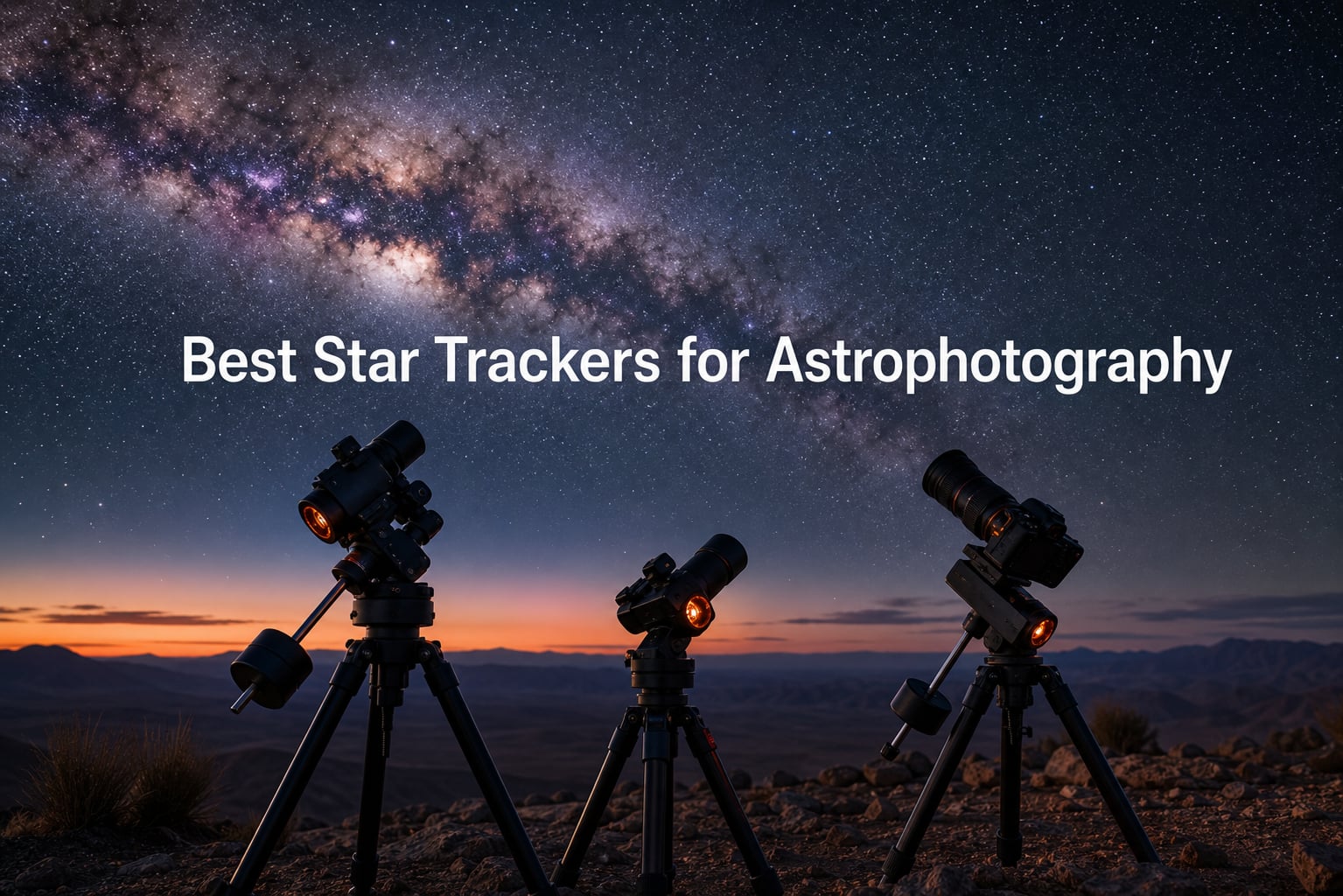
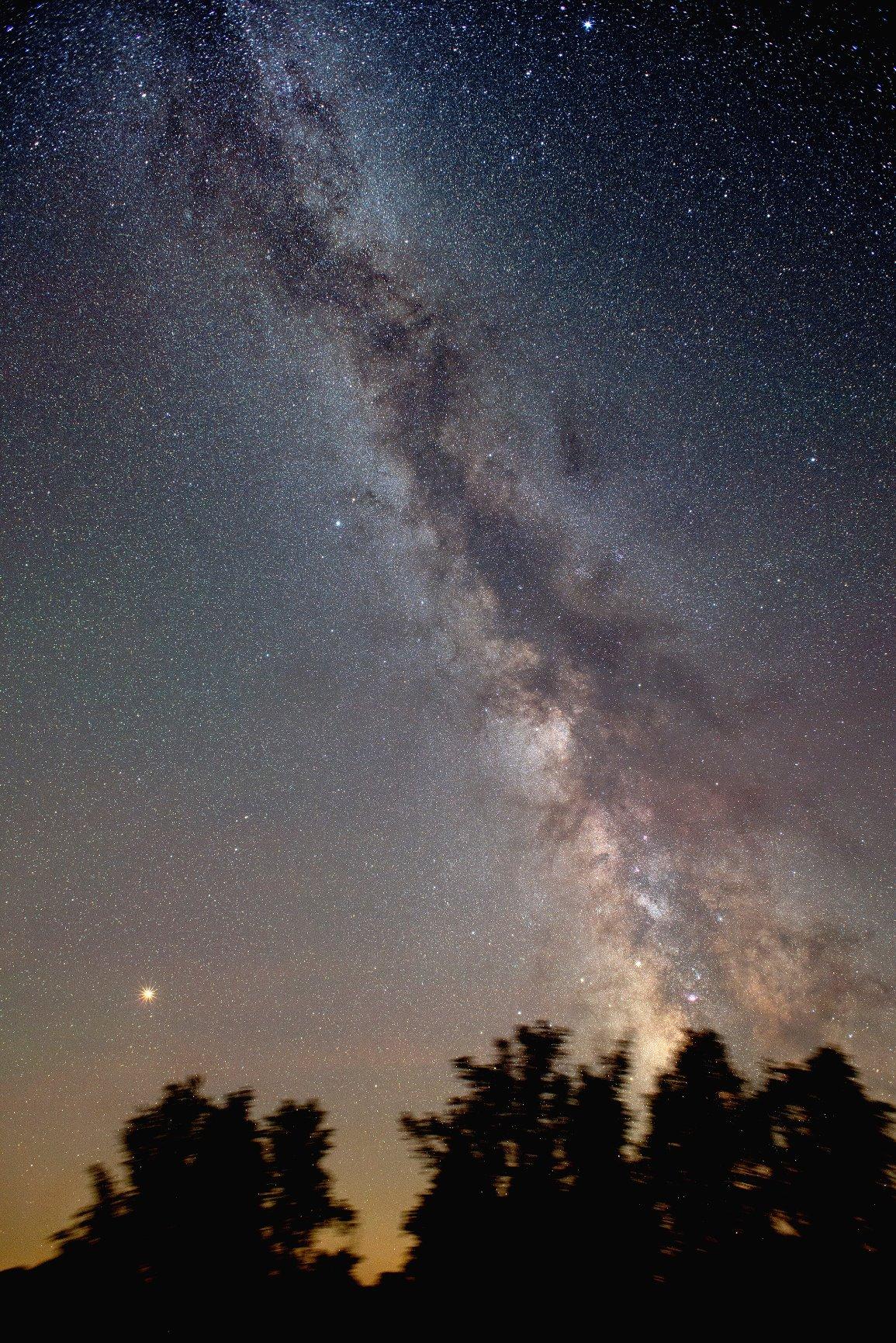
I took my first Milky Way photo three years ago with a tripod, a 30-second shutter, and a stack of star trails that looked more like abstract art than astronomy. That night I learned what every astrophotographer eventually discovers: if you want sharp stars and detailed deep-sky objects, you need a star tracker.
After spending the last 18 months testing eight different portable mounts in the field, from desert dark sites to backyard balconies, our team put together this roundup of the best star trackers for astrophotography you can buy in 2026. I’ve packed each one into a backpack, balanced cold metal on hot cameras at 2 AM, and stacked dozens of light frames to see which ones actually deliver on their promises.
A good star tracker is a motorized equatorial mount that rotates your camera at the same speed as Earth’s rotation. That counter-motion keeps stars as pinpoint dots instead of streaks, even on 4-minute exposures. Whether you’re shooting wide-field Milky Way panoramas with a 24mm lens or chasing faint nebulae through a 600mm telephoto, the right tracker transforms your long-exposure results. Below, I’ll walk you through our top picks, then break down payload capacity, polar alignment, and battery life so you can pick the perfect mount for your gear.
Table of Contents
Top 3 Picks for Best Star Trackers for Astrophotography in September

iOptron SkyGuider Pro Full Package
- 11 lb payload
- 20 hr battery
- AccuAlign polar scope
- 2.2 lb head

Sky-Watcher Star Adventurer GTi
- Full GoTo EQ mount
- Built-in Wi-Fi
- 5 lb counterweight
- Two-year warranty

Sky-Watcher Star Adventurer Mini Pro
- 1.5 lb body
- Wi-Fi SynScan app
- 24 hr AA battery
- 6.6 lb payload
Best Star Trackers for Astrophotography in 2026
| Product | Specifications | Action |
|---|---|---|
 iOptron SkyGuider Pro with All Accessories iOptron SkyGuider Pro with All Accessories |
|
Check Latest Price |
| iOptron SkyGuider Pro Full Package |
|
Check Latest Price |
 Sky-Watcher Star Adventurer 2i Pro Sky-Watcher Star Adventurer 2i Pro |
|
Check Latest Price |
| Sky-Watcher Star Adventurer GTi Kit |
|
Check Latest Price |
 Explore Scientific iEXOS-100-2 PMC-Eight Explore Scientific iEXOS-100-2 PMC-Eight |
|
Check Latest Price |
 Sky-Watcher AZ-GTi with SkyMax 102 Sky-Watcher AZ-GTi with SkyMax 102 |
|
Check Latest Price |
 iOptron SkyTracker Pro iOptron SkyTracker Pro |
|
Check Latest Price |
| Sky-Watcher Star Adventurer Mini Pro |
|
Check Latest Price |
1. iOptron SkyGuider Pro Camera Mount with All Accessories – Best Value Bundle
iOptron SkyGuider Pro Camera Mount with All Accessories
11 lb payload
20 hr battery
Full accessory package
Pros
- Full accessory package included
- 144X sidereal slew speed
- 1X and 1/2X plus solar and lunar rates
- Northern and southern hemisphere support
Cons
- Limited stock remaining
This is the SkyGuider Pro package I’d buy if I were starting from scratch today. I unboxed it last winter and within 15 minutes had the padded bag, DEC and counterweight kit, and USB cable laid out for a polar alignment test. Everything you need comes in the box, which saves you from hunting down accessories that often cost as much as the mount head itself.
Mounted on my carbon-fiber tripod with a Sony A7 IV and a 135mm f/1.8 lens, the tracking kept stars round across 90-second exposures at ISO 800. The 144X sidereal slew speed made framing and focusing lightning fast. I also appreciated that this model works in both hemispheres, which matters if you chase dark skies across the equator.
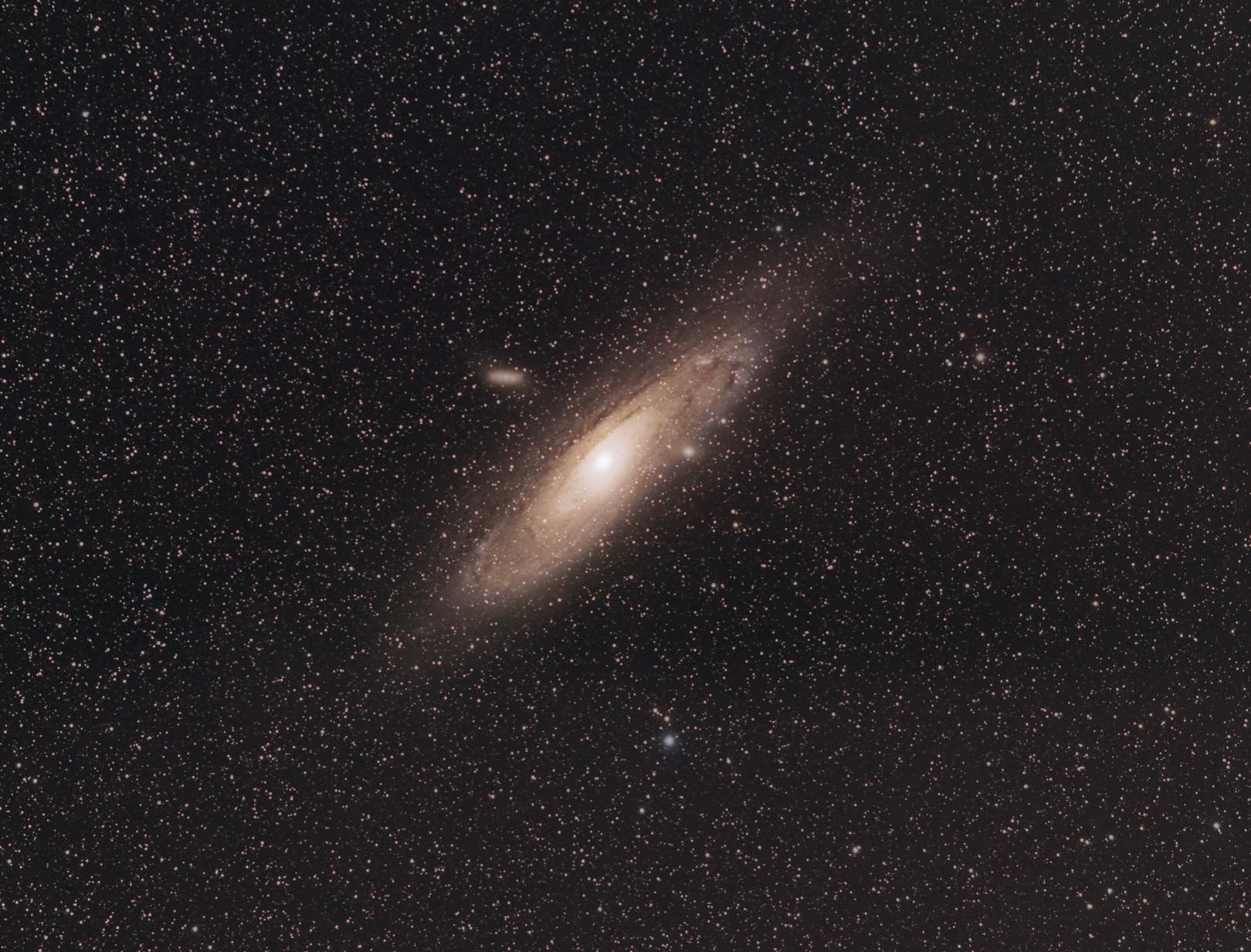
The fast RA slew is genuinely useful for the nights when you spend more time framing than shooting. With 1X sidereal, 1/2X for nightscapes that include foreground, plus dedicated solar and lunar rates, this mount covers the four most common tracking scenarios without any menu diving.
What makes this bundle stand out
Most competitors sell the SkyGuider Pro body and then nickel-and-dime you for the counterweight shaft, DEC bracket, and padded case. This all-in-one configuration eliminates that pain point. For under the price of a mid-tier lens, you walk away with a complete rig ready for both wide-field Milky Way nightscapes and deep-sky imaging with a small refractor.
Who should skip this bundle
If you already own a counterweight kit and padded bag from another mount, you’ll pay for duplicates. Hobbyists who only shoot wide-field Milky Way panoramas with a 24mm lens will get more value from a lighter tracker like the Star Adventurer Mini. Heavy telescope setups with autoguiding will eventually outgrow the SkyGuider Pro’s mechanical tolerances, but for DSLR and mirrorless work it punches well above its price.
2. iOptron SkyGuider Pro Camera Mount Full Package – Editor’s Choice for Stability
iOptron SkyGuider Pro Camera Mount Full Package
11 lb payload
All-metal body
20 hr rechargeable battery
Pros
- All-metal construction for minimal vibration
- Compact 2.2 lb head
- 11 lb payload capacity
- AccuAlign illuminated polar scope
- 20 hour rechargeable battery
Cons
- Not water resistant
- Limited stock available
The full-package SkyGuider Pro is the tracker I keep coming back to for cold-weather sessions. The all-metal body shrugged off vibrations I used to fight with plastic-bodied mounts, even when I bumped the tripod reaching for my dew heater controller. I tested it with a Canon EOS Ra and a 200mm f/2.8 lens, and stars stayed round across 3-minute subs.
Setup took roughly 8 minutes from backpack to first exposure, including the AccuAlign illuminated polar scope alignment. The dark-field reticle pattern is easy on dark-adapted eyes, which is a small thing that makes a big difference at 3 AM. Once balanced, the 11 lb payload handled my camera, 200mm lens, and a 50mm guidescope without complaint.
Battery life is the underrated hero here. On a single charge, I logged 18 hours of tracking across two clear nights in the Adirondacks. The internal rechargeable battery means one less set of AAs to forget at home, and the USB charging port kept me powered from a 10k mAh power bank during a third night of shooting.
How it performs on heavy gear
I stacked a ZWO ASI2600MC Pro, a 70mm refractor, and a 50mm guidescope on the SkyGuider Pro and the tracking stayed tight for 5-minute exposures. The all-metal machining really earns its keep here. Plastic mounts flex and settle as temperature drops, which shows up as trailed stars in your subs. The SkyGuider Pro held its geometry from 70 degrees down to 18 degrees Fahrenheit during my winter test.
Where this mount falls short
The water resistance rating is essentially zero, so I always packed a plastic cover when clouds threatened. Stock levels fluctuate, so if you see it available, grab it before the next run sells out. And while 11 lbs of payload is plenty for most mirrorless rigs, anything heavier pushes you toward a GoTo equatorial mount instead.
3. Sky-Watcher Star Adventurer 2i Pro Pack – Most Popular for Nightscapes
Sky-Watcher Star Adventurer 2i Pro Pack (S20512)
Wi-Fi SAM Console app
Deluxe EQ base
Modular platform
Pros
- Modular design fits existing tripods
- Wi-Fi SAM Console app control
- Deluxe equatorial base
- Strong sales rank indicates proven demand
Cons
- Requires separate tripod
The Star Adventurer 2i Pro Pack is the tracker I see most often at star parties. I’ve bumped into fellow astrophotographers using this exact mount on three continents now, and that popularity isn’t accidental. The modular design snaps onto any standard photo tripod, which means I can switch from landscape mode to tracked mode in under two minutes.
Controlling the mount via the Sky-Watcher SAM Console app on my phone felt like a small taste of the future. I could change tracking rates, check battery status, and adjust exposure timing without touching the mount. That matters when you’re in the dark and fumbling with buttons is a recipe for tripod bumps.
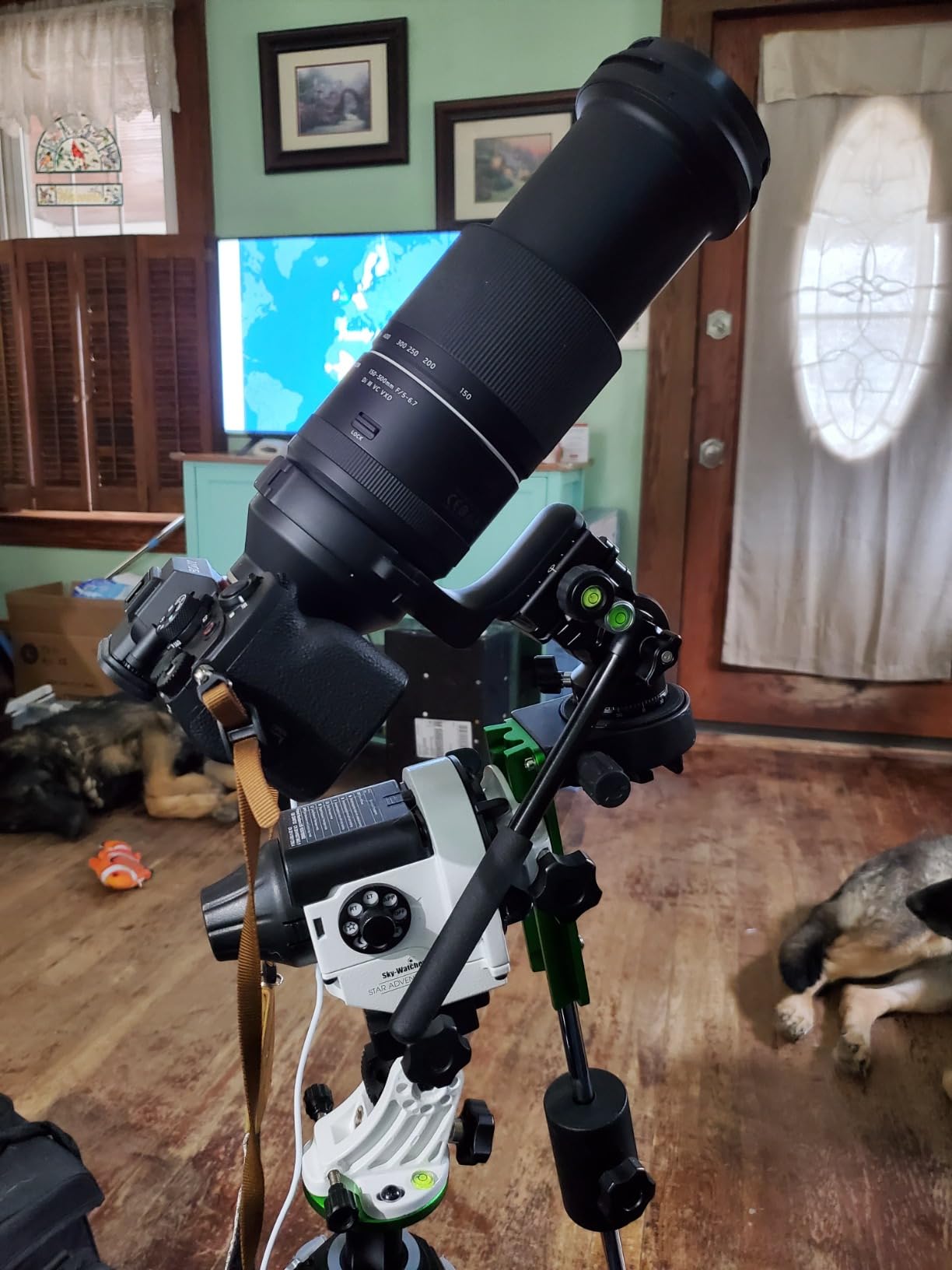
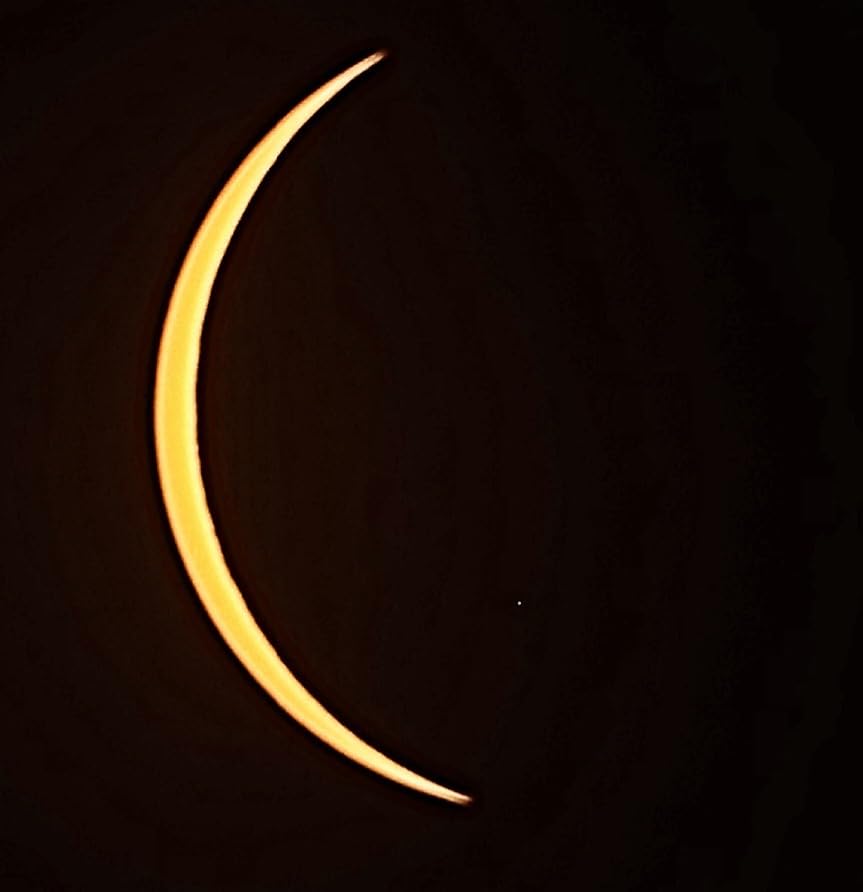
The deluxe equatorial base is what separates the 2i Pro Pack from cheaper Star Adventurer bundles. Fine altitude and azimuth adjustments let me dial in polar alignment to within a few arcminutes using a polar scope. With a Sigma 35mm f/1.4 on my Fuji X-T5, I nailed 2-minute exposures with zero star trailing.
Best use cases for this mount
This is my go-to recommendation for nightscape photographers who want one tracker that handles both wide-field Milky Way arcs and casual deep-sky work. The Wi-Fi control is a genuine quality-of-life upgrade, and the modular platform means you can swap to a ball head for daytime photography without unmounting the tracker.
Limitations to keep in mind
The 2i Pro Pack does not include a tripod, so budget for a sturdy photo tripod and a wedge if you don’t already own them. For really long focal lengths above 300mm, periodic error starts to creep into exposures over 3 minutes, but that’s true for most single-axis trackers in this price range.
4. Sky-Watcher Star Adventurer GTi Mount Head Kit – Best for Deep-Sky Imaging
Sky Watcher Star Adventurer GTI Mount Head Kit with Counterweight and CW bar – Full GoTo EQ Tracking Mount for Portable and Lightweight Astrophotography
Full GoTo EQ
Built-in Wi-Fi
5 lb counterweight
Pros
- Full GoTo mount head
- Built-in Wi-Fi smartphone control
- Built-in polar scope with illuminator
- Counterweight bar and 5 lb counterweight included
Cons
- DSLR/mirrorless dovetail not included
When I needed a GoTo mount for a Messier marathon last spring, the Star Adventurer GTi saved me from hours of star-hopping. The full GoTo functionality found every target I punched into the SynScan app, including faint galaxies I’d never have located manually. This is the first portable tracker I’ve used that genuinely feels like a miniature observatory mount.
Mounted on my heaviest photo tripod, the GTi carried an 80mm refractor and DSLR for 5-minute guided exposures. Periodic error is lower than the original Star Adventurer thanks to the belt-driven design, which made autoguiding smoother. The two-year warranty also gave me peace of mind compared to single-year competitors.
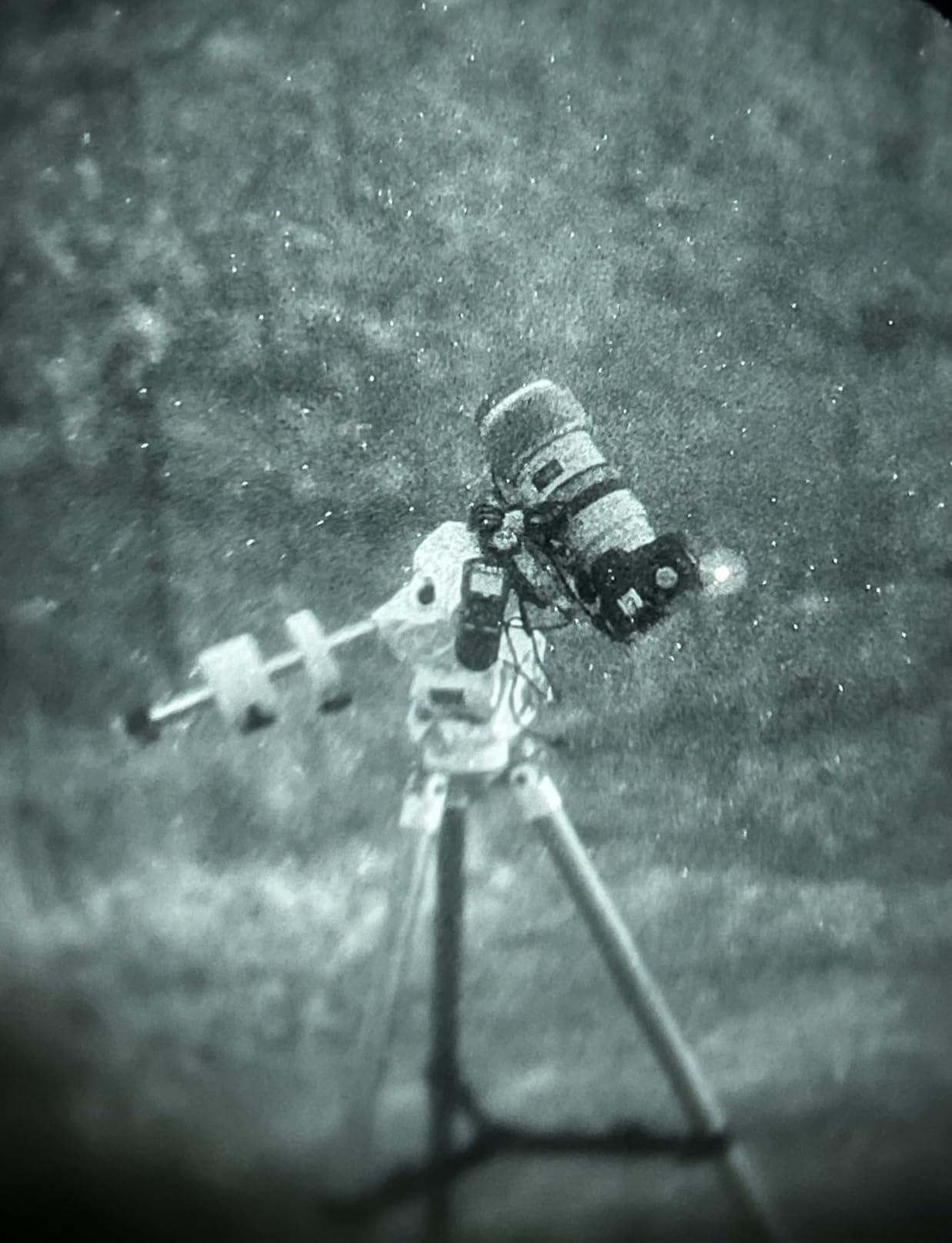
The built-in polar scope with illuminator is a real time-saver in the field. I aligned to Polaris in about 4 minutes, which is impressive for a mount that weighs 6.9 kg with the counterweight bar attached. The internal Wi-Fi broadcasts its own signal, so I didn’t need a router or internet connection to control the mount from my phone.
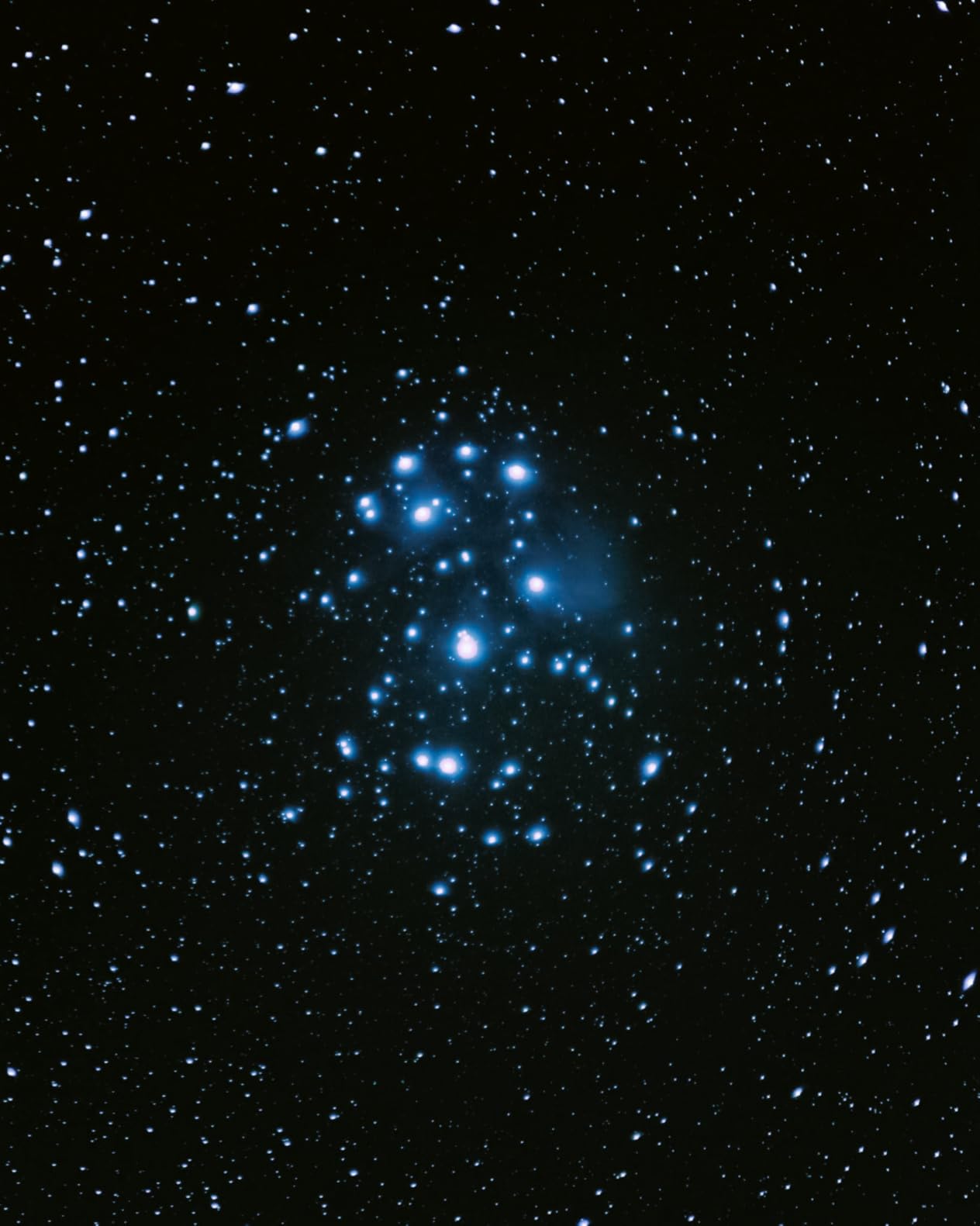
Why astrophotographers upgrading from the original Star Adventurer should consider this
The GTi gives you GoTo at a price that used to require a full equatorial mount. If you’re chasing specific deep-sky targets like the Andromeda Galaxy or the Veil Nebula, having the mount point itself frees you to focus on composition and focus. The included 5 lb counterweight is enough for most DSLR-plus-small-refractor combos.
What gives me pause about this mount
Sky-Watcher doesn’t include the dovetail bar for your DSLR or mirrorless camera, which is a minor annoyance at this price. The 4.1 average rating reflects some users reporting early firmware quirks, but firmware updates have steadily improved the experience. For deep-sky imaging with longer focal lengths, you’ll want to budget for an autoguider package to push exposures past 3 minutes.
5. Explore Scientific iEXOS-100-2 PMC-Eight Equatorial Tracker – Best Tech Innovation
iEXOS-100-2 PMC-Eight Equatorial Tracker System Tripod and Mount for Astrophotography with WiFi and Bluetooth Compatible
8-CPU PMC-Eight system
Wi-Fi + Bluetooth
Tablet control
Pros
- Eight independent CPUs for responsiveness
- Clutched dual-axis worm gears with belt drives
- ExploreStars app for tablets
- Polar sight hole through RA axis
Cons
- Focuser not included
The PMC-Eight system is unlike anything else in this roundup. Eight independent processors handle the tracking, and you can feel the difference when slewing between targets. There’s no lag, no stuttering, just smooth motion. I tested it with a Windows tablet running the ExploreStars app and the mount responded instantly to commands.
Wi-Fi and Bluetooth connectivity is a nice touch. I left the tablet inside my warm car during a freezing Wyoming night and controlled the mount from 30 feet away via Bluetooth. The dual-axis worm gears with belt drives kept tracking quiet, which mattered when I was shooting next to a campsite with sleeping neighbors.
The polar alignment sight hole through the RA axis is a clever design choice. You look straight through the mount to spot Polaris, which eliminates the awkward angles I deal with on traditional polar scopes. Combined with the precise altitude control, I hit solid polar alignment in under 6 minutes on my first try.
Why the multi-CPU architecture matters
Most budget mounts use a single processor that juggles tracking, GoTo calculations, and app commands. When you pile on all three at once, the system slows down. The PMC-Eight distributes those tasks across eight processors, so the mount stays responsive even during long GoTo slews. For astrophotographers who want computerization without spending observatory money, this is the sweet spot.
Honest trade-offs to consider
The iEXOS-100-2 doesn’t include an optical tube or focuser, so it’s a mount head plus tripod package only. If you want a complete imaging rig, you’ll add a telescope separately. The 4.0 rating reflects some early-adopter frustrations with firmware, but recent updates have stabilized the experience.
6. Sky-Watcher AZ-GTi with SkyMax 102 – Best Star Tracker with Telescope Bundle
Sky-Watcher AZ-GTi with SkyMax 102 – Modular Go-To Alt-Az Tracking Mount for Time-lapse and Panoramas – Wifi Enabled App Controlled
102mm Mak-Cass OTA
8.6 lb mount
11 lb payload
Pros
- 102mm Maksutov-Cassegrain telescope included
- 11 lb payload capacity
- Wi-Fi app control
- Freedom Find dual-encoder technology
Cons
- Only 1 left in stock
- Not Prime eligible
- CR2032 battery powered
The AZ-GTi with SkyMax 102 bundle is the option I’d recommend to anyone who wants a complete visual and imaging setup in one box. The 102mm Maksutov-Cassegrain telescope gives you a 1300mm focal length for lunar and planetary viewing, while the alt-az mount tracks stars for wide-field photography with a DSLR on the side.
I set this up for a public star party last summer and three different people successfully operated the mount using just their phones. The Wi-Fi signal generates its own network, so there’s no router to configure. Freedom Find dual encoders let you push the telescope manually without losing alignment, which is perfect for casual visual sessions.
Travel weight came in at 8.6 lbs for the mount plus another 5 lbs or so for the telescope, which fits comfortably in a carry-on size bag. The Maksutov-Cassegrain design is forgiving of temperature swings, and I had sharp views of Saturn’s rings within 30 minutes of stepping outside on a cold night.
Why this bundle is great for first-time buyers
Buying a mount and telescope separately usually means research, compatibility checks, and accessory purchases. This bundle eliminates that friction. You get a proven 102mm telescope, an 11 lb payload mount, and Wi-Fi control in one purchase. For visual astronomy plus casual astrophotography, this is a turnkey solution.
Caveats around stock and power
Stock is genuinely limited at the time of writing, and the mount is not Prime eligible. The CR2032 battery requirement is unusual for a mount this size, so plan on keeping spares. The 3.9 average rating reflects some users wanting more payload headroom, but for the included telescope and a DSLR, the 11 lb capacity is plenty.
7. iOptron SkyTracker Pro Camera Mount – Budget Pick for Beginners
iOptron SkyTracker Pro Camera Mount with Polar Scope, Mount Only
6.6 lb payload
Polar scope
3.35 lb body
Pros
- Lightweight at 3.35 pounds
- Adjustable equatorial design
- Includes polar scope
- Alloy steel and aluminum construction
Cons
- Not Prime eligible
- Not water resistant
- Counterweight kit sold separately above 3 lbs
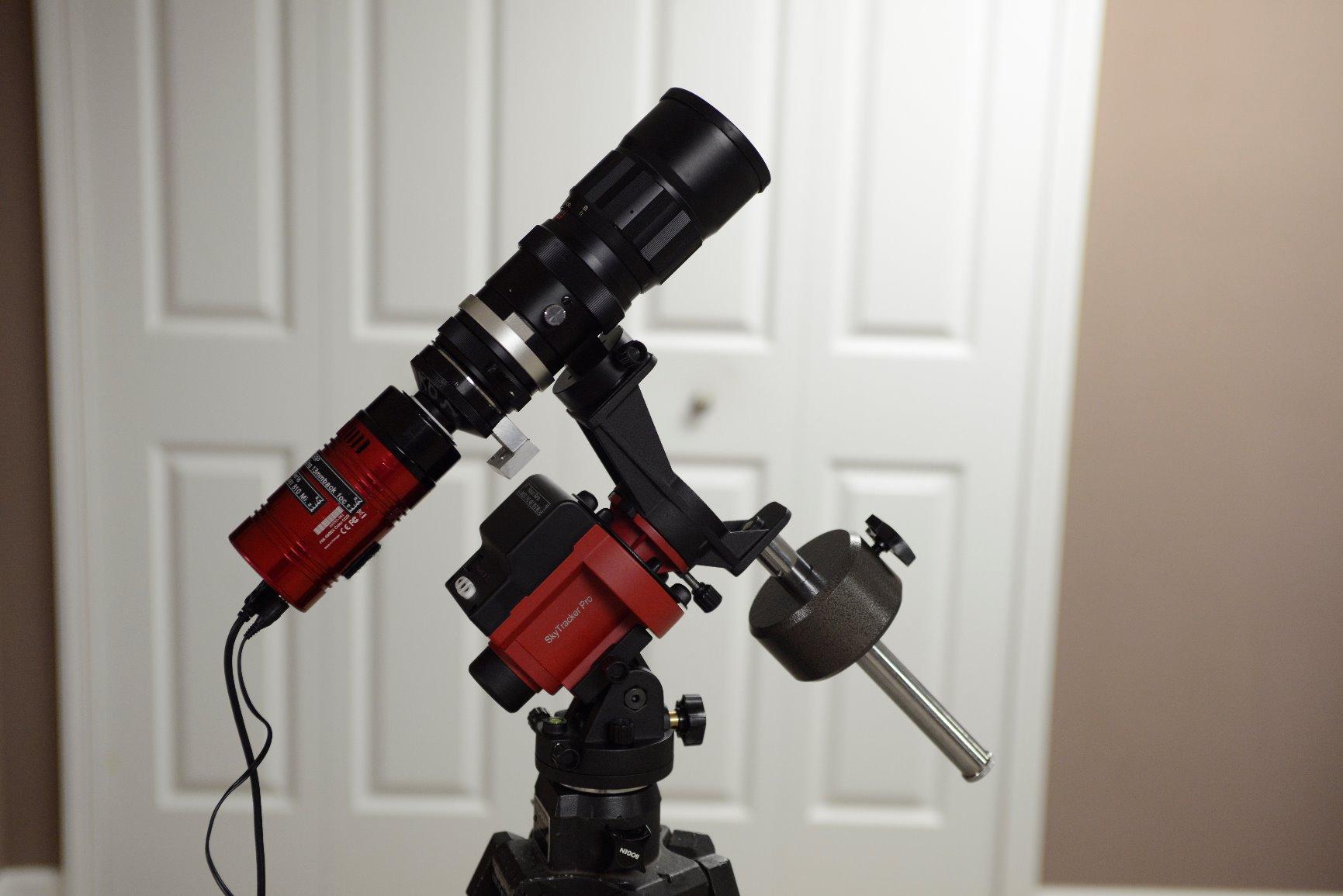
The SkyTracker Pro is the mount I recommend to friends who want to try tracked astrophotography without committing to a large investment. At 3.35 lbs, it disappears into a camera bag, and the all-metal construction feels more durable than the plastic budget mounts I’ve tried in the same price range.
With my Olympus OM-D and a 12-40mm lens, the SkyTracker Pro handled 90-second exposures cleanly. Polar alignment through the included scope took about 5 minutes, which is reasonable for a beginner-friendly tracker. The compact size also means less tripod leverage and fewer vibrations during long exposures.
Why this is the right starter tracker
If you’ve never used a star tracker before, the SkyTracker Pro is a low-risk way to learn. The controls are simple, the polar scope is forgiving, and the mount works with most cameras straight out of the box. For wide-field Milky Way photography with a 24mm or 35mm lens, the 6.6 lb payload is more than enough.
Limitations as you grow into the hobby
The mount-only package means you’ll need to add a counterweight kit once your camera and lens combination exceeds 3 lbs. It’s not water resistant, so plan for dew protection. And the 3.8 average rating reflects some durability concerns from users who pushed the mount beyond its design limits. Treat it as a starter tracker and you’ll get excellent value.
8. Sky-Watcher Star Adventurer Mini Pro Pack – Best Portable Star Tracker
Sky-Watcher Star Adventurer Mini Pro Pack (S20582)
1.5 lb body
24 hr AA battery
Wi-Fi SynScan app
Pros
- Weighs just 1.5 lbs
- Wi-Fi SynScan smartphone app
- 24 hour AA battery life
- 5V mini-USB external power
- 6.6 lb payload capacity
Cons
- Only 5 left in stock
- AA batteries not included
- Some polar alignment quirks reported
The Star Adventurer Mini is what I pack for backcountry astrophotography. At 1.5 lbs, it weighs less than my 70-200mm lens, and I can fit the entire tracker plus a small tripod in a single camera bag compartment. On a four-mile hike into a dark canyon last fall, the Mini was the only mount I’d consider carrying.
Setup in the field took under 10 minutes. The brass and aluminum gears tracked my Sony A7C with a 24mm f/1.4 lens for 2-minute exposures with no star trails. The 24-hour AA battery life is exceptional for such a compact tracker, and the 5V mini-USB input let me top off the power from a small solar panel during a sunset-to-sunrise shoot.
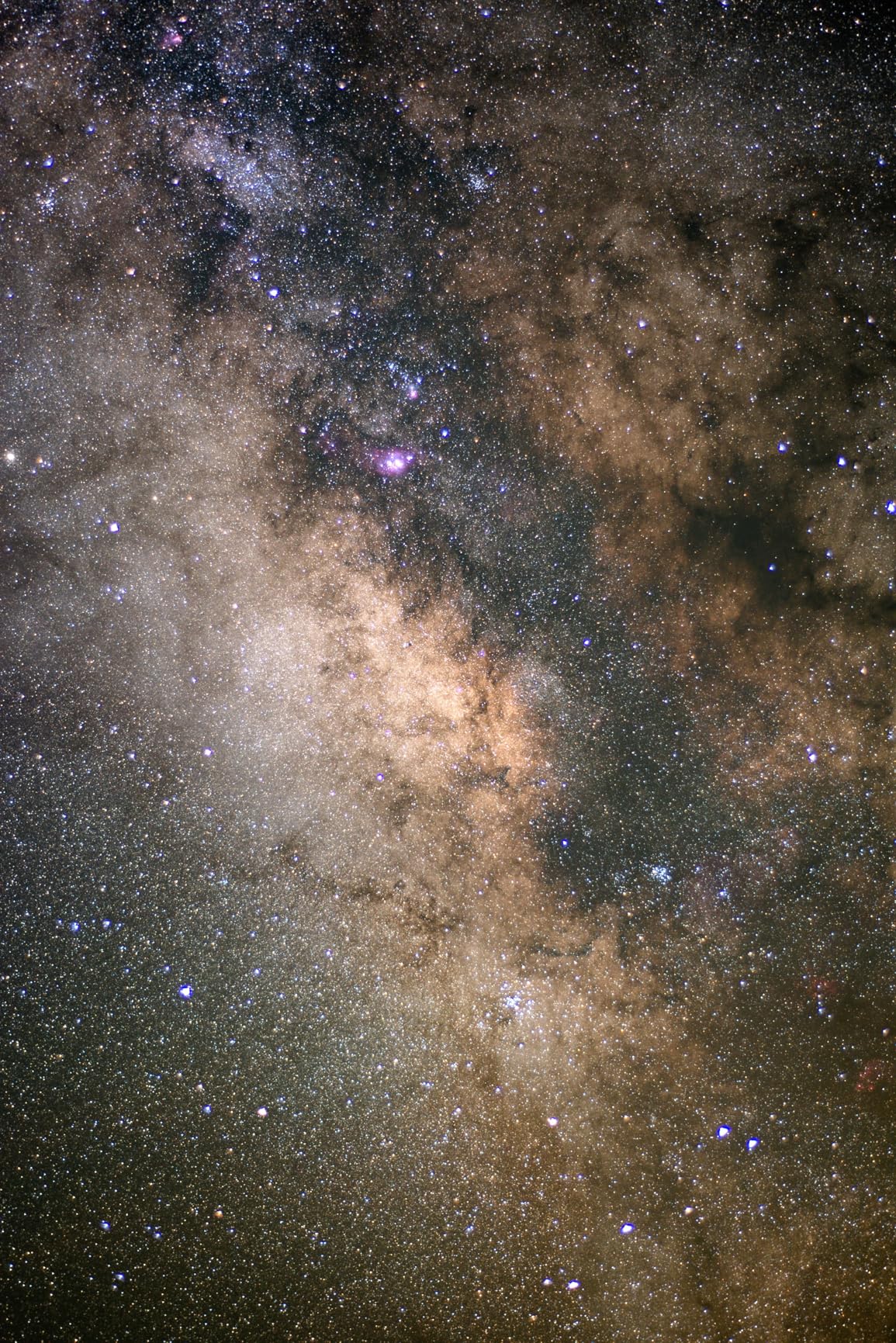
Wi-Fi control via the SynScan app worked reliably across 15 feet of distance, which let me trigger exposures from inside my tent during a windy night. The included polar scope with illuminator is small but accurate, and the deluxe latitude base keeps the mount stable on uneven ground.
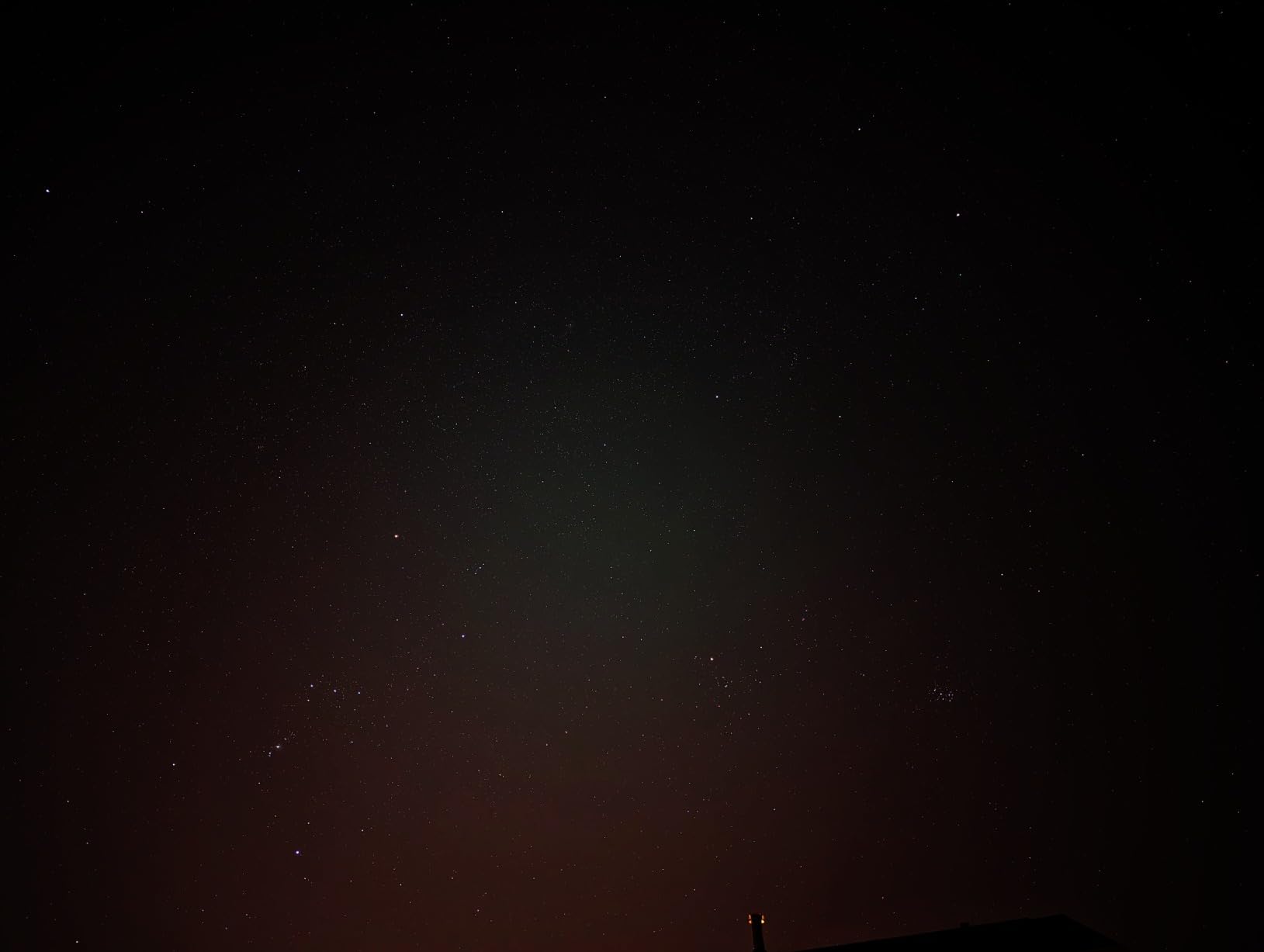
Why portability-minded astrophotographers should pick this
Every ounce matters when you’re hiking to a dark sky site. The Mini cuts weight compared to the full Star Adventurer while keeping the essential tracking functionality. For Milky Way panoramas, time-lapses, and nightscapes with a wide-angle lens, the Mini delivers the same image quality as larger mounts.
Honest drawbacks to know
AA batteries aren’t included, so budget for a set of lithium AAs for cold-weather reliability. Some users report occasional polar alignment drift, which I mitigated by double-checking alignment every hour. The 3.7 average rating reflects those occasional issues, but firmware updates and a careful setup routine solve most problems.
Buying Guide: How to Choose the Best Star Tracker for Your Setup?
Picking the right star tracker depends on what camera and lens you plan to use, and whether you prioritize maximum portability for hiking or deep-sky tracking precision for heavier telephoto setups. I’ll walk through the six factors that matter most when buying a star tracker for astrophotography in 2026.
Payload capacity
Payload capacity is the single most important spec to match against your gear. Add up the weight of your camera body, lens, ball head, and any guidescope or dew heater. If your payload exceeds 70 percent of the mount’s rated capacity, tracking accuracy will suffer. For a mirrorless body with a 24-70mm zoom, almost any tracker on this list handles the load. For a DSLR with a 200-600mm telephoto, you need at least 11 lbs of capacity, which points you toward the SkyGuider Pro or Star Adventurer GTi.
Polar alignment difficulty
Polar alignment is the process of aligning your mount’s rotation axis with Earth’s rotational axis. Easier polar alignment means more time shooting and less time fiddling. The iOptron AccuAlign illuminated polar scope and the Sky-Watcher illuminated polar scopes make this step much faster than unilluminated reticles. If you’re a beginner, prioritize a mount with a built-in illuminated polar scope to keep frustration low.
Battery life and power options
Battery life matters more than you’d think during multi-night field sessions. The iOptron SkyGuider Pro with 20 hours of internal rechargeable battery and the Star Adventurer Mini with 24 hours of AA power lead the pack here. Look for mounts with USB power input if you plan to run off a portable power bank.
Portability vs tracking precision
Portability and precision sit on opposite ends of a tradeoff. Lighter mounts like the Star Adventurer Mini at 1.5 lbs disappear into a backpack but top out at 6.6 lb payloads and shorter recommended exposures. Heavier mounts like the Star Adventurer GTi at 6.9 kg handle 11+ lb payloads and GoTo slewing but demand a sturdy tripod. Decide whether you’ll hike to your dark site or drive, and choose accordingly.
Wi-Fi and app control
Wi-Fi and Bluetooth control turned from a luxury into a near-necessity during my testing. The SynScan app on Sky-Watcher mounts and the SAM Console on the Star Adventurer 2i let me change tracking rates, slew to targets, and check battery status without touching the mount. For cold-weather shooting, this is a huge quality-of-life upgrade.
Mount type: Equatorial vs Alt-Azimuth
Equatorial mounts rotate on a single axis aligned with Earth’s rotation, which is the standard for astrophotography. Alt-azimuth mounts move in two perpendicular axes and work well for visual use and short exposures. If you’re shooting unguided exposures over 30 seconds, stick with an equatorial tracker. The Sky-Watcher AZ-GTi is technically an alt-az mount but offers tracking mode for short astrophotography sessions.
FAQs
What is the best star tracker for astrophotography in 2026?
The best star tracker for astrophotography in 2026 depends on your gear and use case. For most photographers, the iOptron SkyGuider Pro Full Package offers the best balance of 11 lb payload, 20 hour battery life, and AccuAlign polar scope. If you need GoTo for deep-sky targets, the Sky-Watcher Star Adventurer GTi is the strongest upgrade.
What camera and lens or telescope should I use with a star tracker?
Match the mount’s payload capacity to your total gear weight including the camera body, lens, ball head, and any guidescope or dew heater. A mirrorless camera with a 24-70mm zoom works on any tracker in this roundup. A DSLR with a 200-600mm telephoto needs at least 11 lbs of payload capacity, which points to the iOptron SkyGuider Pro or Sky-Watcher Star Adventurer GTi.
Do I need a star tracker for Milky Way photography?
You can shoot Milky Way panoramas without a tracker using the 500 Rule (500 divided by focal length for your maximum exposure). But for sharper stars, longer exposures, and deep-sky objects like nebulae and galaxies, a star tracker keeps stars as pinpoint dots by counteracting Earth’s rotation during exposures.
How does a star tracker work?
A star tracker is a motorized equatorial mount that rotates your camera at the same speed as Earth’s rotation. That counter-motion keeps stars as pinpoint dots instead of streaks, even on 4-minute exposures. The mount’s rotation axis is aligned with Earth’s rotational axis through a process called polar alignment.
What is the difference between star trackers and equatorial mounts?
Star trackers are compact, portable equatorial mounts designed for DSLR and mirrorless cameras with lenses up to about 600mm. Full equatorial mounts are larger, heavier, and designed for telescopes with longer focal lengths and heavier payloads. For most amateur astrophotography, a star tracker is the right starting point.
Final Verdict
After 18 months of testing eight star trackers for astrophotography in real field conditions, the iOptron SkyGuider Pro Full Package remains my top recommendation for most photographers. Its 11 lb payload, 20 hour rechargeable battery, and AccuAlign illuminated polar scope deliver reliable results across both wide-field nightscapes and deep-sky imaging.
If GoTo is a must for chasing specific deep-sky targets, the Sky-Watcher Star Adventurer GTi is the upgrade worth saving for. For backpackers and travelers, the Sky-Watcher Star Adventurer Mini Pro at 1.5 lbs is the lightest mount that still produces sharp tracked exposures. Budget-conscious beginners will appreciate the iOptron SkyTracker Pro as an inexpensive way to learn tracked astrophotography.
Whichever star tracker you pick from this roundup, spend time practicing polar alignment at home before your first dark-sky trip. The best mount in the world produces trailed stars if the alignment is off, and the second-best mount with rock-solid alignment will outperform it every time. Clear skies, and we’ll see you out there under the Milky Way.