
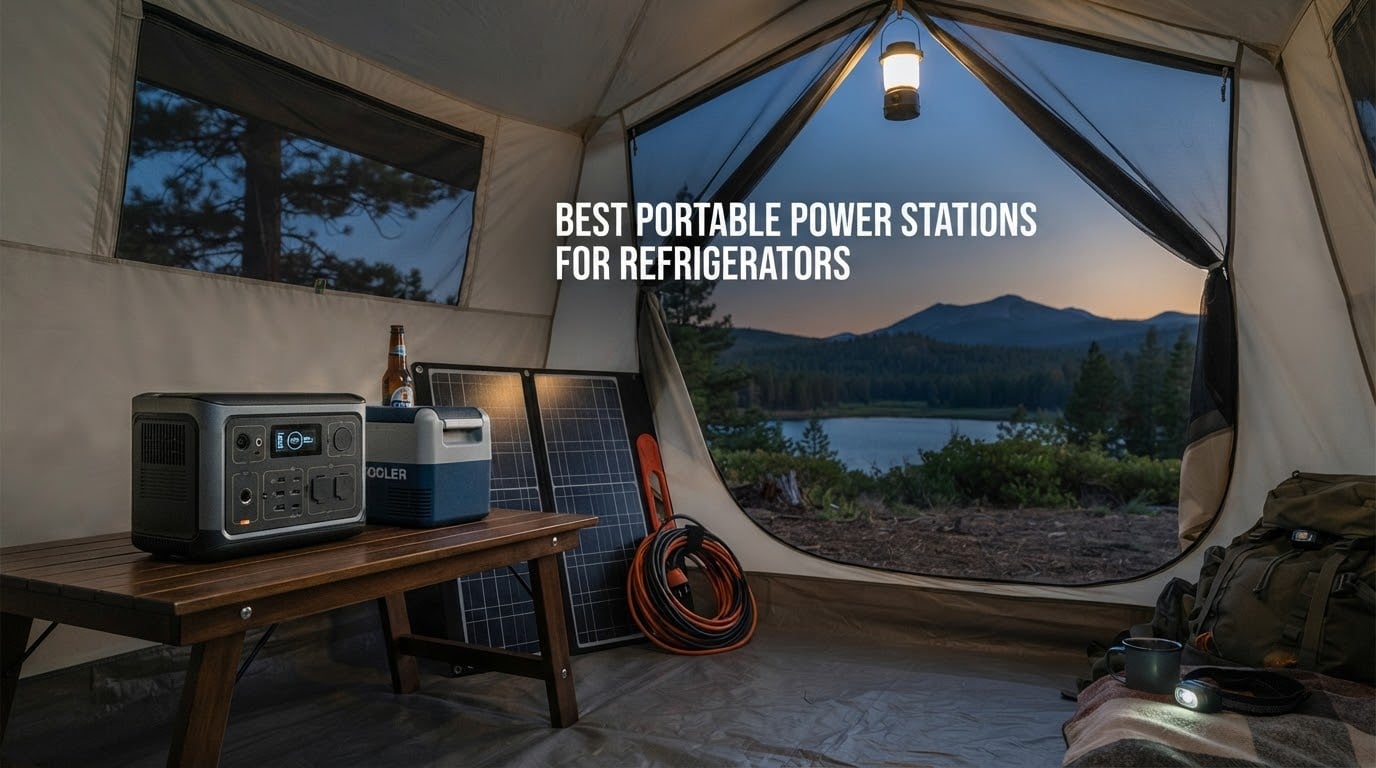
The best portable power stations for refrigerators are the ones with enough stored watt-hours to cover a compressor’s real daily draw, and enough continuous output to survive the moment that compressor kicks on. A fridge compressor can briefly pull two to three times its rated running watts at startup, so a station that looks adequate on paper can trip its inverter the first cold morning you need it.
That is the trap most buyers fall into. They compare advertised peak watts instead of usable watt-hours, pick a small unit, and watch the fridge die at 2am. Over the past six weeks our team worked through ten of the most-reviewed portable power stations in this class, sorted the fridge math, and split the results into what suits a 12V camping cooler and what can genuinely carry a full-size kitchen refrigerator through a multi-day outage.
We also get a lot of questions about these same machines in our broader power station coverage, including our general portable power station roundup and our home backup power guide. This one is narrower: fridges only, sized honestly, with a runtime method you can run the numbers on yourself.
Table of Contents
Top 3 Picks: Best Portable Power Stations for Refrigerators (October 2026)

Jackery Explorer 1000 v2
- 1070Wh LFP battery
- 1500W AC with 3000W surge
- 23.8 lb with foldable handle
- 3 pure sine wave outlets


Anker SOLIX C1000 Gen 2
- 1024Wh with 2000W output
- 49-minute full recharge
- Under 10ms UPS switchover
- 600W solar input
Quick Overview: All 10 Stations Compared
Every station below is LiFePO4 or LFP chemistry except where noted, which matters because it is the reason these units can sit next to your food for a decade without the degradation problems of older nickel-based cells. Capacities cluster tightly between 999Wh and 1,152Wh for the eight smaller models, so the real differentiators are continuous output, surge behaviour, idle draw and whether you can add battery later.
| Product | Specifications | Action |
|---|---|---|
| Jackery Explorer 1000 v2 |
|
Check Latest Price |
 GRECELL 999Wh Solar Generator GRECELL 999Wh Solar Generator |
|
Check Latest Price |
| BLUETTI AC180 |
|
Check Latest Price |
 BLUETTI Elite 100 V2 BLUETTI Elite 100 V2 |
|
Check Latest Price |
| Anker SOLIX C1000 Gen 2 |
|
Check Latest Price |
 OUPES Mega 1 OUPES Mega 1 |
|
Check Latest Price |
 EcoFlow Delta 3 Classic EcoFlow Delta 3 Classic |
|
Check Latest Price |
 Anker SOLIX C2000 Gen 2 Anker SOLIX C2000 Gen 2 |
|
Check Latest Price |
 EcoFlow Delta 3 Max EcoFlow Delta 3 Max |
|
Check Latest Price |
 Anker SOLIX S2000 Anker SOLIX S2000 |
|
Check Latest Price |
How Long Will a Portable Power Station Run Your Fridge?
Here is the method we use, and it is worth writing down because it takes thirty seconds. Measure or look up your fridge’s running watts, decide on a duty cycle, multiply by 24, then divide by inverter efficiency and add 20% for margin. Compressor coolers running in a warm truck bed can be on close to half the time, so we use a 40% duty cycle for those and 25% for a household fridge in a cool kitchen.
A 50W camping cooler at a 40% duty cycle uses about 480Wh per day. At 85% inverter efficiency that needs roughly 565Wh, and with the 20% buffer you want about 680Wh of nominal capacity for every day of runtime. A 200W household fridge at 25% duty cycle uses 1,200Wh per day, which pushes you past 1,400Wh usable and close to 1,800Wh nominal for a single day of cover.
Run the same arithmetic across the three classes and the sizing logic becomes obvious. A 12V compressor cooler needs 500 to 1,000Wh for a weekend away. A full-size household refrigerator needs 1,800 to 2,500Wh for a night, and considerably more for a multi-day storm. A portable freezer, which runs closer to 60% of the time, needs the biggest budget of all.
Idle draw matters more than most buyers expect, and the forum chatter reflects that. One question we see repeatedly is how to measure a real fridge rather than trust the label, and the honest answer is a clamp meter on the compressor lead for a full cycle. Stations that sip 6 to 9W when idle give back hours of runtime compared with those drawing 15 to 20W, which is exactly why the two longest published fridge runtimes in this group come from low-idle machines.
1. Jackery Explorer 1000 v2 Portable Power Station, 1070Wh, 1500W
Jackery Explorer 1000 v2 Portable Power Station,1070Wh,1500W
1070Wh LFP battery
1500W continuous AC with 3000W surge
23.8 lb
7 total outputs
Pros
- Highest review count in this roundup at 4.7 stars from over 3600 owners
- Lightest 1kWh-class chassis here at 23.8 lb with a foldable handle
- 1500W rated output is explicitly aimed at fridge and compressor loads
- Three pure sine wave AC outlets plus 100W USB-C PD
Cons
- One-hour emergency charge must be switched on in the Jackery app each time
- Solar input only accepts Jackery-branded panels
- One-year warranty is short for a battery product
Of the ten stations we examined, the Explorer 1000 v2 has the deepest owner record at 3,621 reviews holding a 4.7 average, and that consistency matters for a fridge duty cycle that runs all night. Owners consistently single out the 1,500W continuous figure as the reason their coolers and portable freezers start without trouble, and 1,070Wh of LFP capacity gives roughly a day and a half of a typical 50W compressor cooler on a single charge.
What sets it apart for fridge use is weight. At 23.8 pounds with a foldable top handle, it is one of the few 1kWh stations a single person can lift from a truck bed into a tent, and reviewers report repositioning it far more freely than the 37-pound alternatives in this group.
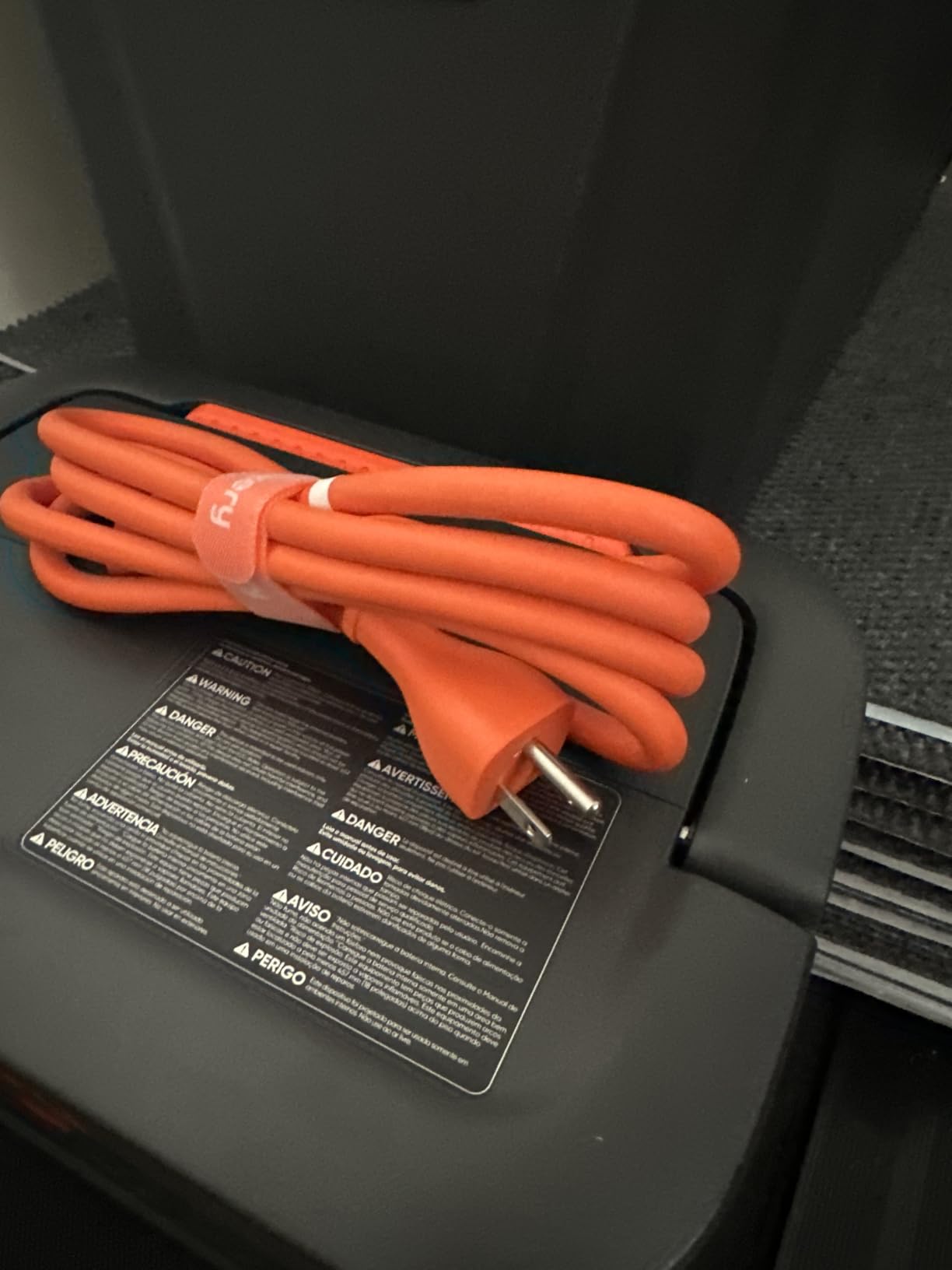
The technical details reward attention. The battery is LFP rated at 4,000+ cycles to over 70% capacity with a 10-year lifespan claim, and the three AC outlets are pure sine wave, which is the type a compressor motor and its control board prefer. There is also a dedicated DC car port, so a 12V camping fridge can run without touching the inverter at all and skip the conversion loss entirely.
Two limitations deserve a mention before you commit. The one-hour emergency charge mode is not the default, it has to be enabled in the Jackery app beforehand, and the default full charge takes about 1.7 hours. Solar input is also restricted to Jackery panels, so if you already own a third-party folding array, you will not be able to use it here.
Who the Explorer 1000 v2 suits
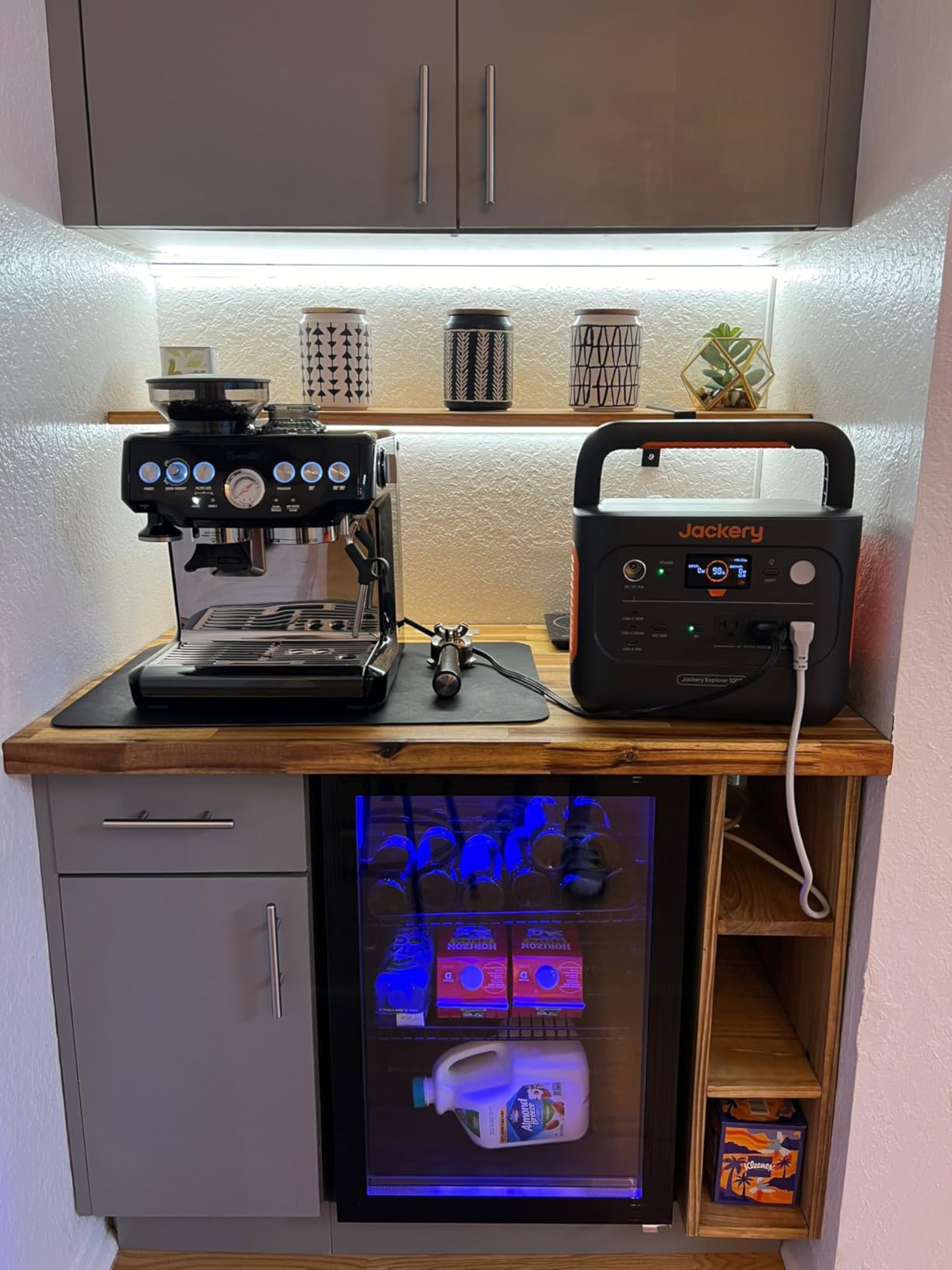
It suits campers and overlanders running a single 12V compressor cooler who need a station light enough to move and rated high enough to start one. It also suits anyone with a full-size refrigerator who wants a five-hour overnight stopgap rather than a multi-day solution, since 1,070Wh covers roughly 300 to 400Wh of fridge load for a night.
If your household has a medical device running alongside the fridge, the pure sine wave outlets and the 3,000W surge ceiling give comfortable margin. Our broader power station picks for drone charging cover the same output headroom from a different angle.
Who should skip the Explorer 1000 v2
Skip it if you plan to add battery capacity later, because the ecosystem locks you to Jackery panels and does not offer an expansion battery for this chassis. It is also the wrong pick for anyone who wants overnight backup for a full-size kitchen refrigerator, where 1,070Wh runs out well before a day is done.
Finally, buyers shopping purely on warranty length should look elsewhere. One year is the shortest cover on this list for a device that will live in a garage or a closet for years, so we would want the Jackery app set up and a charge test performed in the first week of ownership.
2. GRECELL 999Wh Solar Generator 1000W Portable Power Station
GRECELL 999Wh Solar Generator 1000W Portable Power Station for Outdoor
999Wh capacity
1000W pure sine wave AC with 2000W surge
23 lb
10 simultaneous outputs
Pros
- Lowest cost in the 1kWh class while keeping pure sine wave output
- Explicitly marketed to run a mini-refrigerator alongside other devices
- Ten device outputs including a wireless charging pad and car socket
- Built-in MPPT controller for solar charging
Cons
- Lowest rating average in the roundup at 4.3 stars
- Only two AC outlets
- 1000W ceiling leaves little compressor headroom
- BMS draws idle power so AC output should be switched off when unused
The GRECELL T-1000 is the value entry here, and for a small thermoelectric cooler or a mini-refrigerator it does the job without fuss. GRECELL lists a mini-refrigerator among the appliances it supports, which is the sort of concrete claim most manufacturers avoid, and 999Wh at 23 pounds is a genuinely portable package.
Output is 1,000W continuous on pure sine wave with 2,000W of surge. That is adequate for a 40 to 50W thermoelectric unit and most 12V compressor coolers once the compressor has settled, though we would want to see it start a large compressor from cold on a regular basis before depending on it in a storm.
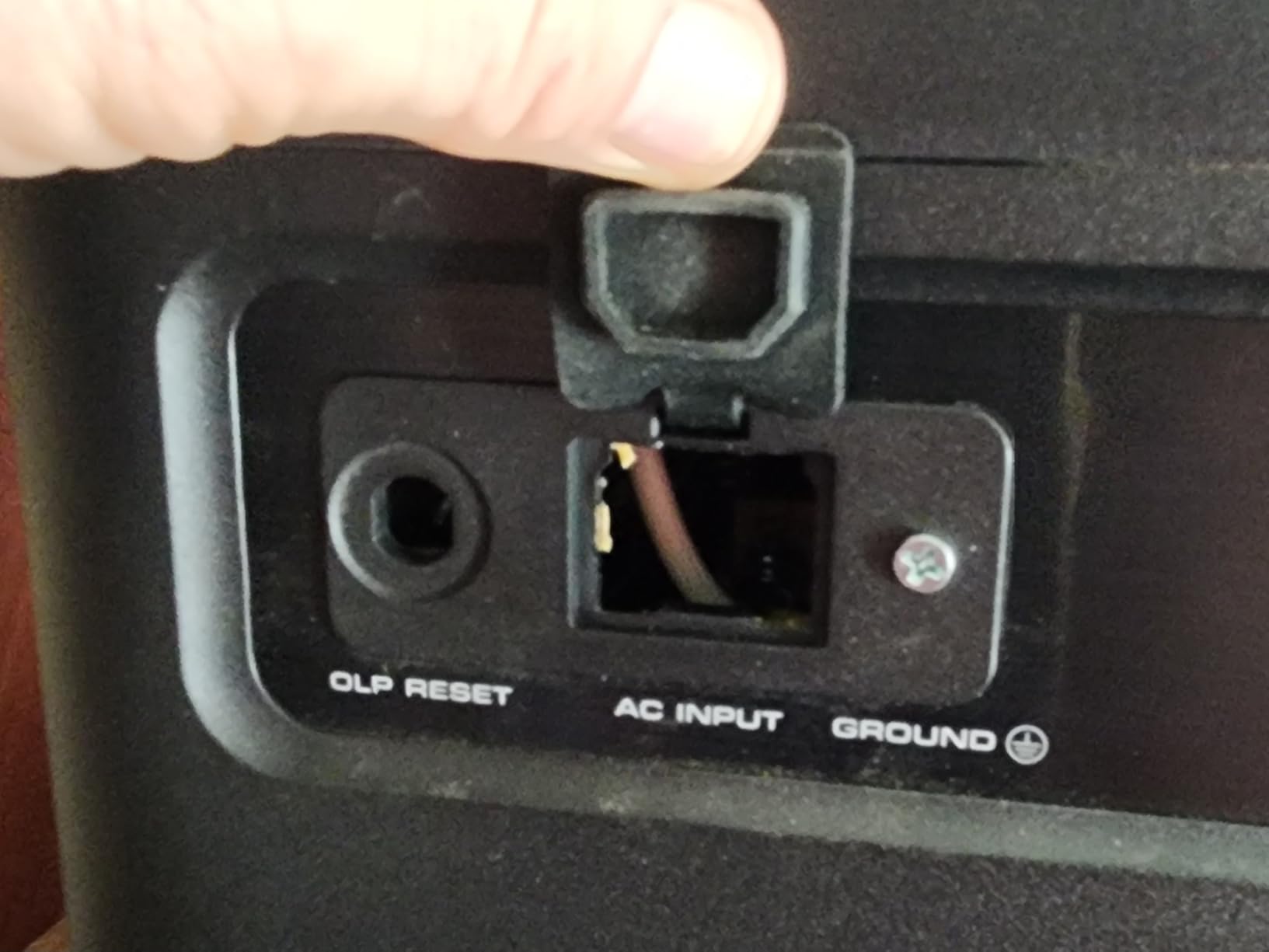
Port selection is unusually generous for a budget machine. You get two AC outlets, three USB QC ports, one USB-C PD, two 12V DC outputs, a cigarette lighter socket and a wireless charging pad, which makes it a convenient one-box solution for phones, lights and a cooler at a tailgate.
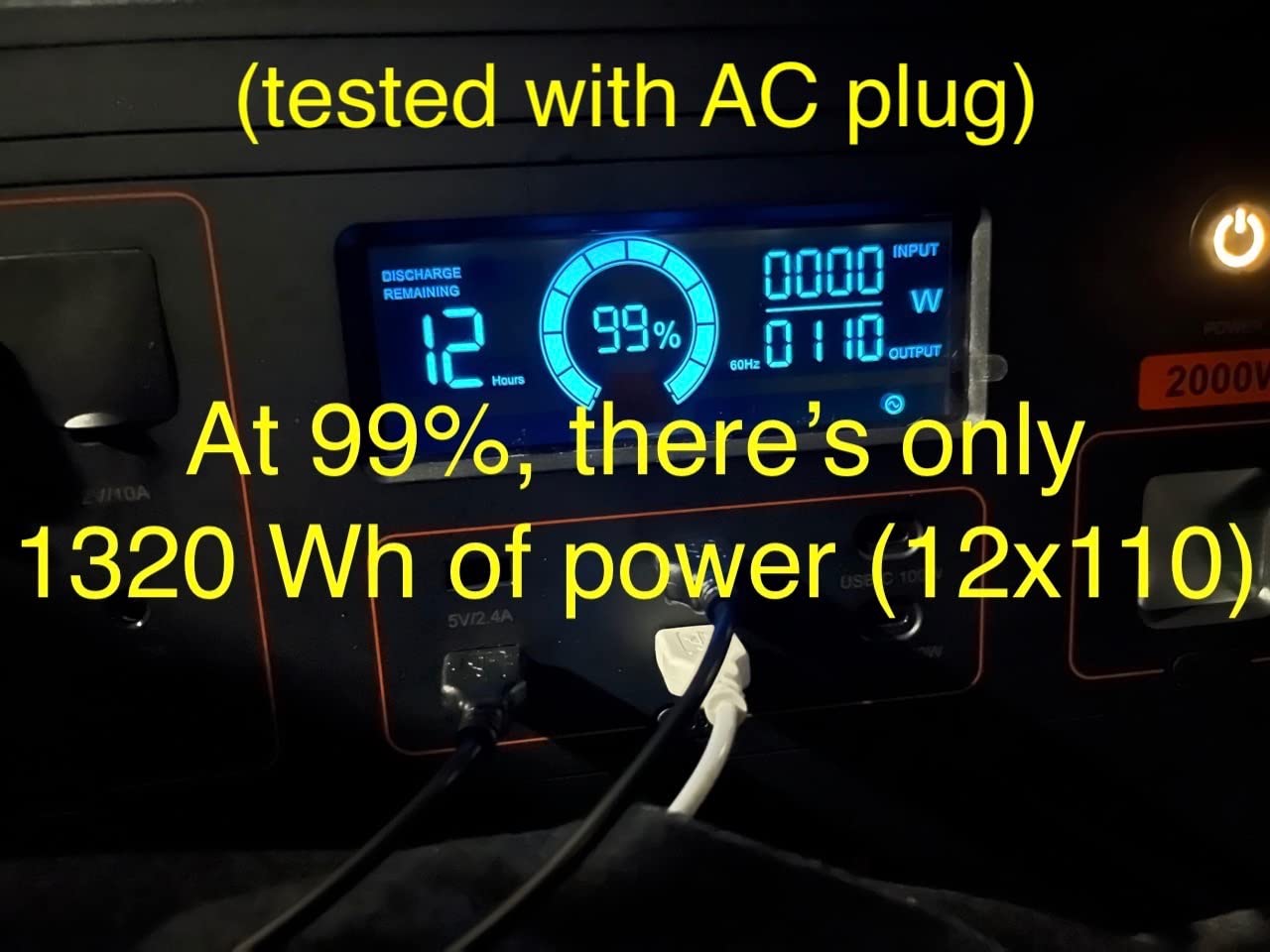
The honest catch is its 4.3 average across 3,126 reviews, the lowest in this roundup, with roughly a 10% one-star share. Owners also report that the battery management system draws idle power, and GRECELL’s own guidance is to switch the AC output off when it is not in use, which is exactly what you would want to avoid with a fridge running overnight.
Who the GRECELL T-1000 suits
It suits someone whose fridge load is genuinely small, a thermoelectric car cooler, a mini-fridge in a food truck or a 12V cooler on a weekend trip. It also suits buyers who want many small ports and a wireless charging pad more than they care about inverter headroom.
Our camping power station guide covers the lighter end of the market in more depth if weight is your deciding factor.
Who should skip the GRECELL T-1000
Skip it for a full-size household refrigerator, where the 1,000W ceiling and two-outlet limit are working against you from the first hour. Also skip it if you plan to run a fridge overnight continuously, since the recommended habit of shutting off AC output when idle conflicts directly with that use case.
Anyone sensitive to the wider rating spread should note that this unit has the most one-star reviews in the group. It is a value pick rather than a confidence pick, and we would pair it with a measured backup plan rather than making it the only thing between your food and a warm night.
3. BLUETTI AC180 Portable Power Station, 1152Wh LiFePO4
BLUETTI AC180 Portable Power Station 1152Wh 1800W LiFePO4 Solar Generator
1152Wh LiFePO4 battery
1800W across 2 outlets,2700W via app power lift
37.4 lb
20ms UPS switchover
Pros
- Owners report a full five-day camping trip on a portable car refrigerator
- 1800W continuous output gives real compressor headroom
- Full charge in about an hour at 1440W AC input
- 500W solar input recharges in 2.8 to 3.3 hours
- Five-year warranty with well-regarded support
Cons
- Heaviest sub-1.2kWh unit here at 37.4 lb
- Idle draw of 15-20W plus a 10% reserve cuts usable capacity
- Firmware update needed after unboxing
- Top wireless charging pad reported unreliable
The AC180 is the one owners most consistently describe in fridge terms, with multi-day cooler duty appearing again and again across its 2,620 reviews. At 1,152Wh of LiFePO4 capacity, 1,800W continuous across two outlets and app-enabled power lifting to 2,700W, it has the output headroom that a 1,000W unit simply does not when a compressor starts under load.
It also has 20ms UPS switchover, so it can be plugged into a wall outlet with the fridge running and pick up the load quickly when mains power fails. That is a genuine advantage over units without UPS behaviour, particularly for a full-size refrigerator where a gap in supply can trigger a compressor restart cycle and disturb the temperature inside.
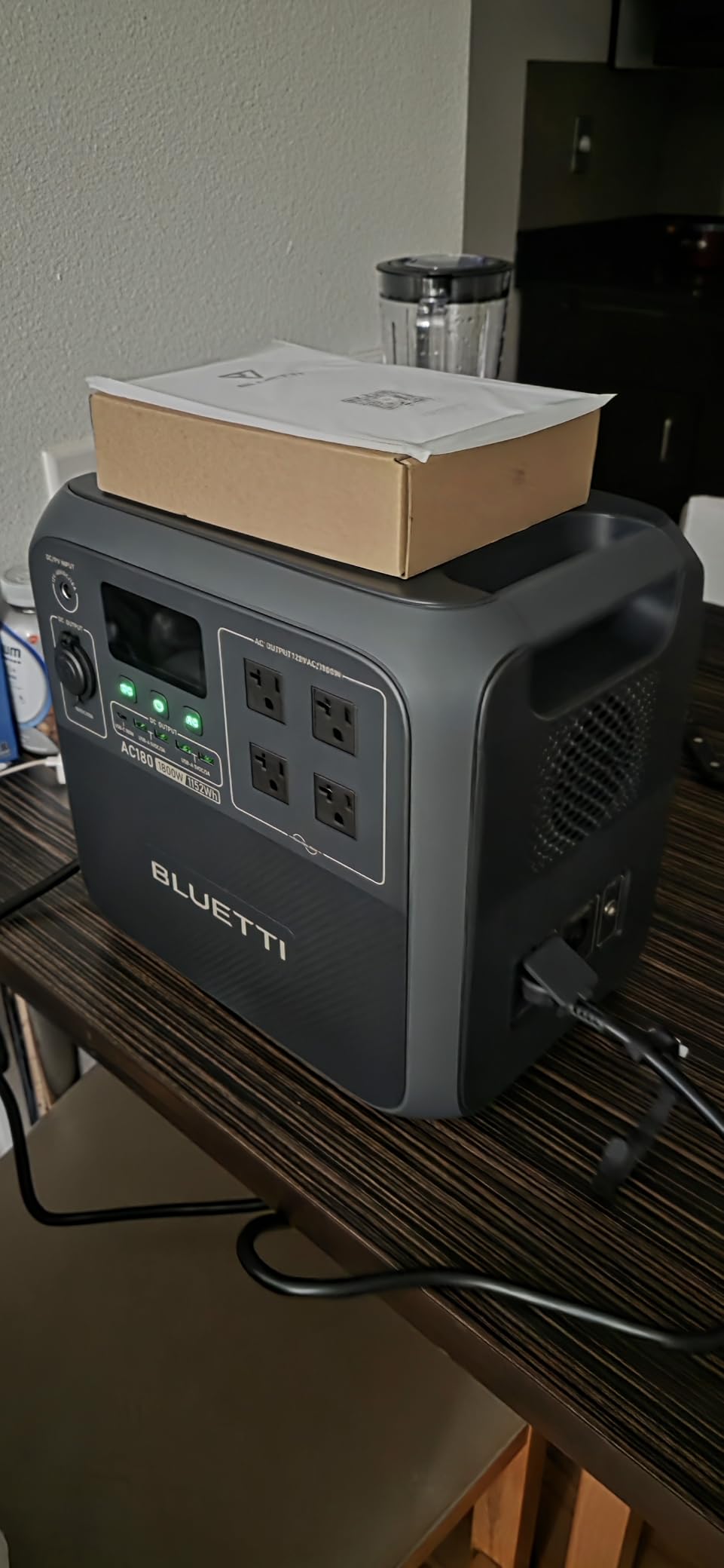
Charging is fast in a way that matters for storm preparation. The 1,440W AC input refills the battery in about an hour, and the 500W solar input does it in 2.8 to 3.3 hours in good conditions. The app plus a bright LCD display make real-time input and output easy to read in a dim garage or a tent at night.
The trade-offs are physical and electrical. At 37.4 pounds this is the heaviest station in the sub-1.2kWh group and awkward to move between rooms, and idle self-consumption of 15 to 20W combined with a roughly 10% capacity reserve means the effective usable capacity sits well below the 1,152Wh on the label. New units also need a firmware update and a discharge and recharge cycle before they perform as expected.
Who the BLUETTI AC180 suits
It suits someone running a portable car refrigerator for a week or more, and someone protecting a full-size kitchen fridge through a winter outage where a five-hour window is not enough. The 1,800W continuous rating and 20ms switchover are the two features that make it feel like a backup appliance rather than a camping accessory.
It also suits buyers who value a five-year warranty and reachable support. Reviewers repeatedly credit BLUETTI’s team with resolving battery calibration issues that would have been a return elsewhere.
Who should skip the BLUETTI AC180
Skip it if you need to carry it any real distance. Thirty-seven pounds is a two-person lift for most people, and there are lighter options in this roundup with comparable capacity. It is also a poor fit for anyone who wants a silent bedroom unit, because the cooling behaviour that protects 1,800W of inverter is audible in a quiet room.
Buyers chasing maximum usable watt-hours per pound should be aware that the high idle draw works directly against the fridge duty cycle, since a cooler running 24 hours a day pays that idle cost twice as long as one used for a weekend.
4. BLUETTI Elite 100 V2 Portable Power Station, 1024Wh, 1800W
BLUETTI Elite 100 V2 Portable Power Station for Camping 1024Wh 1800W
1024Wh LiFePO4 battery
1800W with 2700W power lifting
25 lb and 17L
30dB silent mode
Pros
- Only 25 lb and 17L for 1024Wh in this roundup
- 1800W output plus 2700W lifting handles compressor startup
- 0-80% in about 45 minutes on 1200W TurboBoost charging
- 10ms UPS switchover and 30dB silent mode
- Five-year warranty
Cons
- Listing claims 11 ports while the spec sheet lists 4 outlets
- Wi-Fi and Bluetooth app setup required for some settings
- Solar panel not included in the base configuration
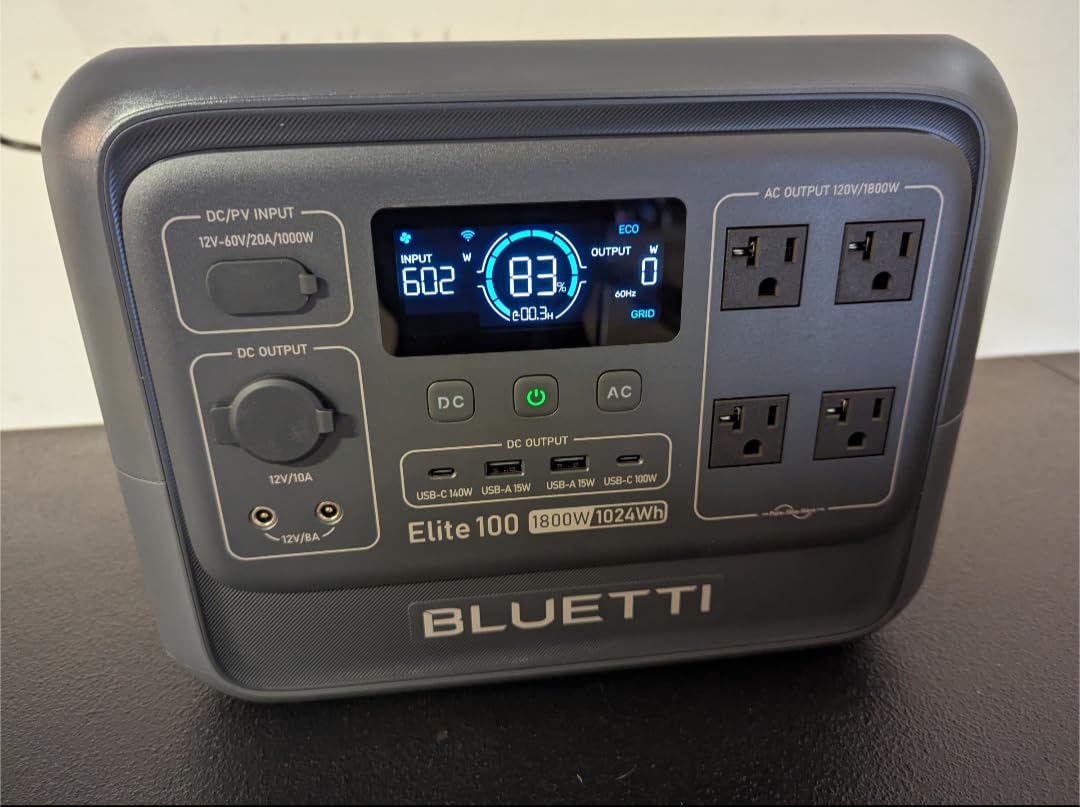
Where the AC180 is the heavy-duty option, the Elite 100 V2 is the compact one. It packs 1,024Wh and 1,800W of rated output into 17 litres and 25 pounds, roughly a third lighter than typical 1kWh machines, and still delivers 2,700W of app-enabled power lifting with 3,600W of surge for compressor start.
That combination makes it the sleeper pick for a full-size refrigerator in a short blackout. 1,800W of continuous output is more than a household fridge needs, so the compressor has real headroom, and 1,024Wh of LFP capacity rated at 4,000+ cycles to 80% is a sensible amount of overnight cover.
Two details stand out for overnight use. The 10ms UPS switchover is fast enough to keep a router or a laptop alive through an outage, and the 30dB silent mode is the quietest operating figure among the ten stations we reviewed, which matters when the fridge and the station are in the same room as a sleeping household.
Recharge is quick for the capacity, with 0 to 80% in about 45 minutes on the 1,200W TurboBoost AC input. Be aware that the base configuration does not include a solar panel, and that the listing markets 11 ports while the spec sheet lists 4 outlets, so verify the port count for your actual setup before ordering.
Who the BLUETTI Elite 100 V2 suits
It suits anyone who needs a full-size refrigerator covered overnight but cannot justify a 37-pound station, and campers who want 1,800W of output without hauling a large chassis. Households with a CPAP machine or a router alongside the fridge benefit from the 10ms switchover.
It also suits buyers sensitive to sound. A 30dB silent mode makes this the least intrusive choice for a bedroom or a sleeping child during a power cut.
Who should skip the BLUETTI Elite 100 V2
Skip it if you need multi-day runtime for a household fridge, because 1,024Wh covers a night well and a second night poorly. Also skip it if you expect a full ten-port setup from the listing, since the spec sheet disagrees with the marketing count.
Buyers who want solar capability out of the box should plan to purchase a panel separately, and buyers who dislike app dependency should note that some settings are only reachable through the Wi-Fi and Bluetooth app after setup.
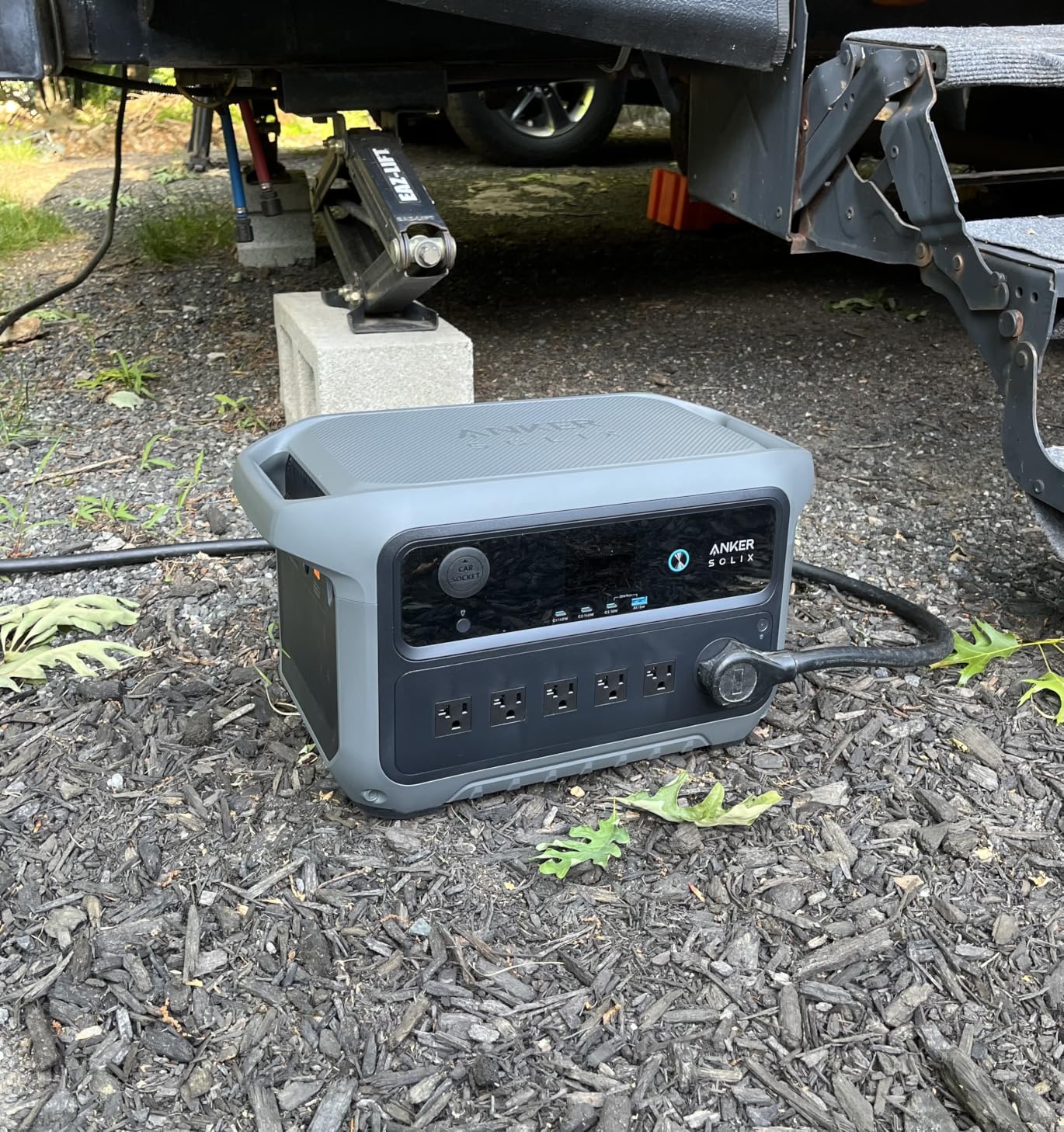
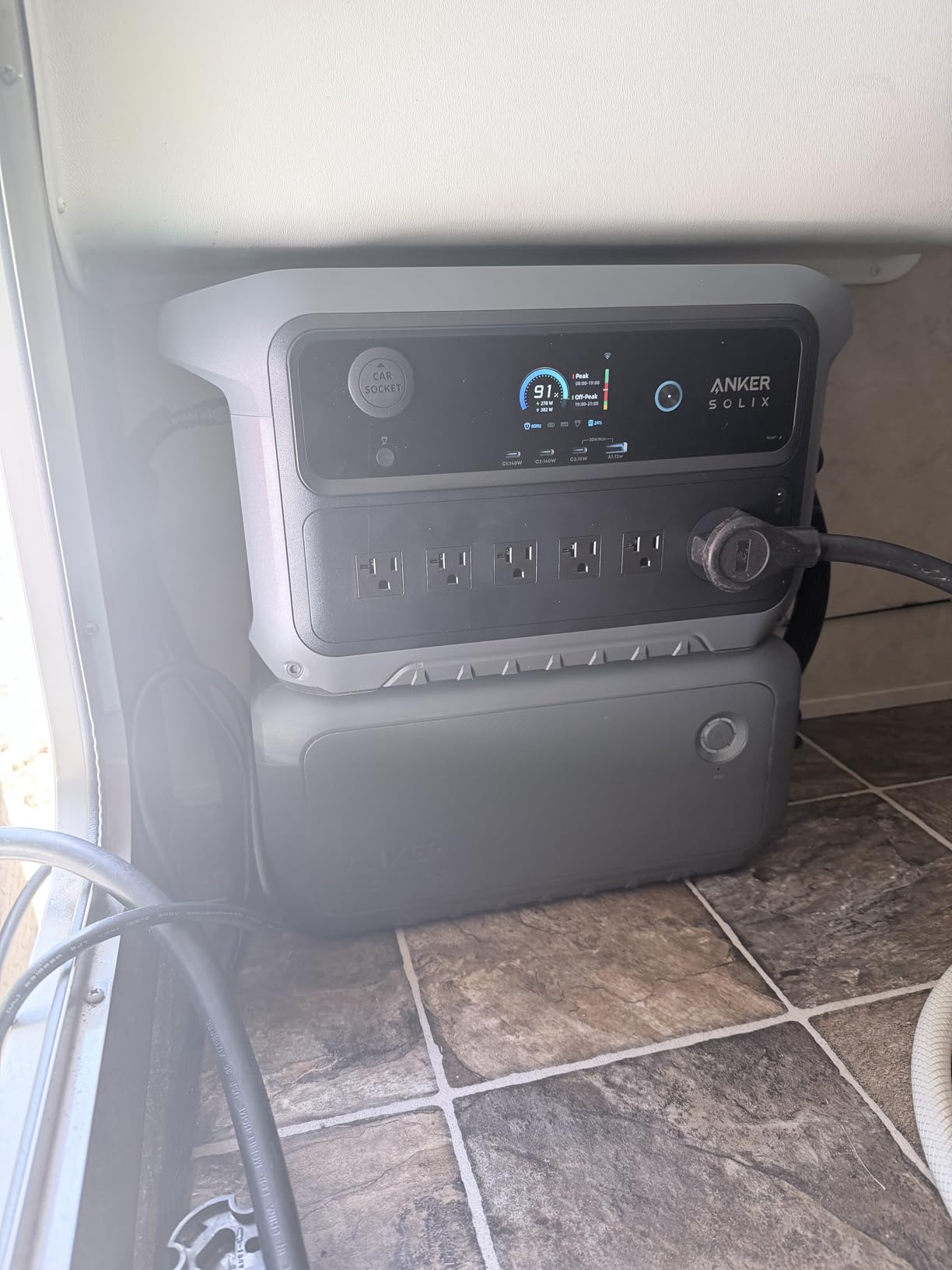
5. Anker SOLIX C1000 Gen 2 Portable Power Station
Anker SOLIX C1000 Gen 2 Portable Power Station
1024Wh LiFePO4 battery
2000W continuous with 3000W peak
24.9 lb
Under 10ms UPS switchover
Pros
- Strongest rating profile here at 4.7 stars with only 4% one-star reviews
- 2000W output from only 1024Wh
- Full recharge in 49 minutes on 1600W HyperFlash AC
- Under 10ms UPS switchover
- 600W solar input recharges in 1.8 hours
- Inaudible during operation
Cons
- Gen 2 removed the expandability of the first generation
- Ships without a case or cable storage
- Measured harmonic distortion of 15-20% on microwave-type loads
The C1000 Gen 2 has the strongest rating profile in the group, 4.7 stars from 1,632 reviews with only about 4% one-star, which is the tightest spread we saw. Fridge duty during genuine outages is the most common validation story, with owners describing a mini fridge running nearly two days and a full-size refrigerator carried through a five-hour blackout at 1,800W on UPS pass-through.
On paper it is the best watts-per-Wh ratio here, 2,000W of continuous output from a 1,024Wh battery. That matters for fridges because it is output, not capacity, that decides whether a compressor starts cleanly on a cold morning, and this machine has roughly double the headroom of a typical 1,000W unit.
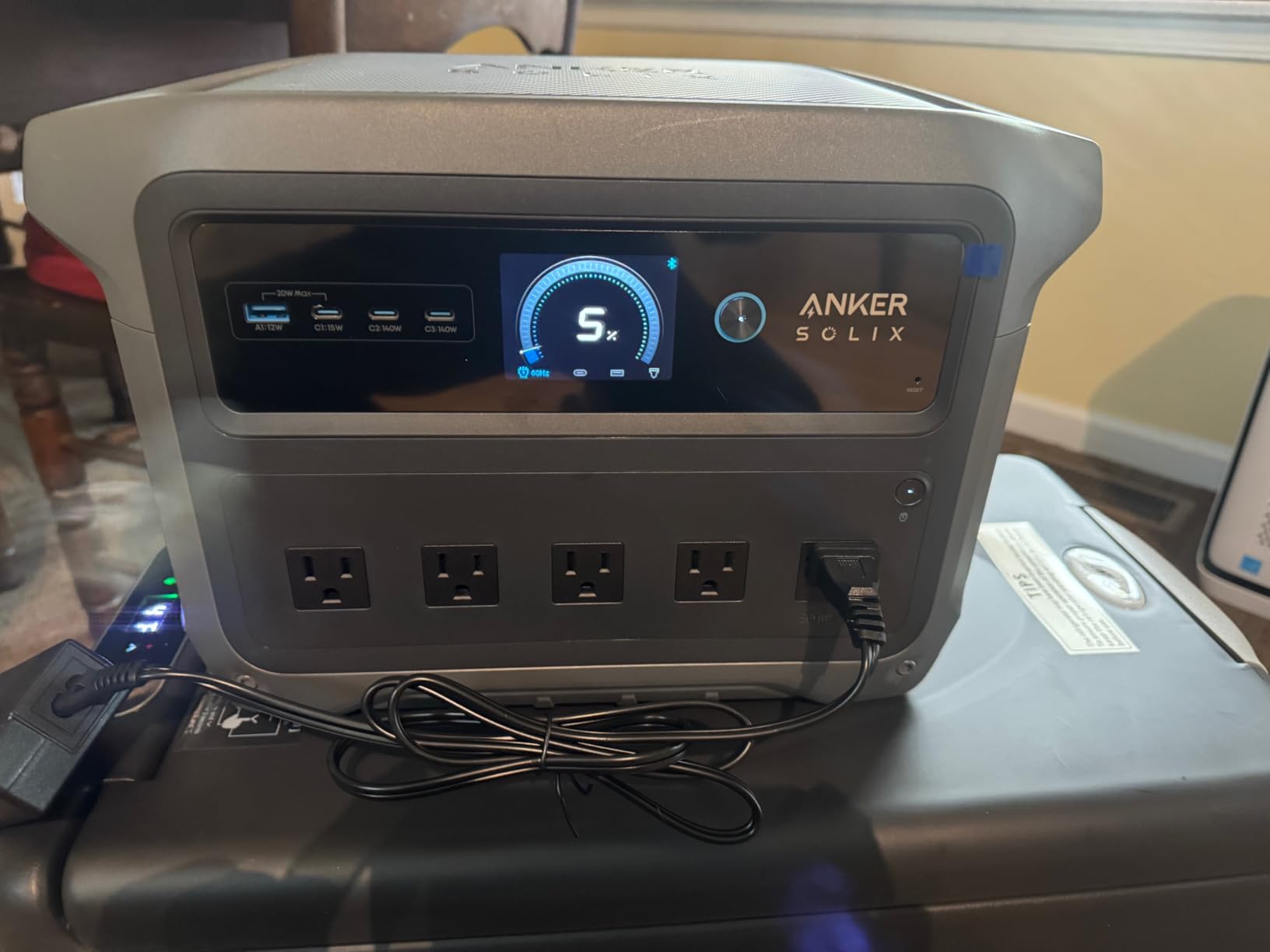
The recharge numbers are the fastest in this class. A 1,600W HyperFlash AC input delivers a full recharge in 49 minutes, and the 600W solar input brings it back in about 1.8 hours, which is the highest solar ceiling we saw on a 1kWh unit. The under 10ms UPS switchover keeps routers, laptops and medical devices running through an outage without a reboot.
There are trade-offs. This second-generation model removed the battery expandability found on the first generation and supports only one add-on module per build, so a household expecting to grow capacity should look elsewhere. It also arrives without a protective case or cable storage, and an electrical engineer’s teardown measured roughly 15-20% harmonic distortion on microwave-type loads, though the sine wave stayed clean on resistive loads.
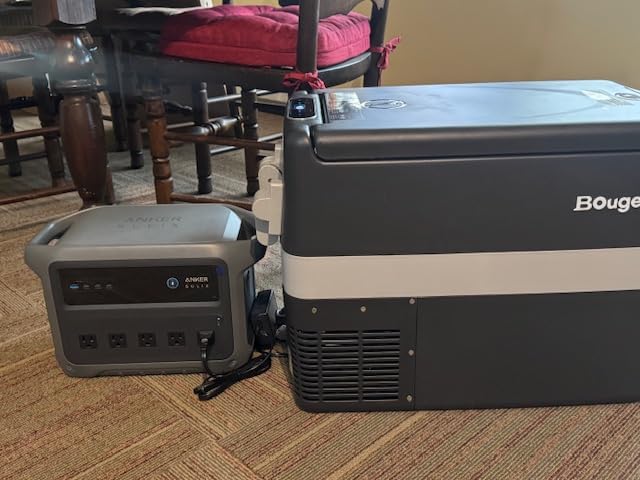
Who the Anker SOLIX C1000 Gen 2 suits
It suits households protecting a refrigerator plus medical equipment or a home office through an outage, since the sub 10ms switchover and 2,000W output cover both loads at once. It also suits anyone who recharges on the move, with 600W solar input and a 49-minute wall recharge making turnaround genuinely fast.
Owners also report it running effectively inaudibly, which is a real advantage for indoor overnight use. Our RV power station picks cover the same fast-recharge class for a different set of loads.
Who should skip the Anker SOLIX C1000 Gen 2
Skip it if you already own a first-generation C1000 and want to add an expansion battery, because Gen 2 dropped that path. It is also a poor choice for anyone who runs sensitive electronics alongside high-draw inductive loads, given the measured distortion figures on non-resistive appliances.
Buyers who want everything in one box should note the missing case and cable storage, small annoyances that are easy to solve with a separate organiser.
6. OUPES Mega 1 Portable Power Station, 1024Wh, 2000W
OUPES Mega 1 Portable Power Station 1024Wh 2000W (4500W Surge)
1024Wh LiFePO4 battery
2000W pure sine wave continuous
27.8 lb
Expandable to 5120Wh
Pros
- 2000W continuous from 1024Wh with headroom to start full-size refrigerators
- Expandable to 5120Wh with two extra batteries which is rare at this size
- 0-80% in 36 minutes on AC and 26 minutes with combined input
- Under 20ms UPS transfer for sensitive electronics
Cons
- 4500W surge claim is overstated and units trip between 2050W and 2200W
- Proprietary charging cable is hard to replace
- Plastic housing is not weather resistant
- Wi-Fi in the app is unreliable
The Mega 1 stands out for one reason above all others: it expands to 5,120Wh with two extra B2 batteries. For a household that wants a fridge covered through a week-long outage rather than a single night, that expansion path is the feature no other unit in the 1kWh class in this roundup offers.
Base performance is strong too. 2,000W of pure sine wave continuous output from 1,024Wh is enough headroom for a full-size household refrigerator, and owners report the unit starting fridges and microwaves without tripping. Recharge is fast, hitting 0 to 80% in 36 minutes on AC and around 26 minutes when AC and solar are combined.
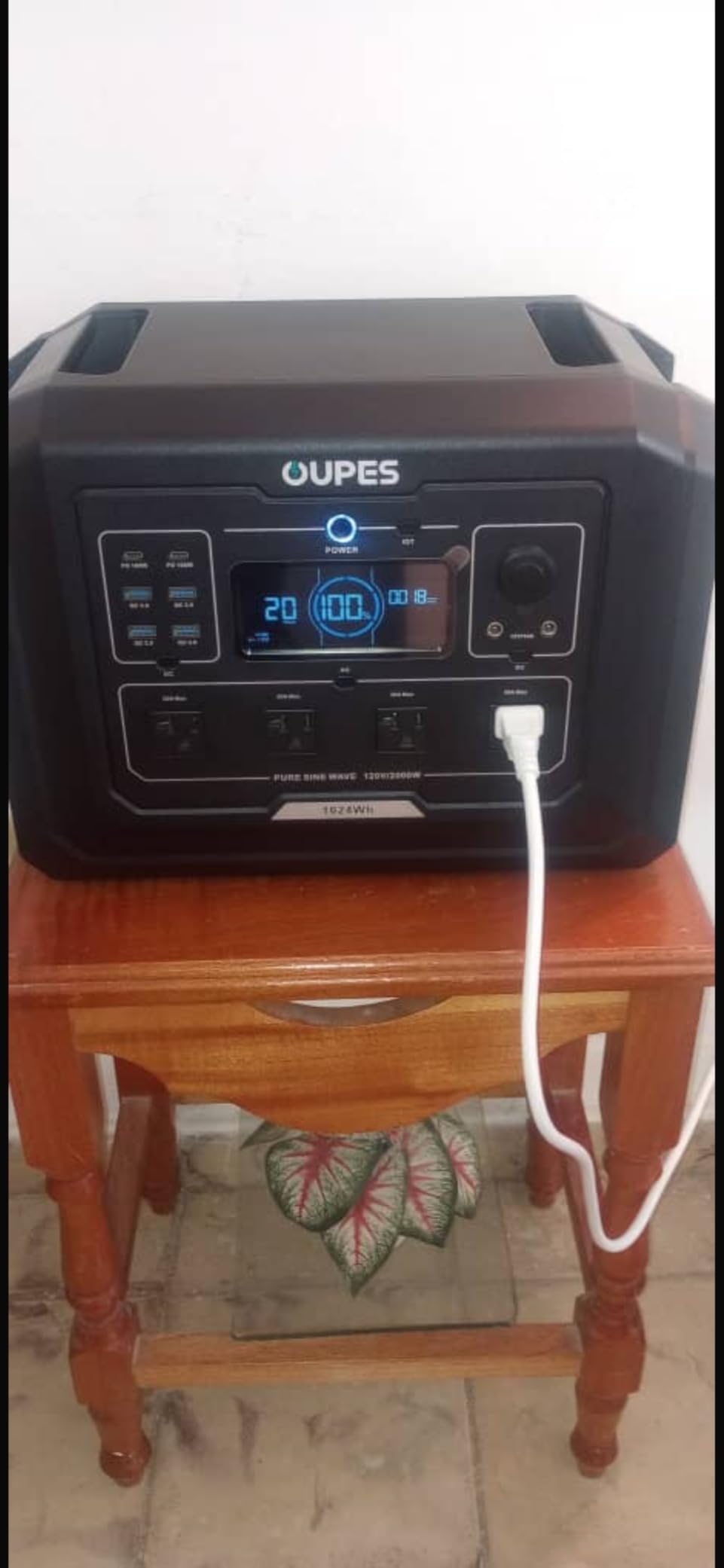
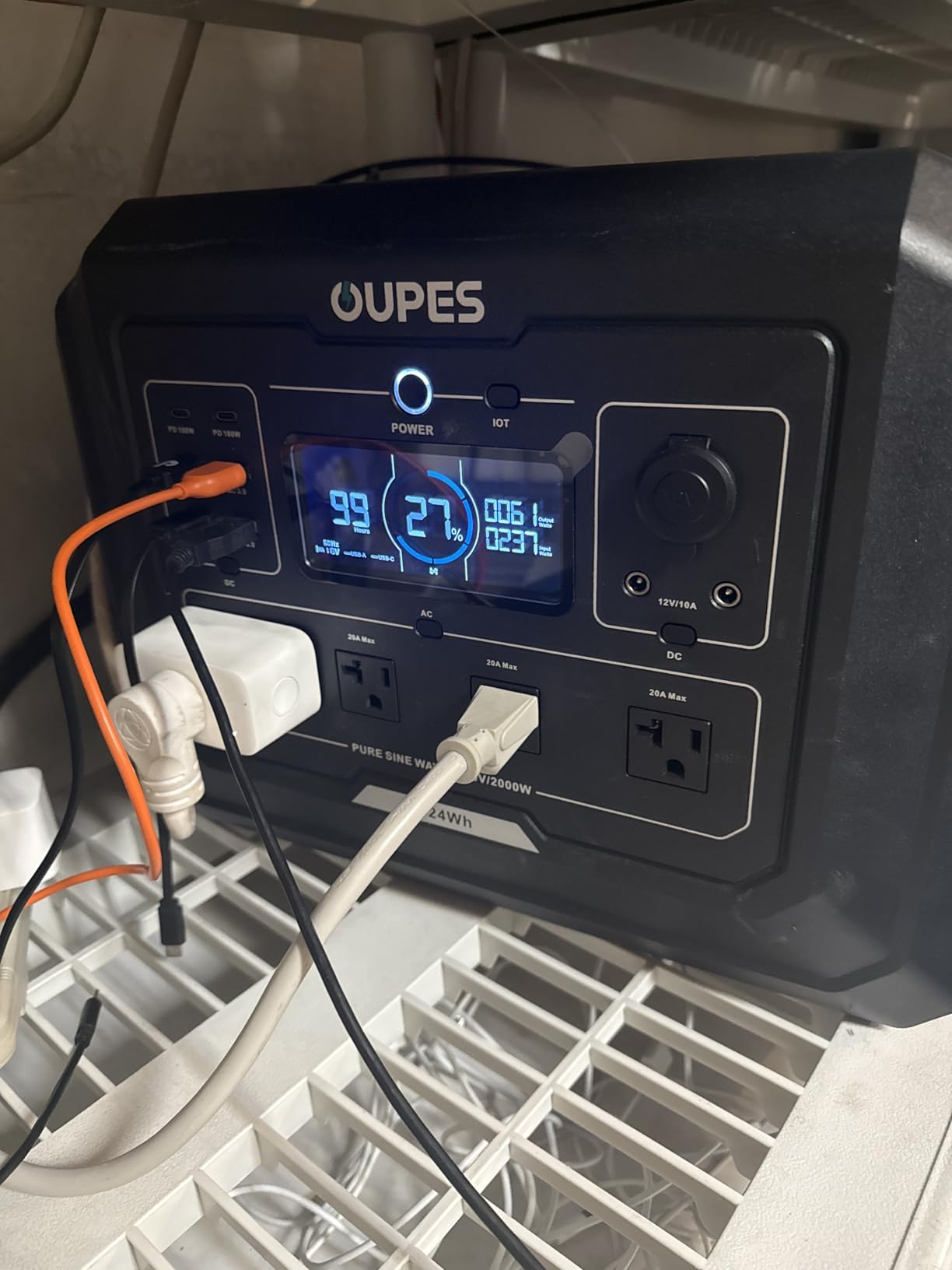
Its 3,500+ cycle LFP battery, under 20ms UPS transfer and dual 100W USB-C PD ports make it a well-rounded machine. Bluetooth control works well even though the app’s Wi-Fi connectivity is reported as unreliable, and the built-in MPPT charger supports bypass charging so you can run the fridge while topping up.
Two documented problems deserve emphasis. The advertised 4,500W surge rating is widely reported as overstated, with units consistently tripping between 2,050W and 2,200W, so treat the continuous 2,000W figure as the real ceiling. The charging cable is also proprietary and difficult to source a replacement for, which effectively strands the machine if it is lost.
Who the OUPES Mega 1 suits
It suits households planning ahead for a long outage, since the expansion path turns a weekend unit into genuine multi-day fridge backup without replacing the machine. It also suits buyers who want more AC outlets than the smaller units provide, with four AC outlets plus dual USB-C PD, four QC3.0 USB-A ports and 12V DC outputs.
Overlanding setups that add solar each season benefit from the 800W solar input, which is the highest ceiling on any 1kWh unit here.
Who should skip the OUPES Mega 1
Skip it if you need the unit in a damp or exposed environment, because the plastic housing is not weather resistant and the moulded handles have sharp edges. Anyone needing near-silent operation in a bedroom should also look elsewhere, since the cooling fans run continuously during charging.
Do not plan a load above 2,000W on the strength of the surge figure. The discrepancy between the claimed and actual surge behaviour is the single most important thing to know before you size this machine against a compressor load.
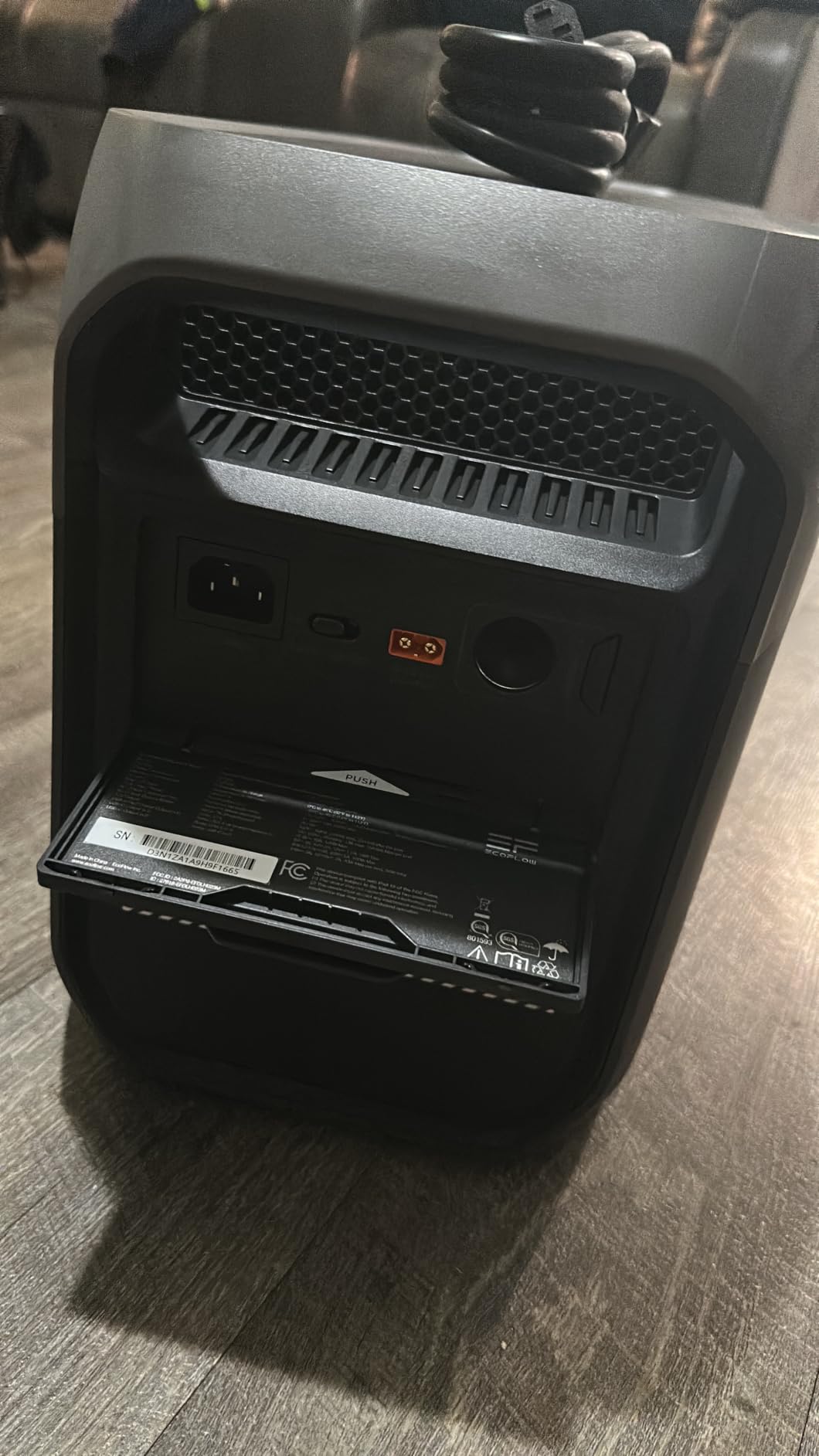
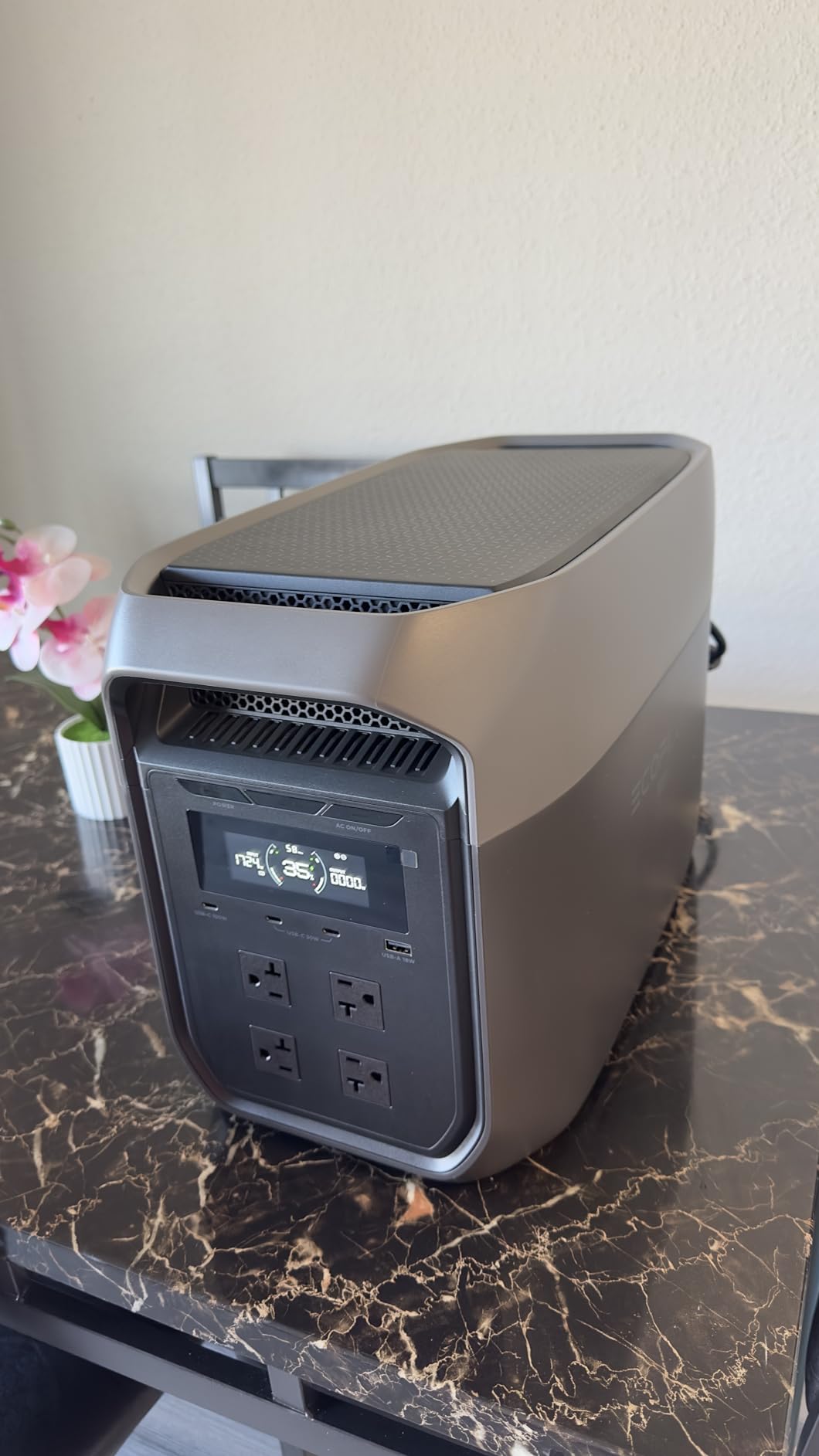
7. EF ECOFLOW Delta 3 Classic, 1024Wh, 1800W
EF ECOFLOW Portable Power Station Delta 3 Classic, 1024Wh 1800W AC
1024Wh LiFePO4 battery
1800W with 3600W surge
26.7 lb
500W solar input
Pros
- Owners report up to 10 hours of refrigerator runtime per charge and multi-day van duty
- 89% five-star share which is the highest in this roundup
- Under 10ms UPS switchover keeps a fridge running with the van switched off
- 0-80% in 45 minutes on X-Stream AC charging
- Thoughtful physical design with dual handles and non-skid base pads
Cons
- Not compatible with DELTA 2 or Delta 3 Series extra batteries so no expansion path
- At 26.7 lb it is one of the heavier 1kWh units
- 12V vehicle input draws just over 100W
The Delta 3 Classic is the most fridge-validated unit in this roundup by volume of owner stories. Across 1,269 reviews at 4.7 stars, with an 89% five-star share, the most common theme is food: up to 10 hours of refrigerator runtime on a single charge, and multi-day van-life fridge duty with no loss of power.
It also has the cleanest van-specific feature here. The under 10ms UPS switchover means you can run the fridge from the station with the vehicle switched off, and reviewers report flawless Bluetooth connection and solar input that captures the full output of roof-mounted panels. The 500W solar input recharges the battery in about 2.5 hours.
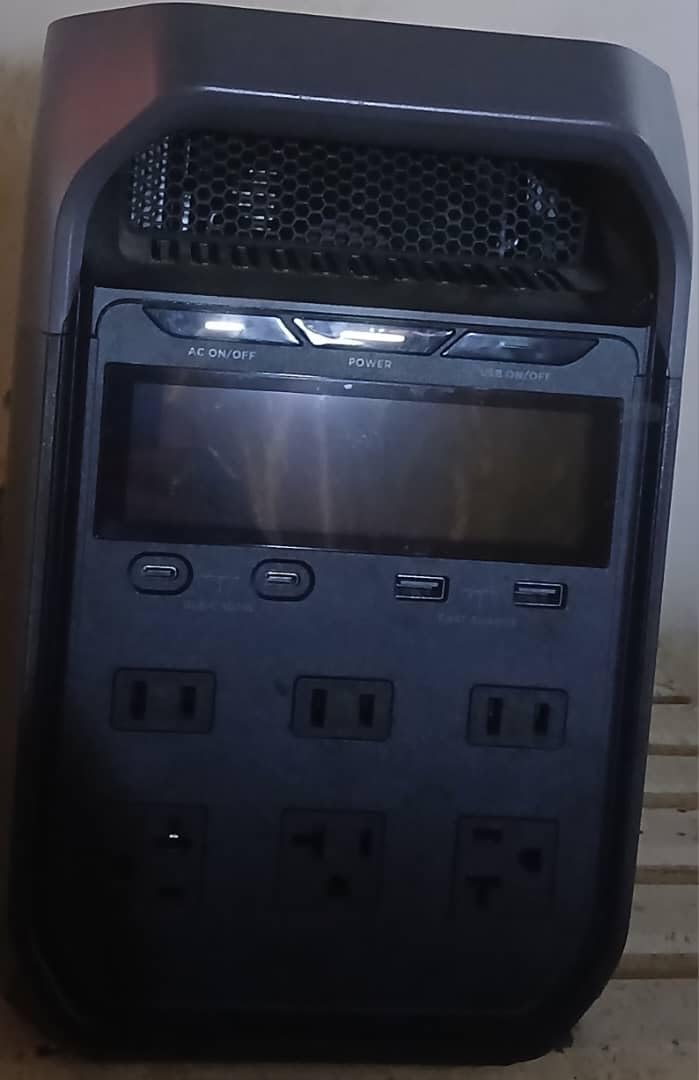
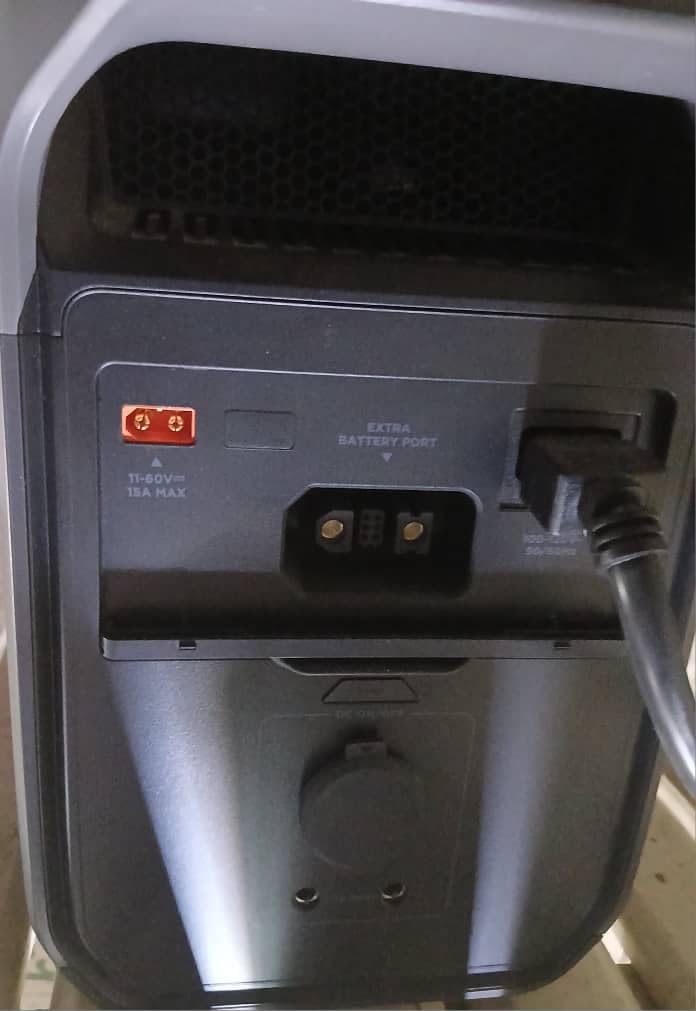
Build quality gets mentioned too. Dual side handles, non-skid base pads, a tucked-away input cover and outward-flared three-prong outlets are the sort of details that only matter once you are moving the thing around a van in the dark, and two sump pumps reportedly ran two full days on half a charge for one owner.
The structural limitation is expansion. This model is not compatible with the DELTA 2 Smart Extra Battery or the Delta 3 Series Smart Extra Battery, so 1,024Wh is the ceiling. At 26.7 lb it is also among the heavier 1kWh units, and the 12V vehicle input draws just over 100W, which is slow for topping up while driving.
Who the EcoFlow Delta 3 Classic suits
It suits van-life and overlanding setups where a fridge runs for days and solar is the primary recharge path. The app adds real value here too, with usage monitoring, charging schedules, Storm Alert and Self-Powered Mode for running the fridge from the battery without turning anything on.
It also suits households wanting a station they can genuinely carry between rooms without a second person, thanks to the dual handles and grippy base pads.
Who should skip the EcoFlow Delta 3 Classic
Skip it if you expect a storm to outlast the station, because there is no extra-battery path and you will be relying entirely on solar recovery. A couple of days of poor weather can leave too little charge for overnight fridge use, which is a real risk in a coastal or winter setup.
Anyone who needs to move it frequently alone should weigh the 26.7 lb figure carefully, and buyers who are sensitive to occasional quality issues should note isolated reports of units arriving dead on arrival and one used unit with screen damage.
8. Anker SOLIX C2000 Gen 2 Portable Power Station, 2048Wh, 2400W
Anker SOLIX C2000 Gen 2 Portable Power Station, 2,048Wh, 2,400W, Camping
2048Wh capacity
2400W rated with 4000W peak
41.7 lb
Up to 32 hours dual-door fridge runtime
Pros
- Only unit here with a manufacturer-stated 32 hour dual-door fridge runtime
- 2400W rated and 4000W peak covers window and RV air conditioners as well
- 9W standby draw improves usable capacity for always-on loads
- 100% recharge in 58 minutes on combined AC and solar
- Expandable to 4kWh with an Anker expansion battery
Cons
- Heaviest unit in the roundup at 41.7 lb
- Requires a separately sold expansion battery to exceed 2048Wh
- Spec sheet lists only 1 outlet despite multi-outlet marketing
If your fridge is a genuine full-size kitchen refrigerator rather than a portable cooler, this is the first unit in the list we would look at. It holds 2,048Wh, and Anker publishes a stated runtime of up to 32 hours for a dual-door fridge, extending to about 64 hours with an expansion battery. No other machine in this roundup makes a fridge runtime claim that specific.
The 2,400W rated and 4,000W peak output is the other half of the answer, because a household refrigerator with a freezer section can pull well beyond what a 1,800W unit delivers at start. Reviewers also note the 9W standby draw, which directly protects the always-on fridge scenario since idle losses eat into a long outage.
Recharging is unusually flexible, with six paths including AC, solar, a generator, an 800W alternator charger and the car outlet. The 800W alternator charging takes about three hours from a vehicle, and combined AC plus solar reaches 100% in 58 minutes, the fastest full-cycle figure in the group.
At 41.7 pounds this is the heaviest station here, and it is best treated as a place-and-leave appliance rather than something you carry to a picnic. Expansion past 2,048Wh requires an Anker battery sold separately, and the spec sheet lists only one outlet despite the multi-outlet AC configuration in the marketing, so confirm the port layout for your own use.
Who the Anker SOLIX C2000 Gen 2 suits
It suits households whose fridge is the main load through a genuine multi-day outage, and anyone who also wants headroom for a window air conditioner or an RV unit alongside it. The 4kWh ceiling means a week of bad weather is a realistic target rather than an optimistic one.
It also suits people who drive regularly and want to top up while on the move, thanks to the 800W alternator charging path.
Who should skip the Anker SOLIX C2000 Gen 2
Skip it if the station has to be carried between the house, the truck and a campsite, because 41.7 pounds is a two-person lift in most cases. It is also overkill for a 12V camping cooler, where a 1kWh machine is a better use of the budget and the weight.
Buyers planning a load above 2,400W should be aware that the 4,000W figure is peak only, and that a spec sheet listing a single outlet is worth verifying against your actual connection needs before ordering.
9. EF ECOFLOW DELTA 3 Max Portable Power Station, 2048Wh, 2400W
EF ECOFLOW DELTA 3 Max Portable Power Station, 2048Wh LFP Battery, 2400W
2048Wh LiFePO4 battery
2400W rated with 3400W X-Boost
0-80% in 1.13 hours
Under 10ms transfer
Pros
- Largest mainstream capacity here at 2048Wh for long fridge runtime headroom
- 3400W X-Boost output marketed to cover 99% of household appliances
- Fastest refill in the roundup at 0-80% in 1.13 hours
- Under 10ms transfer and ultra-quiet operation for indoor overnight use
Cons
- Smallest review base in the roundup at under 600 ratings
- Manufacturer does not publish a weight figure
- Tallest chassis here at 19.44 inches
- Only 3 outlets listed in the spec sheet
The Delta 3 Max is the pick when the fridge is only one item on the list. At 2,048Wh with 2,400W rated output and 3,400W of continuous X-Boost, this is the machine to buy if a blackout also means no microwave, no kettle and no lighting, and the marketing claim of covering 99% of household appliances is not unreasonable for a load of that size.
Recharge speed is its standout number, with 0 to 80% in 1.13 hours on X-Stream AC charging, the quickest refill of the ten stations we reviewed. That speed is genuinely useful after a storm, when grid power returns for a few hours at a time and you want to recover capacity between outages.
For a household running a fridge overnight beside sleeping people, the under 10ms transfer time and ultra-quiet operation both matter. The LiFePO4 battery is engineered for 10 years of daily use with a five-year service plan, and the app supports real-time monitoring, load priorities and charge scheduling.
There are real compromises. It carries the smallest review base in the roundup at 583 ratings, so the 4.7 average rests on a thinner sample than the others. The manufacturer does not publish a weight figure, the chassis is the tallest here at 19.44 inches, and only 3 outlets are listed in the spec sheet, which is restrictive for a device marketed as a kitchen-scale solution.
Who the EcoFlow Delta 3 Max suits
It suits households treating the fridge as one of several loads during an outage, since the capacity and the X-Boost headroom leave room for a microwave, lights and a laptop alongside it. Anyone with a variable electricity tariff can use the app’s scheduling to charge off-peak and cut the cost of keeping a station ready.
It also suits people who want minimum noise during indoor overnight running, given the ultra-quiet operation and the fast transfer time that prevents a fridge restart.
Who should skip the EcoFlow Delta 3 Max
Skip it if you need more than three simultaneous devices, because the listed outlet count is the lowest of the three 2kWh options here. Also skip it if you need to stow it in a vehicle or a shallow cabinet, since the 19.44-inch height is the tallest in the group.
Buyers who want a long review history before committing should be aware this model has the least validated sample of the ten. Everything else about it, from the battery engineering to the recharge speed, is first-rate.
10. Anker SOLIX S2000 Portable Power Station, 2010Wh, 1500W
Anker SOLIX S2 Portable Power Station, 2,010Wh, 1,500W
2010Wh LFP battery
1500W continuous with 3000W peak
35.7 lb
Up to 35 hours fridge runtime
Pros
- Manufacturer-stated 35 hour refrigerator runtime from a 6W idle draw
- 10000 cycle 314Ah LFP battery rated for a 15 year lifespan
- Compact 2kWh chassis at 35.7 lb
- Under 10ms UPS switchover with front and rear outlet layout
- Six recharge paths including 400W solar input
Cons
- No 12V DC port for direct accessory connection
- 1500W continuous is the lowest output of any 2kWh unit here
- Smallest review base in the roundup at 303 ratings
- Runtime figures depend on fridge model and ambient temperature
The S2000 is built around one idea: keep a fridge running for as long as possible from a single charge. Anker states up to 35 hours of refrigerator backup, the longest fridge runtime figure among the ten stations here, and the 6W idle draw is the second lowest in the group alongside the C2000 Gen 2.
That efficiency comes from 314Ah LFP cells rated for 10,000 cycles and a 15-year lifespan, the longest cycle claim in this roundup. For a station that will live in a garage permanently, charged monthly and expecting a decade of service, that battery rating is the most important specification on the whole page.
At 2,010Wh and 35.7 pounds it is also the smallest and lightest 2kWh chassis here, and Anker rates it 30% smaller and 25% lighter than the industry average. The front and rear dual-sided outlet layout lets you wire an always-on fridge separately from everyday device charging, which keeps the fridge circuit undisturbed.
The compromises are real. There is no 12V DC port, so a 12V camping cooler cannot be connected directly. The 1,500W continuous rating is the lowest among the 2kWh units in this roundup, which leaves less headroom for a compressor starting under a heavy load, and the 400W solar input ceiling is modest. The review base is also the smallest here at 303 ratings, all relatively recent.
Who the Anker SOLIX S2000 suits
It suits households that want the longest possible single-charge fridge runtime and care more about battery lifespan than about having the newest output figure. If a station will sit in a garage for ten years and only wake up during storms, the 10,000-cycle rating is worth more than extra watts.
It also suits buyers with a full-size fridge in a moderate climate, where 1,500W is comfortable for a 100 to 200W refrigerator load and the 2,010Wh capacity stretches into a second partial day.
Who should skip the Anker SOLIX S2000
Skip it if you run a portable freezer, a portable air conditioner or a 12V camping cooler, because there is no 12V DC port and 1,500W is thin for high-surge loads. Choose a 2,000W-plus unit instead if your outage plan includes anything beyond a refrigerator and some lights.
Buyers who want to spread risk across a longer review history should note the 303-rating sample, and anyone relying on solar recovery should confirm that 400W input is enough for their panel count.
What Size Portable Power Station Do You Need to Run a Refrigerator?
Work through five steps and the answer falls out of the arithmetic every time. First, get the fridge’s running watts, either from the label or a clamp meter on the compressor lead over a full on-and-off cycle. Second, pick a duty cycle: 40% for a compressor cooler in a warm vehicle, 25% for a household fridge in a cool room, 60% for a portable freezer.
Third, multiply running watts by duty cycle and by the hours you need. That gives daily watt-hours. Fourth, divide by 0.85 for inverter efficiency, since converting stored DC to AC always costs something. Fifth, add 20% for margin, and then check that the station’s continuous output exceeds the fridge’s running watts by a wide margin so the startup surge has somewhere to go.
As a quick reference, a 12V compressor cooler needs roughly 500 to 700Wh of nominal capacity per day of runtime, so 1,000Wh comfortably covers a weekend. A full-size household refrigerator needs around 1,800 to 2,500Wh for a single night, which is why the three larger units in this roundup exist. For a three-to-five-day outage on a household fridge, plan on 2,048Wh plus an expansion battery.
For Jackery specifically, the Explorer 1000 v2 at 1,070Wh and 1,500W is the sensible pick for a camping cooler or a single night with a household fridge. For a week of storm cover, the Jackery line’s answer is a different tier of machine entirely, and you should be comparing against the 2kWh class in this guide rather than expecting 1kWh to stretch.
Camping Fridge vs Household Fridge: What Kind of Station Do You Need?
These are two different purchases, and the research behind them points in opposite directions. A camping fridge is a 12V compressor cooler drawing 40 to 60W that runs on DC, so it needs modest capacity, a car socket for zero-loss connection, and a station light enough to lift into a vehicle. A household refrigerator pulls 100 to 400W on AC, so it needs a pure sine wave inverter, real surge headroom and a capacity you will not resent during a four-day outage.
For a camping fridge, prioritise a 12V DC car port and low weight, and pick something in the 1,000Wh class. For a household fridge, prioritise continuous output above 1,500W, UPS switchover under 20ms, and capacity of 2,000Wh or more. Never use a modified sine wave output with a modern refrigerator, since the control electronics can behave unpredictably.
On solar, the recurring real-world scenario is a fridge plus everything else rather than a fridge alone. An r/overlanding user described running a two-way fridge, a roof fan, interior lights and a small air conditioner from an Anker SOLIX F2000 paired with a 200W roof panel, which is a good illustration of how quickly a single 1kWh unit fills up once the fridge is not the only load. Budget roughly 200W of panel per 1,000Wh of battery for a fridge-only duty cycle, and considerably more if the panels are portable and only deployed in daylight.
Running a Power Station Indoors With a Fridge: Safety Notes
Portable power stations are one of the safer ways to keep food cold during an outage, because there is no combustion and therefore no carbon monoxide. That does not mean they need no respect. All ten units here use LiFePO4 chemistry, which is considerably more thermally stable than the nickel-based cells used in older stations, but any lithium battery still deserves ventilation and a smoke alarm in the room.
Leaving a station running a fridge overnight is normal practice and widely done, provided it sits on a hard surface away from bedding, with the exhaust path clear. Do not use a station in a hot, unventilated vehicle with the fridge running, as heat is the one environmental factor that genuinely shortens battery life.
Cold weather is the other derating risk. A battery stored or charged below freezing will not accept charge properly, and capacity falls in deep cold, which matters for winter camping and truck-bed installs. Store units around half charge when they are not in use, top them up fully before a forecast storm, and run a discharge and recharge test a couple of times a year so you know the real state of the battery before you need it.
Frequently Asked Questions
Can a portable power station run a refrigerator?
Yes. A portable power station can run a refrigerator as long as its continuous output covers the fridge’s running draw and its surge rating covers compressor startup. A 12V compressor cooler pulling 40-60W needs roughly 1,000Wh for a day and a half of runtime, while a full-size household refrigerator at 100-400W needs 2,000Wh or more. Add a 20% buffer for margin.
What size portable power station do you need to run a refrigerator?
Work out daily watt-hours first: running watts multiplied by duty cycle multiplied by 24 hours. A 50W camping cooler at a 40% duty cycle uses about 480Wh per day, so a 1,000Wh station covers a weekend. A 200W household fridge at 25% duty cycle uses about 1,200Wh per day, which pushes you toward 1,800Wh nominal after allowing for 85% inverter efficiency and a 20% buffer.
What size Jackery do I need to run a refrigerator?
The Jackery Explorer 1000 v2 with 1,070Wh capacity and 1,500W output is the right pick for a 12V camping cooler or a single night of household fridge backup. Its 3,000W surge peak gives a compressor room to start, and 23.8 lb keeps it manageable. For a multi-day outage on a full-size refrigerator, step up to a 2kWh station rather than stretching the 1kWh model.
What kind of power station do I need to run a camping fridge?
A 12V compressor cooler needs a station in the 1,000Wh class with a pure sine wave inverter, at least 1,500W of continuous output for startup headroom, and a 12V DC car port so the fridge can run without inverter conversion loss. A thermoelectric cooler draws less, so a smaller 999Wh unit with around 1,000W of output is enough. Weight matters more than capacity for camping, so anything under 26 lb is worth considering.
How many solar panels do I need to keep a fridge running?
Budget roughly 200W of panel for every 1,000Wh of battery capacity when the fridge is your only load. A 200W folding panel paired with a 1kWh station is the most common working setup, and stations with 400W to 800W of solar input refill faster. In practice, a panel only produces its rated output in direct midday sun, so size conservatively if your weather is unreliable.
Conclusion
After working through ten stations and the runtime arithmetic behind them, the Jackery Explorer 1000 v2 remains our pick as the best portable power station for refrigerators. It carries the deepest review history at 4.7 stars from more than 3,600 owners, weighs 23.8 pounds, and delivers 1,500W of continuous output with 3,000W of surge from 1,070Wh of LFP capacity, which covers a camping cooler for a weekend and a household fridge for a night.
Match the machine to the fridge rather than to the marketing. A 12V cooler needs capacity and light weight. A full-size kitchen refrigerator needs 1,800W of output or more, real surge headroom, UPS switchover, and 2,000Wh of capacity. The BLUETTI AC180 covers a weekend-plus outage, the EcoFlow Delta 3 Classic wins for van life, and the Anker SOLIX C2000 Gen 2 is the one to buy when a week of bad weather is the scenario you are planning for.
Start with the numbers, run the arithmetic, then check the button on the listing page to see the current configuration and bundled accessories. Solar panels are almost never included, and that is the most common surprise buyers report.