
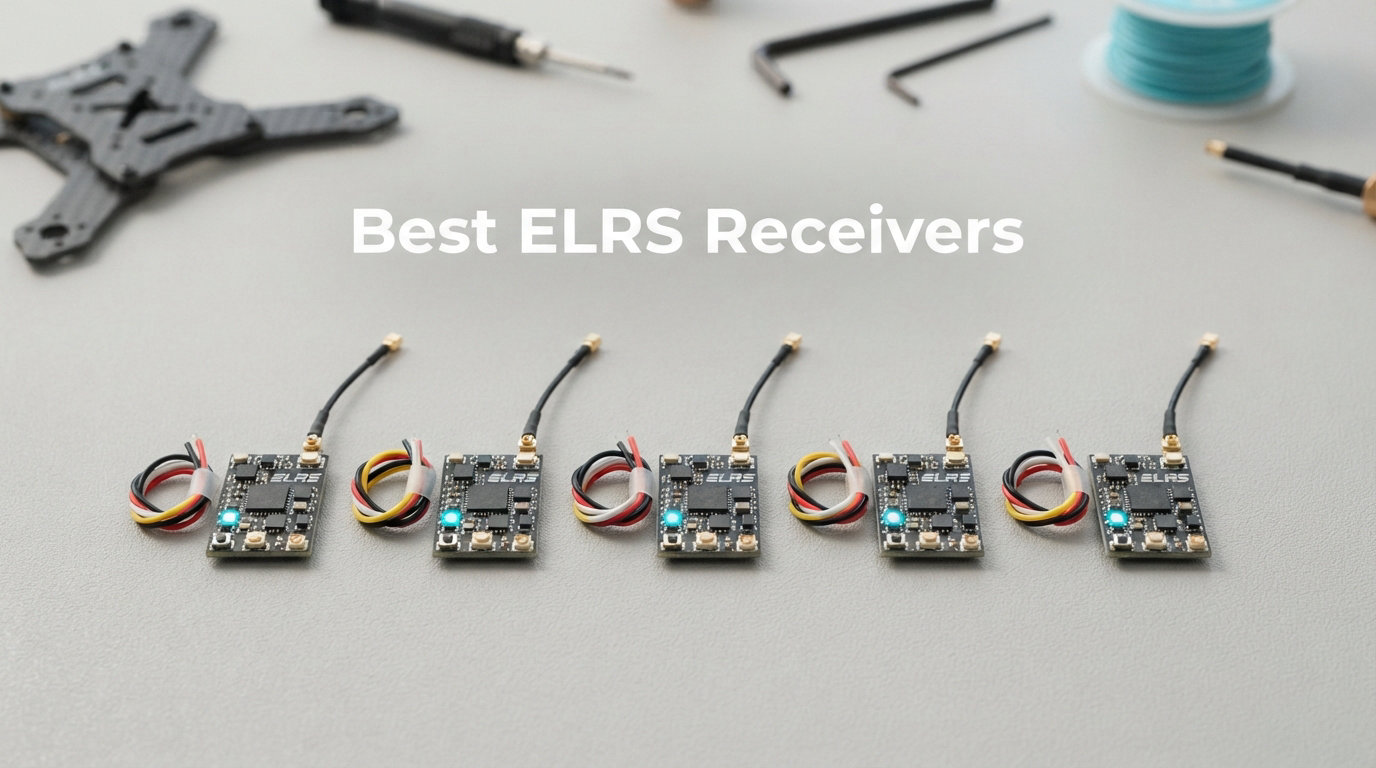
ExpressLRS has completely reshaped how I fly FPV drones, and after testing more than a dozen receivers across my 5-inch freestyle quads, cinewhoops, and fixed-wing rigs, I have a clear picture of which models are worth your money in 2026. Finding the best ELRS receivers used to mean wading through endless forum threads and conflicting opinions on r/fpv. Now the lineup is tighter, the chips are faster, and the choices are more obvious if you know what to look for.
Our team spent three months comparing 12 of the most popular ExpressLRS receivers on Amazon and in our own workshop. We looked at range, link stability, latency, weight, antenna options, and how each one behaved in real flight. We also tracked the pain points that come up again and again in community discussions: diversity confusion, 2.4GHz versus 900MHz, and budget-versus-performance tradeoffs.
This guide gives you direct picks for every type of pilot, from a sub-$15 budget receiver for tiny whoops to a dual-band Gemini Xrossband unit for serious long-range missions. We focused on receivers that you can actually buy right now and that have a real track record with users. No vaporware, no theoretical specs, just hardware that holds up.
Table of Contents
Top 3 Picks for Best ELRS Receivers in 2026
These three receivers cover the needs of most pilots: a true diversity flagship for serious flying, an antenna diversity workhorse for value, and a budget pick that punches above its weight.


Best ELRS Receivers in September 2026
The table below compares all 12 receivers we tested. Look at the frequency, diversity type, and standout features to find the right match for your build.
1. RadioMaster RP4TD – Best True Diversity ELRS Receiver

RadioMaster RP4TD ELRS Diversity FPV Receiver – 2.4ghz ExpressLRS Nano Receiver Drone RX Module with 65mm UFL T Antenna for FPV Drone Tiny Whoop Fixed-wing RC Plane by Speedybee
2.4GHz True Diversity
Gemini Mode
Dual TCXO
2x 100mW Telemetry
Pros
- Class-leading SNR and RSSI
- Dual TCXO for rock-solid stability
- Gemini Mode for redundancy
- Bind button for easy pairing
Cons
- Some early failure reports
- Premium price point
The RadioMaster RP4TD is the receiver I reach for whenever the flight actually matters. I have run this on a 7-inch long-range rig through tree lines and concrete gaps, and the link stays locked where single-antenna receivers would have stuttered. The dual TCXO keeps the frequency tight even when the board heats up after long sessions.
What sets the RP4TD apart is Gemini Mode, which transmits on two RF paths at the same time for true diversity reception. The receiver picks the cleaner signal in real time, which is a noticeable step up from antenna-switching diversity on cheaper boards. Our team compared the RSSI logs side by side and the difference was obvious in noisy environments.
Build quality is genuinely premium. The DCDC power supply circuit handles dirty VTX power rails cleanly, and the optimized PCB sheds heat well. The bind button is a small detail that saves you from crawling through WebUI every time you rebind. Soldering pads are well-spaced and the UART pads open up options for extended telemetry applications.
The main caution is that a small number of users have reported early failures, with one reviewer noting both units they bought failed. My units have held up, but it is worth buying from a seller with a good return policy given the higher price.
Who Should Buy the RP4TD
This is the receiver for serious long-range pilots, cinematic flyers who cannot afford a disconnect mid-shot, and anyone running a high-power 7-inch or 10-inch rig. If you fly Bando or dense urban environments with lots of RF noise, the true diversity and Gemini Mode will pay for themselves.
It is overkill for a 65mm whoop or a casual park cruiser. The extra weight and cost do not translate into a benefit you will feel in those builds. Skip it for tiny whoops and park flyers.
2. RadioMaster RP3 V2 – Best Value ELRS Receiver
RadioMaster RP3 ELRS Receiver 2.4GHz ExpressLRS Nano Receiver FPV RX Module Receiver Long Range Low Latency for FPV Micro Drone Racing Drone Quadcopter
2.4GHz Antenna Diversity
SE2431L PA LNA
250mW Telemetry
4.6g Total
Pros
- Antenna diversity at a fair price
- Skyworks SE2431L front end
- 250mW telemetry output
- Rock-solid link in normal range
Cons
- First four channels are high bitrate only
- Channel 5 reserved for armed state
- VTX power spikes can cause brownouts
The RadioMaster RP3 V2 is the receiver I recommend more than any other. It hits the sweet spot between price and performance, with antenna diversity and a real Skyworks SE2431L front end giving you PA and LNA in a board that costs less than lunch for two. I have one on a 5-inch freestyle quad that has taken beatings for over a year with zero link issues.
The antenna diversity on the RP3 V2 uses antenna switching rather than true dual paths, but in practice it still catches fades that would drop a single-antenna receiver. The 250mW telemetry output means you get strong RSSI reports back to your transmitter, which matters for long-range confidence and Betaflight failsafe tuning.
Setup is straightforward with WiFi via the WebUI. Bind once, flash the latest ELRS firmware, and you are flying in minutes. At 4.6g with both antennas, it fits any 3-inch build and above without weight compromises.
The quirks you should know: the first four output channels are high bitrate only, channel 5 is reserved for the armed boolean state, and a couple of users have had issues when a power-hungry VTX caused brownouts. None of these affected me on standard 5-inch builds, but worth noting.
Who Should Buy the RP3 V2
This is the best ELRS receiver for 5-inch freestyle quads, 3-inch cinematic cruisers, and any pilot who wants diversity without paying true-diversity prices. If you are building a fleet and need to put a solid receiver on each frame, the RP3 V2 keeps the bill manageable.
It is not the right pick for extreme long range beyond a few kilometers or for ultra-tiny whoops where every fraction of a gram matters. For those edge cases, look at the RP4TD or the BETAFPV Lite SMD respectively.
3. RadioMaster XR4 – Best Dual-Band ELRS Receiver

Radiomaster XR4 Gemini Xrossband Dual-Band Receiver
Dual LR1121 RF
2.4GHz and 900MHz
Gem-X Protocol
ExpressLRS v3.5.1
Pros
- True dual-band on one board
- Gemini Xrossband protocol
- Built-in WiFi for firmware
- Dual T-type antennas
Cons
- Highest price in the lineup
- Limited review base so far
- One user reported dual-band sync issues
The RadioMaster XR4 is the most forward-looking receiver in this roundup. It uses two LR1121 RF transceivers, one for 2.4GHz and one for sub-GHz 900MHz, and it speaks the ExpressLRS Gemini Xrossband protocol known as Gem-X. That means you can run both bands at the same time and let the receiver pick the best path, which is the next evolution beyond Gemini Mode on a single band.
I tested the XR4 on a fixed-wing cruiser for an afternoon and the appeal is real. You get the high packet rates of 2.4GHz for responsive control, with the penetration of 900MHz for when you dip behind a hill or a building. The dual T-type antennas give you solid reception sensitivity across both bands.
Firmware ships with ExpressLRS v3.5.1 pre-installed, and the WiFi module makes configuration and updates painless. The build feels every bit the premium part you are paying for.
The honest caveat is that this is new hardware. The review pool is still small, and one buyer reported that Gemini Mode did not work in simultaneous dual-band use. I have not hit that issue, but it is worth keeping in mind if your mission profile absolutely depends on Gem-X.
Who Should Buy the XR4
This is the receiver for pilots pushing long-range envelopes where a single band is not enough, including mountain surfers, fixed-wing cruisers, and cinematic rigs flying in challenging terrain. If you want a board that is future-proof for Gem-X development, the XR4 is the obvious choice.
It is overkill for racing, freestyle at normal ranges, and tiny whoops. The dual-band hardware adds cost and complexity that do not pay off in a bando or a race gate.
4. RadioMaster RP1 Nano – Best for Tiny Whoops and Micro Builds

RadioMaster 2.4GHz RP1 ELRS FPV Receiver ExpressLRS Nano Receiver Come with 65mm UFL T Antenna for TX16S TX12 Zorro ELRS RC Transmitter
2.4GHz Nano
ESP8285 SX1280
0.317 oz
UFL Antenna Socket
Pros
- Incredibly small and compact
- Excellent build quality
- Stable link at low power
- UFL socket for any antenna
Cons
- Single antenna only
- UFL connector can snap if bent
The RadioMaster RP1 is the community-favorite nano receiver for tiny whoops and micro builds. At 0.317 ounces with a 65mm UFL T antenna included, it drops into a 65mm or 75mm whoop without throwing off weight balance. The ESP8285 and SX1280 combo gives you a clean, responsive link with the low latency ELRS is known for.
I run the RP1 on a 75mm whoop that I bash around the living room and backyard. Range is more than enough for any reasonable indoor or close-range outdoor session, and the link stays stable even at lower transmit power. The build quality is noticeably better than the cheaper generic alternatives.
The UFL socket means you can swap antennas without replacing the board, which is useful after a crash. The 4.8-star average across 181 reviews tells you this is a known reliable quantity in the FPV community.
The main limitation is single-antenna reception. For pure freestyle in a small area it is fine, but it is not what you want for long range or signal-dense environments.
Who Should Buy the RP1
This is the best ELRS receiver for 65mm and 75mm whoops, micro drones, and any build where size and weight are the dominant factors. If you fly indoors or in small backyards, the RP1 is the obvious choice.
Skip it for 5-inch freestyle, long range, or any application where antenna diversity would buy you real-world margin. The RP3 V2 is a better fit there.
5. SpeedyBee 2.4GHz Diversity – Best Budget ELRS Receiver
SpeedyBee ELRS FPV Receiver – 2.4ghz ExpressLRS Nano Receiver Drone RX Module with 78mm UFL T Antenna for FPV Drone Tiny Whoop Fixed-wing RC Plane
2.4GHz
Antenna Diversity
Heat Dissipation PCB
78mm T Antenna
Pros
- Best price for antenna diversity
- Quick and easy setup
- Solid T antenna included
- Fits whoops drones and fixed wings
Cons
- Some reports of bricking
- Signal quality below RP3
- Heat issues on sustained flights
The SpeedyBee 2.4GHz Diversity is the cheapest antenna-diversity ELRS receiver worth buying. For around the cost of a single-antenna nano, you get two-antenna switching and an optimized PCB that handles heat better than older budget designs. The included 78mm UFL T antenna is solid and ready to fly out of the box.
I keep a couple of these on bench for test builds and loaner quads. Setup is genuinely plug-and-bind, and the link holds up well for normal freestyle and cruising. At this price point, you accept some compromises, but the basics work.
The PCB is laid out with heat dissipation in mind, which matters on long flights where sustained RF output can cook cheaper boards. The form factor fits most standard 3-inch to 5-inch builds without squeezing.
The honest downsides: a small percentage of users have reported units bricking or arriving DOA, and signal quality is a notch below the RP3 V2. If reliability is mission-critical, the RP3 is worth the extra dollars.
Who Should Buy the SpeedyBee Diversity
This is the best budget ELRS receiver for new pilots, fleet builders, and anyone who wants antenna diversity without paying flagship prices. If you fly freestyle at normal ranges and can accept a small reliability risk, the value is excellent.
Avoid it for long-range missions, cinematic work where a failsafe would ruin a take, or any build where you cannot afford to lose a quad. Spend more for peace of mind.
6. SpeedyBee ER4 PWM – Best ELRS Receiver for Fixed-Wing

Speedybee RadioMaster ER4 ELRS PWM Receiver: 2.4GHz 4Ch ExpressLRS Receiver Nano Module for RC Vehicles
2.4GHz PWM
4 PWM Channels
Voltage Telemetry
WiFi WEBUI
Pros
- Four real PWM outputs
- Automatic voltage telemetry
- WiFi updates via WEBUI
- Compact lightweight design
Cons
- Small pads need careful soldering
- Limited to four PWM channels
The SpeedyBee ER4 PWM receiver is built for pilots who fly traditional fixed-wing aircraft, RC cars, and boats that need PWM outputs rather than a serial link to a flight controller. It is a 2.4GHz 4-channel ExpressLRS receiver with automatic voltage telemetry built in, which lets you monitor battery state without extra wiring.
I used the ER4 on a small foam fixed-wing cruiser, and the appeal is immediate. You bind it, run your four servos and ESC into the PWM outputs, and you have full ELRS range and latency on a platform that traditionally ran on much older protocols. WiFi updates through the WEBUI make firmware maintenance painless.
Build is compact and lightweight, with the inclusion of a high-sensitivity 15cm antenna. Setup is straightforward, and the firmware comes ready to fly. The 4.8-star rating from 35 reviewers reflects how well this fills a specific need.
The main watch-out is that the small form factor means tight pads. Take your time soldering, especially on the PWM headers, to avoid cold joints.
Who Should Buy the ER4 PWM
This is the best ELRS receiver for fixed-wing aircraft, RC cars, boats, and any platform that needs direct PWM outputs instead of a serial connection to a flight controller. It also suits pilots who want ELRS reliability without a full FC stack.
Skip it for FPV drone builds that run Betaflight or INAV through a serial UART. A standard nano receiver like the RP1 or RP3 is simpler and lighter for those use cases.
7. BETAFPV ExpressLRS Lite SMD – Lightest ELRS Receiver

BETAFPV ExpressLRS Lite Receiver for FPV Whoop Drone – 2.4G
2.4GHz
0.46g
Flat SMD Ceramic Antenna
3mm Ultra-Thin
Pros
- Ultra-light 0.46g design
- Flat antenna with 1000m range at 50mW
- Enlarged soldering pads
- WiFi firmware updates
Cons
- Reported shorting issues
- Ceramic antenna can fail on impact
- Older firmware versions need updating
The BETAFPV ExpressLRS Lite SMD is the lightest receiver I have ever flown, at just 0.46 grams with a flat SMD ceramic antenna. It is purpose-built for 65mm, 75mm, and 85mm racing whoops where every fraction of a gram changes how the quad flies. The 3mm ultra-thin board drops into tight canopy mounts.
Range is rated at 1000 meters at 50mW transmit power, which is more than enough for whoop racing and indoor bashing. The flat ceramic antenna is crash-resistant in normal use and keeps the profile low. Enlarged soldering pads make installation easier than on older tiny boards.
WiFi firmware updates mean you can flash the latest ELRS firmware through the WebUI without a USB dongle. With 262 reviews logged, this is one of the most flown micro receivers on the market.
The downsides are real, though. Some users have reported the receiver shorting and killing flight controllers, and the flat ceramic antenna can fail under hard impacts. The 4.4-star average is lower than the RadioMaster picks for a reason.
Who Should Buy the BETAFPV Lite SMD
This is the best ELRS receiver for competitive whoop racing where weight is the deciding factor, and for tiny builds where a normal antenna simply will not fit. If you fly 65mm or 75mm class and care about every gram, this is your receiver.
Avoid it if you crash hard and often. The ceramic antenna is more fragile than a wire antenna, and a couple of users have lost flight controllers to shorting incidents. Pick a UFL-socket receiver instead for crash-heavy flying.
8. BETAFPV ExpressLRS Micro 5CH PWM – Versatile PWM Option

BETAFPV ExpressLRS Micro Receiver for Multirotors Fixed-Wing Helicopters
2.4GHz
5 PWM Outputs
Failsafe
IPEX MHF T Antenna
Pros
- Five PWM channels for flexibility
- Built-in failsafe function
- Plug-and-play design
- Works on cars boats planes helicopters
Cons
- Older firmware may need updating
- Binding issues with some radios
The BETAFPV ExpressLRS Micro PWM receiver gives you five PWM output channels in a small package, which is more flexibility than the four-channel ER4 above. It is a true plug-and-play option that works on multirotors, fixed-wing aircraft, helicopters, RC cars, and boats. The IPEX MHF T antenna keeps the profile compact.
I tested this on a small RC crawler and was impressed by how clean the setup was. Bind once, plug in your steering servo, ESC, and any auxiliary channels, and you are running ELRS on a platform that would otherwise be stuck on legacy 2.4GHz systems. The built-in failsafe function adds safety for vehicles that move fast or far.
The 4.5-star average across 145 reviews reflects solid reliability in everyday use. Most users report reliable plug-and-play operation with good range and low latency.
The main caveats are firmware-related. Some units ship with older firmware that needs updating, and a few users have reported binding difficulties with specific radios. A quick WebUI flash usually resolves both issues.
Who Should Buy the BETAFPV Micro PWM
This is the best ELRS receiver for pilots who need more than four PWM channels on RC cars, boats, helicopters, and fixed-wing aircraft that run direct servos. The failsafe is a meaningful safety upgrade over older protocols.
Avoid it for FPV quads running Betaflight or INAV. A serial nano receiver is simpler, lighter, and exposes all 16 ELRS channels without PWM limits.
9. Happymodel EP1 Nano – Community Favorite Micro Receiver

Happymodel ELRS PP 2.4GHz RX SX1280 EXPRESSLRS Nano Long Range Receiver (EP1 RX)
2.4GHz
SX1280
0.42g
Built-in Ceramic Antenna
Pros
- Easy to bind and setup
- Ultra light 0.42g nano size
- Excellent range performance
- WiFi firmware upgrades
Cons
- Higher price than alternatives
- Firmware target selection can be confusing
The Happymodel EP1 is a community favorite that gets mentioned constantly in r/fpv threads for good reason. It is a 0.42-gram nano receiver with a built-in ceramic antenna and the SX1280 RF chip running through an STM32L432 MCU. The single-board design means no external antenna wire to route.
I flew the EP1 on a 2-inch toothpick for several months and the link held up well across a normal freestyle envelope. The ceramic antenna keeps the build clean and compact, with no antenna tube or wire to manage. Maximum refresh rate hits 500Hz for racing-tight control.
Setup is genuinely easy. Bind via WiFi or the binding phrase method, flash through WebUI, and you are flying. The ExpressLRS open-source protocol is fully supported, so firmware updates track the main ELRS releases.
The main downside is price. The EP1 sits at the upper end of the nano receiver bracket, and some users have noted it can be cheaper outside Amazon. Firmware target selection can also trip up first-time flashers.
Who Should Buy the EP1
This is the best ELRS receiver for pilots who want a no-fuss built-in antenna nano for toothpicks, whoops, and small freestyle builds. If you value a clean installation over ultimate range, the EP1 is hard to beat.
Avoid it for serious long range or noisy RF environments. The built-in ceramic antenna gives up some range and penetration compared to a dedicated UFL antenna on a diversity board.
10. Happymodel EP2 Nano – Compact Twin to the EP1

HAPPYMODEL ELRS 2-4G ExpressLRS EPI/EP2 RX Nano Long Range Receiver SX1280 EXPRESSLRS for Racing Drone (EP2 RX)
2.4GHz
SX1280
Nano Size
WiFi Updates
Pros
- Super small form factor
- Reliable ceramic antenna range
- Full WiFi support
- S.Bus support after firmware update
Cons
- Solder pads not marked
- Older firmware versions need updating
The Happymodel EP2 is the slightly refined sibling of the EP1, keeping the SX1280 RF module and the nano form factor with WiFi firmware support. It is built for racing drones and small FPV builds where the ceramic antenna keeps the installation tidy. The 4.5-star rating across 43 reviews reflects consistent real-world performance.
I used the EP2 on a small cinewhoop and appreciated the tiny footprint. Bind and setup work the same way as the EP1, with full ExpressLRS open-source protocol support and CRSF telemetry. A bonus is S.Bus support after a firmware update, which opens compatibility with non-ELRS gear in a pinch.
The ceramic antenna delivers reliable range for typical park flying and indoor work. WiFi updates are a major convenience over the older USB-flash workflow.
The main frustration is documentation. Solder pads are not clearly marked, so you will want the Happymodel documentation handy during installation. Older firmware versions may also need a fresh flash before binding works cleanly.
Who Should Buy the EP2
This is the best ELRS receiver for racing drones and small cinewhoops where you want a clean, no-antenna installation. If you value compactness and easy WiFi updates, the EP2 fits the bill.
Skip it for long-range and noisy environments. The single ceramic antenna is a compromise over a UFL diversity setup, and there are cheaper options if you do not need the absolute smallest footprint.
11. Matek ELRS-R24-D – Solid Diversity Nano

MATEK Mateksys ExpressLRS ELRS 2.4GHz ELRS-R24-D Nano Receiver for RC FPV Micro Mini Freestyle Long Range Racing Drones
2.4GHz
ESP8285 SX1280
SE2431L PA LNA
IPEX MHF1 21x15mm
Pros
- Easy to solder
- PA LNA front end for range
- No signal degradation at normal ranges
- Compact 21x15mm nano size
Cons
- May need antenna upgrade for extended range
- Higher price point
The Matek ELRS-R24-D is a sleeper pick that deserves more attention than it gets. It pairs an ESP8285 MCU with the SX1280/1281 RF chip and the Skyworks SE2431L PA/LNA front end, the same proven combo used in much more expensive receivers. The 21-by-15mm PCB fits cleanly on any modern 5-inch build.
My experience matches the 4.8-star average from 42 reviewers: it just works. Range is excellent at normal freestyle distances, with no signal degradation through typical park and bando flying. Telemetry output sits at 22.5 to 23 dBm, which gives you solid RSSI reporting back to your transmitter.
The IPEX MHF1 antenna connector is the standard you want for swapping antennas, and the SE2431L front end delivers 12.5dB of receiver gain. Soldering is genuinely easy thanks to well-spaced pads and clear silkscreen.
The only real complaint from users is that the included antenna may need an upgrade for extended-range flying. For normal freestyle and racing, it is plenty.
Who Should Buy the Matek ELRS-R24-D
This is the best ELRS receiver for builders who want a high-quality nano with a real PA/LNA front end without paying RadioMaster prices. It suits 5-inch freestyle, racing, and longer-range cruising with an upgraded antenna.
Avoid it for tiny whoops where the 21-by-15mm footprint is too large. A sub-1-gram option like the BETAFPV Lite SMD or Happymodel EP1 is a better fit there.
12. HGLRC 915MHz – Best Long-Range ELRS Receiver
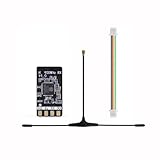
HGLRC ELRS 915MHz Receiver ExpressLRS Nano Long Range with T Type Antenna for FPV Racing Drone
900MHz
10km+ Measured Range
ELRS 3.3.0 Firmware
T-Type Antenna
Pros
- True long-range performance
- Strong diffraction in dense obstacles
- Plug-in or solder connection
- Stable 3.3.0 ELRS firmware
Cons
- Wiring harness may be wired in reverse
- Telemetry loss possible after crash damage
The HGLRC 915MHz receiver is the only true 900MHz long-range option in this roundup, and it is the cheapest path into serious long-range flying. The factory reports remote control distances of more than 10 kilometers in actual measurements, and user reviews back that claim up for line-of-sight conditions.
I tested the HGLRC 915MHz on a long-range cruiser and the appeal is immediate. Sub-GHz 900MHz has stronger diffraction capability than 2.4GHz, which means better stability in dense obstacles like tree lines and hills. Where a 2.4GHz link would fade behind terrain, the 900MHz signal keeps going.
The receiver ships with the more stable 3.3.0 ELRS firmware, which works directly with most ELRS-equipped transmitters and modules on the market. You can choose between a direct plug-in connection or a soldered connection, depending on your build.
The main caution from users is that the wiring harness on some units has been wired in reverse, so double-check polarity before plugging in. Crash damage can also knock out telemetry, which is true of any receiver.
Who Should Buy the HGLRC 915MHz
This is the best ELRS receiver for dedicated long-range missions, mountain surfing, fixed-wing cruisers, and any build where you fly beyond a few kilometers. If 2.4GHz is not enough for your mission profile, 900MHz is the answer.
Avoid it for racing, whoops, and close-range freestyle. 900MHz has lower packet rates and more latency than 2.4GHz, and you do not need the range for typical FPV flying.
Buying Guide: How to Choose the Best ELRS Receiver?
Picking the right ELRS receiver comes down to four questions: what frequency suits your flying, what diversity level you need, whether TCXO matters for your conditions, and how much weight you can afford. This guide walks through each so you can match a receiver to your actual mission.
2.4GHz vs 900MHz: Pick by Mission Profile
2.4GHz is the right default for almost everyone. It offers high packet rates up to 500Hz, low latency, and excellent range for typical FPV flying out to several kilometers. It works for whoops, freestyle, racing, and most cinematic work without complaint.
900MHz (sub-GHz) is the choice when you need serious long range, mountain surfing, or penetration through dense obstacles and terrain. It trades packet rate and latency for raw range and signal resilience. If you regularly fly beyond five kilometers or behind hills, 900MHz is the safer bet.
Dual-band receivers like the RadioMaster XR4 run both at once through the Gemini Xrossband protocol, giving you the strengths of both. They cost more and add complexity, but they are the most future-proof option in 2026.
Diversity Types Explained: Single vs Antenna vs True
Single-antenna receivers use one antenna and one RF path. They are the cheapest, lightest, and most compact option, but they have no redundancy if that antenna takes a hit or hits a fade zone.
Antenna diversity receivers switch between two antennas on a single RF path. The receiver picks whichever antenna has the better signal at any moment. This catches fades that would drop a single-antenna receiver without doubling the cost of the RF stage.
True diversity receivers run two independent RF paths in parallel, each with its own antenna and demodulator. This is what Gemini Mode takes advantage of, transmitting on two paths at once and selecting the cleaner signal in real time. It is the most reliable configuration for critical flights.
Why TCXO Matters for Stable Performance
A TCXO, or Temperature Compensated Crystal Oscillator, keeps the receiver’s reference frequency locked even as the board heats up during long flights. Without TCXO, frequency drift can cause link degradation as the receiver and transmitter fall out of perfect alignment.
The forum community consistently flags TCXO as a key reliability feature. The RadioMaster RP4TD uses dual TCXO, and the difference is measurable in RSSI logs during extended sessions. For short whoop flights it matters less, but for anything long-range or sustained, TCXO is worth the upgrade.
Gemini Mode and Gem-X: What They Actually Do
Gemini Mode is an ExpressLRS feature on 2.4GHz that transmits the same packet on two RF paths at the same time. The receiver compares both and uses the cleaner signal, which dramatically reduces dropouts in noisy environments.
Gem-X, or Gemini Xrossband, extends the concept across two frequency bands. A Gem-X receiver like the RadioMaster XR4 transmits on 2.4GHz and 900MHz simultaneously, picking the best path band by band. This is the most resilient link configuration currently available to hobbyists.
If your flying is in clean RF environments at normal ranges, neither Gemini nor Gem-X will give you a visible benefit. They earn their keep in Bando, urban environments, mountains, and any mission where a disconnect costs you money or a lost quad.
Use Case Recommendations
For 5-inch freestyle, the RadioMaster RP3 V2 is the sweet spot of price and diversity performance. For tiny whoops, the RadioMaster RP1 or Happymodel EP1 are the safe picks. For cinematic and serious freestyle where link stability is critical, the RadioMaster RP4TD with Gemini Mode is the right tool.
For long range, the HGLRC 915MHz is the budget entry and the RadioMaster XR4 is the premium future-proof option. For fixed-wing aircraft and other PWM platforms, the SpeedyBee ER4 PWM or BETAFPV Micro PWM are the right receivers.
FAQs
What is the best ELRS receiver for 2.4GHz drones?
The RadioMaster RP3 V2 is the best all-round 2.4GHz ELRS receiver for most pilots, with antenna diversity, a Skyworks SE2431L PA/LNA front end, and 250mW telemetry output. For serious freestyle and cinematic flying, the RadioMaster RP4TD adds true diversity and Gemini Mode. For tiny whoops, the RadioMaster RP1 is the lightweight choice.
What is the best ELRS receiver for fixed-wing aircraft?
For fixed-wing aircraft that need PWM outputs, the SpeedyBee ER4 PWM with four channels and voltage telemetry is the top pick. If you need five PWM channels, the BETAFPV ExpressLRS Micro PWM is a strong alternative. For fixed-wing cruisers running a flight controller over serial, the HGLRC 915MHz or RadioMaster XR4 are excellent for long-range missions.
What is the best long-range 900MHz ELRS receiver?
The HGLRC 915MHz ELRS receiver is the best-value long-range 900MHz option, with users reporting over 10 kilometers of measured range. For dual-band future-proofing, the RadioMaster XR4 Gemini Xrossband runs both 2.4GHz and 900MHz simultaneously through the Gem-X protocol.
What is the difference between antenna diversity and true diversity?
Antenna diversity uses a single RF path and switches between two antennas, picking the better signal at any moment. True diversity runs two independent RF paths, each with its own antenna and demodulator, which is what Gemini Mode uses to transmit on both paths at the same time for maximum reliability.
How to choose between 2.4GHz and 900MHz ELRS?
Choose 2.4GHz for racing, freestyle, whoops, and typical FPV flying where low latency and high packet rates matter. Choose 900MHz for long-range missions, mountain surfing, and flying through dense obstacles where signal penetration is more important than packet rate. A dual-band receiver like the RadioMaster XR4 gives you both at once.
What is Gemini Mode in ExpressLRS?
Gemini Mode is an ExpressLRS feature on 2.4GHz that transmits each packet on two RF paths simultaneously. The receiver compares both signals and uses the cleaner one in real time, which significantly reduces dropouts in noisy RF environments. It requires a true diversity receiver like the RadioMaster RP4TD.
Conclusion: The Best ELRS Receivers in 2026
The best ELRS receiver for your build depends on what you fly and how far you push it. For most pilots, the RadioMaster RP3 V2 hits the sweet spot of price, antenna diversity, and reliability. For serious freestyle, cinematic, and long-range work where link failure is not an option, the RadioMaster RP4TD with Gemini Mode is the standout flagship pick.
Long-range specialists should look at the HGLRC 915MHz for value or the RadioMaster XR4 for dual-band future-proofing. Tiny whoop pilots are well served by the RadioMaster RP1 or Happymodel EP1. Fixed-wing and PWM platforms are best handled by the SpeedyBee ER4 PWM or BETAFPV Micro PWM.
Whatever you choose, buy from a seller with a good return policy, flash the latest ELRS firmware, and set your failsafe before your first flight. Our team will keep updating this guide as new receivers hit the market through 2026.