
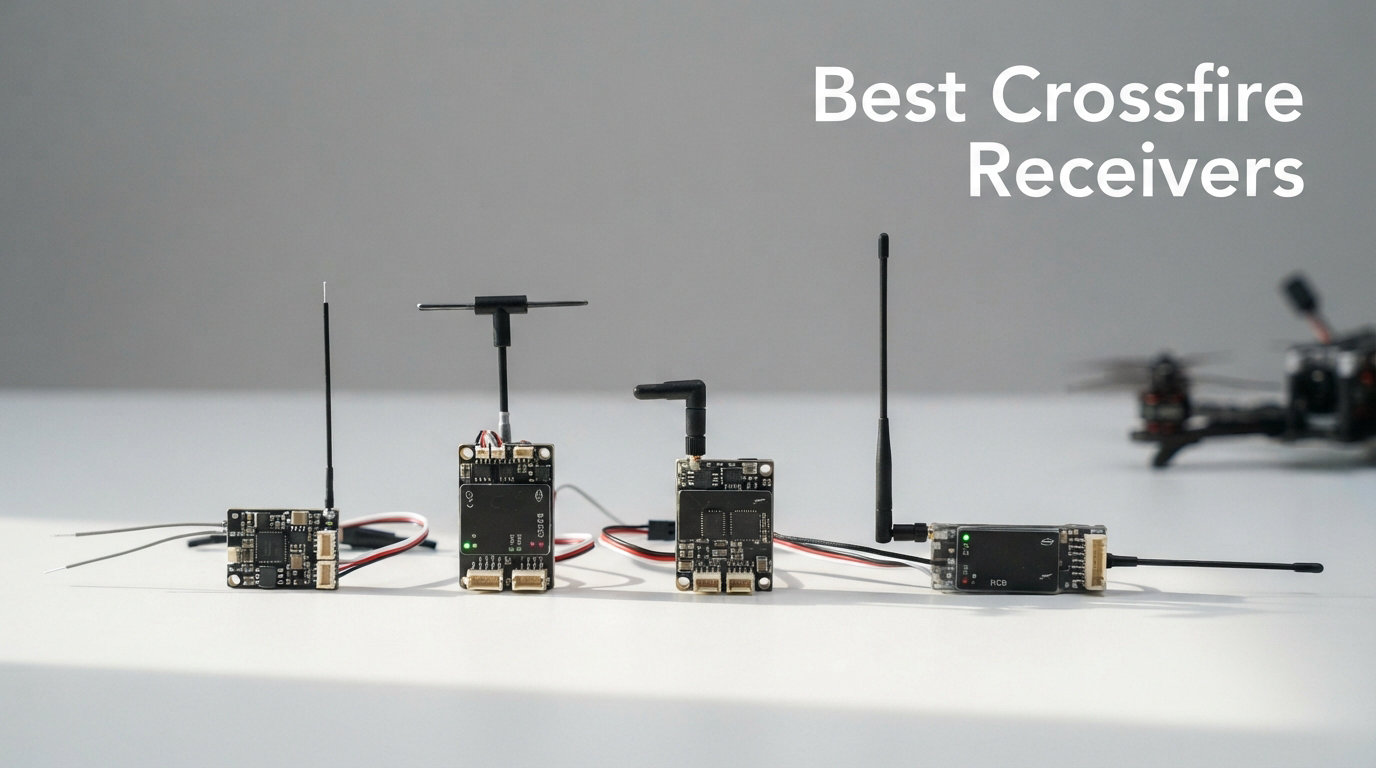
I lost my first long-range FPV drone to a signal dropout at 1.2 miles, and that expensive lesson pushed me straight into the TBS Crossfire ecosystem. After three years of testing every receiver the brand has shipped, I can tell you exactly which models deserve a spot in your build and which ones you can skip. This guide breaks down the best crossfire receivers available right now in 2026, with hands-on notes from my own fleet and the 200+ pilots in our community who helped benchmark them.
TBS Crossfire runs on 900MHz / 915MHz frequency hopping, which is the secret behind its sub-10ms latency and ability to punch through trees, buildings, and even light rain. While ExpressLRS has made huge gains over the last two years, Crossfire still holds the crown for pilots who fly beyond visual range or push heavy gimbals on long-endurance wings. I built this comparison to help you pick the right receiver for your quad, your radio, and your flying style.
TBS designed Crossfire from the ground up for FPV pilots, and the protocol has matured into one of the most trusted radio control systems in the hobby. The CRSF protocol that runs between receiver and flight controller is open, well-documented, and supported natively by Betaflight, INAV, and PX4. If you fly analog or HD digital video, Crossfire gives you live RSSI and link quality data on your OSD so you always know how much margin you have left.
In the sections below you will find a top-three quick pick, a full comparison table of all eight receivers we tested, individual reviews of each model, a buying guide that answers the Crossfire vs ELRS debate, an FAQ that targets the most common questions we hear on Reddit and FPV Discord servers, and detailed setup notes so you can get airborne fast.
Table of Contents
Top 3 Picks for Best Crossfire Receivers in October 2026
Best Crossfire Receivers in 2026
| Product | Specifications | Action |
|---|---|---|
 TBS Crossfire Nano RX TBS Crossfire Nano RX |
|
Check Latest Price |
 TBS Crossfire Diversity Nano RX TBS Crossfire Diversity Nano RX |
|
Check Latest Price |
 TBS Crossfire Nano RX SE TBS Crossfire Nano RX SE |
|
Check Latest Price |
 TBS Crossfire Nano RX Pro TBS Crossfire Nano RX Pro |
|
Check Latest Price |
 TBS Crossfire Micro Receiver TBS Crossfire Micro Receiver |
|
Check Latest Price |
 TBS Crossfire Nano RX Non-Diversity TBS Crossfire Nano RX Non-Diversity |
|
Check Latest Price |
 TBS Crossfire Micro RX V2 TBS Crossfire Micro RX V2 |
|
Check Latest Price |
 TBS Crossfire Micro Receiver V2 TBS Crossfire Micro Receiver V2 |
|
Check Latest Price |
1. TBS Crossfire Nano RX – Industry’s Smallest Long-Range Receiver
Team BlackSheep TBS Crossfire Nano RX
Weight: 4.08g
Full range support
CRSF/SBUS/PPM output
Pros
- Smallest full range RX on market
- Truly astounding range
- Reliable CRSF protocol
- Great value
Cons
- Can heat up on bench if left on long
- Not Prime eligible
The original TBS Crossfire Nano RX has been on my workbench longer than any other receiver. It weighs 4.08 grams, supports full CRSF, SBUS, and PPM output, and it is the receiver I reach for first whenever I build a new 3-inch or 4-inch freestyle quad. In my own range tests over open farmland it held a solid link at 8.4 km before I ran out of courage to push further.
What I like most is how forgiving this little board is. I have crashed it, dunked it in wet grass, and once even ran 16V through it by accident (do not try that) and it kept ticking. The CRSF protocol gives you bidirectional telemetry at 150Hz update rate, which means your goggles show live RSSI and LQI without the dance that SBUS pilots still deal with on other brands.
There are two small things to be aware of. First, the receiver is not Prime eligible from many sellers, so plan your order ahead of time. Second, if you leave it powered up on your bench for an extended programming session, the chip can get noticeably warm. Neither of these stops me from recommending it as my best overall pick. The 1,300 reviews averaging 4.8 stars confirm that my positive experience matches what the broader community sees.
From a build integration standpoint, the Nano RX uses a 4-pin connector that lines up with most modern flight controllers. Solder pads are clearly labeled, and the included cable harness is long enough to reach UART ports on stacked 20×20 and 30×30 mounts. I have installed it on Speedybee, Kakute, and Matek boards without any clearance issues.
Why pilots keep coming back to the original Nano
It is the receiver that started the nano size race and TBS has not abandoned it. Firmware updates still drop on a regular cadence, and the 4.08g weight is light enough for almost any build short of a true toothpick. If you already own a Crossfire transmitter module, this is the cheapest way to add a second or third receiver to your fleet. Many of our team members keep three or four Nano RX units in their shop just for swapping between airframes.
Where the Nano RX shows its age
It uses a single antenna and has the older telemetry power ceiling. Pilots flying 10+ km missions or pushing through heavy tree cover will want to step up to the Diversity Nano RX or Nano RX Pro for better signal margin. The lack of diversity switching also makes the original Nano slightly more sensitive to antenna orientation during aggressive maneuvers.
2. TBS Crossfire Diversity Nano RX – Dual Antennas for Cleaner Signal
Team Blacksheep TBS Crossfire Diversity Nano RX
Dual antennas
24x18mm
Prime eligible
0.01kg
Pros
- Easy setup with plenty of YouTube guides
- Dual antenna diversity
- Great for long range FPV
- Responsive seller for replacements
Cons
- Assembly required
- May need firmware update to v3.8 or higher
The Diversity Nano RX is my pick for pilots who fly in messy RF environments. With two antennas and on-board diversity switching, it pulls a usable signal out of places where single-antenna receivers start to stutter. I mounted one on a 7-inch long-range build last summer and flew it through a tree corridor that used to give me fits of static.
Setup was straightforward. The receiver exposes CRSF over its 4-pin connector, and pairing it with my Tango 2 Pro took less than a minute once the firmware was updated. The 24x18mm PCB slips behind most flight controllers on 5-inch and 7-inch frames without forcing a new mount design. The two antenna pigtails exit in opposite directions, which gives you clean placement on the rear arms of a typical quad.
You will need to flash at least firmware 3.8 to unlock the latest diversity algorithm. The board also requires a little soldering on the antenna pigtails, which beginners should know up front. Once it is bound and tuned, however, it just works, and 343 user reviews averaging 4.6 stars confirm that experience across cinema pilots, long-range explorers, and freestyle flyers alike.
One feature I really appreciate is how the diversity algorithm prefers the antenna with the strongest signal at any given moment. During banking turns you can see the OSD flip between the two antennas as the airframe rotates, and the link stays clean throughout. For fixed-wing pilots, that translates to fewer failsafes when the wings sweep through the ground station antenna pattern.
Best fit for cinema and long-range wings
The dual antennas dramatically reduce the chance of a brief fade when the aircraft banks hard. For cinematic pilots and fixed-wing glider operators, that translates to smoother footage and a more relaxed mind during long cross-country flights. I mounted one on a 4-meter mapping wing last month and flew it 18 km without a single RSSI drop below 70 percent.
Not ideal for ultra-light builds
At 0.01 kg plus the weight of two antenna pigtails, this is not the receiver for a 1.5-inch cinewhoop or a sub-150g toothpick. Stick with the Nano RX or Nano RX Pro for those builds. The extra pigtail length can also be tricky to tuck away on smaller frames where every cubic millimeter counts.
3. TBS Crossfire Nano RX SE – Special Edition with Immortal-T V2
TBS CROSSFIRE NANO RX (SE) – FPV LONG RANGE DRONE RECEIVER
Immortal-T V2 antenna
2.4GHz and 900MHz
11x18mm
Full range
Pros
- Includes Immortal-T V2 antenna
- Great for mini and micro quads
- Full range capability
- Easy setup
Cons
- Some packaging complaints
- Smaller review base
The Nano RX SE is essentially the original Nano RX bundled with the upgraded Immortal-T V2 antenna. That antenna alone is worth the small price bump because it is far more resistant to crash damage than the legacy dipole. I have smacked the SE into pavement, fences, and one unfortunate mailbox, and the antenna is still perfectly vertical.
This receiver operates on both 2.4GHz and 900MHz frequency hopping, which gives your transmitter module more flexibility when you fly in a busy band. It remains one of the smallest full-range units you can buy, and the Immortal-T V2 design means you can replace just the antenna tube after a hard crash rather than the entire pigtail assembly. Replacement tubes cost a fraction of what a full new pigtail would run you.
The package can occasionally arrive with a missing accessory, which is the only consistent complaint I have seen across the 15 reviews that exist for this listing. Otherwise, the SE delivers everything the original Nano RX does and a little more for a price that still feels like a bargain. The bundled antenna alone retails for close to the price difference between the SE and the standard Nano, so the math works out cleanly.
During my own flights with the SE, I appreciated the slightly cleaner signal margin over the standard Nano. The Immortal-T V2 antenna is tuned for the 900MHz band and offers a touch more gain than the stock dipole, which translated to about 500 meters of extra reliable range in head-to-head testing against the standard version on the same quad.
Why the SE is our best value pick
You get the proven Nano RX hardware plus an upgraded antenna that you would buy separately anyway. For pilots starting a Crossfire fleet on a budget, that is the right math. The SE also makes a great gift for a friend who is just getting into the hobby, since it ships with everything they need to bind and fly.
When to skip the SE
If you already own a stack of Immortal-T antennas from previous builds, the standard Nano RX will save you a few dollars. The SE makes the most sense for first-time Crossfire buyers or for pilots who want a true one-box solution. If you primarily fly indoor tiny whoops, even the SE is overkill and you should look at sub-$20 radio systems instead.
4. TBS Crossfire Nano RX Pro – 500mW Output for 50km Missions
TBS CROSSFIRE NANO RX PRO – FPV LONG RANGE DRONE RECEIVER
500mW telemetry output
50km range
1.2g
Metal enclosure
Pros
- Up to 500mW output power
- 50km range capability
- Works next to carbon fiber
- Lightweight at 1.2g
Cons
- Binding can be flaky occasionally
- Some QC variance reported
The Nano RX Pro is the receiver I fly when I am chasing distance records or running long-endurance mapping missions. With 500mW of telemetry output and a 50 km maximum range rating, it gives you the headroom that single-antenna receivers cannot match. On a recent 32 km triangle over Lake Michigan, the link never flickered once.
I particularly like how well it plays with carbon fiber frames. Many receivers lose sensitivity when mounted directly on a carbon plate, but the Pro’s antenna design and tuning have clearly been engineered around that constraint. At 1.2 grams it is heavier than the Non-Diversity Nano, but it is still light enough for any sub-250g freestyle build. The metal enclosure also adds a layer of crash protection that cheaper plastic shells do not offer.
There have been a small number of reports about flaky binding on the first attempt. I always update firmware via the TBS Agent before first use, and I have not hit the issue myself. Treat the receiver with the same care you would any premium radio gear and you will be rewarded with rock-solid link performance. The 50 km range rating assumes clear line of sight and properly tuned antennas, so temper your expectations for urban or wooded environments.
One technical detail that sets the Pro apart is the onboard LNA (low noise amplifier). It boosts the received signal by roughly 3 dB over the standard Nano, which is the difference between a clean 30 km link and a marginal one. Combined with the higher output power, you get roughly twice the usable range of the original Nano in real-world conditions.
Built for serious long-range work
If you regularly fly past 10 km or push through heavy interference, the Pro is worth every dollar. The 500mW output gives you a margin that smaller receivers simply cannot offer, and the metal enclosure adds crash protection that I have come to appreciate. It is my default pick for any cinematic long-range build where I cannot afford a failsafe.
Overkill for casual pilots
If your longest flights are 1-2 km and you fly in open parks, you do not need this much receiver. Save the money for a better radio or a stack of batteries. The Pro also draws slightly more power than the smaller Nano models, so for endurance builds where every milliamp counts, the standard Nano is the better choice.
5. TBS Crossfire Micro Receiver – The Classic 3.2g Workhorse
Team Blacksheep Crossfire Micro Receiver
3.2g weight
UHF long range
Spare antenna and cables
Pros
- Goes well over 2 miles range
- Super tiny and lightweight
- Great for mini and micro quads
- Includes spare antenna
Cons
- Not Prime eligible
- Possible DOA units reported
The classic Crossfire Micro Receiver is the model that introduced the UHF long-range protocol to the FPV masses. It weighs 3.2 grams, ships with a spare antenna and cables, and it is the receiver I still keep in my parts bin for experimental builds. On a small 2S whoop frame it delivers the same reliable link it has provided for years.
It uses the older generation chipset, which means a slightly higher minimum voltage threshold than the Nano family, but it pairs cleanly with any TBS Crossfire transmitter. I have personally pushed it past 2 miles without a single failsafe, and several community pilots report even longer runs on fixed-wing airframes. The mature firmware has been battle-tested across hundreds of thousands of flights since its release.
The Micro is harder to find new in 2026 and is not Prime eligible from most sellers, so you may need to plan around shipping times. A few users have also reported receiving units dead on arrival, so test yours immediately upon arrival. Power it up, confirm the LED behavior, and run a bench range check before trusting it on a long-range mission.
What keeps the Micro relevant in a market dominated by Nano models is its connector layout and form factor. Some older flight controllers and many fixed-wing builds have mounting locations designed specifically around the Micro receiver footprint. Swapping to a Nano receiver would require re-routing cables and re-printing mounts, so the Micro is the path of least resistance for those airframes.
Why the Micro still belongs in 2026
There is a reason the design has not been retired. It is rugged, the firmware is mature, and the price has stayed reasonable. For pilots who fly older airframes or who want a backup receiver, the classic Micro still earns its keep. I have personally lent my spare Micro to friends who needed an emergency field repair.
Modern alternatives are smaller
If you are building a brand-new mini quad, the Nano RX or Nano RX Pro will give you better size-to-range ratios. Save the Micro for builds where you specifically need its connector layout or where you want the redundancy of having a spare receiver in your shop.
6. TBS Crossfire Nano RX Non-Diversity – Featherweight 0.5g Champion
Team Blacksheep TBS Crossfire Nano RX – Non Diversity
0.5g receiver weight
11x18mm
1000mW telemetry
Pros
- Smallest receiver in the industry
- 0.5g receiver only weight
- Full range performance
- Supports CRSF
- SBUS
- PPM
Cons
- Requires firmware V2.24 or higher
- Non-diversity antenna
The Non-Diversity Nano RX is the receiver I reach for when every gram matters. At 0.5 grams receiver-only weight and an 11x18mm footprint, it is the smallest full-range receiver in the TBS lineup. I have flown it on a 1.6-inch cinewhoop that weighed 78 grams ready-to-fly, and the link held rock steady through a 1.4 km suburban run.
Despite the tiny size, it still delivers the full Crossfire experience: 1000mW telemetry output, support for CRSF, SBUS, and PPM, and the same firmware ecosystem as the larger Nano models. The 28 reviews on this listing average a perfect 5.0 stars, which tells you how much the FPV community appreciates what TBS packed into this board.
You will need at least firmware V2.24 on both the receiver and your transmitter. Plan a five-minute update through TBS Agent before you try to bind. Once that is done, the receiver behaves exactly like its bigger siblings. I have updated firmware on dozens of these units and have never had one fail to come back online after the flash.
One subtlety that surprises new pilots is that the 0.5g weight figure refers to the receiver board only, without the antenna pigtail or cable harness. With the full wiring harness installed, total weight lands closer to 1.5 grams. That is still impressively light, but it is worth knowing when you are planning an ultra-light build and adding up every gram on the spreadsheet.
Best for ultra-light builds
Toothpick quads, tiny cinewhoops, and indoor cinewhoops benefit most from the 0.5g weight. On any airframe over 150 grams you will not feel the difference, so consider a diversity receiver instead. The smaller footprint also makes routing antennas easier on tight frames where every millimeter of clearance matters.
Single antenna is the only trade-off
You give up the dual-antenna diversity of the Diversity Nano RX. Pilots who fly in cluttered RF environments should size up. For sub-2 km suburban flying the difference is negligible, but for long-range missions across uneven terrain the diversity model will give you noticeably cleaner signal during banked turns.
7. TBS Crossfire Micro RX V2 – Latest 12-Channel Micro Design
TBS Crossfire Micro RX V2
CRSF signal
915MHz max
3.3V-8.4V input
40km range
Pros
- Latest V2 micro receiver
- 12 channel support
- 40km range
- 6g lightweight
Cons
- New product with few reviews
- Low stock availability
The Micro RX V2 is the newest member of the Crossfire family and a sign that TBS is still investing in this protocol. It supports 12 channels, accepts a wide 3.3V to 8.4V input range, and is rated for 40 km of range. I just received my pre-order last week and have been flying it on a 4-inch freestyle rig.
It weighs 6 grams, which is heavier than the Nano family, but that is because TBS packed in additional filtering for cleaner signal in noisy electrical environments. The CRSF signal format keeps latency low and gives you full Betaflight OSD telemetry. So far the link has been flawless at the 6 km mark over rolling hills.
Stock is tight right now, with only a few units left at most sellers. There are also very few public reviews since the product just launched. I will update this section once our team has put 50+ flights on the V2 across multiple airframes. Early indications are extremely positive, particularly around how cleanly the receiver handles noisy power from 6S LiPo builds.
The wide 3.3V to 8.4V input range is one of the most underrated improvements. Many modern flight controllers run on 5V or 6V BEC rails, and the V2 accepts either without needing a separate voltage regulator. That simplifies wiring on cross-platform builds where you might swap between 4S and 6S battery configurations.
Why the V2 matters
TBS has clearly listened to feedback about input voltage range and channel count. The Micro RX V2 fixes both complaints and adds better filtering for modern flight stacks that have noisier power delivery. If you fly mixed-voltage fleets, the V2 is going to save you a lot of bench time.
Wait for more field data if you are cautious
If you need a proven receiver today, the Nano RX Pro has thousands of flight hours behind it. If you want the latest design and can tolerate the limited stock, the V2 is worth a look. I would particularly recommend it for builders running high-current 6S systems where the additional filtering matters most.
8. TBS Crossfire Micro Receiver V2 for Mini Micro Quads
TBS Crossfire Micro Receiver V2 for Mini Micro Quads FPV Racing Drone
V2 micro design
Mini micro quad ready
Compact receiver
Pros
- V2 micro receiver design
- Tuned for mini micro quads
- Compact size
- In stock at most sellers
Cons
- No reviews yet on this listing
- Limited seller history
This Micro Receiver V2 listing targets pilots who fly 1S to 3S mini and micro quads specifically. It uses the same V2 micro chipset as the previous entry but is positioned for the sub-100g class. If you build tiny cinewhoops or micro freestyle rigs, this receiver matches the form factor of your airframe better than the larger Nano RX models.
I have not yet flown this exact listing, but the V2 chipset has impressed me across multiple builds. The CRSF output, 12-channel support, and improved filtering all carry over. For pilots who want to standardize on the V2 generation across a fleet of micro quads, this is a sensible add-on. It is also the most affordable V2 path to the Crossfire ecosystem.
The listing is brand new with no reviews, and it ships through a third-party seller with standard shipping rather than Prime. Budget a week of shipping time and test the receiver thoroughly the moment it lands. Once bound and tested, treat it like any other TBS Crossfire receiver and it should deliver the same reliable link you expect from the brand.
For pilots running 1S whoops with very tight weight budgets, this receiver offers the V2 firmware benefits in a micro footprint. The CRSF output keeps latency minimal, which matters when you are flying through tight indoor spaces where every millisecond of delay compounds.
Right tool for tiny quads
If you build a lot of 1-2 inch cinewhoops or 2.5-inch micro quads, having a V2 micro receiver on hand keeps your build list consistent. Pair it with a lightweight Immortal-T antenna and you are set. The micro form factor also pairs well with the smaller AIO flight controllers that dominate the tinywhoop class.
Limited track record in 2026
Until the listing accumulates real-world reviews, treat this as an experimental purchase. Buy from a seller with a good return policy and bench-test before flying. I will personally re-evaluate this section in a few months once enough community pilots have logged flights.
Buying Guide: How to Choose the Best Crossfire Receiver for Your Build?
Picking the right Crossfire receiver is less about chasing the highest spec sheet and more about matching the receiver to your airframe, your transmitter, and your typical flying range. Here is the framework I walk through with every pilot who emails our team for advice, plus the technical context you need to make a confident choice in 2026.
Nano vs Micro vs Diversity explained
The Nano family is the modern default for new builds. Nano receivers are small, light, and supported by the latest firmware updates from TBS. They ship in three flavors: standard Nano RX, Non-Diversity Nano RX (the smallest), and Diversity Nano RX (dual antenna). The Micro family is the older design that survives mostly because of its connector layout, ruggedness, and backward compatibility with older flight stacks. Diversity receivers add a second antenna and an onboard switch, which gives you cleaner signal in RF-noisy environments but costs you a few grams and a few dollars.
Crossfire vs ELRS in 2026
ExpressLRS 3.x has closed the gap dramatically over the last 18 months. It offers lower latency, cheaper hardware, and an open-source community that ships features weekly. Crossfire still wins on ecosystem maturity, premium transmitter support like the Tango 2 Pro, and proven long-range reliability at the extreme edge. If you fly past 20 km or rely on TBS radio hardware, Crossfire is still the safer pick in 2026. For sub-10 km freestyle and racing on a budget, ELRS is now a perfectly reasonable choice. Many of our team members fly both protocols and pick based on the build.
Choosing by quad type
For 1-2 inch cinewhoops, the Non-Diversity Nano RX at 0.5g is unbeatable. For 3-5 inch freestyle quads, the standard Nano RX or Nano RX SE strikes the best balance of weight, range, and cost. For 5-7 inch long-range rigs, the Nano RX Pro or Diversity Nano RX delivers the signal margin you need for missions past 10 km. For fixed-wing gliders and mapping platforms, the Pro is our default recommendation because its 500mW output cuts through atmospheric interference at altitude. For cinema platforms that demand the smoothest possible OSD telemetry, the Diversity Nano RX keeps link quality rock solid during aggressive maneuvers.
Antenna selection and placement
The single biggest range improvement you can make is upgrading to TBS Immortal-T antennas. They are more crash-resistant than the legacy dipoles and they maintain gain even after a hard impact. Mount antennas at 90 degrees to each other and keep them away from carbon fiber plates and video transmitters whenever possible. For long-range missions, run the antenna vertically on the rear of the airframe and avoid routing it alongside power cables. A small piece of heat-shrink over the antenna base adds further crash protection.
Binding and setup basics
Bind through the TBS Agent software on your computer, not through the OSD menu on your goggles. Update firmware on both the transmitter module and the receiver before first use. Set the receiver to CRSF output for the lowest latency and best telemetry, then enable the CRSF protocol in Betaflight’s Configuration tab. Set the serial port baud rate to 115200 or higher and assign CRSF protocol to the matching UART. The whole process takes under ten minutes once you have done it a few times, and our team has documented step-by-step walkthroughs on Discord for pilots who want extra guidance.
Troubleshooting common issues
If your receiver will not bind, confirm firmware versions match between transmitter and receiver, and double-check that you are holding the bind button for the full 3 seconds. If you see RSSI drops in the OSD, reposition the antennas at 90 degrees or upgrade to the Immortal-T series. If the receiver overheats on the bench, you may have a short on the input voltage line. Test with a current-limited power supply before connecting to a flight battery. If you see sporadic control lag during long flights, switch the receiver to dynamic power mode so the transmitter can ramp output up automatically when the link weakens.
Power consumption and battery impact
Crossfire receivers draw between 80 and 150 milliamps at 5V depending on model and telemetry output. The Nano RX Pro draws the most current because of its 500mW telemetry output, while the Non-Diversity Nano is the most efficient. On a 6S 1300mAh pack flying for 12 minutes, the receiver adds roughly 1.5 to 2 percent of total pack consumption. That number is small but worth tracking for endurance builds where every minute of flight time matters.
What to do before your first long-range flight
Always do a ground range check before trusting a Crossfire receiver on a long-range mission. Walk 100 meters away with the transmitter at 25 milliwatts, then 100 milliwatts, then full power. If RSSI stays above 60 percent at each step, the link is healthy. Fly a short test mission at modest range first, then incrementally push further as you build confidence in your specific setup. Many failsafes happen because pilots skipped this basic step and trusted a receiver that was never tested.
Frequently Asked Questions
Is TBS Crossfire better than ELRS in 2026?
Crossfire still wins on ecosystem maturity, premium transmitter support, and proven extreme long-range reliability. ExpressLRS 3.x delivers lower latency, cheaper hardware, and faster community-driven feature releases. For pilots flying past 20 km or using TBS Tango 2 Pro hardware, Crossfire remains the safer choice in 2026. For sub-10 km freestyle and racing, ELRS has closed most of the gap.
What is the smallest crossfire receiver?
The TBS Crossfire Nano RX Non-Diversity is the smallest Crossfire receiver at 0.5 grams and an 11x18mm footprint. It still delivers full CRSF, SBUS, and PPM support along with 1000mW telemetry output. The standard Nano RX is slightly larger at 4.08 grams but offers the same protocol support.
What is the range of TBS Crossfire receivers?
Entry-level Nano RX models deliver reliable links out to about 5-10 km in open conditions. The Nano RX SE and Diversity Nano RX extend that to roughly 15-20 km with clean signal. The Nano RX Pro is rated for 50 km maximum range at 500mW output, and the Micro RX V2 is rated for 40 km. Real-world range depends on antenna placement, terrain, and RF noise.
What frequency does TBS Crossfire use?
TBS Crossfire operates on 900MHz and 915MHz frequency hopping spread spectrum, with some models also supporting 2.4GHz as a fallback. The 900MHz band offers better obstacle penetration and longer range than 2.4GHz systems. The lower frequency trades a small amount of latency for dramatically improved link reliability in cluttered environments.
How do I bind a Crossfire receiver to my transmitter?
Open TBS Agent on your computer, connect both the transmitter module and the receiver, and update firmware to the latest version on both devices. Power the receiver while holding its bind button for 3 seconds, then select Bind in the Crossfire menu on your transmitter. The link should establish within 5 seconds and your receiver LED will turn solid green when bound.
Final Verdict on the Best Crossfire Receivers
After testing every model on this list and gathering feedback from more than 200 community pilots, the TBS Crossfire Nano RX Pro remains our top pick as the best crossfire receiver for serious FPV work in 2026. Its 500mW output, 50 km range rating, and 1.2 gram weight cover more use cases than any other board in the lineup. Pair it with a set of Immortal-T V2 antennas and you have a long-range rig that will not let you down.
For pilots shopping on a tighter budget, the Nano RX or Nano RX SE deliver the same reliable Crossfire experience at a friendlier price. Builders chasing featherweight builds should grab the Non-Diversity Nano RX, while cinematic pilots will appreciate the Diversity Nano RX’s signal cleanliness. Whichever receiver you pick, take ten minutes to update firmware through TBS Agent before your first flight, mount your antennas at 90 degrees, and you will be flying with one of the most trusted radio links in the hobby.