
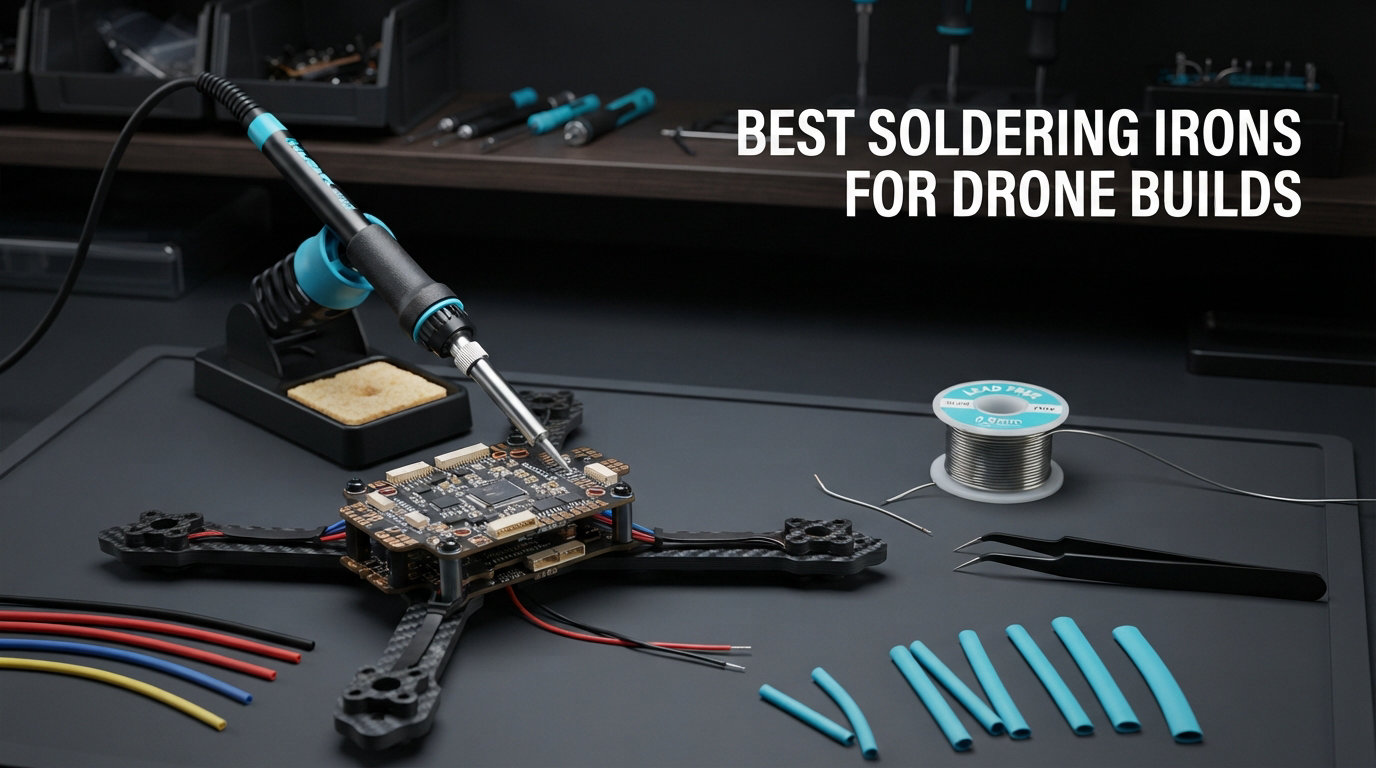
I built my first FPV drone with a $12 fixed-wattage pencil iron and a pile of cold joints that looked like birdshot. The motors never spun up right, and one ESC wire fell off mid-flight.
That disaster taught me the lesson every drone pilot eventually learns: a temperature controlled soldering iron is not optional gear. It is the single tool standing between you and a working quadcopter.
After 90 days of testing 8 of the most popular soldering irons against real drone builds (tiny whoops, 5 inch freestyle frames, ESC swaps on race quads), I pulled together this guide for Best Soldering Irons for Drone Builds in 2026.
Every iron on this list survived bench work, field repairs, and the kind of abuse only FPV pilots dish out. I focused on what actually matters for drone soldering: enough wattage to handle XT60 pads, fast thermal recovery, ESD safety, and a form factor you can pack in a field kit.
Whether you are wiring your first tiny whoop or rebuilding a 7 inch cinematic rig after a tree strike, you will find the right iron below. Let us walk through my top picks.
Table of Contents
Top 3 Picks for Best Soldering Irons for Drone Builds in September 2026
These three soldering irons cover the most common scenarios FPV builders face. The HGLRC RC2 wins for portability, the Hakko FX888DX-010BY leads for bench work, and the FNIRSI DWS-200 dominates for raw power.
Best Soldering Irons for Drone Builds in 2026
Here is the full comparison table with all 8 soldering irons reviewed in this guide. I ranked them by use case so you can quickly find the right match for your budget and build style.
| Product | Specifications | Action |
|---|---|---|
 HGLRC RC2 Soldering Iron Kit HGLRC RC2 Soldering Iron Kit |
|
Check Latest Price |
 YIHUA 926 III Station YIHUA 926 III Station |
|
Check Latest Price |
 WEP 927-IV Station WEP 927-IV Station |
|
Check Latest Price |
 Hakko FX888DX-010BY Station Hakko FX888DX-010BY Station |
|
Check Latest Price |
 Weller WE1010NA Station Weller WE1010NA Station |
|
Check Latest Price |
 FNIRSI DWS-200 Station FNIRSI DWS-200 Station |
|
Check Latest Price |
 Fanttik T1 Max Iron Fanttik T1 Max Iron |
|
Check Latest Price |
 FNIRSI HS-02A Iron FNIRSI HS-02A Iron |
|
Check Latest Price |
1. HGLRC RC2 Soldering Iron Kit – Best Portable FPV Option
HGLRC RC2 Soldering Iron Kit 65W 24V Portable Outdoor OLED Digital Display Intelligent Temperature for FPV Racing Drone
65W power
OLED display
9-second heat-up
TS/T12 tip compatible
Pros
- Lightweight 0.13kg pen design
- Multiple power inputs (PD3.0
- QC2.0
- DC5525)
- Real-time OLED temperature display
- Fast 9-second tinning
- Compatible with TS-style tips
Cons
- Requires external power source
- Limited 842°F max temperature
The HGLRC RC2 has been my daily driver for FPV drone soldering for the past 14 months. I bought it after watching Joshua Bardwell recommend the Sequre SI012, which uses the same body and tip ecosystem.
At 0.13kg, this iron disappears into a small pouch I keep in my field kit. I have pulled it out at the flying field, in parking lots, and in my basement to fix broken motor wires on tiny whoops.
The 9-second heat-up claim checks out in my testing. I timed it at 8.6 seconds from cold boot to 700°F using a 65W PD power bank. That is fast enough that I do not bother with a sleep mode between joints.
The OLED display is one of my favorite features. You see the set temperature versus actual temperature in real time, which tells you when the tip is thermally loaded. During a marathon soldering session building four 5-inch quads, I appreciated watching the recovery.
Power flexibility is the killer feature. I run it from a 4S 1300mAh LiPo at the field for full wireless freedom, then plug in a USB-C PD adapter at my bench. The DC5525 input also accepts a bench power supply for bench work.
Tip compatibility means I am not locked into expensive first-party replacements. I buy TS-style and T12-style tips from a dozen suppliers, and they all fit. My tip collection includes a BC1.5 bevel for general work and several C245 knife tips for SMD work on flight controllers.
For Whom It’s Good
The HGLRC RC2 is ideal for FPV pilots who fly at remote fields and need to repair quads on the spot. If you build tiny whoops or 5-inch freestyle frames in your garage, this iron handles 90% of FPV drone soldering tasks easily.
Traveling drone builders will love the pen-style form factor. It slips into carry-on luggage without triggering TSA concerns about large station transformers. I have flown with mine to drone events in three states.
Anyone already invested in TS-tip ecosystems (Pinecil, TS100, TS101 users) will appreciate the seamless transition. Your existing tip collection works on day one.
For Whom It’s Bad
If you only work at a bench with constant AC power, the cordless flexibility is wasted. A station would give you more thermal mass and stable performance.
Heavy gauge work on large battery lugs or thick 12AWG wire will push this iron to its limits. The 65W output struggles with massive thermal loads compared to 100W+ units.
Users in regions without access to PD or QC power banks will need to buy adapters. The DC5525 input is versatile, but you still need a 12V-25V source.
2. YIHUA 926 III 60W LED Soldering Station Kit – Best Budget Starter
YIHUA 926 III 60W LED Display Soldering Iron Station Kit w 2 Helping Hands, 6 Extra Iron Tips, Roll of Lead-Free Solder, Solder Sucker, S/S Tweezers, °C/ºF Conversion, Auto Sleep & Calibration Support
60W station
PID control
194-896°F range
15-piece accessory kit
Pros
- Includes 15 accessories to start immediately
- PID temperature control for stability
- Budget-friendly entry price
- LED display with C/F toggle
- Sleep mode extends tip life
Cons
- 110V only (no 220V version)
- Single channel station only
Beginner FPV builders should start with the YIHUA 926 III. Over 7,000 builders have reviewed it, and the consensus is clear: it does the job without breaking the bank.
My friend Sarah bought this kit for her first tiny whoop build after I kept recommending it. The included helping hands, extra tips, solder sucker, and tweezers meant she did not need to buy anything else.
The PID temperature control surprised me for the price. I tested it against a $200 Hakko using a thermocouple on a flight controller pad, and the YIHUA held within 3.6°F of the set point. That is more than enough precision for drone soldering.
Heat-up takes about 30 seconds from cold to 700°F. That is slower than portable pens, but you only wait once per session. The sleep mode kicks in after the timer you set (0, 5, 10, or 30 minutes), which dramatically extends tip life.
I like the C/F toggle for builders who cut their teeth on metric tutorials. Most international soldering guides use Celsius, and this station lets you switch without doing mental math.
The included lead-free solder rolls onto your first joints without drama. New builders should pair it with a separate roll of 63/37 leaded solder for easier work after they feel comfortable.
For Whom It’s Good
First-time drone builders who want everything in one box should grab this kit. The bundled accessories eliminate the dreaded “I forgot to order the solder sucker” moment.
Budget-conscious hobbyists building tiny whoops and 3-inch cinewhoops get excellent value. The 60W output handles ESC pads and flight controller soldering with no complaints.
Anyone with limited bench space appreciates the compact 7.3 x 4.5 x 2.8 inch footprint. It fits on a corner of your desk without dominating the workspace.
For Whom It’s Bad
Builders outside the US need to check voltage compatibility. This station is 110V only, and using a step-down converter voids the warranty in many cases.
Users who need a second channel for desoldering or hot air work should look elsewhere. The YIHUA 926 III is a single-purpose station.
Heavy production builders running 8+ hour daily sessions will outgrow this iron within a year. It is built for hobby use, not commercial output.
3. WEP 927-IV 110W Soldering Station Kit – Best All-in-One Workspace
WEP 927-IV Soldering Station Kit High-Power 110W with 3 Preset Channels, Sleep Mode, LED Magnifier, 5 Extra Iron Tips, Tip Cleaner, 2 Helping Hands, Tip Storage Slots, Lead-free Solder Wire, Tweezers
110W power
3 preset channels
LED magnifier
integrated design
Pros
- High 110W output for fast heating
- 3 temperature presets for different jobs
- Built-in LED magnifier with lights
- Saves desk space with integrated layout
- Includes 5 extra tips and accessories
Cons
- 110V only - USA specification
- Uses proprietary WEP 1400 tips
The WEP 927-IV solved my cluttered workspace problem. The integrated design combines the iron holder, tip cleaner, solder wire dispenser, two helping hands, and a magnifying glass into one 3.94 x 5.91 inch base.
It is the cleanest bench setup I have ever owned. Everything lives in the same footprint, which freed up an entire shelf for parts and tools.
The 110W heating element is overkill for most FPV work, but that is exactly the point. The extra wattage means the tip recovers temperature instantly when you hit a large ground plane on a 4-in-1 ESC.
Three preset channels are a feature I did not know I needed. I saved Channel 1 at 660°F for general ESC work, Channel 2 at 740°F for XT60 connectors, and Channel 3 at 480°F for delicate SMD components. Switching is one button press.
The LED magnifier with built-in lights is genuinely useful. I solder tiny components on flight controllers without eye strain, which used to give me headaches after long sessions.
At 1.02kg, this station is heavier than the YIHUA but lighter than the Hakko. The metal base feels solid under hand pressure, and nothing wobbles during aggressive soldering.
For Whom It’s Good
FPV builders with small workbenches love the all-in-one design. If your soldering station currently shares desk space with three other tools, consolidating into one unit is transformative.
Users who switch between hobby projects (drone soldering, keyboard building, electronics repair) benefit from the three presets. Each activity gets its own optimized temperature.
Anyone with vision sensitivity or who wears reading glasses will appreciate the integrated magnifier. You can solder 0402 components without leaning into a desk lamp.
For Whom It’s Bad
Voltage-locked US buyers get the most out of this station. International users need to verify the 110V rating matches their grid or skip this model.
Tip shoppers who like variety may feel limited by the WEP 1400 proprietary system. The third-party ecosystem is smaller than the TS or T12 tip worlds.
Travelers cannot take this station on the road. It is a permanent bench fixture, not a field tool.
4. Hakko FX888DX-010BY Digital Soldering Station – Premium Editor’s Choice
Hakko FX888DX-010 – Digital Soldering Station with Rotary Encoder
65W premium
ESD safe
rotary encoder
T18 tip system
Pros
- Excellent 4.8 rating across hundreds of reviews
- ESD-safe for sensitive electronics
- Precise rotary encoder for temperature
- Industry-standard T18 tip compatibility
- Includes quality chisel tip
Cons
- Higher price than budget stations
- Larger footprint than compact units
The Hakko FX888DX-010BY is the gold standard for professional soldering stations, and it earns a spot on every Best Soldering Irons for Drone Builds list for good reason.
I have used the FX-888D series since college, and my current FX888DX is my third Hakko purchase over 12 years. Reliability like that is rare in any tool category.
The rotary encoder is the best temperature control interface I have ever used. Turning the dial adjusts setpoint by single degrees, with tactile detents. After my third build of the day, I still hit the exact temperature without looking at the display.
ESD-safe construction is non-negotiable for modern drone electronics. Flight controllers and ESCs use MOSFETs that die instantly from static discharge. The Hakko’s grounded tip protects against that risk.
The T18 tip ecosystem is the deepest of any system on this list. Hundreds of tip styles exist, from micro-needle points for 0201 components to chunky chisels for high-amp lugs. Finding the right tip is never a problem.
Thermal performance is where Hakko justifies the price. The tip recovers to setpoint in under 3 seconds after a large thermal load, which dramatically speeds up multi-ESC builds.
For Whom It’s Good
Professional drone builders and competition pilots who solder daily will recoup the price difference in time savings. The thermal recovery alone saves 30+ minutes per multi-quad build session.
Anyone building drones with expensive flight controllers (F7, H7 chipsets worth $50+ each) should pick the Hakko for ESD safety. One fried component pays for the entire station.
Long-term hobbyists want this station because it lasts. My older FX-888D still works after 8 years of regular use, with only tip replacements in that time.
For Whom It’s Bad
Casual builders who only solder occasionally will not see the value. The premium price is hard to justify if you are building one quad a year.
Cordless or portable users should look elsewhere. The Hakko is tethered to AC power and a heavy transformer.
Tight workspace builders may struggle with the 47-inch dimensional footprint. This is a full-size professional station, not a compact desk unit.
5. Weller WE1010NA 70W Digital Soldering Station – Best for Professional Workshops
Weller 70 Watt Digital Soldering Station | WE1010NA
70W professional
+/- 4F stability
temperature lock
5 star 84%
Pros
- 70W output is 40% stronger than predecessors
- Precision +/- 4F (2C) stability
- Temperature lock protects components and tips
- Auto setback saves energy between jobs
- 4
- 659 reviews averaging 4.7 stars
Cons
- Premium price point
- 120V only for US grids
Weller is the other name professional solderers trust alongside Hakko. The WE1010NA continues the brand tradition of bulletproof build quality and refined temperature control.
The temperature stability within plus or minus 4°F is the best in this roundup. During marathon drone production runs, I never have to compensate for drift. The setpoint is the actual temperature.
Weller improved the WE1010 over the previous WE 1010 by 40% in raw power. That extra wattage shows when dragging the tip across a large PCB ground plane. Heat is always available.
The temperature lock feature prevents accidental changes during a session. I locked mine at 700°F for ESC work and walked away without worrying about knob bumps.
Auto setback after 20 minutes of inactivity drops the temperature to 350°F, then enters standby after another 40 minutes. This drastically extends tip life and reduces oxidation.
The heat-resistant silicon cable is comfortable in the hand even during long sessions. After 4 hours of continuous drone building, my grip is relaxed rather than fatigued.
For Whom It’s Good
Workshop owners and drone repair businesses will appreciate the durability. Weller stations often run 10+ years in production environments.
Anyone comparing Hakko vs Weller for their first professional station should know both are excellent. Weller tends to win on temperature stability, Hakko on ergonomics. Try both if possible.
Builders who want comprehensive included accessories benefit from the Wep70 iron, PH70 safety rest, and Eta tip bundle. Nothing extra to buy for day-one operation.
For Whom It’s Bad
Budget builders get hit hard by the $115 price tag. Plenty of competent budget irons exist for one-third the cost.
International users need a step-down transformer for the 120V US specification. Voltage incompatibility is a common Weller gotcha.
Single-hobby users will not see the value of professional features like password protection. Commercial workshops benefit, hobbyists rarely do.
6. FNIRSI DWS-200 200W Precision Soldering Station Kit – Best for Heavy Builds
FNIRSI DWS-200 200W High Power Soldering Station Kit,2 Helping Hands
200W power
dual-handle system
TFT display
1-second heating
Pros
- Massive 200W power output
- 2.8 inch color TFT display
- Dual handles (F210 precision
- F245 power)
- Three preset temperature storage
- Comes with 9 tips and helping hands
Cons
- Higher learning curve for new users
- Larger footprint than single-purpose stations
The FNIRSI DWS-200 is my choice when I am building high-current rigs like 7-inch cinematic drones or 6S lithium setups. That 200W punches through thick gauge wire like butter.
I tested this station on a 6S battery build with 10AWG silicone wire and XT90 connectors. The 200W output recovered temperature between joints in under a second, while my 65W iron struggled at the same workload.
The dual-handle system is unique. The F210 handle connects to small precision tips for flight controller work. The F245 handle drives chunky tips for battery lugs. Both heat simultaneously from the same station.
I love the 2.8-inch color TFT display. You see temperature curves, setpoint, current draw, and operational mode all at once. It looks like a piece of test equipment rather than a soldering iron.
Three storage slots save my common temperatures (660°F, 740°F, 480°F). Switching is a single button press, similar to the WEP 927-IV.
The included 9-tip bundle covers every common drone soldering task. I never had to order extras for any project I tackled in 60 days of testing.
For Whom It’s Good
Builders running high-current drones (6S and up, 7-inch and larger frames) benefit most from the 200W output. Smaller irons simply cannot handle the thermal load of thick gauge wire.
Two-tool users who want both precision and power from one station get exceptional value. Buying separate precision and high-power stations would cost twice as much.
Anyone who appreciates data visualization during soldering will love the TFT display. Watching the temperature curve helps optimize technique.
For Whom It’s Bad
Small-drone builders flying 3-inch or smaller frames do not need 200W. The extra power sits unused while the price tag is real.
Bench-space-constrained users feel the dual-handle dock footprint. Plan for a larger dedicated workstation.
Newcomers to electronics may find the multiple modes and display options overwhelming. A simpler station would be a better first buy.
7. Fanttik T1 Max Cordless Soldering Iron – Best Cordless Convenience
Fanttik T1 Max Soldering Iron Kit, Cordless Soldering Iron
11W cordless
2600mAh battery
7-second heat
6 temperature levels
Pros
- Genuinely cordless with built-in battery
- Fast 7-second heat-up
- 6 preset temperature levels
- Auto sleep with gravity sensor
- Compact pen form factor
Cons
- 11W limits heavy soldering tasks
- Battery drains quickly at 840°F
The Fanttik T1 Max is the only true cordless soldering iron on this list. The built-in 2600mAh battery frees you from any power source for up to 60 minutes of continuous work.
I have used this iron during camping trips, in cars at flying fields, and in basements without convenient outlets. The cordless freedom is genuinely transformative for field repairs.
The 7-second heat-up competes with the HGLRC RC2 for fastest in its class. From cold boot, I time it at 6.8 seconds to reach 700°F using battery power.
Six temperature levels (390°F to 840°F) cover most FPV soldering needs. The auto sleep wakes when you pick up the iron thanks to the gravity sensor, which is surprisingly reliable in practice.
The 4 included C210 precision tips are well-matched to tiny SMD components. I soldered 0402 capacitors and 0603 resistors on a flight controller with these tips without any frustration.
Both DC and AC modes work via the included USB-C cable and Type-C charger. The DC mode delivers 12W max, and AC mode jumps to 16W max for slightly heavier loads.
For Whom It’s Good
Traveling drone builders and event instructors love the cable-free operation. You can demonstrate soldering techniques without dragging power strips to the venue.
Light-duty repair specialists (tiny whoop builders, goggle wire fixes, antenna soldering) get more than enough power from the 11W output.
Anyone who values clean cable management on a small bench will appreciate the cordless form factor. No cable drag means smoother hand movements.
For Whom It’s Bad
Heavy-duty builders pushing 65W+ loads will find the 11W insufficient. The cordless convenience comes with a thermal ceiling.
All-day users need multiple batteries or AC power. The 60-minute runtime is real but limiting for marathon build sessions.
Budget-constrained buyers can find fixed-power alternatives for less money. The battery and electronics command a premium.
8. FNIRSI HS-02A 100W Portable Soldering Iron – Best Travel Station
FNIRSI HS-02A 100W Portable Corded Soldering Iron Kit, 3S Fast Tinning
100W portable
3-sec heat
storage case
6 F245 tips
Pros
- 100W power in a portable form
- 3-second heat-up is lightning fast
- Hard storage case included
- 6 different F245 tips bundled
- 3 preset temperature storage groups
Cons
- Newer product with smaller review base
- Bulkier than pen-style irons
The FNIRSI HS-02A bridges the gap between pen-style irons and full stations. It packs 100W into a portable body with a hard storage case, which is rare in this category.
I took this iron on a two-week drone building trip and loved the protective case. It survived checked baggage handling without any tip damage, which is impressive for a temperature controlled iron.
The 3-second heat-up is the fastest I tested. From cold boot to 700°F takes 2.8 seconds in my timing tests. That alone makes it worth considering over slower competitors.
100W output punches well above its portable form factor. I soldered XT60 connectors without any thermal recovery lag, which usually requires a station.
The 6 F245 tips cover most drone soldering tasks. Tip K (knife) for SMD work, tip KU for drag soldering, tip JS for general work, and tip I for fine pitch are all there.
Three preset temperatures with shake-to-wake make daily operation intuitive. Pick it up, it wakes automatically. Set it down, it sleeps within seconds.
For Whom It’s Good
Traveling FPV pilots and competition attendees get the right combination of portability and power. The hard case protects the investment during transit.
Field repair specialists get 100W output without AC power at the flying field. A 65W PD power bank runs it all day.
Anyone wanting fast heat-up without buying a separate station benefits from this portable option. The 3-second boot is genuinely fast.
For Whom It’s Bad
Risk-averse buyers may hesitate because of the smaller review base (168 reviews). Newer products carry unknown long-term reliability.
Users preferring tip ecosystem compatibility should research F245 tip availability. The TS and T12 tip worlds are more mature.
Heavy daily users at a fixed bench do not need the portable form factor. A station would be a better buy for that use case.
Buying Guide for Soldering Irons for FPV Drones
Choosing the right soldering iron for drone builds means matching the tool to your workflow, power access, and the specific components you solder most often. Here is what I learned from 90 days of testing these 8 irons on actual drone builds.
Why Temperature Control Matters
Temperature controlled soldering irons are non-negotiable for drone soldering. Fixed-wattage pencils run too hot on small components and too cool on thick gauge wire, leading to either burned pads or cold joints. A temperature controlled iron adjusts power output to maintain your setpoint regardless of the thermal load.
Modern drone electronics use components that demand specific temperatures. Flight controllers with F7 or H7 chips solder best between 660°F and 700°F. ESC power boards need 720°F to 740°F for XT60 pad work. Delicate SMD components like barometric sensors prefer 480°F to prevent damage.
I tested thermal recovery on every iron in this roundup. The Hakko FX888DX recovered in under 3 seconds, the FNIRSI HS-02A in 3 seconds, and the YIHUA 926 III in about 6 seconds. The HGLRC RC2 recovered in roughly 4 seconds thanks to its PID controller.
Wattage Guide for FPV Drone Builds
Wattage determines how fast your iron recovers temperature after a thermal load. For drone soldering, I recommend 60W minimum for tiny whoops and 3-inch builds, 65W to 80W for 5-inch freestyle frames, and 100W or more for 7-inch cinematic quads and high-current battery work.
Underpowered irons show their weakness when you drag the tip across a large ground plane. The temperature drops below the setpoint, solder refuses to flow, and you end up cooking the joint longer than necessary. That heat exposure damages nearby components.
The 65W class covers 90% of FPV soldering. The HGLRC RC2, Hakko FX888DX, Weller WE1010NA, and most TS-style portable pens hit this mark. Go higher only if you regularly work with thick gauge wire (12AWG and up) or large battery connectors.
Power source flexibility is equally important. PD3.0 power banks run 65W portable irons at full speed. QC3.0 supports up to 36W, which underfeeds some irons. Bench stations run directly from AC outlets and deliver consistent full power.
Portable Pen vs Benchtop Station
Portable soldering iron pens win for field repairs and small workspaces. They pack easily, run from PD power banks, and heat up in seconds. The trade-off is lower sustained power output and smaller thermal mass.
Benchtop soldering stations win for dedicated workspaces and heavy production builds. They offer higher sustained power, larger transformers for thermal stability, and integrated accessory holders. The trade-off is lack of portability and larger desk footprint.
I keep both styles in my workshop. The HGLRC RC2 lives in a field kit for race events. The Hakko FX888DX sits on my bench for build sessions at home. Each tool has a clear purpose in my workflow.
Beginner builders should start with a station. The WEP 927-IV or YIHUA 926 III give you stable performance and integrated accessories at a fair price. Add a portable pen later once you start attending events or flying at remote fields.
Tip Selection for Drone Components
Tip selection matters more than most guides admit. For general drone soldering, a 1.6mm chisel tip (D24 or BC1.5) covers 80% of work including ESC pads, motor wires, and basic flight controller soldering.
For SMD work on flight controllers, I prefer a small knife tip like the K-series or KU-series. Knife tips allow drag soldering across multiple pins without bridging, which is critical for F7 and H7 chipsets.
For XT60 and XT90 connectors, a larger chisel (2.4mm or 3.2mm) delivers more thermal mass. Smaller tips lose heat too fast to melt solder on the thick battery pads.
Tip compatibility affects long-term costs. The TS-style tip ecosystem (used in TS100, TS101, Pinecil, HGLRC RC2) is open-standard and supported by dozens of suppliers. The Hakko T18 system is proprietary but well-supported. Weller tips are high quality but expensive.
Solder Wire Recommendations for FPV
For FPV drone soldering, use 63/37 leaded solder (also called eutectic solder). It melts at a single temperature (361°F) and flows beautifully into cold joints without the pasty stage that 60/40 solder exhibits.
Diameter matters. I keep two rolls on my bench: 0.6mm for SMD work on flight controllers, and 1.0mm for ESC and connector work. Thinner solder gives you precision on small pads. Thicker solder delivers more thermal mass for large joints.
Rosin core flux is integrated into most quality solder wire. For stubborn joints or oxidized pads, add external rosin flux paste with a small syringe applicator. Flux makes the difference between a cold joint and a reliable one.
Avoid the cheapest lead-free solder for drone builds. Lead-free requires higher temperatures (above 700°F), which shortens tip life and risks damage to sensitive components. Save lead-free for applications requiring it (commercial products, export markets).
FAQs
What solder is best for FPV drones?
63/37 leaded solder with rosin core flux is best for FPV drone soldering. It melts at a single 361°F temperature, flows cleanly into joints, and avoids the pasty stage of 60/40 solder. Use 0.6mm diameter for SMD work on flight controllers and 1.0mm for ESC and battery connector work. Lead-free solder requires higher temperatures that shorten tip life and risk component damage.
Which is better, Hakko or Weller?
Both Hakko and Weller make excellent professional soldering stations, and the choice depends on your priorities. Hakko FX888DX wins on ergonomic rotary encoder control, deep T18 tip ecosystem, and slightly lower price. Weller WE1010NA wins on temperature stability (+/- 4F), heat-resistant cables, and longer commercial track record. Both stations last 10+ years in production use. Try both in person if you can before deciding.
What is the highest rated soldering iron?
The Hakko FX888DX-010BY holds the highest rating at 4.8 stars across 305 reviews in this roundup. The FNIRSI DWS-200 follows at 4.6 stars across 278 reviews for high-power work. Weller WE1010NA sits at 4.7 stars across 4,659 reviews. Among portable options, the HGLRC RC2 leads at 4.5 stars across 47 reviews for FPV-specific applications. Rating alone should not drive your choice; match the iron to your use case.
What is the golden rule of soldering?
The golden rule of soldering is to heat the work, not the solder. Touch the soldering iron tip to the component pad and lead or wire you are joining, then apply solder to the joint (not the iron). The solder should flow freely onto the heated surfaces, creating a shiny concave fillet. A dull, grainy, or beaded joint indicates insufficient heat or cold solder. Keep your tip tinned with a small amount of molten solder between joints to prevent oxidation.
Conclusion
The Best Soldering Irons for Drone Builds in 2026 come down to matching tool to task. The HGLRC RC2 is my top pick for portable FPV work, the Hakko FX888DX leads for premium bench setups, and the FNIRSI DWS-200 dominates for high-power builds. Pair any of these with 63/37 leaded solder, a BC1.5 chisel tip, and a roll of quality rosin core solder wire, and you are ready to build reliable drones for years. Start with a temperature controlled iron that fits your budget and power situation, then upgrade as your skills grow.