
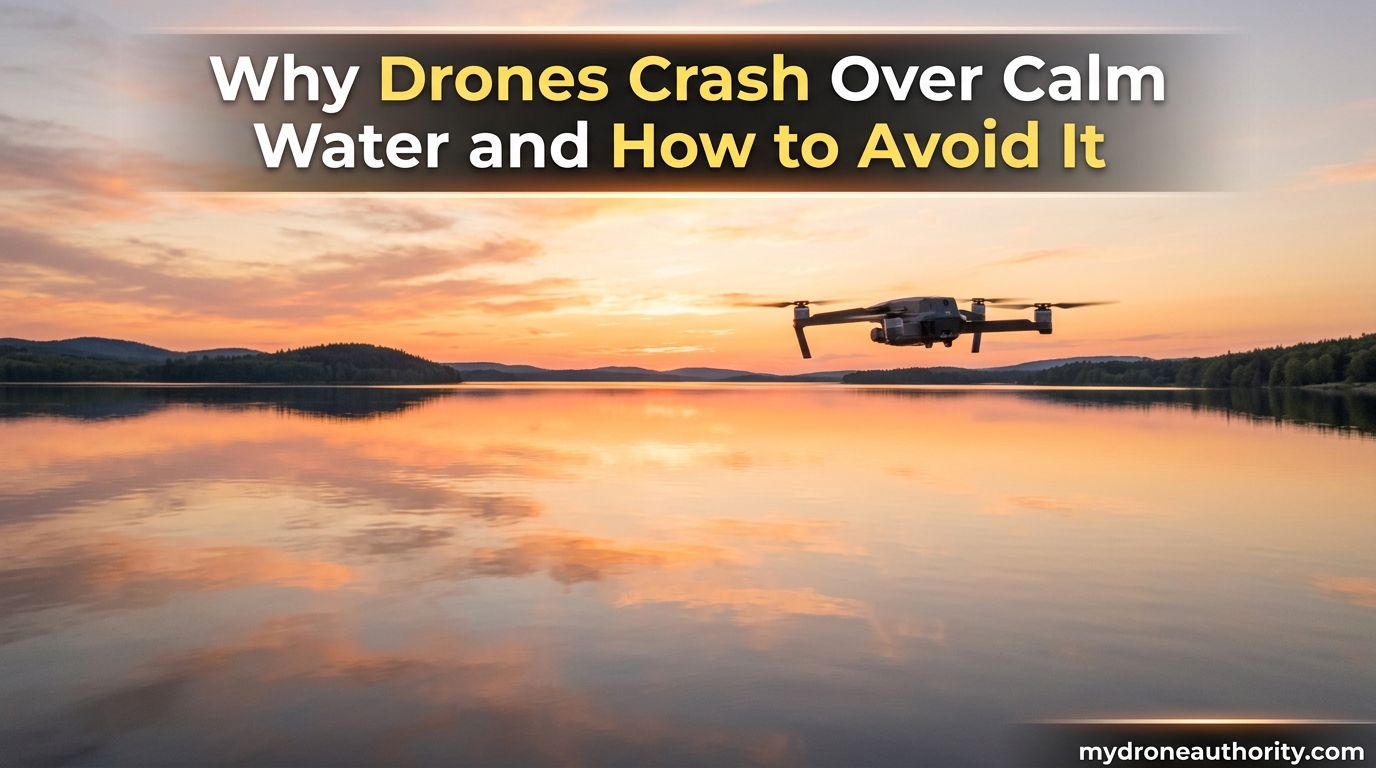
A drone over water crash almost always traces back to two sensor systems failing at the worst possible moment. When a drone hovers low over a still lake, glassy bay, or calm pond, the downward vision sensors cannot find enough visual texture to lock onto, and the GPS receiver starts picking up satellite signals that have bounced off the water’s surface. The flight controller then receives bad altitude and position data, and the aircraft either drifts, sinks, or dives.
I have spent enough time flying over lakes and coastal areas to know how quickly a calm-water flight can turn into a recovery mission. In this guide, I will walk you through the exact technical reasons these crashes happen, the altitude rules experienced pilots follow, and a step-by-step checklist that has saved my drones from going swimming more than once.
Table of Contents
Why Calm Water Is the Most Dangerous Surface for Drones
Calm water is more dangerous than choppy water for one reason: it acts like a mirror. Downward vision sensors, GPS receivers, and even barometric altimeters all struggle when the surface below is uniform, reflective, and constantly shifting in tiny ways.
On a windy day with whitecaps, the surface has visible texture. A drone’s optical flow system can track ripples, foam, and surface variation to figure out how far it is moving. Calm water offers none of that. The surface looks like a featureless, moving mirror, and the drone’s vision system simply cannot keep up.
This is the content gap I have noticed in most articles on the topic. Pilots assume rough water is riskier because of spray and turbulence, but the data says the opposite. A still pond on a windless morning is one of the most crash-prone environments a drone can face. The mirror-like surface reflects sunlight, sky, and clouds back into the downward cameras, scrambling the optical flow calculation.
Choppy water gives the drone something to grip onto. Calm water gives it nothing.
How Downward Vision Sensors Fail Over Water
Downward vision sensors, sometimes called optical flow sensors, are small cameras mounted on the belly of modern drones. They work by tracking the apparent motion of the ground below. If the camera sees texture moving in a particular pattern, the flight controller can calculate the drone’s speed and hover position with impressive accuracy.
These sensors expect a textured, contrasting surface. Carpet, grass, gravel, and patterned concrete all work well. They are tuned to detect edges, shadows, and recognizable features frame-to-frame.
Calm water destroys this entire process. The surface is too uniform, the reflections are constantly changing, and there are no stable features to lock onto. The result is what pilots describe as the drone “going crazy” or “drifting on its own” over water. In some cases, the flight controller falls back to barometric altitude only, and as the barometric pressure shifts with temperature, the drone may slowly sink without the pilot realizing it.
One DJI Mini 2 owner on a drone forum described the issue clearly: “The bottom sensors have problems with water. Relying entirely on avoidance and depth sensors over water will ruin a drone quick, fast, and in a hurry.” That matches my own experience flying Mini-series drones over still lakes.
GPS and GNSS Multipath Errors Over Water
The second sensor system that misbehaves over water is GPS, technically called GNSS (Global Navigation Satellite System). GNSS works by timing how long it takes a signal to travel from a satellite to your drone. The flight controller uses that timing from multiple satellites to triangulate the drone’s position.
Water reflects radio signals. When your drone is over a large body of calm water, the GPS antenna receives both the direct signal from the satellite and a delayed, bounced copy that has reflected off the water below. This is called multipath interference.
Multipath causes the position calculation to drift. The drone may think it is three feet to the left of where it actually is. The position hold function then tries to “correct” by moving three feet right, which puts it somewhere it should not be. Over land, this drift is small and corrected quickly. Over water, the corrections can compound, causing the drone to walk itself sideways toward the lake or shoreline until it hits something solid or lands in the water.
Some pilots notice their position hold icon shows the drone floating well outside its actual location. That is multipath in action.
The 20-Foot Minimum Altitude Rule Explained
Professional drone pilots and most manufacturer guidelines suggest a minimum altitude of 20 feet above ground level (AGL) when flying over water. The number is not arbitrary. At 20 feet, the angle between the drone and the water surface becomes steep enough that the GPS antenna receives a much weaker reflected signal compared to the direct satellite signal.
Below 20 feet, the reflected signal strength is high enough to cause significant multipath errors. Above 20 feet, the geometry favors the direct signal, and the flight controller can usually filter out the reflections.
For downward vision sensors, the same principle applies. At 20 feet and above, the camera is far enough from the water that the surface pattern, even on a calm day, includes enough horizon line, shoreline, and surrounding terrain to give the system some context. Below 20 feet, the water fills the camera’s field of view and the optical flow algorithm has nothing to lock onto.
Twenty feet is a practical minimum, not a guarantee. Higher is always safer when flying over water.
Step-by-Step Prevention Checklist for Water Flights
Use this checklist before every flight that takes you within 100 feet of any body of water. Following it has kept my own drones dry through dozens of lakefront and coastal operations.
Step 1: Recalibrate the IMU and compass before takeoff. This takes 30 seconds and gives the flight controller a clean baseline for sensor fusion. Skipping this is the most common cause of mysterious drift, and the effect is amplified over water.
Step 2: Check GPS satellite count. Wait for a minimum of 10 satellites with a strong HDOP value. Multipath is worse when there are fewer satellites to choose from, so do not take off with a marginal GPS lock.
Step 3: Set a conservative Return to Home (RTH) altitude. If you normally fly at 100 feet, set RTH to 150 feet. Trees, cliffs, and terrain features around water can be tricky, and a higher RTH gives you a buffer.
Step 4: Maintain at least 30 percent battery reserve. Water flights often take longer than expected because of unexpected drift, recovery maneuvers, and extra caution. A reserve of 30 percent gives you time to land safely on shore.
Step 5: Fly laterally, not straight up, when taking off or moving over water. Forward motion in ATTI or GPS mode gives the optical flow system something to track. Vertical motion over a still surface does not.
Step 6: Keep the drone in your visual line of sight. Reflected glare on water makes it surprisingly easy to lose orientation. A clear line of sight helps you notice drift before it becomes a crash.
Step 7: Know how to switch to ATTI mode. ATTI mode disables GPS and vision positioning, leaving the drone in a manual attitude hold. Pilots who have practiced ATTI can sometimes save a drone that is misbehaving over water by switching modes and flying it out manually.
What to Do If Your Drone Starts to Descend Over Water
If your drone begins to descend unexpectedly over water, follow this emergency protocol. Move quickly but deliberately. The first three to five seconds matter most.
Step 1: Push the throttle stick straight up to full power. Many water descents are actually a slow sink the pilot did not notice. Full power stops the descent and gives you time to assess.
Step 2: Switch to ATTI mode immediately. If your drone has an ATTI mode toggle on the controller, switch to it. This turns off GPS and vision positioning, removing the bad data that is causing the problem. The drone will not hold position on its own, but you regain direct control.
Step 3: Fly laterally toward shore. Do not try to climb vertically. Lateral motion helps the IMU and remaining sensors stabilize. Pick the closest point of dry land and head for it.
Step 4: If you cannot recover, fly it toward the shallows. A drone in a few inches of water is easier to retrieve than one in the middle of a lake. Aim for the shoreline as you lose control.
Step 5: When the drone hits the water, do not chase it in. Note the GPS coordinates from your controller app or the Find My Drone feature. Recovery by hand is the last option because of water current, depth, and personal safety.
Recovering a Drone After Water Landing
Fresh water and salt water lead to very different outcomes. A drone retrieved from a freshwater lake within a few seconds can sometimes survive a full power-off, dry-out period, and battery replacement. The corrosion is minimal if the electronics are dried properly.
Salt water is a different story. Salt accelerates corrosion on every metal surface inside the drone, and the damage continues even after the drone is removed from the water. Most professional repair shops consider salt water damage irreversible, especially if the drone was submerged for more than a few minutes.
Whatever the water type, take these steps as soon as you have the drone back in hand:
Step 1: Power off immediately and remove the battery. Do not try to test it. Every second the electronics are live in moisture increases the damage.
Step 2: Rinse the drone with fresh water if it landed in salt water. Counterintuitive, but it removes the salt that would otherwise continue to corrode. Skip this step for freshwater landings.
Step 3: Do not use rice. The rice myth does not work for electronics. Rice does not pull moisture out of sealed components effectively, and starch dust can make things worse. Use silica gel packets in a sealed container instead.
Step 4: Open the drone if you can and let it air dry for 48 to 72 hours. A fan running nearby improves airflow. Avoid heat sources like hair dryers, which can warp plastic and damage screens.
Step 5: Send it to the manufacturer for inspection before flying it again. Even if the drone powers on and seems fine, internal corrosion can cause failures weeks later. A professional inspection is worth the cost compared to a repeat crash.
FAQ’s
How do you avoid drone crashes over water?
Fly at least 20 feet above the water’s surface, recalibrate the IMU and compass before takeoff, maintain a strong GPS lock with 10 or more satellites, and avoid hovering in place. Fly laterally rather than vertically when moving over water, and keep at least 30 percent battery in reserve so you have time to recover and return to shore.
Is it safe to fly a drone over water?
Flying a drone over water is safe when you follow altitude, sensor, and weather guidelines. Calm water is the most dangerous surface because it confuses downward vision sensors and causes GPS multipath errors. Higher altitudes, stronger GPS locks, and avoiding stationary hovering all reduce the risk significantly.
What happens if a drone lands in water?
If a drone lands in fresh water, prompt retrieval, immediate power-off, and a 48 to 72 hour drying period may save it. If a drone lands in salt water, corrosion begins immediately and is usually irreversible. Power off the drone, remove the battery, rinse with fresh water if the landing was in salt water, and let the unit air dry with silica gel before professional inspection.
Why did my drone lose control near water?
Most loss-of-control incidents near water are caused by GPS multipath interference, downward vision sensor confusion, or a combination of both. The flight controller receives bad position and altitude data, and the aircraft drifts, descends, or fails to hold its hover position. Switching to ATTI mode and flying manually toward shore is the standard recovery technique.
Can a drone be fixed after being soaked in salt water?
In most cases, salt water damage is permanent. Salt corrodes internal electronics within minutes, and the corrosion continues even after the drone is dried. Most manufacturer repair centers will not attempt to repair a salt-water-submerged drone and will recommend a replacement instead. Freshwater damage has a much better chance of full recovery if the drone is dried quickly.
Final Thoughts: Fly Smart Around Water in 2026
Drone over water crashes are not random. They happen because calm water looks like nothing to the sensors that are supposed to keep your drone stable. Fly at 20 feet or higher, keep your GPS lock strong, avoid hovering in place, and know how to switch to ATTI mode if things go wrong.
Take the prevention checklist seriously before your next coastal or lakefront flight. The five minutes it takes to recalibrate and check your sensors is cheaper than any drone you have ever owned.