
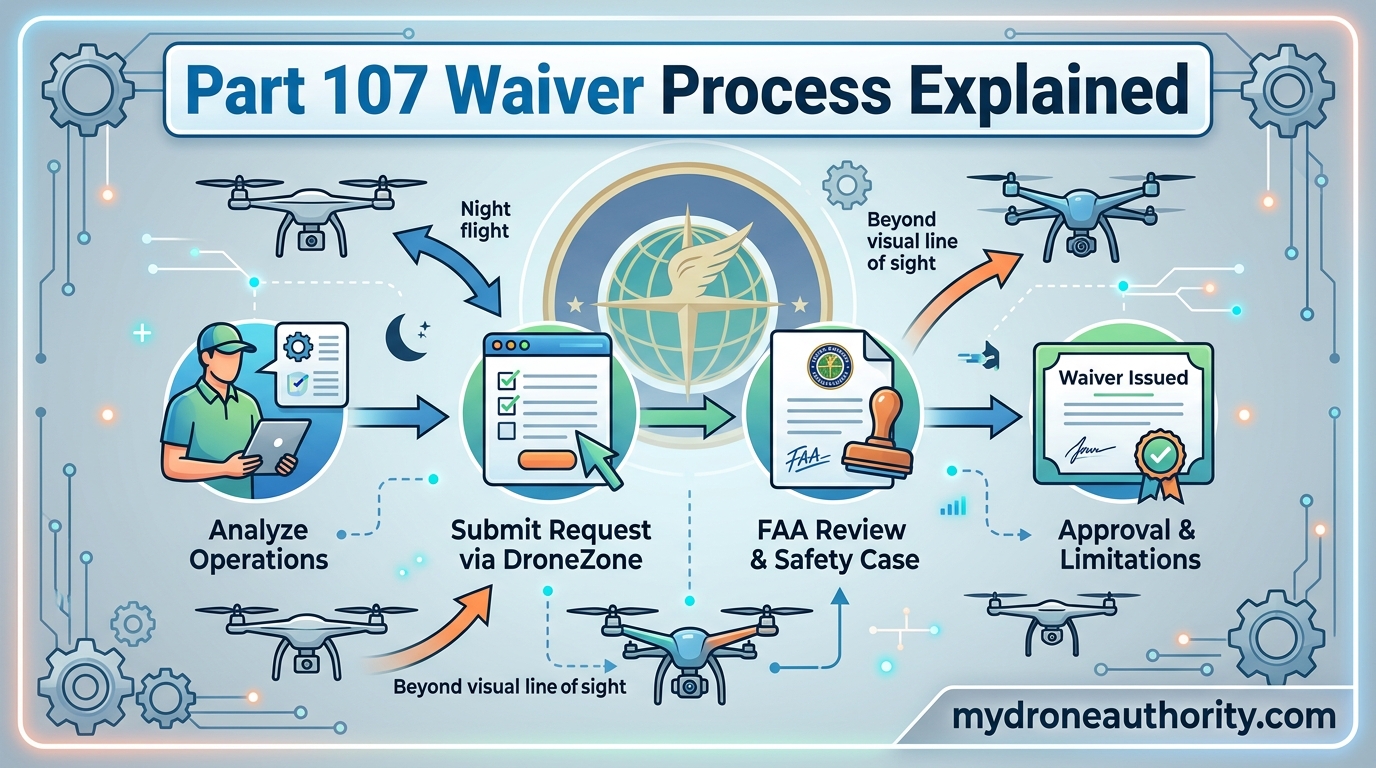
A Part 107 waiver is an official FAA authorization that lets certificated remote pilots operate drones in ways that would otherwise violate standard Part 107 rules, by proving they can maintain an equivalent level of safety through alternative methods. If you need to fly beyond visual line of sight, operate at night without standard anti-collision lighting, work above 400 feet, or run multiple drones at once, you likely need a Part 107 waiver before you ever take off.
I have walked two pilots through the Part 107 waiver process in the last year, and the same pattern shows up every time. Pilots who understand what the FAA actually wants get approved faster. Pilots who guess end up with a 90-day clock ticking toward a denial letter.
This guide explains when you need a Part 107 waiver, which rules can actually be waived, what the FAA cannot waive, and how the entire Part 107 waiver process works from start to finish in 2026. You will also get the real timelines, common rejection reasons, and the appeal steps nobody else writes about.
One quick note before we dive in. A Part 107 waiver is not the same thing as getting your Remote Pilot Certificate, and it is not the same as an airspace authorization. We will cover all three separately so you can tell at a glance which one your operation needs.
Table of Contents
What Is a Part 107 Waiver?
A Part 107 waiver is a written FAA authorization, formally called a Certificate of Waiver (COW), that allows a remote pilot in command to deviate from specific operating rules in 14 CFR Part 107. The FAA grants these waivers when an applicant can show that the proposed operation can be conducted safely using methods that differ from the standard rule.
The waiver system exists because Part 107 is written as a one-size-fits-all rule. But drone operations range from inspecting a one-acre roof to coordinating a 500-drone light show. A rigid rule cannot cover both, so Congress built regulatory flexibility into the law. A Part 107 waiver is how that flexibility gets applied to your specific operation.
When the FAA approves a waiver, you receive a Certificate of Waiver with conditions. Those conditions are not optional. Every mitigation you promised in your safety explanation becomes a binding operational rule. Violate them, and you have lost the protection of the waiver itself.
Two important things to know before we go further. First, a Part 107 waiver is not a license to ignore Part 107 entirely. You must still hold a valid Remote Pilot Certificate. Second, a waiver is not the same as an airspace authorization. We will cover that distinction in detail later in this guide.
Waivers are issued to a specific pilot or organization, and they travel with the operation, not the aircraft. If you change employers, the waiver does not automatically transfer. You have to reapply or request an amendment to assign the waiver to a new operator. This is one detail that catches a lot of commercial pilots off guard, especially when they move from one company to another and assume their old approvals are still valid.
The FAA’s authority to grant waivers comes from Section 107.205 of 14 CFR Part 107, which gives the agency broad discretion to waive any operating rule in Subpart B as long as the proposed operation can be conducted safely. The agency uses this authority to support new commercial use cases that did not exist when the original Part 107 rule was written in 2016.
When You Need a Part 107 Waiver
You need a Part 107 waiver whenever your planned operation cannot be done while fully complying with the standard rules in 14 CFR Part 107. The FAA allows waivers of most operating rules, but not all of them, and the list of waiverable operations has changed significantly since 2024.
The most common situations that trigger a Part 107 waiver include flying beyond visual line of sight (BVLOS), operating at night without the standard anti-collision lighting setup, flying over people when your drone does not fit into one of the four defined categories, operating from a moving vehicle in a populated area, controlling more than one drone at a time, and flying above 400 feet above ground level or above a structure.
Many pilots are surprised to learn that night operations no longer always require a waiver. Under the 2024 Part 107 Final Rule, you can now fly at night under Part 107 as long as your drone has anti-collision lighting visible for 3 statute miles with a flash rate of 1 to 100 flashes per minute, and you have completed the updated recurrent training. If your lighting does not meet that standard, you still need a 107.29 waiver.
Operations over people also changed under the same rule. Drones that meet Category 1, 2, 3, or 4 requirements can now fly over people without a waiver. If your drone does not fit any of those four categories, you need a 107.39 waiver. The categories are based on weight, kinetic energy at terminal velocity, and safety features like propeller guards and parachute systems.
You will also need a waiver if you are planning a drone light show, conducting commercial BVLOS inspections, or coordinating search and rescue operations that go beyond visual range. The FAA treats all of these as deviation from standard rules, even when they look routine to experienced pilots.
Here is a practical way to think about it. If you have to ask the question, you probably need a waiver. The FAA expects you to know the rules before you operate, and assuming an operation is allowed under Part 107 is not a defense if it turns out you needed a waiver and did not have one.
Real use cases that almost always require a Part 107 waiver include long-linear infrastructure inspections (pipelines, power lines, railways), large-scale agricultural spraying operations, package delivery testing programs, autonomous BVLOS surveying for construction sites, real estate flyovers near crowds, news gathering over accident scenes, and tactical operations for law enforcement. Each of these involves at least one Part 107 operating rule that the standard text does not allow.
Which Part 107 Regulations Can Be Waived
You can request a waiver for almost every operating rule in Subpart B of 14 CFR Part 107. The FAA cannot waive aircraft registration, pilot certification, or the rules that protect the national airspace system, but most operational restrictions are open to a waiver request.
The most frequently requested waivers cover Section 107.25 (operations from a moving vehicle or aircraft), Section 107.29 (night operations without standard lighting), Section 107.31 (visual line of sight), Section 107.35 (operation of multiple small UAS), Section 107.37 (yielding right of way), and Section 107.39 (operations over people).
Section 107.51 covers altitude limits, including flights above 400 feet above ground level or above a structure. Section 107.145 covers immediate reporting of accidents. Section 107.150 covers the aircraft airworthiness and registration display rules in certain limited cases.
Approval rates vary widely by waiver type. BVLOS waivers under 107.31 remain the hardest to get, with reported approval rates in the 20 to 40 percent range depending on the operation and equipment. Operations over people waivers under 107.39 have a much higher approval rate, often above 70 percent for well-prepared applications.
Night operation waivers also depend on what you are asking for. A request to operate at night with reduced anti-collision lighting is much more likely to succeed than a request to operate with no lighting at all. The FAA wants to see that you have a specific reason for the deviation and a clear plan to manage the risk.
Multiple drone operation waivers under 107.35 see roughly 60 to 75 percent approval rates for applications that include strong visual observer procedures, geo-fencing details, and clear communication protocols between pilots.
One of the more common waiver requests that pilots underestimate is the operations from a moving vehicle waiver under 107.25. This is required any time you operate from a moving vehicle in a populated area, even if the vehicle is moving slowly. Law enforcement, news gathering, and search and rescue teams all run into this rule.
Yielding right of way waivers under 107.37 are less common but still relevant. The standard rule requires a small UAS to yield right of way to all other aircraft, including manned aircraft operating under instrument flight rules. Waivers are sometimes needed for operations in busy airspace where frequent yields would ground the operation.
What You Cannot Get a Part 107 Waiver For
Several Part 107 rules cannot be waived through the standard waiver process. These include the requirement to hold a valid Remote Pilot Certificate, the requirement to register your drone with the FAA, and the requirement to comply with airspace restrictions that come from outside Part 107.
You also cannot use a Part 107 waiver to operate a drone that exceeds the 55-pound weight limit, to carry hazardous materials, or to conduct operations that are not allowed under any circumstance. The waiver process gives you operational flexibility, not a way around core safety rules.
If you need an exception to one of these non-waivable rules, the alternative path is a Section 44807 exemption. This is a separate FAA process used for unique operations that do not fit into Part 107, such as certain package delivery concepts or operations involving aircraft that exceed the weight limit. The Section 44807 process is slower and more expensive than a Part 107 waiver, but it is the only available path for some use cases.
Some pilots also pursue a Certificate of Authorization (COA) under Section 44809 for public aircraft operations like law enforcement and emergency response. A COA is a different authorization and operates outside the Part 107 waiver system.
The 55-pound weight limit is one of the hardest rules to get around. If your drone is over 55 pounds, no Part 107 waiver will help. You would need a Section 44807 exemption or operate under a different set of rules entirely, such as Public COA or experimental category rules. The FAA is strict on this limit because it ties directly to the original statutory language that created Part 107.
Hazardous materials are another non-waivable area. You cannot use a Part 107 waiver to carry lithium batteries above certain thresholds, aerosols, or other dangerous goods. There are limited exceptions for certain agricultural operations, but they require additional DOT coordination and are not waiver-based.
Part 107 Waiver vs Airspace Authorization
The Part 107 waiver and the airspace authorization are two different things, and confusing them is one of the most common mistakes I see in applications. A Part 107 waiver lets you deviate from operating rules. An airspace authorization lets you fly in controlled airspace that is normally off-limits without permission.
If you want to fly in Class B, C, D, or the surface area of Class E airspace around an airport, you need an airspace authorization, not a waiver. The fastest way to get one is through LAANC, the Low Altitude Authorization and Notification Capability, which provides near-real-time approval for flights below approved altitude ceilings in controlled airspace.
Some operations need both. If you want to fly BVLOS in Class C airspace, you will need a 107.31 waiver for the line-of-sight deviation and a separate airspace authorization to enter the controlled airspace. The FAA treats these as two separate requests on two separate timelines.
The simplest way to remember the difference is this. A waiver asks the FAA to let you break a Part 107 operating rule. An airspace authorization asks the FAA to let you into a piece of airspace. They serve different purposes, and many pilots need both for a single commercial mission.
LAANC works for most routine controlled airspace access under 400 feet and is often approved in minutes. It is not a substitute for a waiver. If you are approved through LAANC to fly in Class C airspace, that does not give you BVLOS authority. You still need to keep visual line of sight, even if the airspace entry itself was approved.
For controlled airspace access that LAANC cannot handle, such as operations above the published ceiling, you can request a manual airspace authorization through the FAA DroneZone or Aviation Safety Hub. These manual authorizations take longer, often 30 to 90 days, but they cover the gap that LAANC cannot reach.
How the Part 107 Waiver Process Works Step by Step
As of March 2026, all Part 107 waiver applications go through the FAA’s Aviation Safety Hub, the new system that replaced parts of the older FAADroneZone workflow. Here is exactly how the process works from start to finish.
Step 1: Confirm You Need a Waiver
Before you do anything else, confirm that the operation you are planning actually requires a Part 107 waiver. Check the 2024 rule changes carefully, especially for night and operations over people. Many pilots in my network wasted 60 to 90 days applying for waivers they no longer needed because they were working from outdated guides.
Step 2: Identify the Specific Regulation to Waive
Every waiver request must cite a specific section of 14 CFR Part 107. You cannot request a generic waiver that covers multiple operations. If you need to fly BVLOS and at night, that is two separate waiver applications, each with its own safety explanation and review timeline.
Step 3: Prepare the Waiver Safety Explanation
The Waiver Safety Explanation Guidelines (WSEG) document is the FAA’s published framework for what a strong safety explanation looks like. Your explanation must include a clear concept of operations (CONOPS), a hazard identification section, a risk assessment, and specific mitigations for each identified hazard. The FAA wants to see that you understand the risk, not just that you have equipment.
Strong safety explanations include specific details: latitude and longitude coordinates for the operating area, exact altitudes, weather minimums, pilot certification levels, and visual observer procedures. Vague applications get rejected or sent back for revision.
Step 4: Submit Through the Aviation Safety Hub
Log into the Aviation Safety Hub, go to your Part 107 Dashboard, and select Create Part 107 Waiver. Upload your safety explanation, concept of operations, and any supporting documentation. The system will assign a tracking number that you will use for all future correspondence.
The Aviation Safety Hub has replaced the older FAADroneZone workflow for new waiver submissions. If you have used DroneZone in the past, your account should have been migrated, but you may need to re-link certificates and update contact information. The new system is more streamlined for waiver tracking but the underlying review process is the same.
Step 5: Respond to FAA Follow-Up Questions
Expect the FAA reviewer to come back with questions, especially for complex waivers. Most reviewers ask for additional risk data, more specific operational boundaries, or clarification on mitigation procedures. The faster and more thoroughly you respond, the faster your application moves through the queue.
Most reviewers send their first round of follow-up questions within 30 to 60 days of submission. If you go silent for 60 days after receiving a question, the FAA will treat your application as inactive and may close it out. Check your email and your Aviation Safety Hub inbox at least weekly during the review window.
Step 6: Receive the Decision
Once the FAA makes a decision, you will receive an email with the Certificate of Waiver or a denial letter explaining the reasons. Approved waivers come with specific conditions that become your binding operating limits. Denials include a written explanation and, in some cases, guidance on how to revise and resubmit.
If approved, download and print your Certificate of Waiver. Keep a copy in your flight kit, and make sure every pilot operating under that waiver has read and understood the conditions. The waiver only protects you if you actually follow it.
How Long Does a Part 107 Waiver Take to Get Approved
The FAA states that waiver decisions typically take around 90 days from submission. In practice, processing times vary significantly by waiver type, application quality, and FAA workload.
Simpler waivers for operations over people with documented category data often come back in 60 to 90 days. Night operation waivers with clear lighting specifications take a similar window. BVLOS waivers, the most complex, regularly take 120 to 180 days and sometimes longer, especially if the FAA requests additional risk modeling or third-party validation.
Reddit pilots in the r/Part107 community consistently report that the 90-day timeline is optimistic for any waiver beyond the simplest operations. One BVLOS applicant told me they waited 217 days for a decision on a power line inspection waiver. Another pilot got an operations over people waiver approved in 47 days because they had prior experience and submitted a complete application on the first try.
Submitting at least 90 days before you need the waiver is the FAA’s official guidance. For BVLOS operations, treat 180 days as your planning baseline. Waiting until the last minute can cost you a season of billable work.
FAA workload also affects your timeline. Waiver review is handled by a relatively small team at the FAA’s UAS Integration Office. When the team is dealing with high-profile events like large drone shows or public safety responses, regular waiver applications can sit longer in the queue. There is no way to know the current workload from outside, so always plan for the longer end of the timeline.
If you need a waiver in less than 90 days because of an emergency or unique opportunity, the FAA does offer an expedited review process. You have to request it in writing, justify the urgency with specific operational evidence, and accept that the FAA will still prioritize safety over speed. Expedited reviews are not guaranteed.
Common Reasons Part 107 Waivers Get Rejected
Rejections fall into a few predictable patterns. The most common reason is an incomplete safety explanation that does not address specific hazards. The FAA wants to see a hazard-by-hazard analysis with concrete mitigations, not general statements like “we will fly safely.”
The second most common reason is requesting too many waivers at once. Pilots who submit a single application asking to waive five different regulations often get the entire package rejected. The FAA reviews each request independently, and a weak link in one section can sink the others.
Third, applications that lack specific operational details get bounced. The FAA reviewer needs to know where you are flying, how high, in what weather, with what equipment, and who is in the operating area. Hand-waving on these details is a fast path to a denial.
Fourth, applications that propose mitigations the FAA cannot verify get rejected. Promising to use a “proprietary detect and avoid system” without documentation or specifications is not enough. The FAA wants to see published standards (like ASTM F3322 for parachute systems) or test data.
Fifth, drone light show operators who request waivers to operate with lights off for portions of the show face a particularly high rejection rate. The FAA treats this as a meaningful safety deviation and requires detailed audience separation and contingency procedures.
Sixth, applicants with a poor safety history or certificate actions face additional scrutiny. The FAA reviews your Part 107 record before approving a waiver, and past incidents count against you.
Seventh, applications that do not match the actual operation get flagged. If your safety explanation describes a daytime agricultural survey but your operation is actually an urban infrastructure inspection, the FAA will treat that as a material mismatch and deny the waiver. Make sure the CONOPS, the hazards, and the mitigations all line up with the real-world mission.
Eighth, failure to address 14 CFR 107.35 properly on multi-drone operations is a frequent cause of rejection. The FAA wants to see how the lead pilot maintains command and control, what happens if one drone loses link, and how visual observers coordinate across multiple aircraft. Generic answers that do not name specific procedures get sent back.
Tips to Improve Your Part 107 Waiver Approval Odds
Start with a smaller waiver before tackling BVLOS. Pilots who get a night operations waiver approved first have an easier path to BVLOS later, because the FAA already has a record of their safe operations.
Reference the Waiver Safety Explanation Guidelines (WSEG) document directly in your application. Showing that you understand the FAA’s framework signals that you are serious and reduces the back-and-forth cycle of questions.
Cite published standards wherever possible. ASTM F3322 for parachute systems, ASTM F3178 for visual observers, and RTCA standards for detect and avoid systems all carry weight with FAA reviewers. Even if you are not using equipment covered by these standards, referencing them shows you have done your homework.
Include a detailed concept of operations that covers normal, abnormal, and emergency procedures. Most applications focus only on the normal case. The FAA wants to know what happens when something goes wrong, including lost link procedures, pilot incapacitation, and intrusion by manned aircraft.
Limit your scope. The narrower the operating area, the lower the altitude, the smaller the drone, the more likely you are to get approved. You can always request an amendment to expand later. A tight initial request with a plan to grow beats a sweeping request that tries to do everything at once.
Use a real visual observer program, not just a checkbox. The FAA wants to know who your visual observers are, how they are trained, how they communicate with the pilot, and what their procedures are for lost sight of the aircraft.
Run a documented test program before you submit. Pilots who can point to actual flight test data, including logs and lessons learned, get approved more often than pilots who submit a paper-only safety case. If you can show 50 to 100 hours of relevant flight experience with documented safety outcomes, your application stands out.
Get a Part 107 waiver consultant or aviation attorney to review your application before you submit. Most consultants charge between $1,500 and $5,000 for a comprehensive review and rewrite, and the return on investment is significant. A consultant can also flag weak spots before the FAA reviewer does, which shortens the entire review cycle.
Pay attention to formatting. The FAA reviewer reads hundreds of these applications, and a clean, well-organized document with clear section headers, numbered procedures, and embedded diagrams is much easier to approve than a 30-page single-spaced wall of text. Use the Waiver Safety Explanation Guidelines as your outline and you cannot go wrong.
What to Do If Your Part 107 Waiver Is Denied
A denial is not the end. The FAA denial letter includes specific reasons, and those reasons tell you exactly what to fix. Most successful re-applicants address each cited reason point by point in the new safety explanation.
There is no formal “appeal” in the way there is for a civil penalty case. The path forward is a revised application that responds to the denial reasoning. Some pilots bring in a Part 107 waiver consultant or aviation attorney for the second attempt, especially for BVLOS or other complex operations.
If the denial is based on a regulation that simply cannot be waived, your only option is the Section 44807 exemption process, which is a different FAA pathway with its own requirements and timeline. Section 44807 applications typically take 6 to 12 months and are appropriate for unique operations like certain package delivery concepts or aircraft that exceed the 55-pound limit.
You can also request a meeting with the FAA’s UAS Integration Office to discuss the denial in person. These informal conversations do not guarantee a different outcome, but they can clarify the FAA’s concerns and help you write a stronger re-application.
Before you resubmit, do a complete audit of your original application against the denial letter. If the FAA cited three specific issues, your new application should directly address each of those three issues with new evidence, new procedures, or new mitigations. Do not just reword the same safety explanation. The reviewer will recognize that immediately.
Part 107 Waiver Expiration and Renewal
Part 107 waivers have a stated effective period, usually 4 years from the date of issuance, though some complex waivers come with shorter terms. The expiration date is printed on the Certificate of Waiver itself.
You can request an amendment to an active waiver to change operational boundaries, add aircraft, or update procedures. Amendments go through the same Aviation Safety Hub process but typically take less time than a brand-new waiver because the FAA already has your baseline safety case on file.
Renewal is essentially a new waiver application. The FAA will look at your operational history under the previous waiver, including any incidents or violations, and use that as input into the new decision. A clean operational record makes renewal much smoother than a first-time application.
Start the renewal process at least 120 days before your current waiver expires. If you wait until the last 30 days, you risk a coverage gap where you cannot legally operate under the old waiver and do not yet have a new one. There is no automatic extension, so plan ahead.
Frequently Asked Questions
Can you fly at night with Part 107?
Yes, you can fly at night under Part 107 without a waiver as long as your drone has anti-collision lighting visible for 3 statute miles with a flash rate between 1 and 100 flashes per minute, and you have completed the updated recurrent training. If your lighting does not meet that standard, you still need a 107.29 night operations waiver.
How do you get a Part 107 waiver?
To get a Part 107 waiver, identify the specific Part 107 rule you need to deviate from, prepare a detailed safety explanation that follows the FAA Waiver Safety Explanation Guidelines, then submit your application through the Aviation Safety Hub portal. Expect FAA follow-up questions and a 60 to 180 day review timeline depending on waiver complexity. If approved, you receive a Certificate of Waiver with binding operational conditions.
How long does a Part 107 waiver take to get approved?
The FAA states 90 days as the typical review window, but real-world timelines range from 60 days for simple operations over people waivers to 180 days or longer for BVLOS waivers. Submit at least 90 days before your planned operation, and plan for 180 days if your waiver involves BVLOS or complex multi-aircraft operations.
What happens if you fly without a Part 107 waiver?
Flying without a required Part 107 waiver is a federal violation that can result in civil penalties up to $32,666 per incident, certificate suspension or revocation, and in serious cases criminal charges. The FAA treats unauthorized operations as a serious safety issue, especially for BVLOS or operations over people. Always confirm whether your operation requires a waiver before you fly.
Final Thoughts on the Part 107 Waiver Process
The Part 107 waiver process rewards preparation and punishes vagueness. Pilots who understand exactly which rule they need waived, who write a hazard-by-hazard safety explanation, and who submit specific operational details get approved faster and face fewer follow-up questions.
Start by confirming you actually need a Part 107 waiver, especially given the 2024 rule changes around night and operations over people. Then build your safety explanation around the Waiver Safety Explanation Guidelines, reference published standards wherever you can, and submit through the Aviation Safety Hub with at least 90 days of lead time. If your operation is complex, give yourself six months.
For commercial operators planning to scale beyond standard Part 107 operations, the waiver you get this year is also your training data for the next one. A clean operational record under an existing waiver makes the next approval much easier to land.
The Part 107 waiver system is not going away. If anything, the FAA is expanding it as new commercial use cases emerge. Pilots who learn how to navigate the waiver process now will be ready for whatever the next generation of drone operations looks like, from autonomous BVLOS networks to heavy-lift cargo operations and beyond.