
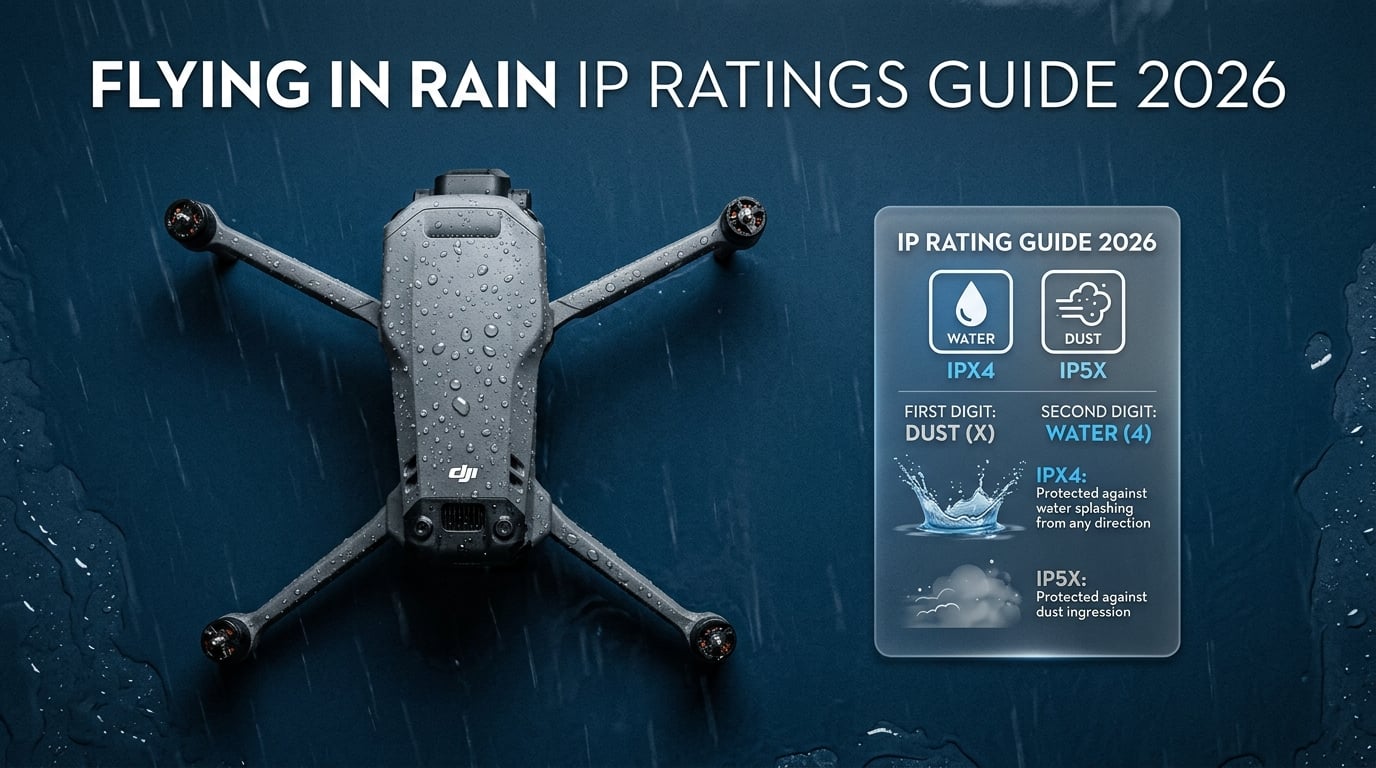
The short answer is no – you should not fly a drone in the rain unless it carries a confirmed IP rating of at least IP43 or higher for the conditions you face. Most consumer drones, including the popular DJI Mini, Air, and Mavic lines, have no official water resistance rating, which means even a light drizzle can fry flight controllers, kill motors, or fog your camera gimbal. In this guide, I’ll break down exactly what IP ratings mean, which drones can handle wet weather, and what to do if you get caught in a sudden shower mid-flight.
I’ve been flying drones for over six years and have learned this lesson the hard way. One unexpected rain shower cost me a DJI Mini 2 that never flew again. So before you launch when the clouds look threatening, read this first. Your drone, your footage, and your wallet will thank you.
Table of Contents
What Is an IP Rating and Why It Matters for Drones
An IP rating (Ingress Protection rating) is a two-digit code defined by the international standard EN 60529 that tells you how well a device is sealed against solid particles and liquids. The first digit rates dust protection on a scale of 0 to 6, and the second digit rates water protection on a scale of 0 to 9. Higher numbers always mean better protection.
Most consumer electronics, including phones and smartwatches, advertise IP ratings so buyers know what they can survive. Drones are different – many models carry no IP rating at all, and others advertise ratings that are far less protective than people assume. When DJI says a drone is “weather resistant” or has an IP43 rating, that’s a very different claim than “IP67” or “IP68.”
Here’s the quick translation: if your drone has no published IP rating, assume it cannot handle any direct water contact. If it has a rating, read both digits carefully. A drone rated IP43 can handle some light spray from above but not submersion or heavy rain. Only drones rated IP55 or higher can realistically fly in moderate rain, and even then, manufacturer guidelines often still advise against it.
Breaking Down the IP Code: What Each Digit Means
The first digit (0-6) describes protection against solid objects, including dust:
- 0: No protection
- 1: Protected against objects larger than 50 mm (a hand)
- 2: Protected against objects larger than 12.5 mm (a finger)
- 3: Protected against objects larger than 2.5 mm (tools, thick wires)
- 4: Protected against objects larger than 1 mm (most wires, small screws)
- 5: Dust-protected (limited ingress allowed)
- 6: Dust-tight (no ingress at all)
The second digit (0-9) describes protection against liquids:
- 0: No protection
- 1: Protected against vertical dripping water
- 2: Protected against dripping water when tilted up to 15 degrees
- 3: Protected against spraying water (rainfall up to 60 degrees from vertical)
- 4: Protected against splashing water from any direction
- 5: Protected against low-pressure water jets from any direction
- 6: Protected against powerful water jets and heavy seas
- 7: Protected against temporary immersion up to 1 meter for 30 minutes
- 8: Protected against continuous immersion beyond 1 meter
- 9: Protected against high-pressure, high-temperature water jets
For drone flying, the second digit is the one that matters most. Anything below a 3 means almost no rain protection at all. A rating of 4 means the drone can handle some light spray but not direct rainfall. Ratings of 5 and above are where real rain resistance begins, though even those ratings were tested in lab conditions with clean water, not real-world conditions involving wind-driven rain, dust, and salt.
Can You Fly a Drone in the Rain? The Direct Answer
No, you should not fly a standard consumer drone in the rain. Most consumer drones on the market today are not waterproof and can suffer permanent damage from even brief water exposure. DJI explicitly warns against flying any of its drones in rain, snow, or fog, regardless of whether the model has any weather-sealing features.
If you own an industrial-grade drone with an IP45 or higher rating, you can fly in light to moderate rain within the manufacturer’s specified limits. These drones are specifically engineered for wet weather operations like power line inspection, search and rescue, and emergency response. They cost several thousand dollars more than consumer models for that very reason.
From a legal standpoint, no aviation authority specifically bans rain flying, but your responsibility is the same as in fair weather. In the United States, FAA Part 107 rules require you to maintain visual line of sight and operate the aircraft safely. Rain reduces visibility, can cause erratic flight behavior, and creates a serious safety hazard to people and property below if your drone fails mid-flight.
Common Misconceptions About Rain Flying
I see the same wrong assumptions on drone forums every week. The biggest one is that “a few drops won’t hurt.” It absolutely can. Even a single drop landing on the wrong circuit board contact can create a short that bricks your drone instantly. Another myth is that “my drone is sealed, so it’s waterproof.” Sealed is not the same as waterproof. Cooling vents, motor housings, and gimbal openings all create water entry points that most people don’t think about.
There’s also a community myth that “everyone flies in light rain and it’s fine.” Real pilots don’t recommend this. The long-term cost of corrosion, motor wear, and electronics degradation is not visible in the moment. By the time you notice the problem, the damage is done.
What Happens When You Fly a Drone in the Rain
Rain damages drones through several mechanisms, some immediate and some that develop over time. Understanding these failure modes helps you make smarter decisions about when to fly and when to wait.
Immediate Electronic Failures
Water on a circuit board creates short circuits. The flight controller, ESCs (electronic speed controllers), and GPS module are particularly vulnerable. When water bridges two electrical contacts that shouldn’t be connected, current flows where it shouldn’t, and components can burn out in seconds. Once this happens, the drone either crashes immediately or behaves erratically before going down.
Batteries are also at risk. Lithium polymer batteries don’t mix with water, and water ingress into the battery compartment can cause swelling, fire, or complete failure. If you crash-land a wet drone, treat the battery as hazardous and dispose of it properly.
Motor and ESC Damage
Drone motors spin at high RPM and generate heat. When rain hits hot motor windings, it can cause thermal shock that cracks insulation and degrades performance. Even if the drone keeps flying, the motors may draw more current than usual to compensate, which stresses the ESCs and reduces overall flight time.
I’ve seen posts on r/dji where pilots report “ESC errors” appearing days after flying in light rain. The water got in, didn’t cause immediate failure, and slowly corroded the connections until the system flagged an error mid-flight.
Camera and Gimbal Issues
Water on the gimbal or camera lens creates fog and condensation that ruins footage. The gimbal motors themselves can fail if water gets into the bearings or motor windings. Even after the drone dries out, you may notice drift, vibration, or autofocus problems that weren’t there before.
GPS and Sensor Degradation
Rain between the drone and GPS satellites attenuates the signal, causing position errors. You may notice the drone drifting, hovering inaccurately, or losing GPS lock entirely. The vision positioning system also struggles in rain because the downward cameras can’t see the ground clearly through water droplets.
Long-Term Corrosion
Even if the drone seems fine immediately after a wet flight, corrosion can develop on metal contacts, solder joints, and motor windings over weeks or months. This is the slow, silent killer. A drone that flew “perfectly fine” in light rain can start experiencing mysterious failures a month later as corrosion eats through connections.
Drone Types and Their Rain Resistance Levels
Not all drones are created equal when it comes to wet weather. Here’s a realistic breakdown by category.
Consumer Drones (DJI Mini, Air, Mavic Lines)
Most consumer DJI drones have no official IP rating. The DJI Mini 2, Mini 3, Mini 4 Pro, Air 2, Air 2S, Air 3, Mavic 3, and Mavic 3 Pro all carry no IP rating from the factory. Some users report surviving light rain, but DJI’s official stance is that these drones are not designed for wet weather operation. Community consensus on r/drones and r/dji is clear: don’t fly these in rain.
Industrial and Commercial Drones
Industrial drones from manufacturers like DJI Matrice, Autel EVO II Enterprise, Skydio X10, and JOUAV often carry IP43 or IP45 ratings. These are designed for inspection, mapping, and public safety work where weather delays aren’t always an option. The DJI Matrice 30, for example, is rated IP55, which means it can handle rain in actual flight conditions.
Military Drones
Military drones like the Insitu ScanEagle, Textron Aerosonde, and various other tactical UAVs are built to MIL-STD-810G standards, which include far more rigorous environmental testing than civilian IP ratings. They can operate in heavy rain, snow, sand, and salt spray. These systems are not available to civilian pilots, but they explain why search and rescue teams can fly in conditions that would ground a consumer drone instantly.
DJI Drone IP Ratings Reference List
Here’s a quick reference for the most common DJI models and their official weather ratings as of 2026. Always check DJI’s official specs page for the most current information.
- DJI Mini 2 / Mini 3 / Mini 4 Pro: No IP rating (do not fly in rain)
- DJI Air 2 / Air 2S / Air 3: No IP rating (do not fly in rain)
- DJI Mavic 3 / Mavic 3 Pro / Mavic 3 Classic: No IP rating (do not fly in rain)
- DJI Phantom 4 Pro V2.0: No IP rating (do not fly in rain)
- DJI Avata 2: No IP rating (do not fly in rain)
- DJI FPV: No IP rating (do not fly in rain)
- DJI Matrice 30 / 30T: IP55 (can fly in light to moderate rain)
- DJI Matrice 350 RTK: IP55 (can fly in light to moderate rain)
- DJI Matrice 300 RTK: IP45 (can fly in light rain with conditions)
- DJI Agras T50 / T25: IP67 (designed for agricultural spraying in wet conditions)
For non-DJI brands, the Autel EVO II Enterprise V3 carries an IP43 rating, and the Skydio X10 is rated IP55. Always verify the rating on the manufacturer’s current spec sheet before assuming any drone can handle wet weather.
Safety Tips for Flying in Wet Weather Conditions
If you absolutely must fly in marginal conditions, follow these guidelines to minimize risk to your equipment and the people around you.
Step 1: Check the IP Rating First
Confirm your drone has an IP rating of at least IP43 before even considering flight. If there’s no rating, do not fly in any form of precipitation. This includes mist, fog, and very light drizzle that doesn’t look like much but contains real water.
Step 2: Reduce Flight Intensity
Wet conditions reduce motor efficiency, so fly slower and avoid aggressive maneuvers. The drone will use more battery to maintain stability, so plan for a shorter flight time and bring it back well before the low-battery warning. A wet drone that can’t make it back is a worse outcome than a delayed flight.
Step 3: Maintain Visual Line of Sight
Visibility drops fast in rain, and FAA regulations still apply in bad weather. You must keep visual contact with the drone. If visibility drops below the point where you can see orientation clearly, land immediately.
Step 4: Avoid Water Bodies
Don’t fly over water in the rain. If the drone loses power or has a flyaway, you’re now searching for it in the rain over a wet surface. The risk of total loss goes up dramatically.
Step 5: Land at the First Sign of Trouble
If you see ESC errors, GPS warnings, gimbal drift, or any unusual behavior, land right where you are. Don’t try to bring it home if it’s already misbehaving. A drone in a tree is recoverable; a drone in a lake is not.
What to Do If Your Drone Gets Caught in the Rain
Sometimes rain catches you by surprise. Here’s exactly what to do the moment your drone is on the ground and wet.
Step 1: Power Down Immediately
Remove the battery as soon as you have the drone in hand. Do not power it off through the app – pull the battery. This breaks the circuit before water can cause active shorts.
Step 2: Remove the Gimbal Cover and Dry Externally
Take off any protective covers, props, and accessories. Use a soft microfiber cloth to wipe down every surface you can reach. Tilt the drone in different directions to let water drain from motor housings, cooling vents, and the battery compartment.
Step 3: Air Dry for 48-72 Hours
Do not use a hair dryer, oven, or microwave to dry your drone. Heat can damage seals and melt plastic components. Place the drone in a warm, dry area with good airflow for at least 48 hours. Some pilots use a sealed container with silica gel desiccant packs to speed up the process.
Step 4: Clean Corrosion-Prone Areas With Isopropyl Alcohol
After 48 hours, use 90%+ isopropyl alcohol and a soft brush to clean battery contacts, motor windings, and any visible metal parts. The alcohol displaces remaining moisture and evaporates without leaving residue. This step is critical for long-term reliability.
Step 5: Test Components Individually
After the drying period, reinsert the battery in a dry environment and test each component one at a time. Check the gimbal, camera, motors, GPS lock, and compass calibration. If anything behaves abnormally, do not fly – send the drone to an authorized service center.
Step 6: Monitor for Delayed Issues
Even after a successful dry-out, watch for problems over the next 30 days. ESC errors, gimbal drift, and reduced flight time can appear days or weeks after the initial exposure. If you notice anything unusual, ground the drone until it’s inspected.
How to Waterproof Your Drone (DIY and Commercial Options)
For pilots who regularly fly in challenging conditions, several options exist to add water protection to a non-rated drone.
Commercial Waterproof Covers
Brands like PGYTECH, PolarPro, and Dji sell silicone and plastic protective covers designed for specific drone models. These covers add IPX4-level splash protection but generally add weight and may reduce GPS sensitivity. They’re a compromise, not a true solution for serious wet weather flying.
Conformal Coating
Conformal coating is a thin polymer layer applied to circuit boards that repels water and prevents shorts. Some hobbyists apply it themselves, but opening your drone and coating the boards voids the warranty and risks damage if done incorrectly. For most pilots, this isn’t worth the risk.
Silica Gel and Desiccants
Storing your drone with silica gel packets in a hard case doesn’t make it waterproof, but it does help manage moisture that gets inside between flights. This is good practice even if you never fly in rain, especially in humid climates.
When to Upgrade to an IP-Rated Drone
If your work or hobby requires regular wet weather operation, the right answer is to buy a drone with a real IP rating. The DJI Matrice 30 series, Autel EVO II Enterprise, and Skydio X10 are all built for this. Yes, they cost more, but the alternative is replacing consumer drones every time the weather turns.
FAQ’s
Can you legally fly a drone in the rain?
Yes, in the United States FAA Part 107 rules do not specifically ban rain flying, but you are still legally required to maintain visual line of sight and operate the aircraft safely. Visibility drops in rain, and if your drone crashes due to weather, you could face enforcement action for operating in a way that creates a hazard to people or property on the ground.
How much rain is too much for a drone?
For a non-rated consumer drone, any rain is too much. Even light drizzle can cause short circuits or corrosion. For an IP43-rated drone, light drizzle is usually acceptable. For an IP55 or higher-rated drone, moderate rain is generally within the manufacturer’s specified limits, though you should always check the official manual before flying.
Are DJI drones waterproof?
No, most DJI consumer drones including the Mini, Air, Mavic, Avata, and FPV lines are not waterproof and carry no official IP rating. Only the Matrice series and Agras agricultural drones have official water resistance ratings, ranging from IP45 to IP67.
What should I do if my drone gets caught in the rain?
Land the drone immediately, remove the battery without using the app, dry the exterior with a microfiber cloth, and let the drone air dry in a warm space for 48 to 72 hours. Do not use a hair dryer or heat source. After drying, clean battery contacts and motor windings with 90 percent isopropyl alcohol before testing the drone again.
Can you fly a DJI Mini 3 Pro in the rain?
The DJI Mini 3 Pro has no official IP rating, so DJI does not authorize rain flying. Some users on r/dji have reported the Mini 3 Pro surviving brief unexpected showers, but community consensus is to avoid rain entirely. Even if the drone keeps working immediately after, corrosion and ESC errors can develop weeks later.
What does an IP43 rating mean for a drone?
An IP43 rating means the drone is protected against solid objects larger than 1 millimeter and against spraying water falling at up to 60 degrees from vertical. In practical terms, the drone can handle light drizzle or splash exposure but should not be exposed to direct heavy rainfall, water jets, or submersion.
What is the difference between water-resistant and waterproof?
Water-resistant means the device can handle some water exposure under specific conditions, usually light splashes or brief drizzle. Waterproof means the device can be fully submerged in water without damage. For drones, water resistance is the realistic expectation, and even IP-rated drones are tested with clean water, not salt spray or wind-driven rain.
Can military drones fly in the rain?
Yes, military and tactical drones are typically built to MIL-STD-810G environmental standards, which include testing for heavy rain, snow, dust, salt fog, and extreme temperatures. Civilian pilots cannot purchase or operate these systems, but they are used by armed forces, border patrol, and some search and rescue teams in all weather conditions.
Final Verdict
So can you fly a drone in the rain? For 95 percent of pilots reading this, the honest answer is no. Unless you own a specific IP-rated industrial or commercial drone, rain flying is a gamble where the house always wins. The cost of water damage – whether immediate or delayed through corrosion – almost always exceeds the value of the footage you would have captured.
Save yourself the headache. Watch the radar, check the forecast, and wait for better weather. Your drone will last longer, your footage will be sharper, and your stress level will be much lower.