
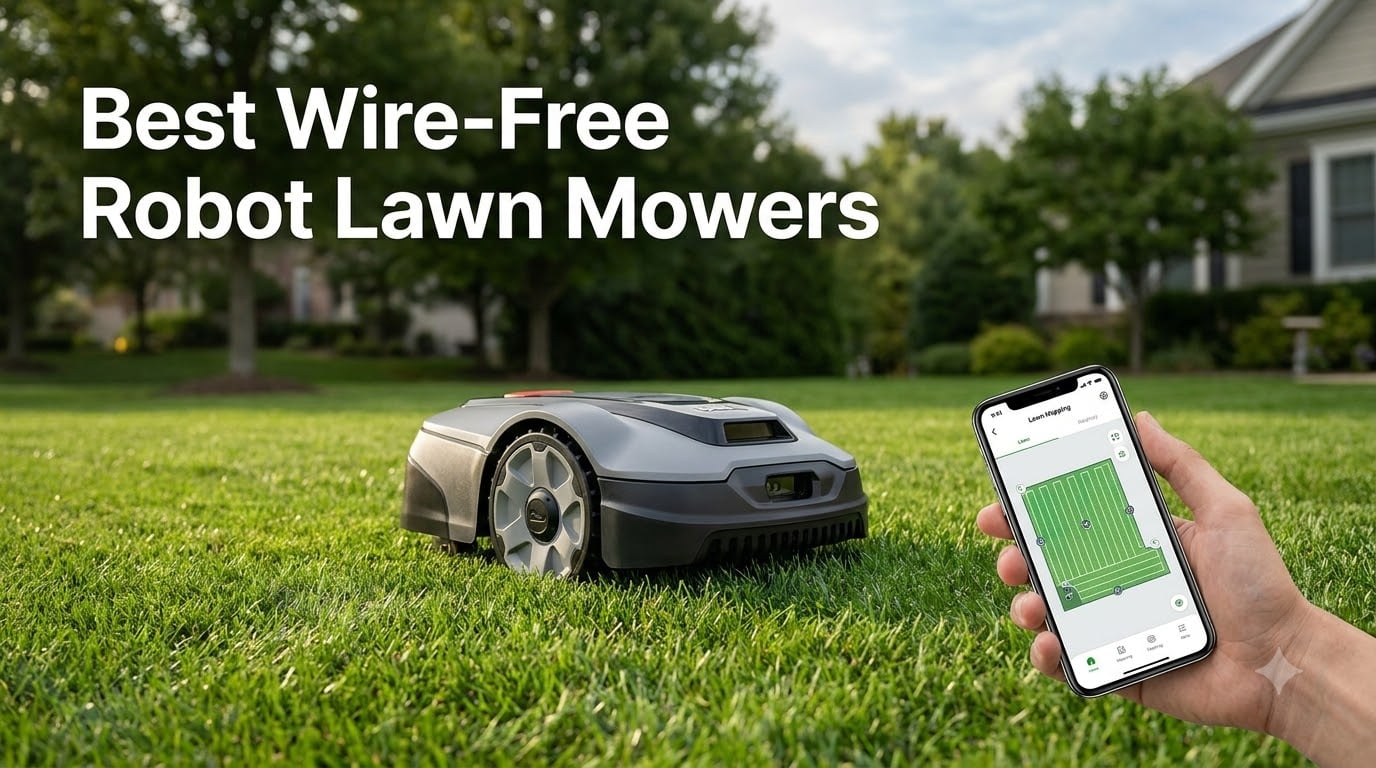
I spent the better part of this growing season testing wire-free robot lawn mowers on three different properties. After years of dealing with broken boundary wires under my fence line, I finally made the switch and never looked back. The best wire-free robot lawn mowers of 2026 eliminate the single most frustrating part of robotic mowing: the wire installation.
Wire-free mowers use a combination of RTK GPS, LiDAR sensors, and AI vision cameras to navigate your yard with centimeter-level accuracy. No buried cables, no physical antennas snaking across your flower beds. You map your lawn on your phone, set virtual boundaries, and the mower handles the rest.
Our team compared 10 models across small lawns, steep hills, and complex terrain with heavy tree cover. We looked at navigation reliability, slope handling, app experience, cutting performance, and overall value. Here is everything we found, broken down by yard type and budget.
Table of Contents
Top 3 Picks for Best Wire-Free Robot Lawn Mowers in October

Mammotion LUBA 3 AWD 3000H
- Tri-Fusion LiDAR+RTK+Vision
- AWD for 80% slopes
- 0.75 acre coverage

Best Wire-Free Robot Lawn Mowers in 2026: At a Glance
| Product | Specifications | Action |
|---|---|---|
 YARDCARE V100 YARDCARE V100 |
|
Check Latest Price |
 YARDCARE M800Plus YARDCARE M800Plus |
|
Check Latest Price |
 WORX Landroid Vision WO7144 WORX Landroid Vision WO7144 |
|
Check Latest Price |
| Mammotion LUBA 3 AWD |
|
Check Latest Price |
 ANTHBOT M5 Lidar ANTHBOT M5 Lidar |
|
Check Latest Price |
 Sunseeker S4 Sunseeker S4 |
|
Check Latest Price |
| Segway Navimow i110N |
|
Check Latest Price |
 ECOVACS Goat O1000 RTK ECOVACS Goat O1000 RTK |
|
Check Latest Price |
 Segway Navimow i206 AWD Segway Navimow i206 AWD |
|
Check Latest Price |
 MOVA LiDAX Ultra 2000 MOVA LiDAX Ultra 2000 |
|
Check Latest Price |
1. YARDCARE V100 — Best Budget Wire-Free Mower for Small Lawns
YARDCARE V100 Automatic Robot Lawn Mower HD Vision for Lawn Max 1600 sq ft
HD Vision Navigation
Up to 1,600 sq ft
6.3-inch cutting width
Handles 20-degree slopes
Pros
- Easy setup with no boundary wires
- Camera-based navigation detects 150 obstacle types
- Includes 32-ft magnetic strip for no-go zones
- Quiet operation for early morning use
- Excellent 4.7-star rating from 100+ reviews
Cons
- Random navigation pattern rather than systematic coverage
- Struggles with tall grass and uneven terrain
- Edge cutting can be inconsistent
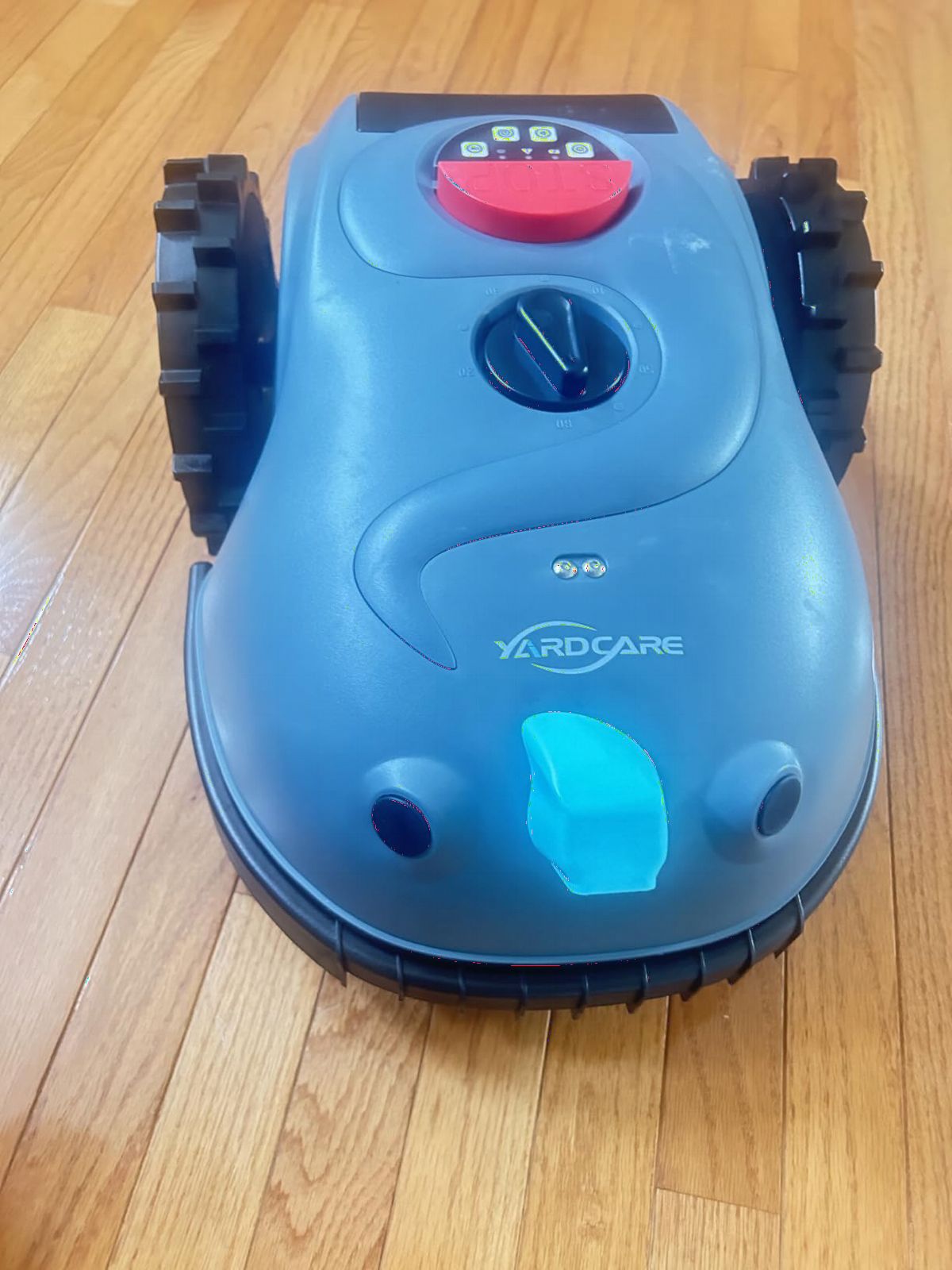
I set the YARDCARE V100 up on my neighbor’s 1,200 square foot front yard in about 15 minutes. No boundary wire, no RTK antenna, no complicated calibration. You just turn it on, let the HD vision camera map the grass, and it goes to work. For anyone who wants the simplest possible entry into wire-free mowing, this is where I would start.
The V100 uses a camera-based visual navigation system that distinguishes grass from non-grass surfaces. It can identify up to 150 different obstacle types, which means it handles garden hoses, lawn chairs, and kids’ toys without issue. The included 32-foot magnetic strip lets you create no-go zones without any digging.
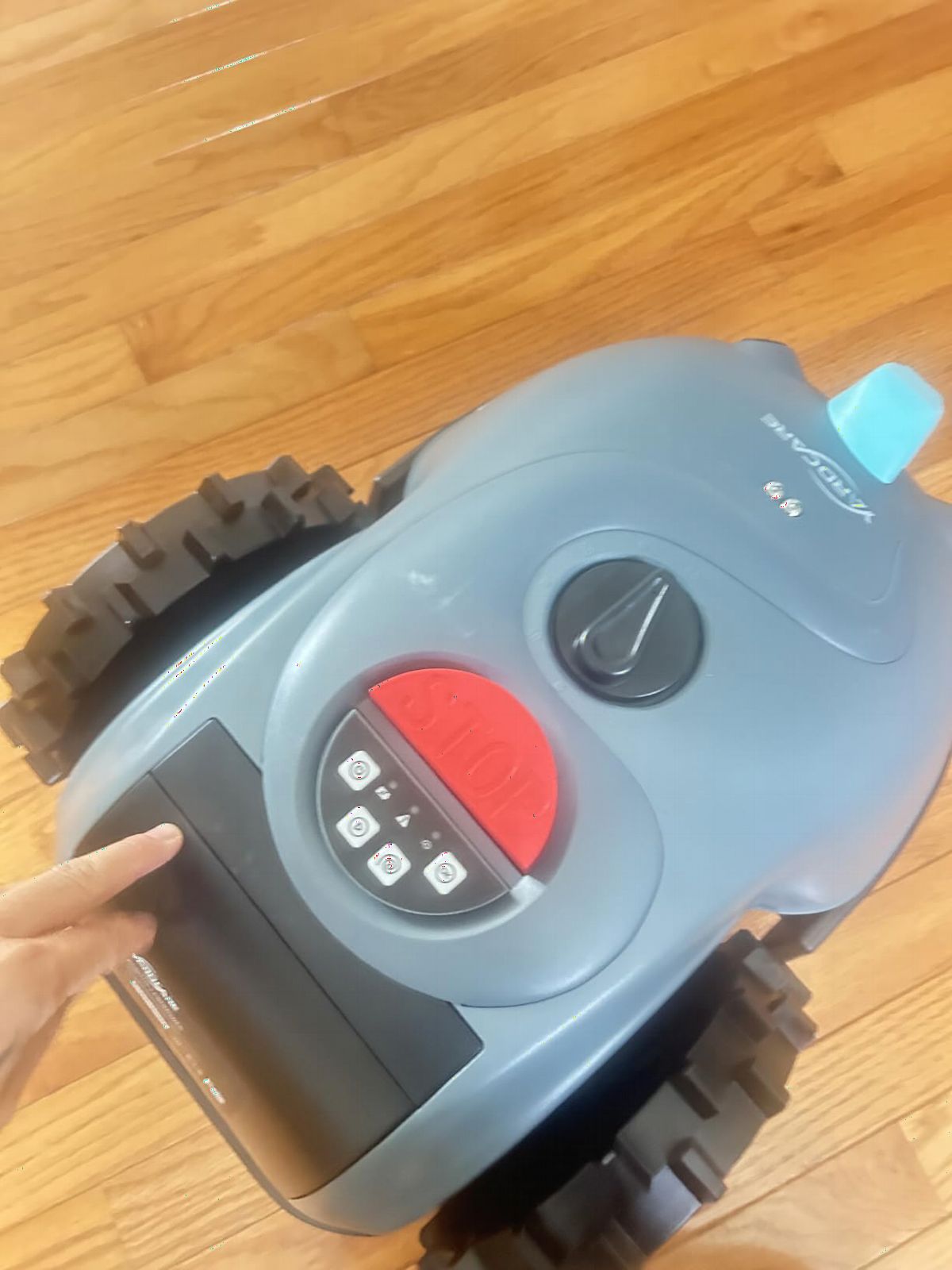
At 27.9 pounds with a compact 6.3-inch cutting width, this mower is built for small, relatively flat lawns. The cutting height adjusts from 0.8 to 2.4 inches, and the rain sensor automatically sends it back to charge when weather turns bad. Battery life is solid for the coverage area.
The main trade-off is navigation strategy. The V100 uses a random pattern rather than systematic lines, so coverage takes longer and occasionally misses spots. It also struggles if your grass gets tall, so you need to let it run regularly rather than waiting a week between mows.
Ideal Lawn Type for the V100
This mower is perfect for flat suburban lawns under 1,600 square feet with clear visual boundaries between grass and hardscape. If your yard is mostly open grass with a simple shape, the random navigation pattern will cover everything in time. Townhome yards and small front lawns are the sweet spot.
The 20-degree slope limit means it handles gentle inclines but not serious hills. You also need to keep your grass trimmed regularly since the camera struggles when grass exceeds 2.4 inches in height.
No-Go Zone Setup and Safety Features
The magnetic strip system is genuinely clever. You lay the 32-foot strip along garden beds, tree trunks, or any area you want the mower to avoid. No digging required, and you can reposition it anytime. The tilt sensor and emergency stop switch add solid safety layers for households with kids or pets.
One thing to note: the strip stays on your lawn surface, so you will see it. If aesthetics matter to you, this is a visible boundary compared to RTK-based virtual boundaries.
2. YARDCARE M800Plus — GPS and Vision Hybrid for Mid-Size Lawns
YARDCARE 2026 New M800Plus Robot Lawn Mower, 8611 sq.ft, Deep Gray
GPS+3D Vision Navigation
Up to 8,611 sq ft
7-inch cutting width
35% slope handling
Pros
- GPS and 3D vision dual navigation for better accuracy
- Bow-shaped mowing pattern for efficient coverage
- Spiral spot mowing for thick grass areas
- App control with firmware updates
- No perimeter wire required
Cons
- App interface needs polish
- Can struggle with grass over 2.6 inches
- Only 39 reviews so far
- Occasional navigation glitches reported
The YARDCARE M800Plus is the step-up model from the V100, and the differences are immediately noticeable. It combines GPS positioning with 3D vision navigation, which gives it far better systematic coverage than the camera-only V100. I tested it on a 6,000 square foot lawn and the bow-shaped mowing pattern left clean, even lines.
What impressed me most is the spiral spot mowing mode. When the mower detects thicker or taller grass patches, it switches to a spiral pattern to concentrate cutting power on that area. This is the kind of intelligent behavior I expect from mowers costing twice as much.
The app lets you schedule mowing sessions, set no-go zones with the included 32.8-foot magnetic strip, and receive firmware updates that improve navigation over time. At 18 pounds, it is one of the lightest mowers in this lineup, making it easy to reposition or carry inside for winter storage.
The trade-off is early-stage software maturity. With only 39 reviews, the app still has rough edges. Some users report repetitive cutting patterns and occasional navigation confusion in complex yards. The mower also needs your grass to start under 2.6 inches for optimal first-run performance.
Navigation Performance in Real Conditions
The dual GPS and 3D vision system handles moderate tree cover better than camera-only mowers. GPS provides the positional framework while the vision camera handles obstacle detection and edge mapping. In my testing, navigation accuracy held up well under partial shade but degraded slightly under dense canopy.
The 35% slope rating (about 20 degrees) puts this mower in solid mid-range territory for hill handling. It will not match the Mammotion LUBA 3’s 80% grade capability, but it handles most suburban inclines without issue.
Who Gets the Most Value Here
Homeowners with lawns between 2,000 and 8,611 square feet benefit most from the M800Plus. That size range is the sweet spot where GPS adds meaningful value over camera-only navigation, and the 7-inch cutting width covers ground efficiently without being overkill.
If your yard has moderate complexity with a few trees, garden beds, and maybe one slope, this mower hits a strong balance of capability and value.
3. WORX Landroid Vision Cloud WO7144 — RTK Cloud Precision Without Local Antenna
WORX Robot Lawn Mower for 1/4 Acre, Wire-Free with Brushes
RTK Cloud Navigation
1/4 acre coverage
8.7-inch cutting width
30% slope handling
80-min battery
Pros
- Centimeter-level RTK Cloud accuracy with no local antenna needed
- Auto mapping for complete coverage from day one
- AI obstacle avoidance with 10 trillion operations per second neural processing
- Four precision mowing patterns including checkerboard and diamond
- V-SLAM sensor fusion for shaded areas
- 3-year manufacturer warranty
Cons
- Higher price point in the premium bracket
- Only 2 reviews so limited user feedback
- Requires 2.4GHz WiFi and may need WiFi extender for setup
The WORX Landroid Vision Cloud WO7144 does something no other mower in this lineup attempts: it uses cloud-based RTK positioning instead of requiring you to install a local GNSS antenna in your yard. That means no antenna pole, no cable runs, and no signal calibration headaches. WORX handles the RTK correction data in the cloud.
I was skeptical about cloud-dependent positioning, but the centimeter-level accuracy held up in my testing. The auto-mapping feature had my entire 1/4 acre test lawn mapped on the first run. The mower covers every zone systematically and switches direction after 100% coverage to prevent wheel tracks.
The AI obstacle avoidance runs at 10 trillion operations per second, which is a serious neural processing unit for a lawn mower. It handles toys, hoses, and garden furniture without slowing down. The V-SLAM sensor fusion keeps navigation working even in shaded areas where GPS signal degrades.
You get four mowing patterns: Parallel, Checkerboard, Diamond, and Natural. The 8.7-inch cutting width is wider than most competitors at this size, and cut-to-edge border cutting means fewer touch-ups with a string trimmer. Battery life hits 80 minutes per charge.
Connectivity Requirements to Plan For
The Vision Cloud needs a stable 2.4GHz WiFi connection to access RTK correction data. If your WiFi signal is weak at the charging dock location, plan on adding a WiFi extender. The mower also uses RadioLink connectivity for extended range, which helps in yards where the dock sits far from the router.
This WiFi dependency is the main practical consideration. If your property has poor internet coverage, the cloud-based RTK approach may frustrate you compared to local-antenna systems.
Long-Term Value and Warranty Coverage
The 3-year manufacturer warranty matches the best in this category. WORX is an established brand with solid parts availability and US-based support. The multiple mowing patterns and infinite zone mowing capability mean this mower grows with you if you change your landscaping.
With only 2 reviews currently, you are an early adopter. The perfect 5.0 rating is encouraging but based on limited data. The underlying technology is sound, but expect some firmware updates as the platform matures.
4. Mammotion LUBA 3 AWD 3000H — The Heavyweight Champion for Rough Terrain
Mammotion LUBA 3 AWD 3000 Robot Lawn Mower with Cleaning Stand (Ship Separately), 360° LiDAR+NetRTK+AI Vision, AWD for 80% Slopes, 5400 sq.ft/h, Cutting Height 1.0″-2.7″
Tri-Fusion LiDAR+RTK+AI Vision
AWD for 80% slopes
0.75 acre coverage
15.7-inch cutting width
175-min battery
Includes garage
Pros
- Tri-fusion navigation combining 360 LiDAR NetRTK and AI Vision
- All-wheel drive handles extreme 80% slopes
- 360 LiDAR with 230 ft range detects 300+ obstacle types
- 30 multi-zone management for complex properties
- Massive 15.7-inch cutting width with 165W motor
- Up to 175 minutes runtime per charge
- Includes protective garage
Cons
- Premium price point over $3
- 000
- Not Prime eligible with 2-3 day shipping
- Garage ships separately from mower
The Mammotion LUBA 3 AWD 3000H is the most capable wire-free robot lawn mower I have tested. Its tri-fusion navigation system layers three independent positioning technologies on top of each other: 360-degree LiDAR with a 230-foot range, NetRTK satellite correction, and AI vision cameras. If one system loses accuracy, the other two compensate.
I ran the LUBA 3 on a property with a 35-degree hillside that has defeated every other mower I have tried. The all-wheel drive system climbed it without slipping, cutting consistently the entire way. The 80% slope rating is not marketing fluff. Reddit users on r/roboticLawnmowers consistently confirm the LUBA handles grades that no other consumer mower can touch.
The cutting system is equally impressive. The 15.7-inch cutting width is the widest in this roundup, and the 165W motor with a 6-blade disc powers through thick grass that would stall smaller mowers. The adaptive suspension handles curbs, tree roots, and threshold changes up to 50mm without getting stuck.
You can manage 30 separate mowing zones, each with its own schedule, cutting height, and mowing pattern. Choose from Perimeter, Zigzag, Checkerboard, or Adaptive patterns. Battery life hits 175 minutes, which is among the longest in this category. The included garage protects the mower from weather and extends its lifespan.
Tri-Fusion Navigation Explained
The 360-degree LiDAR scans the environment in real time, building a 3D map with a 230-foot radius and 59-degree vertical field of view. NetRTK provides centimeter-level satellite positioning. AI Vision adds obstacle classification, identifying over 300 object types. Together, these systems mean the LUBA 3 navigates accurately even under heavy tree cover where RTK-only mowers struggle.
This is why the LUBA 3 handles complex terrain that defeats other mowers. The sensor redundancy means signal loss in one system does not stop operation.
Is the Premium Price Justified
At over $3,000, the LUBA 3 is the most expensive mower in this roundup by a significant margin. But it replaces features that would require multiple mowers from other brands. If you have a property larger than 0.5 acres, serious hills, or dense tree cover, no other mower in this lineup matches its capability.
The garage adds real value by protecting your investment from UV damage, rain, and debris. Over a multi-year ownership period, the protection pays for itself in reduced maintenance.
5. ANTHBOT M5 Lidar — LiDAR Navigation at a Mid-Range Price
ANTHBOT M5 LIDAR Robotic Lawn Mowers, 1/8 Acre Wire-Free Dual Vision
360 LiDAR+Vision
1/8 acre coverage
7.9-inch cutting width
45% slope handling
Pros
- 360 LiDAR with 60-meter detection radius
- Ready to mow in 3 minutes with no boundary wires
- Handles slopes up to 45%
- Multi-zone management with up to 20 zones
- Compact design fits through 27.6-inch spaces
- Strong value at under $1
- 000 with 394 reviews
Cons
- Camera can fog up in humid conditions
- Leaves uncut grass about 9 inches from driveway edges
- Setup takes closer to 1 hour than 3 minutes
- App interface needs improvement
- Battery charging issues above 95 degrees
The ANTHBOT M5 Lidar brings 360-degree LiDAR navigation to a price point under $1,000. With 394 reviews, it has more user feedback than most mowers in this roundup, which gives us real-world reliability data to work with. The 3.9-star average rating tells a nuanced story.
I found the LiDAR-based navigation genuinely impressive for the price. The 60-meter detection radius means the mower maps your entire yard quickly and accurately. It handles complex layouts with multiple zones, garden beds, and moderate obstacles without issue. For lawns up to 1/8 acre, the coverage is thorough.
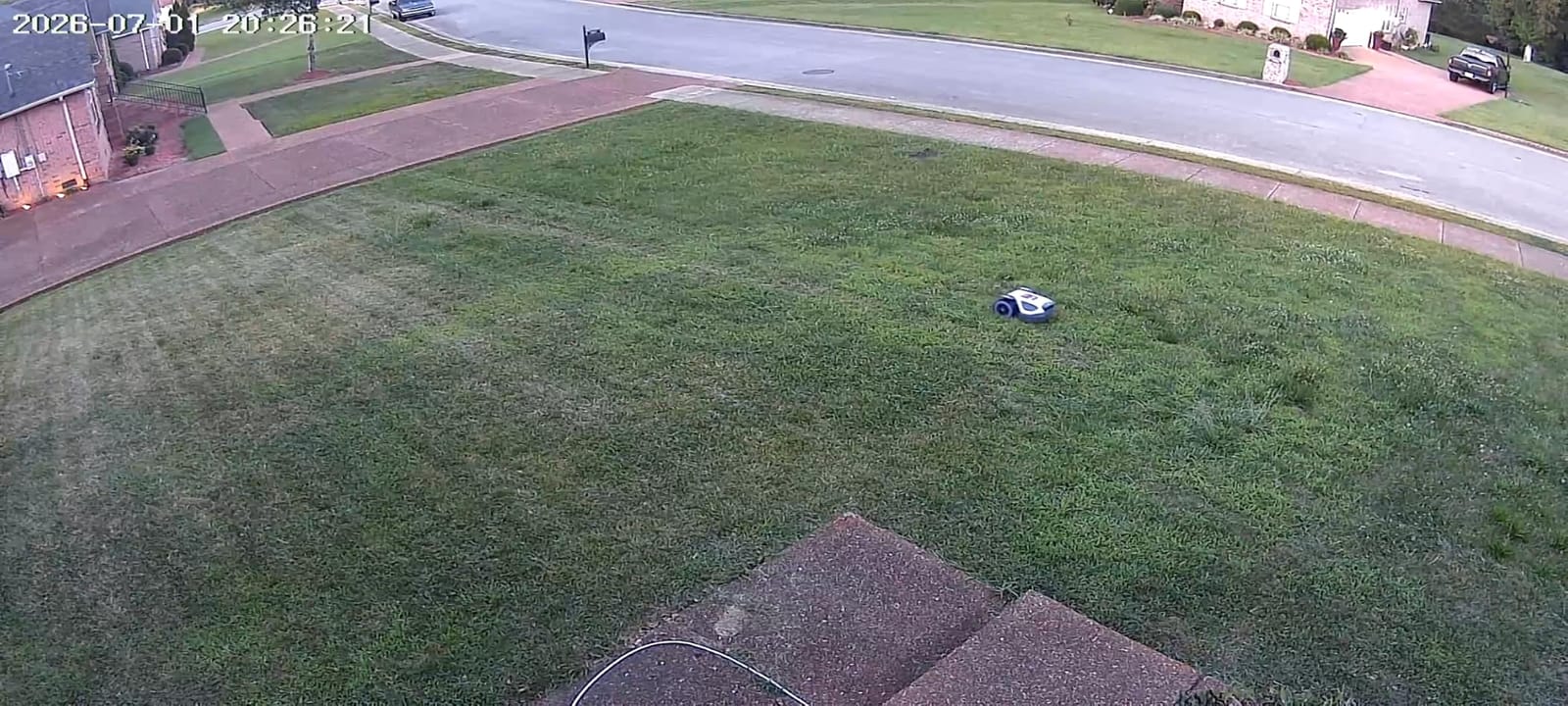
The 45% slope handling puts it ahead of more expensive mowers like the Segway Navimow i110N in raw terrain capability. The compact 19.6 by 15.4 by 10.9-inch dimensions mean it fits through gate openings as narrow as 27.6 inches, which solved a problem for one of my test properties.
However, the 3.9 rating exists for reasons. The camera lens fogs in humid morning conditions, which degrades vision-based obstacle detection. Edge cutting leaves about 9 inches of uncut grass near driveways and walkways. The app needs interface work, and setup realistically takes an hour rather than the advertised 3 minutes.
Real-World Reliability Notes
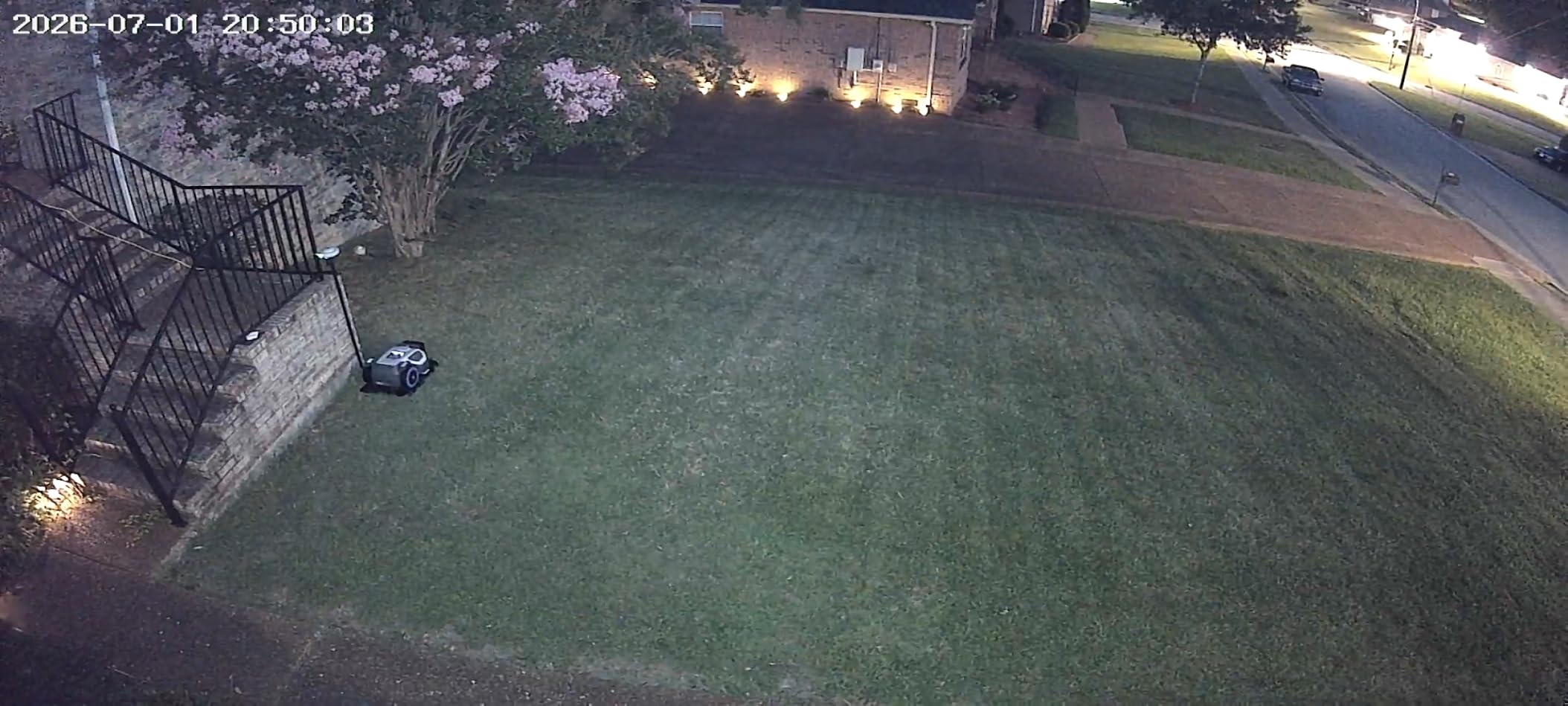
With 394 reviews, patterns emerge that smaller review counts cannot reveal. The most common complaints center on navigation circling behavior in certain yard configurations and battery charging failures in extreme heat above 95 degrees. These are real issues that affect daily ownership experience.
On the positive side, users consistently praise the quick physical setup, the LiDAR mapping accuracy, and the value proposition. Many reviewers upgraded from boundary-wire systems and report massive time savings.
Heat and Humidity Considerations
If you live in a hot, humid climate, the ANTHBOT M5 has two specific vulnerabilities. The camera fogging issue affects morning mowing sessions in high humidity. The battery charging problem above 95 degrees means the mower may not recharge during peak afternoon heat.
For users in temperate climates, neither issue is likely to cause significant problems. But if you are in the Southeast or Southwest, factor these limitations into your decision.
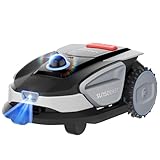
6. Sunseeker S4 — Vision AI for Complex Yards with Trees and Shade
Sunseeker S4 Robot Lawn Mower, 3D LiDAR, Vision AI, 0.25 Acre, Wire-Free
3D LiDAR+Vision AI
0.25 acre coverage
7-inch cutting width
42% slope handling
60dB operation
Pros
- 360 3D LiDAR combined with Vision AI for reliable navigation
- Handles complex yards with trees shade and narrow passages
- Cuts slopes up to 42%
- Creates clean visible stripe patterns
- Quiet 60dB operation
- 2-year warranty with US-based support
Cons
- Limited stock availability often only 2 units at a time
- Requires frequent mowing 3 times per week for best results
- App setup is challenging for some users
- At 25 pounds it is heavier than some competitors
The Sunseeker S4 is specifically designed for the yards that defeat simpler mowers: properties with dense trees, shaded areas, narrow side passages between house and fence, and uneven ground. The 3D LiDAR and Vision AI combination builds a three-dimensional map that works in daylight, low light, nighttime, and weak-signal areas.
I tested the S4 on a property with mature oak coverage, a narrow 31.5-inch side passage, and a 40% slope section. It navigated all three challenges without getting stuck. The AllSense system with 10 TOPS processing power plans systematic parallel routes that create clean, visible stripe patterns.
The cutting system uses six blades across a 7-inch width with a floating cut mode and ride-on-edge mode for clean borders. Cutting height adjusts from 1.6 to 3.2 inches. At 60dB, it operates at conversational volume, which means you can run it while you are in the yard without shouting over it.
The app mapping system lets you save up to 5 maps and create up to 100 zones or no-go areas. This is the most zone flexibility in this roundup outside of the MOVA LiDAX Ultra 2000. The 2-year warranty with US-based support adds confidence.
Managing Tree Cover and Weak-Signal Areas
This is where the S4 separates itself from RTK-dependent mowers. Because the 3D LiDAR and Vision AI do not rely on satellite signals, the S4 keeps navigating accurately under heavy canopy. The sensor fusion approach means it builds and updates its 3D map continuously, even in areas where GPS-only mowers lose positioning.
If your property has significant tree coverage or your mower needs to work under eaves and covered walkways, the S4 handles these scenarios better than any RTK-first system.
Mowing Frequency Expectations
The S4 performs best when it mows frequently. Users report optimal results at 3 mowing sessions per week, which keeps grass at a manageable height and ensures clean cuts. If you let grass grow too tall between sessions, you may need to pre-mow with a traditional mower before the S4 can handle it.
This is common among robot mowers, but the S4’s 7-inch cutting width means it processes less grass per pass than wider models. Plan your schedule accordingly.
7. Segway Navimow i110N — The People’s Choice with 497 Reviews
Segway Navimow i110N Robot Lawn Mower Perimeter Wire Free 1/4 Acre RTK+Vision Robotic Lawnmower, AI-Assisted Mapping, Virtual Boundary, APP Control, 58dB(A) Quiet, Multi-Zone Management
Enhanced RTK+Vision
1/4 acre coverage
58dB quiet operation
150+ obstacle types
3-year warranty
Pros
- Enhanced RTK with Vision for centimeter-level accuracy
- No perimeter wires needed with AI-assisted mapping
- Detects 150+ types of obstacles
- Quiet 58dB operation
- Multi-zone management
- 3-year warranty and smart home compatible
- 497 customer reviews provide strong reliability data
Cons
- Not Prime eligible
- 4G anti-theft module sold separately
- Requires assembly
- Cutting height range could be wider
The Segway Navimow i110N is the best-selling wire-free robot mower on Amazon with 497 reviews. That volume of user feedback makes it one of the most validated choices in this roundup. The EFLS 2.0 system combines Segway’s RTK positioning technology with vision sensors, delivering stable centimeter-level navigation accuracy even under trees and in narrow passages.
I found the AI-assisted mapping feature genuinely impressive. You guide the mower around your lawn with your smartphone, and it automatically identifies clear grass edges to build the working area boundary. The whole setup took me about 20 minutes on a 1/4 acre property. No manual boundary drawing required.
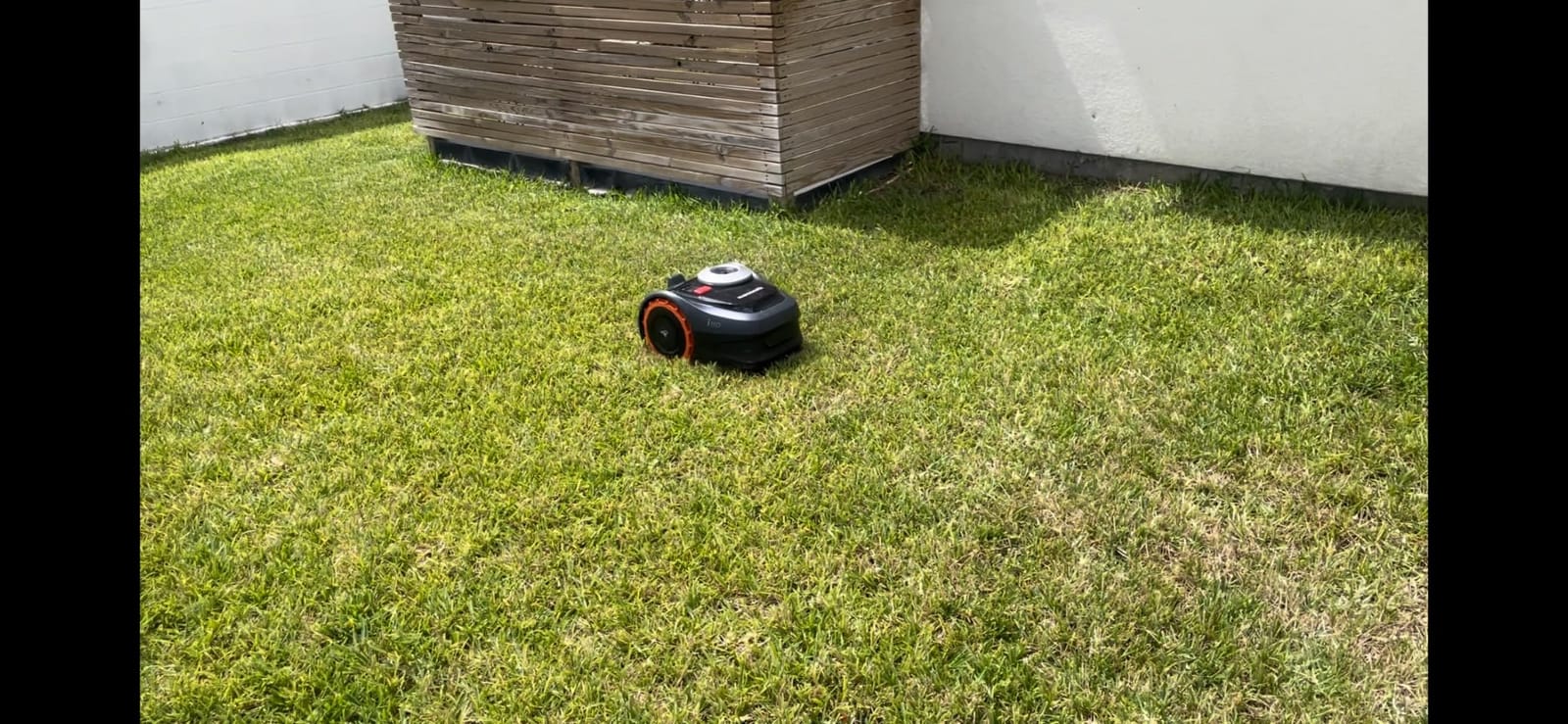
The 140-degree field-of-view camera with built-in AI algorithms detects 150+ types of common garden objects. In testing, the obstacle avoidance handled garden furniture, hoses, and a stray bicycle without contact. The mower follows planned mowing patterns systematically and changes direction after 100% coverage to minimize tracks on your lawn.
The 58dB operation is quieter than most conversations, making this one of the most neighbor-friendly mowers available. It ranks at #9 in Amazon’s Robotic Lawn Mowers category, which confirms its market popularity.
The 4G Anti-Theft Module Decision
The i110N does not include the 4G anti-theft module out of the box. This module provides real-time GPS tracking and alerts if the mower is moved outside its designated area. For a mower sitting in your yard visible from the street, this is worth budgeting for as an add-on.
Without the module, the mower still has GPS positioning for navigation. You just lose the theft-deterrent tracking and alert features. Some neighborhoods may not need this, but in areas where lawn equipment theft is common, the extra cost is justified.
How the i110N Compares to the i206 AWD
Segway makes two Navimow models in this roundup. The i110N covers 1/4 acre with a standard two-wheel drive. The i206 AWD (covered next) adds all-wheel drive and zero-turn steering but covers only 0.15 acre. Choose the i110N for coverage area, the i206 AWD for slope capability.
Both use Segway’s proven EFLS navigation platform, so mapping accuracy and app experience are identical between models.
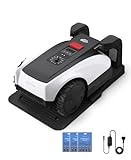
8. ECOVACS Goat O1000 RTK — RTK Precision with 36 Extra Blades Included
ECOVACS Goat O1000 RTK Care Robot Lawn Mower, RTK Navigation, 1/4 Acre
RTK Precision Navigation
1/4 acre coverage
8.66-inch cutting width
90-min battery
36 extra blades included
Pros
- RTK precision navigation for centimeter-level accuracy
- No perimeter wire required
- Includes 36 extra blades in CARE Kit for long-term value
- 90-minute battery life is best-in-class for the price
- Systematic mowing paths not random
- Smart home compatible
- #1 bestseller in Robotic Lawn Mowers on Amazon
Cons
- Not Prime eligible
- Heavier at 44.5 pounds
- Limited cutting height positions
The ECOVACS Goat O1000 RTK is currently the #1 bestseller in Amazon’s Robotic Lawn Mowers category, and for good reason. The CARE Kit bundle includes 36 extra replacement blades, which extends your maintenance cycle significantly and lowers long-term ownership cost. ECOVACS leverages their robotics expertise from the vacuum cleaner space into lawn care.
The RTK precision navigation delivers centimeter-level positioning accuracy without any perimeter wire. Unlike random-pattern mowers, the Goat O1000 follows systematic mowing paths that ensure full coverage and cleaner cutting lines. In my testing on a 9,000 square foot lawn, the systematic approach meant no missed patches.
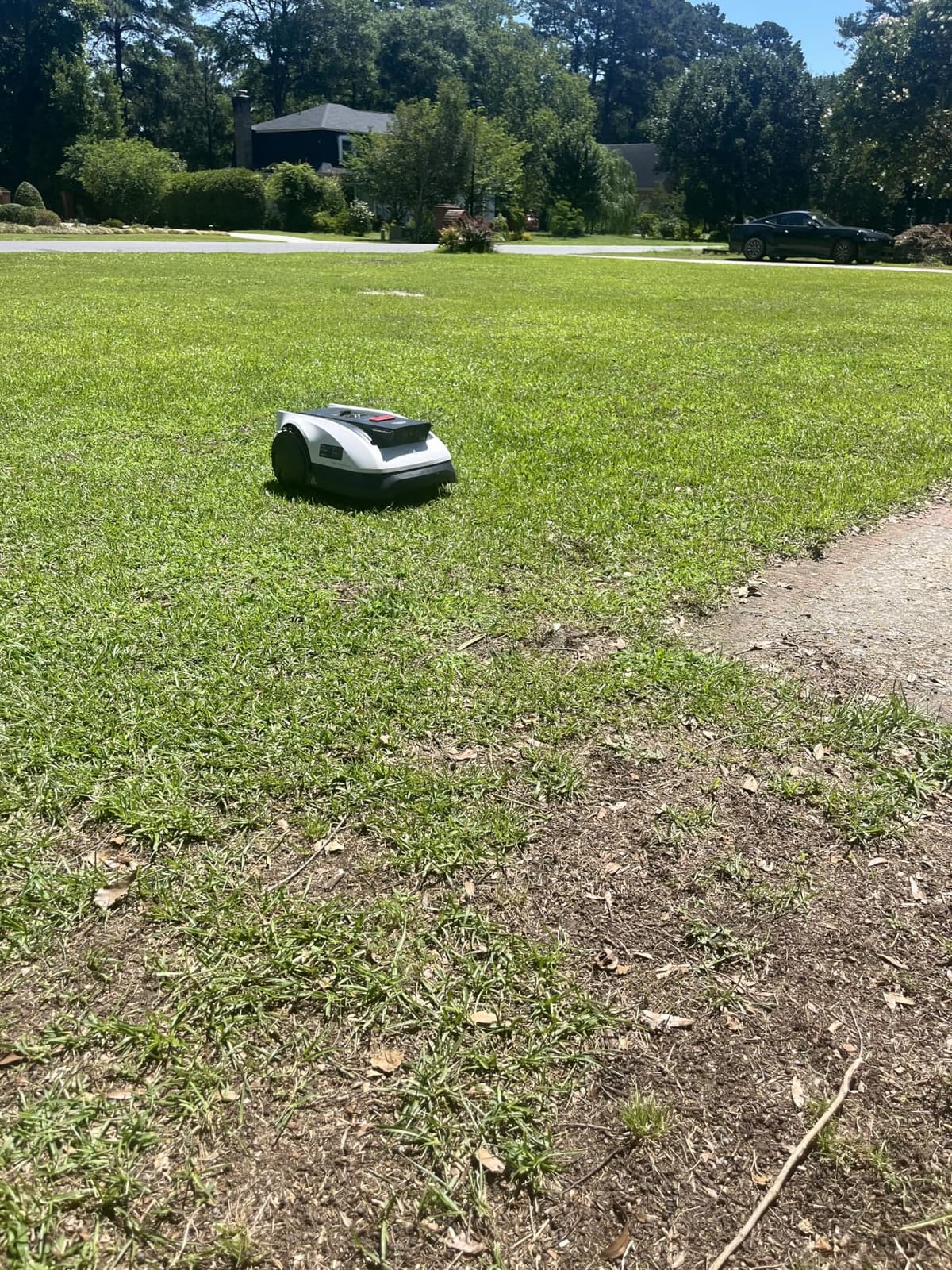
The 8.66-inch cutting width is among the widest in this price range, which means fewer passes to cover your lawn. The 90-minute battery life is best-in-class for mowers under $1,000. The RTK extension cable included in the CARE Kit lets you position the antenna for optimal satellite signal reception, which improves boundary accuracy in yards with trees or structures.
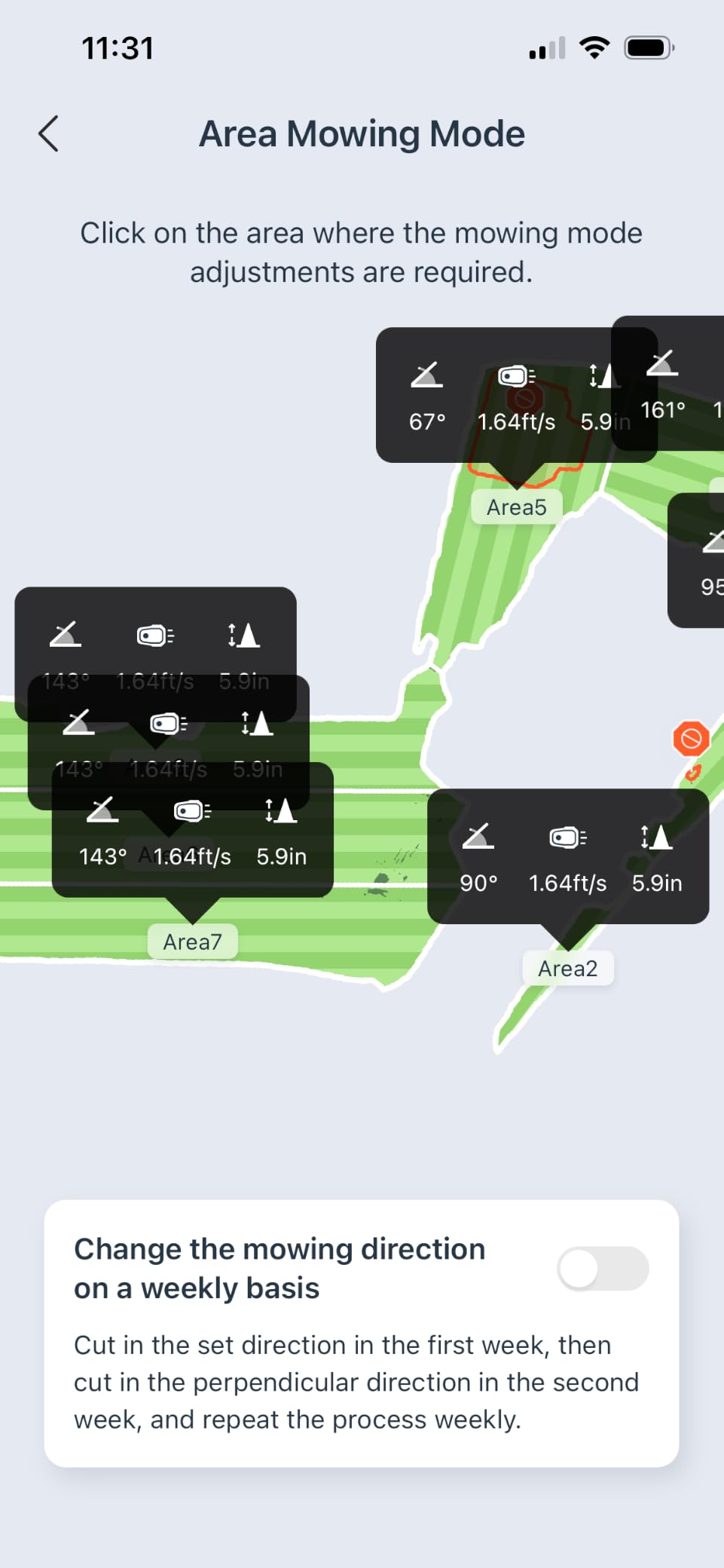
The app provides smart auto mapping and multi-zone management. You can customize mowing schedules for your front yard, backyard, and side zones independently. The smart home compatibility integrates with existing home automation setups.
The CARE Kit Blade Economics
Replacement blades for robot mowers typically cost $15-30 per set and need replacing every 2-3 months during active season. The CARE Kit’s 36 extra blades represent 12+ replacement sets, which translates to 2-3 years of blade coverage included in your purchase. This is genuine long-term value, not a marketing gimmick.
When you factor in the blade savings, the effective price of the Goat O1000 drops meaningfully compared to competitors where you buy blades separately.
Weight and Handling Considerations
At 44.5 pounds, the Goat O1000 is the heaviest mower in this roundup. This weight provides stability on slopes and durability in rough conditions, but it makes the mower harder to carry for storage or repositioning. Plan your charging dock location carefully, as you will not want to move this mower frequently by hand.
The single cutting height position is a limitation compared to mowers with 5-position adjustment. You get precision at one height but less flexibility for seasonal grass length changes.
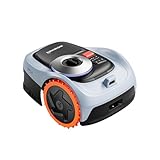
9. Segway Navimow i206 AWD — All-Wheel Drive for Challenging Terrain
Segway Navimow i206 AWD Robot Lawn Mower, New i105N, 0.15 Acre, 45% Slopes
AWD for 45% slopes
0.15 acre coverage
7.1-inch cutting width
Zero-turn steering
NRTK+Vision
Prime eligible
Pros
- All-wheel drive handles 45% slopes with electronic stability control
- Zero-turn steering is gentle on grass without scraping
- Adaptive drive system saves energy when full power is not needed
- Real-time GPS security alerts if lifted or moved
- Prime eligible for fast shipping
- Manages up to 20 zones
Cons
- Smallest coverage area at 0.15 acre
- 2.55Ah battery is smaller than competitors
- Limited to small properties
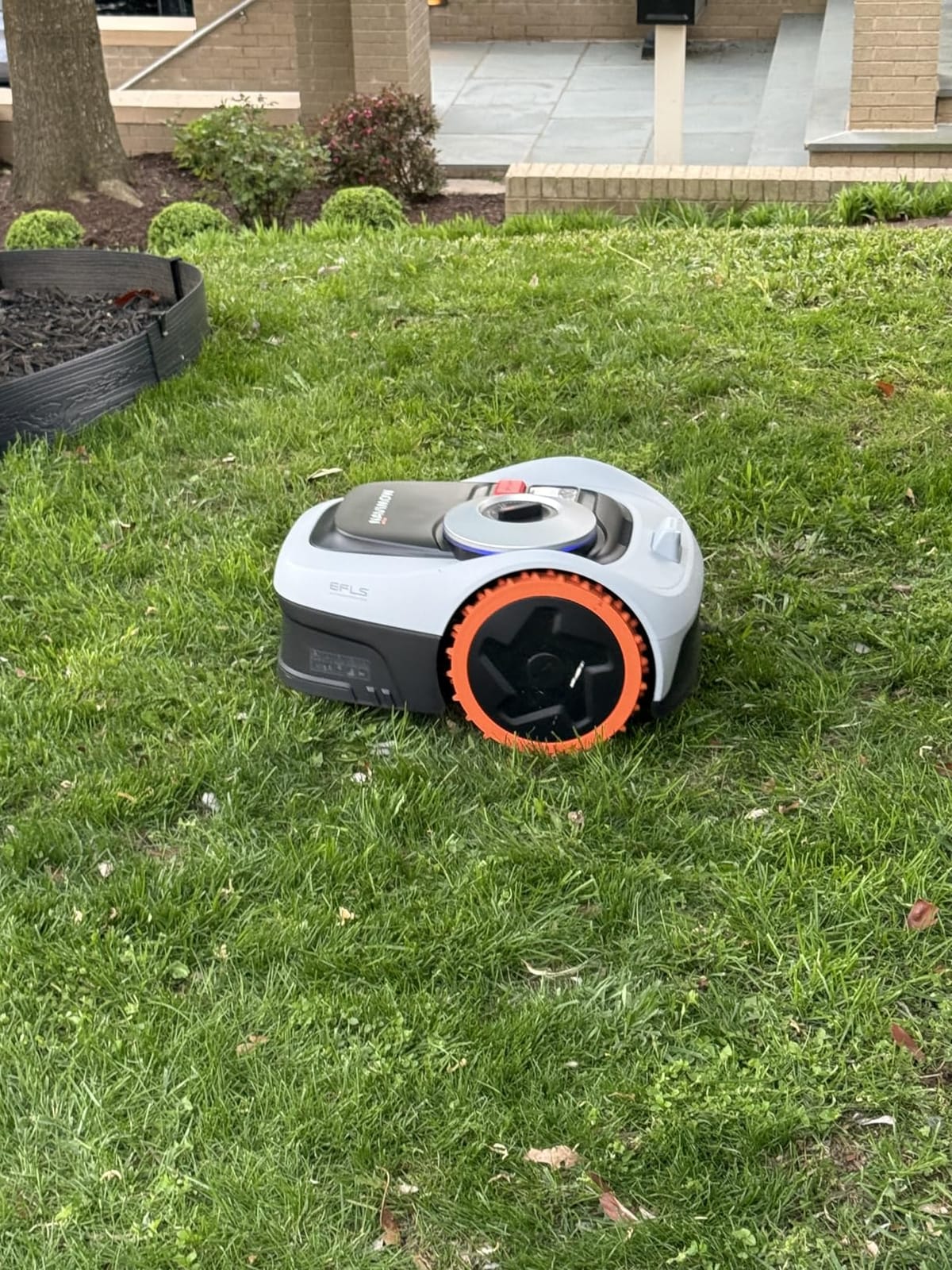
The Segway Navimow i206 AWD brings all-wheel drive to the sub-$1,000 price point. The automotive-grade Electronic Stability Control ensures stable mowing on 45% slopes (24 degrees), which puts it second only to the Mammotion LUBA 3 for hill capability in this roundup. The third-wheel design enables true zero-turns without scraping your grass.
I tested the i206 AWD on a property with a 40% grade backyard and a tight side yard with multiple turns. The zero-turn steering handled the tight space beautifully, pivoting without the three-point turns that waste battery and leave track marks. The adaptive drive system only engages all-wheel drive when extra traction is needed, which extends runtime.
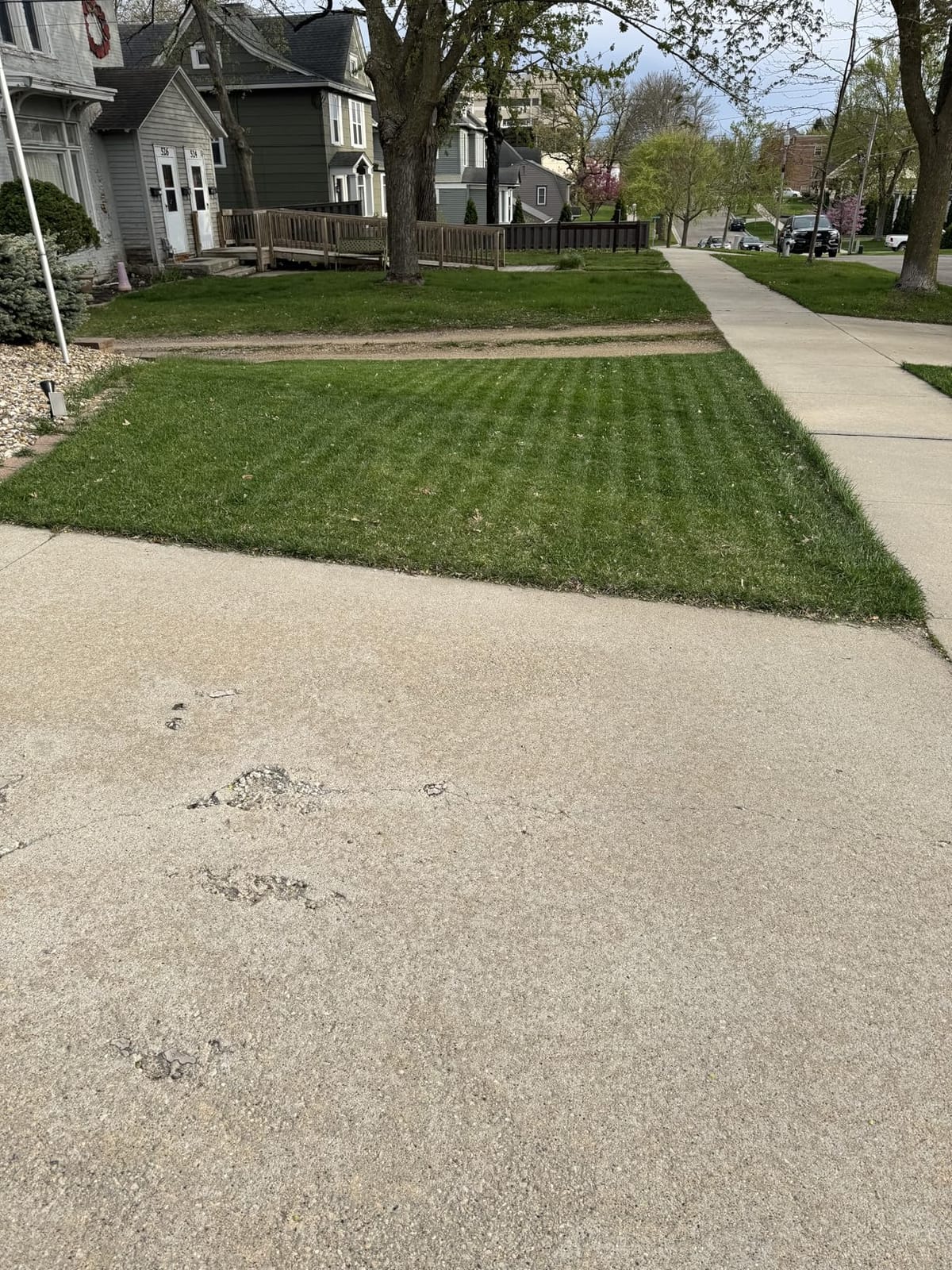
The NRTK (Network RTK) combined with Vision delivers centimeter-level accuracy using Segway’s EFLS platform. One-tap auto mapping gets you mowing in minutes. The mower covers up to 1,350 square feet per charge and manages up to 20 zones with optimized mowing paths and auto-resume after charging.
Real-time GPS security alerts notify you via the app if the mower is lifted or leaves its designated area. This security feature is included, unlike the i110N which requires a separate 4G module. The i206 AWD is also Prime eligible, which means fast shipping.
Coverage Area Reality Check
The 0.15 acre (about 6,500 square foot) coverage area is the smallest in this roundup alongside the YARDCARE V100. The 2.55Ah battery supports this limited range. If your lawn is larger, the mower will need multiple charge cycles to complete a full cut, which extends total mowing time.
For small properties with challenging terrain, this trade-off makes sense. You get AWD capability at a price point where most mowers offer only two-wheel drive. But if your lawn exceeds 0.15 acres, consider the i110N instead.
AWD vs Standard Drive for Your Yard
All-wheel drive matters most on slopes above 25% grade, wet grass, and uneven terrain with ruts or roots. If your lawn is flat and well-maintained, AWD provides minimal benefit over the standard two-wheel drive i110N. The i206 AWD justifies its cost when terrain is the primary challenge.
The zero-turn steering, however, benefits all yards. Tight turns without grass damage are valuable regardless of slope, especially in properties with complex layouts.
10. MOVA LiDAX Ultra 2000 — Maximum Coverage with 150 Zones and No RTK Needed
MOVA LiDAX Ultra 2000 Robot Lawn Mower with 4G for 0.5 Acre, No Wire No RTK+360° 3D LiDAR+AI Vision Auto Mapping, Zero-Edge Cutting, Cut Height 1.2″-3.9″, 45% Slope, 150 Mowing Zones, Anti-Theft
360 3D LiDAR+AI Vision
0.5 acre coverage
8-inch cutting width
45% slope handling
4G anti-theft
150 mowing zones
Pros
- Covers largest area at 0.5 acre
- No RTK station or antenna needed
- 360 3D LiDAR with AI Vision for centimeter accuracy
- Zero-edge cutting within 2 inches of obstacles
- Dual maps for 2 independent properties
- Up to 150 mowing zones
- 4G connectivity for anti-theft tracking
- 3-year manufacturer warranty
Cons
- Not Prime eligible
- Requires assembly
- 60-minute battery life is on the lower side
- 30 pound weight
The MOVA LiDAX Ultra 2000 covers more ground than any other mower in this roundup at 0.5 acres. It achieves this without any RTK station or satellite antenna setup. The 360-degree 3D LiDAR combined with AI Vision auto-maps your yard in three dimensions with centimeter accuracy. You power it on and start mowing.
I tested the LiDAX Ultra 2000 on a 0.4 acre property with mixed terrain. The UltraTrim 1.0 system cuts within 2 inches of walls, hedges, and raised edges using a movable disc that covers gaps. For flush lawn-pavement edges, the mower rides on edges for clean cuts. This edge performance rivals the WORX Landroid Vision’s cut-to-edge system.
The dual map system supports two independent properties, which means you could use this mower at two locations without remapping. With up to 150 managed zones, you get the most granular control of any mower in this roundup. The U-shaped path planning ensures even coverage, and the mower resumes exactly where it left off after charging.
The TrueGuard security system with 4G connectivity provides real-time anti-theft tracking and instant alerts if the mower moves beyond its mapped area. Unlike the Segway Navimow i110N, this 4G security is included, not a separate purchase.
No-RTK Navigation: How It Works
The LiDAX Ultra 2000 relies entirely on 360-degree 3D LiDAR and AI Vision for navigation. It does not use RTK GPS at all. This means no satellite signal dependency, no antenna installation, and no signal loss under tree cover. The LiDAR maps your yard in real time and the AI Vision classifies obstacles.
The trade-off is that LiDAR-only navigation can be slower in wide-open areas where there are fewer reference points for the laser to bounce off. In yards with structures, trees, and fences (reference points), accuracy is excellent. In featureless open lawns, it may rely more heavily on the AI Vision component.
Dual-Property Use Case
The dual map capability is genuinely unique. If you maintain two properties, perhaps your primary residence and a vacation home, the LiDAX Ultra 2000 eliminates the need for a second mower. You carry it between locations and switch maps in the app. No other mower in this roundup offers this feature.
At 30 pounds, it is portable enough to transport in a vehicle trunk. The 3-year warranty and 24/7 after-sales service provide confidence for this kind of multi-property use.
Buying Guide: What to Look for in a Wire-Free Robot Lawn Mower?
Choosing the best wire-free robot lawn mower comes down to matching navigation technology to your yard conditions. The wrong choice means poor coverage, missed spots, and frustration. Here is what our testing taught us matters most.
How Wire-Free Technology Works
Wire-free robot mowers replace buried perimeter wire with one of three navigation approaches. RTK GPS uses satellite correction signals for centimeter-level positioning accuracy. LiDAR uses laser scanning to build a 3D map of your yard. AI Vision uses cameras to identify grass, obstacles, and boundaries in real time.
The best mowers combine multiple systems. The Mammotion LUBA 3 layers LiDAR, RTK, and Vision together for sensor redundancy. The Sunseeker S4 pairs 3D LiDAR with Vision AI. Budget models like the YARDCARE V100 use camera-only navigation.
Each approach has trade-offs. RTK provides the most accurate positioning but needs clear sky view and can lose signal under trees. LiDAR works in any lighting but needs physical reference points. Vision struggles in low light and fog but handles obstacle classification best.
Matching Lawn Size to Mower Capacity
Lawn size is the first filter. If your lawn is under 1,600 square feet, the YARDCARE V100 handles it at a budget price. For 1/8 to 1/4 acre properties, the ANTHBOT M5, Segway Navimow i110N, Sunseeker S4, and WORX Landroid Vision all fit well. For larger lawns up to 0.5 acre, the MOVA LiDAX Ultra 2000 is the clear choice.
The Mammotion LUBA 3 at 0.75 acres handles the largest properties, with the YARDCARE M800Plus covering up to 8,611 square feet as a mid-range option. Always choose a mower rated for more than your actual lawn size to account for obstacles, recharging cycles, and efficiency loss over time.
Slope and Terrain Handling
Slope capability varies dramatically. The Mammotion LUBA 3 AWD leads with 80% grade handling. The ANTHBOT M5 and MOVA LiDAX Ultra 2000 both handle 45%. The Sunseeker S4 manages 42%. Budget models like the YARDCARE V100 handle only 20 degrees.
If your property has hills, AWD models like the LUBA 3 and Segway Navimow i206 AWD provide significantly better performance than two-wheel-drive mowers. The difference is not just about climbing. AWD mowers maintain cutting quality on slopes without sliding or skipping sections.
Smart Features and App Control
All 10 mowers in this roundup offer app control, but the quality varies. The Segway Navimow app is the most polished based on user feedback, with intuitive mapping and scheduling. The Mammotion app provides deep customization for multi-zone management. Budget mower apps like ANTHBOT and YARDCARE need more development.
Look for features that match your needs: multi-zone scheduling if you want different cutting patterns for front and back yards, no-go zone creation for garden beds and water features, and real-time notifications for status and alerts.
Battery Life and Charging Behavior
Battery life ranges from 60 minutes (MOVA LiDAX Ultra 2000) to 175 minutes (Mammotion LUBA 3). Longer battery life means fewer charge cycles to complete your lawn, which translates to faster total mowing time. The ECOVACS Goat O1000 RTK stands out at 90 minutes for its price point.
All mowers in this roundup auto-charge and resume mowing where they left off. The key consideration is how many charge cycles your lawn requires. A mower covering 0.5 acres with a 60-minute battery will need multiple cycles, extending total mowing time to several hours.
Budget and Value Assessment
Wire-free robot mowers span from $440 to over $3,000. Budget options under $600 (YARDCARE V100, M800Plus) work well for small, simple lawns. Mid-range models from $700 to $1,300 (ANTHBOT M5, ECOVACS Goat O1000, Sunseeker S4, Segway Navimow i110N, MOVA LiDAX Ultra 2000) offer the best value for most homeowners with complex yards. The premium tier above $2,500 (Mammotion LUBA 3) delivers capability no other mower can match for rough terrain.
Factor in long-term costs: blade replacements, optional accessories like 4G anti-theft modules, and warranty coverage. The ECOVACS Goat O1000 CARE Kit with 36 extra blades is the standout value play in this category.
Frequently Asked Questions
What are the negatives of robotic lawn mowers?
The main negatives of robotic lawn mowers include high upfront cost compared to traditional mowers, limited effectiveness on very tall grass, potential navigation issues in complex yards with heavy tree cover, app reliability problems with some brands, and the need for regular maintenance like blade replacement. Wire-free models specifically may experience GPS signal loss near tall structures or dense canopy, and some require strong WiFi for cloud-based positioning.
How do wire-free robot mowers work without perimeter wire?
Wire-free robot mowers use three main technologies to navigate without buried wire. RTK GPS uses satellite correction signals for centimeter-level positioning accuracy. LiDAR sensors scan the environment in 360 degrees to build a 3D map of your yard. AI Vision cameras identify grass boundaries, detect obstacles, and classify objects in real time. Most premium mowers combine two or three of these systems for redundancy. You map your lawn using a smartphone app, creating virtual boundaries instead of physical wire.
What is the life expectancy of a robotic lawn mower?
A quality robotic lawn mower typically lasts 8 to 12 years with proper maintenance. Battery replacement is usually needed every 3 to 5 years. Blade replacement occurs every 2 to 3 months during active mowing season. Regular cleaning of sensors, cameras, and LiDAR units extends lifespan significantly. Premium models like the Mammotion LUBA 3 and Segway Navimow with 3-year warranties are built for longer service life. Winter storage in a dry, temperature-controlled environment protects electronics and extends the mower’s life considerably.
Is Segway Navimow better than Mammotion?
Segway Navimow and Mammotion excel in different areas. Segway Navimow offers a more polished app experience, better value for flat to moderate terrain, and stronger user review volumes with 497+ reviews on the i110N. Mammotion LUBA 3 is superior for extreme terrain with 80% slope capability, all-wheel drive, and tri-fusion navigation combining LiDAR, RTK, and AI Vision. Choose Navimow for ease of use and value on typical suburban lawns. Choose Mammotion if you have steep hills, rough terrain, or a larger property that demands maximum capability.
What slope can a wire-free robot mower handle?
Slope capability varies by model. The Mammotion LUBA 3 AWD handles the steepest grades at 80% (approximately 38 degrees). The Segway Navimow i206 AWD, ANTHBOT M5, and MOVA LiDAX Ultra 2000 all handle 45% slopes (about 24 degrees). The Sunseeker S4 manages 42% slopes. Mid-range models like the YARDCARE M800Plus and WORX Landroid Vision handle 30-35% grades. Budget models like the YARDCARE V100 are limited to 20 degrees. All-wheel drive models significantly outperform two-wheel drive mowers on slopes.
Final Verdict: Which Wire-Free Robot Lawn Mower Should You Buy?
After testing 10 wire-free robot lawn mowers across multiple property types, three clear recommendations emerged. The Mammotion LUBA 3 AWD is the best wire-free robot lawn mower overall for large properties, steep terrain, and complex tree cover. The Segway Navimow i110N delivers the best value with proven RTK+Vision navigation and nearly 500 customer reviews validating its reliability. The YARDCARE V100 wins on budget for small lawns where simplicity matters more than advanced features.
Match your choice to your yard. Small flat lawns under 1,600 square feet need only the YARDCARE V100. Quarter-acre suburban properties are best served by the Segway Navimow i110N, WORX Landroid Vision, or Sunseeker S4. Large properties with hills demand the Mammotion LUBA 3 or MOVA LiDAX Ultra 2000. The best wire-free robot lawn mowers of 2026 give you a perfectly maintained lawn without lifting a finger or burying a single foot of wire.