
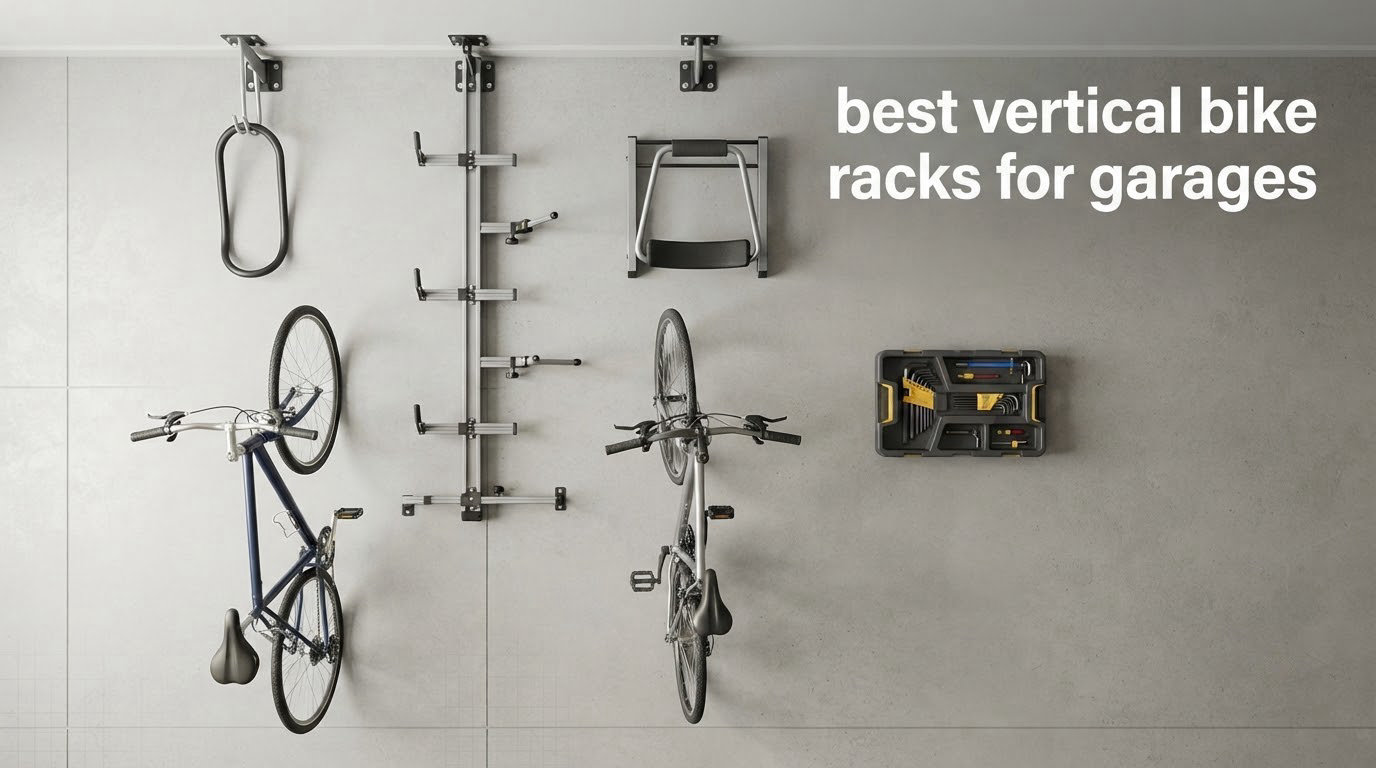
The Steadyrack Swivel Bike Wall Mount is the best vertical bike rack for a garage overall, because it is the only single-bike rack in our test group that folds flat against the wall, takes a heavy bike without a lift, and holds 24 to 29 inch wheels with 2.1 to 2.8 inch tires.
We spent six weeks cycling through ten vertical racks in a two-car garage, loading and unloading bikes, testing tire fit on everything from a fat bike to a 20 inch kids’ bike, and checking that every rack left the wall and the rims in good condition. Ten racks sounds like a lot for one storage job, but the vertical bike rack market splits into genuinely different categories, and the right pick depends almost entirely on how many bikes you own and how heavy they are.
What follows is our full ranking of the best vertical bike racks for garages, covering swivel wall mounts, multi-bike rail systems, gravity stands, freestanding floor stands and simple fixed hooks. Each entry carries the capacity figures and tire limits straight from the manufacturer data so you can check compatibility before you commit, and every rack links to its current listing so you can see today’s version.
If your garage is a shared bay where the car needs the floor more than the bikes do, start with the top three. If you want the wider picture on garage organization first, our guide to the best bike storage racks for garages covers ceiling racks, workbench-mounted options and shelving layouts that sit alongside this list.
Table of Contents
Top 3 Picks for the Best Vertical Bike Racks for Garages (October 2026)
These three cover the three most common household situations: one bike you ride every day, five bikes in a shared family garage, and a no-drill install.

Steadyrack Swivel Bike Wall Mount
- 160-degree pivot folds flat
- Roll-in no-lift loading
- Holds 35 kg
- Fits 24-29 in wheels

StoreYourBoard 5 Bike Rack
- Holds 5 bikes and 300 lbs
- 45 hook slots with locking pin
- Infinity Stud System

Delta Cycle Gravity Pole Stand
- No drilling required
- Gravity-lock stability
- Two bikes up to 30 lb each
All 10 Vertical Bike Racks at a Glance
Every rack below holds bikes upright and off the floor. The differences that matter are mounting type, per-bike weight rating, tire width ceiling and how many bikes the unit covers.
| Product | Specifications | Action |
|---|---|---|
| Steadyrack Swivel Bike Wall Mount |
|
Check Latest Price |
| StoreYourBoard 5 Bike Rack |
|
Check Latest Price |
| Delta Cycle Gravity Pole Stand |
|
Check Latest Price |
 Delta Cycle Leonardo Wall Mount Delta Cycle Leonardo Wall Mount |
|
Check Latest Price |
 Sttoraboks Freestanding Vertical Stand Sttoraboks Freestanding Vertical Stand |
|
Check Latest Price |
 monTEK Swivel Bike Wall Mount 2 Pack monTEK Swivel Bike Wall Mount 2 Pack |
|
Check Latest Price |
 CyclingDeal Two Bike Gravity Floor Stand CyclingDeal Two Bike Gravity Floor Stand |
|
Check Latest Price |
 StoreYourBoard Swivel Wall Mount 2 Pack StoreYourBoard Swivel Wall Mount 2 Pack |
|
Check Latest Price |
 TORACK 6 Bike Rail Rack TORACK 6 Bike Rail Rack |
|
Check Latest Price |
 Wallmaster 2 Bike Wall Hanger Wallmaster 2 Bike Wall Hanger |
|
Check Latest Price |
1. Steadyrack Swivel Bike Wall Mount – Best Overall Vertical Bike Rack for a Garage
Steadyrack Swivel Bike Wall Mount, Vertical Mountain Bike Rack, Garage
Holds 35 kg
Fits 24-29 in wheels and 2.1-2.8 in tires
160-degree pivot
Pros
- Roll-in loading means you never lift the bike
- 160-degree pivot folds flat against the wall
- Carries heavy bikes to 77 lb
- Accepts road mountain and gravel bikes
- Mounting hardware included
Cons
- Supplied drywall anchors are inadequate and need studs
- Instructions list wrong drill bit sizes
- Will not take bikes with fenders or mudguards
- Chrome finish can show rust in damp covered spaces
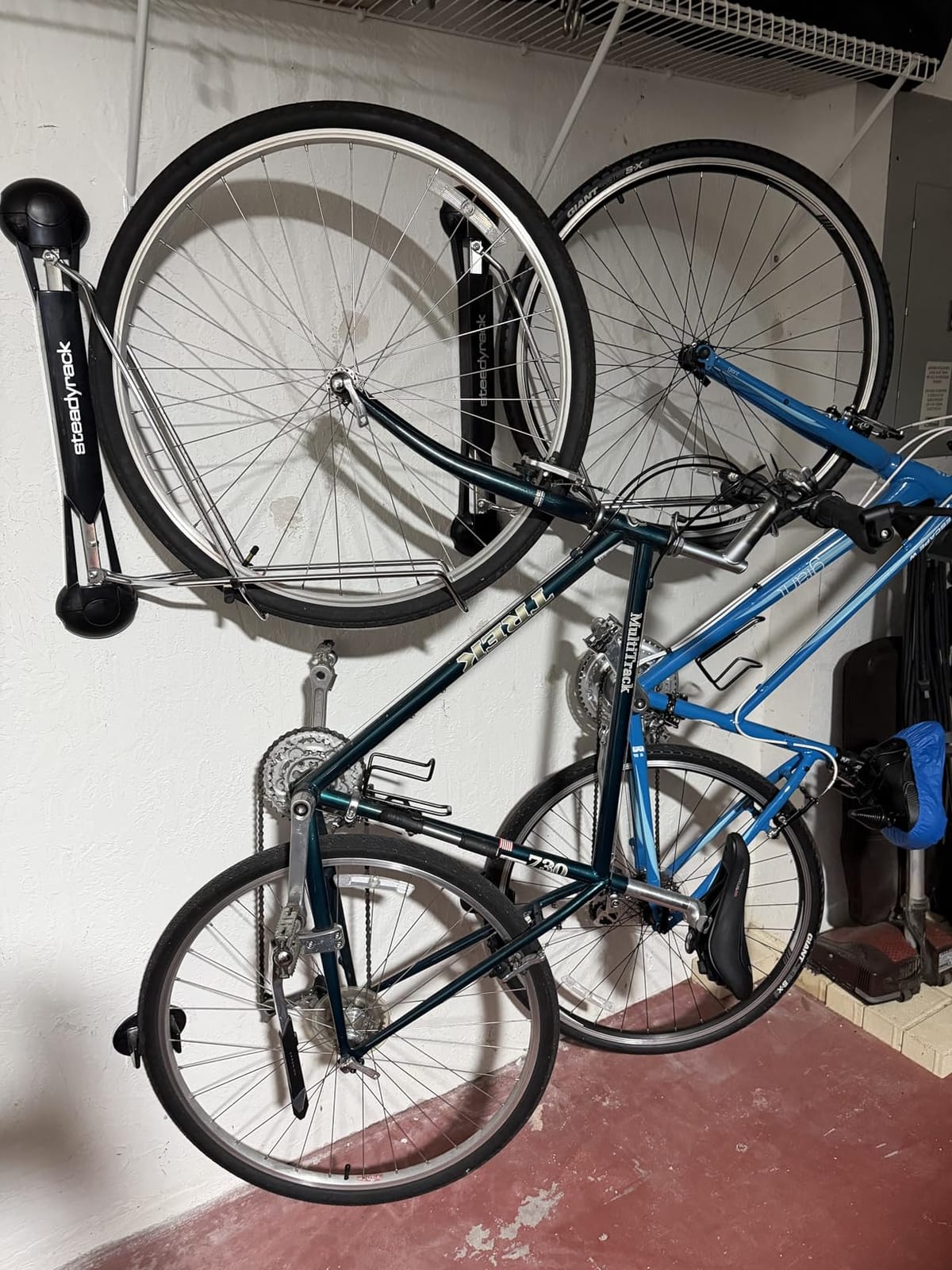
This is the rack we kept coming back to. You balance the bike on its rear wheel, walk it forward until the front wheel seats in the cradle, and the rack takes the weight. There is no lift, and that single design decision is why a 55 lb e-MTB ends up on the wall instead of back on the floor where it started.
The pivot is the part that changes how a garage works. Swing the rack 160 degrees and the bike folds in tight to the wall, which is the difference between a rack you can walk past and one you have to step around. It is a genuinely space-saving mechanism, and once you start using it you notice immediately when it is missing on a fixed hook.
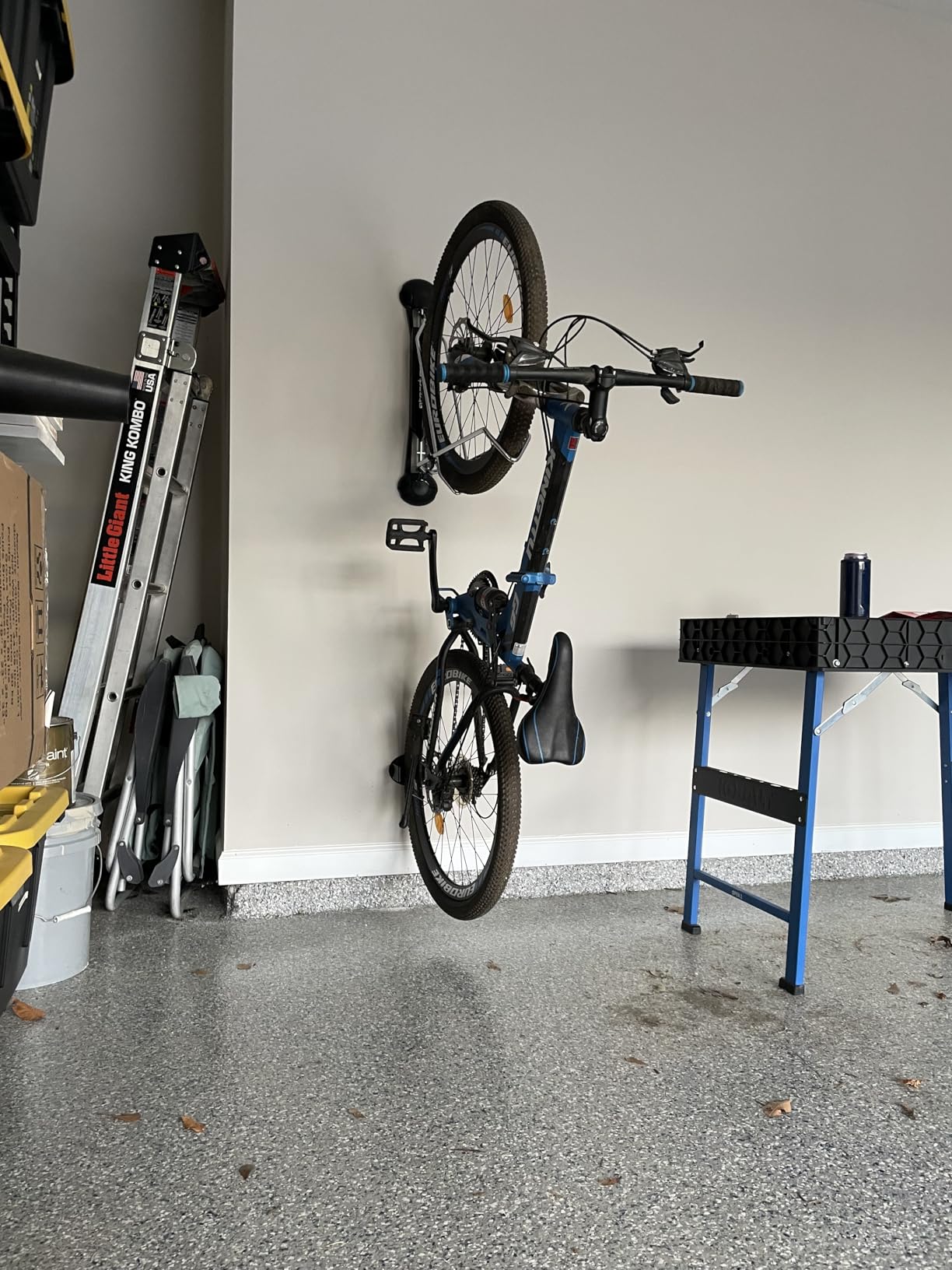
The steel and UV-treated plastic build feels heavier than the 2.7 kg weight suggests, and the 35 kg rating covers nearly every e-bike most riders own. Fitted to a stud or properly anchored into block, it stays put. The dimensions are compact at 4.72 inches deep by 4.53 inches wide, so it fits between a stud bay without stealing wall you may need later.
Two things catch people out. The tire range of 2.1 to 2.8 inches excludes bikes with fenders, and the included drywall anchors are not strong enough for the stated rating, so plan on hitting a stud. Instructions also list the wrong drill bit sizes, so check the bit you need before you start.
Will a fat bike or a heavy e-bike fit this rack?
A heavy e-bike fits comfortably. At a 35 kg rating, the rack carries a 55 lb e-MTB without complaint, and the wheel tray keeps the rear tire off the wall. Disc brake rotors clear the cradle, which is where a lot of cheaper racks cause problems on wide-bore mountain bike wheels.
A fat bike does not fit. The upper limit is 2.8 inch tires, so a 4 inch plus-size setup needs one of the wide-hook racks further down this list.
Is the drilling job harder than it looks?
It is straightforward if you hit framing. Find a stud, mount the plate, and the whole install takes minutes with a drill and a level.
It is a different job on bare drywall alone, which is why so many owners end up fitting a plywood backing or switching to masonry anchors. Treat the supplied anchors as spacing helpers rather than structural fixings.
2. StoreYourBoard 5 Bike Rack – Best Value Vertical Rack for Large Households
StoreYourBoard Bike Storage Rack – Heavy Duty Garage Bike Rack for 5 Bicycles, Space-Saving Vertical Bike Rack, Adjustable Wall Bike Mount for Garage Organizer, Bicycle Hanger, Holds 300 lbs
Holds 5 bikes and 300 lbs
46 in wide bar
45 hook slots
Pros
- Highest bike count of any rack in this roundup
- Hooks lock in place and do not slide
- Heavy-duty powder-coated steel
- Rubber-coated hooks protect rims
- Installs in about 20-30 minutes
Cons
- 46 inch bar is tight for wide handlebars
- Instructions omit mounting height guidance
- Bar can slide sideways unless the outer hooks are pinned
If you have four or five bikes and one wall to work with, this is the highest-use rack here. A single 46 inch bar holds up to five bikes and 300 lbs total, which is more capacity than every other product in this roundup combined at three bikes apiece.
The 45 mounting slots with a 3D locking pin are the detail that makes it work. You decide where each bike hangs, the pin stops the hook sliding, and bikes stay where you put them instead of migrating into each other over a season. The Infinity Stud System is built around standard stud spacing, so the bar lands on framing without a fight.
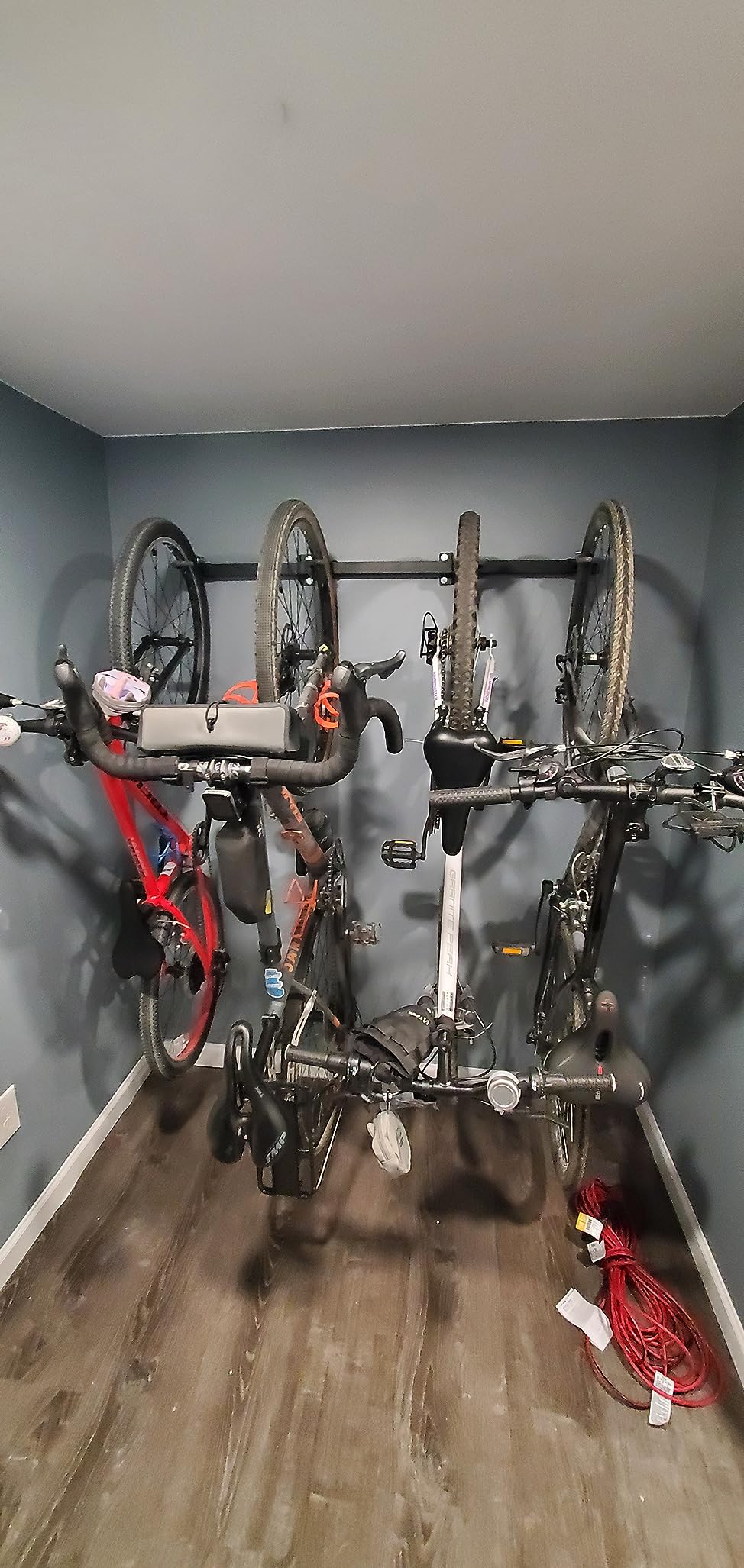
Owners consistently describe this as the practical choice for a family garage, and the 2347 reviews reflect a long, stable pattern of use rather than a burst of early enthusiasm. Rubber-coated hooks handle both front and rear wheel hanging without marking rims.
The honest limitation is width. A 46 inch bar divided among five bikes leaves very little room for mountain bike handlebars, and several owners solved it by adding a second unit. Mounting height is the other trap: the instructions say nothing about it, and bikes settle lower than most people expect, so measure your floor clearance before you drill.
How many bikes can actually fit on the bar?
Five is the rated maximum with adult bikes of normal width. For a family of five with road bikes or kids’ bikes, it is comfortable. Add adult mountain bikes with wide bars and the effective count drops to around three or four.
The 300 lb total rating is not a per-bike figure. Check that your heaviest bike still sits comfortably under 60 lb before you load the bar.
What wall prep does the bar need?
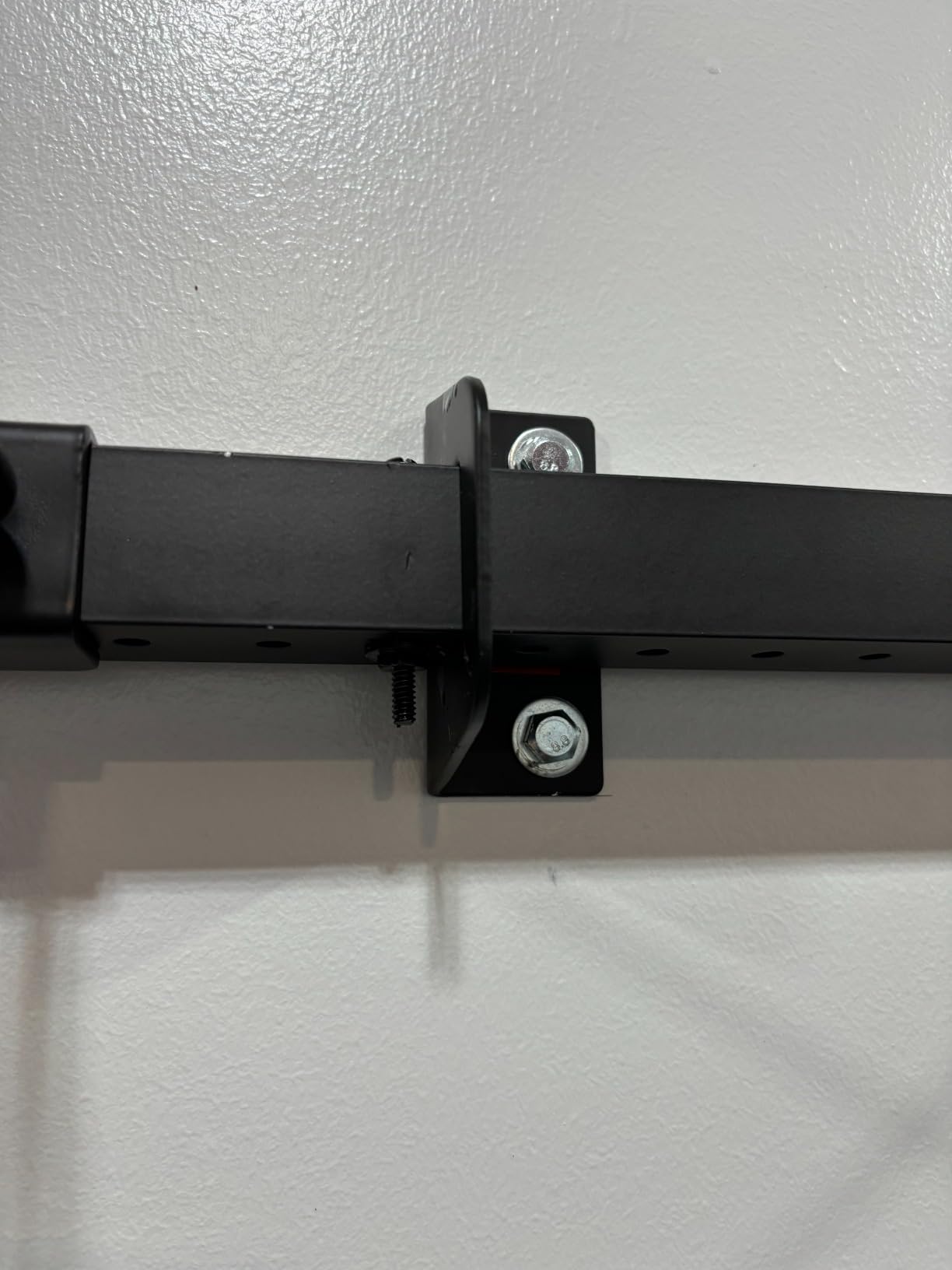
Four lag bolts into studs is the whole job, and it takes roughly half an hour. The manufacturer does not publish lag screw diameter or masonry guidance, so verify the fastener size against your wall material before you start.
Because the bar is long, it can shift in its brackets while you are positioning it. Pin the outer hooks first and the bar stays put.
3. Delta Cycle Two Bike Gravity Pole Stand – Best No-Drill Vertical Rack
Delta Cycle Two Bike Gravity Pole Stand Garage, 2 Bike Storage Rack, No Drilling Required, Fully Adjustable Vertical Bike Rack for Any Style Bicycle, Leaning Wall Bike Rack Holds Up to 60 lbs
No drilling required
Holds 2 bikes up to 30 lb each
84 in tall
Pros
- Installs without touching the wall
- The more weight on it the more secure it gets
- Snap-to-move padded hooks fit any bike size
- Rounded feet protect hardwood floors
- Assembles with a screwdriver
Cons
- Only holds two bikes
- Needs 84 inches of vertical clearance
- Bikes lean on the wall rather than hanging free
This is the answer for anyone who cannot drill, will not drill, or lives somewhere that forbids it. The gravity design means the stand leans into the wall and the more weight you load onto it, the harder it grips. No fasteners, no studs, no patching drywall when you move out.
At 10344 reviews, it is also the most widely used vertical rack we tested, and the feedback is consistent: owners value the drill-free install and the stability, and they adjust the padded hooks up or down until the bike sits right.
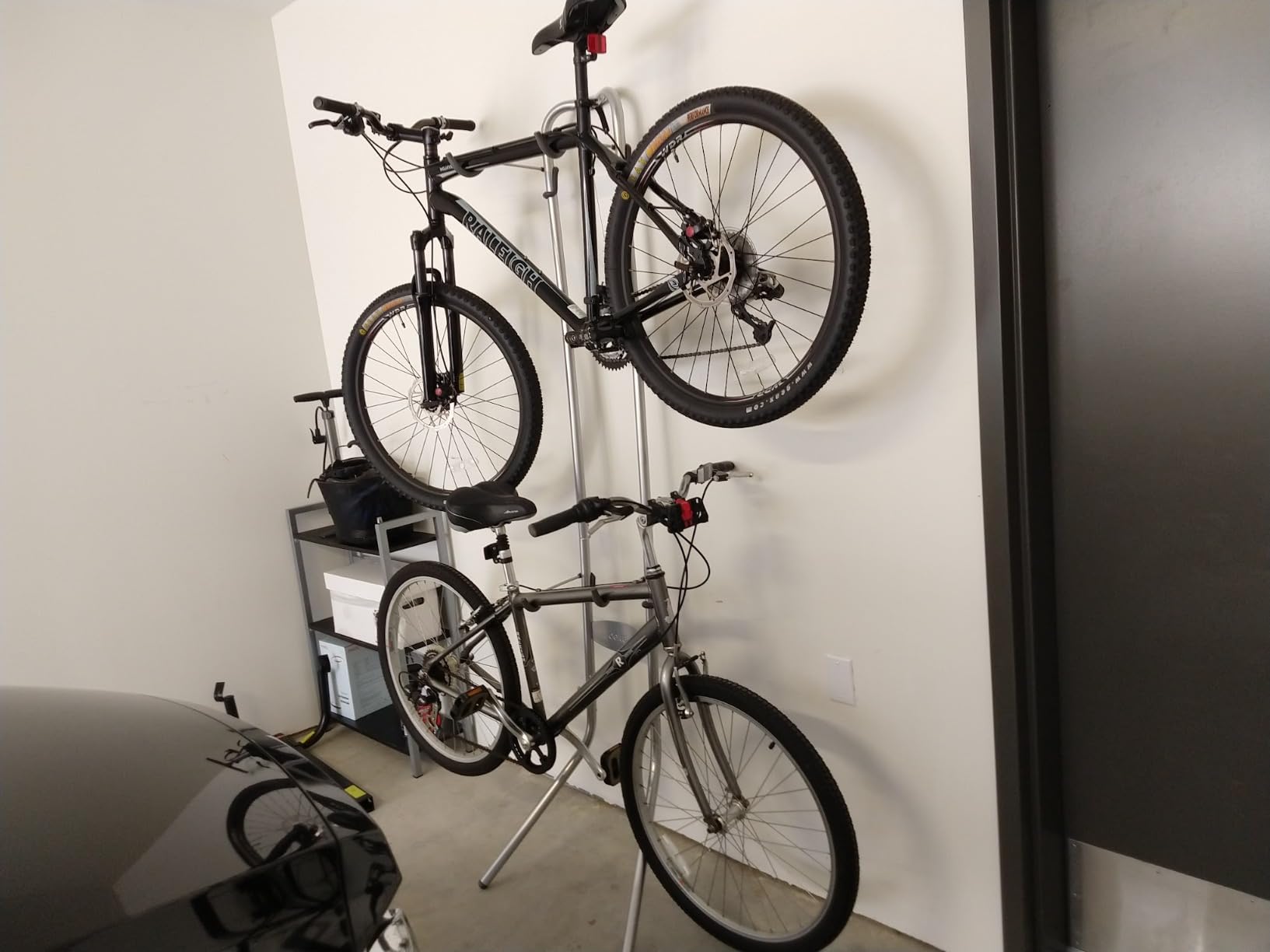
It suits a mixed fleet well. Kids’ bikes, a cruiser and a gravel bike all fit on the same two hooks, and the padded arms and rounded feet mean it will not mark a bike or a finished floor. The 22 by 22 inch footprint is small enough to sit in a corner you would otherwise ignore.
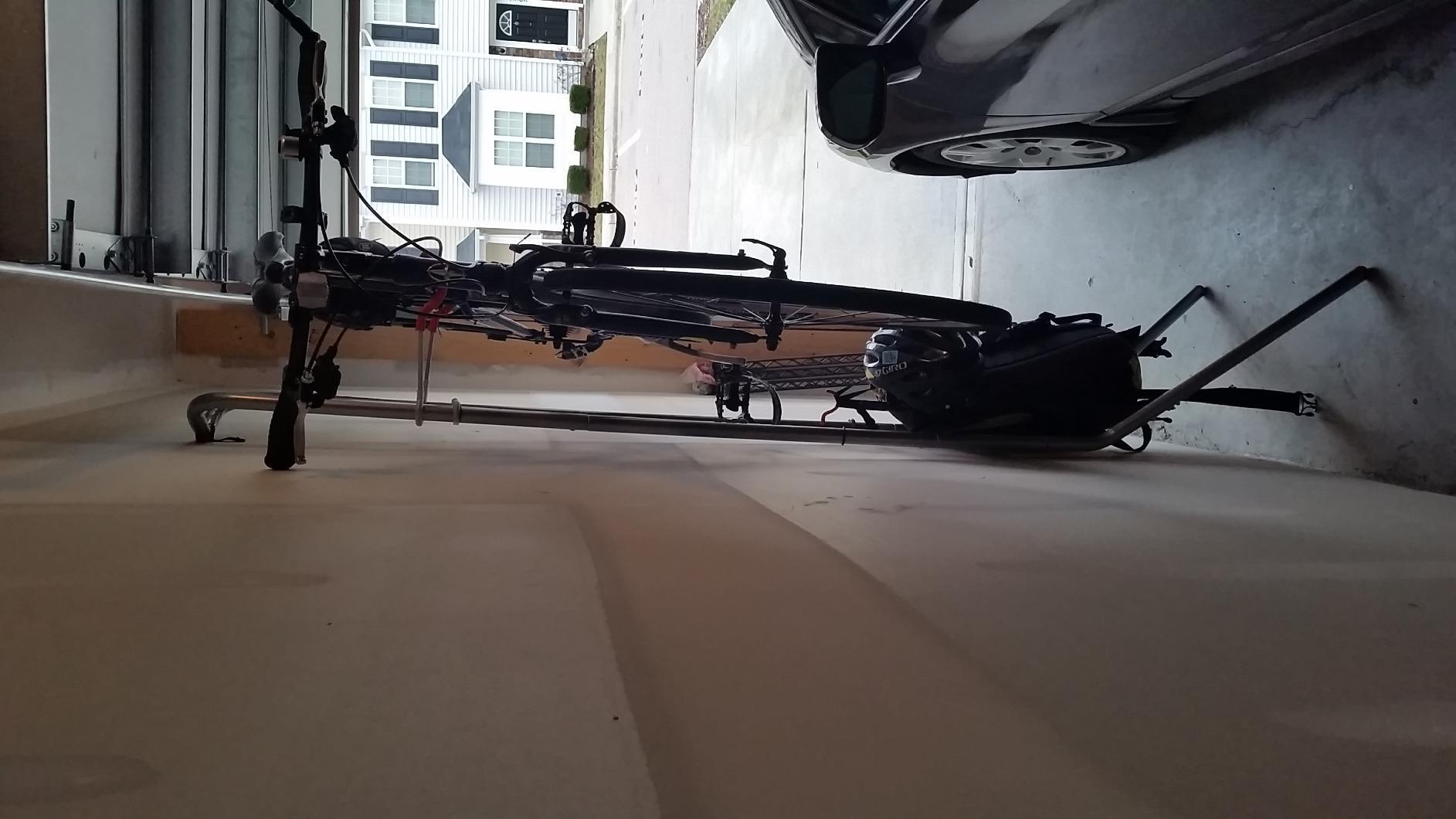
The constraints are capacity and height. Two bikes is two bikes, no matter how good the design is, and the pole stands 84 inches tall, so it needs a wall with real vertical space. Because the bikes lean against the wall rather than hanging clear, you still need a wall to lean on.
Is a gravity stand safe with a heavy e-bike?
Not really. The rating is 30 lb per bike and 60 lb total, which covers road bikes, gravel bikes, kids’ bikes and most older mountain bikes. A 50 lb e-bike exceeds the per-bike limit, and we would not trust that load on a leaning stand.
For heavy e-bikes, a freestanding cradle stand or a wall-mounted rack rated above 60 lb is the safer route.
Will it work in a rented garage or apartment?
Yes. That is exactly what it is built for. Nothing enters the wall, it moves with you, and the assembly needs only a screwdriver, which makes it a strong pick for a short-term parking situation where the bikes travel with you.
Just confirm you have 84 inches of clear height and a wall to lean into before you commit.
4. Delta Cycle Leonardo Wall Mount with Tire Tray – Best Vertical Rack for Tight Walls
Leonardo Bike Rack Wall Mount with Tire Tray by Delta Cycle – Elegant Vertical Hanger Hook Design Provides Easy Bicycle Storage Access – Hassle-Free Installation – Vertical Mount Holds Up to 40 lbs
Single bike up to 40 lb
Tires under 2.5 in
Adhesive tire tray
Pros
- Extremely slim profile reclaims real floor space
- Powder-coated steel looks clean on a finished wall
- Rubber hook and tire tray protect rim and wall
- Mounts in minutes
- Made for any bike size or type
Cons
- Single bike only
- Included screws and anchors are too small for the 40 lb rating
- Screws can sit proud and press on the tire
- Tire tray tape can peel off light walls
Where a swivel rack needs depth, this hanger needs almost none. The body is a slim steel hook with a matching tire tray, and owners frequently describe it as transforming a tight apartment or garage because it gives back wall space that other racks would cover with a pivot mechanism.
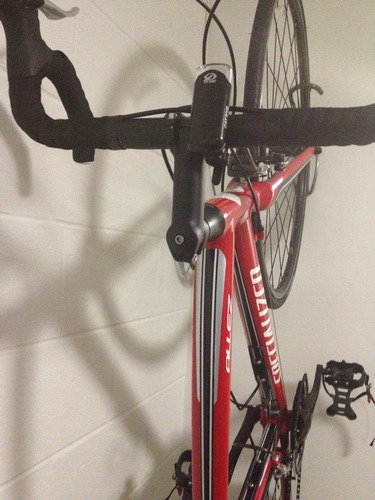
The tire tray is the quiet hero. It sits under the wheel, catches the marks a bare hook would leave on painted drywall, and can be stuck on with the included tape or screwed down properly. Paired with the rubber-coated hook, it is one of the gentlest options here on both rim and wall.
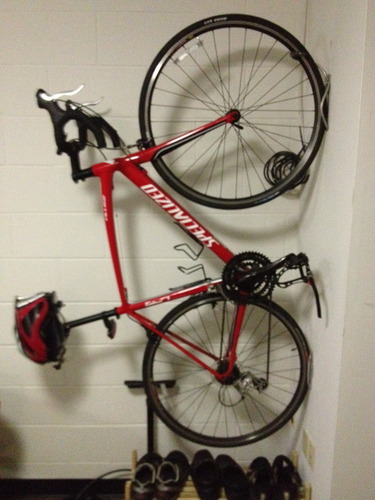
With a 4051-review history, it is well understood as a long-term storage option rather than a daily grab-and-go system. It suits road bikes, mountain bikes, kids’ bikes and even beach cruisers, and the limited lifetime warranty is stronger than most in this category.
Plan to replace the fixings. The supplied screws and anchors are undersized for the 40 lb rating, and the screw heads can stand proud enough to press against the tire. Upgrade the hardware and it holds; leave it as shipped and it will not.
Does the tire tray really protect the wall?
It does, on a painted or finished wall, because the load transfers from the rim to the tray rather than rubbing on paint. On bare drywall or a light wall the double-sided tape can let go, so screw the tray down if the wall matters to you.
On a painted block or plaster wall the same applies: the tape holds, but mechanical fixing is the durable option.
Is 40 lb enough for a modern e-bike?
It covers lighter e-bikes and most non-electric bikes comfortably. A 50 lb or heavier e-MTB is pushing the rating, and you would be relying on hardware you are likely to replace anyway.
Check your bike’s actual weight, and if it is over 40 lb, move up to a rack rated at 60 lb or more.
5. Sttoraboks Freestanding Vertical Bike Stand – Best Vertical Rack on Wheels
Vertical Bike Stand, Freestanding Bike Rack for Garage Storage, Upright Bicycle Floor Stand with Adjustable Height and 360° Rolling Wheels, Space Saving Indoor Bike Holder for 24″-29″ Standard Bikes
One bike up to 55 lb
Tires up to 4 in wide
Four lockable casters
Pros
- No drilling and no wall damage
- Four lockable rolling casters let you move the whole stand
- Adjustable rod and V-brackets fit many bike sizes
- Velcro straps and reinforced seatpost keep the bike stable
- Rustproof powder-coated steel
Cons
- Single bike capacity
- Adjustment steps take time on setup
- Velcro straps loosen with repeated use
- Bulky footprint for a one-bike stand
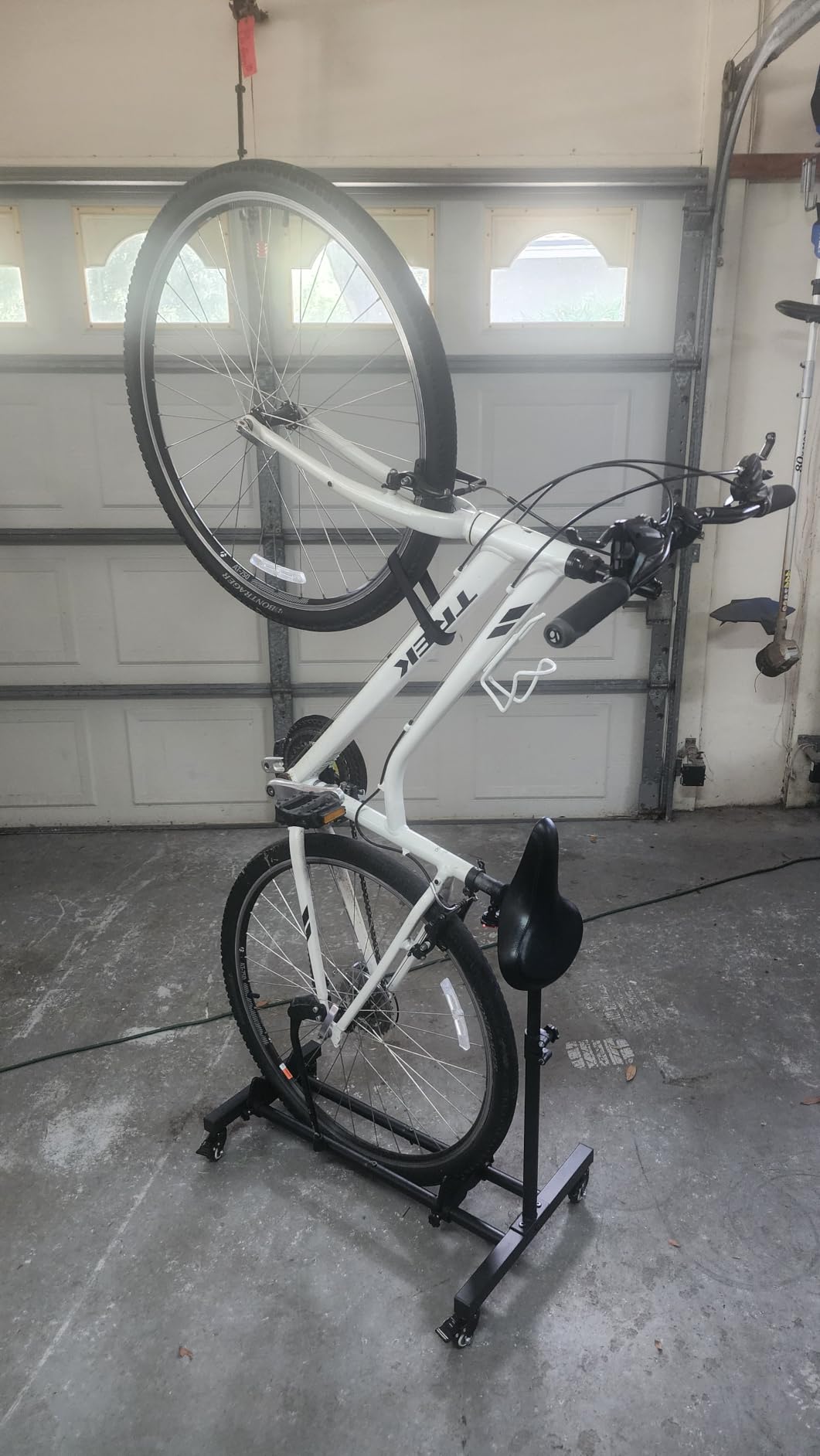
The casters are what separate this from every other single-bike stand we looked at. Four 360 degree lockable wheels mean you can roll the whole unit to whichever wall the bike happens to be parked against, lock it, and walk away. In a shared bay where the car needs the floor during the week and the bike needs it on Saturday, that flexibility is worth more than it sounds.
It also solves the renter problem outright. No holes, no anchors, no patching, and it moves house with you. At 2153 reviews the owners consistently single out the wheels as the deciding feature, with the adjustable lifting rod and wide V-brackets close behind for fit.
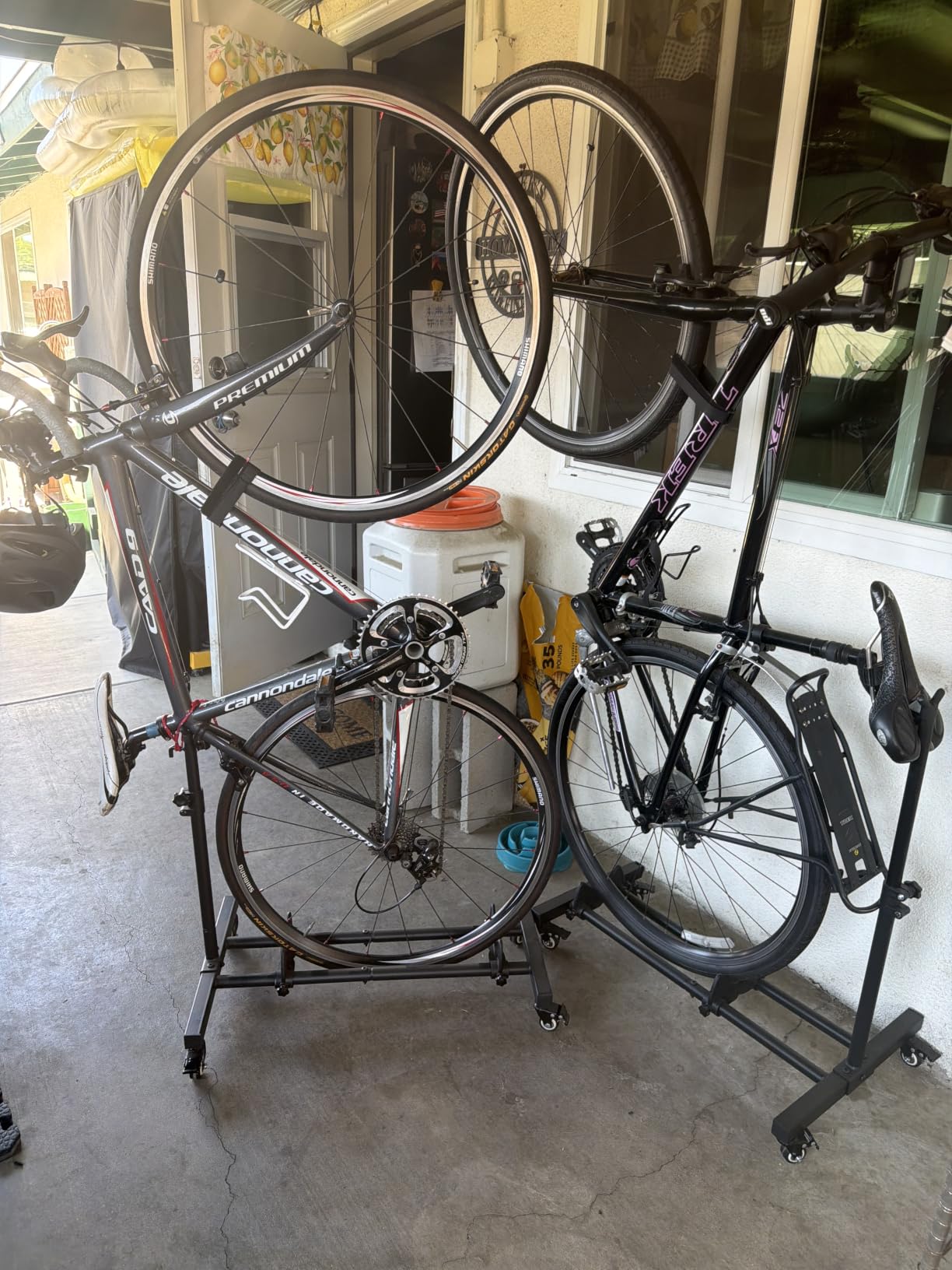
It is also unusually tolerant on tire size, handling tires up to 4 inches wide across 24 to 29 inch wheels. That wide bracket means a plus-size gravel bike or a small fat bike fits where most single-bike stands would refuse it, and the 55 lb rating covers a mid-weight e-bike.
Set it up slowly. The adjustable rod and bracketing take a few passes to dial in correctly, and once they are right the triangular frame with its reinforced seatpost support and Velcro straps holds the bike firmly. The straps are the part that wears first, so expect to re-tighten them periodically.
Can it hold a fat bike?
Yes. Tires up to 4 inches wide are supported by the V-brackets, which covers most plus-size and mid-fat setups. The 55 lb rating also handles heavier electric bikes better than most one-bike options.
It will not take a full 5 inch tire. If that is your bike, look at a rail system with wide hooks instead.
Is it better than a wall hook in a garage?
Different, not better. A wall hook is tidier and permanent; this stand is flexible and removable. For a garage you control, a wall mount gives you back floor space permanently, while this gives up some floor space in exchange for being movable.
For a garage where bikes come and go constantly, the casters win. For a static garage, the wall racks further up this list use the space more efficiently.
6. monTEK Swivel Bike Wall Mount 2 Pack – Best Swivel Rack for Wide Tires
monTEK Swivel Bike Wall Mount, Bike Hangers for Garage, 2 Pack
30 kg per mount
150-degree swivel
Tires up to 3.54 in
Pros
- Swivels up to 150 degrees to sit flush with the wall
- Solid steel rated to 66 lb per mount
- Rubber hook protects rims and spokes
- Handles bikes with fenders
- Hardware for studs and masonry included
Cons
- Bikes still project from the wall
- Tires wider than 3.54 inches will not fit the bracket
- Weak guidance on alignment during install
This is the swivel answer when your bikes are wider than a 2.6 to 2.8 inch tire. The bracket accepts tires up to 3.54 inches deep, which covers plus-size mountain tires, many fat setups and every fendered commuter, which several narrower racks explicitly exclude.
The 150 degree swivel is the largest travel in this roundup, and it uses a bearing system rather than a plain pin, so it moves smoothly under a loaded bike. That matters more than it sounds: a stiff pivot is how people end up not swiveling at all. Swung flat, the bikes tuck close to the wall around parked cars and storage bins.
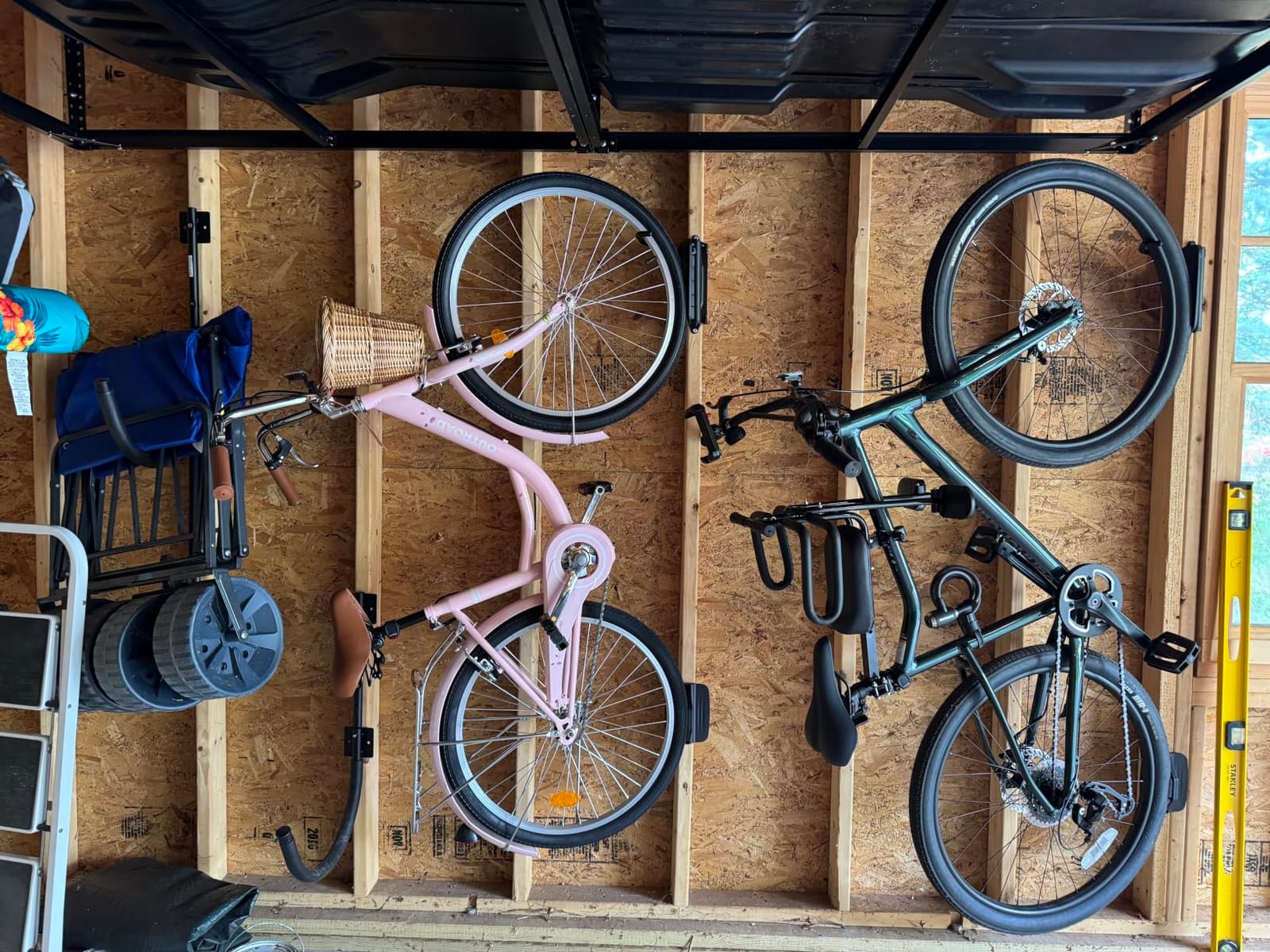
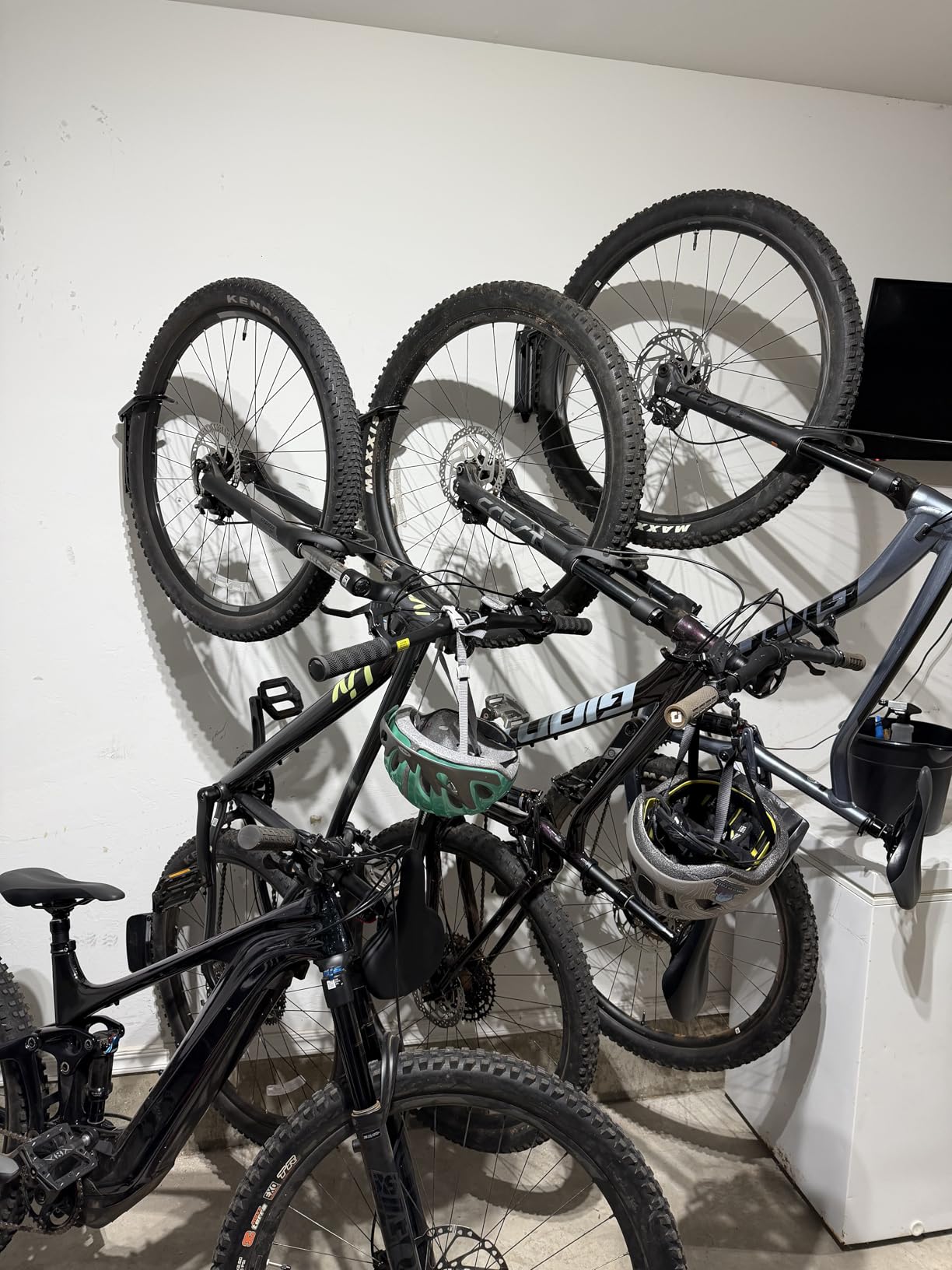
At 66 lb per mount across a two-pack, the rating is more than most of the capacity here, and the rear wheel stabilizer keeps the back tire off the wall. Installation takes roughly twenty minutes with the included hardware, which covers studs, concrete, brick and masonry, and it ranks first in indoor bike storage for a reason.
Two honest notes. Bikes still stand off from the wall rather than sitting tight to it, so the space saving is real but partial. And the instructions are thin on alignment, which is exactly the step where you want guidance, so use a level and check the swing before you tighten everything down.
Is this heavy enough for an e-MTB?
Yes. At 30 kg per mount it carries a 55 lb e-MTB with margin, which makes it one of the few swivel racks here that comfortably covers electric mountain bikes.
Make sure the two mounts land on framing. It is not rated for unsupported drywall or plasterboard.
How much wall space does a swivel really recover?
Most of it, once you actually swing the rack flat. In a bay shared with a car, the difference between a bike projecting 20 inches into the bay and sitting 5 inches off the wall is often the difference between parking comfortably and squeezing in.
The catch is discipline. If the rack is left angled, the swivel buys you nothing, so pick a mounting spot that encourages the folded position.
7. CyclingDeal Two Bike Gravity Floor Stand – Best Freestanding Rack for Heavy Bikes
CyclingDeal 2 Bike Bicycle Vertical Hanger Parking Rack Gravity Floor Storage Stand for Garages or Apartments
2 bikes up to 55 lb each
110 lb total
54 in tall
Pros
- Freestanding with no wall drilling
- 55 lb per bike is the highest per-bike rating here
- Tilting cradles handle aggressive geometry
- Y-shaped base stays stable under load
- Adjustable cradle height and hook spacing
Cons
- Two-piece tube flexes during loading
- Welded leg joint is a long-term stress point
- Limited cradle height adjustment range
- Tall frame needs ceiling clearance
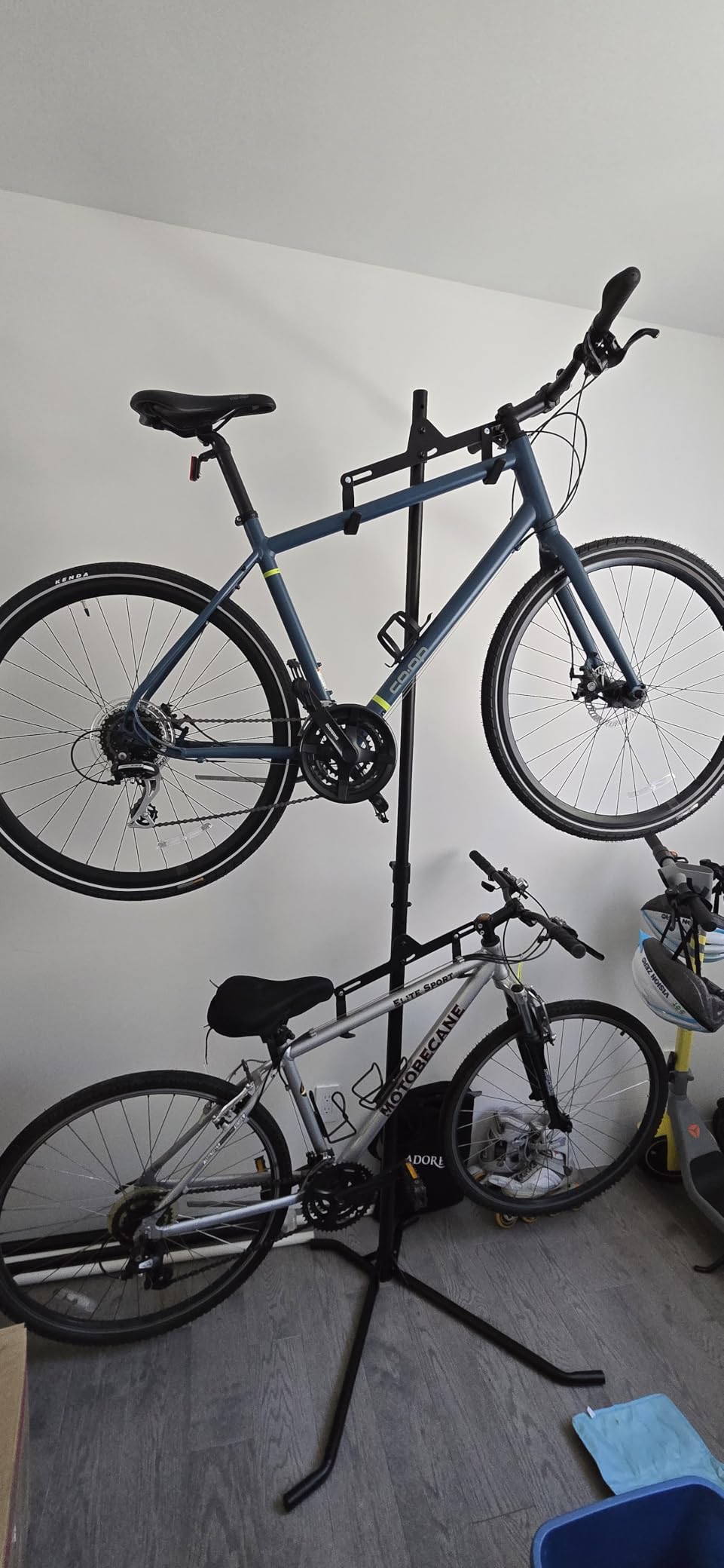
This is the freestanding option for people with heavy bikes, and the number that separates it is 55 lb per bike. A pair of mid-weight e-MTBs can live here without a single hole in the wall, which is a combination no other drill-free stand on this list offers.
The tilting cradles are the second reason to look closely. Modern mountain bike geometry has a sloping top tube, and a fixed cradle leaves the bike rocking or falling. These cradle angle to match, so the bike sits level and the frame actually rests on something. The Y-shaped base is designed to resist tipping from any direction, which matters when you are cranking a heavy bike onto an upper cradle.
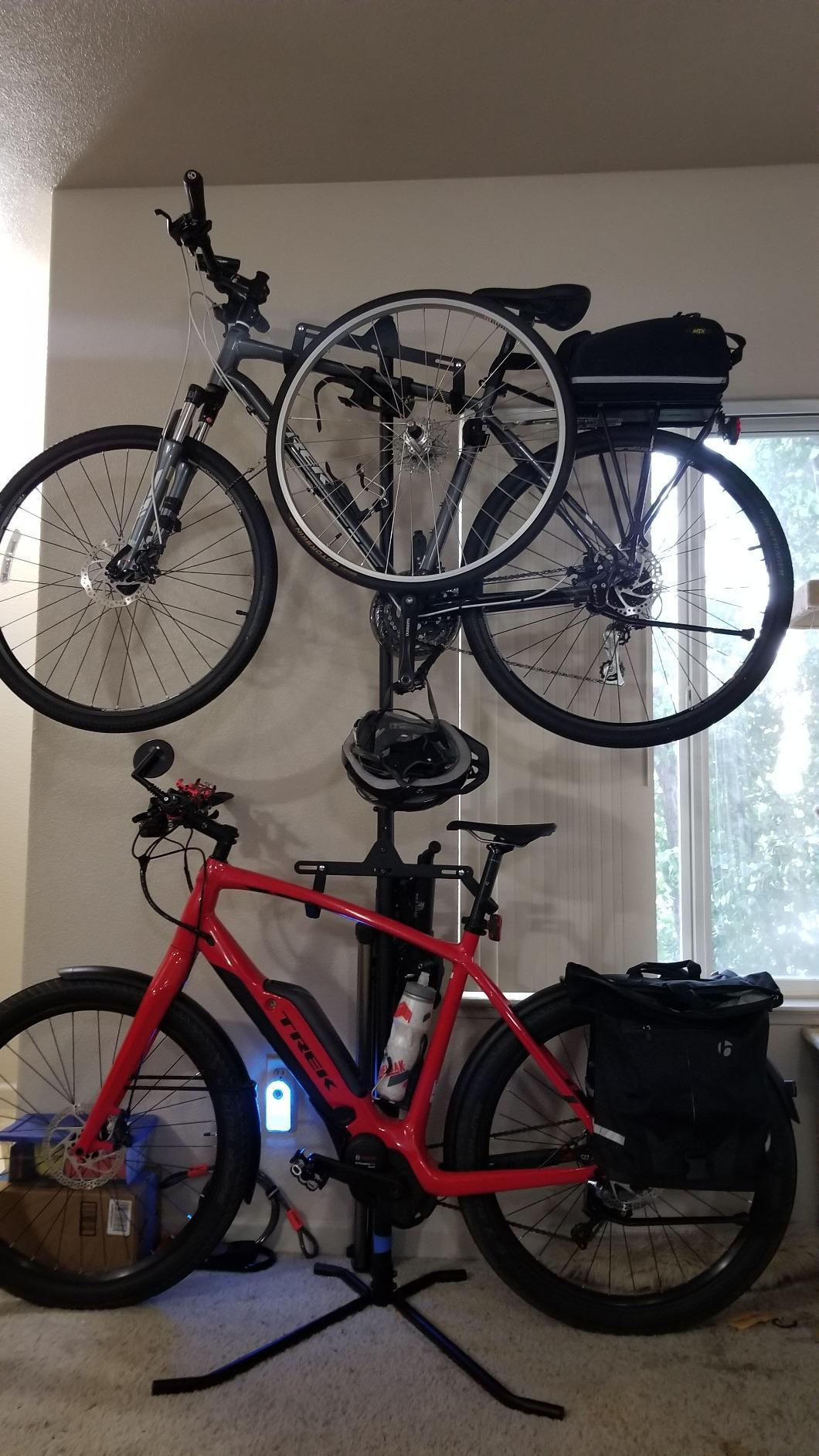
Owners report years of solid use, and the 2-year manufacturer warranty backs that up. At 54 inches tall it is lower than the Delta gravity pole, which helps in a garage with a low ceiling or a car that needs height behind it.
The criticism worth taking seriously is structural. The two-piece vertical tube flexes slightly as you load and unload, and the welded leg-to-bracket joint is a stress point under repeated heavy loading. If your bikes are that heavy and your garage stays as they are, a wall-mounted steel rack rated above 60 lb per bike is a longer-term answer than a leaning stand.
Can two e-bikes sit on this stand?
Yes, provided each bike is 55 lb or under. The 110 lb total rating assumes the load is split evenly, so two 55 lb bikes sit right at the limit with nothing in reserve.
We would keep a margin if you ride steep trails and carry a heavy battery pack, and consider the wall-mounted swivel options for heavier setups.
How hard is it to assemble?
Straightforward with the included tools, though the hardware bag contains assorted screw lengths, which slows the process down. Budget an afternoon rather than an hour if you are not used to flat-pack steel.
Check the base is fully seated on a level floor before loading bikes. The stability depends on it.
8. StoreYourBoard Swivel Bike Wall Mount 2 Pack – Best Swivel Rack with a Lifetime Warranty
StoreYourBoard Swivel Bike Wall Mount, Vertical Rack for Garage, 2 Pack
50 lb per rack
124-degree swivel
Tires up to 2.6 in
Pros
- Swivels left or right to tuck bikes beside parked cars
- Lock pin and detent control add real stability
- Precision-welded steel rated to 50 lb with no flex
- Rubber hook and rear tire catch protect wheel and wall
- Lifetime manufacturer warranty
Cons
- Tire limit of 2.6 inches excludes fat bikes
- Stud mounting only
- 124 degrees is less travel than some rivals
- Two-bike pack fixes the capacity
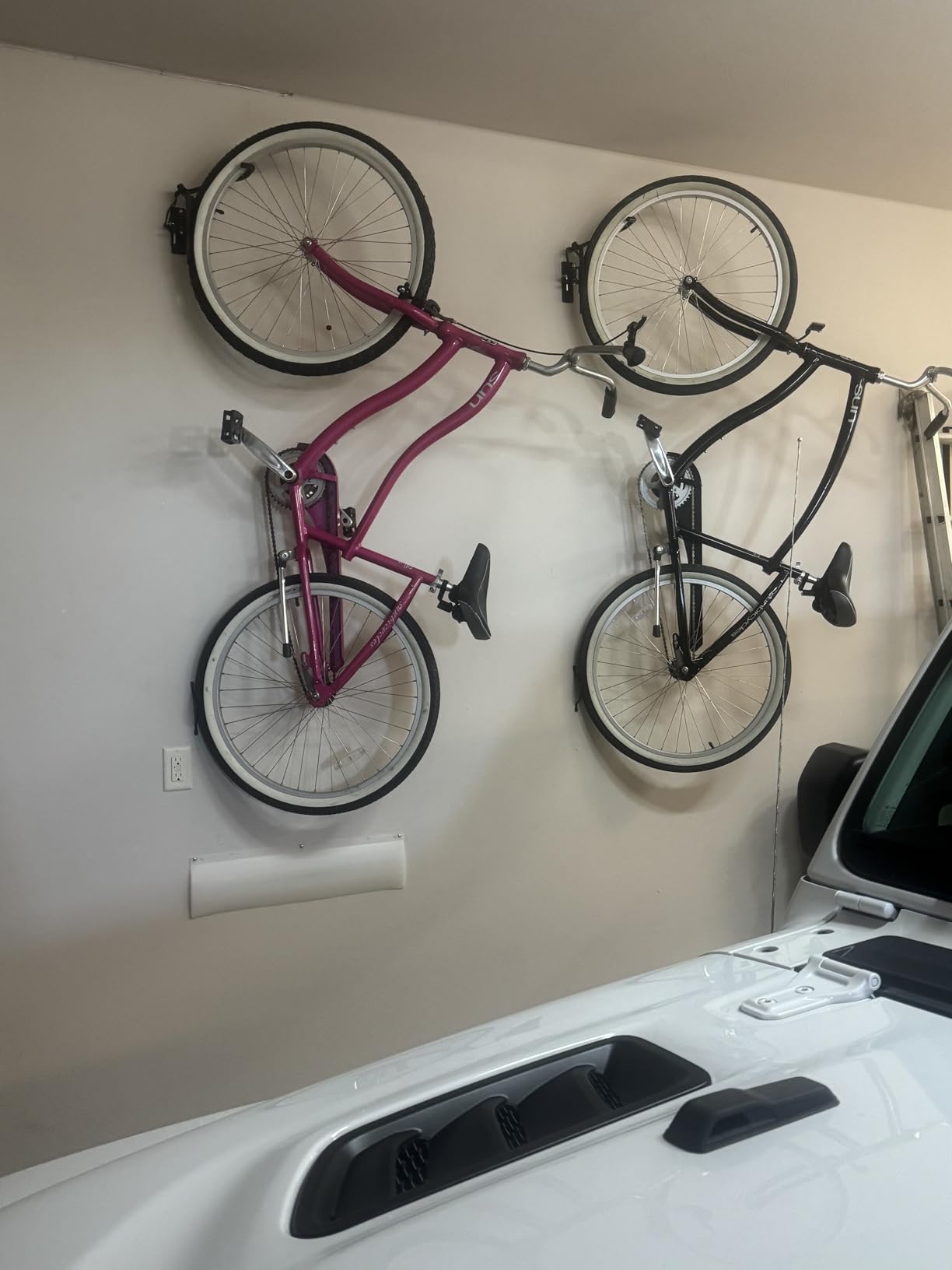
What sets this apart from a generic stamped steel hook is the hardware around the swivel. A detent pin locks the rack into defined positions, and a separate lock pin keeps the hook stable while you load, so the bike does not swing out from under you halfway up. That is the single biggest quality difference between this and a budget hook, and reviewers name it every time.
The construction is precision-welded alloy steel with a powder-coated finish, rated to 50 lb with no flex in the arm. Add the rubber-coated hook and the rear tire catch, and the wall and the wheel stay clean. Swung around, bikes tuck neatly beside a car or a run of storage bins.
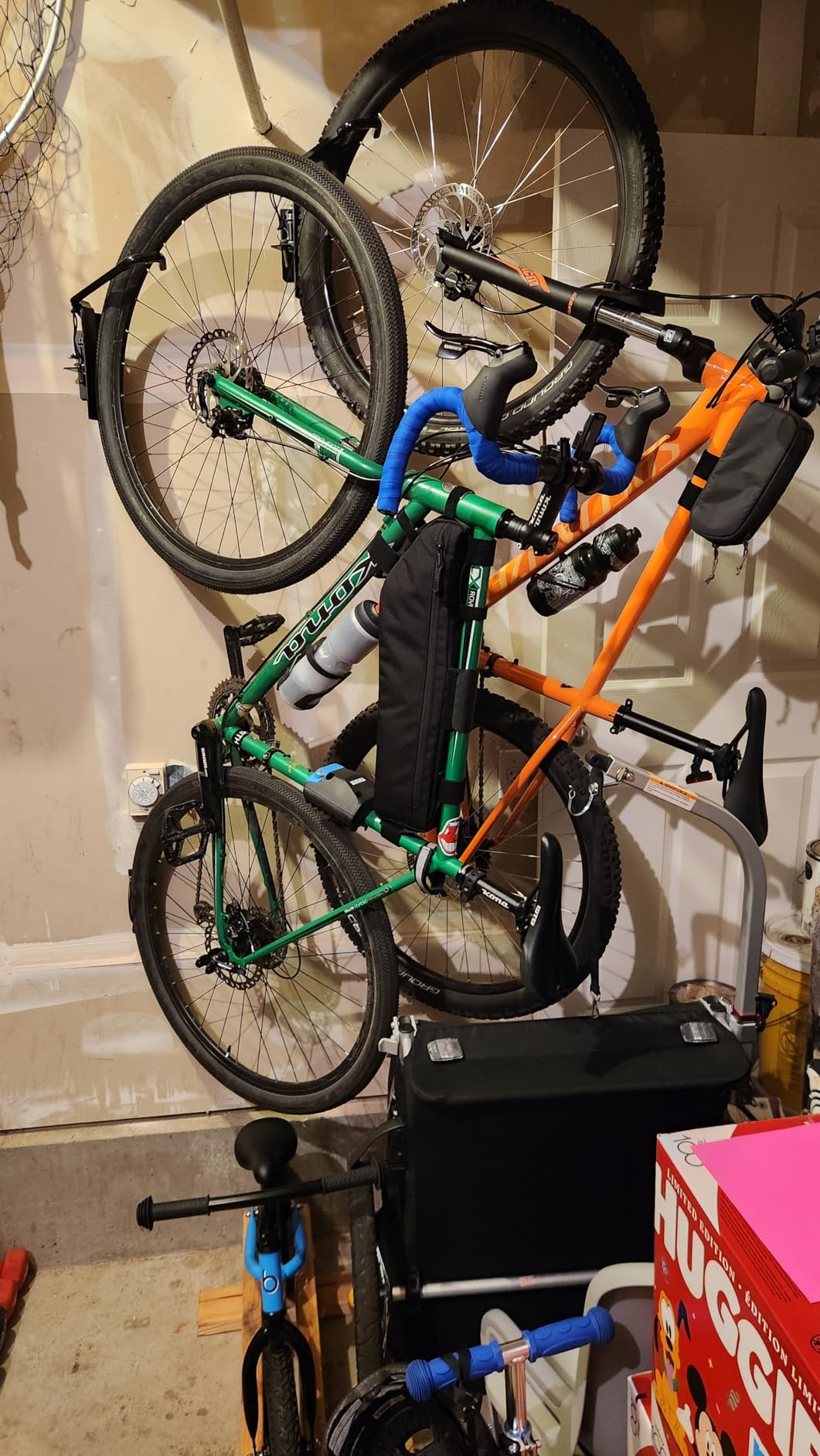
The lifetime manufacturer warranty is the strongest guarantee in this roundup. For a rack going into a garage wall and staying there for a decade, that is a meaningful difference against two-year and hardware-as-is alternatives.
The limit to know before buying is tire width. At a 2.6 inch maximum, plus-size and fat bikes are excluded, and the 124 degree swivel gives you less fold-flat travel than the 150 degree and 160 degree racks here. It is a stud-mounted install, so bare drywall will not carry it.
Is 50 lb enough for an e-bike?
It covers lighter e-bikes and most non-electric bikes well. It is comfortable for mid-weight e-bikes, and tight for a 55 lb e-MTB with a large battery.
If your heaviest bike is over 50 lb, pick a rack rated at 60 lb or higher rather than running at the limit permanently.
How does it compare to a swivel rack with more travel?
More swivel angle means more wall recovered when folded. The 124 degrees here is enough to angle a bike out of the way of a car door or a bin, but not enough to sit completely flush.
In exchange you get a heavier build, a detent lock, and a lifetime warranty, which for a permanent garage install is a good trade.
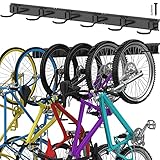
9. TORACK 6 Bike Rail Rack – Best Vertical Rack for Fat Bikes and Modular Layouts
TORACK Bike Storage Rack, 6 Bike Rack Wall Mount Home and Garage Organizer
3 x 16 in rails
Six hooks
Hooks fit 4.4 in tires
Pros
- Hooks handle fat bike tires up to 4.4 inches
- Modular rails can be interlocked or used separately
- Rubber-coated sleeves grip without marking rims
- Hangs bikes by front or rear wheel
- Powder-coated rails resist rust
Cons
- Thin stamped mounting plate can pull out of drywall
- Real-world capacity is closer to three adult bikes
- No replacement hooks when one breaks
- Holes may not line up with stud spacing
The hooks are the reason this rack exists. At 4.4 inches of tire width, they are the widest in this roundup by a clear margin, and they open up storage options that most vertical racks simply cannot take. A fat bike or a plus-size gravel bike goes up without a fight.
The modular design is genuinely useful in a garage. Three 16 inch rails interlock into a 48 inch run, or you can mount them separately along different walls, which lets you spread bikes around a corner or over a workbench area instead of forcing everything onto one line. Hook spacing adjusts along the rails, and bikes hang by either wheel.
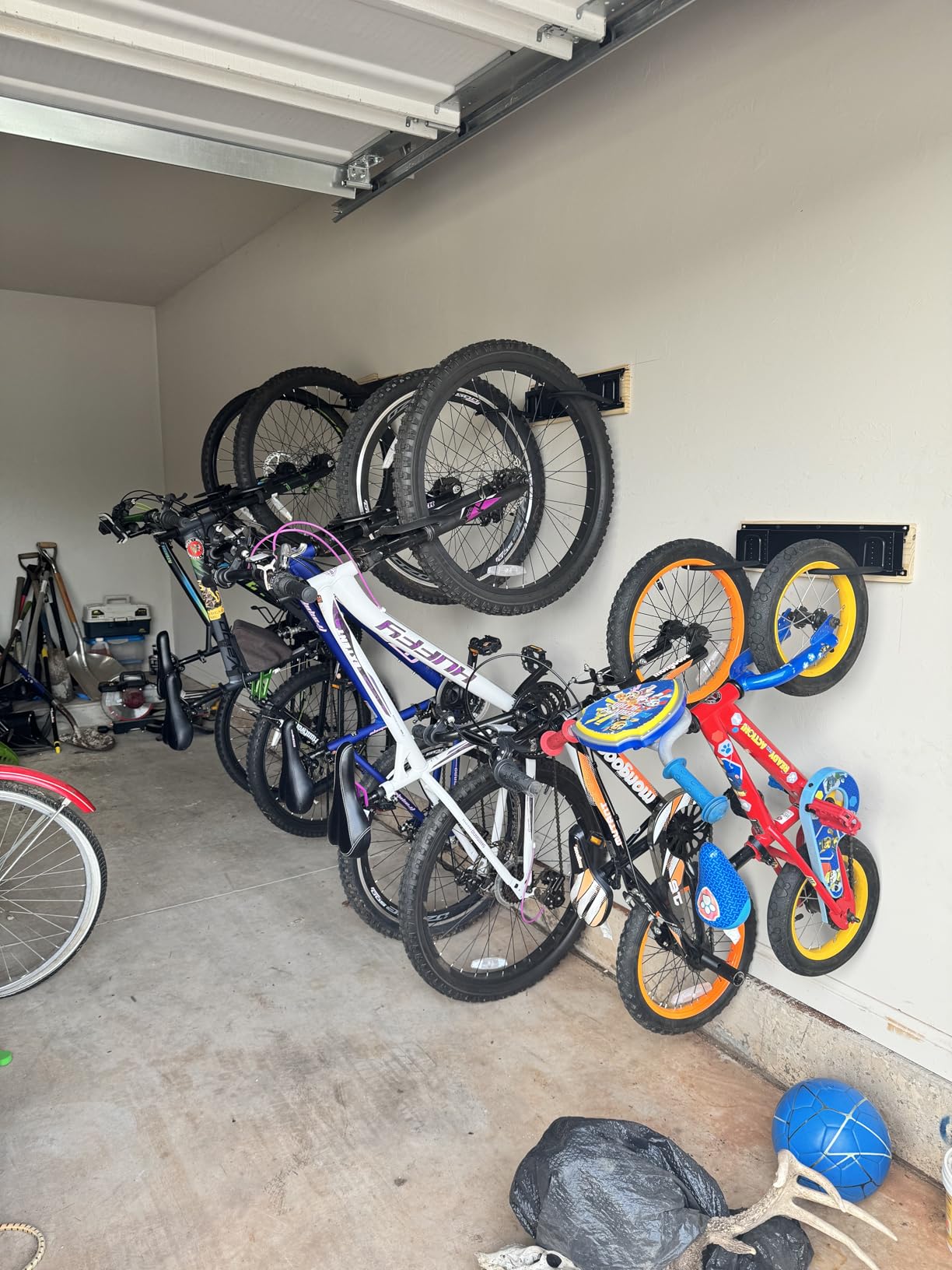
What gives us pause is the mounting. The plate is thin stamped metal, and several owners report bent rails or the whole assembly pulling out of drywall. Real-world capacity also lands closer to three adult bikes than the advertised six, because six is a hook count rather than a width calculation.
There is a straightforward fix that owners describe: screw the rails into a 2×4 or a ledger board that is fastened into the studs. Once the load runs through timber into framing, the structural complaints largely disappear. Replacement hooks are not offered, so a broken one means replacing the rail.
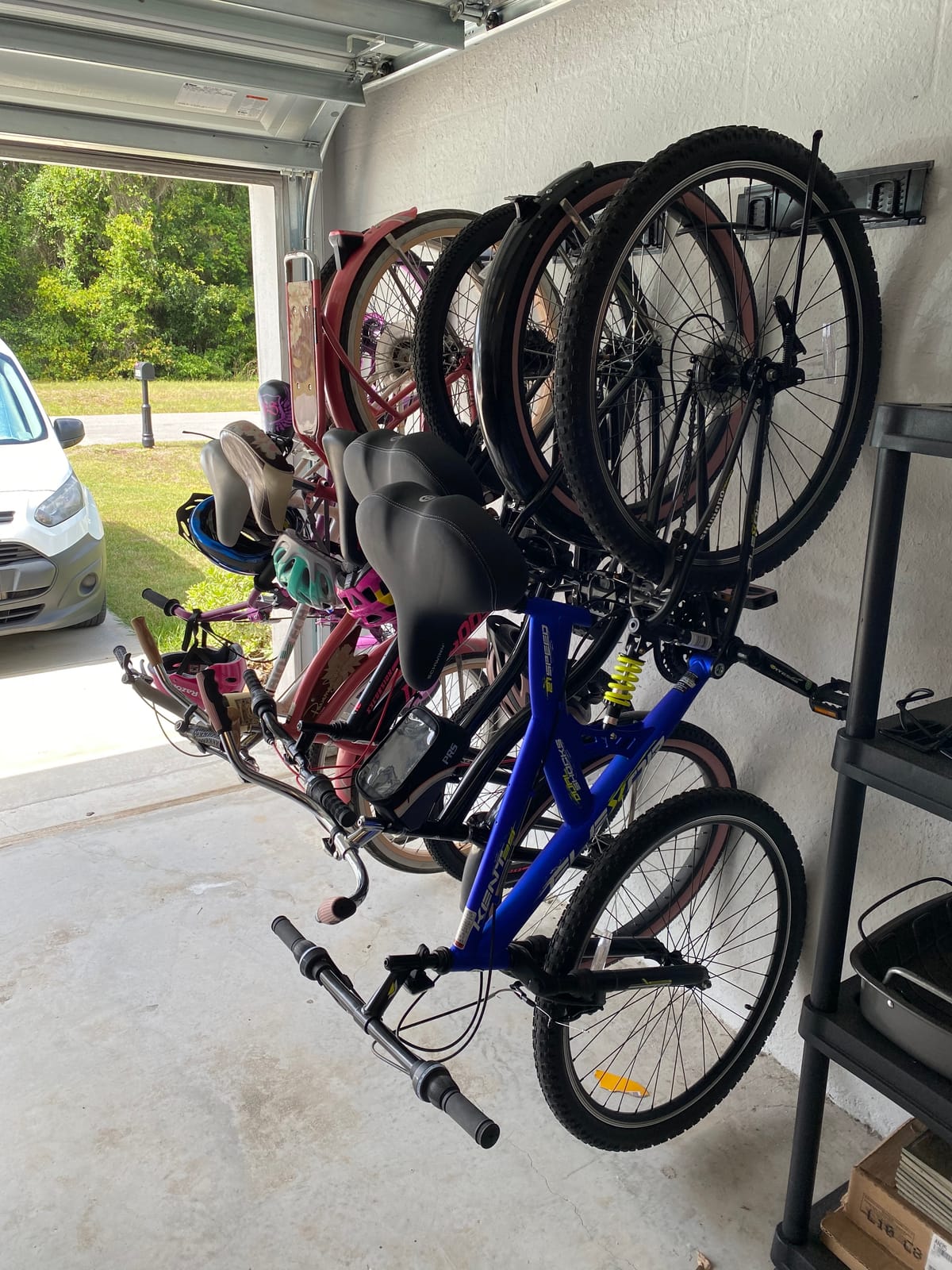
Is it strong enough for a loaded garage wall?
Not on its own, in our view. The stamped plate is the weak point, and reports of rails bending under multiple bikes repeat across reviews.
Fasten the rails to a 2×4 ledger screwed into studs and the load path becomes solid. Plan for that from the start rather than discovering it later.
How many bikes fit on three rails?
Three adult bikes comfortably, and up to six smaller bikes such as kids’ bikes or slim road bikes if widths allow. Count the hooks, then measure the bars you actually own.
If you are storing wide-tire adult bikes, assume three. Wide hooks give you clearance, not width.
10. Wallmaster 2 Bike Wall Hanger – Best Starter Vertical Rack
Wallmaster Bike Storage Rack for Garage, Wall Mount Bicycles Hanger
Two fixed vertical hooks
50 lb per bike
4.7 in deep
Pros
- Lowest entry point into vertical storage
- Rubber-coated hooks prevent scratches and slipping
- Fixed design reduces accidental release
- Solid powder-coated steel
- Four screws per rack
Cons
- Supplied anchors pull out of drywall
- Replace the fixings with lag bolts or a backing board
- Narrow road rims can twist sideways
- Two bikes per pack
Two bikes, real steel, a rubber coating on the hook and four screws. That is the entire proposition, and for a first garage it is a sensible way to get bikes off the floor without overcomplicating anything. With 4560 reviews, it is one of the most proven racks in the category.
The fixed hook design is deliberate. A fixed arm is harder to knock a bike off than a swiveling one, which is worth something in a garage where a bike falling onto a car is a real possibility. The powder-coated alloy steel is simple and predictable, and the 3.8 inch depth means it sits close to the wall.
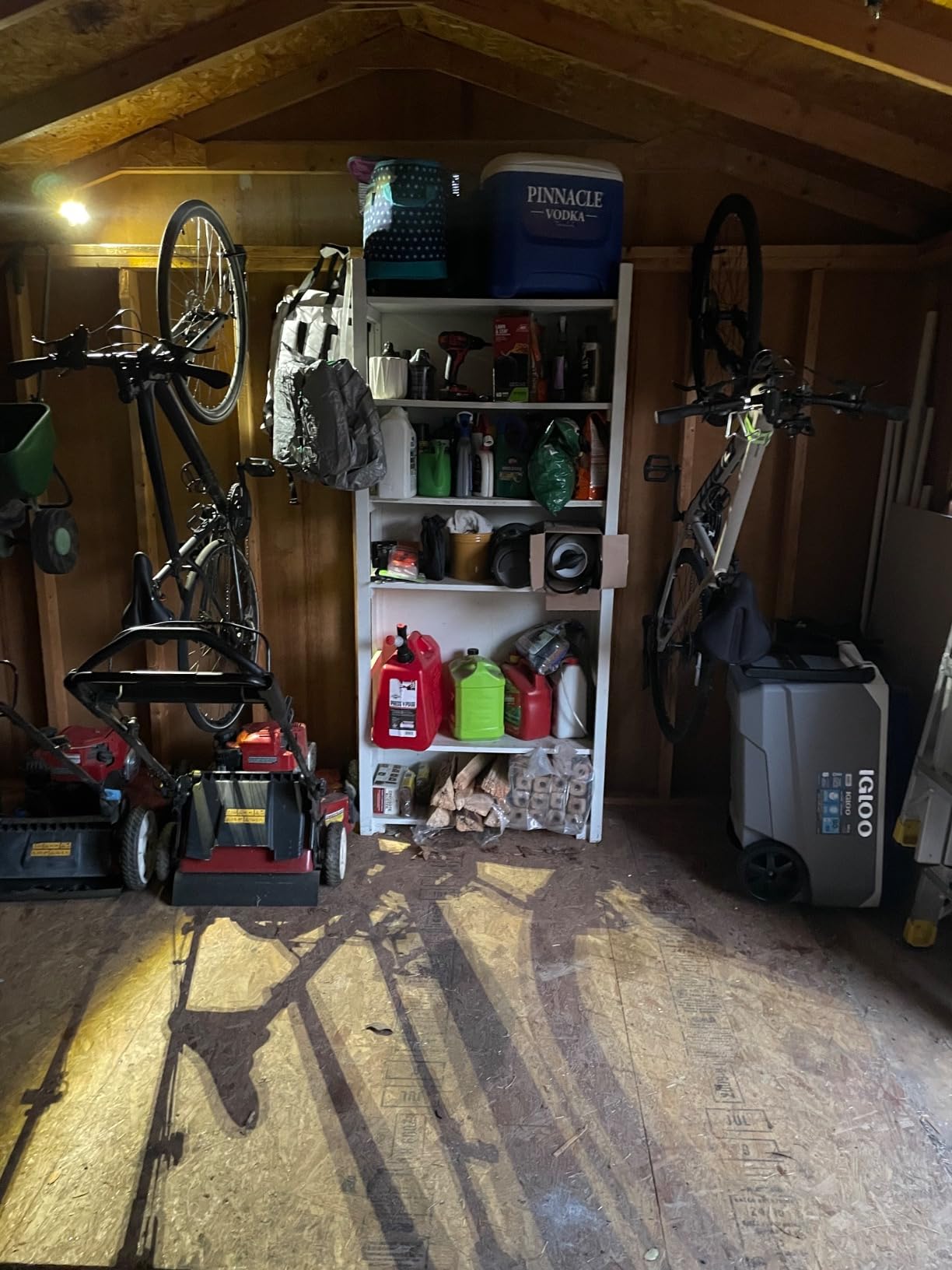
Owners are broadly satisfied and share one piece of advice almost unanimously: the supplied screws and anchors are not strong enough for the 50 lb rating. Nearly everyone upgrades to lag bolts or adds a plywood backing, and once that is done the rack performs exactly as advertised.
The secondary complaint is narrow road bike rims, which can twist sideways in the hook rather than sitting straight. It is a cosmetic issue on a hanging rack, but it is the most common reason buyers move up to a tray-style hook such as the Delta Cycle earlier in this list.
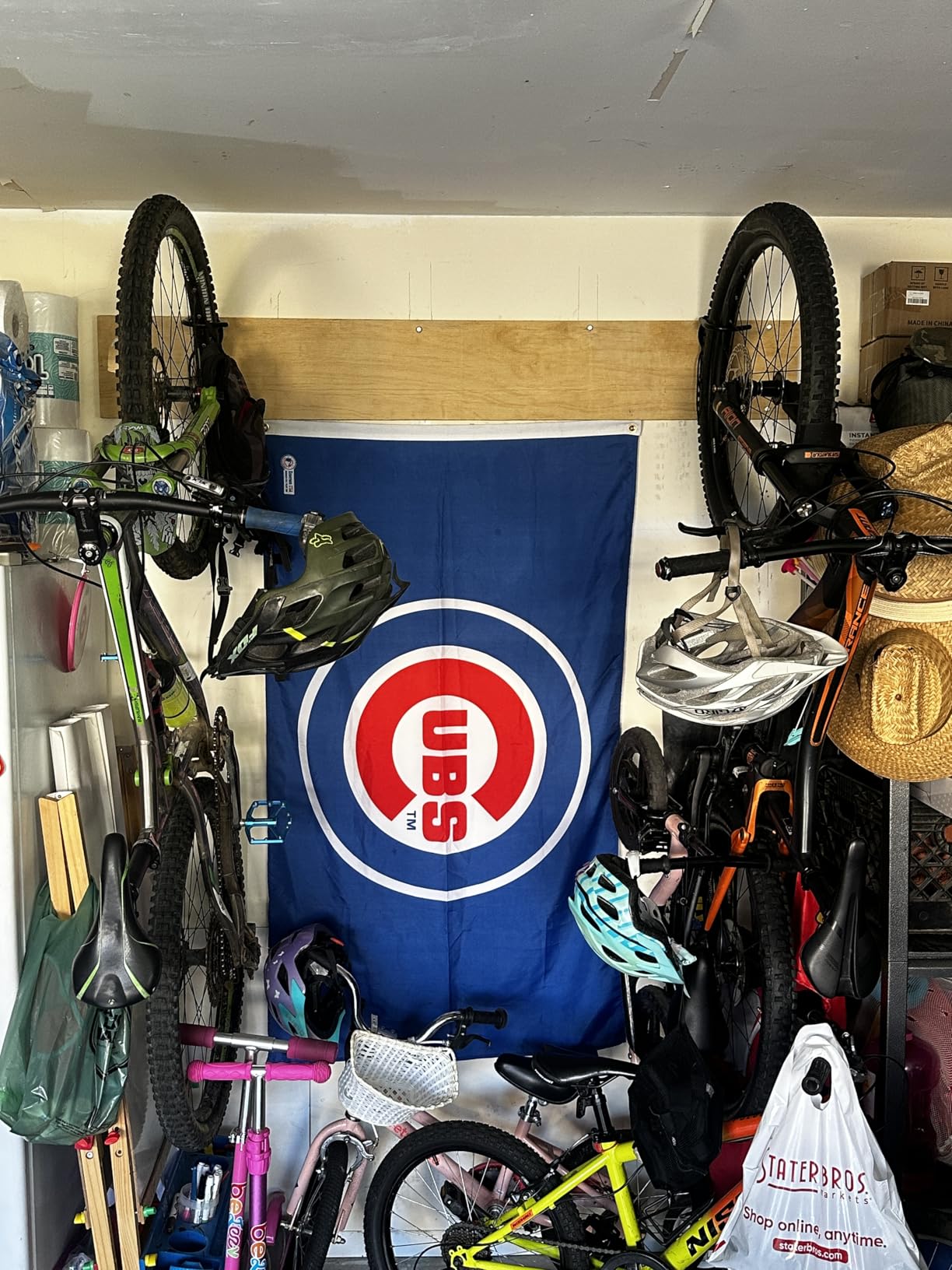
Is this strong enough without upgrading the fixings?
No, and we would not leave it as shipped. The included hardware is the weakest link on an otherwise solid rack, and it is the single most repeated theme in the reviews.
Spend a few minutes on lag bolts into studs, or a plywood backing, and the 50 lb rating is genuinely reachable.
When should I buy something bigger instead?
Upgrade when you have more than two bikes to store, when your bikes are fat-tired, or when you want bikes to fold flat against the wall rather than project into the bay. For two standard bikes in a small garage, this is enough.
Adding a second pack is the cheapest path to doubling capacity on the same wall layout.
How to Choose a Vertical Bike Rack for Your Garage
Start by counting bikes and weighing them, because those two numbers eliminate most options immediately. A rack’s per-bike weight rating is the figure that matters, not the total capacity, and a 300 lb total rating across five bikes tells you nothing about whether your 55 lb e-MTB is safe on any one hook.
As a simple rule, if any bike in your house weighs more than 50 lb, rule out anything rated below 60 lb per bike. That single filter eliminates the budget hooks, the gravity pole stand and the mid-tier swivel rack in one step, and it is the check most buyers skip until a loaded bike is already on the wall.
Check tire width before anything else
Tire width is the most commonly misread specification in this category, and the limits are tighter than buyers expect. A standard mountain or gravel tire lands between 2.1 and 2.8 inches. Plus-size gravel and wide trail tires push toward 3 to 3.5 inches. Fat bikes start around 4 inches and go wider.
Against those numbers, the Steadyrack covers 2.1 to 2.8 inches, which is the standard-tire sweet spot. The monTEK extends to 3.54 inches, the TORACK hooks to 4.4 inches, and the freestanding rolling stand accepts tires up to 4 inches wide. If your bike has a fender, check that too, because the Steadyrack explicitly excludes fenders and mudguards while several competitors do not.
Match the rack class to your e-bike weight
For bikes under 35 lb, which covers most non-electric machines and light e-bikes, anything in this roundup works. For bikes in the 40 to 50 lb range, target a 50 lb or higher per-bike rating. Above 50 lb, you need a rack rated at 60 lb or more, and that rules out the leaning gravity stands in favour of a wall-mounted steel rack or a heavy freestanding cradle.
Kids’ bikes are the opposite problem. Small wheels and low weight suit almost anything, but check the lowest hook position on a gravity stand, since a 20 inch wheel can sit awkwardly low on a tall pole.
Decide what your wall is made of
Framed drywall with studs on standard 16 inch centres is the easy case. Find two studs that bracket your rack, use lag bolts, and the job takes minutes. Mounting holes rarely line up perfectly with a specific rack, so plan on either a short ledger board screwed between studs or accepting an offset hole with a masonry anchor.
Bare drywall on its own will not carry a loaded bike rack in this category. That single fact explains most of the negative reviews across budget racks, where the supplied anchors pull straight out of the wall. If you have block or concrete, use masonry anchors and check the fastener length matches the wall thickness.
Finished garage walls, common in newer homes and in converted spaces, are the hardest case. You may need to locate the framing behind the drywall or accept a freestanding solution. Our guides to roof racks and storage covers assume a fixed wall, so for a finished surface, plan the freestanding or no-drill route first.
Choose swivel for shared bays, fixed for simplicity
A swivel rack folds the bike flat against the wall, which matters enormously in a bay shared with a vehicle and dramatically less in a corner nobody else uses. The Steadyrack offers the most travel at 160 degrees, the monTEK follows at 150 degrees with the smoothest bearing mechanism, and the StoreYourBoard swivel mount gives you 124 degrees plus a detent lock and a lifetime warranty.
Fixed hooks are cheaper, simpler and more resistant to a bike being knocked off. If the wall is out of the way and you want the simplest possible install, a fixed hook is the right call.
Count bikes per foot of wall, not bikes per product
The StoreYourBoard 5 Bike Rack holds the most bikes in this roundup on a single 46 inch bar, which makes it the most wall-efficient choice for a large family. The Steadyrack holds one bike per unit but is modular, so you can add mounts as the household grows rather than committing to a fixed capacity.
The tension is between immediate capacity and future flexibility. A single swivel mount costs less per bike and can be added to over time. A multi-bike rail concentrates five bikes in one place and finishes the job in an afternoon.
No-drill options and their honest limits
No-drill vertical storage comes in three forms here. Gravity pole stands lean into a wall and need no fasteners but only take two light bikes. Freestanding cradle stands support a bike on the floor and handle heavier loads but use up floor area. Wheeled stands hold a single bike and roll out of the way when you need the space.
All three are genuinely useful in a rented flat, a condo, or a garage where drilling is not an option. None of them match a wall mount for permanent floor-space recovery, and that is the honest trade-off.
Measure the garage door and car clearance
A vertically stored bike is roughly as tall as the bike itself, so a 29 inch mountain bike on a wall rack can reach toward head height and interfere with a garage door track, a parked car’s roof, or a wall-mounted shelf you already own.
Before drilling, check three things: the swing path of your garage door, the height of the roof on the vehicle you park in the same bay, and any ceiling track or ladder stored above. Mounting a swivel rack slightly lower and closer to the corner of the wall usually solves the interference without reducing capacity.
Installing a Vertical Bike Rack Without Damaging Your Wall
Most wall-mounted racks take four lag bolts into studs, and the whole installation is under half an hour once you know where the studs are. The failures we see in reviews are almost always the same three mistakes, and all three are avoidable.
The first is trusting the supplied drywall anchors. On a rated 40 to 60 lb rack, the anchors in the box are decorative. Find framing, use lag bolts, and skip the anchors entirely. If the rack’s holes do not land on studs, screw a 2×4 ledger into two studs and mount the rack to that.
The second is skipping the stud finder. A magnetic stud finder or a stud finder with a live-wire detection mode is inexpensive and removes most of the guessing. Mark the studs with tape before you drill so you do not lose them behind the mounting plate.
The third is mounting too high. Bikes settle downward once the wheel is hooked on, and many instructions say nothing about the finished height. Measure the floor clearance you need for a workbench, bins or a car sill, add a few inches, and mount to that line rather than to a comfortable-looking eye-level guess.
Protecting rims matters as much as protecting the wall. A rubber-coated hook grips the tire rather than the rim, and a wheel tray spreads the load so the wheel does not rub on paint. A padded strip behind the rack does more for your wall than any coating on the rack itself, and costs very little. Our garage bike storage guide covers wall prep in more detail if you are working on a freshly painted wall.
One last habit: load bikes heaviest at the bottom and closest to the studs. On a multi-hook rail, the load distribution across brackets matters more than anything else you do after mounting.
Frequently Asked Questions
What is the best bicycle rack for a garage?
The Steadyrack Swivel Bike Wall Mount is our best overall pick. Its 160-degree pivot folds a bike flat against the wall, it loads by rolling the bike in on its rear wheel with no lifting, and it holds 35 kg with tires from 2.1 to 2.8 inches. For households needing more capacity on one wall, the StoreYourBoard 5 Bike Rack holds five bikes and 300 lbs on a single bar.
What is the best bicycle wall rack for a garage?
A swivel vertical wall mount is the best bicycle wall rack for most garages, because the pivot lets a bike fold flat and stop projecting into the bay. The Steadyrack leads with 160 degrees of travel and a 35 kg rating, while the monTEK swivels 150 degrees and accepts tires up to 3.54 inches for wider setups. Always mount into studs rather than drywall anchors.
Are vertical bike racks good?
Yes. A vertical bike rack takes roughly 18 to 22 inches of wall depth instead of the 6 to 8 feet a horizontal floor rack needs, so a rack holding four bikes can free the space of a small parking bay. The drawbacks are that most require drilling into studs, a vertical bike still needs head height and can conflict with a garage door track, and swivel racks only save space if you swing them flat every time.
Do vertical bike racks damage walls?
They can if you use the supplied drywall anchors, which are not rated for a loaded bike. Mount into wall studs with lag bolts, or run a 2×4 ledger between studs and mount to that, and the wall is safe. Adding a padded strip behind the rack and using a wheel tray or rubber-coated hook also stops the wheel from rubbing paint and protects the rim.
Can you store an e-bike vertically?
Yes, provided the rack’s per-bike weight rating exceeds your e-bike. Anything in the 40 to 50 lb range needs a rack rated 50 lb or higher, and bikes above 50 lb need 60 lb or more. A 55 lb e-MTB rules out the 30 lb per-bike gravity pole stand, while the Steadyrack at 35 kg and the monTEK at 30 kg per mount both handle it comfortably.
How much space does a vertical bike rack save?
A vertically stored bike occupies about 18 to 22 inches of floor depth compared with the 6 to 8 feet a horizontally parked bike needs, so a four-bike wall rack typically frees most of a small parking bay. Swing racks save more because the bike folds flat, and multi-bike rail systems such as the StoreYourBoard concentrate five bikes into a single 46 inch bar on one wall.
The Best Vertical Bike Racks for Garages, Verdict by Household
For most households, the Steadyrack Swivel Bike Wall Mount is the best vertical bike rack for a garage, because the pivot and the roll-in loading solve the two problems that push people back to parking bikes on the floor.
If you have five bikes and one wall, the StoreYourBoard 5 Bike Rack gets more of them up per foot of wall than anything else we tested. If you cannot drill, the Delta Cycle gravity pole is the simplest route, and the Sttoraboks rolling stand is the most flexible for a shared bay. For wide tires, the monTEK swivel pair covers plus-size setups and the TORACK rails reach fat bike widths. For a first two bikes, the Wallmaster pair does the job once you replace the fixings.
Whichever you choose, measure your bikes’ weight and tire width first, mount into studs rather than drywall, and set the height against the floor space you need to keep. Those three checks prevent nearly every complaint we found across thousands of reviews.