
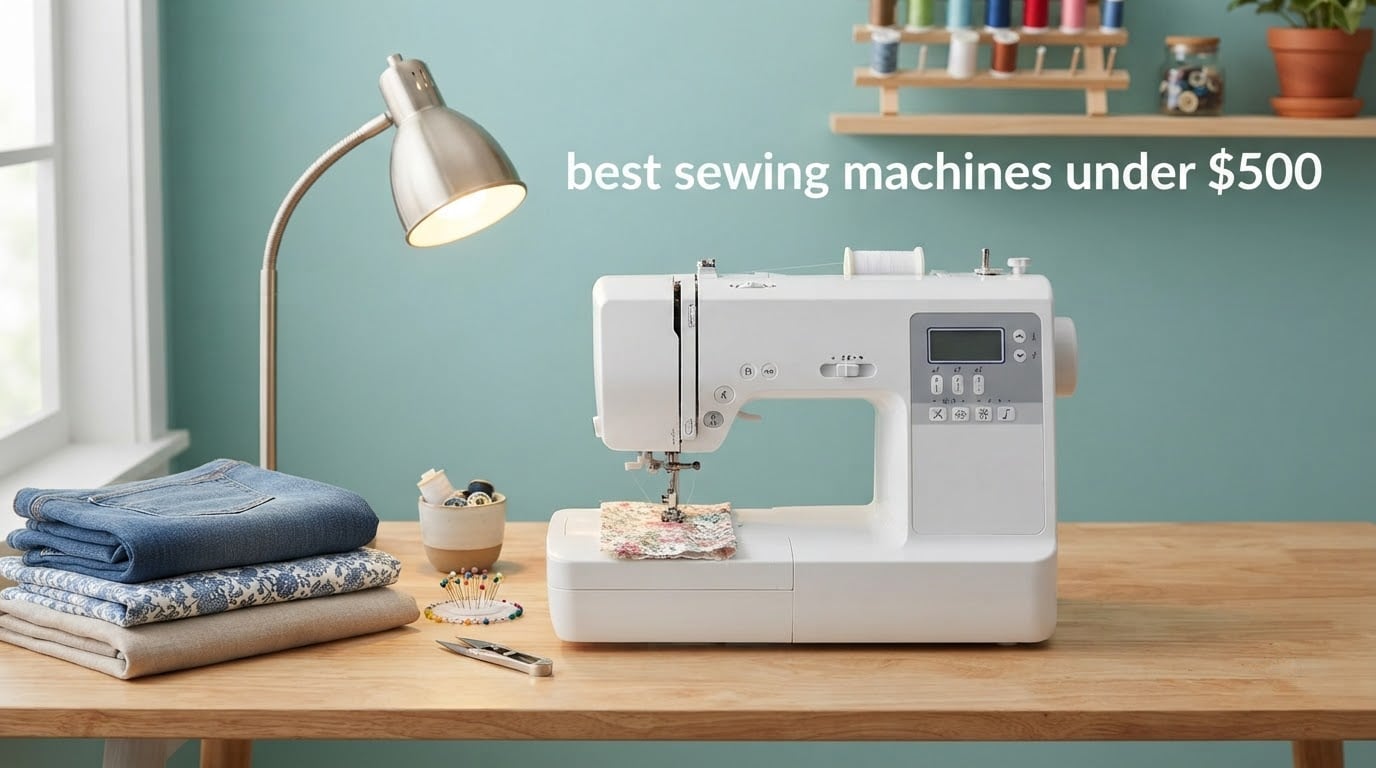
The best sewing machines under 500 dollars right now are the Brother XM2701 for total beginners, the Singer 4423 for denim and heavy fabric, and the Janome JW8100 if you want the most complete feature set. We compared ten machines that all sit comfortably below the cap, and the difference between the cheapest and the most expensive pick here is not stitch count. It is how the fabric feeds, how the bobbin loads, and whether the machine is still working a decade from now.
That distinction matters more than any spec sheet. A 27-stitch machine with a jam-resistant drop-in bobbin and an automatic needle threader will outlast a 185-stitch machine with a frustrating bobbin system, every single time. We built this list around the handful of things you touch on every stitch: the feed dog, the presser foot pressure, the throat space, the bobbin, and the availability of parts five years from now.
One note on our process, because it shapes how you should read the ratings below. We did not buy ten machines and sew for six months. We read the published specifications, the manufacturer documentation, and thousands of owner reviews, then we cross-checked recurring patterns against community discussion. When we say a machine struggles with thick denim, that pattern shows up in owner reports again and again rather than in our own stopwatch reading.
The recurring theme in beginner discussions on r/sewing is that people do not actually want a big stitch library. They want the two hardest beginner steps, threading the needle and changing the bobbin, to stop being hard. On patternreview.com, the community consensus for a first machine names Janome, Kenmore and Baby Lock as solid starting brands, which are exactly the brands most roundups skip. For the wider picture without a price cap, our best sewing machines expert review covers the full range from portable to dealer-line.
Table of Contents
Top 3 Picks for the Best Sewing Machines Under $500 (October 2026)

Brother XM2701
- 27 built-in stitches
- Automatic needle threader
- Jam-resistant drop-in bobbin
- 6 sewing feet included
SINGER 4423
- 1
- 100 stitches per minute
- Heavy-duty metal interior frame
- Automatic needle threader
- 1-step buttonhole
Brother HC1850
- 185 stitches and 8 auto-size buttonholes
- LCD stitch selection screen
- Advanced lever needle threader
- Wide table and 8 feet
Quick Picks by Use Case in 2026
Here is the short version if you want a decision in thirty seconds. Every line below is a use case, not a spec dump, so you can find your situation in the list.
Best for a first-ever machine: Brother XM2701 – automatic needle threader, drop-in bobbin and a free arm make the two hardest beginner steps disappear.
Best for denim, canvas and webbing: Singer 4423 – 1,100 stitches per minute, a heavy-duty metal interior frame and a stainless steel bedframe.
Best all-round feature set: Janome JW8100 – 100 stitches, 7 one-step buttonholes, a 7-piece feed dog and standard Class 15 bobbins.
Best bundled quilting starter: Brother XR3774 – 37 stitches plus a removable wide extension table, walking foot and 8 feet in the box.
Best computerized step-up: Brother HC1850 – an LCD screen, 185 stitches, 8 auto-size buttonholes and a wide sewing table.
Best for small spaces, classes and retreats: Singer M1500 – under 10 pounds with a dial selector and preset stitch length and width.
Best mechanical build that will outlast you: Bernette B35 – an all-metal mechanical design with a needle threader, winder and thread cutter.
Best indestructible dial machine: Janome 2212 – a front-loading vertical oscillating hook bobbin, extra-high foot lift and a 25-year parts warranty.
Best for upholstery and thick outdoor fabric: Singer Heavy Duty 4523 – a stainless steel bedplate, adjustable foot pressure and speed control to 1,000 stitches per minute.
Best heavy-duty specialist: Janome HD 3000 BE – the most substantial metal build in this group with a dial-controlled mechanical layout.
Every Pick Side by Side in 2026
This table is the fastest way to see where the machines sit relative to each other. Read down the feature columns, not the price column, because the price is capped for all ten of them anyway.
| Product | Specifications | Action |
|---|---|---|
| Brother XM2701 |
|
Check Latest Price |
| SINGER 4423 |
|
Check Latest Price |
 Janome JW8100 Janome JW8100 |
|
Check Latest Price |
 Brother XR3774 Brother XR3774 |
|
Check Latest Price |
| Brother HC1850 |
|
Check Latest Price |
 SINGER M1500 SINGER M1500 |
|
Check Latest Price |
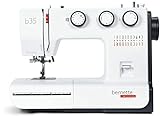 Bernette B35 Bernette B35 |
|
Check Latest Price |
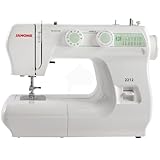 Janome 2212 Janome 2212 |
|
Check Latest Price |
 SINGER Heavy Duty 4523 SINGER Heavy Duty 4523 |
|
Check Latest Price |
 Janome HD 3000 BE Janome HD 3000 BE |
|
Check Latest Price |
1. Brother XM2701 – Best First Machine for Total Beginners
Brother Sewing Machine, XM2701, Portable Sewing Machine, 27 Stitches
27 built-in stitches
Automatic needle threader
Jam-resistant drop-in bobbin
12.6 pounds
Pros
- Threads itself and changes bobs in seconds
- 27 stitches without a confusing menu
- Free arm handles cuffs and sleeves
- 6 feet plus 4 bobbins in the box
- Reported sewing within 30 minutes for first-timers
Cons
- LED work light is dim
- Thread tension needs dialing in
- Audible under load
- Struggles past roughly 9 fabric layers
- Manual and DVD less clear than online guides
Of everything we read for this roundup, the XM2701 has the most owner reports from people who had never touched a sewing machine before. Reviewers describe being sewing hems within half an hour of unboxing, and a good number of them were in their seventies or eighties. That is not a marketing line. It happens because this machine removes the two steps where beginners quit: threading and bobbin change.
The automatic needle threader routes the thread through the needle for you, and the jam-resistant drop-in top bobbin drops straight into the bedplate without a casing to thread by hand. Everything else is deliberately plain. Stitch selection is a linear dial with 27 options, including the utility set you actually need, plus blind hem, zigzag and stretch stitches. The presser foot lever is a simple metal lever rather than something plastic and vague.
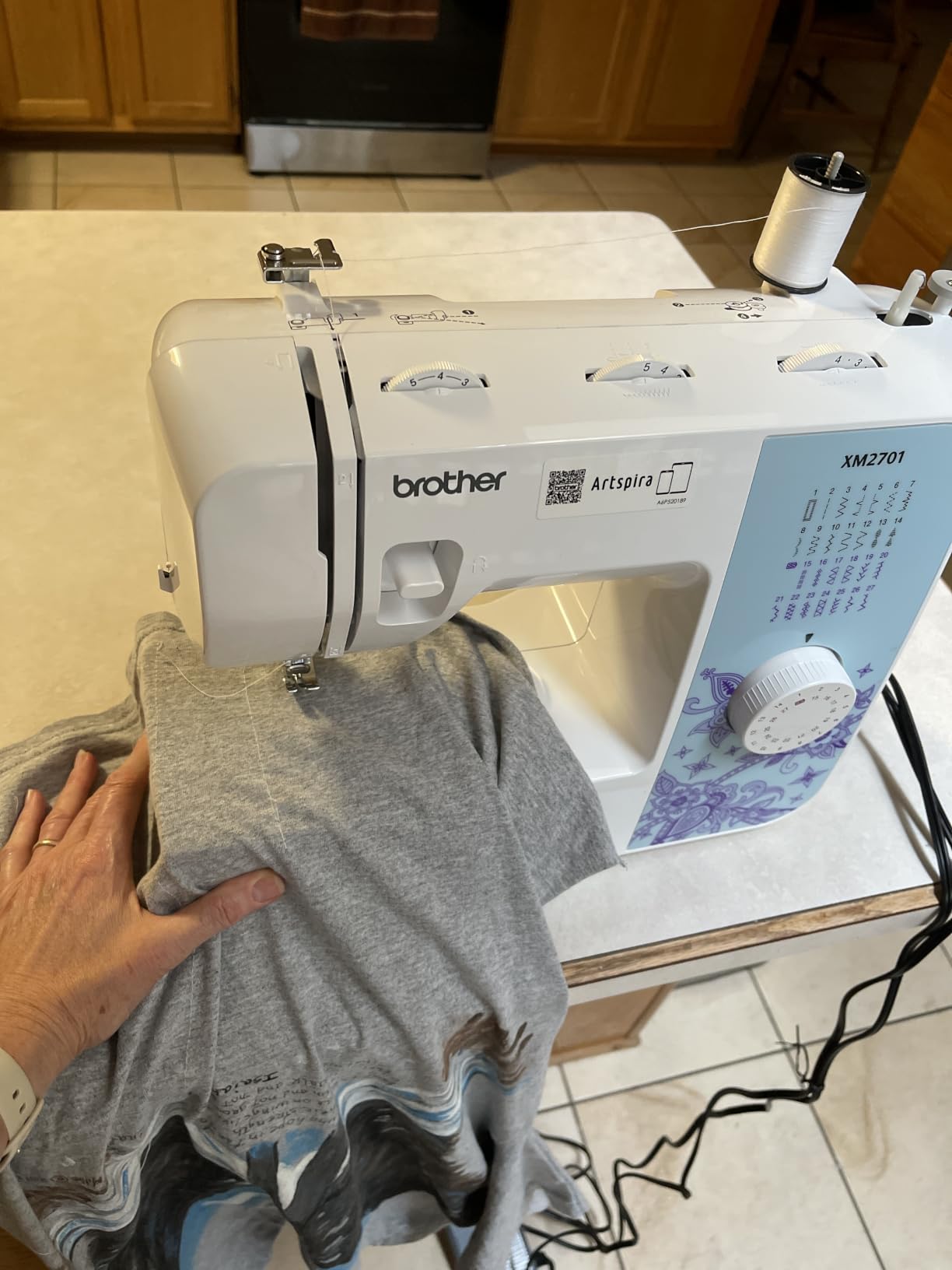
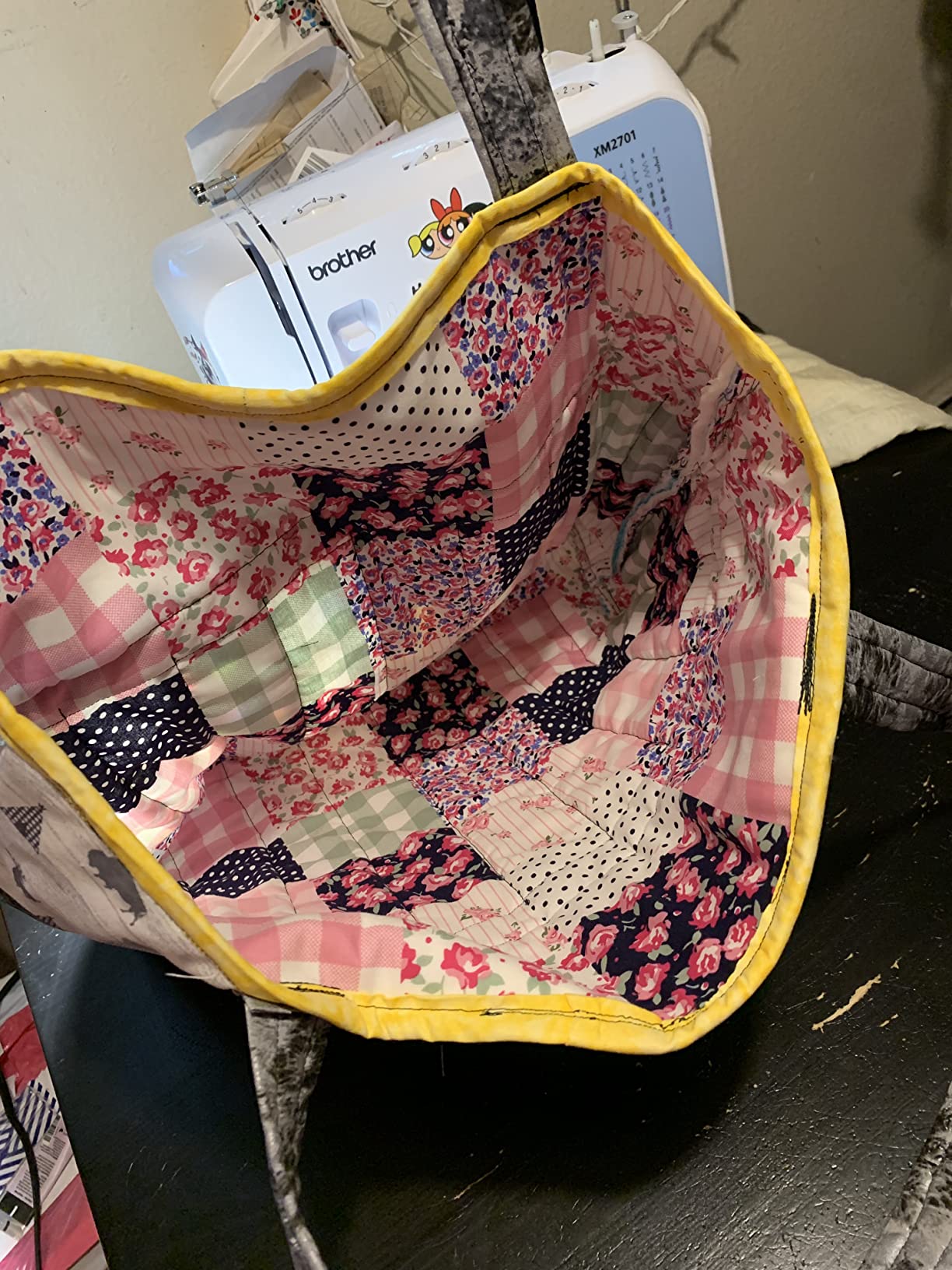
Owner photos and reviews are unusually consistent on one point: this thing simply works, quietly, for light work. Hems, mending, pillow covers, masks and small quilting pieces all fall well inside its comfort zone. The metal body and 12.6-pound weight make it portable enough to move between a sewing room and a class, and Brother support is available for as long as you own it.
The honest limits are real though. The LED work light is dim, which is the single most repeated complaint in the reviews, and you will end up adding a separate lamp before long. Thread tension takes a few sessions to dial in rather than being automatic. And the presser foot will not plow through heavy multi-layer seams, so plan on a second machine for that work later.
Who should buy the XM2701
Buy this if you are learning alone, if you mostly sew light to medium cotton, and if you want the lowest-friction entry point. It is also the machine we would hand to a teenager. Everything is labelled on the machine face, and the bundle includes six sewing feet, a three-piece needle set, a twin needle, four bobbins and a screwdriver.
If your plan involves denim from week one, keep reading. The 4423 and the 4523 exist specifically for that, and the difference shows up the first time you sew a thick seam.
Who should skip the XM2701
Skip it if you sew knits regularly, because there is no dedicated stretch-stitch handling comparable to the Bernette, and skip it if you intend to quilt a bed-size project, because the free arm is small and there is no extension table in the box. It is also a machine for one person at a time, which is worth remembering if you plan to teach a group.
2. SINGER 4423 – Best for Denim, Canvas and Heavy Fabric
SINGER® 4423 (Grey) High Speed Heavy Duty Sewing Machine with Accessory Kit
1,100 stitches per minute
60 percent stronger motor
Heavy-duty metal interior frame
17.1 pounds
Pros
- Punches through denim
- webbing and canvas
- Very fast at 1100 stitches per minute
- Metal frame under a plastic shell
- Numbered threading path printed on the body
- Wide accessory kit with quilting guide
Cons
- No power switch for the work light
- Lightweight plastic foot pedal with a short cord
- External parts are brittle plastic despite metal internals
- Printed manual points to an online download
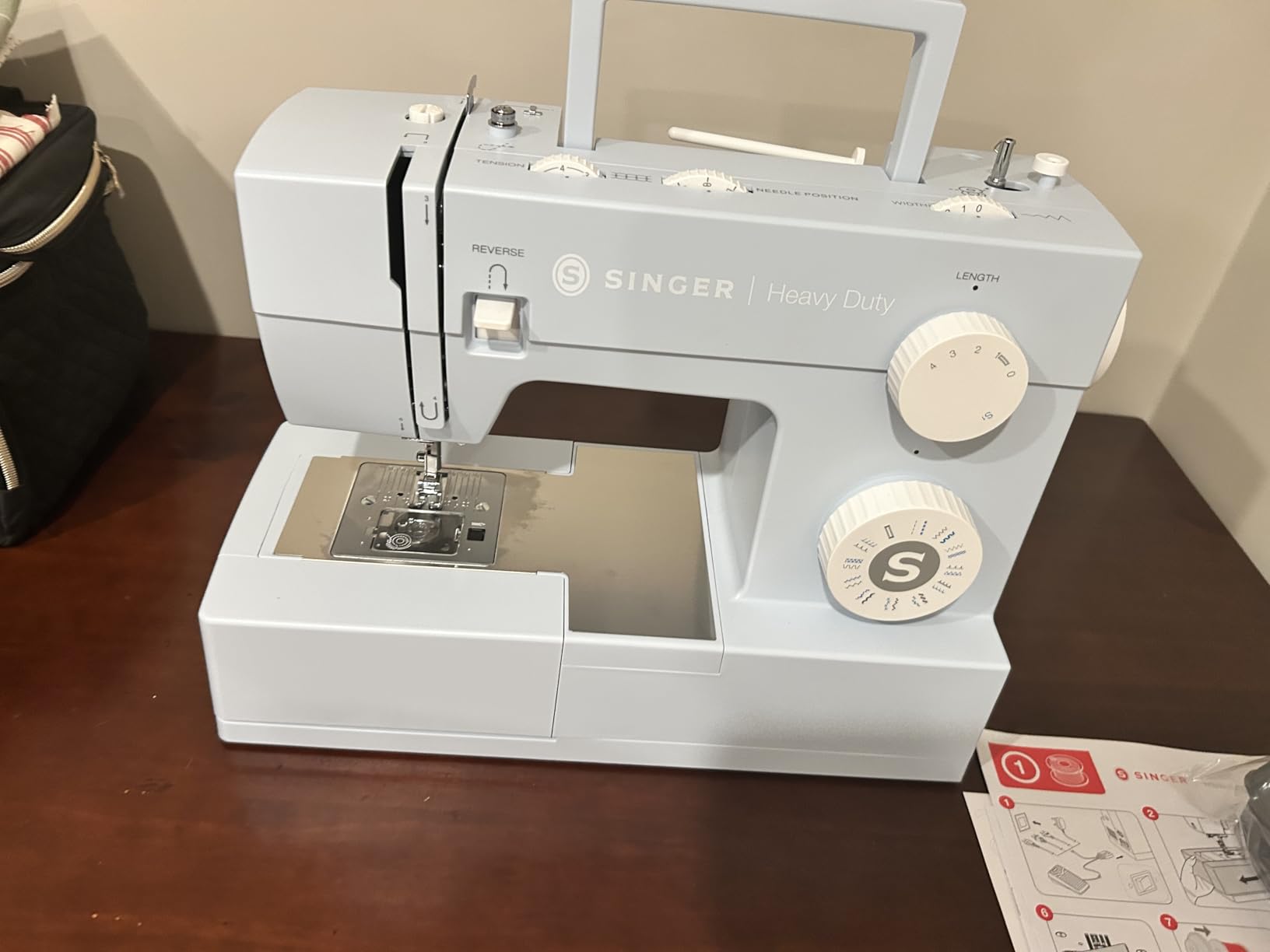
The 4423 is the machine owner reports reach for when a project stops being easy. Denim, webbing, camping gear, canvas and even 10 oz leather show up repeatedly in the reviews as things it handles without drama. The reason is the heavy-duty metal interior frame paired with a stainless steel bedframe, and a motor rated 60 percent stronger than the machines below it in this list.
Speed is the other story. At up to 1,100 stitches per minute this is a fast machine, and the foot pedal gives you real control when you are sewing a curve or hitting a thick intersection. The numbered threading path is printed directly on the machine body, which sounds minor until you have set up a new machine at 10 p.m.
Owner photos show a machine that looks far more industrial than the price band suggests. The accessory kit is unusually complete for this tier: all-purpose, zipper, buttonhole and button sewing feet, a seam ripper and lint brush, a quilting guide, needles, bobbins, a screwdriver and a soft-sided dust cover.
The durability story is not perfect, and reviewers are honest about where it fails. The shell, spool post and bobbin case are brittle plastic even though the frame underneath is metal, and a number of owners report the included foot pedal floating on hard floors because of its short cord. Some heavy users also report thread nesting and broken needles on recent production runs. The 25-year limited parts warranty partly offsets that concern.
Who should buy the SINGER 4423
Buy this if you make jeans, work bags, outdoor gear or anything else where fabric thickness is the main problem. It also makes a strong second machine later, once a lighter one is handling the daily mending. Owner reports show hobbyists and semi-professionals using it interchangeably for both.
It is a good choice if you like speed, because the pedal response and top speed make long seams quick. Just expect more noise than the computerized machines on this list.
Who should skip the SINGER 4423
Skip it if you work on delicate fabric or knits where a lower, more controlled speed matters, and skip it if you want automatic thread tension or an LCD-guided stitch selection. It is also the heaviest machine we recommend for beginners, at 17.1 pounds, so moving it between rooms is a two-person job in a small apartment.
3. Janome JW8100 – Best All-Round Feature Set
Janome JW8100 Fully-Featured Computerized Sewing Machine with 100 Stitches, 7 Buttonholes, Hard Cover, Extension Table and 22 Accessories
100 stitches and 7 one-step buttonholes
LCD screen with speed control
7-piece feed dog system
12 pounds
Pros
- Smooth even stitching on denim and layers
- Excellent automatic needle threader
- Standard Class 15 bobbins
- Start stop button and speed slider
- Extension table and even feed foot included
Cons
- Shallow throat space for bulky quilting
- LED light is dim
- Some decorative stitches render poorly
- Controls take longer to learn than a dial
The JW8100 is the most complete machine in this roundup on paper, and owner reviews mostly confirm the paper. It is a computerized machine with 100 built-in stitches, 7 one-step buttonholes, an LCD screen for stitch selection, a start and stop button and a speed control slider. The 7-piece feed dog system is the kind of specification that does not appear on the cheaper models, and it shows up in owner comments as noticeably even feeding.
Two details make it stand out from the Brother computerized machines. First, the needle threader is repeatedly described in reviews as the best in this group, cutting threading down to seconds. Second, it uses standard Class 15 bobbins rather than a proprietary bobbin, so your supply costs stay flat for as long as you own the machine.
The box is unusually generous. You get an extra-wide extension table, an even feed foot, a quarter inch quilting foot, a hard cover, a pin cushion, satin and zipper feet, an automatic buttonhole foot and a full assortment of needles, and Janome warranty coverage runs 25 years on mechanical parts with two years on electrical parts.
Where it falls short is size and lighting. The throat space is shallow, which limits how much quilt you can actually manage under the arm, and the LED light is dim for detailed work. A few owners also find that specialized decorative stitches, star patterns in particular, do not render cleanly.
Who should buy the Janome JW8100
Buy this if you want the widest range of projects on one machine and you plan to sew garments, home decor and small quilts. The start and stop button and speed slider make it unusually teachable, which matters if a child or a complete beginner is at the machine with you.
It is also the pick for anyone tired of paying premium prices for bobbins. Standard Class 15 bobbins are available everywhere.
Who should skip the Janome JW8100
Skip it if quilting is your primary goal and you are already working toward large projects, because the throat space is the limiting factor, not the power. Also skip it if you want a fully mechanical machine with nothing to fail electronically, since the LCD and controls are the point here and also the thing that can fail.
4. Brother XR3774 – Best Bundled Quilting Starter
Brother XR3774 Sewing and Quilting Machine 37 Stitches
37 built-in stitches
Removable wide extension table
8 included presser feet
15 pounds
Pros
- Eight feet plus wide table and darning plate
- Needle threader and drop-in bobbin included
- Handles denim and bulky quilt layers
- Detachable table eases small projects
- Used by professionals as an interim machine
Cons
- Extension table legs are flimsy
- Throat space and power limit large quilts
- Some decorative stitches throw tension
- Brother SA156 bobbins recommended
Bundle value is the story here. The XR3774 ships with 8 presser feet, a removable wide extension table, a darning plate, a twin needle, a machine cover and four bobbins. When you add up what you would otherwise buy separately, the accessory list alone is worth more than the price difference between this and the computerized models.
It has 37 built-in stitches including quilting and blind hem stitches, a 1-step buttonhole, an automatic needle threader and a jam-resistant drop-in top bobbin. The removable table is the feature owners use most, because it turns a free-arm machine into a flat-bed machine for piecing, binding and binding-size projects.
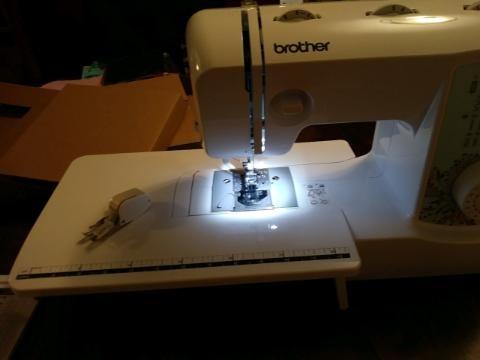
Reviewers report sewing denim, blackout curtain fabric and bulky quilt layers with the included walking foot, and several professionals use it as an interim machine alongside a better one. Brother warranty coverage here is 1, 2 and 25 years on the standard tiered schedule.
There is one quality thread worth knowing. A number of owners reported zigzag skipping and sticking in reverse on early units, an issue the manufacturer later resolved. Owner sentiment in the current reviews treats it as historical, but the extension table legs are still widely described as flimsy and a known weak point.
Who should buy the Brother XR3774
Buy this if quilting is on your horizon but you are not ready to spend on a dedicated quilting machine, or if you want a first machine that ships with a walking foot and a wide table already in the box. The free arm handles sleeves and cuffs for the garment side of your work.
It is also the value pick if you like the Brother interface and want more feet than the cheaper models include.
Who should skip the Brother XR3774
Skip it if you are already an experienced quilter. Throat space and motor power become the ceiling quickly on large multi-layer projects, and the extension table legs will not survive being knocked repeatedly. For heavy denim work specifically, the 4423 or the 4523 is a better engine for the job.
5. Brother HC1850 – Best Computerized Step-Up
Brother HC1850 Sewing and Quilting Machine, 185 Built-in Stitches, LCD Display, 8 Included Feet
185 stitches and 8 auto-size buttonholes
LCD display for stitch selection
Advanced lever needle threader
10.1 pounds
Pros
- Huge stitch library for the tier
- Auto-size buttonholes need no measuring
- LCD makes selection quick
- Lightest Brother in this group at 10.1 pounds
- 8 feet and a wide table included
Cons
- Throat and power limit large quilts
- Sewing light not bright enough for detail
- Stitch selection takes sessions to memorize
- Alphanumeric stitches add bulk not usefulness
The HC1850 is the middle rung between a basic mechanical machine and an expensive computerized one, and it is the first machine on this list that feels like a step up rather than a step sideways. The LCD screen makes stitch selection visible instead of memorised, the advanced lever needle threader is a one-leaver operation, and 8 auto-size buttonholes mean you never measure one yourself.
Of the 185 built-in stitches, 130 are sewing stitches and 55 are alphanumeric. For garment work, that utility count is the number that matters. A wide sewing table and 8 presser feet are included, and at 10.1 pounds this is the easiest Brother here to carry to a class or a retreat.
Owners consistently describe it as learnable for a beginner while still offering quilting capability, and the 25-year limited warranty is the longest Brother coverage in this group. The wide table is credited in reviews with making large panels far more workable than a bare machine bed.
The honest downsides: the work light is not bright enough for detailed work in some setups, and the long-press and dial stitch selection needs a few sessions before you can find things without looking. Younger quilters consistently report that the throat and power become limiting once they move to large multi-layer quilts.
Who should buy the Brother HC1850
Buy this if you are a beginner who intends to grow, because the LCD removes the memorisation burden now and the library keeps options open later. It is also a strong carry-everywhere option at just over 10 pounds with a table that detaches for transport.
Brothers who want lettering on labels and gifts will find the 55 alphanumeric stitches genuinely useful, not just filler.
Who should skip the Brother HC1850
Skip it if you only sew hems and repairs, because you will use maybe a dozen of those 185 stitches. Also skip it if you plan heavy denim as your main project, since the motor is not built for that, and be prepared for a dim work light no matter how good the rest is.
6. SINGER M1500 – Budget Pick, Classes and Retreats
SINGER® M1500 Lightweight & Portable Sewing Machine with Accessory Kit
6 stitches and 57 applications
Stitch selector dial with preset settings
Lightweight 9.7 pound body
4-step buttonhole
Pros
- Genuinely under 10 pounds to carry
- Preset length and width remove guesswork
- Quiet operation and responsive pedal
- Reliable for hems and mending
- 4-step buttonhole clearly marked on the dial
Cons
- Not heavy duty for thick layers
- Can slide on smooth tables
- Only a one year warranty
- Smallest stitch library in the roundup
- Undersized internal storage
The M1500 is the machine to buy if your sewing space is a corner of a table and your real constraint is storage. At under 10 pounds it is the lightest machine we recommend, and the SINGER Free Creativate app provides manuals and tutorials on your phone rather than in a thin printed booklet.
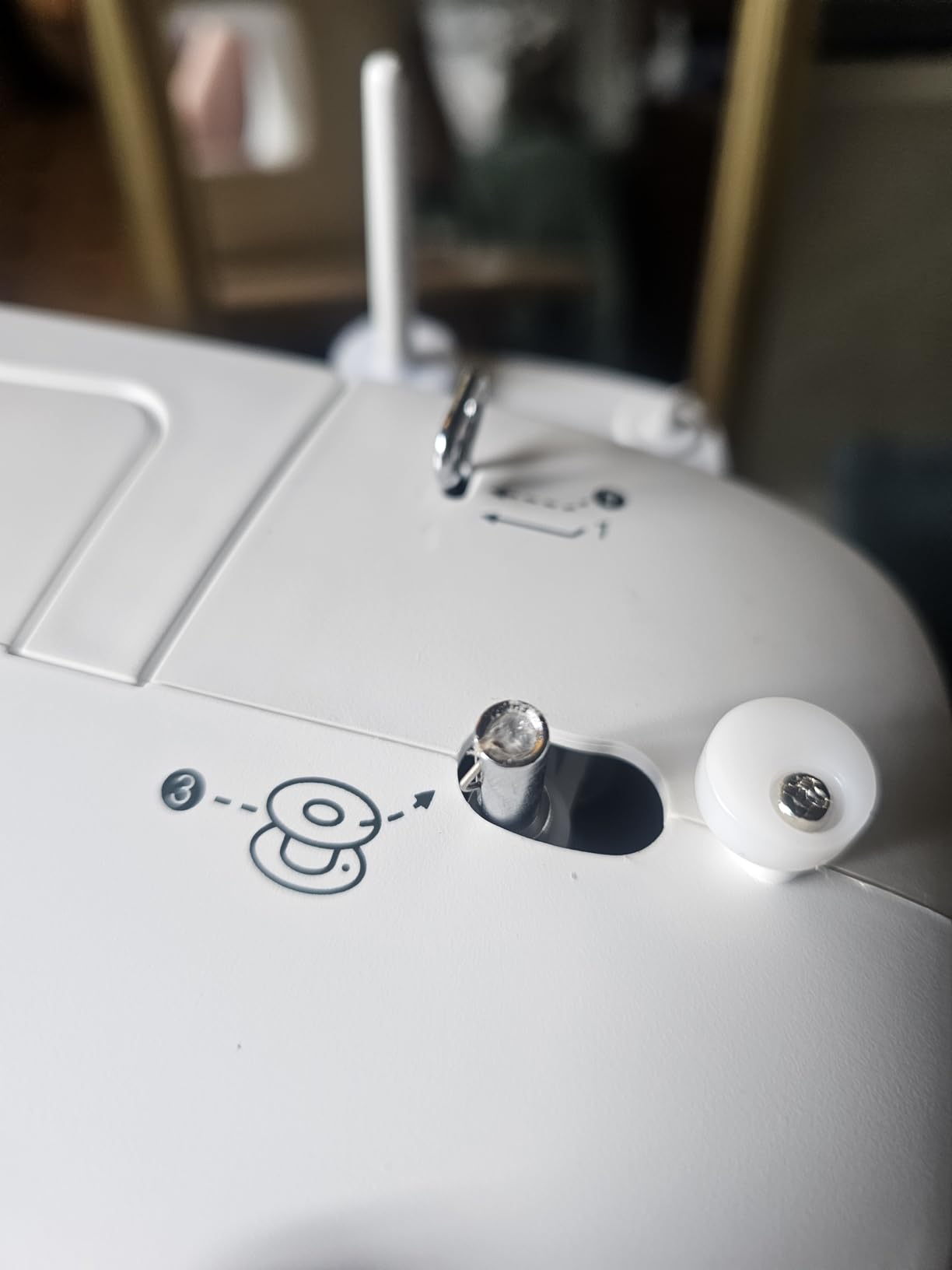
Operation is as simple as a sewing machine gets. The stitch selector dial shows icons for each option, and stitch length and width are preset rather than adjusted, which removes an entire category of beginner error. Threading guides are marked directly on the machine body, and the 4-step buttonhole is marked on the same dial.
Owner reports describe it as quiet with a responsive foot pedal, and several buyers bought it specifically for hemming curtains and repairing children’s clothes. The bundled kit covers the essentials: all-purpose, zipper and buttonhole feet, a darning plate, needles, Class 15 bobbins, a screwdriver and a seam ripper.
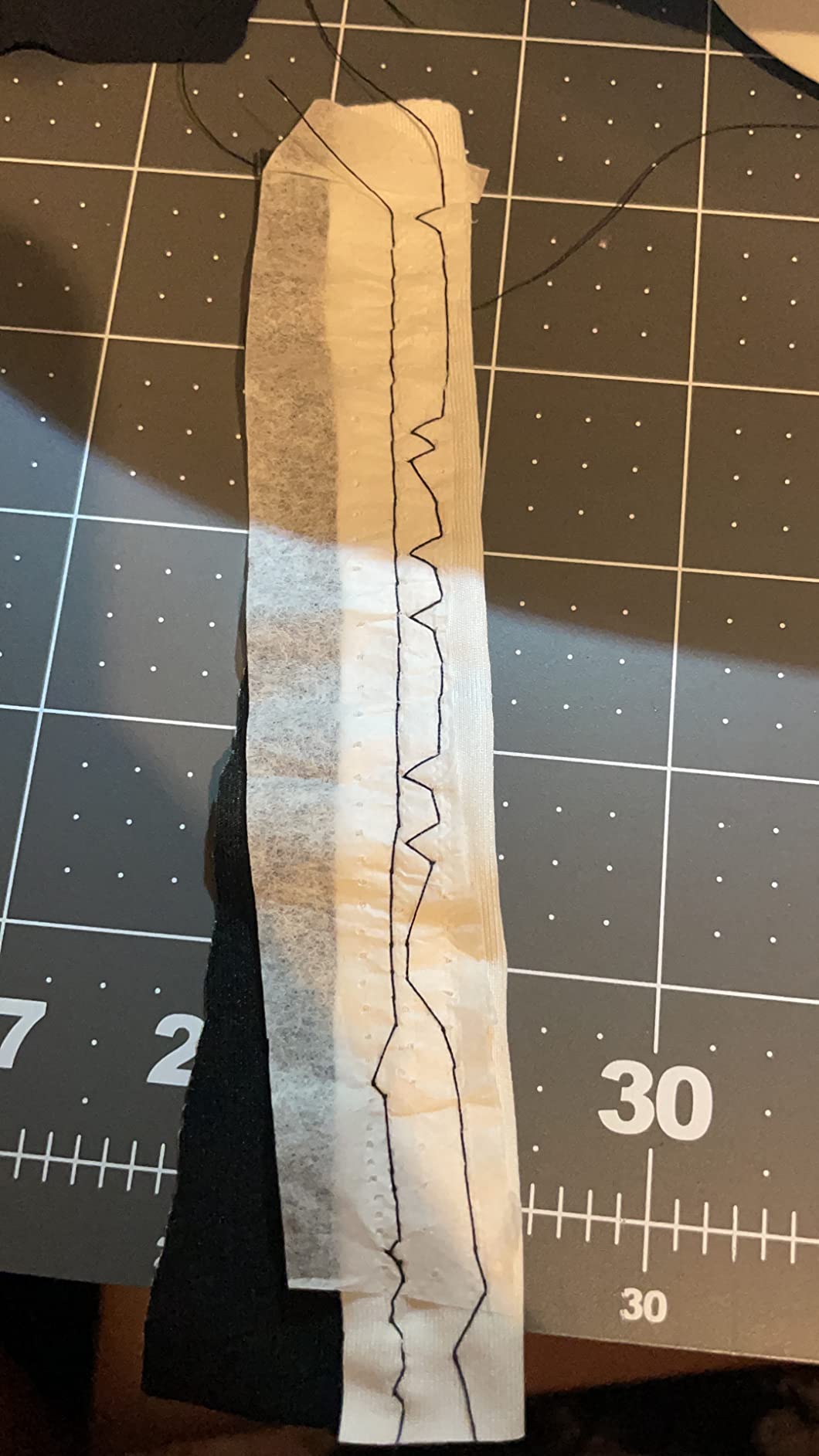
It is not a heavy-duty machine and the reviews are clear about that. Thin denim hems and thick layers are beyond it, the light weight means it can slide on a smooth table without padded feet underneath, and the one-year warranty is the shortest here. A small number of owners report recurring skipped-stitch problems, which is why the 4.4 average is the lowest of the mainstream models.
Who should buy the SINGER M1500
Buy this if you sew occasionally, if you travel to classes or retreats, or if you live somewhere storage is genuinely tight. The preset settings also make it a good machine to teach on, because there is almost nothing to configure incorrectly.
It pairs well with the hard-case mentality. If you can put the machine away in a drawer between sessions, you will sew more often than if it lives on a permanent stand.
Who should skip the SINGER M1500
Skip it if denim or canvas is anywhere in your future, and skip it if you want to do decorative or lettering work, since six stitch options is the smallest library in this roundup. Anyone buying a machine for a decade of garment sewing should spend more.
7. Bernette B35 – Best Mechanical Build That Outlasts Software
Bernette B35 Sewing Machine Swiss Design with 23 Stitches, 7 Presser Feet, Automatic Buttonhole, Quilting, Heavy-Duty Build, LED Light, Portable
23 utility and decorative stitches
1-step automatic buttonhole
Built-in threader, winder and thread cutter
7 presser feet included
Pros
- All-metal mechanical build with nothing to fail
- Quality controlled under the Bernina name
- Sews evenly and quietly
- Handles knits well with the stretch stitch
- Popular as a backup machine
Cons
- Lowest rating in the roundup at 4.2
- Not truly heavy duty for many denim layers
- Loudens on thick stacks
- Vibrates at higher speeds
- Accessories hard to source
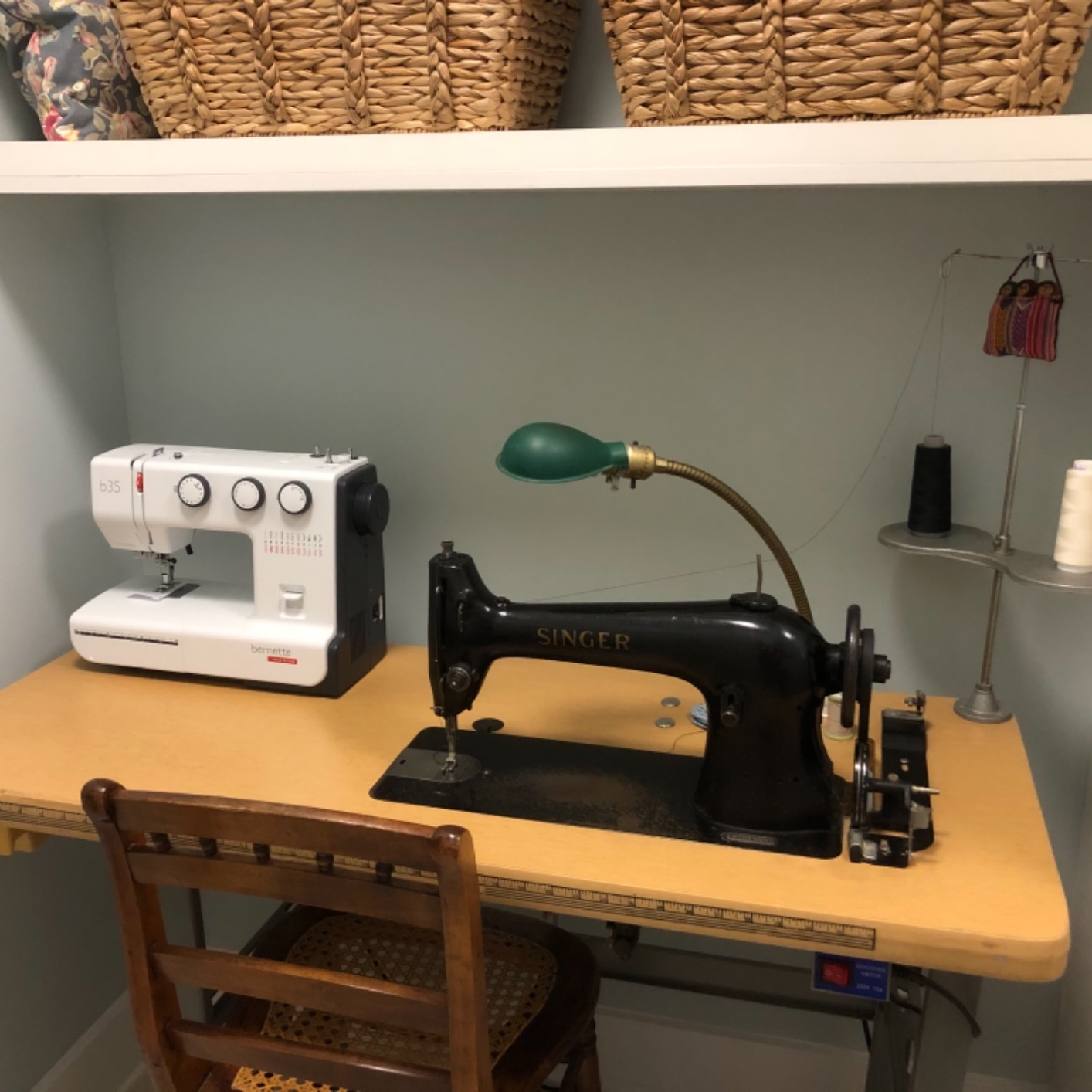
The Bernette B35 is a mechanical machine with an all-metal body, which means no screen, no firmware and no electronics to fail. Owners with decades of experience describe it as the kind of machine you can hand to a repair shop and have serviced indefinitely, and one owner in the reviews runs it six hours a day through quilting, denim repair and minky.
It still includes the modern conveniences. There is a built-in needle threader, a spool winder, a thread cutter, a 1-step automatic buttonhole, an extension table, an LED work light and 7 presser feet, and it accepts universal Class 15 bobbins. The 23 built-in utility and decorative stitches have adjustable length and width rather than being fixed.
The knits performance is worth calling out. The included stretch stitch is reported to handle knit and stretchy fabric well, which is the gap in most of the mechanical and heavy-duty machines on this list. That is why we picked it as the knit-friendly option even though it is not a dedicated knit machine.
The 4.2 rating is the lowest in the group and the reasons are consistent: it is not truly heavy duty for many layers of denim despite the marketing, it gets noticeably louder and shudders through thick stacks, and its review base is small at 410 reviews. Extra feet and accessories for this specific model are also harder to source. One owner reported a broken needle threader hook and an uneven free-arm assembly on arrival.
Who should buy the Bernette B35
Buy this if you sew knits, if you value a machine that will still work in fifteen years, or if you already own a computerized machine and want a mechanical backup for straight-line and heavy work. The metal construction is the reason.
It is also a reasonable choice for someone who wants Bernina-family quality control without paying dealer-line prices, though be honest with yourself about the accessory availability.
Who should skip the Bernette B35
Skip it if you need a machine that eats thick multi-layer denim, because the heavy-duty label outruns the reality here. Also skip it if you want an LCD to select stitches, since this is a mechanical layout with a threader and buttonhole as its only electronic assists.
8. Janome 2212 – Best Indestructible Dial Machine
Janome 2212 Front-Loading Sewing Machine with 12 Built-In Stitches
12 built-in stitches
Front-loading vertical oscillating hook bobbin
Free arm with drop feed
14.9 pounds
Pros
- Metal bobbin holder and plate
- Owners report years of daily service
- Sews thick fabric and layered denim
- Front bobbin is easy to thread and clear
- Readable manual with line drawings
Cons
- Reverse lever will not latch
- Runs fast with no start or stop button
- Foot pedal cord is short
- Only 12 stitches for non-basic work
- Outer case is plastic
The 2212 is the answer to the beginner question about whether an under-500 machine is built to last. Owner reviews describe five-plus years of daily use, teaching children on it and passing it down to grandchildren as a first machine. The build is a metal bobbin holder and plate inside a plastic outer case, which is where the durability actually comes from.
The front-loading vertical oscillating hook bobbin is the design detail that earns the loyalty. It is easy to thread, and when thread catches you can remove the bobbin case and clear it without a service visit. The free arm comes with drop feed for free-motion work, the feed dog is a 5-piece design, and the presser foot lift is extra-high, which helps when you are handling multiple layers.
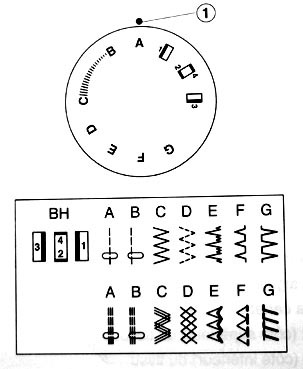
Variable stitch length and width dials give it more real project range than the stitch count suggests, and Janome warranty coverage runs 25 years on mechanical parts. The instruction manual is described in reviews as readable, with line drawings, which sounds basic and matters enormously for a first machine.
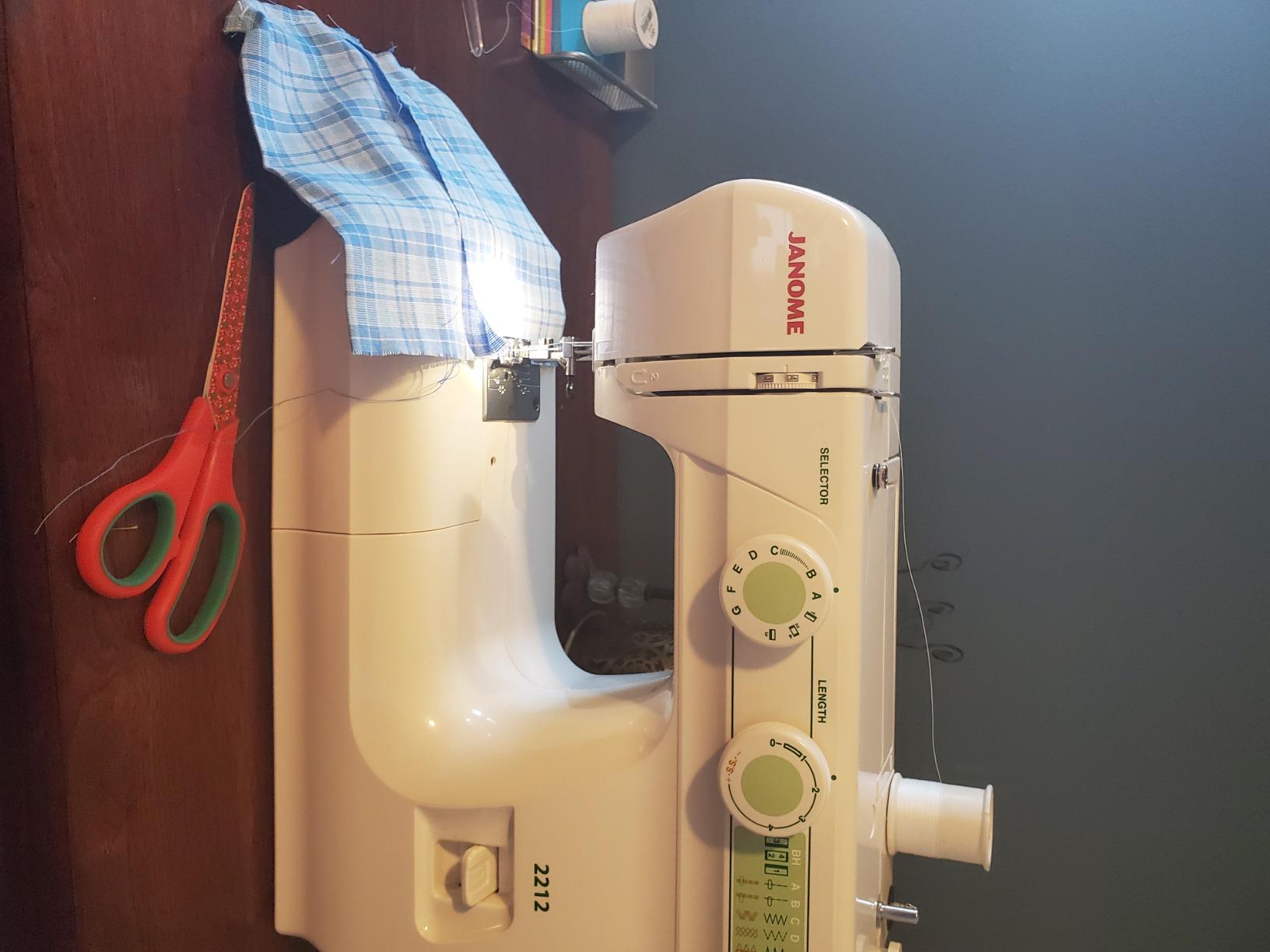
The mechanical-logic annoyances are the trade. The reverse lever must be held continuously because it does not latch, and there is no start or stop button, so at speed the spool thread can pull loose off the needle. Only 12 stitches means no decorative or lettering work, and the foot pedal cord is short.
Who should buy the Janome 2212
Buy this if longevity is your main concern, if you sew thick fabric, or if you want a machine that a repair technician can service without any special software. The 25-year mechanical parts warranty is the strongest coverage on this list.
It is also a strong teaching machine for anyone learning on a manual, because the mechanics are visible and simple rather than hidden behind a menu.
Who should skip the Janome 2212
Skip it if you want automatic features. No needle threader, no one-step buttonhole, no start or stop button, and only 12 stitches. It is a deliberate tool for people who prefer to understand the mechanics, not a first machine for someone who wants threading handled for them.
9. SINGER Heavy Duty 4523 – Best for Upholstery and Thick Outdoor Fabric
SINGER® Heavy Duty 4523™ Next Evolution Sewing Machine with Accessories
New powerful DC motor
Stainless steel bedplate
Speed control to 1,000 SPM
Drop feed and adjustable foot pressure
Pros
- Newer DC motor and metal frame add real piercing power
- Speed dial helps on curves and corners
- Tracks straight close to the fabric edge
- Stainless bedplate lets fabric glide
- Well regarded by repair-minded owners
Cons
- One year manufacturer warranty
- Not as smooth and quiet as higher-end machines
- Some buyers report early failures
- Heavy duty label oversells capability
The 4523 is the updated take on the classic heavy-duty Singer layout, and the two changes owners actually notice are the new DC motor and the speed control dial. The motor delivers noticeably better piercing power than older heavy-duty models, and the stainless steel bedplate lets thick fabric glide instead of catching.
It keeps the same 23 stitches and 97 applications as the 4423, plus a 1-step buttonhole, an integrated needle threader and an easy-monitor drop-in bobbin. The parts that separate it from the 4423 for upholstery work are the adjustable needle position, the adjustable presser foot pressure and the drop feed for free-motion monogramming and quilting.
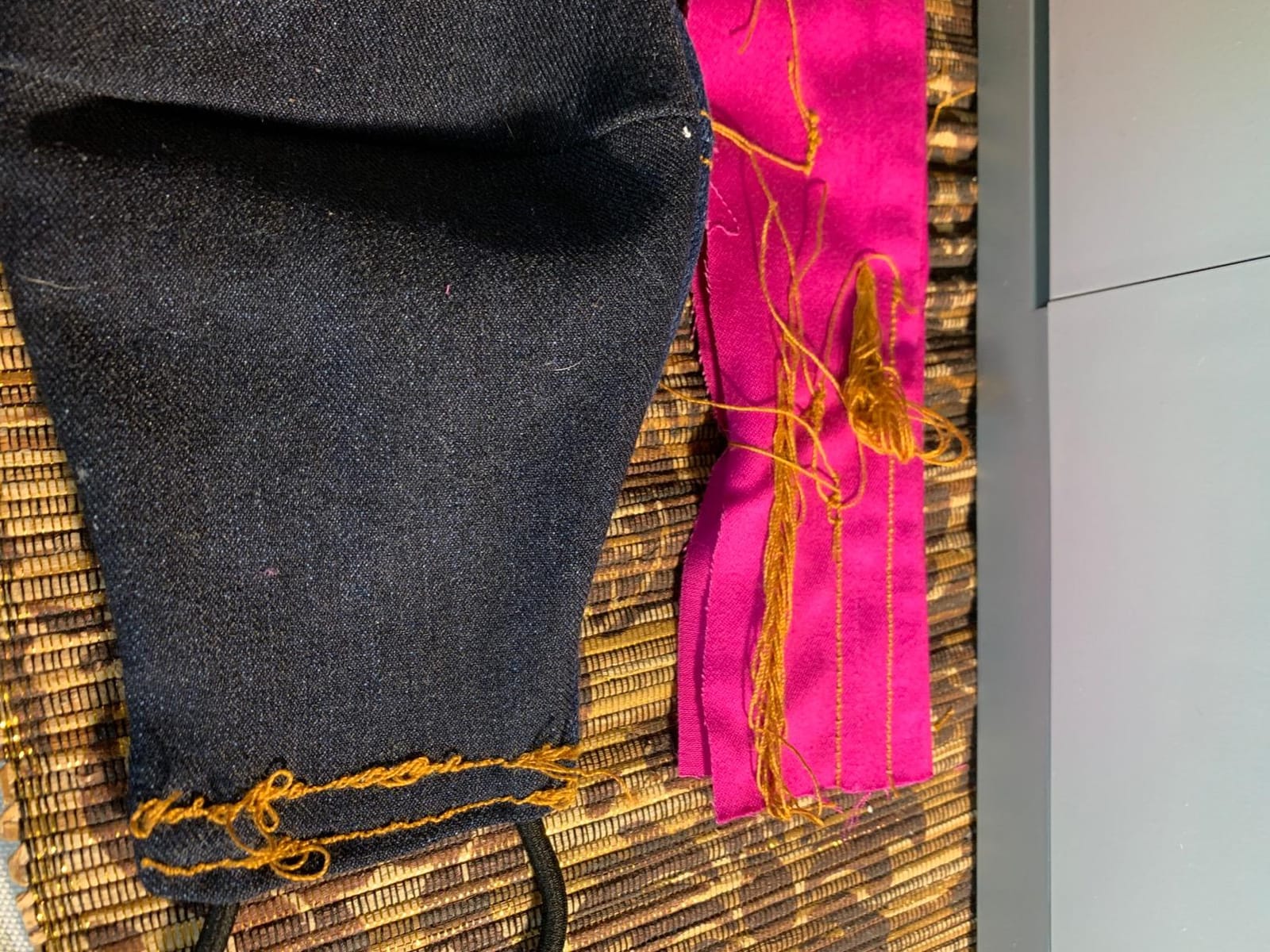
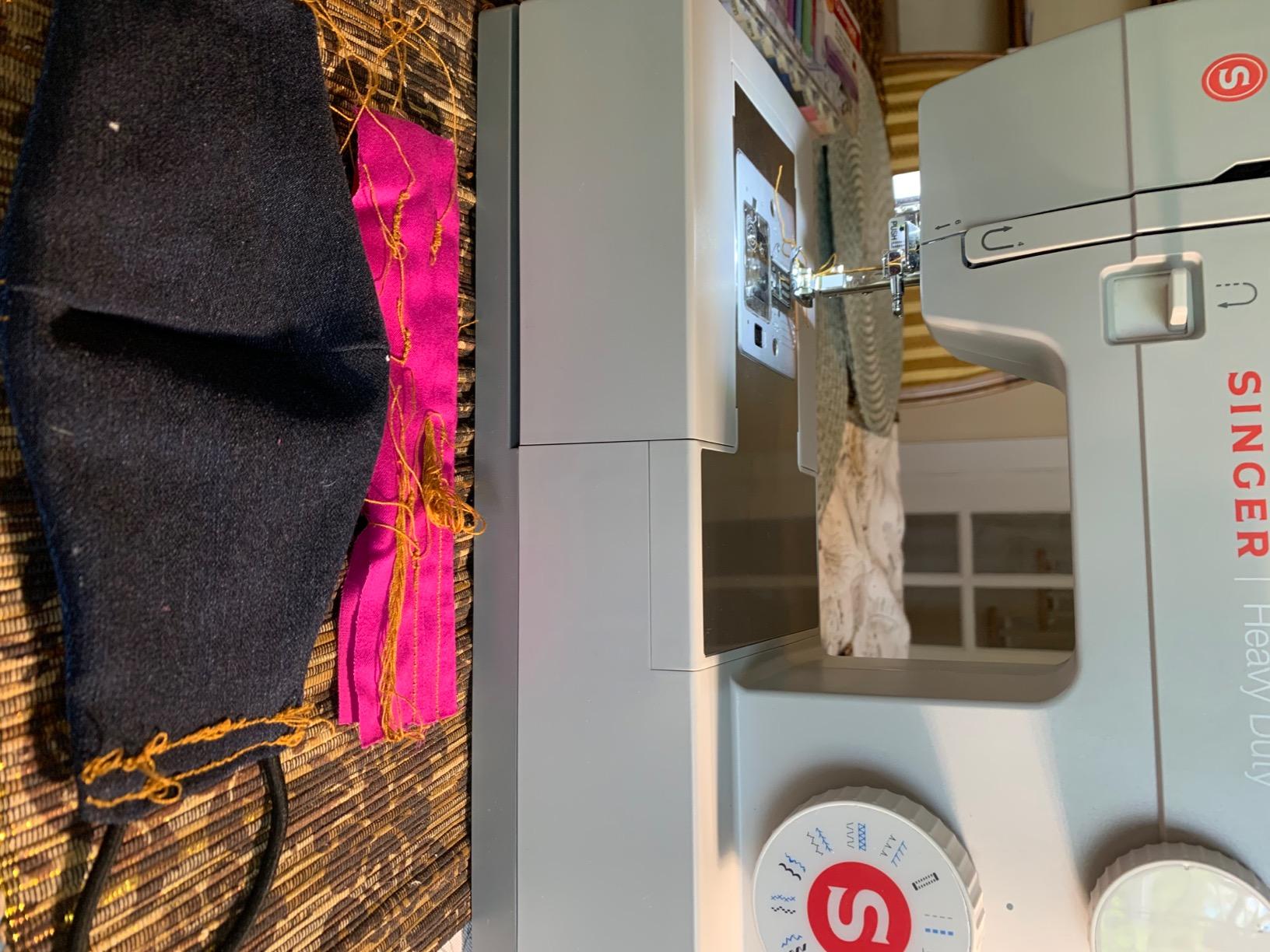
Owners report it tracking straight even when sewing close to the fabric edge, which is exactly what cushion and outdoor-cushion projects need. The bundle includes all-purpose, buttonhole, zipper and blind hem feet, an edge and quilting guide, three needles, four Class 15 bobbins and a seam ripper with lint brush.
Two cautions. The one-year manufacturer warranty is the shortest of the group, which sits oddly against the heavy-duty positioning, and a small number of buyers report the machine stopping sewing within a couple of months. Some owners also feel the heavy-duty label oversells what it does on genuinely heavy fabric, so manage expectations accordingly.
Who should buy the SINGER 4523
Buy this if you sew upholstery, cushions, outdoor gear or heavy cotton, or if you do a lot of curved work where the speed control dial earns its place. Drop feed also makes it useful for free-motion quilting without buying a separate feed foot.
It is also a reasonable pick if you want the 4423’s stitch set with a modern motor and adjustable foot pressure but at a lower weight class.
Who should skip the SINGER 4523
Skip it if you want long-term warranty peace of mind, because one year is thin for a machine you expect to keep for a decade. Also skip it if you sew delicate fabrics where a heavy machine’s power is more than you need, or if noise and vibration in your shared space is a real concern.
10. Janome HD 3000 BE – Best Heavy-Duty Specialist
Janome HD 3000 BE Black Edition with Exclusive Bonus Bundle
Heavy-duty metal construction
Metal internal frame
Free-arm capable
18.7 pounds
Pros
- Most substantial build in the roundup
- Metal frame and component reputation
- Handles denim
- canvas and bulky layers
- Forgiving compared with plastic-framed models
- Black edition suits a dedicated sewing space
Cons
- Smallest review base at 332 reviews
- 4.4 average with 8 percent one-star
- 18.7 pounds makes it the least portable
- Bonus bundle contents are less clear
- Fewer reviews means harder troubleshooting
The HD 3000 BE is the heaviest machine in this roundup at 18.7 pounds, and that weight is the feature. It stays planted while you sew denim, canvas and bulky multi-layer work, where lighter machines walk across the table and struggle to keep the fabric moving evenly. The metal internal frame and Janome’s component reputation are why.
Operation is fully mechanical with dial-controlled stitch selection and free-arm capability, so there is no electronics to fail. It is sold with an exclusive bonus bundle, and Janome warranty coverage on this model class runs 25 years on mechanical parts with 2 years on electrical parts.
Owner reports describe it as forgiving of heavy work compared with plastic-framed budget models, and the black edition finish suits a dedicated sewing room. If you have moved past a plastic-bodied machine and found it flexing and skipping, the difference in feel is immediate.
The evidence here is thinner than anywhere else in the list. With 332 reviews and an 8 percent one-star share, the 4.4 average is a real satisfaction score on a small sample. Reviewers note that fewer online reviews makes troubleshooting and parts sourcing harder, and the bonus-bundle format means accessory contents are less clearly listed than on other models.
Who should buy the Janome HD 3000 BE
Buy this if your work is consistently heavy fabric and you have a permanent table to put it on. The stability and frame mass are the whole argument, and owners moving up from lighter machines report the difference as immediate.
It is also a good choice for anyone who wants mechanical simplicity with the durability expectations of a machine that can be serviced for decades.
Who should skip the Janome HD 3000 BE
Skip it if you need to move the machine, carry it to a class or store it away, because at 18.7 pounds it is not portable by any honest definition. Also skip it if you want an automatic needle threader, a screen or one-step buttonholes, because this is a dial machine without those assists.
How to Choose a Sewing Machine Under 500
Every machine above is a legitimate buy, so the decision comes down to machine type first, then the three or four features you will touch on every single stitch. Here is how we would think about it if we were starting over.
Mechanical, electronic or computerized: pick one type
A mechanical machine uses dials to set stitch length and width, and everything else is mechanical. An electronic machine adds automatic tension, a needle threader and speed control. A computerized machine adds an LCD screen for stitch selection. Within this price band, electronic and computerized models are where the convenience lives, and a 27-stitch machine with a good threader will outlast a 185-stitch machine with a bad bobbin system.
Stitch count matters less than feeding and threading
The 185 stitches in the HC1850 include 55 alphanumeric designs you may never touch, while the 6 stitches in the M1500 cover the jobs most people actually do. What changes your daily experience is the feed dog quality, the presser foot pressure and whether the machine threads itself. Judge a machine on the 7-piece feed dog in the JW8100 or the drop feed and adjustable foot pressure in the 4523, not on the headline number.
The bobbin system decides your supply costs later
Drop-in top bobbin systems, found on the Brother machines and the Janome JW8100, are faster to change. Front-loading systems like the Janome 2212 are easier to clear when thread jams. The real cost question is proprietary versus standard, and standard Class 15 bobbins, used by the Janome and Bernette machines here, keep your supply bill flat indefinitely.
Throat space and the real quilting ceiling
Throat space is the distance from the needle to the right-hand column, and it is the single most important number for quilting. Every machine under 500 dollars has a throat that will eventually feel tight, and every owner review in this roundup mentions the ceiling. Plan on table runners, throws and small quilts, and treat a larger machine as a later purchase rather than a disappointment today.
What you give up below the 500 mark
You are buying without an automatic thread cutter on most models, without a knee lifter, without adjustable foot pressure on the computerized machines, and without the 9mm stitch width that heavy-duty fabrics want. You also rarely get a walking foot in the box, though the XR3774 and the JW8100 both include one. What you keep is a metal frame, a working needle threader, a drop-in bobbin and a machine that can be serviced.
How to split the budget between machine and supplies
Resist spending the entire cap on the machine. Budget separately for a pack of needles in the sizes you will actually use, good all-purpose thread, sharp shears, pins, a seam ripper, an iron and a proper task lamp. A dim work light is the most common complaint in the reviews of the Brother models, and a lamp costs less than any machine upgrade. That way a lower-priced pick leaves room for the tools that make sewing pleasant. The same budgeting logic applies to the rest of the workshop, whether you are setting up a soundbar under 500 dollars for the sewing room or an espresso machine under 500 dollars for the break you actually deserve between projects.
Used dealer-line machine or new budget machine
A serviced used machine from a dealer can be a better long-term buy than a new plastic-bodied one, because dealers stand behind their servicing and parts last longer. The risk forum readers raise most is inheriting a machine that needs immediate expensive work, so have it checked before you commit and confirm that parts and bobbins for the model are still available. If parts sourcing is difficult, the advantage disappears, which is why the Bernette’s accessory availability is a real caution despite its build quality. Our automatic watches under 500 dollars guide applies the same value-first method to a different kind of long-term purchase.
Frequently Asked Questions
What is the best sewing machine under $500?
The Brother XM2701 is the best overall pick in this price range, because its automatic needle threader, jam-resistant drop-in bobbin and 27 built-in stitches remove the two steps beginners struggle with most. For heavy fabric specifically, the Singer 4423 is the stronger choice, and the Janome JW8100 wins on features with its LCD screen, 7-piece feed dog and standard Class 15 bobbins.
What is the best sewing machine at a reasonable price?
At this budget, reasonable means a metal interior frame, a working automatic needle threader, a drop-in or easy front-loading bobbin, and a feed dog that moves fabric evenly. The Singer 4423 and the Janome 2212 both have metal frames and long mechanical parts warranties, while the Brother XM2701 and XR3774 cover the beginner-friendly computerized and mechanical basics. Stitch count is the least important specification at this level.
What is the best sewing machine for a good price?
Value here comes from what ships in the box, not from the sticker. The Brother XR3774 includes 8 presser feet, a removable wide extension table and a darning plate, while the Janome JW8100 adds an even feed foot, a quarter inch quilting foot, a hard cover and 22 accessories. Included feet and tables often save more than the price difference between two machines.
What is the best and most affordable sewing machine for home use?
For home mending, hems and simple garments, the Brother XM2701 is the most affordable option that still threads itself and uses a drop-in bobbin. If your home projects include curtains, denim or heavy cotton, step up to the Singer 4523 or the Janome 2212, both of which have metal frames and stronger motors. The SINGER M1500 is the cheapest and lightest, but it is not built for thick layers.
Can a sewing machine under $500 handle quilting?
Yes, for table runners, throws and small quilts, as long as you plan around throat space. The Janome JW8100 and Brother HC1850 ship with wide extension tables, and the JW8100 includes an even feed foot and a 7-piece feed dog. Owner reports across this list repeatedly note that large multi-layer quilts hit the ceiling of throat space and motor power, which is the normal upgrade point rather than a fault.
What is the most reliable sewing machine brand?
Reliability in this price band tracks the mechanical brand more than the model. Janome offers 25-year limited warranties on mechanical parts across both the 2212 and the HD 3000 BE, and its community reputation for serviceability is strong. Brother pairs lifetime technical support with tiered warranty coverage, and SINGER’s metal-frame models are the ones owners report outlasting plastic-bodied rivals. Always confirm that parts and bobbins for the specific model are still available before buying.
Our Final Verdict for 2026
After reading the specifications and several thousand owner reports, the best sewing machines under 500 dollars come down to three machines for most people. The Brother XM2701 is the pick if you are starting from zero, because it makes threading and bobbin changes disappear and the reports of fast, confident first projects are overwhelming. The Singer 4423 is the pick the day your projects get thick, and its metal frame is why it keeps going. The Janome JW8100 is the pick if you want one machine to cover garments, decor and small quilts without buying a second.
Everything else here is a specialist worth knowing: the XR3774 for bundled quilting tools, the HC1850 for a computerized step-up with a screen, the M1500 for portability, the Bernette B35 for knits and mechanical longevity, the Janome 2212 for indestructible dial simplicity, the Singer 4523 for upholstery, and the Janome HD 3000 BE for maximum heavy-fabric stability.
Pick the one that matches the fabric you actually plan to sew, spend some of what you saved on needles, thread and a good lamp, and check the price button below before you commit. Sewing machine pricing shifts frequently in this band, so the current figure is always the one that matters.